 2016, Vol.36


② 甘肃省西部矿产资源重点实验室, 兰州 730000;
③ 中国地质科学院地质力学研究所, 北京 100081)
中国黄土-古土壤序列是世界上最为连续的陆相沉积物之一,而磁性地层的研究有效确立了其年代框架。黄土-古土壤序列不仅记录了2.6Ma以来地磁场倒转的信息,还保存了丰富的古气候变化和地磁场变化的信息[1~8]。尽管黄土的磁性地层学研究成为确定黄土-古土壤序列年代框架的最有效手段之一,然而对于黄土剩磁记录的可靠性和准确度还存在着较大争议[9~13]。例如,松山/布容地磁极性转换界限(Matuyama-Brunhes Boundary,简称MBB)的轨道调谐年龄为0.78Ma[14],在我国黄土-古土壤序列中记录的位置介于黄土L8到古土壤S7或S8之间[1, 4, 9],该差异使得黄土-古土壤序列剩磁记录与气候记录相比深海沉积物是否存在显著滞后这一问题一直为近20多年来黄土磁学研究的重点[11~13, 15~24];另外,布容正极性期内地磁漂移在不同区域的黄土剖面上并不完全被记录,也引发了对黄土剩磁记录的可靠性的讨论[25~29]。
“上粉砂层”黄土L9在松山倒转极性期内沉积[30],早期在九州台[31~33]、蓝田[34]、渭南[35]等多个剖面的古地磁学研究中发现,L9中记录了厚度不一的正极性段落,并被称为蓝田正极性亚带[34]或后期贾拉米洛事件(post-Jaramillo event)[31~33, 35];之后,Yang等[36]在宝鸡黄土层L9中发现2个短期极性事件,据沉积速率推算,认为两个极性事件分别代表了Kamikatsura和Santa Rosa地磁漂移[37~40];汪道京等[41]对宋家店黄土剖面的研究认为,L9重磁化的可能性较小,而将这些极性异常解释为地磁漂移更为合理;刘维明等[42]在对洛川经典黄土剖面的研究中认为,L9记录的厚度达6.4m的正极性段落代表的时间尺度达6万年之久,很难解释为地磁漂移;王喜生等[43~45]对河南陕县曹村剖面、甘肃会宁草滩剖面的研究则认为,L9记录的正极性段落是由岩性所控制的重磁化现象而非地磁漂移的记录;而Jin和Liu[46]、Chen等[47]在对洛川及甘肃古浪剖面进行了详细的古地磁学研究,提出L9中多个正极性段落是弱地磁场强度条件下多畴(Multi-domain,简称MD)磁性矿物颗粒中次生粘滞剩磁(Viscous Remanent Magnetization,简称VRM)主导天然剩磁(Natural Remanent Magnetization,简称NRM)的结果。由于中国黄土沉积层分布广,地层产出稳定,L9作为地层划分的标志层得到地层学家的广泛认可,然而对该段地层记录的正极性特征究竟是地磁漂移还是重磁化的问题上存在较大的争议,在很大程度上影响了中国黄土古地磁记录可靠性的解释。为了厘清L9黄土地层中古地磁记录的可靠性,在不同剖面上开展更深入的研究工作就显得十分必要。
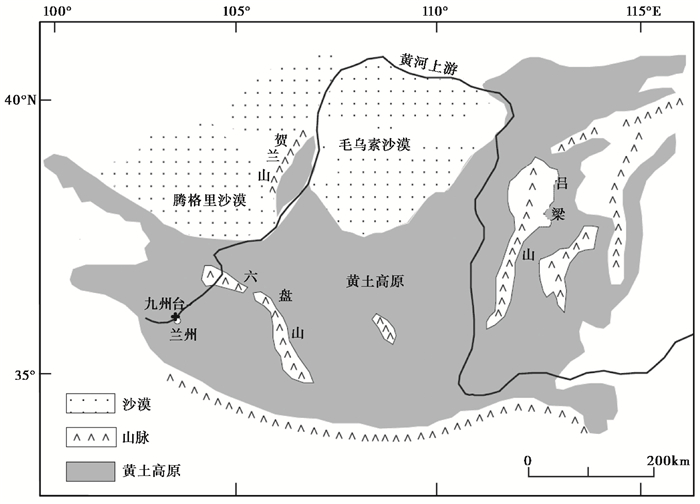
兰州地区地处黄土高原西部边缘(图 1),是青藏高原、黄土高原和西北荒漠区的交接地带。九州台黄土剖面(36.09°N,103.79°E)位于甘肃省兰州市九州台,为我国出露最厚的黄土剖面之一,在21m厚的冲积黄土之上堆积的风成黄土-古土壤序列厚度达到近300m,其中“上粉砂层” L9厚度约25m,早期研究已报道L9中记录有5~7m的一段正极性[31~33]。该剖面黄土沉积速率高,受土壤化作用影响较小,因此对该剖面L9进行详细的古地磁学研究可为解决L9古地磁记录可靠与否的问题提供有力的证据。鉴于此,本文对九州台黄土L9及相邻层位黄土-古土壤序列开展了详细的古地磁学及岩石磁学研究,对L9记录的剩磁特征和剩磁记录机制进行了深入的探讨。
|
图 1 九州台黄土剖面地理位置图 Fig. 1 Geographic location of the Jiuzhoutai loess section |
根据前人在九州台黄土剖面的磁性地层工作成果[31~33],我们把研究目标定在海拔1830m到1916m之间黄土层L6~L10。在九州创城有限公司新近开挖剖面的基础上,以30~50cm间隔进行了水平定向古地磁样品的采集,剖面总厚度86m,共获得190块标本,每块标本后期实验室加工为2cm×2cm×2cm大小平行样品2块。
粒度分析采用Malven Mastersizer 2000完成,样品前处理流程依据孙东怀等[46]。样品的磁化率(χ)、磁化率各向异性(Anisotropy of Magnetic Susceptibility,简称AMS)分别由Bartington-MS2磁化率仪和KLY-3s旋转卡帕桥来进行。两组平行样品分别进行交变退磁(Alternating Field Demagnetization,简称AFD)和热退磁(Thermal Demagnetization,简称ThD)测试。交变退磁采用2G-755R岩石超导磁力仪,以5~20mT的间隔退到80mT,部分样品退磁到100mT;热退磁采用MMTD80热退磁仪,以30~50℃间隔加热到590℃,部分样品继续以30℃间隔继续加热到680℃。以上所有实验均在兰州大学西部环境教育部重点实验室完成。粉末状样品及部分样品磁性矿物颗粒提取物(采用强磁铁在全样分散水溶液中提取)的磁滞回线由振动磁力仪(VSM the ADE Model EV9 system)测试,在兰州大学磁学教育部重点实验室内完成。
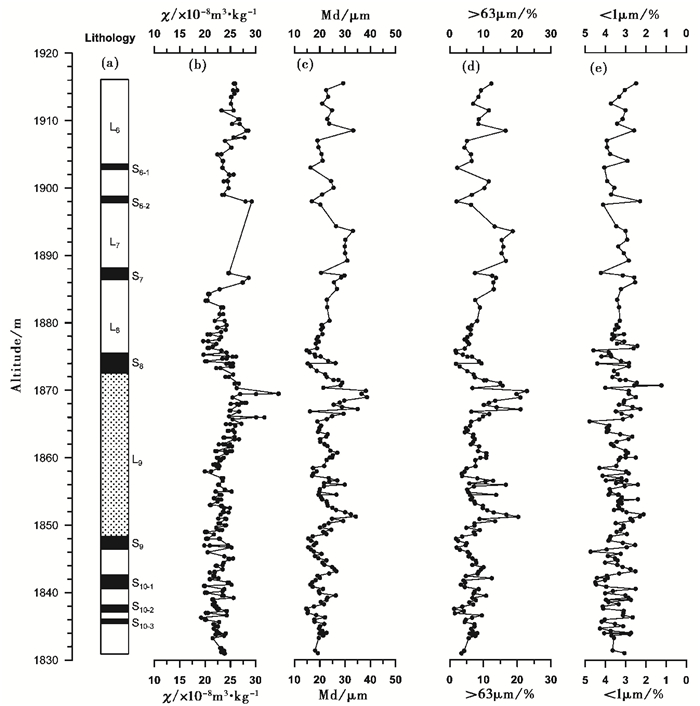
3 实验结果 3.1 粒度和磁化率九州台采样剖面黄土层酥松,颜色较浅呈灰白色;而古土壤层则致密坚硬,颜色较深,呈浅棕色。本文主要根据剖面黄土层质地和颜色,同时也结合前人在九州台剖面的研究成果[31~33]来进行黄土古土壤地层划分,地层划分结果如图 2a所示。从剖面粒度参数和磁化率随海拔高度的变化(图 2b~2e)可以看出,黄土层位L6~L10与中值粒径的峰值、>63μm颗粒体积百分比峰值及 & 1μm颗粒体积百分比谷值有着良好的对应关系。古土壤层位则恰好相反,结果表明该剖面黄土粒度可以很好的反映冬季风强度的大小[46, 47]。而“上粉砂层” L9的中值粒径峰值高达40μm,该峰值位于L9上部,另外其下还有两个稍低的峰值(图 2c),该结果与洛川[46]、古浪[47]、平凉[49]、宝鸡[49]、西津[50]等黄土剖面所报道的L9粒度变化趋势大体一致,而九州台剖面前期研究报道[51]中黄土层L9中值粒径随深度变化则呈现较多相近大小的峰值,可能是本次研究样品间距过大的原因。
|
图 2 九州台剖面磁化率和粒度随海拔高度变化图(a)黄土地层岩性划分,(b)磁化率,(c)中值粒径(Md),(d)>63μm颗粒粒度百分比,(e) & 1μm颗粒体积百分比 Fig. 2 Variation of magnetic susceptibility and grain size parameters with altitude in Jiuzhoutai loess section. (a)Lithology, (b)magnetic susceptibility, (c)Md(median grain size), (d)volume percentage of grains larger than 63μm, and (e)volume percentage of grains smaller than 1μm |
值得注意的是,该段地层(L6~L10)的磁化率与粒度呈正相关,粒度较大的黄土反而具有较古土壤更大的磁化率,表明该剖面黄土磁化率特征与阿拉斯加黄土类似[52, 53],主要由原始碎屑磁性矿物颗粒输入通量所控制[54~56];而九州台剖面上部黄土-古土壤序列L1/S1到L5/S5则显示磁化率与粒度呈负相关[51, 57],与黄土高原大多数地区古土壤磁化率增强特征一致,主要有成壤作用形成的细粒磁性矿物颗粒含量所控制[58~62]。
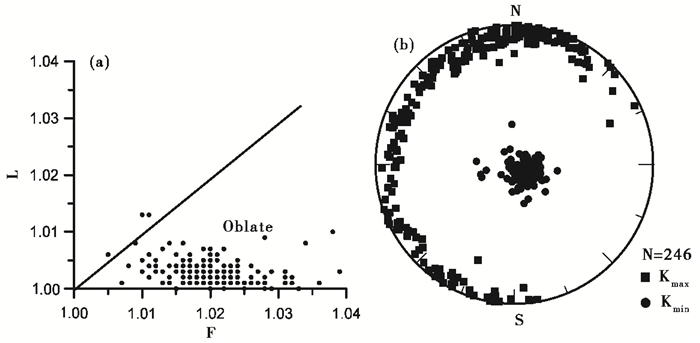
3.2 磁化率各向异性九州台剖面样品磁化率各向异性参数面理值F较线理值L大,显示磁组构基本为扁平状(图 3),磁化率最小轴Kmin大致与水平面垂直,而磁化率最大轴Kmax则基本在水平分布,各向异性度P值在1.01~1.04之间,为典型的原生风成黄土磁组构[63],无后期次生改造。Kmin偏角多偏向在东南方向,而Kmax轴偏角则基本在东南方向没有分布,这可能是由于在较强劲的东北向冬季风作用下,磁性矿物颗粒定向排列所造成的[64, 65]。
|
图 3 九州台剖面样品磁组构结果图(a)为线理值L与面理值F对应图,(b)Kmax与Kmin两轴的赤平投影图 Fig. 3 Anisotropy of magnetic susceptibility of Jiuzhoutai loess samples. (a)Lineation parameter L vs foliation parameter F; (b)Stereographic projection of the Kmax and Kmin axis |
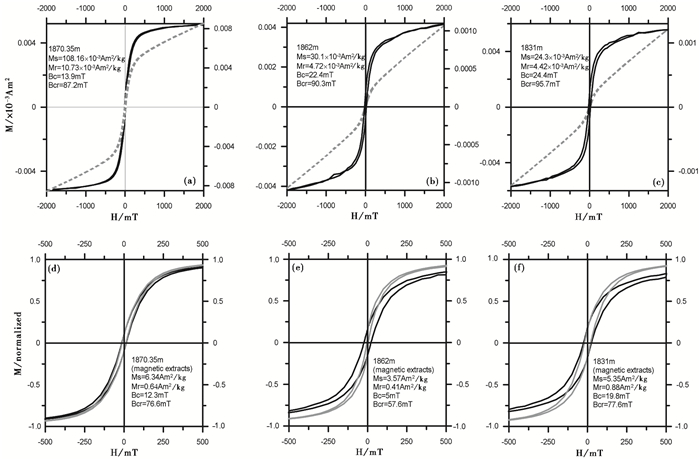
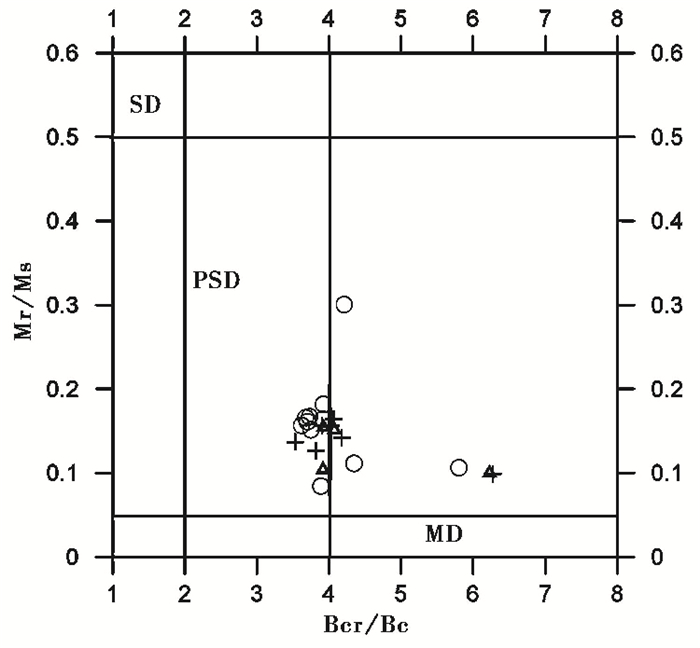
粉末状全样及部分磁性矿物颗粒提取物的磁滞回线参数包括饱和磁化强度(Ms)、饱和剩磁(Mr)、矫顽力(Bc)和剩磁矫顽力(Bcr)都是在经过顺磁组分校正后计算[66]得出。典型样品的磁滞回线如图 4所示,全样的磁滞回线在500~1000mT强度下闭合,而磁性矿物颗粒提取物的磁滞回线通常在250mT以上闭合;个别磁性矿物颗粒提取样品的磁滞回线呈现蜂腰形状,表明高矫顽力和低矫顽力组分的混合[67]。磁滞回线参数比值(Mr/Ms、Bcr/Bc)在Day图[68, 69]中投图如图 5,样品磁性矿物颗粒集中在假单畴(Pseudo-single-domain,简称PSD)区间,并向多畴(MD)区间过渡。其中L9黄土层样品Mr/Ms比值普遍较低,而Bcr/Bc比值则比较分散。
|
图 4 九州台剖面不同海拔高度黄土样品磁滞回线示意图其中深灰点曲线为全样磁滞回线,黑色曲线为500mT以上顺磁部分贡献校正后的曲线,浅灰色曲线为磁性矿物颗粒提取物的磁滞回线 Fig. 4 Characteristic hysteresis loops of Jiuzhoutai loess samples and their extracts at different altitude. Dark grey dot:bulk samples; Black:after corrected for paramagnetic contribution above 500mT; Light grey:magnetic extractions |
|
图 5 部分样品磁滞回线参数在Day图上的投影其中空心圆圈为全样样品,三角为磁性矿物颗粒提取物,十字为黄土L9层位样品 Fig. 5 Day-plot of some loess samples. Open circle:bulk samples; Triangle:magnetic extracts; Cross:L9 bulk samples |
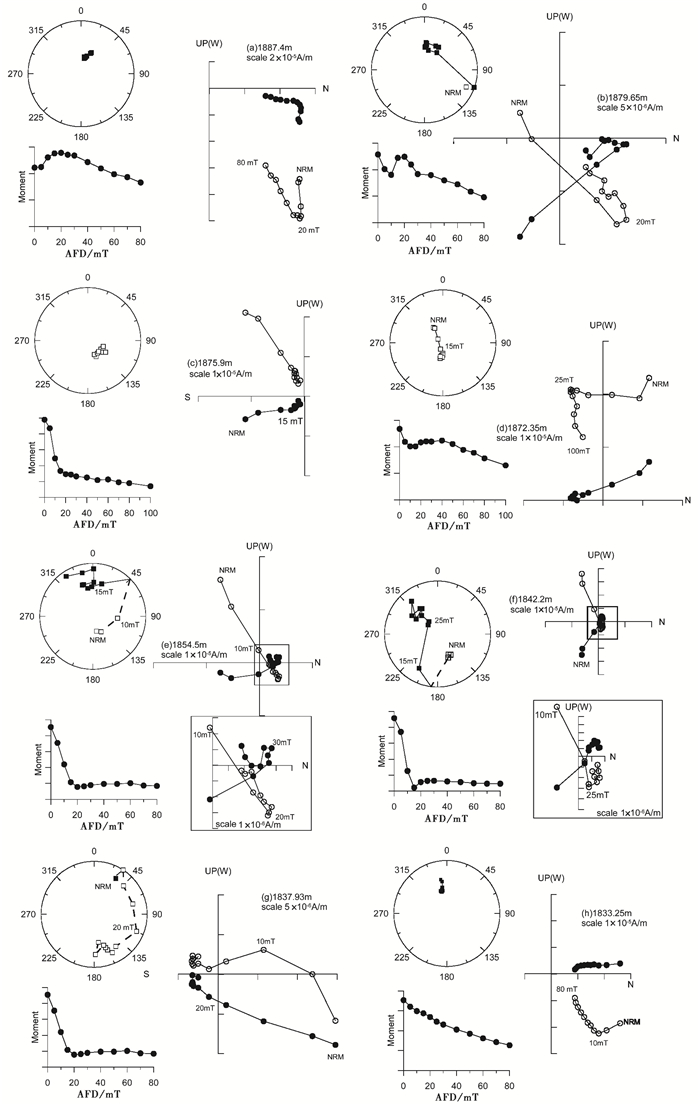
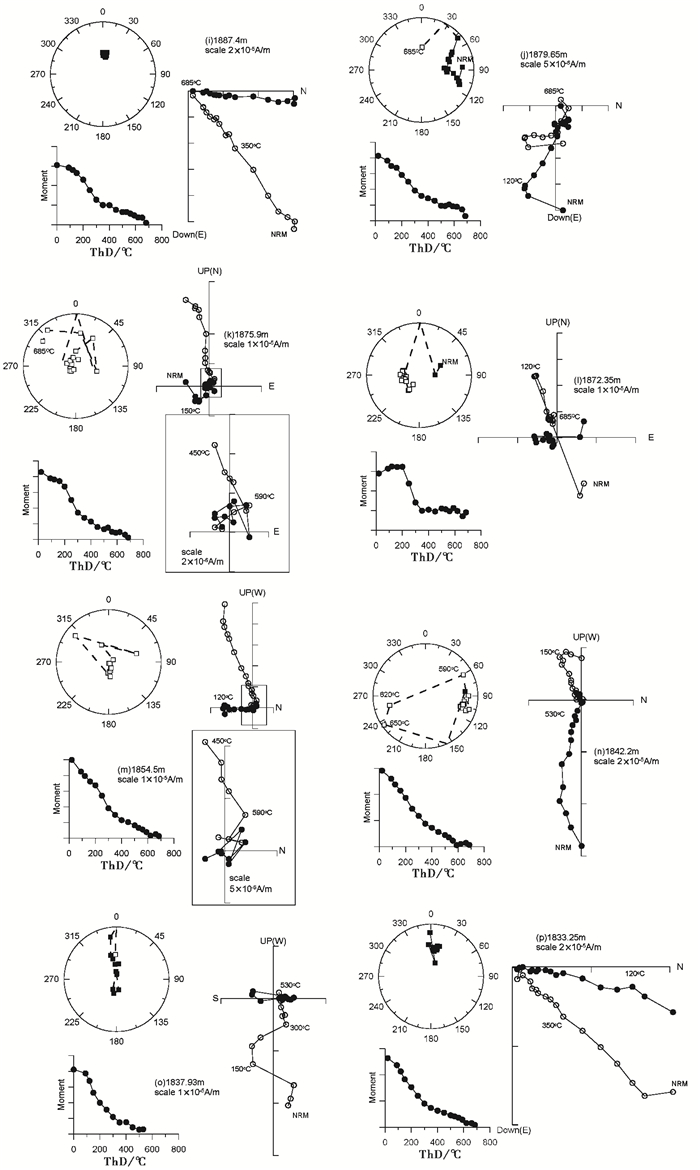
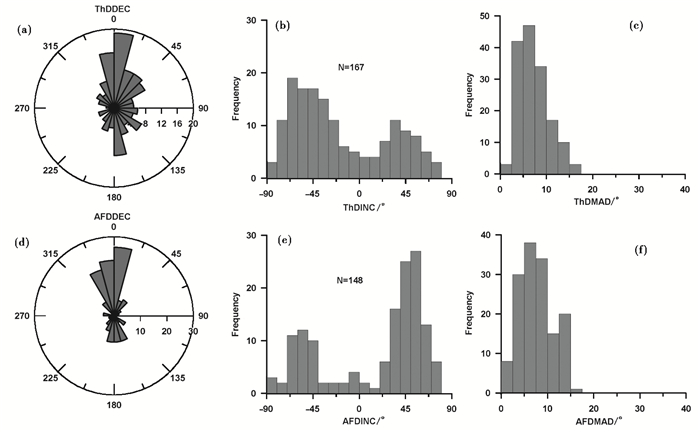
代表性样品的退磁结果由图 6表示。在正交矢量投影图上,样品显示1~2个剩磁分量。交变退磁中的第一个剩磁分量通常在15~20mT时被完全清洗,而热退磁中第一个分量剩磁分量则通常在150~200℃时被清除干净。第一个剩磁分量不趋向于原点,一般认为是次生的VRM分量。特征剩磁(Characteristic Remanent Magnetization,简称ChRM)由20mT和200℃以上靠近原点至少4个数据点获得[70]。交变退磁(AFD)和热退磁(ThD)特征剩磁的磁偏角(Declination,简称DEC)、磁倾角(Inclination,简称INC)及最大角偏差(Maximum Angular Deviation,简称MAD)分布区间的统计结果如图 7。结果表明交变退磁与热退磁结果差异较大。热退磁中所获取ChRM虽然多数(60%)为正极性或反极性,但其磁偏角与磁倾角方向比较分散(图 7a和7b),其中很大一部分样品(>30%)为不匹配的磁偏角与磁倾角,即正的磁偏角对应负的磁倾角或负的磁偏角对应正的磁偏角,还有约12%样品在加热到200℃以上后方向变得杂乱,无法获得可靠的ChRM(最大角偏差MAD>15°,见图 7c)。交变退磁所获取的ChRM磁偏角与磁倾角相对集中在正极性或反极性两个部分(图 7d和7e),但是也有部分样品(8%)为不匹配的磁偏角与磁倾角,还有较大一部分样品(16%)的剩磁强度在退磁过程中衰减很快,20mT以上方向杂乱,无法获得可靠的特征剩磁(MAD>15°,见图 7f)。值得注意的是交变退磁过程中有部分样品显示样品剩磁由反极性转变为正极性,即低矫顽力分量(次生VRM)为反极性,如图 6b、6e和6f所示,这与通常认为黄土样品NRM中的布容期正极性VRM结果[46, 47]存在差异。
|
图 6 典型的样品交变退磁结果左上为等面积赤平投影图(实心方框磁倾角为正,空心方框磁倾角为负),左下为剩磁强度衰减曲线;右为正交矢量投影图(实心圆点水平面投影,空心圆点竖直平面投影) (a,b,h)典型正极性特征剩磁样品;(c,d)典型反极性特征剩磁样品;(e,f,g)退磁曲线显示剩磁分量发生反转,但特征剩磁最大角偏差MAD>10° Fig. 6 Characteristic alternating field demagnetization results of Jiuzhoutai loess samples. Up-left: equal-area projections with open square indicating upward inclination and solid square indicating downward inclination; Down-left:Remanent magnetization decay curve with demagnetization steps; Right: vector component diagram with solid points representing vector end points projected on to horizontal plane and open points representing vector end points projected on to a north-south or east-west oriented vertical plane. (a, b, h)Typical normal polarity samples: (c, d)Typical reversed polarity samples: (e, f, g)Vector component diagram indicating two opposite components, MAD of ChRM directions larger than 10° |
|
图 6(续) 对应平行样品的热退磁结果 Fig. 6(续) Continued, but thermal demagnetization behavior of corresponding parallel loess samples |
|
图 7 热退磁与交变退磁方法获取的特征剩磁方向磁偏角DEC(a,d)、磁倾角INC(b,e)和最大角偏差MAD(c,f)分布区间统计图 Fig. 7 Statistical distribution of ChRM directions and their MAD obtained by both ThD and AFD. (a, d)Rose diagram of ChRM declinations: (b, e)Histogram of ChRM inclinations obtained from THD and AFD respectively: (c, f) Histogram of the MAD of ThD and AFD ChRM directions |
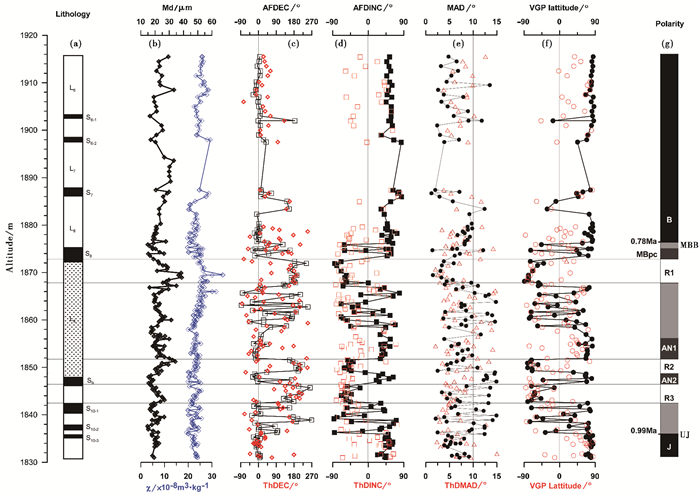
图 8显示了研究剖面地层中值粒径与磁化率、交变退磁及热退磁特征剩磁方向、VGP纬度随海拔高度的变化特征及所对应的极性柱划分(只显示MAD & 15°数据点)。采用交变退磁结果来看,松山/布容极性转换界限(MBB)出现在L8底部(图 8),而贾拉米洛正极性亚时顶界Upper Jaramillo(UJ)出现在剖面底部S10中,未见贾拉米洛正极性亚时底界。布容正极性期与贾拉米洛正极性亚时中间出现3段较稳定的反极性R1、R2和R3(MAD & 10°),以及两段的正极性段AN1与AN2,其中AN2可信度较差(MAD>10°);除此之外,还有多个可性度较差(MAD>10°)的极性频繁跳跃段落。
|
图 8 兰州九州台(a)地层、(b)中值粒径(实心)与磁化率(空心)、(c)交变退磁(方形)与热退磁(棱形)ChRM磁偏角、(d)交变退磁(实心)与热退磁(空心)ChRM磁倾角、(e)交变退磁(实心点)与热退磁(三角形)方法获取ChRM方向的MAD、(f)分别根据交变退磁(实心)与热退磁(空心)ChRM计算的虚地磁极VGP纬度,以及所对应的(g)极性柱(稳定正极性黑色,稳定反极性白色,不稳定正极性段深灰色,极性频繁跳跃段浅灰色),其中布容正极性期(B)底部界限MBB年龄和贾拉米洛正极性亚时(J)的顶界(UJ)分别采用轨道调谐年龄0.78Ma和0.99Ma[14] Fig. 8 Magnetostratigraphy of Jiuzhoutai loess section. (a)Lithology; (b)Median grain size(solid) and magnetic susceptibility(open), (c)ChRM declinations obtained by AFD(square) and ThD(diamond); (d)ChRM inclinations obtained by AFD(solid) and ThD(open); (e)MAD of ChRM directions obtained by both AFD(solid circle) and ThD(triangle); (f)VGP latitudes obtained by AFD(solid) and ThD(open), and (g)corresponding polarity zonation with astronomically calibrated ages of MBB and UJ[14](black: normal polarity; white: reversed polarity; dark grey: unstable normal polarity; light grey: high-frequent polarity oscillation) |
本次研究中我们发现在九州台剖面中黄土样品的磁化率与粒度呈良好的正相关关系,颗粒较粗的黄土相比古土壤有着更高的磁化率,同时该剖面细颗粒组分( & 1μm)成分体积百分比小于5 % (图 2),频率磁化率百分数普遍小于5 % [45],说明该区域黄土-古土壤受到成壤作用的影响非常小,剖面磁性矿物颗粒以碎屑来源的粗粒磁铁矿(PSD-MD)为主,与Day图(图 5)结果一致。
黄土高原中部及东南部黄土-古土壤序列的磁化率特征通常表现为古土壤层磁化率高于黄土层,其中古土壤磁化率增高主要是由于成壤作用产生较多细小亚铁磁性颗粒所引起[58~62];然而在黄土高原西北边缘的很多剖面,如草滩[17]、九州台[45]、古浪[47]、沙湾[54]、尼勒克[56]均有报道本次研究中所出现的黄土磁化率与粒度正相关的现象。这种磁化率的变化特征与阿拉斯加黄土类似[52, 53],磁化率增高主要是由于近源黄土中由于较强的风力分选作用,颗粒较大磁化率较高的假单畴至多畴内的磁性矿物颗粒含量增多[45, 52~56]。这两种磁化率增强的机制随离黄土源区的远近,成壤作用的影响可能同时存在并相互竞争,如九州台[51, 57]和草滩剖面[17, 45]中磁化率和粒度既出现正相关关系也出现负相关关系,表明磁化率同一剖面不同时段受到不同程度气候及源区等多种因素的控制。因此,利用磁化率参数进行黄土-古土壤地层的对比划分及古气候重建时应十分谨慎。
4.2 松山/布容极性倒转界限位置根据交变退磁所得ChRM方向(图 8c和8d)及虚地磁极纬度(Virtual Geomagnetic Pole,简称VGP)纬度(图 8f)随剖面高度的变化可以看出,MBB位于L8底部靠近S8的位置,其下部显示有约1.5m左右的松山布容极性转换带(Matuyama/Brunhes Transition,简称MBT)和3.5m左右的松山布容极性倒转前驱事件(Matuyama/Brunhes reversal precursor,简称MBpc)(图 8g)。根据热退磁特征剩磁方向所计算的VGP纬度(图 8f)在交变退磁结果所得MBB界限之上约5m内仍显示为较低值,可能指示MBB位于L8上部。由此可见,退磁方法直接影响磁极性序列的划分。Chen等[47]在古浪黄土剖面的研究中发现交变退磁相比热退磁能较好地清除VRM,而本次研究中交变退磁方法所获取的ChRM磁偏角(图 7d)和磁倾角(图 7e)都较热退磁所得到的ChRM方向(图 7a和7b)集中,因此极性柱的划分(图 8g)采用了交变退磁的结果。MBB位置在九州台剖面中位于L8底部接近S8的位置,MBpc则出现在S8中,该结果与洛川[13, 15, 16, 42]、靖边[71]、三门峡[43, 44]等剖面MBB出现的位置基本一致。但是九州台MBT(1.5m)及MBpc(3.5m)的厚度均较黄土高原中部及东南部的很多剖面大[9, 13],例如在洛川[13, 16]、渭南[72]、灵台[73]、段家坡[18]、三门峡[43, 44]、宝鸡[74]等剖面中的研究中布容松山极性转换带记录只有30~70cm、而MBpc在洛川剖面中的记录则约为50cm[16];由于黄土高原西部九州台剖面黄土沉积速率较高[31~33, 50],MBT(1.5m)和MBpc(3.5m)在九州台剖面中的记录因此相应较厚(L9在兰州九州台剖面厚度25m[31~33],在洛川厚7m[13, 16])。Wang等[17, 45]研究中指出九州台的布容松山极性转换带长达7m,MBpc记录约为2m。造成该结果差异可能是由于本次研究中的采样间距30~50cm偏大、分辨率较低的原因。
部分研究[9, 15, 23, 24]将黄土层L8与其底部古土壤层S8分别对应深海氧同位素阶段(Marine Isotope Stage)MIS18和MIS19,认为黄土-古土壤序列中的剩磁锁定深度很小(低于20cm),而黄土的重沉积实验[75, 76]也证实在黄土中记录的剩磁并不存在显著的滞后。深海沉积物的研究表明其中MBB记录的位置位于深海氧同位素阶段MIS19末期靠近MIS18[77, 78],因此MBB的轨道调谐年龄应调整为0.77Ma[79]。该年龄也与Suganuma等[80]通过深海火山灰沉积中锆石的U-Pb年龄所估算的结果一致,与多人报道相对地磁场强度谷值[9, 15, 81]及10Be峰值[77, 78, 82]对应较好。由此可见,经调整后的MBB(0.77Ma)位于位置应记录在古土壤S8的顶部靠近L8的位置,而九州台剖面中MBB出现在L8底部,可能是由于区域性气候的差异,在MIS19末期,九州台地区气候已经变得干冷,古土壤S8停止发育,黄土L8已经开始堆积[11, 23]。
4.3 黄土L9的极性特征九州台剖面MBB以下出现了频繁的极性跳跃,如图 8所示。底部较稳定的正极性顶部出现在S10中,我们因此推断,该段地层S10中开始出现未见底的正极性段为贾拉米洛正极性亚时。该结果与早期研究报道的九州台剖面[31~33]以及兰州西津剖面[50]、蓝田[34]、宋家店[41]、洛川[42]和三门峡[43, 44]等剖面中的研究一致,它们的UJ均记录在S10中;而在靖边[2, 71]、西峰[2, 74]、宝鸡[2, 74]和渭南[29, 72]等剖面中UJ则记录在L10中。我们认为UJ在黄土古土壤序列中记录位置(L10或S10)存在差异与MBB在黄土古土壤序列中记录位置(L8或S8)存在差异的原因一样,可能是由于黄土高原上黄土-古土壤发育存在区域性的差异[11, 23]。另外L9~L15之间发育的古土壤层较多,划分比较混乱[2],也可能导致上述不同剖面所报道的UJ位置不一致的情况。
在MBB和UJ之间频繁的极性跳跃中可以发现3段较稳定的反极性段(如图 8g),样品交变退磁结果主向量分析中MAD值均小于10°。这部分黄土样品粒度较粗,天然剩磁强度较大,退磁结果显示有较好的正反极性两个分量,如图 6d和6i。这些反极性段中间还间隔有两段正极性AN1和AN2(如图 8g),这两段正极性较稳定,样品退磁曲线如图 6e和6f所示。如果依据MBB(0.78Ma)和UJ(0.99Ma)[14]计算该段黄土的平均沉积速率为约19.1cm/ka,AN1和AN2中心时间点分别为0.888Ma和0.927Ma,可以与Kamikatsura(0.850~0.899Ma)和Santa Rosa(0.922~0.936Ma)地磁漂移事件对应[36~40]。AN2对应的Santa Rosa事件位于九州台古土壤S9之中,而宋家店剖面[41] Santa Rosa事件记录在L9下部粒度较粗部位,该差异也表明黄土特征剩磁记录并不完全是地球磁场变化的忠实记录,可能还受到黄土中不同剩磁记录载体和不同剩磁记录机制的影响。
除了较稳定的正极性和反极性段,九州台剖面MBB之下还有两段极性不稳定区域分别位于AN1和贾拉米洛正极性亚时(J)之上(图 8g)。这两段极性不稳定区域存在两部分样品,一部分样品天然剩磁强度较小,随交变退磁峰值磁场强度的增加,样品剩磁强度急剧减小,致使样品在随后的退磁过程中剩磁方向紊乱,无法获得稳定可靠的特征剩磁,虽然部分样品退磁曲线(例如图 6g和6o)显示样品记录了倒转极性,但特征剩磁的MAD>15°。这部分黄土可能由于磁性矿物颗粒矫顽力较低,沉积时地球磁场强度小,后期获得正极性分量VRM的覆盖,造成退磁方法无法获取稳定的特征剩磁;还有一部分样品天然剩磁较强,主向量分析MAD较小,但获得的特征剩磁方向介于正极性与反极性之间,这部分样品主要分布在极性转换灰色极性柱之中,剩磁记录机制暂不清楚。
本次研究中黄土L9粒度较粗的层位中记录了稳定的反极性段落,该结果与古浪[47]黄土L9相似;而在洛川剖面中L9粒度较粗的层位则均对应较稳定的正极性,Jin和Liu[46]认为其为MD磁性矿物颗粒VRM重磁化的结果;在三门峡剖面中L9中粒度较粗的层位也出现两段较长正极性段落,Wang等[44]则认为其可能是由于后沉积剩磁(post-Depositional Remanent Magnetization,简称pDRM)重磁化的结果;宋家店剖面中L9中的两个正极性段落也对应粒度较粗的层位,汪道京等[41]则认为可以与Kamikatsura及Santa Rosa地磁漂移事件对应。
黄土-古土壤序列中的ChRM一般由单畴至假单畴磁铁矿和磁赤铁矿颗粒携带[83],而九州台剖面中磁性矿物颗粒相对较粗,ChRM可能由较粗的PSD颗粒携带。在的九州台黄土L9上部粒度最粗的层位中,全样和磁性矿物颗粒提取物的Bcr较其他层位低,Mr则比其他层位高(图 4);而Mr/Ms和Bcr/Bc(图 5)则显示L9中磁性矿物颗粒也主要是以低矫顽力的PSD及MD磁铁矿与磁赤铁矿颗粒为主,磁滞回线在较高磁场(500mT)仍未达到饱和表明有一定的赤铁矿/针铁矿组分的存在;交变退磁则显示该层位样品在退磁到80mT以后,天然剩磁强度仍残余30 %以上(图 6b);热退磁结果则显示该层位样品天然剩磁强度在250~350℃衰减最为显著,而在590℃以上NRM残余约10 % (图 6i)。这些结果均显示L9中粒度最粗层位含有大量的低矫顽力的磁铁矿和磁赤铁矿,它们是Mr以及NRM记录的主要载体,而高矫顽力的赤铁矿或针铁矿组分可能也是NRM的重要载体。该层位的交变退磁与热退磁结果比较一致,均显示低矫顽力和低阻挡温度的剩磁分量与特征剩磁分量在较低交变磁场或温度下就能够很好的分离,不存在Chen等[47]在古浪剖面发现的热剩磁无法清除MD磁铁矿颗粒所携带的VRM这一现象。
从九州台、古浪[47]、洛川[46]、三门峡[43, 44]和宋家店[41]等剖面的研究来看,它们的L9的极性特征相似,均由两到三段正极性段落夹反极性段落组成,但在洛川[46]、三门峡[43, 44]和宋家店[41]剖面中L9中粒度较粗的层位记录较稳定正极性,而古浪[47]和本次研究的九州台剖面中L9中粒度较粗的层位则记录较稳定的反极性。黄土粒度作为冬季风强度指标,其谷值与峰值是不同黄土剖面之间的地层对比以及与深海氧同位素变化曲线对比的重要依据[30, 48~51],不同黄土剖面L9粒度峰值对应同一年龄,应记录相同的地球磁场信息;然而在黄土高原西北部(古浪剖面[47]及本次研究的九州台剖面)、中部(洛川剖面[42, 46])及东南部(三门峡[43, 44]和宋家店[41]剖面)黄土剖面中L9粒度峰值记录着相反的极性特征,说明黄土剩磁记录的特征在很大程度上还取决于黄土中剩磁记录载体的种类和其相对丰度以及气候条件的影响。该结果表明,黄土高原黄土西北部、中部及东南部可能存在不同的剩磁记录机制,进一步挑战了黄土剩磁记录的可靠性和准确性。
4.4 不稳定极性段记录的机制黄土高原西北部气候干冷,受成壤作用影响小,因此其天然剩磁NRM主要组成包括原生碎屑剩磁(Detrital Remanent Magnetization,简称DRM)及次生粘滞剩磁(VRM)。DRM主要由PSD/MD磁铁矿颗粒和少量赤铁矿颗粒携带[8, 76, 83],而VRM则主要由MD磁铁矿颗粒携带[44, 45]。我们认为地球磁场方向的变化在黄土中的记录则可能受到了磁性矿物颗粒高矫顽力和低矫顽力组分组成比例的影响,当低矫顽力组分磁性矿物颗粒为主要的剩磁携带颗粒时,黄土极易受到VRM重磁化。如果这样的剩磁载体遇到极性转换事件磁场强度普遍降低,磁性矿物颗粒定向排列效率低的情况,则可能出现样品原生碎屑剩磁完全被VRM覆盖[46, 47]。中国黄土高原西部黄土沉积速率快、颗粒较粗[45, 47],但当其中低矫顽力组分磁性矿物颗粒含量占主导地位时,容易受VRM重磁化的影响,无法记录强度较低时地磁场的详细变化特征,这可能是本次研究中布容、AN1、贾拉米洛正极性与反极性转换之间存在较长过渡带的原因。
5 结论本次研究发现九州台黄土剖面L6~L10段磁化率与粒度呈正相关关系,表明该段地层成壤作用弱,磁化率主要受风力输入的PSD~MD磁性矿物含量所控制;AMS数据显示该段地层磁组构受较强劲的西北向冬季风影响;磁滞回线与Day图则显示假单畴/多畴磁铁矿与磁赤铁矿为该剖面的主要磁性矿物颗粒,而“上粉砂层”黄土L9中有更多粗粒磁铁矿的风力输入。
剖面交变退磁结果显示极性倒转界限MBB记录在L8底部,MBpc记录在S8,而UJ记录在S10。“上粉砂层” L9记录了两次短期正极性事件AN1和AN2,其中间点年龄通过MBB与UJ之间的平均沉积速率计算分别为0.888Ma和0.927Ma,可分别对应Kamikatsura(0.850~0.899Ma)和Santa Rosa(0.922~0.936Ma)地磁漂移事件。这些剩磁记录不存在滞后,但极性转换期内,特征剩磁显示较高频率的正反极性振荡以及较高的最大角偏差(MAD>10°),详细地磁场方向变化特征无法确定。
L9中粒度较粗层位记录稳定反极性,与黄土西北边缘古浪剖面[47]一致;而中部洛川[42, 46]及东南部三门峡[43, 44]和宋家店剖面[41]则相反,L9中粒度较粗层位记录稳定正极性。该结果表明,黄土高原黄土西北部、中部及东南部可能存在不同的剩磁记录机制。
致谢: 感谢兰州九州创城有限公司多人在野外采样过程中给予的帮助;感谢陈发虎院士、王喜生研究员对论文初稿的宝贵意见;特别感谢邓成龙研究员对论文稿件多次详细的修改意见,感谢编辑杨美芳对论文稿件提出改进和完善的详细建议。
| 1 |
刘东生, 等.
黄土与环境 . 北京: 科学出版社, 1985 : 1 ~481.
Liu Tunsheng, et al. Loess and the Environment. Beijing: Science Press, 1985 : 1 ~481. (  0) 0)
|
| 2 |
朱日祥, 岳乐平, 白立新. 中国第四纪古地磁学研究进展.
第四纪研究,1995 (2) : 162~173.
Zhu Rixiang, Yue Leping, Bai Lixin. Progress of Quaternary paleomagnetism in China. Quaternary Sciences,1995 (2) : 162~173. ( 0)
|
| 3 |
邓成龙, 刘青松, 潘永信, 等. 中国黄土环境磁学.
第四纪研究,2007, 27 (2) : 193~209.
Deng Chenglong, Liu Qingsong, Pan Yongxin, et al. Environmental magnetism of Chinese loess-paleosol sequences. Quaternary Sciences,2007, 27 (2) : 193~209. ( 0)
|
| 4 |
Heller F, Liu T S. Magnetostratigraphical dating of loess deposits in China.
Nature,1982, 300 (5891) : 431~433.
doi:10.1038/300431a0 (0)
|
| 5 |
Heller F, Liu T S. Magnetism of Chinese loess deposits.
Geophysical Journal of the Royal Astronomical Society,1984, 77 (1) : 125~141.
doi:10.1111/j.1365-246X.1984.tb01928.x (0)
|
| 6 |
Heller F, Liu T S. Palaeoclimatic and sedimentary history from magnetic susceptibility of loess in China.
Geophysical Research Letters,1986, 13 (11) : 1169~1172.
doi:10.1029/GL013i011p01169 (0)
|
| 7 |
Heller F, Evans M E. Loess magnetism.
Reviews of Geophysics,1995, 33 (2) : 211~240.
doi:10.1029/95RG00579 (0)
|
| 8 |
Liu Q S, Deng C L, Torrent J, et al. Review of recent developments in mineral magnetism of the Chinese loess.
Quaternary Science Reviews,2007, 26 (3~4) : 368~365.
(0)
|
| 9 |
Liu Q S, Jin C S, Hu P X, et al. Magnetostratigraphy of Chinese loess-paleosol sequences.
Earth-Science Reviews,2015, 150 : 139~167.
doi:10.1016/j.earscirev.2015.07.009 (0)
|
| 10 |
朱日祥, 郭斌, 潘永信, 等. 甘肃灵台黄土剖面记录地球磁场长期变化的可靠性探析.
中国科学(D辑),2000, 43 (1) : 1~9.
Zhu Rixiang, Guo Bin, Pan Yongxin, et al. Reliability of geomagnetic secular variations recorded in a loess section at Lingtai, North Central China. Science in China (Series D),2000, 43 (1) : 1~9. ( 0)
|
| 11 |
王喜生, 杨振宇, 裴军令, 等. 松山-布容地磁极性倒转在黄土高原东南缘记录的可靠性探讨.
第四纪研究,2007, 27 (6) : 963~971.
Wang Xisheng, Yang Zhenyu, Pei Junling, et al. Discussion on the recording fidelity of the Matuyama/Brunhes boundary in the southeastern extremity of the Chinese Loess Plateau. Quaternary Sciences,2007, 27 (6) : 963~971. ( 0)
|
| 12 |
Zhu R X, Zhang R, Deng C, et al. Are Chinese loess deposits essentially continuous?.
Geophysical Research Letters,2007, 34 (1~2) : L17306.
(0)
|
| 13 |
Jin C S, Liu Q S. Reliability of the natural remanent magnetization recorded in Chinese loess.
Journal of Geophysical Research,2010, 115 (B4) : B04103.
doi:10.1029/2009JB006703 (0)
|
| 14 |
Shackleton N J, Berger A, Peltier W R. An alternative astronomical calibration of the lower Pleistocene timescale based on ODP Site 677.
Transactions of the Royal Society of Edinburgh:Earth Sciences,1990, 81 (4) : 251~261.
doi:10.1017/S0263593300020782 (0)
|
| 15 |
Jin C S, Liu Q S. Revisiting the stratigraphic position of the Matuyama-Brunhes geomagnetic polarity boundary in Chinese loess.
Palaeogeography, Palaeoclimatology, Palaeoecology,2011, 299 (1~2) : 309~317.
(0)
|
| 16 |
Jin C S, Liu Q S, Larrasoaña J C. A precursor to the Matuyama-Brunhes reversal in Chinese loess and its palaeomagnetic and stratigraphic significance.
Geophysical Journal International,2012, 190 (2) : 829~842.
doi:10.1111/gji.2012.190.issue-2 (0)
|
| 17 |
Wang X S, Løvlie R, Chen Y, et al. The Matuyama-Brunhes polarity reversal in four Chinese loess records:High-fidelity recording of geomagnetic field behavior or a less than reliable chronostratigraphic marker?.
Quaternary Science Reviews,2014, 101 : 61~76.
doi:10.1016/j.quascirev.2014.07.005 (0)
|
| 18 |
郭斌, 朱日祥, FlorindoF, 等. 土壤化作用对黄土剖面记录的松山-布容极性转换的影响.
科学通报,2001, 46 (5) : 377~383.
Guo Bin, Zhu Rixiang, Florindo F, et al. Pedogenesis affecting the Matuyama-Brunhes polarity transition recorded in Chinese loess. Chinese Science Bulletin,2001, 46 (5) : 377~383. doi:10.1007/BF03183267 ( 0)
|
| 19 |
Tauxe L, Herbert T, Shackleton N J. Astronomical calibration of the Matuyama-Brunhes boundary:Consequences from magnetic remanence acquisition in marine carbonates and the Asian loess sequences.
Earth and Planetary Science Letters,1996, 140 (1~4) : 133~146.
(0)
|
| 20 |
Zhu Rixiang, Pan Yongxin, Guo Bin, et al. A recording phase lag between ocean and continent climate changes:Constrained by the Matuyama/Brunhes polarity boundary.
Chinese Science Bulletin,1998, 43 (19) : 1593~1599.
doi:10.1007/BF02883400 (0)
|
| 21 |
Zhou L P, Shackleton N J. Misleading positions of geomagnetic reversal boundaries in Eurasian loess and implications for correlation between continental and marine sedimentary sequences.
Earth and Planetary Science Letters,1999, 168 (1~2) : 117~130.
(0)
|
| 22 |
Spassov S, Heller F, Evans M E, et al. A Lock-in model for the complex Matuyama-Brunhes boundary record of the loess/palaeosol sequence at Lingtai(central Chinese Loess Plateau).
Geophysical Journal International,2003, 155 (2) : 350~366.
doi:10.1046/j.1365-246X.2003.02026.x (0)
|
| 23 |
Wang X S, Yang Z Y, Løvlie R. A magnetostratigraphic reassessment of correlation between Chinese loess and marine oxygen isotope records over the last 1.1Ma.
Physics of the Earth and Planetary Interiors,2006, 159 (1~2) : 109~117.
(0)
|
| 24 |
Liu Q S, Roberts A P, Rohling E J, et al. Post-depositional remanent magnetization Lock-in and the location of the Matuyama-Brunhes geomagnetic reversal boundary in marine and Chinese loess sequences.
Earth and Planetary Science Letters,2008, 275 (1~2) : 102~110.
(0)
|
| 25 |
曾庆有, 郑洪波, 朱日祥, 等. 邙山黄土Laschamp事件的缺失及成因探讨.
海洋地质与第四纪地质,2002, 22 (1) : 89~95.
Zeng Qingyou, Zheng Hongbo, Zhu Rixiang, et al. The absence of the Laschamp excursion in the Mangshan loess section and its cause of formation. Marine Geology & Quaternary Geology,2002, 22 (1) : 89~95. ( 0)
|
| 26 |
郭斌, 朱日祥, 丁仲礼. Blake极性事件与古土壤层S1的沉积环境.
地球物理学报,1997, 40 (6) : 802~808.
Guo Bin, Zhu Rixiang, Ding Zhongli. Blake polarity event and depositional environment of paleosol S1. Chinese Journal of Geophysics,1997, 40 (6) : 802~808. ( 0)
|
| 27 |
朱日祥, 刘青松, 潘永信, 等. 马兰黄土剩磁不存在显著Lock-in效应:来自Laschamp地磁漂移的证据.
中国科学(D辑),2006, 49 (9) : 960~967.
Zhu Rixiang, Liu Qingsong, Pan Yongxin, et al. No apparent Lock-in depth of the Laschamp geomagnetic excursion:Evidence from the Malan loess. Science in China (Series D),2006, 49 (9) : 960~967. doi:10.1007/s11430-006-0960-x ( 0)
|
| 28 |
Sun Jimin, Liu Tungsheng. Pedostratigrahphic sudivision of the loess-paleosol sequences and a new interpretation of the paleoenvironmental significance of L9 and L15.
Quaternary Sciences,2002, 22 (5) : 406~412.
(0)
|
| 29 |
Pan Y X, Zhu R X, Liu Q S, et al. Geomagnetic episodes of the last 1.2 Myr recorded in Chinese loess.
Geophysical Research Letters,2002, 29 (8) : 123-1~123-4.
doi:10.1029/2001GL014024 (0)
|
| 30 |
孙继敏, 刘东生. 洛川黄土地层的再划分及其L9、L15古环境意义的新解释.
第四纪研究,2002, 22 (5) : 406~412.
(0)
|
| 31 |
曹继秀, 徐齐治, 张宇田, 等. 兰州九州台黄土-古土壤系列与环境演化研究.
兰州大学学报(自然科学版),1988, 24 (1) : 118~122.
Cao Jixiu, Xu Qizhi, Zhang Yutian, et al. The study of Jiuzhoutai loess-paleosol sequences and paleoenvironmental evolution in Lanzhou. Journal of Lanzhou University (Natural Science Edition),1988, 24 (1) : 118~122. ( 0)
|
| 32 |
陈发虎, 张宇田, 张维信, 等. 兰州九洲台黄土沉积年代的综合研究.
沉积学报,1989, 7 (3) : 105~111.
Chen Fahu, Zhang Yutian, Zhang Weixin, et al. The comprehensive study of depositional age of Jiuzhoutai loess, Lanzhou. Acta Sedimentologica Sinica,1989, 7 (3) : 105~111. ( 0)
|
| 33 |
岳乐平, 屈红军, 杨永利. 兰州九洲台黄土剖面古地磁研究.
西北大学学报(自然科学版),1992, 22 (1) : 87~94.
Yue Leping, Qu Hongjun, Yang Yongli. Paleomagnetic study of loess section from Jiuzhoutai, Lanzhou. Journal of Northwest University(Natural Science Edition),1992, 22 (1) : 87~94. ( 0)
|
| 34 |
岳乐平, 王焰, 屈红军. 中国黄土剖面蓝田正极性亚带之确认.
西北大学学报(自然科学版),1990, 20 (1) : 98~112.
Yue Leping, Wang Yan, Qu Hongjun. Confirmation of normal polarity subzone in Chinese loess section. Journal of Northwest University (Natural Science Edition),1990, 20 (1) : 98~112. ( 0)
|
| 35 |
葛同明, 樊利民, 徐行, 等. 渭南阎村W7孔岩芯样品的古地磁学研究.
海洋地质与第四纪地质,1991, 11 (4) : 5~71.
Ge Tongming, Fan Limin, Xu Xing, et al. Paleomagnetic study of the core samples of W7 at Yancun, Weinan. Marine Geology & Quaternary Geology,1991, 11 (4) : 5~71. ( 0)
|
| 36 |
Yang T S, Hyodo M, Yang Z Y, et al. Evidence for the Kamikatsura and Santa Rosa excursions recorded in aeolian deposits from the southern Chinese Loess Plateau.
Journal of Geophysical Research,2004, 109 (B12) : B12105.
doi:10.1029/2004JB002966 (0)
|
| 37 |
Izett G A, Obradovich J D. 40Ar/39Ar age constraints for the Jaramillo normal subchron and the Matuyama-Brunhes geomagnetic boundary.
Journal of Geophysical Research,1994, 99 (B2) : 2925~2934.
doi:10.1029/93JB03085 (0)
|
| 38 |
Takatsugi K O, Hyodo M. A geomagnetic excursion during the late Matuyama Chron, the Osaka group, Southwest Japan.
Earth and Planetary Science Letters,1995, 136 (3~4) : 511~524.
(0)
|
| 39 |
Singer B S, Hoffman K A, Chauvin A, et al. Dating transitionally magnetized lavas of the late Matuyama Chron:Toward a new 40Ar/39Ar timescale of reversals and events.
Journal of Geophysical Research,1999, 104 (B1) : 679~693.
doi:10.1029/1998JB900016 (0)
|
| 40 |
Singer B, Brown L L. The Santa Rosa Event:40Ar/39Ar and paleomagnetic results from the Valles rhyolite near Jaramillo Creek, Jemez Mountains, New Mexico.
Earth and Planetary Science Letters,2002, 197 (1~2) : 51~64.
(0)
|
| 41 |
汪道京, 王永成, 汉景泰, 等. 黄土高原东南部宋家店黄土剖面L9中地磁记录异常.
科学通报,2010, 55 (4~5) : 374~383.
Wang Daojing, Wang Yongcheng, Han Jingtai, et al. Geomagnetic anomalies recorded in L9 of the Songjiadian loess section in southeastern Chinese Loess Plateau. Chinese Science Bulletin,2010, 55 (4~5) : 374~383. doi:10.1007/s11434-009-0565-9 ( 0)
|
| 42 |
刘维明, 张立原, 孙继敏. 高分辨率洛川剖面黄土磁性地层学.
地球物理学报,2010, 53 (4) : 888~894.
Liu Weiming, Zhang Liyuan, Sun Jimin. High resolution magnetostratigraphy of the Luochuan loess-paleosol sequence in central Chinese Loess Plateau. Chinese Journal of Geophysics,2010, 53 (4) : 888~894. ( 0)
|
| 43 |
王喜生, 杨振宇, LøvlieR, 等. 三门峡地区黄土L9的重磁化现象及原因探析.
第四纪研究,2005, 25 (4) : 453~456.
Wang Xisheng, Yang Zhenyu, Løvlie R, et al. Remagnetization of L9 in Sanmenxia area and preliminary analysis of remagnetization mechanisms. Quaternary Sciences,2005, 25 (4) : 453~456. ( 0)
|
| 44 |
Wang X S, Løvlie R, Yang Z Y, et al. Remagnetization of Quaternary eolian deposits:A case study from SE Chinese Loess Plateau.
Geochemistry, Geophysics, Geosystems,2005, 6 (6) : Q06H18.
(0)
|
| 45 |
Wang X S, Yang Z Y, Chen Y, et al. Deciphering magnetoclimatological patterns of late Early to early Middle Pleistocene loess-paleosol sequences in the western Chinese Loess Plateau.
Global and Planetary Change,2015, 130 : 37~46.
doi:10.1016/j.gloplacha.2015.04.003 (0)
|
| 46 |
Jin C S, Liu Q S. Remagnetization mechanism and a new age model for L9 in Chinese loess.
Physics of the Earth and Planetary Interiors,2011, 187 (3~4) : 261~275.
(0)
|
| 47 |
Chen T, Qiang X, Zhao H, et al. An investigation of the magnetic carriers and demagnetization characteristics of the Gulang loess section, northwestern Chinese loess Plateau.
Journal of Technology & Science,2014, 15 (4) : 1600~1616.
(0)
|
| 48 |
孙东怀, 鹿化煜, DavidRea, 等. 中国黄土粒度的双峰分布及古气候意义.
沉积学报,2000, 18 (3) : 327~335.
Sun Donghuai, Lu Huayu, David Rea, et al. Bimode grain-size distribution of Chinese loess and its paleoclimate implication. Acta Sedimentologica Sinica,2000, 18 (3) : 327~335. ( 0)
|
| 49 |
Ding Z L, Derbyshire E, Yang S L, et al. Stacked 2.6-Ma grain size record from the Chinese loess based on five sections and correlation with the deep sea δ18O record.
Paleoceanography,2002, 17 (3) : 5-1~5-21.
doi:10.1029/2001PA000725 (0)
|
| 50 |
Zhang J, Li J, Guo B, et al. Magnetostratigraphic age and monsoonal evolution recorded by the thickest Quaternary loess deposit of the Lanzhou region, western Chinese Loess Plateau.
Quaternary Science Reviews,2016, 139 : 17~29.
doi:10.1016/j.quascirev.2016.02.025 (0)
|
| 51 |
刘秀铭, 毛学刚, 丁仲礼, 等. 黄土古气候变化趋势与青藏高原隆升关系初探.
第四纪研究,2009, 29 (5) : 988~999.
Liu Xiuming, Mao Xuegang, Ding Zhongli, et al. Study on the relation between loess paleoclimate trend and uplift of Tibetan Plateau. Quaternary Sciences,2009, 29 (5) : 988~999. ( 0)
|
| 52 |
Begét J, Stone D, Hawkins D. Paleoclimatic forcing of magnetic susceptibility variations in Alaskan loess during the Late Quaternary.
Geology,1990, 18 (1) : 40~43.
doi:10.1130/0091-7613(1990)018<0040:PFOMSV>2.3.CO;2 (0)
|
| 53 |
刘秀铭, 夏敦胜, 刘东生, 等. 中国黄土和阿拉斯加黄土磁化率气候记录的两种模式探讨.
第四纪研究,2007, 27 (2) : 210~220.
Liu Xiuming, Xia Dunsheng, Liu Tungsheng, et al. Discussion on two models of paleoclimatic records of magnetic susceptibility of Alaskan and Chinese loess. Quaternary Sciences,2007, 27 (2) : 210~220. ( 0)
|
| 54 |
李冠华, 夏敦胜, 温仰磊, 等. 天山北麓典型黄土沉积序列的磁学特征及主控因子初探.
第四纪研究,2013, 33 (5) : 900~910.
Li Guanhua, Xia Dunsheng, Wen Yanglei, et al. Rock magnetism of the loess/paleosol sequences in north of the Tianshan Mountains, Northwest China. Quaternary Sciences,2013, 33 (5) : 900~910. ( 0)
|
| 55 |
昝金波, 杨胜利, 方小敏, 等. 西昆仑山黄土的岩石磁学特征及其磁化率增强机制.
第四纪研究,2010, 30 (1) : 46~53.
Zan Jinbo, Yang Shengli, Fang Xiaomin, et al. Rock-magnetic characteristics and the enhancing mechanism of magnetic susceptibility for west Kunlun Mountains loess. Quaternary Sciences,2010, 30 (1) : 46~53. ( 0)
|
| 56 |
王涛, 刘秀铭, 吕镔, 等. 新疆尼勒克黄土岩石磁学特征及变化机制研究.
第四纪研究,2014, 34 (3) : 491~503.
Wang Tao, Liu Xiuming, Lü Bin, et al. Study of rock magnetic properties and its variation mechanism of loess in Nileke, Xinjiang. Quaternary Sciences,2014, 34 (3) : 491~503. ( 0)
|
| 57 |
刘现彬, 夏敦胜, 贾佳, 等. 兰州九州台黄土磁性特征及其古气候意义研究.
第四纪研究,2012, 32 (4) : 761~770.
Liu Xianbin, Xia Dunsheng, Jia Jia, et al. Magnetic properties of Jiuzhoutai loess in Lanzhou and its significance of palaeoclimate. Quaternary Sciences,2012, 32 (4) : 761~770. ( 0)
|
| 58 |
Liu Xiuming, Liu Tungsheng, Hesse P, et al. Two pedogenic models for paleoclimatic records of magnetic susceptibility from Chinese and Siberian loess.
Science in China (Series D),2008, 51 (2) : 284~293.
doi:10.1007/s11430-007-0145-2 (0)
|
| 59 |
Maher B A, Thompson R. Mineral magnetic record of the Chinese loess and paleosols.
Geology,1991, 19 (1) : 3~6.
doi:10.1130/0091-7613(1991)019<0003:MMROTC>2.3.CO;2 (0)
|
| 60 |
Evans M E, Heller F. Magnetic enhancement and paleoclimate:Study of loess/paleosol couplet across the Loess Plateau of China.
Geophysical Journal International,1994, 117 : 257~264.
doi:10.1111/gji.1994.117.issue-1 (0)
|
| 61 |
Liu Q S, Torrent J, Maher B A, et al. Quantifying grain size distribution of pedogenic magnetic particles in Chinese loess and its significance for pedogenesis.
Journal of Geophysical Research,2005, 110 (B11) : B11102.
(0)
|
| 62 |
郭雪莲, 刘秀铭, 郭晖, 等. 宝鸡剖面S5古土壤磁化率变化机制.
第四纪研究,2012, 32 (4) : 785~794.
Guo Xuelian, Liu Xiuming, Guo Hui, et al. The magnetic mechanism of S5 paleosol in Baoji section. Quaternary Sciences,2012, 32 (4) : 785~794. ( 0)
|
| 63 |
刘秀铭, 许同春, 刘东生. 中国黄土磁化率各向异性与成因及其对第四纪研究意义.
中国科学(B辑),1989 (4) : 441~448.
Liu Xiuming, Xu Tongchun, Liu Tungsheng. The anisotropy of magnetic susceptibility of Chinese loess and its significance in Quaternary studies. Science in China (Series B),1989 (4) : 441~448. ( 0)
|
| 64 |
王勇, 潘保田, 高红山, 等. 祁连山东北缘黄土磁组构记录的古风向重建.
地球物理学报,2007, 50 (4) : 1160~1166.
Wang Yong, Pan Baotian, Gao Hongshan, et al. Magnetic fabric-based reconstruction of the paleowind direction from a loess sequence in the northeastern flank of the Qilian Mountains. Chinese Journal of Geophysics,2007, 50 (4) : 1160~1166. ( 0)
|
| 65 |
Zhang R, Kravchinsky V A, Zhu R, et al. Paleomonsoon route reconstruction along a W-E transect in the Chinese Loess Plateau using the anisotropy of magnetic susceptibility:Summer monsoon model.
Earth and Planetary Science Letters,2010, 299 (3~4)) : 436~446.
(0)
|
| 66 |
Tauxe L.
Essentials of Paleomagnetism. Berkeley: University of California Press, 2010 : 1 ~512.
(0)
|
| 67 |
Roberts A P, Cui Y L, Verosub K L. Wasp-waisted hysteresis loops:Mineral magnetic characteristics and discrimination of components in mixed magnetic systems.
Journal of Geophysical Research,1995, 100 (B9) : 17909~17924.
doi:10.1029/95JB00672 (0)
|
| 68 |
Day R, Fuller M, Schmidt V A. Hysteresis properties of titanomagnetites:Grain-size and compositional dependence.
Physics of the Earth and Planetary Interiors,1977, 13 (4) : 260~266.
doi:10.1016/0031-9201(77)90108-X (0)
|
| 69 |
Dunlop D J. Theory and application of the Day plot(Mrs/Ms versus Hcr/Hc)1. Theoretical curves and tests using titanomagnetite data.
Journal of Geophysical Research,2002, 107 (B3) : EPM4-1~EPM4-22.
(0)
|
| 70 |
Craig H J. User-driven integrated software lives:"Paleomag" paleomagnetics analysis on the Macintosh.
Computers & Geosciences,2002, 28 (10) : 1145~1151.
(0)
|
| 71 |
Guo B, Zhu R X, Florindo F, et al. A short, reverse polarity interval within the Jaramillo subchron:Evidence from the Jingbian section, northern Chinese Loess Plateau.
Journal of Geophysical Research,2002, 107 (B6) : EPM 2-1~EPM 2-12.
(0)
|
| 72 |
Zhu R X, Laj C, Mazaud A. The Matuyama-Brunhes and Upper Jaramillo transitions recorded in a loess section at Weinan, north-central China.
Earth and Planetary Science Letters,1994, 125 (1~4) : 143~158.
(0)
|
| 73 |
Spassov S, Heller F, Evans M E, et al. The Matuyama/Brunhes geomagnetic polarity transition at Lingtai and Baoji, Chinese Loess Plateau.
Physics and Chemistry of the Earth(Part A),, 26 (11~12) : 899~904.
(0)
|
| 74 |
Yang T, Hyodo M, Yang Z, et al. Multiple rapid polarity swings during the Matuyama-Brunhes transition from two high-resolution loess-paleosol records.
Journal of Geophysical Research,2010, 115 (B5) : B05101.
doi:10.1029/2009JB006301 (0)
|
| 75 |
Zhao X, Roberts A P. How does Chinese loess become magnetized?.
Earth and Planetary Science Letters,2010, 292 (1) : 112~122.
(0)
|
| 76 |
Wang R H, Løvlie R. Subaerial and subaqueous deposition of loess:Experimental assessment of detrital remanent magnetization in Chinese loess.
Earth and Planetary Science Letters,2010, 298 (3~4) : 394~404.
(0)
|
| 77 |
Suganuma Y, Yokoyama Y, Yamazaki T, et al. {10Be} evidence for delayed acquisition of remanent magnetization in marine sediments:Implication for a new age for the Matuyama-Brunhes boundary.
Earth and Planetary Science Letters,2010, 296 (3~4) : 443~450.
(0)
|
| 78 |
Suganuma Y, Okuno J, Heslop D, et al. Postdepositional remanent magnetization Lock-in for marine sediments deduced from {10Be} and paleomagnetic records through the Matuyama-Brunhes boundary.
Earth and Planetary Science Letters,2011, 311 (1~2) : 39~52.
(0)
|
| 79 |
Channell J E T, Hodell D A, Singer B S, et al. Reconciling astrochronological and 40Ar/39Ar ages for the Matuyama-Brunhes boundary and late Matuyama Chron.
Geochemistry, Geophysics, Geosystems,2010, 11 (12) : Q0AA12.
(0)
|
| 80 |
Suganuma Y, Okada M, Horie K, et al. Age of Matuyama-Brunhes boundary constrained by U-Pb zircon dating of a widespread tephra.
Geology,2015, 43 (6) : 491~494.
doi:10.1130/G36625.1 (0)
|
| 81 |
Jouzel J, Masson-Delmotte V, Cattani O, et al. Orbital and millennial Antarctic climate variability over the past 800, 000 years.
Science,2007, 317 (5839) : 793~796.
doi:10.1126/science.1141038 (0)
|
| 82 |
Dreyfus G B, Raisbeck G M, Parrenin F, et al. An ice core perspective on the age of the Matuyama-Brunhes boundary.
Earth and Planetary Science Letters,2008, 274 (1) : 151~156.
(0)
|
| 83 |
Liu Q S, Jackson M J, Banerjee S K, et al. Determination of magnetic carriers of the characteristic remanent magnetization of Chinese loess by low-temperature demagnetization.
Earth and Planetary Science Letters,2003, 216 (1~2) : 175~186.
(0)
|
② Key Laboratory of Mineral Resources in Western China, Gansu Province, Lanzhou 730000;
③ Institute of Geomechanics, Chinese Academy of Geological Sciences, Beijing 100081)
Abstract
Chinese loess-paleosol sequences were accumulated continuously and recorded detailed information of paleoclimate and paleomagnetic changes since 2.6Ma.The upper sandy loess unit L9, which deposited in the end of Matuyama reverse polarity chron, was reported of having recorded positive polarity segments of different lengths in different locations on the Chinese Loess Plateau(CLP).The question of whether these positive polarity intervals within L9 were reliable paleomagnetic records of geomagnetic excursions or results of remagnetizations is currently in debate.In order to clarify the exact paleomagnetic records in L9, we conduct a detailed paleomagnetic study of Jiuzhoutai section(36.09°N, 103.79°E)on the western margin of CLP.Jiuzhoutai section was reported to be one of the thickest loess section(about 300m)with high sedimentation rate and low degree of pedogenesis, and the upper sandy loess unit L9 alone was about 25m.According to the previous studies on Jiuzhoutai loess, we collected total 190 oriented samples from L6~L10 between altitude 1830~1916m with 30~50cm interval between each sample.Parallel cubic samples(2×2×2cm3)were cut for the measurements of anisotropy of magnetic susceptibility(AMS)and demagnetization analysis, while powder samples were applied for hysteresis loop and grain size measurements.This work found that the magnetic susceptibility have a positive correlation with grain size variations, giving evidence for dominant control of aeolian coarse magnetic grain on the magnetic susceptibility; AMS data indicate an oblate fabric formed under strong current of a north-west winter monsoon; Hysteresis loops and the Day-plot suggest that pseudo-single domain and multi-domain magnetite and maghemite grains were the main carriers; Combining thermal demagnetization and alternating field demagnetization, both demagnetization behavior and Characteristic Remanent Magnetization(ChRM)were analyzed.Results show that the Matuyama-Brunhes reversal Boundary(MBB)was recorded in the lower part of loess L8, and the Matuyama-Brunhes reversal precursor(MBpc) in S8, while the upper boundary of Jaramillo(UJ)in S10.Between MBB and UJ, there are 3 intervals of stable reversed polarity(Maximum angular deviation or MAD < 10°)corresponding with the coarse parts of L9 and L10.Besides, there are two intervals of normal polarity with less-reliability (MAD>10°).Calculating by the average sedimentation rate between MBB and UJ, the middle point timing of these two normal polarities are 0.888Ma and 0.927Ma, which can correspond to the Kamikatsura and Santa Rosa excursions respectively.Similar to the polarity records in Gulang loess L9, the coarsest parts of L9 in Jiuzhoutai section recorded stable reverse polarities, which is in the contrary to what were reported in Luochuan, Sanmenxia and Songjiadian, where the coarse parts of L9 recorded normal polarity.This contradictory polarity records in L9 may suggest a significantly different magnetization mechanism of loess in the west CLP compared to the central and south-east CLP.