 2016, Vol.36


②. 兰州地球物理国家野外科学观测研究站, 兰州 730000)
自新生代欧亚板块和印度板块碰撞汇聚以来,青藏高原不断在三维尺度上向周围扩展增生,不仅导致了亚洲大陆内部强烈的新生代构造变形,还对周边的地貌格局和环境演化产生了重大影响[1~7]。在青藏高原不断隆升和向北东方向挤压扩展过程中,与北部的阿拉善及东北部的鄂尔多斯刚性地块碰撞挤压,形成了规模巨大的走滑断裂带和逆冲推覆构造[8~10],进而造成祁连山、六盘山等山脉的隆升和构造变形。
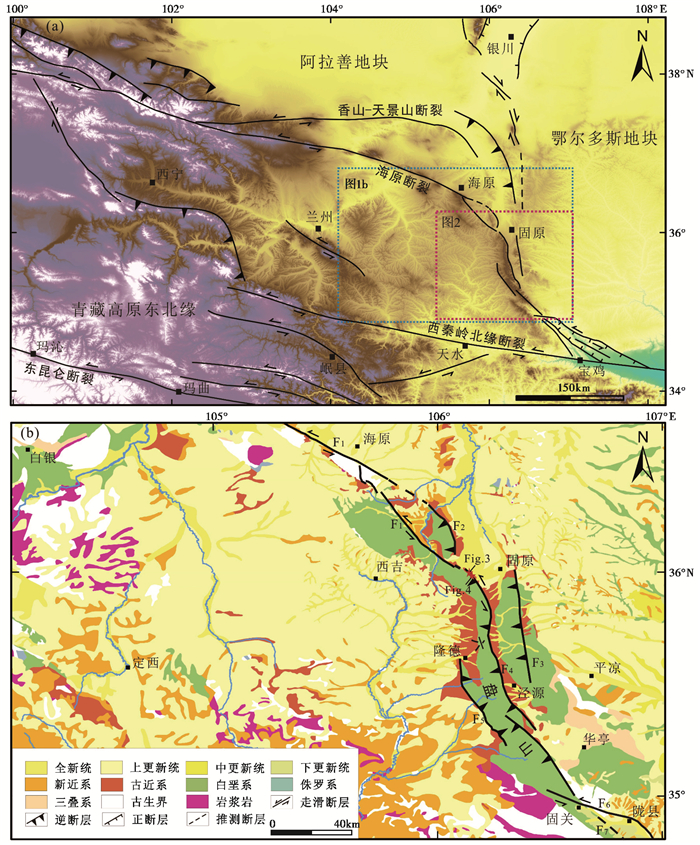
六盘山位于青藏高原东北缘和鄂尔多斯块体交界部位(图 1a),该地区经历了复杂漫长的构造演化过程,自古生代至中生代的侏罗纪,该区以剥蚀为主,早白垩时期,六盘山地区形成较深的山间盆地[11];白垩纪末期,燕山运动第Ⅳ幕使得鄂尔多斯块体隆升,其西南缘遭受强烈挤压,形成六盘山的雏形[12];新生代以来,印度板块与欧亚板块碰撞,青藏高原东北缘晚新生代(约8~10Ma)发生了准同期、影响深远的构造变形[13, 14],在青藏高原持续向北东方向推挤的条件下,祁连-海原断裂带由早期的逆冲转为走滑,走滑运动引起的端部挤压效应沿马东山褶皱带、六盘山东麓断裂(图 1b)等先存构造进行应力调整和应变分配,从而沿六盘山断裂带发生了大规模的挤压逆冲,六盘山开始快速隆升[15, 16],但在六盘山东麓断裂的北段仍然具有左旋走滑运动分量[17, 18]。随后,六盘山东麓断裂继续向南发展,开始与陇县-宝鸡断裂带相连通。3.6Ma以来,六盘山加速隆升,河流急剧下切,发育典型的风成沉积物和土壤过程[15]。六盘山西侧为平缓的陇西盆地,东侧为鄂尔多斯块体黄土台地,二者高度在1800m左右,到六盘山地区则迅速上升到2600m左右,其隆升明显受到了六盘山逆冲断裂带构造活动的影响;在其东侧受小关山逆冲断裂的影响,崆峒山也逐步隆升,其高度明显高于东侧的鄂尔多斯块体[19]。
|
图 1 青藏高原东北缘地貌及主要活动断裂分布(a)和六盘山地区地质构造简图(b) F1——海原断裂;F2——马东山褶皱逆冲带;F3——小关山断裂;F4——六盘山东麓断裂;F5——六盘山西麓断裂;F6——陇县-岐山-马召断裂;F7——固关-虢镇断裂 Fig. 1 Geomorphological map of the northeastern margin of the Tibet Plateau and the main fault in this region (a) and simplified geological map of the Liupanshan Mountain region(b) |
从图 1可见,六盘山地区发育了众多的活动断裂带,这些断裂控制了六盘山的隆升和地貌发育演化,断裂带无论活动时代还是性质都有明显的差异。断裂活动时代与活动性质的转化是否会对六盘山隆升极其地貌演化产生影响?各条断裂所起的作用有什么差异?这是本文拟探讨的主要问题。
2 六盘山地区活动断裂特征六盘山山体区主要活动断裂为六盘山西麓断裂和六盘山东麓断裂(图 1),两条断裂活动时代和活动性质都有明显的差异。
2.1 六盘山西麓断裂六盘山西麓断裂(F5)位于六盘山西侧(图 1b),是六盘山地区的主干活动断裂之一,断裂北起隆德县三里店水库,向南经罗家峡、桃山水库、奠安东、陈家堡东、关地峡,最后消失于酒槽附近,全长约60km,断裂性质为挤压逆冲,倾向东或北东。六盘山西麓断裂是控制六盘山西侧地质地貌发育的主要断裂,地貌上表现为高山和中低山之间的分界,东侧为六盘山山脉,西侧为陇西盆地。六盘山西麓断裂在罗家峡水库附近断层地貌明显,水库北岸可见到紫红色白垩系砂岩层逆冲于红色砂岩与泥岩互层的第三系地层之上。奠安乡庄浪河断层剖面显示断裂断错庄浪河T3阶地砾石层,阶地年代在76.0±9.4ka左右[19]。水洛河两岸发育I、II级阶地,两级阶地均未被错断。根据其断错地貌特征,推测断裂晚更新世晚期新活动并不明显,全新世以来已停止活动[19]。
2.2 六盘山东麓断裂六盘山东麓断裂(F4)北段自硝口一带起,在硝口附近与海原断裂带相接,南端至固关北与陇县-宝鸡断裂带相接(图 1b),总体走向330°~335°,全长约130km。前人的研究中,都将六盘山东麓断裂分为北、中、南三段[18~20],南段止于马家新庄一带。根据最新的研究结果,六盘山东麓断裂向南延伸到了固关以北[21];北段具有左旋走滑特征,中南段以逆冲为主[18~21]。
六盘山东麓断裂晚第四纪构造活动明显,历史上曾发生多次7级以上地震[22, 23],全新世以来也有多次古地震事件[24, 25]。对于断裂的滑动速率前人曾开展过一些初步研究,得到北段的左旋走滑速率为1~3mm/a,垂直滑动速率为0.9mm/a[18];现今GPS观测,北段左旋走滑速率约1mm/a[26, 27]。在本研究中,我们选择典型断错地貌单元,野外通过差分GPS测量及年代样品采集测试,获得了断裂北段的滑动速率。
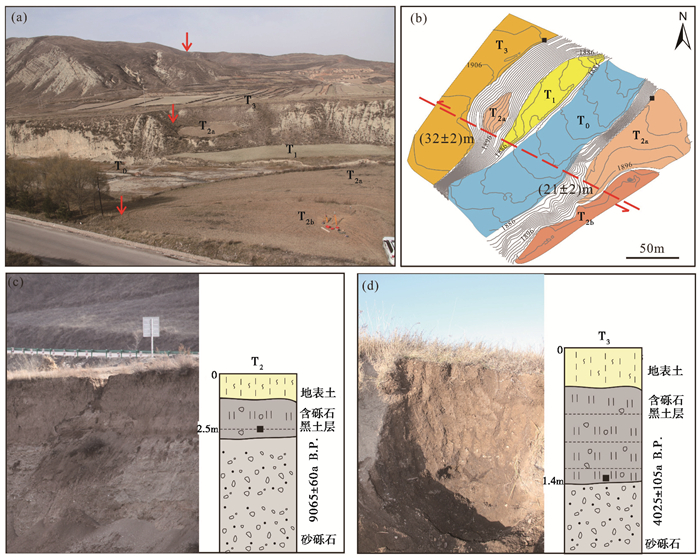
在六盘山东麓断裂北段,后磨河是一条发源于六盘山区的一条较大水系,发育3级基座阶地,基座为第三系红色砂岩,其中T2阶地可细分为T2a和T2b二级阶地。断裂通过处,阶地边缘形成明显的左旋位错(图 2a),野外用差分GPS对位错值进行了实测(图 2b)。T3边缘位错量约为32±2m,河东岸T2a阶地边缘位错量为约21±2m,东岸由于阶地保存条件及后期人为改造,其位错量存在较大的不确定性,只能作为参考值。在测量处,T1阶地拔河高度3m,T2拔河高度为13m,T3拔河高度为24m。同时野外对T3和T2两级阶地进行了年代样品的采集,T2采样剖面如图 2c所示,顶部为现代地表耕作土层,其下为灰黑色砂砾石土层,在阶地砾石层之上,距地表 2.5m的砂砾石土层中发现黑色木炭,经Beta实验室测定,树轮校正年龄为9065±60a B.P.;T3采样深度约1.4m,采集的主要为阶地砾石层之上黑色的含炭土层(图 2d),树轮校正年代为4025±105a B.P.。根据T2年代样品及区域河流已有年代对比,该结果明显偏年轻。野外考察发现,T3阶地砾石层之上的沉积物较薄,大多小于1m,而T2之上沉积物厚约3m,按照正常沉积,T3之上沉积物应该更厚,但测量点并没有发现更厚的沉积,可能后期遭受了剥蚀,因此该年代样品不能代表阶地沉积年代。我们假设近几万年来河流下切速率保持较稳定,根据T2阶地砾石层拔河高度为10m,年代为9065±60a B.P.,则其下切速率为约1.1mm/a。根据T3阶地砾石层拔河高度为23m,推测其形成年代为约2.1万年。
|
图 2 后磨河阶地左旋位错及14 C采样剖面 (a)后磨河阶地分布(镜像NW);(b)阶地位错差分GPS测量;(c)T2阶地采样剖面;(d)T3阶地采样剖面 Fig. 2 Surveys of left-lateral offset of terraces at Houmohe River and 14 C sampling section. (a)Terrace distribution of Houmohe (view to NW); (b)Differential GPS surveys of offsetting terrace; (c)Sampling section of T2; (d)Sampling section of T3 |
滑动速率为累计位移量与起始时间的比值,但由于位移量的保存条件及起始时间难以确定,很多研究者提出了不同的模型加以说明,总的来讲主要为上阶地模型或下阶地模型,即本级阶地的位移量是在形成之时就可以保存,还是当下级阶地形成后才能保存下来,而利用这两级阶地的年代可以获得滑动速率的上限值和下限值[28]。根据T3阶地的位错量及年代,得到其最大滑动速率为3.5±0.3mm/a,最小滑动速率为1.5±0.1mm/a,其均值约为2.0±0.3mm/a。
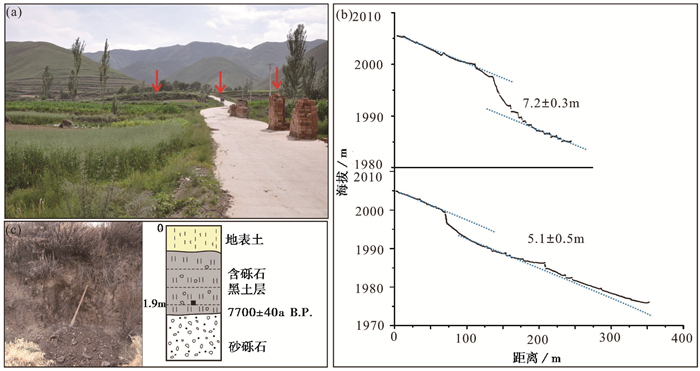
在后磨河向南的柯家庄,河流T2阶地的表面上,断裂持续活动形成醒目的北东向断层陡坎(图 3a),野外利用差分GPS对陡坎的两处进行了测量,两条剖面得到的陡坎高度分别为7.2±0.3m和5.1±0.5m(图 3b),平均高度为6.2±0.6m。同时,野外对该阶地进行了14C年代样品采集,采集位置在阶地砾石层上部,距地表 1.9m,得到样品的树轮校正年代为7700±40a B.P.(图 3c),据此得到该点断裂的逆冲速率为0.80±0.08mm/a。
|
图 3 柯家庄陡坎测量及14 C采样剖面 (a)柯家庄断错地貌(镜像SW);(b)断层陡坎差分GPS测量;(c)T2阶地采样剖面 Fig. 3 Surveys of fault scarp at Kejiazhuang and 14 C sampling section. (a)Fault landform of Kejiahzuang(view to SW); (b)Differential GPS surveys of fault scarp; (c)Sampling section of T2 |
六盘山东麓断裂中南段,由于地形及后期人为改造,很难找到理想的地点确定断层滑动速率,但从地貌上观测,断裂中南段逐渐变为倾角低缓的逆冲推覆构造,尾端出现褶皱变形,走滑活动不明显[20]。GPS同样揭示断裂北段逆冲不明显,中南段则有4~5mm/a的逆冲分量[27]。虽然这个数值可能大于由活动构造研究得到的滑动速率,但可以表明,沿六盘山东麓断裂从北往南逆冲速率具有变大趋势。
3 六盘山地区河流陡峭指数特征近年来,许多研究者以定量化的地貌因子为研究手段,深入探讨了地貌形态对活动构造的响应机制[29~35]。河道陡峭指数(ksn)作为反映岩石抬升速率的指标也被广泛应用[36~40],Whipple等[36]率先引入河道陡峭指数来描述河道整体陡峭程度,通过对Siwalik山的研究得出了河道陡峭指数与抬升速率有着很好的正相关关系;Snyder等[37]和Wobus等[38]分别在研究美国加州King Range地区基岩河道纵剖面时指出,抬升速率高的区域河道比较陡,抬升速率低的区域较缓;胡小飞等[39]根据河流陡峭指数的分布特征得出祁连山中西部抬升速率大,东段小,抬升速率最大处位于榆木山以西区域的结论。六盘山地区也有研究者利用河流陡峭指数变化分析其隆升差异,并得出北段隆升速率低,中、南段较高的认识[40],但其南端只到马家新庄一带,并未包括整个六盘山,对六盘山东西侧差异抬升也并未作对比。
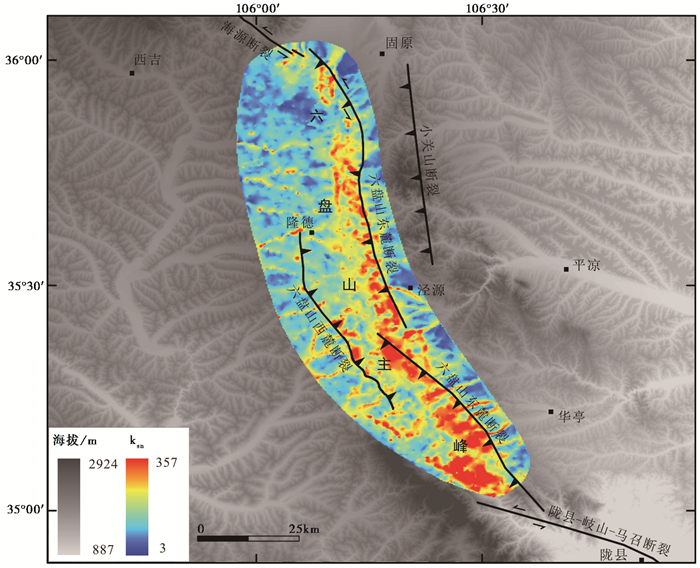
本研究中,我们基于ArcGIS平台,利用Snyder等[37]和Kirby等[41]开发的Matlab脚本程序从90m分辨率的SRTM数据中提取河道高程和流域面积(A)后,选用250m的移动窗口进行平滑,并每隔12m的垂距计算出河道比降或河道坡度(S),再根据公式log S=-θ*log A+log ksn[42~45],反演回归得到的河道陡峭指数(ksn)和下切凹曲度(θ)或河道凹度(θ=m/n,其中m为面积指数,n为坡度指数),为了方便断裂带沿线不同河道之间的对比,设定河道下切凹度值为0.45[46],对河道陡峭指数归一化后进行数值内插,得到河道陡峭指数(ksn)平面分布图(图 4)。河道陡峭指数受3个变量的制约:岩石抬升速率、侵蚀系数和坡度指数[47, 48]。侵蚀系数和坡度指数受到多个因素的影响,如岩性、降水和河流负载等[49, 50]。李小强等[40]通过分析六盘山地区区域岩石性质、降雨量变化及河道输沙量、负载大小,综合均衡河道纵剖面及河道陡峭指数的限制条件,得出河道陡峭指数的变化主要受区域构造隆升的影响,并且岩石隆升速率与河道陡峭指数呈正相关性。所以,六盘山地区河道陡峭指数的变化反映了构造隆升速率分布的差异性。
|
图 4 六盘山地区河道陡峭指数分布图 Fig. 4 Distribution mapping of channel steepness along the Liupanshan Mountain |
从图 4的河道陡峭指数分布的情况看,高陡峭指数主要分布在六盘山的东侧及南段。东西对比来看,以六盘山主峰为界,颜色区分明显,东侧表现为红颜色的高陡峭指数区,西侧多为蓝色的低值区,六盘山西麓断裂以北尤为明显,表明断裂对陡峭指数分布有重要的影响。以六盘山为整体南北对比来看,南段要高于北段,河道陡峭指数的高值区主要分布在六盘山东麓断裂南段及陇县-岐山-马召断裂以北地带,这与前人研究结果较为吻合[40]。
六盘山河道陡峭指数整体具有南高北低、东高西低的特征,反映出六盘山抬升速率在空间分布上的差异,六盘山抬升速率南段高于北段,东侧大于西侧,这与前文叙述的断裂活动性差异具有高度的一致性,从图 4也可看出断裂对河道陡峭指数分布的控制作用。活动性强、逆冲为主的断裂附近分布高陡峭指数,活动性弱或具走滑性质的断裂附近分布低陡峭指数,反映出断裂活动性对造山隆升影响明显。
4 讨论与结论六盘山北侧为海原断裂带,它西起祁连山,东至六盘山,分割了构造变形强烈的青藏高原与相对稳定的阿拉善和鄂尔多斯块体(图 1a),新生代以来经历了先逆冲、后走滑的两阶段变形过程[51]。无论是活动构造研究还是现今GPS观测,都揭示海原断裂东段的左旋滑动速率为3~5mm/a[52, 53],这一滑动速率在其尾端被马东山逆冲褶皱带及六盘山东麓断裂逆走滑所吸收。根据本文在六盘山东麓断裂北段所的得到的滑动速率,推测马东山褶皱带和六盘山东麓断裂各吸收了海原断裂约一半的衰减量。六盘山南侧为陇县-宝鸡断裂带,由西向东包括桃园-龟川寺断裂、固关-虢镇断裂、千阳-彪角断裂以及陇县-岐山-马召断裂,其中桃园-龟川寺断裂和千阳-彪角断裂规模较小,活动性不强[54]。固关-虢镇断裂北端在固关附近与六盘山东麓断裂斜接,向东南至宝鸡一带进入渭河谷地而消失。断层总体走向325°~335°,长80km。断层有多个段落组成,北侧靠近六盘山段断裂活动性不强,中南段有新活动迹象,可能为公元600年秦陇
六盘山山体区的断裂主要为六盘山东麓断裂和西麓断裂,六盘山西麓断裂为一条晚更新世活动的逆冲断裂,全新世以来已停止活动;六盘山东麓断裂为一条全新世活动的逆左旋断裂,北段走滑作用明显,逆冲作用弱,北段左旋走滑速率为2.0±0.3mm/a,逆冲滑动速率为0.80±0.08mm/a,向南走滑作用逐渐减弱,逆冲作用增强。断裂活动性的差异对山体或构造隆升产生了较大的影响[49, 56],通过河道陡峭指数的分析,发现六盘山地区河道陡峭指数分布具有东高西低、南高北低的特征,反映六盘山隆升速率东侧比西侧快,南段比北段快,这种地貌变化特征是对活动构造的响应。分析认为六盘山地区断裂活动性的差异及活动性质、滑动速率的转变是造成六盘山差异隆升的主要原因。
致谢: 文中14 C样品由BETA实验室完成测试。中国地震局地质研究所张会平研究员在成文过程中进行了指导,在此表示感谢。
| 1 |
An Z S, Kutzbach J E, Prell W L, et al. Evolution of Asian monsoons and phased uplift of the Himalaya-Tibet Plateau since Late Miocene times.
Nature,2001, 411 (6833) : 62~66.
( 0) 0)
|
| 2 |
Harrison T M, Copeland P, Kidd W S F, et al. Raising Tibet.
Science,1990, 255 (5052) : 1663~1670.
(0)
|
| 3 |
Molnar P, England P, Martinod J. Mantle dynamics, uplift of the Tibet Plateau, and the Indian monsoon.
Reviews of Geophysics,1993, 31 (31) : 357~396.
(0)
|
| 4 |
Tapponnier P, Xu Z Q, Roger F, et al. Oblique stepwise rise and growth of the Tibet Plateau.
Science,2001, 294 (5574) : 1671~1677.
(0)
|
| 5 |
李吉均, 文世宣, 张青松, 等. 青藏高原隆起的时代、幅度和形式的探讨.
中国科学,1979 (6) : 608~616.
Li Jijun, Wen Shixuan, Zhang Qingsong, et al. A discussion on the period, amplitude and type of the uplift of the Qinghai-Xizang Plateau. Scientia Sinica,1979 (6) : 608~616. ( 0)
|
| 6 |
李吉均, 方小敏. 青藏高原隆起与环境变化研究.
科学通报,1998, 43 (15) : 1569~1574.
Li Jijun, Fang Xiaomin. Uplift of the Tibetan Plateau and environment changes. Chinese Science Bulletin,1998, 43 (15) : 1569~1574. ( 0)
|
| 7 |
李吉均, 方小敏, 潘保田, 等. 新生代晚期青藏高原强烈隆起及其对周边环境的影响.
第四纪研究,2001, 21 (5) : 381~391.
Li Jijun, Fang Xiaomin, Pan Baotian, et al. Late Cenozoic intensive uplift of Qinghai-Xizang Plateau and its impacts on environment in surrounding area. Quaternary Sciences,2001, 21 (5) : 381~391. ( 0)
|
| 8 |
Meyer B, Tapponnier P, Bourjot L, et al. Crustal thickening in Gansu-Qinghai, lithospheric mantle subduction, and oblique, strike-slip controlled growth of the Tibet Plateau.
Geophysical Journal International,1998, 135 (1) : 1~47.
(0)
|
| 9 |
Metivier F, Gaudemer Y, Tapponnier P, et al. Northeastward growth of the Tibet Plateau deduced from balanced reconstruction of two depositional areas:The Qaidam and Hexi-Corridor basins, China.
Tectonics,1998, 17 (6) : 823~842.
(0)
|
| 10 |
Yin A, Rumelhart P E, Butler R, et al. Tectonic history of the Altyn Tagh fault system in northern Tibet inferred from Cenozoic sedimentation.
Geological Society of America Bulletin,2002, 114 (10) : 1257~1295.
(0)
|
| 11 |
孙昭民, 邓起东.六盘山东麓断裂和陇县-宝鸡断裂带基本特征及其相互关系.见:中国地震学会地震地质专业委员会.中国活动断层研究.北京:地震出版社, 1994.114~125
Sun Zhaomin, Deng Qidong. Basic characteristics and interaction of the eastern Liupanshan piedmont fault and the Longxian-Baoji fault zone. In:Seismogeology Professional Committee, Seismological Society of China. China Active Fault Research. Beijing:Seismological Press, 1994.114~125 ( 0)
|
| 12 |
国家地震局《鄂尔多斯周缘活动断裂系》课题组编.
鄂尔多斯周缘活动断裂系 . 北京: 地震出版社, 1988 : 5 ~7.
The Research Group on Active Fault System around Ordos Massif, State Seismological Bureau. Active Fault System around Ordos Massif. Beijing:Seismological Press, 1988.5~7. Active Fault System around Ordos Massif. Beijing: Seismological Press, 1988 : 5 ~7. ( 0)
|
| 13 |
Molnar P. Mio-Pliocene growth of the Tibetan Plateau and evolution of East Asian climate.
Palaeontologia Electronica,2005, 8 (1) : 1~23.
(0)
|
| 14 |
张培震, 郑德文, 尹功明, 等. 有关青藏高原东北缘晚新生代扩展与隆升的讨论.
第四纪研究,2006, 26 (1) : 5~13.
Zhang Peizhen, Zheng Dewen, Yin Gongming, et al. Discussion on Late Cenozoic growth and rise of northeastern margin of the Tibetan Plateau. Quaternary Sciences,2006, 26 (1) : 5~13. ( 0)
|
| 15 |
宋友桂, 方小敏, 李吉均, 等. 晚新生代六盘山隆升过程初探.
中国科学(D辑),2001, 31 (Suppl.) : 142~148.
Song Yougui, Fang Xiaomin, Li Jijun, et al. A primary discussion on the uplift process of Liupanshan in Late Cenozoic. Science in China(Series D),2001, 31 (Suppl.) : 142~148. ( 0)
|
| 16 |
Zheng D W, Zhang P Z, Wan J, et al. Rapid exhumation at-8Ma on the Liupan Shan thrust fault from apatite fission-track thermo chronology:Implications for growth of the northeastern Tibetan Plateau margin.
Earth and Planetary Science Letters,2006, 248 (1) : 198~208.
(0)
|
| 17 |
Zhang P Z, Burchfiel B C, Monlar P, et al. Amount and style of Late Cenozoic deformation in the Liupan Shan area, Ningxia Autonomous Region, China.
Tectonics,1991, 10 (6) : 1111~1129.
(0)
|
| 18 |
向宏发, 虢顺民, 张秉良, 等. 六盘山东麓活动逆断裂构造带晚第四纪以来的活动特征.
地震地质,1998, 20 (4) : 321~327.
Xiang Hongfa, Guo Shunmin, Zhang Bingliang, et al. Active features of the eastern Liupanshan piedmont reverse fault zone since Late Quaternary. Seismology and Geology,1998, 20 (4) : 321~327. ( 0)
|
| 19 |
刘兴旺, 袁道阳, 史志刚, 等. 六盘山断裂带构造活动特征及流域盆地地貌相应.
地震工程学报,2015, 37 (1) : 168~174.
Liu Xingwang, Yuan Daoyang, Shi Zhigang, et al. The tectonic characters and geomorphological response of the Liupanshan fault zone. China Earthquake Engineering Journal,2015, 37 (1) : 168~174. ( 0)
|
| 20 |
史志刚.六盘山地区断裂新活动特征与大震危险性趋势判定.兰州:中国地震局兰州地震研究所硕士学位论文, 2011.1~90
Shi Zhigang.The Recent Activity Features and Risk Trend of Strong Earthquake in Liupanshan Region. Lanzhou:The Master's Thesis of Lanzhou Institute of Seismology, China Earthquake Administration, 2011.1~90 ( 0)
|
| 21 |
郑文俊, 袁道阳, 张培震, 等. 青藏高原东北缘活动构造几何图像、运动转换与高原扩展.
第四纪研究,2016, 36 (4) : 775~788.
Zheng Wenjun, Yuan Daoyang, Zhang Peizhen, et al. Tectonic geometry and kinematic dissipation of the active faults in the northeastern Tibetan Plateau and their implications for understanding northeastward growth of the Plateau. Quaternary Sciences,2016, 36 (4) : 775~788. ( 0)
|
| 22 |
袁道阳, 雷中生, 张俊玲, 等. 1219年宁夏固原地震考证与发震构造探讨.
地震学报,2008, 30 (6) : 648~657.
Yuan Daoyang, Lei Zhongsheng, Zhang Junling, et al. Textual research of1219A.D.Guyuan earthquake in Ningxia Hui Autonomous Region, China, and discussion on its causative structure. Acta Seismology Sinica,2008, 30 (6) : 648~657. ( 0)
|
| 23 |
史志刚, 袁道阳, 雷中生, 等. 1306年宁夏固原地震考证与发震构造探讨.
西北地震学报,2011, 33 (4) : 342~348.
Shi Zhigang, Yuan Daoyang, Lei Zhongsheng, et al. Textual research on Guyuan earthquake in1306 in Ningxia Region, and discussion on its seismogenic structure. Northwestern Seismological Journal,2011, 33 (4) : 342~348. ( 0)
|
| 24 |
史志刚, 李廷栋, 袁道阳, 等. 六盘山东麓断裂南段断裂沟槽韵律沉积特征对最新活动时代的限定.
地球学报,2014, 35 (1) : 31~37.
Shi Zhigang, Li Tingdong, Yuan Daoyang, et al. The recent active time of the south segment of the eastern Liupanshan piedmont fault:Constraints from the characteristics of rhythmic deposits in the fault groove. Acta Geoscientica Sinica,2014, 35 (1) : 31~37. ( 0)
|
| 25 |
向宏发, 池田安隆, 张晚霞, 等. 六盘山东麓断裂的古地震研究.
中国地震,1999, 15 (1) : 74~91.
Xiang Hongfa, Ikeda Yasutake, Zhang Wanxia, et al. Study on paleoearthquake of the eastern Liupanshan piedmont fault zone. Earthquake Research in China,1999, 15 (1) : 74~91. ( 0)
|
| 26 |
张晓亮, 师昭梦, 蒋锋云, 等. 海原-六盘山弧形断裂及其附近最新构造变形演化分析.
大地测量与地球动力学,2011, 31 (3) : 20~24.
Zhang Xiaoliang, Shi Zhaomeng, Jiang Fengyun, et al. Research on late tectonic deformation evolvement of Haiyuan-Liupanshan arc fault and its surrounding area. Journal of Geodesy and Geodynamics,2011, 31 (3) : 20~24. ( 0)
|
| 27 |
周德敏.青藏高原东北缘现今地壳形变的GPS观测研究.北京:中国地震局中国地震局地质研究所硕士学位论文, 2005.1~102
Zhou Demin. A Study on Crustal Deformation Based on GPS Data in the Northeastern Margin of the Qinghai-Tibetan Plateau. Beijing:The Master's Thesis of Institute of Geology, China Earthquake Administration, 2005.1~102 ( 0)
|
| 28 |
张培震, 李传友, 毛凤英. 河流阶地演化与走滑断裂滑动速率.
地震地质,2008, 30 (1) : 44~57.
Zhang Peizhen, Li Chuanyou, Mao Fengying. Strath terrace formation and strike-slip faulting. Seismology and Geology,2008, 30 (1) : 44~57. ( 0)
|
| 29 |
张会平, 张培震, 袁道阳, 等. 南北地震带中段地貌发育差异性及其与西秦岭构造带关系初探.
第四纪研究,2010, 30 (4) : 803~811.
Zhang Huiping, Zhang Peizhen, Yuan Daoyang, et al. Differential landscape development of the central N-S seismic zone and its relation to the west Qingling tectonic belt. Quaternary Sciences,2010, 30 (4) : 803~811. ( 0)
|
| 30 |
张沛全, 孙杰, 刘小汉, 等. 沿南盘江-红水河(中段)的河流地貌特征与地壳变形.
第四纪研究,2013, 33 (4) : 771~784.
Zhang Peiquan, Sun Jie, Liu Xiaohan, et al. Features of fluvial landform and crust deformations along the Nanpanjiang River-Hongshuihe River(middle segment). Quaternary Sciences,2013, 33 (4) : 771~784. ( 0)
|
| 31 |
梁红颖, 林舟. 哀牢山地貌演化过程详析.
第四纪研究,2015, 35 (1) : 38~47.
Liang Hongying, Lin Zhou. Characterization of landform evolution stages of the Ailao Shan Mountain range. Quaternary Sciences,2015, 35 (1) : 38~47. ( 0)
|
| 32 |
徐岳仁, 何宏林, 邓起东, 等. 山西霍山山脉河流地貌定量参数及其构造意义.
第四纪研究,2013, 33 (4) : 746~759.
Xu Yueren, He Honglin, Deng Qidong, et al. Quantitative river geomorphic parameters surrounding Mts. Huoshan, Shanxi Province and their tectonic implications. Quaternary Sciences,2013, 33 (4) : 746~759. ( 0)
|
| 33 |
张天琪, 王振, 张晓明, 等. 北天山乌鲁木齐河流域面积-高程积分及其地貌意义.
第四纪研究,2015, 35 (1) : 60~70.
Zhang Tianqi, Wang Zhen, Zhang Xiaoming, et al. Hypsometric integral analysis of the Vrümqi River drainage basin and its implications for topographic evolution. Quaternary Sciences,2015, 35 (1) : 60~70. ( 0)
|
| 34 |
苏琦, 袁道阳, 谢虹, 等. 祁连山西段党河流域地貌特征及其构造指示意义.
第四纪研究,2015, 35 (1) : 48~59.
Su Qi, Yuan Daoyang, Xie Hong, et al. Geomorphic features of the Danghe River drainage basin in western Qilian Shan Mountain and its tectonic implications. Quaternary Sciences,2015, 35 (1) : 48~59. ( 0)
|
| 35 |
褚永彬, 朱利东, 陈伟, 等. 疏勒河上游河流地貌特征及其演化.
第四纪研究,2015, 35 (2) : 465~474.
Chu Yongbin, Zhu Lidong, Chen Wei, et al. Geomorphology and evolution of the upper Shule River. Quaternary Sciences,2015, 35 (2) : 465~474. ( 0)
|
| 36 |
Whipple K X, Tucker G E. Dynamics of the stream-power river incision model:Implications for height limits of mountain ranges, landscape response timescales, and research needs.
Journal of Geophysical Research,1999, 104 (17) : 17661~17674.
(0)
|
| 37 |
Snyder N P, Whipple K X, Tucker G E, et al. Landscape response to tectonic forcing: Digital elevation model analysis of stream profiles in the Mendocino triple junction region, northern California.
Geological Society of America Bulletin,2000, 112 (8) : 1250~1263.
(0)
|
| 38 |
Wobus C, Whipple K X, Kirby E, et al. Tectonics from topography: Procedure, promise, and pitfalls.
Geological Society of America Special Papers,2006, 398 (12) : 55~74.
(0)
|
| 39 |
胡小飞, 潘保田, KirbyE, 等. 河道陡峭指数所反映的祁连山北翼抬升速率的东西差异.
科学通报,2010, 55 (23) : 3205~3214.
Hu Xiaofei, Pan Baotian, Kirby E, et al. Spatial differences in rock uplift rates inferred from channel steepness indices along the northern flank of the Qilian Mountain, northeast Tibetan Plateau. Chinese Science Bulletin,2010, 55 (23) : 3205~3214. ( 0)
|
| 40 |
李小强, 王军, 熊仁伟, 等. 六盘山地区河道陡峭指数对隆升速率差异的响应.
第四纪研究,2016, 36 (2) : 443~452.
Li Xiaoqiang, Wang Jun, Xiong Renwei, et al. The response of the channel steepness index to the difference of uplift rate in the Liupanshan Mountain area. Quaternary Sciences,2016, 36 (2) : 443~452. ( 0)
|
| 41 |
Kirby E, Whipple K X, Tang W Q, et al. Distribution of active rock uplift along the eastern margin of the Tibetan Plateau:Inferences from bedrock channel longitudinal profiles.
Journal of Geophysical Research,2003, 108 (B4) : 215~231.
(0)
|
| 42 |
Whipple K X, Hancock G S, Anderson R S. River incision into bedrock:Mechanics and relative efficacy of plucking, abrasion, and cavitation.
Geological Society of America Bulletin,2000, 112 (3) : 490~503.
(0)
|
| 43 |
Whipple K X. Bedrock rivers and the geomorphology of active orogens.
Annual Review of Earth and Planetary Science,2004, 32 (1) : 151~185.
(0)
|
| 44 |
陈彦杰, 宋国城, 陈昭男. 非均衡山脉的河流水力侵蚀模型.
科学通报,2006, 51 (7) : 865~869.
Chen Yanjie, Song Guocheng, Chen Zhaonan. Stream-power incision model for non-steady orogens. Chinese Science Bulletin,2006, 51 (7) : 865~869. ( 0)
|
| 45 |
张会平, 张培震, 吴庆龙, 等. 循化-贵德地区黄河水系河流纵剖面形态特征及其构造意义.
第四纪研究,2008, 28 (2) : 299~309.
Zhang Huiping, Zhang Peizhen, Wu Qinglong, et al. Characteristics of the Huanghe River longitudinal profiles around Xunhua-Guide area(NE Tibet)and their tectonic significance. Quaternary Sciences,2008, 28 (2) : 299~309. ( 0)
|
| 46 |
陈涛, 张会平, 王伟涛. 海原断裂带中东段地貌差异及其成因探讨.
地震地质,2014, 36 (2) : 449~463.
Chen Tao, Zhang Huiping, Wang Weitao. Topographic variation along the middle-east segment of Haiyuan fault zone and its implications. Seismology and Geology,2014, 36 (2) : 449~463. ( 0)
|
| 47 |
Sklar L S, Dietrich W E. Sediment and rock strength controls on river incision into bedrock.
Geology,2001, 29 (12) : 1087~1090.
(0)
|
| 48 |
Snyder N P, Whipple K X, Tucker G E, et al. Channel response to tectonic forcing:Field analysis of stream morphology and hydrology in the Mendocino triple junction region, northern California.
Geomorphology,2003, 53 (1-2) : 97~127.
(0)
|
| 49 |
李琼, 潘保田, 高红山, 等. 祁连山东段基岩河道宽度对差异性构造抬升的响应.
第四纪研究,2015, 35 (2) : 453~464.
Li Qiong, Pan Baotian, Gao Hongshan, et al. Bedrock channel width responses to differential tectonic uplift in eastern Qilian Mountain. Quaternary Sciences,2015, 35 (2) : 453~464. ( 0)
|
| 50 |
胡小飞, 潘保田, 李琼. 基岩河道水力侵蚀模型原理及其最新研究进展.
兰州大学学报(自然科学版),2014, 50 (6) : 824~830.
Hu Xiaofei, Pan Baotian, Li Qiong. Principles of the stream power erosion model and its latest progress in research. Journal of Lanzhou University (Natural Sciences),2014, 50 (6) : 824~830. ( 0)
|
| 51 |
王伟涛, 张培震, 郑德文, 等. 青藏高原东北缘海原断裂带晚新生代构造变形.
地学前缘,2014, 21 (4) : 266~274.
Wang Weitao, Zhang Peizhen, Zheng Dewen, et al. Late Cenozoic tectonic deformation of the Haiyuan fault zone in the northeastern margin of the Tibetan Plateau. Earth Science Frontiers,2014, 21 (4) : 266~274. ( 0)
|
| 52 |
Li C Y, Zhang P Z, Yin J H, et al. Late Quaternary left-lateral slip rate of the Haiyuan fault, northeastern margin of the Tibetan Plateau.
Tectonics,2009, 28 (5) : 357~369.
(0)
|
| 53 |
Zheng W J, Zhang P Z, He W G, et al. Transformation of displacement between strike-slip and crustal shorting in the northern margin of the Tibetan Plateau:Evidence from decadal GPS measurement and Late Quaternary slip rates on fault.
Tectonophysics,2013, 584 (1) : 267~280.
(0)
|
| 54 |
石卫.陇县-宝鸡断裂带发育特征及活动性分析.西安:长安大学硕士学位论文, 2011.1~112
Shi Wei. The Analysis of the Developmental Characteristics and Activity about Fault Zone of Longxian-Baoji. Xi'an:The Master's Thesis of Chang' an University, 2011.1~112 ( 0)
|
| 55 |
史志刚, 袁道阳, 李廷栋, 等. 公元600年秦陇地震考证与发震构造探讨.
科学导报,2013, 31 (12) : 48~52.
Shi Zhigang, Yuan Daoyang, Li Tingdong, et al. Textual research of A.D.600 Qin-Long earthquake and discussion on its seismogenic structure. Science and Technology Review,2013, 31 (12) : 48~52. ( 0)
|
| 56 |
李小强, 任金卫, 杨攀新, 等. 六盘山东西两侧第四纪以来构造差异隆升速率递变性.
第四纪研究,2015, 35 (2) : 445~452.
Li Xiaoqiang, Ren Jinwei, Yang Panxin, et al. Regularity of tectonic differential uplifting rates of both the east and west sides of Liupanshan Mountain since the Quaternary. Quaternary Sciences,2015, 35 (2) : 445~452. ( 0)
|
②. Lanzhou National Observatory of Geophysics, Lanzhou 730000)
Abstract
The Liupanshan Mountain is located in the northeastern margin of the Tibetan Plateau, and it is adjacent to the Ordos block to the east. Series of active faults are developed in this area. The Liupanshan Mountain fault zone includes the western Liupanshan Mountain Fault and the eastern Liupanshan Mountain Fault. Obvious difference in activities and the nature exist in the two faults. The western Liupanshan Mountain Fault is a high-angle reverse fault and its movements were dated back to the early Late-Pleistocene, but since the Middle-Late Pleistocene, the fault became inactive. However, the eastern Liupanshan Mountain fault is a reverse and left-lateral fault in Holocene. According to differential GPS surveys and 14C dating, we got that the rates of left-lateral slip and dip-slip at the northern segment are 2.0±0.3mm/a and 0.80 ±0.08mm/a, respectively. In addition, we observed the strike slip rate decreases southward with an increasing of the dip-slip rate. Recent studies of fluvial incision models have provided supports for the contention that rock uplift rate exerts a first-order control on the gradient of longitudinal river profiles. In this paper, we used this method to extract information about the spatial patterns of differential rock uplift along the Liupanshan Mountain. According to the analysis of the longitudinal profile for those bedrock channels, we found systematic differences in the channel steepness index along the Liupanshan Mountain. We concluded that the varied distribution of channel steepness in the Liupanshan Mountain was mostly the result of differential rates of rock uplift. Thus, channel steepness indices reveal relatively lower rock uplift rate in the western and northern portions of the Liupanshan Mountain but higher rate to the east and south. We speculated the difference of steepness indices may be controlled by the active fault in the Liupanshan Mountain area. The observed fault activity difference, fault nature and slip rate change together are the main drivers to the differential Liupanshan Mountain uplift.