 2016, Vol.36


晚新生代以来全球的气候和环境经历了一系列重大变化,沙漠和戈壁覆盖了亚洲大陆中纬度的大部分地区,构成了广袤的干旱地带。亚洲内陆是耦合全球海-陆-气变化的关键纽带区域,亚洲内陆干旱化严重影响着人类的生存环境,干旱区内部形成的粉尘经过季风环流作用可运输至黄土高原[1]、北太平洋地区[2, 3],并参与生物地球化学循环,其形成时间、机制及演化序列一直是新生代古气候研究的热点科学问题[4, 5]。前人已从多角度、多手段开展了大量相关研究[3, 6~14],但亚洲内陆干旱化形成的时间、演化历史和驱动机制尚未形成定论,目前主要存在3种代表性观点:1)全球变冷是驱动亚洲内陆干旱化的决定因素。全球变冷通过减弱海洋和大陆水体的蒸发作用而降低全球水汽含量,从而减少由西风或季风携带输送进入内陆的水汽总量,直接导致了亚洲内陆盆地的干旱化,特别是北半球高纬度的变冷将会显著引起西风控制区域的干旱化[1, 4, 15, 16]。2)青藏高原隆升是导致亚洲内陆干旱化的关键因素。大量数值模拟工作已经证实,青藏高原持续的阶段性隆升阻挡了印度季风和东南亚季风深入亚洲内陆,改变西风和季风的环流形式,引起动力和热力效应以及风化的加强加剧全球变冷,从而导致了亚洲内陆干旱化[17~22]。3)特提斯洋海退在亚洲内陆干旱化的进程中也发挥了重要作用[23~26]。产生上述认知分歧的根源在于目前亚洲内陆干旱化研究主要建立在黄土高原地区[1, 7]以及干旱区外围(如北太平洋[2, 3]以及格陵兰岛地区[6]的风成粉尘堆积)沉积记录之上,缺乏干旱区内部更多具有精确年代控制的长序列、连续记录。因此,更多准确获取亚洲干旱区内部长序列完整的气候变化序列,并与已发现的重大干旱事件进行对比检验,对深入理解亚洲内陆干旱化形成机理及其演化趋势具有重要的理论和实际意义。
作为亚洲内陆干旱区的主体部分,中国西北干旱区是准确建立亚洲内陆干旱区环境演化框架的理想地区。中国西北干旱区柴达木盆地是位于青藏高原北部最大的一个封闭盆地[27, 28],地处高寒、干旱气候区,位于北半球中纬度西风带、冬季风、印度洋季风和东亚季风的交汇地带,新生代以来经历了快速的气候变化与强烈的构造活动,其内部沉积的巨厚、连续沉积物是研究青藏高原形成与亚洲内陆气候变化良好的地质记录载体。因此,本文拟通过柴达木盆地东北缘已有磁性地层年代序列研究的怀头他拉剖面沉积物盐类离子含量变化研究,结合古生物和前人研究成果,探讨中中新世以来柴达木盆地气候演化历史及其可能的驱动机制,为丰富亚洲内陆干旱化形成和演化研究提供证据。
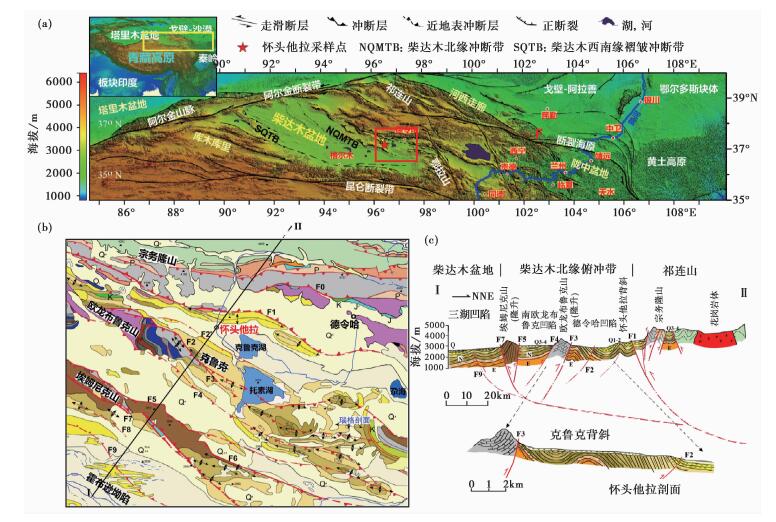
2 研究区与研究剖面概况柴达木盆地是青藏高原北缘最大的山间内陆盆地[27~29],西部以阿尔金山为界,北达祁连山,南抵昆仑山,东部以鄂拉山所限,形成了一个轴向为NW-SE向的不规则菱形向心汇水盆地(图 1a)。盆地内部地貌呈同心带状分布,自边缘至中心依次分布有:洪积砾石扇形地(戈壁)、冲积-洪积粉砂质平原、湖积-冲积粉砂粘土质平原、湖积淤泥盐土平原。“柴达木”为蒙古语,意为“盐泽”,盆地地势低洼处广泛分布盐湖与沼泽,目前湖水类型主要为硫酸盐型和氯化物型[30]。
|
图 1 柴达木盆地和研究剖面位置(据Fang等,2007[29]修改) (a)柴达木盆地DEM图;(b)研究区地质图;(c)怀头他拉剖面 Fig. 1 Locations of the Qaidam Basin and Huaitoutala section, modified from Fang et al., 2007[29] (a)DEM presentation of the geomorphology of the Qaidam Basin; (b)Geologic map of the study area; (c)The study sectionⅠ-Ⅱin the Fig. 1b |
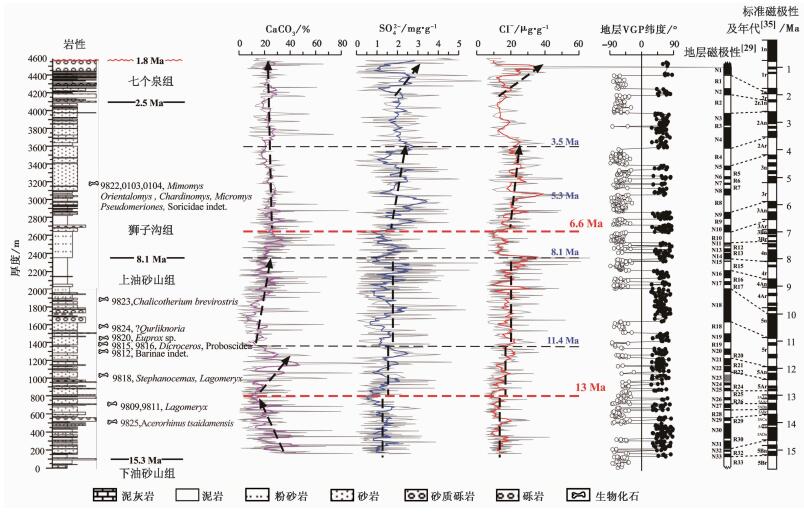
盆地内部广泛发育巨厚且连续的新生代地层,自下而上划分为路乐河组、下干柴沟组、上干柴沟组、下油砂山组、上油砂山组、狮子沟组和七个泉组[31]。本文选取柴达木盆地出露较好、有古地磁年代控制的怀头他拉剖面为研究对象,该套地层以湖相沉积为主,沉积连续且含丰富的动植物化石[29, 32~34]。怀头他拉剖面(37°13′48″N,96°43′10″E)位于柴达木盆地东北缘德令哈凹陷、怀头他拉镇以南10km,欧龙布鲁克山北侧克鲁克背斜北翼( 图 1b和1c),厚度达4570m( 图 2),包括下油砂山组上部、上油砂山组、狮子沟组和七个泉组。其中剖面底部下油砂山组仅出露100m,主要为细颗粒沉积物(泥岩,粉砂岩夹灰岩);上油砂山组厚2250m,自下而上沉积物粒度逐渐变细,由砂质细砾岩和砂岩为主过渡为以粉砂岩和泥岩为主;狮子沟组厚1750m,以厚层砂岩夹泥岩为特征;剖面顶部七个泉组厚470m,以巨厚砾岩为主,夹砂质粉砂岩、泥岩。Fang等[29]利用古生物宏观年代控制通过高密度磁性地层年代学研究,建立的怀头他拉剖面地层年代序列(15.7~1.8Ma)( 图 2),为本文研究提供了重要的地层年代资料。
|
图 2 柴达木盆地怀头他拉剖面15.3~1.8Ma沉积物碳酸钙、硫酸根和氯离子含量变化 生物化石据Fang等,2007[29]和Wang等,2007[34];磁性地层年代据Fang等,2007[29];标准磁极性柱及年代据Cande等,1995[35] Fig. 2 Change of climatic proxy records(CaCO3, SO42-and Cl-)of Huaitoutala section in the northeastern Qaidam Basin from ca.15.3Ma to 1.8Ma. Biological fossils from Fang et al., 2007[29] and Wang et al., 2011[34]; The magnetostratigraphy of the Huaitoutala section from Fang et al., 2007[29]; The geomagnetic polarity time scale from Cande et al., 1995[35] |
在地层年代控制下,野外对研究剖面上油砂山组、狮子沟组和七个泉组(15.3~1.8Ma)彻底刨挖直至新鲜原生岩石层面,剖面下部以2m等间隔对泥岩、粉砂质泥岩和粉砂岩系统采样,剖面上部粗砂岩和砾岩段视夹细粒碎屑岩情况适度放大采样间距至10m(尽量选取其中细粒碎屑岩夹层采样),共采集样品663块。室内将野外釆集样品置于36℃烘箱内烘干,研磨成粉末状,然后分別进行环境指标碳酸钙、硫酸根和氯离子含量的测定。
所有样品分析是在兰州大学甘肃省西部矿产资源重点实验室完成,碳酸钙含量采用Karbonat-Bombe国际标准碳酸盐计进行测定[36],利用已知质量样品与足量稀盐酸反应生成CO2气体的体积计算该样品中碳酸盐含量;可溶硫酸根离子含量采用EDTA(二钠)即乙二胺四乙酸二钠盐间接络合滴定法进行测定[37],EDTA(二钠)能与多种金属阳离子在不同的pH条件下形成稳定的络合物,只加入Ba-Mg混合液所消耗EDTA的量(即空白标定)和同体积待测液中原有Ca2+、Mg2+(即不加Ba-Mg混合液)所消耗的EDTA的量之和减去待测液中原有Ca2+、Mg2+及与SO42-作用后(即加入Ba-Mg混合液)剩余钡及镁所消耗的EDTA量,即为消耗于SO42-的Ba2+量,从而可获得SO42-含量;可溶氯离子含量采用AgNO3滴定法进行测定[38],根据分级沉淀的原理,在中性或弱碱性溶液中,微过量的Ag+与CrO42-反应析出砖红色Ag2CrO4沉淀指示达到滴定终点,根据消耗标准AgNO3溶液的体积计算氯离子含量。上述实验重复实验误差均在2%以内。
3.2 实验结果通过对沉积物样品的系统测量,获得了柴达木盆地怀头他拉剖面15.3~1.8Ma沉积物碳酸钙、硫酸根和氯离子含量变化序列,同时为避免偶然因素的影响我们对实验数据进行7点平滑处理。依据各指标变化特征和指标组合变化规律,将实验结果总体划分为3个阶段( 图 2)。
阶段Ⅰ(15. 3~13. 0Ma):以高的碳酸钙(平均值为11.331 %)、低的硫酸根(平均值为1.464mg/g)和氯离子(平均值为12.786μg/g)含量为特征。其中碳酸钙含量整体上呈高频宽振幅波动式降低趋势,而硫酸根和氯离子平均含量为全剖面最低值,并且硫酸根含量呈高频宽振幅强烈波动、氯离子含量为低频低振幅变化。
阶段Ⅱ(13.0~6.6Ma):相对阶段Ⅰ,总体碳酸钙含量降低(平均值为10.443 %)、而硫酸根和氯离子含量增加(平均值分别为1.526mg/g和17.394μg/g)。但该阶段各指标存在波动,其中13.0~11.4Ma,碳酸钙含量呈低频宽振幅迅速升高后降低,而硫酸根和氯离子平均含量相对前期呈台阶式增大。11.4~8.1Ma,碳酸钙含量低呈低频低振幅变化,而硫酸根和氯离子平均含量相对再次呈台阶式增大,特别氯离子含量至8.1Ma左右达到高值。8.1~6.6Ma,碳酸钙含量相对小幅增加,而硫酸根和氯离子含量相对前期明显降低。
阶段Ⅲ(6.6~1.8Ma):相对阶段Ⅱ,总体碳酸钙(平均值为11.908 %)、硫酸根(平均值为2.055mg/g)和氯离子(平均值为20.314μg/g)含量增加,其中碳酸钙含量呈低频低振幅稳定变化,而硫酸根和氯离子含量相对前期增大为整个剖面高值。但3.5~2.6Ma硫酸根和氯离子含量降低,2.6Ma以来具明显快速增大趋势。
4 柴达木盆地中中新世以来古气候变化沉积过程中气候发生变化必然会导致沉积物的特征(如颜色、成分等)产生差异并保存在沉积序列中[39~49]。因此,通过对盆地连续沉积物进行系统分析可以获取研究区古气候环境演化信息。在湖泊沉积演化过程中,随着干旱化的加剧,沉积物中碳酸钙、硫酸根和氯离子含量发生规律性变化[40~42, 50]。当气候相对湿润时,湖水中碳酸钙、硫酸根和氯离子的浓度均较低;当气候逐渐干旱时,蒸发作用和降水减少使湖水水位逐步下降,湖水中Ca2+、CO32-和HCO3-浓度逐渐增大(逐步达到其饱和浓度沉淀),形成的沉积物由淡水湖泊沉积依次演化为碳酸钙盐、硫酸盐和卤化物盐湖沉积。即淡水湖盆发展为碳酸钙盐湖时,沉积物中碳酸钙含量增大呈高值、且硫酸根和氯离子含量也相对增高;当气候持续干旱、湖水进一步浓缩,湖泊沉积由碳酸盐阶段演化为硫酸盐阶段,沉积物中硫酸根含量增大呈高值、氯离子含量相对进一步增高,而碳酸钙含量相对降低[51];当气候极干旱时,湖泊进一步演化为卤化物盐湖阶段,则沉积物中氯离子含量增大呈高值,而碳酸钙和硫酸根含量相对降低[52]。因此,沉积物中这些可溶盐类离子含量及它们组合变化规律可指示不同的盐度环境和干旱程度[40, 43~45, 53];沉积物碳酸钙作为良好的古环境气候指标已广泛应用于封闭盐湖环境以及黄土-古土壤研究[46~49]。但研究表明湖泊沉积物高碳酸钙含量在反映干旱化程度仅适用于半干旱-半湿润气候条件。即当气候由半干旱向湿润或向干旱-极端干旱环境转变时,碳酸钙含量相对呈现低值或降低趋势;当由湿润环境向半干旱-半湿润转变或者由干旱-极端干旱环境向半干旱-半湿润环境转变时,碳酸钙含量相对增高呈现高值的变化趋势[54]。因此应用湖泊沉积物碳酸钙指标恢复古气候干旱化演化时,应结合硫酸根和氯离子含量以及其他环境代用指标综合分析[55]。
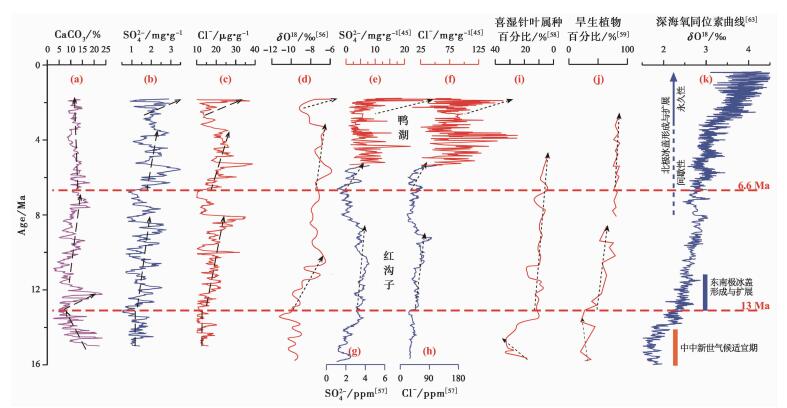
柴达木盆地怀头他拉剖面主要为三角洲相和湖相沉积,物源稳定[29],且柴达木盆地自渐新世以来就是封闭湖盆[27, 28],所以柴达木盆地怀头他拉剖面沉积物氯离子、硫酸根和碳酸钙含量主要受控于气候变化。根据上述实验结果,结合岩性、生物化石及前人研究成果[29, 32~34, 45, 56~62],并与深海氧同位素曲线[63]对比分析,认为15.3Ma以来柴达木盆地气候环境经历了3个阶段的变化过程( 图 3):
|
图 3 柴达木盆地怀头他拉剖面沉积物碳酸钙、硫酸根和氯离子含量变化与前人研究成果和全球气候变化曲线对比 (a)、(b)和(c)分别为怀头他拉剖面CaCO3、SO42-和Cl-含量;(d)怀头他拉剖面氧同位素记录(据Zhuang等,2011[56]);(e)和(f)分别为鸭湖剖面SO42-和Cl-含量变化(据方小敏等,2008[45]);(g)和(h)分别为红沟子剖面SO42-和Cl-含量变化(据Song等,2014[57]);(i)喜湿针叶属种百分比(据Miao等,2011[58]);(j)旱生植物百分比(据Wang等,1999[59]);(k)深海氧同位素曲线(据Zachos等,2001[63]) Fig. 3 The content changes of the CaCO3、SO42- and Cl- in the Huaitoutala section with other records of the Qaidam Basin and the global oxygen isotope record of the deep sea sediments. (a), (b) and (c) are respectively the content changes of CaCO3、SO42- and Cl- in the Huaitoutala section; (d)the oxygen isotope records of the Huaitoutala section(from Zhuang et al., 2011[56]); (e) and (f) are respectively the content changes of SO42- and Cl- in the Yahu section (from Fang et al., 2008[45]); (g) and (h) are respectively the content changes of SO42- and Cl- in the Honggouzi section (from Song et al., 2014[57]); (i)the relatively humid conifers percentages recorded by pollen(from Miao et al., 2011[58]); (j)the xerophyte percentage recorded by pollen (from Wang et al.,1999[59]); (k)the global oxygen isotope record of the deep sea sediments(from Zachos et al., 2001[63]) |
Ⅰ.相对湿润阶段(15.3~13.0Ma)
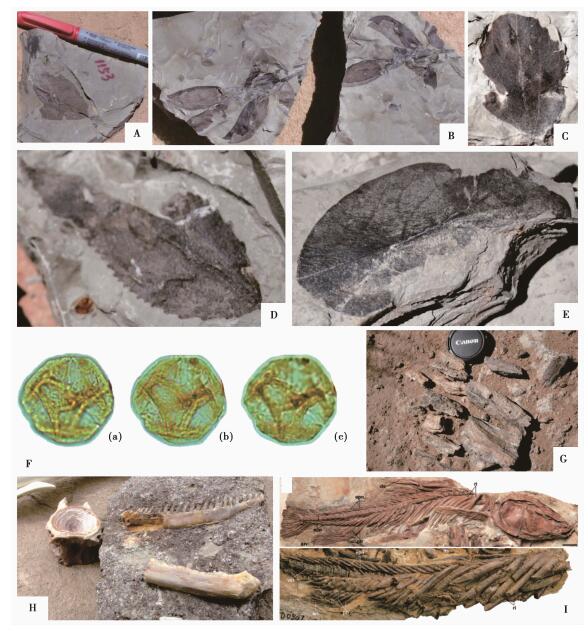
剖面上油砂山组底部相对以高碳酸钙、低硫酸根和氯离子含量为特征( 图 3a~3c),表明此时盆地水位相对较高。结合研究剖面该时段地层中含柴达木无鼻角犀(Acerorhinus tsaidamensis)和柄杯鹿(Lagomeryx)等化石[34]( 图 2)以及氧同位素为全剖面低值( 图 3d)[56],同时怀头他拉剖面东约50km与之平行的瑙格剖面(37°59′2″N,97°18′12″E,见图 1b)同时代地层中(15.5Ma左右)含大量豆科(Leguminosae)、杨属(Populus)、桦木属(Betula)等植物化石(由兰州大学孙柏年教授鉴定)、伏平粉属孢粉(Fupingopollenites)(15.2Ma)[60],以及14.2Ma左右地层存在西班牙犀(Hispanotherium matritense)化石[32, 34]和14Ma左右地层存在大量硅化木化石( 图 4A~4G)[60],认为柴达木盆地15.3~13.0Ma气候总体呈相对湿润特征。
|
图 4 柴达木盆地生物化石 (A~E)瑙格剖面15.5Ma地层中含大量豆科(Leguminosae)、杨属(Populus)、桦木属(Betula)植物化石;(F)瑙格剖面15.2Ma地层含伏平粉属(Fupingopollenites)孢粉(据Miao等,2016[60]);(G)瑙格剖面14Ma地层硅化木化石[60];(H)瑙格剖面8Ma地层中骨骼正常的鱼类化石[60];(I)鸭湖地区上新世地层含骨骼异常增粗的伍氏献文鱼(Hsianwenia wui)化石(据Chang等,2008[61]) Fig. 4 Biological fossils of the Qaidam Basin. (A~E)Lots of plant fossils of the Naoge section in 15.5Ma, such as Leguminosae, Populus and Betula; (F)Fupingopollenites of the Naoge section in 15.2Ma (from Miao et al., 2016[60]); (G)silicified wood fossils of the Naoge section in 14Ma[60]; (H)the normal bone fish fossil of the Naoge section in 8Ma[60]; (I)extraordinarily thick-boned fish fossil of the Yahu region in Pliocene (from Zhang et al., 2008[61]) |
Ⅱ.半干旱-半湿润阶段(13.0~6.6Ma)
13.0Ma左右沉积物CaCO3、SO42-和Cl-含量相对明显增加,13.0~8.1Ma可溶性SO42-和Cl-含量相对前期呈阶段性台阶式增加,特别Cl-含量在13.0Ma和11.4Ma左右明显增加,到8.1Ma左右达到高值(见图 2和图 3a~3c),可能代表柴达木盆地气候从前期相对湿润环境开始向逐步干旱环境转变。结合Zhuang等[56]对该剖面研究表明氧同位素记录于13Ma左右开始明显逐渐增大( 图 3d)、Song等[57]通过柴达木盆地红沟子剖面沉积物记录研究显示13Ma左右SO42-和Cl-含量明显增高( 图 3g和3h)、Wang等[59]通过柴达木盆地西部地区研究显示13Ma左右旱生植物孢粉开始明显相对增加( 图 3j)以及Miao等[58]通过柴达木盆地KC-1钻孔孢粉研究显示13Ma左右喜湿针叶属种孢粉相对明显减少( 图 3i),认为13Ma左右以来柴达木盆地气候具有向干旱环境发展趋势。但结合研究剖面8.1~6.6Ma硫酸根和氯离子含量相对前期明显降低,以及12.5~10.0Ma左右地层含鼬鬣狗(Ictitherium)、皇冠鹿属(Stephanocemas)、柄杯鹿(Lagomeryx)和长鼻类(Elephant)等化石[29, 34]( 图 2),10~9Ma左右地层存在砂犷兽(Chalicotherium)、菱角(Trapasp.)和犀牛(Rhino)等以及粗大植物茎秆化石,8Ma左右地层存在象、三趾马(Hipparion)[33, 34]和爪兽(Chalicotherium)[62]以及骨骼正常的鱼类化石(由美国洛杉矶自然历史博物馆王晓鸣鉴定)( 图 4H)等资料,认为该时期柴达木盆地气候总体属半干旱-半湿润环境。这与邻区祁连山北缘酒泉盆地老君庙剖面孢粉记录显示的气候特征大体一致,即酒泉盆地13.0~11.5Ma为草原植被生态环境、8.6Ma草原植被开始发育、8.40~6.93Ma为森林草原生态环境[64, 65]。
Ⅲ.干旱阶段(6.6~1.8Ma)
6.6Ma左右沉积物可溶硫酸根和氯离子含量再次增加,特别5.3Ma左右氯离子含量达到峰值以及2.6Ma以来硫酸根和氯离子含量呈明显大幅增高(见图 2和图 3a~3c),结合怀头他拉剖面该时段地层5Ma左右仅出现以模鼠(Mimomys)、东方鼠(Orientalomys)、日进鼠(Chardinomys)、巢鼠(Micromys)、沙鼠(Pseudomeriones)、尖鼠(Soricidae)等啮齿目小哺乳动物化石[29, 34]( 图 2),说明此阶段气候具明显逐步阶段性干旱化特征。另一方面,除柴达木盆地8Ma左右地层保存有骨骼正常的鱼类化石外,Chang等[61]在盆地中部鸭湖地区上新世地层发现代表气候干旱化特征的骨骼异常增粗的伍氏献文鱼化石(Hsianwenia wui)( 图 4I)。同时,方小敏等[45]通过鸭湖剖面孢粉和盐类元素气候代用指标的研究( 图 3e和3f),认为5.3Ma时湖泊周围已分布着以蒿属(Artemisia)、藜科(Chenopodiaceae)、麻黄属(Ephedra)、禾本科(Poaceae)等为主的草原,气候已经变干,2.6Ma后耐旱植物花粉含量与盐度指标均呈现明显长期增加趋势,气候快速向更干旱方向发展;另外,柴达木盆地脊椎动物牙釉质碳氧同位素和孢粉记录也显示该区上新世初干旱化加剧[66, 67]。上述柴达木盆地记录表明6.6Ma以来区域气候明显具有干旱环境的特征,该阶段气候干旱化特征在邻近中国西北广大地区都有普遍的记录,如临夏盆地7Ma出现风成沉积物[68]、6.4Ma后急剧加速变干(约6.2Ma碳酸钙含量和氯离子浓度增加至最高峰)[43],孢粉显示5.67Ma为荒漠草原环境、5.0~4.4Ma植被以藜、麻黄和蒿为主,3.6Ma暖温带阔叶林消失[64];河西走廊酒泉盆地孢粉记录显示古气候环境经6.93~6.64Ma、5.67~5.42Ma和3.66~3.30Ma干旱事件后最终演化为荒漠植被[64];黄土高原北部佳县红粘土剖面的无机碳同位素记录了C4植被分别在6.6Ma和3.6Ma存在明显扩张演化[69]。在新疆,Sun等[70~72]通过对塔里木盆地桑珠剖面沉积物色度、磁化率、有机碳、孢粉、风成砂、SO42-和Cl-含量等研究,认为世界第二大移动沙漠——新疆塔克拉玛干沙漠开始形成于5.3Ma,代表了内陆干旱加强。他们又通过塔里木盆地塔克拉玛干沙漠中部麻扎塔格剖面的风成砂进一步研究,确认塔克拉玛干沙漠开始形成于7Ma左右[71];2015年他们又通过塔里木盆地北缘库车剖面沉积物色度、元素和有机碳等分析,认为晚新生代存在7.0~5.3Ma干旱和5.3Ma以来极端干旱化两个阶段[72];Liu等[73]通过新疆塔里木盆地罗布泊地区钻孔沉积物TOC、CaCO3以及硼(δ 11 B)和氧(δ 18 O)同位素记录研究,认为干旱的塔里木盆地于4.9Ma从湖泊环境转变为沙漠环境;姚轶锋等[12]通过新疆准噶尔、塔里木、昆仑地区孢粉记录研究显示上新世出现草原和荒漠草原,代表气候干旱化显著加剧;马小林和田军[74]通过中国内陆、南海和西北太平洋的构造和气候信号对比分析,认为7Ma左右西北内陆全面干旱化;常秋芳和常宏[75]根据罗布泊Ls2孔千余米沉积物详细的岩性磁学和环境磁学研究,认为罗布泊地区7.1~5.6Ma气候相对干旱和湿润交替出现、5.6~3.6Ma干旱化加剧,反映了渐进式的干旱化过程。
根据上述柴达木盆地怀头他拉剖面中中新世以来碳酸盐、硫酸根和氯离子含量变化趋势以及剖面中含动物和植物化石情况,结合前人研究成果,认为该区中中新世以来气候变化经历了15.3~13.0Ma相对湿润、13.0~6.6Ma半干旱-半湿润和6.6~1.8Ma干旱3个演化阶段,但干旱历史可能从13.0Ma开始逐步发展,而真正意义上的干旱化可能自6.6Ma左右开始。由于大量研究表明特提斯洋海退发生时间为中新世前[26, 76],所以特提斯洋海退时间早于本文研究时段。而新生代全球气候变化存在3次重大阶梯状变冷事件( 图 3),分别发生在渐新世(34Ma)、中新世(14Ma)和上新世(3Ma)[63]。渐新世全球变冷事件后,全球温度自26Ma开始持续升高,至“中中新世气候适宜期”(Middle Miocene Climatic Optimum,18~14Ma,见图 3k)赤道海表温度上升3~5℃,南极洲底层水温增加2~3℃,南极区和中低纬度之间存在温度梯度而形成北半球的夏季风,携带着热带海洋蒸发的水汽长驱直入亚洲大陆内部,可能导致了柴达木盆地怀头他拉地区15.3~13.0Ma气候相对湿润( 图 3);13Ma左右中中新世全球大降温事件导致大西洋底栖有孔虫氧同位素值由14Ma前小于1.5‰一度升高至大于2‰[63, 77],全球气候由最温暖期向低温寒冷期转变,东南极冰盖开始形成,并于11Ma扩展至最大规模( 图 3k),海平面大幅度下降,12Ma挪威-格陵兰海域首次出现冰筏[63]。所以柴达木盆地气候从13.0Ma以前湿润转为13.0~6.6Ma半干旱-半湿润环境与全球中中新世大降温趋势一致( 图 3k);柴达木盆地6.6Ma以来(特别5.3Ma左右和2.6Ma以来)气候的干旱[45],与6Ma左右南极冰盖再次增大(西南极冰盖开始形成并延伸至南美洲南部地区[63])、3Ma左右北极冰盖迅速增长(北大西洋和北太平洋深海沉积物氧同位素值和冰筏碎屑物显著增加[63])吻合( 图 3k)。可见,全球变冷控制着柴达木盆地干旱气候形成和发展;另一方面,中国北方地质、生物和构造记录与南海及全球记录的对比研究等大量地质证据支持青藏高原的构造隆升与亚洲季风气候变化存在着阶段性的耦合关系,尤其是高原东北缘的扩张可导致东亚冬季风同步加强以及亚洲内陆干旱化的加剧[78~80]。Fang等[29]通过柴达木盆地怀头他拉一带构造-沉积研究认为青藏高原在14.7Ma、8.1Ma和3.6Ma经历了多次强烈的构造活动。大量研究表明,晚新生代以来青藏高原发生一系列阶段性的强烈快速隆升[19, 65, 78~80],高原不断的构造抬升不仅阻挡水汽进入内陆地区(雨影效应),而且加速了地表风化进程,大量消耗大气中的CO2,形成冰室效应导致气候变冷变干。因此,柴达木盆地13.0Ma以来干旱化进程是由全球变冷与高原隆升共同影响所致,其中全球变冷是亚洲内陆干旱化的主控因素,而青藏高原隆升起到了催化剂的作用。
5 结论柴达木盆地沉积了巨厚且连续的新生代地层,详细记录了古气候环境演化信息。盆地东北缘怀头他拉剖面沉积物碳酸钙、硫酸根和氯离子含量总体上呈3个阶段变化特征:1)15.3~13.0Ma期间CaCO3含量呈降低趋势、SO42-和Cl-含量保持相对低值;2)13.0~6.6Ma期间CaCO3含量急剧升高后降低、SO42-和Cl-含量台阶式增加;3)6.6 Ma以来各指标含量均高于上一阶段、CaCO3含量稳定变化、SO42-和Cl-含量呈明显增加趋势。结合生物化石和周缘地区研究成果,表明中国西北干旱区柴达木盆地中中新世以来气候环境经历了由15.3~13.0Ma相对湿润转变为13.0~6.6Ma半干旱-半湿润、最后6.6~1.8Ma为显著干旱的逐渐阶段性演化过程,而该区干旱化历史可能从13.0Ma开始逐步发展,但真正意义上的干旱化可能自6.6Ma左右开始。气候代用指标变化趋势与深海氧同位素曲线、青藏高原构造事件对比分析,认为我国西北地区中新世以来气候演化过程是由全球变化和青藏高原隆升共同控制,干旱化形成主要由中中新世全球变冷事件引起,而中新世晚期以来青藏高原强烈隆升加剧了干旱化过程。
致谢: 感谢审稿专家和编辑部老师建设性的修改意见。
| 1 |
Lu Huayu, Wang Xianyan, Li Langping. Aeolian sediment evidence that global cooling has driven Late Cenozoic stepwise aridification in Central Asia.
Geological Society (London:Special Publications),2010, 342 (1) : 29~44.
( 0) 0)
|
| 2 |
Duce R A, Unni C K, Ray B J, et al. Long-range atmospheric transport of soil dust from Asia to the tropical North Pacific:Temporal variability.
Science,1980, 209 (4464) : 1522~1524.
(0)
|
| 3 |
Bishop J K B, Davis R E, Sherman J T. Robotic observations of dust storm enhancement of carbon biomass in the North Pacific.
Science,2002, 298 (5594) : 817~821.
(0)
|
| 4 |
郭正堂, 彭淑贞, 郝青振, 等. 晚第三纪中国西北干旱化的发展及其与北极冰盖形成演化和青藏高原隆升的关系.
第四纪研究,1999 (6) : 556~567.
Guo Zhengtang, Peng Shuzhen, Hao Qingzhen, et al. Late Tertiary development of aridification in Northwestern China:Link with the arctic ice-sheet formation and Tibetan uplifts. Quaternary Sciences,1999 (6) : 556~567. ( 0)
|
| 5 |
刘晓东, 李力, 安芷生. 青藏高原隆升与欧亚内陆及北非的干旱化.
第四纪研究,2001, 21 (2) : 114~121.
Liu Xiaodong, Li Li, An Zhisheng. Tibetan Plateau uplift and drying in Eurasian interior and Northern Africa. Quaternary Sciences,2001, 21 (2) : 114~121. ( 0)
|
| 6 |
Biscaye P E, Grousset F E, Revel M, et al. Asian provenance of glacial dust(stage2)in the Greenland Ice Sheet Project2 Ice Core, Summit, Greenland.
Journal of Geophysical Research Oceans,1997, 102 (C12) : 26765~26781.
(0)
|
| 7 |
Yang Shiling, Ding Feng, Ding Zhongli. Pleistocene chemical weathering history of Asian arid and semi-arid regions recorded in loess deposits of China and Tajikistan.
Geochimica et Cosmochimica Acta,2006, 70 (7) : 1695~1709.
(0)
|
| 8 |
方小敏, 徐先海, 宋春晖, 等. 临夏盆地新生代沉积物高分辨率岩石磁学记录与亚洲内陆干旱化过程及原因.
第四纪研究,2007, 27 (6) : 989~1000.
Fang Xiaomin, Xu Xianhai, Song Chunhui, et al. High resolution rock magnetic records of Cenozoic sediments in the Linxia Basin and their implications on drying of Asian inland. Quaternary Sciences,2007, 27 (6) : 989~1000. ( 0)
|
| 9 |
Sun Jimin, Zhang Liyuan, Deng Chenglong, et al. Evidence for enhanced aridity in the Tarim Basin of China since5.3Ma.
Quaternary Science Reviews,2008, 27 (9-10) : 1012~1023.
(0)
|
| 10 |
肖国桥, 周新郢, 葛俊逸, 等. 西宁盆地晚始新世石膏-红色泥岩旋回的古环境指示.
第四纪研究,2010, 30 (5) : 919~924.
Xiao Guoqiao, Zhou Xinying, Ge Junyi. Sedimentary characteristics and paleoenvironmental significance of Late Eocene gypsum-mudstone cycles in the Xining Basin, north eastern Tibetan Plateau. Quaternary Sciences,2010, 30 (5) : 919~924. ( 0)
|
| 11 |
脱世博, 方小敏, 宋春晖, 等. 青藏高原东北部西宁盆地晚渐新世-早中新世沉积物岩石磁学特征及其古环境意义.
第四纪研究,2013, 33 (5) : 829~838.
Tuo Shibo, Fang Xiaomin, Song Chunhui, et al. Rock magnetic characteristics of the Late Oligocene to Early Miocene sediments in the Xining Basin, northeastern Tibetan Plateau. Quaternary Sciences,2013, 33 (5) : 829~838. ( 0)
|
| 12 |
姚轶锋, 王霞, 谢淦, 等. 孢粉记录的新疆地区新近纪植被格局与气候环境演化.
第四纪研究,2015, 35 (3) : 683~697.
Yao Yifeng, Wang Xia, Xie Gan, et al. Neogene vegetation pattern, climate and environment evolution in Xinjiang region: A synthesis of pollen records. Quaternary Sciences,2015, 35 (3) : 683~697. ( 0)
|
| 13 |
汪品先, 李前裕, 田军, 等. 从南海看第四纪大洋碳储库的长周期循环.
第四纪研究,2015, 35 (6) : 1297~1319.
Wang Pinxian, Li Qianyu, Tian Jun, et al. Long-term cycles in carbon reservoir of the Quaternary ocean:A perspective from the South China Sea. Quaternary Sciences,2015, 35 (6) : 1297~1319. ( 0)
|
| 14 |
赵秀丽, 张春霞, 吴海斌, 等. 西宁盆地始新世/渐新世过渡期孢粉植物群特征及其意义.
第四纪研究,2015, 35 (6) : 1489~1499.
Zhao Xiuli, Zhang Chunxia, Wu Haibin, et al. Significance of Eocene-Oligocenen transition pollen record from Xining Basin, China. Quaternary Sciences,2015, 35 (6) : 1489~1499. ( 0)
|
| 15 |
Guo Zhengtang, Peng Shuzhen, Hao Qingzhen, et al. Late Miocene-Pliocene development of Asian aridification as recorded in the Red-Earth Formation in Northern China.
Global & Planetary Change,2004, 41 (3-4) : 135~145.
(0)
|
| 16 |
Dupont-Nivet G, Krijgsman W, Langereis C G, et al. Tibetan plateau aridification linked to global cooling at the Eocene-Oligocene transition.
Nature,2007, 445 (7128) : 635~638.
(0)
|
| 17 |
Ruddiman W F, Kutzbach J E. Forcing of Late Cenozoic Northern Hemisphere climate by Plateau uplift in Southern Asia and the American West.
Journal of Geophysical Research Atmospheres,1989, 94 (15) : 409~427.
(0)
|
| 18 |
施雅风, 汤懋苍, 马玉贞. 青藏高原二期隆升与亚洲季风孕育关系探讨.
中国科学(D辑),1999, 42 (3) : 303~312.
Shi Yafeng, Tang Maocang, Ma Yuzhen. Linkage between the second uplifting of the Qinghai-Xizang(Tibetan)Plateau and the initiation of the Asian monsoon system. Science in China (Series D),1999, 42 (3) : 303~312. ( 0)
|
| 19 |
李吉均, 方小敏. 青藏高原隆起与环境变化研究.
科学通报,1998, 43 (15) : 1569~1574.
Li Jijun, Fang Xiaomin. Uplift of Qinghai-Tibetan Plateau and environmental change. Chinese Science Bulletin,1998, 43 (15) : 1569~1574. ( 0)
|
| 20 |
陈隆勋, 刘骥平, 周秀骥. 青藏高原隆起及海陆分布变化对亚洲大陆气候的影响.
第四纪研究,1999 (4) : 314~319.
Chen Longxun, Liu Jiping, Zhou Xiuji. Impact of uplift of Qinghai-Xizang Plateau and change of land-ocean distribution on climate over Asia. Quaternary Sciences,1999 (4) : 314~319. ( 0)
|
| 21 |
An Zhisheng, Kutzbach J E, Prell W L, et al. Evolution of Asian monsoons and phased uplift of the Himalaya-Tibetan Plateau since Late Miocene times.
Nature,2001, 411 (6833) : 62~66.
(0)
|
| 22 |
刘晓东, DongBuwen. 青藏高原隆升对亚洲季风-干旱环境演化的影响.
科学通报,2013, 58 (34) : 4277~4291.
Liu Xiaodong, Dong Buwen. Influence of the Tibetan Plateau uplift on the Asian monsoon-arid environment evolution. Chinese Science Bulletin,2013, 58 (34) : 4277~4291. ( 0)
|
| 23 |
Ramstein G, Fluteau F, Besse J, et al. Effect of orogeny, plate motion and land-sea distribution on Eurasian climate change over the past30 million years.
Nature,1997, 386 (6627) : 788~795.
(0)
|
| 24 |
]ZhangZhongshi, WangHuijun, GuoZhengtang, 等. What triggers the transition of palaeoenvironmental patterns in China, the Tibetan Plateau uplift or the Paratethys Sea retreat?.
Palaeogeography, Palaeoclimatology, Palaeoecology,2007, 245 (3-4) : 317~331.
(0)
|
| 25 |
Zhang Zhongshi, Wang Huijun, Guo Zhengtang, et al. Impacts of tectonic changes on the reorganization of the Cenozoic paleoclimatic patterns in China.
Earth & Planetary Science Letters,2007, 257 (3-4) : 622~634.
(0)
|
| 26 |
孙东怀, 王鑫, 李宝锋, 等. 新生代特提斯海演化过程及其内陆干旱化效应研究进展.
海洋地质与第四纪地质,2013, 33 (4) : 135~151.
Sun Donghuai, Wang Xin, Li Baofeng, et al. Evolution of Cenozoic Tethys and its environmental effects on inland drought. Marine Geology & Quaternary Geology,2013, 33 (4) : 135~151. ( 0)
|
| 27 |
赵加凡, 陈小宏, 杜业波. 柴达木第三纪湖盆沉积演化史.
石油勘探与开发,2004, 31 (3) : 41~44.
Zhao Jiafan, Chen Xiaohong, Du Yebo. The Tertiary sedimentary evolution of the Qaidam Basin, Northwest China. Petroleum Exploration and Development,2004, 31 (3) : 41~44. ( 0)
|
| 28 |
Zhu Lidong, Wang Chengshan, Zheng Hongbo, et al. Tectonic and sedimentary evolution of basins in the northeast of Qinghai-Tibet Plateau and their implication for the northward growth of the Plateau.
Palaeogeography, Palaeoclimatology, Palaeoecology,2006, 241 (1) : 49~60.
(0)
|
| 29 |
Fang Xiaomin, Zhang Weilin, Meng Qingquan, et al. High resolution magnetostratigraphy of the Neogene Huaitoutala section in the eastern Qaidam Basin on the NE Tibetan Plateau, Qinghai Province, China and its implication on tectonic uplift of the NE Tibetan Plateau.
Earth & Planetary Science Letters,2007, 258 (S1-2) : 293~306.
(0)
|
| 30 |
张彭熹, 于升松, 支霞臣, 等.
柴达木盆地盐湖 . 北京: 科学出版社, 1987 : 1 ~6.
Zhang Pengxi, Yu Shengsong, Zhi Xiachen, et al. Saline Lake in the Qaidam Basin. Saline Lake in the Qaidam Basin. Beijing: Science Press, 1987 : 1 ~6. ( 0)
|
| 31 |
青海省地质矿产局.
中华人民共和国地质矿产部地质专报:一, 区域地质, 第24号:青海省区域地质志 . 北京: 地质出版社, 1991 : 1 ~662.
Bureau of Geology and Mineral Resources of Qinghai Province. People's Republic of China Ministry of Geology and Mineral Resources, Geological Memoirs, Series1, November24:Regional Geology of Qinghai Province. Beijing: Geological Publishing House, 1991 : 1 ~662. ( 0)
|
| 32 |
邓涛, 王晓鸣. 柴达木盆地新近纪犀科化石新材料.
古脊椎动物学报,2004, 42 (3) : 216~229.
Deng Tao, Wang Xiaoming. New material of the Neogene Rhinocerotids from the Qaidam Basin in Qinghai, China. Vertebrata PalAsiatica,2004, 42 (3) : 216~229. ( 0)
|
| 33 |
邓涛, 王晓鸣. 柴达木盆地晚中新世三趾马化石.
古脊椎动物学报,2004, 42 (4) : 316~333.
Deng Tao, Wang Xiaoming. Late Miocene Hipparion (Equidae, Mammalia) of eastern Qaidam Basin in Qinghai, China. Vertebrata PalAsiatica,2004, 42 (4) : 316~333. ( 0)
|
| 34 |
Wang Xiaoming, Qiu Zhuding, Li Qiang, et al. Vertebrate paleontology, biostratigraphy, geochronology and paleoenvironment of Qaidam Basin in northern Tibetan Plateau.
Palaeogeography, Palaeoclimatology, Palaeoecology,2007, 254 (3) : 363~385.
(0)
|
| 35 |
Cande S C, Kent D V. Revised calibration of geomagnetic polarity time scale for the Late Cretaceous and Cenozoic.
Journal of Geophysical Research: Solid Earth,1995, 100 (B4) : 6093~6095.
(0)
|
| 36 |
Dunn D A. Revised techniques for quantitative calcium carbonate analysis using the "Karbonat-Bombe, " and comparisons to other quantitative carbonate analysis methods.
Journal of Sedimentary Research,1980, 50 (2) : 631~636.
(0)
|
| 37 |
刘兆礼, 黄钺. 应用EDTA容量法测定土壤中的石膏.
土壤,1981, 13 (1) : 34~37.
Liu Zhaoli, Huang Yue. The application of EDTA volumetric method in determination of gypsum in soil. Soil,1981, 13 (1) : 34~37. ( 0)
|
| 38 |
俞凌云, 朱娟, 张新申. 氯离子测定方法及其应用研究.
西部皮革,2009, 31 (15) : 32~36.
Yu Lingyun, Zhu Juan, Zhang Xinshen. Determination method of chloride and its application. Westleather,2009, 31 (15) : 32~36. ( 0)
|
| 39 |
李明慧, 康世昌. 青藏高原湖泊沉积物对古气候环境变化的响应.
盐湖研究,2007, 15 (1) : 63~72.
Li Minghui, Kang Shichang. Responses of lake sediment to paleoenvironmental and paleoclimatic changes in Tibetan Plateau. Journal of Salt Lake Research,2007, 15 (1) : 63~72. ( 0)
|
| 40 |
Eugster H P, Hardie L A.
Saline Lakes. New York: Lakes Springer, 1978 : 237 ~293.
(0)
|
| 41 |
郑绵平, 赵元艺. 第四纪盐湖沉积与古气候.
第四纪研究,1998 (4) : 297~307.
Zheng Mianping, Zhao Yuanyi. Quaternary saline lake deposition and paleoclimate. Quaternary Sciences,1998 (4) : 297~307. ( 0)
|
| 42 |
张洪, 靳鹤龄, 肖洪浪, 等. 东居延海易溶盐沉积与古气候环境变化.
中国沙漠,2004, 24 (4) : 409~415.
Zhang Hong, Jin Heling, Xiao Honglang, et al. Soluble salt sediments of east Juyan Lake and its indicating palaeoclimate environment changes. Journal of Desert Research,2004, 24 (4) : 409~415. ( 0)
|
| 43 |
方小敏, 奚晓霞, 李吉均, 等. 中国西部晚中新世气候变干事件的发现及其意义.
科学通报,1997, 42 (23) : 2521~2524.
Fang Xiaomin, Xi Xiaoxia, Li Jijun, et al. Dry climate events and its significance in the Late Miocene in Western China. Chinese Science Bulletin,1997, 42 (23) : 2521~2524. ( 0)
|
| 44 |
Sinha R, Raymahashay B C. Evaporite mineralogy and geochemical evolution of the Sambhar Salt Lake, Rajasthan, India.
Sedimentary Geology,2004, 166 (1) : 59~71.
(0)
|
| 45 |
方小敏, 吴福莉, 韩文霞, 等. 上新世-第四纪亚洲内陆干旱化过程-柴达木中部鸭湖剖面孢粉和盐类化学指标证据.
第四纪研究,2008, 28 (5) : 874~882.
Fang Xiaomin, Wu Fuli, Han Wenxia, et al. Plio-Pleistocene drying process of Asian inland-Sporopollen and salinity records from Yahu section in the central Qaidam Basin. Quaternary Sciences,2008, 28 (5) : 874~882. ( 0)
|
| 46 |
曾蒙秀, 宋友桂. 西风区昭苏黄土剖面中碳酸盐矿物组成及其古环境意义辨识.
第四纪研究,2013, 33 (3) : 424~436.
Zeng Mengxiu, Song Yougui. Carbonate minerals of Zhaosu loess section in westerly area and their paleoenvironmental significance. Quaternary Sciences,2013, 33 (3) : 424~436. ( 0)
|
| 47 |
滕晓华, 韩文霞, 叶程程, 等. 柴达木盆地SG-1孔1.0Ma以来碳酸盐同位素记录的亚洲内陆干旱化及成因.
第四纪研究,2013, 33 (5) : 866~875.
Teng Xiaohua, Han Wenxia, Ye Chengcheng, et al. Aridification of the Asian inland since1.0Ma:Evidences from carbonate isotope records of deep core from the Qaidam Basin. Quaternary Sciences,2013, 33 (5) : 866~875. ( 0)
|
| 48 |
梁莲姬, 孙有斌, ChristiaanJ B, 等. 黄土中的碳酸盐矿物特征与化学风化.
第四纪研究,2014, 34 (3) : 345~653.
Liang Lianji, Sun Youbin, Christiaan J B, et al. Characteristics of carbonate minerals in loess and its implication for chemical weathering. Quaternary Sciences,2014, 34 (3) : 345~653. ( 0)
|
| 49 |
雷国良, 张虎才, 朱芸, 等. 湖泊沉积碳酸盐氧同位素影响因素的定量评估.
第四纪研究,2015, 35 (1) : 143~151.
Lei Guoliang, Zhang Hucai, Zhu Yun, et al. Quantitative evaluation for driving factors of carbonate oxygen isotope composition in lake sediments. Quaternary Sciences,2015, 35 (1) : 143~151. ( 0)
|
| 50 |
Warren J K.
Evaporites:Sediments, Resources and Hydrocarbons. Berlin: Springer-Verlag, 2006 : 84 ~96.
(0)
|
| 51 |
Berelson W, Corsetti F, Johnson B, et al. Carbonate-associated sulfate as a proxy for lake level fluctuations:A proof of concept for Walker Lake, Nevada.
Journal of Paleolimnology,2009, 42 (1) : 25~36.
(0)
|
| 52 |
Hakanson L, Jansson M.
Principles of Lake Sedimentology. Berlin: Springer-Verlag, 1983 : 73 ~117.
(0)
|
| 53 |
Tabor N J, Poulsen C J. Palaeoclimate across the Late Pennsylvanian-Early Permian tropical palaeolatitudes:A review of climate indicators, their distribution, and relation to palaeophysiographic climate factors.
Palaeogeography, Palaeoclimatology, Palaeoecology,2008, 268 (3-4) : 293~310.
(0)
|
| 54 |
Sun Jimin, Lu Tongyan, Zhang Zhengqing, et al. Stepwise expansions of C4 biomass and enhanced seasonal precipitation and regional aridity during the Quaternary on the southern Chinese Loess Plateau.
Quaternary Science Reviews,2012, 34 (2) : 57~65.
(0)
|
| 55 |
盛文坤, 姚檀栋, 邓友生. 用冰芯中的硫酸根离子探讨古里雅冰川作用区的干湿变化.
冰川冻土,1997, 19 (1) : 90~94.
Sheng Wenkun, Yao Tandong, Deng Yousheng. Dryness variation in the Guliya Ice Cap region approached by SO42-within ice core. Journal of Glaciology and Geocryology,1997, 19 (1) : 90~94. ( 0)
|
| 56 |
Zhuang Guangsheng, Hourigan J K, Koch P L, et al. Isotopic constraints on intensified aridity in Central Asia around12Ma.
Earth & Planetary Science Letters,2011, 312 (1) : 152~163.
(0)
|
| 57 |
Song Chunhui, Hu Sihu, Han Wenxia, et al. Middle Miocene to Earliest Pliocene sedimentological and geochemical records of climate change in the western Qaidam Basin on the NE Tibetan Plateau.
Palaeogeography, Palaeoclimatology, Palaeoecology,2014, 395 (2) : 67~76.
(0)
|
| 58 |
Miao Yunfa, Fang Xiaomin, Herrmann M, et al. Miocene pollen record of KC-1 core in the Qaidam Basin, NE Tibetan Plateau and implications for evolution of the East Asian monsoon.
Palaeogeography, Palaeoclimatology, Palaeoecology,2011, 299 (S1-2) : 30~38.
(0)
|
| 59 |
Wang Jian, Wang Yongjin, Liu Zechun, et al. Cenozoic environmental evolution of the Qaidam Basin and its implications for the uplift of the Tibetan Plateau and the drying of Central Asia.
Palaeogeography, Palaeoclimatology, Palaeoecology,1999, 152 (1) : 37~47.
(0)
|
| 60 |
Miao Yunfa, Song Chunhui, Fang Xiaomin, et al. Late Cenozoic genus Fupingopollenites development and its implications for the Asian summer monsoon evolution.
Gondwana Research,2016, 29 (1) : 320~333.
(0)
|
| 61 |
Chang Meemann, Wang Xiaoming, Liu Huanzhang, et al. Extraordinarily thick-boned fish linked to the aridification of the Qaidam Basin(northern Tibetan Plateau).
Proceedings of the National Academy of Sciences of the United States of America,2008, 105 (36) : 13246~13251.
(0)
|
| 62 |
陈少坤, 李强, 王晓鸣. 柴达木盆地晚中新世早期的爪兽化石及其古环境意义.
第四纪研究,2015, 35 (3) : 528~538.
Chen Shaokun, Li Qiang, Wang Xiaoming. Chalicothere fossils from the early Late Miocene of the Qaidam Basin, and their paleoenvironmental implications. Quaternary Sciences,2015, 35 (3) : 528~538. ( 0)
|
| 63 |
Zachos J C, Shackleton N J, Revenaugh J S, et al. Climate response to orbital forcing across the Oligocene-Miocene boundary.
Science,2001, 292 (5515) : 274~278.
(0)
|
| 64 |
马玉贞, 方小敏, 李吉均, 等. 酒西盆地晚第三纪-第四纪早期植被与气候变化.
中国科学,2005, 48 (5) : 676~688.
Ma Yuzhen, Fang Xiaomin, Li Jijun, et al. The vegetation and climate change during Neocene and Early Quaternary in Jiuxi Basin, China. Science in China(Series D),2005, 48 (5) : 676~688. ( 0)
|
| 65 |
方小敏, 宋春晖, 戴霜, 等. 青藏高原东北部阶段性变形隆升:西宁、贵德盆地高精度磁性地层和盆地演化记录.
地学前缘,2007, 14 (1) : 230~242.
Fang Xiaomin, Song Chunhui, Dai Shuang, et al. Cenozoic deformation and uplift of the NE Qinghai Tibet Plateau:Evidence from high resolution magnetostratigraphy and basin evolution. Earth Science Frontier,2007, 14 (1) : 230~242. ( 0)
|
| 66 |
Zhang Chunfu, Wang Yang, Li Qiang, et al. Diets and environments of Late Cenozoic mammals in the Qaidam Basin, Tibetan Plateau:Evidence from stable isotopes.
Earth and Planetary Science Letters,2012, 333 (6) : 70~82.
(0)
|
| 67 |
Miao Yunfa, Fang Xiaomin, Wu Fuli, et al. Late Cenozoic continuous aridification in the western Qaidam Basin:Evidence from sporopollen records.
Climate of the Past,2013, 9 (4) : 1863~1877.
(0)
|
| 68 |
Fan Majie, Song Chunhui, Dettman D L, et al. Intensification of the Asian winter monsoon after7.4Ma:Grain-size evidence from the Linxia Basin, northeastern Tibetan Plateau, 13.1Ma to4.3Ma.
Earth and Planetary Science Letters,2006, 248 : 186~197.
(0)
|
| 69 |
何同, 刘连文, 陈旸, 等. 晚中新世-上新世黄土高原佳县红粘土剖面碳同位素记录与C4植被演化.
第四纪研究,2015, 35 (4) : 791~800.
He Tong, Liu Lianwen, Chen Yang, et al. Carbon isotope record of authigenic calcite from the northern Chinese Loess Plateau:Implications for C4 vegetation evolution during Late Miocene-Pliocene. Quaternary Sciences,2015, 35 (4) : 791~800. ( 0)
|
| 70 |
Sun Jimin, Liu Tungsheng. The age of the Taklimakan Desert.
Science,2006, 312 (5780) : 1621.
(0)
|
| 71 |
Sun Jimin. New evidence on the age of the Taklimakan Desert.
Geology,2009, 37 (2) : 159~162.
(0)
|
| 72 |
Sun Jimin, Gong Zhijun, Tian Zhonghua, et al. Late Miocene stepwise aridification in the Asian interior and the interplay between tectonics and climate.
Palaeogeography, Palaeoclimatology, Palaeoecology,2015, 421 : 48~59.
(0)
|
| 73 |
Liu Weiguo, Liu Zhonghui, An Zhisheng, et al. Late Miocene episodic lakes in the arid Tarim Basin, Western China.
Proceedings of the National Academy of Sciences of the United States of America,2014, 111 (46) : 16292~16296.
(0)
|
| 74 |
马小林, 田军. 15Ma以来海陆记录的轨道-构造尺度东亚季风的演化以及西北内陆的干旱化.
第四纪研究,2015, 35 (6) : 1320~1330.
Ma Xiaolin, Tian Jun. East Asian monsoon evolution and aridification of Northwest China viewed from land and sea on the tectonic-orbital time scale since15Ma. Quaternary Sciences,2015, 35 (6) : 1320~1330. ( 0)
|
| 75 |
常秋芳, 常宏. 罗布泊Ls2孔近7.1Ma以来沉积物的环境磁学研究.
第四纪研究,2013, 33 (5) : 876~888.
Chang Qiufang, Chang Hong. The environmental magnetism study of core Ls2 in Lop Nur, Tarim since7.1Ma. Quaternary Sciences,2013, 33 (5) : 876~888. ( 0)
|
| 76 |
Bosboom R E, Dupont-Nivet G, Houben A J P, et al. Late Eocene sea retreat from the Tarim Basin (West China)and concomitant Asian paleoenvironmental change.
Palaeogeography, Palaeoclimatology, Palaeoecology,2010, 299 (3-4) : 385~398.
(0)
|
| 77 |
Zachos J C, Dickens G R, Zeebe R E. An Early Cenozoic perspective on greenhouse warming and carbon-cycle dynamics.
Nature,2008, 451 (7176) : 279~283.
(0)
|
| 78 |
安芷生, 张培震, 王二七, 等. 中新世以来我国季风-干旱环境演化与青藏高原的生长.
第四纪研究,2006, 26 (5) : 678~693.
An Zhisheng, Zhang Peizhen, Wang Erchie, et al. Changes of the monsoon-arid environment in China and growth of the Tibetan Plateau since the Miocene. Quaternary Sciences,2006, 26 (5) : 678~693. ( 0)
|
| 79 |
Rea D K, Hilde S, Joseph L H. Late Cenozoic eolian deposition in the North Pacific:Asia drying, Tibetan uplift and cooling of the Northern Hemisphere.
Paleoceanography,1998, 13 (3) : 215~224.
(0)
|
| 80 |
Li Jijun, Fang Xiaomin, Song Chunhui, et al. Late Miocene-Quaternary rapid stepwise uplift of the NE Tibetan Plateau and its effects on climatic and environmental changes.
Quaternary Research,2014, 81 (3) : 400~423.
(0)
|
Abstract
As the largest temperate arid region, Central Asia has been attracting widely attention for its great impacts on global climatic change. Global cooling, Tibetan Plateau uplift and the retreat of the Para-Tethys Sea have been thought to be the key factors controlling the formation and evolution of the aridity of the Asian inland. However, most of the existed evidences on this issue are indirect, largely from the eolian records of the surrounding areas, and little from inland arid area. Due to the scarcity of long-term palaeoclimate records, which of these factors playing the major role keeps unclear. Therefore, obtaining a series of direct and convincing climate evidence is of great significance for us to understand the process and mechanism of Asian aridity. Qaidam Basin, the largest closed basin in the northern Tibetan Plateau, develops continuous Cenozoic sediments, which recorded the tectonic uplift of surrounding mountains and climatic evolution of the area. Here we present multiple geochemical climatic proxy records(CaCO3, SO42- and Cl-) from the Late Cenozoic sedimentary sequence of the Huaitoutala section (37°13'48"N, 96°43'10"E), which is located in the northeastern Qaidam Basin(Fig.1) and consists of the Shangyoushashan Fm., Shizigou Fm. and Qigequan Fm. at ca.15.3~1.8Ma(Fang et al., 2007). The analysis results of the climatic proxy records from 663 samples reveal an evident three-stage climate change since the Middle Miocene(Fig.2). From 15.3Ma to 13.0Ma(relatively humid), the CaCO3 contents(average 11.331%)showed an upward decrease, as well as the average concentrations of the soluble anions SO42- (average 1.464mg/g)and Cl- (average 12.786μg/g) remained at relatively low values. From 13.0Ma to 6.6Ma(semi-arid and semi-humid), the CaCO3 contents(average 10.443 %)decreased after a sharp increase with superimposed high-frequency fluctuations, while the concentrations of SO42-(average 1.526mg/g)and Cl-(average 17.394μg/g)stepwise increased and an obvious drop occurred at 8.1Ma and lasted to 6.6Ma. Since 6.6Ma(arid), the average contents of all the salinity ions were higher than before, among which the CaCO3 contents(average 11.908 %)displayed stable changes, the concentrations of SO42-(average 2.055mg/g)and Cl-(average 20.314μg/g)showed an evident increase, especially after 2.6Ma. With biological characteristics and previous research(Fig.3 and 4), it is concluded that the Qaidam Basin has experienced increased aridity since ca.13.0Ma, and the extreme aridity was initiated at 6.6Ma. We suggest that the Miocene global cooling exerted a significant influence on the drying of the Qaidam Basin. In addition, the episodic and persistent uplift of the NE Tibetan Plateau since the Late Micocene exerted an important influence superimposed upon this driving force.