 2016, Vol.36


②. 中国科学院大学, 北京 100049;
③. 中国科学院青藏高原 地球科学卓越创新中心, 北京 100101;
④. 兰州大学地质科学与矿产资源学院, 甘肃省西部矿产资源重点实验室, 兰州 730000)
造山带与其相伴生的沉积盆地是大陆的两个基本构造单元,它们构成了在空间发展和形成机制上密切联系的构造体系。沉积盆地作为造山带构造演化最直接、最具体的地质记录者,记载了造山带构造演化的许多宝贵信息和线索[1~17]。盆地的沉积学特征、生物地层学研究及其物质组分分析不仅可用于恢复盆地的沉积环境[18~22],而且能够示踪沉积物源区的构造演化历史,可据此建立盆-山耦合演化模式[7~10, 12, 13, 17, 23]。
阿尔金山作为青藏高原地理意义上的北界以及印欧板块碰撞远程效应的一条重要应力释放线,对限定青藏高原隆升、剥蚀、生长历史、构造变形及其环境效应有着非常重要的意义,成为近年来地质学家研究的热点地区之一[24~27]。前人曾以裂变径迹测年、稳定同位素等方法为基础,从阿尔金断裂走滑变形与山脉隆升的耦合关系等角度探讨阿尔金山的隆升历史[28~42]。但利用盆地沉积证据追踪阿尔金山新生代隆升-剥蚀的研究却鲜有报道[6, 15, 43],而通过沉积学手段(如:碎屑成分组成、古流向和沉积物沉积速率随时间的变化等)与其他地质证据相结合来反演周缘造山带的构造隆升事件在青藏高原北缘其他地区已有许多成功先例[7~16, 44~49]。因此,本文拟从盆山耦合的角度出发,选择毗邻阿尔金山且已建立高精度磁性地层年代的柴达木盆地西部地区红沟子剖面作为研究耙区,分析其晚新生代岩性、沉积相、沉积速率以及物源等沉积特征,揭示它们蕴涵的众多信息,探讨其变化的主控因素;进而为研究区构造或气候变化研究提供新的证据,同时为深入研究柴达木盆地及周缘晚新生代以来构造-气候相互作用提供新的线索。
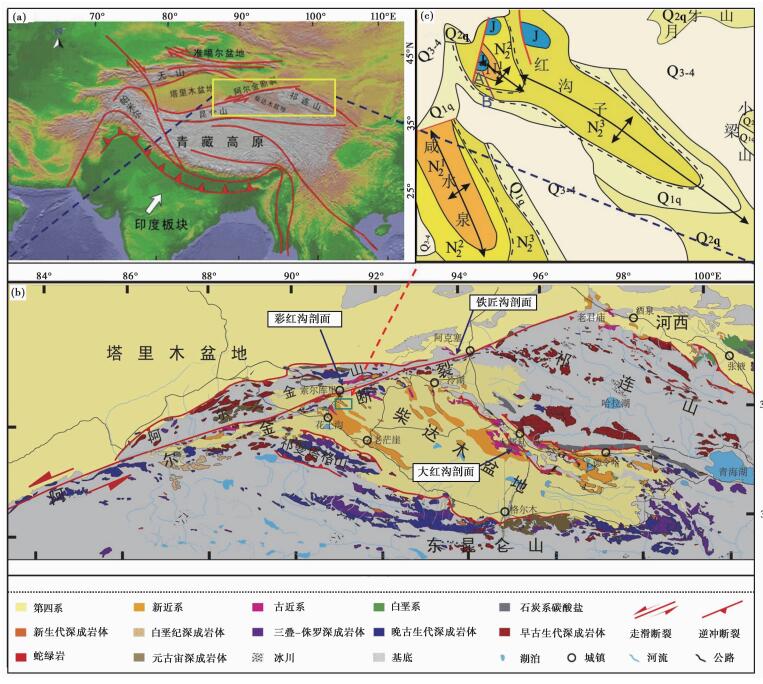
1 研究区地质背景柴达木盆地位于青藏高原东北缘( 图 1a),东西长约850km,南北宽约300km,面积约121000km2。盆地北西以阿尔金山,东北以祁连山,南为东昆仑山,西南以祁曼塔格山为界( 图 1b),是我国西部重要的中、新生代陆相大型含油气盆地。盆地内发育和出露完整的新生代沉积地层,最厚可达13000m。目前其地层学研究比较深入,地层划分已被广泛接受,即从老到今依次为路乐河组、下干柴沟组、上干柴沟组、下油砂山组、上油砂山组、狮子沟组以及七个泉组[50]。
|
图 1 研究区位置及其周缘构造地质简图 a)青藏高原遥感影像图;(b)柴达木盆地及周缘构造地质简图[3];(c)红沟子剖面地质图 Fig. 1 Location and the geological sketch of the studied area and its surroundings. (a)The remote-sensing image of the Tibetan Plateau; (b)Geological map of the Qaidam Basin and its surroundings; (c)Detailed geological map of the Honggouzi section |
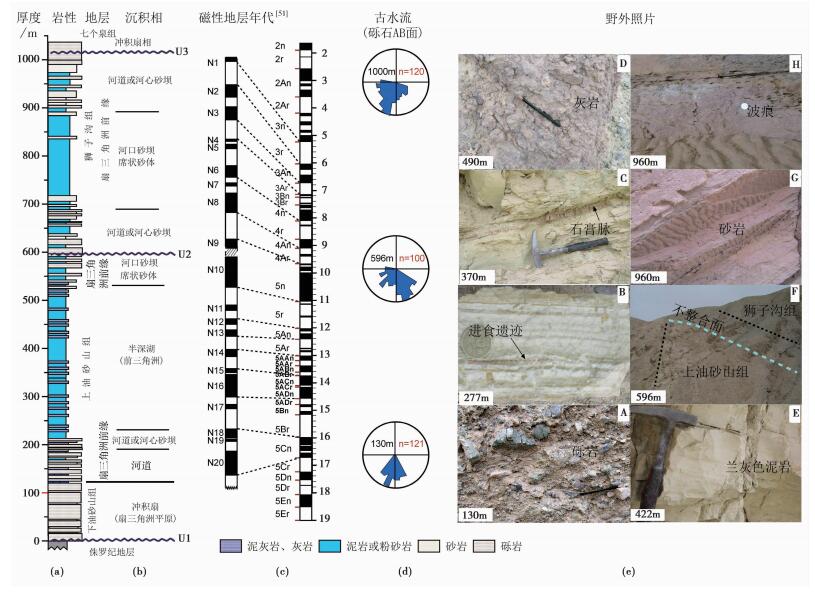
红沟子背斜位于毗邻阿尔金山的柴达木盆地西北部,是一个北西向展布的断鼻构造,其南为咸北凹陷,北为小梁山次凹,西北被北北东向断裂所截( 图 1c),是柴达木盆地重要的油气远景区。本次研究的主干剖面HGZ(38°34′N,91°03′E)位于红沟子背斜西南翼,剖面总厚度为1040m,出露的最老地层为中生代侏罗系碎屑岩,主要由灰绿色砾岩、砂岩和炭质页岩等组成,其上依次沉积了下油砂山组、上油砂山组、狮子沟组以及七个泉组(图 2a)。地层年代是研究盆地演化及其周缘山体隆升的关键,2006年,方小敏等[51]在柴达木盆地西部红沟子背斜开展了详细的磁性地层研究( 图 2c),建立了红沟子剖面约17~5Ma的高精度磁性地层年代框架。其中,该剖面的上油砂山组为17.0~9.8Ma、狮子沟组为9.8~5.0Ma。由于下油砂山组和七个泉组以砾岩为主,方小敏等[51]并未采集到满足高精度的古地磁样品,下油砂山组底部与七个泉组顶部年代未能建立,因此大致限定下油砂山组年代为> 17Ma和七个泉组< 5Ma。在上述精确的年代学基础上,本文对红沟子剖面的沉积物开展了详细的沉积学研究。
|
图 2 红沟子剖面(HGZ)岩性柱(a)、沉积相(b)、磁性地层(c)、古水流(d)和野外岩性照片(e)综合图 其中磁性地层结果修改自方小敏等(2006)[51] Fig. 2 Lithology(a), facies(b), magnetostratigraphy(c), paleocurrent (d) and field pictures (e) of Honggouzi section(HGZ). The magnetostratigraphy result is modified from Fang et al.(2006)[51] |
依据红沟子剖面地层的分布、地貌部位以及野外详细的岩性描述与沉积物结构构造诊断等,红沟子剖面地层整体为一套扇三角洲沉积体系的产物( 图 2),具体如下。
红沟子剖面底部是下油砂山组与下伏侏罗系呈不整合接触。
下油砂山组(0~120m)由厚层黑灰色砾岩、角砾岩组成,夹薄层浅棕红色砾质粗砂岩、砂质泥岩,上部砂岩增多;砾石平均粒径70~80mm(最大粒径达200~300mm),呈棱角状,分选差,杂基支撑,块状构造,属冲-洪积扇或扇三角洲平原相沉积特征( 图 2a和2b)。
上油砂山与下油砂山组呈整合接触,厚476m(120~596m),其岩性总体表现为粗-细-粗的沉积特征( 图 2a)。其底部(120~227m)主要为厚层黑色细砾岩以及浅灰绿、蓝灰色泥岩和细砂岩夹薄层泥灰岩、粉砂岩、砾质砂岩,向上粒度有变细趋势。其中砾石以棱角-次棱角状为主,杂基支撑,块状构造和粗糙层理( 图 2e-A);泥岩与薄层细砂岩、泥灰岩呈韵律互层,发育水平层理;细砂岩具球枕构造。因此,上油砂山组底部属扇三角洲前缘河道、河道砂坝及河道间细粒沉积环境沉积产物。上油砂山组中上部(227~525m)为灰绿、蓝灰色泥岩与钙质泥岩韵律互层,夹薄层粉砂岩、砂岩、泥灰岩和多层石膏脉( 图 2e-C、2e-D和2e-E),发育平行层理和韵律层理,具有包卷层理和进食遗迹构造( 图 2e-B),属半深湖产物。上油砂山组顶部(525~596m)为浅灰绿、浅褐红色粉砂质泥岩、砂质泥岩、钙质泥岩夹黑色砾岩和薄层蓝灰色泥灰岩。向上砾岩增多、变厚,砾石平均粒径20~40mm(最大粒径达200mm),呈棱角状,分选差,杂基支撑,块状构造,属高密度流沉积特征(扇三角洲前缘河道内洪水期水下泥石流沉积)。浅灰绿粉砂质泥岩、钙质泥岩和薄层蓝灰色泥灰岩具水平层理,浅褐色砂质泥岩具块状构造,它们为扇三角洲前缘席状砂坝的产物。因此上油砂山组顶部沉积组合属扇三角洲前缘环境。
狮子沟组(596~1014m)与下伏上油砂山组呈角度不整合接触( 图 2e-F),其岩性总体仍表现为粗-细-粗的沉积特点( 图 2a)。下部的底部(596~628m)是巨厚黑灰色砾岩夹砂岩薄层或条带(扇三角洲前缘河道沉积),其上部(628~690m)为浅灰绿色泥质粉砂岩、粉砂质泥岩、砂岩夹砂砾岩(扇三角洲前缘河道及河道间沉积)。其中砾石多为棱角状,一般大小10~50mm,分选差,杂基支撑,块状构造和粗糙平行层理,具高密度流沉积特征。砂岩、泥岩、粉砂质泥岩呈韵律互层,水平层理和块状构造。因此,狮子沟组下部属扇三角洲前缘沉积环境。狮子沟组中部(690~900m)为蓝灰色泥质粉砂岩、粉砂质泥岩、砂岩夹薄层砂质细砾岩或含细砾砂岩,发育平行层理、砂纹层理、波状层理以及波痕构造,属扇三角洲前缘河道砂坝和席状砂体沉积环境。狮子沟组顶部(900~1014m)是灰黑色砾岩、砂质砾岩夹浅灰绿、褐红色粉砂质泥岩、砂岩。砂岩中发育波痕构造( 图 2e-G和2e-H),砾石呈次圆状,平均粒径10mm(最大30mm),分选差,杂基支撑,块状构造,属扇三角洲河道及河道间沉积产物。
七个泉组(1014~1024m)与下伏狮子沟组呈不整合接触,为巨厚黑灰色砾岩夹少量砂质条带,砾石成分复杂、呈次棱角状-次圆状,平均大小30mm左右(最大粒径80mm),分选差,杂基支撑,块状构造,属洪积扇沉积产物。
综合上述,红沟子剖面晚新生界沉积环境经历了下油砂山组的“冲积扇或扇三角洲平原相”到上油砂山组“扇三角洲前缘-半深湖-扇三角洲前缘相”,再到狮子沟组“扇三角洲前缘相”以及七个泉组“洪积扇相”的演变过程;岩性呈现粗-细-粗-细-粗且整体向上变粗的趋势( 图 2a、2b和2e)。
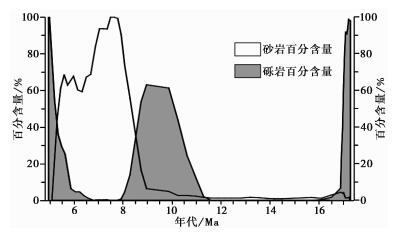
2.2 砾岩与砂岩含量变化特征本文依据野外详细的岩性描述,室内按照50m步长,20m递增窗口对红沟子剖面砂岩与砾岩含量的百分比计算统计,其中砾岩包括含砾砂岩、细砾岩、粗砾岩,砂岩包括含砾砂岩、粗砂岩、细砂岩和粉砂岩,结果如图 3所示:大套砾岩主要集中于> 16.5Ma、9.8Ma以及< 5.0Ma;砂岩呈“一高一低”的两段式分布特征,其中,16.5~9.8Ma砂岩含量很低,9.8~5.0Ma期间砂岩含量较高。
|
图 3 砾岩与砂岩含量百分含量变化图 Fig. 3 Variation of occurrence of conglomerate and sandstone beds |
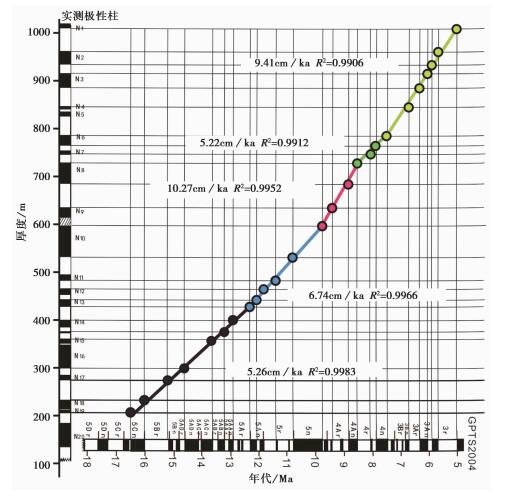
根据磁性地层学建立的年代框架[51]与相应的地层厚度线性内插,可计算红沟子剖面16.5~5.0Ma的沉积速率。如图 4所示,红沟子剖面沉积速率表现出“三低两高”的特征:在16.5~12.3Ma、12. 3~9. 8Ma和8. 53~7. 48Ma期间剖面沉积速率较低,分别为5. 26cm/ka、6. 74cm/ka和5. 22cm/ka;而在9. 80~8. 53Ma和7. 48~5. 00Ma期间剖面沉积速率较高,分别为10.27cm/ka(为了便于计算,未考虑剖面中9.8~9.1Ma沉积间断,故9.80~8.53Ma的沉积速率代表了该阶段的最低值)和9.41cm/ka。
|
图 4 红沟子剖面实测厚度与标准极性年表年代(GPTS2004[52])关系图(即沉积速率的变化特征) Fig. 4 Stratigraphic thickness as a function of magnetostratigraphic age of the Honggouzi section, showing the changes of the sedimentary rates |
物源分析对于认识盆地沉积作用、追踪沉积盆地源区以及重建盆地周边造山带隆升历史等具有重要作用。目前物源分析的方法诸多,如碎屑岩类分析法、砂岩碎屑成分分析法、砾石成分统计、古流向恢复法、阴极发光法、地球化学分析法以及稀土元素分析法等[53~62]。其中,碎屑岩类分析法不仅简便易行可操作性强,且通过碎屑岩的碎屑组成和结构特征还可直接反映沉积区与物源区的构造环境,砾石成分组成特征也是确定物源的直接证据[63];此外,古流向对于确定沉积物搬运路径、源区与沉积区关系和重塑研究区古地貌特征等方面具有重要作用[64]。本次研究采用碎屑岩类分析法和古流向相结合的分析方法,同时综合分析前人成果,一起探讨柴达木西部红沟子地区沉积物质来源。
砾石A-B面产状是判断古流向的主要方法之一[64~68]。通过野外对红沟子剖面3处砾岩层中砾石的A-B面进行详细统计,以及室内进行产状校正后利用EXECL软件绘制玫瑰花图并分析其结果发现( 图 2d):上油砂山组底部(130m左右)沉积时的古水流主要来自于北西方向,但个别层位有来自北北东方向的碎屑物;上油砂山组上部(596m)砾岩层揭示其沉积时古水流主要流向南东;狮子沟组上部(1000m)结果显示古水流主要来自于北东方向,个别层位来自北西方向。
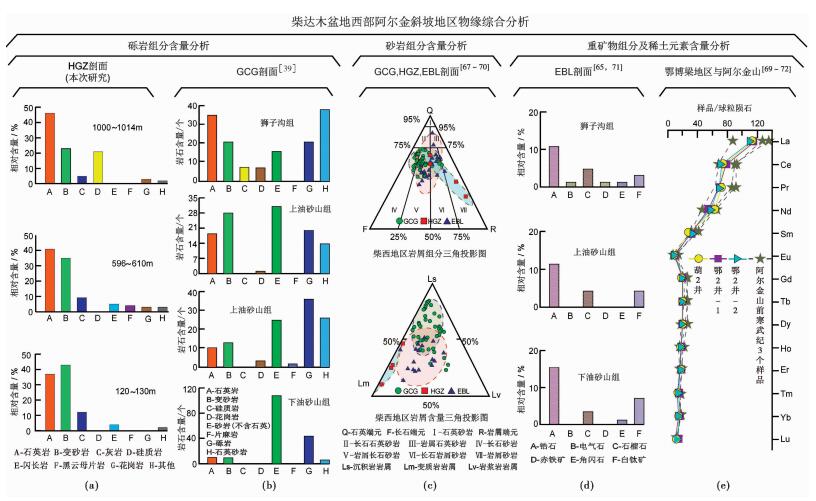
通过对红沟子剖面的3套砾岩层(在每套砾岩层中随机选取1m2面积,对其内部的砾石(约100颗左右进行成分统计)开展的详细砾石成分统计分析发现:1)上油砂山组(120~130m)砾岩层的砾石主要由石英岩(43 %)、变质砂岩(36 %)、灰岩(12 %)和少数闪长岩(4 %)、黑云母片岩(3 %)以及其他(2 %)组成( 图 5a下图),这种砾石组合特征与阿尔金山地区中上元古界长城系和下元古界米兰群砾石成分基本一致[50];2)狮子沟组(596~610m)砾岩层砾岩主要由石英岩(41 %)、变质砂岩(35 %)和少数灰岩(9 %)、闪长岩(5 %)、黑云母片岩(4 %)、花岗岩(3 %)以及其他(3 %)组成( 图 5a中图),这与阿尔金山地区的长城系和拉配泉群岩性特征类似50];3)七个泉组(1000~1014m)发育大套灰黑色砾岩,其主要由石英岩(46 %)、变质砂岩(23 %)、硅质岩(21 %)和少数灰岩(5 %)、花岗岩(3 %)以及其他(2 %)组成( 图 5a上图),它们与上油砂山组和狮子沟组的砾石成分组成特征基本一致。
|
图 5 柴达木盆地西部阿尔金斜坡地区物源综合分析图 GCG剖面砾石组分含量数据来源于文献[39],GCG(干柴沟)、HGZ(红沟子)、EBL(鄂博梁)剖面的砂岩组分含量数据来源于文献[69, 70],EBL剖面的重矿物和稀土元素数据来源于文献[71],阿尔金山地区的稀土元素数据来源于文献[72] Fig. 5 Comprehensive analysis on the provenance of the Altyn Tagh slope in western Qaidam Basin. Conglomerate component data of GCG section is from Wu et al., 2012[39]; Sand component data of GCG, HGZ and EBL sections come from Ma et al., 2010[69] and Hu, 2013[70]; Heavy minerals and Rare Earth Element(REE)data of EBL section from Kong et al., 2015[71] while the REE data of Altyn Tagh from Qin et al., 2008[72]. GCG=Ganchaigou, HGZ=Honggouzi, EBL=Eboliang |
上述红沟子剖面砾石层碎屑成分分析结果显示了其成分相对稳定,且可与阿尔金山地区中上元古界长城系和下元古界米兰群砾岩成分或长城系、拉配泉群岩性相对比[50],结合古水流分析结果,我们认为红沟子剖面的沉积物可能主要来自与其毗邻的阿尔金山地区。同时综合梳理分析前人在毗邻红沟子剖面的柴达木盆地西部阿尔金斜坡地区不同剖面(干柴沟[39, 69, 70]和鄂博梁[69~72]剖面)的沉积物物源研究成果,发现:1)红沟子剖面的砾岩成分和含量特征也与同时期物源主要来自阿尔金山的干柴沟剖面砾石统计结果基本类似( 图 5b);2)干柴沟剖面、红沟子剖面以及鄂博梁剖面的砂岩碎屑组分分布具有一定的相似之处,3个剖面岩屑含量都占主要部分且矿物类型均以岩屑长石砂岩和长石岩屑砂岩为主( 图 5c上图),这表明研究区内碎屑成分成熟度低,可能形成于近源、快速堆积环境;3个剖面的岩屑分布图显示研究区内岩屑类型也具有相似特点,主要以沉积岩岩屑和变质岩岩屑为主、岩浆岩岩屑少量或不包含( 图 5c下图);而3个剖面周缘的阿尔金山岩性主要为碎屑岩-碳酸盐岩,其次为变质岩、少量侵入岩并以斜长花岗岩为主,火山岩极少量,祁漫塔格山的主要岩性为侵入岩、花岗岩以及少量的变质岩和碎屑岩-碳酸盐岩,赛什腾山主要由前三叠纪地层和加里东-印支期中酸性侵入岩体组成[50, 73],这表明3个剖面的砂岩岩屑组分特征与阿尔金山岩性特征[50]基本相同,祁漫塔格山和赛什腾山由于侵入岩含量最多,碎屑岩与变质岩较少[73],而与其特征相反,这也暗示了阿尔金山可能是研究区的主要物质源区;3)鄂博梁地区的重矿物组合( 图 5d)及稀土元素地球化学特征( 图 5e)都清楚的显示了阿尔金山的原岩与鄂博梁地区新近系沉积存在着渊源关系,是鄂博梁地区新近系沉积的主要物源区[71, 72]。综合上述,柴达木盆地西部中晚中新世( >16.5~5.0Ma)沉积物可能主要来自于北部的阿尔金山地区。
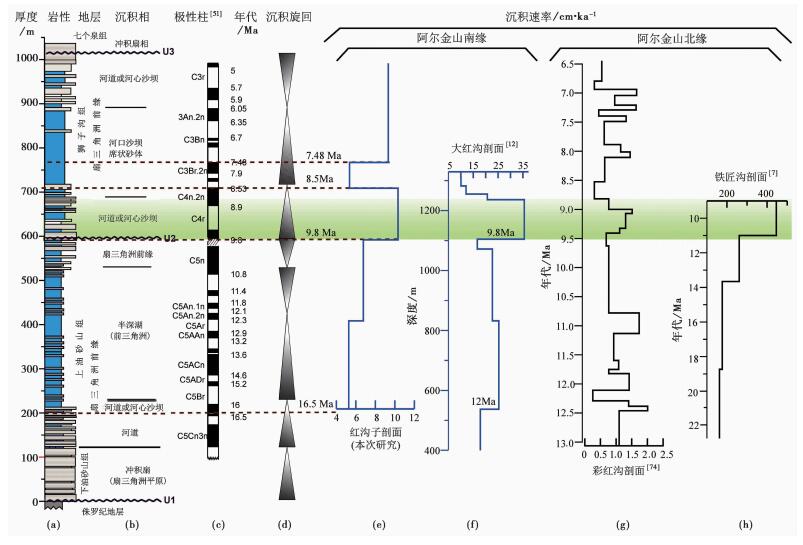
通过前述对红沟子剖面沉积物源区、岩性、沉积环境以及沉积速率等精细分析,可以看出红沟子剖面晚新生代沉积特征主要经历了5个演化阶段( 图 6):1)>16.5Ma主要以粗颗粒砾岩为主的冲-洪积相沉积;2)16.5~9.8Ma沉积环境主要为半深湖或前扇三角洲,以泥岩或泥灰岩等细颗粒为主,沉积速率较低;3)9.80~8.53Ma沉积环境为扇三角洲前缘,岩性变粗且有大套砾岩堆积,沉积速率达到剖面最高值,并在9.8Ma存在不整合面;4)8.53~7.48Ma沉积环境基本与上一阶段类似,砾岩含量减少,砂岩沉积相对增加,沉积速率呈现低值特征;5)7.48~5.00Ma主要是扇三角洲前缘沉积环境,砂岩含量较高,沉积速率较高。
|
图 6 阿尔金山南北缘沉积速率综合对比图 a),(b),(c),(d),(e)为红沟子剖面结果;(f),(g),(h)分别为大红沟[12]、彩红沟[74]和铁匠沟[7]剖面结果,剖面位置见图 1 Fig. 6 Summary and comparison of the sedimentation rates in northern and southern Altyn Tagh. (a), (b), (c), (d) and (e) are the results of HGZ section; (f), (g) and (h) are the results of Dahonggou, Caihonggou and Tiejianggou sections, respectively. Refer to Fig. 1 for the locations of (e), (f), (g) and (h) |
目前,青藏高原及周缘地区沉积特征(如:岩性和沉积速率等)的变化驱动机制通常解释成高原构造隆升[4, 7, 10~16, 41, 42, 46, 47]或气候变化[74~76]。然而,辨别构造和气候在沉积特征变化中各自所扮演的角色并非易事[77]。一般认为,在构造活跃期,沉积特征更受控于构造;而在构造平静期,稳定的气候条件有利于维持地貌的平衡状态,只有气候在小于构造时间尺度上发生剧烈变化时,沉积特征才明显受控于气候[75, 76]。下面具体讨论和判别构造和气候两个因素对红沟子剖面晚新生代地层沉积特征变化的控制。
气候因素如气候高频振荡变化[75]、冰川侵蚀[76]、海平面变化[78]和降水分布[79, 80]等可造成沉积特征的变化。柴达木盆地处于我国西部内陆,近年多项研究结果表明副特提斯海最后退出塔里木盆地西南地区的时间不晚于渐新世[81~84]。显然,红沟子剖面沉积时海洋早已退出,故海平面变化对研究区沉积特征变化无影响;而北半球高纬度地区冰川大规模发育的起始时间为约2.6Ma[85],研究区地层的沉积时代约为17.0~5.0Ma,且野外并未观测到冰川活动的痕迹,故也可剔除冰川作用对沉积特征的控制;Sun和Wang[86]认为,晚新生代我国西北内陆和中亚地区的干旱气候格局与现今基本相似;在毗邻研究区拥有高精度年代学的KC1井(38°03′N,91°45′E)采用对气候变化最敏感的孢粉研究表明,14~5Ma柴达木盆地呈干旱气候特征且干旱化程度逐步加强[87];Zhuang等[88]的同位素研究结果也得出12Ma以来,柴达木盆地干旱化逐渐加剧;Wang等[89]在柴达木盆地大浪滩地区的孢粉研究,同样表明中新世具有干旱稳定的气候特征;相邻的塔里木盆地孢粉结果同样表明,13~5Ma干旱气候在该盆地盛行[90, 91];红沟子剖面的气候变化代用指标则直接证实,该区的微弱气候变化与剖面沉积特征变化无明显的相关性[92, 93]。由以上研究结果可以推断,气候高频振荡变化及降水也不是造成剖面沉积特征变化的关键诱因。综上所述,气候可能不是研究区沉积特征变化的主控因素。
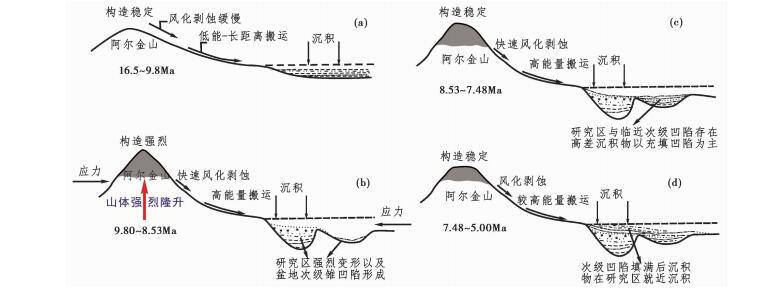
那么构造活动又是如何影响或控制研究区的沉积特征?根据上述5个阶段的沉积特征,本文提出以下模式阐述二者之间的关系:1)>16.5Ma时剖面沉积环境以冲-洪积相的近源堆积为主,岩性为粗颗粒的砾岩( 图 6a、6b和6d)且其分选与磨圆度都较差,剖面底部的不整合面也进一步佐证了研究区此时处于构造活动期( 图 6a)。2)16.5~9.8Ma时研究区处于构造活动稳定期( 图 7a),红沟子地区持续接受阿尔金山的风化剥蚀产物,但由于此时物源区构造稳定,所以风化剥蚀能力也相对较弱,故此阶段研究区沉积速率较小,沉积环境较为稳定( 图 6b和6e)。同时,随着源区风化剥蚀作用持续进行,物源区与沉积区间的相对高差也会变小,进而引起搬运动力减弱,源区物质经历较长时间的风化剥蚀作用才能被搬运到沉积区( 图 7a),故该阶段剖面沉积物颗粒较细( 图 6a),粗颗粒的砾岩以及砂岩含量基本处于全剖面低值( 图 3)。3)剖面在约9.8Ma时大套砾岩开始出现且其含量也急剧增加( 图 3和图 6a),沉积相由半深湖-扇三角洲前缘相演变成扇三角洲相( 图 6b),沉积速率陡增为前一阶段的近两倍,达到10.27cm/ka( 图 4),野外观测到剖面此时地层存在一个不整合面(U2)且古地磁结果表明约10Ma左右剖面地层记录的极性事件也存在缺失( 图 6c),这些现象均表明研究区发生了强烈的构造运动。强烈的构造运动产生的挤压应力不仅导致了研究区次级凹陷发育,而且会造成地壳缩短、源区阿尔金山的隆升,进而增加了山盆之间的陡峭指数。同时,构造活动也导致了物源区岩石松散、破碎,这样增加沉积物的运输动力的同时也增强了物源区风化剥蚀能力( 图 7b),继而造就了研究区沉积环境由前一段的扇三角洲前缘转为河道或河心沙坝( 图 6b),粗颗粒砾石含量及沉积速率快速增大( 图 3和4)。4)8.53~7.48Ma左右沉积沉积环境与岩性较上一阶段只发生了微弱变化( 图 6a、6b和6d),砾岩与砂岩百分含量的变化趋势未发生明显改变( 图 3),但沉积速率却由前一阶段的10.27cm/ka降至5.22cm/ka,这可能是由于沉积物在研究区沉积到一定阶段后与邻近的次级凹陷存在一定的高差,使沉积物流向更易于堆积的邻近凹陷区,在物源区提供的剥蚀物总量不变的情况下,研究区沉积速率继而降低( 图 7c)。5)7.48~5.00Ma沉积期间,红沟子剖面的岩性和沉积环境基本继承了上一阶段的特征( 图 6a、6b和6d),但其沉积速率又恢复至9.41cm/ka。这可能是前一阶段沉积物将邻近次级凹陷充填至满后又开始在研究区就近沉积的结果。经过数百万年的剥蚀后,物源区与沉积区的高差减小,沉积速率较9.8Ma时也略有降低( 图 7d)。
|
图 7 研究区及周缘晚新生代构造与沉积特征关系模式图 Fig. 7 A model showing the relations between the tectonic evolution and the sedimentary characters of the studied area and surroundings |
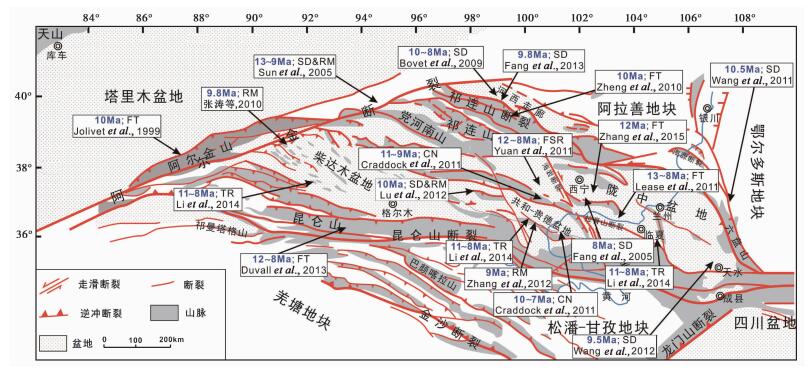
综上所述,红沟子剖面9.8Ma沉积特征的变化可能很好地记录了其源区阿尔金山的一次构造隆升事件。值得注意的是:利用单一地区沉积特征探讨山体的构造隆升时,还应考虑沉积特征的变化是否具有区域性[3],因为单个剖面沉积特征变化也可能是局域小构造事件或流域水系重组的结果,不能代表整个区域由构造隆升引起的盆地内沉积通量的变化。我们通过梳理前人研究成果发现,红沟子剖面沉积特征在9.8Ma的变化,特别是沉积速率的陡增在阿尔金山周缘地区具有普遍性。如图 6所示,无论是与本次研究同属阿尔金断裂南缘的大红沟剖面( 图 6f),还是阿尔金断裂北缘的彩红沟剖面( 图 6g)和铁匠沟剖面(图 6h)均与研究区的沉积速率变化特征类似(图 6e、6f、6g和6h),即12.3Ma左右沉积速率呈微弱升高趋势,并在10Ma左右分别达到剖面的最高值(10.27cm/ka、35.0cm/ka、1.5cm/ka和445.0cm/ka)。与此同时,红沟子剖面沉积特征在9.8Ma的变化事件,与前人利用不同方法捕获的晚新生代阿尔金山构造隆升时间基本一致:袁四化等[94]利用沉积学手段发现,10Ma以来阿尔金断裂带经历了一次快速隆升事件;Jolivet等[28]利用40 Ar/39 Ar、FT热年代学方法同样得出阿尔金地区10Ma左右有一次构造隆升事件;张涛等[95]在柴达木盆地通过岩石磁学揭示阿尔金山在约9.8Ma处于构造活动期;高军平等[96]在本研究区利用磁组构手段也发现在约9.8Ma柴西地区构造活动强烈;陈正乐等[32]通过热年代学研究得出阿尔金断裂带在8Ma左右发生快速走滑变形。以上这些证据可能共同指示了阿尔金山在大致10Ma前后的一次重要加速隆升事件。另外,前人在青藏高原东北缘其他地区利用热年代学[28, 97~100]、沉积学[7,13,49,101,102]、古地磁学和岩石磁学[14,95,103,104]、构造几何学[105]及宇宙成因核素[106]等多种手段开展的大量研究均表明大致10Ma左右在其研究区存在一期强烈的构造活动( 图 8),这可能指示了青藏高原东北缘在10Ma前后经历了一次大范围的构造隆升变形事件。
|
图 8 青藏高原北缘10Ma构造事件研究分布图 据文献[7, 13, 14, 28, 49, 95, 97~106]修改总结SD:沉积学(sedimentology);RM:岩石磁学(rock magnetism);FSR:断裂走滑速率(fault slip rate);FT:裂变径迹(fission track);CN:宇宙成因核素(cosmogenic nuclide);TR:构造旋转(tectonic rotations) Fig. 8 The diagram of 10Ma tectonic event in the northeastern Tibet Plateau, modified from references[7, 13, 14, 28, 49, 95, 97~106] |
通过对柴达木盆地西部地区红沟子剖面晚新生代沉积特征的精细研究,主要得到以下认识:
第一,红沟子剖面晚新生代地层整体为一套扇三角洲沉积体系的产物,岩性具有粗-细-粗-细-粗且总体向上变粗的特点。沉积环境经历了下油砂山组冲积扇或扇三角洲平原相到上油砂山组扇三角洲前缘-半深湖-扇三角洲前缘相,再到狮子沟组扇三角洲前缘相,最后转为七个泉组洪积扇相的演化过程。
第二,红沟子剖面大套砾岩主要集中于> 16.5Ma、9.8Ma以及< 5.0Ma;砂岩主要出现在9.8~5.0Ma期间。
第三,红沟子剖面沉积速率呈现“两高三低”的变化特征,其中9.80~8.53Ma期间沉积速率达到剖面最高值,为10.27cm/ka。
第四,柴达木盆地西部阿尔金斜坡地区的物源综合分析如砾石成分、碎屑组分、重矿物及稀土元素特征等共同揭示柴达木盆地西部中晚中新世( > 16.5~5.0Ma)物源区可能主要来自于其北部的阿尔金山地区。
第五,综合分析同时期研究区及周缘气候和构造特点,认为红沟子剖面9.8Ma附近不整合面出现,岩性、沉积环境以及沉积速率等沉积特征变化是对阿尔金山乃至青藏高原东北缘约10Ma一次大范围隆升事件的响应。
致谢: 方小敏研究员和审稿专家对本文提出了宝贵意见,特别感谢第四纪研究编辑部杨美芳对本文提出的建议和意见,很好地提高了论文的质量。此外刘栋梁、孟庆泉、张玺正、李立立、王亚东、韩文霞、张志高、申苗苗、田茜等参加了野外采样及室内分析工作,在此一并表示感谢!
| 1 |
刘宝珺, 余光明, 徐强, 等. 雅鲁藏布中新生代深水沉积盆地形成和演化(Ⅰ):喜马拉雅造山带沉积特征及演化.
岩相古地理,1993, 13 (1) : 32~49.
Liu Baojun, Yu Guangming, Xu Qiang, et al. Formation and evolution of the Mesozoic and Cenozoic deep-water sedimentary basins along the Yarlung Zangbo River (Ⅰ):Sedimentary characteristics and evolution of sedimentary characteristics and evolution of the Himalayan Orogenic Zone. Sedimentary Facies and Palaeogeography,1993, 13 (1) : 32~49. (  0) 0)
|
| 2 |
Métivier F, Gaudemer Y, Tapponnier P, et al. Northeastward growth of the Tibet Plateau deduced from balanced reconstruction of two depositional areas:The Qaidam and Hexi Corridor basins, China.
Tectonics,1998, 17 (6) : 823~842.
(0)
|
| 3 |
Zhuang Guangsheng, Hourigan J K, Ritts B D, et al. Cenozoic multiple-phase tectonic evolution of the northern Tibetan Plateau:Constraints from sedimentary records form Qaidam Basin, Hexi Corridor, and Subei Basin, Northwest China.
American Journal of Science,2011, 311 (2) : 116~152.
(0)
|
| 4 |
Li Jijun, Fang Xiaomin, van der Voo R, et al. Late Cenozoic magnetostratigraphy (11-0Ma) of the Dongshanding and Wangjiashan sections in the Longzhong Basin, Western China.
Geologie En Mijnbouw,1997, 76 (1-2) : 121~134.
(0)
|
| 5 |
宋春晖, 方小敏, 高军平, 等. 青藏高原东北部贵德盆地新生代沉积演化与构造隆升.
沉积学报,2001, 19 (4) : 493~500.
Song Chunhui, Fang Xiaomin, Gao Junping, et al. Tectonic uplift and sedimentary evolution of Guide Basin in the northeast margin of Tibetan Plateau in Cenozoic Era. Acta Sedimentologica Sinica,2001, 19 (4) : 493~500. ( 0)
|
| 6 |
王成善, 朱利东, 刘志飞. 青藏高原北部盆地构造沉积演化与高原向北生长过程.
地球科学进展,2004, 19 (3) : 373~381.
Wang Chengshan, Zhu Lidong, Liu Zhifei. Tectonic and sedimentary evolution of basins in the north of Qinghai-Tibet Plateau and northward growing process of Qinghai-Tibet Plateau. Advance in Earth Sciences,2004, 19 (3) : 373~381. ( 0)
|
| 7 |
Sun Jimin, Zhu Rixiang, An Zhisheng. Tectonic uplift in the northern Tibetan Plateau since13.7Ma ago inferred from molasse deposits along the Altyn Tagh Fault..
Earth and Planetary Science Letters,2005, 235 (3) : 641~653.
(0)
|
| 8 |
Fang Xiaomin, Garzione C, van der Voo R, et al. Flexural subsidence by29Ma on the NE edge of Tibet from the magnetostratigraphy of Linxia Basin, China.
Earth and Planetary Science Letters,2003, 210 (3-4) : 545~560.
(0)
|
| 9 |
Fang Xiaomin, Yan Maodu, van der Voo R, et al. Late Cenozoic deformation and uplift of the NE Tibetan Plateau:Evidence from high-resolution magnetostratigraphy of the Guide Basin, Qinghai Province, China.
Geological Society of America Bulletin,2005, 117 (9) : 1208~1225.
(0)
|
| 10 |
Fang Xiaomin, Zhang Weilin, Meng Qingquan, et al. High-resolution magnetostratigraphy of the Neogene Huaitoutala section in the eastern Qaidam Basin on the NE Tibetan Plateau, Qinghai Province, China and its implication on tectonic uplift of the NE Tibetan Plateau.
Earth and Planetary Science Letters,2007, 258 (1-2) : 293~306.
(0)
|
| 11 |
Ji Junliang, Luo Pan, White P, et al. Episodic uplift of the Tianshan Mountains since the Late Oligocene constrained by magnetostratigraphy of the Jingou River section, in the southern margin of the Junggar Basin, China.
Journal of Geophysical Research:Solid Earth,2008, 113 (B5) : 2556~2572.
(0)
|
| 12 |
Lu Haijian, Xiong Shangfa. Magnetostratigraphy of the Dahonggou section, northern Qaidam Basin and its bearing on Cenozoic tectonic evolution of the Qilian Shan and Altyn Tagh Fault.
Earth and Planetary Science Letters,2009, 288 (3-4) : 539~550.
(0)
|
| 13 |
Wang Weitao, Zhang Peizhen, Kirby E, et al. A revised chronology for Tertiary sedimentation in the Sikouzi Basin:Implications for the tectonic evolution of the northeastern corner of the Tibetan Plateau.
Tectonophysics,2011, 505 (1) : 100~114.
(0)
|
| 14 |
Lu Haijian, Wang Erchie, Shi Xuhua, et al. Cenozoic tectonic evolution of the Elashan range and its surroundings, northern Tibetan Plateau as constrained by paleomagnetism and apatite fission track analyses.
Tectonophysics,2012, 580 (2) : 150~161.
(0)
|
| 15 |
Chang Hong, Ao Hong, An Zhisheng, et al. Magnetostratigraphy of the Suerkuli Basin indicates Pliocene(3.
, .
(0)
|
| 16 |
Zhang Huiping, Craddock W H, Lease R O, et al. Magnetostratigraphy of the Neogene Chaka Basin and its implications for mountain building processes in the north-eastern Tibetan Plateau.
Basin Research,2012, 24 (1) : 31~50.
(0)
|
| 17 |
王清晨. 造山带隆起剥蚀过程与沉积记录.
地质科学,2013, 48 (1) : 1~31.
Wang Qingchen. Erosion and sedimentary record of orogenic belt. Chinese Journal of Geology,2013, 48 (1) : 1~31. ( 0)
|
| 18 |
方小敏, 吴福莉, 韩文霞, 等. 上新世-第四纪亚洲内陆干旱化过程-柴达木中部鸭湖剖面孢粉和盐类化学指标证据.
第四纪研究,2008, 28 (5) : 874~882.
Fang Xiaomin, Wu Fuli, Han Wenxia, et al. Plio-Pleistocene drying process of Asian inland-Sporopollen and salinity records from Yahu section in the central Qaidam Basin. Quaternary Sciences,2008, 28 (5) : 874~882. ( 0)
|
| 19 |
滕晓华, 韩文霞, 叶程程, 等. 柴达木盆地SG-1孔1.0Ma以来碳酸盐同位素记录的亚洲内陆干旱化及成因.
第四纪研究,2013, 33 (5) : 866~875.
Teng Xiaohua, Han Wenxia, Ye Chengcheng, et al. Aridification of the Asian inland since1.0Ma:Evidences from carbonate isotope records of deep core from the Qaidam Basin. Quaternary Sciences,2013, 33 (5) : 866~875. ( 0)
|
| 20 |
陈少坤, 李强, 王晓鸣. 柴达木盆地晚中新世早期的爪兽化石及其古环境意义.
第四纪研究,2015, 35 (3) : 528~538.
Chen Shaokun, Li Qiang, Wang Xiaoming. Chalicothere fossils from the early Late Miocene of the Qaidam Basin, and their paleoenvironmental implications. Quaternary Sciences,2015, 35 (3) : 528~538. ( 0)
|
| 21 |
脱世博, 方小敏, 宋春晖, 等. 青藏高原东北部西宁盆地晚渐新世-早中新世沉积物岩石磁学特征及其古环境意义.
第四纪研究,2013, 33 (5) : 829~838.
Tuo Shibo, Fang Xiaomin, Song Chunhui, et al. Rock magnetic characteristics of the Late Oligocene to Early Miocene sediments in the Xining Basin, northeastern Tibetan Plateau. Quaternary Sciences,2013, 33 (5) : 829~838. ( 0)
|
| 22 |
赵秀丽, 张春霞, 吴海斌, 等. 西宁盆地始新世/渐新世过渡期孢粉植物群特征及其意义.
第四纪研究,2015, 35 (6) : 1489~1499.
Zhao Xiuli, Zhang Chunxia, Wu Haibin, et al. Significance of Eocene-Oligocenen transition pollen record from Xining Basin, China. Quaternary Sciences,2015, 35 (6) : 1489~1499. ( 0)
|
| 23 |
王岳军, 范蔚茗, 林舸. 盆地沉积物示踪源区山脉隆升剥露的几种方法.
地质科技情报,1999, 18 (2) : 85~89.
Wang Yuejun, Fan Weiming, Lin Ge. Several indicative methods of mountain uplift-erosion from basin sediments. Geological Science and Technology Information,1999, 18 (2) : 85~89. ( 0)
|
| 24 |
Molnar P, Tapponnier P. Cenozoic Tectonics of Asia:Effects of a continental collision.
Science,1975, 189 (4201) : 419~426.
(0)
|
| 25 |
Tapponnier P, Xu Zhiqin, Roger F, et al. Oblique stepwise rise and growth of the Tibet Plateau.
Science,2001, 294 (5547) : 1671~1677.
(0)
|
| 26 |
Yin An, Rumelhart P E, Butler R, et al. Tectonic history of the Altyn Tagh fault system in northern Tibet inferred from Cenozoic sedimentation.
Geological Society of America Bulletin,2002, 114 (10) : 1257~1295.
(0)
|
| 27 |
Cowgill E, Yin An, Harrison T M, et al. Reconstruction of the Altyn Tagh Fault based on U-Pb geochronology:Role of back thrusts, mantle sutures, and heterogeneous crustal strength in forming the Tibetan Plateau.
Journal of Geophysical Research:Solid Earth,2003, 108 (B7) : 457~470.
(0)
|
| 28 |
Jolivet M, Roger F, Arnaud N, et al. Exhumation history of the Altun Shan with evidence for the timing of the subduction of the Tarim block beneath the Altyn Tagh system, North Tibet.
Comptes Rendus de l'Academie des Sciences-SeriesⅡA: Earth and Planetary Science,1999, 329 (10) : 749~755.
(0)
|
| 29 |
Jolivet M, Brunel M, Seward D, et al. Mesozoic and Cenozoic tectonics of the northern edge of the Tibetan Plateau:Fission-track constraints.
Tectonophysics,2001, 343 (1) : 111~134.
(0)
|
| 30 |
万景林, 王瑜, 李齐, 等. 阿尔金山北段晚新生代山体抬升的裂变径迹证据.
矿物岩石地球化学通报,2001, 20 (4) : 222~224.
Wan Jinglin, Wang Yu, Li Qi, et al. FT evidence of northern Altyn uplift in Late-Cenozoic. Bulletin of Mineralogy, Petrology and Geochemistry,2001, 20 (4) : 222~224. ( 0)
|
| 31 |
王瑜, 万景林, 李齐, 等. 阿尔金山北段阿克塞-当金山口一带新生代山体抬升和剥蚀的裂变径迹证据.
地质学报,2002, 76 (2) : 191~198.
Wang Yu, Wan Jinglin, Li Qi, et al. Fission-track evidence for the Cenozoic uplift and erosion of the northern segment of the Altyn Tagh Fault zone at the Aksay-Dangjin Pass. Acta Geologica Sinica,2002, 76 (2) : 191~198. ( 0)
|
| 32 |
陈正乐, 万景林, 王小凤, 等. 阿尔金断裂带8Ma左右的快速走滑及其地质意义.
地球学报,2002, 23 (4) : 295~300.
Chen Zhengle, Wan Jinglin, Wang Xiaofeng, et al. Rapid strike-slip of the Altyn Tagh Fault at8Ma and its geological implications. Acta Geoscientia Sinica,2002, 23 (4) : 295~300. ( 0)
|
| 33 |
陈正乐, 宫红良, 李丽, 等. 阿尔金山脉新生代隆升-剥露过程.
地学前缘,2006, 13 (4) : 91~102.
Chen Zhengle, Gong Hongliang, Li Li, et al. Cenozoic uplifting and exhumation process of the Altyn Tagh Mountains. Earth Science Frontiers,2006, 13 (4) : 91~102. ( 0)
|
| 34 |
Sobel E R, Arnaud N, Jolivet M, et al. Jurassic to Cenozoic exhumation history of the Altyn Tagh range, Northwest China, constrained by 40 Ar/39 Ar and apatite fission track thermochronology.
Geological Society of America Memoirs,2001, 194 : 247~267.
(0)
|
| 35 |
Li Haibing, Yang Jingsui, Xu Zhiqin, et al. Geological and chronological evidence of Indo-Chinese strike-slip movement in the Altyn Tagh Fault zone.
Chinese Science Bulletin,2002, 47 (1) : 27~32.
(0)
|
| 36 |
Liu Yongjiang, Neubauer F, Genser J, et al. Geochronology of the initiation and displacement of the Altyn strike-slip fault, Western China.
Journal of Asian Earth Sciences,2007, 29 (2-3) : 243~252.
(0)
|
| 37 |
张志诚, 龚建业, 王晓丰, 等. 阿尔金断裂带东端40 Ar/39 Ar和裂变径迹定年及其地质意义.
岩石学报,2008, 24 (5) : 1041~1053.
Zhang Zhicheng, Gong Jianye, Wang Xiaofeng, et al. 40 Ar/39 Ar and fission-track analysis of eastern segment of Altyn Tagh Fault and its geological significance. Acta Petrologica Sinica,2008, 24 (5) : 1041~1053. ( 0)
|
| 38 |
张志诚, 郭召杰, 李建锋, 等. 阿尔金断裂带中段中新生代隆升历史分析:裂变径迹年龄制约.
第四纪研究,2012, 32 (3) : 499~509.
Zhang Zhicheng, Guo Zhaojie, Li Jianfeng, et al. Mesozoic and Cenozoic uplift-denudation along the Altyn Tagh Fault, Northwestern China:Constraints from apatite fission track data. Quaternary Sciences,2012, 32 (3) : 499~509. ( 0)
|
| 39 |
吴磊, 肖安成, 汪立群, 等. 阿尔金断裂中段南侧东西向隆起的形成及对阿尔金山新生代隆升机制的启示.
中国科学:地球科学,2012, 42 (12) : 1863~1876.
Wu Lei, Xiao Ancheng, Wang Liqun, et al. W-trending uplifts along the southern side of the central segment of the Altyn Tagh Fault, NW China:Insight into the rising mechanism of the Altyn Mountain during the Cenozoic. Science China:Earth Sciences,2012, 42 (12) : 1863~1876. ( 0)
|
| 40 |
Yue Yongjun, Bradley D R, Stephan A G. Initiation and long-term slip history of the Altyn Tagh Fault.
International Geology Review,2001, 43 (12) : 1087~1093.
(0)
|
| 41 |
Yue Yongjun, Bradley D R, Hanson A D, et al. Sedimentary evidence against large strike-slip translation on the northern Altyn Tagh Fault, NW China.
Earth and Planetary Science Letters,2004, 228 (3-4) : 311~323.
(0)
|
| 42 |
Yue Yongjun, Graham S A, Ritts B D, et al. Detrital zircon provenance evidence for large-scale extrusion along the Altyn Tagh Fault.
Tectonophysics,2005, 406 (3) : 165~178.
(0)
|
| 43 |
王亚东, 刘永江, 常丽华, 等. 沉积物粒度分析在阿尔金山隆升研究中的应用.
吉林大学学报:地球科学版,2005, 35 (2) : 155~162.
Wang Yadong, Liu Yongjiang, Chang Lihua, et al. Application of sediment grainsize analyse researched on the uplift of Altyn. Journal of Jilin University(Earth Science Edition),2005, 35 (2) : 155~162. ( 0)
|
| 44 |
Zheng Hongbo, Powell M A, An Zhisheng, et al. Pliocene uplift of the northern Tibetan Plateau.
Geology,2000, 28 (8) : 715~718.
(0)
|
| 45 |
Sun Jimin, Zhu Rixiang, Bowler J. Timing of the Tianshan Mountains uplift constrained by magnetostratigraphic analysis of molasse deposits.
Earth and Planetary Science Letters,2004, 219 (3-4) : 239~253.
(0)
|
| 46 |
Charreau J, Gilder S, Chen Yan, et al. Magnetostratigraphy of the Yaha section, Tarim Basin(China):11Ma acceleration in erosion and uplift of the Tian Shan Mountains.
Geology,2006, 34 (3) : 181~184.
(0)
|
| 47 |
Huang Baochun, Piper J D A, Peng Shoutao, et al. Magnetostratigraphic study of the Kuche Depression, Tarim Basin, and Cenozoic uplift of the Tian Shan Range, Western China.
Earth and Planetary Science Letters,2006, 251 (3-4) : 346~364.
(0)
|
| 48 |
Li Chuanxin, Guillaume D N, Guo Zhaojie. Magnetostratigraphy of the northern Tian Shan foreland, Taxi He section, China. Basin Research, 2010, 23 (1):101~117
(0)
|
| 49 |
Wang Zhicai, Zhang Peizhen, Garzione C N, et al. Magnetostratigraphy and depositional history of the Miocene Wushan Basin on the NE Tibetan Plateau, China:Implications for Middle Miocene tectonics of the west Qinling Fault zone.
Journal of Asian Earth Sciences,2012, 44 (1) : 189~202.
(0)
|
| 50 |
青海省地质矿产局.
青海省区域地质志 . 北京: 地质出版社, 1991 : 605 .
Geological and Mineral Resources Bureau of Qinghai Province. Regional Geology of Qinghai Province. Beijing: Geological Publishing House, 1991 : 605 . ( 0)
|
| 51 |
方小敏, 高军平, 张伟林等.柴达木盆地阿尔金山前七个泉-月牙山构造精细演化与勘探目标选择.中国石油青海油田分公司勘探开发研究院内部报告, 2006.1~122
Fang Xiaomin, Gao Junping, Zhang Weilin et al. Detailed Evolution of Qigequan-Yueyashan Tectonics in the Front of Altyn Tagh and Western Qaidam Basin and Selection of Prospective Targets. Report of Academy2006-Kantan-JSFWHT-23. Qinghai Oilfield Company, 2006.1~122 ( 0)
|
| 52 |
Gradstein F M, Ogg J G, Smith A G, et al.
A Geologic Time Scale2004. Cambridge: Cambridge University Press, 2004 : 500 .
(0)
|
| 53 |
汪正江, 陈洪德, 张锦泉. 物源分析的研究与展望.
沉积与特提斯地质,2000, 20 (4) : 104~110.
Wang Zhengjiang, Chen Hongde, Zhang Jinquan. The research and prospect in provenance analysis. Sedimentary Geology and Tethyan Geology,2000, 20 (4) : 104~110. ( 0)
|
| 54 |
章生译. 根据碎屑石英的研究结果确定剥蚀区的位置.
华东石油学院译丛,1975 (1) : 53~57.
Zhang Sheng translated. Definite the provenance according to the detrital quartz. Huadong Petroleum CollegeCollection of Translations,1975 (1) : 53~57. ( 0)
|
| 55 |
Colombo F. Normal and reverse inroofing sequence in syntectonic conglomerates as evidence of progressive basinward deformation.
Geology,1994, 22 (3) : 235~238.
(0)
|
| 56 |
Blatt H. Provenance studies and mudrocks.
Journal of Sedimentary Petrology,1985, 55 (1) : 69~75.
(0)
|
| 57 |
田洪均. 阴极发光技术在沉积学中的应用.
岩相古地理,1989, 43 (5) : 56~64.
Tian Hongjun. Cathodolumiescence technique in the application of sedimentology. Sedimentary Facies and Palaeogeography,1989, 43 (5) : 56~64. ( 0)
|
| 58 |
黎兵, 李勇, 张开均, 等. 青藏高原东缘晚新生代大邑砾岩的物源分析与水系变迁.
第四纪研究,2007, 27 (1) : 64~73.
Li Bing, Li Yong, Zhang Kaijun, et al. Provenance of the siliciclastic rocks of the Late Cenozoic Dayi Formation and drainage change at eastern margin of the Tibetan Plateau. Quaternary Sciences,2007, 27 (1) : 64~73. ( 0)
|
| 59 |
陈衍景, 杨忠芳, 赵太平. 微量元素示踪物源区和地壳成分的方法和现状.
地质地球化学,1996, 15 (3) : 7~11.
Chen Yanjing, Yang Zhongfang, Zhao Taiping, et al. Methods and recent research of the provenance and crustal constitution by rare elements tracer in sediments. Geology-Geochemistry,1996, 15 (3) : 7~11. ( 0)
|
| 60 |
杨守业, 李超, 王中波, 等. 现代长江沉积物地球化学组成的不均一性与物源示踪.
第四纪研究,2013, 33 (4) : 645~655.
Yang Shouye, Li Chao, Wang Zhongbo, et al. Heterogeneity of geochemical compositions of the Changjiang River sediments and provenance indication. Quaternary Sciences,2013, 33 (4) : 645~655. ( 0)
|
| 61 |
李高军, 车旭东, 肖国桥, 等. 西宁黄土碎屑锆石年龄特征及其对黄土高原黄土物源的指示意义.
第四纪研究,2013, 33 (2) : 345~350.
Li Gaojun, Che Xudong, Xiao Guoqiao, et al. Zircon ages of Xining loess:Implication for the provenance of the loess on Chinese Loess Plateau. Quaternary Sciences,2013, 33 (2) : 345~350. ( 0)
|
| 62 |
何梦颖, 郑洪波, 贾军涛. 长江现代沉积物碎屑锆石U-Pb年龄及Hf同位素组成与物源示踪研究.
第四纪研究,2013, 33 (4) : 656~670.
He Mengying, Zheng Hongbo, Jia Juntao. Detrital zircon U-Pb dating and Hf isotope of modern sediments in the Yangtze River:Implications for the sediment provenance. Quaternary Sciences,2013, 33 (4) : 656~670. ( 0)
|
| 63 |
赵红格, 刘池洋. 物源分析方法及研究进展.
沉积学报,2003, 21 (3) : 409~415.
Zhao Hongge, Liu Chiyang. Approaches and prospects of provenance analysis. Acta Sedimentologica Sinica,2003, 21 (3) : 409~415. ( 0)
|
| 64 |
陈妍, 陈世悦, 张鹏飞, 等. 古流向的研究方法探讨.
断块油气田,2008, 15 (1) : 37~40.
Chen Yan, Chen Shiyue, Zhang Pengfei, et al. Discussion on research methods of paleocurrent direction. Fault-Block Oil and Gas Field,2008, 15 (1) : 37~40. ( 0)
|
| 65 |
吴磊伯, 沈淑敏. 北京西郊第四纪砾石层的结构-构造特征及其成因的探讨.
中国地质科学院地质力学研究所所刊,1982 : 13~23.
Wu Leibo, Shen Shumin. Textural and structural features of Pleistocene gravel bed in Beijing with special reference to their origin. Bulletin of Institute of Geomechanics, Chinese Academy of Geological Sciences,1982 : 13~23. ( 0)
|
| 66 |
宋春晖, 方小敏, 李吉均, 等. 青藏高原东北部贵德盆地上新世沉积环境分析及其意义.
第四纪研究,2003, 23 (1) : 92~102.
Song Chunhui, Fang Xiaomin, Li Jijun, et al. Pliocene sedimentary environment of the Guide Basin on the northeast margin of the Qinghai-Tibetan Plateau and its significance. Quaternary Sciences,2003, 23 (1) : 92~102. ( 0)
|
| 67 |
李长安, 张玉芬, 皮建高, 等. 洞庭湖古湖滨砾石层的发现及意义.
第四纪研究,2006, 26 (3) : 491~492.
Li Chang'an, Zhang Yufen, Pi Jiangao, et al. The discovery and significances of the highstand lacustrine gravel bed of Dongting Lake. Quaternary Sciences,2006, 26 (3) : 491~492. ( 0)
|
| 68 |
Morton A C, Todd S P, Haughton P D W.
Developments in Sedimentary Provenance Studies. London: Oxford University Press, 1991 : 370 .
(0)
|
| 69 |
马雪, 伊海生, 夏国清. 柴达木盆地西部新生代砂岩碎屑组分变化记录的沉积转型事件.
地质通报,2010, 29 (9) : 1294~1303.
Ma Xue, Yi Haisheng, Xia Guoqing. Cenozoic sedimentary transformation event record by detrital components in western Qaidam Basin, Qinghai, China. Geological Bulletin of China,2010, 29 (9) : 1294~1303. ( 0)
|
| 70 |
胡旭.柴达木盆地北缘新生代沉积特征与物源分析.成都:成都理工大学硕士学位论文, 2013.30~49
Hu Xu. The Characteristics of Cenozoic Sedimentary and Provenance Analysis in the Northern Qaidam Basin. Chengdu:The Master Dissertation of Chengdu University of Technology, 2013.30~49 ( 0)
|
| 71 |
孔红喜, 赵健, 侯泽生, 等. 柴达木盆地鄂博梁Ⅲ号构造新近系沉积环境演化及物源分析.
古地理学报,2015, 17 (1) : 51~62.
Kong Hongxi, Zhao Jian, Hou Zesheng, et al. Provenance analysis and sedimentary environment evolution of the Neogene in EboliangⅢstructure of Qaidam Basin. Journal of Palaeogeography,2015, 17 (1) : 51~62. ( 0)
|
| 72 |
覃小锋, 夏斌, 黎春泉, 等. 阿尔金构造带西段前寒武纪花岗质片麻岩的地球化学特征及其构造背景.
现代地质,2008, 22 (1) : 34~44.
Qin Xiaofeng, Xia Bin, Li Chunquan, et al. Geochemical characteristics and tectonic setting of Precambrian granitic gneiss in the western segment of Altyn Tagh tectonic belt. Geoscience,2008, 22 (1) : 34~44. ( 0)
|
| 73 |
新疆维吾尔自治区地质矿产局.
新疆维吾尔自治区区域地质志 . 北京: 地质出版社, 1993 : 762 ~762.
Geological and Mineral Resources Bureau of Xinjiang Uygur Autonomous Region. Regional Geology of Xinjiang Uygur Autonomous Region. Beijing:Geological Publishing House. Beijing: Geological Publishing House, 1993 : 762 ~762. ( 0)
|
| 74 |
Li Jianxing, Yue Leping, Pan Feng, et al. Intensified aridity of the Asian interior recorded by the magnetism of red clay in Altun Shan, NE Tibetan Plateau.
Palaeogeography, Palaeoclimatology, Palaeoecology,2014, 411 (1) : 30~41.
(0)
|
| 75 |
Zhang Peizhen, Molnar P, Downs W R. Increased sedimentation rates and grain sizes2-4 Myr ago due to the influence of climate change on erosion rates.
Nature,2001, 410 (6831) : 891~897.
(0)
|
| 76 |
Molnar P. Late Cenozoic increase in accumulation rates of terrestrial sediment:How might climate change have affected erosion rates?.
Annual Review of Earth and Planetary Sciences,2004, 32 (12) : 67~89.
(0)
|
| 77 |
Molnar P, England P. Late Cenozoic uplift of mountain ranges and global climate change:Chicken or egg?.
Nature,1990, 346 (6279) : 29~34.
(0)
|
| 78 |
Zhang Zhongshi, Wang Huijun, Guo Zhengtang, et al. What triggers the transition of palaeoenvironmental patterns in China, the Tibetan Plateau uplift or the Paratethys Sea retreat?.
Palaeogeography, Palaeoclimatology, Palaeoecology,2007, 245 (3-4) : 317~331.
(0)
|
| 79 |
BrozoviĆ N, Burbank D W, Meigs A J. Climatic limits on landscape development in the northwestern Himalaya.
Science,1997, 276 (5312) : 571~574.
(0)
|
| 80 |
Willett S D. Orogeny and orography:The effects of erosion on the structure of mountain belts.
Journal of Geophysical Research Solid Earth,1999, 104 (B12) : 28957~28981.
(0)
|
| 81 |
Sun Jimin, Jiang Maosheng. Eocene seawater retreat from the southwest Tarim Basin and implications for Early Cenozoic tectonic evolution in the Pamir Plateau.
Tectonophysics,2013, 588 (2) : 27~38.
(0)
|
| 82 |
郭宪璞, 丁孝忠, 何希贤, 等. 塔里木盆地中新生代海侵和海相地层研究的新进展.
地质学报,2002, 76 (3) : 299~307.
Guo Xianpu, Ding Xiaozhong, He Xixian, et al. New progress in the study of marine transgressional events and marine strata of the Meso-Cenozoic in the Tarim Basin. Acta Geologica Sinica,2002, 76 (3) : 299~307. ( 0)
|
| 83 |
Bosboom R E, Abels H A, Hoorn C, et al. Aridification in continental Asia after the Middle Eocene Climatic Optimum(MECO).
Earth and Planetary Science Letters,2014, 389 (1) : 34~42.
(0)
|
| 84 |
Sun Jimin, Windley B F, Zhang Zhiliang, et al. Diachronous seawater retreat from the southwestern margin of the Tarim Basin in the Late Eocene.
Journal of Asian Earth Sciences,2016, 116 : 222~231.
(0)
|
| 85 |
Ruddiman W F, Raymo M E, Lamb H H, et al. Northern Hemisphere climate regimes during the past3Ma:Possible tectonic connections.
Philosophical Transactions of the Royal Society of London, Series B,1988, 318 (1191) : 411~429.
(0)
|
| 86 |
Sun Xiangjun, Wang Pinxian. How old is the Asian monsoon system?-Palaeobotanical records from China.
Palaeogeography, Palaeoclimatology, Palaeoecology,2005, 222 (3-4) : 181~222.
(0)
|
| 87 |
Miao Yunfa, Fang Xiaomin, Herrmann M, et al. Miocene pollen record of KC-1 core in the Qaidam Basin, NE Tibetan Plateau and implications for evolution of the East Asian monsoon.
Palaeogeography, Palaeoclimatology, Palaeoecology,2011, 299 (1-2) : 30~38.
(0)
|
| 88 |
Zhuang Guangsheng, Hourigan J K, Koch P L, et al. Isotopic constraints on intensified aridity in Central Asia around12Ma.
Earth and Planetary Science Letters,2011, 312 (1) : 152~163.
(0)
|
| 89 |
Wang Jian, Wang Yongjin, Liu Zechun, et al. Cenozoic environmental evolution of the Qaidam Basin and its implications for the uplift of the Tibetan Plateau and the drying of Central Asia.
Palaeogeography, Palaeoclimatology, Palaeoecology,1999, 152 (1-2) : 37~47.
(0)
|
| 90 |
Sun Jimin, Xu Qinghai, Huang Baochun. Late Cenozoic magnetochronology and paleoenvironmental changes in the northern foreland basin of the Tian Shan Mountains.
Journal of Geophysical Research:Solid Earth,2007, 112 (B4) : 638~646.
(0)
|
| 91 |
Zhang Zhenqing, Sun Jimin. Palynological evidence for Neogene environmental change in the foreland basin of the southern Tianshan range, Northwestern China.
Global and Planetary Change,2011, 75 (1-2) : 56~66.
(0)
|
| 92 |
胡思虎, 张涛, 高军平, 等. 柴西红沟子地区中新世气候变化与侵蚀速率控制因素.
沉积学报,2012, 30 (6) : 1106~1114.
Hu Sihu, Zhang Tao, Gao Junping, et al. The Miocene climate changes in Honggouzi area of western Qaidam Basin and dominating factors on erosion rate. Acta Sedimentologica Sinica,2012, 30 (6) : 1106~1114. ( 0)
|
| 93 |
Song Chunhui, Hu Sihu, Han Wenxia, et al. Middle Miocene to Earliest Pliocene sedimentological and geochemical records of climate change in the western Qaidam Basin on the NE Tibetan Plateau.
Palaeogeography, Palaeoclimatology, Palaeoecology,2014, 395 (2) : 67~76.
(0)
|
| 94 |
袁四化, 刘永江, 葛肖虹, 等. 阿尔金山中-新生代隆升历史研究进展.
世界地质,2006, 25 (2) : 164~171.
Yuan Sihua, Liu Yongjiang, Ge Xiaohong, et al. Advance in study of Mesozoic-Cenozoic uplift history of the Altyn Mountains. Global Geology,2006, 25 (2) : 164~171. ( 0)
|
| 95 |
张涛, 胡思虎, 刘栋梁, 等. 柴西红沟子地区晚新生代岩石磁学特征及对青藏高原北缘隆升的响应.
地质科学,2010, 45 (4) : 987~996.
Zhang Tao, Hu Sihu, Liu Dongliang, et al. The Late Cenozoic rock magnetic characteristics of the Honggouzi section in the western Qaidam Basin and its response to the uplift of the NE Tibetan Plateau. Chinese Journal of Geolog,2010, 45 (4) : 987~996. ( 0)
|
| 96 |
高军平, 刘胜昌, 方小敏, 等. 柴西红沟子地区晚新生界磁组构的特征和意义.
世界地质,2007, 26 (2) : 180~189.
Gao Junping, Liu Shengchang, Fang Xiaomin, et al. Characteristics of Late Cenozoic magnetic fabric in Honggouzi area of western Qaidam Basin and their significance. Global Geology,2007, 26 (2) : 180~189. ( 0)
|
| 97 |
Zheng Dewen, Clark M K, Zhang Peizhen, et al. Erosion, fault initiation and topographic growth of the north Qilian Shan(northern Tibetan Plateau).
Geosphere,2010, 6 (6) : 937~941.
(0)
|
| 98 |
Lease R O, Burbank D W, Clark M K, et al. Middle Miocene reorganization of deformation along the northeastern Tibetan Plateau.
Geology,2011, 39 (4) : 359~362.
(0)
|
| 99 |
Zhang Jin, Wang Yannan, Zhang Beihang, et al. Evolution of the NE Qinghai-Tibetan Plateau, constrained by the apatite fission track ages of the mountain ranges around the Xining Basin in NW China.
Journal of Asian Earth Sciences,2015, 97 : 10~23.
(0)
|
| 100 |
Duvall A R, Clark M K, Kirby E, et al. Low-temperature thermochronometry along the Kunlun and Haiyuan faults, NE Tibetan:Evidence for kinematic change during late-stage orogenesis.
Tectonics,2013, 32 : 1190~1211.
(0)
|
| 101 |
Bovet P M, Ritts B D, Gehrels G, et al. Evidence of Miocene crustal shortening in the north Qilian Shan from Cenozoic stratigraphy of the western Hexi Corridor, Gansu Province, China.
American Journal of Science,2009, 309 (4) : 290~329.
(0)
|
| 102 |
Li Jijun, Fang Xiaomin, Song Chunhui, et al. Late Miocene-Quaternary rapid stepwise uplift of the NE Tibetan Plateau and its effects on climatic and environmental changes.
Quaternary Research,2014, 81 (3) : 400~423.
(0)
|
| 103 |
Fang Xiaomin, Yan Maodu, van der Voo R, et al. Late Cenozoic deformation and uplift of the NE Tibetan Plateau:Evidence from high-resolution magnetostratigraphy of the Guide Basin, Qinghai Province, China.
Geological Society of America Bulletin,2005, 117 (9) : 1208~1225.
(0)
|
| 104 |
Fang Xiaomin, Liu Dongliang, Song Chunhui, et al. Oligocene slow and Miocene-Quaternary rapid deformation and uplift of the Yumu Shan and North Qilian Shan:Evidence from high-resolution magnetostratigraphy and tectonosedimentology.
Geological Society,2013, 373 : 149~171.
(0)
|
| 105 |
Yuan Daoyang, Champagnac J, Ge Weipeng, et al. Late Quaternary right-lateral slip rates of faults adjacent to the Lake Qinghai, northeastern margin of the Tibetan Plateau.
Geological Society of America Bulletin,2011, 123 (9-10) : 2016~2030.
(0)
|
| 106 |
Craddock W, Kirby E, Zhang Huiping, et al. Late Miocene-Pliocene range growth in the interior of the northeastern Tibetan Plateau.
Lithosphere,2011, 3 (6) : 420~438.
(0)
|
②. University of Chinese Academy of Sciences, Beijing 100049;
③. CAS Center for Excellence in Tibetan Plateau Earth Sciences, Beijing 100101;
④. Key Laboratory of Mineral Resources in Western China, Gansu Province, College of Geology and Mineral Resources, Lanzhou University, Lanzhou 730000)
Abstract
As an intermountain basin in the northeastern margin of the Tibetan Plateau, the Qaidam Basin developed thick Mesozoic-Cenozoic sediments that have recorded the tectonic evolution history of the basin and the peripheral mountains. This study presents a high-resolution sedimentary records from the Middle Miocene to the Early Pliocene 1040-thick sediments of the Honggouzi(HGZ)section(38°34'N, 91°03'E), located in northwestern Qaidam Basin. The oldest strata developed in HGZ section are Jurassic clastic rocks, covered by the Xia Youshashan Formation, Shang Youshashan Formation, Shizigou Formation and Qigequan Formation in an upward sequence, which were well-dated to be > 17.0Ma, ca.17.0~9.8Ma, ca.9.8~5.0Ma, and < 5.0Ma by previous magnetostratigraphic work, respectively. High resolution sedimentary analyses including the lithology and sedimentary facies, the conglomerate and sandstone content changes, the sedimentation rate characteristics, and the provenance analysis of the studied area show that (1)the HGZ section experienced alluvial fan/fan delta plain environment of the Xia Youshashan Formation( > 17.0Ma) to the fan delta front/semi-deep lake/fan delta front environment of the Shang Youshashan Formation(17.0~9.8Ma), and transferred from fan delta/shallow lake/fan delta of the Shizigou Formation (9.8~5.0Ma)to the diluvial fan of Qigequan Formation ( < ca.5.0Ma); (2)the conglomerates mainly occurred at > 16.5Ma, 9.8Ma and < 5.0Ma, and the sandstone appeared at 9.8~5.0Ma; (3)the sedimentation rate of the HGZ section displays a characteristic of "three low stages, two high stages" pattern, especially, a sharp increase at 9.8Ma; (4)the conglomerate composition and paleocurrent analyses combined with previous provenance results from the different sections, close to HGZ section in the Altyn Tagh slope areas, indicate that the sediments of the western Qaidam Basin probably mainly derived from the Altyn Tagh area during > 16.5~5.0Ma. Based on the above, the Late Cenozoic sedimentary evolution of the HGZ was divided into five stages : (1) > 16.5Ma, the alluvial-pluvial deposition mainly composed of coarse conglomerates; (2) 16.5~9.8Ma, the semi-deep lake/fan delta depositional environment with fine grained mudstone or marlstone and relatively low sedimentation rate; (3) 9.80~8.53Ma, in the fan delta front environment, the lithology became coarsen with massive conglomerate, the sedimentation rate of the section reached the highest and the unconformity developed at 9.8Ma; (4) 8.53~7.48Ma, the similar sedimentary environment as the previous stage with the decreasing of the conglomerate, increasing of the sandstone and the lowering sedimentation rate; (5) 7.48~5.00Ma, the fan delta front environment with high sandstone percentage and relatively high sedimentation rate. Those results indicated that the tectonic activity was the main driving factor for the sedimentary evolution in the studied area. We further proposed an evolution model showing the relations between the Cenozoic tectonic evolution and the sedimentary characters of the studied area and surroundings. Compared with other published results, the event of the sedimentary changes of HGZ at 9.8Ma, especially, the widespread sharp increase of the sedimentary rate in Altyn Tagh ranges, was in accordance with the tectonic uplift of the northeastern Tibetan Plateau, which suggested that the northeastern Tibetan Plateau and the Altyn Tagh Mountains has experienced significant tectonic activities around 10Ma.