 2016, Vol.36


②. 广东省近海海洋变化与灾害预警技术重点实验室, 广东海洋大学, 湛江 524088)
陆地环境最直接和有效的古气候定量重建主要是依赖古生物或地球化学替代性指标进行数值转换而获得。孢粉分析是诸多陆地生物指标中最重要的方法之一,在第四纪古环境研究中起到十分重要的作用。特别是反映第四纪时期陆地的地带性植被更替,基于化石孢粉数据的植被反演是最有效和最直接的方法[1~4]。鉴于近几十年来对各种植物花粉形态的不断认识,第四纪地层中孢粉的鉴定水平和统计精度也随之得到提高。近年来,无论孢粉分析的研究数量,还是研究样点的空间分布都在快速地扩大。由于孢粉统计结果的第一手数据是以孢粉谱形式的含量变化,众多的孢粉植物种类在时间上的复杂变化常常不能直观地反映植被或气候因子,导致大量的孢粉分析结果难以被其他第四纪古环境研究者所利用。因此,随着全球变化研究的不断深入,利用复杂的孢粉资料准确地定量重建古气候参数已成为当前第四纪研究的热点[5]。然而,选择恰当的定量化方法和具有足够代表性的现代孢粉数据集是解决孢粉-气候定量转换这一难题的关键[6~9]。
国外学者早在20世纪70年代起陆续建立一些统计学方法[2, 10, 11],这些研究对多变量的孢粉数据开创性地进行了古气候的重建,为定量探讨过去的气候变化奠定了基础。我国学者利用孢粉数据进行定量古环境重建的尝试最初始于80年代,王开发等[12]首次在我国将因子分析的数理方法引入孢粉分析结果的解释,罗伦德[13]于1989年还提出用“气温指数”和“降水指数”的概念来计算孢粉指示的古气候,童国榜等[14]于1990年提出孢粉时间序列的研究方法; 随着个人计算机的飞速发展,利用数理统计方法进行定量气候重建的运算能力也随之加强。90年代以来,沈才明和唐领余[15]翻译出版了《第四纪花粉分析数值方法》一书。与此同时,我国学者吸收和发扬国外学者新方法的研究进入了一个新的高潮,在定量重建方面逐步开始了较为深入的探讨。这一时期较有代表性的定量孢粉-气候重建研究如王立新等[16],采用多元逐步回归的转换函数方法对内蒙古的一个剖面孢粉记录进行了气候重建,并首次采用了33个表土孢粉来建立孢粉与气候的函数关系; 随后,宋长青等[17, 18]基于215个表土样点对内蒙古DJ钻孔孢粉数据进行了转换函数气候重建的研究,由此触发了转换函数方法在我国的广泛应用。在这一时期,另一种孢粉-气候定量分析方法也被引入我国,自1986年Bartlein等[19]发表了气候响应面在孢粉学中的应用以后; 孙湘君等[20]计算了我国部分孢粉属种的气候响应面,随后选择了分布较广,生态指示意义较强的部分属种如Pinus、 Betula、 Quercus、 Picea等木本植物和Artemisia、 Chenopodiaceae、 Asteraceae、 Ephedra等旱生草本-灌木植物,在中国首次采用表土花粉与气候参数之间的花粉-气候响应面模型(非线性函数方程)研究,并对钻孔剖面进行了了古气候定量重建[18]。此外,另一种定量分析方法,即最佳类比法,从80年代末在欧洲也逐渐发展成熟,该方法是基于较大型的现代孢粉数据集来进行古今孢粉组合非相似距离计算而获得的。早期比较有代表性的成果如法国Guiot[21]的研究。最早将最佳类比法引入我国的是郑卓和Guiot[22]对雷州半岛田洋玛珥湖的孢粉-气候定量研究工作。由此,基于孢粉分析结果进行古气候定量重建快速成为各不同时间序列第四纪气候替代性指标的重要研究手段,并引起第四纪科学界和全球变化研究领域的高度关注。
此外,我国改革开放以来,国际合作的迅猛发展,极大地促进了我国学者开展和深化气候定量重建的研究工作。近十余年来,国外学者在中国独立完成或与我国学者合作完成的孢粉-植被-气候定量研究也愈来愈多,有效提高了我国孢粉定量气候研究的水平。早期较有代表性的如1997年欧洲学者与中国学者对孢粉数据进行植被类群定量分析的中外科研合作,Yu等[23]和中国第四纪孢粉数据库小组[24]等学者基于孢粉的生物群区定量估算方面发表的一系列文章使我国的孢粉学定量研究水平向前推进了一大步。一些国内外合作的大陆尺度或次大陆空间尺度孢粉数据库也应运而生[7, 25]。直到目前为止,基于孢粉-植物功能型-生物群区的计算仍广泛应用于古植被和古气候的定量重建中[7, 23, 26~28]。
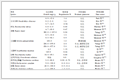
秦峰和赵艳[29]搜集的资料表明,中国基于孢粉学资料已开展古气候定量重建的化石点(含第三纪)迄今为止超过80个。据前人的初步统计[25],中国及其邻近区域近几十年孢粉研究地点中,第四纪年代范围内的研究点至少有400个以上。图 1a显示了区域内271个第四纪孢粉记录的样点位置,然而这个区域中利用第四纪孢粉(不含第三纪)数据进行气候定量估算的地点大约只有50余个(表 1),而且许多研究资料发表年代较早。由于早期的定量重建年代精度较低,无论在序列的分辨率精确度,还是孢粉-气候重建的可信度都相对薄弱。近十多年我国在基于孢粉数据的古气候定量重建方面虽然已经取得了长足进步,但无论在数量,还是时空尺度上仍然不足。目前收集的已开展孢粉-古气候定量重建资料主要集中于西北、 青藏高原东部以及华北地区,而华南、 西南、 东北和中国最西端等地区虽有一定数量的孢粉记录,但古气候重建资料极少,呈现明显的空白(图 1)。从近20年的定量孢粉-气候重建资料来看,绝大多数化石孢粉数据涉及的沉积序列都在全新世阶段,距今2万年以来的沉积孢粉记录数量不多(图 2)。个别孢粉记录的时间尺度达到数十万年,如雷州半岛田洋玛珥湖[22]和日本Biwa湖[6]的定量孢粉古气候重建达到数十万年; 鹤庆盆地穿过第四纪沉积的长序列孢粉结果只给出典型孢粉的季风气候指示意义,并没有做气候的定量重建[30]; 其他较长序列的孢粉记录如河北邯郸[31]和唐山[32]的剖面达到十几万年,但这些长时间尺度的记录的分辨率相对较低。纵观近几十年的定量孢粉-气候重建结果,即便是数万年的沉积序列也屈指可数,如邻近的日本Mikata湖[33]、 青藏高原乱海子湖[34]、 泥河湾井儿洼[35]的记录为近5万年; 而神农架大九湖[36]、 青藏高原冬给措纳湖[37]和希门错湖[38]的记录为2万年左右。可见,定量孢粉-气候重建资料中涉及冰期-间冰期轨道尺度记录的定量孢粉-气候重建资料比较缺乏。

|
图 1 中国及其邻区第四纪孢粉分析点(a)[25]和开展第四纪孢粉-气候定量重建的地点(b,编号见表 1) Fig. 1 Sites of Quaternary fossil pollen study (a) and pollen-based quantitative climate reconstruction (b) in China and adjacent areas. See Table 1 for the numbers in (b) |
|
表 1 定量古气候重建的相关文献及其地点和相关参数 Table 1 List of references and related parameters used for quantitative paleoclimate reconstruction |

|
图 2 近20年来基于化石孢粉数据定量古气候重建相关研究的信息数据图大于5万年为缩小的示意标尺 Fig. 2 Data information of the researches on pollen-based quantitative paleoclimate reconstruction during the past 20 years. Shortening scale is used for the data older than 50cal.ka B.P. |
2 基于孢粉的第四纪古气候重建基本方法
当前国内应用最广泛的第四纪孢粉-气候定量重建方法主要是各种类比法和转换函数法,以及这两种计算方程的衍生方法。实际上,所有这些方法的应用都建立在孢粉数据(或组合)与气候之间存在显著相关的函数关系的基本条件。因此,大部分方法都需要现代孢粉数据集的支撑。作为较大型的数据集,除了早年的第四纪孢粉数据库外[24, 27],目前已经发表的表土孢粉数据集,包括东亚地区[7]、 中国和蒙古[25]、 青藏高原[34, 50, 59, 71, 72]、 黄土地区[73]、 新疆和西北地区[74~76]、 华北地区[57, 77, 78]、 湖北神农架[79]和云南-四川西南部地区[80]等。现有的现代孢粉数据目前初步统计至少有4000余个,但这些现代数据目前大部分尚未能实现资源共享。
2.1 现代类比法(Modern analogue technique,简称MAT)现代类比法也叫做最佳类比法(the best analogue method),是第四纪古气候定量重建中应用最广泛的方法之一。该方法逐一计算化石孢粉谱与现代孢粉数据集中各孢粉谱的属种相似程度,寻找最接近的若干个现代孢粉谱,取其现代气候值的均值或得分权重值作为化石孢粉谱对应的古气候数值。MAT在20世纪80年代中期被引入第四纪古气候变化研究领域[1],此后,许多孢粉学家应用该方法重建了欧洲[21, 81~89]、 北美[90~92]、 非洲[93, 94]、 日本[6, 33]等地区晚更新世和全新世古气候,取得了丰富的成果。20世纪90年代末MAT被引入国内[22],近10多年来MAT已被我国孢粉学者广泛使用[36, 57, 61, 64, 68, 74, 95, 96]。
2.2 基于孢粉植物功能型的现代类比法(PFT-based modern analogue technique,简称PFT-MAT)在古今植被属种组成变化不大的情况下,MAT往往能得到较高的重建精度[10, 57]。但在气候环境完全不同的末次冰期,其植被组成与现代有很大的不同,某些植物种类还会发生远距离迁移甚至在本地区消失,因此化石孢粉谱中的属种组合与现代一定空间范围内的表土孢粉组合可能存在很大的差别[74],导致化石孢粉无法找到现代类比。末次冰期的孢粉谱找不到现代类比的情况在全球各地都十分常见[21, 55]。基于孢粉植物功能型的现代类比法可以在一定程度上克服这个问题。先将古今孢粉属种按照植物功能型(Plant Functional Type,简称PFT)归类,由PFT计算得分来代替单个孢粉种类含量。此后再采用MAT方法计算古今孢粉谱PFT得分的相似程度,寻找与化石孢粉谱PFT最接近的若干个现代孢粉谱,根据现代样点气候数据作为化石孢粉谱对应的古气候值。我国学者近些年也开始利用该方法进行气候数值的换算,较典型的如Jiang等[55]采用该方法对多种气候参数进行了重建,取得了较好的结果。目前诸多研究结果证实该方法是可行的[55, 62, 97]。
2.3 层级现代类比法(Hierarchical analog technique,简称HAT)如前所述,由于类比法应用于冰期-间冰期长周期的序列中,常常在现代数据集中找不到相应的类比结果[21],因此可采用层级的方法来解决。HAT首先基于属种寻找化石孢粉谱的现代类比,按普通MAT方法计算古气候值[93]; 无现代类比的孢粉谱进入第二级PFT-MAT计算。如果第二级仍然无现代类比,再进入第三级,按孢粉属种对应的植物生活形态、 物候特征和叶形等特点归类为若干生活形态类别,计算孢粉谱的生活形态类别的相似程度,以最接近的若干个现代孢粉谱气候值的均值作为化石孢粉谱对应的古气候值[98]。显然,第一级类比精度高于第二级,第二级精度高于第三级。该种方法在我国的研究中尚无应用的例子。
2.4 孢粉-气候响应面法(Pollen response surface,简称PRS)响应面法实质上也是一种现代类比法的变种[99]。1986年首次用于北美孢粉-气候重建[19]。这种方法需要先选出化石孢粉谱中主要的、 有气候指示意义的属种,利用现代孢粉数据集和现代气候数据,通过非线性回归建立所选孢粉属种含量对二维气候空间(如年均温vs年降雨量)的响应面函数。按照一定的间隔距离把二维气候空间均匀划分成若干网格,提取网格结点处对应的气候值并代入各属种的响应面函数求出对应的孢粉含量。经过这样的计算得到一组有明确气候值和属种含量的结点孢粉数据集[19]。化石孢粉谱中被选出的属种与结点孢粉数据集之间,按照MAT法进行距离计算,从而求取与化石孢粉谱相似性最大的结点,其气候参数直接作为石花粉谱对应的气候值[3, 19, 100]。国内许多孢粉学者尝试用这种方法成功重建了晚第四纪古气候[42, 45, 47, 101~104]。
2.5 转换函数(Transfer function,简称TF)及其衍生方法转换函数法是第四纪孢粉-气候定量重建中除MAT之外的另一种使用最为广泛的方法,我国学者最近几十年也有广泛的应用[5, 16, 43, 44, 56, 58, 76, 105]。基本思想是假定古今孢粉-气候关系不变或相似且可被数学函数描述,通过统计学回归方法,在现代孢粉数据集中寻找待研究地点表现最佳的转换函数,代入化石孢粉数据计算其古气候值[106]。这种方法很早就被微体古生物学家和孢粉学家使用[107]。
为了将太多的孢粉变量转变为1个或几个主因子,其衍生方法还包括主成分回归法(Principal Component Regression,简称PCR)[108]、因子载荷法(Factor Loading,简称FL)[44]、 逆线性回归法(Inverse Linear Regression,简称IL)[50]、 偏最小二乘回归法(Partial Least Squares Regression,简称PLS)、 加权平均偏最小二乘回归法(Weighted Averaging Partial Least Squares Regression,简称WAPLS)[5, 50, 56, 57, 63, 66, 77, 78, 109, 110]、 局部加权的加权平均法(Locally Weighted Weighted Averaging Model,简称LWWA)[59]等。
2.6 古植被模型反演方法(Inverse vegetation modelling,简称IVM)古植被模型反演方法是近十多年发展起来的一种孢粉-古气候定量重建方法,其实质是将植被BIOME模型与反演过程相结合,获得孢粉数据所指示的植被类型生长的气候区间,进而实现气候要素的定量化重建[111, 112]。该方法最主要的优势在于能一定程度上克服冰期时段孢粉种属缺乏现代可类比样本的弱点,从而提高冰期阶段气候重建的可靠性。古植被模型反演方法的应用首先需要在较大空间区域的现代孢粉数据中实现并得到检验。吴海斌等[113]利用该方法在我国的表土孢粉数据上进行了首次尝试,研究结果显示该方法具有较好的植被反演和气候要素重建能力,这为今后在我国第四纪孢粉上的应用奠定了基础。
2.7 其他第四纪孢粉-气候定量重建方法除以上6种方法之外,国际上还有其他一些第四纪适用的方法有较多的应用。例如神经网络法(Artificial Neural Network,简称ANN)[84, 114]、 生态位法[115]、 概率密度法(实质上也是一种转换函数法)[116]等。
此外,由于转换函数和最佳类比法等目前第四纪常用的定量气候重建手段主要基于现代生态系统与气候间的相互关系,因此对于百万年至千万年以前的样品,会出现化石孢粉谱在现代数据集中找不到最佳类比的孢粉样点,从而难以运用到较古老地层的孢粉分析结果中,使古近纪、 新近纪乃至早中第四纪时期的孢粉-气候定量重建较为困难[117],因此,对古老孢粉组合的定量重建常采用另外的定量古气候重建方法,较流行的如共存因子分析法和气候区间法。国内学者目前对这些方法已有较多的应用[118],但本文对这些重点应用于第三纪或更老地层的方法不做赘述[117]。
3 末次冰期以来的古气候重建与集成 3.1 气候参数与重建方法的应用纵观近几十年来的孢粉-气候定量重建结果,主要反演的替代气候参数为年平均温度(Tann)和年均降雨量(Pann),这两个气候参数作为孢粉-气候重建的输出结果,在整个中国及邻近区域分别有36个和42个; 其他涉及的古气候参数尚有最冷月均温(或1月均温,Tjan)和最热月均温(或7月均温,Tjuly),这两个指标分别有10个和15个记录; 此外,湿度相关的参数(H和MI)有2个,蒸散量(E)和5℃有效积温(GDD5)等气候参数分别各有1个。
综合所有的定量重建方法,转换函数方法(TF)和最佳类比法(MAT)是最常用的两种定量重建采用的数理统计方法。由于最佳类比法要求使用空间范围较大的现代孢粉数据集,因此在使用上常常受到限制。因此,目前绝大部分基于孢粉数据的定量气候重建主要是应用转换函数方法。转换函数法是基于一定数量的现代孢粉组合,建立孢粉类群百分含量或因子组合与气候参数建立多元回归函数,并将该函数运用到第四纪孢粉数据中来定量计算古气候[5, 50, 57]。这种方法与最佳类比法相比,是在无足够大的表土孢粉数据库时和化石孢粉组合无现代类比时,仍能够较好地完成古气候重建。
诚然,作为现代参照系的表土或湖泊表层孢粉数据需要尽可能多地代表区域内不同生态体系下的环境变量。就目前我国的孢粉转换函数应用情况来看,研究区域内的现代参照系孢粉点数量和植物类群代表性有待增加。经统计,除了个别研究没有给出具体的现代孢粉数量外,一般研究所采用的现代孢粉数据集为40~500个样点(表 2),部分研究运用了已发表的孢粉数据库,如东亚孢粉数据库(EAPD)[7, 36, 66, 119]、 日本孢粉数据集(JPPD)[53, 120]、 中国第四纪孢粉数据库(CQPD)[27, 55]、 欧洲孢粉数据库(EPD)[22,55 121]、 中国和蒙古孢粉数据集(C & MPD)[25, 70]、 北欧亚大陆孢粉数据集(NEPD)[26]等。
同一组孢粉数据采用不同重建方法进行对比可以较好地筛选出最适合当地的研究手段。如Xu等[5]对岱海湖全新世孢粉记录的同一组数据进行了转换函数、 最佳类比法和花粉响应面3种定量方法的对比,认为降雨量的重建结果3种方法都是一致的,而温度变化采用TF和MAT可获得基本相似的结果,但利用PRS响应面的重建结果则差异较大,特别是晚全新世温度曲线的负偏移十分大,欠缺准确性。可见,在不同地区采用不同的重建方法仍然存在显著的差别。
|
|
表 2 末次冰期以来钻孔孢粉定量古气候重建相关的基本信息 Table 2 Basic information of pollen-based quantitative climate reconstruction since the Last Glacial |
本研究对中国及周边地区利用孢粉数据定量恢复第四纪古气候的资料进行了收集整理,统计分析结果表明,我国及邻近区域至少有50个化石孢粉数据进行了定量气候重建的工作(见图 1和表 1),其中有定量温度指标(Tann)的孢粉谱共35个。对定量重建的年代范围收集结果发现,绝大部分孢粉数据的年代覆盖多数集中在全新世,其中最长的孢粉记录约为430cal.ka B.P.[6],而最短仅为0.2cal.ka B.P.[58]。达到末次冰期范围的孢粉-气候重建结果有7个,占全部的14%,穿越多个冰期-间冰期的孢粉分析结果和定量重建工作仅有郑卓和Guiot[22]、 Tarasov等[6]以及Mu等[68]。
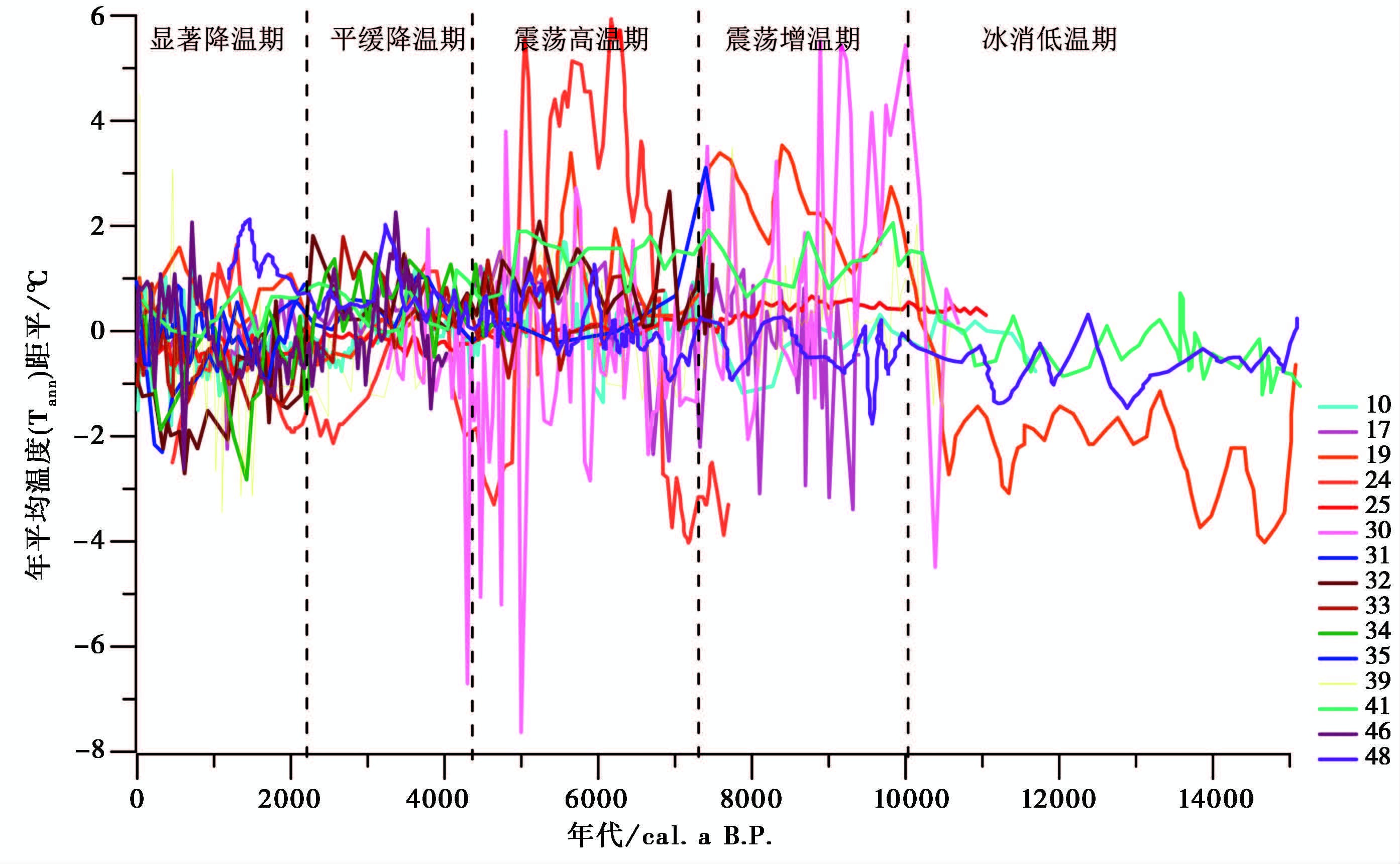
根据气候重建结果的年代范围和分辨率等可靠性,本文选取了15个孢粉-年均温度结果进行了集成对比分析(图 3)。可以看出,不同纬度和海拔高度的研究差别明显,青藏高原、 西北干旱区等高纬度地区温度低,但变化幅度普遍较小,如Herzschuh等[38]在希门错对22cal.ka B.P. 以来的气候重建显示,年平均温度值比较低,大致在-5℃到-1℃之间变化,显示其变化幅度较小,约4℃左右。青藏高原和西北地区古气候重建点的最高年均温度均小于9.5℃,变化幅度也基本限制在4~5℃以内[34, 51, 62, 66, 67]。然而,东部季风区的许多定量重建结果的年平均温度变化幅度一般在冰期-间冰期旋回达到6~10℃左右,最大可达15℃[6, 53]。
|
图 3 中国及其邻区年平均气温(Tann)定量重建距平集成图(曲线编号见表 2) Fig. 3 Data integration of temperature(Tann) anomaly in China and adjacent areas. See Table 2 about the curve numbers |
研究发现,无论是高纬度还是高海拔地区的古温度重建结果与上述讨论基本一致,本次收集的海拔最高的样点位于青藏高原的乱海子湖(海拔3200m),对50cal.ka B.P. 以来的孢粉-气候重建[34]结果显示,年平均温度变化在-0.5~4.0℃之间,盛冰期与间冰期温度值相差4.5℃; 而东部季风区温度变化幅度相对较大的例子如白音查干湖的气候定量重建结果显示,仅在冰消期12.5cal.ka B.P. 以来温度变化幅度就达到10℃[55]。上述温度因子重建结果的差别可能存在如下因素:

|
图 4 中国及其邻区年降雨量定量重建结果的标准化集成(图 4b),以及与董哥洞石笋的氧同位素(图 4a)[123]对比图例编号见表 2 Fig. 4 Integration of standardization data based on quantitative precipitation reconstructions in China and adjacent areas(b),and comparison with δ18O curve[123] from Dongge cave(a). See Table 2 about the curve numbers |
(1) 对于年平均温度0℃以下地区,地表为冰雪覆盖或冻荒漠,一般认为年平均生物温度在3℃以下的植物类群基本均为苔原或高寒草甸[122],因此在温度较低或雪线附近的高寒草甸区域,很难利用生物反演的办法来准确重建低于0℃的古气候。也就是说,如果在现代年平均温度接近0℃的高海拔和高纬度地区利用孢粉进行气候重建,其结果可能显示冰期-间冰期变化幅度要小于实际的变化量。
(2) 由于东部季风区植被对温度的响应比较敏感,可以较精确还原冰期以来的实际温度变化,幅度变化较大的温度参数可能是真实的。但由于东部季风区植被分布比较复杂,特别是中低纬度地区的生物多样性十分显著,从而导致基于孢粉谱的精确气候定量重建难度也比较高,因而也不能排除一些温度重建结果在这些地区存在误差值较大结果。
(3) 无论是转换函数还是最佳类比法等方法,现代参照系孢粉样点的数量和代表性直接影响重建结果的精度和变化幅度,特别是跨越冰期阶段化石孢粉的气候重建需要足够大空间范围的现代孢粉样点数据集。
尽管基于第四纪孢粉分析数据的气候转换在方法上仍存在一些问题,但由于植被对温度的响应十分敏感,因此孢粉分析结果仍然是陆地记录最好和最可信的温度重建替代性指标之一。本文为了探索东亚区次大陆整体的古温度变化,将部分年代可靠性较强的数据进行了年均温度(Tann)距平处理(图 3),即对每一个重建的年平均温度值与该数据的平均值进行距平计算。由于大部分数据仅局限在全新世年代区间,本次温度距平的集成展示了15cal.ka B.P. 以来的变化(图 3)。其重建结果显示不同区域和不同重建方法存在比较大的差异,温度重建差距最大的时间段为早-中全新世,该时段常被普遍认为属于全新世夏季风最强盛和较为温暖的时期[38, 53, 65]。此外本研究还发现,冰消期气温与全新世约10cal.ka B.P. 之间的气候变化为突变过程,即在较短时间内年平均温度变化幅度可达到3~8℃,这一结果有可能是YD事件后的快速升温所造成[53]。根据对比结果,全新世10.0~7.2cal.ka B.P. 为振荡或起伏较大的增温期,但这一时期不同地区的重建结果相差甚大,如果取多个数据的平均值,该时期的年平均温度比现代约高出1.0~1.5℃; 之后的7.2~4.1cal.ka B.P. 为气候振荡高温期,部分曲线达到全新世的最大值; 4.1~2.1cal.ka B.P. 为平缓降温时期,这一阶段大部分孢粉-气候重建结果均比较一致,总体反映的气温已接近现代或略高; 从2.1cal.ka B.P. 至今为显著降温期,此间还包括了小冰期等事件的影响。
基于上述分析可以发现,将整个东亚次大陆所有气候重建结果进行集成可以大体了解晚第四纪温度与降水量总体的变化趋势和特征(见图 3和图 4b)。但由于本次研究没有考虑不同地貌单元气候变化的非一致性,而且我国的地势由东至西和由南至北变化较大,不同的气候区还可能存在第四纪气候变化趋势上的差别,如西南季风区、 东南季风区、 西风带影响区域等。实际上,基于孢粉数据对古温度的重建尚需要认真思考地形、 海拔、 纬度等因素对植被的影响,如青藏高原区、 西北干旱区、 东南季风区等。这些区域上的气候变化差别有待今后进一步研究。
其他涉及的古温度参数中,比较常用的尚有1月均温Tjan(或最冷月均温Tc)和7月均温Tjuly(或最热月均温Tw),这两个指标经统计分别有10个和15个记录,且绝大部分的重建结果均在全新世。个别跨越冰期的长记录如中国邻区的日本Biwa湖结果表明[6],末次盛冰期最冷月降温幅度达到16℃,最热月降幅也有6℃,而年平均温度的降温幅度大约为8~10℃。在全新世的重建结果中,1月和7月两个参数总体的变化趋势与年平均温度是一致的,但个别研究在短期波动过程中存在反向变化,如7月温度降低时,1月温度则相对上升,显示出季节性温差降低的特点[55]。
3.2.2 降雨量重建降雨量在我国幅员广大的生态系统中是对其植被的空间分布最具有密切依存关系的指标,也是研究第四纪东亚季风变化的关键气候因子。我国从东部到西部的森林-草原-荒漠过渡带孢粉数据可以比较好地记录过去的降雨量变化[43, 45, 47, 51, 53, 59, 67, 70]。在中国及周边地区第四纪以来利用孢粉数据恢复古气候的数据中,50个左右的气候重建地点中含有降雨量参数指标的就达到42个,且多数为年均降雨量(Pann)。由于重建结果覆盖的时间的范围不一,本文选用了14个重建结果进行了对比分析(图 4b),并与董哥洞石笋的氧同位素(图 4a)[123]进行对比。由于降雨量在不同植被带差距十分大,如东南部年降雨量达到2000mm以上[119],而在西北干旱区甚至小于100mm[74],如冬给措纳湖对20cal.ka B.P. 以来的降雨量重建结果显示末次冰期以来的变化范围在50~400mm之间[37],虽然相差仅350mm,但对植被类型的分布起决定性作用。但在东南季风区,数百毫米降雨量的变化可能对植被并没有太大影响[119]。因此,采用降雨量绝对值的距平方法,实际上无法正确反映降雨量在各不同地点变化幅度对植被分布的重要性。为此,本研究采用了数据标准化方法[124],其数值不代表降雨量绝对值,而是当地变化量的波动幅度,即采用标准差来描述一组数据的波动情况特征值,也可以看成是样本数据到平均数的一种平均距离。标准化过程选择了无量纲化处理中的Z-score方法进行综合分析[124]。该标准化是基于原始数据的均值(mean)和标准差(standard deviation)进行的,公式为:
| $z = \left( {x - \bar x} \right)/\sigma $ |
其中z为原数据,x为原数据,为平均数,σ为标准差。
Z-score标准化后的变量值围绕0上下波动,使不同地区的降雨量值都处于同一个数量级上,从而比较易于进行大区域的对比分析(图 4)。
降雨量重建结果的标准化集成可以看出(图 4a),不同地点的降雨量重建结果差别较大,特别是在15cal.ka B.P. 以来的末次冰消期降雨量整体波动频繁。冰消期至8cal.ka B.P. 期间,降雨量的变化各地很不一致,分辨率也比较低,定量重建的误差偏大。早全新世12.0~7.5cal.ka B.P. 是目前国内诸多定量重建结果中数量较少,且可信度较低的区间,与石笋的同位素结果[125]对比发现,石笋在11~6cal.ka B.P. 指示的强季风降雨信号与孢粉定量转换结果并不一致。此外,冰消期过程中的YD事件在降雨量曲线中也没有明显的表现。从目前的数据来看,基于孢粉的降雨量的重建结果在6cal.ka B.P. 以来的共同趋势大致相互吻合,从4.2cal.ka B.P. 开始降雨量降低,与石笋氧同位素可以对比。
与降雨有关的气候重建指标尚有潮湿指数(MI)、 湿度(H),以及蒸散量(E)等参数。对青藏高原现代表土孢粉-气候重建的研究表明,湿度和蒸散量指标也具有较好的重建结果,Lu等[59]在青藏高原获得的表土样点观测值与重建值之间的相关系数R2分别达到0.96和0.93,均方差误差分别为4.5%和215mm。该研究对青藏高原南部的全新世相对湿度(H)重建的结果与降雨量基本一致,约在8.6cal.ka B.P. 为高值区,但蒸散量则一定程度呈现反向变化[59]; 另一项对我国北方全新世湿度的研究显示,湿度变化趋势并不等同于降雨量,即降雨量最高值出现在11~8cal.ka B.P.,但相对湿度的最高值区间在8.0~5.5cal.ka B.P.[55]。
从目前我国基于孢粉数据的降雨量和湿度等指标重建资料分析,许多重建结果精度仍较低,特别是季风湿润地区降雨量重建的可信度仍有待今后进一步加强。干旱区和高原区域的降雨量与蒿属、 藜科/苋科、 麻黄属、 莎草科等的含量关系十分密切[7],可以较好地重建降雨量指标。我国较长尺度或达到末次冰期连续的孢粉-降雨量重建结果数量仍然较少,冰期的降雨量下降幅度迄今为止仍不十分明确。此外,西南季风、 东南季风、 西北缘的西风带等水汽来源因来源地和时间均不一致,今后有必要进行分区的古气候数据集成和模拟。
4 结语及展望我国从20世纪70年代起,在老一辈孢粉学家的引领下,开创性地引入了孢粉-气候定量重建方法,与国外学者的发展基本同步。但最近20多年来,国外学者利用转换函数、 最佳类比法等统计学方法的气候重建得到了快速的发展,其精度和科学性也不断提高。相比之下,我国孢粉学界在这方面的进步相对滞后,目前大量的国际合作有望加快提高我国在孢粉-气候定量重建的水平。
过去利用孢粉记录定量重建古气候的研究尽管已有一定的数量,但多数只注重单个孢粉分析钻孔样点位置的重建,未考虑到区域或更大空间尺度的相互对比,从而所用气候指标和方法在不同地点的不一致造成相互间的比较产生困难。因而利用相同指标或相同方法对区域至洲际尺度的大范围古气候重建难以实现。此外,我国近几十年的孢粉-气候定量重建结果主要集中在全新世,特别是中晚全新世; 对冰期甚至更老地层的定量重建结果十分少,其精度也相对较低。
基于孢粉数据的古气候重建结果集成分析表明,末次冰期阶段不同纬度和海拔高度重建的温度差别明显,青藏高原、 西北干旱区等高纬度地区温度低,但冰期-间冰期变化幅度普遍较小,而东部季风区年平均温度的一些重建结果显示温差幅度较大,一般可达8~10℃左右。高海拔和高纬度区孢粉重建的温度变化幅度小于中低纬度地区的原因主要与植物的生存温度最低值有关。此外,冰消期至10cal.ka B.P. 之间的气候变化多数结果显示为突变过程,即在较短时间内年平均温度变化幅度可达到3~8℃。降雨量的集成结果发现不同地点的重建结果差别较大且振幅明显,特别是末次冰消期至7.5cal.ka B.P. 期间降雨量的变化各地很不一致,分辨率也相对较低; 然而在6cal.ka B.P. 以来各曲线的共同趋势大致趋于吻合,从4.2cal.ka B.P. 开始降雨量降低,与石笋氧同位素可以对比。综合数据对比表明,孢粉重建结果的可信度需要考虑到所在地域出现的诸多影响因子,包括地形、 海拔、 纬度等因素。 对数据的集成分析还需要考虑不同气候区和不同水汽来源区的影响,但本次研究未考虑不同地域和不同气候带在第四纪期间变化的差异性。
基于孢粉数据进行古气候定量重建是陆地区域其他指标所不可替代的,因为孢粉数据不仅具有温度和降雨信号,同时还直接具备恢复各气候带的植被格局或生物群区功能。具有精确年代框架和连续时间序列的孢粉记录,如果使用合适的定量方法和具有一定数量的现代孢粉数据支持,是完全可以达到较精确重建古气候的目的。从近年来的工作成果分析,利用偏最小二乘法的回归计算作为孢粉-气候转换函数的建立已比较成熟,该方法不一定需要数量很大的现代孢粉数据作为基础,实际的应用较为方便可行。虽然目前我国对第四纪古气候重建结果并未得到第四纪研究者的广泛引用,但随着年代的精度提高和方法的进一步成熟,以及现代参照系孢粉代表性样点的齐全和共享,孢粉-气候的定量重建一定会为深入理解区域和全球的第四纪气候变化起到重要作用,该方法实际上正在孕育着大展宏图趋势。
| 1 |
Overpeck J T, Webb T, Prentice I C. Quantitative interpretation of fossil pollen spectra:Dissimilarity coefficients and the method of modern analogs[J].
Quaternary Research,1985, 23 (1) : 87~108.
( 0) 0)
|
| 2 |
Huntley B. Studying global change:The contribution of Quaternary palynology[J].
Palaeogeography, Palaeoclimatology, Palaeoecology,1990, 82 (1-2) : 53~61.
(0)
|
| 3 |
Anderson P M, Bartlein P J, Brubaker L B, et al. Vegetation-pollen-climate relationships for the arcto-boreal region of North America and Greenland[J].
Journal of Biogeography,1991, 18 (5) : 565~582.
(0)
|
| 4 |
唐领余, 沈才明, 赵希涛, 等. 江苏建湖庆丰剖面1万年来的植被与气候[J].
中国科学(B辑 化学 生命科学 地学),1993, 23 (6) : 637~643.
Tang Lingyu, Shen Caiming, Zhao Xitao, et al. Vegetation and climate changes since 10ka inferred from Qingfeng section, Jianhu, Jiangsu Province[J]. Science in China(Series B, Chemistry, Life Sciences & Earth Sciences),1993, 23 (6) : 637~643. ( 0)
|
| 5 |
Xu Q, Xiao J, Li Y, et al. Pollen-based quantitative reconstruction of Holocene climate changes in the Daihai Lake area, Inner Mongolia, China[J].
Journal of Climate,2010, 23 (11) : 2856~2868.
(0)
|
| 6 |
Tarasov P E, Nakagawa T, Demske D, et al. Progress in the reconstruction of Quaternary climate dynamics in the Northwest Pacific:A new modern analogue reference dataset and its application to the 430-kyr pollen record from Lake Biwa[J].
Earth-Science Reviews,2011, 108 (1) : 64~79.
(0)
|
| 7 |
Zheng Z, Wei J, Huang K, et al. East Asian pollen database:Modern pollen distribution and its quantitative relationship with vegetation and climate[J].
Journal of Biogeography,2014, 41 (10) : 1819~1832.
(0)
|
| 8 |
Chen F, Xu Q, Chen J, et al. East Asian summer monsoon precipitation variability since the Last Deglaciation[J].
Scientific Reports,2015, 5 .
doi: 10.1038/srep11186 (0)
|
| 9 |
李珍, 王开发, 王永吉, 等. 红树林孢粉-气候因子转换函数恢复古环境的可行性初探[J].
海洋科学进展,2002, 20 (3) : 73~78.
Li Zhen, Wang Kaifa, Wang Yongji, et al. A preliminary study on the feasibility for reconstructing paleoenvironment using the mangrove a preliminary study on the feasibility for reconstructing paleoenvironment using the mangrove sporo-pollen-climate factor transfer function[J]. Advances in Marine Science,2002, 20 (3) : 73~78. ( 0)
|
| 10 |
Guiot J. Late Quaternary climatic change in France estimated from multivariate pollen time series[J].
Quaternary Research,1987, 28 (1) : 100~118.
(0)
|
| 11 |
Webb T, Bryson R A. Late-and postglacial climatic change in the northern Midwest, USA:Quantitative estimates derived from fossil pollen spectra by multivariate statistical analysis[J].
Quaternary Research,1972, 2 (1) : 70~115.
(0)
|
| 12 |
王开发, 卞玉清, 孙煜华, 等. 东海沉积物中孢粉组合的因子分析[J].
海洋学报,1982, 4 (5) : 570~585.
Wang Kaifa, Bian Yuqing, Sun Yuhua, et al. Factor analysis of sporo-pollen assemblages of sediments from East China Sea[J]. ActaOceanologica Sinica,1982, 4 (5) : 570~585. ( 0)
|
| 13 |
罗伦德. 重庆嘉陵江一级阶地孢粉分析及其晚全新世古气候的演变[J].
海洋地质与第四纪地质,1989, 9 (4) : 69~85.
Luo Lunde. Sporopollen analysis to one-step terrace of the Jialing River in Chongqing City and its paleoclimatic development during Late Holocene[J]. Marine Geology & Quaternary Geology,1989, 9 (4) : 69~85. ( 0)
|
| 14 |
童国榜, 白土英, 周顺江, 等. 昆明盆地第四纪孢粉时间序列的波动特征及其地质环境意义[J].
植物学报,1990, 32 (2) : 146~156.
Tong Guobang, Bai Tuying, Zhou Shunjiang, et al. The characteristics of the pollen spore time series fluctuation and its significant in the geological environments of the Quaternary in Kunming basin[J]. Acta Botanica Sinica,1990, 32 (2) : 146~156. ( 0)
|
| 15 |
沈才明, 唐领余.
第四纪花粉分析的数值方法[M]. 南京: 东南大学出版社, 1992 : 1 ~239.
Shen Caiming, Tang Lingyu. Numerical Methods in Quaternary Pollen Analysis[M]. Nanjing: Southeast University Press, 1992 : 1 ~239. ( 0)
|
| 16 |
王立新, 王仪华, 童国榜. 孢粉数据的回归分析方法[J].
数理统计与管理,1995, 14 (4) : 27~32.
Wang Lixin, Wang Yihua, Tong Guobang. Regression analysis in disposition of pollen data[J]. Journal of Applied Statistics and Management,1995, 14 (4) : 27~32. ( 0)
|
| 17 |
宋长青, 孙湘君. 花粉-气候因子转换函数建立及其对古气候因子定量重建[J].
植物学报,1997, 39 (6) : 554~560.
Song Changqing, Sun Xiangjun. Establishment of transfer function of the pollen-climatic factors in Northern China and the quantitative climatic reconstruction at DJ core[J]. Acta Botanica Sinica,1997, 39 (6) : 554~560. ( 0)
|
| 18 |
宋长青, 孙湘君, 吕厚远. 中国北方花粉-气候因子转换函数建立及应用[J].
科学通报,1997, 42 (20) : 2182~2186.
Song Changqing, Sun Xiangjun, Lü Houyuan. Establishment and application of transfer functions of the pollen-climatic factors in Northern China[J]. Chinese Science Bulletin,1997, 42 (20) : 2182~2186. ( 0)
|
| 19 |
Bartlein P J, Prentice I C, Webb Ⅲ T. Climatic response surfaces from pollen data for some eastern North American taxa[J].
Journal of Biogeography,1986, 13 (1) : 35~57.
(0)
|
| 20 |
孙湘君, 王琫瑜, 宋长青. 中国北方部分科属花粉-气候响应面分析[J].
中国科学(D辑: 地球科学),1996, 26 (5) : 431~436.
Sun Xiangjun, Wang Bengyu, Song Changqing. Document pollen-climate response surfaces of selected taxa from Northern China[J]. Science in China(Series D:Earth Sciences),1996, 26 (5) : 431~436. ( 0)
|
| 21 |
Guiot J. Methodology of the last climatic cycle reconstruction in France from pollen data[J].
Palaeogeography, Palaeoclimatology, Palaeoecology,1990, 80 (1) : 49~69.
(0)
|
| 22 |
郑卓, GuiotJoël. 我国热带地区40万年以来古气候的定量恢复[J].
中山大学学报(自然科学版),1999, 38 (6) : 95~99.
Zheng Zhuo, Guiot Joël. A 400 000-year paleoclimate reconstruction in tropical region of China[J]. Journal of Sun Yat-sen University(Natural Science),1999, 38 (6) : 95~99. ( 0)
|
| 23 |
Yu G, Prentice I C, Harrison S P, et al. Pollen-based biome reconstructions for China at 0 and 6000 years[J].
Journal of Biogeography,1998, 25 (6) : 1055~1069.
(0)
|
| 24 |
中国第四纪孢粉数据库小组. 中国中全新世(6ka BP)和末次盛冰期(18ka BP)生物群区的重建[J].
植物学报,2000, 42 (11) : 1201~1209.
Members of China Quaternary Pollen Data Base. Pollen-based biome reconstruction at Middle Holocene(6ka BP)and Last Glacial Maximum(18ka BP)in China[J]. Acta Botanica Sinica,2000, 42 (11) : 1201~1209. ( 0)
|
| 25 |
Cao X, Herzschuh U, Telford R J, et al. A modern pollen-climate dataset from China and Mongolia:Assessing its potential for climate reconstruction[J].
Review of Palaeobotany and Palynology,2014, 211 : 87~96.
(0)
|
| 26 |
Tarasov P E, Webb Ⅲ T, Andreev A A, et al. Present-day and Mid-Holocene biomes reconstructed from pollen and plant macrofossil data from the former Soviet Union and Mongolia[J].
Journal of Biogeography,1998, 25 (6) : 1029~1053.
(0)
|
| 27 |
孙湘君, 陈旭东, 宋长青. 中国第四纪孢粉数据库(CPD)和生物群区(Biome 6000)[J].
地球科学进展,1999, 14 (4) : 407~411.
Sun Xiangjun, Chen Xudong, Song Changqing. "China Quaternary pollen database"(CPD)and "Biome 6000" project[J]. Advance in Earth Sciences,1999, 14 (4) : 407~411. ( 0)
|
| 28 |
Chen Y, Ni J, Herzschuh U. Quantifying modern biomes based on surface pollen data in China[J].
Global and Planetary Change,2010, 74 (3) : 114~131.
(0)
|
| 29 |
秦锋, 赵艳. 基于孢粉组合定量重建古气候的方法在中国的运用及思考[J].
第四纪研究,2013, 33 (6) : 1054~1068.
Qin Feng, Zhao Yan. Methods of quantitative climate reconstruction based on palynological data and their applications in China[J]. Quaternary Sciences,2013, 33 (6) : 1054~1068. ( 0)
|
| 30 |
Xiao X Y, Shen J, Wang S M, et al. The variation of the southwest monsoon from the high resolution pollen record in Heqing basin, Yunnan Province, China for the last 2.78Ma[J].
Palaeogeography, Palaeoclimatology, Palaeoecology,2010, 287 (1) : 45~57.
(0)
|
| 31 |
肖景义, 陈建强, 李辉, 等. 河北邯郸HZ-S孔第四纪孢粉组合的定量分析[J].
地质通报,2008, 27 (5) : 599~604.
Xiao Jingyi, Chen Jianqiang, Li Hui, et al. Quantitative analysis of the Quaternary sporopollen assemblages:A case study of hole HZ-S core in Handan, Hebei, China[J]. Geological Bulletin of China,2008, 27 (5) : 599~604. ( 0)
|
| 32 |
李玉嵩, 陈建强, 赵硕, 等. 河北唐山地区第四纪近20万年来的古气候定量重建[J].
海洋地质与第四纪地质,2011, 31 (4) : 163~170.
Li Yusong, Chen Jianqiang, Zhao Shuo, et al. Quantitative reconstruction of palaeoclimate since 200ka BP in Tangshan area, Hebei Province[J]. Marine Geology & Quaternary Geology,2011, 31 (4) : 163~170. ( 0)
|
| 33 |
Nakagawa T, Tarasov P E, Nishida K, et al. Quantitative pollen-based climate reconstruction in Central Japan:Application to surface and Late Quaternary spectra[J].
Quaternary Science Reviews,2002, 21 (18) : 2099~2113.
(0)
|
| 34 |
Herzschuh U, Birks H, Mischke S, et al. A modern pollen-climate calibration set based on lake sediments from the Tibetan Plateau and its application to a Late Quaternary pollen record from the Qilian Mountains[J].
Journal of Biogeography,2010, 37 (4) : 752~766.
(0)
|
| 35 |
Liu X, Chi Z, Herzschuh U, et al. A MIS 3 charcoal and pollen record and quantitative precipitation inferences from the Jingerwa section of the Nihewan basin, north-Central China[J].
Journal of Paleolimnology,2014, 51 (2) : 211~221.
(0)
|
| 36 |
黄康有, 魏金辉, 陈碧珊, 等. 最佳类比法的孢粉-古气候定量重建研究进展[J].
第四纪研究,2013, 33 (6) : 1069~1079.
Huang Kangyou, Wei Jinhui, Chen Bishan, et al. Research progress of pollen-based quantitative paleoclimate reconstruction using modern analogue technique[J]. Quaternary Sciences,2013, 33 (6) : 1069~1079. ( 0)
|
| 37 |
Wang Y, Herzschuh U, Shumilovskikh L S, et al. Quantitative reconstruction of precipitation changes on the NE Tibetan Plateau since the Last Glacial Maximum——Extending the concept of pollen source area to pollen-based climate reconstructions from large lakes[J].
Climate of the Past Discussions,2014, 10 (1) : 21~39.
(0)
|
| 38 |
Herzschuh U, Borkowski J, Schewe J, et al. Moisture-advection feedback supports strong Early-to-Mid Holocene monsoon climate on the eastern Tibetan Plateau as inferred from a pollen-based reconstruction[J].
Palaeogeography, Palaeoclimatology, Palaeoecology,2014, 402 : 44~54.
(0)
|
| 39 |
乔玉楼, 陈佩英, 沈才明, 等. 定量重建贵州梵净山一万年以来的植被与气候[J].
地球化学,1996, 25 (5) : 445~457.
Qiao Yulou, Chen Peiying, Shen Caiming, et al. Quantitative construction of vegetation and climate of Fanjingshan section Guizhou during last 10000 years[J]. Geochimica,1996, 25 (5) : 445~457. ( 0)
|
| 40 |
童国榜, 石英, 吴瑞金, 等. 龙感湖地区近3000年来的植被及其气候定量重建[J].
海洋地质与第四纪地质,1997, 17 (2) : 54~62.
Tong Guobang, Shi Ying, Wu Ruijin, et al. Vegetation and climatic quantitative reconstruction of Longgan Lake since the past 3000 years[J]. Marine Geology & Quaternary Geology,1997, 17 (2) : 54~62. ( 0)
|
| 41 |
童国榜, 吴锡浩, 童琳, 等. 太白山最近1000年的孢粉记录与古气候重建尝试[J].
地质力学学报,1998, 4 (4) : 60~65.
Tong Guobang, Wu Xihao, Tong Lin, et al. Spore-pollen records and tentative paleoclimate reconstruction in Taibai Mountain in the last 1000 years[J]. Journal of Geomechanics,1998, 4 (4) : 60~65. ( 0)
|
| 42 |
王琫瑜, 宋长青, 程全国, 等. 利用花粉-气候响应面恢复察素齐泥炭剖面全新世古气候的尝试[J].
植物学报,1998, 40 (11) : 1067.
Wang Bengyu, Song Changqing, Cheng Quanguo, et al. Palaeoclimate reconstruction by adopting the pollen-climate response surface model to analysis the Chasuqi deposition section[J]. Acta Botanica Sinica,1998, 40 (11) : 1067. ( 0)
|
| 43 |
刘会平, 唐晓春, 刘胜祥. 神农架花粉-气候转换函数的建立与初步应用[J].
华中师范大学学报(自然科学版),2000, 34 (4) : 454~459.
Liu Huiping, Tang Xiaochun, Liu Shengxiang. The construction and application of pollen-climate transfer function in Shennongjia Mountain region[J]. Journal of Central China Normal University (Natural Sciences),2000, 34 (4) : 454~459. ( 0)
|
| 44 |
蔡永立, 陈宇, 陈中原, 等. 孢粉-气候对应分析重建上海西部地区8.5ka B .P. 以来的气候[J].
湖泊科学,2001, 13 (2) : 118~126.
Cai Yongli, Chen Yu, Chen Zhongyuan, et al. Climate fluctuation of the western Shanghai district by correspondence analysis since 8.5ka B .P[J]. Journal of Lake Sciences,2001, 13 (2) : 118~126. ( 0)
|
| 45 |
许清海, 肖举乐, 中村俊夫, 等. 孢粉资料定量重建全新世以来岱海盆地的古气候[J].
海洋地质与第四纪地质,2003, 23 (4) : 99~108.
Xu Qinghai, Xiao Jule, Nakamura Toshio, et al. Quantitative reconstructed climatic changes of Daihai basin by pollen data[J]. Marine Geology & Quaternary Geology,2003, 23 (4) : 99~108. ( 0)
|
| 46 |
Herzschuh U, Tarasov P, Wünnemann B, et al. Holocene vegetation and climate of the Alashan Plateau, NW China, reconstructed from pollen data[J].
Palaeogeography, Palaeoclimatology, Palaeoecology,2004, 211 (1) : 1~17.
(0)
|
| 47 |
许清海, 阳小兰, 杨振京, 等. 孢粉分析定量重建燕山地区5000年来的气候变化[J].
地理科学,2004, 24 (3) : 339~345.
Xu Qinghai, Yang Xiaolan, Yang Zhenjing, et al. Reconstruction of climatic changes of Yanshan Mountain area since 5000a B .P. inferred from pollen data[J]. Scientia Geographica Sinica,2004, 24 (3) : 339~345. ( 0)
|
| 48 |
Tarasov P, Granoszewski W, Bezrukova E, et al. Quantitative reconstruction of the Last Interglacial vegetation and climate based on the pollen record from Lake Baikal, Russia[J].
Climate Dynamics,2005, 25 (6) : 625~637.
(0)
|
| 49 |
Tarasov P, Jin G, Wagner M. Mid-Holocene environmental and human dynamics in Northeastern China reconstructed from pollen and archaeological data[J].
Palaeogeography, Palaeoclimatology, Palaeoecology,2006, 241 (2) : 284~300.
(0)
|
| 50 |
Shen C, Liu K, Tang L, et al. Quantitative relationships between modern pollen rain and climate in the Tibetan Plateau[J].
Review of Palaeobotany and Palynology,2006, 140 (1) : 61~77.
(0)
|
| 51 |
Herzschuh U, Kramer A, Mischke S, et al. Quantitative climate and vegetation trends since the Late Glacial on the northeastern Tibetan Plateau deduced from Koucha Lake pollen spectra[J].
Quaternary Research,2009, 71 (2) : 162~171.
(0)
|
| 52 |
朱诚, 陈星, 马春梅, 等. 神农架大九湖孢粉气候因子转换函数与古气候重建[J].
科学通报,2008, 53 (S1) : 38~44.
Zhu Cheng, Chen Xing, Ma Chunmei, et al. Spore-pollen-climate factor transfer function and paleoenvironment reconstruction in Dajiuhu, Shennongjia, Central China[J]. Chinese Science Bulletin,2008, 53 (S1) : 38~44. ( 0)
|
| 53 |
Yoshida A, Takeuti S. Quantitative reconstruction of palaeoclimate from pollen profiles in Northeastern Japan and the timing of a cold reversal event during the Last Termination[J].
Journal of Quaternary Sciences,2009, 24 (8) : 1006~1015.
(0)
|
| 54 |
Rudaya N, Tarasov P, Dorofeyuk N, et al. Holocene environments and climate in the Mongolian Altai reconstructed from the Hoton-Nur pollen and diatom records:A step towards better understanding climate dynamics in Central Asia[J].
Quaternary Science Reviews,2009, 28 (5) : 540~554.
(0)
|
| 55 |
Jiang W, Guiot J, Chu G, et al. An improved methodology of the modern analogues technique for palaeoclimate reconstruction in arid and semi-arid regions[J].
Boreas,2010, 39 (1) : 145~153.
(0)
|
| 56 |
Wen R, Xiao J, Chang Z, et al. Holocene precipitation and temperature variations in the East Asian monsoonal margin from pollen data from Hulun Lake in northeastern Inner Mongolia, China[J].
Boreas,2010, 39 (2) : 262~272.
(0)
|
| 57 |
Xu Q, Li Y, Bunting M J, et al. The effects of training set selection on the relationship between pollen assemblages and climate parameters:Implications for reconstructing past climate[J].
Palaeogeography, Palaeoclimatology, Palaeoecology,2010, 289 (1-4) : 123~133.
(0)
|
| 58 |
王筠, 赵元杰. 近200年以来罗布泊地区红柳沙包孢粉组合特征及其反映的植被和气候变化[J].
第四纪研究,2010, 30 (3) : 609~619.
Wang Jun, Zhao Yuanjie. Pollen assemblages of Tamarix cone and vegetation and climatic change in the Lop Nur region during the past about 200 years[J]. Quaternary Sciences,2010, 30 (3) : 609~619. ( 0)
|
| 59 |
Lu H, Wu N, Liu K, et al. Modern pollen distributions in Qinghai-Tibetan Plateau and the development of transfer functions for reconstructing Holocene environmental changes[J].
Quaternary Science Reviews,2011, 30 (7) : 947~966.
(0)
|
| 60 |
Park J. A modern pollen-temperature calibration data set from Korea and quantitative temperature reconstructions for the Holocene[J].
The Holocene,2011, 21 (7) : 1125~1135.
(0)
|
| 61 |
郭春晓, 罗璠, 罗传秀, 等. 基于若尔盖高原湿地唐克剖面孢粉记录的古气候重建[J].
古生物学报,2012, 51 (3) : 351~358.
Guo Chunxiao, Luo Fan, Luo Chuanxiu, et al. Holocene pollen record in the Tangke Peat profile of Sichuan and its palaeoclimatic significance[J]. Acta Palaeontologica Sinica,2012, 51 (3) : 351~358. ( 0)
|
| 62 |
Sun A, Feng Z. Holocene climatic reconstructions from the fossil pollen record at Qigai Nuur in the southern Mongolian Plateau[J].
The Holocene,2013, 23 (10) : 1391~1402.
(0)
|
| 63 |
Tian F, Herzschuh U, Telford R J, et al. A modern pollen-climate calibration set from central-western Mongolia and its application to a Late Glacial-Holocene record[J].
Journal of Biogeography,2014, 41 (10) : 1909~1922.
(0)
|
| 64 |
赵信文, 罗传秀, 陈双喜, 等. 基于孢粉数据的珠江三角洲QZK6孔全新世气候定量重建[J].
地质通报,2014, 33 (10) : 1621~1628.
Zhao Xinwen, Luo Chuanxiu, Chen Shuangxi, et al. Quantitative re-construction of Holocene climate based on pollen data from drill hole QZK 6 in Pearl River Delta[J]. Geological Bulletin of China,2014, 33 (10) : 1621~1628. ( 0)
|
| 65 |
Chen F, Chen X, Chen J, et al. Holocene vegetation history, precipitation changes and Indian summer monsoon evolution documented from sediments of Xingyun Lake, South-West China[J].
Journal of Quaternary Sciences,2014, 29 (7) : 661~674.
(0)
|
| 66 |
Li J, Zhao Y, Xu Q, et al. Human influence as a potential source of bias in pollen-based quantitative climate reconstructions[J].
Quaternary Science Reviews,2014, 99 : 112~121.
(0)
|
| 67 |
Zhang H, Zhang Y, Kong Z, et al. Late Holocene climate change and anthropogenic activities in North Xinjiang:Evidence from a peatland archive, the Caotanhu Wetland[J].
The Holocene,2015, 25 (2) : 323~332.
(0)
|
| 68 |
Mu H, Xu Q, Zhang S, et al. Pollen-based quantitative reconstruction of the paleoclimate during the formation process of Houjiayao Relic Site in Nihewan basin of China[J].
Quaternary International,2015, 374 : 76~84.
(0)
|
| 69 |
Park Junjiae, Park Jina. Pollen-based temperature reconstructions from Jeju Island, South Korea and its implication for coastal climate of East Asia during the Late Pleistocene and Early Holocene[J].
Palaeogeography, Palaeoclimatology, Palaeoecology,2015, 417 : 445~457.
(0)
|
| 70 |
Stebich M, Rehfeld K, Schlütz F, et al. Holocene vegetation and climate dynamics of NE China based on the pollen record from Sihailongwan Maar Lake[J].
Quaternary Science Reviews,2015, 124 : 275~289.
(0)
|
| 71 |
Zhang Z, Harrison S P, Mosbrugger V, et al. Evaluation of the realism of climate reconstruction using the Coexistence Approach with modern pollen samples from the Qinghai-Tibetan Plateau[J].
Review of Palaeobotany and Palynology,2015, 219 : 172~182.
(0)
|
| 72 |
Wei H, Ma H, Zheng Z, et al. Modern pollen assemblages of surface samples and their relationships to vegetation and climate in the northeastern Qinghai-Tibetan Plateau, China[J].
Review of Palaeobotany and Palynology,2011, 163 (3) : 237~246.
(0)
|
| 73 |
Zhao Y, Li F, Hou Y, et al. Surface pollen and its relationships with modern vegetation and climate on the Loess Plateau and surrounding deserts in China[J].
Review of Palaeobotany and Palynology,2012, 181 : 47~53.
(0)
|
| 74 |
Luo C, Zheng Z, Tarasov P, et al. A potential of pollen-based climate reconstruction using a modern pollen-climate dataset from arid Northern and Western China[J].
Review of Palaeobotany and Palynology,2010, 160 (3) : 111~125.
(0)
|
| 75 |
Zhao Y, Xu Q, Huang X, et al. Differences of modern pollen assemblages from lake sediments and surface soils in arid and semi-arid China and their significance for pollen-based quantitative climate reconstruction[J].
Review of Palaeobotany and Palynology,2009, 156 (3) : 519~524.
(0)
|
| 76 |
Zhang S, Xu Q, Nielsen A B, et al. Pollen assemblages and their environmental implications in the Qaidam Basin, NW China[J].
Boreas,2012, 41 (4) : 602~613.
(0)
|
| 77 |
Li Y, Xu Q, Liu J, et al. A transfer-function model developed from an extensive surface-pollen data set in Northern China and its potential for palaeoclimate reconstructions[J].
The Holocene,2007, 17 (7) : 897~905.
(0)
|
| 78 |
Wen R, Xiao J, Ma Y, et al. Pollen-climate transfer functions intended for temperate Eastern Asia[J].
Quaternary International,2013, 311 : 3~11.
(0)
|
| 79 |
Fang Y, Ma C, Mao L, et al. Surface pollen spectra from Shennongjia Mountains, Central China:An interpretation aid to Quaternary pollen deposits[J].
Review of Palaeobotany and Palynology,2015, 214 : 40~50.
(0)
|
| 80 |
Xiao X, Shen J, Wang S. Spatial variation of modern pollen from surface lake sediments in Yunnan and southwestern Sichuan Province, China[J].
Review of Palaeobotany and Palynology,2011, 165 (3) : 224~234.
(0)
|
| 81 |
Guiot J, Harrison S P, Prentice I C. Reconstruction of Holocene precipitation patterns in Europe using pollen and lake-level data[J].
Quaternary Research,1993, 40 (2) : 139~149.
(0)
|
| 82 |
Cheddadi R, Yu G, Guiot J, et al. The climate of Europe 6000 years ago[J].
Climate Dynamics,1996, 13 (1) : 1~9.
(0)
|
| 83 |
Cheddadi R, Lamb H F, Guiot J, et al. Holocene climatic change in Morocco:A quantitative reconstruction from pollen data[J].
Climate Dynamics,1998, 14 (12) : 883~890.
(0)
|
| 84 |
Peyron O, Guiot J, Cheddadi R, et al. Climatic reconstruction in Europe for 18000 yr BP from pollen data[J].
Quaternary Research,1998, 49 (2) : 183~196.
(0)
|
| 85 |
Davis B A, Brewer S, Stevenson A C, et al. The temperature of Europe during the Holocene reconstructed from pollen data[J].
Quaternary Science Reviews,2003, 22 (15) : 1701~1716.
(0)
|
| 86 |
Klotz S, Guiot J, Mosbrugger V. Continental European Eemian and Early Würmian climate evolution:Comparing signals using different quantitative reconstruction approaches based on pollen[J].
Global and Planetary Change,2003, 36 (4) : 277~294.
(0)
|
| 87 |
Ortu E, Brewer S, Peyron O. Pollen-inferred palaeoclimate reconstructions in mountain areas:Problems and perspectives[J].
Journal of Quaternary Sciences,2006, 21 (6) : 615~627.
(0)
|
| 88 |
Tarasov P, Bezrukova E, Karabanov E, et al. Vegetation and climate dynamics during the Holocene and Eemian interglacials derived from Lake Baikal pollen records[J].
Palaeogeography, Palaeoclimatology, Palaeoecology,2007, 252 (3) : 440~457.
(0)
|
| 89 |
Ortu E, David F, Peyron O. Pollen-inferred palaeoclimate reconstruction in the Alps during the Late Glacial and the Early Holocene:How to estimate the effect of elevation and local parameters[J].
Journal of Quaternary Sciences,2010, 25 (5) : 651~661.
(0)
|
| 90 |
Sawada M, Viau A E, Vettoretti G, et al. Comparison of North-American pollen-based temperature and global lake-status with CCCma AGCM 2 output at 6ka[J].
Quaternary Science Reviews,2004, 23 (3) : 225~244.
(0)
|
| 91 |
Whitmore J, Gajewski K, Sawada M, et al. Modern pollen data from North America and Greenland for multi-scale paleoenvironmental applications[J].
Quaternary Science Reviews,2005, 24 (16) : 1828~1848.
(0)
|
| 92 |
Williams J W, Shuman B. Obtaining accurate and precise environmental reconstructions from the modern analog technique and North American surface pollen dataset[J].
Quaternary Science Reviews,2008, 27 (7) : 669~68.
(0)
|
| 93 |
Bonnefille R, Chalié F. Pollen-inferred precipitation time-series from equatorial mountains, Africa, the last 40 kyr BP[J].
Global and Planetary Change,2000, 26 (1) : 25~50.
(0)
|
| 94 |
Gajewski K, Lézine A, Vincens A, et al. Modern climate-vegetation-pollen relations in Africa and adjacent areas[J].
Quaternary Science Reviews,2002, 21 (14) : 1611~1631.
(0)
|
| 95 |
李凡, 侯光良, 鄂崇毅, 等. 青藏高原全新世气温序列的集成重建[J].
干旱区研究,2015, 32 (4) : 716~725.
Li Fan, Hou Guangliang, E Chongyi, et al. Integrated reconstruction of the Holocene temperature series of Qinghai-Tibet Plateau[J]. Arid Zone Research,2015, 32 (4) : 716~725. ( 0)
|
| 96 |
穆会双, 许清海, 张生瑞, 等. 孢粉资料定量重建泥河湾盆地侯家窑遗址时期的古气候[J].
第四纪研究,2006, 65 (3) : 411~420.
Jiang W, Guo Z, Sun X, et al. Reconstruction of climate and vegetation changes of Lake Bayanchagan(Inner Mongolia):Holocene variability of the East Asian monsoon[J]. Quaternary Research,2006, 65 (3) : 411~420. ( 0)
|
| 97 |
Mu Huishuang, Xu Qinghai, Zhang Shengrui, et al. Pollen-based quantitative reconstruction of the paleoclimate during the formation process of Houjiayao Relic Site in Nihewan basin of China[J].
Quaternary Sciences,2015, 35 (3) : 698~711.
(0)
|
| 98 |
Mu Huishuang, Xu Qinghai, Zhang Shengrui, et al. Pollen-based quantitative reconstruction of the paleoclimate during the formation process of Houjiayao Relic Site in Nihewan basin of China[J].
Quaternary Sciences,2015, 35 (3) : 698~711.
(0)
|
| 99 |
Birks H B, Heiri O, Seppä H, et al. Strengths and weaknesses of quantitative climate reconstructions based on Late-Quaternary[J].
The Open Ecology Journal,2010, 3 (1) : 68~110.
(0)
|
| 100 |
Huntley B.
The Use of Climate Response Surfaces to Reconstruct Palaeoclimate from Quaternary Pollen and Plant Macrofossil Data[M]. Netherlands: Springer, 1994 : 7 ~16.
(0)
|
| 101 |
康兴成, 张其花, GraumlichL J, 等. 青海都兰过去2000年来的气候重建及其变迁[J].
地球科学进展,2000, 15 (2) : 215~221.
Kang Xingcheng, Zhang Qihua, Graumlich L J, et al. Reconstruction and variation of climate in Dulan region, Qinghai during last 2000a[J]. Advances in Earth Sciences,2000, 15 (2) : 215~221. ( 0)
|
| 102 |
许清海, 肖举乐, 中村俊夫, 等. 孢粉记录的岱海盆地1500年以来气候变化[J].
第四纪研究,2004, 24 (3) : 341~347.
Xu Qinghai, Xiao Jule, Nakamura Toshio, et al. Climate changes of Daihai basin during the past 1500 from a pollen record[J]. Quaternary Sciences,2004, 24 (3) : 341~347. ( 0)
|
| 103 |
Markgraf V, Webb R S, Anderson K H, et al. Modern pollen/climate calibration for southern South America[J].
Palaeogeography, Palaeoclimatology, Palaeoecology,2002, 181 (4) : 375~397.
(0)
|
| 104 |
喻树龙, 袁玉江, 魏文寿, 等. 天山北坡西部树木年轮对气候因子的响应分析及气温重建[J].
中国沙漠,2008, 28 (5) : 827~832.
Yu Shulong, Yuan Yujiang, Wei Wenshou, et al. Response of tree-ring to climate change and temperature reconstruction in west of Tianshan Mountains north slope[J]. Journal of Desert Research,2008, 28 (5) : 827~832. ( 0)
|
| 105 |
邓韫, 郑卓, CourP, 等. 中国东部花粉比值与气候的关系及其在定量古气候重建中的应用(英文)[J].
古生物学报,2002, 41 (4) : 508~516.
Deng Yun, Zheng Zhuo, Cour P, et al. Relation between pollen ratios and climate in East China and an attempt of paleoclimate reconstruction[J]. Acta Palaeontologica Sinica,2002, 41 (4) : 508~516. ( 0)
|
| 106 |
Cook E J, Van der Kaars S. Development and testing of transfer functions for generating quantitative climatic estimates from Australian pollen data[J].
Journal of Quaternary Sciences,2006, 21 (7) : 723~733.
(0)
|
| 107 |
Andrews J T, Mode W N, Davis P T. Holocene climate based on pollen transfer functions, Eastern Canadian Arctic[J].
Arctic and Alpine Research,1980, 12 (1) : 41~64.
(0)
|
| 108 |
刘润幸, 萧灿培, 宫齐, 等. 利用SPSS进行主成分回归分析[J].
数理医药学杂志,2001, 14 (2) : 103~105.
Liu Runxing, Xiao Canpei, Gong Qi, et al. The principal component regression analysis with SPSS[J]. Journal of Mathematical Medicine,2001, 14 (2) : 103~105. ( 0)
|
| 109 |
ter Braak C J F, Juggins S. Weighted averaging partial least squares regression(WA-PLS):An improved method for reconstructing environmental variables from species assemblages[J].
Hydrobiologia,1993, 269 (1) : 485~502.
(0)
|
| 110 |
Li J, Ilvonen L, Xu Q, et al. East Asian summer monsoon precipitation variations in China over the last 9500 years:A comparison of pollen-based reconstructions and model simulations[J].
The Holocene,2015 .
(0)
|
| 111 |
Guiot J, Torre F, Jolly D, et al. Inverse vegetation modeling by Monte Carlo sampling to reconstruct palaeoclimates under changed precipitation seasonality and CO2 conditions:Application to glacial climate in Mediterranean region[J].
Ecological Modelling,2000, 127 (2) : 119~140.
(0)
|
| 112 |
Guiot J, Wu H B, Garreta V, et al. A few prospective ideas on climate reconstruction:From a statistical single proxy approach towards a multi-proxy and dynamical approach[J].
Climate of the Past,2009, 5 (4) : 571~583.
(0)
|
| 113 |
吴海斌, 罗运利, 姜文英, 等. 植被反演方法的古气候要素定量化: 现代数据的检验[J].
第四纪研究,2016, 36 (3) : 520~529.
Wu Haibin, Luo Yunli, Jiang Wenying, et al. Paleoclimate reconstruction from pollen data using inverse vegetation approach:Validation of model using modern data[J]. Quaternary Sciences,2016, 36 (3) : 520~529. ( 0)
|
| 114 |
Racca J M, Racca R, Pienitz R, et al. PaleoNet:New software for building, evaluating and applying neural network based transfer functions in paleoecology[J].
Journal of Paleolimnology,2007, 38 (3) : 467~472.
(0)
|
| 115 |
Guiot J, Hély-alleaume C, Wu H, et al. Interactions between vegetation and climate variability:What are the lessons of models and paleovegetation data[J].
Comptes Rendus Geoscience,2008, 340 (9) : 595~601.
(0)
|
| 116 |
Kühl N, Gebhardt C, Litt T, et al. Probability density functions as botanical-climatological transfer functions for climate reconstruction[J].
Quaternary Research,2002, 58 (3) : 381~392.
(0)
|
| 117 |
魏金辉, 郑卓, 彭环环, 等. 基于孢粉植物类群气候区间的古气候定量重建方法[J].
第四纪研究,2013, 33 (6) : 1080~1090.
Wei Jinhui, Zheng Zhuo, Peng Huanhuan, et al. Methods of quantitative paleoclimate reconstruction based on pollen flora and their climatic intervals[J]. Quaternary Sciences,2013, 33 (6) : 1080~1090. ( 0)
|
| 118 |
杨毅, 金培红, 董重, 等. 浙江天台-宁海晚中新世孢粉组合及其古植被和古气候[J].
第四纪研究,2015, 35 (3) : 669~682.
Yang Yi, Jin Peihong, Dong Chong, et al. Palynological assemblage from the Late Miocene of Tiantai-Ninghai area, Zhejiang, China and its paleovegetation and paleoclimate[J]. Quaternary Sciences,2015, 35 (3) : 669~682. ( 0)
|
| 119 |
郑卓, 黄康有, 魏金辉, 等. 中国及其邻区现代孢粉数据: 空间分布特征和定量古环境重建中的应用[J].
第四纪研究,2013, 33 (6) : 1037~1053.
Zheng Zhuo, Huang Kangyou, Wei Jinhui, et al. Modern pollen data in China and adjacent areas:Sptatial distribution features and applications on quantitative paleoenvironment reconstruction[J]. Quaternary Sciences,2013, 33 (6) : 1037~1053. ( 0)
|
| 120 |
Gotanda K, Nakagawa T, Tarasov P E, et al. Disturbed vegetation reconstruction using the biomization method from Japanese pollen data:Modern and Late Quaternary samples[J].
Quaternary International,2008, 184 (1) : 56~74.
(0)
|
| 121 |
Guiot J, de Beaulieu J L, Cheddadi R, et al. The climate in Western Europe during the Last Glacial/Interglacial cycle derived from pollen and insect remains[J].
Palaeogeography, Palaeoclimatology, Palaeoecology,1993, 103 (1) : 73~93.
(0)
|
| 122 |
方精云. [J].
全球生态学,2000 : 26~41.
Fang Jingyun. [J]. Global Ecology,2000 : 26~41. ( 0)
|
| 123 |
Dykoski C A, Edwards R L, Cheng H, et al. A high-resolution, absolute-dated Holocene and deglacial Asian monsoon record from Dongge Cave, China[J].
Earth and Planetary Science Letters,2005, 233 (1) : 71~86.
(0)
|
| 124 |
李付梅, 王超. [J].
统计学,2014 : 103~193.
Li Fumei, Wang Chao. [J]. Statistics,2014 : 103~193. ( 0)
|
| 125 |
Wang Y, Cheng H, Edwards R L, et al. The Holocene Asian monsoon:Links to solar changes and North Atlantic climate[J].
Science,2005, 308 (5723) : 854~857.
(0)
|
②. Guangdong Province Key Laboratory for Coastal Ocean Variation and Disaster Prediction Technologies, Guangdong Ocean University, Zhanjiang 524088)
Abstract
Pollen-based quantitative climate reconstruction is one of the most important methods using terrestrial paleoenvironment proxies. As an effective quantitative parameter for revealing the ecosystem response to climate changes, pollen data and related profound studies on quantitative paleoclimate reconstruction are significant for better understanding the glacial-interglacial environment changes and paleomonsoon histories. In this paper, we review the early development of the methods of pollen-based quantitative climate reconstruction after a brief historical summary. All published documents of pollen-based climate reconstruction in China and adjacent areas are collected and organized. It is shown that the most popular methods used for climate reconstruction are transfer function(TF) and modern analogue technique(MAT) in the recent decades. So far, the number of quantitative climate reconstruction archives based on pollen data for Quaternary period is at least 50 sites, most of which covers only the Holocene period. The most common climate parameters used in the reconstructions are mean annual temperature, annual precipitation, July and January temperatures. According to the data integration of temperature anomaly in China and adjacent areas, it is suggested that the Early Holocene at 10.0~7.2cal.ka B.P. is a transitional stage into the megathermal period, but characterized by strong oscillations and large differences among regions. The average values for mean annual temperature during the Early-Mid Holocene are generally 1.0~1.5℃ higher than that of present-day. Temperature gradually decreased from 4.1cal.ka B.P. and more significantly decline since 2.1cal.ka B.P. The data integration for annual precipitation is based on the values of standardization which reveals not only inconsistent changes among different sites, but also disagreement in comparison with stalagmite oxygen isotopes for the period between the Last Deglacial to 7.0cal.ka B.P. However, the trend of precipitation reconstruction is likely coherent with the stalagmite result since 6.0cal.ka B.P., in particular for the monsoonal rainfall decrease since 4.2cal.ka B.P. With the improvement of dating precision and techniques of quantitative reconstruction, as well as the enlargement of modern pollen reference samples and resource sharing of Chinese and international pollen database, pollen analysis has become now an irreplaceable method for Quaternary paleoeclimate studies. According to the new advance of statistic techniques, there is no doubt that palynology will make better contribution to the Quaternary quantitative climate studies both in regional and global scales.