 2016, Vol.36


1 引言
植物钙质根管是陆生植物在生物沉积作用下形成的次生碳酸盐结壳[1, 2, 3],一般出现于伴随着明显的土壤水分季节性亏损的石灰质土壤中[1, 4, 5],譬如地中海西部[1, 4, 5, 6]和南非[2]等地区。由于其可以在很短时间内形成并且形成的次生碳酸盐不与外界元素发生交换[1],使得植物钙质根管在古环境研究中具有巨大潜力。以往的研究侧重植物钙质根管的分类[1]、 形成机制[3, 4, 5]、 同位素组成特征[3, 7]、 形态学特征[4, 5, 8]和年代学[3, 9]等,并尝试重建了区域古环境和古植被[3, 10, 11, 12, 13, 14, 15]。上述研究为探讨植物钙质根管的成因及其环境意义提供了新的证据,也为古环境重建工作提供了可能的新的古环境代用资料。
由于植物钙质根管的形成受到了土壤水分变化的影响[1, 2, 4, 9],而土壤水分的变化受到了区域有效湿度的影响,因此在理论上,植物钙质根管在形成过程中可能记录了丰富的古环境信号。但如何从中提取可靠的古环境信号,并以此来进行古环境重建研究,则是尚待解决的问题。
阿拉善高原沙漠位于我国中纬度的干旱区[16],受到季风和西风的共同影响[17],是古环境研究中重点关注的区域之一[18, 19, 20, 21, 22, 23]。之前的研究主要通过湖相沉积和风成沉积序列重建该区域的古环境变化过程[24, 25],但由于在沙漠腹地缺乏具有可靠测年结果的沉积地层和具有明确环境指示意义的古环境代用指标,在一定程度上限制了该区域的古环境重建工作。但在该地区,广泛分布着地质历史时期的植物钙质根管[9, 26, 27, 28, 29],杨小平[29]、 Li等[9, 30]对腾格里沙漠、 巴丹吉林沙漠以及乌兰布和沙漠植物钙质根管进行了年代学和时间分布研究,发现其年代结果在全新世范围的千年尺度上可靠性较高,并且研究认为植物钙质根管的形成可能指示阿拉善高原沙漠地区相对湿润的气候阶段。但能否从植物钙质根管中提取古环境信号并进行古环境重建,尚需进一步探讨。
由于表生环境中元素的迁移和富集受到元素的地球化学性质和环境因素共同支配[31],因此利用特定地球化学元素的比值可以重建古环境[20, 30, 31, 32, 33, 34, 35, 36, 37]。气候条件会影响土壤中化学元素的含量[31, 38],而植物钙质根管的形成受到了土壤水分的影响[1, 2, 4, 5],因此在理论上,植物钙质根管中的化学元素及其含量变化包含了一定的古气候信号。基于上述讨论,本文在腾格里沙漠植物钙质根管的年代学[9]基础上,拟通过X射线荧光光谱法测定腾格里沙漠全新世植物钙质根管中 Sr/Ca 比值变化,探讨其环境指示意义,并以此尝试重建该区域全新世千年尺度的有效湿度变化。
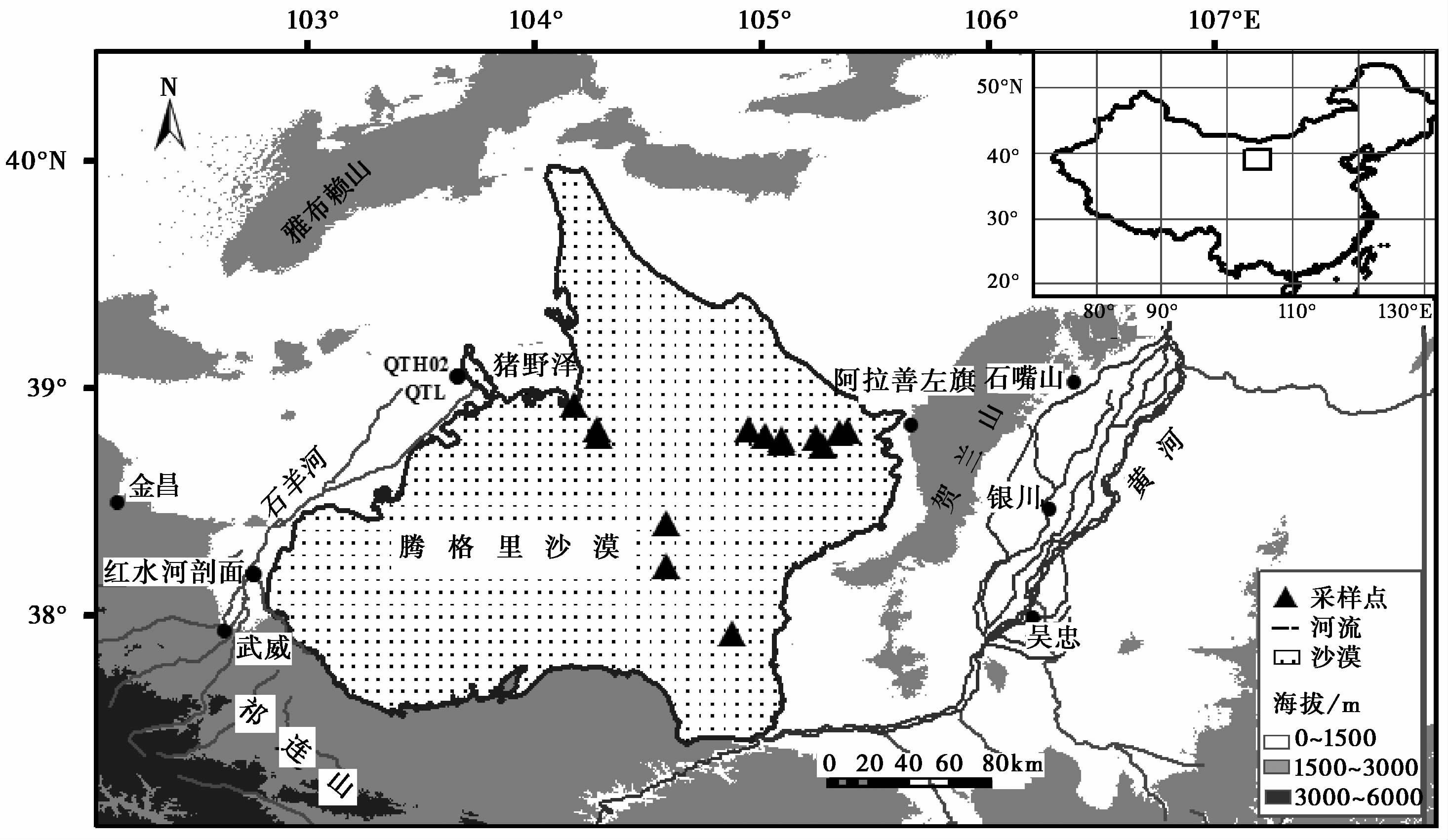
2 区域概况腾格里沙漠(37°26′28″-39°58′59″N,102°48′25″-105°38′13″E) 地处阿拉善高原地区东南部,东接贺兰山、 南邻祁连山山前洪积扇前缘,西北部与雅布赖山相连,西部是民勤盆地的石羊河流域,东西宽180km,南北长240km,总面积约42700km2[39, 40],是中国的第四大沙漠(图1)。现代气候受到亚洲季风和西风带气流的共同影响[41],年平均温度7.0-9.7℃,年平均降水量125-160mm,年潜在蒸发量在2400-3000mm之间。冬季盛行西北风,夏季短暂时期盛行东北风,多年平均主风向为W-NNW,次风向为 NE-E,其次为WSW-S[42]。沙漠内海拔由西向东逐渐降低; 沙漠内部沙丘、 湖盆、 山地、 平地交错分布,其中沙丘71%,湖盆草滩7%,山地残丘及平地22%[39]。腾格里沙漠的地带性土壤为灰漠土和棕钙土。植被以沙生灌木、 半灌木为主[43]。
|
图1 腾格里沙漠植物钙质根管采样点分布图 Fig.1 Locations of the calcareous root tubes samples from the Tengger Desert |
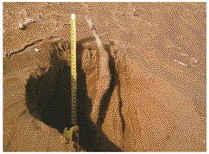
本文共采集了腾格里沙漠14组植物钙质根管样品,经纬度范围为 37°54′59″-38°55′31″N,104°10′34″-105°22′59″E(图1),植物钙质根管样品多分布于丘间洼地并成片分布,形态结构上呈水平状或直立状,颜色以灰白色为主(图2)。采样点砂层厚度均在1m以上,土壤类型为砂壤土,中值粒径在0.2-0.4mm之间。水平状的植物钙质根管长度从几厘米到十几厘米不等; 直立状植物钙质根管的长度在10-28cm之间,最长为28cm且其底部延伸到地表以下18cm(图2)[9, 30]。在此采集的植物钙质根管样品均为地表样品。
|
图2 腾格里沙漠植物钙质根管形态(图片来自文献[9]) Fig.2 Details of the calcareous root tubes samples from the Tengger Desert. The picture is from the reference[9] |
元素分析在兰州大学西部环境教育部重点实验室完成。实验步骤如下: 将已经自然风干的样品磨至200目以下,称取4g样品,加入适量硼酸,在30t/m2的压强下对样品进行压片处理后用荷兰飞利浦公司生产的Magix PW2403型号X-射线荧光光谱仪进行元素测定。
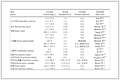
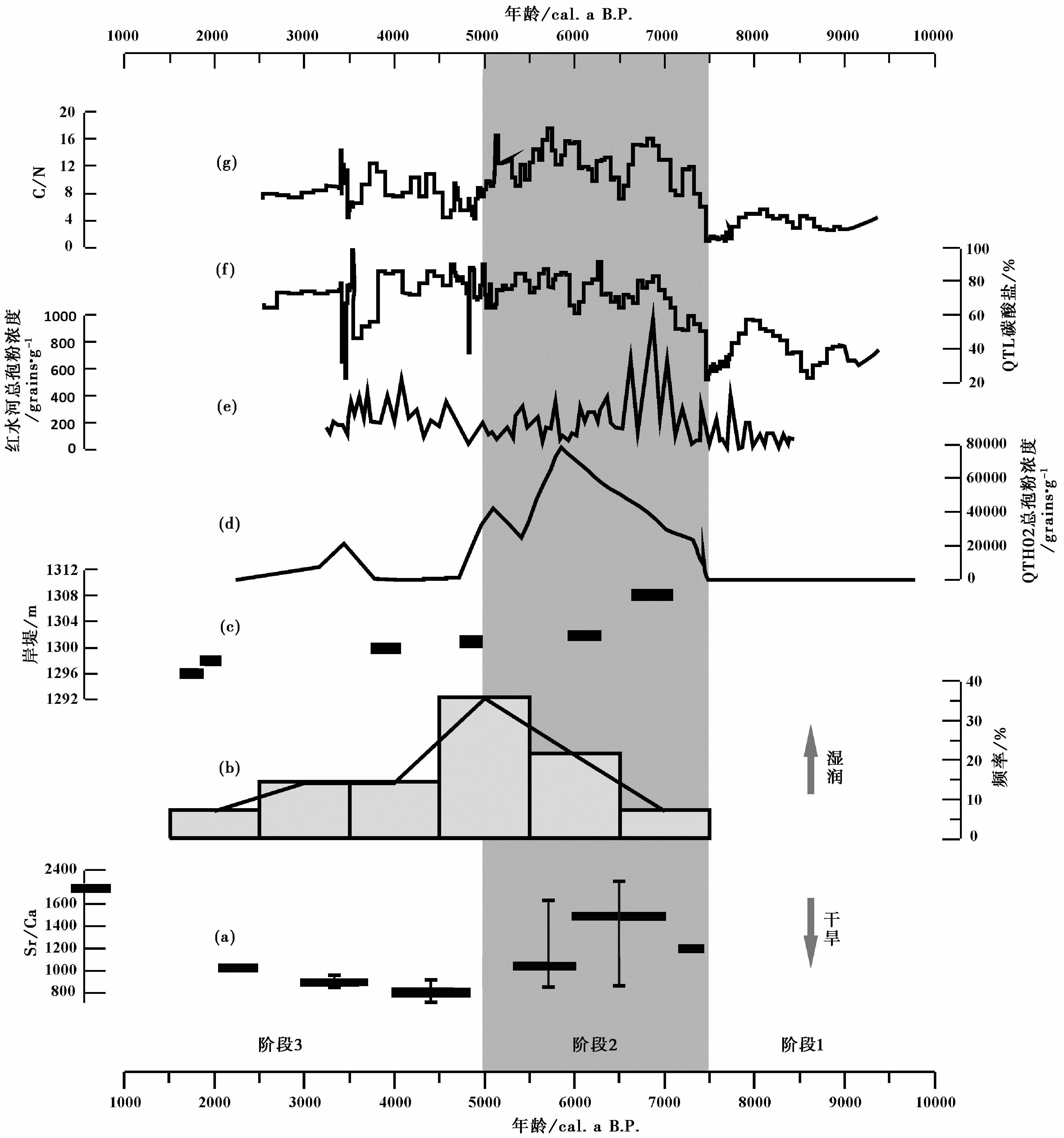
4 结果Li等[9, 30]先前对上述样品的年代学研究结果发现,腾格里沙漠植物钙质根管全部分布于全新世时期,8cal.ka B.P. 之前没有发现植物钙质根管; 8-5cal.ka B.P. 阶段共有植物钙质根管样品9组,占64.29%; 5-2cal.ka B.P. 共有5组,占35.71%。X射线荧光光谱法结果显示(表1):8-5cal.ka B.P. 阶段,Sr值平均为748.12ppm,最高值1663ppm,最低值350ppm; CaO平均值为37.66%,最高值48.49%,最低值25.66%; Sr的高值基本上对应Ca的高值,并出现了Sr的最高值; Sr/Ca比值的平均值为1215.26μmol/mol,Sr/Ca比值的最高值出现在6829(6670-6988)cal. a B.P.,为2332.02μmol/mol,最低值出现在5462(5326-5597)cal. a B.P.,为845.78μmol/mol(图3a)。5-2cal.ka B.P. 阶段,Sr值平均为473.38ppm,最高值709.5ppm,最低值418.6ppm; CaO平均值为35.28%,最高值63.28%,最低值24.56%; Sr值相对于8-5cal.kaB.P. 有所降低,Ca值则无明显变化; Sr/Ca比值的平均值为891.81μmol/mol,最高值出现在2259(2061-2457)cal. a B.P.,为1035.70μmol/mol,最低值出现在4630(4438-4821)cal. a B.P.,为713.50μmol/mol(图3a)。
|
表1 腾格里沙漠植物钙质根管中的Sr、 Ca元素结果 Table 1 Elemental results(Sr and Ca) of calcareous root tubes samples collected from the Tengger Desert |
半干旱地区的石灰质土壤往往缺乏植物生长所需的养分,因此生活在上述地区的植物形成了一种特殊的养分获取机制,即植物根释放质子到根围中[2, 4, 44],使得根围溶液中的pH值变低,溶解Sr和Ca等元素以供植物生长所需[1, 2, 4]。在植物钙质根管形成过程中产生的次生碳酸盐结壳形成土壤水分运动的导管,并在蒸腾作用影响下,土壤水中溶解的矿物质逐渐在次生碳酸盐结壳周围堆积起来[2, 4]。在上述植物钙质根管形成的过程中,Sr和Ca等元素经过土壤水进入植物钙质根管中,且植物钙质根管形成的次生碳酸盐不与外界发生元素交换[1],因此植物钙质根管中Sr/Ca比值的高低可以指示植物钙质根管形成时周围土壤水中的Sr/Ca比值的高低。
Sr和Ca都是十分活跃且会发生显著迁移的元素[45, 46],并且离子半径越小的元素越容易迁移[38],由于Sr 的离子半径(0.113nm)大于Ca 的离子半径(0.099nm)(Sr>Ca),故而Ca比Sr更容易发生迁移。在降水较多、 土壤水分充足的条件下,离子半径较小的Ca会比Sr更容易迁移,因此Ca会先被土壤水溶解达到饱和,Sr则会继续溶解,故土壤中水分含量越高,土壤水中Sr的含量越高[45],即Sr/Ca比值也会越高。且植物钙质根管形成的次生碳酸盐不与外界发生元素交换[1],因此植物钙质根管中Sr/Ca比值可以指示有效湿度的变化,Sr/Ca比值越高,表明土壤水中Sr/Ca比值越高,即有效湿度越高,环境越湿润,反之亦然。
5.2 古环境重建根据腾格里沙漠植物钙质根管Sr/Ca比值变化以及年代分布结果[9, 30],我们重建了腾格里沙漠地区全新世千年尺度有效湿度的变化并划分为如下几个阶段:
阶段1: 早全新世时期(8cal.ka B.P.之前): 因植物钙质根管的形成受到有效湿度的控制,在干旱区可以指示相对湿润的气候[30, 47],在该阶段并未发现植物钙质根管(图3b),表明阶段1为干旱时期。
|
图3 腾格里沙漠古环境重建结果对比 (a)植物钙质根管中的Sr/Ca比值,(b)植物钙质根管时间分布频率[30],(c)全新世猪野泽白碱湖岸堤高程[16, 48], (d)全新世猪野泽QTH02剖面总孢粉浓度[49],(e)红水河剖面总孢粉浓度[24],(f)猪野泽QTL剖面湖相沉积物碳酸盐含量[48], (g)QTL剖面湖相沉积物C/N比值[48]; 阴影部分表示湿润时期 Fig.3 Comparison of our study and other proxy paleo-climate records. The shaded part indicates the humid period,(a) Sr/Ca ratios of paleo calcareous root tubes; (b) The frequency of 14C dating results[30]; (c) Lake-level record of Baijian Lake[16, 48]; (d) Total pollen content of QTH02 section[49]; (e) Total pollen content of Hongshui River section[24]; (f) The carbonate content of QTL section[48];(g)C/N ratios from QTL section[48] |
阶段2: 中全新世时期(8-5cal.ka B.P.): 湿润时期。此阶段的Sr/Ca比值最高(图3a),并且植物钙质根管广泛分布(图3b),表明该阶段有效湿度最高,指示了相对湿润的环境。
阶段3: 晚全新世时期(5-2cal.ka B.P.): 该阶段Sr/Ca比值明显低于阶段2(图3a),并且根管样品数量较阶段2 减少(图3b),表明阶段3的有效湿度较阶段2降低,气候逐渐干旱。
5.3 区域对比为了验证重建结果的可靠性,本文将腾格里沙漠全新世植物钙质根管中Sr/Ca比值变化与腾格里沙漠猪野泽的QTH02剖面(39°03′N,103°40′E) 、 QTL剖面(39°03′N,103°40′E) 以及毗邻地区石羊河流域红水河剖面(38°10′46″N,102°45′53″E) 全新世气候变化重建结果做了对比(图3):
早全新世时期(8cal.ka B.P.之前): 腾格里沙漠猪野泽QTL剖面碳酸盐含量、 C/N比、 QTH02总孢粉浓度和石羊河流域红水河剖面总孢粉浓度均处于低值[24, 48, 49](图3),指示了干旱环境; 在中全新世时期(8-5cal.ka B.P.),腾格里沙漠猪野泽QTL剖面C/N比值、 碳酸盐含量、 QTH02总孢粉浓度和红水河剖面总孢粉含量都达到全新世时期的最高值,此外地貌证据也表明猪野泽在该时期湖面扩张、 湖泊水位明显升高[16, 25, 48],综上结果,均表明该时期气候湿润、 有效湿度最高; 中晚全新世时期(5-2cal.ka B.P.),腾格里沙漠猪野泽QTL剖面碳酸盐含量、 C/N比、 QTH02总孢粉浓度以及湖面高度均较前一时期显著降低,红水河剖面总孢粉浓度也呈现类似的变化,指示了中晚全新世时期气候由湿润向干旱转变的特点。上述重建结果的一致性表明,腾格里沙漠植物钙质根管中的Sr/Ca变化可以指示该区域千年尺度的有效湿度变化。
为了进一步探讨该区域千年尺度有效湿度的变化机制,本文对比了本研究与中国西部的季风区、 西风区和季风-西风过渡区全新世千年尺度有效湿度变化的重建结果。在青藏高原季风区全新世有效湿度重建结果显示[50, 51, 52, 53, 54, 55],早、 中全新世时期气候湿润、 晚全新世气候干旱。在新疆西风区[52, 56, 57, 58, 59],湖泊沉积记录显示早全新世干旱、 中全新世湿润、 晚全新世干旱但较早全新世湿润。本研究与河西走廊其他的湖泊沉积记录[16, 24, 48, 60, 61, 62, 63]显示,在季风-西风过渡地区呈现了早全新世干旱、 中全新世湿润、 晚全新世干旱的气候变化模式。这种全新世千年尺度有效湿度气候变化模式既有别于典型的季风区又与西风区不同[64, 65],显示了季风-西风过渡带的气候变化模式。
6 结论本文在腾格里沙漠植物14组植物钙质根管样品 14C测年结果的基础上,通过X射线荧光光谱法测定其Sr/Ca比值。结果显示: 中全新世时期(8-5cal.ka B.P.)9组植物钙质根管Sr/Ca比值的平均值为1215.26μmol/mol,最高值为2332.02μmol/mol,为整个全新世钙质根管中Sr/Ca比值的最高阶段; 晚全新世时期5组植物钙质根管Sr/Ca比值的平均值为891.81μmol/mol,明显低于中全新世时期。早全新世时期(8cal. ka B.P之前)未发现植物钙质根管。
根据腾格里沙漠植物钙质根管中Sr/Ca比值含量的变化及其指示的环境意义,重建了该地区的全新世千年尺度有效湿度变化,结果显示早全新世时期(8cal.ka B.P.之前)气候干旱,中全新世(8-5cal.ka B.P.)时期气候湿润,晚全新世(5-2cal.kaB.P.)气候逐渐干旱。上述重建结果与该区域其他代用指标重建的全新世千年尺度有效湿度变化结果具有较好的一致性,表明了植物钙质根管中的Sr/Ca比值可以指示有效湿度的变化。因此,可以从植物钙质根管中提取可靠的古环境信号,重建区域的有效湿度变化。
腾格里沙漠地区全新世千年尺度有效湿度变化,既与典型的季风区存在一定的差异,又与西风区亦有不同,呈现了一种季风-西风过渡带全新世千年尺度有效湿度变化的模式。
致谢 两位审稿专家对本文提出了宝贵修改意见、 杨美芳老师认真细致的审读了全文、 兰州大学资源环境学院张洵赫同学参与了部分实验,谨致谢忱。
| 1 | Klappa C F. Rhizoliths in terrestrial carbonates——Classification, recognition, genesis and significance. Sedimentology, 1980, 27(6):613~629 |
| 2 | Cramer M D, Hawkins H J. A physiological mechanism for the formation of root casts. Palaeogeography, Palaeoclimatology, Palaeoecology, 2009, 274(3-4):125~133 |
| 3 | Gocke M, Pustovoytov K, Kuehn P et al. Carbonate rhizoliths in loess and their implications for paleo environmental reconstruction revealed by isotopic composition:δ13C,14C. Chemical Geology, 2011, 283(3-4):251~260 |
| 4 | Kosir A. Microcodium revisited:Root calcification products of terrestrial plants on carbonate-rich substrates. Journal of Sedimentary Research, 2004, 74(6):845~857 |
| 5 | Jaillard B, Guyon A, Maurin A F. Structure and composition of calcified roots, and their identification in calcareous soils. Geoderma, 1991, 50(3):197~210 |
| 6 | Alonso-Zarza A M, Genise J F, Cabrera M C et al. Megarhizoliths in Pleistocene aeolian deposits from Gran Canaria(Spain):Iconological and palaeoenvironmental significance. Palaeogeography, Palaeoclimatology, Palaeoecology, 2008, 265(1-2):39~51 |
| 7 | 张普, 刘卫国. 西峰、洛川黄土碳酸盐根茎体碳同位素分布特征及古环境意义探讨. 第四纪研究, 2013, 33(1):179~186 Zhang Pu, Liu Weiguo. Carbon isotope composition and paleoenvironment information of rhizolith in Xifeng and Luochuan loess. Quaternary Sciences, 2013, 33(1):179~186 |
| 8 | Barta G. Paleoenvironmental reconstruction based on the morphology and distribution of secondary carbonates of the loess-paleosol sequence at Süttö, Hungary. Quaternary International, 2014, 319:64~75 |
| 9 | Li Z L, Wang N A, Cheng H Y et al. Formation and environmental significance of Late Quaternary calcareous root tubes in the deserts of the Alashan Plateau, Northwest China. Quaternary International, 2015, 372:167~174 |
| 10 | Wright V P, Platt N H, Marriott S B et al. A classification of rhizogenic(root-formed)calcretes, with examples from the Upper Jurassic Lower Cretaceous of Spain and Upper Cretaceous of Southern France. Sedimentary Geology, 1995, 100(1-4):143~158 |
| 11 | Wang H, Ambrose S H, Fouke B W. Evidence of long-term seasonal climate forcing in rhizolith isotopes during the Last Glaciation. Geophysical Research Letters, 2004, 31(13):718~730 |
| 12 | Wang H, Greenberg S E. Reconstructing the response of C3 and C4 plants to decadal-scale climate change during the Late Pleistocene in Southern Illinois using isotopic analyses of calcified rootlets. Quaternary Research, 2007, 67(1):136~142 |
| 13 | Huguet A, Wiesenberg G L B, Gocke M et al. Branched tetraether membrane lipids associated with rhizoliths in loess:Rhizomicrobial overprinting of initial biomarker record. Organic Geochemistry, 2012, 43:12~19 |
| 14 | Gallant C E, Candy I, Bogaard P et al. Stable isotopic evidence for Middle Pleistocene environmental change from a loess-paleosol sequence:Kärlich, Germany. Boreas, 2014, 43(4):818~833 |
| 15 | Gocke M, Hambach U, Eckmeier E et al. Introducing an improved multi-proxy approach for paleoenvironmental reconstruction of loess-paleosol archives applied on the Late Pleistocene Nussloch sequence(SW Germany). Palaeogeography, Palaeoclimatology, Palaeoecology, 2014, 410:300~315 |
| 16 | Wang Nai'ang, Li Zhuolun, Cheng Hongyi et al. High lake levels on Alxa Plateau during the Late Quaternary. Chinese Science Bulletin, 2011, 56(17):1799~1808 |
| 17 | Yang Xiaoping, Scuderi L, Paillou P et al. Quaternary environmental changes in the drylands of China——A critical Review. Quaternary Science Reviews, 2011, 30(23-24):3219~3233 |
| 18 | Yang Xiaoping, Ma Nina, Dong Jufeng et al. Recharge to the inter-dune lakes and Holocene climatic changes in the Badain Jaran Desert, Western China. Quaternary Research, 2010, 73(1):10~19 |
| 19 | Yang Xiaoping, Scuderi L A. Hydrological and climatic changes in deserts of China since the Late Pleistocene. Quaternary Research, 2010, 73(1):1~9 |
| 20 | 张虎才, 李吉均, 马玉贞等. 腾格里沙漠南缘武威黄土沉积元素地球化学特征. 沉积学报, 1997, 15(4):154~160 Zhang Hucai, Li Jijun, Ma Yuzhen et al. A study on elemental geochemical characters of the Wuwei loess section in the south vicinity of Tengger Desert. Acta Sedimentological Sinica, 1997, 15(4):154~160 |
| 21 | 高尚玉, 王贵勇, 哈斯等. 末次冰期以来中国季风区西北边缘沙漠演化研究. 第四纪研究, 2001, 21(1):66~71 Gao Shangyu, Wang Guiyong, Ha Si et al. A case study on desert evolution in the northwestern fringe of monsoon area, China since the last glacial epoch. Quaternary Sciences, 2001, 21(1):66~71 |
| 22 | 刘子亭, 杨小平, 朱秉启等. 巴丹吉林沙漠全新世环境记录的年代校正与古气候重建. 第四纪研究, 2010, 30(5):925~933 Liu Ziting, Yang Xiaoping, Zhu Bingqi et al. Reinterpretation of the chronological data of paleo-environmental records in the Badain Jaran Desert and reconstruction of the Holocene climatic changes. Quaternary Sciences, 2010, 30(5):925~933 |
| 23 | 庞有智, 张虎才, 常凤琴等. 腾格里沙漠南缘末次冰消期气候不稳定性记录. 第四纪研究, 2010, 30(1):69~79 Pang Youzhi, Zhang Hucai, Chang Fengqin et al. Instability record of the Late Glacial in the southern Tengger Desert. Quaternary Sciences, 2010, 30(1):69~79 |
| 24 | Zhang H C, Ma Y Z, Wünnemann B et al. A Holocene climatic record from arid Northwestern China. Palaeogeography, Palaeoclimatology, Palaeoecology, 2000, 162(3-4):389~401 |
| 25 | Zhang H C, Peng J L, Ma Y Z et al. Late Quaternary palaeolake levels in Tengger Desert, NW China. Palaeogeography, Palaeoclimatology, Palaeoecology, 2004, 211(1-2):45~58 |
| 26 | Gao Shangyu, Chen Weinan, Jin Heling et al. Preliminary study on Holocene sand desert evolution in the northwestern fringe of China's monsoon region. Science in China(Series D), 1993, 23:202~208 |
| 27 | Yang Xiaoping. Landscape evolution and precipitation changes in the Badain Jaran Desert during the last 30 000 years. Chinese Science Bulletin, 2000, 45(11):1042~1047 |
| 28 | 陈建生, 赵霞, 汪集旸等. 巴丹吉林沙漠湖泊钙华与根状结核的发现对研究湖泊水补给的意义. 中国岩溶, 2004, 23(4):277~282 Chen Jiansheng, Zhao Xia, Wang Jiyang et al. Meaning of the discovery of lacustrine tufa and root-shaped nodule in Badain Jaran for the study on lake recharge. Carsologica Sinica, 2004, 23(4):277~282 |
| 29 | 杨小平. 巴丹吉林沙漠地区钙质胶结层的发现及其古气候意义. 第四纪研究, 2000, 20(3):295 Yang Xiaoping. Discovery of calcic cementation layers in dunes in the Bardain Jaran Desert and their paleo-climate significance. Quaternary Sciences, 2000, 20(3):295 |
| 30 | Li Zhuolun, Wang Nai'ang, Li Ruolan et al. Indication of millennial-scale moisture changes by the temporal distribution of Holocene calcareous root tubes in the deserts of the Alashan Plateau, Northwest China. Palaeogeography, Palaeoclimatology, Palaeoecology, 2015, 440:496~505 |
| 31 | 牟保磊. 元素地球化学. 北京:北京大学出版社, 1999. 17~20,174~177 Mou Baolei. Elemental Geochemistry. Beijing:Peking University Press, 1999. 17~20,174~177 |
| 32 | Cahyarini S Y, Pfeiffer M, Timm O et al. Reconstructing seawater δ18O from paired coral δ18O and Sr/Ca Ratios:Methods, error analysis and problems, with examples from Tahiti(French Polynesia)and Timor(Indonesia). Geochimica et Cosmochimica Acta, 2008, 72(12):2841~2853 |
| 33 | Poulain C, Gillikin D P, Thébault J et al. An evaluation of Mg/Ca, Sr/Ca, and Ba/Ca ratios as environmental proxies in aragonite bivalve shells. Chemical Geology, 2015, 396:42~50 |
| 34 | Schöne B R, Zhang Z, Radermacher P et al.Sr/Ca and Mg/Ca ratios of ontogenetically old, long-lived bivalve shells(Arctica Islandica)and their function as paleotemperature proxies. Palaeogeography, Palaeoclimatology, Palaeoecology, 2011, 302(1-2):52~64 |
| 35 | 张伟宏, 汪永进, 吴江滢等. 南京葫芦洞石笋微量元素记录的末次冰消期气候变化. 第四纪研究, 2014, 6(6):1227~1237 Zhang Weihong, Wang Yongjin, Wu Jiangying et al. Last deglacial climate variations inferred from trace elements in a stalagmite from Hulu Cave, Nanjing. Quaternary Sciences, 2014, 6(6):1227~1237 |
| 36 | 张文翔, 张虎才, 雷国良等. 柴达木贝壳堤剖面元素地球化学与环境演变. 第四纪研究, 2008, 28(5):917~928 Zhang Wenxiang, Zhang Hucai, Lei Guoliang et al. Elemental geochemistry and paleo environment evolution of shell bar section at Quahan in the Qaidam Basin. Quaternary Sciences, 2008, 28(5):917~928 |
| 37 | 谭亮成, 蔡演军, 安芷生等. 石笋氧同位素和微量元素记录的陕南地区4200-2000a B.P. 高分辨率季风降雨变化. 第四纪研究, 2014, 34(6):1238~1245 Tan Liangcheng, Cai Yanjun, An Zhisheng et al. High-resolution monsoon precipitation variations in southern Shaanxi, Central China during 4200-2000a B.P. as revealed by speleothem δ18O and Sr/Ca records. Quaternary Sciences, 2014, 34(6):1238~1245 |
| 38 | Chen Jun, Qiu Gang, Lu Huayu et al. Variation of summer monsoon intensity on the Loess Plateau of Central China during the last 130000a——Evidence from Rb and Sr distribution. Chinese Science Bulletin, 1997, 42(6):473~476 |
| 39 | 来婷婷, 王乃昂, 黄银洲等. 2002年腾格里沙漠湖泊季节变化研究. 湖泊科学, 2012, 24(6):957~964 Lai Tingting, Wang Nai'ang, Huang Yinzhou et al. Seasonal changes of lake in Tengery Desert of 2002. Journal of Lake Sciences, 2012, 24(6):957~964 |
| 40 | 丁贞玉, 马金珠, 何建华. 腾格里沙漠西南缘地下水水化学形成特征及演化. 干旱区地理, 2009, 32(6):948~957 Ding Zhenyu, Ma Jinzhu, He Jianhua. Geochemical evolution of groundwater in the southwest of Tengger Desert, NW of China. Arid Land Geography, 2009, 32(6):948~957 |
| 41 | 王可丽, 江灏, 赵红岩. 西风带与季风对中国西北地区的水汽输送. 水科学进展, 2005, 16(3):432~438 Wang Keli, Jiang Hao, Zhao Hongyan. Atmospheric water vapor transport from westerly and monsoon over the Northwest China. Advances in Water Science, 2005, 16(3):432~438 |
| 42 | 张克存, 屈建军, 俎瑞平等. 腾格里沙漠东南缘风沙活动动力条件分析——以沙坡头地区为例. 干旱区地理, 2008, 31(5):643~649 Zhang Kecun, Qu Jianjun, Zu Ruiping et al. Dynamical characteristics of wind-blown sand activities at the southeast edge of Tengger Desert:A case study at Shapotou Region. Arid Land Geography, 2008, 31(5):643~649 |
| 43 | 裴浩. 阿拉善荒漠区生态环境特征与环境保护. 北京:气象出版社, 2011. 41~55 Pei Hao. The Ecological Environment Characteristics and Environmental Protection in Alashan Deserts. Beijing:China Meteorological Press, 2011. 41~55 |
| 44 | McConnaughey T, Whelan J. Calcification generates protons for nutrient and bicarbonate uptake. Earth-Science Reviews, 1997, 42(1-2):95~117 |
| 45 | 牛洁, 张虎才, 常凤琴等. 柴达木察尔汗贝壳堤剖面Sr同位素及其环境意义. 高校地质学报, 2007, 13(1):14~22 Niu Jie, Zhang Hucai, Chang Fengqin et al. The 87 Sr/86 Sr ratios of shell bar section at Charhan Lake Qaidam Basin and it's paleoenvironmental significance. Geological Journal of China Universities, 2007, 13(1):14~22 |
| 46 | 常凤琴, 张虎才, 雷国良等. 湖相沉积物锶同位素和相关元素的地球化学行为及其在古气候重建中的应用——以柴达木盆地贝壳堤剖面为例. 第四纪研究, 2010, 30(5):962~971 Chang Fengqin, Zhang Hucai, Lei Guoliang et al. Geochemical behaviors of strontium isotope and related elements of the lacustrine deposits and their application to paleoenvironment reconstruction. Quaternary Sciences, 2010, 30(5):962~971 |
| 47 | 李卓仑, 邵孔兰, 宁凯等. 阿拉善高原沙漠地区植物钙质根管的矿物组成特征. 中国沙漠, 2015, 35(6):1483~1488 Li Zhuolun, Shao Konglan, Ning Kai et al. Mineral composition characteristics of calcareous roots in desert areas of Alxa Plateau, NW China. Journal of Desert Research, 2015, 35(6):1483~1488 |
| 48 | Long Hao, Lai Zhongping, Wang Nai'ang et al. Holocene climate variations from Zhuyeze terminal lake records in East Asian monsoon margin in arid Northern China. Quaternary Research, 2010, 74(1):46~56 |
| 49 | Li Yu, Wang Nai'ang, Li Zhuolun et al. Holocene palynological records and their responses to the controversies of climate system in the Shiyang River drainage basin. Chinese Science Bulletin, 2011, 56(6):535~546 |
| 50 | Wu Yanhong, Lücke A, Jin Zhangdong et al. Holocene climate development on the central Tibetan Plateau:A sedimentary record from Cuoe Lake. Palaeogeography, Palaeoclimatology, Palaeoecology, 2006, 234(2-4):328~340 |
| 51 | 郑绵平, 刘俊英, 庞其清等. 西藏台错沉积记录与更新世晚期-全新世气候变化. 地质学报, 2012, 86(1):104~131 Zheng Mianping, Liu Junying, Pang Qiqing et al. Sedimentary records and the Late Pleistocene-Holocene climatic changes in Tai Co, Tibet(Xizang). Acta Geologica Sinica, 2012, 86(1):104~131 |
| 52 | Jiang Qingfeng, Shen Ji, Liu Xingqi et al. A high-resolution climatic change since Holocene inferred from multi-proxy of lake sediment in westerly area of China. Chinese Science Bulletin, 2007, 52(14):1970~1979 |
| 53 | Liu Xingqi, Shen Ji, Wang Sumin et al. Southwest monsoon changes indicated by oxygen isotope of ostracode shells from sediments in Qinghai Lake since the Late Glacial. Chinese Science Bulletin, 2007, 52(4):539~544 |
| 54 | 吴中海, 赵希涛, 吴珍汉等. 西藏纳木错末次盛冰期以来的古植被、古气候和湖面变化. 地质通报. 2003, 22(11-12):928~935 Wu Zhonghai, Zhao Xitao, Wu Zhenhan et al. Paleovegetation, paleoclimate and lake-level change since the Last Glacial Maximum in Nam Co, Tibet. Geological Bulletin of China, 2003, 22(11~12):928~955 |
| 55 | Shen Ji, Liu Xingqi, Ryo M et al. A high-resolution climatic change since the Late Glacial age inferred from multi-proxy of sediments in Qinghai Lake. Science in China(Series D), 2005, 48(6):742~751 |
| 56 | Xue Jibin, Zhong Wei. Holocene climate variation denoted by Barkol Lake sediments in northeastern Xinjiang and its possible linkage to the high and low latitude climates. Science China:Earth Science, 2011, 54(4):603~614 |
| 57 | Tao Shichen, An Chengbang, Chen Fahu et al. Pollen-inferred vegetation and environmental changes since 16.7 Ka BP at Balikun Lake, Xinjiang. Chinese Science Bulletin, 2010, 55(22):2449~2457 |
| 58 | Liu Xingqi, Herzschuh U, Shen Ji et al. Holocene environmental and climatic changes inferred from Wulungu Lake in northern Xinjiang, China. Quaternary Research, 2008, 70(3):412~425 |
| 59 | 孙博亚, 岳乐平, 赖忠平等. 14ka B.P. 以来巴里坤湖区有机碳同位素记录及古气候变化研究. 第四纪研究, 2014, 34(2):418~424 Sun Boya, Yue Leping, Lai Zhongping et al. Paleoclimate change recorded by sediment organic carbon isotopes of lake Barkol since 14ka B.P. Quaternary Sciences, 2014, 34(2):418~424 |
| 60 | 李卓仑, 王乃昂, 李育等. 河西走廊花海古湖泊早、中全新世湖水盐度变化及其环境意义. 冰川冻土, 2013, 35(6):1481~1489 Li Zhuolun, Wang Nai'ang, Li Yu et al. The salinity change and it's environmental significance in Huahai Lake, Hexi Corridor, Northwest China during the early Middle Holocene. Journal of Glaciology and Geocryology, 2013, 35(6):1481~1489 |
| 61 | 李小强, 刘汉斌, 赵克良等. 河西走廊西部全新世气候环境变化的元素地球化学记录. 人类学学报, 2013, 32(1):110~120 Li Xiaoqiang, Liu Hanbin, Zhao Keliang et al. Holocene climate and environmental changes reconstructed from elemental geochemistry in the western Hexi Corridor. Acta Anthropologica Sinica, 2013, 32(1):110~120 |
| 62 | Wang N A, Li Z L, Li Y et al. Millennial-scale environmental changes in the Asian monsoon margin during the Holocene, implicated by the lake evolution of Huahai Lake in the Hexi Corridor of Northwest China. Quaternary International, 2013, 313-314:100~109 |
| 63 | 王乃昂, 李卓仑, 李育等. 河西走廊花海剖面晚冰期以来年代学及沉积特征研究. 沉积学报, 2011, 29(3):552~560 Wang Nai'ang, Li Zhuolun, Li Yu et al. The chronology and characteristics of sediments since Late Glacial in Huahai Lake, Hexi Corridor, NW China. Acta Sedimentologica Sinica, 2011, 29(3):552~560 |
| 64 | 李渊, 强明瑞, 王刚刚等. 晚冰期以来共和盆地更尕海碎屑物质输入过程与气候变化. 第四纪研究, 2015, 35(1):160~171 Li Yuan, Qiang Mingrui, Wang Ganggang et al. Processes of exogenous detrital input to Genggahai Lake and climatic changes in the Gonghe basin since the Late Glacial. Quaternary Sciences, 2015, 35(1):160~171 |
| 65 | 李芳亮, 魏海涛, 范育新等. JYZ 11A钻孔记录的居延泽演化历史. 第四纪研究, 2015, 35(1):180~191 Li Fangliang, Wei Haitao, Fan Yuxin et al. The drill core JYZ 11a revealed lake evolution in Juyanze basin, Inner Mongolia. Quaternary Sciences, 2015, 35(1):180~191 |
Abstract
Calcareous root tubes, also called rhizoliths, are defined as secondary carbonate crusts produced by the root of terrestrial plants.Calcareous root tubes frequently occur in calcareous soils with a pronounced seasonal moisture regime.Paleo calcareous root tubes are widely distributed across the Alashan Plateau, Northwest China.Previous studies reveal that calcareous root tubes have potential to reconstruct the paleo-environment and paleo-vegetation.However, it remains unclear whether any environmental signals could be extract from the calcareous root tubes and used for reconstructing paleo-environmental conditions.The Tengger Desert, with area of approximately 42700km2, is the fourth-largest desert in China.The annual average temperature of the Tengger Desert is 7.0~9.7℃, the regional annual average precipitation is 125~160mm and the annual average potential evaporation is 2400~3000mm.The effective moisture level affects the formation of calcareous root tubes, and different geochemical elements has different features of transport and enrichment in various controlling factors.Therefore, influenced by the soil water changes and the special nutrient-acquiring mechanism of terrestrial plants that live in calcareous soils with deficit nutrition, Sr and Ca was enriched in the calcareous root tubes and the Sr/Ca ratios will changes in different effective moisture level.In this study, based on previous conventional 14C dating results of 14 Holocene calcareous root tube samples(37°54'59"~38°55'31"N, 104°10'34"~105°22'59"E) collected from the Tengger Desert(37°26'28"~39°58'59"N, 102°48'25"~105°38'13"E), we used the X-ray fluorescence to analyzed the elemental composition of the calcareous root tubes samples.The results show that the highest value of Sr/Ca ratios(2332.02μmol/mol) was occurred in 8~5cal.ka B.P.with the mean value of 1215.26μmol/mol, and the Sr/Ca ratios of calcareous root tubes was decreased during 5~2cal.ka B.P.with mean value of 891.81μmol/mol, but not in the Early Holocene.Based on the Sr/Ca ratios' variation and temporal distributions of the calcareous root tubes in the Tengger Desert, we reconstructed the effective moisture level changes in this area during the Holocene.The results reveal that the climate was dry in Early-Holocene(ca.8cal.ka B.P.), humidity in Mid-Holocene(8~5cal.ka B.P.), and from humidity to dry in Late-Holocene(5~2cal.ka B.P.).The reconstruction results were consistent with other previous reconstruction results from lake sediments of Zhuyeze terminal lake section and Hongshui River section, and consistent with the Holocene moisture pattern of the Asian monsoon margin of Northwestern China, which demonstrated that the Sr/Ca ratios of paleo calcareous root tubes can reflect millennial-scale effective moisture changes in this area.These studies reveal that the environmental signals can be extract from the calcareous root tubes and can be applied to paleo environment reconstruction.