 2016, Vol.36


湖泊沉积作为区域古气候、 古环境演化信息的良好载体[1],具有分辨率高、 连续性好、 信息量大、 易于测年等优点[2, 3, 4, 5, 6],是进行高分辨率区域古气候研究的理想载体[7]。青藏高原东北部处于现代季风边缘区,同时受到西风环流、 西南季风和东亚季风的共同作用,其气候变化具有过渡带特有的复杂性。全新世气候变化模式和植被对气候变化的响应在高原东北部存在区域差异。并且,在青藏高原东北部地区影响气候变化和植被演化的内在机制还不够清楚,尚需要更多的古气候资料来探讨。孢粉作为有效且可靠的代用指标,已被广泛用于重建古植被和探讨古气候的研究中[8, 9, 10, 11, 12, 13, 14, 15, 16, 17]。
近年来,石笋[18, 19, 20, 21, 22]、 树轮[23]、 湖泊沉积[24, 25, 26]等高分辨率气候代用指标很好地反映了东亚季风区和中亚干旱区全新世气候变化特征: 东亚季风区由于受到亚洲季风系统的强烈影响,早全新世气候湿润,至中全新世湿度已有所下降,晚全新世气候干旱; 相反,中亚干旱区由于常年受西风环流的控制,早全新世气候干旱、 中全新世气候湿润、 晚全新世中等湿润。然而,现代季风边缘区全新世以来气候变化与中亚干旱区和东亚季风区都不尽相同,因而近年来受到国际学术界广泛关注[27, 28, 29, 30]。Zhao和Yu[31]综合分析了我国20个位于现代季风边缘区的化石孢粉记录,发现位于青藏高原现代高山草甸和半荒漠/荒漠过渡带的多数研究区在早中全新世较为湿润,中晚全新世转为冷干。此过渡带内的地区,即使气候变化模式整体类似,各区域的植被对气候变化的响应也存在一定差异。位于高原东北部季风边缘区的青海湖[32]和达连海[33]孢粉记录均显示青藏高原自进入全新世开始湿度增加,到中全新世气候温暖湿润; 而对于晚全新世气候青海湖孢粉记录显示冷干,达连海孢粉记录却显示1.4cal.ka B.P. 以来气候呈冷湿状态。位于高原中部季风边缘区的色林错[34]和兹格塘错[35]的孢粉结果同样显示青藏高原早中全新世气候温暖湿润,晚全新世气候趋于冷干; 但是兹格塘错在4.4cal.ka B.P. 时植被由温带草原转化为荒漠草原,比色林错(6.8cal.ka B.P.)滞后了2.4ka。克鲁克湖孢粉记录[36]显示,高原在9.5cal.ka B.P. 之前气候较为湿润,9.5-5.5cal.ka B.P. 时气候呈干湿波动但总体较干,5.5cal.ka B.P. 之后较为湿润; 湖区自全新世以来一直发育荒漠植被,基本没有森林发育。可以看出,青藏高原现代季风边缘区全新世气候存在较大的差异主要集中在晚全新世气候表现干旱还是相对湿润。之所以存在较大差异,一则可能是由于不同记录所采用的年代模型不同; 二则可能反应了亚洲季风系统和西风环流对我国现代季风边缘区降水的影响不同; 三则可能由于温度的变化对高海拔地区的植被生长发育有重要影响。为了探究该区域中晚全新世气候和植被的演化历史及其影响因素,在这一区域取得百年尺度上的高分辨率湖泊记录显得尤为重要。
更尕海位于青藏高原东北部共和盆地内,湖水深度约1.8m,面积约2km2,没有明显的入湖河流和出水口,属于封闭的小型湖泊,主要通过地下水补给[37]。由于地处季风边缘区,现代植被又以高寒草原和荒漠草原为主,对气候变化的响应十分敏感,是研究区域气候变化和植被演化的理想地点[26, 37, 38, 39]。本文拟通过对更尕海GGHA孔岩芯上部(0-581cm)的85个孢粉样品进行分析,建立中晚全新世以来更尕海地区植被、 气候演化的基本特征,并探讨影响研究区气候变化的可能因素。
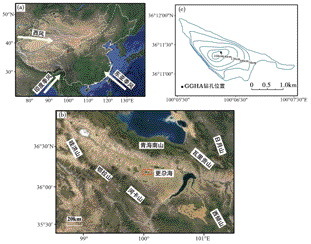
2 研究区域概况共和盆地(35°27′-36°56′N,98°46′-101°22′E) 位于青藏高原东北缘,盆地总面积约13800km2,平均海拔在2900m以上,主要呈西北-东南方向展布,夹于祁连山系的青海南山及其余脉的瓦里贡山与昆仑山系哇洪山、 鄂拉山及河卡山之间,东临秦岭山系的西倾山(图1a和1b)。更尕海(36°10′50″-36°11′57″N,100°05′33″-100°07′33″E; 海拔2858m)是共和盆地中部的一个封闭型微咸水湖,分为上更尕海(钻孔所在位置图1c)和下更尕海,下更尕海现今基本干涸,通过地下水与上更尕海联系[38]。
|
图1 研究区概况 (a)研究区大气环流系统,点线显示现代亚洲夏季风界线;(b)区域卫星照片(Google地球);(c)GGHA钻孔位置 Fig.1 General situation of study region. (a)General atmospheric circulation influencing study area. Dashed shows the modern Asian summer monsoon bountary;(b)Regional satellite map(image source from Google Earth);(c)Core GGHA site in Genggahai Lake |
研究区属于高寒干旱-半干旱大陆性气候,气候寒冷干燥,年平均气温为1.0-5.2℃,最热月为7月,平均气温约15℃; 年降水量为250-400cm,主要集中在5-9月,可占全年降水总量的80%以上; 年平均蒸发量约1716mm。由于水热条件的限制,区域植被种类较为单一。地带性植被以草原植被、 荒漠草原、 高寒草原和荒漠为主。其中草原植被主要以克氏针矛(Stipa krylovii)、 固沙草(Orinus thoroldii)和冷蒿(Artemisia frigida)为建群种,并伴有短花针茅(Stipa breviflora)、 驼绒藜(Ceratoides latens)、 长芒草(Stipa bungeana)等,广布于沙珠玉河中下游、 一、 二、 三塔拉滩地和河卡滩等地; 荒漠草原主要以短花针茅(Stipa breviflora)为建群种,主要有早熟禾(Poa annua)等,主要分布在切吉、 沙珠玉等地; 高寒草原以紫花针茅(Stipa purpurea)为建群种,伴生种主要有早熟禾及克氏针矛,主要分布于盆地东部尕海滩一带; 荒漠则以川青锦鸡儿(Caragana tibetica)为建群种,主要分布于一、 二塔拉和倒邦公路以南至黄河边缘一带[39]。湖泊周围山地现代基本无森林发育,垂直地带性植被主要是: 以沙蒿(Artemisia desertorum)为建群种的半灌丛主要分布于盆地内部固定和半固定沙丘上; 以线叶蒿草(Artemisia subulata)、 高山嵩草(Kobresia pygmaea)等为优势种的山地草甸主要分布在海拔3300-4000m的青海南山、 哇洪山和瓦里贡山等地; 以高山嵩草和矮蒿草(Artemisia lancea)为优势种的高寒草甸主要分布在海拔4200-4470m的哇洪山; 河谷和湖泊附近滩地上分布小面积湿地草甸; 以芦苇(Phragmites australis)为代表种的沼泽主要集中在排水不畅的低洼地带,分布范围很小[39](图1b)。
3 材料与方法 3.1 GGHA沉积岩芯与年代模型2008年1月课题组用Piston钻具在湖泊中心位置(36°11′26″N,100°06′15″E) 取得两根相隔1.8m的平行沉积岩芯GGHA(782cm)和GGHB(750cm),并根据交叉进深平行钻孔粒度和磁化率分析结果,对GGHA缺失的部分用对应的GGHB补充,保证沉积序列的连续性,最终得到总长度为782cm的岩芯GGHA[38]; 其岩性主要由粉砂质粘土(0-63cm)、 粘土质粉砂(63-634cm)、 青灰色粉砂质粘土(634-674cm)、 细粉砂(674-750cm)和沙漠砂(750-782cm)组成[39]。
本文GGHA岩芯年代序列的建立基于12个水生植物残体的AMS 14C测年,扣除碳库效应1010a后,采用CALIB 5.0.1程序[40]将14C年龄校正为日历年龄,底部年代为16.7cal.ka B.P.,具体年代结果和年代模式见Qiang等[41]。本文研究中选取GGHA岩芯上段0-581cm(即下文所指的更尕海GGHA孔岩芯)对应年代为0-6.3cal.ka B.P.。
3.2 孢粉鉴定与数据分析孢粉提取采用常规的HCl-NaOH-HF处理法[42],样品冷冻干燥后取干重0.5-1.0g; 为了计算孢粉浓度,称重后每个样品均加入1片石松孢子片剂(含石松孢子 27637±563粒)后再进行化学处理[43]。
孢粉鉴定统计工作在尼康ECLIPSE-80i型显微镜下进行,放大倍数为400倍,对于难以鉴定的花粉在放大600倍、 1000倍下进行鉴定。每个样品统计的陆生花粉总数基本大于500粒,对于浓度较低的样品,陆生花粉也统计300粒以上。对于无法鉴定或未知的花粉类型,均归为未知。孢粉图谱在Tilia 2.0.29下完成,并采用CONISS对孢粉百分比数据进行有序聚类分带[44]。
此外,计算陆生植物花粉百分含量时,按照通常规范水生植物和藻类数量不计入孢粉总数(pollen sum)。水生花粉百分比和藻类的百分比分别基于pollen sum与水生花粉之和以及pollen sum和藻类之和计算。
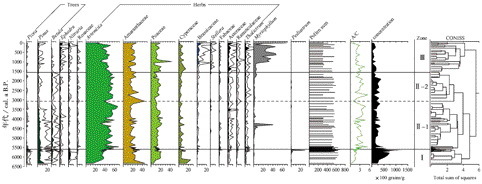
4 结果 4.1 GGHA孔岩芯孢粉记录本文从GGHA岩芯(0-581cm)共挑出85个样品,考虑到沉积速率的不同,采样方式为:0-400cm,按6cm共选取66个样品; 400-500cm按10cm共选取5个样品; 500-581cm按6cm共选取14个样品。样品最高分辨率约10年,平均分辨率约80年,共鉴定出植物孢粉类型45种。其中,乔木花粉类型主要包括云杉属(Picea)、 松属(Pinus)、 桦木属(Betula)、 栎属(Quercus)等; 灌木花粉类型主要包括沙棘属(Hippophae)、 麻黄属(Ephedra)、 白刺属(Nitraria)、 蔷薇科(Rosaceae)等; 草本花粉类型主要包括蒿属(Artemisia)、 藜科(Amaranthaceae即原Chenopodiaceae)、 禾本科(Poaceae)、 莎草科(Cyperaceae)、 毛茛科(Ranunculaceae)、 菊科(Asteraceae)、 唐松草属(Thalictrum)等。藻类含量较高的种属主要是盘星藻属(Pediastrum)。水生植物和蕨类孢子主要类型为狐尾藻属(Myriophyllum)、 香蒲属(Typha)、 水龙骨科(Polypodiaceae)、 三缝孢子(Trilete spore)和单缝孢子(Monolete spore)。根据CONISS[44]聚类分析结果,将GGHA岩芯(0-581cm)由下至上共划分为3个孢粉谱带(图2)。
|
图2 GGHA钻孔孢粉百分比图谱(开曲线为放大5倍) Fig.2 Percentage pollen diagram of core GGHA at Genggahai Lake(Open curves are 5× exaggerations) |
本带乔木花粉含量为该段岩芯中最高(7.17%-16.39%,平均10.10%),主要以松属为主,云杉属(0-2.28%,平均1.13%)和桦木属(0-4.3%,平均2.2%)极少; 草本花粉占绝对优势(82.33%-91.30%,平均87.72%),主要包括蒿属(13.84%-42.35%,平均35.21%),藜科(17.95%-44.99%,平均26.77%),禾本科(4.92%-20.74%,平均14.75%)和莎草科(1.00%-24.56%,平均8.09%)。此带含有极少量的水生植物花粉,但是盘星藻出现了一个极高值(29.1%)。陆生花粉浓度(24477-125819粒/g)。
4.1.2 孢粉带Ⅱ(524-118cm,5.6-1.6cal.ka B.P.)本带乔木花粉含量(1.32%-13.40%,平均5.79%)较孢粉Ⅰ带明显下降,花粉组合仍以松属为主。该孢粉带草本花粉仍占绝对优势且含量有所上升(85.04%-97.13%,平均92.57%),其中蒿属(31.15%-68.62%,平均50.95%)明显增加,藜科(10.52%-43.87%,平均19.67%)和莎草科(0.35%-12.23%,平均3.72%)明显减少,禾本科(4.89%-24%,平均13.94%)略微减少。陆生花粉浓度5301-63127粒/g,花粉浓度较上一阶段明显减小。该带基于松科和蒿属百分含量变化又分为Ⅱ-1和Ⅱ-2两个孢粉亚带。
4.1.3 孢粉带Ⅲ(118-0cm,1.6-0cal.ka B.P.)乔木花粉含量(0.6%-3.6%,平均2.21%)略有下降。草本花粉含量有所上升(89.64%-97.66%,平均94.47%),其主要科属仍为蒿属(23.1%-50.8%,平均48.02%),藜科(10.86%-27.45%,平均10.86%),禾本科(6.15%-41.67%,平均21.05%)和莎草科(1.2%-14.2%,平均10.2%); 灌木花粉浓度相比前两带虽有所上升(平均3.31%),但是占主要地位的麻黄属和白刺属的最高含量也小于5%。该带的草本植物中出现了狼毒属(Stellera)(0-2.65%,平均1.0%)和十字花科(Brassicaceae)(1.09%-13.72%,平均3.41%)。狐尾藻含量急剧升高,平均含量约24.0%。该带的陆生花粉浓度是该段钻孔最低的(2503-18403粒/g,平均9335粒/g)。
5 讨论 5.1 更尕海孢粉记录对植被的指示意义更尕海GGHA岩芯中乔木花粉的主要组成为松属,所以乔木花粉含量变化与松属含量变化基本一致。由于松属花粉产量大且传播能力强,低百分比的松属花粉通常被认为是远距离传播而来[45]。共和盆地现代表土花粉研究结果显示,荒漠区松科花粉百分含量极低(<5%)[46, 47],说明远距离传播而来的松属花粉极少,可以推断更尕海岩芯中松属花粉基本来自研究区周围山地森林。
地层中草本花粉主要是蒿属、 藜科、 禾本科和莎草科。蒿属和藜科是干旱半干旱区主要花粉类型,大量研究表明蒿属和藜科属超代表性花粉,具有较强的传播能力,高含量的藜科和蒿属花粉通常指示研究区内的主要植被类型为干草原和荒漠草原[47, 48]。根据青藏高原现代表土花粉研究[49]表明,当蒿属和藜科花粉含量之和占绝对优势时(通常占花粉总量的50%以上),蒿属与藜科花粉含量之比(A/C)对气候条件具有明显的指示意义。禾本科花粉为草原植被的优势种属,广泛分布于共和盆地内,因其花粉产量低(<10%),通常呈低代表性特征[50, 51]。李月丛等[47]对荒漠区东部(包括共和盆地)的表土花粉与植被关系的研究中指出,禾本科的Xa值(母体植物不存在时花粉百分比平均值)远小于Xp值(母体植物存在时花粉百分比平均值),对植被具有较明显的指示意义。更尕海地区禾本科植物主要以针矛(分裂生殖)为主,花粉产量较低[51],但岩芯中禾本科花粉百分含量基本处于10%-20%(见图2),其花粉含量可能指示研究区内有较大面积的草原植被分布。莎草科百分含量与母体植被盖度具有较好的相关性,高山草甸的莎草含量比较高,但是传播能力较弱,由于本研究莎草花粉的含量比较低,可能是主要生长在河滩地、 湖区周围积水低洼地带的莎草科植物贡献,主要反映湖区周围植被状况[50]。
综上所述,更尕海岩芯的孢粉记录中松属花粉主要来自研究区周围山地森林,其百分含量的变化可以指示山地森林植被的进退。蒿属、 藜科和禾本科则主要反映研究区荒漠草原/草原植被发育状况,而莎草科主要反映湖区周围草甸植被的发育历史。
5.2 更尕海湖区植被变化过程根据更尕海GGHA孔岩芯孢粉组合特点可以看出,总体而言,6.3cal.ka B.P. 以来盆区的陆地广泛发育以蒿属、 藜科和禾本科为主的荒漠植被,以及一定面积的以禾本科和蒿属为主的草原植被。盆区周围山地的乔木产生的花粉总体呈现下降趋势,指示中全新世山地水分条件较好的地方可能存在小片的森林植被,而在晚全新世逐渐消失。6.3-5.6cal.ka B.P.,云杉花粉和阔叶树花粉百分含量极低(分别<2.28%和<4.30%),基本可以判断盆区内没有云杉林和阔叶林发育[45, 48]。根据现代表土花粉研究结果显示,松属花粉传播能力强,采样点周围无松林存在时松属花粉多小于5%; 采样点周围有松属植物存在(盖度1%-30%)时松属花粉含量多高于10%[47, 48]。更尕海乔木花粉主要以松属为主,该时段内较高比例(约10.10%)的松属花粉,指示湖区周围山地发育有以松属为主的针叶林。5.6-4.1cal.ka B.P. 乔木花粉百分比显著下降,以松树为主的针叶林快速衰退; 4.1cal.ka B.P. 之后,乔木花粉百分含量基本低于5%,可推断盆区内已经没有森林发育[46, 48]。
共和盆地表土花粉研究表明,蒿属、 藜科、 禾本科和莎草科为盆区内主要花粉科属,其中蒿藜比(A/C)可用于指示盆地干湿状态,禾本科丰度与湿度明显正相关[46]。从更尕海GGHA岩芯的孢粉组合可以明显看出,6.3cal.ka B.P. 以来研究区荒漠草原面积由于受到湖区湿度的影响,在百年尺度上波动较大。对比6.3-5.6cal.ka B.P. 和5.6-3.1cal.ka B.P. 时期的蒿属花粉含量变化(图2),不难发现,在5.6-3.1cal.ka B.P. 以蒿属为主的荒漠草原和高寒草原面积有所扩张; 3.1-1.6cal.ka B.P.,湖区主要发育以蒿属为主的荒漠草原,蒿属和禾本科为主的荒漠草原-草原仍占有一定面积; 1.6-0cal.ka B.P.,以蒿属和禾本科为主的荒漠草原-草原面积缩小,以藜科为主的荒漠草原面积扩大,特别是近200年以来,蒿草草原面积快速下降,该段时期内人类干扰指示植物(狼毒属)和农作物(十字花科)含量明显增加,表示湖区受到人类活动的影响[52](另文讨论)。此外,湖区陆地开始出现一些喜干的白刺和麻黄。湖区周围沼泽草甸在6.3-5.6cal.ka B.P. 和1.6-0.2cal.ka B.P. 有短暂发育,而在5.6-1.6cal.ka B.P. 和0.2-0cal.ka B.P. 发育基本停滞且面积波动缩小。
石笋记录[53, 54]和孢粉重建结果[55, 56]显示,由于受到北半球夏季太阳辐射变化的影响,中晚全新世亚洲夏季风强度逐渐减弱,青藏高原东北部季风降水减少和温度下降造成该地区森林植被逐渐退缩,荒漠草原/荒漠面积扩大。更尕海森林植被中晚全新世以来呈波动下降的趋势,荒漠草原占据主导地位。并且,更尕海和青海湖[32]乔木花粉变化显示,6.3cal.ka B.P. 以来乔木花粉浓度显著下降,其变化趋势与董哥洞、 和尚洞的石笋氧同位素基本一致。这表明亚洲夏季风的衰退对更尕海区域植被的演替存在影响。位于更尕海东北部约23km处的达连海孢粉记录也显示,亚洲夏季风衰退时,湖区气候转干使得乔木花粉含量减少,研究区荒漠草原植被盖度逐渐增加[33]。 但达连海花粉记录本身受到河流搬运花粉的影响,因此更尕海记录的当地植被的变化可能更真实可靠。
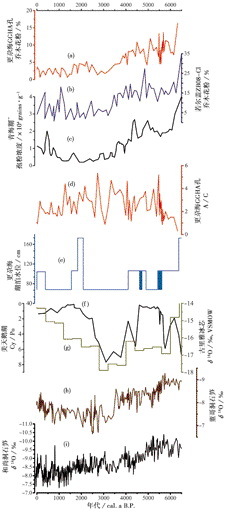
5.3 更尕海孢粉记录的中晚全新世古气候、 古环境变化6.3-5.6cal.ka B.P.,更尕海GGHA孔岩芯的乔木花粉(图3a)含量下降说明盆区周围山地湿度呈下降趋势,盆区内以蒿属、 禾本科植物为主的荒漠草原和高山草原面积开始扩张。这与若尔盖ZB08-C1孔乔木花粉含量[55](图3b)和青海湖孢粉浓度[32](图3c)记录相一致,两个指标均有明显下降也说明青藏高原东北部温度和湿度较气候最适宜期都有所下降。从Qiang等[41]重建的更尕海湖泊水位变化可以看出,湖泊水位呈逐步下降的趋势(图3e),湖区降水明显减少。更尕海GGHA孔岩芯A/C值低(图3d)且沉积物粒径(>63μm) [57]反映出风沙活动加剧,均说明研究区可能湿度偏低。根据共和盆地现代表土花粉研究显示,风力作用是控制盆区内湖泊花粉散布与沉积的重要因素[58]。5.6-3.1cal.ka B.P.,更尕海GGHA孔岩芯的乔木花粉含量(图3a)呈波动下降的趋势,与季风区董哥洞[53](图3h)及和尚洞[54](图3i)石笋氧同位素(δ18O)变化趋势基本一致,钻孔孢粉记录在一定程度上反应了亚洲夏季风强度的变化。其中,5.6-4.1cal.ka B.P.处于中晚全新世气候转型的过渡时期,气候存在明显波动,温度和降水相较气候最适宜期都有所下降[59, 60, 61]。更尕海GGHA孔岩芯的A/C值(图3d)和乔木花粉含量(图3a)在这一时期存在明显的波动,同时TOC、 TN和植物大化石的δ13C值也有剧烈波动[41],说明该段时期内盆区气候总体偏湿,但干湿波动仍很明显。4.1-3.1cal.ka B.P.,更尕海GGHA孔岩芯的乔木花粉含量(图3a)持续下降,山地森林植被已退缩消失。这与若尔盖ZB08-C1孔的乔木花粉含量[55](图3b)和青海湖孢粉浓度[32](图3c)变化趋势基本一致。这两个地区的森林植被均逐渐退缩,草原面积增大,表明高原东北部气候处于干旱的状态。达连海[33]乔木花粉含量也有明显下降,虽其森林植被退缩的时间明显滞后于上述3个地区,但也表明该时期共和盆地气候已向冷干转化。该时期内,更尕海GGHA孔岩芯的A/C值(图3d)的变化指示,湖区湿度在百年尺度上仍存在较大的波动,其中,在4.10-3.35cal.ka B.P. 更尕海GGHA孔岩芯的A/C值上升,湖区湿度虽有所增加,但湖区周围山地森林植被并没有得到恢复,说明湿度虽然增加但仍未达到森林植被发育的条件。同时,青藏高原古里雅冰芯氧同位素(δ18O)记录[62](图3g)在这一时期明显偏负,且天山美天鹅的湖莎草科/禾本科(Cy/Po)(图3f)维持高值[63],指示该时期为低温期,持续的低温可能抑制了蒸发,使得有效湿度增加。在约3.35-3.10cal.ka B.P.,更尕海GGHA孔岩芯的A/C值(图3d)迅速下降(从4.8降至0.9),以藜科为主的荒漠草原面积迅速扩大,研究区气候进一步变干。3.1cal.ka B.P. 以来,更尕海GGHA孔岩芯的A/C值总体呈下降趋势,但波动较为明显,湖区干湿变化基本可分为3个阶段: 约3.1-1.6cal.ka B.P.,更尕海A/C值波动明显,盆区湿度变化剧烈; 1.6-0.2cal.ka B.P.,更尕海GGHA孔岩芯的A/C值明显下降,说明盆区湿度降低,旱生麻黄和白刺出现,湖泊呈低水位状态,表明研究区气候冷干; 0.2-0cal.ka B.P.,A/C值快速下降,湖区湿度明显降低,可能与气候从新冰期转暖导致蒸发增强有关,风沙活动强度加剧[57]。
|
图3 更尕海GGHA孔岩芯的孢粉记录与其他古气候记录对比 (a)更尕海GGHA孔岩芯乔木花粉百分含量;(b)若尔盖ZB08-C1孔岩芯乔木花粉百分含量[55];(c)青海湖孢粉浓度[32];(d)更尕海GGHA孔岩芯A/C值;(e)更尕海湖泊水位变化[41];(f)美天鹅湖Cy/Po比(莎草科/禾本科)[63];(g)古里雅冰芯氧同位素记录[62]; (h)董哥洞石笋氧同位素记录[53];(i)和尚洞石笋氧同位素记录[54] Fig.3 Compare pollen records from core GGHA at Genggahai Lake with other palaeoclimate records. (a)Total tree pollen(%)from core GGHA at Genggahai Lake(this study);(b)Total tree pollen(%)from core ZB08-C1 in the central Zoigê Basin[55];(c)Pollen concentration from Qinghai Lake[32];(d)Pollen A/C ratio from core GGHA at Genggahai Lake(this study);(e)Lake-level fluctuations recorded from Genggahai Lake[41];(f)Pollen Cy/Po ratio(Cyperaceae/Poaceae)from Swan Lake[63];(g)Oxygen isotope recorded from Guliya ice core[62];(h)Oxygen isotope recorded from Dongge Cave[53];(i)Oxygen isotope recorded from Heshang Cave[54] |
(1)更尕海GGHA孔0-581cm沉积岩芯孢粉记录揭示了6.3cal.ka B.P. 以来研究区的植被演化过程和气候变迁历史: 6.3-5.6cal.ka B.P. 盆区湿度呈明显波动下降的趋势,盆区内主要发育蒿属、 藜科和禾本科为主的荒漠草原和草原,而盆区周围水热条件较好的山地仍发育有以松属为主的针叶林; 5.6-3.1cal.ka B.P.,盆区湿度较前一时期降低,植被类型仍以荒漠草原-草原为主,其中,5.6-4.1cal.ka B.P.,气候整体温凉偏湿,但仍存在明显波动,森林面积逐渐缩小至消失,盆区内荒漠草原面积有所增加,4.1-3.1cal.ka B.P.,湖盆区气候明显恶化,湖区周围山地森林已不再发育,植被类型与现代植被类型一致; 3.1cal.ka B.P. 以来盆区气候基本呈干旱状态,百年尺度上干湿波动较为明显。此外,湖泊周围湿地发育历史在更尕海GGHA孔岩芯中也有很好的反映: 6.3-5.6cal.ka B.P. 和1.6-0.2cal.ka B.P.盆区湿度较高,湖泊周围有小面积沼泽草甸发育; 而盆区湿度降低的时期(5.6-1.6cal.ka B.P. 和0.2-0cal.ka B.P.)沼泽草甸发育停滞,其面积在波动中减小。
(2)对比石笋季风记录发现,更尕海GGHA孔岩芯乔木花粉百分含量的变化在一定程度上反应了亚洲夏季风强度的变化。加之与青藏高原东北部孢粉记录(青海湖和若尔盖)的对比研究显示,在高原东北部森林退缩的时间具有一致性,基本发生在中晚全新世亚洲夏季风逐渐衰退的时期,表明研究区湿度的降低是限制森林植被生长的最主要原因。即使在4.10-3.35cal.ka B.P.,更尕海GGHA孔岩芯A/C值(图3d)上升指示湖区湿度增加,但增加的湿度未达到盆区周围山地森林发育的条件,森林仍无法恢复发育。
致谢 宋磊等参与野外岩芯取样工作,特此感谢。
| 1 | Birks H J B, Lotter A F, Juggins S et al. Tracking Environmental Change Using Lake Sediments:Data Handling and Numerical Techniques. Berlin:Springer Netherlands, 2012. 249-327 |
| 2 | 王苏民, 吴瑞金, 蒋新禾. 内蒙古岱海末次冰期以来的环境变迁与古气候. 第四纪研究, 1990,(3):223-232 Wang Sumin, Wu Ruijin, Jiang Xinhe. Environment evolution and paleoclimate of Daihai Lake, Inner Mongolia since the last glaciation. Quaternary Sciences, 1990,(3):223-232 |
| 3 | Lowe J J, Walker M J C. Reconstructing Quaternary Environments. Harlow:Longman, 1997. 1-472 |
| 4 | 匡欢传, 周浩达, 胡建芳等. 末次盛冰期和全新世大暖期湖光岩玛珥湖沉积记录的正构烷烃和单体稳定碳同位素分布特征及其古植被意义. 第四纪研究, 2013, 33(6):1222-1233 Kuang Huanchuan, Zhou Haoda, Hu Jianfang et al. Variations of n-alkanes and compound-specific carbon isotopes in sediment from Huguangyan Maar Lake during the Last Glacial Maximum and Holocene Optimum:Implications for paleovegetation. Quaternary Sciences, 2013, 33(6):1222-1233 |
| 5 | 宋木, 刘卫国, 郑卓等. 西北干旱区湖泊沉积物中长链烯酮的古环境意义. 第四纪研究, 2013, 33(6):1199-1210 Song Mu, Liu Weiguo, Zheng Zhuo et al. Paleoenvironmental implications of long chain alkenones in arid regions, Northwestern China. Quaternary Sciences, 2013, 33(6):1199-1210 |
| 6 | 范佳伟, 肖举乐, 温锐林等. 内蒙古达里湖全新世有机碳氮同位素记录与环境演变. 第四纪研究, 2015, 35(4):856-870 Fan Jiawei, Xiao Jule, Wen Ruilin et al. Holocene environment variations recorded by stable carbon and nitrogen isotopes of sedimentary organic matter from Dali Lake in Inner Mongolia. Quaternary Sciences, 2015, 35(4):856-870 |
| 7 | 沈吉, 刘兴起, Matsumoto R等. 晚冰期以来青海湖沉积物多指标高分辨率的古气候演化. 中国科学(D辑), 2004, 34(6):582-589 Shen Ji, Liu Xingqi, Matsumoto R et al. Paleoclimate evolution in the Qinghai Lake recorded by proxies since the late glacial epoch. Science in China(Series D), 2004, 34(6):582-589 |
| 8 | Webb Ⅲ T. Is vegetation in equilibrium with climate? How to interpret Late-Quaternary pollen data. Vegetatio, 1986, 67(2):75-91 |
| 9 | Field M H, Huntley B, Müller H. Eemian climate fluctuations observed in a European pollen record. Nature, 1994, 371:779-783 |
| 10 | Seppä H, Birks H J B. July mean temperature and annual precipitation trends during the Holocene in the Fennoscandian tree-line area:Pollen-based climate reconstructions. The Holocene, 2001, 11(5):527-539 |
| 11 | Behling H, Pillar V D P, Orlóci L et al. Late Quaternary Araucaria forest, grassland(Campos), fire and climate dynamics, studied by high-resolution pollen, charcoal and multivariate analysis of the Cambará do Sul core in southern Brazil. Palaeogeography, Palaeoclimatology, Palaeoecology, 2004, 203(3-4):277-297 |
| 12 | Rudaya N, Tarasov P, Dorofeyuk N et al. Holocene environments and climate in the Mongolian Altai reconstructed from the Hoton-Nur pollen and diatom records:A step towards better understanding climate dynamics in Central Asia. Quaternary Science Reviews, 2009, 28(5-6):540-554 |
| 13 | Herzschuh U, Tarasov P, Wünnemann B et al. Holocene vegetation and climate of the Alashan Plateau, NW China, reconstructed from pollen data. Palaeogeography, Palaeoclimatology, Palaeoecology, 2004, 211(1-2):1-17 |
| 14 | Bartlein P J, Harrison S P, Brewer S et al. Pollen-based continental climate reconstructions at 6 and 21ka:A global synthesis. Climate Dynamics, 2011, 37(3-4):775-802 |
| 15 | Opitz S, Zhang C J, Herzschuh U et al. Climate variability on the south-eastern Tibetan Plateau since the Late Glacial based on a multiproxy approach from Lake Naleng-Comparing pollen and non-pollen signals. Quaternary Science Reviews, 2015, 115:112-122 |
| 16 | 魏金辉, 郑卓, 彭环环等. 基于孢粉植物类群气候区间的古气候定量重建方法. 第四纪研究, 2013, 33(6):1080-1090 Wei Jinhui, Zheng Zhuo, Peng Huanhuan et al. Methods of quantitative paleoclimate reconstruction based on pollen flora and their climatic intervals. Quaternary Sciences, 2013, 33(6):1080-1090 |
| 17 | 郑茜, 张虎才, 明庆忠等. 泸沽湖记录的西南季风区15000a B.P. 以来植被与气候变化. 第四纪研究, 2014, 34(6):1314-1326 Zheng Qian, Zhang Hucai, Ming Qingzhong et al. Vegetational and environmental changes since 15ka B.P. recorded by Lake Lugu in the southwest monsoon domain. Quaternary Sciences, 2014, 34(6):1314-1326 |
| 18 | Neff U, Burns S J, Mangini A et al. Strong coherence between solar variability and the monsoon in Oman between 9 and 6 kyr ago. Nature, 2001, 411:290-293 |
| 19 | Yuan D X, Cheng H, Edwards R L et al. Timing, duration, and transitions of the last interglacial Asian monsoon. Science, 2004, 304(5670):575-578 |
| 20 | Fleitmann D, Burns S J, Mangini A et al. Holocene ITCZ and Indian monsoon dynamics recorded in stalagmites from Oman and Yemen(Socotra). Quaternary Science Reviews, 2007, 26(1-2):170-188 |
| 21 | 张振球, 刘殿兵, 汪永进等. 中全新世东亚季风年至10年际气候变率:湖北青天洞5.56-4.84ka B.P. 石笋年层厚度与地球化学证据. 第四纪研究, 2014, 34(6):1246-1255 Zhang Zhenqiu, Liu Dianbing, Wang Yongjin et al. Annual-to decadal-scale variability of Asian monsoon climates during Mid-Holocene:Evidence from proxies of annual bands and geochemical behaviors of a speleothem from 5.56ka B.P. to 4.84ka B.P. in Qingtian Cave, Central China. Quaternary Sciences, 2014, 34(6):1246-1255 |
| 22 | 谭亮成, 蔡演军, 安芷生等. 石笋氧同位素和微量元素记录的陕南地区4200-2000a B.P. 高分辨率季风降雨变化. 第四纪研究, 2014, 34(6):1238-1245 Tan Liangcheng, Cai Yanjun, An Zhisheng et al. High-resolution monsoon precipitation variations in southern Shaanxi, Central China during 4200-2000a B.P. as revealed by speleothem δ18O and Sr/Ca records. Quaternary Sciences, 2014, 34(6):1238-1245 |
| 23 | Yang B, Qin C, Wang J L et al. A 3,500-year tree-ring record of annual precipitation on the northeastern Tibetan Plateau. Proceedings of the National Academy of Sciences of the United States of America, 2014, 111(8):2903-2908 |
| 24 | An C B, Feng Z D, Barton L. Dry or humid?Mid-Holocene humidity changes in arid and semi-arid China. Quaternary Science Reviews, 2006, 25(3):351-361 |
| 25 | Chen F H, Yu Z C, Yang M L et al. Holocene moisture evolution in arid Central Asia and its out-of-phase relationship with Asian monsoon history. Quaternary Science Reviews, 2008, 27(3-4):351-364 |
| 26 | 李渊, 强明瑞, 王刚刚等. 晚冰期以来共和盆地更尕海碎屑物质输入过程与气候变化. 第四纪研究, 2015, 35(1):160-171 Li Yuan, Qiang Mingrui, Wang Ganggang et al. Processes of exogenous detrital input to Genggahai Lake and climatic changes in the Gonghe basin since the late glacial. Quaternary Sciences, 2015, 35(1):160-171 |
| 27 | Wen R L, Xiao J L, Chang Z G et al. Holocene climate changes in the mid-high-latitude-monsoon margin reflected by the pollen record from Hulun Lake, northeastern Inner Mongolia. Quaternary Research, 2010, 73(2):293-303 |
| 28 | Wen R L, Xiao J L, Chang Z G et al. Holocene precipitation and temperature variations in the East Asian monsoonal margin from pollen data from Hulun Lake in northeastern Inner Mongolia, China. Boreas, 2010, 39(2):262-272 |
| 29 | Long H, Lai Z P, Wang N A et al. Holocene climate variations from Zhuyeze terminal lake records in East Asian monsoon margin in arid northern China. Quaternary Research, 2010, 74(1):46-56 |
| 30 | Liu X J, Lai Z P, Madsen D et al. Last deglacial and Holocene lake level variations of Qinghai Lake, north-eastern Qinghai-Tibetan Plateau. Journal of Quaternary Sciences, 2015, 30(3):245-257 |
| 31 | Zhao Y, Yu Z C. Vegetation response to Holocene climate change in East Asian monsoon-margin region. Earth-Science Reviews, 2012, 113(1-2):1-10 |
| 32 | Shen J, Liu X Q, Wang S M et al. Palaeoclimatic changes in the Qinghai Lake area during the last 18,000 years. Quaternary International, 2005, 136(1):131-140 |
| 33 | 程波, 陈发虎, 张家武. 共和盆地末次冰消期以来的植被和环境演变. 地理学报, 2010, 65(11):1336-1344 Cheng Bo, Chen Fahu, Zhang Jiawu. Palaeovegetational and palaeoenvironmental changes in Gonghe basin since Last Deglaciation. Acta Geographica Sinica, 2010, 65(11):1336-1344 |
| 34 | 孙湘君, 杜乃秋, 陈因硕等. 西藏色林错湖湘沉积物的花粉分析. 植物学报, 1993, 35(12):943-950 Sun Xiangjun, Du Naiqiu, Chen Yinshuo et al. Holocene palynological records in Lake Selicuo, northern Xizang. Acta Botanica Sinica, 1993, 35(12):943-950 |
| 35 | Herzschuh U, Winter K, Wünnemannc B et al. A general cooling trend on the central Tibetan Plateau throughout the Holocene recorded by the Lake Zigetang pollen spectra. Quaternary International, 2006, 154-155:113-121 |
| 36 | Zhao Y, Yu Z C, Chen F H et al. Holocene vegetation and climate history at Hurleg Lake in the Qaidam Basin, Northwest China. Review of Palaeobotany and Palynology, 2007, 145(3-4):275-288 |
| 37 | 宋磊, 强明瑞. 更尕海现代碎屑物质粒度组成空间分异及其输入过程. 第四纪研究, 2010, 30(6):1199-1208 Song Lei, Qiang Mingrui. Spatial grain-size differentiation and input processes of the clastic sediments of Genggahai Lake in the Gonghe Basin. Quaternary Sciences, 2010, 30(6):1199-1208 |
| 38 | 宋磊, 强明瑞, 郎丽丽等. 16ka BP 共和盆地更尕海湖泊生产力演化历史. 科学通报, 2012, 57(19):1763-1774 Song Lei, Qiang Mingrui, Lang Lili et al. Changes in palaeoproductivity of Genggahai Lake over the past 16ka in the Gonghe basin, northeastern Qinghai-Tibetan Plateau. Chinese Science Bulletin, 2012, 57(19):2595-2605 |
| 39 | 宋磊. 晚冰期以来青藏高原东北部更尕海沉积记录的气候变化. 兰州:兰州大学博士论文, 2012. 24-25 Song Lei. Climatic Changes Documented by Sediments from Genggahai Lake since the Late Glacial, Northeastern Tibetan Plateau. Lanzhou:Doctoral Thesis of Lanzhou University, 2012. 24-25 |
| 40 | McCormac F G, Manning S W, Ramsey C B et al. IntCal04 terrestrial radiocarbon age calibration, 26-0ka BP. Radiocarbon, 2004, 46:1029-1058 |
| 41 | Qiang M R, Song L, Chen F H et al. A 16-ka lake-level record inferred from macrofossils in a sediment core from Genggahai Lake, northeastern Qinghai-Tibetan Plateau(China). Journal of Paleolimnology, 2013, 49(4):575-590 |
| 42 | Faegri K, Kaland P E, Krzywinski K. Textbook of Pollen Analysis(4th edition). London:John Wiley & Sons, 1989. 1-328 |
| 43 | Maher L J. Statistics for microfossil concentration measurements employing samples spiked with marker grains. Review of Palaeobotany and Palynology, 1981, 32(2-3):153-191 |
| 44 | Grimm E C. CONISS:A FORTRAN 77 program for stratigraphically constrained cluster analysis by the method of incremental sum of squares. Computers & Geosciences, 1987, 13(1):13-35 |
| 45 | 李文漪. 云杉花粉散播效率问题. 植物学报, 1991, 33(10):792-800 Li Wenyi. On dispersal efficiency of Picea pollen. Acta Botanica Sinica, 1991, 33(10):792-800 |
| 46 | 陈英玉, Qing Hai-ruo, Velez M I等. 青海共和盆地达连海湖泊流域表土花粉-气候响应面分析. 地球学报, 2015, 35(1):87-94 Chen Yingyu, Qing Hai-ruo, Velez M I et al. Climatic response of vegetation inferred from surface pollen from Dalianhai Lake, Gonghe Basin, northeastern Tibetan Plateau. Acta Geoscientica Sinica, 2015, 35(1):87-94 |
| 47 | 李月丛, 许清海, 阳小兰等. 中国荒漠区东部花粉对植被的指示性研究. 科学通报, 2005, 50(13):1356-1364 Li Yuecong, Xu Qinghai, Yang Xiaolan et al. The relationships between modern pollen rain and vegetation in the eastern desert regions, China. Chinese Science Bulletin, 2005, 50(13):1356-1364 |
| 48 | 许清海, 李月丛, 阳小兰等. 中国北方几种主要花粉类型与植被定量关系. 中国科学(D辑), 2007, 37(2):192-205 Xu Qinghai, Li Yuecong, Yang Xiaolan et al. Quantitative relationships between modern pollen rain and vegetation in Northern China. Science in China(Series D), 2007, 37(2):192-205 |
| 49 | Herzschuh U. Reliability of pollen ratios for environmental reconstructions on the Tibetan Plateau. Journal of Biogeography, 2007, 34(7):1265-1273 |
| 50 | Shen C M, Liu Kam-biu, Tang L Y et al. Quantitative relationships between modern pollen rain and climate in the Tibetan Plateau. Review of Palaeobotany and Palynology, 2006, 140(1):61-77 |
| 51 | 仲延凯, 包青海, 孙维等. 割草干扰对典型草原土壤种子库种子数量与组成的影响 Ⅳ 群落生物量的组成与种子数量组成的比较. 内蒙古大学学报:自然科学版, 2001, 32(5):551-556 Zhong Yankai, Bao Qinghai, Sun Wei et al. The influence of mowing on seed amount and composition in soil seed bank of typical steppe:Ⅳ the comparing of the compositions of community biomass and seed amount. Acta Scientiarum Naturalium Universitatis Neimongol, 2001, 32(5):551-556 |
| 52 | Shang Xue, Li Xiaoqiang, An Zhisheng et al. Modern pollen rain in the Lake Qinghai basin, China. Science in China(Series D), 2009, 52(10):1510-1519 |
| 53 | Dykoski C A, Edwards R L, Cheng H et al. A high-resolution, absolute-dated Holocene and deglacial Asian monsoon record from Dongge Cave, China. Earth and Planetary Science Letters, 2005, 233(1-2):71-86 |
| 54 | Hu C Y, Henderson G M, Huang J H et al. Quantification of Holocene Asian monsoon rainfall from spatially separated cave records. Earth and Planetary Science Letters, 2008, 266(3-4):221-232 |
| 55 | Zhao Y, Yu Z C, Zhao W W. Holocene vegetation and climate histories in the eastern Tibetan Plateau:Controls by insolation-driven temperature or monsoon-derived precipitation changes?Quaternary Science Reviews, 2011, 30(9-10):1173-1184 |
| 56 | Chen F H, Chen X M, Chen J H et al. Holocene vegetation history, precipitation changes and Indian summer monsoon evolution documented from sediments of Xingyun Lake, south-west China. Journal of Quaternary Sciences, 2014, 29(7):661-674 |
| 57 | Qiang M R, Liu Y Y, Jin Y X et al. Holocene record of eolian activity from Genggahai Lake, northeastern Qinghai-Tibetan Plateau, China. Geophysical Research Letters, 2014, 41(2):589-595 |
| 58 | 李国荣, 陈英玉, Velez M等. 青海共和盆地达连海湖泊流域的表土孢粉研究. 冰川冻土, 2014, 36(3):599-607 Li Guorong, Chen Yingyu, Velez M et al. A study of surface pollen in Dalianhai Lake catchment, Qinghai. Journal of Glaciology and Geocryology, 2014, 36(3):599-607 |
| 59 | 施雅风, 孔昭宸, 王苏民等. 中国全新世大暖期的气候波动与重要事件. 中国科学(B辑), 1992, 22(12):1300-1308 Shi Yafeng, Kong Zhaochen, Wang Sumin et al. Climate fluctuation and important events during the Holocene Megathermal in China, Science in China(Series B), 1992, 22(12):1300-1308 |
| 60 | Xiao J L, Xu Q H, Nakamura T et al. Holocene vegetation variation in the Daihai Lake region of north-central China:A direct indication of the Asian monsoon climatic history. Quaternary Science Reviews, 2004, 23(14-15):1669-1679 |
| 61 | Wang Y J, Cheng H, Edwards R L et al. The Holocene Asian monsoon:Links to solar changes and North Atlantic climate. Science, 2005, 308(5723):854-857 |
| 62 | Thompson L G, Yao T, Davis M E et al. Tropical climate instability:The last glacial cycle from a Qinghai-Tibetan ice core. Science, 1997, 276(5320):1821-1825 |
| 63 | Huang X Z, Chen C Z, Jia W N et al. Vegetation and climate history reconstructed from an alpine lake in central Tienshan Mountains since 8.5ka BP. Palaeogeography, Palaeoclimatology, Palaeoecology, 2015, 432:36-48 |
Abstract
Paleoenvironmental studies are essential for understanding the future climate changes and their impacts on our environment.A key area for investigating long-term environment changes is the Tibetan Plateau(TP) because the environmental changes of TP are highly sensitive and strong effect to climate changes.The Gonghe basin is an intermontane basin on the northeastern TP, which is influenced by Asian monsoon and westerly.Due to its unique topography, the past palaeoclimate studies in this region show a complicate humidity pattern during the Mid-Late Holocene.
Genggahai Lake(36°10'50"N~36°11'57"N, 100°05'33"~100°07'33"E; 2858m a.s.l.), a shallow grass-type lake in the Gonghe basin, includes Upper Genggahai Lake and Lower Genggahai Lake.The Lower Genggahai Lake is nearly desiccated, connecting with Lower Genggahai Lake through groundwater.The Upper Genggahai Lake has a surface area of about 2km2.A 782-cm-long drilling core(GGHA) and a 750-cm-long drilling core(GGHB) were obtained from the center of Genggahai Lake(36°11'26"N,100°06'15"E).By comparing their grain-size and magnetic susceptibility profiles, the missing sediments from core GGHA were supplement by corresponding sediments in core GGHB.The 12 samples of aquatic plant macrofossil were selected for Accelerated Mass Spectrometry(AMS) 14C dating.In this study, we select a total of 85 samples from the upper part of the core GGHA range from 0 to 581m, which were performed for pollen analysis to detect vegetation compositions and climate changes on Gonghe basin since 6.3cal.ka B.P.The pollen data from Genggahai Lake suggested that the study area was mainly covered by desert steppe/steppe vegetation dominated by Artemisia, Amaranthaceae(Chenopodiaceae) and Poaceae over the last 6.3cal.ka.(1) From 6.3cal.ka B.P.to 5.6cal.ka B.P., the montane forest, surrounded the Gonghe basin, was composed by conifer(Pinus).Slightly high percentage of Cyperaceae pollen possibly reflects a small area of wetland around the lake.In addition, a low A/C ratio indicated a low relative humidity during this period.(2) The montane forest decline started at 5.6cal.ka B.P.and disappeared at 4.1cal.ka B.P., accompanied by expanding Artemisia-dominated steppe/desert steppe and shrinking Cyperaceae-dominated swamp meadow.The increasing value of A/C ratio indicated that the climate inside the Gonghe basin became relatively humid during this period.(3) During the 4.1~3.1cal.ka B.P., the variable A/C ratio indicated highly fluctuated humidity in study region.Local vegetation was still covered by steppe and desert steppe, and the swamp meadow degraded because of limited moisture.(4) After about 3.1cal.ka B.P., the deceasing percentages of Cyperaceae and Artemisia and the increasing percentage of Ephedra and Nitraria(typical arid plants) illustrated that the climate was more arid than former stage.The vegetation surrounding Genggahai Lake was mainly desert steppe, and the area of steppe, dominated by Artemisia and Poaceae, was decreasing.
Generally, our research has an important implication for understanding the long-term vegetation history responses to climate forcing on the northeastern TP.The pattern of vegetation changes indicates a drying climate trend, consistent with other independent climate records in relation to a weakening summer monsoon and decreasing summer insolation during the Mid-late Holocene.And, the regional humidity is responsible for forest decline during this period.