 2015, Vol.35

1 引言
树木年轮资料以分辨率高、 定年准确等优势,在历史气候变化研究中发挥着重要作用[1, 2, 3, 4, 5, 6, 7, 8]。稳定同位素技术具有示踪、 整合和指示功能,是了解生物与其生长环境相互关系的重要工具。树轮稳定氧同位素比率(δ18O)能够综合反映树轮形成时期内气候和植物水源的变化信息。因此,树轮 δ18O作为一种灵敏的生物指示器,记录了历史气候环境变化信息。
Roden等[9]通过控制实验和示踪试验提出了树轮纤维素 δ18O分馏模型。该模型主要包含了叶面蒸腾 δ18O的富集效应; 光合作用中 δ18O的生化分馏效应; 光合产物从叶片到茎秆的同位素分馏效应; 纤维素与木质部水分交换时的同位素分馏效应[10, 11]; 纤维素合成的 δ18O生化分馏效应等。Sternberg[12]假定叶片水的 δ18O值和水汽的 δ18O值是平衡的,叶面温度和空气温度近似相等。因此,可利用相对湿度来代替叶片周围大气水汽压和叶片内部水汽压之比。基于此,Waterhouse等[13]进一步考虑到光合作用后碳水化合物和木质部水之间的交换比例的作用,对Roden等[9]提出的模型进一步修正,改进了树轮纤维素 δ18O的分馏模型:

公式(1)中, f0是氧原子和木质部水分氧原子交换的比例,通常取值变化在0.4~0.6之间[12],ε0是氧同位素生物分馏因子(≈27±3‰[14]),h为相对湿度; δ18Ocell和 δ18Os是纤维素和土壤水(降水)的 δ18O值,εk(≈9.5‰)和εe(≈28.5‰)为动力分馏系数和平衡分馏系数。该模型的建立奠定了树轮纤维素 δ18O(以下简称为树轮 δ18O)进行古气候重建的理论依据。
树轮 δ18O能够记录温度变化[15, 16]、 水分状况(相对湿度、 降水和干旱)[8, 17, 18, 19, 20, 21]和大气环流[22, 23]的信息。由于树轮 δ18O记录受到树木生长趋势的影响较小,在古气候重建中不需要去除生长趋势,因此基于树轮 δ18O的气候重建能够较好地保留低频气候信号,同时其在较大的范围内具有相对较为一致的气候响应[8, 24, 25, 26]。
Grieinger等[27]利用青藏高原南部柏树年轮 δ18O重建了过去800年8月份降水变化。Xu等[28]在我国川西地区建立树轮 δ18O序列,与其他代用资料比较分析发现树轮 δ18O反映了自1860年以来印度季风减弱。我国藏东南的研究表明,树轮 δ18O主要反映了云量变化的信息[29, 30]。Liu等[8]综合了藏东南区域树轮 δ18O的序列,将区域云量重建延长到过去400年,并讨论了区域云量变化和区域环流(印度季风和厄尔尼诺-南方涛动)之间的关系。在柴达木盆地圆柏树轮 δ18O主要反映了区域干湿变化(相对湿度或干旱指数)的信息[31, 32, 33]。Liu等[23]在贺兰山的树轮 δ18O记录了东亚季风的变化,Xu等[20, 34, 35]研究表明在我国天山和阿尔泰山区树轮 δ18O主要反映区域干湿变化的信息。然而,这些研究仅局限在单个样点或是相对较小的区域内探讨树轮 δ18O所记录的气候信息。目前,我国西部地区的树轮 δ18O记录的区域气候信号是什么,是否不同气候区域的树轮 δ18O具有一致的气候响应等,尚不明确。本文收集我国西部已建立的树轮 δ18O序列,分析树轮 δ18O和气候要素的响应,明确不同大气环流影响区树轮 δ18O序列的空间特征及其气候响应,进一步探讨了中国西部树轮 δ18O网络气候响应的空间一致性及树轮 δ18O在大区域尺度上的气候重建潜力。
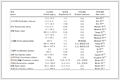
2 数据和方法 2.1 树轮稳定氧同位素数据本研究利用在中国西部建立的树轮 δ18O序列近100年公共时段(1901~2004年)进行分析。16个树轮 δ18O序列采样点的详细信息见表 1。研究区域主要集中在中国西部地区,树轮 δ18O序列主要分布于我国青藏高原区和西北干旱区,囊括了季风气候影响区和西风环流影响区。采样点大部分位于当地森林上限,树种为区域优势树种,包括云杉、 圆柏、 冷杉和落叶松。
|
表 1 树轮δ18O样点分布信息 Table 1 Information of tree-ring δ18O sampling sites |
在研究区我们新补充5个树轮 δ18O样点。在树轮采样点获取树轮样本后经晾干、 打磨、 交叉定年后按照文献[37]的方法提取α-纤维素,称取0.14~0.20mg α-纤维素在气体稳定同位素质谱仪(MAT-253)连接高温元素裂解仪(TC/EA)的系统在线测定 δ18O值。研究区中13个样点的 δ18O数据在中国科学院寒区旱区环境与工程研究所冰冻圈科学国家重点实验室测定。另外3个样点的树轮纤维素 δ18O数据来自国内外同行实验室。数据的测试精度均达到国际标准(SMOW,<0.3‰)。由于样点热根寺的树轮 δ18O数据没有收集到原始数据,因此在进行气候响应分析时剔除该样点。红原样点树轮 δ18O序列数据存在一定的缺失[28],利用缺失年份相邻5年数据的均值来替代缺失值。
2.2 气象站数据本文分析中的气象数据来自于中国气象科学数据共享网(http://www. cdc.nmic.cn),采用距树轮样点最近气象站自建站以来的数据。气象数据包括月平均气温、 月平均降水量和月平均相对湿度。此外,还采用标准化降水-蒸发指数(Standardized Precipitation-Evapotranspiration Index,简称SPEI)[38, 39]来探讨树轮 δ18O和干旱指数的响应。SPEI干旱指数在物理意义上相对明确,同时计算方法相对简单[40],能够较好地表征干旱程度,已被广泛用于干旱监测、 生态变化和树木生理的研究[38, 41, 42, 43]。进行空间分析时采用英国东安格拉大学气候研究中心的格点资料 CRU TS 3.2数据集,其中包括月平均温度、 月降水量和SPEI指数。CRU TS 3.2数据集分辨率为 0.5°×0.5°。
2.3 方法本文利用相关分析法探讨了树轮 δ18O和气候要素的响应关系,明确树轮 δ18O中的气候信号。然后利用REOF(Rotated Empirical Orthogonal Function)计算了样点树轮 δ18O记录的“时间系数序列”,利用空间分析的方法将时间系数回归到温度场,降水场和SPEI场,探明各个样点特征值在不同气候场上的分布。空间分析通过气候研究在线软件KNMI climate explore(http://climexp.knmi.nl/)实现。
3 结果与讨论 3.1 不同区域树轮δ18O值空间变化树轮 δ18O能够记录区域降水 δ18O的信号[13, 44, 45, 46],多年的观测结果表明树木源水(土壤水和降水多月或是年的混合)δ18O的值在年际尺度上基本保持不变[47]; 然而,树轮 δ18O在不同地点在叶片水平上却存在着不同强度的同位素分馏过程。研究树轮 δ18O平均值的空间分布,一方面通过和全球大气降水同位素观测网络(GNIP)降水 δ18O的分布状况比较,可以清楚地认识到空间上降水 δ18O对树轮 δ18O的分馏贡献,对树轮 δ18O记录的气候意义做更为科学合理的解释; 另一方面,也为揭示我国西部不同气候区树轮 δ18O的气候意义及 δ18O分馏过程中的主导因素的差异提供一些基本的认识。
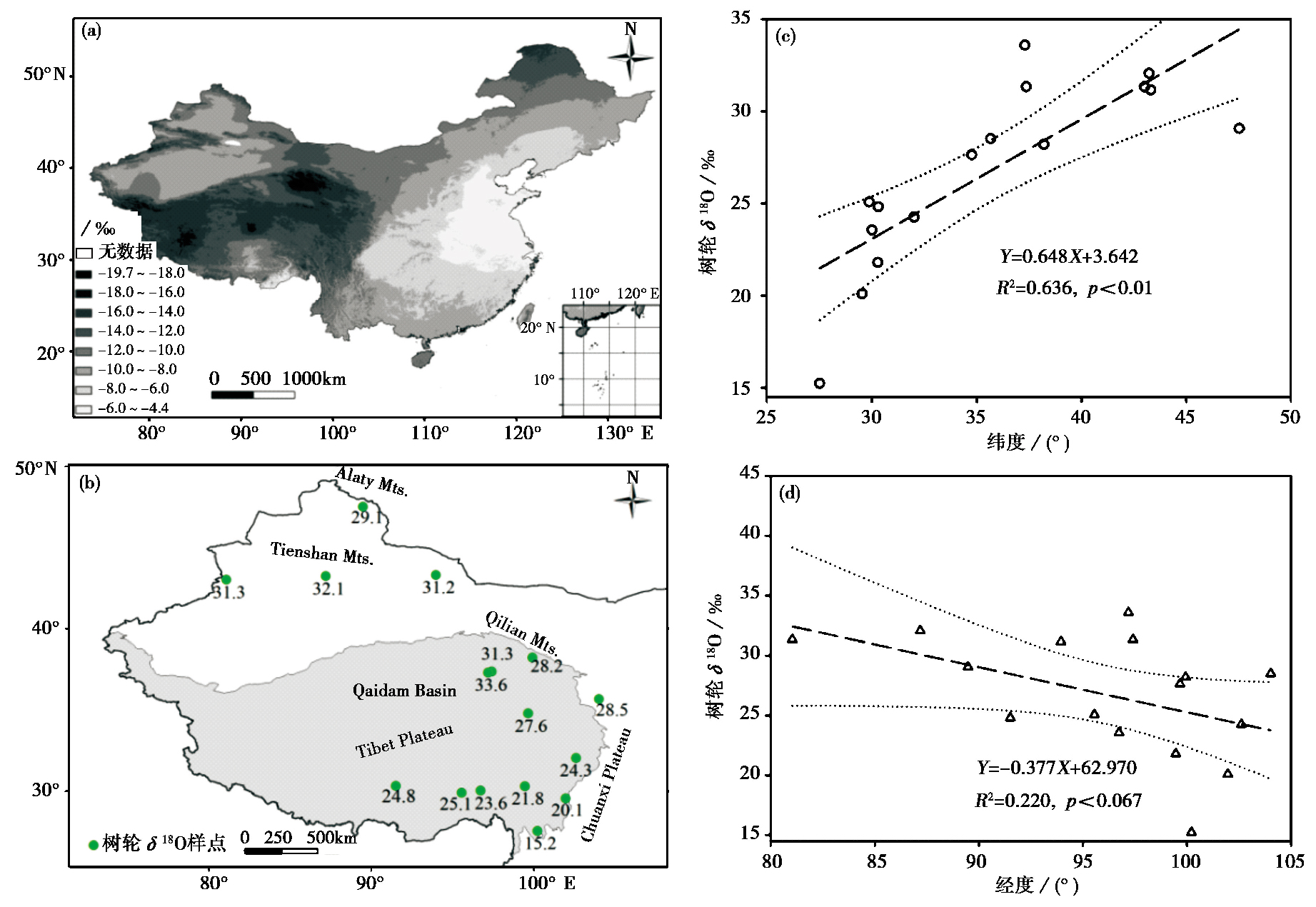
为了比较我国西部不同区域树轮 δ18O平均值的异同,对近百年(1901~2004年)树轮 δ18O平均值的空间分布进行了分析。树轮 δ18O是树木源水(土壤水和降水多月或是年的混合)δ18O经过植物叶片分馏进入植物木质部中的纤维素 δ18O的信号,因此树轮 δ18O值的变化在一定程度上受到降水 δ18O的影响。利用降水 δ18O与纬度和海拔的关系给出了我国降水 δ18O的空间分布图[48]。从图 1a中显示我国西部地区降水 δ18O的变化范围较大,从-19.7‰到-4.4‰。我国西部树轮 δ18O平均值的变化范围在15.2‰~33.6‰之间(图 1b),这与美国树轮 δ18O的分布范围21‰~33‰比较接近[49]。在空间分布上,树轮 δ18O平均值在青藏高原南北部之间变化相对较大: 在青藏高原东南部地区树轮 δ18O值在15.2‰~25.1‰之间,青藏高原北部地区树轮 δ18O变化在27.6‰~33.6‰之间。同样,降水 δ18O也在青藏高原南北部之间变化较大。但是,树轮 δ18O的低值区和降水 δ18O的低值区并不完全吻合。降水 δ18O的低值区出现在高原南部雅鲁藏布江附近,而树轮 δ18O的低值区出现在云南、 川西一带(图 1a),这可能与树轮 δ18O受到局地的气候变化导致叶片水 δ18O的分馏程度产生差异有一定的关系。在天山山脉和阿勒泰山区降水 δ18O有一定的差别(图 1a),其数值达到2.0‰~4.0‰左右,树轮 δ18O平均值的差别达到2.0‰~3.0‰(图 1b)。然而,在降水 δ18O平均值差别相对较小的天山北坡,3个样点的树轮 δ18O之间差别相对较小,最大仅为1.0‰。这表明降水 δ18O对树轮 δ18O平均值的分布有一定的影响。树轮 δ18O平均值和样点的纬度呈现显著的正相关,即随着采样点纬度的增加树轮 δ18O平均值增大(图 1c); 树轮 δ18O平均值和样点的经度呈现负相关,随着采样点经度的增加,树轮 δ18O平均值减小(图 1d)。树轮 δ18O平均值和纬度的关系与降水 δ18O的“纬度效应”表现比较一致,树轮 δ18O平均值和经度的关系体现出降水 δ18O的“经度效应”,但其统计关系不显著(p<0.1)。树轮 δ18O平均值和采样点海拔之间的关系在统计上完全不相关(图略)。样点间树轮 δ18O平均值的差别可能是由于采样点降水 δ18O的差别或是气候作用导致,因此不同样点之间产生差异的原因还需进一步甄别。
|
图 1 中国大气降水 δ18O空间分布(a)(基于文献[48]提出的模型公式和计算方法)、 中国西部树轮 δ18O平均值(1901~2004年)空间分布(b)以及中国西部树轮 δ18O平均值(1901~2004年)与纬度(c)、 经度(d)的关系图(c)和(d)中虚线为回归方程线,图中点线为95%置信线 Fig. 1 Spatial distribution of mean annual δ18O in precipitation over China(a)(based on the reference[48]). Spatial distribution of mean δ18O in tree rings over Western China(b),and relationships between the tree-ring δ18O mean value from 1901 to 2004 with the latitude (c) and the longitude (d) of the sampling sites. In figures (c) and(d),the dashed line represents the linear regression, and the dotted line represents the 95% significant levels |
植物利用水分的 δ18O反映的是多月降水或是年降水 δ18O的混合信号[13]。Labuhn等[47]基于15年监测降水 δ18O数据发现,树木源水 δ18O的信号基本保持不变,树轮 δ18O值的改变主要发生在叶片水平上的蒸腾分馏,这为树轮 δ18O的气候意义的解释提供了一些观测事实。虽然树轮 δ18O分馏模型描述了树轮 δ18O的分馏过程,但在实际应用中由于缺少采样点长期的降水 δ18O观测数据,对树轮 δ18O气候信号的解释,更多地基于树轮 δ18O与气候响应的结果。不同样点控制树轮 δ18O分馏的主要气候环境因子可能有所不同。为了进一步分析不同区域树轮 δ18O对于气候要素的响应,将树轮 δ18O与采样点最近气象站资料进行树轮 δ18O气候响应分析,选取的时间窗口为上一年11月到当年9月。
将不同样点的树轮 δ18O和气候要素响应分析结果依样点分布的纬度绘图后可以看出,树轮 δ18O和采样点附近气象站的月平均气温呈现正相关关系,显著的正相关关系出现在当年4~9月(图 2)。这一时段对应大部分地区树木的生长季。在生长季的前期,多数样点树轮 δ18O和平均温度呈现不显著的正相关关系。仅在波密样点,在4月份出现树轮 δ18O和气温显著负相关,其他样点在前年11月到当年4月树轮 δ18O和温度的负相关系都较弱且不显著(图 2)。

|
图 2 不同区域样点树轮 δ18O和气象要素的响应图中空心圈代表正相关系数,黑色的实心圈代表负相关系数,灰色的阴影代表通过95%显著性水平 Fig. 2 Tree-ring δ18O-climate response at different sampling sites. The white(black)circle represents positive (negative) correlation and the gray shaded square represents the correlation coefficient passed the 95% significance levels |
树轮 δ18O和月降水量主要呈现负相关关系,显著的负相关出现在5~9月份。在干旱区(如乌河、 哈密等),树轮 δ18O和降水量的响应关系显著(图 2),主要是区域的降水变化影响到树木可利用水分的多寡,进而影响了树轮 δ18O的分馏。然而,季风和西风的交汇区,降水量对于树轮 δ18O的限制作用减弱,二者之间没有显著的负相关关系。在青藏高原南部较为湿润的样点(如丽江、 贡嘎山、 波密和然乌),树轮 δ18O和降水量在前一年11月到当年4月没有显著相关关系,而在生长季的部分月份树轮 δ18O和降水量之间出现显著负相关,这与印度季风带来的区域降水增加,导致降水 δ18O出现“雨量效应”有一定关系[50](图 2)。
树轮 δ18O与5~9月相对湿度呈显著负相关关系(图 2),这种负相关主要体现了相对湿度通过叶片气孔活动对树木叶片水 δ18O的蒸腾富集作用[9, 26, 51]; 负相关的强度随着样点纬度变化呈现出增强的趋势,主要体现了从气候湿润区到干旱区相对湿度对于树轮 δ18O分馏的控制作用逐渐增强。然而,在季风和西风交汇区(兴隆山、 雪山乡、 天峻和德令哈样点),树轮 δ18O与相对湿度显著相关的月份主要出现在7~8月,其强度也低于新疆北部地区(图 2)。
总体来看,不同区域树轮 δ18O对于生长季5~9月的气候信号响应相对比较一致,体现为气温对树轮 δ18O的正效应,降水和相对湿度对树轮 δ18O具有负效应(图 2)。然而,在湿润的青藏高原东南区域,生长季前期1~4月树轮 δ18O与降水、 相对湿度出现不显著的正相关关系,这与西北干旱区的结果有所不同。在西北干旱区(新疆北部样点)树轮 δ18O与生长季前期降水和相对湿度负相关[20, 34, 35](图 2),体现了不同区域干湿变化对树轮 δ18O控制出现时间有一定的差异。另外,同处于干旱区的新疆北部和柴达木盆地东北缘,树轮 δ18O与相对湿度和降水的相关关系也存在着强度上的差异[31, 32](图 2),这体现了区域干湿状况对树轮 δ18O分馏的控制强度和贡献存在一定差异。
3.3 区域树轮δ18O的REOF分析和气候响应本文采用REOF方法分析了树轮 δ18O序列的时空变化特征,利用主分量的时间序列(RPC)和空间气候格点资料在研究区及邻近区域进行空间相关分析。REOF前3个主分量代表了树轮 δ18O所有序列48%的变化信息,其主成分的载荷能够代表样点信息在区域上的分布状况。REOF#1在空间上包含了4个载荷较大的样点(图 3),主要反映了新疆北部区域的变化信息。RPC1占树轮 δ18O变化18.4%的方差解释量,与新疆北部的温度变化显著正相关; RPC 1与我国西北的降水、 SPEI指数在空间上呈现显著负相关,显著的相关区域出现在新疆北部和甘肃西部地区。这与之前树轮 δ18O在该区域主要反映出与温度的正效应、 与降水和相对湿度负效应的结论一致[20, 34]。树轮 δ18O在西风影响的新疆北部主要体现出区域干湿变化的信号,且这种信号在较大的范围内都是一致的(图 3)。尽管树轮 δ18O序列来自于不同树种,然而树轮 δ18O记录的气候信号相对一致,这也证实了前期研究结果[24, 25]。

|
图 3 树轮 δ18O的空间REOF分析时间序列和气候要素空间响应 分析时段为1950~2004年,时间窗口为5~9月平均值; 气候变量为: T,平均温度;P,平均降水量; SPEI,干旱指数; 图中样点为REOF分析中空间载荷较大的样点 Fig. 3 Maps of loadings of tree-ring δ18O chronology sites on rotated empirical orthogonal function analysis,for the three retained δ18O chronology factors(RPC1~3)and corresponding spatial correlation fields for May to September mean temperature(T),precipitation(P),and SPEI from CRU TS 3.22 dataset. The analysis period covered from 1950 to 2004. Dots are sites participating with highest loading at the corresponding REOF |
REOF#2在空间上主要反映出藏东南区域4个样点较大的载荷值(图 3)。RPC2解释了树轮 δ18O变化17.2%的方差变化量。RPC2与藏东南区域的温度变化显著正相关,与降水、 SPEI变化显著负相关。RPC2和降水的负相关最强,相关显著区域也相对较大(图 3),表明在藏东南区域树轮 δ18O主要反映区域水文气候变化的信息,这也印证了前期利用树轮 δ18O来重建区域水文气候变化的相关研究结果[8,21,27, 28,30]。
REOF#3在空间上主要反映了处于西风和季风影响交汇区域的树轮 δ18O信号(图 3)。RPC3占树轮 δ18O变化的方差解释量为12.6%。RPC3和气候要素的空间响应在1950~2004年期间并没有显著的气候信号。前人研究表明,在该区域树轮 δ18O能够反映干湿变化的信息[31, 32]。然而,树轮 δ18O在该区域的气候信号的强度相对较弱,在空间响应上也没有显著的相关区域。一方面,与该区域相对较为复杂的水汽来源有一定的关系。在这些区域,树木源水 δ18O的信号可能受到季风降水、 西风降水和局地蒸发的影响[52, 53]; 另一方面,也与该区域受不同气候环流系统的综合影响,气候变化相对复杂,因而导致树轮 δ18O变化在空间上没有呈现出显著气候限制因子。因此,在该区域进行树轮 δ18O气候学相关研究时,需要进一步区分树木源水 δ18O和气候变化对树轮 δ18O的相对贡献。需要指出的是,本研究中在该区域只有3个研究样点(雪山乡、 德令哈和兴隆山样点),还需要更多的研究样点来诊断该区域树轮 δ18O空间气候信号。
4 结论树轮 δ18O变化是树木源水 δ18O和气候要素综合作用的结果。通过对比1901~2004年树轮 δ18O平均值和降水 δ18O的空间分布特征发现,两者的空间分布存在一定的相似性。在青藏高原南部树轮 δ18O和降水 δ18O都存在区域极低值,同时青藏高原南北部树轮 δ18O也存在较大的差异。树轮 δ18O和树轮样点最近气象站记录响应结果表明,树轮 δ18O和生长季温度呈显著正相关关系,与生长季的降水和相对湿度呈现显著的负相关关系。然而,树轮 δ18O的气候响应强度在不同区域存在一定的差异。树轮 δ18O在西风影响的新疆北部主要反映区域干湿变化的气候信号; 树轮 δ18O在西南季风影响的藏东南区域主要反映区域水文气候变化信息; 然而在季风和西风影响的交汇区域,树轮 δ18O的区域气候信号相对较弱,需要进一步明确。
虽然树轮 δ18O在样点间具有相对一致的气候响应,但是不同样点树轮 δ18O对于气候要素响应的强度存在着差异。本文结果表明在我国西部地区树轮 δ18O在区域气候信号上具有较为一致的信号。因此,利用树轮 δ18O网络资料能够建立区域气候变化信号,且较好地保留气候信号的低频信息。在未来工作中,基于区域树轮 δ18O序列网络,可开展区域尺度气候变化及树木对气候变化的生态学方面的研究。
致谢 感谢GrieBinger J博士、 张齐兵研究员、 徐海研究员、 石春明博士提供树轮 δ18O数据。
| 1 | 邵雪梅, 王树芝, 徐 岩等. 柴达木盆地东北部3500年树轮定年年表的初步建立. 第四纪研究2007,27 (4):477~485 Shao Xuemei, Wang Shuzhi, Xu Yan et al. A 3500-year master tree-ring dating chronology from the northeastern part of the Qaidam Basin. Quaternary Sciences, 2007,27 (4):477~485 |
| 2 | 刘 禹, 蔡秋芳, 宋慧明. 关于青藏高原2485年温度的季节和空间代表性问题. 第四纪研究, 2013,33 (1):108~114 Liu Yu, Cai Qiufang, Song Huiming. Seasonal and spatial representativeness of the tree-ring based 2485-year annual mean temperature reconstruction in the northeastern Tibetan Plateau. Quaternary Sciences, 2013,33 (1):108~114 |
| 3 | 勾晓华, 杨梅学, 彭剑峰等. 树轮记录的阿尼玛卿山区过去830年夏半年最高温变化. 第四纪研究, 2006,26 (6):991~998 Gou Xiaohua, Yang Meixue, Peng Jianfeng et al. Maximum temperature reconstruction for Animaqing Mountains over past 830 years based on tree-ring records. Quaternary Sciences, 2006,26 (6):991~998 |
| 4 | 杨 保. 树轮记录的小冰期以来青藏高原气候变化的时空特征. 第四纪研究, 2012,32 (1):81~94 Yang Bao. Spatial and temporal patterns of climate variations over the Tibetan Plateau during the period 1300~2010. Quaternary Sciences, 2012,32 (1):81~94 |
| 5 | 袁玉江, 魏文寿, 陈 峰等. 天山北坡乌鲁木齐河年径流总量的树轮重建. 第四纪研究, 2013,33 (3):501~510 Yuan Yujiang, Wei Wenshou, Chen Feng et al. Tree-ring reconstruction of annual total runoff for the Ürümqi River on the northern slope of Tien Shan Mountains. Quaternary Sciences, 2013,33 (3):501~510 |
| 6 | 蔡秋芳, 刘 禹. 山西五鹿山油松树轮宽度年表的建立及过去百余年5~6月平均气温变化. 第四纪研究, 2013,33 (3):511~517 Cai Qiufang, Liu Yu. The development of a tree-ring width chronology and the May-June mean temperature variability in Wulu Mountain, north-Central China. Quaternary Sciences, 2013,33 (3):511~517 |
| 7 | 李宗善, 刘国华, 傅伯杰等. 利用树木年轮宽度资料重建川西米亚罗地区过去200年夏季温度的变化. 第四纪研究, 2011,,31 (3):522~534 Li Zongshan, Liu Guohua, Fu Bojie et al. Tree ring-based summer temperature reconstruction over the past 200 years in Miyaluo of western Sichuan, China. Quaternary Sciences, 2011,,31 (3):522~534 |
| 8 | Liu Xiaohong, Xu Guobao, Grieinger J et al. A shift in cloud cover over the southeastern Tibetan Plateau since 1600: Evidence from regional tree-ring δ18O and its linkages to tropical oceans. Quaternary Science Reviews, 2014, 88 :55~68 |
| 9 | Roden J S, Lin G, Ehleringer J R. A mechanistic model for interpretation of hydrogen and oxygen isotope ratios in tree-ring cellulose. Geochimica et Cosmochimica Acta, 2000,64 (1):21~35 |
| 10 | Sternberg L, Deniro M J D. Biogeochemical implications of the isotopic equilibrium fractionation factor between the oxygen atoms of acetone and water. Geochimica et Cosmochimica Acta, 1983,47 (12):2271~2274 |
| 11 | Sternberg L, Anderson W T, Morrison K. Separating soil and leaf water 18 O isotopic signals in plant stem cellulose. Geochimica et Cosmochimica Acta, 2003,67 (14):2561~2566 |
| 12 | Sternberg L. Oxygen stable isotope ratios of tree-ring cellulose:The next phase of understanding. New Phytologist, 2009,181 (3):553~562 |
| 13 | Waterhouse J S, Switsur V R, Barker A C et al. Oxygen and hydrogen isotope ratios in tree rings:How well do models predict observed values?Earth and Planetary Science Letters, 2002,201 (2):421~430 |
| 14 | Deniro M J, Epstein S. Isotopic composition of cellulose from aquatic organisms. Geochimica et Cosmochimica Acta, 1981,45 (10):1885~1894 |
| 15 | Porter T J, Pisaric M F, Field R D et al. Spring-summer temperatures since AD 1780 reconstructed from stable oxygen isotope ratios in white spruce tree-rings from the Mackenzie Delta, Northwestern Canada. Climate Dynamics, 2014,42 (3~4):771~785 |
| 16 | Libby L M, Pandolfi L J, Payton P H et al. Isotopic tree thermometers. Nature, 1976, 261 :284~288 |
| 17 | Sidorova O V, Siegwolf R T W, Myglan V S et al. The application of tree-rings and stable isotopes for reconstructions of climate conditions in the Russian Altai. Climatic Change, 2013,120 (1~2):153~167 |
| 18 | Rinne K T, Loader N J, Switsur V R et al.400-year May-August precipitation reconstruction for Southern England using oxygen isotopes in tree rings. Quaternary Science Reviews, 2013, 60 :13~25 |
| 19 | Treydte K S, Schleser G H, Helle G et al. The twentieth century was the wettest period in Northern Pakistan over the past millennium. Nature, 2006, 440 :1179~1182 |
| 20 | Xu Guobao, Liu Xiaohong, Qin Dahe et al. Tree-ring δ18O evidence for the drought history of eastern Tianshan Mountains, Northwest China since 1700 AD. International Journal of Climatology, 2014,34 (12):3336~3347 |
| 21 | An Wenling, Liu Xiaohong, Leavitt S W et al. Relative humidity history on the Batang-Litang Plateau of Western China since 1755 reconstructed from tree-ring δ18O and δD. Climate Dynamics, 2014,42 (9~10):2639~2654 |
| 22 | Liu Xiaohong, Shao Xuemei, Liang Eryuan et al. Climatic significance of tree-ring δ18O in the Qilian Mountains, Northwestern China and its relationship to atmospheric circulation patterns. Chemical Geology, 2009,268 (1~2):147~154 |
| 23 | Liu Yu, Cai Qiufang, Liu Weiguo et al. Monsoon precipitation variation recorded by tree-ring δ18O in arid Northwest China since AD 1878. Chemical Geology, 2008,252 (1~2):56~61 |
| 24 | Treydte K, Frank D, Esper J et al. Signal strength and climate calibration of a European tree-ring isotope network. Geophysical Research Letters, 2007,34 (24):L24302 |
| 25 | Saurer M, Schweingruber F, Vaganov E A et al. Spatial and temporal oxygen isotope trends at the northern tree-line in Eurasia. Geophysical Research Letters, 2002,29 (9):GL013739 |
| 26 | Sano M, Xu C, Nakatsuka T. A 300-year Vietnam hydroclimate and ENSO variability record reconstructed from tree ring δ18O. Journal of Geophysical Research, 2012,117 (D12):D12115 |
| 27 | Grieinger J, Bräuning A, Helle G et al. Late Holocene Asian summer monsoon variability reflected by δ18O in tree-rings from Tibetan junipers. Geophysical Research Letters, 2011,38 (3):L03701 |
| 28 | Xu Hai, Hong Yetang, Hong Bin. Decreasing Asian summer monsoon intensity after 1860 AD in the global warming epoch. Climate Dynamics, 2012,39 (7~8):2079~2088 |
| 29 | Shi Chunming, Daux V, Zhang Qibing et al. Reconstruction of southeast Tibetan Plateau summer climate using tree ring δ18O:Moisture variability over the past two centuries. Climate of the Past, 2012, 8 :205~213 |
| 30 | Liu Xiaohong, Zeng Xiaomin, Leavitt S W et al. A 400-year tree-ring δ18O chronology for the southeastern Tibetan Plateau:Implications for inferring variations of the regional hydroclimate. Global and Planetary Change, 2013, 104 :23~33 |
| 31 | Xu Guobao, Chen Tuo, Liu Xiaohong et al. Potential linkages between the moisture variability in the northeastern Qaidam Basin, China, since 1800 and the East Asian summer monsoon, as reflected by tree-ring δ18O. Journal of Geophysical Research, 2011,116 (D9):D09111 |
| 32 | Qin Chun, Yang Bao, Bräuning A et al. Drought signals in tree-ring stable oxygen isotope series of Qilian Juniper from the arid northeastern Tibetan Plateau. Global and Planetary Change, 2015, 125 :48~59 |
| 33 | Wang Wenzhi, Liu Xiaohong, Xu Guobao et al. Moisture variations over the past millennium characterized by Qaidam Basin tree-ring δ18O. Chinese Science Bulletin, 2013,58 (32):3956~3961 |
| 34 | Xu Guobao, Liu Xiaohong, Qin Dahe et al. Drought history inferred from tree ring δ 13 C and δ18O in the central Tianshan Mountains of China and linkage with the North Atlantic Oscillation. Theoretical and Applied Climatology, 2014,116 (3~4):385~401 |
| 35 | Xu Guobao, Liu Xiaohong, Qin Dahe et al. Relative humidity reconstruction for Northwestern China's Altay Mountains using tree-ring δ18O. Chinese Science Bulletin, 2014, 59 (2):190~200 |
| 36 | Liu Xiahong, An Wenling, Treydte K et al. Tree-ring δ18O in Southwestern China linked to variations in regional cloud cover and tropical sea surface temperature. Chemical Geology, 2012, 291 :104~115 |
| 37 | 刘晓宏, 刘 禹, 徐国保等. 树木年轮稳定同位素分析样品前处理方法探讨. 冰川冻土, 2010,32 (6):1242~1250 Liu Xiaohong, Liu Yu, Xu Guobao et al. Pretreatment of the tree-ring samples for stable isotope analysis. Journal of Glaciology and Geocryology, 2010,32 (6):1242~1250 |
| 38 | Vicente-Serrano S M, Gouveia C, Camarero J J et al. Response of vegetation to drought time-scales across global land biomes.Proceedings of the National Academy of Sciences of the United States of America, 2013,110 (1):52~57 |
| 39 | Vicente-Serrano S M, Beguería S, López-Moreno J I et al. A new global 0.5° gridded dataset(1901~2006)of a multiscalar drought index:Comparison with current drought index datasets based on the Palmer drought severity index. Journal of Hydrometeorology, 2010,11 (4):1033~1043 |
| 40 | Vicente-Serrano S M, Beguería S, López-Moreno J I. A multiscalar drought index sensitive to global warming: The standardized precipitation evapotranspiration index. Journal of Climate, 2010,23 (7):1696~1718 |
| 41 | Vicente-Serrano S M, Beguería S, Lorenzo-Lacruz J et al. Performance of drought indices for ecological, agricultural, and hydrological applications. Earth Interactions, 2012,16 (10):1~27 |
| 42 | Tao Hui, Borth H, Fraedrich K et al. Drought and wetness variability in the Tarim River basin and connection to large-scale atmospheric circulation. International Journal of Climatology, 2014,34 (8):2678~2684 |
| 43 | Vicente-Serrano S M, López-Moreno J I, Drummond A et al. Effects of warming processes on droughts and water resources in the NW Iberian Peninsula(1930~2006). Climate Research, 2011,48 (2~3):203~212 |
| 44 | Li Qiang, Nakatsuka T, Kawamura K et al. Regional hydroclimate and precipitation δ18O revealed in tree-ring cellulose δ18O from different tree species in semi-arid Northern China. Chemical Geology, 2011,282 (1):19~28 |
| 45 | Leonelli G, Pelfini M, Battipaglia G et al. First detection of glacial meltwater signature in tree-ring δ18O:Reconstructing past major glacier runoff events at Lago Verde(Miage Glacier, Italy). Boreas, 2014,43 (3):600~607 |
| 46 | Managave S R, Ramesh R. Isotope dendroclimatology:A review with a special emphasis on tropics. In:Baskaran M ed. Handbook of Environmental Isotope Geochemistry, Advances in Isotope Geochemistry. Berlin Heidelberg:Springer, 2011. 811~833 |
| 47 | Labuhn I, Genty D, Daux V et al. Linking the isotopic composition of monthly precipitation, cave drip water and tree ring cellulose—15 years of monitoring and data-model comparison. EGU General Assembly Conference Abstracts, 2013, 15 :4818 |
| 48 | 刘忠方, 田立德, 姚檀栋等. 中国大气降水中 δ18O 的空间分布. 科学通报, 2009,54 (6):804~811 Liu Zhongfang, Tian Lide, Yao Tandong et al. Spatial distribution of δ18O in precipitation over China. Chinese Science Bulletin, 2009,54 (6):804~811 |
| 49 | Feng Xiahong, Reddington A L, Faiia A M et al. The changes in north American atmospheric circulation patterns indicated by wood cellulose. Geology, 2007,35 (2):163~166 |
| 50 | 安文玲, 刘晓宏, 陈 拓等. 云南丽江树轮 δ18O记录的大气环流变化信息. 地理学报, 2009,64 (9):1103~1112 An Wenling, Liu Xiaohong, Chen Tuo et al. Atmospheric circulation information recorded in tree-ring δ18O at Lijiang, Yunnan Province. Acta Geographica Sinica, 2009,64 (9):1103~1112 |
| 51 | Liu Xiaohong, An Wenling, Leavitt S W et al. Recent strengthening of correlations between tree-ring δ 13 C and δ18O in mesic Western China:Implications to climatic reconstruction and physiological responses. Global and Planetary Change, 2014, 113 :23~33 |
| 52 | Zhao Liangju, Xiao Honglang, Zhou Maoxian et al. Factors controlling spatial and seasonal distributions of precipitation δ18O in China. Hydrological Processes, 2012,26 (1):143~152 |
| 53 | Liu Jianrong, Song Xianfang, Sun Xiaomin et al. Isotopic composition of precipitation over arid Northwestern China and its implications for the water vapor origin. Journal of Geographical Sciences, 2009,19 (2):164~174 |
 , Liu Xiaohong①
 , Chen Tuo①, An Wenling④, Wang Wenzhi①③, Wu Guoju①③, Zeng Xiaomin①③, Wang Bo①③
 Abstract
Here, we have synthetized 16 tree-ring δ18O series from western part of China; most of sampling sites are distributed on the Tibetan Plateau and the arid region of Northwest China. These sites are mainly near to the local forest upper treeline. Tree samples we selected are from the regional dominant species, including spruce, fir, larch and juniper. We firstly compared the spatial patterns of the mean values of tree-ring δ18O during the period from 1901 to 2004 with the mean values of δ18O in precipitation, and find that tree-ringδ18O share the similar spatial distribution pattern with precipitation δ18O. In addition, tree-ring δ18O shows relative lower values in the southern Tibetan Plateau, while a higher value is revealed in the northern Tibetan Plateau. Tree-ring δ18O values increase along with the latitude of the tree-ring δ18O sampling site, which is similar to the "latitude effect" of δ18O in precipitation. The climate responses between tree-ring δ18O and meteorological dataset from the nearest tree-ring sampling sites reveal that δ18O in tree rings is significantly positively correlated with the growing season temperature, and is significantly negatively correlated with the growing season precipitation and relative humidity. By rotated empirical orthogonal function analysis and spatial response analysis, we point out that in northern part of Xinjiang, where climate is mainly dominated by the westerly circulations, tree-ring δ18O reflects mainly the regional drought(moisture)conditions; in the southeastern Tibetan Plateau, where climate is dominated by the summer monsoon, tree-ring δ18O records the regional hydroclimate variability; while in the intersection area between monsoonal area and westerly area, tree-ring δ18O mirrors climate signals relative weakly. Our results suggest that tree-ring δ18O can be an excellent proxy in regional climatic reconstruction based on it's better ability in keeping the long-frequency climatic signals over larger region. The reinforcement of the ongoing tree-ring isotopic network over the entire China will be helpful to understanding the regional climate change which is linked by differing atmospheric circulations systems and forest dynamics under the significant climate changes in the future.