 2015, Vol.35


1 引言
中国北方季风边缘区的位置随着季风的强弱和扩展范围的变化,存在不同时间尺度上的摆动。不同时间尺度下的季风活动强弱所影响的区域范围存在很大的差异。在万年尺度上,Cheng等[1]利用新疆特克斯科桑洞石笋代用资料记录与甘肃靖远黄土磁化率记录[2]比较得出,东亚夏季风携带的水汽可以深入到内陆干旱地区,可见在500ka B.P. 东亚夏季风的推进可以达到比现在更北的广大区域。在千年尺度上的研究认为[3],全新世早期季风最强,能够影响到干旱区,使气候湿润,之后季风衰退南撤,干旱区东部边缘变干; 然而,Chen等[4]利用数条高质量的湖泊沉积记录集成研究却发现,早全新世(约11~8ka B.P. )季风最强盛时期,西北内陆干旱区的湖泊均处于干涸或水位极低的状态,显然这个时期季风不能深入到西北内陆干旱区使降水量增加,而在中晚全新世(约8~2ka B.P. )季风衰退时期,干旱区湖泊却处于湿润状态,可见这种湿润状态不可能是衰退的季风深入内陆造成的。最近的地质证据也表明,受东亚季风影响的中国北方沙漠,在末次冰盛期(约26~16ka B.P. )流动沙丘扩张距离现代沙漠边界约30~50km,在全新世大暖期(约9~5ka B.P. )气候趋向于暖湿,沙丘急剧收缩约20~200km[5, 6, 7, 8]。这些研究促使我们开始思考,在近百年到数十年尺度上,季风降水的空间配置格局和变化特征是怎样的?其影响范围有多大?可能的驱动机制是什么?
中国丰富的树木年轮资料[9, 10, 11, 12, 13, 14, 15]以及历史文献资料[16, 17, 18, 19]为探索以上科学问题提供了数据基础。本文利用树轮数据结合历史文献资料着重研究中国北方 100°~115°E范围内,400mm等降水量线的年际-年代际变化特征和驱动机制,并进一步讨论季风边缘区在中国的影响范围。400mm等降水量线是中国西北干旱半干旱区与东部湿润半湿润区的分界线,同时也是农业、 牧业交错地带。因此,研究历史时期400mm等降水量线的空间位移及机制,不仅可以说明季风对中国北方气候变化的影响还可以表明中国干旱半干旱区的范围是如何变化的。
2 资料和方法 2.1 研究资料本文选用国家气象中心气象资料室提供的覆盖研究区的31个地面台站的月降水量观测资料。这31个气象台站和本文所选的旱涝等级点相对应。对个别台站中个别年份(不超过3年)的缺测数据进行了处理,主要是采用该台站多年平均值代替缺测值。因为观测资料的起始年份不一致,这里一致选取1958~2010年的数据进行分析。
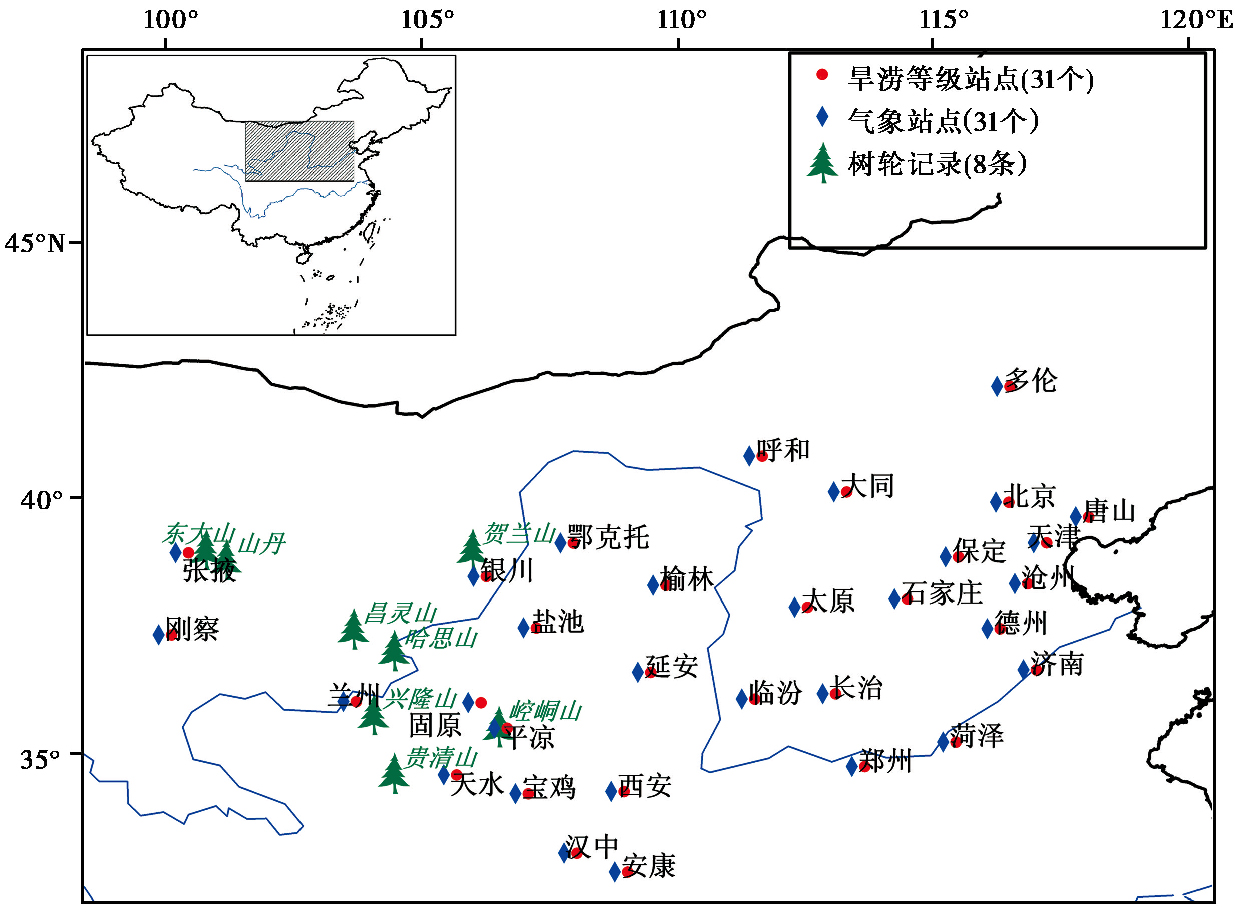
在 45°~33°N,100°~120°E 范围内,共选取历史文献记载中的31个旱涝等级站点(图 1),所选站点可以很好的覆盖本文的研究范围(100°~115°E范围内)。中国近530年的历史文献资料记载的旱涝等级数据始自1470年,在中国范围内共包含120个站点,其中中国西部地区资料有部分缺失,而东部地区较为完整。针对本文所选的31个旱涝等级站点中部分记载缺失年代或者时间不连续时段,利用正则期望最大法(Regularized Expectation Maximization,简称RegEM),将缺失数据补充完整,使序列长度达到1470~2000年的时段。
|
图 1 研究区旱涝等级站点(31个)、 气象站点(31个)及树轮记录(8条)的分布 Fig. 1 Map showing locations of 31 dryness/wetness indices sites,31 meteorological stations and 8 tree ring sites on the study region |
表 1中统计了所采用的旱涝等级点中的10个站点缺失年的总数及具体的缺失年份,除兰州、 大同、 天水、 沧州站点缺失年代在10年以上外,其他站点都为个别年份缺失,对于这些缺失数据的年份进行了插补; 另外需要说明的是,呼和浩特站点记录的数据起始于1739年,多伦站点起始于1910年,鄂克托站点起始于1870年,其余旱涝等级站点都起始于1470年,菏泽与德州站点数据记录终止于1994年,沧州站点终止于1995年,其他站点都统一选取截止2000年的数据。其余站点的记录数据都是完整连续的。

|
表 1 旱涝等级站点缺测年统计 Table 1 The miss years about the dryness/wetness stations |
我们选取了8条能够反映降水量和湿度变化信息的树轮序列[20, 21, 22, 23, 24, 25, 26, 27](见图 1)与其邻近旱涝站点的历史文献资料进行交叉验证,8条树轮序列记录的地点为贺兰山、 张掖市东大山、 山丹县的山丹、 武威古浪县昌灵山、 靖远县哈思山、 兰州市兴隆山、 平凉市崆峒山和定西市贵清山(见图 1)。
2.2 研究方法由于史料记载评定的旱涝等级主要是依据暖季(春、 夏、 秋季)的旱情和雨情出现的范围和严重程度来分级。所以本文计算了与所选的31个旱涝等级点邻近的31个器测降水量气象台站的近50年来5~9月的降水量占年降水量的百分比,发现,除西安站点5~9月的降水量占年降水量的百分比低于70%外(为67%),其余30个器测台站的5~9月降水量占年降水量的百分比都高于70%,近三分之二的台站5~9月降水量占年降水量的百分比都在80%以上,尤其是刚察台站的5~9月的降水量占年降水量的百分比高达90%。可见,研究区的年降水量主要来源于5~9月。
基于31条旱涝等级站点数据和其邻近的31个器测台站的月降水量数据,使用方差匹配的方法[28]重建了近530年5~9月的降水量序列,依据各站点5~9月降水量占年降水量的不同百分比情况,重建了1470~2000年的年降水量序列。方差匹配方法与简单的线性回归方法相比,前者可以较好的避免重建结果中存在的方差损失的现象,因此重建结果也更加准确。为了保证重建结果能更好的反应与各站点的相关性,本文选取不同校准时段与验证时段,分别计算了每条重建序列的误差缩减值(Reduction of Error,简称RE)和有效系数(Coefficient of Efficiency,简称CE)[29, 30]来检验重建的可靠性,RE和CE的值大于零则表明校准模型可靠,两者的值越接近1则表明重建模型越可靠。为了提高重建结果的准确性,计算了每条重建序列的±1倍校准误差(Root Mean Squared Error,简称RMSE)。重建数据在ArcGIS 9.2的空间分析(Spaitial Analyst)模块下采用Kring插值方法[31]绘制400mm等降水量线位置的空间分布图。对于所选取的8条树轮序列,同样采用方差匹配的方法重建了年降水量序列。
采用经验正交函数(Empirical Orthogonal Function,简称EOF)方法分析了通过方差匹配方法处理旱涝等级数据后获得的31条年降水量序列,得到前3个有意义的特征向量和时间系数(PC)。对第一时间系数(PC1)标准化序列和器测时期北大西洋5~9月涛动数据(North Atlantic Oscillation,简称NAO)以及赤道太平洋海域Ni、o3.4区(即在Ni、o3 区和Ni、o4 区之间的区域,为 5°S~5°N,170°W~120°W) 冬季(12~2月)海温标准化序列进行交叉小波谱分析。并计算了PC1序列与印度6~9月总降水量的相关性。EOF方法可以有效的保留原始数据中的绝大部分信息,又可以起到降维的作用,分解得到的特征向量所对应的时间系数代表了该空间场随时间的演变规律。交叉小波谱分析是把小波变换和交叉谱分析两种方法结合在一起产生的新型信号分析手段,它可以揭示两条序列在不同时间尺度上的一致性和相关性,同时可以体现时频域中的相位关系。
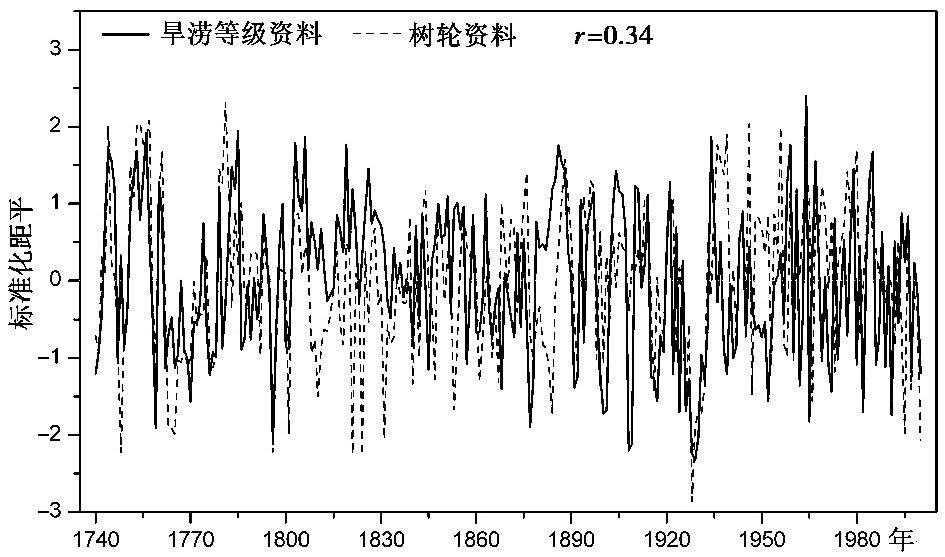
3 结果与讨论 3.1 降水量序列的重建如图 2所示,分别利用历史文献资料和其邻近的8条树轮资料重建的年降水量序列有很好的一致性,相关系数为0.34(显著水平为0.01,n=261)。另外,在包头、 呼和浩特、 鄂尔多斯和山西宁武的树轮研究[32, 33, 34, 35]也表明,历史文献记载的旱灾年份在用树轮样点重建的序列上均有反映,两者在年际和10年际尺度上的变化具有很好的一致性,尤其是历史文献记载的比较严重的旱年,如1877年、 1878年和1928年、 1929年均出现在树轮重建序列的降水量较少时段,这也进一步说明历史文献记载的准确性。
|
图 2 历史文献和树轮资料重建的年降水量比较 Fig. 2 Comparison between the precipitation reconstruction by historical document records and tree-ring data |
本文共计算了31个站点的RE和CE值,结果显示各重建序列的RE和CE值都大于零,RE和CE的中值分别为0.75和0.72,因此所有重建序列都通过检验。其中,平凉和刚察站点的RE和CE值都在0.9以上,是所有站点中计算结果最接近于1的两个站点; 盐池、 临汾、 呼和浩特与长治4个站点的RE和CE值相对其他站点较低,分布在0.4~0.5之间; 55%的站点RE和CE值的计算结果介于0.70~0.89之间。
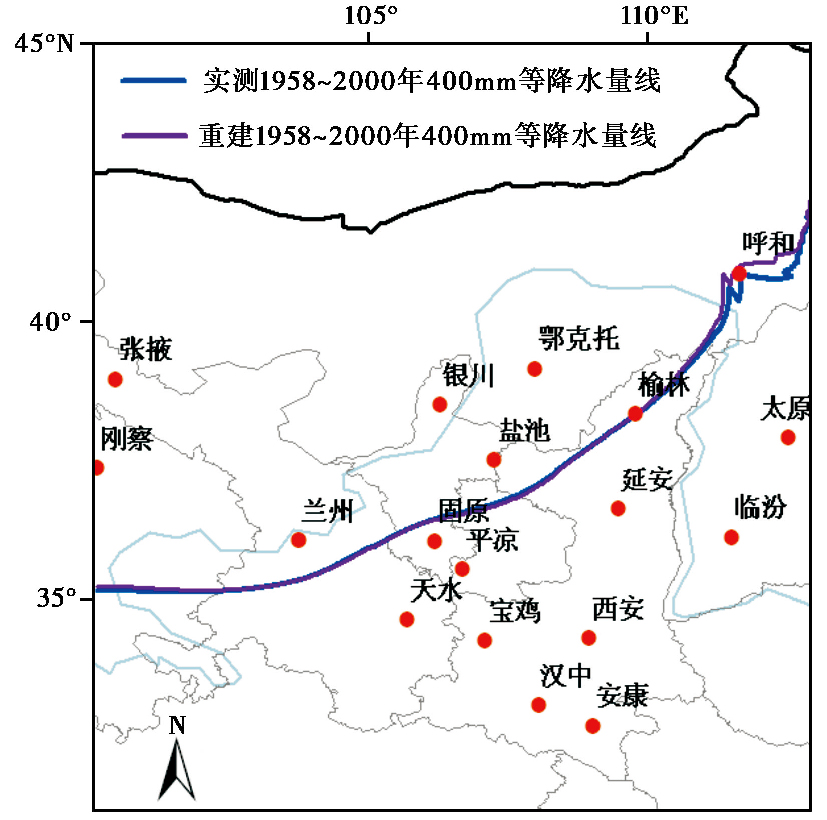
图 3对比了1958~2000年400mm等降水量线重建曲线和气象数据实测曲线。重建曲线所用数据即是采用上述方差匹配方法处理后的旱涝等级数据。两条对比曲线变化较为一致,重建曲线基本反映了研究区降水量的变化。说明重建方法可靠,重建结果准确。需要指出的是在呼和浩特和大同这些边缘地区,重建和实测曲线存在偏差,所以这些地区具有一定的不确定性。
|
图 3 实测与重建400mm等降水量线空间位置比较 Fig. 3 Comparison between the reconstructed and observed the 400mm annual rainfall isoline |
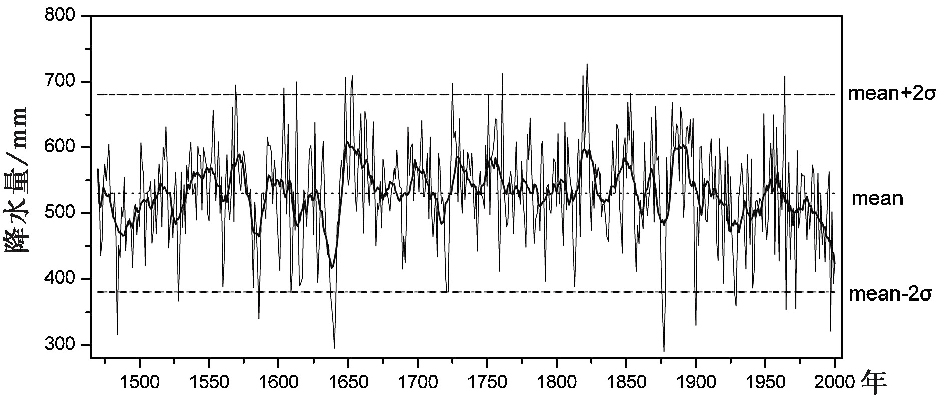
本文重建了过去530年以来研究区的降水量序列(图 4),重建时段各点的平均年降水量为530mm,标准差(σ)为±75mm。定义极端湿润年为>mean+2σ,极端干旱年为<mean-2σ。在整个重建序列中降水量大于680mm的极端湿润年份有13年; 降水量小于380mm的极端干旱年份有18年。
|
图 4 过去530年降水量变化曲线和其11年滑动平均曲线 Fig. 4 Precipitation change series for the last 530 years and its 11-years moving average |
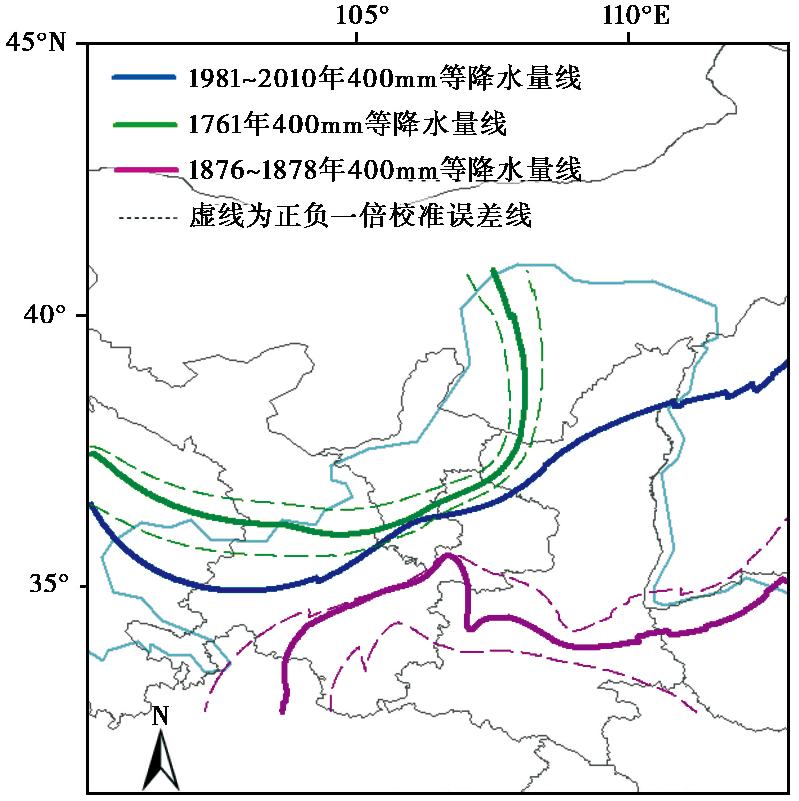
在年际尺度上(图 5),给出了近530年极端湿润年份和极端干旱事件时期400mm等降水量线位置与1981~2010年平均位置的空间对比图。降水量丰年1761年时400mm等降水量线位置偏北约111km(105°E处),在不同地区波动幅度不同,但是在固原地区偏北位置不是很显著。重建结果表明近530年来最严重的一次干旱事件出现在1876~1878年,这次干旱事件时期的400mm等降水量线位置要比1981~2010年平均位置偏南约455km(110°E处),与湿润年份相比,干旱年份400mm等降水量线较1981~2010年平均位置波动幅度更大。Yang等[36]利用树轮资料和史料对明朝末年(1638~1644年)、 光绪初年(1876~1878年)以及民国初年(1927~1930年)的干旱事件发生的程度和空间范围进行了详细分析,发现在这些干旱事件时期,中国北方地区呈现出大范围的干旱分布。本文的重建结果也很好地再现了这些干旱时期。
|
图 5 历史时期最湿润和最干旱年份的400mm等降水量线空间位置 Fig. 5 Spatial change about the wettest and driest years of the 400mm annual rainfall isolines |
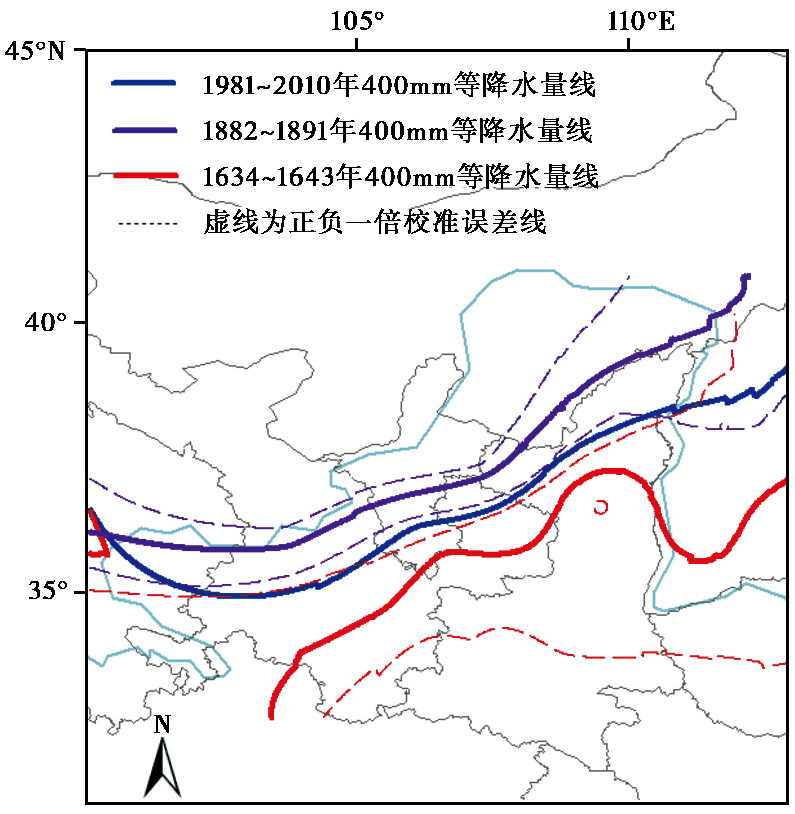
在年代际尺度上,依据11年滑动平均(图 4)计算结果,选取近500年来最干旱的10年1634~1643年和最湿润的10年1882~1891年为例进行说明。图 6给出的是历史时期最湿润和最干旱10年和最近30年(1981~2010年)的400mm等降水量线位置的空间对比图。可见,相对于最近30年的平均状态来说,历史时期最湿润的10年400mm等降水量线偏北约144km(110°E处),而最干旱的10年400mm等降水量线偏南约322km(111°E处)。但是需要指出的是,在部分边缘地区,1981~2010年的400mm等降水量线位置在校准误差范围之内,所以,年代际尺度上的变化没有年际尺度上的变化显著。
|
图 6 历史时期最湿润10年(1882~1891年)和最干旱10年(1634~1643年)与最近30年(1981~2010年)400mm等降水量线空间位置对比 Fig. 6 Spatial distribution about the 400mm annual rainfall isolines in the wettest 10 years(1882~1891),in the driest 10 years(1634~1643)and the last 30 years (1981~2010),and the three distributions difference |
研究区地处西北农牧交错带,农业发展多为雨养农业,对降水变化有较高的依赖性。有研究认为[37, 38]凡是经济发达、 社会安定、 国力强盛、 人口增加、 疆域扩展的时期往往出现在暖湿时期。据此可以推测,研究区降水量增加年份,400mm等降水量线位置北移,给更多区域带来充沛降水,因此农业生产兴盛,粮食充足,没有饥荒,社会安定和谐。当然,社会经济的兴衰还有其他多方面的影响因素,但是降水量增加无疑是对西北干旱地区生态建设和国民经济发展都有很大的益处。
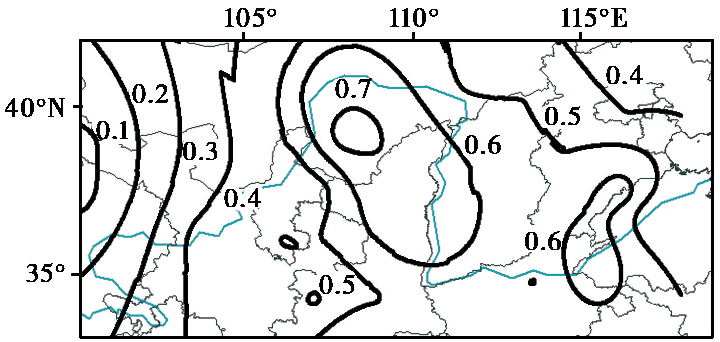
3.3 机制分析对1470~2000年标准化后的31条重建降水量序列进行EOF分解,提取时间系数PC1序列。依据计算结果第一特征向量方差贡献为26%,前4个特征向量累计方差贡献率为52%。如图 7所示,第一特征向量的空间分布型表现为整个区域的降水变化具有同步性,反应了研究区同时多雨或同时少雨的降水变化格局,特征向量极大值中心区域靠近临河和乌海市一带,且EOF1更能代表河套地区的降水量变化。通过对PC1序列计算功率谱[39],2~10年和24年周期(通过99%信度检验)最为显著。而其他年代际尺度到百年尺度上的周期性并不显著。
|
图 7 1470~2000年年降水量第一特征向量(EOF1)分布型 Fig. 7 Spatial patterns of factor loadings of the first leading EOF 1 of precipitation for the period 1470~2000 |
那么降水量的这种周期性变化是由什么气候系统要素驱动的?为解决这一问题,我们对PC1序列与各种大气涛动指数之间的关系进行了分析。器测时期的大气涛动指数主要包括PDO(Pacific Decadal Oscillation)、 ENSO(El Ni、o-Southern Oscillation)、 AMO(Atlantic Multi-decadal Oscillation)和5~9月NAO指数。其中,本文用赤道太平洋海域Ni、o3.4区的实测SST指数12月到2月的平均变化来描述ENSO的时间演变规律。以上时间序列数据均来自美国国家海洋和大气管理局(NOAA)网站。
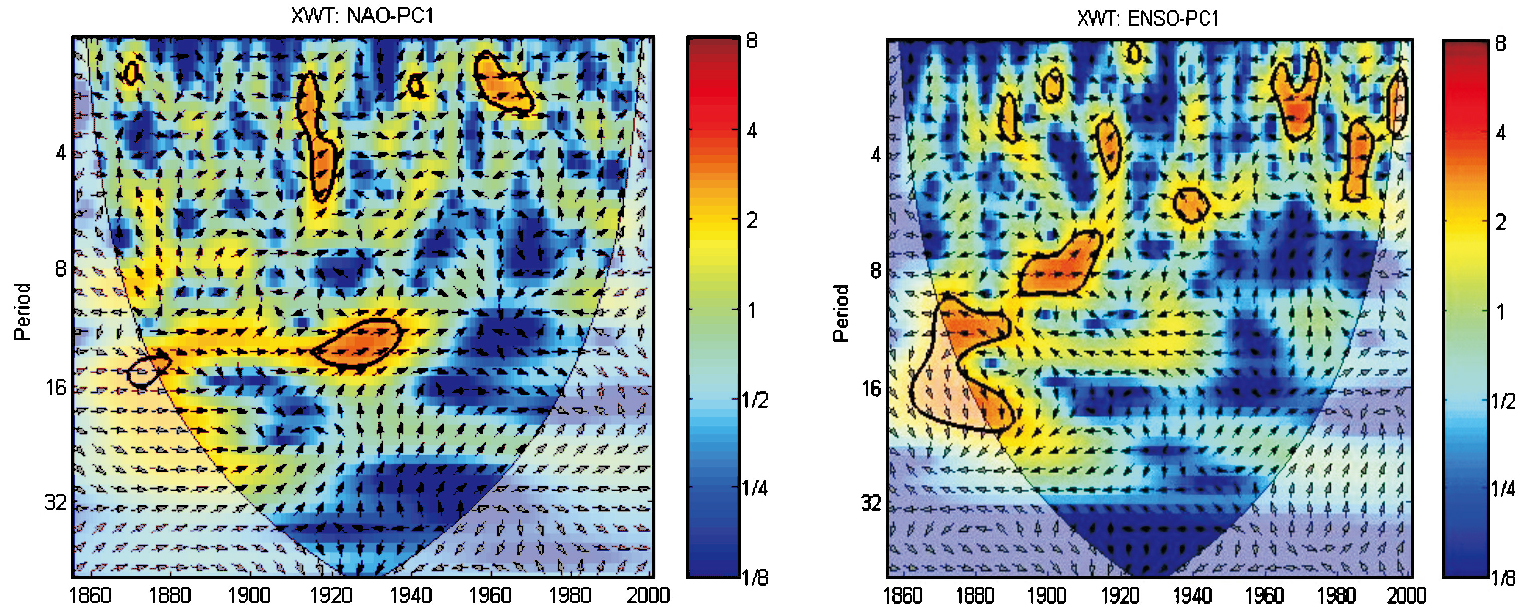
结果表明,降水量PC1年际尺度上的变化主要受NAO和ENSO这两种短周期性的大气涛动指数的驱动。而PDO与AMO对降水量的变化影响比较微弱,其相关性比较低。PC1序列与1856~2000年5~9月NAO实测指数的相关性为0.26(通过99%信度检验,n=145),与ENSO指数的相关性为-0.24(通过95%的信度检验,n=145)。图 8是PC1序列与5~9月NAO和ENSO指数在1856~2000年时段的交叉小波谱分析结果,图 8a中黑色细线表示小波影响锥,显示连续小波变换的数据边缘效应影响较大的区域,黑色粗线圈闭的值表示通过了95%的信度检验,红色和蓝色分别表示能量密度的峰值和谷值。在1910~1940年和1960~1980年时段上,能量密度处在峰值时期,5~9月NAO指数和PC1序列有显著的共振周期2~6年和10年左右。其在主要震荡周期内有很强的相干性,且存在正相位的变化。图 8b显示,在1860~2000年时段上,ENSO指数和PC1序列有显著的共振周期3~10年。在主要震荡周期内有很强的相干性,且存在反相位的变化。Linderholm等[40, 41]研究表明,东亚地区尤其是中国中西部区域的夏季气温和降水量变化受夏季NAO的调控。相关性分析表明夏季NAO指数处于高值时,对应中国北方地区降水量比常年有所偏多。ENSO已经是大家公认的对全球范围内许多区域的降水和温度都有重要影响的一个因素。当赤道中东太平洋海温异常偏高时,发生El Ni、o现象,中国北方降水量偏少,江南地区降水量偏多; 在La Ni、a年情况正好相反[42]。而本文所分析的1876~1878年的干旱事件也正好出现在El Ni、o事件最强时期。可见,北半球中高纬度的NAO现象和热带地区的ENSO循环对中国北方地区的降水量变化存在至关重要的影响[43, 44, 45, 46, 47]。
|
图 8 5~9月NAO指数(a)和ENSO指数(b)与PC1序列的交叉小波谱分析 Fig. 8 Cross wavelet spectrum analysis for PC1 series between the May-September NAO index (a) and the ENSO index(b) |
本文选用Li等[48]重建的ENSO指数序列,计算了其与本文PC1序列在器测时期之前的时间段内(1470~1855年)的相关性,相关系数为-0.15(通过99%信度检验,n=385),说明ENSO对研究区降水量变化的影响是稳定的。计算1871~2000年时段本文PC1序列与印度6~9月的总降水量相关系数为0.36(通过99%信度检验,n=130),而印度6~9月的总降水量可以表示印度夏季风的强弱,表明中国北方降水量变化同时受印度季风的影响。有研究表明ENSO对我国北方降水的影响主要是通过影响季风的强弱而联系起来的[42],El Ni、o年,印度夏季风减弱,中国北方地区降水量偏少; La Ni、a年,从印度洋输送到中国北方的水汽较多,北方地区降水量偏多。
研究发现[49],北大西洋温盐环流与NAO有密切的关系,认为北大西洋的经向温盐环流与赤道中、 东太平洋海温变化存在关系,推测ENSO会通过大气遥相关作用于NAO产生联系,然后与北大西洋温盐环流变化联系起来作用于区域乃至全球的气候变化。北大西洋温盐环流还会引起El Ni、o的活动发生变化,造成北太平洋副热带高压位置变化,进而使东亚夏季风强度改变,导致我国季风区的降水量发生变化。因此,还需要进一步从细节上分段研究来证实NAO和ENSO这两种大气涛动的过程哪一种对中国北方地区的降水变化影响是主要的,哪一种是次要的; 两种大气涛动的不同相位叠加又是如何与研究区降水量多少联系起来。
4 结论本文利用中国近530年旱涝等级数据和最新的西北地区530年旱涝数据,结合收集到的中国北方地区的树轮代用资料以及中国气象台站的月降水量数据,重建了研究区过去530年来降水的时空变化。分析了400mm等降水量线在年际-年代际尺度上的空间变化。检验了过去530年来中国北方地区降水量变化的周期及其与大气涛动的关系。结果表明: 在近50年的器测时期内,研究区的5~9月降水量几乎占全年降水量的70%以上。重建的年降水量序列与器测降水量序列相比,可代表研究区降水量的变化。400mm等降水量线在历史时期最湿润年的空间位置比器测时期的平均位置有较小的偏北波动; 而在最干旱时期400mm等降水量线位置比最近30年的平均位置有较大的偏南波动,偏南约455km(110°E处)。历史时期最湿润的10年和最干旱的10年,400mm等降水量线的空间位置比最近30年的平均位置分别偏北约144km(110°E处)和偏南约322km(111°E处),但是整体变化没有年际尺度显著。交叉小波谱分析表明,研究区降水量变化受NAO和ENSO的影响比较显著。NAO变化不仅可以引起北大西洋上空高空环流场的变化,也可以影响我国北方地区的降水量变化。热带地区的ENSO循环对研究区降水量的变化也存在显著影响。然而,具体是NAO还是ENSO起关键的主导作用,还是两者作用相当控制了研究区的降水量变化,还需要分不同时间段进一步细化研究。
致谢 笔者感谢王江林博士在论文写作中提出的宝贵建议; 特别感谢审稿专家和编辑部老师给予的宝贵修改意见。
| 1 | Cheng H, Zhang P Z, Spötl C et al. The climatic cyclicity in semiarid-arid Central Asia over the past 500000 years. Geophyscial Research Letters, 2012,39 (L01705):doi:10.1029/2011GL050202 |
| 2 | Sun Y B, Chen J, Clemens S C et al. East Asian monsoon variability over the last seven glacial cycles recorded by a loess sequence from the northwestern Chinese Loess Plateau. Geochemistry, Geophysics, Geosystems, 2006,7 (Q12Q02):doi:10.1029/2006GC001287 |
| 3 | An Z S, Porter S C, Kutzbach J E et al. Asynchronous Holocene optimum of the East Asian monsoon. Quaternary Science Reviews, 2000,19 (8):743~762 |
| 4 | Chen F H, Yu Z C, Yang M L et al. Holocene moisture evolution in arid Central Asia and its out-of-phase relationship with Asian monsoon history. Quaternary Science Reviews, 2008,27 (3~4):351~364 |
| 5 | 冯 晗, 鹿化煜, 弋双文等. 末次盛冰期和全新世大暖期中国季风区西北缘沙漠空间格局重建初探. 第四纪研究, 2013,33 (2):252~259 Feng Han, Lu Huayu, Yi Shuangwen et al. The border changes of the deserts/sand field in the East Asian monsoon marginal region during the last glacial maximum and Holocene optimum. Quaternary Sciences, 2013,33 (2):252~259 |
| 6 | 徐志伟, 鹿化煜, 弋双文等. 末次盛冰期和全新世大暖期毛乌素沙地的空间变化. 第四纪研究, 2013,33 (2):218~227 Xu Zhiwei, Lu Huayu, Yi Shuangwen et al. Spatial variations of the Mu Us dune field(north Central China)during the last glacial maximum and Holocene optimum. Quaternary Sciences, 2013,33 (2):218~227 |
| 7 | 周亚利, 鹿化煜, 张小艳等. 末次盛冰期和全新世大暖期浑善达克沙地边界的变化. 第四纪研究, 2013,33 (2):228~242 Zhou Yali, Lu Huayu, Zhang Xiaoyan et al. Changes of the border of Otindag sand field(North China)during the last glacial maximum and Holocene optimum. Quaternary Sciences, 2013,33 (2):228~242 |
| 8 | 弋双文, 鹿化煜, 曾 琳等. 末次盛冰期以来科尔沁沙地古气候变化及其边界重建. 第四纪研究, 2013,33 (2):206~217 Yi Shuangwen, Lu Huayu, Zeng Lin et al. Paleoclimate changes and reconstruction of the border of Horqin dune field(Northeastern China)since the last glacial maximum. Quaternary Sciences, 2013,33 (2):206~217 |
| 9 | Liang E Y, Shao X M, Liu X H. Annual precipitation variation inferred from tree rings since AD 1770 for the western Qilian Mts., northern Tibetan Plateau. Tree-Ring Research, 2009,65 (2):95~103 |
| 10 | Yang B, Qin C, Wang J L et al. A 3500-year tree-ring record of annual precipitation on the northeastern Tibetan Plateau.Proceedings of the National Academy of Sciences of the United States of American, 2014,111 (8):2903~2908 |
| 11 | 马 龙, 刘廷玺, 冀鸿兰等. 科尔沁沙地1826年以来榆树树轮宽度年表的建立及降水重建. 第四纪研究, 2011,31 (2):360~369 Ma Long, Liu Tingxi, Ji Honglan et al. Establishment of ring width chronology and rainfall reconstruction of Ulmus pumila L. in Horqin sandy land since 1826. Quaternary Sciences, 2011,31 (2):360~369 |
| 12 | 杨 保. 树轮记录的小冰期以来青藏高原气候变化的时空特征. 第四纪研究, 2012,32 (1):81~94 Yang Bao. Spatial and temporal patterns of climate variations over the Tibetan Plateau during the period 1300~2010. Quaternary Sciences, 2012,32 (1):81~94 |
| 13 | 刘昶智, 勾晓华, 方克艳等. 甘肃南部公元1824年以来降水重建. 第四纪研究, 2013,33 (3):518~525 Liu Changzhi, Gou Xiaohua, Fang Keyan et al. Precipitation reconstruction in southern Gansu Province since A.D. 1824. Quaternary Sciences, 2013,33 (3):518~525 |
| 14 | 刘晶晶, 杨 保. 西藏浪卡子地区树轮宽度特征值年表的建立. 第四纪研究, 2014,34 (6):1280~1287 Liu Jingjing, Yang Bao. Development of a tree-ring-width chronology using the Eigen analysis method in Langkazi regions of Tibet. Quaternary Sciences, 2014,34 (6):1280~1287 |
| 15 | 李宗善, 刘国华, 伍 星等. 川西米亚罗地区岷江冷杉林过去223年森林净初级生产力重建. 第四纪研究, 2014,34 (4):831~847 Li Zongshan, Liu Guohua, Wu Xing et al. Tree-ring based net primary production of Abies faxoniana forest over the past 223 years in Miyaluo of western Sichuan, China. Quaternary Sciences, 2014,34 (4):831~847 |
| 16 | 中央气象局气象科学研究院. 中国近五百年旱涝分布图集. 北京: 地图出版社, 1981. 321~332 Chinese Academy of Meteorological Science. Yearly Charts of Dryness/Wetness in China for the Last 500-Year Period. Beijing:Cartological Press, 1981. 321~332 |
| 17 | 张德二, 刘传志.《中国近五百年旱涝分布图集》续补(1980~1992年). 气象, 1993,19 (11):41~45 Zhang De'er, Liu Chuanzhi. Continuation(1980~1992)of the yearly charts of dryness/wetness in China for the last 500 years period. Meteorological Monthly, 1993,19 (11):41~45 |
| 18 | 张德二, 李小泉, 梁有叶.《中国近五百年旱涝分布图集》的再续补 (1993~2000年). 应用气象学报, 2003,14 (3):379~384 Zhang De'er, Li Xiaoquan, Liang Youye. Continuation(1992~2000)of the yearly charts of dryness/wetness in China for the last 500 years period. Journal of Applied Meteorological Science, 2003,14 (3):379~384 |
| 19 | 白虎志, 董安祥, 郑广芬等. 中国西北地区近500年旱涝分布图集(1470~2008). 北京: 气象出版社, 2010. 211~223 Bai Huzhi, Dong Anxiang, Zheng Guangfen et al. Yearly Charts of Dryness/Wetness in the Northwest China for the Last 500-Year Period(1470~2008). Beijing:China Meteorological Press, 2010. 211~223 |
| 20 | Kang S Y, Yang B, Qin C. Recent tree-growth reduction in north Central China as a combined result of a weakened monsoon and atmospheric oscillations. Climatic Change, 2012,115 (3~4):519~563 |
| 21 | Chen F, Yuan Y J, Wei W S et al. Tree-ring-based annual precipitation reconstruction for the Hexi Corridor, NW China:Consequences for climate history on and beyond the mid-latitude Asian continent. Boreas, 2013,42 (4):1008~1021 |
| 22 | 陈 峰, 袁玉江, 魏文寿等. 树轮记录的甘肃山丹近224年降水变化. 地理与地理信息科学, 2010,26 (5):82~86 Chen Feng, Yuan Yujiang, Wei Wenshou et al. Reconstruction of annual precipitation in Shandan based tree-ring since 1783AD. Geography and Geo-Information Science, 2010,26 (5):82~86 |
| 23 | Li J B, Chen F H, Cook E R et al. Drought reconstruction for north Central China from tree rings:The value of the Palmer Drought Severity Index. International Journal of Climatology, 2007,27 (7):903~909 |
| 24 | Fang K Y, Gou X H, Chen F H et al. Drought variations in the eastern part of Northwest China over the past two centuries:Evidence from tree rings. Climate Research, 2009,38 (2):129~135 |
| 25 | Gao Shangyu, Lu Ruijie, Qiang Mingrui et al. Reconstruction of precipitation in the last 140 years from tree ring at south margin of the Tengger Desert, China. Chinese Science Bulletin, 2005, 50 (21):2487~2492 |
| 26 | Fang K Y, Gou X H, Chen F H et al. Tree-ring based drought reconstruction for Guiqing Mountain(China):Linkages to the Indian and Pacific Oceans. International Journal of Climatology, 2010,30 (8):1137~1145 |
| 27 | Fang K Y, Gou X H, Chen F H et al. Tree-ring based reconstruction of drought variability(1615~2009)in the Kongtong Mountain area, Northern China. Global and Planetary Change, 2012, 80~81 :190~197 |
| 28 | Esper J, Frank D, Wilson R et al. Effect of scaling and regression on reconstructed temperature amplitude for the past millennium. Geophysical Research Letters, 2005,32 (L07711):dio:10.1029/2004GL021236 |
| 29 | Fritts H C. Tree Rings and Climate. London:Academic Press, 1976. 10~30 |
| 30 | Cook E R, Meko D M, Stahle D W et al. Drought reconstructions for the Continental United States. Journal of Climate, 1999,12 (4):1145~1162 |
| 31 | Isaaks E H, Srivastava R M. An Introduction to Applied Geostatistics. Oxford:Oxford University Press, 1989. 20 |
| 32 | 刘 禹, 蔡秋芳, 马利民等. 树轮降水记录及东亚夏季风强弱变化——以内蒙古包头地区为例. 地学前缘, 2001,8 (1):91~97 Liu Yu, Cai Qiufang, Ma Limin et al. Tree ring precipitation records from Baotou and the East Asia summer monsoon variations for the last 254 years. Earth Science Frontiers, 2001,8 (1):91~97 |
| 33 | 刘 禹, 马利民. 树轮宽度对近376年呼和浩特季节降水的重建. 科学通报, 1999,44 (18):1986~1992 Liu Yu, Ma Limin. Seasonal precipitation reconstruction from tree ring widths for the last 376 years in Hohhot region. Chinese Science Bulletin, 1999,44 (18):1986~1992 |
| 34 | 杨银科, 黄 强, 刘 禹等. 以树木年轮密度资料重建鄂尔多斯中部地区6至10月降水量的变化. 西北农林科技大学学报(自然科学版), 2013,41 (8):96~109 Yang Yingke, Huang Qiang, Liu Yu et al. Tree-ring density based precipitation reconstruction from June to October in Central Ordos. Journal of Northwest A & F University(Natural Science Edition), 2013,41 (8):96~109 |
| 35 | 李 强, 刘 禹, 蔡秋芳等. 山西宁武地区1686年以来降水重建. 第四纪研究, 2006,26 (6):999~1006 Li Qiang, Liu Yu, Cai Qiufang et al. Reconstruction of annual precipitation since 1686A.D. from Ningwu region, Shanxi Province. Quaternary Sciences, 2006,26 (6):999~1006 |
| 36 | Yang B, Kang S Y, Ljungqvist F C et al. Drought variability at the northern fringe of the Asian summer monsoon region over the past millennia. Climate Dynamics, 2014,43 (3~4):845~859 |
| 37 | 方修琦, 葛全胜, 郑景云. 环境演变对中华文明影响研究的进展与展望. 古地理学报, 2004,6 (1):85~94 Fang Xiuqi, Ge Quansheng, Zheng Jingyun. Progress and prospect of researches on impacts of environmental changes on Chinese civilization. Journal of Paleogeography, 2004,6 (1):85~94 |
| 38 | 魏柱灯, 方修琦, 苏 筠等. 过去2000年气候变化对中国经济与社会发展影响研究综述. 地球科学进展, 2014,29 (3):336~343 Wei Zhudeng, Fang Xiuqi, Su Yun et al. A review of climatic impacts on Chinese socio-economic development over the past 2000 years. Advances in Earth Science, 2014,29 (3):336~343 |
| 39 | Mann M E, Lees J M. Robust estimation of background noise and signal detection in climatic time series. Climate Change, 1996,33 (3):409~445 |
| 40 | Linderholm H W, Ou T H, Jeong J H et al. Interannual teleconnections between the summer North Atlantic Oscillation and the East Asian summer monsoon. Journal Geophysical Research, 2011 116 (D13107):doi:10.1029/2010JD015235 |
| 41 | Linderholm H W, Seim A, Ou T H et al. Exploring teleconnections between the summer NAO(SNAO)and climate in East Asia over the last four centuries——A tree-ring perspective. Dendrochronologia, 2013,31 (4):297~310 |
| 42 | 龚道溢, 王绍武. ENSO对中国四季降水的影响. 自然灾害学报, 1998,7 (4):45~52 Gong Daoyi, Wang Shaowu. Impact of ENSO on the seasonal rainfall in China. Journal of Natural Disasters, 1998,7 (4):45~52 |
| 43 | Borgaonkar H P, Sikdera A B, Rama S et al. El Niño and related monsoon drought signals in 523-year-long ring width records of teak(Tectona grandis L. F.)trees from south India. Palaeogeography, Palaeoclimatology, Palaeoecology, 2010, 285 (1~2):74~84 |
| 44 | Xu Z X, Takeuchi K, Ishidaira H. Correlation between El Niño -Southern Oscillation(ENSO)and precipitation in south-East Asia and the Pacific region. Hydrological Processes, 2004,18 (1):107~123 |
| 45 | Liu X D, Yin Z Y. Spatial and temporal variation of summer precipitation over the eastern Tibetan Plateau and the North Atlantic Oscillation. Journal of Climate, 2001,14 (13):2896~2909 |
| 46 | Wang J L, Yang B, Qin C et al. Spatial patterns of moisture variations across the Tibetan Plateau during the past 700 years and their relationship with atmospheric oscillation modes. International Journal of Climatology, 2013,34 (3):728~741 |
| 47 | Syed F S, Yoo J H, Kornich H et al. Extratropical influences on the inter-annual variability of South-Asian monsoon. Climate Dynamics, 2011,38 (7):1661~1674 |
| 48 | Li J B, Xie S P, Cook E R et al. El Niño modulations over the past seven centuries.Nature Climate Change, 2013,3 (9):doi:10.1038/nclimate1936 |
| 49 | Gray W M. The Atlantic Ocean thermohaline circulation as a driver for multi-decadal variations in El Niño intensity and frequency. In:Proceedings of the Twenty-Third Annual Climate Diagnostics and Prediction Workshop. Florida:American Meteorology Society Press, 1998. 54~57 |
Abstract
The spatial change of the fringe of the Asian summer monsoon in Northern China has an important influence on precipitation variations and ecological development. Changes in the strength of the Asian summer monsoon(ASM)have direct impacts on the occurrence of both floods and drought in this zone. This region has an extremely varied climate, ranging from extremely arid to semiarid climate types. Therefore, study of precipitation variations and its possible mechanism in this region is of great importance from both scientific and societal points of view.
Tree-ring record is a valuable source of information regarding climate variations and the ASM over several centuries in northern China. Historical documents provide dryness/wetness grade series for 120 locations in China. Taking together, they provide a good basis to study precipitation variability over the last 530 years in northern China. In this paper, we collected newly developed and existing dryness/wetness indices(DWI)for 31 single sites, 8 tree ring-width chronologies and 31 instrumental measurement stations to analyze the precipitation variations in the study region(45°~33°N, 100°~115°E) during the period 1470~2000. The missing values of some stations for the DWI were imputed with a Regularized Expectation Maximization(RegEM)algorithm. The instrumental precipitation data spans 1958~2010. The missing values of instrumental data(no more than 3 years)were instead of the average values of the stations. We firstly compared the inter-decadal precipitation variations between historical documentary data and tree-ring width chronologies from 1740A.D.to 2000A.D.It was found that the historical documentary data can effectively represent precipitation variations in study region, so it is appropriate to reconstruct precipitation variations. Then we used ArcGIS 9.2 geographical software to map the spatial characteristics of 400mm rainfall isoline in severe flooding and drought periods respectively. An Empirical Orthogonal Function (EOF) or Principal Component Analysis was used to study temporal characteristics of precipitation variations in the study region. The Cross Wavelet Transform was conducted for identifying periodic signals in the precipitation reconstruction.
The results suggested that on an inter-decadal scale, the position of the 400mm rainfall isoline in the wettest years was more northerly than the average position for the last 30 years. In contrast, the position of the 400mm rainfall isoline in the driest period was more southerly than the average position for the last 30 years, which is far from the average position about 455km away(at 110°E).Our study of the decadal variation of rainfall found that the position of the 400mm rainfall isoline in the wettest 10 years was also more northerly than in the last 30 years, while in the driest 10 years it was more southerly than in the last 30 years. During the wettest 10 years, the 400mm rainfall isoline moved northward at least 144km(at 110°E) to the average position. During the driest 10 years, the 400mm rainfall isoline with a maximum southerly extension of about 322km(at 111°E) relative to the average position.
Spectral analysis of the Multi-taper method showed remarkable 2~10 and 24 year cycles at a 99% confidence level for the past 530 years. The cycle of 2~10 years is similar to the El Nio -Southern Oscillation(ENSO)cycle, and it also matches well with the cycle of North Atlantic Oscillation (NAO). The first principal component(PC1)reconstruction was significantly correlated with sea surface temperature(SST)in the eastern equatorial Pacific Ocean and northern Atlantic Ocean on an annual timescale, implying that the ENSO and the NAO might be influencing precipitation variability in Northern China both in the present time and the past. These results suggest a strong association between moisture variability in the study area and large-scale ocean-atmosphere-land circulation systems.