 2015, Vol.35


近几十年来,随着全球气温升高[1],中国东北地区作为典型的气候敏感区增温效果明显[2]。温度升高导致大尺度空间水分循环加快,促使各类极端气候事件频繁发生,出现一系列旱涝灾害。20世纪90年代以来,该地区年降水量呈略减少趋势,洪涝灾害次数相对减少[3],但旱灾发生的频率相对增加,给当地社会和经济发展产生巨大影响。此外,了解辽河平原过去气候发展状况以及干湿变化规律有助于认清中国东北地区未来气候变化模式以及与全国大范围的极端气候事件的关系。
树木年轮的宽窄变化能够真实的记录过去每一年的极端气候因素[4],且记录的年分辨率高,能将几百年甚至上千年的气候信息通过树木年轮资料反映出来。能够在较大程度上满足历史气候重建的需要,因此成为获取过去气候变化信息的重要手段。利用树木年轮重建过去气候变化能够很好的反应当时实际气候状况[5, 6, 7, 8, 9, 10, 11]。我国树木年轮气候重建工作主要集中在中西部干旱、 寒冷地区[12, 13, 14, 15, 16, 17, 18, 19, 20, 21, 22, 23, 24],近几年,在内蒙古东部科尔沁沙地和海拉尔森林草原交错带以及大兴安岭和长白山一带也做了相应的一些重建结果[8, 10, 25, 26, 27, 28],但相关研究在辽河平原进展较少。
因此,依托经典树木年代学理论与技术,深入了解中国东北地区历史气候变化规律,透彻研究区域森林植被对全球气候变化的响应,对于扩展树木年轮学在该地区的研究密度,探索区域气候与东亚季风活动的关系等具有重要的意义。
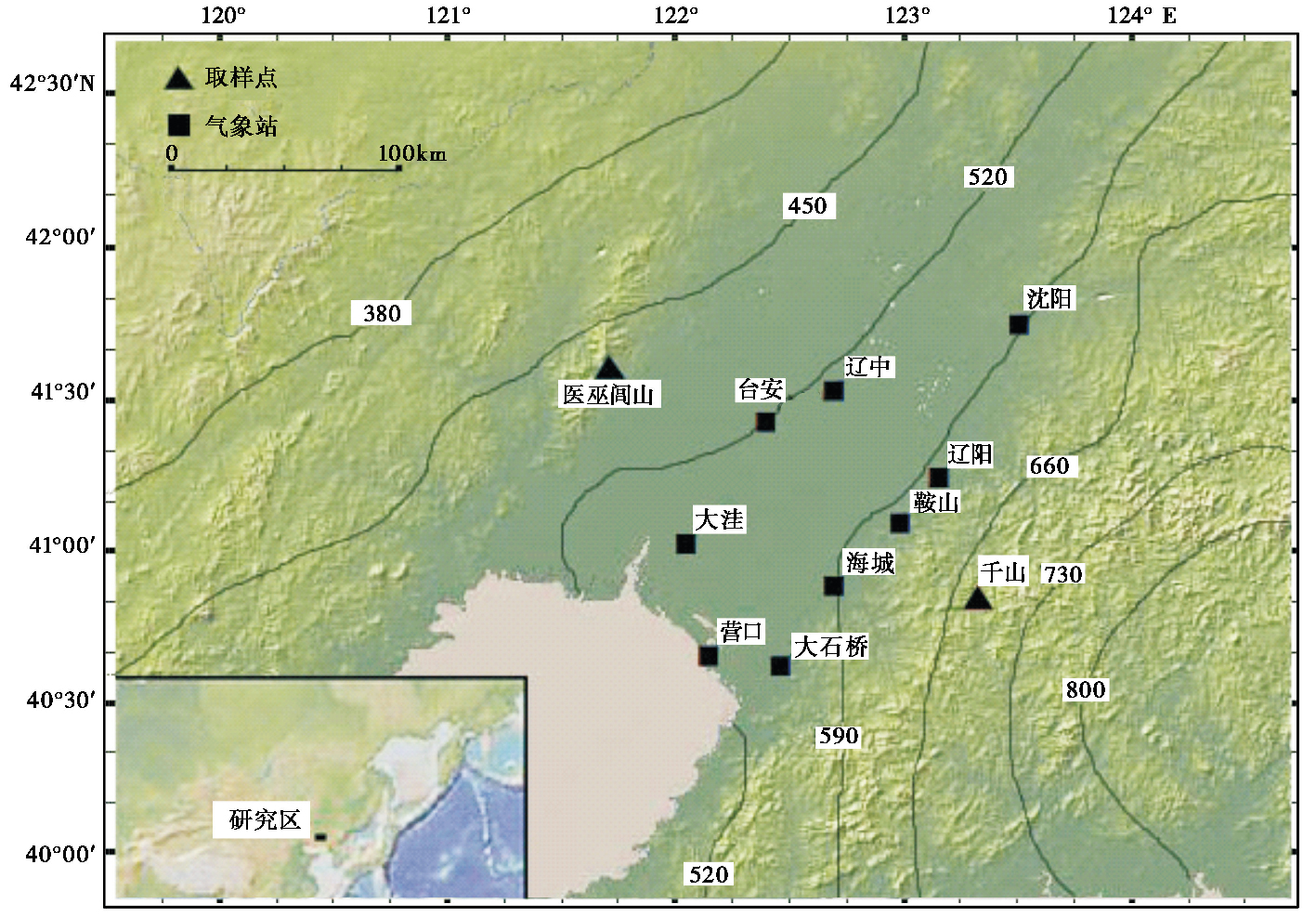
1 资料与方法 1.1 研究区概况辽河平原为辽河的冲积平原(图 1),贯穿辽宁省,作为我国东北平原一部分位于其南部,其夹于辽宁省东部丘陵和西部丘陵之间,南至辽东湾。该区域属温带大陆性季风气候,冬季寒冷干燥,夏季暖热多雨。雨热同期,日照充足。冬季春季多大风。植物区系处于华北、 长白、 内蒙古3个植物区系的交汇地带[29],植物种类较丰富。油松(Pinus tabulaeformis)、 蒙古栎(Quercus mongolica)组成的森林群落在平原东西两侧的丘陵山地广泛分布[30]。
|
图 1 研究区采样点和气象站分布位置 ▲代表树木年轮采样点,■代表气象站点,黑色细线为该地区等雨线(mm) Fig. 1 Location of sampling sites and meteorological stations,black triangle indicates tree ring sampling sites, black square indicates location of meteorological stations,black curves are isohyets |
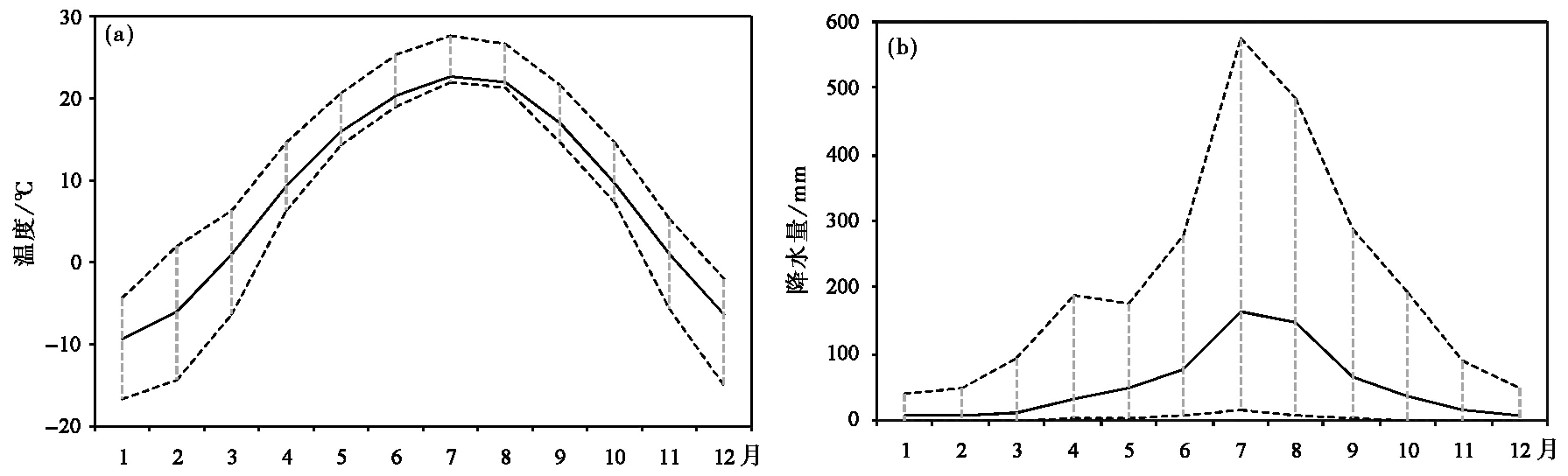
气象数据来自辽河平原南部辽宁省域内的9个气象站(图 1)记录的月平均气温和月降水量。由于各站点的气象记录有着高度的同质性,如各站月均温之间和月降水量之间极显著相关(r月均温=0.481-0.995,r月降水量=0.418-0.977,p<0.01),为了反映研究区气候变化的区域特点,同时降低或消除由于单个站点的记录数据造成的随机性差异,本文将研究区内所有9个站点的记录数据进行平均,进而获得区域月平均温度和月降水量数据(图 2)。其中,1951~1954年间包含3个气象站(沈阳站、 鞍山站和营口站)的记录,1955年增为4个气象站(增大洼站),1956年为5站(增辽阳站),1957年为7站(增辽中站和台安站),1958年为8站(增海城站),1959年为9站(增大石桥站)。
|
图 2 研究区内9个气象站1951~2010年月平均温度(a)和月降水量(b)的平均值(实线)及其最大、 最小值(虚线) Fig. 2 Annual variation of the mean value(solid curve)of monthly temperature (a) and precipitation (b) records from 9 selected meteorological stations,and the maximum and minimum monthly records(dot curve)from 9 selected meteorological stations |
东亚夏季风数据源自文献[31],东亚冬季风数据源自文献[32]; 帕尔默干湿指数(Palmer Drought Severity Index,简称PDSI)来源于CRU全球 0.5°×0.5°格点数据(40.0°~41.5°N,123°~124°E); 空间相关分析由KNMI Climate Explorer(http//www.knmi.nl)实现,比较数据为 CRU TS 3.22 全球 0.5°×0.5°格点降水量数据; 谱分析由MTM(Multi-Taper Method)方法[33]实现。
1.3 树木年轮样本采集与年表建立按照传统的树木年代学理论与技术[4, 34, 35],选择位于辽河平原东西两侧的千山和医巫闾山(见图 1)保护区进行油松的树木年代学取样。千山(简称QS: 41°11′23″N, 123°08′01″E; 平均海拔520m)属于半湿润地区,植被茂密,水分充足; 医巫闾山(简称LS: 41°36′35″N, 121°41′42″E; 平均海拔415m)属于半干旱地区,相对千山植被较少,较为干旱,降水均集中在6月、 7月和8月份。为了避免人为及其他非气候因素对树木生长产生的影响,选择远离有人为活动的地方进行取样。两个采样点都采用生长锥钻取树芯获得年轮样本,每树1~3芯,共计126株树(千山70株; 医巫闾山56株),233个样芯(千山136个; 医巫闾山97个),装入定制的塑料管中带回实验室。
将样本粘贴固定并自然晾干,用不同目数砂纸由粗到细逐级打磨至看到清晰年轮[36],然后借助体式显微镜对样本进行交叉定年,保证所有样本年代真实可靠。利用精度为0.01mm的LINTAB5年轮测量分析系统测得全部样本的年轮宽度序列,使用COFECHA程序[34]进行交叉定年检验和数据质量控制,并剔除个别存在生长突变或与主序列相关性较低的样芯。通过ARSTAN程序[37],用负指数、 线性函数或者根据样本实际情况采用样条函数(步长选用样本 2/3 左右长度)拟合出每个样芯的生长趋势,消除非气候因素和树木自身生长趋势。最终建立辽河平原中南部两个采样点油松树轮宽度的3种形式共计6个年表,包括标准化年表(STD)、 差值年表(RES)和自回归年表(ARS)。通过对各年表的比较,STD年表含有比较丰富的气候信息,因此本文重点讨论该类年表与气候因子的关系。
2 结果与分析 2.1 区域气候变化与年表统计特点研究区暖干化趋势明显,如年平均温度以0.22℃/10年(p<0.01)的速率显著升高,其中春季温度的增加趋势较为明显,达到0.31℃/10年(p<0.01),而夏季温度则未表现出显著的上升趋势。区域年降水量总体下降不显著(-13.5mm/10年),全年降水主要集中在4~10月份。
年表统计量特征(表 1)可反映树木生长的基本特征以及年表含有不同频率信息量的多少。平均敏感度(Mean Sensitivity,简称MS)是表现年表质量的重要指标,通常样本的平均敏感度在0.15~0.80之间,则表明年表较优,并且平均敏感度越大则说明树木对气候变化更为敏感[4, 35],而标准差是反映树木年轮指数变化幅度的一个统计参数,一般平均敏感度大的年表,标准差也大,对气候的变化也较为敏感。研究区两个采样点的STD年表的平均敏感度分别是0.242和0.230,均在可接受水平。两个采样点一阶自相关系数分别为0.636和0.484,这表明上一年气候对当年树木生长的影响强度较大。本研究中以两个样点年表的样本总体代表性(Expressed Population Signal,简称EPS)大于0.85起始年至今作为年表可接受时段[38],结果表明千山为1774~2010年,医巫闾山为1828~2010年为有效时段,可以认为样本在此时段能够代表该研究区油松树木的总体生长情况,并适用于和气候因子的相关性分析。

|
表 1 两个采样点标准化年表统计参数 Table 1 Statistics of the standard(STD) chronologies in two sampling sites |
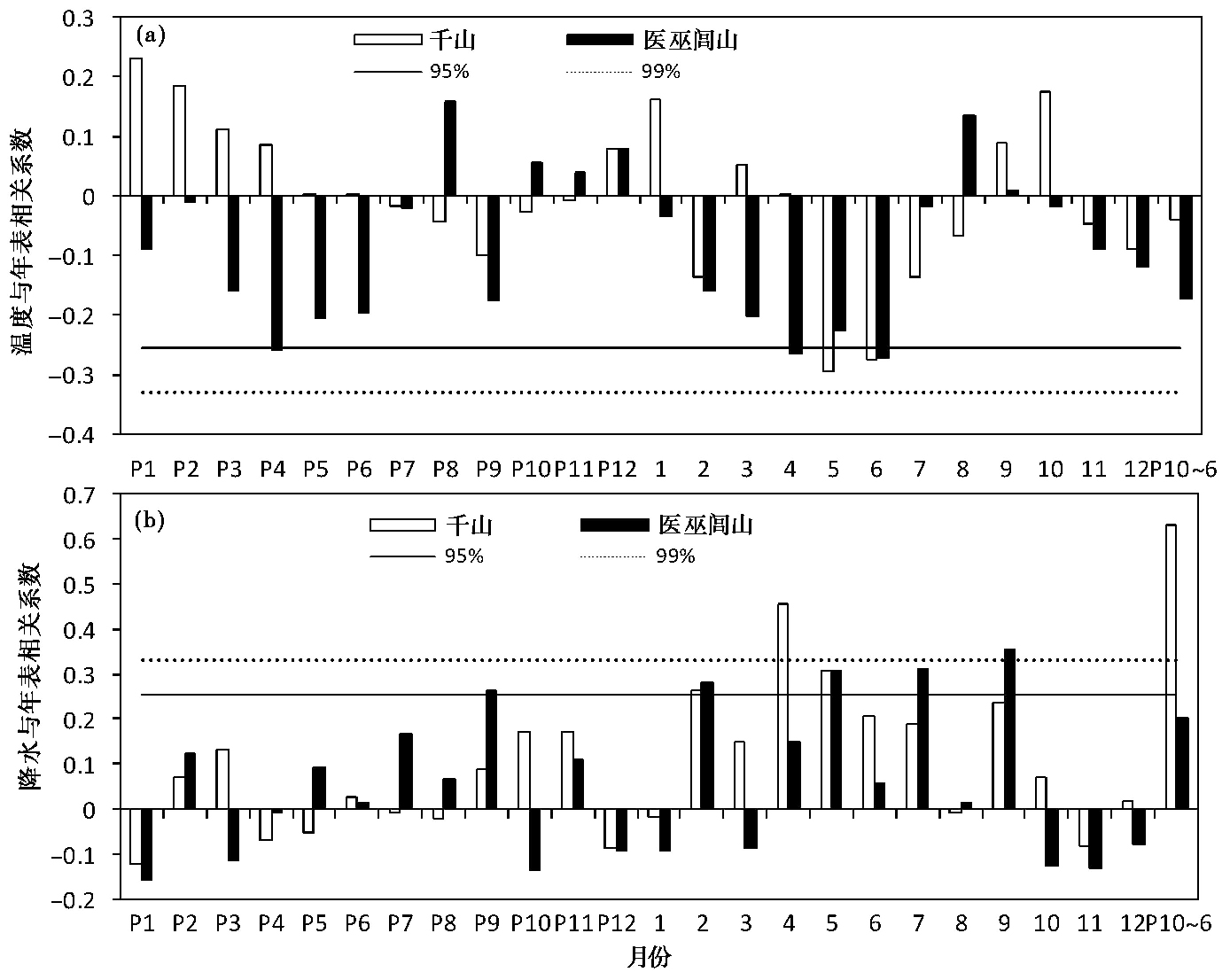
相关分析表明,两个采样点油松的生长与当年春季和夏季温度呈负相关(图 3a),且千山地区树木生长与5月、 6月份温度显著负相关(p<0.05),医巫闾山4月和6月份温度与树木生长呈显著负相关(p<0.05)。与温度相比,降水对该地区树木生长的影响较显著(图 3b),千山油松年轮宽度变化与当年2月、 4月和5月份降水量变化呈显著正相关(p<0.05),其中与4月份降水达到极显著水平(p<0.01)。医巫闾山油松年轮宽度与上一年9月和当年2月、 5月、 7月、 9月份降水显著正相关(p<0.05),其中与当年9月份降水达极显著水平(p<0.01)。气候对树木的影响具有持续性,阶段性气候要素的平均值比单月气候要素对树木的影响更明显,如上一年10月至当年6月的降水量与千山标准化年表相关性较好(r=0.631,p<0.01),医巫闾山年表与此时段降水相关较低。
|
图 3 油松树木年轮宽度与区域月平均温度(a)和月降水量(b)之间的相关关系 Fig. 3 Correlation between Chinese pine tree ring width index and monthly mean temperature(a),monthly precipitation(b) |
另外,还分析了帕尔默干湿指数(PDSI)对该地区树木生长的影响,结果显示千山和医巫闾山两个采样点年表与上一年10月至当年6月PDSI指数的相关系数分别为0.438和0.499(p<0.01),均低于降水量在此时段对树木的影响。千山油松年轮宽度指数与上年11月至当年7月各月PDSI均呈极显著正相关(r=0.340-0.480,p<0.01),医巫闾山油松年轮宽度指数与上一年9月至当年9月各月PDSI指数均呈极显著正相关(r=0.340-0.560,p<0.01)。
2.3 降水重建根据油松年轮宽度指数与不同月份组合降水量的相关关系,利用线性逐步回归方法,建立两地油松年轮宽度指数与研究区不同月份组合降水量之间的变化关系模型。在所有的重建模型中,所测试的上年10月至当年6月模型的降水量变化具有最好的解释(r=0.632,R2=0.399(解释变化的39.9%),R2adj=0.377,F=18.6,n=59,p<0.0001,模型(1))。在此时段(10~6月)重建的模型中,医巫闾山年轮宽度指数在模型中的标准系数较低,为0.026,另外,在不考虑医巫闾山年轮宽度对模型的贡献的情况下,重建模型仍可以很好的解释研究区10~6月的降水量变化(r=0.631,R2=0.398(解释变化的39.8%),R2adj=0.387,F=37.7,n=59,p<0.0001,模型(2)),而且调整后的方差解释量变化很小,模型F检验的稳定性也要好于前者。另外,模型对于10~6月PDSI重建(r=0.580,R2=0.336,R2adj=0.312,F=14.17,n=59,p<0.0001)也超过30%的变化解释,但低于对同期降水的重建(模型1和2),不过这进一步证实了该重建时段气候对树木生长的重要影响。为了易于统计对比和方便讨论生长季前期水分对树木的影响,以下讨论主要基于模型(2)的重建结果:
(1)Pt=135.408×qsIt+4.945×lsIt+137.782
(2)Pt=137.004×qsIt+140.738
模型(1)和(2)分别代表千山与医巫闾山共同重建模型和千山单点重建模型,Pt为第t年降水量(mm),qsIt为千山第t年年轮宽度标准年表指数(无量纲),lsIt为医巫闾山第t年年轮宽度标准年表指数(无量纲)。
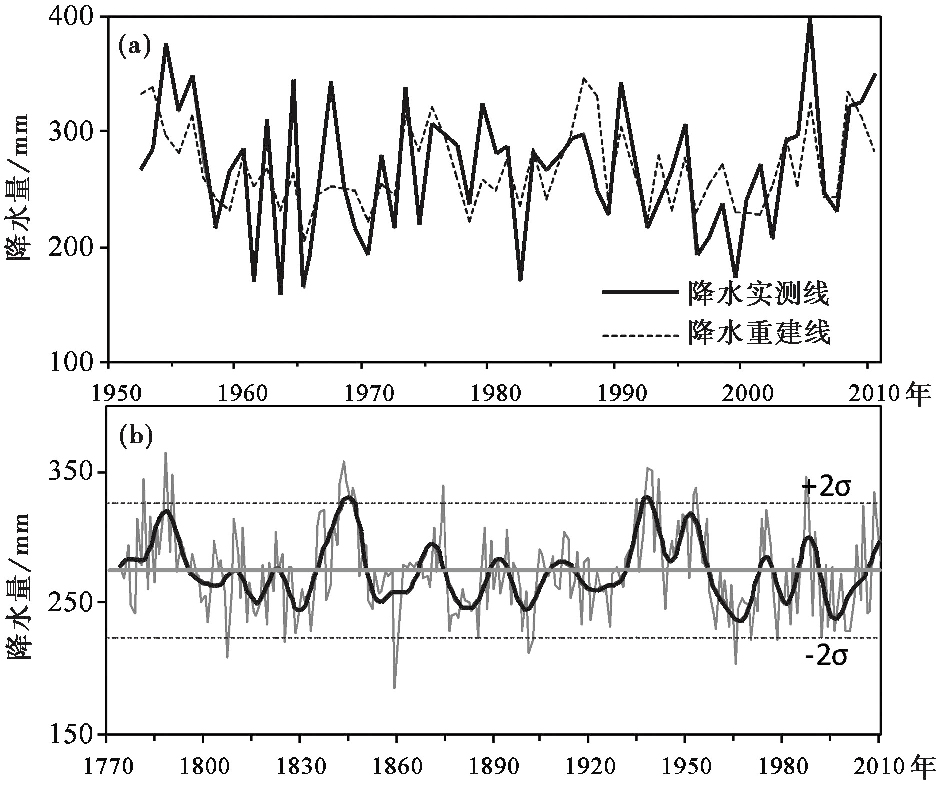
降水重建值与实测值在校准期内一致性非常好(图 4a)。为了检验模型的稳定性和可靠性,本文采用“交叉检验法”[39],通过计算误差缩减值(Reduction of Error Statistic,简称RE)和有效系数(Coefficient of Efficiency Statistic,简称CE)等指标对重建方程进行交叉检验(表 2)。误差缩减值与有效系数都为正且远大于零,证实了重建方程的可靠性。
|
图 4 降水重建值与实测值在校准期内(1952~2010年)的对比(a)和重建的1774~2010年10~6月降水量(细实线)及其11年低通滤波值(粗实线)(b) Fig. 4 Comparison between the actual and reconstructed October-June precipitation during the calibration period of 1952~2010 (a) and the reconstructed October-June precipitation (thin solid curve) and its 11-year low-pass filtered value (thick solid curve) during 1774~2010 (b) |
|
|
表 2 公共区间内重建结果的校准和验证统计 Table 2 Statistics of calibration and verification test results for the common periods |
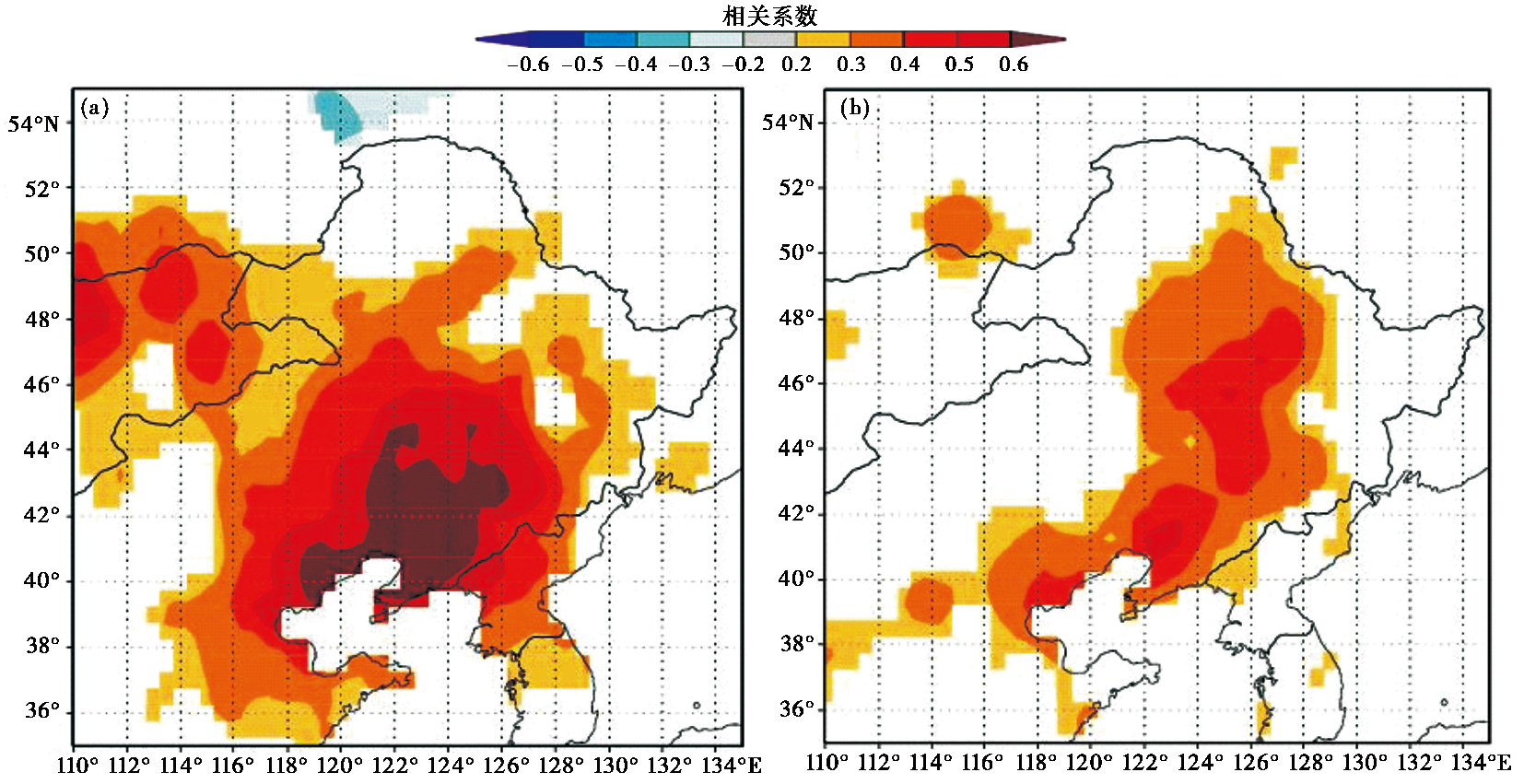
由图 4b可以看出辽河平原南部历史时期(1774~2010年)降水量变化波动较大,存在明显的干湿变化规律。以高于或低于1774~2010年间平均值两个标准差(2σ)定义湿润年份19个,干旱年份9个,其中最湿年份为1788年,最干年份为1859年。经11年低通滤波法后(图 4b粗黑实线),重建的降水序列分为11个相对湿润期,分别为1774~1795年、 1809~1810年、 1822~1823年、 1835~1850年、 1867~1874年、 1889~1894年、 1907~1914年、 1931~1956年、 1973~1976年、 1985~1991年和2006~2010年; 10个相对干旱期,分别为1796~1808年、 1811~1821年、 1824~1834年、 1851~1866年、 1875~1888年、 1895~1906年、 1915~1930年、 1957~1972年、 1977~1984年和1992~2005年。最长偏湿阶段是1931~1956年,持续26年,其前后均有16年的偏干期。空间相关结果显示,重建结果有一定的区域代表性(图 5)。
|
图 5 1951~2010年间实测(a)与重建结果(b)与CRU TS 3.22 0.5°×0.5°降雨量全球格点数据的空间相关关系 Fig. 5 Correlation patterns of actual (a) and reconstructed (b) rainfall with the concurrent CRU TS 3.22 0.5°×0.5° gridpoint rainfall over their overlapping periods(1951~2010) |
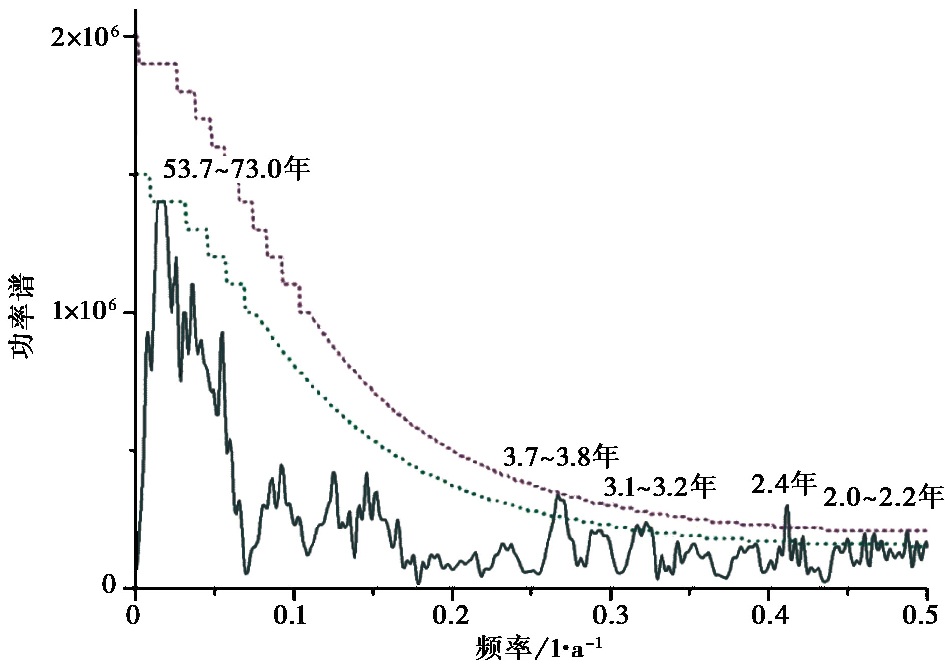
MTM谱分析结果显示(图 6),重建结果存在准2.0年、 2.1年、 2.2年、 2.4年、 3.1年、 3.2年、 3.7年和3.8年显著周期(p<0.05),其中准2.1年和准2.4年周期变化达极显著水平(p<0.01)。本研究还发现准53.7年、 56.5年、 59.9年、 63.7年、 68年和73年周期低频变化也达到显著水平(p<0.05)。
|
图 6 重建降水的MTM谱密度 图中标注的显著周期峰值(超过95%置信水平) Fig. 6 MTM spectral density of the precipitation reconstruction. The significant peaks are labeled(above 95% confidence level) |
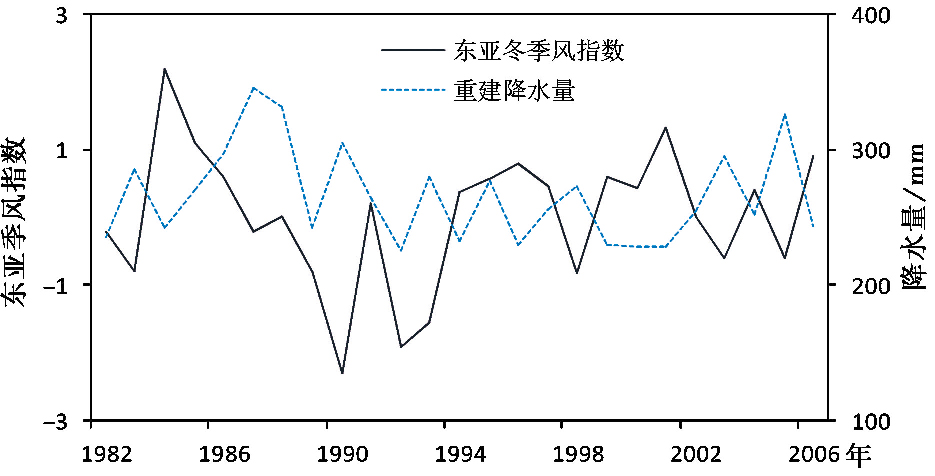
本研究结果与冬季风每年的变化基本呈反相位(图 7),东亚冬季风指数与重建时段10~6月份的降水变化表现为负相关,尤其是冬季风与该地区2~5月降水量表现为明显负相关,该时段降雨量占重建时段(10~6月份)降水的42%。重建10~6月份的降水与东亚夏季风的变化也有一定关联,如重建结果与上年8月份的东亚夏季风指数显著正相关(p<0.05)。 季风的强弱变化影响到该地区的干湿变化。
|
图 7 公共时段内(1982~2006)重建降水波动 与东亚冬季风变化[32]的对比 Fig. 7 Comparison of reconstructed precipitation varibility and East Asian winter monsoon change[32] during common period(1982~2006) |
研究区由东向西属于半湿润到半干旱气候过渡区(见图 1),树木在生长季内对区域水分变化较为敏感。上一个生长季后期的降水增加树木后期光合养分积累与水分储存,为树木当年生长储备了物质和能量,有利于树木生长[40],例如,医巫闾山树木年轮生长与上一年9月份降水呈显著正相关(p<0.05)(图 3b)。
冬季和春季降水可增加土壤水分含量,有利于下一个生长季树木形成层活动初期的水分代谢活动,促进树木年轮宽度的生长[40, 41]。两个采样点油松年轮生长与2月、 4月和5月降水[42]呈正相关关系(图 3b),根据本文采用的气象站数据做多年平均计算,得出该地区4月份多年平均温度为10.1℃,属于树木初期生长活跃阶段,树木要补充休眠期内损失的水分,恢复体内生理状况的平衡,所以,此时的降水对树木后期生长起到重要作用。冬季低温会造成树木针叶和根系等组织结构受损,使得来年树木生长受到影响[40, 41, 43]。夏季温度过高会增加树木代谢强度和叶片蒸腾速率,并加快根系土壤水分散失,影响树木对水分的利用,导致树木生长减慢[40, 41],在本文中表现为年表与5~8月温度呈负相关,其中与5月、 6月份达到显著负相关(p<0.05)(图 3a)。
另外,在公共区间内(1959~2010年),千山油松年轮宽度可以解释区域(研究区9个气象站的平均)41.4%的降水变化,高于区域内任何以它为变量重建的单站降水变化(25%~39.9%)。而且,对于研究区内单站降水变化的指示,随着降水梯度的增加而显著降低(p<0.05),即所采用的9个气象站中降水量越高的站点,利用年轮宽度重建的降水方差解释量就越小。这间接反映出研究区环境干湿条件的差异,影响树木对水分敏感性的空间格局特征。
3.2 区域干湿变化特点空间水平上,辽河平原从西向东(年)降水量逐渐增加,相差约200mm(见图 1)。重建时段10~6月的降水占年度(10~9月)降水量的36.2%,而且11月中下旬至2月基本以降雪的形式出现,以冰冻的形式存留,蒸发损失相对较小。在公共区间内,10~6月的降水量和日历年度(1~12月)的全年降水量变化存在一定关联(r实测=0.441,r重建=0.385,p<0.01),重建的降水变化含有一定的年际干湿变化信息。
由于样本量低、 树木年龄小等原因,可能导致早期(或起始阶段)的重建结果出现偏差,所以对比附近沈阳的重建结果[44],来检验第一个湿润期(1774~1795年)的可靠程度,结果证明这个时期应是较湿润的气候环境。
1951年至今,实测和重建的10~6月的降水均呈负趋势但不显著,重建结果显示这个时期的多年平均降水量低于240年来的平均水平。虽然近年的降水有所增加,但近10年的平均降水量仍低于过去240年的平均水平。1951~2010年间,该地区10~6月的平均温度上升了约2.2℃,使得10~6月的平均温度由原来的平均3.2℃左右升至平均5.5℃左右,较1950年升高了68.8%,升高速率为0.36℃/10年。 相比之下7~9月平均温度上升要少得多,约0.86℃,年均温升高约1.8℃。这就使得降水不增加的情况下,温度如此大幅度升高,已经驱使当地的干湿环境发生巨大的变化[45]。恰恰这个时期正是辽河平原干旱少雨的季节[45],温度过高,蒸发加大不利于雨、 雪的存留,导致春(研究区集中在4~6月)旱的几率增加。
近240年来的10~6月的降水变化,以高频变化最为显著,尤其是2~3年左右的周期(p<0.01),这与周边重建的降水结果一致[28, 44]。与以往的研究[28, 43]不同的是: 本研究存在50年以上(53.7~73.0年)的周期,这可能与热带太平洋ENSO准50~90年的周期波动有关[46],再加之ENSO主信号之一为准两年震荡(2.0~2.5年),暗示研究区的降水变化受ENSO作用的影响。在百年尺度上,19世纪要略干于20世纪,其中在50年尺度上,两个主要的干旱少雨期发生在19世纪,第一个起始于18世纪90年代末持续到19世纪30年代中期,第二个从19世纪50年代初一直延续到20世纪30年代,19世纪也是近2000年来干旱发生频次较高的时期之一[47],20世纪60年代至90年代的持续少雨导致的干旱要比前两者严重。本研究中年轮记录的其它年代际和年际的干湿变化,多数得到印证,如1875~1888干旱期,此期间发生清朝受灾面积最广、 持续时间最长、 对社会影响最为深刻的(旱)灾害——“丁戊奇荒”(1875~1879年)的连年大旱,以晋、 豫、 冀、 陕、 鲁为中心,辐射周边苏、 皖、 鄂、 川、 甘等地,该旱灾害还波及到朝鲜半岛[47]。另有最近研究表明维多利亚后期的大旱(1876~1878年)是与过去150年内最剧烈的一次ENSO有关事件[48]。说明本研究区的水分干湿变化受到明显的热带太平洋ENSO作用的影响。还有研究表明1876~1878年(清光绪二至四年)国内大范围地区遭受本次旱灾的影响,包括辽宁省大部分地区,此阶段位于11周太阳黑子数下降阶段和12周的极小年[49],说明该区域水分变化还可能与太阳黑子活动有密切关系。
3.3 季风变化对区域降水的影响研究区地处东亚季风区,降水变化具备典型的季风特色[50]。研究发现,东亚冬季风对重建时段(10~6月份)的降水表现为负作用,夏季风则表现为正相关。重建时段处在秋、 冬、 春三季,使得本研究结果与东亚冬、 夏季风的变化存在时间和物理影响上的关联:10月(中后期)是本研究区树木进入休眠期的开始,这一时期(秋季后期)该地区降水量随着东亚夏季风减弱逐步减少——降雨带由北向南移,夏季风在此区域的影响由南向北逐渐减弱消失,冬季风的影响逐渐增强。该休眠阶段直到第二年4月结束,这个时期(10~4月份)的降水/雪,对于树木的越冬和春季萌芽至关重要[41, 43],表现为水分变化与油松的径向生长正相关。总体上讲,该季节东亚冬季风盛行(由弱转强再转弱),冬季风使暖湿空气远离这一地区(南移)[32],也就不难理解冬季风与研究区降水和树木生长均为负相关关系的机制。5~6月份是该地区树木(春季)生长的关键期,对于水分的丰亏异常敏感[41]。此时季风影响也已由冬季风完全转变为夏季风[31],并且对降水的影响存在时间上的滞后性[31, 32],如8月份夏季风活动可以影响到其后几个月降水变化。所以在该地区夏季风的活动可以影响生长季前期(6月)、 后期(10月甚至11月)降水量的变化,从而影响到区域树木生长。综上所述,本地区的降水和树木生长与东亚季风的关系密切,夏季风强,降水量大,树木生长量大,冬季风强则降水量小,树木生长量也小。季风的强弱变化影响到该地区的干湿变化和森林生态系统的生物量动态。
4 结论本文研究了辽河平原南部油松生长与区域水热变化的关系,发现研究区温度和降水均对树木的生长有重要的作用。近半个世纪以来,该区域由温度持续升高引起的气候暖干化趋势明显,持续暖干化的气候变化对油松的生长不利,并可引起该地区油松的生长呈现出衰退的特征。
利用所建油松树木年轮宽度年表,采用逐步回归方法重建了辽河平原南部1774年以来降水变化。其中以10~6月的重建方程最好,可以解释该地区实际降水量的39.9%。基于10~6月降水的重建结果,我们讨论了在1774~2010年的过去约240年里,研究区经历的干、 湿气候变化: 研究区存在11个相对湿润期(1774~1795年、 1809~1810年、 1822~1823年、 1835~1850年、 1867~1874年、 1889~1894年、 1907~1914年、 1931~1956年、 1973~1976年、 1985~1991年和2006~2010年)和10个相对干旱期(1796~1808年、 1811~1821年、 1824~1834年、 1851~1866年、 1875~1888年、 1895~1906年、 1915~1930年、 1957~1972年、 1977~1984年和1992~2005年),其中最湿润年份是1788年,最干旱年份是1859年。
MTM谱分析显示,该地区降水以高频变化为主,存在准2.0~2.2年、 2.4年、 3.1~3.2年和3.7~3.8年的显著周期(p<0.05),其中准2.1年和准2.4年的周期达到极显著水平(p<0.01),可能与ENSO主信号之一,准两年震荡(2.0~2.5年)有关,重建降水序列的50~70年左右的准周期可能与热带太平洋ENSO准50~90年的周期波动有关,这些都暗示研究区的降水变化受ENSO作用的影响。
研究区10~6月的降水受东亚季风的影响,东亚冬季风强或夏季风弱,降水量均少,东亚冬季风弱或夏季风强,降水量则偏多。
| 1 | 秦大河, 陈振林, 罗 勇等. 气候变化科学的最新认知. 气候变化研究进展, 2007,3 (2):63~73 Qin Dahe, Chen Zhenlin, Luo Yong et al. Updated understanding of climate change sciences. Advances in Climate Change Research, 2007,3 (2):63~73 |
| 2 | 孙凤华, 任国玉, 赵春雨等. 中国东北地区及不同典型下垫面的气温异常变化分析. 地理科学, 2005,25 (2):167~171 Sun Fenghua, Ren Guoyu, Zhao Chunyu et al. An analysis of temperature abnormal change in Northeast China and type underlying surface. Scientia Geographica Sinica, 2005,25 (2):167~171 |
| 3 | 赵春雨, 曲晓波, 王 颖等. 辽宁气候变化及若干气象灾害的事实分析. 灾害学, 2008,22 (4):77~80 Zhao Chunyu, Qu Xiaobo, Wang Ying et al. Analysis on the climate change and some meteorologica disasters in Liaoning Province in 1961~2005. Journal of Catastrophology, 2008,22 (4):77~80 |
| 4 | Fritts H C. Tree Rings and Climate. London:Academic Press, 1976. 1~567 |
| 5 | Steinman B A, Abbott M B, Mann M E et al.1500 year quantitative reconstruction of winter precipitation in the Pacific Northwest. Proceedings of the National Academy of Sciences of the United States of America, 2012,109 (29):11619~11623 |
| 6 | Cook E R, Seager R, Cane M A et al. North American drought:Reconstructions, causes, and consequences. Earth-Science Reviews, 2007,81 (1):93~134 |
| 7 | Zhang Y, Tian Q H, Gou X H et al. Annual precipitation reconstruction since AD 775 based on tree rings from the Qilian Mountains, Northwestern China. International Journal of Climatology, 2011,31 (3):371~381 |
| 8 | 马 龙, 刘廷玺, 冀鸿兰等. 科尔沁沙地1826年以来榆树树轮宽度年表的建立及降水重建. 第四纪研究, 2011,31 (2):360~369 Ma Long, Liu Tinxi, Ji Honglan et al. Establishment of ring width chronogy and rainfall reconstruction of Ulmus pumila L. in Horqin sandy land since 1826. Quaternary Sciences, 2011,31 (2):360~369 |
| 9 | Chen Z J, Zhang X L, Cui M X et al. Tree-ring based precipitation reconstruction for the forest-steppe ecotone in northern Inner Mongolia, China and its linkages to the Pacific Ocean variability. Global and Planetary Change, 2012, 86~87 :45~56 |
| 10 | Zhang X L, He X Y, Li J B et al. Temperature reconstruction(1750~2008)from Dahurian larch tree-rings in an area subject to permafrost in Inner Mongolia, Northeast China. Climate Research, 2011, 47 (3):151~159 |
| 11 | Liu Yu, Wang Caiyong, Hao Wenju et al. Tree-ring-based annual precipitation reconstruction in Kalaqin, Inner Mongolia for the last 238 years. Chinese Science Bulletin, 2011,56 (28~29):2995~3002 |
| 12 | 戴君虎, 邵雪梅, 崔海亭等. 太白山树木年轮宽度资料对过去生态气候要素的重建. 第四纪研究, 2003,23 (4):428~435 Dai Junhu, Shao Xuemei, Cui Haiting et al. Reconstruction of past eco-climate by tree-ring width index of Larix chinensis on Mt. Taibai. Quaternary Sciences, 2003,23 (4):428~435 |
| 13 | Li Z S, Zhang Q B, Ma K. Tree-ring reconstruction of summer temperature for AD 1475~2003 in the central Hengduan Mountains, northwestern Yunnan, China. Climatic Change, 2012, 110 (1~2):455~467 |
| 14 | Liang E Y, Shao X M, Qin N S. Tree-ring based summer temperature reconstruction for the source region of the Yangtze River on the Tibetan Plateau. Global and Planetary Change, 2008,61 (3):313~320 |
| 15 | Fan Z X, Bräuning A, Yang B et al. Tree ring density-based summer temperature reconstruction for the central Hengduan Mountains in Southern China. Global and Planetary Change, 2009,65 (1):1~11 |
| 16 | Zhu Haifeng, Zheng Yonghong, Shao Xuemei et al. Millennial temperature reconstruction based on tree-ring widths of Qilian Juniper from Wulan, Qinghai Province, China. Chinese Science Bulletin, 2008,53 (24):3914~3920 |
| 17 | Liu Y, Tian H, Song H M et al. Tree ring precipitation reconstruction in the Chifeng Weichang region, China, and East Asian summer monsoon variation since A.D. 1777. Journal of Geophysical Research:Atmospheres(1984~2012), 2010,115 (D06103):1~9 |
| 18 | 李宗善, 刘国华, 傅伯杰等. 利用树木年轮宽度资料重建川西米亚罗地区过去200年夏季温度的变化. 第四纪研究, 2011,31 (3):522~534 Li Zongshan, Liu Guohua, Fu Bojie et al. Tree ring-based summer temperature reconstruction over the past 200 years in Miyaluo of western Sichuan, China. Quaternary Sciences, 2011,31 (3):522~534 |
| 19 | 刘昶智, 勾晓华, 方克艳等. 甘肃南部公元1824年以来降水重建. 第四纪研究, 2013,33 (3):518~525 Liu Changzhi, Gou Xiaohua, Fang Keyan et al. Precipitation reconstruction in southern Gansu Province since A.D. 1824. Quaternary Sciences, 2013,33 (3):518~525 |
| 20 | 张同文, 刘 禹, 袁玉江等. 利用树轮资料重建天山中段南坡巩乃斯地区公元1777年来平均最高气温变化. 第四纪研究, 2011,31 (6):1011~1021 Zhang Tongwen, Liu Yu, Yuan Yujiang et al. Tree ring based mean maximum temperature reconstruction for the Gongnaisi region on the southern slope of the central Tienshan Mountain, China since A.D. 1777. Quaternary Sciences, 2011,31 (6):1011~1021 |
| 21 | 袁玉江, 魏文寿, 陈 峰等. 天山北坡乌鲁木齐河年径流总量的树轮重建. 第四纪研究, 2013,33 (3):501~510 Yuan Yujiang, Wei Wenshou, Chen Feng et al. Tree-ring reconstruction of annual total runoff for the Ürümqi River on the northern slope of Tien Shan Mountains. Quaternary Sciences, 2013,33 (3):501~510 |
| 22 | 杨 保. 树轮记录的小冰期以来青藏高原气候变化的时空特征. 第四纪研究, 2012,32 (1):81~94 Yang Bao. Spatial and temporal patterns of climate variations over the Tibetan Plateau during the period 1300~2010. Quaternary Sciences, 2012,32 (1):81~94 |
| 23 | 刘晶晶, 杨 保. 西藏浪卡子地区树轮宽度特征值年表的建立. 第四纪研究, 2014,34 (6):1280~1287 Liu Jingjing, Yang Bao. Development of a tree-ring-width chronology using the Eigen analysis method in Langkazi regions of Tibet. Quaternary Sciences, 2014,34 (6):1280~1287 |
| 24 | 任军莉, 刘 禹, 宋慧明等. 甘肃临夏地区过去195年最高温度历史重建——基于紫果云杉树轮宽度资料. 第四纪研究, 2014,34 (6):1270~1279 Ren Junli, Liu Yu, Song Huiming et al. The historical reconstruction of the maximum temperature over the past 195 years, Linxia region, Gansu Province——Based on the data from Picea purpureaMast. Quaternary Sciences, 2014,34 (6):1270~1279 |
| 25 | Liu Y, Bao G, Song H M et al. Precipitation reconstruction from Hailar pine(Pinus sylvestris var. mongolica)tree rings in the Hailar region, Inner Mongolia, China back to 1865 AD. Palaeogeography, Palaeoclimatology, Palaeoecology, 2009, 282 (1):81~87 |
| 26 | Zhu H F, Fang X Q, Shao X M et al. Tree ring-based February-April temperature reconstruction for Changbai Mountain in Northeast China and its implication for East Asian winter monsoon. Climate of the Past, 2009,5 (4):661~666 |
| 27 | Chen Z J, Zhang X L, He X Y et al. Extension of summer(June-August)temperature records for northern Inner Mongolia(1715~2008), China using tree rings. Quaternary International, 2013, 283 :21~29 |
| 28 | Peng J J, Sun Y, Chen M et al. Tree-ring based precipitation variability since AD 1828 in northwestern Liaoning, China. Quaternary International, 2013, 283 :63~71 |
| 29 | Wu Zhengying, Wu Sugong. A proposal for a new Floristic Kingdom(realm)——The E. Asiatic kingdom, its delineation and characteristics. In:Zhang Auluo, Wu Sugong eds. Floristic Characteristics and Diversity of East Asian Plants. Beijing:China Higher Education Press, 1998. 3~42 |
| 30 | 李书心. 辽宁植物志. 沈阳: 辽宁科学技术出版社, 1992. 1~1245 Li Shuxin. Flora of Liaoning. Shenyang:Science and Technology Press of Liaoning, 1992. 1~1245 |
| 31 | Li J P, Zeng Q C. A unified monsoon index. Geophysical Research Letters, 2002,29 (8):111~115 |
| 32 | Li Y Q, Yang S. A dynamical index for the East Asian winter monsoon. Journal of Climate, 2010,23 (15):4255~4262 |
| 33 | Mann M E, Lees J M. Robust estimation of background noise and signal detection in climatic time series. Climatic Change, 1996,33 (3):409~445 |
| 34 | Holmes R L. Computer-assisted quality control in tree-ring dating and measurement. Tree-Ring Bulletin, 1983,43 (1):69~78 |
| 35 | Cook E R. A Time Series Analysis Approach to Tree Ring Standardization(Dendrochronology, Forestry, Dendroclimatology, Autoregressive Process). Tucson, USA:University of Arizona Press, 1985. 1~171 |
| 36 | Stokes M A, Smiley T L. An Introduction to Tree-Ring Dating. Tucson, USA:University of Arizona Press, 1968. 15~15 |
| 37 | Cook E R, Holmes R L. Users manual for program ARSTAN. Laboratory of Tree-Ring Research, Tucson, USA:University of Arizona Press, 1986. 50~65 |
| 38 | Wigley T M, Briffa K R, Jones P D. On the average value of correlated time series, with applications in dendroclimatology and hydrometeorology. Journal of Climate and Applied Meteorology, 1984,23 (2):201~213 |
| 39 | Meko D, Graybill D A. Tree-ring reconstruction of upper Gila River discharge. Water Resources Bulletin, 1995,31 (4):605~616 |
| 40 | Kozlowski T T. Growth and Development of Trees:Vol.Ⅱ:Cambial Growth, Root Growth, and Reproductive Growth. London:Academic Press, 1971. 1~435 |
| 41 | Chen Zhenju, Sun Yu, He Xingyuan et al. Chinese pine tree ring width chronology and its relation to climate conditions in the Qianshan Mountains. Frontiers of Forestry in China, 2008,3 (4):381~392 |
| 42 | 李广起, 白 帆, 桑卫国. 长白山红松和鱼鳞云杉在分布上限的径向生长对气候变暖的不同响应. 植物生态学报, 2011,35 (5):500~511 Li Guangqi, Bai Fan, Sang Weiguo. Different responses of radial growth to climate warming in Pinus koraiensis and Picea jezoensis var. komarovii at their upper elevational limits in Changbai Mountain, China. Chinese Journal of Plant Ecology, 2011,35 (5):500~511 |
| 43 | Chen Z J, Zhang X L, He X Y et al. Response of radial growth to warming and CO2 enrichment in southern Northeast China:A case of Pinus tabulaeformis. Climatic Change, 2015, 130 :559~571 |
| 44 | Chen Z J, He X Y, Cook E R et al. Detecting dryness and wetness signals from tree-rings in Shenyang, Northeast China. Palaeogeography, Palaeoclimatology, Palaeoecology, 2011, 302 (3):301~310 |
| 45 | 中国气象局沈阳区域气象中心.《东北气候变化公报》第一期, 2006-12-1, 15:00:44(http://www.lnmb.gov. cn/sy_news_content.asp?ID=2787) Shenyang Regional Meteorological Center of Chinese Meteorological Bureau. The First Issue of 《Northeast climate change report》, 2006-12-1, 15:00:44(http://www.lnmb.gov.cn/sy_news_content.asp?ID=2787)(http://www.lnmb.gov. cn/sy_news_content.asp?ID=2787) |
| 46 | Li J B, Xie S P, Cook E R et al. Interdecadal modulation of El Niño amplitude during the past millennium. Nature Climate Change, 2011,1 (2):114~118 |
| 47 | 葛全胜. 中国历朝气候变化. 北京: 科学出版社, 2011. 1~709 Ge Quansheng. Climate Change in the Past Dynasties of China. Beijing:Science Press, 2011. 1~709 |
| 48 | Cook E R, Anchukaitis K J, Buckley B M et al. Asian monsoon failure and megadrought during the last millennium. Science, 2010,328 (5977):486~489 |
| 49 | 张德二, 梁有叶. 1876~1878 年中国大范围持续干旱事件. 气候变化研究进展, 2010,6 (2):106~112 Zhang De'er, Liang Youye. A long lasting extensive drought event over China during 1876~1878. Advances in Climate Change Research, 2010,6 (2):106~112 |
| 50 | Xiong Kaigao, Feng Guolin, Huang Jianping et al. Analogue-dynamical prediction of monsoon precipitation in Northeast China based on dynamic and optimal configuration of multiple predictors. Acta Meteorologica Sinica, 2011,25 (3):316~326 |
Abstract
The study area is in the southern part of Liaohe-River plain, which has a temperate continental monsoon climate: it is cold and dry in winter, and warm and wet in summer.
According to the technology of dendrochronology, a total of 233 cores(1 to 3 cores per tree)were taken from 126 Pinus tabulaeformis trees from two sites:Qianshan(41°11'23"N, 123°08'01"E; 520m a.s.l.; 70 trees/136 cores), which belongs to semi-humid region with exuberant vegetation), and Lüshan(41°36'35"N, 121°41'42"E; 415m a.s.l.; 56 trees/97 cores)is located at a semi-arid area with less vegetation as compared to Qianshan. The crossdating was checked using COFECHA after dried, mounted, surface sanded, corssdated and ring width measured(with a precision of 0.01mm)process. Using the program ARSTAN, three kinds of chronologies(Standard chronology, STD, Residual chronology, RES, and ARSTAN chronology, ARS)of two sites were developed respectively. The regional climate data developed by using the arithmetical average of climatic data from 9 meteorological stations record the monthly mean temperature and precipitation near the sampling sites.
Correlation analysis shows that the radial growth from two sites negatively correlate to the spring and summer temperatures. Compared to the temperature, precipitation has more significant effects on the pine's radial growth. Specifically, tree ring from Qianshan has positive correlations with precipitation in February, May(p <0.05), and in April(p <0.01). Tree ring from Lüshan positively correlated to the precipitation in previous September and current February, May and July(p <0.05), especially in current September(p <0.01).
The October-June precipitation since 1774 was reconstructed using Chinese pine tree rings to explore regional moisture variations in southern Liaohe river plain. The reconstruction can explain 39.9% of the total variance of actual records. The reconstruction shows eleven persistent wet periods:1774~17951809~18101822~18231835~18501867~18741889~18941907~19141931~19561973~19761985~1991, and 2006~2010, and ten persistent dry periods:1796~18081811~18211824~18341851~18661875~18881895~19061915~19301957~19721977~1984, and 1992~2005, during the past 240 years. The wettest year is 1788, and the driest year is 1859. The variation of the reconstructed precipitation is mainly at high frequency level, and its cycles at ca.2.0~2.2-year, 2.4-year, 3.1~3.2-year, and 3.7~3.8-year are significant(p <0.05), of which ca.2.1-year and 2.4-year reach a extremely significant level(p <0.01). Also, the reconstruction has ca.50~70-year cycles(p <0.05).
The October-June precipitation is influenced by the East Asian monsoon. The strong East Asian winter monsoon or the weak East Asian summer monsoon indicates less regional precipitation, and the weak East Asian winter monsoon or the strong East Asian summer monsoon suggests more regional precipitation.