 2015, Vol.35


1 引言
在气候变暖的背景下,全球范围内气候变率增加,极端气候事件频发,比如,2009~2011年的冬季大范围的低温寒潮侵袭了北美与欧洲地区[1, 2, 3]。在中国亚热带地区,由于环流冷中心的南移[4],区域低温事件也时有发生,对当地农业生产活动与基础设施造成了严重的破坏[5, 6]。有研究还指出[4],在21世纪我国亚热带地区会比北方地区遭受更频繁的低温事件的侵袭。所以,区域温度的变化引起了广泛的关注[4, 5, 6, 7],同时针对引起低温事件的空间大尺度上的气候环流系统(如东亚冬季风、 北极涛动和西伯利亚高压)也已有广泛的报道[8, 9, 10, 11, 12, 13]。
但是由于器测气象资料时间太短,限制了我们对长时间尺度上的区域温度变化趋势、 低温事件发生频率及其驱动机制方面的研究。树轮因其定年准确、 分辨率高等特点已经被广泛应用于过去百年甚至是千年的温度重建的研究中[14, 15, 16, 17, 18, 19, 20, 21, 22, 23]。我国基于树轮资料的温度重建工作大多数集中在青藏高原以及北方的高寒地区[24, 25, 26, 27, 28, 29, 30, 31, 32, 33, 34],近年来在中国亚热带地区树轮气候学的研究得到越来越多的关注[6, 7, 35, 36, 37, 38]。Shi 等[36]利用浙江天目山的树轮宽度数据重建了区域过去150年冬季温度变化,并指出极端温度事件与东亚冬季风指数变化一致; Chen等[37, 38]利用福建长汀的树轮资料重建了区域过去150年来的冬季温度变化,发现区域暖冬对应于ENSO暖相位,而冷冬与火山活动密切相关; 另外,还利用福建永安的树轮年表反演了该地区过去200多年的夏秋季温度变化,指出区域温度序列包含很明显的亚太地区的温度信号; Shi 等[39]利用大别山的树轮资料重建了区域过去178年冬春季温度,发现过去50年增暖的速率是过去100多年来最快的; Duan等[7]基于我国东南地区的树轮资料网络重建了区域过去200多年的温度变率,发现1930s以后极端气候事件增多与西伯利亚高压活动有关。尽管如此,区域的树轮资料网络仍然比较稀疏,为了在中国亚热带地区研究大范围过去气候的变化,建立更多的树轮年表显得尤为必要。
本文基于神农架林区巴山冷杉(Abies fargesii Franch)建立了新的树轮宽度年表,恢复了研究区过去170多年来的冬春季温度变化,并探索区域历史上低温事件,以及造成低温事件的大气环流模式。
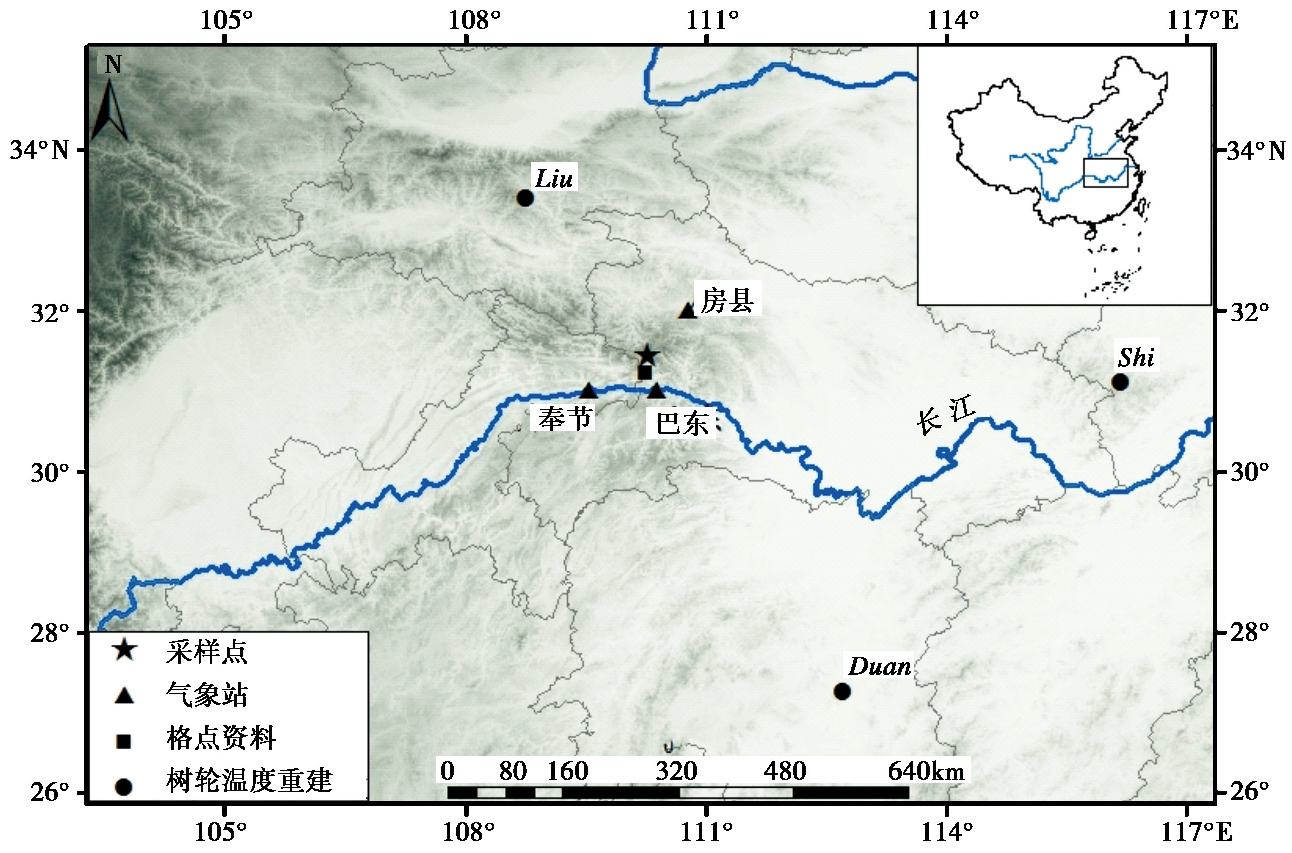
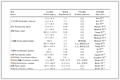
2 材料与方法 2.1 采样点概况与年表建立神农架林区位于湖北省西部边陲,主要受亚热带亚洲季风气候的影响,神农架被誉为“华中第一峰”。本文的两个树轮采样点相距较近,直线距离大约4km(图 1),一个采样点位于林区的“神农顶”(31°27′N, 110°16′E),一个位于“太子娅”(31°27′N,110°11′E),两个采样点都在林线位置,该位置树木的生长一般对于温度变化响应比较敏感[40]。我们在两个采样点共采集了59棵巴山冷杉活树的118个样芯,采样点海拔在2000m以上(表 1)。
|
图 1 树轮样点与气象资料及采样点附近CRU TS 3.2格点数据[41] 与其他树轮温度重建样点Duan等[6]、 Shi等[39]、 刘洪滨和邵雪梅[42]的地理位置分布图 Fig. 1 Map showing locations of the tree-ring sampling sites,the meteorological stations,the nearest climate grid point from CRU TS 3.2 dataset[41] and other tree-ring based temperature reconstructions nearby:Duan(the site from literature[6]), Shi(the site from literature[39]),Liu(the site from literature[42]) |
|
表 1 树轮采样点与气象站和CRU TS 3.2格点信息 Table 1 Statistics of the two tree-ring sampling sites, the meteorological stations and the climate grid point extracted from CRU TS 3.2 |
将样芯经过自然干燥后对其进行固定、 打磨处理与交叉定年,之后用分辨率为0.001mm的VELMEX树木年轮分析仪测量树轮样芯每一年轮的宽度值,并利用国际树木年轮库的软件程序COFECHA进行定年质量控制[43]。考虑到两个采样点相隔较近,且两个点的树轮年表相关系数较高(0.522,p<0.01),我们将两个样点的样芯合在一起,剔除部分生长异常的样芯后(神农顶12根样芯,太子娅8根样芯),用ARSTAN[44]程序对各样芯序列进行去趋势,大部分样芯用负指数曲线或者是线性回归曲线进行拟合,少数(8根)生长异常的样芯用步长为67%的样条函数进行拟合。去趋势后的树轮序列利用双权重平均法计算,最终得到标准化年表(STD)、 差值年表(RES)和自回归年表(ARS)。STD年表包含更多的低频信号,而RES年表则更多的表现出高频变化,ARS年表与STD年表比较类似。本文研究采用STD年表,如图 2所示,图中竖直虚线代表子样本信号强度(subsample signal strength,简称SSS)[45]等于0.85的样本量,最终确定的可靠年表时段为1842~2013年,共172年。序列样本量整体代表性(EPS)[45]比较高(图 2),说明我们的年表比较可靠。

|
图 2 神农架STD年表、 样本量和SSS (子样本信号强度)统计信息 Fig. 2 The standard chronology of Shennongjia, sample size and SSS(subsample signal strength) |
我们一开始选择了临近3个采样点的气象站房县、 巴东和奉节(见图 1和表 1),发现树木生长与这些气象站点记录的气候资料无显著相关。这可能是由于尽管这些气象站点离采样点较近,但是他们大多位于河谷或山谷地段,海拔在300~400m之间(表 1),并不能很好的代表样点处的气候状况。鉴于此,本研究的气象资料选择了样点附近的CRU TS 3.2格点数据(格点A、 B),其空间分辨率为 0.5°×0.5°[41],记录时段为1901~2013年。因为区域内大多数的器测气象资料开始于1950s,所以选择1958年以后的格点气象数据进行分析,并将两格点的气象数据进行了算数平均。将树轮宽度年表与平均格点气象资料月降水与月平均温度进行相关分析,探讨树轮年表记录的主要气候信号,并利用人工神经网络模型[46]探索不同季节间树轮气候响应的非线性模式,更加全面地理解区域树木生长与气候变化之间的关系。
此外,本文还利用NOAA/OAR/ESRL PSD(http://www.esrl.noaa. gov/psd/)的500hpa高度场(geopotential height)数据进行分析,简单探索区域低温事件的驱动机制。高度场格点数据的空间分辨率为2°×2°,时间尺度为1871~2010年。
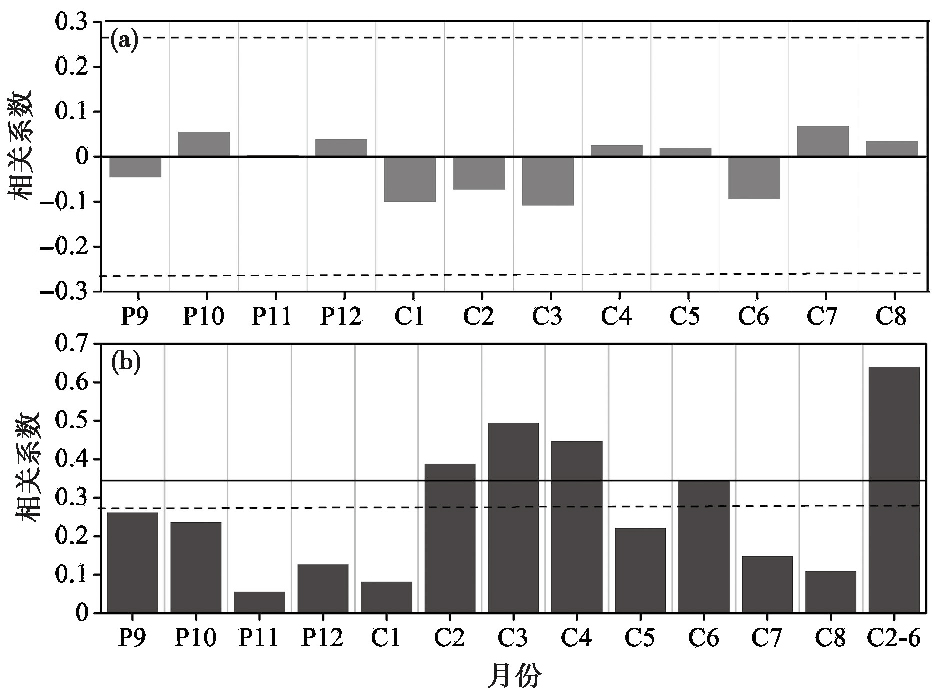
3 结果与讨论 3.1 树轮气候响应关系STD年表与上一年9月份至当年8月份的月降水与月平均温度相关分析发现(图 3),区域树木径向生长与降水量无显著的相关性,而与2月(0.387)、 3月(0.495)、 4月(0.477)和6月(0.358)的平均温度的相关性均达到了显著(p<0.01),与2~6月的平均温度的相关性最高,达到0.64(p<0.01),说明冬春季的温度变化是神农架地区高海拔地区巴山冷杉树木生长的主要限制气候因子。暖冬能够保护树木的根部不受到霜冻的伤害,同时在树木的叶片没有被冰冻时可以促进光合作用碳水化合物的形成进而有利于第二年形成层的活动[47]。春季温度的升高有利于树木早材细胞的分裂和增长[30, 36, 39],而早材是树木年轮的主要组成部分。类似的树轮温度响应模式在其他地区的针叶树研究中也有发现,例如秦岭山脉的东部和中部地区[47, 48, 49]、 中国东南地区[6, 36, 37, 38]、 东北的长白山地区[30]以及青藏高原的东部和东北部地区[26, 27]。
|
图 3 树轮与格点降水(a)和温度(b)的相关性分析, 公共时段为1958~2013年上年9月到当年8月 虚线和实线分别表示95%与99%置信线 Fig. 3 Correlations between tree-ring indices and precipita ̄tion (a) and temperature (b) records(extracted from CRU TS 3.2 dataset)from previous September to current August for the common period from 1958 to 2013. The dash and solid lines represent the corresponding 95% and 99% confidence level,respectively |
树轮年表与冬春季温度相关系数要高于其与单月份或单季节温度的相关系数,说明树木生长与单月份或单季节温度可能存在着非线性的响应关系。为了更好理解区域树轮温度响应关系,本文基于人工神经网络模型在不同的冬-春季温度组合条件下模拟树轮宽度指数(图 4)。为了减轻人工神经网络模型过程中的“过度拟合”现象[46],本文中仅使用冬季(2~3月)与春季(4~6月)的温度变化作为输入量来模拟区域树木生长。模拟发现,冬季与春季温度对树木生长的影响存在着“补偿效应”,即春(冬)季的高温可以缓解或抵消冬(春)季低温对树木生长的影响。研究还发现,树木生长与冬春季温度主要表现出线性响应关系,但这种线性关系会随着温度的增高或降低而逐渐减弱,而当温度超过一定阈值后,其对树木的生长几乎没有影响。这一现象与“生态幅”的概念类似,即每一种生物对每一种生态因子都有一个耐受范围,超过这一范围生物的生长就会受到抑制[46]。理论上在进行树轮气候重建的时候,去除极端年份会提高重建方程的解释量,但是这样做会导致重建的序列低估极端气候事件的强度,所以重建的时候应尽量包含时段内所有气象资料[46]。

|
图 4 基于人工神经网络模型在不同冬(2~3月份)-春 (4~6月份)季温度组合条件下模拟树轮宽度, 2~3月平均温度从4.5℃上升至11.5℃, 4~6月平均温度由17.5℃上升至21.5℃ Fig. 4 The artificial neural network simulated tree-ring width indices from winter(February-March)temperature increasing from 4.5℃ to 11.5℃associated with spring(April-June)temperature increasing from 17.5℃ to 21.5℃ |
在树轮气候响应分析的基础上,确立研究区2~6月平均气温(T2~6)与树轮标准宽度序列(STDt)之间的关系,其回归方程为

公式(1)中:T2~6为重建的2~6月平均气温,STDt为t年的STD年轮宽度指数。重建序列如图 5a所示,重建值与观测值之间有较好的一致性。

|
图 5 重建值与器测值之间的比较(a)和 1842~2013年神农架地区冬春季温度重建序列 与其10年低通滤波序列(粗实线)(b) Fig. 5 The comparisons between the instrumental and recon ̄structed February-June temperature (a) and the reconstructed winter-spring temperature (b) from 1842 to 2013 and the 10-year low passed data(heavy line) |
为了判断重建方程的稳定性与可靠性,我们选用传统的逐一剔除法对其进行检验,各统计结果见表 2。相关系数为(r)为0.64,方差解释量为(r2)为40.96%,F检验值为45.06,符号检验值S1与S2达到了95%的置信度,说明重建序列同实测序列在低频和高频上均比较吻合,乘积平均值(t)为5.22,超过了99%的置信度临界值(2.40),具有有效诊断能力的残差缩减值(RE)为0.44,统计量均表明重建方程稳定可靠,可以被用来重建研究区过去172年来的冬春季温度变化。
|
|
表 2 重建方程的统计量 Table 2 Statistics of the reconstruction model |
通过对重建序列进行10年低通滤波处理,发现低于平均温度的寒冷事件发生在1848~1859年、 1869~1874年、 1888~1900年、 1927~1932年、 1938~1973年和1979~1994年(图 5b),这些寒冷时段在研究区周边的历史文献资料中也有很好的记载(表 3)。
|
|
表 3 树轮资料记录的冬春季寒冷时段与研究区邻近地区的史料记载的冰冻历 史比对(史料来源于《湖北省近500年气候历史资料》[50]) Table 3 Combined dendro-documentary evidence of winter-spring temperature cold spells in Hubei Province (the historical documents derive from “A History of Nearly Five Hundred Climate Date in Hubei Province”[50]) |
例如本文树轮年表所反映的低温时段1848~1859年、 1869~1874年、 1927~1932年和1979~1994年期间,历史资料记载[50]: 清咸丰十年(1859年),光化、 枣阳等地“冬,雪深四尺,冰冻弥月不解,牲口多冻死”; 清同治十八年(1873年),沔阳、 光化等地“春,大雨雪,野兽冻死,湖中皆冰,人畜多冻死”; 民国十八年(1929年),汉口“汉水冰,县长率兵渡汉西履冰而过”; 中华人民共和国1983年,武汉“降雪19日,冬季最低日温度达-12.8℃”。这些历史资料所记录的低温事件证实了区域树轮温度重建的可靠性。
表 4给出了研究区1842~2013年间每10年的温度距平平均值与极端低温事件发生次数。如表 4所示,温度距平的最低值分别发生在1850s与1980s,在此期间,极端低温事件发生次数也达到最高。研究还发现自20世纪60年代以来,冬春季低温事件的发生频率明显增大,与周边树轮温度重建的研究结果有很好的一致性[6, 7]; 在20世纪50至70年代,低温事件发生的频率低于80年代,这与中国南方地区冬春季温度的变化情况比较一致[6]; 而到20世纪90年代中后期,冬春季低温事件发生频率减少,这也与有关中国寒潮研究的结果相对应,可能与中国地区空间大范围的气候正在变暖有关[4, 5, 6]。
|
|
表 4 每10年温度距平的平均值与极端低温事件发生次数 Table 4 Mean temperature departure and anomalously cold events at every 10 years |
为了探索本文的重建序列所反映的温度信息与周边树轮资料所记录的温度信息的异同情况,将其与来自我国东南大别山地区[39]和江西、 湖南地区[6]的基于树轮重建的冬春季温度变化结果进行了对比分析。为了使对比结果便于识别,本文将所有序列都进行10年低通滤波处理,使低频温度变化信号更加突出(图 6)。如图 6所示,本文重建序列中所指示的低温时段1940s~1950s、 1960s~1970s和1980s以及1990s年以来的变暖趋势,在大别山[39]和南方地区[6]基于树轮重建的冬春季温度序列中也都有表现; 本文的重建序列与江西、 湖南地区的重建序列中均有显示的1920s~1930s低温时段在大别山地区的重建序列中并没有相同的记录; 其中1850s和1870s~1880s两个显著的低温时段在江西湖南地区和大别山地区的重建序列中没有被发现,而在研究区西部的秦岭山脉地区(图 1)的树轮温度重建序列中却有这两个低温事件的记录[42]; 此外,重建序列还显示1876~1887年时段内区域冬春季温度较高(图 6),然而在周围基于树轮重建温度的结果中却没有发现1870s~1880s的暖期。另外,历史气候资料也证明,1877年、 1886年和1887年大范围的寒流袭击了研究区的东部,造成了大量的人口和牲畜的死亡[51],因此,本文树轮资料所反映的1870s~1880s的温暖期可能是小区域的气候信号。可见,由于地处中国亚热带地区和温带地区的过渡带,研究区温度的变化在不同时段可能受到不同气候影响。神农架地区冬春季低温的变化情况在1870s时段以前与温带地区秦岭山脉的低温变化较一致,而在1920s之后则与大别山地区与湖南江西地区的低温变化较一致。

|
图 6 大别山地区1~7月温度的重建结果(a)[39] 与本文的冬春季温度重建结果(b)和中国江西 湖南地区1~4月温度的重建结果[6](c)对比 Fig. 6 Comparison of (a) January-July temperature recon ̄struction for the Dabie Mountain[39] with (b) tree growth anomalies in this study and (c) January-April temperature reconstruction for Jiangxi and Hunan over the South China[6] |
基于改进的经验模态分解方法[52]提取上述3条重建序列的变化趋势,结果如图 7所示,在1920年之前,大别山地区与江西、 湖南地区冬春季温度呈现下降的趋势; 而1920年以后,这两个地区的冬春季温度呈现持续上升的趋势。这一结果与东部地区基于历史文献资料重建的冬半年温度变化趋势比较一致[53, 54]。神农架地区的冬春季温度在1900年之前无明显的变化,而在1900年之后区域温度表现出快速上升的趋势。可见,神农架地区的冬春季温度开始变暖的时间要早于大别山地区与江西湖南地区,且变暖的幅度更大,这可能是由于神农架地区的海拔较高,热容量(heat capacity)较小导致的。

|
图 7 神农架地区(黑色)、 大别山地区(灰色)、 江西湖南地区(浅灰色)冬春季温度变化趋势 Fig. 7 The trend of the winter-spring temperature variations in Shennongjia(black),Dabie Mountains(gray), and Jiangxi and Hunan(ash gray) |
最后,为了探索神农架地区的冬春季低温事件发生的驱动机制,我们基于1871~2010年间2~6月份的500hpa高度场进行冷期与暖期合成分析(图 8)。研究发现,区域低温事件对应于乌拉尔山脉地区(50°~65°N,30°~60°E) 高压异常,在该高压脊的前方有一个低压槽(图 8),这种气候模式被称为乌拉尔高压(Ural High Ridge)模式。当前方的低压槽被破坏时,寒流会从西北方向入侵中国的研究区,从而引起区域强降雪和低温事件。与此同时,北极地区低压异常会将冷空气封锁在极地地区,阻止气流向南运动进入研究区。已有的研究表明,乌拉尔高压模式对我国整个东南地区冬春季低温事件有显著的影响[2, 9, 55]。

|
图 8 神农架地区1871~2010时段内低温期与高温期 2~6月份500hPa高度场合成分析 显著性超过95%的区域用黑色和灰色表示 Fig. 8 Scaled anomaly composites of the February-June 500hPa patterns for the cold and warm intervals during the 1871~2010 period in the Shennongjia. The 95% significant areas are highlighted in black and gray |
利用神农架地区与2~6月份温度相关较高的巴山冷杉树轮宽度资料,重建了区域过去172年来的冬春季温度变化,为研究区域温度变化提供了一条新的序列,也是对我国亚热带地区树轮资料网络的重要补充。基于该温度重建序列,发现区域过去170多年来共有6个低温时段,分别为1848~1859年、 1869~1874年、 1888~1900年、 1927~1932年、 1938~1973年和1979~1994年。通过与研究区周边树轮记录的冬春季温度变化的对比发现,1870s之前本文树轮记录的低温变化与秦岭山脉东部地区树轮所记录的低温变化较一致,在1920s以后则与大别山地区和江西、 湖南地区树轮所记录的低温变化较一致。对比3条重建序列的趋势变化发现,神农架地区的温度开始变暖的时间要早于大别山地区与江西湖南地区,且升温的幅度也更大。最后通过对区域冷期与暖期500hPa高度场的合成分析得出,区域低温事件主要受乌拉尔高压的影响。
致谢 真诚感谢审稿专家建设性的修改意见,使文章得以发表。
| 1 | Seager R, Kushnir Y, Nakamura J et al. Northern Hemisphere winter snow anomalies:ENSO, NAO and the winter of 2009/10. Geophysical Research Letters, 2010,37 (14):227~235 |
| 2 | Ratnam J V, Behera S K, Masumoto Y et al. Anomalous climatic conditions associated with the El Niño Modoki during boreal winter of 2009. Climate Dynamics, 2012,39 (1~2):227~238 |
| 3 | Moore G W K, Renfrew I A. Cold European winters:Interplay between the NAO and the east Atlantic mode. Atmospheric Science Letters, 2012,13 (1):1~8 |
| 4 | Ma Tingting, Wu Zhiwei, Jiang Zhihong. How does cold wave frequency in China respond to a warming climate. Climate Dynamics, 2012,39 (9~10):2487~2496 |
| 5 | 丁一汇, 王遵娅, 宋亚芳等. 中国南方2008年1月罕见低温雨雪冰冻灾害发生的原因及其与气候变暖的关系. 气象学报, 2008, 66 (5):808~825 Ding Yihui, Wang Zunya, Song Yafang et al. Causes of the unprecedented freezing disaster in January 2008 and its possible association with the global warming. Acta Meteorologica Sinica, 2008, 66 (5):808~825 |
| 6 | Duan Jianping, Zhang Qibing, Lü Lixin et al. Regional-scale winter-spring temperature variability and chilling damage dynamics over the past two centuries in Southeastern China. Climate Dynamics, 2012,39 (3~4):919~928 |
| 7 | Duan Jianping, Zhang Qibing, Lü Lixin. Increased variability in cold-season temperature since the 1930s in Subtropical China. Journal of Climate, 2013,26 (13):4749~4757 |
| 8 | 刘传凤, 高 波. 我国南方春季低温冷害气候及其大气环流特征. 热带气象学报, 2001,17 (2):179~187 Liu Chuanfeng, Gao Bo. Climate of chilling damage in spring in Southern China and its atmospheric circulation features. Journal of Tropical Meteorology, 2001,17 (2):179~187 |
| 9 | 王遵娅, 丁一汇. 近53年中国寒潮的变化特征及其可能原因. 大气科学, 2006,30 (6):1068~1076 Wang Zunya, Ding Yihui. Climate change of the cold wave frequency of China in the last 53 years and the possible reasons. Chinese Journal of Atmospheric Science, 2006,30 (6):1068~1076 |
| 10 | 朱红芳, 余金龙, 邱学兴. 安徽省近52年寒潮的气候特征分析. 长江流域资源与环境, 2013,22 (21):116~121 Zhu Hongfang, Yu Jinlong, Qiu Xuexing. Climatic characteristics of cold wave of Anhui Province in the last 52 years. Resources and Environment in the Yangtze Basin, 2013,22 (21):116~121 |
| 11 | Zhang Ziyin, Gong Daoyi, Hu Miao et al. Anomalous winter temperature and precipitation events in Southern China. Journal of Geographical Sciences, 2009, 19 (4):471~488 |
| 12 | Gong Daoyi, Wang Shaowu, Zhu Jinhong. Arctic Oscillation influence on daily temperature variance in winter over China. Chinese Science Bulletin, 2004,49 (6):637~642 |
| 13 | 温克刚, 陈双溪. 中国气象灾害大典——江西卷. 北京: 北京气象出版社, 2006. 382~396 Wen Kegang, Chen Shuangxi. China Meteorological Calamity Grand Ceremony:Jiangxi Volume. Beijing:Meteorological Press of Beijing, 2006. 382~396 |
| 14 | 任军莉, 刘 禹, 宋慧明等. 甘肃临夏地区过去195年最高温度历史重建——基于紫果云杉树轮宽度资料. 第四纪研究, 2014,34 (6):1270~1279 Ren Junli, Liu Yu, Song Huiming et al. The historical reconstruction of the maximum temperature over the past 195 years, Linxia region, Gansu Province——Based on the data from Picea purpureaMast. Quaternary Sciences, 2014,34 (6):1270~1279 |
| 15 | 张同文, 刘 禹, 袁玉江等. 利用树轮资料重建天山中段南坡巩乃斯地区公元1777年来平均最高气温变化. 第四纪研究, 2011,31 (6):1011~1021 Zhang Tongwen, Liu Yu, Yuan Yujiang et al. Tree ring based mean maximum temperature reconstruction for the Gongnaisi region on the southern slope of the central Tienshan Mountain, China since A.D. 1777. Quaternary Sciences, 2011,31 (6):1011~1021 |
| 16 | 李宗善, 刘国华, 傅伯杰等. 利用树木年轮宽度资料重建川西米亚罗地区过去200年夏季温度的变化. 第四纪研究, 2011,31 (3):522~534 Li Zongshan, Liu Guohua, Fu Bojie et al. Tree ring-based summer temperature reconstruction over the past 200 years in Miyaluo of western Sichuan, China. Quaternary Sciences, 2011,31 (3):522~534 |
| 17 | 田沁花, 周秀骥, 刘 禹等. 秦岭地区多点树轮序列记录的春末夏初气温变化与北半球海温关系的初步分析. 第四纪研究, 2011,31 (5):864~872 Tian Qinhua, Zhou Xiuji, Liu Yu et al. Historical late-spring-to-early-summer temperature at Qinling Mountain Range Inferred from multi-site tree-ring chronologies, and their relationship with Northern Hemisphere sea surface temperature. Quaternary Sciences, 2011,31 (5):864~872 |
| 18 | 刘 禹, 蔡秋芳, 宋慧明. 关于青藏高原2485年温度的季节和空间代表性问题. 第四纪研究, 2013,33 (1):108~114 Liu Yu, Cai Qiufang, Song Huiming. Seasonal and spatial representativeness of the tree-ring based 2485-year annual mean temperature reconstruction in the northeastern Tibetan Plateau. Quaternary Sciences, 2013,33 (1):108~114 |
| 19 | 蔡秋芳, 刘 禹. 山西五鹿山油松树轮宽度年表的建立及过去百余年5~6月平均气温变化. 第四纪研究, 2013,33 (3):511~517 Cai Qiufang, Liu Yu. The development of a tree-ring width chronology and the May-June mean temperature variability in Wulu Mountain, north-Central China. Quaternary Sciences, 2013,33 (3):511~517 |
| 20 | Esper J, Cook E R, Fritz H S. Low-frequency signals in long tree-ring chronologies for reconstructing past temperature variability. Science, 2002,295 (5563):2250~2253 |
| 21 | Briffa K R, Shishov V V, Melvin T M et al. Trends in recent temperature and radial tree growth spanning 2000 years across northwest Eurasia. Philosophical Transactions of the Royal SocietyB: Biological Sciences, 2008, 363 (1501):2269~2282 |
| 22 | Mann M E, Zhang Z, Hughes M K et al. Proxy-based reconstructions of hemispheric and global surface temperature variations over the past two millennia. Proceedings of the National Academy of Sciences of the United States of America, 2008, 105 (36):13252~13257 |
| 23 | Cook E R, Krusic P J, Anchukaitis K J et al. Tree-ring reconstructed summer temperature anomalies for temperate East Asia since 800 CE. Climate Dynamics, 2012,41 (11~12):2957~2972 |
| 24 | 刘 禹, 安芷生, Linderholm W H等. 青藏高原中东部过去2485年以来温度变化的树轮记录. 科学通报, 2009,39 (2):166~176 Liu Yu, An Zhisheng, Linderholm W H et al. Tree-ring based temperature variations in the past 2485 years over the central-eastern Tibetan Plateau. Chinese Science Bulletin, 2009,39 (2):166~176 |
| 25 | 冯 松, 姚檀栋, 江 灏等. 青藏高原近600年的温度变化. 高原气象, 2001,20 (1):105~108 Feng Song, Yao Tandong, Jiang Hao et al. Temperature variations over Qinghai-Xizang Plateau in the past 600 years. Plateau Meteorology, 2001,20 (1):105~108 |
| 26 | Gou Xiaohua, Chen Fahu, Jacoby G et al. Rapid tree growth with respect to the last 400 years in response to climate warming, northeastern Tibetan Plateau. International Journal of Climatology, 2007,27 (11):1497~1503 |
| 27 | Liang Eryuan, Shao Xuemei, Qin Ningsheng. Tree-ring based summer temperature reconstruction for the source region of the Yangtze River on the Tibetan Plateau. Global and Planetary Change, 2008,61 (3):313~320 |
| 28 | Fan Zexin, Bräuning A, Tian Qinhua et al. Tree ring recorded May-August temperature variations since AD 1585 in the Gaoligong Mountains, southeastern Tibetan Plateau. Palaeogeography, Palaeoclimatology, Palaeoecology, 2010,296 (1~2):94~102 |
| 29 | Yang Bao, Kang Xingcheng, Bräuning A et al. A 622-year regional temperature history of southeast Tibet derived from tree rings. The Holocene, 2010,20 (2):181~190 |
| 30 | Zhu Haifeng, Fang Xiuqi, Shao Xuemei et al. Tree ring-based February-April temperature reconstruction for Changbai Mountain in Northeast China and its implication for East Asian winter monsoon. Climate of the Past, 2009,5 (4):661~666 |
| 31 | 杨 保. 树轮记录的小冰期以来青藏高原气候变化的时空特征. 第四纪研究, 2012,32 (1):81~94 Yang Bao. Spatial and temporal patterns of climate variations over the Tibetan Plateau during the period 1300~2010. Quaternary Sciences, 2012,32 (1):81~94 |
| 32 | 时兴合, 秦宁生, 刘洪滨等. 青海治多公元1374年以来树轮记录的青藏高原地面加热场强度变化. 第四纪研究, 2013,33 (1):115~125 Shi Xinghe, Qin Ningsheng, Liu Hongbin et al. Surface heating field intensity change over Tibetan Plateau recorded Qinghai Zhiduo tree rings since 1374A.D.Quaternary Sciences, 2013,33 (1):115~125 |
| 33 | 勾晓华, 杨梅学, 彭剑峰等. 树轮记录的阿尼玛卿山区过去830年夏半年最高温变化. 第四纪研究, 2006,26 (6):991~998 Gou Xiaohua, Yang Meixue, Peng Jianfeng et al. Maximum temperature reconstruction for Animaqing Mountains over past 830 years based on tree-ring records. Quaternary Sciences, 2006,26 (6):991~998 |
| 34 | 王亚军, 马玉贞, 鲁瑞洁等. 树木年轮记录的祁连山东段公元1895年来的气温变化. 第四纪研究, 2009,29 (5):905~912 Wang Yajun, Ma Yuzhen, Lu Ruijie et al. Reconstruction of mean temperatures of January to August since A.D. 1895 based on tree ring data in the eastern part of the Qilian Mountains. Quaternary Sciences, 2009,29 (5):905~912 |
| 35 | 陈 峰, 袁玉江, 魏文寿等. 福建沙县马尾松树轮宽度与夏季亚洲-太平洋涛动指数的关系. 第四纪研究, 2011,31 (1):96~103 Chen Feng, Yuan Yujiang, Wei Wenshou et al. Correlations between the smmer Asian Pacific Oscillation Index and the tree-ring width of Pinus massonianafrom Sha County, Fujian Province. Quaternary Sciences, 2011,31 (1):96~103 |
| 36 | Shi Jiangfeng, Cook E R, Lu Huayu et al. Tree-ring based winter temperature reconstruction for the lower reaches of the Yangtze River in Southeast China. Climate Research, 2010,41 (2):169~175 |
| 37 | Chen Feng, Yuan Yujijang, Wei Wenshou et al. Tree ring-based winter temperature reconstruction for Changting, Fujian, subtropical region of Southeast China, since 1850:Linkages to the Pacific Ocean. Theoretical and Applied Climatology, 2012,109 (1~2):141~151 |
| 38 | Chen Feng, Yuan Yujiang, Wei Wenshou et al. Reconstructed temperature for Yong'an, Fujian, Southeast China:Linkages to the Pacific Ocean climate variability. Global and Planetary Change, 2012, 86~87 (1):11~19 |
| 39 | Shi Jiangfeng, Cook E R, Li Jinbao et al. Unprecedented January-July warming recorded in a 178-year tree-ring width chronology in the Dabie Mountains, Southeastern China. Palaeogeography, Palaeoclimatology, Palaeoecology, 2013,381 (7):92~97 |
| 40 | Fritts H C. Tree Rings and Climate. London:Academic Press, 1976. 567 |
| 41 | Mitchell T D, Jones P D. An improved method of constructing a database of monthly climate observations and associated high-resolution grids. International Journal of Climatology, 2005,25 (6):693~712 |
| 42 | 刘洪滨, 邵雪梅. 采用秦岭冷杉年轮宽度重建陕西镇安1755年以来的初春温度. 气象学报, 2000,58 (2):223~233 Liu Hongbing, Shao Xuemei. Reconstruction of early-spring temperature at Zhenan from 1755 using tree-ring chronology. Acta Meteorologica Sinica, 2000,58 (2):223~233 |
| 43 | Holmes R. Computer-assisted quality control in tree-ring dating and measurement. Tree-Ring Bulletin, 1983,43 (1):69~78 |
| 44 | Cook E R. A Time Series Analysis Approach to Tree-ring Standardization. Tucson:University of Arizona Press, 1985. 171 |
| 45 | Wigley T M L, Briffa K R, Jones P D. On the average value of correlated time series, with applications in dendroclimatology and hydrometeorology. Journal of Climate and Applied Meteorology, 1984,23 (2):201~213 |
| 46 | Fang Keyan, Gou Xiaohua, Chen Fahu et al. Precipitation variability during the past 400 years in the Xiaolong Mountain(Central China)inferred from tree rings. Climate Dynamics, 2012,39 (7~8):1697~1707 |
| 47 | 史江峰, 鹿化煜, 万建东等. 采用华山松树轮宽度重建秦岭东缘近百年冬半年温度. 第四纪研究, 2009,29 (4):831~836 Shi Jiangfeng, Lu Huayu, Wan Jiandong et al. Winter-half year temperature reconstruction of the last century using Pinus armandiiFranch tree-ring width chronologies in the eastern Qinling Mountains. Quaternary Sciences, 2009,29 (4):831~836 |
| 48 | Shi Jiangfeng, Li Jinbao, Cook E R et al. Growth response of Pinus tabulaeformis to climate along an elevation gradient in the eastern Qinling Mountains, Central China. Climate Research, 2012,53 (2):157~167 |
| 49 | Liu Yu, Lindernolm H W, Song Huiming et al. Temperature variations recorded in Pinus tabulaeformis tree rings from the southern and northern slopes of the central Qinling Mountains, Central China. Boreas, 2008, 38 (2):285~291 |
| 50 | 湖北省武汉中心气象台. 湖北省近五百年气候历史资料. 武汉: 湖北省武汉中心气象台图书出版社, 1978. 187~301 Wuhan , Hubei Province Center Observatory. A History of Nearly Five Hundred Climate Date in Hubei Province. Wuhan:Wuhan Center Observatory Press, Hubei Province, 1978. 187~301 |
| 51 | 余武安, 陈正洪, 马德栗等. 湖北省近200年大冻年表的建立及频率特征的初步分析. 湖北农业科学, 2009,48 (10):2576~2580 Yu Wuan, Chen Zhenghong, Ma Deli et al. Establishment of the chronology of serious freezing events and analysis on its frequency in last 200 years in Hubei. Hubei Agriculture Sciences, 2009,48 (10):2576~2580 |
| 52 | Wu Zhaohua, Huang Norden E. Ensemble empirical mode decomposition:A noise-assisted data analysis method. Advances in Atmospheric Sciences, 2009,1 (1):1~14 |
| 53 | Ge Quansheng, Zheng Jingyun, Fang Qiuqi et al. Winter half-year temperature reconstruction for the middle and lower reaches of the Yellow River and Yangtze River, China, during the past 2000 years. The Holocene, 2003,13 (6):933~940 |
| 54 | 丁玲玲, 葛全胜, 郑景云等. 1736~2009年华南地区冬季年平均气温序列重建. 第四纪研究, 2013,33 (6):1191~1198 Ding Lingling, Ge Quansheng, Zheng Jingyun et al. Reconstruction of annual winter mean temperature series in Southern China during 1736 to 2009. Quaternary Sciences, 2013,33 (6):1191~1198 |
| 55 | 袁 熹, 石正国, 周卫健. 中全新世和末次盛冰期北大西洋涛动变化及其与亚洲降水的联系: 基于MPI-ESM模拟实验. 第四纪研究, 2014,34 (6):1156~1165 Yuan Xi, Shi Zhengguo, Zhou Weijian. North Atlantic Oscillation changes and its relationship with Asian precipitation in Mid-Holocene and last glacial maximum:Results from MPI-ESM simulations. Quaternary Sciences, 2014,34 (6):1156~1165 |
Abstract
A robust tree-ring chronology was developed, based on 98 cores from 59 Abies fargesii Franch trees, for the Shennongjia Mountain area of Central China. All the tree species are typically found growing above 2000m a.s.l. The Shennongjia Mountains, known as the "top of Central China", are located in the boundary region between the subtropical and warm-temperature China and are mainly influenced by Asian monsoonal climate patterns. Tree-ring samples are collected from two close sites(approximately 4 kilometers apart)in the Shennongjia Mountains. The two sampling sites are Shennongding(31°27'N, 110°16'E) and Taiziya(31°27'N, 110°11'E), and both are almost located at the tree line, where tree growth is generally sensitive to temperature change. As the meteorological stations are basically situated in the river/mountain valleys at elevations ranging from 300m a.s.l. to 400m a.s.l. and are less representative of local climate processes than stations situated at higher elevation. Therefore, we extract precipitation and temperature records for the nearest grid point from the CRU TS 3.2 dataset with a resolution of 0.5°×0.5°. Climate-growth relationships are evaluated by correlating tree rings with the average rainfall and temperature records of the grid point from the previous September to the current August. This chronology exhibits significant(at 0.01 level)positive correlations with temperature in February(0.387), March(0.495), April(0.477)and June(0.358). No significant Pearson correlation is found between tree rings and precipitation in any month. The highest correlation is observed between tree growth and February-June average temperature(0.64), suggesting tree rings tend to manifest the winter-spring temperature signals. Accordingly, the February-June average temperature was reconstructed back to 1842 using these tree rings, explaining 40.96% of the instrumental variance. The 10-year low passed series of the reconstruction reveals that six cold periods occurred in 1848~18591869~18741888~19001927~19321938~1973 and 1979~1994, which cohere with the historical documents nearby. We find that the frequency of exceptionally cold winter-spring temperature has increased since the 1960s, which agrees well with a previous dendroclimatic investigation nearby. The frequency of cold extremes in the 1950s, 1960s and 1970s were less than that in the 1980s, which is in good agreement with spring temperature change in south China. By comparing our chronology with other winter-spring temperature reconstructions nearby, it shows that the regional decadal-scale winter-spring temperature is consistent with that in eastern Qinling Mountains west to the study area before the 1870s and that in Jiangxi and Hunan over the subtropical China after the 1920s. The tendency of the reconstruction extracted by the ensemble empirical mode decomposition(EEMD)suggests that the temperature dynamics was stable before the 1900, followed by a remarkable increase until 2013. The composite analysis of 500hPa geopotential height fields reveals that regional cold events are triggered by Ural High Ridge, which is favorable for the cold waves to flow into the study area from the northwest.