 2015, Vol.35


在过去的30年中,许多研究已经表明利用针叶树种的树轮资料在重建过去气候变化具有巨大的潜力[1, 2, 3, 4, 5, 6, 7, 8, 9, 10, 11, 12, 13, 14, 15, 16, 17, 18, 19, 20, 21, 22, 23]。但由于树轮宽度存在生理意义多解性和重建时段的不确定性,在重建过去温度变化研究中常常面临诸多困难[13, 14, 15, 16]。而树轮密度,尤其是树轮晚材最大密度以其生理明确和温度重建时段的一致性等优点,被证明是重建过去大范围暖季温度变化最有用的代用指标[1, 2, 3, 4, 5, 6, 7, 8, 9, 10, 11, 12]。最近10年来,中国的树轮密度气候研究有了长足进步,树轮科学家在西北干旱区和青藏高原建立了多个树轮晚材最大密度年表和基于树轮晚材最大密度的温度重建序列,为揭示区域温度变化提供了新的证据[4, 7, 8, 9, 10, 11, 12],同时也为在中国西部进行大范围温度变化奠定了坚实的基础。
青藏高原是世界上平均海拔最高的高原,有“世界屋脊”和“第三极”之称,因其对中国气候乃至整个全球气候变化的重要影响,一直是全球变化研究的热点地区之一。作为中国最早开展树轮密度研究的地区之一,树轮科学家在青藏高原开展了许多富有意义的树轮密度气候研究。例如,Bruning和Mantwill[11]利用22个高海拔采样点的树轮晚材最大密度重建了藏东南地区8~9月温度和季风降水变化; Chen等[7]利用青海云杉树轮晚材最大密度重建张掖地区近234年的5~8月温度变化; Duan等[8] 利用峨眉冷杉树轮晚材最大密度重建了青藏高原东缘贡嘎山地区自1837年以来的8~9月温度变化; Fan等[10]利用树轮晚材最大密度重建了横断山脉中部近257年4~9月温度变化。以上这些树轮气候成果为促进青藏高原气候变化研究起到了重要作用。但相对于欧洲、 北美和北亚,青藏高原地区树轮密度研究还十分稀少,且主要集中于降水充沛的藏东南地区,对于青藏高原北部研究相对较少。为了研究青藏高原大范围温度的时空变化,需要建立更多树轮晚材最大密度年表。
岷江冷杉(Abies faxoniana)是藏东北地区和西秦岭地区一个主要的针叶树种,主要产于甘肃南部洮河流域、 白龙江流域、 四川岷江流域上游以及大、 小金川流域和康定折多山的东坡等海拔2700~3900m高山地带,其耐阴性强,喜冷湿气候,在森林上线能够形成大面积的纯林。本文利用岷江冷杉树轮晚材最大密度重建藏东北玛曲地区自1725年以来的5~8月温度变化,并对比同样基于树轮晚材最大密度的藏东南地区温度重建序列[4],探讨整个青藏高原东部大范围温度变化。
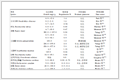
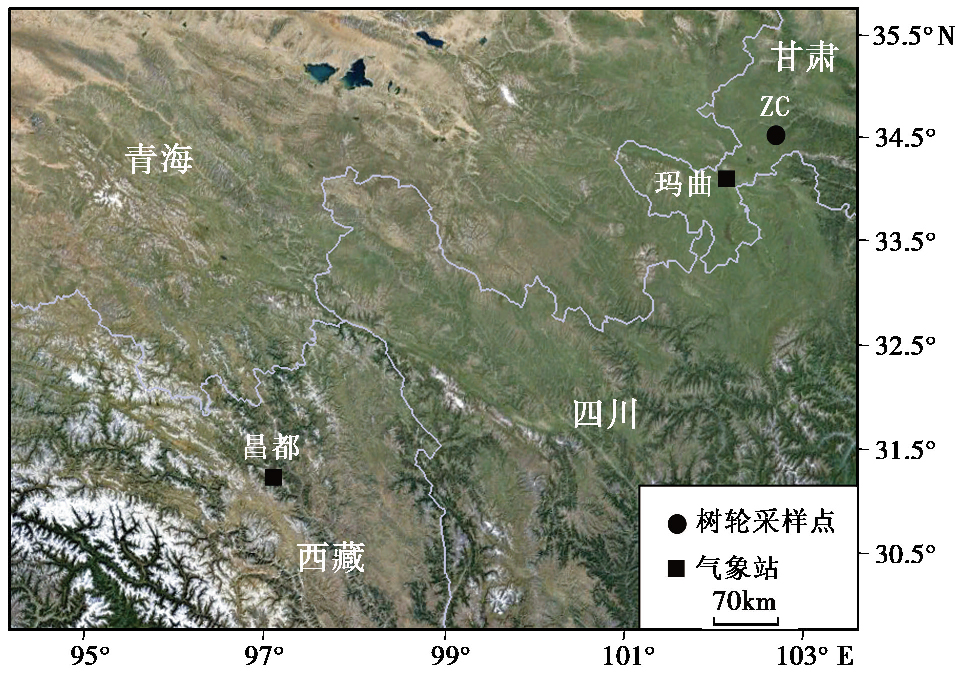
1 资料和方法 1.1 树轮采样及晚材最大密度年表的建立采样点则岔(ZC)位于尕海-则岔自然保护区内,位于青藏高原、 黄土高原和陇南山地交汇处(图 1),地跨黄河和长江两大水系,也是黄河支流洮河和长江水系白龙江的发源地。采样点海拔高度为3300~3320m,接近森林上限。树轮样本树种为岷江冷杉,采样点森林郁闭度为0.5,坡度为 20°~40°(表 1)。在采样点,我们选取了23棵生长状况良好的岷江冷杉,使用口径为10mm的生长锥在呈对角的两个方向上在胸高部位钻取树轮样芯,每棵树钻取2根样芯。在采样过程中,为了使得树芯头部不会扭曲变形,我们采用了胸托稳定生长锥。本文采样点以及研究所涉及的西藏昌都温度序列位置和甘肃玛曲气象站如图 1所示。
|
表 1 树轮采样点概况 Table 1 Survey of the sampling site |
|
图 1 树轮采样点和气象站分布图 Fig. 1 Location of tree-ring sampling site and meteorological stations |
依照树轮样本处理的基本程序,首先对所采样芯进行晾干、 粘贴、 磨平和打光等预处理,然后用精度为0.001mm的Velmex轮宽测量仪进行树轮宽度测量。利用COFECHA程序[24]对树轮宽度的交叉定年结果进行检验。在完成树轮宽度的测量和交叉定年工作以后,将树轮样芯切割成梯形小段,并固定之后,再进行树轮木质纤维角度的量测。利用Dendrocut双片锯依树轮木质纤维横切面的角度切成1mm左右的薄木片,再用X射线透射成像。使用Dendro2003树轮密度工作站将光学强度转化成树轮密度,得到树轮晚材最大密度。最后,以已完成交叉定年的树轮宽度数据作为基础,将所得到的树轮晚材最大密度数据进行交叉定年。树轮晚材最大密度标准化年表(STD)和差值年表(RES)由ARSTAN程序制成,根据样本长度和多次的尝试,采用Hugershoff 生长曲线去除年轮的生长趋势,而Hugershoff 生长曲线能够有效保持树轮序列中的低频趋势,同时还能够有效减少幼龄效应的影响[25, 26, 27]。尽管树轮晚材最大密度标准化年表也与温度存在显著相关(r=0.611,p>0.001),但较树轮晚材最大密度差值年表重建结果的方差解释量要小,故本文只展示了基于树轮晚材最大密度差值年表的温度重建结果。所得到的树轮晚材最大密度差值年表概况如表 2所示,树轮晚材最大密度差值年表的主要统计特征一般都较小,这与前人研究结果是一致的[28, 29]。以样本总解释量(EPS)[30]大于0.85为标准,将树轮晚材最大密度差值年表可靠时段确定为1725~2008年,共284年(图 2)。
|
|
表 2 则岔树轮晚材最大密度差值年表的主要统计特征 Table 2 Statistics of the maximum latewood density chronology(RES)from Zecha |

|
图 2 树轮晚材最大密度差值年表和样本量曲线 Fig. 2 Curve of maximum latewood density(RES)and sample depth |
本文选取距采样点较近的青藏高原东北部甘肃玛曲气象站(34°00′N, 102°05′E) 的气象资料(1967~2008年)运用于树轮气候响应分析。利用统计软件SPSS13.0对岷江冷杉树轮晚材最大密度年表与上年7月至当年9月的多种气象因子进行Person相关分析,以揭示岷江冷杉树轮晚材最大密度变化的主要限制因素。之后,选取不同月份组合的温度和降水分别计算均值,再与树轮晚材最大密度差值年表做Person相关分析,以寻找最适合的气候因子进行重建。
2 结果 2.1 树轮晚材最大密度对气候要素的响应从图 3可知,岷江冷杉树轮晚材最大密度与月平均温度和月平均最高温度在 各月的相关系数较为接近,它们变化趋势也十分相似。在0.05显著水平的单月分析中,树轮晚材最大密度与5~8月气温显著相关,与6月平均最高温度的相关达到最高,高于任一单月。树轮晚材最大密度与气温相关的差异是: 与7月平均温度和平均最低温都达到了0.05显著水平,而7月平均最高温相关不显著; 在0.05显著水平上,树轮晚材最大密度与各月降水都未达到显著水平。可见,研究区树轮晚材最大密度的生长主要受温度的控制,尤其是月平均最高温度。进一步相关普查发现,5~8月平均最高温(r=0.635,p>0.001)是树轮晚材最大密度最主要的限制因子,这与张掖地区的青海云杉树轮晚材最大密度研究结果一致[7]。后文的过去气候重建工作也选择了5~8月的平均最高温作为重建对象。

|
图 3 树轮晚材最大密度差值年表与气候因子相关 Fig. 3 Correlations of maximum latewood density chronology with climate data |
利用树轮晚材最大密度差值年表对青藏高原东北部玛曲地区1725~2008年5~8月平均最高温度进行重建,转换方程为:T5~8=5.186+10.19×MXD。其中,T5~8表示重建的5~8月平均最高温度,MXD表示则岔岷江冷杉树轮晚材最大密度年表。重建方程对实测(1967~2008年,共42年)5~8月平均最高温度的方差解释量为40.4%(N=42,p<0.001),调整自由度后可解释38.9%。图 4显示了1967~2008年5~8月平均最高温度实测值和重建值的对比,二者表现出良好一致性。采用交叉检验法对重建方程的稳定性进行了检验[31],检验的各统计量列于表 3。从表 3可以看出,符号检验和一阶符号差检验分别达到了95%和99%的置信水平,这说明重建序列对高频信号表征能力更强。误差缩减值(0.34)、 效率系数(0.33)以及方程的F 检验值(F=27.09)等统计量都达到了99%的置信水平,表明了重建方程稳定可靠。

|
图 4 实测温度值与重建温度值比较 Fig. 4 Comparison of recorded and estimated temperature for common period from 1967 to 2008 |
|
|
表 3 温度重建方程的统计量和交叉检验的统计量 Table 3 Leave-one-out cross-validation statistics for the temperature reconstruction |
图 5展示了利用树轮晚材最大密度所重建的玛曲地区过去284年5~8月的平均最高温度变化。经21年低通滤波处理以后温度重建序列表现出的温度偏低阶段有:1725~1746年、 1769~1819年、 1834~1845年、 1857~1869年和1965~1988年; 温度偏高阶段有:1747~1758年、 1820~1833年、 1846~1856年、 1870~1964年和1989~2008年。从以上温度偏高时段中,可以看到20世纪是一个偏暖的世纪。采用温度重建序列的标准差(σ)对异常高、 低温年份进行判别。温度重建序列的标准差σ为0.42℃,我们将温度距平大于1σ定义为异常高温年份,温度距平小于1σ为异常低温年份,研究区近284年中5~8月异常高温年份和异常低温年份相当,分别为38年和42年,约占总年份数的28%。

|
图 5 玛曲地区1725~2008年5~8月平均最高温度变化及其21年低通滤波曲线 Fig. 5 Reconstructed May-August maximum temperature of Maqu (thin line) with 21-year smoothing (thick line) |
气候响应分析表明,岷江冷杉树轮晚材最大密度与5~8月平均最高温度有着良好的正相关关系,而与月平均最低温度的相关系数较低。这说明在树轮生长过程中,当年生长季的白天温度变化对树轮密度的积累,尤其是树轮晚材最大密度有着较为重要作用。特别是在生长季后期(8~9月),树轮晚材最大密度与平均最高温度表现出很高的相关。从树木生理学角度分析,在生长季后期,树轮生长主要体现在晚材木质细胞壁的加厚上,8~9月份偏高的温度能够使得生长季延长,增强树木生长的光合作用,从而促进树轮细胞壁的加厚过程,进而产生较大的树轮晚材最大晚材密度[32]; 同时,树轮生长和气候变化都是连续的过程,会受到生长季前中期状况的影响。生长季前中期相对温暖气候条件对于树木生长有着显著效应,能够有效促进树轮细胞伸长和物质积累[32, 33]; 另外,如果前期的温度较高也会对生长季后期的温度产生影响。这种相关关系广泛存在于中国高海拔和高纬度针叶树种树轮中[32, 34],这为我们开展大范围温度重建奠定基础。
为了验证藏东北玛曲温度重建的结果,并探究利用树轮晚材最大密度资料重建大范围暖季温度变化的可行性,将本文重建玛曲地区5~8月平均最高温度序列与来自藏东南昌都地区温度序列[4]进行对比(位置见图 1)。昌都温度重建序列同样是基于树轮晚材最大密度,只是基于不同树种(川西云杉),它们都能够表征区域温度变化(图 6a和6b)。尽管两个地区相距超过800km,但是两个温度重建序列相关系数仍到达了0.312(p>0.001,n=276),两者具有很强的一致性(图 7a),这说明青藏高原地区的树轮晚材最大密度变化存在公共气候限制因子。利用主成分分析法提取青藏高原东部这两个温度序列的第一主成分(以下简称为PC1),结果显示PC1的方差解释量占65.624%,能够解释两个温度序列的总体变化特征。为了解PC1是否能准确反映青藏高原东部大范围温度变化,我们计算了PC1与英国CRU(Climatic Research Unit)0.5°×0.5°格点温度数据的相关,时间段为1950~2000年。结果表明,PC1与5~8月青藏高原和中国南方平均温度场表现了较大范围的显著正相关区(图 6c),最高相关中心为青藏高原东部,PC1则与邻近印度地区表现了显著的负相关关系。这说明利用树轮晚材最大密度重建大范围的暖季温度变化是可行的。PC1所显示青藏高原东部有7个偏冷阶段,它们分别为1725~1744年、 1754~1771年、 1808~1819年、 1833~1842年、 1853~1867年、 1898~1906年和1955~1980年,中间为偏暖阶段。其中,1808~1819年这一偏冷阶段与这一段频繁发生的大规模火山喷发有关[35]。最近30年,与其他地区温度快速上升不同[36, 37, 38, 39],青藏高原东部暖季温度上升趋势相对缓慢(图 7b)。

|
图 6 玛曲5~8月平均最高温度重建序列1967~2008年空间相关图(a)、 昌都8~9月温度重建序列1950~2000年空间相关图(b)以及青藏高原东部两个温度序列的第一主成分(PC1)与5~8月平均最高温度场1950~2008年空间相关图(c)和1854~2000年海温场相关系数图(d) Fig. 6 The spatial correlation pattern between temperature reconstruction of Maqu and the gridded May-August temperatures for the period 1967~2008(a),the spatial correlation pattern between temperature reconstruction of Changdu and the gridded August-September temperatures for the period 1950~2000(b),the spatial correlation pattern between the first principal component of two temperature sequences from eastern Qinghai-Tibet Plateau and May-August temperature for the period 1950~2000(c),and sea surface temperature for the period 1854~2000(d) |

|
图 7 玛曲5~青藏高原东部玛曲和昌都温度重建序列对比(a)和青藏高原东部两个温度序列的第一主成分(PC1)及其21年低通滤波曲线(b) Fig. 7 Graphical comparison of the temperature reconstructions of Maqu and Changdu from eastern Qinghai-Tibet Plateau (a) and the first principal component of two temperature sequences from eastern Qinghai-Tibet Plateau (thin line) with 21-year smoothing(thick line)(b) |
PC1能够指示青藏高原东部指示5~8月温度变化,因此本研究中将该序列与同期海表温度场进行了分析。使用的海温场资料为2°×2°格距的NCDC v3b ERSST(Extended Reconstruction Sea Surface Temperature)海温资料[40]。结果显示在与海温数据的公共时段内(1854~2000年),青藏高原东部暖季温度变化与海温场相关表现了两个显著相关区——印度洋孟加拉湾和中国近海西太平洋中低纬度海区(0°~30°N),r>0.3(p>0.05)(图 6d),表明当这两个海域海温偏高时,青藏高原东部地区5~8月温度偏高,反之则反,这说明我国近海和印度洋海温变化对青藏高原东部地区温度变化存在显著的影响。此外,青藏高原东部暖季温度变化还与中东太平洋海温表现出负相关(图 6d),与刘珊等[41]对青藏高原夏季气候与冬季太平洋海温的分析结果相一致,说明中东太平洋海温异常——厄尔尼诺-南方涛动(ENSO)对青藏高原东部地区温度的影响具有季节延续性,但细节尚待进一步探讨。相关研究揭示青藏高原东部的气候受到印度夏季风的影响,当印度夏季风增强时候,季风降水增加,导致暖季温度下降[11]。尽管玛曲树轮晚材最大密度与降水的相关性并不明显,但是昌都地区温度重建序列与降水呈现出显著负相关[4]。进一步对PC1所指示的有观测记录以来(1948~2000年)的10个偏冷年和9个偏暖年(具体年份详见图 8)的500hPa风场和帕尔默指数(Palmer Drought Severity Index)合成图分析发现: 当在偏冷年,印度夏季风偏强,越过喜马拉雅山,湿润气团进而控制研究区,降水增加,土壤湿度增大,导致暖季温度偏低,使得树木生长季缩短,树轮晚材最大密度减小; 在偏暖年份,印度夏季风偏弱,研究区被干燥西风控制时,暖季温度偏高(见图 8),这与前人研究结果相一致[11]。

|
图 8 偏冷年(a和c)和偏暖年(b和d)的500hPa风场和帕尔默干旱指数合成图 Fig. 8 Composite anomaly maps of 500hPa vector wind and Palmer Drought Severity Index for the coldest and warmest years for May-August temperature of eastern Qinghai-Tibet Plateau during the period 1948~2000. Composite for coldest years (a and c). Composite maps for warmest years (b and d) |
(1)则岔树轮晚材最大密度表现出与其他一些高纬度和高海拔地区相一致的气候响应特征,受当年5~8月份温度的制约。利用树轮晚材最大密度对青藏高原东北部玛曲地区1725年以来5~8月平均最高温度进行重建。在重建期间玛曲地区平均最高温度较低的时期主要有:1725~1746年、 1769~1819年、 1834~1845年、 1857~1869年和1965~1988年; 而温度较高的时段主要有1747~1758年、 1820~1833年、 1846~1856年、 1870~1964年和1989~2008年。最近30年来,出现了温度出现缓慢上升趋势。
(2)通过与同样基于树轮晚材最大密度的昌都温度重建序列对比发现,两者之间有显著正相关,他们的第一主成分能够表征青藏高原东部地区大范围温度变化。这说明青藏高原地区的树轮晚材最大密度变化存在公共气候限制因子,利用树轮晚材最大密度重建青藏高原大范围温度变化是可行的。
(3)研究表明,青藏高原东部地区暖季温度变化主要受到了北印度洋孟加拉湾和西太平洋中低纬度的海温以及印度夏季风的影响。同时,青藏高原东部地区暖季温度与中东太平洋海温的负相关说明其变化还可能受到ENSO影响。
限于树轮采样点数限制,本研究基于一个样点的树轮晚材最大密度年表,重建了玛曲地区5~8月平均最高温度,并结合昌都温度重建序列对青藏高原东部地区大范围暖季温度变化和海温对研究区温度变化的可能影响进行了分析。目前的研究只是初步的,未来可以通过增补更多树轮晚材最大密度资料,可以建立更为精确,时间尺度更长的温度序列。开展基于树轮密度资料的青藏高原温度变化与大气环流的关系研究,尤其是与亚洲夏季风活动的关联性研究有待加强。要深入进行上述研究今后需要结合古气候和现代气候研究方法相结合。
致谢对中国科学院地理科学与资源研究所王丽丽研究员在树轮密度实验方面和树轮密度数据给予的无私帮助表示感谢!
| 1 | Schweingruber F H, Bartholin T, Schär E et al. Radiodensitometric-dendroclimatological conifer chronologies from Lapland(Scandinavia)and the Alps(Switzerland). Boreas, 1988,17 (4):559~566 |
| 2 | Briffa K R, Jones P D, Bartholin T S et al. Fennoscandian summers from AD 500:Temperature changes on short and long timescales. Climate Dynamics, 1992,7 (3):111~119 |
| 3 | Davi N, D'Arrigo R D, Jacoby G C et al. Warm-season annual to decadal temperature variability for Hokkaido, Japan, inferred from maximum latewood density(AD 1557~1990)and ring width data(AD 1532~1990). Climatic Change, 2002,52 (1~2):201~217 |
| 4 | Wang L L, Duan J P, Chen J et al. Temperature reconstruction from tree-ring maximum density of Balfour spruce in eastern Tibet, China. International Journal of Climatology, 2009,30 (7):972~979 |
| 5 | Chen Feng, Yuan Yujiang, Chen Fahu et al. Reconstruction of spring temperature on the southern edge of the Gobi Desert, Asia, reveals recent climatic warming. Palaeogeography, Palaeoclimatology, Palaeoecology, 2014, 409 :145~152 |
| 6 | Briffa K R, Osborn T J, Schweingruber F H et al. Low-frequency temperature variations from a northern tree ring density network. Journal of Geophysical Research, 2001,106 (D3):2929~2941 |
| 7 | Chen F, Yuan Y J, Wei W S et al. Temperature reconstruction from tree-ring maximum latewood density of Qinghai spruce in middle Hexi Corridor, China. Theoretical and Applied Climatology, 2012,107 (3~4):633~643 |
| 8 | Duan Jianping, Wang Lili, Li Lun et al. Temperature variability since A.D. 1837 inferred from tree-ring maximum density of Abies fabrion Gongga Mountain, China. Chinese Science Bulletin, 2010,55 (26):3015~3022 |
| 9 | Yu S L, Yuan Y J, Wei W S et al. A 352-year record of summer temperature reconstruction in the western Tianshan Mountains, China, as deduced from tree-ring density. Quaternary Research, 2013,80 (2):158~166 |
| 10 | Fan Z X, Bräuning A, Yang B et al. Tree ring density-based summer temperature reconstruction for the central Hengduan Mountains in Southern China. Global and Planetary Change, 2009,65 (1~2):1~11 |
| 11 | Bräuning A, Mantwill B. Summer temperature and summer monsoon history on the Tibetan Plateau during the last 400 years recorded by tree rings. Geophysical Research Letters, 2004, 31 :L24205, doi:10.1029/2004GL020793 |
| 12 | Chen Feng, Yuan Yujiang, Wei Wenshou et al. Climatic response of ring width and maximum latewood density of Larix sibiricain the Altay Mountains, reveals recent warming trends. Annals of Forest Science, 2012,69 (6):723~733 |
| 13 | Yang B, Kang X, Liu J et al. Annual temperature history in southwest Tibet during the last 400 years recorded by tree rings. International Journal of Climatology, 2010,30 (7):962~971 |
| 14 | Liang E Y, Shao X M, Qin N S. Tree-ring based summer temperature reconstruction for the source region of the Yangtze River on the Tibetan Plateau. Global and Planetary Change, 2008,61 (3):313~320 |
| 15 | 宋慧明, 刘 禹, 倪万眉等. 以树轮宽度重建九寨沟1750年以来冬半年平均最低温度. 第四纪研究, 2007,27 (4):487~491 Song Huiming, Liu Yu, Ni Wanmei et al. Winter mean lowest temperature derived from tree-ring width in Jiuzhaigou region, China since 1750A.D.Quaternary Sciences, 2007,27 (4):487~491 |
| 16 | Liu Yu, Cai Qiufang, Song Huiming et al. Amplitudes, rates, periodicities and causes of temperature variations in the past 2485 years and future trends over the central-eastern Tibetan Plateau. Chinese Science Bulletin, 2011,56 (28~29):2986~2994 |
| 17 | 任军莉, 刘 禹, 宋慧明等. 甘肃临夏地区过去195年最高温度历史重建——基于紫果云杉树轮宽度资料. 第四纪研究, 2014,34 (6):1270~1279 Ren Junli, Liu Yu, Song Huiming et al. The historical reconstruction of the maximum temperature over the past 195 years, Linxia region, Gansu Province——Based on the data from Picea purpureaMast. Quaternary Sciences, 2014,34 (6):1270~1279 |
| 18 | 刘昶智, 勾晓华, 方克艳等. 甘肃南部公元1824年以来降水重建. 第四纪研究, 2013,33 (3):518~525 Liu Changzhi, Gou Xiaohua, Fang Keyan et al. Precipitation reconstruction in Southern Gansu Province since A.D. 1824. Quaternary Sciences, 2013,33 (3):518~525 |
| 19 | 马 龙, 刘廷玺, 冀鸿兰等. 科尔沁沙地1826年以来榆树树轮宽度年表的建立及降水重建. 第四纪研究, 2011,31 (2):360~369 Ma Long, Liu Tingxi, Ji Honglan et al. Establishment of ring width chronology and rainfall reconstruction of Ulmus pumila L. in Horqin sandy land since 1826. Quaternary Sciences, 2011,31 (2):360~369 |
| 20 | 刘 禹, 蔡秋芳, 宋慧明. 关于青藏高原2485年温度的季节和空间代表性问题. 第四纪研究, 2013,33 (1):108~114 Liu Yu, Cai Qiufang, Song Huiming. Seasonal and spatial representativeness of the tree-ring based 2485-year annual mean temperature reconstruction in the northeastern Tibetan Plateau. Quaternary Sciences, 2013,33 (1):108~114 |
| 21 | 杨 保. 树轮记录的小冰期以来青藏高原气候变化的时空特征. 第四纪研究, 2012,32 (1):81~94 Yang Bao. Spatial and temporal patterns of climate variations over the Tibetan Plateau during the period 1300~2010. Quaternary Sciences, 2012,32 (1):81~94 |
| 22 | 刘晶晶, 杨 保. 西藏浪卡子地区树轮宽度特征值年表的建立. 第四纪研究, 2014,34 (6):1280~1287 Liu Jingjing, Yang Bao. Development of a tree-ring-width chronology using the Eigen analysis method in Langkazi regions of Tibet. Quaternary Sciences, 2014,34 (6):1280~1287 |
| 23 | 时兴合, 秦宁生, 刘洪滨等. 青海治多公元1374年以来树轮记录的青藏高原地面加热场强度变化. 第四纪研究, 2013,33 (1):115~125 Shi Xinghe, Qin Ningsheng, Liu Hongbin et al. Surface heating field intensity change over Tibetan Plateau recorded Qinghai Zhiduo tree rings since 1374A.D.Quaternary Sciences, 2013,33 (1):115~125 |
| 24 | Holmes R L. Computer-assisted quality control in tree-ring dating and measurement. Tree-Ring Bulletin, 1983, 43 :69~75 |
| 25 | Cook E R, Kairiukstis L A. Methods of Dendrochronology. The Netherlands, Dordrecht:Kluwer Academic Publishers, 1990. 1~391 |
| 26 | Briffa K R, Schweingruber F H, Jones P D et al. Reduced sensitivity of recent tree-growth to temperature at high northern latitudes. Nature, 1998, 391 (6668):678~682 |
| 27 | Pederson N, Cook E R, Jacoby G C et al. The influence of winter temperatures on the annual radial growth of six northern range margin tree species. Dendrochronologia, 2004,22 (1):7~29 |
| 28 | Xiong L M, Naoki O, Takeshi F et al. Chronology development and climate response analysis of different New Zealand pink pine(Halocarpus biformis)tree-ring parameters. Canadian Journal of Forest Research, 1998,28 (4):566~573 |
| 29 | Pant G B, Kumar K R, Borgaonkar H P et al. Climatic response of Cedrus deodara tree-ring parameters from two sites in the western Himalaya. Canadian Journal of Forest Research, 2000,30 (7):1127~1135 |
| 30 | Wigley T M L, Briffa K R, Jones P D. On the average value of correlated time series, with applications in dendroclimatology and hydrometeorology. Journal of Climate and Applied Meteorology, 1984,23 (2):201~213 |
| 31 | 李江风, 袁玉江, 由希尧等. 树木年轮水文学研究与应用. 北京: 科学出版社, 2000. 51~158 Li Jiangfeng, Yuan Yujiang, You Xiyao et al. Dendrohydrology Research and Application. Beijing:Science Press, 2000. 51~158 |
| 32 | Chen Jin, Wang Lili, Zhu Haifeng et al. Reconstructing mean maximum temperature of growing season from the maximum density of the Schrenk Spruce in Yili, Xinjiang, China. Chinese Science Bulletin, 2009,54 (13):2300~2308 |
| 33 | 王丽丽, 邵雪梅, 黄 磊等. 黑龙江漠河兴安落叶松与樟子松树轮生长特性及其对气候的响应. 植物生态学报, 2005,29 (3):380~385 Wang Lili, Shao Xuemei, Huang Lei et al. Tree-ring characteristic of Larix gmelinii and Pinus sylvestrisvar. mongolica and their response to climate in Mohe, China. Acta Phytoecologica Sinica, 2005,29 (3):380~385 |
| 34 | Sun Yu, Wang Lili, Chen Jin et al. Reconstructing mean maximum temperatures of May-August from tree-ring maximum density in north Dahinggan Mountains, China. Chinese Science Bulletin, 2012,57 (19):2007~2014 |
| 35 | Briffa K R, Jones P D, Schweingruber F H et al. Influence of volcanic eruptions on Northern Hemisphere summer temperature over the past 600 years. Nature, 1998,393 (6684):450~455 |
| 36 | 刘 禹, 田 华, 宋慧明等. 油松年轮记录的河北围场公元1884年以来5~6月平均温度. 第四纪研究, 2009,29 (5):896~904 Liu Yu, Tian Hua, Song Huiming et al. Tree ring based reconstruction of the May-June mean temperature since A.D. 1884 in Weichang, Hebei Province, China. Quaternary Sciences, 2009,29 (5):896~904 |
| 37 | 王亚军, 马玉贞, 鲁瑞杰等. 树木年轮记录的祁连山东段公元1895年来的温度变化. 第四纪研究, 2009,29 (5):905~912 Wang Yajun, Ma Yuzhen, Lu Ruijie et al. Reconstruction of mean temperature of January to August since A.D. 1895 based on tree ring data in the eastern part of the Qilian Mountains. Quaternary Sciences, 2009,29 (5):905~912 |
| 38 | 勾晓华, 杨梅学, 彭剑峰等. 树轮记录的阿尼玛卿山区过去830年夏半年最高温度变化. 第四纪研究, 2006,26 (6):991~998 Gou Xiaohua, Yang Meixue, Peng Jianfeng et al. Maximum temperature reconstruction for Animaqing Mountains over past 830 years based on tree-ring records. Quaternary Sciences, 2006,26 (6):991~998 |
| 39 | 陈 峰, 王慧琴, 袁玉江等. 树轮最大密度记录的吉尔吉斯斯坦天山山区公元1650 年以来的7~8月温度变化. 沙漠与绿洲气象, 2014,8 (4):1~7 Chen Feng, Wang Huiqin, Yuan Yujiang et al. July-August temperature variability since A.D. 1650 inferred from tree-ring maximum density of Picea schrenkiana on the Tianshan Mountains, Kyrgyzstan. Desert and Oasis Meteorology, 2014,8 (4):1~7 |
| 40 | Smith T M, Reynolds R W. Improved extended reconstruction of SST(1854~1997). Journal of Climate, 2004,17 (12):2466~2477 |
| 41 | 刘 珊, 李栋梁. 夏季青藏高原气温与冬季北太平洋海温的异常特征及其相关分析. 高原气象, 2009,28 (4):711~722 Liu Shan, Li Dongliang. Anomaly features of temperature over Qinghai-Xizang Plateau in summer and Pacific SSTA in winter and its correlation analysis. Plateau Meteorology, 2009,28 (4):711~722 |
Abstract
Understanding of past climatic change over the Tibetan Plateau is still limited because of the shortness of available meteorological records. However, high-resolution climate proxy records from the Tibetan plateau are scarce and of limited spatial representativeness. In this study we developed a maximum latewood density (MXD) chronology of Abies faxoniana from a sampling site (34°26'N, 102°43'E, site code ZC) of the northeastern Tibetan Plateau and used it to reconstruct the history of temperature variation for the region. Twenty-three trees were sampled. Two 10mm cores were taken from each tree with increment borers at breast height. In the correlation analysis, the local climate data (Maqu, 34°00'N, 102°05'E; 1967~2008) along with the MXD chronology was examined from the previous July to the current September. Response analysis shows that warm season(May-August)temperature is the main factor limiting the MXD variability of fir trees in the northeastern Tibetan Plateau. Based on growth-climate analyses, we reconstructed mean May-August maximum temperature during the past 284 years for the study area. The reconstruction explained 40.4% of the instrumental temperature variance during the period 1967~2008 (F=27.09, Radj2=38.9%). In the past 284 years, there were five cold periods (1725~17461769~18191834~18451857~1869 and 1965~1988) and five warm periods (1747~17581820~18331846~18561870~1964 and 1989~2008). The values beyond the standard deviation(±1 SD)indicate warm and cold years. The warm years accounted for 28.0% (38 warm years and 42 cold years)of the years during the whole reconstruction. There is a reasonable agreement with cold and warm periods previously estimated from tree-ring records from Changdu in the southeastern Tibetan Plateau. Correlations of the first principal component(PC1)of the two temperature sequences with May-August gridded temperature data(Climatic Research Unit, CRU)were calculated to investigate if it was capable of representing regional large-scale temperature variability during 1950~2000. Based on the results of principal component analyses and spatial correlation analysis, warm season temperature(May-August)is the most important forces on the MXD variability of the eastern Tibetan Plateau. We thus consider that the PC1 was representative of a large area temperature history of eastern Tibetan Plateau. Seven cold periods(1725~17441754~17711808~18191833~18421853~18671898~1906 and 1955~1980)were found in the eastern Tibetan Plateau. The PC1 was used to investigate the influence of sea surface temperature(SST)on the regional temperature variability in the common period 1854~2000. The significant positive correlations with SST were observed for the western Pacific Ocean and the northern Indian Ocean. This result indicated that the higher SST of the above ocean domains, possibly the higher temperature of eastern Tibetan Plateau. Moreover, the linkages to the eastern Pacific Oceans suggest the possible close connection of the temperature of eastern Tibetan Plateau to ENSO. Preliminary analysis of links between large-scale climatic variation and the temperature series shows that there is a relationship between extremes in the temperature of eastern Tibetan Plateau and anomalous atmospheric circulation(Indian summer monsoon)in the region. This record helps broaden the climatic information resource to the Tibetan Plateau where heretofore there was little long-term climate data.