 2015, Vol.35


③ 四川省气候中心, 成都 610072;④ 四川省农业气象中心, 成都 610072)
1 引言
近期的一些研究中指出青藏高原是整个东亚地区气候变化启动区,对全球气候变化十分敏感[1, 2],三江源地处青藏高原腹地,是我国主要流域水资源的来源区,同时也是世界上海拔最高的湿地自然保护区,其自然环境与气候的改变将对我国第二、 第三阶梯地区社会、 经济产生重大影响,鉴于该地区生态环境的重要性,许多学者对三江源及其周边地区气候与环境变化都有过研究[3, 4, 5, 6, 7]; 此外,三江源地广人稀且受人类活动因素的影响较小,源区内分布着许多年代久远的圆柏和云杉类树木,研究表明,这些生长在高寒地区的这些树木其径向生长对气候响应非常敏感,很适合于气候要素的重建工作[8, 9, 10]。在我国利用树轮进行气候要素重建的工作发展迅速并取得众多成果[11, 12, 13, 14, 15],然而在三江源地区开展的重建工作却相对较晚,规模也十分有限,直到21世纪以后,在三江源地区的重建工作才逐渐展开[16, 17]。
目前而言,在三江源区域重建的历史气候序列并不能满足全面了解三江源地区过去气候变化背景以及未来变化趋势预测的需求,从过往采样以及相关研究经历来看,该区域完全有可能开展更为深入的采样、 重建工作,完全有可能依据树轮参数开展三江源地区气候要素场的恢复重建工作[18, 19]。本文利用三江源之一的长江源境内树轮样本,建立树轮宽度标准化年表,并分析标准化年表与各气候要素间响应情况与相关性,了解气候因素对长江源地区树木年轮径向生长影响,进而重建该地区长时间尺度的气候序列,对重建序列趋势特征,周期变化进行分析以及对比验证等工作。目的是为长江源甚至整个青藏高原东部地区气候变化研究提供基础数据资料,为同一地区局地气候研究提供对比参照,为长江源区生态环境保护工作提供全新的认识和科学依据[20]。
2 资料与方法 2.1 样本采集长江源位于我国青海省南部,青藏高原东部,昆仑山脉与唐古拉山脉之间,源区内山地是主要地貌,地势高且地形复杂,海拔在3335~6564m之间。受高原季风和西南季风影响,源区表现为冷热两季分明,为典型高原大陆性气候,降水集中在暖季,水汽主要由西南季风输送,年均降水量为328.0mm,为植被生长提供了水分,全年气温维持在-9.1~5.6℃之间。长江源自然资源丰富,植物种类繁多,土壤以高山草甸土、 山地草甸土和高山草原土等为主,土壤之上形成了以高寒灌丛草甸、 高寒草甸及山地森林为主的植被分布,乔木主要包括以松科(Pinaceae)和柏科(Cupressaceae),灌木丛中以菊科(Asteraceae)、 毛茛科(Ranunculaceae)及虎耳草科(Saxifragaceae)等为主,较为常见的植物包括西南花楸(Sorbus rehderiana Koehne),印度锦鸡儿(Caragana gerardiana Royle),四川忍冬(Lonicera szechuanica Batal.)和冰川茶藨(Ribes glaciale Wall.)[21]。
长江源地区内的采样工作于2013年10月初完成,采样地点总共有3个,分别是青海省治多县立新乡夏日寺、 曲麻莱县约改镇和巴干乡,其代号(具体地理位置)分别为XRS(33°44′N,96°14′E;海拔3908~4050m)、 YG(33°47′N,96°11′E;海拔4355~4455m)和BG(33°46′N, 96°24′E;海拔3933~4233m)。样本采集处坡向均为南坡,坡度 30°~45°,坡上无成种群树林,多为孤木,优势种为大果圆柏(Sabina tibetica Kom.),树下少量杂草。采集工具为5.15mm生长锥,采样严格按照国际惯用流程完成,获得大量树芯样本,其中XRS获得了26株树,53棵芯; YG含27株树,55棵芯; BG包括27株树,54棵芯。复本量基本满足要求。

|
图 1 采样点与气象站点分布 Fig. 1 Distribution of sampling sites and meteorological stations |
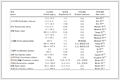
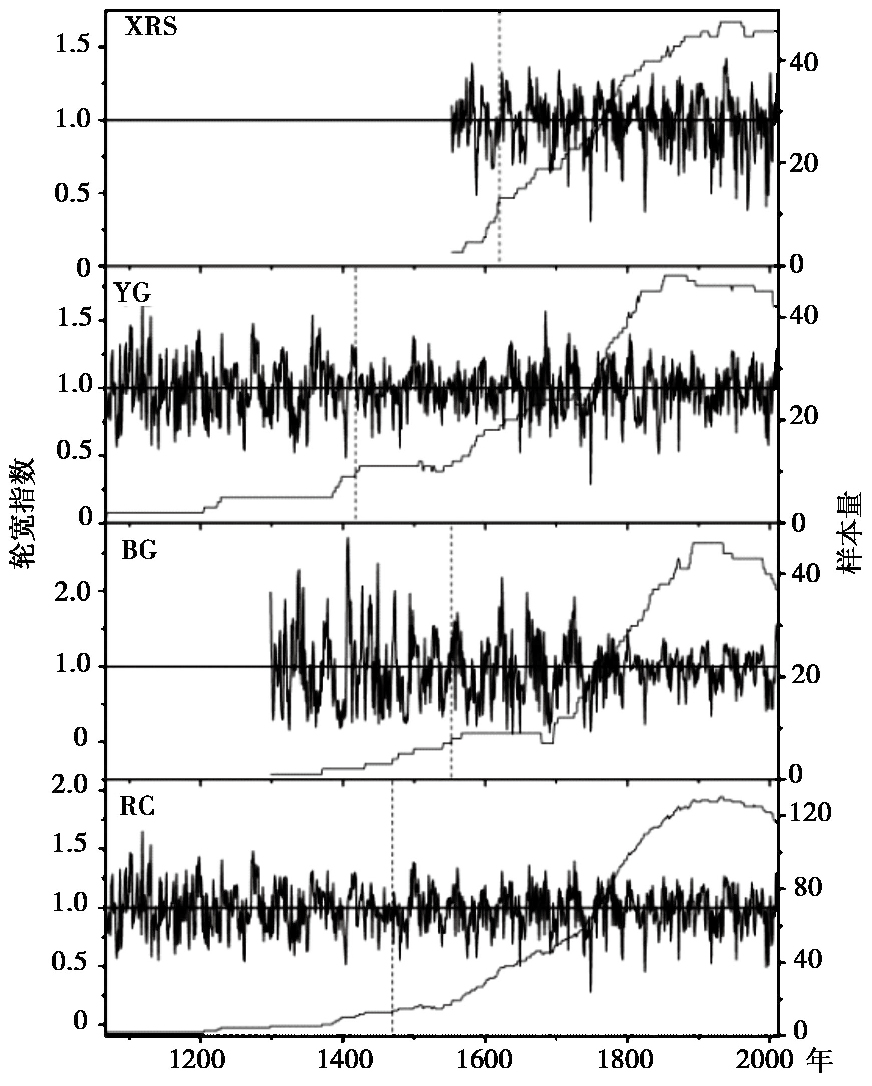
样本经过粘贴、 晾干、 打磨、 定年一系列国际惯例步骤处理,之后使用LINTAB6轮宽测量仪对树轮宽度进行测量,测量工作于中国科学院地理科学与资源研究所完成,再利用COFECHA程序[22]交叉定年,以确保每棵树芯的定年和测量结果准确性。完成交叉定年后,对各采样点树轮宽度序列进行生长量订正[23, 24],即利用ARSTAN程序[25]去除序列中的非气候因素的影响,经反复试验发现步长为100的样条函数能够很好地拟合树木自身的生长趋势,将这部分信号去掉,以使序列保留气候信号并同时得到3种年表: 标准化年表(STD)、 差值年表(RES)和自回归年表(ARS)。为了更多的反映气候变化信息,本文采用STD年表进行分析,各年表统计量及变化特征如表 1和图 2所示。由表 1和图 2可以看出,各STD年表具有相似的统计量特征(表 1),且高低频变化也比较相似(图 2)。由于3个采样点之间地理位置距离很短,分别计算3个采样点标准化年表之间的相关系数发现,XRS与YG间相关系数为0.56(1553~2013年,n=461,p<0.0001),XRS与BG相关系数为0.54(1553~2013年,n=461,p<0.0001),YG与BG之间的相关系数0.44(1553~2013年,n=461,p<0.0001),3个年表间正相关性十分显著,考虑将它们合并成一个总年表RC[26, 27],以代表整个长江源,其统计特征详见表 1。由表 1可以发现,RC年表的标准差、 平均敏感度、 一阶自相关系数以及总体代表性与3个采样点的基本一致,信噪比有较明显提高,第一主成分方差解释量有所下降,这可能是由于合成后序列数量增多后造成的,SSS>0.85的起始年份变为1470年,也有了一定的提前,这些信息都表明RC年表保留了各样点年表的公共信息,能够反映出区域气候变化信息。
|
表 1 各年表公共区间(1800~2010年)统计特征 Table 1 Statistical characteristics of each chronology in common period(1800~2010) |
|
图 2 XRS、 YG、 BG和RC标准化年表及样本量垂直虚线表示SSS>0.85年份 Fig. 2 STD chronologies and sample size of XRS,YG,BG,and RC. The vertical dashed line represents for the year of SSS >0.85 |
气候数据均来自采样点附近5个气象站点逐月数据,所采用的站点分别是曲麻莱(95°47′N, 34°08′E; 海拔4775m)、 清水河(97°08′N, 33°48′E; 海拔4415m)、 玉树(97°01′N, 33°01′E; 海拔3681m)、 五道梁(93°05′N, 35.13°E; 海拔4612m)和沱沱河(92°26′N, 34°13′E; 海拔4533m)。气候要素包括降水量、 平均气温、 平均最高气温、 平均最低气温、 日照时数和相对湿度,各数据时间段均为1960~2009年,少部分年份存在数据缺失情况,利用一元线性回归的方法对缺失年份数据进行补齐。各站点都分布在长江流域沿河地区,因此将这5个站各气象数据作算术平均以代表整个长江源; 另外,还使用Climate Research Unit(CRU TS 3.22,0.5°×0.5°) 和COBE SST 2(1°×1°) 格点资料,以便在之后进行空间代表性分析以及周期分析。
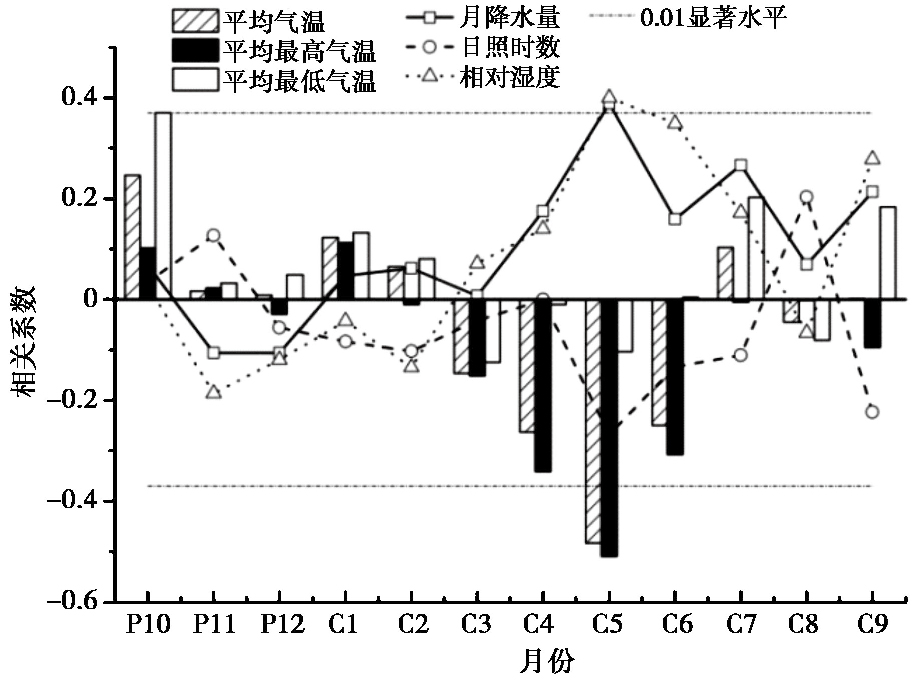
3 相关与响应分析 3.1 相关分析为了研究合成的RC标准化年表与长江源区内各气候要素(平均气温、 平均最高气温、 平均最低气温、 降水量、 日照时数和相对湿度)之间联系,探索上述各气候要素序列与标准化年表之间的相关性特征,因此进行相关分析,分析结果如图 3所示。由于植物在9月过后会停止生长[23, 24],所以选择前一年10月、 11月和12月气候要素与当年标准化年表作相关,剩余的月份则采用当年数据,时间尺度与站点气候资料相一致,为1960~2009年。在相关分析中发现平均气温、 平均最高气温以及日照时数在当年4月、 5月、 6月与RC标准化年表间存在明显负相关,特别是平均最高气温在4月、 5月、 6月与标准化年表之间的负相关的显著性基本上都超过了0.05 的显著性水平,在5月的相关系数显著性水平已经超过了0.01。降水量和相对湿度则与上述的情况相反,在5月份与RC标准化年表呈显著正相关,产生这样的结果跟植被在春末夏初的生长特征有关。鉴于最高气温与RC标准化年表在4月、 5月、 6月的显著负相关,初步推测平均最高气温为树木在4~6月期间生长的主要限制因子,确定重建的气候因子为最高气温。将4~6月平均最高气温进行一定组合,能反映最高气温的季节性变化,同时也使得相关系数进一步提高,其中4~5月与RC标准化年表间的相关系数为-0.57(n=50,p<0.0001),5~6月为-0.50(n=50,p<0.0001),4~6月为-0.57(n=50,p<0.0001),考虑到4~6月在时间尺度上更具有一定的代表性,所以确定重建的平均最高气温的时间段为4~6月。
|
图 3 标准化年表与长江源区各气候要素相关分析 Fig. 3 Correlation analysis between STD and climate factors in source region of Yangtze River |
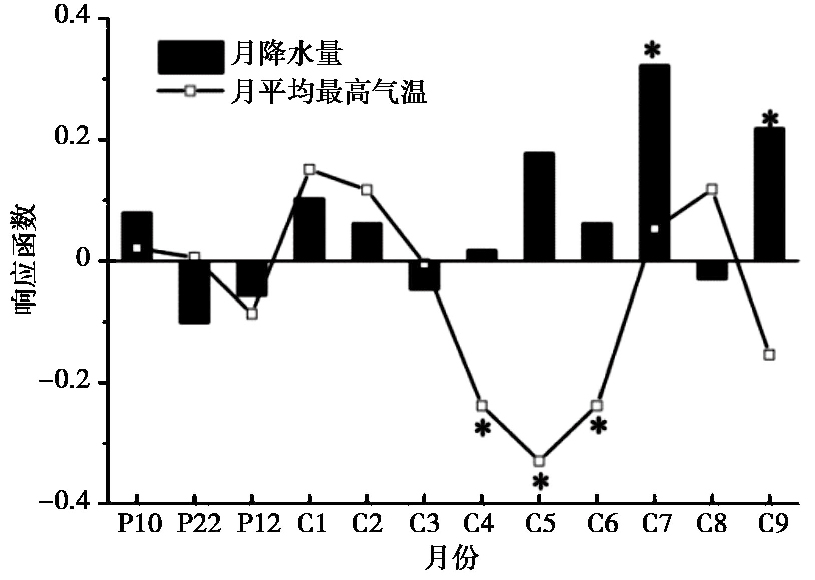
为了进一步验证相关分析的结果,分别将平均气温、 平均最高气温、 平均最低气温与降水量组合从而与RC标准化年表进行响应分析,上述组合能够分别解释65.83%、 66.17%和55.49%的树轮宽度指数序列方差。平均最高气温与月降水组合的响应分布如图 4所示,4月、 5月、 6月最高气温与标准化年表间存在明显负影响的关系,且均超过了0.05的显著性检验。由于树木在春末夏初时节生长迅速,对水分的需求很高,若在此期间气温升高,日照时数增强,则植被蒸腾作用增强,树木水分被耗散,同时,气温升高使得土壤中水分含量减少,不能及时对树木水分补充,抑制了树木径向生长[24],故最高气温与树木年表间存在明显负关系,在过往研究中也存在一些利用平均最高气温与标准化年表间显著负相关进行重建的序列,如: 阿尼玛卿山过去830年夏半年最高气温变化[4]和青海杂多1360~2005年5~6月最高气温变化[28]。本文的响应分析与相关分析结果相一致,因此最终将4~6月平均最高气温作为重建对象。
|
图 4 标准化年表与月平均最高气温和月降水量响应分析*表示超过0.05显著水平 Fig. 4 Response analysis of STD and combination of monthly mean maximum temperature and monthly precipitation.*represents for 0.05 confidence level |
根据上述确定的重建对象以及标准化年表,建立二者间的线性关系,重建的关系式为

Ti表示第i年4~6月平均最高气温,RCi是指长江源区第i年标准化年表。重建方程各检验量如表 2所示,方程相关系数(R)为0.57(n=50,p<0.0001),方差解释量达0.33,进行自由度调整之后为0.31,t检验值为2.02,F值23.36,缩减误差RE>0,说明方程是稳定的,具有较高的可信度,另外,重建方程符号检验通过了0.05的显著性检验,能够更好地反映序列的低频变化[29]。图 5是1960~2009年长江源区4~6月平均最高气温实测标准化序列跟重建的标准化序列间的对比,实测序列和重建序列间变化大致相似,特别是在1969年、 1995年和1998年这几年,实测值跟重建值一致性很高,可以发现这几年都是高值年份,说明重建为最高气温时,实际测量值越高,重建的值就越接近实际测量值,产生这样的结果跟植物在春末夏初时节生长特征密不可分[28]。
|
|
表 2 重建方程各检验量 Table 2 Test statistics of reconstructed equation |

|
图 5 1960~2009年4~6月平均最高气温重建值与实际值比较 Fig. 5 Comparision between observed and reconstructed average maximum temperature from April to June during 1960~2009 |
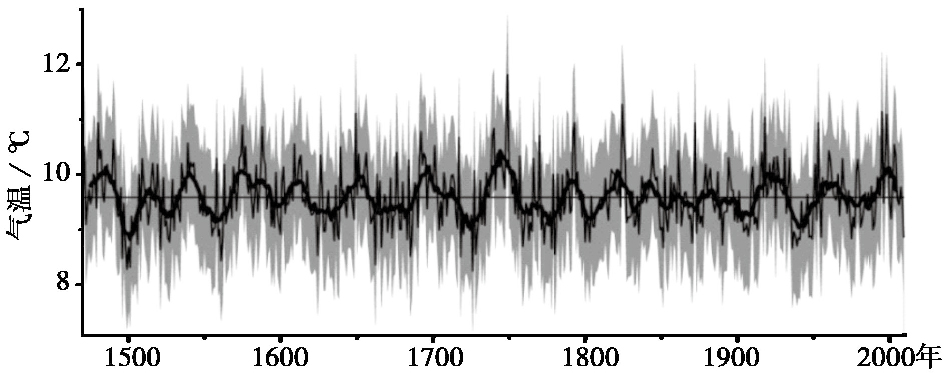
根据SSS>0.85的起始年代,并考虑到本文气象资料截止到2009年,重建了长江源区1470~2009年4~6月平均最高气温,其变化趋势如图 6所示,整个序列平均气温9.59℃,标准差0.54,变化幅度在8℃到12℃之间,气温高于均值2σ的极端偏暖年有20个年,分别是1480年、 1575年、 1588年、 1649年、 1692年、 1717年、 1739年、 1740年、 1748年、 1749年、 1770年、 1792年、 1793年、 1824年、 1825年、 1872年、 1918年、 1953年、 1995年和1998年,最暖的年是1749年,最高气温值是11.81℃; 而低于均值2σ的极端偏冷年份包括:1496年、 1499年、 1501年、 1561年、 1662年和1726年这6年,最低气温值为8.25℃,出现在1726年。对重建序列作11a滑动平均,观察其低频变化特征,并根据以往研究中冷暖期的定义[28],滑动平均值连续11a以上大于多年平均值为暖期,滑动平均值连续11a以上低于多年平均值则为冷期,对此次重建序列进行冷暖时期的划分,其中,11个暖期时段包括:1475~1492年、 1533~1547年、 1568~1593年、 1604~1617年、 1644~1656年、 1688~1713年、 1734~1754年、 1813~1829年、 1884~1932年、 1954~1969年以及1990~2004年,持续时间最长的暖期分别是1568~1593年和1688~1713年,持续时间25年,而偏暖强度大的暖期是1734~1754年,距平值为0.49℃; 12个冷期包括:1493~1510年、 1520~1532年、 1548~1576年、 1618~1643年、 1661~1678年、 1714~1733年、 1755~1786年、 1798~1812年、 1863~1875年、 1885~1912年、 1933~1953年和1970~1982年,最长时段冷期是1755~1786年,长达32年,偏冷强度最大的冷期为1493~1510年,距平为-0.44℃。
|
图 6 1470~2009年4~6月平均最高气温重建序列细实线为最高气温; 粗实线为最高气温11a滑动平均;灰色阴影为2σ误差区域 Fig. 6 Reconstructed average maximum temperature in April-June from 1470 to 2009. The thin solid line represents for the maximum temperature; the thick solid line represents for 11a moving average maximum temperature; the gray shaded area for 2σ error |
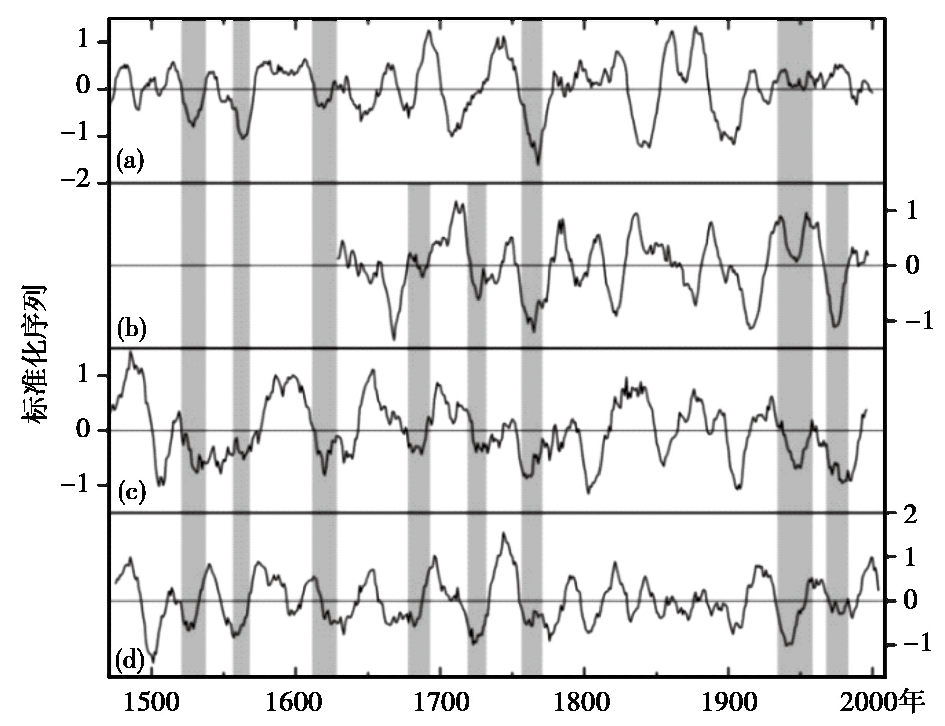
为了验证本次重建序列的准确性和可信性,将三江源区内以及青藏高原其他地区一些过往重建序列进行对比验证,所有重建序列先经标准化处理,再作11a滑动平均以便于对比各序列低频变化特征,如图 7所示,图 7a是时兴合等[28]于杂多重建的5~6月平均最高气温序列,图 7b是Liang等[30]在长江源重建的夏季最低气温,图 7c为Gou等[31]于黄河源区内重建的夏季最高气温,图 7d为本次重建序列。4条序列低频变化趋势相一致,Gou等[31]的重建序列与本文重建序列间相正相关性显著,相关系数为0.44(n=522,p<0.0001),青海杂多的重建序列[28]与此次重建序列间相关系数为0.33(n=526,p<0.0001),二者间相关性也很显著。对于低频的变化特征反映以及冷暖期的划分,各重建序列都有较好的一致性,特别是在近1个世纪以内,4条序列都能反映20世纪中期的低温期,图 7b、 图 7c和图 7d中3条曲线能显示出20世纪80年代气温的上升趋势,与器测数据所反映出的高原气温变化特征也是相一致的。另外,4条重建序列都能反映出18世纪中期的一次冷时期,18世纪后期的一次暖期以及19世纪初的冷期,
|
图 7 本次重建序列(d)与杂多5~6月平均最高气温[28](a)、 长江源夏季最低气温[30](b)以及青藏高原东北部夏半年最高气温序列[31](c)年代际对比 Fig. 7 Interdecadal comparison between reconstructed series in this study (d) and in previous studies as average maximum temperature of Zadoi from May to June[28](a),minimum temperature of Yangtze River source region in summer[30](b)and maximum half-year temperature of summer on northeastern Tibetan Plateau[31](c) |
其中,18世纪后期的暖期还与汪青春等[32]18世纪后期的暖期一致,18世纪中期的冷时段在秦宁生等[33]和汪青春等[32]重建的气温序列中也有所体现。由于图 7b序列时间尺度较短,不能反映出17世纪中期之前的变化特征,另外3条序列在17世纪中期之前部分变化特征十分相似,如15世纪末和16世纪初短暂的暖期,16世纪中期前后的两次冷期以及17世纪初期的冷时期,17世纪初的冷期在靳立亚等[34]序列中也有体现。各序列变化特征大致相同,但也有变化趋势不同的时段存在,如本次重建序列在1830~1840年间是一个低值时段,与其余序列变化不一致,同时在1850~1900时段,此次的重建序列振荡幅度明显弱于其他序列,产生以上这些差异跟采样点的小生境或是所采用的树种以及年表的不同有关。
5.2 与史料文献比较根据其他一些史料记载,图 7中的一些气温冷暖变化规律以及持续时间能找到一些很好的对应,如记述中,从清乾隆九年到四十三年(即1744~1778年),青海地区有所记录的低温、 寒潮、 强降温灾害就达到了20起[35],从图 7的(a)、(b)、(c)以及(d)的4条曲线都表现为低温时段或是降温时段,与历史记载基本对应。另外图 7在20世纪50年代左右4条重建序列均为低温期或降温期,而这一时段的历史记载中(1942~1956年),共有11起雪灾记录,其中有一半以上雪灾发生在春末夏初之际,记录中最严重的事件发生在1942年,青海省十二个县在八月普降大雪,造成当时各地粮食作物全面减产,“禾稼冻枯,秋收无望”[35]就是直接写照,给当时社会经济带来严重损失。一些极端干旱事件的记载可以从侧面反映高温时期,如明成化十七年至弘治十二年(1481~1499年)期间有多次较为严重的干旱事件的记载[35],这一时期正对应着本文重建的15世纪末期这一明显的高温时段,另在清乾隆至嘉庆年间,也存在少量干旱记述记载,与18世纪后期的暖期时段相对应[35, 36]。综上可以看出,重建的最高气温序列冷暖变化特征与古书记载具有很高的一致性,序列的可靠性得到了进一步的证实。
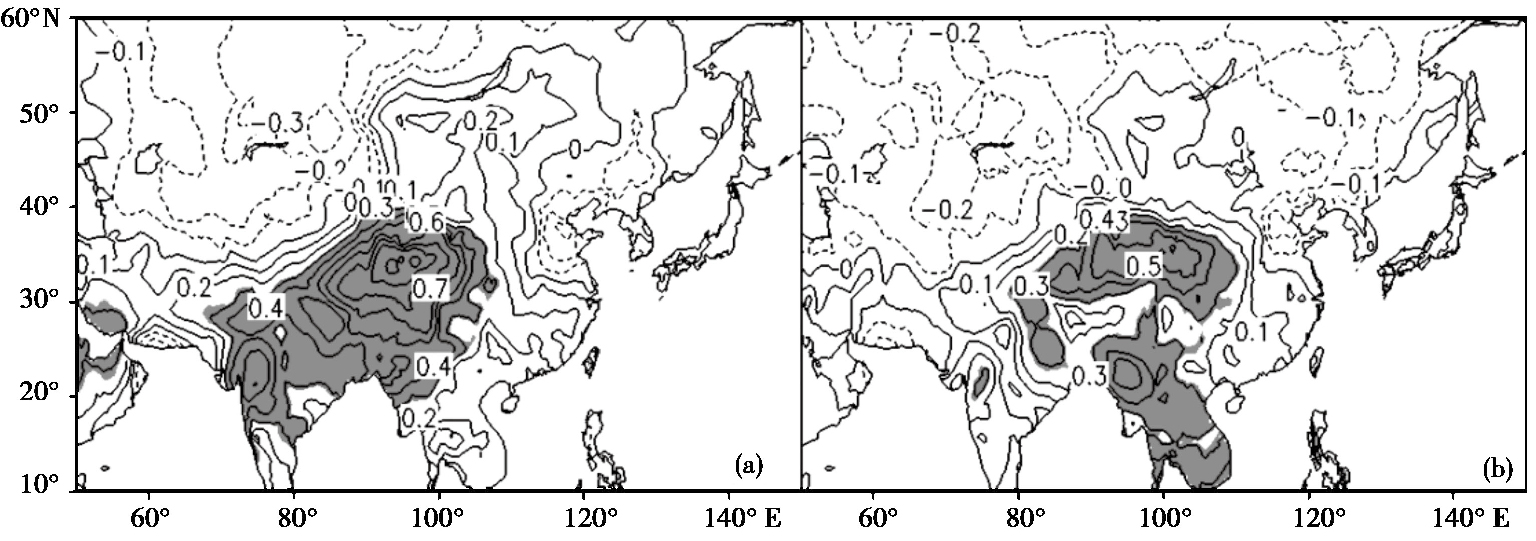
6 空间相关及周期分析 6.1 空间代表性图 8展示出了重建序列的空间代表性分布图,利用Climate Research Unit(CRU TS 3.22,0.5°×0.5°) 格点数据资料1960~2009年4~6月平均最高气温分别与相同时期的长江源区实际测量最高气温与重建最高气温序列做相关分析,图 8a表示源区实测值与CRU格点资料空间相关分布,在整个青藏高原地区都是相关系数的高值区域,特别是在三江源附近,相关系数都在0.6以上; 图 8b为重建序列跟CRU数据相关系数分布,其分布特征与图 8a相似,相关系数高值区也主要分布在高原地区,说明此次重建的最高气温序列对于整个青藏高原都具有较好的空间代表性。
|
图 8 实测最高气温(a)和重建最高气温(b)分别与CRU格点4~6月平均最高气温(1960~2009)空间相关分布阴影表示相关性超过0.05的显著性区域 Fig. 8 Distribution of spatial correlation between measured maximum temperature (a) and reconstructed maximum temperature (b) with CRU grid data of average maximum temperature form April to June during 1960~2009,respectively. The shading areas indicate correlation over significant of 0.05 |
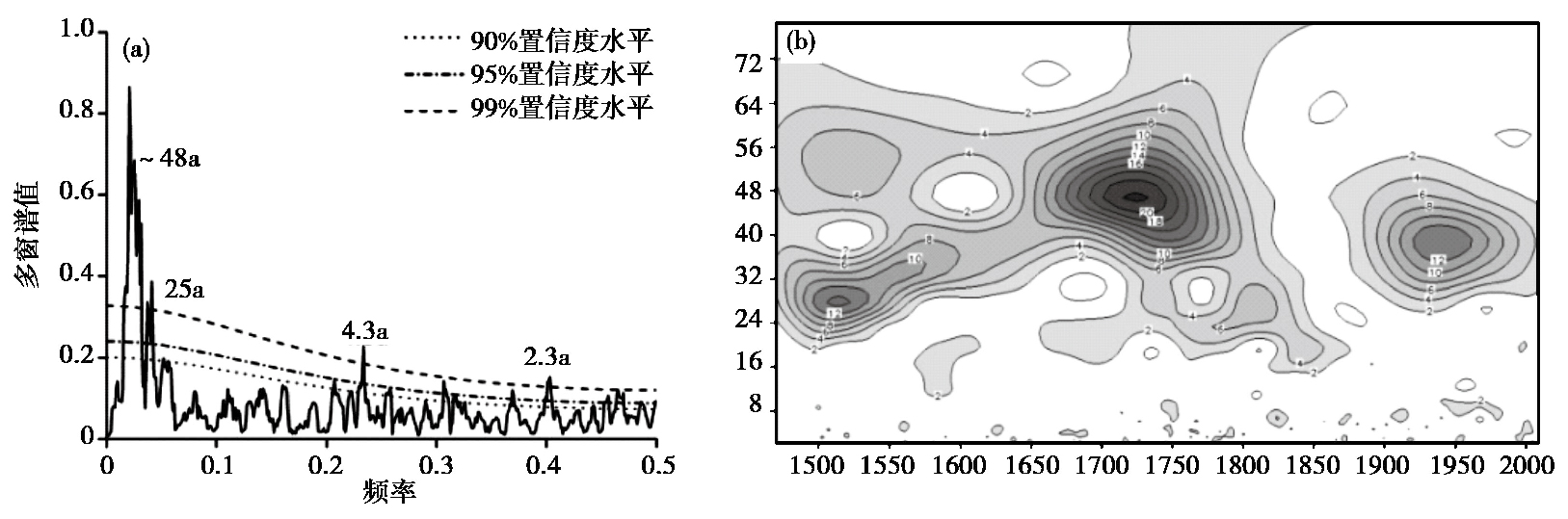
利用多窗谱分析(Multi-Taper Method)对重建的最高气温序列周期变化特征进行一定的检验,结果如图 9a所示。可以看出重建序列存在多个年代际周期,同时在高频和低频区都有周期性变化,其中超过0.01的周期包括准48a、 25a、 4.3a和2.3a,以上周期中,在48a处具有很高的能量值,显著性很强,另据图 9b的Morlet小波变换系数模同样发现在48a有一个极强的能量中心,说明本次重建序列中准48a的变化周期极为显著。所有显著周期中,2.3~4.3a周期性变化与厄尔尼诺-南方涛动(ENSO)振荡周期相符合[37, 38],这种气候变化特征十分普遍,由海洋与大气相互制约,26a左右的周期与北大西洋涛动(NAO)和太平洋年代际振荡(PDO)具有一定关联性[39, 40, 41],而准48a振荡周期可能和太阳的活动,东亚夏季风变化以及夏季西太平洋副高的低频变化有关[42, 43]。另外,重建序列与SST(1850~2009年)间相关系数分布表明(图 10),在东南亚地区附近海域,西、 南太平洋以及北大西洋区域都存在较为显著正相关,进一步确认了上述因子对重建序列周期的影响。
|
图 9 重建的最高气温序列多窗谱分析(a)以及Morlet小波变化系数模(b) Fig. 9 Multi-Taper Method analysis (a) and Morlet wavelet transform coefficients model (b) of reconstructed maximum temperature |
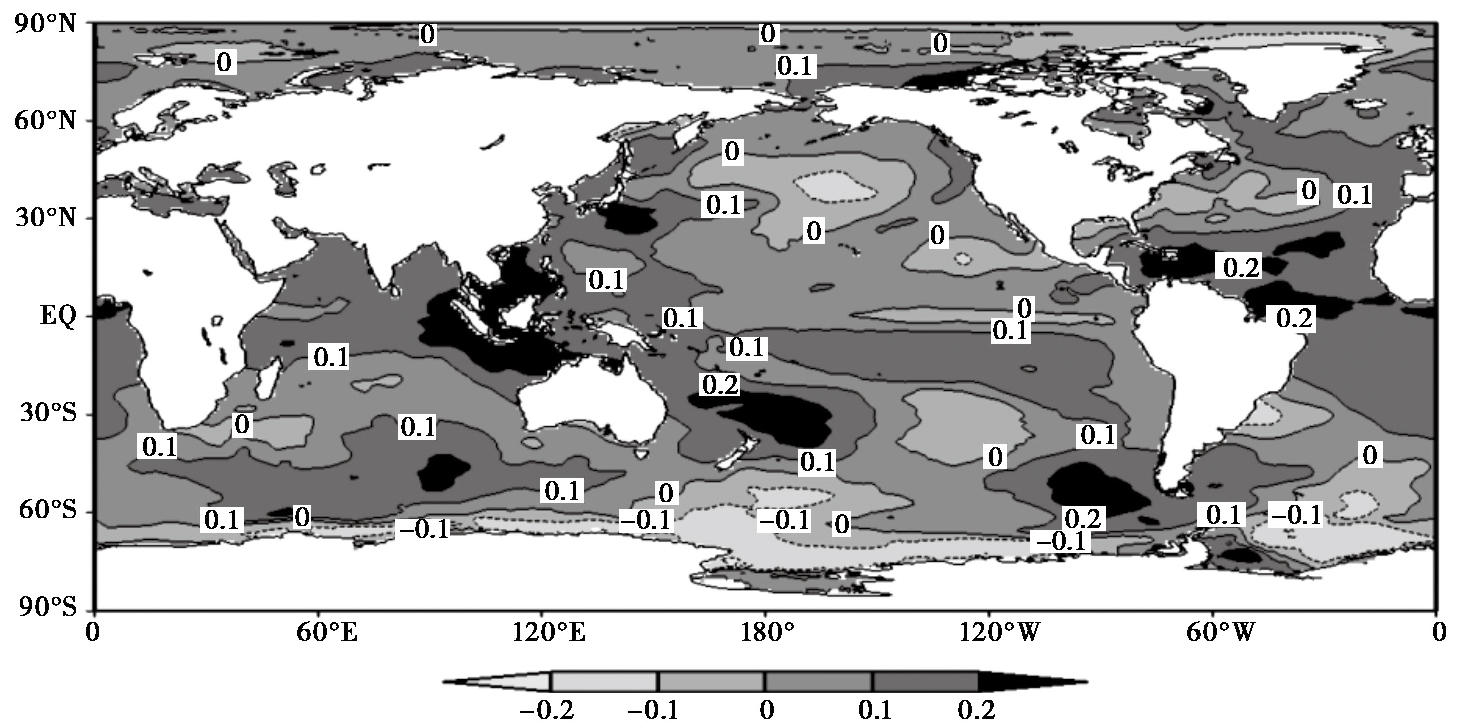
|
图 10 重建最高气温与4~6月SST(1856~2009年)空间相关分布 Fig. 10 Space correlation between reconstructed maximum temperature and SST from April to June during 1856~2009 |
本文利用采集自长江源区境内夏日寺(XRS)、 约改(YG)和巴干(BG)3个样点大果圆柏树轮样本,建立各采样点标准化年表并合成一个总年表RC以代表整个长江源区,重建了长江源1470~2009年4~6月平均最高气温历史序列,重建方程各种验证表明此重建序列是可靠的。重建序列中,极端偏暖年份有20年,最暖的年出现在1749年,极端偏冷年份有6年,最冷出现在1726年。重建最高气温序列在过去期间总共经历了11次暖期和12次冷期,偏暖强度最大的时期是1734~1754年,而偏冷强度最大的时期为1493~1510年。将此次重建序列与三江源地区其他3条气温重建序列作对比,结果表明各序列间变化趋势都具有较好的一致性,各序列所经历的冷暖时段变化也具有很高的相同性,关于冷暖时期变化特征分析结果得到了其他一些的重建结果以及历史记载的证实。经空间代表性分析发现最高气温重建序列对于长江源、 整个三江源甚至空间尺度更为广泛的青藏高原地区最高气温变化特征都具有很好的代表性。重建序列存在显著2.3a、 4.3a、 25a以及准48a周期变化,可能与ENSO、 NAO、 PDO以及太阳活动等因素有一定联系。
| 1 | Liu Xiaodong, Chen Baode. Climatic warming in the Tibetan Plateau during recent decades. International Journal of Climatology, 2000,20 (14):1729~1742 |
| 2 | 冯 松, 汤懋苍, 王冬梅. 青藏高原是我国气候变化启动区的新证据. 科学通报, 1998,43 (6):633~636 Feng Song, Tang Maocang, Wang Dongmei. New evidence of Tibetan Plateau is the start area of climate change in China. Chinese Science Bulletin, 1998,43 (6):633~636 |
| 3 | 蔡 英, 李栋梁, 汤懋苍等. 青藏高原近50年来气温的年代际变化. 高原气象, 2003,22 (5):464~470 Cai Ying, Li Dongliang, Tang Maocang et al. Decadal temperature changes over Qinghai-Xizang Plateau in recent 50 years. Plateau Meteorology, 2003,22 (5):464~470 |
| 4 | 勾晓华, 杨梅学, 彭剑峰等. 树轮记录的阿尼玛卿山区过去830年夏半年最高气温变化. 第四纪研究, 2006,26 (6):991~998 Gou Xiaohua, Yang Meixue, Peng Jianfeng et al. Maximum temperature reconstruction for Animaqing Mountains over past 830 years based on tree ring records. Quaternary Sciences, 2006,26 (6):991~998 |
| 5 | 刘 禹, 安芷生, Linderholm H W等. 青藏高原中东部过去2485年以来温度变化的树轮记录. 中国科学: 地球科学, 2009,39 (2):166~176 Liu Yu, An Zhisheng, Linderholm H W et al. Tree-ring records of temperature changes on eastern Qinghai-Tibet Plateau over the past 2485 years. Science China:Earth Sciences, 2009,39 (2):166~176 |
| 6 | Shao X M, Wang S Z, Zhu H F et al. A 3585-year ring-width dating chronology of Qilian Juniper from the northeastern Qinghai-Tibetan Plateau. IAWA Journal, 2009,30 (4):379~394 |
| 7 | 刘 禹, 蔡秋芳, 宋慧明等. 关于青藏高原2485年温度的季节和空间代表性问题. 第四纪研究, 2013,33 (1):108~114 Liu Yu, Cai Qiufang, Song Huiming et al. Seasonal and spatial representativeness of the tree-ring based 2485-year annual mean temperature reconstruction in the northeastern Tibetan Plateau. Quaternary Sciences, 2013,33 (1):108~114 |
| 8 | 彭剑锋, 勾晓华, 陈发虎等. 阿尼玛卿山不同海拔青海云杉(Picea crassifolia)树轮生长特性及其对气候的响应. 生态学报, 2007,27 (8):3268~3276 Peng Jianfeng, Gou Xiaohua, Chen Fahu et al. Characteristics of ring-width chronologies of Picea crassifolia and their responses to climate at different elevations in the Anyemaqen Mountains. Acta Ecologica Sinica, 2007,27 (8):3268~3276 |
| 9 | 邵雪梅, 方修琦, 刘洪斌等. 柴达木盆地东缘山地千年祁连圆柏树轮定年分析. 地理学报, 2003,58 (1):90~100 Shao Xuemei, Fang Xiuqi, Liu Hongbin et al. Dating the 1000-year-old Qilian Juniper in Mountains along the eastern margin of the Qaidam Basin. Acta Geographica Sinica, 2003,58 (1):90~100 |
| 10 | Qin Ningsheng, Shao Xuemei, Jin Liya et al. Climate change over southern Qinghai Plateau in the past 500 years recorded in Sabina tibetica tree rings. Chinese Science Bulletin, 2003,48 (22):2483~2487 |
| 11 | 李宗善, 刘国华, 傅伯杰等. 利用树木年轮宽度资料重建川西米亚罗地区过去200年夏季温度的变化. 第四纪研究, 2011,31 (3):522~534 Li Zongshan, Liu Guohua, Fu Bojie et al. Tree ring-based summer temperature reconstruction over the past 200 years in Miyaluo of western Sichuan, China. Quaternary Sciences, 2011,31 (3):522~534 |
| 12 | 马 龙, 刘廷玺, 冀鸿兰等. 科尔沁沙地1826年以来榆树树轮宽度年表的建立及降水重建. 第四纪研究, 2011,31 (2):360~369 Ma Long, Liu Tingxi, Ji Honglan et al. Establishment of ring width chronology and rainfall reconstruction of Ulmus pumila L. in Horqin sandy land since 1826. Quaternary Sciences, 2011,31 (2):360~369 |
| 13 | 田沁花, 周秀骥, 刘 禹等. 秦岭地区多点树轮序列记录的春末夏初气温变化与北半球海温关系的初步分析. 第四纪研究, 2011,31 (5):864~872 Tian Qinhua, Zhou Xiuji, Liu Yu et al. Historical late-spring-to-early-summer temperature at Qinling Mountain Range inferred from multi-site tree-ring chronologies, and their relationship with Northern Hemisphere sea surface temperature. Quaternary Sciences, 2011,31 (5):864~872 |
| 14 | 张同文, 刘 禹, 袁玉江等. 利用树轮资料重建天山中段南坡巩乃斯地区公元1777年来平均最高气温变化. 第四纪研究, 2011,31 (6):1011~1021 Zhang Tongwen, Liu Yu, Yuan Yujiang et al. Tree ring based mean maximum temperature reconstruction for the Gongnaisi region on the southern slope of the central Tienshan Mountain, China since A.D. 1777. Quaternary Sciences, 2011,31 (6):1011~1021 |
| 15 | 任军莉, 刘 禹, 宋慧明等. 甘肃临夏地区过去195年最高温度历史重建——基于紫果云杉树轮宽度资料. 第四纪研究, 2014,34 (6):1270~1279 Ren Junli, Liu Yu, Song Huiming et al. The historical reconstruction of the maximum temperature over the past 195 years, Linxia region, Gansu Province——Based on the data from Picea purpureaMast. Quaternary Sciences, 2014,34 (6):1270~1279 |
| 16 | 张志华, 吴祥定. 采用青海两个树木年轮年表重建局地过去降水的初步分析. 应用气象学报, 1992,3 (1):61~69 Zhang Zhihua, Wu Xiangding. Utilizing two Qinghai tree-ring chronologies to reconstruct and analyze local historical precipitation. Journal of Applied Meteorological Science, 1992,3 (1):61~69 |
| 17 | 徐瑞珍, 周陆生. 由斑玛云杉年表重建青海高原东南部夏季降水序列. 气象, 1992,26 (1):3~8 Xu Ruizhen, Zhou Lusheng. Reconstruction of summer precipitation in southeastern Qinghai Plateau using spruce chronology at Banma. Meteorological Monthly, 1992,26 (1):3~8 |
| 18 | 时兴合, 秦宁生, 刘洪滨等. 青海治多公元1374年以来树轮记录的青藏高原地面加热场强度变化. 第四纪研究, 2013,33 (1):115~125 Shi Xinghe, Qin Ningsheng, Liu Hongbin et al. Surface heating field intensity change over Tibetan Plateau recorded Qinghai Zhiduo tree rings since 1374A.D.Quaternary Sciences, 2013,33 (1):115~125 |
| 19 | 杨 保. 树轮记录的小冰期以来青藏高原气候变化的时空特征. 第四纪研究, 2012,32 (1):81~94 Yang Bao. Spatial and temporal patterns of climate variations over the Tibetan Plateau during the period 1300~2010. Quaternary Sciences, 2012,32 (1):81~94 |
| 20 | 赵 亮, 李 奇, 陈懂懂等. 三江源区高寒草地碳流失原因、增汇原理及管理实践. 第四纪研究, 2014,34 (4):795~802 Zhao Liang, Li Qi, Chen Dongdong et al. Principles of alpine grassland ecosystems carbon sequestration and management practices on Sanjiang regions, Tibet. Quaternary Sciences, 2014,34 (4):795~802 |
| 21 | 何友均. 三江源自然保护区森林植物多样性及其保护研究. 北京: 中国林业出版社, 2008. 22~43 He Youjun. Research of Forest Plant Diversity and Protection in the Three-river Source Nature Reserve. Beijing:China Forestry Publishing House, 2008.22~43 |
| 22 | Holmes R L. Computer-assisted quality control in tree-ring dating and measurement. Tree-Ring Bulletin, 1983, 43 :69~78 |
| 23 | 吴祥定. 树木年轮与气候变化. 北京: 气象出版社, 1990. 125~144 Wu Xiangding. Tree-ring and Climate Change. Beijing:China Meteorological Press, 1990. 125~144 |
| 24 | Fritts H C. Tree Ring and Climate. London:Academic Press, 1976. 1~39 |
| 25 | Cook E R. A Time Series Analysis Approach to Tree-ring Standardization. Tucson:University of Arizona Press, 1985. 162~183 |
| 26 | 李金建, 邵雪梅, 李媛媛等. 树轮宽度记录的松潘地区年平均气温变化. 科学通报, 2014,59 (15):1446~1458 Li Jinjian, Shao Xuemei, Li Yuanyuan et al. Annual temperature recorded in tree-ring from Songpan region. Chinese Science Bulletin, 2014,59 (15):1446~1458 |
| 27 | 段建平, 王丽丽, 李 论等. 树轮最大密度记录的贡嘎山区公元1837年以来的温度变化. 科学通报, 2010,55 (11):1036~1042 Duan Jianping, Wang Lili, Li Lun et al. Temperature variability since A.D. 1837 inferred from tree-ring maximum density of Abies fabric in Gongga Mountains, China. Chinese Science Bulletin, 2010,55 (11):1036~1042 |
| 28 | 时兴合, 秦宁生, 朱海峰等. 青海杂多大果圆柏年轮指示的公元1360~2005年5~6月最高气温变化. 科学通报, 2010,55 (19):1924~1931 Shi Xinghe, Qin Ningsheng, Zhu Haifeng et al. May-June mean maximum temperature change during 1360~2005 as reconstructed by tree rings of Sabina tibetica in Zaduo, Qinghai Province. Chinese Science Bulletin 2010,55 (19):1924~1931 |
| 29 | 朱海峰, 郑永宏, 邵雪梅等. 树木年轮记录的青海乌兰地区近千年温度变化. 科学通报, 2008,53 (15):1835~1841 Zhu Haifeng, Zheng Yonghong, Shao Xuemei et al. Millennial temperature reconstruction based on tree-ring widths of Qilian Juniper from Wulan, Qinghai Province, China. Chinese Science Bulletin, 2008,53 (15):1835~1841 |
| 30 | Liang E Y, Shao X M, Qin N S. Tree-ring based summer temperature reconstruction for the source region of the Yangtze River on the Tibetan Plateau. Global and Planetary Change, 2008,61 (3~4):313~320 |
| 31 | Gou X H, Peng J F, Chen F H et al. A dendrochronological analysis of maximum summer half-year temperature variations over the past 700 years on the northeastern Tibetan Plateau. Theoretical and Applied Climatology, 2008,93 (3~4):195~206 |
| 32 | 汪青春, 秦宁生, 李栋梁等. 利用多条树轮资料重建青海高原近250年年平均气温序列. 高原气象, 2005, 24 (3):320~325 Wang Qingchun, Qin Ningsheng, Li Dongliang et al. Annual mean surface air temperature over Qinghai Plateau in recent 250 years reestablished using data of multi-piece tree-ring. Plateau Meteorology, 2005, 24 (3):320~325 |
| 33 | 秦宁生, 时兴合, 邵雪梅等. 川西高原树木年轮所指示的平均最高气温变化. 高原山地气象, 2008,28 (4):18~24 Qin Ningsheng, Shi Xinghe, Shao Xuemei et al. Average maximum temperature change recorded by tree rings in west Sichuan Plateau. Plateau and Mountain Meteorology Research, 2008,28 (4):18~24 |
| 34 | 靳立亚, 秦宁生, 勾晓华等. 青海南部高原近450年来春季最高气温序列及其时变特征. 第四纪研究, 2005,25 (2):193~201 Jin Liya, Qin Ningsheng, Gou Xiaohua et al. Series of spring maximum temperature in southern Qinghai Plateau and analysis of its variations during the last 450 years. Quaternary Sciences, 2005,25 (2):193~201 |
| 35 | 温克刚. 中国气象灾害大典——青海卷. 北京: 气象出版社, 2006. 14~215 Wen Kegang. Chinese Meteorological Disasters Ceremony——Qinghai Volume. Beijing:China Meteorological Press, 2006. 14~215 |
| 36 | 王江山, 李锡福. 青海天气气候. 北京: 气象出版社, 2004. 198~243 Wang Jiangshan, Li Xifu. Weather and Climate of Qinghai. Beijing:China Meteorological Press, 2004. 198~243 |
| 37 | 李崇银, 穆 穆, 周广庆等. ENSO机理及其预测研究. 大气科学, 2008,32 (4):761~781 Li Chongyin, Mu Mu, Zhou Guangqing et al. Mechanism and prediction studies of the ENSO. Chinese Journal of Atmospheric Sciences, 2008,32 (4):761~781 |
| 38 | 李崇银, 龙振夏. 准两年振荡及其对东亚大气环流和气候的影响. 大气科学, 1992, 16 (2):167~176 Li Chongyin, Long Zhenxia. QBO and its influence on the general atmospheric circulation and the climate in East Asia. Chinese Journal of Atmospheric Sciences, 1992, 16 (2):167~176 |
| 39 | DArrigo R, Wilson R. On the Asian expression of the PDO. International Journal of Climatology, 2006,26 (12):1607~1617 |
| 40 | Maxwell R S, Hessl A E, Cook E R et al. A multicentury reconstruction of May precipitation for the mid-Atlantic region using Juniperus virginiana tree rings. Journal of Climate, 2012,25 (3):1045~1056 |
| 41 | Biondi F, Gershunov A, Cayan D R. North Pacific decadal climate variability since 1661. Journal of Climate, 2001,14 (1):5~10 |
| 42 | Silverman S M. Secular variation of the aurora for the past 500 years. Reviews of Geophysics, 1992,30 (4):333~351 |
| 43 | 郭其蕴, 蔡静宁, 邵雪梅等. 1873~2000年东亚夏季风变化的研究. 大气科学, 2004,28 (2):206~215 Guo Qiyun, Cai Jingning, Shao Xuemei et al. Studies on the variations of East Asian summer monsoon during 1873~2000. Chinese Journal of Atmospheric Sciences, 2004,28 (2):206~215 |
Abstract
Three Rivers source region located in the hinterland of the Qinghai-Tibet Plateau. It's not only a source region of China's major water resources, but also the world's highest wetland nature reserve. It's a scarcely populated area and less affected by human activities, so lots of ancient juniper and spruce trees distributed in this region. Studies have shown that these trees are suitable for the reconstruction of climate factors because the radial growth of trees were sensitive to climate response.
In this paper, three tree ring width standardized chronologies were created by Sabina tibetica Kom. which collected from three sampling sites of Yangtze River source region, one of the Three Rivers source. The sampling sites were XRS(33°44'N, 96°14'E; 3908~4050m a.s.l.), YG(33°47'N, 96°11'E; 4355~4455m a.s.l.)and BG(33°46'N, 96°24'E; 3933~4233m a.s.l.)respectively. All of them located in south slope, with the slope 30°~45° and the dominant tree species was Sabina tabetic Kom. According to the international conventional process, 162 root tree cores were collected.
Because of the three sampling points spaced closer, three standardized chronologies could be merged as RC to represent the entire Yangtze River source region. The climate factors include mean temperature, mean maximum temperature, mean minimum temperature, monthly precipitation, sunshine hours and relative humidity collected from five meteorological stations in the Yangtze River source region. Calculate the arithmetic average of each climate factor in the 5 stations in order to represent the whole Yangtze River source region. Correlation analysis between RC and climate factors founded that mean maximum temperature had a significant negative correlation with RC in April, May and June. Then combine the three months in a certain way and the results showed that there was a significant negative correlation between RC and mean maximum temperature in April-June. The correlation coefficient was -0.57.
On this basis, the average maximum temperature series of Yangtze River source region in April-June from 1470 to 2009 was reconstructed. The equation of reconstruction was stable and reliable with the explained variance reached to 32.7%, reduced to 31.3% after adjusting. In the reconstructed sequence, the number of extreme warm years is 20 while the number of extreme cold years is 20. The warmest year is 1749 and the coldest appeared in 1726. By low-frequency transform analysis founded that the reconstructed sequence has experienced 12 cold periods and 11 warm periods over the last 540 years. Compared reconstructed sequence with other three reconstructed temperature series, the trends among the sequences and the warm cold periods divisions were almost unanimous, the reliability of this sequence had been further confirmed. Spatial correlation analysis showed that the reconstructed sequence had a good representation for the variation of April-June average maximum temperature in the source region of Yangtze River, or even across the eastern Qinghai-Tibet Plateau. Multi-Taper and Morlet wavelet Method found that the reconstructed maximum temperature sequence had 2.3a, 4.3a, 25a and quasi 48a periods.