 2015, Vol.35


1 引言
青藏高原是长江、 黄河、 澜沧江等多条大河的发源地,被誉为亚洲的“水塔”[1],由气候变化引发的高原极端干旱事件深刻地影响着河流中下游的水量供给和农业生产。青藏高原上已有的树木年轮和冰芯数据显示,有气象记录以来的极端干旱事件并不能完全反映它们在更长时间尺度上的变化过程和规律[1, 2, 3, 4, 5, 6]。一个自然的科学问题是: 青藏高原极端干旱事件在过去数百年时间尺度上发生的规律及其与全球气候变化的关系是什么?要回答该问题需要在青藏高原不同的地理空间积累大量的历史极端干旱事件数据,然而,这方面的数据积累还非常有限。
树木年轮作为分辨率高、 记录连续性好、 复本易得、 定年准确的气候代用指标,在研究过去气候变化中发挥了重要作用[7, 8, 9, 10, 11, 12, 13, 14]。近些年来,研究者们通过树木年轮数据,在重建青藏高原的降水、 干湿变化历史等方面取得了一定成就[2, 4, 5, 6, 15, 16, 17, 18, 19, 20, 21, 22, 23, 24]。Yang等[16]重建了青藏高原最长的树轮宽度年表和降水序列,研究显示中世纪暖期和小冰期分别是湿润占优势和干旱占优势的时期; Qin等[17]论述了高原东北部的降水极端事件; Liu等[18]恢复了藏南中部的区域降水变化,重建结果证明在过去的500年里青藏高原南部降水量的高(低)时期与北部地区的干(湿)变化一致; Sheppard等[20] 利用祁连圆柏及考古木重建了青海东北部过去2500年的降水,发现这一地区相对干旱的时期有1651~1750年和1801~1825年,相对湿润的时期有1551~1600年; Shao等[21]利用祁连圆柏重建了青海德令哈和乌兰地区过去1437年的年降水量变化序列,发现柴达木盆地东北缘地区小冰期期间(1300~1900年)年降水量的变幅较大,最显著的湿润期在16世纪晚期(1563~1590年),最干旱且持续时间长的时期在17世纪后期到18世纪初期,而近40年处于相对湿润时期; Fang等[22]利用川滇冷杉重建了藏东南横断山区过去568年的帕尔默干旱指数(Palmer Drought Severity index,简称PDSI),发现1560s~1580s、 1700s、 1770s、 1810s、 1860s和1980s为10年尺度的干旱事件; Gou等[23] 重建了藏东南甘孜州乡城县过去457年的降水变化,发现17世纪的干旱持续时间最长,近20年这一地区变得更加湿润; Wang等[24]利用大果圆柏重建了藏北那曲地区嘉黎县过去500年的干湿变化,同样证明了17世纪是最干旱的世纪,18世纪以来则相对湿润。
标准化降水蒸散指数(Standardized Precipitation-Evapotranspiration Index,简称SPEI)[25, 26, 27]是在标准化降水指数(Standardized Precipitation Index,简称SPI)的基础上,引入潜在蒸发项所构建,既具有多时间尺度的优点,又考虑了温度变化对干旱的影响[28]。Gou等[29]利用树轮宽度资料重建了青藏高原东北部SPEI过去千年的变化历史,表明SPEI在该区域的树轮学研究中已经得到了关注和应用。本文通过青藏高原东南部昌都地区3个采样点大果圆柏(Sabina tibetica Kom.)树轮宽度数据,利用SPEI分析了自1560年以来447年间该区域极端干旱事件发生的特征。研究结果可为深入认识青藏高原极端气候事件的时空发生规律及与全球气候变化的关系提供参考,同时对科学制定区域水资源管理方案也具有现实意义。
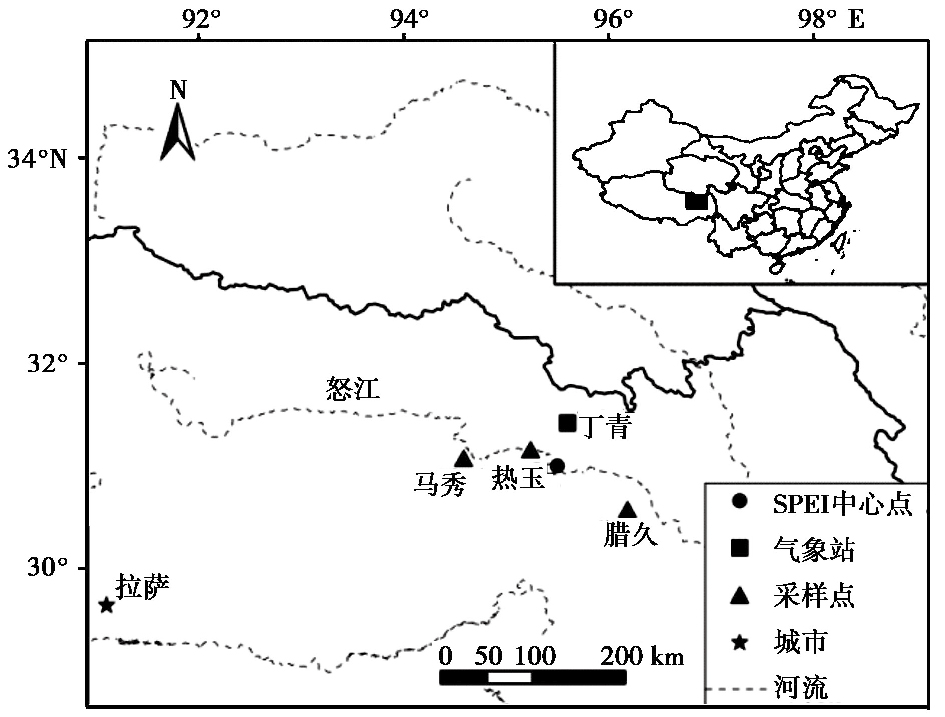
2 研究区域与方法 2.1 研究区域气候与植被本研究的区域为西藏藏族自治区昌都地区边坝县和洛隆县的3个采样点,它们分别是马秀(31 . 08°N,94 . 58°E) 、 热玉(31 . 16°N,95 . 24°E)和腊久(30 . 58°N,96 . 18°E) ( 图 1)。
|
图 1 采样点示意图 Fig. 1 The location map of the sampling sites |
该区域位于念青唐古拉山以东,属于怒江流域。地貌类型以高山和高原为主,地势西北高东南低,海拔在3400m以上(马秀4144m,热玉3468m以及腊久4440m)。研究区属于藏东南高原温带半干旱季风气候区,夏季气候温和湿润,冬季气候干冷; 日照充足,太阳辐射强; 日温差大,年温差小; 降雨集中在5~9月,蒸发量大,相对湿度小。主要植被类型有干旱河谷灌丛、 山地针叶林、 山地灌丛草甸、 高山灌丛、 高山草甸和高山稀疏垫状植被等。
文中使用的温度、 相对湿度及降水量数据来自丁青气象站(31.42°N,95.6°E)(见图 1),标准化降水蒸散指数(SPEI)数据来自荷兰皇家气象研究所的数据共享网站(http://climexp.knmi.nl/)。选取尺度为12个月的SPEI数据,区域范围为 30.5°~31.5°N,94.5°~96.5°E。
2.2 树轮数据本研究所用的树种为大果圆柏(Sabina tibetica Kom.)。2007年夏天,我们分别在3个研究地点选择年龄较老的树木采集了树轮样本,每棵树在胸高处沿平行坡向取1根样芯,每个地点至少采集30个样本。按照树木年轮学的基本方法,将采集的样芯进行固定、 打磨,对打磨后的树轮样本利用Lintab树轮测量仪进行年轮宽度的测量,精确度为0.001mm。测量后的树轮序列通过多种方法进行交叉定年,使得每个年轮都对应上其正确的生长年份。交叉定年的方法包括:1)直观比较树轮序列曲线图的一致性; 2)利用COFECHA程序[30]比较树轮序列的统计相关性; 3)在显微镜下观察前两个方法中提示的可能存在问题的年轮片段,找出问题并改正。因破碎或生长过于独特而无法准确交叉定年的样本在后续的数据分析中剔除。
利用ARSTAN程序[31]分别对3个采样点的树轮宽度序列进行标准化处理,去除树木本身在年龄增大过程中伴随的生长趋势。我们采用步长为50 % 样芯长度的样条函数对原始测量序列进行生长趋势拟合,然后用测量值除以拟合值,得到无量纲的年轮指数序列; 接下来,利用自回归模型去除年轮指数序列的自相关信息,最后,采用双权重平均法将年轮指数按年份进行平均,得到了残差年表(RES)[32]。
我们计算了3个年表的样本总体代表性(Expressed Population Signal,简称EPS)[33],用来判断年表的可靠性,并用EPS不小于0.85为标准来确定年表的可靠时段。此外,计算了3个采样点年表间的滑动相关系数矩阵,相关分析结果表明3个采样点的树轮宽度年表具有较好的一致性。为了更好地代表区域尺度上的树轮宽度变化历史,将马秀、 热玉和腊久的样本合并,以相同方法利用ARSTAN程序建立了区域树轮宽度年表。树轮宽度年表建立后,为了鉴别树木年轮与气候因子的关系,计算了合成区域年表与温度、 降水等气候因子的相关系数,并分析了3个采样点树轮宽度年表与其所在区域月平均 SPEI的相关性。
树轮宽度年表建立后,为了鉴别极端气候事件,我们对公共时期内(1560~2006年)3个树轮采样点的年轮指数分别进行了排序,将年轮指数小于最低10 % 的年份定义为极低生长年,年轮指数在10 % ~20 % 之间的年份定义为低生长年[34, 35]。并将3个采样点共同的极低生长年或者2个采样点为极低生长年、 另外一个点为低生长年的年份定义为共同极低生长年。为了考察极端气候事件的发生频率,我们计算了整个1560~2006年间每50年的共同极低生长年发生的次数。
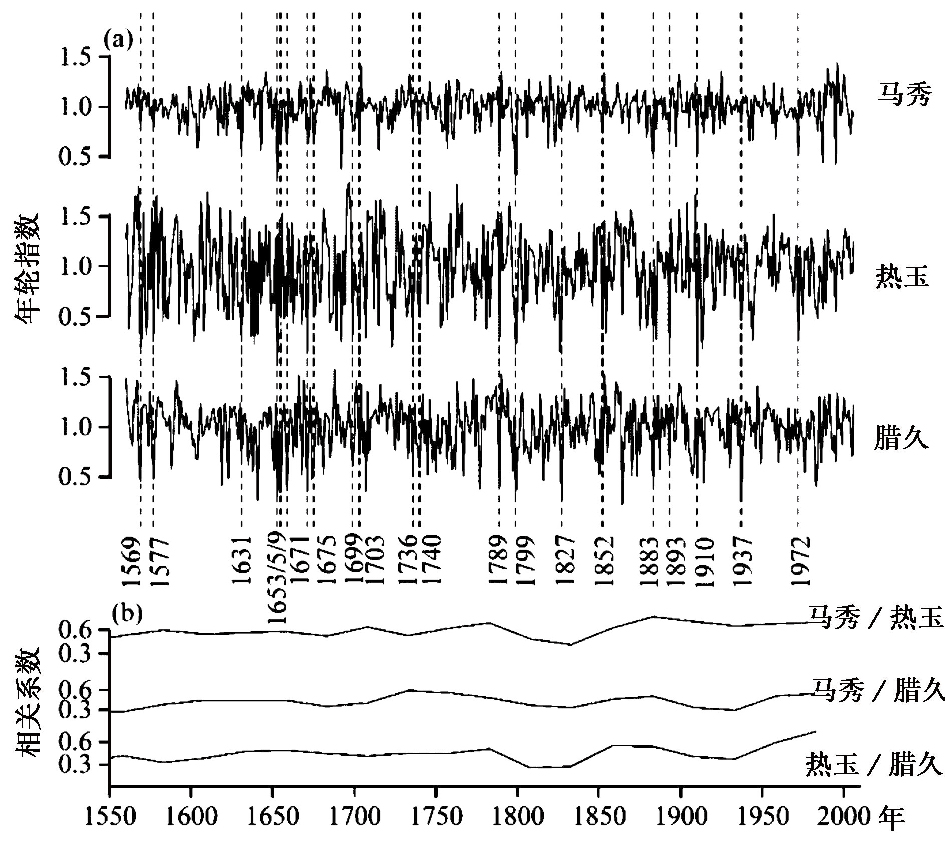
3 结果 3.1 树轮宽度年表及其与干旱指数SPEI的关系经过交叉定年,我们获得了可用于建立树轮宽度年表的树轮样本( 表 1和 图 2),建立了3个采样点的树轮宽度年表( 图 3a)。以样本总体代表性EPS不小于0.85作为判断年表可靠性的标准,马秀年表的可靠区间为1500~2006年、 热玉年表为1475~2006年、 腊久年表为1560~2006年,3个采样点的共同区间为1560年到2006年,共447年。3个子样点年表和其所在区域月平均SPEI的相关系数显示,5~8月SPEI平均值与树轮宽度年表的相关性最高(马秀:r=0.461,p>0.001; 热玉:r=0.665,p>0.001; 腊久:r=0.490,p>0.001)。
|
表 1 3个采样点树轮宽度年表的统计特征 Table 1 Statistical characteristics of tree-ring chronologies for the three sampling sites |

|
图 2 3个采样点个体样本长度和样本量虚线标识年份为3个采样点年表的共同区间起始年 Fig. 2 Tree core time spans and sample depths for individual sites. Dash line denotes the beginning of common periods of the three site chronologies |
|
图 3 3个采样点1560~2006年间的年轮指数(a)虚线标识年份为共同极低生长年;(b)以25年为步长的50年滑动窗口上的年表间相关系数 Fig. 3 Ring-width index for the three sites over the common period 1560~2006(a) and running correlation coefficients between site chronologies over 50-year windows with 25-year overlaps(b). Dashed lines denote common extreme low-growth years in (a) |
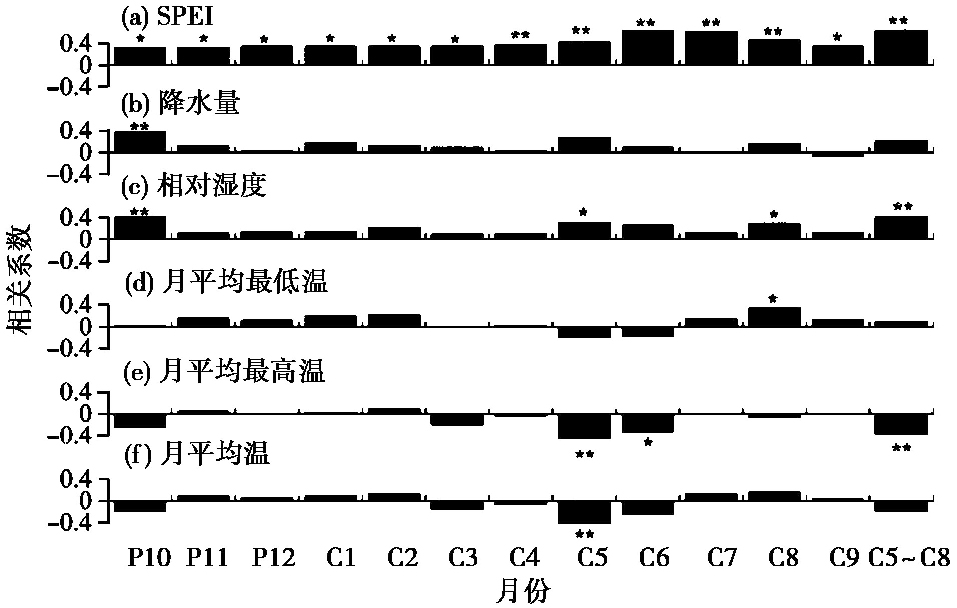
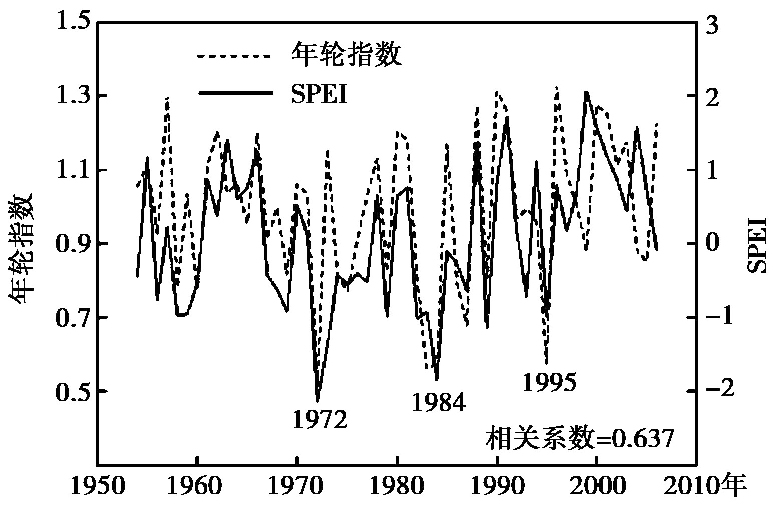
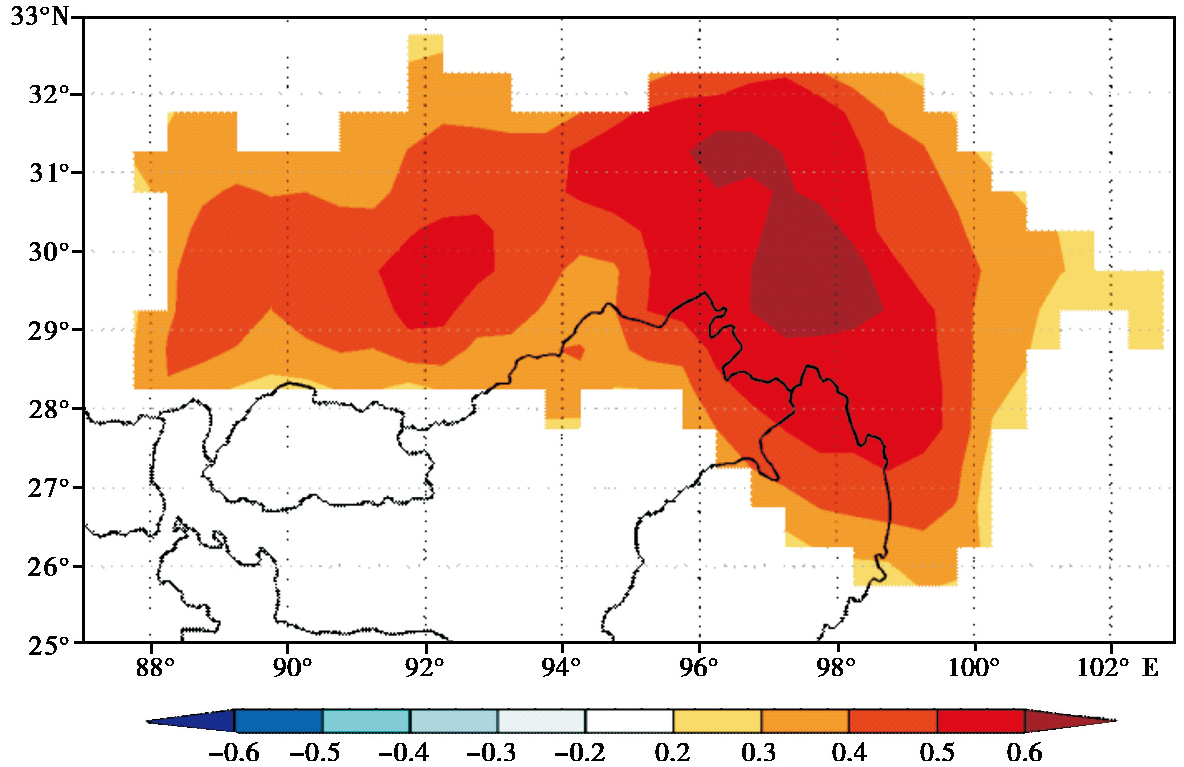
3个树轮年表间两两相关系数显示了采样点间树轮生长具有较好的一致性( 图 3b)。合成区域年表与气候因子的相关性分析表明树木生长与当年5~8月的SPEI及相对湿度显著正相关,与月平均最高温显著负相关,其中与SPEI的相关性最好,3个采样点树轮序列所合成的区域年表与5~8月SPEI的相关性最强(r=0.637,p>0.001)( 图 4和5)。空间相关分析表明,1954年至2006年,3个采样点合成年表与藏东南地区的5~8月SPEI显著正相关,相关最显著的地区位于研究区附近( 图 6)。我们对有气象记录时期(1954~2006年)3个树轮采样点的年轮指数分别进行了排序,按前面提到的方法考察了极低生长年,发现共同极低生长年为1972年、 1984年和1995年,根据1954~2006年5~8月SPEI的记录,这些年也同时是该区域的干旱年(见 图 5)。根据文献记载[36],1937年西藏普遍干旱,该年也是3个采样点的共同极低生长年。
|
图 4 1954~2006年藏东南地区气候因子和区域树轮残差年表相关性P: 树轮形成前一年的月份; C: 树轮形成当年的月份 Fig. 4 Correlation coefficients between climate factors and the regional tree-ring width chronology(1954~2006) in the southeast Tibet. The prefix ‘P' means months of the year before tree ring formation,the prefix ‘C’ means months of the year of tree ring formation |
|
图 5 1954~2006年藏东南地区5~8月SPEI(实线)和区域树轮残差序列(虚线) Fig. 5 May-August averaged SPEI for southeast Tibet(solid line) and the regional tree-ring width chronology (dash line) for 1954~2006 |
|
图 6 藏东南1954~2006年间5~8月SPEI与区域树轮宽度年表相关系数的空间格局 Fig. 6 Spatial pattern of correlation coefficients between May-August averaged SPEI and the regional tree-ring width chronology(1954~2006) in the southeast Tibet |
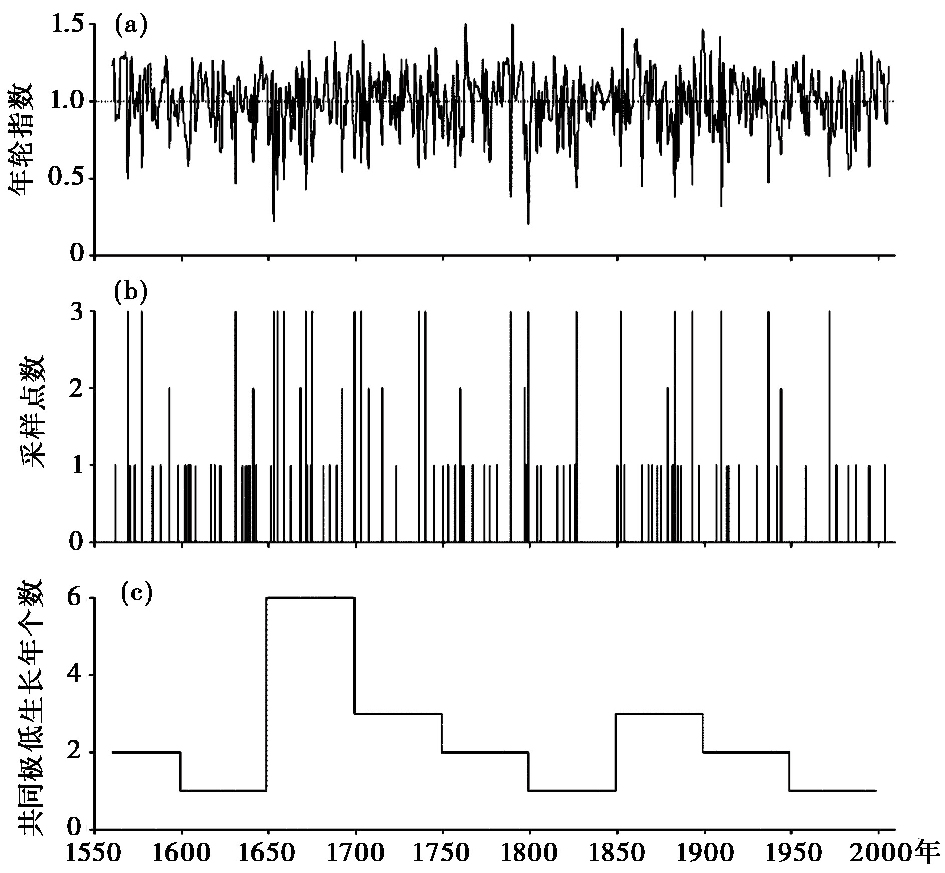
由于树木年轮可以反映干旱气候条件,尤其是极端干旱事件[24, 34, 37, 38, 39],本文将通过3个采样点树轮的共同极低生长年份来重点讨论过去极端干旱事件发生的时间、 程度和频率。在447年的公共时期内,找到21个共同极低生长年(1569年、 1577年、 1631年、 1653年、 1655年、 1659年、 1671年、 1675年、 1699年、 1703年、 1736年、 1740年、 1789年、 1799年、 1827年、 1852年、 1883年、 1893年、 1910年、 1937年和1972年),这些年份很可能指示了极端干旱事件的发生( 图 3a)。这些极端干旱事件在过去的447年间并不是均匀分布的( 图 7b),其发生较频繁的时期为1650~1700年,为6次/50年( 图 7c); 较少的时期为1600~1650年、 1800~1850年和1950~2000年,均为1次/50年; 整个过去的447年间平均极端干旱频率为4.7次/100年。在20世纪,有3次极端干旱事件(1910年、 1937年和1972年),发生的频率小于447年极端干旱事件的平均值。极端干旱频率的最小值出现在1578~1630年间,53年间没有一个极端年。而在1631~1703年间,73年间有8次极端干旱事件。干旱事件在短时间内频繁发生的情况在过去447年中也时有出现,5年间出现2次干旱的情况发生了5次,10年间出现3次干旱的情况发生了1次,出现在1650~1660年。
|
图 7 3个采样点合成区域年表(a)、 记录发生极低生长年的采样点个数(b)和每50年内共同极低生长年的个数(c) Fig. 7 Regional tree-ring width chronology(a),number of tree-ring sites showing occurrence of lowest-growth years(b),and 50-year sums of lowest-growth years(c) |
本文中树轮与生长季(5~8月)干旱指数SPEI存在显著的正相关关系(见图 3b),这一现象在过去的研究中已有报道[29, 40]。如青藏高原东北部祁连圆柏的生长受5~6月份的水分限制[2, 20, 21, 41]; Ren等[40]对青藏高原林芝地区祁连圆柏研究发现,木质部生长的起始时间为5月,5~7月降水对木质部形成起着关键性作用。以上研究中,尽管柏树对降水的响应在季节上存在地区差异,但都与5月起始的生长季水分条件有着密切的关系。
过去对于青藏高原历史上干湿变化的研究中,干旱指标多选用帕尔默干旱指数(PDSI)[24, 42],然而PDSI存在计算复杂、 参数区域性较强、 时间尺度固定等缺点[43]。本文中采用了近年来Vicente-Serrano等[27] 提出的SPEI来反映干旱变化,SPEI既保留对蒸发变化的灵敏性,又兼具计算简单、 资料易得和多时间尺度的特点[44, 45]。
4.2 大空间范围的极端干旱事件本文发现17世纪后半叶处于相对干旱时期和20世纪后半叶至今处于相对湿润时期。Sheppard等[20]对青海东北部的降水重建显示这一地区相对干旱的时期在1651~1750年,这与本文中极端干旱年份最多的时期基本一致; Shao等[21]对柴达木盆地东北缘的降水重建发现最干旱且持续时间长的时期在17世纪后期到18世纪初期,近40年处于相对湿润时期; 另外,对青海德令哈的降水重建显示干旱时期为1634~1741年[46]; 与Wang等[24]对藏北那曲地区的PDSI重建比较,本文重建的17世纪极端干旱年与那曲地区重建的干旱时期较为一致,而在18~19世纪的部分极端干旱年中,那曲地区重建记录显示处于湿润时期; Gou等[23] 对藏东南横断山脉的降水重建也表明了17世纪为干旱时间持续最长的世纪。本研究发现1650~1700年是极端干旱事件发生最频繁的时期。此时,根据树轮重建的降水序列显示藏东北地区[16]和藏南地区[18]也处于持续的干旱时期。此外,Qin等[17]在藏东北地区黑河径流量的重建研究中发现,1593~1739年也处于干旱气候期,并伴随径流量的显著下降。青藏高原地区历史文献资料记载的极端干旱事件也印证了本研究中树轮记录的极端干旱年份。 林振耀和吴祥定[36]对历史上西藏水旱规律的研究发现,近百年西藏有3个干旱期:1907~1915年、 1935~1946年和1963~1980年,其中1937年西藏境内普遍干旱,这与本研究中树轮资料指示的20世纪三大极端干旱事件(1910年、 1937年和1972年)基本相吻合。说明这些时期的极端干旱发生在更大的空间范围,可能受到共同的大尺度气候系统的控制。
4.3 极端干旱事件与太阳活动及亚洲西南季风的关系我们发现极端干旱发生最频繁的1650~1700年与太阳黑子活动较弱的1645~1715年蒙德极小期(Maunder Minimum)[47]相对应,那么两者之间的联系就成为一个需要回答的问题。已有研究表明青藏高原东南部树木生长季的降水主要来自印度洋的西南季风[48],过去1200年来的印度季风强度与太阳活动强弱存在较好的对应关系[49, 50]。季风的形成主要受到海陆温差的影响,太阳活动弱的时期,地球表面温度也降低,导致海陆温差降低,季风减弱,由季风输送到青藏高原的水分也相应减少[51, 52, 53]。本文中极端干旱频率历史与Bruning等[54]、 杨保等[39]建立的昌都树轮年表的比较表明,极端干旱事件频发的时期也是该地区的寒冷期,极端干旱发生最频繁的17世纪是小冰期中最冷的两个世纪之一[39, 55]。而相对温暖的时期,如18世纪初、 20世纪中期,极端干旱频率比较低。以上证据表明,该地区的气候变化呈现暖湿-冷干的模式。类似的气候变化模式也曾在受季风气候影响的横断山区的研究中有所报道[56]。此外,根据拉萨地区冷冬的历史记载,1650年前后为一明显的冷期[36, 57],而该时期也是2000年以来标志性的较弱季风期[58],多地出现干旱事件[16, 20, 23, 24]。此外,本研究中发现的极端干旱年份1789年和1972年(见图 3a)同时也是亚洲西南季风极弱年[59, 60],说明季风活动的强弱对高原干旱事件有着重要的影响。
5 结论本文通过藏东南昌都地区3个采样点大果圆柏的树轮宽度数据,重建了自1560年以来藏东南地区的极端干旱事件,主要得到如下结论: 目前气象记录观测到的极端干旱事件,并不能表现长期的干旱模式,在20世纪,极端干旱事件的发生频率低于历史上的平均值; 而在过去447年间(1560~2006年),3个采样点共同的极端干旱事件发生最频繁的时期为1650~1700年间,多达6次/50年,发生最少的时期有1600~1650年、 1800~1850年和1950~2000年,每50年仅有1次。极端干旱发生最频繁的1650~1700年对应于太阳活动较弱的蒙德极小期(Maunder Minimum),这段时期也是标志性的较弱季风期,说明减弱的太阳活动可能通过影响夏季风来影响干旱频率。
青藏高原一直被认为是全球变化的敏感区,研究结果有助于进一步认识青藏高原极端干旱事件的发生规律及其与全球气候变化的关系,同时对科学地制定区域水资源管理方案也具有现实意义。今后可在极端干旱的驱动机制、 长期的干旱模式等方面开展更加细致和深入的研究,这需要更大时间和空间尺度的树轮数据作为支撑。同时需要注意的是,森林衰退可能造成树木生长发育滞缓、 生产力降低甚至死亡[61],表现出年轮的低生长,这与极端干旱事件作用于树轮的表现类似,在进一步的研究工作中,需要将森林衰退噪音剔除。
致谢感谢中国科学院植物研究所树轮实验室的老师和同学在野外采样,室内树轮测量和交叉定年以及数据分析中的帮助。
| 1 | Xu X, Lu C G, Shi X H et al. World water tower:An atmospheric perspective. Geophysical Research Letters, 2008,35 (20):L20815, doi:10.1029/2008GL035867 |
| 2 | Zhang Q B, Cheng G D, Yao T D et al. A 2326-year tree-ring record of climate variability on the northeastern Qinghai-Tibetan Plateau. Geophysical Research Letters, 2003,30 (14):1739~1741 |
| 3 | Thompson L G, Mosley-Thompson E, Davis M E et al. Ice core evidence for asynchronous glaciation on the Tibetan Plateau. Quaternary International, 2006, 154~155 :3~10 |
| 4 | Shao X, Xu Y, Yin Z Y et al. Climatic implications of a 3585-year tree-ring width chronology from the northeastern Qinghai-Tibetan Plateau. Quaternary Science Reviews, 2010,29 (17):2111~2122 |
| 5 | Liu Yu, An Zhisheng, Ma Haizhou et al. Precipitation variation in the northeastern Tibetan Plateau recorded by the tree rings since 850 AD and its relevance to the Northern Hemisphere temperature. Science in China(Series D), 2006,49 (4):408~420 |
| 6 | Gou X H, Chen F H, Cook E R et al. Streamflow variations of the Yellow River over the past 593 years in Western China reconstructed from tree rings. Water Resources Research, 2007,43 (6):W06434, doi:10.1029/2006WR005705 |
| 7 | 吴祥定. 树木年轮与气候变化. 北京: 气象出版社, 1990. 238~239 Wu Xiangding. Tree Ring and Climate Change. Beijing:China Meteorology Press, 1990. 238~239 |
| 8 | 任军莉, 刘 禹, 宋慧明等. 甘肃临夏地区过去195年最高温度历史重建. 第四纪研究, 2014,34 (6):1270~1279 Ren Junli, Liu Yu, Song Huiming et al. The historical reconstruction of the maximum temperature over the past 195 years, Linxia region, Gansu Province——Based on the data from Picea purpurea Mast. Quaternary Sciences, 2014,34 (6):1270~1279 |
| 9 | 刘昶智, 勾晓华, 方克艳等. 甘肃南部公元1824年以来降水重建. 第四纪研究, 2013,33 (3):518~525 Liu Changzhi, Gou Xiaohua, Fang Keyan et al. Preciptation reconstruction in southern Gansu Province since A.D. 1824. Quaternary Sciences, 2013,33 (3):518~525 |
| 10 | 勾晓华, 杨梅学, 彭剑峰等. 树轮记录的阿尼玛卿山区过去830年夏半年最高温变化. 第四纪研究, 2006,26 (6):991~998 Gou Xiaohua, Yang Meixue, Peng Jianfeng et al. Maximum temperature reconstruction for Animaqing Mountains over past 830 years based on tree ring records. Quaternary Sciences, 2006,26 (6):991~998 |
| 11 | 李宗善, 刘国华, 傅伯杰等. 利用树木年轮宽度资料重建川西米亚罗地区过去200年夏季温度的变化. 第四纪研究, 2011,31 (3):522~534 Li Zongshan, Liu Guohua, Fu Bojie et al. Tree ring-based summer temperature reconstruction over the past 200 years in Miyaluo of western Sichuan, China. Quaternary Sciences, 2011,31 (3):522~534 |
| 12 | 刘 禹, 蔡秋芳, 宋慧明. 关于青藏高原2485年温度的季节和空间代表性问题. 第四纪研究, 2013,33 (1):108~114 Liu Yu, Cai Qiufang, Song Huiming. Seasonal and spatial representativeness of the tree-ring based 2485-year annual mean temperature reconstruction in the northeastern Tibetan Plateau. Quaternary Sciences, 2013,33 (1):108~114 |
| 13 | 田沁花, 周秀骥, 刘 禹等. 秦岭地区多点树轮序列记录的春末夏初气温变化与北半球海温关系的初步分析. 第四纪研究, 2011,31 (5):864~872 Tian Qinhua, Zhou Xiuji, Liu Yu et al. Historical late-spring-to-early-summer temperature at Qinling Mountain Range inferred from multi-site tree-ring chronologies, and their relationship with Northern Hemisphere sea surface temperature. Quaternary Sciences, 2011,31 (5):864~872 |
| 14 | 张同文, 刘 禹, 袁玉江等. 利用树轮资料重建天山中段南坡巩乃斯地区公元1777年来平均最高气温变化. 第四纪研究, 2011,31 (6):1011~1021 Zhang Tongwen, Liu Yu, Yuan Yujiang et al. Tree ring based mean maximum temperature reconstruction for the Gongnaisi region on the southern slope of the central Tien Shan Mountain, China since A.D. 1777. Quaternary Sciences, 2011,31 (6):1011~1021 |
| 15 | Li J B, Cook E R, D'arrigo R et al. Common tree growth anomalies over the northeastern Tibetan Plateau during the last six centuries:Implications for regional moisture change. Global Change Biology, 2008,14 (9):2096~2107 |
| 16 | Yang B, Qin C, Wang J L et al. A 3500-year tree-ring record of annual precipitation on the northeastern Tibetan Plateau. Proceedings of the National Academy of Sciences of the United States of America, 2014,111 (8):2903~2908 |
| 17 | Qin C, Yang B, Burchardt I et al. Intensified pluvial conditions during the twentieth century in the inland Heihe River basin in arid Northwestern China over the past millennium. Global and Planetary Change, 2010,72 (3):192~200 |
| 18 | Liu J J, Yang B, Huang K et al. Annual regional precipitation variations from a 700 year tree-ring record in south Tibet, Western China. Climate Research, 2012,53 (1):25~41 |
| 19 | Fan Z X, Bräuning A, Cao K F. Tree-ring based drought reconstruction in the central Hengduan Mountains region(China)since AD 1655. International Journal of Climatology, 2008,28 (14):1879~1887 |
| 20 | Sheppard P, Tarasov P, Graumlich L et al. Annual precipitation since 515 BC reconstructed from living and fossil Juniper growth of northeastern Qinghai Province, China. Climate Dynamics, 2004,23 (7~8):869~881 |
| 21 | Shao X M, Liang E Y, Huang L et al. A 1437-year precipitation history from Qilian Juniper in the northeastern Qinghai-Tibetan Plateau. Pages News,, 2005,13 (2):14~15 |
| 22 | Fang K Y, Gou X H, Chen F H et al. Reconstructed droughts for the southeastern Tibetan Plateau over the past 568 years and its linkages to the Pacific and Atlantic Ocean climate variability. Climate Dynamics,, 2010,35 (4):577~585 |
| 23 | Gou Xiaohua, Yang Tao, Gao Linlin et al. A 457-year reconstruction of precipitation in the southeastern Qinghai-Tibet Plateau, China using tree-ring records. Chinese Science Bulletin,, 2013,58 (10):1107~1114 |
| 24 | Wang X C, Zhang Q B, Ma K P et al. A tree-ring record of 500-year dry-wet changes in northern Tibet, China. The Holocene,, 2008,18 (4):579~588 |
| 25 | Vicente-Serrano S M, L Pez-Moreno J I, Lorenzo-Lacruz J et al. The NAO impact on droughts in the Mediterranean region. Advances in Global Change Research,, 2011, 46 :23~40 |
| 26 | Vicente-Serrano S M, Beguer A S, López-Moreno J I et al. A new global 0.5 gridded dataset(1901~2006)of a multiscalar drought index:Comparison with current drought index datasets based on the Palmer Drought Severity Index. Journal of Hydrometeorology,, 2010,11 (4):1033~1043 |
| 27 | Vicente-Serrano S M, Beguer A S, López-Moreno J I. A multiscalar drought index sensitive to global warming:The standardized precipitation evapotranspiration index. Journal of Climate,, 2010,23 (7):1696~1718 |
| 28 | 王 林, 陈 文. 标准化降水蒸散指数在中国干旱监测的适用性分析. 高原气象, 2014,33 (2):423~431 Wang Lin, Chen Wen. Applicability analysis of standardized precipitation evapotranspiration index in drought monitoring in China. Plateau Meteorology,, 2014,33 (2):423~431 |
| 29 | Gou X, Deng Y, Gao L et al. Millennium tree-ring reconstruction of drought variability in the eastern Qilian Mountains, Northwest China. Climate Dynamics,, 2014, 12 :1~10 |
| 30 | Holmes R L. Computer-assisted quality control in tree-ring dating and measurement. CTree-Ring Bulletin,, 1983,43 (1):69~78 |
| 31 | Cook E R. A Time Series Analysis Approach to Tree Ring Standardization(Dendrochronology, Forestry, Dendroclimatology, Autoregressive Process). Tuson:Univisity of Arizona Press,, 1985.183 |
| 32 | Cook E R, Kairiukstis L A. Methods of Dendrochronology:Applications in the Environmental Sciences. Dordrecht, Netherlands:Kluwer Academic Publishers, 1990. 1~393 |
| 33 | Wigley T M, Briffa K R, Jones P D. On the average value of correlated time series, with applications in dendroclimatology and hydrometeorology. Journal of Climate and Applied Meteorology,, 1984,23 (2):201~213 |
| 34 | Hughes M K, Brown P M. Drought frequency in central California since 101 BC recorded in giant sequoia tree rings. Climate Dynamics, 1992,6 (3~4):161~167 |
| 35 | Knapp P A, Grissino-Mayer H D, Soulé P T. Climatic regionalization and the spatio-temporal occurrence of extreme single-year drought events(1500~1998)in the interior Pacific Northwest, USA. Quaternary Research, 2002,58 (3):226~233 |
| 36 | 林振耀, 吴祥定. 历史时期(1765~1980 年)西藏水旱雪灾规律的探讨. 气象学报, 1986,44 (3):257~264 Lin Zhenyao, Wu Xiangding. A preliminary analysis of the regularity in flood, drought and snowstorm in Tibetan Plateau during historical times. Acta Meteorologica Sinica, 1986,44 (3):257~264 |
| 37 | Stahle D W, Fye F K, Cook E R et al. Tree-ring reconstructed megadroughts over North America since a.d. 1300. Climatic Change, 2007,83 (1~2):133~49 |
| 38 | 袁玉江, 魏文寿, 陈 峰等. 天山北坡乌鲁木齐河年径流总量的树轮重建. 第四纪研究, 2013,33 (3):501~510 Yuan Yujiang, Wei Wenshou, Chen Feng et al. Tree-ring reconstruction of annual total runoff for the Vrümqi River on the northern slope of Tien Shan Mountains. Quaternary Sciences, 2013,33 (3):501~510 |
| 39 | 杨 保. 树轮记录的小冰期以来青藏高原气候变化的时空特征. 第四纪研究, 2012,32 (1):81~94 Yangbao . Spatial and temporal patterns of climate variations over the Tibetan Plateau during the period 1300~2010. Quaternary Sciences, 2012,32 (1):81~94 |
| 40 | Ren P, Rossi S, Gricar J et al. Is precipitation a trigger for the onset of xylogenesis in Juniperus przewalskii on the north-eastern Tibetan Plateau?Annals of Botany, 2015,115 (4):629~639 |
| 41 | 黄 磊, 邵雪梅, 刘洪滨等. 树轮记录的青海柴达木盆地过去2800 年来的极端干旱事件. 气候与环境研究, 2010,15 (4):379~388 Huang Lei, Shao Xuemei, Liu Hongbin et al. A 2800-year tree-ring record of severe sustained extreme drought events in Qaidam Basin, Qinghai. Climatic and Environmental Research, 2010,15 (4):379~388 |
| 42 | Dai A G, Trenberth K E, Qian T. A global dataset of Palmer Drought Severity Index for 1870~2002:Relationship with soil moisture and effects of surface warming. Journal of Hydrometeorology, 2004,5 (6):1117~1130 |
| 43 | Alley W M. The Palmer drought severity index:Limitations and assumptions. Journal of Climate and Applied Meteorology, 1984,23 (7):1100~1109 |
| 44 | 苏宏新, 李广起. 基于 SPEI 的北京低频干旱与气候指数关系. 生态学报, 2012,32 (17):5467~5475 Su Hongxin, Li Guangqi. Low-frequency drought variability based on SPEI in association with climate indices in Beijing. Acta Ecologica Sinica, 2012,32 (17):5467~5475 |
| 45 | 石 崇, 刘晓东. 1947~2006 年东半球陆地干旱化特征——基于 SPEI 数据的分析. 中国沙漠, 2012,32 (6):1691~1701 Shi Chong, Liu Xiaodong. Contient drought characteristics over the Eastern Hemisphere from 1947 to 2006:Analyses based on the SPEI dataset. Journal of Desert Research, 2012,32 (6):1691~1701 |
| 46 | Shao Xuemei, Huang Lei, Liu Hongbin. Reconstruction of precipitation variation from tree rings in recent 1000 years in Delingha, Qinghai. Science in China(Series D), 2005,48 (7):939~949 |
| 47 | Lean J, Rind D. The sun and climate. Consequences, 1996,2 (1):27~36 |
| 48 | 高懋芳, 邱建军. 青藏高原主要自然灾害特点及分布规律研究. 干旱区资源与环境, 2011,25 (8):101~106 Gao Maofang, Qiu Jianjun. Characteristics and distribution law of major natural disasters in Tibetan Plateau. Journal of Arid Land Resources and Environment, 2011,25 (8):101~106 |
| 49 | Agnihotri R, Dutta K, Bhushan R et al. Evidence for solar forcing on the Indian monsoon during the last millennium. Earth and Planetary Science Letters, 2002,198 (3):521~527 |
| 50 | 黄 磊, 邵雪梅. 青海德令哈地区近400 年来的降水量变化与太阳活动. 第四纪研究, 2005,25 (2):184~192 Huang Lei, Shao Xuemei. Precipitation variation in Delingha, Qinghai and solar activity since last 400 years. Quaternary Sciences, 2005,25 (2):184~192 |
| 51 | Ye D Z, Wu G X. The role of the heat source of the Tibetan Plateau in the general circulation. Meteorology and Atmospheric Physics, 1998,67 (1~4):181~198 |
| 52 | Wu G X, Liu Y M, He B et al. Thermal controls on the Asian summer monsoon. Scientific Reports, 2012,2 (404):doi:10.1038/srep00404 |
| 53 | 袁 熹, 石正国, 周卫健. 中全新世和末次盛冰期北大西洋涛动变化及其与亚洲降水的联系: 基于MPI-ESM模拟实验. 第四纪研究, 2014,34 (6):1156~1165 Yuan Xi, Shi Zhengguo, Zhou Weijian. North Atlantic Oscillation changes and its relationship with Asian precipitation in Mid-Holocene and last glacial maximum:Results from MPI-ESM simulations. Quaternary Sciences, 2014,34 (6):1156~1165 |
| 54 | Bräuning A. Dendrochronology for the last 1400 years in eastern Tibet. GeoJournal, 1994,34 (1):75~95 |
| 55 | 王江林, 杨 保. 北半球及其各大洲过去1200年温度变化的若干特征. 第四纪研究, 2014,34 (6):1146~1155 Wang Jianglin, Yang Bao. General characteristics of temperature changes during the past 1200 years over the North Hemisphere, the Continents and China. Quaternary Sciences, 2014,34 (6):1146~1155 |
| 56 | 徐 海, 盛恩国, 蓝江湖等. 青藏高原东缘近2000年湖泊气候记录及全球联系. 矿物岩石地球化学通报, 2015,34 (02):257~268 Xu Hai, Sheng Enguo, Lan Jianghu et al. Limnological records of the climatic changes along the eastern margin of the Tibetan Plateau during the past 2000 years and their global linkages. Bulletin of Mineralogy, Petrology and Geochemistry, 2015,34 (02):257~268 |
| 57 | Wang J, Yang B, Ljungqvist F C. A millennial summer temperature reconstruction for the eastern Tibetan Plateau from tree ring width. Journal of Climate, 2015, doi:10. 1175/JCLI-D-14~00738. 1. e-View |
| 58 | Gupta A K, Anderson D M, Overpeck J T. Abrupt changes in the Asian southwest monsoon during the Holocene and their links to the North Atlantic Ocean.Nature, 2003, 421 (6921):354~357 |
| 59 | Grove R H. Global impact of the 1789~93 El Niño. Nature, 1998 393(6683):318~319. |
| 60 | Zhou T J, Brnnimann S, Griesser T et al. A reconstructed dynamic Indian monsoon index extended back to 1880. Climate Dynamics, 2009,34 (4):573~585 |
| 61 | 朱教君, 李凤芹. 森林退化/衰退的研究与实践. 应用生态学报, 2007,18 (7):1601~1609 Zhu Jiaojun, Li Fengqin. Forest degradation/decline:Research and practice. Chinese Journal of Applied Ecology, 2007,18 (7):1601~1609 |
Abstract
Extreme drought events on the Qinghai-Tibetan Plateau(QTP)could not only result in hydrological anomalies to the plateau-originated rivers but also involve deep influences on all systems to human beings within the watersheds. However, the spatio-temporal patterns of occurrences of extreme drought events and their linkages to large scale climate circulations and global changes are rarely understood. Few researches are developed related to extreme drought events was due to short meteorological and hydrologic records. In this study, we collected tree-ring samples(Sabina tibetica Kom.)from three sites on the southeast QTP(Maxiu:31.08°N, 94.58°E; Reyu:31.16°N, 95.24°E; Lajiu:30.58°N, 96.18°E). To select climate sensitive trees, old trees with habitats characterized by shallow soil layers and more open canopy covers were preferred during the field sampling. Following the standard dendrochronological methods, we mounted, polished, cross-dated, and measured tree core samples. The successfully cross-dated tree ring width series were then subjected to ARSTAN software to be detrended using spline functions with 50% frequency response cutoff with half of the full length of the tree cores. Tree ring index was calculated as ratios of the raw measurements and the detrending functions for each core. To exclude autocorrelation effects, we derived residuals though fitting an autoregression model for each detrended tree ring index sequence. These residual series were at last averaged using bi-weight robust mean method to develop a chronology for each site(site chronology), as well as for the latter pooled dataset(the regional chronology). Climate data, including monthly mean temperature, monthly mean maximum temperature, monthly mean minimum temperature, monthly total precipitation, and monthly mean relative air humidity, was obtained from the Dingqing Meteorological Station(31.42°N, 95.6°E).Besides, Standardized Precipitation-Evapotranspiration Index(SPEI)with a 12-month time scale was retrieved over the region of 30.5°~31.5°N, 94.5°~96.5°E. The SPEI data was downloaded from the Royal Netherlands Meteorological Institute website(http://climexp.knmi.nl/). These climate variables were subsequently correlated with tree-ring chronologies by using correlation functions for the period 1954~2006A.D.We found that tree growth was significantly and positively correlated with mean May-August SPEI. The frequencies of low-growth events were thus analyzed since the 1560A.D.till 2006A.D.to infer regional extreme drought event history. The inferred frequency of severe drought events varied through time during past centuries. Extreme drought events occurred most frequently(6 out of 50 years)during the period 1650A.D.~1750A.D.The periods 1600~1650A.D., 1800~1850A.D., and 1950~2000A.D.had relatively low incidence of extreme drought events(once for each period). Noticeably, the twentieth century had a below-average frequency of extreme droughts. The Indian summer monsoon is probably the most important climate forcing for the occurrence of the extreme drought events. Moreover, our results suggested that the period with most frequent drought events(1650~1700A.D.)coincided with the Maunder Minimum, a period of extreme solar inactivity that occurred between 1645A.D.and 1710A.D.It indicates that a possible linkage between regional drought events and solar activities though Asian summer monsoon.