 2015, Vol.35


1 引言
近几十年来,全球气候变暖越来越受到学者们的关注[1, 2, 3, 4, 5]。对过去温度的重建是研究不同时间尺度气候变化特征的重要手段[6, 7, 8]。由于器测数据大多不超过150年[9],所以目前主要依靠气候代用资料(树轮、 冰芯、 历史文献、 石笋、 孢粉等)来重建历史时期的温度变化[10, 11, 12, 13, 14, 15, 16, 17, 18, 19, 20, 21]。基本方法是: 首先得到校准时期(即器测数据和代用数据重叠时段)代用数据和器测数据间的线性函数关系,然后利用所得关系和代用数据重建过去的温度变化[22, 23, 24, 25]。
区域优化平均法(Optimal Regional Averaging Method)是一种计算区域平均温度序列的方法,最早由Soviet提出,并由Gandin[26]和Kagan[27]进一步发展而来。与简单的面积加权相比,该方法可在使用较少数据的情况下得到较精确的重建结果[28, 29]。Shen等[30, 31]利用中国北方23个观测站月平均地表温度研究1961~1990年中国东北地区的平均温度,并得到较好的结果。但目前区域化平均法计算协方差模式时,所使用的经验公式只局限于局部区域,在较大空间范围使用时往往存在问题。王聪等[29]提出一种适用于较大区域的协方差模型(Covariance Pattern),但该模型要求代用数据在时间上必须是连续的,这样会浪费较多数据,从而降低计算精度。因此,找到一种适用于较大区域,且可以使用非连续性数据的协方差模式是必要的。本文拟通过引入球谐分析法(Spherical Harmonic Analysis)改进现有方法来解决这一问题。
2 模型 2.1 区域优化平均法
在面积为S的区域Ω中,T(r,t)表示区域内点r,时刻t的温度。在理想状况下,区域内所有点的温度均已知,t时刻区域的平均温度 为:
为:

但在实际计算中,通常只能得到区域内部分点的温度,因此不能直接用公式(1)来计算平均温度,但可以用对已知的各点温度进行加权平均法来计算平均温度。假设区域Ω内已知N个点的温度,w(i)为i点的权值,则区域Ω的近似平均温度 可表示为:
可表示为:

权值满足的条件为:

因此,在t时刻真实平均温度与近似平均温度的均方误差可表示为:

其中,ρ(i,j)=T(i,t)*T( j,t)。
当ε2最小时,与
的差值最小,所计算的平均温度最为精确,此时的权值即为最优权值。选取拉格朗日乘子法计算ε2的极值,从而确定最优权值。选取-2λ为拉格朗日乘子,集合式(3)和(4)可构造新函数F:

将函数F对各自变量求导并令导数为零,可得如下方程组:

其中 为协方差模式,表示点i位置的温度与整个研究区域的平均温度的相关性,其计算方法将在下节中介绍。
通过求解公式(6)即可得到最优权值w(i),再将w(i)代入公式(2)即可求得区域内的平均温度。
2.2 利用球谐分析法求解协方差模式
通过协方差模式 的计算式可以看出,只要计算出研究区域内的各站点的温度,即可直接计算出,而通过球谐分析法可以较为容易地计算出温度分布。
球谐分析是一种模拟球面上物理量随位置变化的方法,已广泛应用于地球科学和天文学研究中[32, 33]。
球谐函数是球坐标系下拉普拉斯方程角度部分的一组解,其正则化形式可以表示为:

其中Pmn为伴随勒让得多项式,θ为π/2减纬度,φ为经度。
可以证明正则化的球谐函数是完备正交的。因此,可以将全球各站点温度用球谐函数展开。

其中,amn(t)和bmn(t)为球谐系数。
为了实现球谐函数的求解,假设全球温度场可以用有限项球谐函数得到,取公式(8)中(N+1)2项近似代替:

利用Tikhonov和Arsenin[34]的正则化方法(Regularization Method)求解公式(9)即可求得球谐系数,再将球谐系数代回公式(9)即可计算出全球温度场。藉此就可计算出协方差模式。
本文首先采用Climatic Research Unit(CRU)的数据集CRUTEM4(2014)计算全球1951~2013年的年平均温度,以检验本文改进的区域优化平均法的性能。
为了模拟站点在时间上不连续的情况,采取以下步骤计算温度序列(以30~40个站点组为例),并在图 1中给出3组站点各年站点选取结果:1)选定年份; 2)在30~40之间随机选取一个数X; 3)在选定年份的全球站点中随机选取Ⅹ个站点; 4)使用球谐分析法利用这些站点数据计算全球各站点温度; 5)利用全球各站点温度计算协方差模式; 6)使用区域优化平均法计算该年平均温度; 7)重复以上步骤(1)~(6)从而得到整个时间段内的年平均温度序列。

|
图 1 3个不同站点组计算过程中各年站点选取结果 Fig. 1 Variations of station number over time with respect to three different groups of stations periods in each year |
本文应用上述方法计算了30~40、 40~50和50~60个站点3种情况下的全球年平均温度序列并与CRU结果(使用面积加权平均法)进行对比(图 2),并计算了3种站点段相对于CRU结果的累积误差(图 3)。

|
图 2 利用改进的区域优化平均法重建的全球年平均 温度变化序列及其与CRU的对比 Fig. 2 Comparison between global average temperature obtained by improved Optimal Regional Average Method with different stations and global average temperature of CRU |

|
图 3 3种站点段结果的累积误差的比较 Fig. 3 Comparison of cumulative error between the results of three stations periods |
从图 2和3中可以看出,应用改进的区域优化平均法计算得到的全球年温度序列与CRU的结果相比,在使用时间上不连续的站点的情况下仍可以很好地描述温度序列的变化,且计算精度随站点的增多而增加。图 3中的累积误差为相对于CRU结果的误差(重建结果减去CRU的结果)绝对值的累计值和。
为了进一步验证结果的可靠性,本文选用简单的算术平均法进行对比(图 4和5)。从图 5可以看出,使用相同站点的情况下,改进的区域优化平均法的累积误差小于算术平均法结果。
从以上结果可以看出,改进的区域优化平均法可以较好地利用非连续的站点数据计算温度序列,且改进的区域优化平均法的计算精度优于简单的算术平均法。由于器测资料太短,在重建过去温度序列时只能依赖于代用资料。代用资料有可能在时间上不连续,也可能在记录长度上不一致。本文的方法无疑对于这类数据的使用有重要的价值。

|
图 4 使用相同站点数据的情况下改进的区域优化平均法 计算全球年平均温度的结果与简单算术平均结果的对比 Fig. 4 Comparison of global average temperature obtained by improved Optimal Regional Average Method with that derived from simple arithmetic average using the same dataset |

|
图 5 使用30~40站点的情况下改进的区域优化平均法 与简单算术平均法的累积误差比较 Fig. 5 Comparison of cumulative error between improved Optimal Regional Average Method and simple arithmetic average method using 30~40 stations |
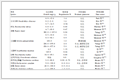
本文选取Schneider等[35]文章中的15组树轮最大晚材密度(Maximum-latewood-density,简称MXD)序列(表 1)重建过去1400年(公元600~2002年)北半球夏季平均温度序列,并与Schneider等[35]原有的重建结果进行对比。表 1中的r为1901~1976年MXD序列与邻近的CRUTEM4v网格点的相关系数。
|
表 1 15组MXD序列的站点信息 Table 1 Site information of the 15 MXD-datasets |
在1850~2002年时段,本文计算了改进的区域优化平均法和Schneider等[35]的重建结果相对于CRU结果的累积误差值。从图 6可以看出,与Schneider等[35]结果比较,改进的区域优化平均法误差稍大,可能是因为使用改进的区域优化平均法重建温度序列时需要先计算重建区域内的温度分布,而本研究选取的15组站点数据均集中分布于北半球中纬度地区,使用这些数据计算的北半球温度分布可能会产生较大的误差,从而造成最终的结果误差偏大。

|
图 6 在1850~2002年时段改进的区域优化平均法的重建结果和Schneider等(2015)[35]的重建结果的累积误差的比较 Fig. 6 Comparison of cumulative error of reconstruction results between improved Optimal Regional Average Method and Schneider et al.(2015)[35] during 1850~2002A.D. |
本文将重建的过去1400年北半球夏季平均温度序列与Schneider等[35]的结果进行对比(图 7),并计算了公元800~1100年、 1300~1500年、 1600~1800年以及1900年以后几个特征时期的相对于20世纪器测夏季温度的距平(表 2)。从图 7和表 2中可以看出,相较于Schneider等[35]的结果,本文重建的结果显示中世纪(公元800~1100年)的平均温度比14和15世纪的平均温度高,即中世纪暖期更为显著,而Schneider等[35]的结果恰恰相反,没有显示更为明显的中世纪暖期。而17~19世纪的小冰期和20世纪气候增暖事件在本研究和Schneider等[35]的重建中均有明显表现。两种方法重建结果在中世纪及14、 15世纪的反差可能是因为两种方法所选用的权值不同,Schneider等[35]选择的是简单的相关系数加权法; 而本文的方法是通过球谐分析法计算校准时段逐年北半球的温度分布,并通过温度分布使用区域优化平均法逐年计算权值。相比而言,尤其当样本量充足(如大于30时,如图 4所示)本文的方法可能会更有效地重建出温度变化的真实特征。

|
图 7 改进的区域优化平均法的结果与Schneider等[35]的结果相对于1900~1999年CRU平均温度的距平 Fig. 7 Temperature anomalies relative to 1900~1999A.D. average of improved Optimal Regional Average Method and Schneider et al.[35] |
|
|
表 2 几个特征时期相对于1900~1999年CRU平均温度的距平 Table 2 Average temperature anomalies during several typical periods of temperature change relative to 1900~1999A.D. average |
依据本文新建的温度序列,计算了中世纪最暖100年和最冷100年相对于20世纪CRU平均温度的距平。其中,最暖期出现在9世纪中叶到10世纪中叶(866~965年),比20世纪平均值低0.064℃,最冷期出现在16世纪末期到17世纪(1578~1677年),比20世纪平均值低0.342℃。
4 结论本文应用球谐分析法对原有的区域优化平均法进行改进,使区域优化平均法适用范围推广到北半球。利用CRU数据计算1951~2013年全球年温度序列,得到较好的结果: 在使用非连续性站点仍可以较好的描述温度序列的变化趋势; 重建结果的精度会随使用数据点数的增多而增大; 使用相同站点的情况下结果优于简单算术平均的结果。因此,利用改进的区域优化平均法可以较好地使用非连续性数据重建过去温度,扩大了代用数据的应用范围。本文利用Schneider等[35]的数据对该方法进行了验证,重建了北半球过去1400年夏季平均温度,结果显示该方法是可行的,重建结果显示显著的中世纪暖期,小冰期及20世纪的暖期。
致谢 感谢审稿专家和编辑部老师建设性的修改意见,使文章得以完善。
| 1 | Hansen J, Lebedeff S. Global trends of measured surface air temperature. Journal Geophysical Research, 1987, 92 (D11):13345~13372 |
| 2 | Vinnikov K Y, Groisman P Y, Lugina K M. Empirical data on contemporary global climate changes(temperature and precipitation). Journal of Climate, 1990, 3 (6):662~677 |
| 3 | Karl T R, Quale R G, Groisman P Y. Detecting climate variations and change:New challenges for observing and data management systems. Journal of Climate, 1993, 6 (8):1481~1494 |
| 4 | Bauer E, Claussen M, Brovkin V et al. Assessing climate forcings of the Earth system for the past millennium. Geophysical Research Letters, 2003, 30 (6):1276 |
| 5 | 王江林, 杨 保. 北半球及各大洲过去1200年温度变化的若干特征. 第四纪研究, 2014, 34 (6):1146~1155 Wang Jianglin, Yang Bao. General characteristics of temperature changes during the past 1200 years over the north Hemisphere, the Continents and China. Quaternary Sciences, 2014, 34 (6):1146~1155 |
| 6 | 严 蜜, 王志远, 刘 健. 中国过去1500年典型暖期气候的模拟研究. 第四纪研究, 2014, 34 (6):1166~1175 Yan Mi, Wang Zhiyuan, Liu Jian. Simulation of the characteristics mechanisms of Chinese typical warm periods over the past 1500 years. Quaternary Sciences, 2014, 34 (6):1166~1175 |
| 7 | 史 锋, 杨 保, 赵 森等. 全球过去千年典型暖期温度空间格局重建. 第四纪研究, 2014, 34 (6):1125~1135 Shi Feng, Yang Bao, Zhao Sen et al. Spatial pattern reconstruction of typical centennial warm periods of global temperature over the past millennium. Quaternary Sciences, 2014, 34 (6):1125~1135 |
| 8 | 杨 保, 史 锋, Sonechkin D M等. 过去千年气候变化重建研究新进展. 中国沙漠, 2011, 3 (2):485~491 Yang Bao, Shi Feng, Sonechkin D M et al. Research progress in millennium paleoclimate reconstructions. Journal of Desert Research, 2011, 3 (2):485~491 |
| 9 | Jones P D, Moberg A. Hemispheric and large-scale surface air temperature variations:An extensive revision and an update to 2001. Journal of Climate, 2003, 16 (2):206~233 |
| 10 | Mann M E, Hughes M K. Tree-ring chronologies and climate variability. Science, 2002, 296 (5569):848~849 |
| 11 | 秦 峰, 赵 艳. 基于孢粉组合定量重建古气候的方法在中国的运用及思考. 第四纪研究, 2013, 33 (6):1054~1068 Qing Feng, Zhao Yan. Methods of quantitative climate reconstruction based on palynological data and their applications in China. Quaternary Sciences, 2013, 33 (6):1054~1068 |
| 12 | 赵华标, 徐柏青, 王宁练. 青藏高原冰芯稳定氧同位素记录的温度代用性研究. 第四纪研究, 2014, 34 (6):1215~1226 Zhao Huabiao, Xu Boqing, Wang Ninglian. Study on the water stable isotopes in Tibetan Plateau ice core as a proxy of temperature. Quaternary Sciences, 2014, 34 (6):1215~1226 |
| 13 | Vinther B M, Johnsen S J, Andersen K K et al. NAO signal recorded in the stable isotopes of Greenland ice cores. Geophysical Research Letters, 2003, 30 (7):1387 |
| 14 | 郑景云, 葛全胜, 郝志新等. 历史文献中的气象记录与气候变化定量重建方法. 第四纪研究, 2014, 34 (6):1186~1196 Zheng Jingyun, Ge Quansheng, Hao Zhixin et al. Paleoclimatology proxy recorded in historical documents and method for reconstruction on climate change. Quaternary Sciences, 2014, 34 (6):1186~1196 |
| 15 | 蔡秋芳, 刘 禹. 山西五鹿山油松树轮宽度年表的建立及过去百余年5~6月平均气温变化. 第四纪研究, 2013, 33 (3):511~517 Cai Qiufang, Liu Yu. The development of a tree-ring width chronology and the May-June mean temperature variability in Wulu Mountain, Shanxi Province of north-Central China. Quaternary Sciences, 2013, 33 (3):511~517 |
| 16 | 杨 保. 树轮记录的小冰期以来青藏高原气候变化的时空特征. 第四纪研究, 2012, 32 (1):81~94 Yang Bao. Spatial and temporal patterns of climate variations over the Tibetan Plateau during the period 1300~2010. Quaternary Sciences, 2012, 32 (1):81~94 |
| 17 | 任军莉, 刘 禹, 宋慧明等. 甘肃临夏地区过去195年最高温度历史重建——基于紫果云杉树轮宽度资料. 第四纪研究, 2014, 34 (6):1270~1279 Ren Junli, Liu Yu, Song Huiming et al. The historical reconstruction of the maximum temperature over the past 195 years, Linxia region, Gansu Province——Based on the data from Picea purpureaMast. Quaternary Sciences, 2014, 34 (6):1270~1279 |
| 18 | 田立德, 姚檀栋, 文 蓉等. 青藏高原西部纳木那尼冰芯同位素记录的气候意义初探. 第四纪研究, 2012, 32 (1):46~52 Tian Lide, Yao Tandong, Wen Rong et al. A primary recognition on the climatic significance of ice core isotope record in Naimona'nyi of west Tibetan Plateau. Quaternary Sciences, 2012, 32 (1):46~52 |
| 19 | 董进国, 吉云松, 钱 鹏. 黄土高原洞穴石笋记录的8.2ka B.P. 气候突变事件. 第四纪研究, 2013, 33 (5):1034~1036 Dong Jinguo, Ji Yunsong, Qian Peng.""8.2ka B.P. event"" of Asian monsoon in a stalagmite record from Chinese Loess Plateau. Quaternary Sciences, 2013, 33 (5):1034~1036 |
| 20 | 伍国凤, 郝志新, 郑景云. 南昌1736年以来的降雪与冬季气温变化. 第四纪研究, 2011, 31 (6):1022~1028 Wu Guofeng, Hao Zhixin, Zheng Jingyun. Reconstruction of snowfall and winter temperature variations in Nanchang since 1736. Quaternary Sciences, 2011, 31 (6):1022~1028 |
| 21 | 丁玲玲, 葛全胜, 郑景云等. 1736~2009年华南地区冬季年平均气温序列重建. 第四纪研究, 2013, 33 (6):1191~1198 Ding Lingling, Ge Quansheng, Zheng Jingyun et al. Reconstruction of annual winter mean temperature series in Southern China during 1736 to 2009. Quaternary Sciences, 2013, 33 (6):1191~1198 |
| 22 | 张会领, 余克服, 施 祺等. 珊瑚生长率重建西沙海域中晚全新世海温变化. 第四纪研究, 2014, 34 (6):1296~1305 Zhang Huiling, Yu Kefu, Shi Qi et al. Sea surface temperature variations during Mid-Late Holocene reconstructed by Porites coral growth rates in the Xisha Islands. Quaternary Sciences, 2014, 34 (6):1296~1305 |
| 23 | Esper J, Cook E R, Schweingruber F H. Low-frequency signals in long tree-ring chronologies for reconstructing past temperature variability. Science, 2002, 295 (5563):2250~2253 |
| 24 | Jones P D, Mann M E. Climate over past millennia. Reviews of Geophysics, 2004, 42 (2):1~42 |
| 25 | Hegerl G C, Crowley T J, Hyde W T. Climate sensitivity constrained by temperature reconstructions over the past seven centuries. Nature, 2007, 440 (7078):650~666 |
| 26 | Gandin L S. Objective Analysis of Meteorological Fields. Jerusalem:Israel Program for Scientific Translations, 1965. 242 |
| 27 | Kagan R L. Averaging of Meteorological Fields. Leningrad:Gidrometeoizdat, 1979. 212 |
| 28 | Weber R O, Madden R A. Optimal averaging for the determination of global mean temperature:Experiments with model data. Journal of Climate, 1995, 8 (3):418~430 |
| 29 | 王 聪, 黄 宁, 杨 保. 区域优化平均法的改进及其在计算平均温度中的应用. 地理科学, 2014, 34 (2):237~241 Wang Cong, Huang Ning, Yang Bao. Improvement of optimal regional averaging method and its application in average temperature calculation. Scientia Geographica Sinica, 2014, 34 (2):237~241 |
| 30 | Shen S S P, North G R, Kim K Y. Spectral approach to optimal estimation of the global average temperature. Journal of Climate, 1994, 7 (12):1999~2007 |
| 31 | Shen S S, Smith T M, Ropelewski C F et al. An optimal regional averaging method with error estimates and a test using tropical Pacific SST data. Journal of Climate, 1998, 11 (9):2340~2350 |
| 32 | Whaler K A, Gubbins D. Spherical harmonic analysis of the geomagnetic field:An example of a linear inverse problem. Geophysical Journal International, 1981, 65 (3):645~693 |
| 33 | Hongre L, Hulot G, Khokhlov A. An analysis of the geomagnetic field over the past 2000 years. Physics of the Earth and Planetary Interiors, 1998, 106 (3~4):311~335 |
| 34 | Tikhonov A N, Arsenin V Y. Solutions of Ill-posed Problems. New York:Winston Wiley, 1997. 136~163 |
| 35 | Schneider L, Smerdon J E, Büntgen U et al. Revising mid-latitude summer-temperatures back to AD 600 based on a wood density network. Geophysical Research Letters, 2015, doi:10.1002/2015GL063956 |
| 36 | Anchukaitis K J, Arrigo R D, Hayles L A et al. Tree-ring-reconstructed summer temperatures from northwestern North America during the last nine centuries. Journal of Climate, 2013, 26 (10):3001~3012 |
| 37 | Myglan V S, Oidupaa O C, Vaganov E A. A 2367-year tree-ring chronology for the Altai-Sayan region(Mongun-Taiga Mountain Massif). Archaeology, Ethnology and Anthropology of Eurasia, 2012, 40 (3):76~83 |
| 38 | Luckman B K, Wilson R J S. Summer temperatures in the Canadian Rockies during the last millennium: A revised record. Climate Dynamics, 2005, 24 (2~3):131~144 |
| 39 | ITRDB. 2015: Tree ring database. International Tree-Ring Data Bank(ITRDB), accessed May 20, 2015.http //www.ncdc.noaa.gov/data-access/paleoclimatology-data/datasets/tree-ring] |
| 40 | Schweingruber F H, Bartholin T, Schar E et al. Radiodensitometric-dendroclimatological conifer chronologies from Lapland(Scandinavia)and the Alps(Switzerland).Boreas, 1988, 17 (4):559~566 |
| 41 | Büntgen U D, Frank D, Nievergelt D et al. Summer temperature variations in the European Alps, AD 755~2004. Journal of Climate, 2006, 19 (21):5606~5623 |
| 42 | Esper J, Frank D C, Timonen M et al. Orbital forcing of tree-ring data. Nature Climate Change, 2012, 2 (12):862~866 |
| 43 | Briffa K R, Melvin T M, Osborn T J et al. Reassessing the evidence for tree-growth and inferred temperature change during the Common Era in Yamalia, northwest Siberia. Quaternary Science Reviews, 2013, 72 :83~107 |
| 44 | Büntgen U, Frank D, Grudd H et al. Long-term summer temperature variations in the Pyrenees. Climate Dynamics, 2008, 31 (6):615~631 |
| 45 | Melvin T M, Grudd H, Briffa K P. Potential bias in ""updating"" tree-ring chronologies using regional curve standardisation:Re-processing 1500 years of Torneträsk density and ring-width data. The Holocene, 2013, 23 (3):364~373 |
| 46 | Esper J, Büntgen U, Frank D et al. Updating the Tyrol tree-ring dataset. In: Haneca K, Verheyden A, Beekmann H et al.eds. TRACE-Tree Rings in Archaeology, Climatology and Ecology, Vol. 5. Proceedings of the DENDROSYMPOSIUM 2006, April 20th-22nd 2006, Tervuren, Belgium. Schriften des Forschungszentrums Jülich, Reihe Umwelt Vol. 74, 2007. 80~84 |
Abstract
Optimal Regional Averaging Method is an effective method to reconstruct temperature variations of the past. It has the advantage of obtaining a reliable regional-scale temperature reconstruction using a limited dataset. This method has been successfully applied in reconstructing average temperature on a given target area in the recent years. However, it should be noted that this method only can calculate average temperature over a local area, and there is still no continental-or hemispheric-scale temperature reconstructions reported. In this paper, we use spherical harmonic function to improve this method.
To validate reliability of this method, we calculate average temperature series over the Northern Hemisphere during the period 1951~2013 using temperature data from Climatic Research Unit(CRU), and compare it with the result derived from the simple average method. The results show that the improved method is better than the simple digital method while using the same dataset, and it can calculate global average temperature series in the case of discontinuous data.
We also use 15 regional Maximum Latewood Density (MXD) series from Schneider et al. (2015) to reconstruct summer temperature during the past 1400 years using the improved Optimal Regional Averaging Method. The reconstruction results show that there are obvious warm period in the Medieval Period(800~1100A.D.), low temperatures during the Little Ice Age(1700~1900A.D.), and the warming trend in the 20 century. These results support that the improved Optimal Regional Averaging Method is an effective method to reconstruct temperature variations of the past.