 2015, Vol.35


⑤ 甘肃省油气资源研究重点 实验室(中国科学院地质与地球物理研究所兰州油气资源研究中心); 中国科学院油气资源研究重点实验室, 兰州 730000)
古土壤是过去地质历史时期形成的土壤,它记录着土壤形成时期当地的古地理信息[1]。根据古土壤类型及特征,对照相应现代土壤类型的成土环境,可以重建古土壤形成时期的古环境[2]。近年来国内外学者通过对不同地质时期古土壤研究,在古气候变化与模拟[3, 4, 5, 6, 7]、 古大气成分变化[8, 9, 10, 11]、 古生态恢复[12, 13, 14]、 古地理与古景观重建[15, 16, 17]等方面取得了重要进展。
澳大利亚悉尼地区普遍分布着一套中新世早期(17Ma B .P. )发育的古土壤地层[18, 19, 20],其中的砖红壤(Laterite)层被认为形成于低纬度热带高温高湿环境[21]。然而中新世早期澳大利亚板块还未漂移至现今位置,悉尼当时的古地理纬度在 45°-50°S之间[22],按照现代的气候带划分,应该属于温带地区。因此,悉尼中新世早期砖红壤地层的形成环境不同学者持不同看法[18,19,21, 23]。Hunt 等[19]认为该套地层的母岩是下伏的三叠纪紫色砂岩,通过对母岩结构和含铁量的研究,认为只要有充足的降水,即使在温带气候条件下也可以通过淋溶淀积作用形成砖红壤;Retallack[21]研究认为不同地质时期全球大气CO2含量不同造成古温度差异,砖红壤的分布纬度亦有所不同,第四纪以来形成的砖红壤都分布在南北回归线之间的热带区域,而第四纪之前形成的砖红壤多分布在高纬度地区。为进一步明确悉尼中新世早期的古气候特征,我们对悉尼地区的Long Reef Beach(LRB)砖红壤地层进行了详细的野外考察和采样,并对所获样品进行了元素地球化学、 岩石磁学及土壤色度测试。希望综合多个环境代用指标来恢复LRB砖红壤地层形成的水热条件,以及悉尼地区中新世早期的古气候特征。
1 研究区概况与实验方法 1.1 剖面信息及样品采集LRB古土壤剖面(33 . 743269°S,151 . 305244°E) 位于澳大利亚新南威尔士州,悉尼市东北部沿海东岸( 图1a)。悉尼地势西部高,东临太平洋,有东澳大利亚暖流经过,在副热带高压带以及东南信风的交替控制下,形成了亚热带季风性湿润气候。降水主要集中在夏季,年均降水量大约1200mm左右,年均温度17.5℃[6]。LRB古土壤下伏三叠纪紫色砂岩(Hawkesbury Sandstone),砂岩中石英颗粒较粗(大小为0.25-0.35mm),且颗粒间孔隙度大。前人研究认为该古土壤地层形成于中新世早期距今17Ma[21],当时悉尼地区地形平坦,为一大的准平原,LRB古土壤地层形成时期覆盖了整个准平原地区。后期的地壳抬升以及风化剥蚀作用破坏了LRB古土壤地层的表面形态,致使其变成一个个孤立残存的剖面。同时,该地层被看作是悉尼第三纪时期的一个标准地层单位[19, 20, 21]。

|
图 1 研究区位置示意图(a)及剖面照片(b) Fig.1 Sketch map of study area (a) and the photo of the section(b) |
研究剖面厚6.9m( 图1b),自上而下可分为3层[20, 21]:1)全新世软土层(Holocene Mollisol,简称HM层,0-1.2m),土壤为黑褐色,表层含砂,结构松散,有机质含量高,下部质地坚硬,呈块状,与下伏地层不整合接触; 2)中新世老成土层(Miocene Ultisol,简称MU层,1.2~5.2m),颜色自上而下由褐黄色-浅褐红色-深褐红色逐渐变化,局部有灰白色土壤,呈网纹状,属于土壤发生层中的淋溶层,底部有铁质结核淀积; 3)中新世红土矿层(Miocene Laterite,以下称ML层,5.2~6.9m),呈棕红色,属于土壤发生层中的淀积层,铁质胶结,密度高,硬度大。剖面下伏三叠纪紫色砂岩[19, 20]。对剖面进行连续采样,上部0~1m样品间距为20cm,中部1.0~5.4m间距为10cm,下部5.4~6.9m间距为30cm,共获散样55个。
1.2 实验方法样品置于室内自然晾干,研磨至200目以上,供实验室测试使用。
常量元素含量测量: 称取样品6g后压制成片,采用荷兰飞利浦公司生产的PW2403型X荧光光谱仪(XRF),对制备好的样品进行常量元素测量,测试过程中加入标样(GSS-5)进行质量控制。测量精度≥95 % ,变异系数(RSD)≤5 % 。
磁学实验方法见参考文献[24]。
色度测量: 采用美国Hunter Lab公司生产的Color Flex? EZ型分光色度仪进行色度测试。测试前使用仪器自带标准测试白板与黑板对仪器进行矫正,称取样品5g,均匀铺满在测试皿底部,压平不起皱,随机选测3个表面平整的区域,仪器自动求出3次测量的亮度(L*),红度(a*),黄度(b*)平均值。
以上常量元素含量和磁学测试过程在兰州大学西部环境教育部重点实验室完成,色度测试过程在福建师范大学湿润亚热带山地生态教育部重点实验室完成。
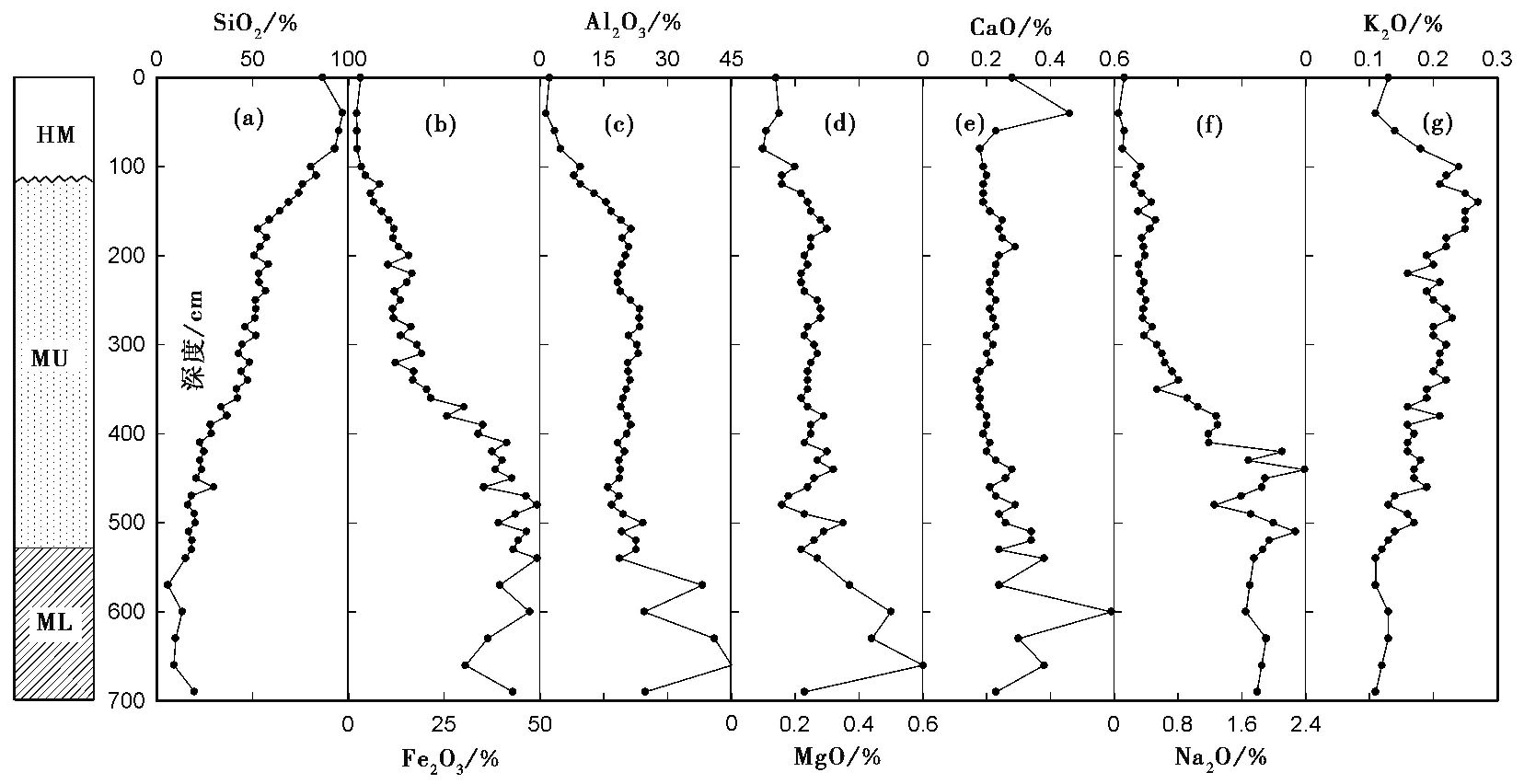
2 实验结果 2.1 常量元素实验结果显示,LRB剖面中常量元素含量随地层深度变化较大。其中SiO2( 图2a)自HM层到ML层不断减少,HM层平均含量高达85.62 % ; MU层顶部含量为68.86 % ,而底部已低至18.46 % ; ML层含量最低,平均为13.15 % 。与SiO2相反,剖面中Fe2O3和Al2O3( 图2b和2c)含量自上而下不断增加,HM层Fe2O3和Al2O3平均含量为3.09 % 和5.01 % ,且变化较小; MU层Fe2O3和Al2O3含量随深度增加逐渐升高,尤其是Fe2O3从8.24 % 增加至46.49 % ,Al2O3自9.62 % 增加至22.65 % ; ML层含量最高,平均值分别为42.97 % 和32.04 % 。MgO、 CaO、 Na2O和K2O( 图2d~2g)等在剖面中普遍含量较低,平均值分别为0.25 % 、 0.24 % 、 0.96 % 和0.18 % ,其中MgO、 CaO、 Na2O在剖面底部含量的突然升高,推测可能因为研究剖面底部离海的高潮面较近,底部受海水影响所致。由以上常量元素的变化可知,LRB古土壤剖面随深度的增加存在明显的脱硅富铝铁过程。同时化学性质活泼、 最易产生迁移淋溶的碱金属和碱土金属元素Na、 K、 Ca和Mg在剖面中已大量淋失。
|
图 2 LRB古土壤剖面常量元素含量 Fig.2 The contents of macrocelement in LRB paleosol profile |
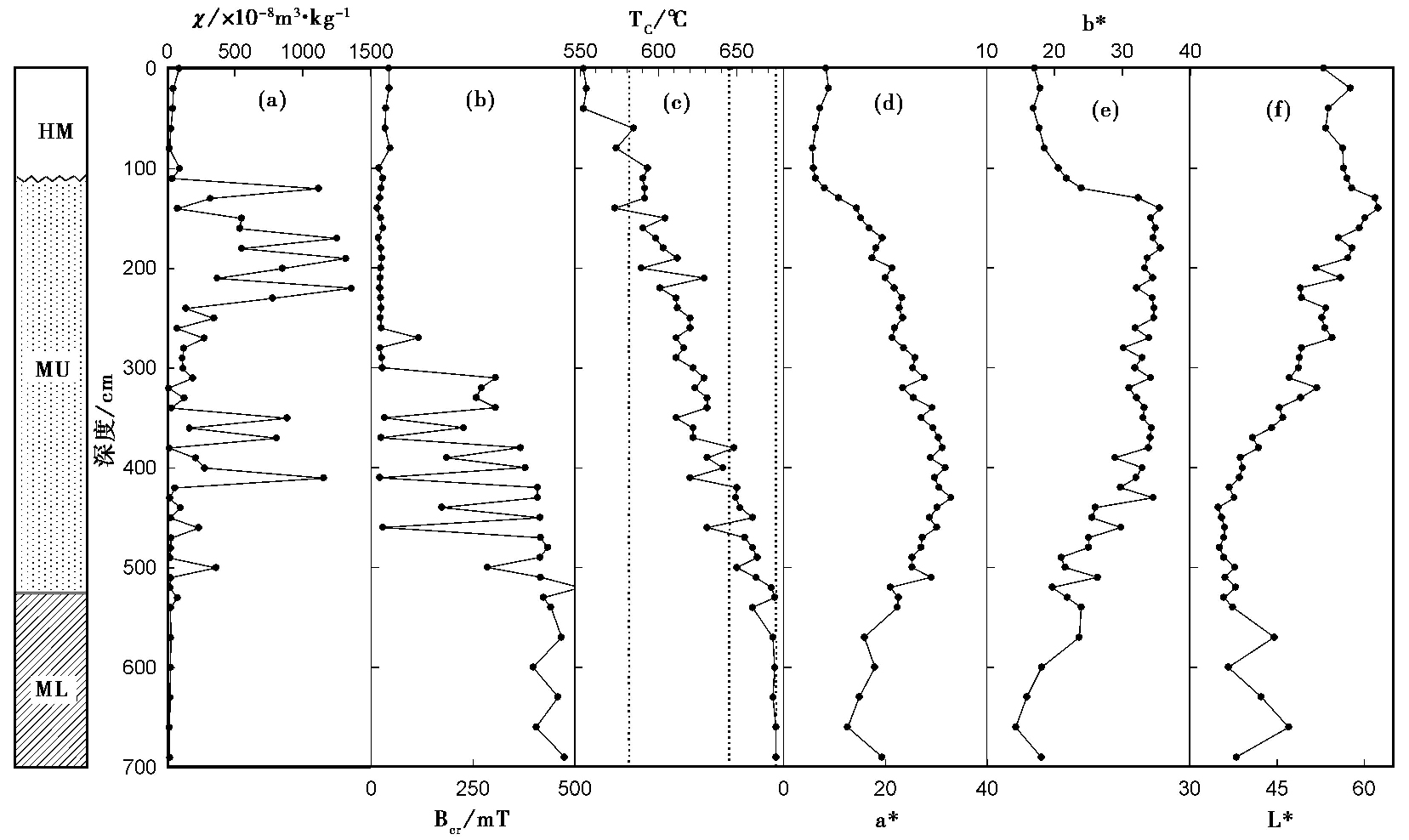
磁化率(χ)是反映样品中磁性矿物总体特征(磁性矿物的种类、 含量及颗粒大小)的常用磁学参数[25, 26, 27, 28]。LRB古土壤剖面中各地层( 图3a)差别较大,介于13×10-8~1358×10-8m3/kg之间。HM层和ML层低(平均值分别为50.7×10-8m3/kg和29.7×10-8m3/kg),波动小,MU层高(平均值为384.8×10-8m3/kg),波动大。剩磁矫顽力(Bcr)指示样品的饱和等温剩磁(SIRM)降低到零所需的反向磁场强度,可反映磁性矿物的种类[25]。亚铁磁性矿物的Bcr值较低,磁铁矿的Bcr值小于50mT; 反铁磁性矿物Bcr值较高,赤铁矿的Bcr值大于400mT[29]。如 图3b所示,LRB剖面中Bcr随地层深度增加而不断波动增大,说明随着地层深度的增加软磁性矿物在逐渐减少而硬磁性矿物在逐渐增多。居里点也称居里温度(TC)是指铁磁体从铁磁相转变为顺磁相的相变温度,其中磁铁矿、 磁赤铁矿、 针铁矿和赤铁矿的TC分别为580℃、 645℃、 125℃和675℃[30]。我们将所有样品进行热磁测量后对TC( 图3c)进行统计,发现LRB古土壤剖面中TC随深度增加逐渐升高。其中HM层样品的TC主要分布在580℃左右,以磁铁矿为主; MU层样品的TC由580℃逐渐升高到675℃,结合、 Bcr及磁滞回线(见参考文献[24]),判断MU层自上而下主要磁性矿物为磁铁矿-磁赤铁矿化的磁铁矿-磁赤铁矿(具有热稳定性)和部分赤铁矿; ML层样品TC稳定在675℃,主要以赤铁矿为主,同时,该层样品加热曲线(κ-T曲线和M-T曲线)在75-125℃之间磁化率(磁化强度)有明显降低(见参考文献[24]),说明样品中含有一定量的针铁矿[31]。
|
图 3 LRB古土壤剖面磁学参数及色度指标 Fig.3 The parameters of rock magnetism and the soil chromaticity in LRB paleosol profile |
土壤颜色(色度)能够反映气候变化信息,CIELAB表色系统是目前主要的颜色描述和测量系统之一,近年来被广泛应用到古土壤和湖泊沉积物的研究当中[32, 33, 34, 35, 36, 37]。在CIELAB表色系统中L*代表亮度,变化于黑(0)与白(100)之间; a*代表红度,变化于红(60)与绿(-60)之间; b*代表黄度,变化于黄(60)与蓝(-60)之间。LRB剖面中a*( 图3d)值变化于5.7至32.88之间,其中HM层最低,平均值为7.07; MU层随深度增加a*值逐渐升高,在该层中下部(3.6~4.6m)达到峰值,平均值为24.57; ML层a*值稍低于HM层,平均值为17.92。剖面中b*( 图3e)值变化于14.32至35.59之间,各层间变化趋势与a*值相似,不同之处在于MU层b*值在上部和中部(1.3~4.3m)最大,下部开始降低,这与MU层中上部网纹发育的特征一致。L*( 图3f)值变化于34.93至62.36之间,变化趋势与a*和b*相反,随地层深度增加而逐渐降低。以上色度参数与野外观察相一致,HM层土壤发育时间短,发育程度低,亮度高而红度和黄度低; MU层自上而下随着土壤发育程度的提高,土壤红度不断升高,而黄度和亮度逐渐降低; ML层铁盘发育,土壤呈棕红色,红度相比MU层有所降低,黄度和亮度也同时降低。
3 讨论 3.1 LRB剖面中新世古土壤化学风化强度与古降水量LRB古土壤剖面自上而下,SiO2含量不断减少,Fe2O3和Al2O3含量不断升高,表现出逐渐的脱硅富铝铁过程。Ca、 Na、 K和Mg等碱土金属大量淋失,说明LRB古土壤在形成过程中经历了强烈的化学风化作用。硅与铁、 铝比值S(silica/sesquioxide ratio):

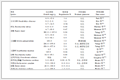
指示土壤中粘土矿物、赤铁矿等风化残积物的富集程度,土壤化学风化越强S值越低[1]。LRB古土壤剖面中HM层形成时间短土壤发育弱,粘土矿物和赤铁矿含量低,S值较大(见表1),平均为1229。MU层和ML层自上而下S值不断降低,MU层中上部(13~40m) S平均值为166,MU层下部和ML层S平均值为035,与澳大利亚始新世早期BridleGreek地区Monaro玄武岩上发育的砖红壤层S值相当[38],低于我国海南岛北部更新世中期玄武岩上发育的砖红壤S值(10~15)[39]。说明LRB中新世古土壤,可能比海南岛北部更新世中期发育的砖红壤化学风化更加强烈,土壤中粘土矿物和赤铁矿含量高。
|
表 1 LRB古土壤剖面各样品硅铝铁比值(S)、 化学蚀变指数(CIA)、 化学风化指数(CIW)及古降水量(R)计算值 Table 1 Silica/sesquioxide ratio (S), the chemical index of alteration (CIA), the chemical index of weathering (CIW) and mean annual precipitation (R) of LRB paleosol profile |
化学蚀变指数CIA (the chemicalindex of alteration)是指示土壤化学风化强度的参数,表示为:

当CIA值在50~65之间时,表示冷干气候条件下土壤经历弱的化学风化; 65~85表示土壤经历中度化学风化; 85~100表示热带亚热带湿热气候条件下土壤经历强烈的化学风化[40]。LRB古土壤剖面中各地层CIA值( 表1)均在85以上。HM层平均值为89.0,且随地层深度增加而不断升高,这不但与悉尼现代的气候条件相吻合,同时还反映出全新世土壤化学风化随发育时间不断增强的特点。ML层属于土壤发生层中的淀积层,是由MU层淋溶淀积而成。因此,我们认为ML层不宜用来指示土壤形成时期的化学风化强度。另外,由于剖面底部可能受海水影响,导致了CaO和Na2O含量异常,我们这里只选取MU层中、 上部(1.3-4.0m)来计算LRB中新世古土壤形成时期化学风化强度,该段CIA平均值为95.26,与我国海南岛更新世中期玄武岩上发育的砖红壤CIA平均值相当[39]。说明LRB中新世古土壤形成时期化学风化作用强于HM层,当时悉尼地区气候比现在更加温暖湿润,可能与我国海南岛当前气候比较相似。
由于古土壤在埋藏成岩过程中钾可能产生富集,有学者用去除K2O之后的化学风化指数CIW(the chemical index of weathering)来表示古土壤的化学风化强度[41, 42]。

CIW在古土壤中随年平均降水量增加而升高,可通过公式:

其中R代表年平均降水量、 C代表CIW (R2=0.72,SE=±182mm) 来半定量估算土壤形成时期古降水量[6, 43],R2为相关系数,SE为标准误差。按照该方法对LRB古土壤形成时期降水量进行计算( 表1),HM层形成时期年平均降水量为1336.83mm,悉尼现代年平均降水量为1276.50mm,差值较小,保持在误差范围以内,说明可以利用此方法对LRB古土壤形成时期降水进行估算。MU层中上部(1.3-4.0m)年平均降水量估算值为1471.22mm,高于悉尼现代降水量,与我国海南岛北部年平均降水量相当(1400~1800mm)[44]。
综上所述,LRB剖面中新世古土壤形成时期经历了强烈的化学风化作用,悉尼地区当时可能是一种湿热的热带气候,年平均降水量半定量重建值为1471.22mm,与我国海南岛北部更新世中期以来的气候(年平均降水量1400~1800mm)[44]较为接近。
3.2 LRB剖面中新世古土壤中磁性矿物转化与古温度LRB剖面中新世古土壤形成时期降水丰沛,土壤中水分充足,铁、 铝氧化物随水淋溶,最终在剖面底部淀积,从而形成铁、 铝富集层。MU层属于土壤发生层中的淋溶层,铁的流失使土壤网纹化发育,流失的铁在该层下部开始淀积,土壤中出现铁结核。ML层是土壤发生层中的淀积层,上部淋溶的铁在该层大量富集,最终形成铁盘。
磁学数据显示MU层自上而下磁性矿物种类为磁铁矿、 磁赤铁矿化的磁铁矿、 磁赤铁矿和赤铁矿,ML层磁性矿物为赤铁矿和少量针铁矿[24]。MU层和ML层磁性矿物种类的这种过渡与 a*随地层深度变化一致,剖面中高的a*值正是由于大量赤铁矿和磁赤铁矿等染色矿物所贡献[34, 45],剖面底部ML层土壤呈棕红色a*降低,是因为赤铁矿中混有少量针铁矿所致,自然界中磁赤铁矿一般由磁铁矿经低温氧化作用形成[46, 47, 48],尤其是在热带亚热带地区,较高的温度使磁铁矿逐渐氧化为磁赤铁矿,磁赤铁矿可进一步转化形成赤铁矿[49, 50]。对照现代土壤类型及特征,磁赤铁矿、 赤铁矿通常在各种成土过程中形成,尤其是热带亚热带气候条件下高度风化的氧化型土壤[1, 51, 52]。LRB剖面中新世古土壤下伏三叠纪紫色砂岩[19, 20],母岩风化初期颗粒松散、 透水通气性好,降雨沿土壤孔隙很快下渗流失和蒸发,从而使土壤大部分时间处在一种干旱氧化的环境之下。这种干湿交替的氧化环境使磁铁矿颗粒在向下淋溶过程中由外而内逐渐被氧化,首先形成磁赤铁矿外壳和磁铁矿内核的双层结构,即磁赤铁矿化的磁铁矿,再逐步被完全氧化形成磁赤铁矿。磁赤铁矿是一种受热不稳定矿物,在剖面底部经长期的氧化作用,导致磁赤铁矿最终完全转变为赤铁矿[45]。长期的淀积过程可能使ML层土壤水分含量稍高于上部地层,在该层形成了少量针铁矿[31, 53, 54]。
LRB古土壤剖面中磁性矿物由磁铁矿→磁赤铁矿化的磁铁矿→磁赤铁矿→赤铁矿的这种转变,尤其是磁赤铁矿和赤铁矿的大量富集,说明悉尼中新世早期对应着一种高温氧化环境[45, 55]。前人通过碳同位素[10, 56]和银杏叶化石植物气孔指数[8, 9, 11]研究,认为在16Ma B .P. 时全球大气CO2浓度为 754±153ppm。虽然LRB剖面中新世古土壤形成时期悉尼地区古地理纬度较高(45°-50°S之间),但由于CO2的温室效应,可能导致悉尼地区当时的温度高于现在。同一时期在德国中部卡塞尔地区(45°N) 也有砖红壤发育[57],这与中中新世气候较为湿暖相吻合[58, 59, 60]。
4 结论本文通过对澳大利亚悉尼LRB剖面中新世古土壤进行常量元素、 岩石磁学和土壤色度的测量与综合分析,得出以下结论:1)LRB剖面中新世古土壤形成时期地表化学风化作用十分强烈,悉尼地区当时可能为湿热的热带亚热带气候,年平均降水半定量重建值达1471.22mm; 2)丰富的降水使铁、 铝氧化物沿剖面淋溶淀积,在剖面底部富集形成铁结核和铁盘层; 3)剖面中磁性矿物由磁铁矿→磁赤铁矿化的磁铁矿→磁赤铁矿→赤铁矿逐渐转变,尤其是磁赤铁矿和赤铁矿的高度富集,说明悉尼地区中新世早期对应着一种高温氧化环境。
| 1 | Retallack G J. Soils of the Past:An Introduction to Paleopedology. London:Unwin-Hyman, 1990. 1~343 |
| 2 | Kraus M J. Paleosols in clastic sedimentary rocks:Their geologic applications. Earth-Science Reviews, 1999, 47 (1):41~70 |
| 3 | Heller F, Liu T S. Palaeoclimatic and sedimentary history from magnetic susceptibility of loess in China. Geophysical Research Letters, 1986, 13 (11):1169~1172 |
| 4 | Kukla G, Heller F, Liu X M et al. Pleistocene climates in China dated by magnetic susceptibility. Geology, 1988, 16 (9):811~814 |
| 5 |
邓成龙, 刘青松, 潘永信等. 中国黄土环境磁学. 第四纪研究, 2007, 27 (2):193~209 DengChenglong, Liu Qingsong, Pan Yongxin et al. Environmental magnetism of Chinese loess-paleosol sequences. Quaternary Sciences, 2007, 27 (2):193~209 |
| 6 | Retallack G J. Cool-climate or warm-spike lateritic bauxites at high latitudes? The Journal of Geology, 2008, 116 (6):558~570 |
| 7 | Retallack G J. Global cooling by grassland soils of the geological past and near future. Annual Review of Earth and Planetary Sciences, 2013, 41 (7):69~86 |
| 8 | Retallack G J. A 300-million-year record of atmospheric carbon dioxide from fossil plant cuticles. Nature, 2001, 411 (6835):287~290 |
| 9 | Retallack G J. Carbon dioxide and climate over the past 300 Myr. Philosophical Transactions of the Royal Society of London, Series A: Mathematical, Physical and Engineering Sciences, 2002, 360 (1793):659~673 |
| 10 | Retallack G J, Krull E S. Carbon isotopic evidence for terminal-Permian methane outbursts and their role in extinctions of animals, plants, coral reefs, and peat swamps. Geological Society of America Special Papers, 2006, 399 :249~268 |
| 11 | Retallack G J. Greenhouse crises of the past 300 million years. Geological Society of America Bulletin, 2009, 121 (9~10):1441~1455 |
| 12 | Retallack G J, Smith R M H, Ward P D. Vertebrate extinction across Permian-Triassic boundary in Karoo Basin, South Africa. Geological Society of America Bulletin, 2003, 115 (9):1133~1152 |
| 13 | Retallack G J, Huang C. Ecology and evolution of Devonian trees in New York, USA. Palaeogeography, Palaeoclimatology, Palaeoecology, 2011, 299 (1):110~128 |
| 14 | Retallack G J. Ediacaran life on land. Nature, 2013, 493 (7430):89~92 |
| 15 | An Z S, Kutzbach J E, Prell W L et al. Evolution of Asian monsoons and phased uplift of the Himalaya-Tibetan Plateau since Late Miocene times. Nature, 2001, 411 (6833):62~66 |
| 16 | Guo Z T, Ruddiman W F, Hao Q Z et al. Onset of Asian desertification by 22 Myr ago inferred from loess deposits in China. Nature, 2002, 416 (6877):159~163 |
| 17 | Ding Z L, Derbyshire E, Yang S L et al. Stepwise expansion of desert environment across Northern China in the past 3.5Ma and implications for monsoon evolution. Earth and Planetary Science Letters, 2005, 237 (1):45~55 |
| 18 | Stephens C G. Laterite and silcrete in Australia:A study of the genetic relationships of laterite and silcrete and their companion materials, and their collective significance in the formation of the weathered mantle, soils, relief and drainage of the Australian continent. Geoderma, 1971, 5 (1):5~52 |
| 19 | Hunt P A, Mitchell P B, Paton T R."Laterite profiles" and "lateritic ironstones" on the hawkesbury sandstone, Australia. Geoderma, 1977, 19 (2):105~121 |
| 20 | Retallack G J. Colour Guide to Paleosols. New York:John Wiley & Sons Ltd, 1997.80~104 |
| 21 | Retallack G J. Lateritization and bauxitization events. Economic Geology, 2010, 105 (3):655~667 |
| 22 | Johnson B D, Powell C M, Veevers J J. Spreading history of the eastern Indian Ocean and Greater India's northward flight from Antarctica and Australia. Geological Society of America Bulletin, 1976, 87 (11):1560~1566 |
| 23 | Milnes A R, Bourman R P, Northcote K H. Field relationships of ferricretes and weathered zones in southern South Australia:A contribution to 'laterite’ studies in Australia. Soil Research, 1985, 23 (4):441~465 |
| 24 |
王涛, 郭晖, 刘秀铭等. 澳大利亚悉尼Long Reef Beach中新世古土壤岩石磁学特征及环境意义. 地球物理学报, 2015, 58 (3):971~981 WangTao, Guo Hui, Liu Xiuming et al. Magnetic properties of a Miocene paleosol section in Long Reef Beach, Sydney, Australia, and its environmental implications. Chinese Journal of Geophysics, 2015, 58 (3):971~981 |
| 25 | Thompson R, Oldfield F. Environmental Magnetism. London:Allen and Uniwin, 1986. 1~227 |
| 26 |
赵国永, 刘秀铭, 吕镔等. 全新世黄土记录的古气候演化及磁化率和粒度参数灵敏性探讨. 第四纪研究, 2012, 32 (4):777~784 ZhaoGuoyong, Liu Xiuming, Lü Bin et al. The paleoclimatic evolution recorded by Holocene loess and discussing on the parameter sensitivity of magnetic susceptibility and medium particle diameter. Quaternary Sciences, 2012, 32 (4):777~784 |
| 27 |
宋扬, 郝青振, 葛俊逸等. 黄土高原表土磁化率与气候要素的定量关系研究. 第四纪研究, 2012, 32 (4):679~689 SongYang, Hao Qingzhen, Ge Junyi et al. Quantitative relationships between modern soil magnetic susceptibility and climatic variables of the Chinese Loess Plateau. Quaternary Sciences, 2012, 32 (4):679~689 |
| 28 |
李冠华, 夏敦胜, 温仰磊等. 天山北麓典型黄土沉积序列的磁学特征及主控因子初探. 第四纪研究, 2013, 33 (5):900~910 LiGuanhua, Xia Dunsheng, Wen Yanglei et al. Rock magnetism of the loess/paleosol sequences in north of the Tianshan Mountains, Northwest China. Quaternary Sciences, 2013, 33 (5):900~910 |
| 29 | 卢升高. 中国土壤磁性与环境. 北京: 高等教育出版社, 2003. 1~240 Lu Shenggao. Chinese Soil Magnetism and Environmental. Beijing:Higher Education Press, 2003. 1~240 |
| 30 | Tauxe L. Essentials of Paleomagnetism. Berkeley:University of California Press, 2010. 86~134 |
| 31 | Özdemir Ö, Dunlop D J. Thermoremanence and Néel temperature of goethite. Geophysical Research Letters, 1996, 23 (9):921~924 |
| 32 |
杨胜利, 方小敏, 李吉均. 表土颜色和气候定性至半定量关系研究. 中国科学(D辑), 2001, 31 (S1):175~181 YangShengli, Fang Xiaomin, Li Jijun et al. Transformation functions of soil color and climate. Science in China(Series D), 2001, 31 (S1):175~181 |
| 33 | 彭淑贞, 郭正堂. 西峰晚第三纪红土记录的亮度学特征. 第四纪研究, 2003, 23 (1):110 Peng Shuzhen, Guo Zhengtang. Characteristic of luminosity of the Late Tertiary red earth in Xifeng area. Quaternary Sciences, 2003, 23 (1):110 |
| 34 |
张岩, 郭正堂, 邓成龙等. 周口店第1 地点用火的磁化率和色度证据. 科学通报, 2014, 59 (8):679~686 ZhangYan, Guo Zhengtang, Deng Chenglong et al. The use of fire at Zhoukoudian:Evidence from magnetic susceptibility and color measurements. Chinese Science Bulletin, 2014, 59 (8):679~686 |
| 35 |
程 瑜, 乔彦松, 刘宗秀等. 甘肃灵台邵寨红粘土的磁性地层及其色度记录. 第四纪研究, 2014, 34 (2):391~398 ChengYu, Qiao Yansong, Liu Zongxiu et al. Magnetostratigraphy and chorma records of a red clay formation near Lingtai County of Gansu Province. Quaternary Sciences, 2014, 34 (2):391~398 |
| 36 |
陈皎杰, 刘焱光, 葛淑兰等. 末次盛冰期以来兴凯湖的古环境演变——基于地磁场长期变化的年龄框架. 第四纪研究, 2014, 34 (3):528~539 ChenJiaojie, Liu Yanguang, Ge Shulan et al. Paleoenvironment evolution of the Lake Khanka since the last glacial maximum:Age model reconstructed by secular variation of geomagnetic field. Quaternary Sciences, 2014, 34 (3):528~539 |
| 37 |
蒋复初, 王书兵, 李朝柱等. 内蒙古托克托台地湖相地层及其初步意义. 第四纪研究, 2012, 32 (5):931~937 JiangFuchu, Wang Shubing, Li Chaozhu et al. On study of lacustrine formation and its meaning in the Togtoh Platform, Inner Mongolia. Quaternary Sciences, 2012, 32 (5):931~937 |
| 38 | Zhou Y, Retallack G J, Huang C. Early Eocene paleosol developed from basalt in Southeastern Australia:Implications for paleoclimate. Arabian Journal of Geosciences, 2015, 8 (3):1281~1290 |
| 39 | Zhang G L, Pan J H, Huang C M et al. Geochemical features of a soil chronosequence developed on basalt in Hainan Island, China. Revista Mexicana de Ciencias Geológicas, 2007, 24 (2):261~269 |
| 40 | Nesbitt H W, Young G M. Early Proterozoic climates and plate motions inferred from major element chemistry of lutites. Nature, 1982, 299 (5885):715~717 |
| 41 | Harnois L. The CIW index:A new chemical index of weathering. Sedimentary Geology, 1988, 55 (3):319~322 |
| 42 | Maynard J B. Chemistry of modern soils as a guide to interpreting Precambrian paleosols. The Journal of Geology, 1992, 100 (3):279~289 |
| 43 | Sheldon N D, Retallack G J, Tanaka S. Geochemical climofunctions from North American soils and application to paleosols across the Eocene-Oligocene boundary in Oregon. The Journal of Geology, 2002, 110 (6):687~696 |
| 44 | Huang Chengmin, Gong Zitong, He Yurong. Elemental geochemistry of a soil chronosequence on basalt on northern Hainan Island, China. Chinese Journal of Geochemistry, 2004, 23 (3):245~254 |
| 45 |
刘秀铭, 吕镔, 毛学刚等. 风积地层中铁矿物随环境变化及其启示. 第四纪研究, 2014, 34 (3):459~470 LiuXiuming, Lü Bin, Mao Xuegang et al. Iron minerals of aeolian deposits vary with environment and its significances. Quaternary Sciences, 2014, 34 (3):459~470 |
| 46 | Mullins C E. Magnetic susceptibility of the soil and its significance in soil science——A review. Journal of Soil Science, 1977, 28 (2):223~246 |
| 47 | Fischer H, Luster J, Gehring A U. EPR evidence for maghemitization of magnetite in a tropical soil. Geophysical Journal International, 2007, 169 (3):909~916 |
| 48 |
王涛, 刘秀铭, 吕镔等. 新疆尼勒克黄土岩石磁学特征及变化机制研究. 第四纪研究, 2014, 34 (3):491~503 WangTao, Liu Xiuming, Lü Bin et al. Study of rock magnetic properties and its variation mechanism of loess in Nileke, Xinjiang. Quaternary Sciences, 2014, 34 (3):491~503 |
| 49 | 吕镔, 刘秀铭, 王涛等. 花岗岩上发育的亚热带红土岩石磁学特征. 第四纪研究, 2014, 34 (3):504~515 Lü Bin, Liu Xiuming, Wang Tao et al. Rock magnetic properties of subtropical red soils developed on granite. Quaternary Sciences, 2014, 34 (3):504~515 |
| 50 |
胡鹏翔, 刘青松. 磁性矿物在成土过程中的生成转化机制及其气候意义. 第四纪研究, 2014, 34 (3):443~458 HuPengxiang, Liu Qingsong. The production and transformation of magnetic minerals during pedogenesis and its paleoclimate significance. Quaternary Sciences, 2014, 34 (3):443~458 |
| 51 |
叶玮, 朱丽东, 李凤全等. 中国亚热带风尘沉积物磁学特征对比研究. 第四纪研究, 2013, 33 (5):911~926 YeWei, Zhu Lidong, Li Fengquan et al. Magnetic properties of the Quaternary sediments with aeolian dust characteristics in present subtropical China, and their implications for climate. Quaternary Sciences, 2013, 33 (5):911~926 |
| 52 |
刘彩彩, 邓成龙. 南方红土的磁性矿物组成及其区域性差异. 第四纪研究, 2012, 32 (4 ):626~634 LiuCaicai, Deng Chenglong. Magnetic mineralogy of the red soil sequences in Southern China and its variety. Quaternary Sciences, 2012, 32 (4):626~634 |
| 53 | Dunlop D J, Özdemir Ö. Rock Magnetism:Fundamentals and Frontiers. Cambridge:Cambridge University Press, 2001. 1~573 |
| 54 |
刘青松, 邓成龙, 潘永信. 磁铁矿和磁赤铁矿磁化率的温度和频率特性及其环境磁学意义. 第四纪研究, 2007, 27 (6):954~962 LiuQingsong, Deng Chenglong, Pan Yongxin. Temperature-dependency and frequency-dependency of magnetic susceptibility of magnetite and maghemite and their significance for environmental magnetism. Quaternary Sciences, 2007, 27 (6):954~962 |
| 55 |
季峻峰, 陈骏, Balsam W等. 黄土剖面中赤铁矿和针铁矿的定量分析与气候干湿变化研究. 第四纪研究, 2007, 27 (2):221~229 JiJunfeng, Chen Jun, Balsam W et al. Quantitative analysis of hematite and goethite in the Chines Loess Plateau sequences and its implication for dry and humid variability. Quaternary Sciences, 2007, 27 (2):22~229 |
| 56 | Jahren A H, Arens N C, Sarmiento G et al. Terrestrial record of methane hydrate dissociation in the Early Cretaceous. Geology, 2001, 29 (2):159~162 |
| 57 | Schwarz T. Lateritic bauxite in Central Germany and implications for Miocene palaeoclimate. Palaeogeography, Palaeoclimatology, Palaeoecology, 1997, 129 (1):37~50 |
| 58 | Zachos J, Pagani M, Sloan L et al. Trends, rhythms, and aberrations in global climate 65Ma to present. Science, 2001, 292 (5517):686~693 |
| 59 | Zachos J C, Dickens G R, Zeebe R E. An Early Cenozoic perspective on greenhouse warming and carbon-cycle dynamics. Nature, 2008, 451 (7176):279~283 |
| 60 | Pross J, Contreras L, Bijl P K et al. Persistent near-tropical warmth on the Antarctic continent during the Early Eocene epoch. Nature, 2012, 488 (7409):73~77 |
Abstract
Early Miocene paleosols, dated back to 17Ma B.P., are prevalently distributed in Sydney area, of which laterite strata was previously thought to form in tropic environments with high temperature and humidity. However, the Australia plate did not yet drift to current position during the Early Miocene, when Sydney paleolatitude was at 45°~50°S, thus belonging to temperate zone. So, what were the paleoenvironments like during the laterite developing period is still in controversial. In order to better understand and investigate the paleoclimate of Sydney during the Early Miocene, a typical paleosol profile(33.743269°S, 151.305244°E) with laterite was taken, which was located at the Long Reef Beach(LRB)town(northeast of Sydney). The profile as depth as 6.9m from top to bottom and was divided into three parts:Holocene Mollisol part(HM, 0~1.2m), Miocene Ultisol part(MU, 1.2~5.2m)and Miocene Laterite part(ML, 5.2~6.9m). Contents of macrocelement(SiO2, Fe2O3, Al2O3, MgO, CaO, Na2O and K2O), the property of rock magnetism(including low field magnetic susceptibility(χ), saturation isothermal remanent(SIRM), saturation magnetization(Ms), and anhysteretic remanent magnetization(ARM)in room temperature, magnetic hysteresis loops, and thermomagnetic analysis(i .e. M-T & κ-T curves))and the soil chromaticity(L *, a*, and b*)for all the samples(n=55)were measured.
The results suggest that:(1)The average chemical index of alteration(CIA, indicating chemical weathering degree)of LRB paleosol is 95.26, which is comparable with the Late Pleistocene paleosols developed on basalt in north Hainan Island. The high CIA of LRB section indicates strong chemical weathering on the Earth surface during the Early Miocene. The calculated mean annual precipitation during the Early Miocene 1471.22mm in Sydney area is close to current precipitation in Hainan Island(1400~1800mm)as well.(2)Si dropped but Fe and Al increased with depth, which were caused by abundant rainfall. Iron oxide and aluminum oxide were leached from top of the paleosol profile to bottom, then formed iron concretion and iron pan at the bottom.(3)Conversion process of magnetic minerals from top to bottom in the section can be summarized as: magnetite→magnetite core wrapped by maghemite shell→maghemite→hematite. Specific enrichment of maghemite and hematite in LRB section provides evidence that during the Early Miocene Sydney area was likely in a high-temperature and oxidation environment.
Combining abovementioned environment proxies with existing results from other researchers, we speculate that Sydney area in Early Miocene was a humid tropical climate. The evident greenhouse effects of CO2(the global CO2 content was 754±153ppm in Early Miocene)likely induced the higher temperature than today, though the high paleolatitude of Sydney(i .e.45°~50°S) at that time.