 2015, Vol.35


1 引言
炭屑是植被不完全燃烧的产物,因此炭屑被称为“火的化石”。根据炭屑记录可以重建火历史,进而了解火事件发生的频率、 间隔期和强度[1, 2, 3]。目前炭屑研究主要是根据炭屑浓度及粒级变化来定性描述火事件的发生规律[4, 5, 6]。一般认为,炭屑浓度越高,代表火事件强度越大,频率越高; 炭屑浓度越低,代表火事件强度越小,频率越低。大粒级炭屑代表局域性火事件,小粒级炭屑代表区域性火事件[7, 8]。但是,依据炭屑浓度的变化只能简单定性地描述火事件的发生规律,而且往往存在较大误差。因此,火历史的重建需要更加有效的定量方法。
一个地区的炭屑背景值是影响火历史重建的主要因素。由于炭屑背景值反映的是非火事件中炭屑浓度的变化规律,因此,把反映火事件的炭屑峰值与炭屑背景值分离出来对于准确重建火历史是非常重要的。Higurea等一些学者[9, 10, 11, 12, 13, 14, 15]利用炭屑堆积的时间序列对炭屑浓度进行数学分解,建立了炭屑的CharAnalysis定量分析方法。在北美地区,Ali等[16] 和Leys等[17]利用不同类型的炭屑数据定量重建当地的火历史,其研究结果表明不同类型的炭屑数据定量重建的火历史具有很好的可比性。
本文根据CharAnalysis模型并利用大兴安岭沉积剖面的炭屑数据定量重建火历史,旨在比较不同类型的炭屑数据用于定量重建火历史的异同,初步探讨不同类型炭屑数据对火历史重建结果的影响。由于不同学者用于研究火历史的炭屑统计方法不尽相同,因此人们普遍关注不同炭屑记录重建的火历史是否存在一些差异。希望本文的研究结果可以为不同地区不同类型的炭屑数据用于火历史重建及对比研究提供一定的参考或借鉴。
2 材料与方法 2.1 研究地点大兴安岭地区(47°03′~53°20′N,119°36′~125°24′E) 位于呼伦贝尔草原与松嫩平原之间。现今地貌特征受控于晚第三纪末的喜马拉雅构造运动,其北宽南窄,向南呈舌状延伸到阿尔山脉;大兴安岭西部和中部地势高,东部、 北部和南部地势低;全区北部和南部坡度较陡,东侧和西侧坡度较缓;最高海拔1528m,平均海拔573m[18]。
本地区属寒温带大陆性气候,并受东亚季风活动影响,具有明显的山地气候特点。该地区年均温在-2℃以下,年温差较大,1月平均气温-20~-30℃,7月平均气温17~20℃。受季风影响,降水集中在夏季,冬季寒冷干燥、 降水较少。独特的地理位置和气候条件使得该地区呈现出群落多样性低,垂直结构层次少,空间格局差异大等植被特点。本地区代表植被主要为杜鹃落叶松林,此外还有藓类落叶松林[18]。
大兴安岭地区火灾严重,火险等级高,火疤记录了火灾的频繁发生。火灾的高发期是春秋两季,火灾类型主要是地表火,也有少量树冠火; 火灾强度为弱强度和中强度,但火灾面积较大[19, 20, 21, 22, 23, 24, 25]。
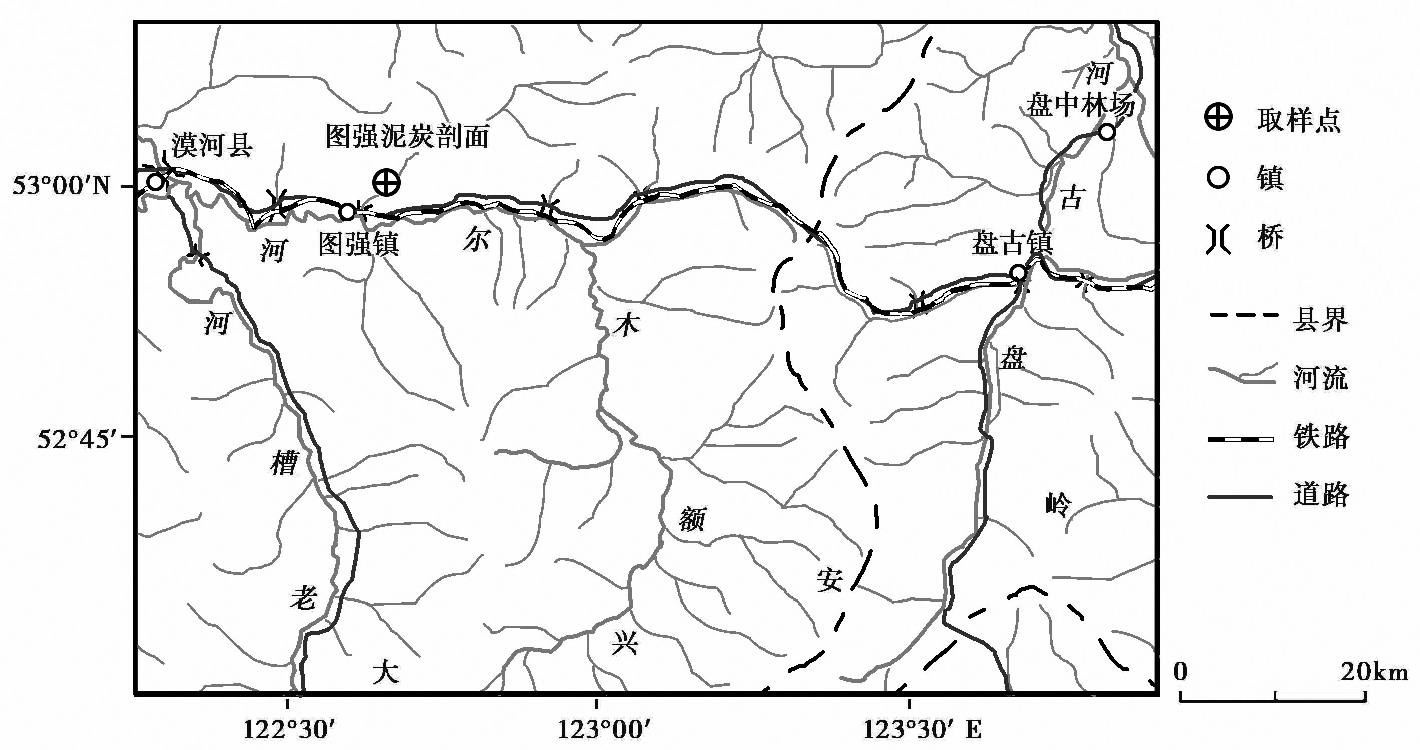
本次研究的地点位于大兴安岭以北的漠河县图强镇( 图1),通过人工方式挖取了图强(TQ)剖面(52°56′28.61″N,122°51′30.65″E)。剖面的总厚度是62cm,每间隔1cm进行分样,共取得62个泥炭沉积物样品。
|
图 1 图强剖面沉积物取样地点 Fig. 1 Sampling site of TQ sediment section |
炭屑的提取和统计工作是在北京大学第四纪生物遗存实验室内完成的。本次实验的微炭屑( < 125μm)的提取方法与孢粉一致,采取的是花粉流程法[26, 27, 28, 29, 30, 31]。在光学显微镜下,微炭屑的主要特征是深黑色、 不透明、 棱角多尖锐、 边缘常平直,在40倍镜下调焦时边缘可见绿黄色光晕[32]。微炭屑的统计分别采用202刻度线法和颗粒计数法[33],为了控制统计误差,本次采用的202刻度线法一共统计了225个视域。大炭屑( >125μm) 利用过筛进行提取,并只统计炭屑的颗粒总数[28, 33]。
2.3 年代测定我们在图强泥炭剖面的9~10cm、 19~20cm、 39~40cm和61~62cm处共选取了5个测年样品,其中61~62cm处选取了2个测年样品。样品处理流程为: 我们首先对样品进行冷冻干燥,然后挑选适量的植物残体,最后送往北京大学 14 C 年代测定实验室进行AMS 14 C 测年。
2.4 数据处理方法 2.4.1 炭屑浓度计算在202刻度线计数法中,统计的微炭屑与测微尺刻度线的接触点数记为C,单个视域面积记为S,外加石松孢子的数目记为L,统计的石松孢子数目记为l,已统计视域中测微尺刻度线的总数记为M,样品体积记为V,则微炭屑的面积浓度(AC,cm2/cm或cm2/g)为:

微炭屑颗粒浓度(MiN)和大炭屑颗粒浓度(MaN)的计算方法完全一样,统计的炭屑颗粒总数为G,外加石松孢子的数目为L,统计的石松孢子数目为l,样品体积记为V,则炭屑颗粒浓度(N,pieces/cm3或pieces/g)为:
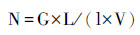
微炭屑的面积浓度(AC)、 微炭屑颗粒浓度(MiN)和大炭屑颗粒浓度(MaN)为3种不同类型的炭屑数据。
2.4.2 炭屑CharAnalysis分析炭屑CharAnalysis分析的基本原理是: 炭屑背景值与炭屑产生、 传播、 沉积及取样等过程有关,其浓度变化往往较小,因此需要从炭屑记录中分离出炭屑背景值以获得反映火事件的炭屑峰值信息[9]。火烧实验和理论模型的研究表明[34, 35, 36, 37],炭屑峰值包含了两部分信息: 一是炭屑噪音信息,代表了沉积物扰动、 分样及炭屑统计等过程产生的噪音信号; 二是炭屑火事件信息,代表了局域火事件形成的炭屑记录。在对每一个样品进行炭屑分析时,均需要采用高斯混合分布模型来检验炭屑的噪音分布,然后选择噪音分布的95 % 、 99 % 或99.9 % 的置信区间作为区分火事件和非火事件炭屑记录的可能阈值[9]。本研究选择95 % 的置信区间进行阈值分析。
此外,本文炭屑背景值的计算是根据500a的时间尺度进行局域加权回归的,最终重建结果都进行了拟合优度检验[15],炭屑数理统计与分析均通过CharAnalysis模型完成,输出结果为: 火事件的间隔期(FRIs)和火事件的频率(fire frequ.)及一定时间范围内的着火次数(fire events)。
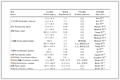
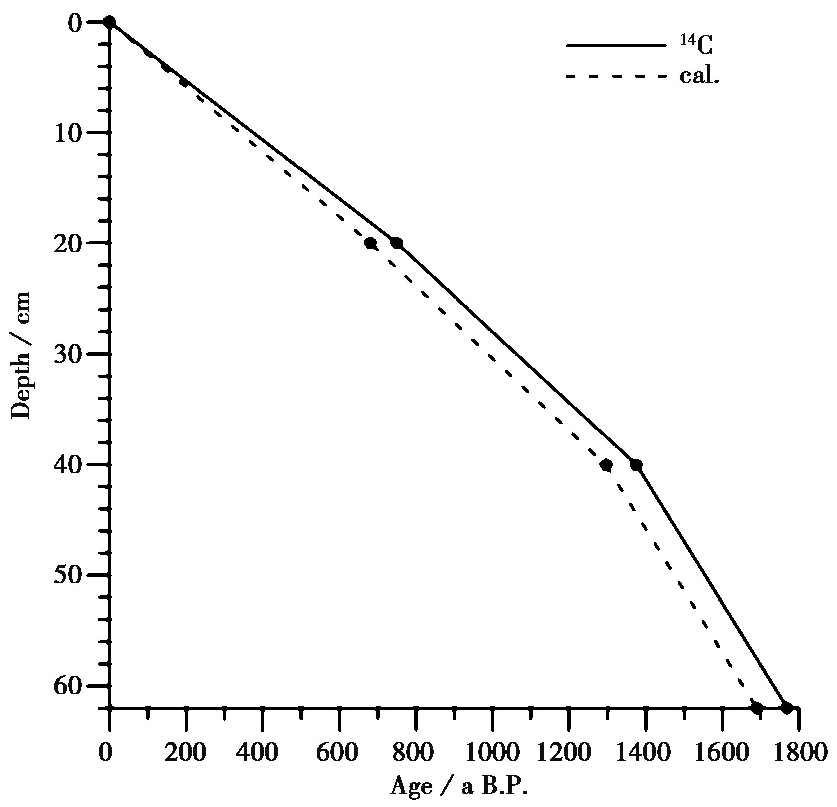
3 结果和讨论 3.1 年代测定结果图强沉积剖面的测年数据如 表1所示。剖面底部61~62cm处根据火烧木进行AMS 14 C 测定的年龄为 1770±20a B .P. ,经过树轮校正后的年龄为 1690±30cal.a B .P.; 而根据动物壳体则未能测出年龄。此外,剖面上部9~10cm处由于苔藓叶样品量不够而未能测出年龄。从图强沉积剖面的年龄-深度模式图可以看出年龄与深度具有良好的线性关系( 图2),表明该剖面沉积速率较为稳定,计算得出的平均沉积速率为0.037cm/a。由此推测,在物源较为稳定的情况下,炭屑堆积受外来干扰作用影响较小,从而有利于不同类型炭屑数据重建火历史的对比。
|
表 1 图强剖面样品的年代数据 Tab.1 AMS 14 C age of TQ sediment section |
|
图 2 图强剖面年龄-深度模式图 Fig. 2 Age-depth model of TQ sediment section |
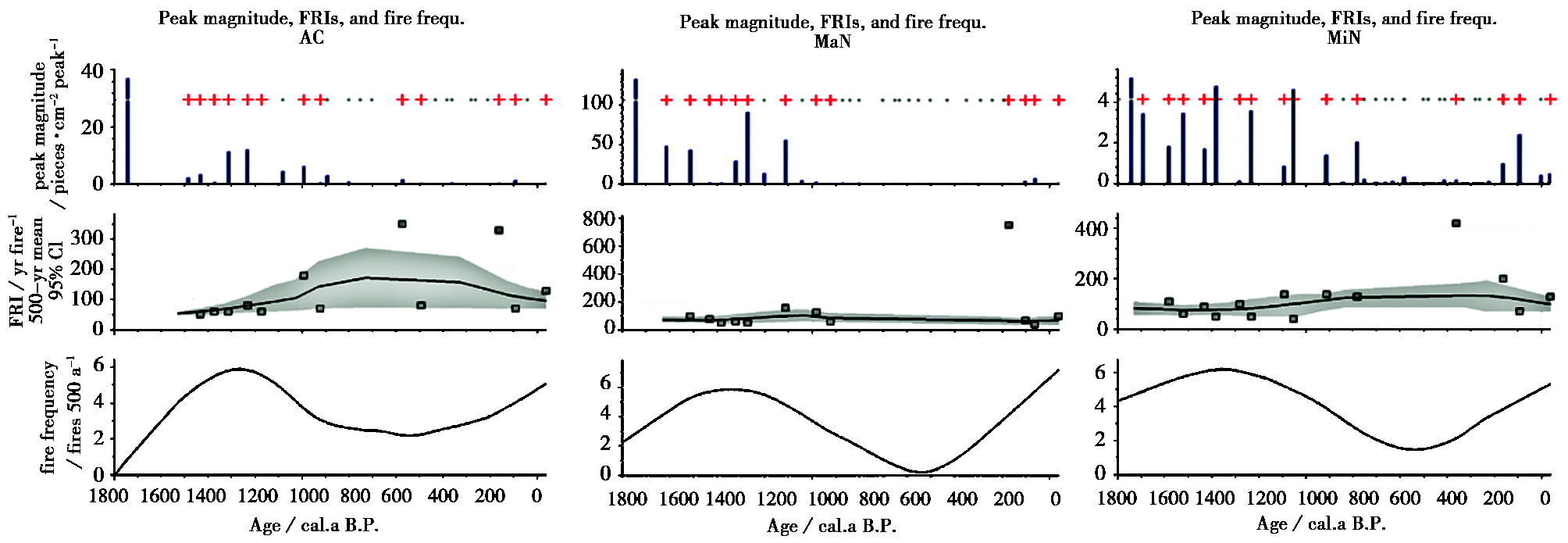
首先,在进行炭屑CharAnalysis分析之前,我们根据 14 C 测年结果对泥炭剖面的年代数据进行了插值分析,以便得到炭屑连续沉积的年代序列。然后,将不同统计方法计算出来的炭屑浓度通过年代序列分别进行数学分解,从而得到炭屑背景值和炭屑峰值(Peak magnitude,图3)。最后,通过判断炭屑阈值的大小来定义火事件。最终的重建结果再通过数理统计方法进行检验。
|
图 3 不同类型炭屑数据的火历史重建结果 红色加号代表“单次火事件”, 蓝色柱状图代表“炭屑峰值”; 灰色阴影代表“95 % 的置信区间”, 矩形方框代表“单次火事件的间隔期” Fig. 3 Reconstruction results of fire-history based on different charcoal data. Red plus represents “a fire event”, blue bar chart represents “charcoal peak magnitude”, gray area represents “95 % confidence interval(Cl)”, rectangle represents “FRI of a fire event” |
大兴安岭地区1690年以来,根据微炭屑面积浓度(AC)重建出的火事件次数为12次,每次火事件的平均间隔期为124年,火事件平均频率为3.5次/500年,火事件的频发期为1150~1500a B .P. 、 900~1000a B .P. 、 500~600a B .P. 和100~150a B .P.( 图3左); 根据大炭屑颗粒浓度(MaN)重建出的火事件次数为12次,每次火事件平均间隔期为81年,火事件平均频率为3.5次/500年,火事件的频发期为1250~1650a B .P. 、 900~1000a B .P. 和50~150a B .P.( 图3中); 根据微炭屑的颗粒浓度(MiN)重建出的火事件次数为14次,每次火事件平均间隔期为107年,火事件平均频率为4.1次/500年,火事件的频发期为1200~1600a B .P. 、 1000~1100a B .P. 和100~150a B .P.( 图3右)。
通过对比发现,3种不同类型的炭屑数据重建出的着火次数(fire events)、 火事件间隔期(FRIs)和火事件频率(fire frequ.)的变化规律基本一致。即着火次数为12~14次; 火事件间隔期的变化均较为平缓,每次火事件平均间隔期为81~124年; 火事件频率经历了先上升后下降再上升的变化趋势,平均频率为3.5~4.1次/500年。
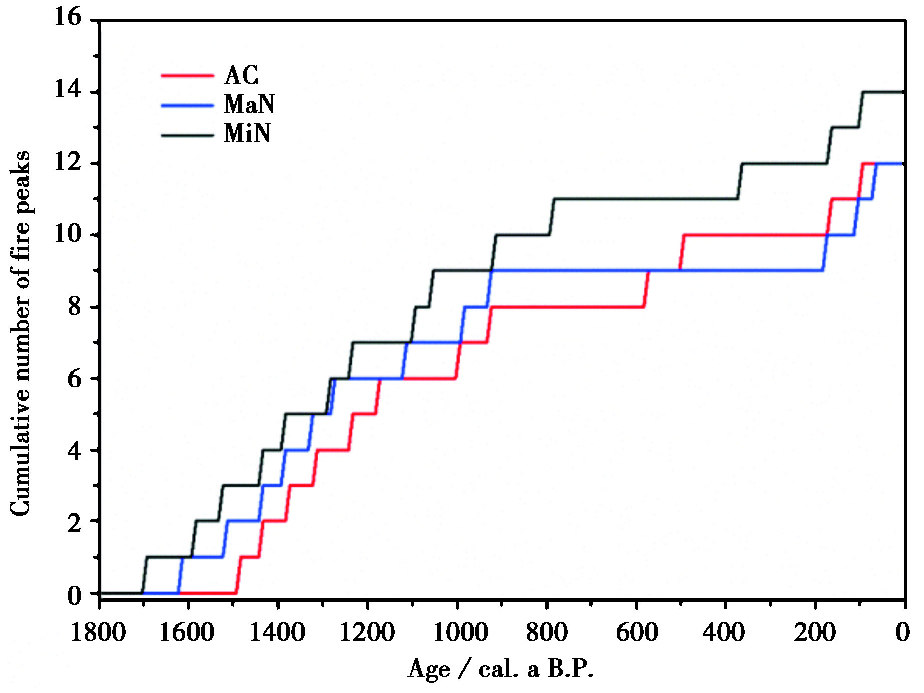
3种不同类型的炭屑数据反映的火事件累积分布曲线也表明,距今1690年以来,大兴安岭地区火历史的总体规律基本一致( 图4)。尤其在1690~900a B .P. ,3种不同类型的炭屑数据反映的火事件累积分布具有相同的变化规律,并且根据微炭屑颗粒浓度和大炭屑颗粒浓度重建的累积着火次数均为9次,与微炭屑面积浓度重建结果(8次)仅相差一次。
|
图 4 不同类型炭屑数据反映的火事件累积分布 Fig. 4 Cumulative number of fire peaks based on different charcoal data |
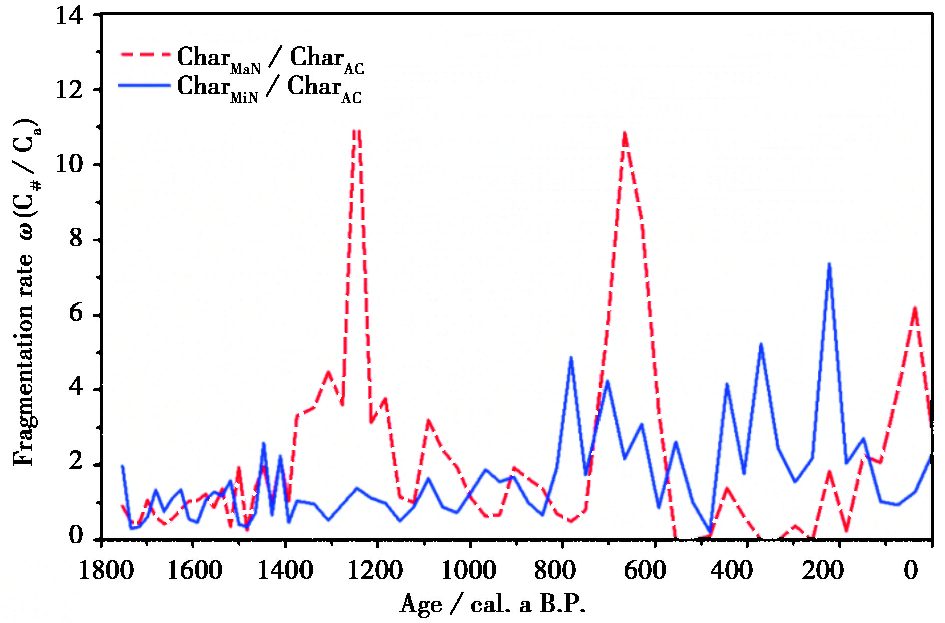
虽然同一沉积剖面不同炭屑数据所重建的火历史总体规律基本一致,但依旧存在一定的差异性。为了探讨重建结果产生差异的原因,本文计算了炭屑破碎率ω ︰ ω=C#/Ca,其中,C#表示炭屑颗粒浓度和Ca表示炭屑面积浓度。 图5中CharMaN、 CharMiN和CharAC分别代表大炭屑颗粒浓度、 微炭屑颗粒浓度和微炭屑面积浓度。结果表明,大炭屑相对于微炭屑总体破碎率较高。大炭屑破碎主要出现在1400~1150a B .P. 、 750~550a B .P. 和100a B .P. ,微炭屑破碎主要出现在850~150a B .P.( 图5)。而本研究中根据微炭屑颗粒浓度重建的着火次数和平均频率均比大炭屑要高,这可能是由于大炭屑破碎导致微炭屑浓度增加所致。
|
图 5 大炭屑和微炭屑破碎率 Fig. 5 Fragmentation ratio of macroscopic and microscopic charcoal |
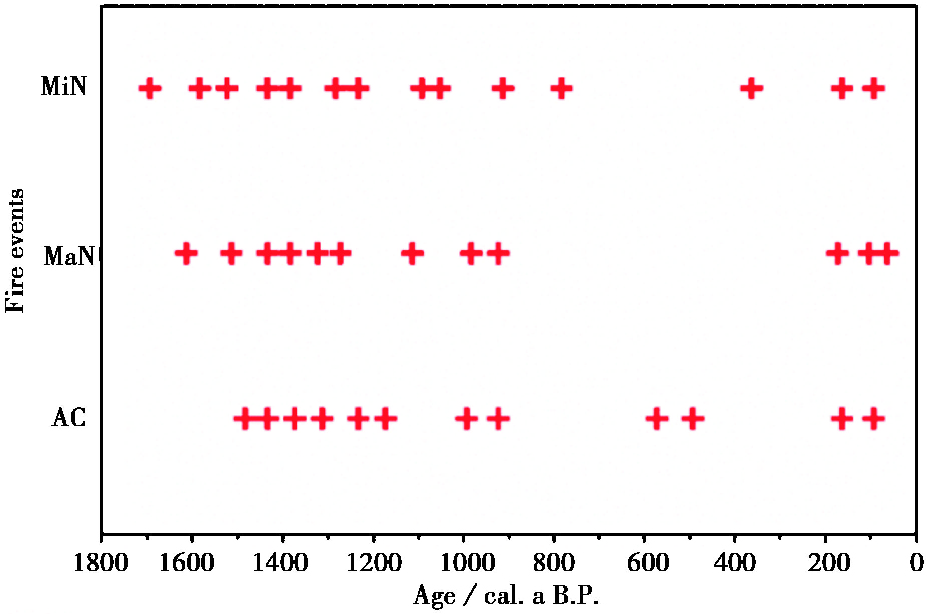
对比大炭屑和微炭屑破碎率变化( 图5)及其重建的着火次数( 图6)可以发现,在750~550a B.P.,基于微炭屑颗粒浓度重建的着火次数为1次,而基于大炭屑颗粒浓度重建的着火次数为0; 在1400~1150a B .P. ,基于微炭屑颗粒浓度重建的着火次数为4次,而基于大炭屑颗粒浓度重建的着火次数为3次; 据此可推测大炭屑破碎导致微炭屑浓度增加可能是造成两者重建结果不同原因。对比 图5和 图6,我们同样可以发现,在850~150a B .P. ,微炭屑的破碎率较高,并且基于微炭屑颗粒浓度重建的着火次数(3次)高于大炭屑颗粒浓度(1次)。这种规律亦表明炭屑破碎与重建结果之间存在一定的联系。
|
图 6 不同类型炭屑数据重建的着火次数对比 Fig. 6 Comparison of fire event reconstruction based on different charcoal data |
以上分析表明,大炭屑破碎率较高时,基于大炭屑重建的着火次数偏低,而基于微炭屑重建的着火次数偏高; 微炭屑破碎率较高时,基于大炭屑重建的着火次数不受影响,而基于微炭屑重建的着火次数偏高。由此可见,炭屑破碎与重建结果之间具有一定的相关性。但是,炭屑破碎对重建结果的影响程度有待进一步研究,尤其是不同粒级的炭屑破碎程度对重建结果的影响更应该值得关注。Leys等[17]认为,炭屑在沉积保存过程和实验处理过程中不可避免会发生破碎作用,但这种破碎作用的影响无法统一量化处理,为了提高不同炭屑数据的稳定性和可比性,应当提倡利用微炭屑面积浓度来重建火历史。
4 结论大兴安岭沉积剖面的微炭屑面积浓度、 微炭屑颗粒浓度和大炭屑颗粒浓度三种不同类型的炭屑数据所重建的火历史基本一致。距今1690年以来,根据三种不同类型的炭屑数据重建的火事件频率经历了先上升后下降再上升的变化趋势; 重建的火事件次数为12~14次,平均频率为3.5~4.1次/500年,每次火事件的平均间隔期为81~124年。由此可见,利用不同类型的炭屑数据重建火历史具有很好的可比性,这将为不同地区进行火历史的对比研究奠定基础。然而,基于不同类型的炭屑数据重建的火历史之间也存在一定的差异性,这种差异可能受炭屑破碎的影响。
致谢 感谢周力平教授在论文构思与写作过程中提供的指导与建议; 审稿人和编辑部老师对本文提出的宝贵修改意见; 赵鹏飞和杨柳的野外样品采集工作; 何飞和许耀中对论文的讨论和修改所给予的帮助。
| 1 | Scott A C, Damblon F. Charcoal:Taphonomy and significance in geology, botany and archaeology. Palaeogeography, Palaeoclimatology, Palaeoecology, 2010, 291 (1~2):1~10 |
| 2 | Bird M I, Cali J A. A million-year record of fire in sub-Saharan Africa. Nature, 1998, 394 (6695):767~769 |
| 3 | Whitlock C, Millspaugh S H. Testing the assumptions of fire-history studies:An examination of modern charcoal accumulation in Yellowstone National Park, USA. The Holocene, 1996, 6 (1):7~15 |
| 4 |
谭志海, 黄春长, 庞奖励等. 陇东黄土高原北部全新世野火历史的木炭屑记录. 第四纪研究, 2008, 28 (4):733~738 Tan Zhihai, Huang Chunchang, Pang Jiangli et al. Charcoal recorded Holocene fire history in the northern part of the Longdong Loess Plateau. Quaternary Sciences, 2008, 28 (4):733~738 |
| 5 |
赵鹏飞, 李宜垠. 大兴安岭泥炭地1300年来泥炭藓孢子和炭屑记录及其指示意义. 第四纪研究, 2012, 32 (3):563~564 Zhao Pengfei, Li Yiyin. The records of sphagnum spore and charcoal in the peat land of Daxing'an Mountain since 1300 years and their paleo-environment implication. Quaternary Sciences, 2012, 32 (3):563~564 |
| 6 |
赵克良, 李小强, 周新郢等. 辽西城子山遗址夏家店下层文化期农业活动特征及环境效应. 第四纪研究, 2011, 31 (1):8~15 Zhao Keliang, Li Xiaoqiang, Zhou Xinying et al. Agricultural activities and its impact on the environment in lower Xiajiadian culture period of the Chengzishan Site, west Liaoning Province. Quaternary Sciences, 2011, 31 (1):8~15 |
| 7 | C1ark J S. Particle motion and tlle theory of charcoal analysis:Source area, transport, deposition, and sarnpling. Quaternary Research, 1988, 30 :67~80 |
| 8 |
李小强, 周新郢, 尚雪等. 黄土炭屑分级统计方法及其在火演化研究中的意义. 湖泊科学, 2006, 18 (5):540~544 Li Xiaoqiang, Zhou Xinying, Shang Xue et al. Different size method of charcoal analysis in loess and its significance in the study of fire variation. Journal of Lake Science, 2006, 18 (5):540~544 |
| 9 | Higuera P E, Gavin D G, Bartlein P J et al. Peak detection in sediment-charcoal records:Impacts of alternative data analysis methods on fire-history interpretations. International Journal of Wildland Fire, 2010, 19 :996~1014 |
| 10 | Higuera P E, Sprugel D G. Brubaker L B. Reconstructing fire regimes with charcoal from small hollow sediments:A calibration with tree-ring records of fire. The Holocene, 2005, 15 (2):238~251 |
| 11 | Higuera P, Peters M, Brubaker L et al. Understanding the origin and analysis of sediment charcoal records with a simulation model. Quaternary Science Reviews, 2007, 26 (13~14):1790~1809 |
| 12 | Peters M E, Higuera P E. Quantifying the source area of macroscopic charcoal with a particle dispersal model. Quaternary Research, 2007, 67 (2):304~310 |
| 13 | Power M J, Marlon J, Ortiz N et al. Changes in fire regimes since the Last Glacial Maximum:An assessment based on a global synthesis and analysis of charcoal data. Climate Dynamics, 2008, 30 (7~8):887~907 |
| 14 | Marlon J R, Bartlein P J, Carcaillet C et al. Climate and human influences on global biomass burning over the past two millennia. Nature Geoscience, 2008, 1 (10):697~702 |
| 15 | Kelly R F, Higuera P E, Barrett C M et al. A signal-to-noise index to quantify the potential for peak detection in sediment charcoal records. Quaternary Research, 2011, 75 (1):11~17 |
| 16 | Ali A A, Higuera P E, Bergeron Y et al. Comparing fire-history interpretations based on area, number and estimated volume of macroscopic charcoal in lake sediments. Quaternary Research, 2009, 72 (3):462~468 |
| 17 | Leys B, Carcaillet C, Dezileau L et al. A comparison of charcoal measurements for reconstruction of Mediterranean paleo-fire frequency in the Mountains of Corsica. Quaternary Research, 2013, 79 (3):337~349 |
| 18 |
徐化成. 中国大兴安岭森林. 北京: 北京科学出版社, 1998. 1~12 Xu Huacheng. Daxing'an Mountain Forest of China. Beijing:Beijing Science Press, 1998. 1~12 |
| 19 |
牛若芸, 翟盘茂, 佘万明. 森林火险气象指数的应用研究. 应用气象学报, 2007, 18 (4):479~489 Niu Ruoyun, Zhai Panmao, She Wanming. Applied research on forest fire danger weather index. Journal of Applied Meteorological Science, 2007, 18 (4):479~489 |
| 20 |
田晓瑞, 舒立福, 王明玉等. 大兴安岭雷击火时空分布及预报模型. 林业科学研究, 2009, 22 (1):14~20 Tian Xiaorui, Shu Lifu, Wang Mingyu et al. Spatial and temporal distribution of lightning fire and forecasting model for Daxing'anling region. Forest Research, 2009, 22 (1):14~20 |
| 21 |
邸学颖, 王宏良, 姚树人等. 大兴安岭森林地表可燃物生物量与林分因子关系的研究. 森林防火, 1994, 41 (2):16~18 Di Xueying, Wang Hongliang, Yao Shuren et al. Relationship between biomass and vegetation in Daxing'an Mountain range. Forest Fire Prevention, 1994, 41 (2):16~18 |
| 22 | 吕静, 王宇飞, 李承森. 古炭屑与古森林火. 古地理学报, 2002, 4 (2):71~76 Lü Jing, Wang Yufei, Li Chengsen. Fossil charcoal and ancient forest fire. Journal of Palaeogeography, 2002, 4 (2):71~76 |
| 23 |
杜乐天, 王驹, 陈国梁等. 区域性森林大火的真正成因. 地学前缘, 2006, 13 (2):224~227 Du Letian, Wang Ju, Chen Guoliang et al. Real genesis of regional forest fire. Earth Science Frontiers, 2006, 13 (2):224~227 |
| 24 |
狄丽颖, 孙仁义. 中国森林火灾研究综述. 灾害学, 2007, 22 (4):118~123 Di Liying, Sun Renyi. Summarization of research on forest fire in China. Journal of Catastropholog, 2007, 22 (4):118~123 |
| 25 | Patterson W A, Edwards K J, Maguire D J. Microscopic charcoal as a fossil indicator of fire. Quaternary Science Reviews, 1987, 6 (1):3~23 |
| 26 | Willcox G. Charcoal analysis and Holocene vegetation history in Southern Syria. Quaternary Science Reviews, 1999, 18 (4):711~716 |
| 27 | Winkler M G. Charcoal analysis for paleoenvironmental interpretation:A chemical assay. Quaternary Research, 1985, 23 :313~326 |
| 28 | Bickford S, Gell P, Hancock G J. Wetland and terrestrial vegetation change since European settlement on the Fleurieu Peninsula, South Australia. The Holocene, 2008, 18 (3):425~436 |
| 29 | Li Y Y, Willis K J, Zhou L P et al. The impact of ancient civilization on the north Eastern Chinese landscape:Palaeoecological evidence from the western Liaohe River basin, Inner Mongolia. The Holocene, 2006, 16 (8):1109~1121 |
| 30 | Wahl D, Schreiner T, Byrne R et al. A paleoecological record from a late classic Maya reservoir in the North Peten. Latin American Antiquity, 2007, 18 (2):212~222 |
| 31 | Clark J S. Stratigraphic charcoal analysis on petrographic thin sections:Application to fire-history in northwestern Minnesota. Quaternary Research, 1988, 30 (1):81~91 |
| 32 |
李宜垠, 侯树芳, 赵鹏飞. 微炭屑的几种统计方法比较及其对人类活动的指示意义. 第四纪研究, 2010, 30 (2):356~363 Li Yiyin, Hou Shufang, Zhao Pengfei. Comparison of different quantification methods for microfossil charcoal concentration and the implication for human activities. Quaternary Sciences, 2010, 30 (2):356~363 |
| 33 | Clark J S, Royall P D. Local and regional sediment-charcoal evidence for fire regimes in presettlement north-eastern North America. Journal of Ecology, 1996, 84 :365~382 |
| 34 | Long C J, Whitlock C, Bartlein P J et al. A 9000-year fire-history from the Oregon Coast Range, based on a high-resolution charcoal study. Canadian Journal of Forest Research, 1998, 28 :774~787 |
| 35 | Gavin D G, Hu F S, Lertzman K et al. Weak climatic control of stand-scale fire-history during the Late Holocene. Ecology, 2006, 87 :1722~1732 |
| 36 | Higuera P E, Brubaker L B, Anderson P M et al. Vegetation mediated the impacts of postglacial climate change on fire regimes in the south-central Brooks Range, Alaska. Ecological Monographs, 2009, 79 :201~219 |
Abstract
Tuqiang section(TQ)(52°56'28.61"N, 122°51'30.65"E) with a peat sediment of 62cm thick is located in the north of Daxing'an Mountain, Heilongjiang Province. We collected 62 samples at intervals of 1cm. All the samples were used for charcoal analysis and number as well as area measurements from macroscopic and microscopic charcoal were used for fire-history reconstructions. Three dated samples, at depth of 19~20cm, 39~40cm and 61~62cm, yielded ages of 680±14cal .a B.P., 1295±20cal .a B.P.and 1690±30cal .a B.P., respectively. Age-depth model presented a good correlation between age and depth.
Many studies have particularly focused on how to reconstruct fire-history accurately based on charcoal records in peat and lake sediments. In the field of paleo-fire research, macroscopic charcoal larger than 125μm and microscopic charcoal smaller than 125μm are the most common charcoal data. In this study, CharAnalysis technique was used to reconstruct fire regimes in Daxing'an Mountain. Three kinds of charcoal data including area concentration of microscopic charcoal(AC), particle concentration of microscopic charcoal(MiN)and particle concentration of macroscopic charcoal(MaN)were processed for Char Analysis.
Results indicated that fire-history analysis based on AC, MaN and MiN identified 12, 12 and 14 fire events, mean fire return intervals(FRIs)were 124a, 81a and 107a per fire event, mean fire frequencies(fire frequ.)were 3.5, 3.5 and 4.1 fire events per 500a respectively. Comparison of the fire reconstruction results turns out that fire-history showed almost the same changing trend:12~14 fire events occurred from 1690a B.P.to nowadays, FRI varied smoothly and mean FRI was 81~124a per fire event, and mean fire frequency was 3.5~4.1 fire events per 500a with a trend of firstly rising, then falling down and ultimately going up again. But the fire events, fire return interval and fire frequency still presented some discrepancy. Charcoal fragmentation might be a factor affecting the fire reconstruction results.