 2015, Vol.35


末次冰消期以来的气候变化是第四纪气候变化研究中极其重要的部分,地球系统发生了重大改变[1]。人们就末次冰消期多次快速冷暖或干湿的气候变化事件以及全新世气候变化的复杂性和周期性进行过深入研究,但是在不同区域,这些气候事件的表现并不相同,而且一些气候事件的发生是否具有全球性仍需更多的证据来支持。因此,要全面理解末次冰消期以来全球气候变化的时空规律及其驱动机制,还需要在不同的地区获得年代和代用指标意义可靠的高分辨率的气候记录[2, 3, 4, 5, 6, 7, 8, 9, 10]。
湖泊沉积物因其沉积速率快、 沉积序列连续、 时间分辨率高、 记录时间序列长等优势,成为研究高分辨率古气候变化最具潜力的研究对象之一[11, 12]。其中,玛珥湖(或火山口湖)因其成因特殊、 湖盆封闭、 深度大、 底部平坦等独特的环境和物化条件,使湖泊沉积物得以避免受河流等因素的干扰,形成连续沉积序列,不仅能保存高分辨率气候环境信息[13, 14, 15, 16],还能揭示气候环境的变迁及其驱动机制,是研究古气候环境的理想场所。
有机碳同位素是一种能有效反映气候和环境演变的替代性指标,在古气候、 古环境研究中得到广泛应用[17, 18, 19, 20, 21, 22, 23, 24, 25, 26, 27, 28, 29, 30, 31, 32],利用湖泊沉积物中全岩有机碳同位素组成进行古气候环境重建的工作也取得了丰硕的成果[17, 18, 19, 20, 21, 22, 23, 24, 29, 30, 31, 32]。然而,气候系统的复杂性、 地质环境的多样性以及主导因素的差异性造成不同地区、 不同类型湖泊的有机碳同位素组成的古气候环境意义并不相同[19, 23]。近年来,很多学者利用泥炭、 湖泊沉积物和树轮等多种高分辨率载体对中国东北季风区的气候变化和环境演变进行了一系列研究[33, 34, 35, 36, 37, 38, 39, 40, 41, 42, 43, 44],但总体来说,主要集中在龙岗火山区的玛珥湖与泥炭沉积[23, 35, 36, 45, 46, 47, 48]以及岱海[49, 50, 51]、 呼伦湖[52, 53, 54]、 达里湖[55]等几个地点。对现代东亚夏季风能达到的北缘——大兴安岭地区,目前除了月亮湖之外[56, 57, 58, 59],古气候研究工作尚未开展。
为此,本文选取处于季风/非季风过渡地带北缘的四方山天池( 图1)湖泊沉积物作为研究载体,对其总有机碳含量、 总有机氮含量和全岩有机碳同位素的古气候意义进行分析,并在此基础上探讨该区域末次冰消期以来气候的演化历史,为大兴安岭地区后续气候重建工作提供更多证据。

|
图 1 大兴安岭中北段四方山天池地理位置图[50] Fig.1 Geographic location of the Lake Sifangshan in the north of the Great Xing′an Range[50] |
四方山天池(49°22′32.97″N,123°27′49.90″E;海拔933m)是一个已经沼泽化,近于干涸的火山口湖[60],位于大兴安岭中北段东麓,诺敏河-奎勒河火山区毕拉河以南、 诺敏河以西的四方山火山锥体内部(火山渣锥-长径:1900m; 短径:1500m)[61],距内蒙古鄂伦春自治旗诺敏镇西北30km。经火山岩年代测定,该火山形成于大约 0.128±0.01Ma年前[62]。现今,湖盆中央残存水域的直径约26m,最大水深2m。
诺敏河-奎勒河火山区内分布着约24座第四纪火山和数百平方千米的熔岩流,火山锥及熔岩流主要沿诺敏河及其东(奎勒河)西(毕拉河)两侧分布,火山岩面积约600km2[61, 62],火山活动一直延续到全新世[62],形成了火山渣锥、 溅落锥和盾形火山等3种主要的火山类型。
大兴安岭中北段东麓的四方山天池地处寒温带针叶林和温带阔叶林相互过渡地带[63],属寒温带大陆性季风气候,主要受东南海洋暖湿气流与西北干寒气流影响。此外,由于大陆型高山气候的影响,区域小气候特征明显,具有独特的四季特征,即春秋相连,夏季特征不明显,冬季漫长寒冷。
2 材料与方法2012年3月利用活塞钻技术(piston drilling),在四方山天池的湖心获得两个长度分别为342.5cm和505cm的平行钻。通过岩芯标志层进行拼接,最终获得深度为482.5cm的连续的沉积物序列。岩芯的岩性组成大致可以分为3段:0~354.5cm富含有机质的腐殖黑泥,其间有大量棕色有机质碎屑层; 354.5~440.5cm为棕色碎屑有机质层,并有黑色和棕色相间的纹层出现; 440.5~482.5cm为棕色碎屑层。
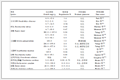
2.1 AMS14C定年为获得可靠的年龄,挑选14个样品(1个全岩样品和13个植物残体)送往波兰波兹南放射性实验室(Poznan Radiocarbon Laboratory)进行AMS14C年代测定,并用最新的IntCal13数据库的CALIB704程序[64]对所测的14C年龄进行日历年龄校正( 表1)。
|
表 1 四方山天池沉积序列AMS14C定年结果 Table 1 Radiocarbon dates of the Lake Sifangshan profile |
本文利用已经获得的14个可靠的、 校正后的日历年龄进行线性内插,并根据最下部两个年龄计算出的沉积速率进行外推得到岩芯最底部(深度482.5cm)年龄约为15.4ka B .P. ,从而建立起四方山天池湖泊沉积物年代学标尺,所得到的深度-年龄曲线如 图2所示。

|
图 2 四方山天池的深度-年龄模式图 Fig.2 The depth-age model of the Lake Sifangshan |
以1cm为间隔对四方山天池钻孔岩芯进行分样。之后,对所得的483个样品进行实验前处理,具体步骤如下: 1)将5g已经冷冻干燥过的样品研磨至200目,置入离心管内; 2)加入25ml 10 % 的稀盐酸(HCl),浸泡静置12小时以上,以便完全去除无机碳酸盐; 3)在离心管中加入蒸馏水,水洗-离心数次直至清液pH值接近中性(pH>4); 4)将在55℃烘箱中烘干的样品再次研磨至200目。
对已进行前处理的样品,在中国科学院青海盐湖所化学分析测试部进行全岩总有机碳(TOC)、 总有机氮(TN)含量的分析与测定: 取10mg左右的样品,用纯度99 % 以上的锡纸包好,用元素分析仪(德国ELEMENTAR公司生产的vario EL cube碳氢氮氧硫有机化学元素分析仪)测定总有机碳、 总有机氮含量,每个样品测定两个平行样,实验结果取其均值,测量误差为±0.03 % 。TOC/TN的比值(原子比)是其摩尔质量比值计算而得。全岩有机碳同位素(δ13Corg.)的测定在中国科学院地球环境研究所黄土与第四纪地质国家重点实验室进行: 样品称量约100~500mg,置于石英管内,加入适量棒状氧化铜及铂金丝作催化剂,抽真空后密封,在850℃的马弗炉中灼烧4小时; 冷却后的石英管在真空系统中破碎,生成的CO2气体用液氮冷冻,并进一步纯化; 提取富集纯化后的CO2在MAT251型同位素质谱仪上测定出δ13Corg.,分析结果参照国际PDB标准,工作标准的测量误差<0.2‰[65]。
3 结果和讨论四方山天池湖泊沉积序列自15.4ka B .P. 以来,总有机碳含量(TOC)的变化范围为1.60 % ~34.40 % ,变化幅度为32.80 % ,可能反映了湖泊有机质逐渐累积过程; 总氮含量(TN)的变化范围约为0.16 % ~2.65 % ,变化幅度为2.49 % ; TOC/TN比值变化范围为10.4~18.8,平均值为14.2。TOC与TN基本呈线性相关(R=0.99)( 图3),且两者自15.4ka B .P. 以来整体一直处于波动上升趋势。

|
图 3 四方山天池TOC和TN的相关关系图 Fig.3 Relationship of TOC and TN in Lake Sifangshan |
15.4ka B.P.以来,四方山天池湖泊沉积物δ13 Corg. 在-31.79 ‰ ~-22.51 ‰ 之间变化,平均值为-27.05 ‰ 。根据TOC含量、 TOC/TN和全岩有机碳同位素的演化规律可以将四方山天池15.4ka B .P. 以来古气候环境记录划分为6个阶段,δ13 Corg. 值的变化规律如下:
(1) 15.4~14.5ka B .P.,δ13Corg. 值在-28.01 ‰ ~-24.99 ‰ 之间波动,平均值为-26.35 ‰ ,整体偏正;
(2)14.5~12.7ka B .P. ,δ13Corg. 值变化范围为-31.79 ‰ ~-26.67 ‰ ,平均值为-29.30 ‰ ,其值基本小于剖面均值,整体偏负;
(3) 12.7~11.3ka B .P. ,δ13Corg. 最大值-27.81 ‰ ,最小值-30.12 ‰ ,平均值-29.21 ‰ ,在δ13 Corg. 值变化曲线上呈现为一个明显的波谷;
(4)11.3~7.2ka B .P. ,δ13 Corg. 值是整个剖面曲线上最为偏正的时期,变化范围在-26.84 ‰ ~-22.51 ‰ 之间,平均值为-24.90 ‰ ,是15.4ka B .P. 以来全岩有机碳同位素最为富集的阶段;
(5)7.2~4.5ka B .P. ,δ13 Corg. 值(-27.47 ‰ ~-25.17 ‰ )虽呈现出逐渐偏负的态势,但就整个剖面而言仍处于相对高位,平均值为-26.44 ‰ ;
(6)4.5ka B .P. 以来,δ13 Corg. 值在-28.11 ‰ ~-26.49 ‰ 之间,平均值为-27.36 ‰ ,变化不大。
3.2 沉积物有机质的来源湖泊沉积物一般包括流域内侵蚀带来的外源组分和湖泊水体中各种化学与生物过程所产生的内生沉淀[66]。湖泊沉积物中的有机质则主要来源于外源的陆生植物和内源的湖泊水生植物[67, 68, 69]。在没有突发性地质事件和强烈的人为干扰的情况下,气候变化是决定沉积物物质组成的重要因素,因此,对湖泊柱状沉积物的研究就成为恢复对应历史时期湖区气候和环境变迁历史的有效途径[66]。
总有机碳含量(TOC)可以反映湖泊沉积物中有机质含量变化,它取决于有机质的输入量与沉积环境对有机质的保存能力之间的相互关系,可以作为揭示气候波动规律的替代性指标,温暖湿润的气候条件下总有机碳含量高,反之则较低[70, 71, 72, 73, 74]。湖泊及其流域范围内初级生产力变化也可以通过TOC和TN含量的变化来反映[69, 75]。大量研究表明[23, 24, 56, 69, 74, 76, 77, 78, 79],TOC/TN比值可以用来判断湖泊沉积物中有机质的来源,富含纤维素的高等陆生维管植物TOC/TN往往大于20,甚至高达100,蛋白质含量高的低等水生生物的TOC/TN比值往往小于10或更低,通常在4~10之间变化,大多数湖泊表层沉积物 TOC/TN 比值在13~14之间,指示陆生维管植物和水生藻类对沉积物中有机质的贡献几乎各占一半。四方山天池的TOC/TN比值变化范围为10.4~18.9,平均值为14.2,表明外源陆生植物和湖泊内源水生植物对沉积物中有机质都有贡献。
3.3 沉积物有机碳同位素组成变化的主控因素及古气候意义陆生植物按照光合作用固碳方式和初级产物的碳原子数不同将划分为C3、 C4和CAM植物,它们具有不同的碳同位素组成。陆源C3植物的δ13 C值变化范围在-33 ‰ ~-22 ‰ 之间,平均值为-27 ‰ ; C4植物的δ13 C值变化范围在-19 ‰ ~-9 ‰ 之间,平均值-13 ‰ ; CAM植物的δ13 C值分布较广(-10 ‰ ~30 ‰ ),主要分布在极干旱区,对位于温带大陆性季风气候区的四方山天池几乎没有影响,可以忽略不计[80, 81, 82]。C3、 C4植物的有机碳同位素组成明显不同,其分布区间互不重叠,因此若湖泊有机质主要来源于陆生植物,且湖区植被类型随气候演化而发生的变化成为导致湖泊沉积δ13 Corg. 值变化的主控因素时,δ13 Corg. 便可以用来反映陆生植被类型,特别是C3和C4植物的相对生物量变化。C3/C4 植物相对生物量降低,δ13 Corg. 值偏正,反之则δ13Corg. 值偏负[23, 83]。
湖泊内的挺水植物、 沉水植物和浮游植物也因光合作用所利用碳源的不同,而有着明显不同的碳同位素组成[68]。利用大气CO2进行光合作用的挺水植物,其δ13 C值与陆生C3植物相似,可偏负至-30 ‰ ~-24 ‰ ; 主要利用湖水中重碳酸盐溶解释放出的CO2进行光合作用的沉水植物,由于常温下HCO3-离子的δ13 C比溶解在水中的大气CO2的δ13 C偏重7 ‰ -11 ‰ ,因此,其δ13 C变化范围在-20 ‰ ~-12 ‰ 之间,平均约为-15 ‰ ; 浮游植物的δ13 C值与湖水中与大气保持平衡的溶解CO2是否能满足其光合作用有关: 当湖水中溶解CO2充足,可以满足浮游植物光合所用所需碳源时,其δ13 C值与陆生C3植物的δ13 C值接近,最大可偏负至-35.5 ‰ ; 当湖水中溶解CO2严重亏损,不能满足浮游植物光合所用所需碳源时,湖水中的HCO3-便作为其光合作用的碳源,其δ13 C值将显著偏正[23, 43, 56, 68, 69, 77]。
经研究表明,在年均温度低于10℃的温带地区C4植物在陆生植物中所占的比例很少[84]。我国东北地区C3植物所占比例达到了80 % 以上,且越往北其比例越高[85]。四方山天池δ13 Corg. 的变化范围约为-31.79 ‰ ~-22.51 ‰ ,落在C3植物、 挺水植物和浮游植物的δ13 C分布范围内。此外,以兴安落叶松为主的北方针叶林和以东亚阔叶林的典型代表蒙古栎为主的针阔混交林的区域植被特征,说明C3植被应该在本区域植被中占绝对主导地位。中国北方C3植物δ13 C值表现出与随温度升高而偏正、 随有效降水量增加而偏负的趋势[86, 87, 88]。即便如此,由于四方山天池湖泊沉积物中的有机质还受到挺水植物和浮游植物的影响,所以只有将TOC/TN所反映的有机质来源信息与δ13 Corg. 值的变化结合起来,才能有效揭示出四方山天池湖泊沉积物中全岩有机碳同位素的古气候意义。当沉积物有机质中外源陆生植被(C3植物)贡献占主导时,全岩有机碳同位素组成除受大气CO2浓度的影响外,主要反映温度和降水的变化: 冷、 湿气候会造成C3植物碳同位素组成偏负,δ13 Corg. 也偏负; 暖、 干气候则会导致C3植物碳同位素组成偏正,δ13 Corg. 也随之偏正[86, 87, 88]。当沉积物有机质中内源水生植物的贡献占主导时,全岩有机碳同位素组成的变化就要受到温度、 降水、 水中溶解的CO2浓度等因素的影响[68]。
3.4 15.4ka B.P.以来四方山天池沉积物记录的古气候环境演变根据四方山天池湖泊沉积物全岩有机碳同位素组成(δ13 Corg.)的变化,将四方山天池地区15.4ka B .P. 以来的气候环境演变划分为如下6个阶段( 图4):

|
图 4 四方山天池15.4ka B .P. 以来各项气候代用指标的变化规律 Fig.4 Variations of climate indexes in Lake Sifangshan since 15.4ka B .P. |
(1)第Ⅰ阶段(15.4~14.5ka B .P. ):TOC含量变化范围为1.60 % ~4.76 % (平均值为2.95 % ),湖泊外源和内源初级生产力都很低; TOC/TN比值在10.4~13.8之间,可能表明沉积物有机质主要来源于湖泊藻类和陆生C3植物的共同输入,且水生植物贡献比例较高; δ13 Corg. 整体偏正,指示气候冷干,在有效降水量低的环境条件下,不仅陆生C3植物的δ13 C值偏正,而且由于湖水水量少,湖水中溶解CO2浓度低,湖水中溶解的CO2有可能不能满足其光合作用所需碳源,水生植物需要利用HCO3-所释放的CO2进行光合作用,其δ13 C也会有所偏正。
(2)第Ⅱ阶段(14.5~12.7ka B .P. ): 本阶段正好与南京葫芦洞所记录的Bølling-Allerød暖期(B-A)(14.5~12.8ka B .P. )相对应[89],而比大兴安岭中段月亮湖的孢粉记录(14.0-12.8ka B .P. )要早[58]。在13.6ka B .P. 之前,TOC含量在高频波动中呈现出显著上升趋势,水生和陆生植物的初级生产力均有所增加; TOC/TN比值在剧烈波动中逐步升高,湖泊沉积物有机质的来源以陆生植物为主; δ13 Corg. 值整体朝着偏负方向演化,并在约14.4ka B .P.达到了剖面全岩有机碳同位素的最负值,即-31.79 ‰ ,反映了末次冰期结束后,气候转湿,有效降水量增加。13.6ka B .P. 后,TOC含量和TOC/TN比值均在急剧下降后保持相对稳定状态; 与此同时,δ13 Corg. 值快速偏正,并在13ka B .P. 左右出现峰值(-26.67 ‰ ),但整体仍位于剖面均值之下。这一系列特征说明,气候条件在13.6ka B .P. 左右发生了突变。考虑到TOC含量虽有所降低,但与前期相比整体仍处于相对高位,而湖泊沉积物有机质的来源却由之前的以陆生植物为主转变为陆生C3植物和水生植物贡献相当,再加上湖泊内源初级生产力主要受湖水营养状况和温度控制[90, 91],降水量对其影响较小,但对陆生植物影响较大。因此,我们认为,此时气候条件的转变主要表现为温度增加、 有效降水量降低,陆生植物初级生产力骤降,湖泊外源有机质的输入量也大为降低,而湖泊内生植物初级生产力却因温度增加而增加,从而使沉积物中有机质含量整体变化较小。考虑到沉积物有机质的“双源性”,有效降水量的降低一方面造成陆生C3植物的δ13 C值偏正; 另一方面也会导致湖水水量降低,在大气CO2浓度基本保持不变[92, 93]的情况下,湖水中溶解的CO2浓度下降,再加上湖泊水生植物生物量增加,进而导致湖水中溶解的CO2不能满足其光合作用所需碳源,水生植物开始利用HCO3-所释放的CO2进行光合作用,其δ13 C值也会偏正,从而造成该阶段13.6ka B .P. 之后的δ13 Corg. 值比14.5~13.6ka B .P. 期间偏正。
(3)第Ⅲ阶段为(12.7~11.3ka B .P. ): 该阶段对应着新仙女木事件(Younger Dryas Event,简称YD),持续时间约1400a左右,这与南京葫芦洞石笋(12.8~11.5ka B .P. )[89]和大兴安岭中段月亮湖孢粉与黑炭记录的新仙女木事件(12.8-11.8ka B .P. )起始时间[58, 59]较为一致,但持续时间略有不同,也比利用月亮湖全岩有机碳同位素重建的新仙女木事件发生的时间(12.0-10.8ka B .P. )略早[56]。在此期间,该湖湖泊沉积物的TOC含量稍有增加(6.33 % -10.19 % ),TOC/TN比值持续下降,平均值为13.7,这与月亮湖记录在新仙女木事件表现特征[56]非常相似,而δ13 Corg. 值却与月亮湖存在很大不同[56]。四方山天池δ13 Corg. 值在新仙女木事件期间表现出严重偏负的特征,并呈现为一个明显的波谷形态,指示在新仙女木时期,本区域的气候与东北四海龙湾[24]、 二龙湾[43]沉积物δ13 Corg. 值偏正峰值以及格陵兰GISP2冰芯 δ 18 O曲线[94]所反映的YD时期的冷干气候不同,而是与东北地区哈尼泥炭记录一样表现出冷湿的特征[39, 40, 48]。TOC/TN比值表明,此时湖泊藻类和陆生C3植物对沉积物有机质都有贡献,但水生植物略多。冷湿的气候条件,使其蒸发量与上一阶段相比大为降低,有效降水量增加,湖水水量上升,再加上大气CO2浓度在此期间也有所升高[93],进而导致湖泊中溶解CO2浓度升高,可以满足湖泊内源水生植物光合作用对碳源的需求,使水生植物δ13 C值偏负; 此外,有效降水量增加还会造成陆生C3植物δ13 C值偏负,最终导致该阶段如此偏负的δ13 Corg. 值。Hong等[39]在解释哈尼泥炭记录中YD期间冷湿的气候条件时提到: 冰筏事件的影响,使大量的冰雪融水注入海水中,海平面上升,海水温度下降,致使全球温度下降; 由于海平面的上升,东亚季风对东北地区的控制增强; 西太平洋亚热带高压增强,并在西太平洋上空的位置向北移动; 进而导致东亚夏季风增强,季风雨带向中国大陆北部迁移,该地区降雨量增加。因此,推测本区域YD期间冷湿的气候特征可能与东亚夏季风增强、 雨带向中国大陆北部迁移有关。
(4)第Ⅳ阶段(11.3~7.2ka B .P. ):TOC含量波动增加且变化较大(8.49 % ~20.24 % ),沉积物中有机质总量增大; TOC/TN比值波动频繁,在11.5~18.4之间,沉积物有机质大部分来源于陆生植物和湖泊藻类的共同输入,但在9.8~9.4ka B .P. 和8.0~7.2ka B .P. 两个时间段内TOC/TN比值大于14并在本阶段TOC/TN比值曲线上呈现为波峰形态,可能其指示沉积物有机质来源以陆生C3植物的贡献为主; δ13 Corg. 值均在剖面均值(-27.05 ‰ )之上,是整个剖面曲线上最为偏正的时期,与新仙女木事件时期相比,此阶段升温明显,有效降水量降低。陆生植物δ13 C值偏正,湖泊内源水生植物也因迅速扩张而开始利用HCO3-所提供碳源进行光合作用,其δ13 C值也会偏正,导致湖泊沉积物δ13Corg. 值也随之偏正。
需要指出的是,在8.3~8.1ka B .P. 期间,TOC含量明显下降,并在8.2ka B .P. 左右出现波谷,沉积物有机质主要来源于湖泊藻类,δ13 Corg. 值稍有偏正,指示气候转为冷干,有效降水量降低,响应了8.2ka B .P. 全球冷事件的发生,并与董哥洞D4石笋[95]、 和尚洞HS4石笋[96]和湖北神农架青天洞[97]记录时间一致,可能与东亚季风在8.2ka B .P. 左右的减弱有关[98]。
(5)第Ⅴ阶段(7.2~4.5ka B .P. ):TOC含量较高且基本保持不变,TOC/TN比值在高频振荡中逐渐升高,陆生C3植物对沉积物有机质的贡献比例逐步增大,导致δ13 Corg. 值逐渐偏负,但就整个剖面而言仍属于13 C相对富集的阶段,指示有效降水量逐渐增加,气候更加湿润。这可能与此期间海平面的升高[98]以及东亚夏季风的增强有关[99]。
(6)第Ⅵ阶段(4.5ka B .P. 以来):TOC含量显著升高(19.45 % ~34.40 % ),TOC/TN比值在14.4~17.1之间,指示湖泊沉积物有机质可能主要来源于外源陆生C3植物,δ13 Corg. 值在剖面均值附近波动。我们认为,沉积物有机质的明显增加可能是由于湖泊沼泽化所致,表明此时湖水大面积减少,气候总体变干。前人研究表明,热带西太平洋SST的升高会引起东亚季风中部和北部降水增加[100],而热带西太平洋海表温度记录显示在约5ka B .P. 左右热带西太平洋海表温度开始降低[101],因此,本区域4.5ka以来气候虽较为稳定,但整体变干可能与此有关。
4 结论综上所述,可以得到如下结论:
(1)15.4ka B .P. 以来,该区域气候演化过程经历了6个阶段:15.4~14.5ka B .P. ,气候冷干; 14.5~12.7ka B .P. ,与Bølling-Allerød暖期相对应,有效降水量有所增加,但也经历了明显的湿-干变化; 12.7~11.3ka B .P. 为新仙女木时期,气候冷湿; 11.3~7.2ka B .P. ,升温明显,但也有冷暖-干湿的波动; 7.2~4.5ka B .P. 气候进一步转暖变湿; 4.5ka B .P. 以来,湖泊沼泽化明显,气候较为稳定且总体变干。
(2)四方山天池湖泊沉积物δ13 Corg. 值的变化主要受到有效降水量的控制: 有效降水量低时,δ13 Corg. 值偏正,有效降水量高时,δ13 Corg. 值偏负; 清楚地记录了B-A暖期、 新仙女木事件、 8.2ka B .P. 冷事件等全球性气候事件的发生,并与东亚季风影响区的其他高分辨率的气候记录有较好的对应性,在定年误差内有良好的同步性。
致谢 感谢所有参加四方山天池湖泊岩芯钻探工作的成员。总有机碳含量和总有机氮含量的测定得到了中国科学院青海盐湖研究所徐黎明高级实验师的帮助,中国科学院地球环境研究所刘卫国研究员对全岩有机碳同位素分析工作提供了支持。
| 1 | Schneider R R, Bard E, Mix A C. Last ice age global ocean and land surface temperatures:The EPILOG initiative. IGBP Newsletter, 2001, 43 :4~7 |
| 2 | An Z S, Porter S C, Zhou W J et al. Episode of strengthened summer monsoon climate of Younger Dryas age on the Loess Plateau of Central China. Quaternary Research, 1993, 39 (1) :45~54 |
| 3 | Broecker W S. Massive iceberg discharges as triggers for global climate change. Nature, 1994, 372 (6505) :421~424 |
| 4 | O'Brien S R, Mayevoski P A, Meeker L D et al. Complexity of Holocene climate as reconstructed from a Greenland ice core. Science, 1995, 270 (5244) :1962~1964 |
| 5 | Bond G, Shower W, Cheseby M et al. A pervasive millennial-scale cycle in North Atlantic Holocene and glacial climates. Science, 1997, 278 (5341) :1257~1266 |
| 6 | Brauer A, Enderes C, Gunter C et al. High resolution sediment and vegetation response to Younger Dryas climate changes in varved lake sediments from Meerfelder Maar Germany. Quaternary Science Reviews, 1999, 18 (3) :321~329 |
| 7 | Baker P A, Seltze G O, Fritz S C et al. The history of South American tropical precipitation for the past 25000 years. Science, 2001, 291 (5504) :640~643 |
| 8 | Luekge A, Doose-Rolinski H, Khhan A A et al. Monsoonal variability in the northeastern Arabian Sea during the past 5000 years:Geochemical evidence from laminated sediment. Paleogeography, Paleoclimatology, Paleoecology, 2001, 167 (3-4):173~186 |
| 9 | McDermott F, Mattey D P, Hawkesworth C. Centennial-scale Holocene climate variability revealed by a high-resolution speleothem δ18O record from SW Ireland. Science, 2001, 294 (5545) :1328~1331 |
| 10 | Broecker W S, Denton G H, Edwards R L et al. Putting the Younger Dryas cold event into context. Quaternary Science Reviews, 2010, 29 (9) :1078~1081 |
| 11 | Colman S M. Continental Drilling for Paleoclimatic Records:Recommendations from An International Workshop. In:PAGES Workshop Report Series, 1996. 964-1004 |
| 12 |
沈吉. 湖泊沉积研究的历史进展与展望. 湖泊科学, 2009, 21 (3) :307~313 Shen Ji. Progress and prospect of palaeolimnology research in China. Journal of Lake Sciences, 2009, 21 (3) :307~313 |
| 13 | 刘嘉麒. 中国火山. 北京: 科学出版社, 1999. 127-144 Liu Jiaqi. Volcanoes of China. Beijing:Science Press, 1999. 127-144 |
| 14 |
李万春, 李世杰, 濮培民. 高分辨率古环境指示器——湖泊纹泥研究综述. 地球科学进展, 1999, 14 (2) :172~176 Li Wanchun, Li Shijie, Pu Peimin. Review on the high-resolution varved lake sediments as a proxy of paleoenvironment. Advance in Earth Sciences, 1999, 14 (2) :172~176 |
| 15 |
匡欢传, 周浩达, 胡建芳等. 末次盛冰期和全新世大暖期湖光岩玛珥湖沉积记录的正构烷烃和单体稳定碳同位素分布特征及其古植被意义. 第四纪研究, 2013, 33 (6) :1222~1233 Kuang Huanchuan, Zhou Haoda, Hu Jianfang et al. Variations of n-alkanes and compound-specific carbon isotopes in sediments from Huguang Maar Lake during the last glacial maximum and Holocene optimum:Implications for paleovegetation. Quaternary Sciences, 2013, 33 (6) :1222~1233 |
| 16 |
凌媛, 孙青, 朱庆增等. 同步辐射X射线荧光光谱测定沉积物中元素含量的归一方法研究——以四海龙湾纹层沉积物为例. 第四纪研究, 2014, 34 (6) :1327~1335 Ling Yuan, Sun Qing, Zhu Qingzeng et al. Research on normalization method for element analysis of sediment with synchrotron radiation X-ray fluorescence(SRXRF)——An example of varved sediment in Lake Sihailongwan, Northeast China. Quaternary Sciences, 2014, 34 (6) :1327~1335 |
| 17 | Stuiver M. Climate versus changes in 13 C content of the organic component of lake sediments during the Late Quaternary. Quaternary Research, 1975, 5 (2) :251~262 |
| 18 | Aravena R, Warner B G, MacDonald G M et al. Carbon isotope composition of lake sediments in relation to lake productivity and radiocarbon dating. Quaternary Research, 1992, 37 (3) :333~345 |
| 19 |
沈吉, 王苏民, 羊向东. 湖泊沉积物中有机碳稳定同位素测定及其古气候环境意义. 海洋与湖沼, 1996, 27 (4) :400~404 Shen Ji, Wang Sumin, Yang Xiangdong. Measurement of organic carbon stable isotope in lacustrine sediments and its significance on paleoclimate and environment. Oceanologia et Limnologia Sinica, 1996, 27 (4) :400~404 |
| 20 |
沈吉, 张祖陆, 孙庆义等. 南四湖沉积剖面中色素与有机碳同位素特征的古环境意义. 湖泊科学, 1998, 10 (2) :17~22 Shen Ji, Zhang Zulu, Sun Qingyi et al. Character and paleoenvironmental significance of the pigment and organic δ13C in sediments of Nansihu Lake. Journal of Lake Sciences, 1998, 10 (2) :17~22 |
| 21 |
殷勇, 方念乔, 胡超涌等. 云南中甸纳帕海古环境演化的有机碳同位素记录. 湖泊科学, 2001, 13 (4) :289~295 Yin Yong, Fang Nianqiao, Hu Chaoyong et al. Palaeoenvironmental evolution deduced from organic carbon stable isotope compositions of Napahai Lake sediments, northwestern Yunnan, China. Journal of Lake Sciences, 2001, 13 (4) :289~295 |
| 22 |
唐国军, 陈衍景. 有机碳同位素示踪古环境变化研究. 矿物岩石, 2004, 24 (3) :110~115 Tang Guojun, Chen Yanjing. Comment on tracing environmental change with organic carbon isotopes. Journal of Mineral and Petrology, 2004, 24 (3) :110~115 |
| 23 |
刘强, 顾兆炎, 刘嘉麒等. 62ka B.P.以来湖光岩玛珥湖沉积物有机碳同位素记录及古气候环境意义. 海洋地质与第四纪地质, 2005, 25 (2) :115~126 Liu Qiang, Gu Zhaoyan, Liu Jiaqi et al. Bulk organic carbon isotopic record of Huguangyan Maar Lake, Southeastern China and its paleoclimatic and paleoenvironmental significance since 62ka B.P. Marine Geology & Quaternary Geology, 2005, 25 (2) :115~126 |
| 24 |
刘强, 刘嘉麒, 陈晓雨等. 18.5ka B.P.以来东北四海龙湾玛珥湖全岩有机碳同位素记录及其古气候环境意义. 第四纪研究, 2005, 25 (6) :711~719 Liu Qiang, Liu Jiaqi, Chen Xiaoyu et al. Stable carbon isotope record of bulk organic matter from the Sihailongwan Maar Lake, Northeast China during the past 18.5ka. Quaternary Sciences, 2005, 25 (6) :711~719 |
| 25 |
饶志国, 陈发虎, 曹洁等. 黄土高原西部地区末次冰期和全新世有机碳同位素变化与C3/C4植被类型转换研究. 第四纪研究, 2005, 25 (1) :107~114 Rao Zhiguo, Chen Fahu, Cao Jie et al. Variation of soil organic carbon isotope and C3/C4 vegetation type transition in the western Loess Plateau during the last glacial and Holocene periods. Quaternary Sciences, 2005, 25 (1) :107~114 |
| 26 |
张普, 刘卫国, 鹿化煜等. 洛南黄土有机碳同位素组成及其与洛川、西峰黄土对比. 第四纪研究, 2009, 29 (1) :34~42 Zhang Pu, Liu Weiguo, Lu Huayu et al. Organic carbon isotope composition of Luonan loess compared with that of Luochuan and Xifeng loess. Quaternary Sciences, 2009, 29 (1) :34~42 |
| 27 |
张普, 刘卫国. 西峰、洛川黄土碳酸盐根茎体碳同位素分布特征及古环境意义探讨. 第四纪研究, 2013, 33 (1) :179~186 Zhang Pu, Liu Weiguo. Carbon isotope composition and paleoenvironment information of rhizolith in Xifeng and Luochuan loess. Quaternary Sciences, 2013, 33 (1) :179~186 |
| 28 |
陈英勇, 鹿化煜, 张恩楼等. 浑善达克沙地地表沉积物有机碳同位素组成与植被-气候的关系. 第四纪研究, 2013, 33 (2) :351~359 Chen Yingyong, Lu Huayu, Zhang Enlou et al. The relationship between organic carbon isotopic composition of surface sediment and vegetation-climate in Otindag dune field, Northern China. Quaternary Sciences, 2013, 33 (2) :351~359 |
| 29 |
任雅琴, 王彩红, 李瑞博等. 有机质饱和烃和δ 13 Corg. 记录的博斯腾湖早全新世晚期以来生态环境演变. 第四纪研究, 2014, 34 (2) :425~433 Ren Yaqin, Wang Caihong, Li Ruibo et al. Ecological environment change recorded by sediment n-alkane and δ 13 Corg. of Lake Bosten since late of Early Holocene. Quaternary Sciences, 2014, 34 (2) :425~433 |
| 30 |
孙博亚, 岳乐平, 赖忠平等. 14ka B.P.以来巴里坤湖区有机碳同位素记录及古气候变化研究. 第四纪研究, 2014, 34 (2) :418~424 Sun Boya, Yue Leping, Lai Zhongping et al. Paleoclimate changes recorded by sediment organic carbon isotopes of Lake Barkol since 14ka B.P.Quaternary Sciences, 2014, 34 (2) :418~424 |
| 31 |
孙伟伟, 沈吉, 张恩楼等. 日本大沼湖沉积物碳氮比值、有机碳同位素特征及其近400年的古气候环境意义. 第四纪研究, 2014, 34 (6) :1306~1313 Sun Weiwei, Shen Ji, Zhang Enlou et al. Characteristics of organic stable carbon isotope and C/N ration of sediments in Lake Onuma, Japna and their environmental implications for the last 400 years. Quaternary Sciences, 2014, 34 (6) :1306~1313 |
| 32 |
赵丽媛, 鹿化煜, 张恩楼等. 敦煌伊塘湖沉积物有机碳同位素揭示的末次盛冰期以来湖面变化. 第四纪研究, 2015, 35 (1) :162~169 Zhao Liyuan, Lu Huayu, Zhang Enlou et al. Lake-level and paleoenvironment variations in Yitang Lake(Northwestern China)during the past 23ka revealed by stable carbon isotopic composition of organic matter of lacustrine sediments. Quaternary Sciences, 2015, 35 (1) :162~169 |
| 33 |
许清海, 王子惠, 徐全洪等. 长白山岳桦林带泥炭沼泽孢粉分析及其意义. 地理科学, 1994, 14 (2) , 186-192 Xu Qinghai, Wang Zihui, Xu Quanhong et al. Pollen analysis of peat marsh in birch forest, the Changbai Mountains and the significance. Scientia Geographica Sinaca, 1994, 14 (2) , 186-192 |
| 34 | Chu G Q, Sun Q, Li S Q et al. Long-chain alkenone distributions and temperature dependence in lacustrine surface sediments from China. Geochimica et Cosmochimica Acta, 2005, 69 (21) :4985~5003 |
| 35 | Schettler G, Liu Q, Mingram J et al. Palaeovariations in the East-Asian monsoon regime geochemically recorded in varved sediments of Lake Sihailongwan(Northeast China, Jinlin Province). Part 1:Hydrological conditions and dust flux. Journal of Paleolimnology, 2006, 35 (2) , 239-270 |
| 36 | Chu G Q, Sun Q, Wang X H et al. A 1600 year multiproxy record of paleoclimatic change from varved sediments in Lake Xiaolongwan, North Eastern China. Journal of Geophysical Research, 2009, 114 (D22):D22108 |
| 37 | Chu G Q, Sun Q, Gu Z Y et al. Dust records from varved lacustrine sediments of two neighboring lakes in Northeastern China over the last 1400 years. Quaternary Science Research, 2009, 194 (1) :108~118 |
| 38 |
洪冰, 刘丛强, 林庆华等. 哈尼泥炭 δ 18 O记录的过去14000年温度演变. 中国科学(D辑), 2009, 39 (5) :626~637 Hong Bing, Liu Congqiang, Lin Qinghua et al. Temperature evolution from the δ 18 O record of Hani peat, Northeast China, in the last 14000 years. Science in China (Series D), 2009, 39 (5) :626~637 |
| 39 | Hong B, Hong Y T, Lin Q H et al. Anti-phase oscillation of Asian monsoons during the Younger Dryas period:Evidence from peat cellulose δ 13 C of Hani, Northeast China. Palaeogeography, Palaeoclimatology, Palaeoecology, 2010, 297 (1) :214~222 |
| 40 | Hong B, Hong Y T, Lin Q H et al. Reply to comment on "Anti-phase oscillation of Asian monsoons during the Younger Dryas period:Evidence from peat cellulose δ 13 C of Hani, Northeast China" By by B. Hong, Y. T. Hong, Q. H. Lin, Y. Shibata, M. Uchida, Y. X. Zhu, X. T. Leng, Y. Wang and C. C. Cai [Palaeogeography, Palaeoclimatology, Palaeoecology, 297 (2010) :214~222]. Palaeogeography, Palaeoclimatology, Palaeoecology, 2011, 306 (1-2):98~101 |
| 41 | Panizzo V N, Mackay A W, Rose N L et al. Recent palaeolimnological change recorded in Lake Xiaolongwan, Northeast China:Climatic versus anthropogenic forcing. Quaternary International, 2013, 290-291 :322~334 |
| 42 | Wang L, Rioual P, Panizzo V N et al. A 1000-yr record of environmental change in NE China indicated by diatom assemblages from Maar Lake Erlongwan. Quaternary Research, 2012, 78 (1) , 24-34 |
| 43 | You Haitao, Liu Jiaqi. High-resolution climate evolution derived from the sediment records of Erlongwan Maar Lake since 14ka BP. Chinese Science Bulletin, 2012, 57 (27) :3610~3616 |
| 44 | Wang L, Mackay A W, Leng M J et al. Influence of the ratio of planktonic to benthic diatoms on lacustrine organic matter δ 13 Corg from Erlongwan Maar Lake, Northeast China. Organic Geochemistry, 2013, 54 :62~68 |
| 45 | Hong Y T, Wang Z G, Jiang H B et al. A 6000-year record of changes in drought and precipitation in North Eastern China based on a δ 13 C time series from peat cellulose. Earth and Planetary Science Letters, 2001, 185 (1-2):111~119 |
| 46 | Mingram J, Allen J R M, Bruchmann C et al. Maar-and crater lakes of the Long Gang Volcanic Field(N. E. China)——Overview, laminated sediments, and vegetation history of the last 900 years. Quaternary International, 2004, 123/125 :135~147 |
| 47 | Hong Y T, Hong B, Liu Q H et al. Synchronous climate anomalies in the Western North Pacific and North Atlantic regions during the last 14000 years. Quaternary Science Reviews, 2009, 28 (9-10):840~849 |
| 48 | Zhou W J, Zheng Y H, Meyers P A et al. Postglacial climate change record in biomarker lipid compositions of the Hani peat sequence, Northeastern China. Earth and Planetary Science Letters, 2010, 294 (1-2):37~46 |
| 49 | Xiao J L, Xu Q, Nakamura T et al. Holocene vegetation variation in the Daihai Lake region of north-Central China:A direct indication of the Asian monsoon climatic history. Quaternary Science Reviews, 2004, 23 (14) :1669~1679 |
| 50 |
孙千里, 肖举乐. 岱海沉积记录的季风/干旱过渡区全新世适宜期特征. 第四纪研究, 2006, 26 (5) :781~790 Sun Qianli, Xiao Jule. Characteristics of the Holocene optimum in the monsoon/arid transition belt recorded by core sediments of Daihai Lake, North China. Quaternary Sciences, 2006, 26 (5) :781~790 |
| 51 |
孙千里, 肖举乐, 刘韬. 岱海沉积物元素地球化学特征反映的末次冰期以来季风/干旱过渡区的水热条件变迁. 第四纪研究, 2010, 30 (6) :1121~1130 Sun Qianli, Xiao Jule, Liu Tao. Hydrothermal status in the monsoon/arid transition belt of China since the last glaciation inferred from geochemical characteristics of the sediment cores at Daihai Lake. Quaternary Sciences, 2010, 30 (6) :1121~1130 |
| 52 | Xiao J L, Chang Z C, Wen R L et al. Holocene weak monsoon intervals indicated by low lake levels at Hulun Lake in the monsoonal margin region of northeastern Inner Mongolia, China. The Holocene, 2009, 19 (6) :899~908 |
| 53 | Wen R L, Xiao J L, Chang Z C et al. Holocene climate changes in mid-high-latitude monsoon margin reflected by the pollen record from Hulun Lake, northeastern Inner Mongolia. Quaternary Research, 2010, 73 (2) :293~303 |
| 54 |
温锐林, 肖举乐, 常志刚等. 全新世呼伦湖植被和气候变化的孢粉记录. 第四纪研究, 2010, 30 (6) :1105~1115 Wen Ruilin, Xiao Jule, Chang Zhigang et al. Holocene vegetation and climate changes reflected by the pollen record of Hulun Lake, north eastern Inner Mongolia. Quaternary Sciences, 2010, 30 (6) :1105~1115 |
| 55 | Xiao J L, Chang Z C, Si B et al. Partitioning of the grain-size components of Dali Lake core sediments:Evidence for lake-level changes during the Holocene. Journal of Paleolimnology, 2009, 42 (2) :249~260 |
| 56 |
刘强, 李倩, 旺罗等. 21ka B.P.以来大兴安岭中段月亮湖沉积物全岩有机碳同位素组成变化及其古气候意义. 第四纪研究, 2010, 30 (6) :1069~1077 Liu Qiang, Li Qiang, Wang Luo et al. Stable carbon isotope record of bulk organic matter from a sediment core at Moon Lake in the middle part of the Da Xing'an Range Northeast China during the last 21ka B.P.Quaternary Sciences, 2010, 30 (6) :1069~1077 |
| 57 |
王利贤, 刘强, 游海涛. 晚冰期以来月亮湖生物硅含量变化的古气候意义. 地球与环境, 2012, 40 (3) :328~335 Wang Lixian, Liu Qiang, You Haitao. Climatic variability since Late Glacial Period inferred from biogenic silica records in Moon Lake sediments. Earth and Environment, 2012, 40 (3) :328~335 |
| 58 |
伍婧, 刘强. 晚冰期以来月亮湖孢粉记录反映的古植被与古气候演化. 地球科学——中国地质大学学报, 2012, 37 (5) :947~954 Wu Jing, Liu Qiang. Pollen-recorded vegetation and climate changes from Moon Lake since Late Glacial. Earth Science——Journal of China University of Geosciences, 2012, 37 (5) :947~954 |
| 59 |
伍婧, 刘强. 晚冰期月亮湖炭屑记录反映的古气候演化. 地质科学, 2013, 48 (3) :860~869 Wu Jing, Liu Qiang. Charcoal recorded climate changes from Moon Lake since Late Glacial. Chinese Journal of Geology, 2013, 48 (3) :860~869 |
| 60 |
赵勇伟. 大兴安岭第四纪火山地质与地球化学研究. 北京: 中国地震局地质研究所博士学位论文, 2010. 14 Zhao Yongwei. Study on Geology and Geochemistry of Quaternary Volcanoes in the DaHinggan Ling Moutains. Beijing:The Doctoral Thesis of Institute of Geology, China Earthquake Administration, 2010.14 |
| 61 |
赵勇伟, 樊祺诚, 白志达等. 大兴安岭诺敏河-奎勒河地区第四纪火山活动研究. 中国科学: 地球科学, 2013, 43 (9) :1464~1473 Zhao Yongwei, Fan Qicheng, Bai Zhida et al. Quaternary volcanism in the Nuomin River and Kuile River area of the Greater Hinggan Mountains. Science China:Earth Sciences, 2013, 43 (9) :1464~1473 |
| 62 |
樊祺诚, 赵勇伟, 隋建立等. 大兴安岭诺敏河第四纪火山岩分期: 岩石学、年代学与火山地质特征. 岩石学报, 2012, 28 (4) :1092~1098 Fan Qicheng, Zhao Yongwei, Sui Jianli et al. Studies on Quaternary volcanism stages of Nuomin River area in the Great Xing'an Range:Evidence from petrology, K-Ar dating and volcanic geology features. Acta Petrologica Sinica, 28 (4) :1092~1098 |
| 63 |
李静, 吴俊军, 赵家明. 四方山、达尔滨湖自然保护区植被及植物区系组成. 内蒙古环境保护, 2002, 14 (4) :22~23 Li Jing, Wu Junjun, Zhao Jiaming. Vegetation and plant composition in Sifang Mountain and Daerbin Lake Nature Reserve. Inner Mongolia Environmental Protection, 2002, 14 (4) :22~23 |
| 64 | Reimer P J, Bard E, Bayliss A et al. Intcal 13 and Marine 13 radiocarbon age calibration curves 0-50000 years cal BP. Radiocarbon, 2013, 55 (4) :1869~1887 |
| 65 | Liu W G, Huang Y S, An Z S et al. Summer monsoon intensity controls C4/C3 plant abundance during the last 35ka in the Chinese Loess Plateau:Carbon isotope evidence from bulk organic matter and individual leaf waxes. Palaeogeography, Palaeoclimatology, Palaeoecology, 2005, 220 (3-4):243~254 |
| 66 | Shen Ji. Spatiotemporal variations of Chinese lakes and their driving mechanisms since the Last Glacial Maximum:A review and synthesis of lacustrine sediment archives. Chinese Science Bulletin, 2013, 58 (1) :17~31 |
| 67 |
吴敬禄, 王苏民. 湖泊沉积物中有机质碳同位素特征及其古气候. 海洋地质与第四纪地质, 1996, 16 (2) :103~109 Wu Jinglu, Wang Sumin. Climate versus changes in δ 13 C values of the organic matter in lake sediments. Marine Geology & Quaternary Geology, 1996, 16 (2) :103~109 |
| 68 | Meryers P A, Lallier-Verges E. Lacustrine sedimentary organic matter records of Late Quaternary paleoclimates. Journal of Paleolimnology, 1999, 21 (3) :345~372 |
| 69 |
吴健, 沈吉. 兴凯湖沉积物有机碳和氮及其稳定同位素反映的28ka BP以来区域古气候环境变化. 沉积学报, 2010, 28 (2) :365~372 Wu Jian, Shen Ji. Paleoenviromental and paleoclimatic changes in Lake Xingkai inferred from stable carbon and nitrogen isotopes of bulk organic matter since 28ka BP. Acta Sedimentologica Sinica, 2010, 28 (2) :365~372 |
| 70 | Meyers P A. Applications of organic geochemistry to paleolimnological reconstructions:A summary of examples from the Laurentian Greak Lakes. Organic Geochemistry, 2003, 34 (2) :261~289 |
| 71 | Sifeddine A, Bertrand E, Lallier-Verges et al. Lacustrine organic fluxes and paleoclimate variations during the last 15ka:Lac du Bouchet(Massif central, France). Quaternary Science Reviews, 1996, 15 (2-3):203~211 |
| 72 |
王文远, 刘嘉麒, 刘东生等. 末次冰消期热带湖光岩玛珥湖古季风变化记录. 地学前缘, 2000, 7 (S2):197~202 Wang Wenyuan, Liu Jiaqi, Liu Dongsheng et al. Changes in tropical Asia monsoon during the last deglaciation. Earth Science Frontiers, 2000, 7 (S2):197~202 |
| 73 |
王文远, 刘嘉麒, 彭平安等. 末次冰消期热带湖光岩玛珥湖记录的气候事件与GISP2记录的对比. 自然科学进展, 2000, 10 (9) :824~829 Wang Wenyuan, Liu Jiaqi, Peng Ping'an et al. Climate events recorded in the Huguangyan Maar Lake contrast with GISP 2 since the last deglaciation. Progress in Natural Science, 2000, 10 (9) :824~829 |
| 74 |
白雁, 刘春莲, 郑卓等. 海南岛双池玛珥湖沉积中的碳、氮地球化学记录及其环境意义. 古地理学报, 2003, 5 (1) :87~93 Bai Yan, Liu Chunlian, Zheng Zhuo et al. Carbon and nitrogen elements geochemical records and palaeoclimate changes of Shuangchi Maar Lake in Hainan Island. Journal of Palaeogeography, 2003, 5 (1) :87~93 |
| 75 |
沈 吉, 杨丽原, 羊向东等. 全新世以来云南洱海流域气候变化与人类活动的湖泊沉积记录. 中国科学(D辑), 2004, 34 (2) :130~138 Shen Ji, Yang Liyuan, Yang Xiangdong et al. Climate change and human activities recorded by lake sediments of Erhai basin, Yunnan Province since the Holocene. Science in China(Series D), 2004, 34 (2) :130~138 |
| 76 | Brahney J, Clague J J, Menounos B et al. Timing and cause of water level fluctuations in Kluane Lake, Yukon Territory, over past 5000 years. Quaternary Research, 2008, 70 (2) :213~227 |
| 77 | Meyers P A, Ishiwatari R. Lacustrine organic geochemistry:An overview of indicators of organic matter sources and diagenesis in lake sediments. Organic Geochemistry, 1993, 20 (7) :867~900 |
| 78 |
王文远, 刘嘉麒. 新仙女木事件在热带湖光岩玛珥湖的记录. 地理科学, 2001, 21 (1) :94~96 Wang Wenyuan, Liu Jiaqi. New evidence from the sediments of Huguangyan Maar Lake, Southern China For the Younger Dryas Event. Scientia Geographica Sinica, 2001, 21 (1) :94~96 |
| 79 | Zheng Zhuo, Wang Jianghua, Wang Bing et al. High-resolution records of Holocene from the Shuangchi Maar Lake in Hainan Island. Chinese Science Bulletin, 2003, 48 (5) :497~502 |
| 80 | Smith B N, Epstein S. Two categories of 13 C/12 C ratio for higher plants. Plant Physiology, 1971, 47 (3) :380~384 |
| 81 | O'Leary M H. Carbon isotope fractionation in plants. Phytochemistry, 1981, 20 (4) :553~567 |
| 82 | Wang L, Mackay A W, Leng M J et al. Influence of the ratio of planktonic to benthic diatoms on lacustrine organic matter δ 13 Corg from Erlongwan Maar Lake, Northeast China. Organic Geochemistry, 2013, 54 :62~68 |
| 83 |
余俊清, 王小燕, 李军等. 湖泊沉积有机碳同位素与环境变化的研究进展. 湖泊科学, 2001, 13 (1) :72~78 Yu Junqing, Wang Xiaoyan, Li Jun et al. Paleoenvironmental interpretations on organic carbon isotopic records from lake sediments:A critique. Journal of Lake Sciences, 2001, 13 (1) :72~78 |
| 84 | Watanabe T, Naraokaa H, Nishimura M et al. Biological and environmental changes in Lake Baikal during the Late Quaternary inferred from carbon, nitrogen and sulfur isotopes. Earth and Planetary Science Letters, 2004, 222 (1) :285~299 |
| 85 |
吴乃琴, 吕厚远, 聂高众等. C3、C4植物及其硅酸体研究的古生态意义. 第四纪研究, 1992, (3):241~251 Wu Naiqin, Lü Houyuan, Nie Gaozhong et al. The study of phytoliths in C3 and C4 grasses and its paleoecological significance. Quaternary Sciences, 1992, (3):241~251 |
| 86 | Sun Q, Xie M M, Shi L M et al. Alkanes and compound-specific carbon isotopic records and climatic variation during the last millennium from varved sediments in Lake Xiaolongwan, Northeastern China. Journal of Paleolimnology, 2013, 50 (3) :331~344 |
| 87 | Wang G A, Li J Z, Liu X Z et al. Variations in carbon isotope ratios of plants across a temperature gradient along the 400mm isoline of mean annual precipitation in North China and their relevance to paleovegetation reconstruction. Quaternary Science Reviews, 2013, 63 :83~90 |
| 88 | Chu G Q, Sun Q, Xie M M et al. Holocene cyclic climatic variations and the role of the Pacific Ocean as recorded in varved sediments from Northeastern China. Quaternary Science Reviews, 2014, 102 :85~95 |
| 89 | Wang Y J, Cheng H, Edwards R L et al. A high-resolution absolute-dated Late Pleistocene monsoon record from Hulu Cave, China. Science, 2001, 294 (5550) :2345~2348 |
| 90 |
陈敬安, 万国江, 汪福顺等. 湖泊现代沉积物碳环境记录研究. 中国科学(D辑), 2002, 32 (1) :73~80 Chen Jing'an, Wan Guojiang, Wang Fushun et al. Study of the carbon environment recorded by modern lake sediments. Science China (Series D), 2002, 32 (1) :73~80 |
| 91 |
马龙, 吴敬禄. 新疆湖泊沉积记录的气候水文变化及其环境效应. 干旱区研究, 2009, 26 (6) :786~792 Ma Long, Wu Jinglu. Climate and hydrological change and environmental response recorded in lacustrine sediment in Xinjiang. Arid Zone Research, 2009, 26 (6) :786~792 |
| 92 | Meryers P A, Horie S. An organic carbon isotopic record of glacial-postglacial change in atmospheric pCO2 in the sediment of Lake Biwa, Japan. Palaeogeography, Palaeoclimatology, Palaeoecology, 1993, 105 (3-4):171~178 |
| 93 | Ahn J, Wahlen M, Deck B L et al. A record of atmospheric CO2 during the last 40000 years from the Siple Dome, Antarctica ice core. Journal of Geophysical Research:Atmospheres, 2004, 109 (D13):1984~2012 |
| 94 | Stuiver M, Grootes P M, Braziunas T F. The GISP2 δ 18 O climate record of past 16500 years and the role of the sun, ocean and volcanoes. Quaternary Research, 1995, 44 (3) :254~341 |
| 95 | Wang Y J, Cheng H, Edwards R L et al. The Holocene Asian monsoon:Links to solar changes and North Atlantic climate. Science, 2005, 308 (5723) :854~857 |
| 96 | Hu C Y, Henderson G M, Huang J H et al. Quantification of Holocene Asian monsoon rainfall from spatially separated cave records. Earth and Planetary Science Letters, 2008, 266 (3-4):221~232 |
| 97 |
邓朝, 汪永进, 刘殿兵等."8.2ka"事件的湖北神农架高分辨率年纹层石笋记录. 第四纪研究, 2013, 33 (5) :945~953 Deng Chao, Wang Yongjin, Liu Dianbing et al. The Asian monsoon variability around 8.2ka B.P.recorded by an annually-laminated stalagmite from Mt. Shennongjia, Central China. Quaternary Sciences, 2013, 33 (5) :945~953 |
| 98 | Jiang Xiuyang, He Yaoqi, Shen Chuanchou et al. Stalagmite-inferred Holocene precipitation in northern Guizhou Province, China, and asynchronous termination of the Climatic Optimum in the Asian monsoon territory. Chinese Science Bulletin, 2012, 57 (7) :795~801 |
| 99 | Wang Y B, Liu X Q, Herzschuh U. Asynchronous evolution of the Indian and East Asian summer monsoon indicated by Holocene moisture patterns in monsoonal Central Asia. Earth-Science Reviews, 2010, 103 (3-4):135~153 |
| 100 | Liu Z, Otto-Bliesner B, Kutzbach J et al. Coupled climate simulation of the evolution of global monsoons in the Holocene. Journal of Climate, 2003, 16 (5) :2472~2490 |
| 101 | Stott L, Cannariato K, Thunell R et al. Decline of surface temperature and salinity in the western tropical Pacific Ocean in the Holocene epoch. Nature, 2004, 431 (7004) :56~59 |
Abstract
Lake Sifangshan(49°22'32.97"N, 123°27'49.90"E, altitude in 933m a.s.l.), a circle nearly dried up volcanic lake, located on the central-northern part of the Great Xing'an Range, northeast of China, current northern margin of the East Asian summer monsoon. It is a particularly sensitive region to climate changes and was formed by volcanic eruptions during the Late-Pleistocene(0.128±0.01Ma). A suite of cores were retrieved from Lake Sifangshan using piston corer in 2012. The cores were correlated using distinctive layers. Then a 482.5cm long sediment core recovered. The cores were split in half longitudinally, and one half of the core was used for geochemical analyses sampled at 1cm interval(e.g. stable carbon isotope of bulk organic matter(δ 13 Corg.), total organic carbon contents(TOC)and total nitrogen(TN)contents)to understand the process of changes in the climate condition during the last 15.4ka B.P.The results show a large variation in TOC and TN contents, they were positively correlated(R=0.99). TOC values may reflect the gradual accumulation of the organic matter in the lake sediment which change from the 1.60 % during the last glacial period to 34.40 % in Modern Time. The atomic rations of TOC to TN ranging from 10.4 to 18.8 with the average of 14.2, indicating the different contribution from algae and terrestrial plant during different climate stage. C3 plants account for absolute advantage in the forest around the Lake Sifangshan. The δ 13 Corg. values which is interpreted to reflect effective precipitation variations from -31.79 ‰ to -22.51 ‰
The process of the climate changes since 15.4ka B.P.can be divided into six stages according to the stable carbon isotope record of bulk organic matter, TOC content and TOC/TN. During 15.4~14.5ka B.P., TOC content is low(1.60 % ~4.76 %), TOC/TN values changes from 10.4~13.8 which may reflect that the original organic matter of the lake sediment was from algal in the lake and terrestrial C3 plants and the proportion of aquatic plants were higher than terrestrial plants, the δ 13 Corg. have less negative values(-28.01 ‰ ~-24.99 ‰), effective precipitation is low, indicating a cold and dry period. In contrast, during 14.5~12.7ka B.P.which is correspond to Bφlling-Allerφd period(B-A), TOC contents and TOC/TN rose significantly and reached their maximum values of this stage around 13.6ka B.P., the δ 13 Corg values became much more negative(-31.79 ‰ ~-26.67 ‰)and appeared most negative values of the profile around 14.4ka B.P.(-31.79 ‰), the original organic matter of the lake sediment changed from terrestrial plant to algae and terrestrial plant around 13.6ka B.P., suggesting that climate has significantly humid-dry variations. From 12.7ka B.P.to 11.3ka B.P., correspond to Younger Dryas period, TOC content slightly increased(6.33 ‰ ~10.19 ‰), TOC/TN values decreased continuously(average being 13.7), the algal and terrestrial C3 plants were the contributors to the organic matter of the sediment, δ 13 Corg. values appeared a significant valley in the profile curve(-30.12 ‰ ~-27.81 ‰), indicating a cold-humid period. Holocene started from 11.3ka B.P., there is the tendency of gradual higher TOC content values in spite of much high frequency oscillations(8.49 % ~20.24 %), TOC/TN values changed from 11.5~18.4, the original organic matter of the lake sediment from algae and terrestrial plant, the values of δ 13 Corg. during this stage is the most heaviest part of the whole curve, climate variations with the tendency to warmer condition superimposed by cold-warm and dry-humid alternations. From 7.2ka B.P.to 4.5ka B.P., TOC content changed little, TOC/TN values increased gradually, the proportion of the terrestrial plant contribution to the organic matter of the lake sediment raised, δ 13 Corg.(-27.47 ‰ ~-25.17 ‰)became lighter, the climate tend to warm and humid. After 4.5ka B.P., TOC content increased obviously(19.45 ‰ ~34.40 ‰) because of lake swamping, TOC/TN values and δ 13 Corg. changed little, terrestrial plants played an important role in the contribution to the lake organic matter, the climate became more stable and drier. We can find the B-A period, Younger Dryas and 8.2ka cold event in the Lake Sifangshan record. These climate events can are comparable to other high resolution records in the East Asian monsoon affected area.