 2015, Vol.35

近年来,气候变化已受到越来越多学者的重视。未来全球变暖将对生态系统和人类活动产生哪些影响业已成为学术界关注的热点问题。重建地质历史时期气候、 环境的演化规律,对于预测未来气候演化的趋势有着重要的意义[1, 2, 3]。湖泊沉积物记录了地球历史时期的古气候、 古环境和古生态等信息[4, 5, 6, 7, 8],它具有存储信息量大、 时间分辨率高和地理覆盖面广等优势[9, 10]。在湖泊、 河口三角洲、 海洋和泥炭沉积物中已经广泛检出正构烷烃[11, 12, 13],它不易遭受微生物的降解作用,因而能够真实地反映生物体贡献的原始正构烷烃分布特征[14],为研究沉积物中有机质来源、 古植被历史恢复、 沉积环境、 源区的气候条件等信息提供良好的依据[15, 16, 17]。除此以外,正构烷烃已被广泛运用在黄土[18, 19]、 红壤[20, 21]和石笋[22]等沉积物的古气候、 古环境重建中[16, 23]。
中国东北地区是C3/C4植物的混合分布区域,是研究植被演化与气候变化响应的敏感地区。相较于中国其他地区湖泊的研究工作而言,前人对于中国东北地区湖泊的分子有机地球化学研究工作较少,主要集中在兴凯湖[24, 25]、 月亮湖[26]以及吉林龙岗火山区玛珥湖[27, 28, 29]等几个地方,对于研究区域的植被的演化情况都未曾探讨。重建C4植物地质演化历史对认识地球气候变化、 全球植被演化和大气CO2演化历史及区域陆地生态系统转变模式有重要意义[30, 31]。本工作利用气相色谱-质谱(GC/MS)联用技术和色谱-同位素比值质谱仪,对小兴安岭与松嫩平原过渡地带的五大连池青石钻孔沉积物中生物标志化合物分布特征,以及单体碳同位素组成进行研究,并结合二元模式探讨研究区35.2ka B .P. 以来的古气候、 古植被演化特征,这将对探索我国东北地区C3/C4植物分布格局,并为评估未来气候演化趋势对该地区植被格局和农业生产的影响提供科学依据。
1 研究区概况五大连池市(48°16′~49°12′N,125°42′~127°37′E)隶属于黑龙江省黑河市,黑龙江省西北部,小兴安岭与松嫩平原的过渡地带。东西长142km,南北宽104km。东邻逊克县,西与克山县、 讷河市、 五大连池风景区毗连,南接北安市、 克东县,北与孙吴县接壤,西北与嫩江县隔河相望。五大连池市属寒温带大陆性季风气候,无霜期119天,年平均降水量515.7mm。
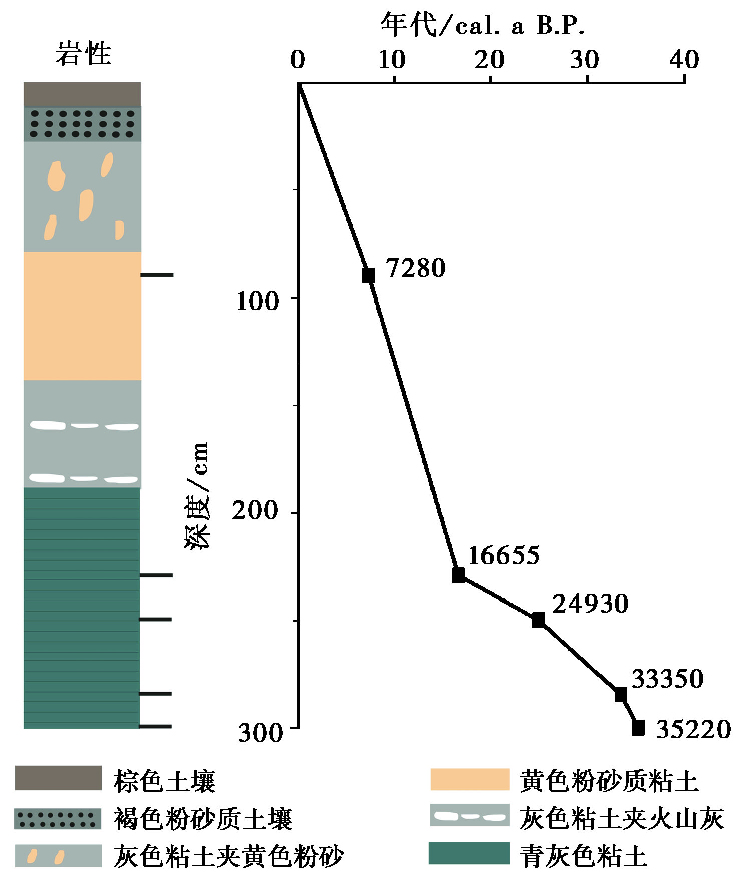
2 样品处理分析 2.1 样品采集及定年实验用样品于2012年12月采自黑龙江省五大连池市西北部青石钻孔沉积物,坐标位置为 48°37′8.66″N,126°7′25.9″E(图1)。青石钻孔深度300cm,沉积物以湖相粘土为主,在160cm和185cm处含有两层火山灰。根据 14C 测年和沉积物岩性特征,间隔取样29个,对其进行有机地球化学特征研究。年代测定数据由中国科学院广州地球化学研究所AMS-14 C制样实验室和北京大学核物理与核技术国家重点实验室联合完成。根据测年结果,建立了青石钻孔沉积物0~300cm深度的年龄序列( 表1和图2)。假设青石钻孔顶部沉积物0cm处的日历年龄识为0ka B .P. ,300cm处的日历年龄则推测为35.2ka B .P. 。

|
图 1 研究区域和钻孔位置图 Fig.1 Location of the study area and the core |
|
图 2 基于5个核正后的青石钻孔年龄模式图 Fig.2 The model of depth-age based on 5 calibrated AMS 14C ages from Qingshi Core |
|
表 1 样品年代及平均沉积速率 Table 1 Results of AMS 14C dating date and the rate of sedimentation |
样品经自然风干后,粉碎至大于80目,取样品100g,用精致氯仿在索氏抽提器中连续抽提72小时。在溶剂中加入活性铜粉进行脱硫处理,然后过滤浓缩衡重得到总有机抽提物。为防止抽提物在分离过程中进一步流失,将样品用二氯甲烷稀释后直接进行全组分GC-MS分析。然后再对总有机抽提物经硅胶-氧化铝色谱柱进行族组分分离,对其中饱和烃馏分利用色谱-同位素比值质谱仪(Trace GC-MAT 253)进行正构烷烃单体碳同位素分析。
有机组分分析在中国科学院地质与地球物理研究所油气资源研究重点实验室完成。气相色谱-质谱联用仪型号为HP6890GC/5973MS,美国惠普公司产品。
色谱条件:HP-5MS石英毛细管柱(30m×0.25mm×0.25μm),柱始温80℃,以3℃/分钟程序升温至300℃,终温恒定30分钟,进样口温度300℃,载气为氦气。
质谱条件: 离子源EI,电离能量70eV,离子源温度230℃,GC-MS接口温度280℃。
色谱-同位素比值质谱仪条件:Trace GC,MAT253质谱仪,HP-5MS毛细管色谱柱(60m×0.32mm×0.25μm),氦气作载气。分馏进样,柱头压124kPa,色谱-质谱的接口温度为850℃。柱始温80℃,恒温3分钟,以3℃/分钟程序升温至300℃,恒温30分钟。单体化合物的碳同位素计算按PDB标准进行,计算公式为:

式中:R=13 C/12 C。仪器的分析误差为±0.5 ‰。
3 结果与讨论 3.1 青石钻孔沉积物中正构烷烃分布特征正构烷烃广泛存在于细菌、 藻类、 大型水生植物以及高等植物等生物体中[9]。研究表明,来源于陆生高等植物的正构烷烃以长链烷烃为主,碳数主要分布在nC27~nC33,且以nC27、 nC29或nC31为主峰,具有明显的奇碳优势; 来源于海洋浮游生物,水生藻类和浮游细菌的正构烷烃,碳数主要分布在nC15~nC20,且以nC17或nC19为主峰,无明显的奇偶优势[32, 33, 34, 35, 36]。
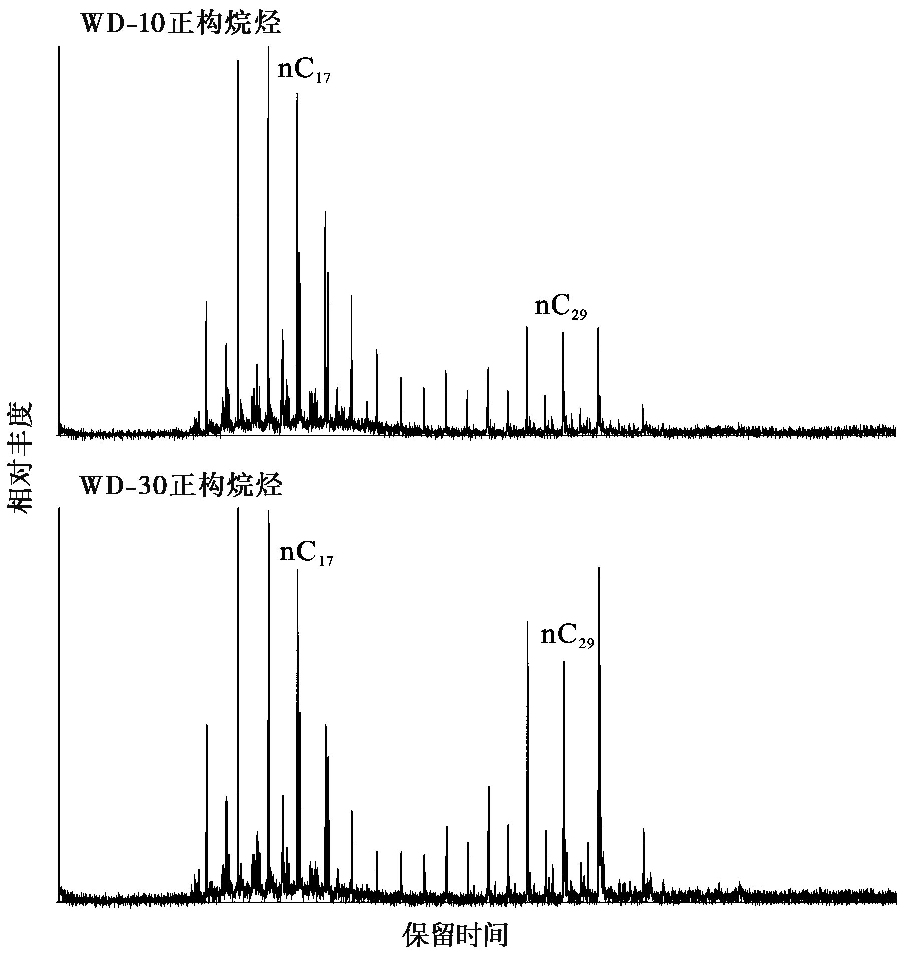
青石钻孔沉积物中检出的正构烷烃碳数分布范围为nC14~nC33,具有前峰型和双峰型分布特征。前峰型以nC15、 nC16或nC17为主峰,双峰型分布中前峰群以nC15、 nC16或nC17为主峰,后峰群主峰碳数主要为nC29或nC31( 图3和 图4)。从 图3可以看出,低碳数正构烷烃( < nC25)奇偶优势不明显,高碳数正构烷烃( >nC25)具有明显的奇碳优势,表明青石钻孔沉积物的有机质输入为混合来源,包括低等菌藻类和陆生高等植物的输入。整个剖面上正构烷烃的OEP值为3.48~7.13,均值为5.34,显示出明显的奇碳优势;Pr/Ph值为1.09~1.87,均值为1.42( 表2),反映沉积环境为弱氧化特征。
|
|
表 2 东北地区青石钻孔沉积物生物标志化合物环境参数表* Table 2 Data of the biomarkers of the sediments from Qingshi Core, Northeast China |

|
图 3 东北地区青石钻孔沉积物正构烷烃分布特征图 Fig.3 Distribution of n-alkanes of the sediments from Qingshi Core, Northeast China |
|
图 4 青石钻孔沉积物代表样品气相色谱图 Fig.4 Representative gas chromatogram of alkanes in the Qingshi Core |
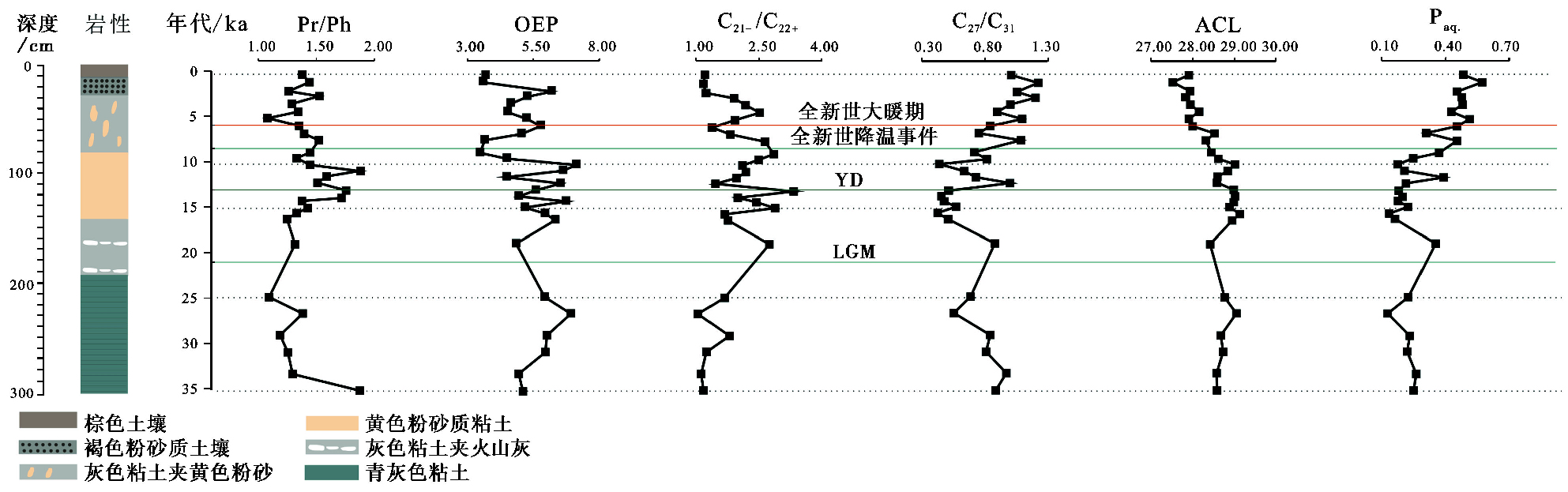
湖泊沉积物的有机质来源主要有两类: 一是来自内源的水生生物,包括菌藻类低等生物和水生植物; 二是由外源的河流径流携入的陆生高等植物[37]。研究表明,ΣnC21-/ΣnC22+ 比值反映了源自低等菌藻类与高等植物正构烷烃的相对丰度变化[38, 39, 40]。由 表2和图5可见,东北青石钻孔沉积物中正构烷烃ΣnC21-/ΣnC22+比值为1.03~3.32,均值为1.93,表明其混合来源有机质输入以内源低等菌藻类为主。在典型冷暖气候事件时期,ΣnC21-/ΣnC22+比值有明显变化。全新世大暖期(6.0ka B .P. ),ΣnC21-/ΣnC22+比值由低值快速转向高值,表明内源低等菌藻类的输入显著增加,反映变暖的气候特征; 新仙女木事件(12.9ka B .P. )和中全新世降温事件(约8.2ka B .P. )时期,ΣnC21-/ΣnC22+比值快速降低,表明外源的陆生高等植物的输入增加,反映冷的气候特征[41]。末次冰盛期(21.0ka B .P. ),ΣnC21-/ΣnC22+比值呈增大的趋势,这可能是在明显低温时期该指标受到了其他环境因素的影响,其影响因素有待进一步研究。
|
图 5 东北地区青石钻孔沉积物有机地化参数演化图 Fig.5 Proxies records in all samples from Qingshi Core, Northeast China |
前人研究也给出区分沉水/漂浮水生大型植物源相对挺水植物和陆生高等植物源的贡献值(Paq.)。当Paq. 值小于0.1时,说明陆生高等植物是主要输入; 当Paq. 值为0.1~0.4时,主要为挺水植物输入; 当Paq.值为0.4~1.0时,沉水/漂浮水生大型植物是主要的生物来源[42]。但在研究区域不同气候阶段,其变化特征明显不同:35.2~24 . 9ka B .P.时期,Paq.值为0.13~0.26,呈轻微减小趋势,同时ΣnC21-/ΣnC22+处于低值,表明陆生高等植物输入量相对有所增加; 24.9~15.0ka B .P.时期,Paq.值呈增加趋势,均值为0.22,同时ΣnC21-/ΣnC22+比值增大,表明低等菌藻类和挺水植物是其有机质的主要来源; 15.0~10.3ka B .P.时期,Paq. 值反映挺水植物的输入增大,同时ΣnC21-/ΣnC22+比值也有较大波动,均值为2.21,指示内源低等菌藻类仍是其有机质主要来源; 10.3ka B .P. 至今,Paq. 值为0.25~0.57,均值为0.42,呈增大趋势,ΣnC21-/ΣnC22+比值减小,说明此阶段陆生高等植物的输入增加,有机质主要为菌藻类,沉水/漂浮水生大型植物和陆生高等植物混合来源。
现代有机地球化学研究显示: 木本植物的正构烷烃以C27或C29为主峰,而草本植物则以C31为主峰,正构烷烃nC27/nC31比值可以反映陆源高等植物类型输入的变化: 比值增加,草本植物向木本植物过渡; 比值减小,则木本植物向草本植物演化[43, 44, 45]。现代湖泊沉积物中长链正构烷烃的平均碳链长度(ACL)也可以用来指示植被类型差异: 草本植物的ACL值比木本植物高,ACL值的变化可反映草本/木本植物的演化变迁[46, 47]。青石钻孔沉积物的nC27/nC31比值和ACL值在整个剖面上变化明显,共同反映出草本植物向木本植物的变化特征。在整个剖面中(见表2和图5),nC27/nC31比值为0.43~1.21,均值为0.80; ACL值为27.53~29.13,均值为28.51。结合主峰碳分布情况,指示出35.2ka B .P. 以来研究区植被类型以草本植物为主的特征。35.2~24.9ka B .P.时期,nC27/nC31比值从0.97波动降低到0.55,ACL值处于高值且略微变大,表明该时期内草本植物所占优势继续扩大,木本植物含量相对继续减少; 24 . 9~15 . 0ka B .P.时期,nC27/nC31比值呈增大趋势,均值为0.60,ACL值呈减小趋势,指示该时期以草本植物占优势的生态格局下,木本植物的含量增大; 15.0~10.3ka B.P.时期,nC27/nC31比值为0.45~1.00,均值为0.61,ACL值处于高值且呈减小趋势,反映该时期内木本植物优势增加; 10.3ka B.P. 至今,nC27/nC31比值为0.73~1.21,均值为0.97,呈增大趋势,ACL值减小,说明木本植物含量相对丰富,甚至由草本植物占优势过渡为木本植物占优势。从整个剖面来看,两个比值变化趋势有很好的吻合性,呈明显的负相关关系,反映出草本植物和木本植物的相互变化特征。这一结果与大兴安岭中段月亮湖沉积物[26]类似。据月亮湖沉积物孢粉研究显示[26],在21.0~14.0ka B .P. ,月亮湖以草本植物为主,木本植物含量增加; 14.0~10.0ka B .P. ,月亮湖木本植物含量继续增加; 10.0ka B .P. 至今,月亮湖草本植物与木本植物含量相当。
青石钻孔剖面沉积物研究表明,在典型冷暖气候事件时期,nC27/nC31比值和ACL值有明显的共同变化特征。在全新世大暖期(6.0ka B .P. ),nC27/nC31>1,ACL值呈减小趋势,气候温暖湿润,草本植物向木本植物过渡; 中全新世降温事件(约8.2ka B .P. )、 新仙女木事件(12.9ka B .P. )和末次冰盛期(21.0ka B .P. )时期,nC27/nC31比值均在低值区,ACL值处于高值,表明植被主要为草本植物,反映冷期的气候特征。可见,两个环境参数同时响应了典型气候事件。
3.2 青石钻孔沉积物正构烷烃碳同位素组成特征根据植物自身光合作用方式的不同,可以划分为C3植物、 C4植物和CAM植物3大类[48]。现代C3植物正构烷烃δ13 C值为-32 ‰ ~-20 ‰ ,平均值为-27 ‰ ,其生长环境多为阴凉、 湿润的环境; C4植物的正构烷烃δ 13 C值为-15 ‰ ~-9 ‰ ,平均值为-13 ‰ ,其生长环境一般为高温、 强光和干旱的气候环境[48, 49, 50, 51]。
由于水生生物合成碳的方式和碳源都比较复杂,其δ13 C值范围较宽,如藻类的δ13 C值为-35 ‰ ~-12 ‰ 。因此,无法用全岩有机质的δ 13 C值来重建C3/C4生物量[52]。研究表明,湖泊沉积物中的长链正构烷烃(C27、 C29、 C31和C33)主要来自陆生高等植物[53, 54, 55],C3和C4植物的长链正构烷烃碳同位素差异较大。因此,通过分析正构烷烃的碳同位素值可以重建C3/C4植物生物量。
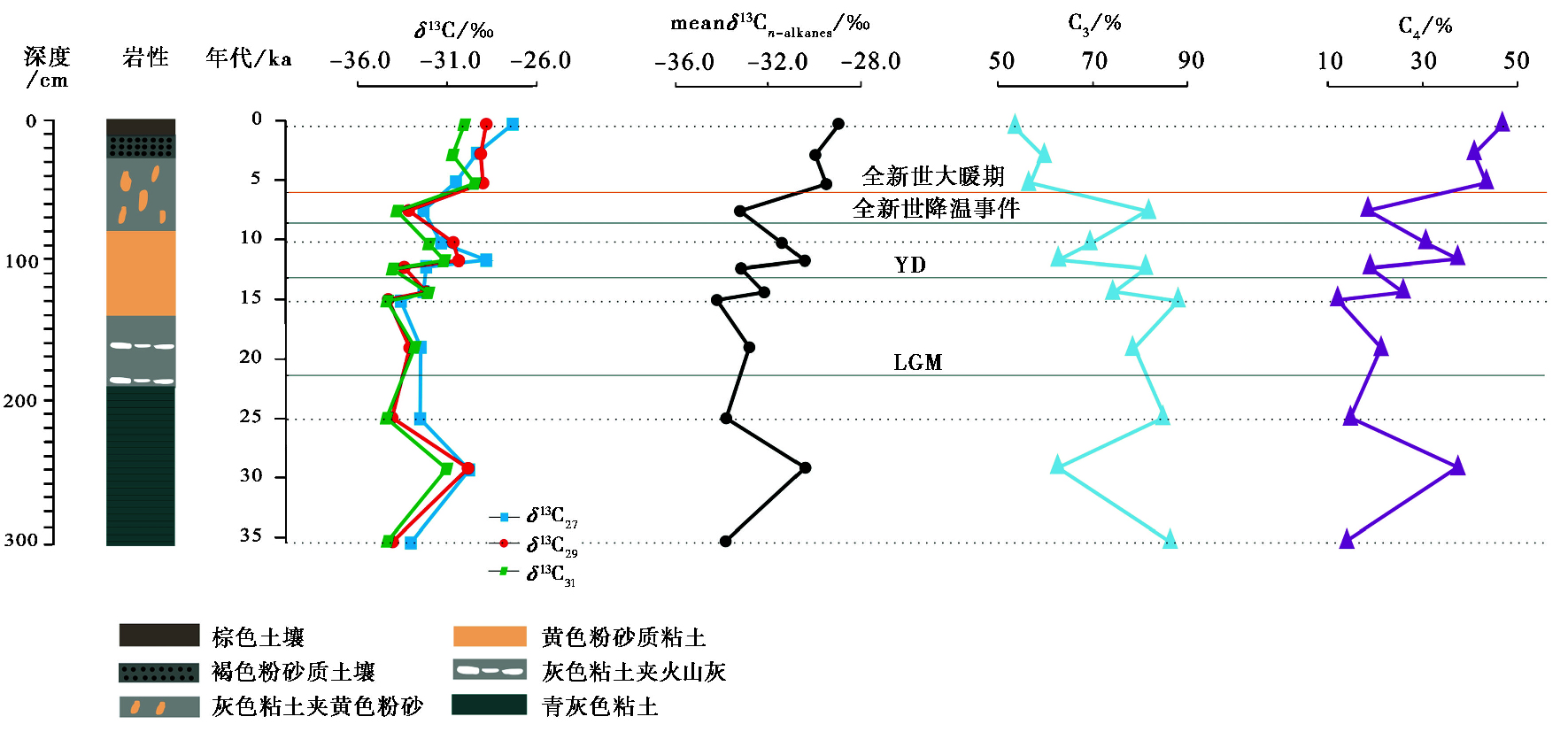
对长链正构烷烃C27、 C29和C31这3种化合物的碳同位素值进行加权平均,计算值代表长链正构烷烃整体的碳同位素组成(mean δ 13 Cn-alkanes)。计算公式如下:

其中,式中RC27、 RC29和RC31分别代表C27、 C29和C31的相对丰度[56, 57]。
从所采样品中选取了13个样品进行了高碳数正构烷烃单体碳同位素分析,结果表明青石钻孔沉积物中高碳数正构烷烃单体碳同位素C27的δ 13 C值为-27.3 ‰ ~-33.6 ‰ ,均值为-31.2 ‰ ; C29的δ 13 C值为-28.8 ‰ ~-34.3 ‰ ,均值为-31.7 ‰ ; C31的δ 13 C值为-29.5 ‰ ~-34.3 ‰ ,均值为-32.3 ‰ 。 图6可见,长链正构烷烃加权平均值mean δ 13 Cn-alkanes为-29.0 ‰ ~-34.2 ‰ ,总体上呈现出C3植物的特征。
|
图 6 正构烷烃碳同位素及C3植物生物量随深度变化曲线图 Fig.6 Vertical variations of δ 13 C values of n-alkanes and C3 biomass |
分别以-36 ‰ 和-21 ‰ 作为C3和C4植物长链正构烷烃碳同位素组成的端元值[57, 58],按照常规的二元模式可以估算出沉积物中长链正构烷烃来自C3和C4植物输入的相对贡献值。假设Ⅹ为C3植物对长链正构烷烃化合物贡献的百分含量,则可用以下公式计算Ⅹ值: (-36 ‰ )×X+(-21 ‰ )×(100 % -X)=mean δ 13 Cn-alkanes,C3植物的相对含量随钻孔深度的变化趋势见 图6,自35.2ka B .P. 以来,C3植物相对生物量为53.4 % ~87.8 % ,均值为72.3 % ,C4植物相对生物量为12.2 % ~46.6 % ,均值为27.7 % ,显示东北地区小兴安岭与松嫩平原过渡带陆生高等植物以C3植物为主、 C3/C4植物共存的植被景观。35.2~24.9ka B .P.时期,C3植物生物量有所波动,但其仍占主要优势,这可能是降水等其他气候条件是控制该地区C3/C4植物相对生物量变化的主要因素; 24.9~15.0ka B .P.时期,长链正构烷烃碳同位素组成平均值较轻,C3植物的生物量最高达到87.8 % ; 15.0~10.3ka B .P.时期,碳同位素组成平均值偏重,C3植物生物量有所减少,C4植物相对增加; 10.3ka B .P. 至今,受温度升高影响,碳同位素组成平均值明显偏重,C3植物生物量明显减少,相应C4植物的生物量明显增加。
另外,在典型冷暖气候事件时期,碳同位素组成平均值和C3/C4植物生物量有明显响应。在全新世大暖期(6.0ka B .P. )过后,受温度升高影响,C3植物的生物量显著减少(从81.4 % 降到56.9 % ),而C4植物的生物量则明显增加(从18.6 % 增加到43.1 % ); 而在两次典型冷气候事件,即中全新世降温事件8.2ka B .P. 和新仙女木事件12.9ka B .P. 时期,受温度降低的影响,C3植物的生物量有增加的趋势,分别从69.5 % 增加到81.4 % 和74.4 % 增加到81.2 % ,C4植物的生物量则相对呈减少的趋势,分别从30.5 % 降到18.6 % 和25.6 % 降到18.8 % ; 在末次冰盛期21.0ka B .P. 时,受明显低温特征的影响,C3植物生物量很高,达到约80.0 % ,这可能是当时低温的气候特征抑制了C4植物的生长。
4 结论对中国东北地区小兴安岭与松嫩平原过渡带五大连池青石钻孔湖相沉积物进行了有机地球化学分析,结果如下:
(1)东北地区小兴安岭与松嫩平原过渡带青石钻孔沉积物中检出了丰富的正构烷烃生物标志化合物,正构烷烃具有前峰型和双峰型分布特征; 表明其有机质输入为混合来源,包括低等菌藻类和陆生高等植物的输入。
(2)正构烷烃分布特征表明在东北地区小兴安岭与松嫩平原过渡带,从35.5ka B .P. 以来,研究区植被类型以草本植物为主; 在典型冷暖气候事件时期,nC27/nC31比值和ACL值有明显的共同变化特征,两个环境参数同时响应了典型气候事件: 在全新世大暖期(6.0ka B .P. ),气候温暖湿润,草本植物向木本植物过渡; 在中全新世降温事件(约8.2ka B .P. ),新仙女木事件(12.9ka B .P. )和末次冰盛期(21.0ka B .P. )时期,植被主要为草本植物,反映冷期的气候特征。从整个剖面来看,两个比值变化趋势有很好的吻合性,呈明显的负相关关系,反映出草本植物和木本植物的相互变化特征。
(3)来源于陆生高等植物输入的长链正构烷烃meanδ 13 Cn-alkanes值揭示在整个研究时间尺度上,东北地区小兴安岭与松嫩平原过渡带植被以C3植物为主。在典型冷暖气候事件时期,碳同位素组成平均值和C3、 C4植物相对生物量对温度有明显响应。此研究结果将对探索我国东北地区C3、 C4植物分布格局,并为评估未来气候演化趋势对该地区植被格局和农业生产的影响提供科学依据。
致谢 感谢审稿专家建设性的修改意见以及编辑部老师细心的指导,使论文得以完善和发表。
| 1 |
温锐林, 肖举乐, 常志刚等. 全新世呼伦湖区植被和气候变化的孢粉记录. 第四纪研究, 2010, 30 (6):1105~1115 WenRuilin, Xiao Jule, Chang Zhigang et al. Holocene vegetation and climate changes reflected by the pollen record of Hulun Lake, north eastern Inner Mongolia. Quaternary Sciences, 2010, 30 (6):1105~1115 |
| 2 |
匡欢传, 周浩达, 胡建芳等. 末次盛冰期和全新世大暖期湖光岩玛珥湖沉积记录的正构烷烃和单体碳同位素分布特征及其古植被意义. 第四纪研究, 2013, 33 (6):1222~1233 KuangHuanchuan, Zhou Haoda, Hu Jianfang et al. Variations of n-alkanes and compound-specific carbon isotopes in sediment from Huguangyan Maar Lake during the Last Glacial Maximum and Holocene Optimum:Implications for paleovegetation. Quaternary Sciences, 2013, 33 (6):1222~1233 |
| 3 |
孙伟伟, 沈吉, 张恩楼等. 日本大沼湖沉积物碳氮比值、有机碳同位素特征及其近400年的古气候环境意义. 第四纪研究, 2014, 34 (6):1307~1313 SunWeiwei, Shen Ji, Zhang Enlou et al. Characteristics of organic stable carbon isotope and C/N ratio of sediments in Lake Onuma, Japan and their environmental implications for the last 400 years. Quaternary Sciences, 2014, 34 (6):1307~1313 |
| 4 | Pereira W E, Hostettler F D, Luoma S N et al. Sedimentary record of anthropogenic and bio-genic polycyclic aromatic hydrocarbons in San Francisco Bay, California. Marine Chemistry, 1999, 64 (1):99~113 |
| 5 |
吴艳宏, 李世杰, 夏威岚. 可可西里苟仁错湖泊沉积物元素地球化学特征及其环境意义. 地球科学与环境学报, 2004, 26 (3):64~68 WuYanhong, Li Shijie, Xia Weilan. Element geochemistry of lake sediment from Gourencuo Lake, Kekexili, Qinghai-Xizang Plateau and its significance for climate variation. Journal of Earth Sciences and Environment, 2004, 26 (3):64~68 |
| 6 |
任雅琴, 王彩红, 李瑞博等. 有机质饱和烃和δ 13 Corg. 记录的博斯腾湖早全新世晚期以来生态环境演变. 第四纪研究, 2014, 34 (2):425~433 RenYaqin, Wang Caihong, Li Ruibo et al. Ecological environment change recorded by sediment n-alkane and δ13Corg. of Lake Bosten since late of Early Holocene. Quaternary Sciences, 2014, 34 (2):425~433 |
| 7 |
孙博亚, 岳乐平, 赖忠平等. 14ka B.P.以来巴里坤湖区有机碳同位素记录及古气候变化研究. 第四纪研究, 2014, 34 (2):418~424 SunBoya, Yue Leping, Lai Zhongping et al. Paleoclimate changes recorded by sediment organic carbon isotopes of Lake Barkol since 14ka B.P.Quaternary Sciences, 2014, 34 (2):418~424 |
| 8 |
郑茜, 张虎才, 明庆忠等. 泸沽湖记录的西南季风区15000a B.P.以来植被与气候变化. 第四纪研究, 2014, 34 (6):1314~1326 ZhengQian, Zhang Hucai, Ming Qingzhong et al. Vegetational and environmental changes since 15ka B.P.recorded by Lake Lugu in the southwest monsoon domain region. Quaternary Sciences, 2014, 34 (6):1314~1326 |
| 9 |
欧杰, 王延华, 杨浩等. 湖泊沉积物中正构烷烃和碳同位素分布特征及其环境意义. 南京师大学报(自然科学版), 2012, 35 (3):98~105 OuJie, Wang Yanhua, Yang Hao et al. Distribution characteristics of n-alkanes and δ 13 C in the lake sediments and their environmental significance. Journal of Nanjing Normal University(Natural Science Edition), 2012, 35 (3):98~105 |
| 10 |
欧杰, 王延华, 杨浩等. 正构烷烃及单体碳同位素记录的石臼湖生态环境演变研究. 环境科学, 2013, 34 (2):484~493 OuJie, Wang Yanhua, Yang Hao et al. Eco-environmental evolution inferred from n-alkanes and δ 13 C records in the sediments of Shijiu Lake. Environmental Science, 2013, 34 (2):484~493 |
| 11 |
朱芸, 雷国良, 姜修洋等. 晚全新世以来福建仙山泥炭钻孔的正构烷烃记录. 第四纪研究, 2013, 33 (6):1211~1221 ZhuYun, Lei Guoliang, Jiang Xiuyang et al. Late Holocene organism records from peat n-alkanes of Xianshan Mountain in Fujian Province, Southeast China. Quaternary Sciences, 2013, 33 (6):1211~1221 |
| 12 |
郑艳红, 程鹏, 周卫建. 正构烷烃及单体碳同位素的古植被与古气候意义. 海洋地质与第四纪地质, 2005, 25 (1):99~104 ZhengYanhong, Cheng Peng, Zhou Weijian. Paleo-vegetation and paleo-climate n-alkanes and compound-specific carbon isotopic compositions. Marine Geology & Quaternary Geology, 2005, 25 (1):99~104 |
| 13 |
宋木, 刘卫国, 郑卓等. 西北干旱区湖泊沉积物中长链烯酮的古环境意义. 第四纪研究, 2013, 33 (6):1199~1210 SongMu, Liu Weiguo, Zheng Zhuo et al. Paleoenvironmental implications of long chain alkenones in arid regions, Northwestern China. Quaternary Sciences, 2013, 33 (6):1199~1210 |
| 14 | Lichfouse E, Collister J W. Tracing biogenic links of natural organic substances at the molecular level with stable carbon-isotopes:n-alkanes and n-alkanoic acids from sediments. Tetrahedron Letters, 1992, 33 (52):8093~8094 |
| 15 |
郭志刚, 杨作升, 林田等. 东海泥质区单体正构烷烃的碳同位素组成及物源分析. 第四纪研究, 2006, 26 (3):384~390 GuoZhigang, Yang Zuosheng, Lin Tian et al. Compound-specific carbon isotope compositions of individual n-alkanes in the East China Sea mud areas. Quaternary Sciences, 2006, 26 (3):384~390 |
| 16 |
张宏亮, 李世杰, 冯庆来等. 云南星云湖沉积物正构烷烃记录的近代环境变化. 第四纪研究, 2008, 28 (4):746~753 ZhangHongliang, Li Shijie, Feng Qinglai et al. Environmental evolution recorded in biomarkers from lacustrine deposits of the Xingyun Lake. Quaternary Sciences, 2008, 28 (4):746~753 |
| 17 |
钟艳霞, 薛骞, 陈发虎. 黄土高原西部地区现代植被及其表土正构烷烃分布模式研究. 第四纪研究, 2009, 29 (4):159~165 ZhongYanxia, Xue Qian, Chen Fahu. n-alkane distributions in modern vegetation and surface soil from western Loess Plateau. Quaternary Sciences, 2009, 29 (4):159~165 |
| 18 |
王志远, 谢树成, 陈发虎. 临夏塬堡黄土地层S1古土壤中的正构烷烃及其古植被意义. 第四纪研究, 2004, 24 (2):231~235 WangZhiyuan, Xie Shucheng, Chen Fahu. n-alkane distributions as indicator for paleo-vegetation an example from Yuanbao S1 paleosol in Linxia Gansu Province. Quaternary Sciences, 2004, 24 (2):231~235 |
| 19 |
杨明生, 张虎才, 雷国良等. 洛川黄土剖面末次冰期间冰段弱古土壤(L1SS1)分子化石及其古植被与古环境. 第四纪研究, 2006, 26 (6):976~984 YangMingsheng, Zhang Hucai, Lei Guoliang et al. Biomarkers in weakly developed paleosol(L1SS1)in the Luochuan Loess section and reconstructed paleovegetation-environment during the interstade of the Last Glaciation. Quaternary Sciences, 2006, 26 (6):976~984 |
| 20 | Xie Shucheng, Lai Xulong, Yi Yi et al. Molecular fossils in a Pleistocene river terrace in Southern China related to paleoclimate variation. Organic Geochemistry, 2003, 34 (6):789~797 |
| 21 | Xie Shucheng, Yi Yi, Liu Yuyan et al. The Pleistocene vermicular red earth in South China signaling the global climatic change:The molecular fossil record. Science in China(Series D), 2003, 46 (11):1113~1120 |
| 22 | Xie Shucheng, Yi Yi, Huang Junhua et al. Lipid distribution in a subtropical Southern China stalagmite:As a record of soil ecosystem response to paleoclimate change. Quaternary Research, 2003, 60 (3):340~347 |
| 23 |
王素萍, 贾国东, 赵艳等. 柴达木盆地克鲁克湖全新世气候变化的正构烷烃分子记录. 第四纪研究, 2010, 30 (6):1097~1104 WangSuping, Jia Guodong, Zhao Yan et al. Plant wax n-alkanes record of the Holocene paleoclimatic changes from a core sediment of Hurleg Lake in the Qaidam Basin. Quaternary Sciences, 2010, 30 (6):1097~1104 |
| 24 |
吴健, 沈吉. 兴凯湖沉积物粒度特征揭示的27.7ka BP 以来区域古气候演化. 湖泊科学, 2010, 22 (1):110~118 WuJian, Shen Ji. Paleoclimate evolution since 27.7ka BP reflected by grain size variation of a sediment core from Lake Xingkai, Northeastern Asia. Journal of Lake Sciences, 2010, 22 (1):110~118 |
| 25 |
陈皎杰, 刘焱光, 葛淑兰等. 末次盛冰期以来兴凯湖的古环境演变——基于地磁场长期变化的年龄框架. 第四纪研究, 2014, 34 (3):528~539 Chenjiaojie, Liu Yanguang, Ge Shulan et al. Paleoenvironment evolution of the Lake Khanka since the last glacial maximum:Age model reconstructed by secular variation of geomagnetic field. Quaternary Sciences, 2014, 34 (3):528~539 |
| 26 |
刘强, 李倩, 旺罗等. 21ka B.P.以来大兴安岭中段月亮湖沉积物全岩有机碳同位素组成变化及其古气候意义. 第四纪研究, 2010, 30 (6):1069~1077 LiuQiang, Li Qian, Wang Luo et al. Stable carbon isotope record of bulk organic matter from a sediment core at Moon Lake in the middle part of the Daxing'an Mountain Range, Northeast China during the last 21ka. Quaternary Sciences, 2010, 30 (6):1069~1077 |
| 27 |
刘强, 刘嘉麒, 陈晓雨等. 18.5ka B.P.以来东北四海龙湾玛珥湖全岩有机碳同位素记录及其古气候环境意义. 第四纪研究, 2005, 25 (6):711~721 LiuQiang, Liu Jiaqi, Chen Xiaoyu et al. Stable carbon isotope record of bulk organic matter from the Sihailongwan Maar Lake, Northeast China during the past 18.5ka. Quaternary Sciences, 2005, 25 (6):711~721 |
| 28 |
刘玉英, 刘嘉麒, 汉景泰. 吉林辉南二龙湾玛珥湖12.0ka BP 以来孢粉记录与气候变化. 吉林大学学报(地球科学版), 2009, 39 (1):93~98 LiuYuying, Liu Jiaqi, Han Jingtai. Pollen record and climate changing since 12.0ka BP in Erlongwan Maar Lake, Jilin Province. Journal of Jilin University(Earth Science Edition), 2009, 39 (1):93~98 |
| 29 |
刘玉英, 张淑芹, 刘嘉麒等. 东北二龙湾玛珥湖晚更新世晚期植被与环境变化的孢粉记录. 微体古生物学报, 2008, 25 (3):274~280 LiuYuying, Zhang Shuqin, Liu Jiaqi et al. Vegetation and environmental history of Erlongwan Maar Lake during the Late Pleistocene on pollen record. Acta Micropalaeontologica Sinica, 2008, 25 (3):274~280 |
| 30 |
张瑜, 熊尚发, 丁仲礼等. 中新世以来六盘山临区黄土-红粘土成土碳酸盐碳氧同位素记录及其对C4植物早期扩张的提示. 第四纪研究, 2011, 31 (5):800~811 ZhangYu, Xiong Shangfa, Ding Zhongli et al. Carbon-oxygen isotope records of pedogenic carbonate from the Early Miocene-Pleistocene loess-red clay in the vicinity of the Liupanshan region and its implications for the early origin of C4 plants in the Chinese Loess Plateau. Quaternary Sciences, 2011, 31 (5):800~811 |
| 31 |
赵得爱, 吴海斌, 吴建育等. 过去典型增温期黄土高原东西部C3/C4植物组成变化特征. 第四纪研究, 2013, 33 (5):848~855 ZhaoDe'ai, Wu Haibin, Wu Jianyu et al. C3/C4 plants characteristics of the eastern and western parts of the Chinese Loess Plateau during Mid-Holocene and Last Interglacial. Quaternary Sciences, 2013, 33 (5):848~855 |
| 32 |
蒲阳, 张虎才, 王永莉等. 青藏高原冰蚀湖沉积物正构烷烃记录的气候和环境变化信息: 以希门错为例. 科学通报, 2011, 56 (14):1132~1139 PuYang, Zhang Hucai, Wang Yongli et al. Climatic and environmental implications from n-alkanes in glacially eroded lake sediments in Tibetan Plateau:An example from Ximen Co. Chinese Science Bulletin, 2011, 56 (14):1132~1139 |
| 33 | Wakeham S G. Algal and bacterial hydrocarbons in particulate matter and interfacial sediment of the Cariaco trench. Geochimica et Cosmochimica Acta, 1990, 54 (5):1325~1336 |
| 34 | Ratnayake N P, Suzuki N, Okada M et al. The variations of stable carbon isotope ratio of land plant-derived n-alkanes in deep-sea sediments from the Bering Sea and the North Pacific Ocean during the last 250000 years. Chemical Geology, 2006, 228 (4):197~208 |
| 35 |
王延华, 杨浩. 正构烷烃单体碳及氢同位素技术在环境变化研究中的应用. 南京师范大学学报(工程技术版), 2011, 11 (4):83~88 WangYanhua, Yang Hao. Spatial characters of n-alkane δ 13 C and δD and their paleoenvironmental significance. Journal of Nanjing Normal University (Engineering and Technology Edition), 2011, 11 (4):83~88 |
| 36 |
饶志国, 贾国东, 朱照宇等. 中国东部表土总有机质碳同位素和长链正构烷烃碳同位素对比研究及其意义. 科学通报, 2008, 53 (17):2077~2084 RaoZhiguo, Jia Guodong, Zhu Zhaoyu et al. Comparison of the carbon isotope composition of total organic carbon and long-chain n-alkanes from surface soils in Eastern China and their significance. Chinese Science Bulletin, 2008, 53 (24):3921~3927 |
| 37 |
吴敬禄, 王苏民. 湖泊沉积物中有机质碳同位素特征及其古气候. 海洋地质与第四纪地质, 1996, 16 (2):103~108 WuJinglu, Wang Sumin. Climate versus changes in δ 13 C values of the organic matter in lake sediments. Marine Geology & Quaternary Geology, 1996, 16 (2):103~108 |
| 38 | Ballentine D C, Macko S A, Turekian V C. Variability of stable carbon from combustion of C4 and C3 plants:Implications for biomass burning. Chemical Geology, 1998, 152 (1):151~161 |
| 39 | Freeman K H, Hayes J M, Trendel J et al. Evidence from carbon isotope measurements for diverse origins of sedimentary hydrocarbons. Nature, 1990, 343 (6255):254~256 |
| 40 |
白艳, 方小敏, 王永莉等. 现代土壤中含季碳支链烷烃的分布特征及环境意义. 科学通报, 2006, 51 (4):448~454 BaiYan, Fang Xiaomin, Wang Yongli et al. Branched alkanes with Quaternary carbon atoms in Chinese soils:Potential environmental implications. Chinese Science Bulletin, 2006, 51 (9):1115~1122 |
| 41 |
郑艳红, 周卫健, 谢树成. 若尔盖高原全新世气候序列的类脂分子化石记录. 第四纪研究, 2007, 27 (1):108~113 ZhengYanhong, Zhou Weijian, Xie Shucheng. Fossil records of lipid molecules from Holocene peat on Zoigê Plateau. Quaternary Sciences, 2007, 27 (1):108~113 |
| 42 | Ficken K J, Li B, Swain D L et al. An n-alkane proxy for the sedimentary input of submerged/floating freshwater aquatic macrophytes. Organic Geochemistry, 2000, 31 (7/8):745~749 |
| 43 |
郭金春, 刘清浩, 马海州等. 察尔汗盐湖正构烷烃和单体碳同位素分布特征及其古植被意义. 地球化学, 2010, 39 (6):566~573 GuoJinchun, Liu Qinghao, Ma Haizhou et al. Chemical and compound-specific carbon isotopic characteristics of n-alkanes in the Qarhan Salt Lake sediments and their paleovegetation significance. Geochemical, 2010, 39 (6):566~573 |
| 44 | Cranwell P A. Lipid geochemistry of sediments from Upton, Broad, a small productive lake. Organic Geochemistry, 1984, 7 (1):25~37 |
| 45 | Huang Y S, Stereet-perrott F A, Perrott R A et al. Glacial-interglacial environmental changes inferred from molecular and compound-specific δ 13 C analyses of sediments from Sacred Lake, Mt. Kenya. Geochimica et Cosmochimica Acta, 1999, 63 (9):1383~1404 |
| 46 | Jeng W L. Higher plant n-alkane average chain length as an indicator of petrogenic hydrocarbon contamination in marine sediments. Marine Chemistry, 2006, 102 (3/4):242~251 |
| 47 | Rosemary T Bush, Francesca A Mcinerney. Influence of temperature and C4 abundance on n-alkane chain length distributions across the Central USA. Organic Geochemistry, 2015, 79 :65~73 |
| 48 |
张晓, 贾鑫, 饶志国等. 陇西黄土高原东南部地区末次冰期以来C3/C4植物相对丰度变化及其区域性剖面的对比研究. 第四纪研究, 2013, 33 (1):187~196 ZhangXiao, Jia Xin, Rao Zhiguo et al. C3/C4 variation since the Last Glacial in the southeastern Longxi Loess Plateau and its comparison with other results. Quaternary Sciences, 2013, 33 (1):187~196 |
| 49 |
陈英勇, 鹿化煜, 张恩楼等. 浑善达克沙地地表沉积物有机碳同位素组成与植被-气候的关系. 第四纪研究, 2013, 33 (2):353~359 ChenYingyong, Lu Huayu, Zhang Enlou et al. The relationship between organic carbon isotopic composition of surface sediment and vegetation-climate in Otindag dune field, Northern China. Quaternary Sciences, 2013, 33 (2):353~359 |
| 50 |
周斌, 郑洪波, 杨文光等. 末次冰期以来南海北部沉积有机碳记录及其古植被环境信息. 第四纪研究, 2011, 31 (3):498~505 ZhouBin, Zheng Hongbo, Yang Wenguang et al. Organic carbon records since the Last Glacial period in the northern South China Sea sediments:Implications for vegetation and environmental changes. Quaternary Sciences, 2011, 31 (3):498~505 |
| 51 |
饶志国, 张晓, 薛骞等. 西峰红粘土/黄土剖面有机碳同位素研究的初步结果. 第四纪研究, 2012, 32 (4):825~827 RaoZhiguo, Zhang Xiao, Xue Qian et al. Primary organic carbon isotopic study result of Xifeng loess/red clay profile. Quaternary Sciences, 2012, 32 (4):825~827 |
| 52 |
王国安. 稳定碳同位素在第四纪古环境研究中的应用. 第四纪研究, 2003, 23 (5):471~484 WangGuo'an. Application of stable carbon isotope for paleoenvironmental research. Quaternary Sciences, 2003, 23 (5):471~484 |
| 53 | Collister J W, Rieley G, Stern B et al. Compound specific δ 13 C analyses of leaf lipids from plants with differing carbon dioxide mechanisms. Organic Geochemistry, 1994, 21 (6/7):619~627 |
| 54 |
段毅, 文启彬, 罗斌杰. 沼泽沉积物中单体正构烷烃碳同位素研究. 科学通报, 1995, 40 (9):1791~1794 DuanYi, Wen Qibin, Luo Binjie. Compound specific δ 13 C analyses of n-alkanes in the swamp deposits. Chinese Science Bulletin, 1995, 40 (9):1791~1794 |
| 55 |
王玉斌, 关平, 刘文汇. 四川西部沉积物中饱和烃单体烃碳同位素及其环境意义. 北京大学学报(自然科学版), 2005, 41 (4):542~550 WangYubin, Guan Ping, Liu Wenhui. Single molecule carbon isotope of n-alkane from sediments and its application to environments, western Sichuan. Acta Scientiarum Naturalium Universitatis Pekinensis, 2005, 41 (4):542~550 |
| 56 | Yamada K, Ishiwatari R. Carbon isotopic compositions of long-chain n-alkanes in the Japan Sea sediments:Implication for paleoenvironmental changes over the past 85 kyr. Organic Geochemistry, 1999, 30 (5):367~377 |
| 57 | Zhang Zhaohui, Zhao Meixun, Lu Huayu et al. Lower temperature as the main cause of C4 plant declines during the glacial periods on the Chinese Loess Plateau. Earth and Planetary Science Letters, 2003, 214 (3/4):467~481 |
| 58 |
孟培, 王永莉, 王自翔等. 东北地区向海湖泊沉积物正构烷烃单体碳同位素特征及其古环境意义. 地球科学与环境学报, 2014, 36 (2):110~120 Mengpei, Wang Yongli, Wang Zixiang et al. Compound-specific carbon isotopic characteristics of n-alkanes in Xianghai Lake sediments of Northeast China and their paleoenvironmental implications. Journal of Earth Sciences and Environment, 2014, 36 (2):110~120 |
 , Wang Yongli①
 , Meng Pei①②, Wang Zixiang①②, Sun Zepeng①②, Yang Hui①, Gong Juncheng①, Zhang Hong①, Wu Yingqin①, Wang Youxiao①
 Abstract
Wudalianchi is located in the transition zone of the Lesser Khingan Range and Songnen Plain, Heilongjiang Province, Northeast China. In order to investigate the paleovegetation in Wudalianchi during the typical warm and cool weather events, a 300cm-long core called Qingshi Core(48°37'8.66"N, 126°7'25.9"E) was obtained during a drill in 2012. The lithology is relatively uniform. The lithology is mainly lacustrine clay. After drilling, core sediments were stored at 4℃ before sub-sampling. The chronology was established according to the AMS-14 C data of the sediments, extending back to about 35.2ka B.P.29 samples were collected to obtain a representative organic record of the present study profile.
The molecular biomarkers includingn-alkanes were identified from the sediments of Qingshi Core. The distribution of n-alkanes and composition of δ 13 C values were mainly discussed in this paper. According to the two distribution patterns of n-alkanes, the n-alkanes exhibited mixed sources, both the import of the algae and fungi and the terrestrial higher plants. The distribution of n-alkanes indicated that from 35.2ka B.P.to the present, the vegetation types in the study area are mainly grasses from the indexes of nC27/nC31 and ACL25~31. In addition, the compound-specific carbon isotopic composition was determined for C27, C29 and C31 n-alkanes in the core, ranging from -27.3 ‰ ~-33.6 ‰, -28.8 ‰ ~-34.3 ‰ and -29.5 ‰ ~-34.3 ‰, respectively. Relative contribution of C3 and C4 plants was estimated by using a binary model, indicating that from 35.2ka B.P., C3 plants was dominated in the study area. The relative biomass of C3/C4 plants varied obviously in the typical warm and cool weather events influenced by the temperature. While during the Holocene Megathermal(6.0ka B.P.), controlled by the high temperature, the biomass of C4 plants increased(from 18.6 % to 43.1 %)while that of C3 plants decreased(from 81.4 % to 56.9 %). After the typical events of cold weather(the cooling event of the Middle Holocene at 8.2ka B.P.and the Younger Dryas at 12.9ka B.P.), C3 plants increased(from 69.5 % to 81.4 % and from 74.4 % to 81.2 %, respectively), relatively C4 plants decreased(from 30.5 % to 18.6 % and from 25.6 % to 18.8 %, respectively). During the Last Glacial Maximum at 21ka B.P., affected by the low temperature, the biomass of C3 plants was high(almost 80.0 %). This could be the result of the cold environment which inhibited the growth of C4 plants. This study was to explore the distribution patterns of C3/C4 plants in Northeast China, and to provide scientific evidence for the vegetation patterns and agricultural production affected by the future climate change.