 2015, Vol.35


近年来,我国西南地区的古气候研究备受关注,其原因在于该区域对亚洲季风所导致的气候波动及其降雨变化的敏感性。西南地区的环境变化主要受西南季风(也称为印度季风)的控制。目前,该地区古气候研究主要集中于末次盛冰期以来西南季风的演化及其与北半球太阳辐射的关系[1, 2, 3]、 古植被重建及其古气候意义[4, 5, 6, 7, 8, 9, 10, 11]以及土壤酸度重建[12]等方面。相比而言,有关C3/C4植被变化的研究工作却开展得较少[13, 14, 15, 16, 17],这有碍于我们全面了解不同气候环境下C3和C4植物竞争机制及与气候要素的关系。为此,重建西南地区C3/C4植被的演化历史显得尤为重要。
湖泊沉积物具有存储信息量大、 时间分辨率高及地理覆盖面广等优势,目前逐渐成为科学家们用来重建古气候的重要载体[18]。特别是湖泊沉积物中含有大量分子标志物,如正构烷烃、 脂肪酸、 醇类和多环芳烃等,这些标志物与生物输入源有一定的关联性,记录着湖泊周围与植被和气候相关的生态环境演变信息。正构烷烃作为一种重要的分子标志物,其分子中含有较高键能的碳-碳键,结构较为稳定,不易发生降解,能够真实地反映母源输入的状况,其分子组成特征及同位素组成已被广泛应用于重建湖泊及流域内古植被和古气候状况[13, 14, 19, 20, 21, 22, 23, 24]。
泸沽湖是云贵高原上典型西南季风区的一半封闭湖泊,湖泊沉积物的来源稳定且相对单一,湖区人为活动干扰较微弱[25, 26, 27],因此,泸沽湖是研究西南季风区古气候变化非常理想的区域。目前,国内外学者已在泸沽湖进行了一些古气候/古环境重建的研究工作,如利用有机碳同位素[25]、 α纤维素[26]、 色素[27]、 硅藻[28]、 植物孢粉[29]及摇蚊[30]等指标对泸沽湖进行了一定的研究,但关于沉积记录的烷烃生物标志物的研究则未见报道。
本文通过研究泸沽湖沉积物中正构烷烃的分布及其碳同位素组成,重建了末次盛冰期以来该地区的C3/C4植被变化特征,并探讨C3/C4植被变化与西南季风演化的关系。
1 研究区域概况泸沽湖(27°41′~27°45′N,100°45′~100°50′E)位于云南省和四川省之间横断山脉中段东缘尾部金沙江褶皱带,泸沽湖略呈北西-南东走向,长约9.4km,平均宽5.2km,被伸入湖心的一个半岛分成南北两个湖区( 图1)。湖面海拔2690.8m,水域总面积50.1km2,最大水深93.5m,平均水深40.3m[25, 26, 27]。泸沽湖流域面积小,入湖河流十分短小,临时性的沟溪汇水和区间坡面漫流是湖水的主要补给形式。湖泊年均来水量约1.1×10⁸m3,湖泊出口位于东岸,每年1-5月份湖水基本没有外泄,湖水寄宿时间长达18.5年,属于半封闭湖泊[25, 26, 27]。湖区处于西南季风气候区、 低纬度高原季风气候带,具有暖温带山地季风气候的特点,冬季受干燥的大陆季风控制,夏季盛行湿润的海洋季风,干湿季节分明,年均气温12.8℃,多年平均降水量为920mm,全年降水量约85 % 集中在雨季[27]。湖周海拔3000m以上的山峰多为森林和灌丛植被覆盖,森林覆盖率达47.6 % ,湖区边居住的少数民族生产力水平低下,社会经济落后,人类活动对湖泊的干扰比较微弱,是难得的研究湖泊演化和气候变化变迁的场所[25, 26, 27]。

|
图 1 泸沽湖地理位置及采样点(修改自文献[28,30]) Fig.1 Location of Lugu Lake and the sampling site(modified from references[28,30]) |
本文所用湖泊沉积物钻孔岩芯是于2008年采用UWITEC取样平台系统钻取自泸沽湖湖区北部(27°43′08.4″N,100°46′33.9″E),水深69.3m,岩芯总长度达18.3m。该岩芯的剖切、 照相和观察描述均在实验室内完成,并对沉积物岩芯按1cm间隔分截取样。本文所分析的样品是对7.5m以上的岩芯按照50cm间隔分取而来,总共获得15个样品。
岩芯岩性描述如下: 下部(10.0~8.1m)为灰黄色细粒粉砂质粘土,中部(8.1~4.1m)为灰棕色泥质粉砂,向上变为灰色泥质粉砂(4.1~1.4m)和暗灰色细粒粉砂质粘土(1.4m以上部分)。
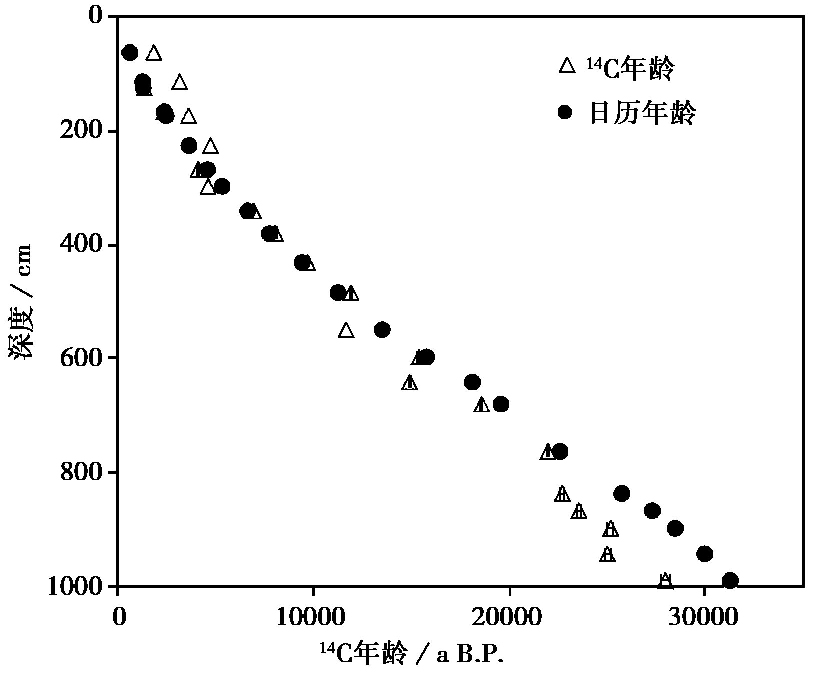
岩芯年代标尺是通过对沉积物全岩有机碳和陆源植物残体进行AMS 14 C 测定获得。该项测试是在新西兰地质与核科学研究所的Rafter放射性碳实验室完成的。对于10m以上岩芯,总共获取22个AMS 14 C 年龄,其中15个来自全岩有机碳,7个来自陆源植物残体。采用CALIB 5.1和CalPal软件(http://www.calpalonline.de/)将 14 C 年龄转换为日历年龄。所获得的 14 C 年龄与深度回归关系表明老碳效应可能为1104~2848年,这一点被生长于湖泊中的现代沉水植物Ottelia sp. 叶片 14 C 年龄(1662±214a B .P.)所证实[28]。具体定年结果见 图2,数据来自Wang等[28]。本文中的样品点年龄根据这些测年结果内插计算所得,所选的15个样品年龄在20.5ka B.P.以来,涵盖了末次盛冰期(Last Glacial Maximum,简称LGM)以来的气候阶段。
|
图 2 泸沽湖岩芯样品的定年结果 Fig.2 AMS 14 C and calibrated ages of the sediment core from Lugu Lake |
样品进行冷冻干燥后研磨均匀,分别用甲醇、 甲醇/二氯甲烷(1 ︰ 1,V/V)、 二氯甲烷超声提取各三遍,将提取液经旋转蒸发仪浓缩以后,用硅胶层柱进行组分分离,分别用正己烷、 甲醇/二氯甲烷(1 ︰ 1,V/V)淋洗,得到烷烃和醇类组分。烷烃组分通过气相色谱GC-FID进行定量分析,化合物的定性根据色谱出峰时间和标样进行,后利用气相色谱-燃烧-气体同位素比值质谱仪GC-C-IRMS进行单体碳同位素的测定。
GC分析条件: 气相色谱仪型号为Konik HRGC 4000B,氦气为载气,FID检测器。色谱进样口温度为290℃,检测器温度为290℃,色谱柱为HP-5MS毛细柱(60m×0.25mm×0.25μm),SPLESS/SPLIT进样模式; 升温程序为: 初始温度为80℃,保留2分钟,以10℃/分钟升至150℃,再以4℃/分钟升至300℃,保留30分钟。
GC-C-IRMS分析条件: 气相色谱仪为Trace GC 2000型,同位素比值质谱仪为Delta V Plus型,它们之间由GC-C(Combustion)接口连接。单个化合物经气相色谱分离后依次进入氧化炉,并在1020℃下氧化转换为CO2,然后CO2进入气体同位素比值质谱仪测定碳同位素。色谱柱为HP-5MS毛细柱(60m×0.25mm×0.25μm),升温程序为: 初始温度为80℃,保留2分钟,以10℃/分钟升至150℃,再以4℃/分钟升至300℃,保留30分钟。
正构烷烃单体化合物的碳同位素计算公式为:

公式(1)中: R样品——样品的碳同位素比值(13C/12C); R标准——标准的碳同位素比值(13C/12C)。
碳同位素组成相对于VPDB标准。测定样品时,每隔4个样品测一个实验室工作标准,用于检测仪器的工作状态,分析精度 < 0.5‰,所有样品进行两次或两次以上测试,最后结果为多次测试的平均值。
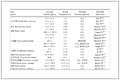
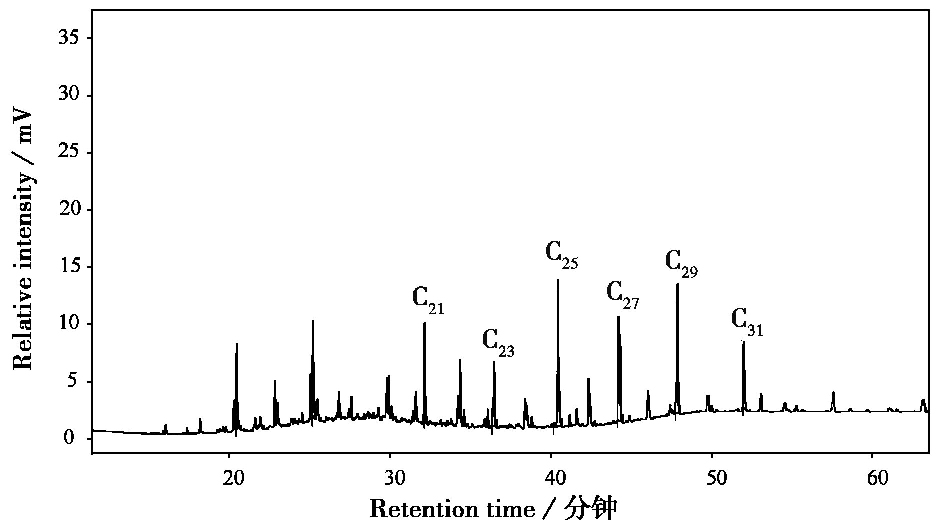
3 结果 3.1 正构烷烃分布特征泸沽湖检测出的正构烷烃碳数分布范围为C16~C31,整体呈现以中高碳数正构烷烃为主的组成特征,具有明显的奇偶优势,多数以C27或C29为主峰,C25或C31次之。图3为泸沽湖沉积物一个代表性样品的气相色谱图(深度为150cm),其正构烷烃含量见表1,C23、 C25、 C27、 C29和C31的平均含量分别为0.57μg/g、 1.67μg/g、 2.14μg/g、 1.97μg/g和1.32μg/g。长链正构烷烃(碳数>C25)的平均碳链长度(ACL)值在28.19~29.61之间,平均值为28.82。碳优势指数CPI值分布范围为1.51~6.60,平均值为3.95。
|
表 1 泸沽湖岩芯样品对应年龄及奇碳数正构烷烃含量 Table 1 Odd n-alkane concentrations from Lugu lake sediment core |
|
图 3 泸沽湖沉积物代表性正构烷烃GC-FID谱图 Fig.3 Typical chromatograms of the n-alkanes from Lugu Lake sediment core |
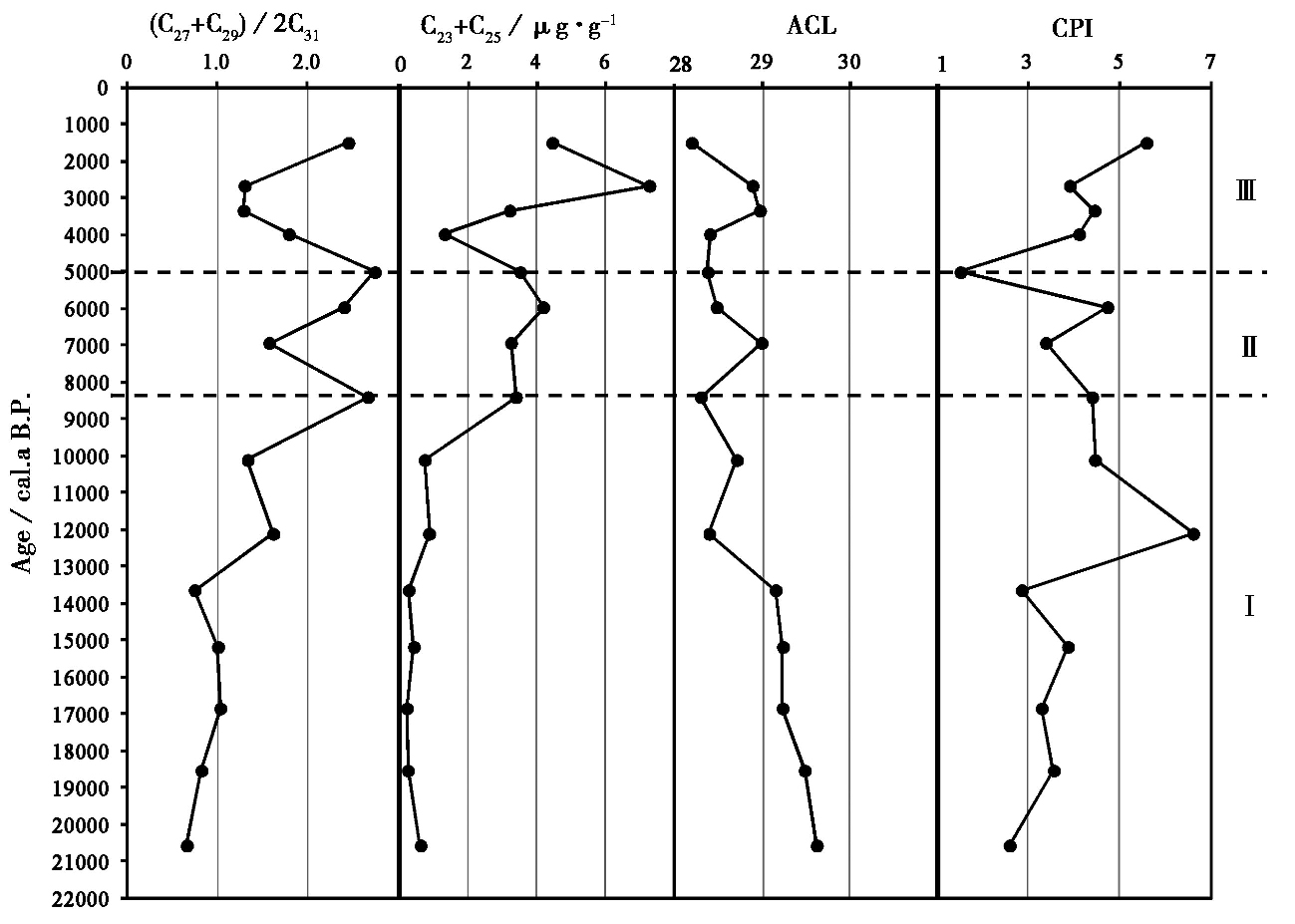
根据正构烷烃的分布特征( 表1和 图4),大致分为以下3个阶段:
|
图 4 末次盛冰期以来泸沽湖沉积物正构烷烃含量参数变化 Fig.4 Changes in n-alkanes parameters from Lugu Lake sediment core since LGM |
阶段Ⅰ,末次盛冰期至全新世早期: 中长链正构烷烃(C23~C31)含量与(C27+C29)/2C31比值均呈逐渐增加的趋势,C23、 C25、 C27、 C29和C31的含量分别从末次盛冰期的0.06μg/g、 0.01μg/g、 0.38μg/g、 0.53μg/g、 0.78μg/g增加至0.41μg/g、 2.96μg/g、 5.01μg/g、 3.23μg/g和1.55μg/g;(C27+C29)/2C31比值由最初的0.66增加至2.66,而CPI值则由2.58增加至4.45; ACL值则呈逐渐减少的趋势,由末次盛冰期的29.61减小至28.29。
阶段Ⅱ,全新世中期: 中长链正构烷烃含量及(C27+C29)/2C31比值仍然相对较高,C23、 C25、 C27、 C29和C31的含量最高可达0.68μg/g、 3.83μg/g、 2.94μg/g、 3.52μg/g和1.67μg/g;(C27+C29)/2C31比值最高为2.74; ACL值处于相对较低的波动范围28.37~28.98。
阶段Ⅲ,全新世晚期: 正构烷烃含量整体变化不明显,但是(C27+C29)/2C31比值也相对于全新世中期稍微有所降低,波动范围为1.29~3.44; ACL值也稍微偏高。
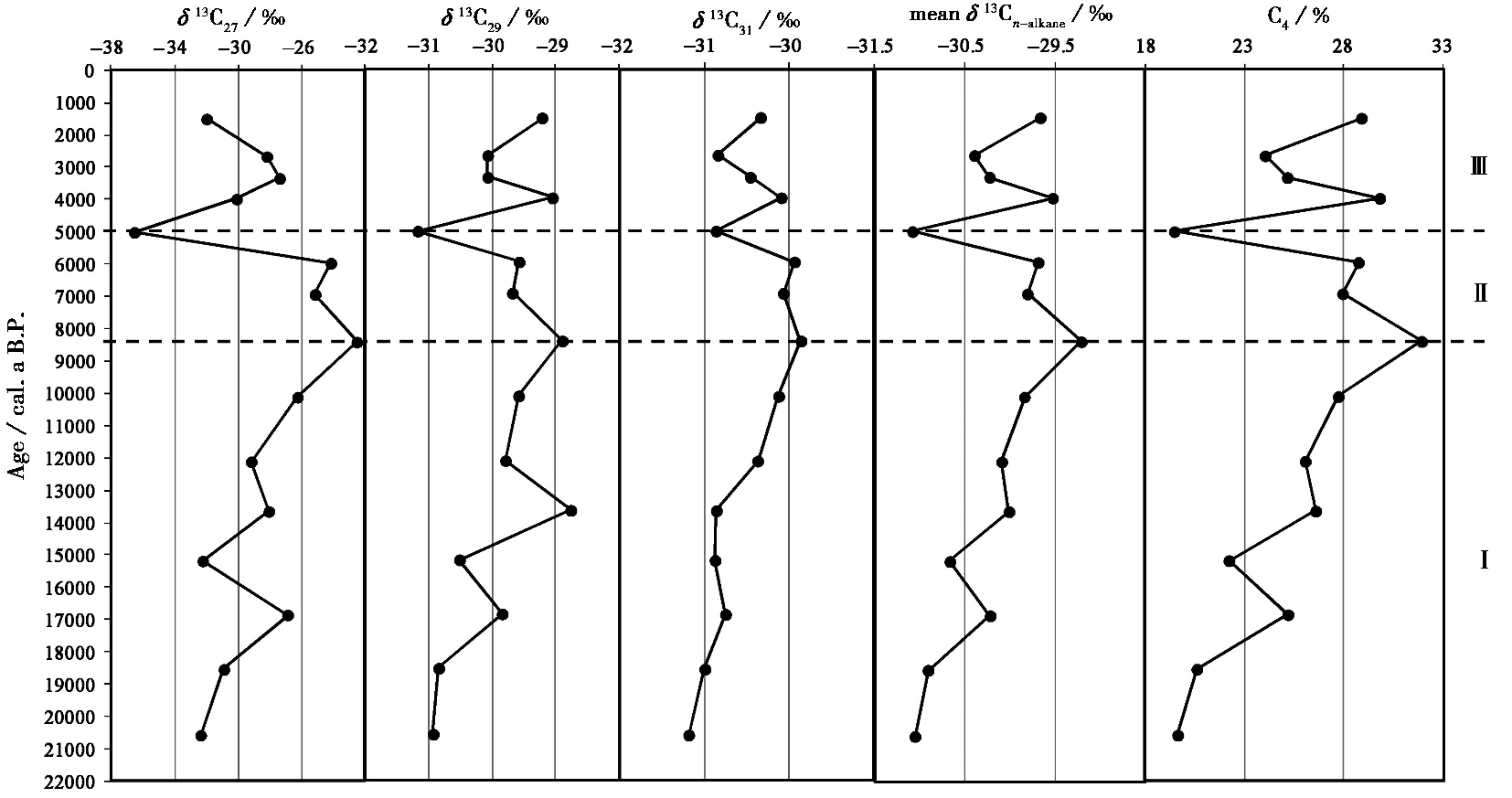
3.2 正构烷烃碳同位素泸沽湖沉积物正构烷烃C27、 C29和C31的单体碳同位素δ 13 C值变化范围分别为:-22.5 ‰ ~-36.6 ‰ 、-28.8 ‰ ~-31.2 ‰ 和-29.9 ‰ ~31.2 ‰ 。通过公式(2)对泸沽湖沉积物长链正构烷烃C29和C31的δ 13 C值计算加权平均值(meanδ 13 Cn-alkanes),变化范围为-29.2 ‰ ~-31.1 ‰ ,均值为-30.2 ‰ 。高碳数正构烷烃的碳同位素值及meanδ 13 Cn-alkanes均表现出相似的变化趋势( 图5)。利用常用的二元模式分别选取-34 ‰ 和-19 ‰ 作为C3和C4植物正构烷烃δ 13 C的端元值[31],根据公式(3)计算出泸沽湖区C3及C4植物的相对含量。


|
图 5 末次盛冰期以来泸沽湖沉积物正构烷烃碳同位素变化 Fig.5 Changes in the δ 13 C of n-alkanes from Lugu Lake sediment core since LGM |
公式(2)和(3)中,mean δ 13 Cn-alkanes为长链正构烷烃 δ 13 C的加权平均值; nA29、 nA31分别为C29和C31的相对丰度; X表示C4植物对长链正构烷烃的贡献量,即C4植物的相对百分含量。
根据碳同位素特征及计算的C4含量,同样大致分为3个阶段:
阶段Ⅰ: 末次盛冰期-全新世早期时,长链正构烷烃C27、 C29和C31的δ 13 C值以及meanδ 13 Cn-alkane值均呈逐渐偏正的趋势,它们分别由最初的-32.4 ‰ 、-30.9 ‰ 、-31.2 ‰ 和-31.1 ‰ 偏正至-22.5 ‰ 、-28.8 ‰ 、-29.9 ‰ 和-29.2 ‰ ,计算所得的C4含量逐渐增多,由19.6 % 逐渐增加至31.9 % 。
阶段Ⅱ: 全新世中期时,δ 13 C值逐渐偏负,并在5.0ka(深度为250cm)附近达到最负值,C27、 C29和C31的δ 13 C值以及mean δ 13 Cn-alkane值最负达-36.5 ‰ 、-31.2 ‰ 、 -30.9 ‰ 及-31.1 ‰ ,计算所得的C4含量逐渐减少,相应地在5.0ka(深度为250cm)附近达到最低值19.5 % 。
阶段Ⅲ: 全新世晚期,δ 13 C值又呈现偏正的趋势。C27、 C29和C31的δ 13 C值以及mean δ 13 Cn-alkane值缓慢偏正至-27.4 ‰ 、-29.1 ‰ 、-30.1 ‰ 及-29.5 ‰ 。
4 讨论 4.1 末次盛冰期以来泸沽湖区古植被变化通常,不同碳数的正构烷烃分布特征可以反映沉积物中有机质的不同来源[32]。一般而言,浮游藻类和细菌碳数分布范围为C15~C20,呈现以C17为主的单峰型分布,无明显奇偶优势; 沉水、 漂浮及大型挺水植物碳数分布范围为C21~C25,其中在C21、 C23和C25处有最大丰度; 陆生高等植物的正构烷烃碳数则主要分布在C27~C33范围内,由于其表皮蜡质层中含有大量的C27、 C29和C31正构烷烃化合物,因而具有显著的奇偶优势[32, 33, 34, 35, 36]。泸沽湖沉积物的中高碳数正构烷烃(C23~C31)含量在末次盛冰期总体较低,可能表明当时水生植物和陆源高等植物的输入相对较低。相比之下,到了末次冰消期之后,中高碳数正构烷烃(C23~C31)含量相对增加,说明水生植物和陆源高等植物输入显著增高。另外,本文研究的泸沽湖沉积物正构烷烃的碳优势指数CPI值在1.51-6.60之间,总体上表明其正构烷烃组分受水生和微生物等有机物的影响较弱[13, 14]。
已有研究显示,以C27和C29为主峰的正构烷烃主要来源于木本植物(包括树木和灌木),而以C31为主峰的正构烷烃则主要来源于草本植物,例如,当草本植物占优势时,C31含量相对增加; 而木本植物占优势时,则C27和C29正构烷烃组分含量相对增加[36, 37, 38]。由此,(C27+C29)/2C31比值变化可以反映陆源高等植物输入类型的变化: 比值增加,草本植物向木本植物过渡; 比值减小,木本植物向草本植物过渡[36, 37, 38]。同时,现代湖泊沉积物长链正构烷烃(碳数>C25)的平均碳链长度(ACL)值也可以用来指示草本植物和木本植物的相对输入量: 当ACL值增大时,表明草本植物所占的比例较木本植物多[39, 40, 41]。
本文中,(C27+C29)/2C31比值从末次盛冰期到全新世早期呈逐渐增加的趋势,而ACL值逐渐减少,这都表明在这一时期木本植物比例相对逐渐增多,而草本植物逐渐减少。这一结论与本湖区孢粉的研究结果[28]相一致,如Wang等[28]表明从21ka B.P.到10ka B.P.泸沽湖区树木比例从65 % 逐渐增加到90 % ,并且在冰消期以后显著增加。同时,高碳数正构烷烃含量的增加说明陆源高等植物输入相对增高,这一方面可表明湖区植被覆盖度逐渐增加,另一方面也可表明入湖径流增强,降雨逐渐增多。综合这些数据,我们可以得出从末次盛冰期到全新世早期,泸沽湖区气候逐渐转好,总体向暖湿方向发展,西南季风逐步加强。泸沽湖区硅藻组合研究[28]和西南地区其他湖区古气候研究[4, 9, 10]均认为从末次盛冰期到全新世早期西南季风具有逐步加强的趋势。前人研究表明北半球低纬太阳辐射量自21ka B.P.起逐渐升高,并在11ka B.P.时达到最大值[42]。由此,太阳辐射量的逐步增加可能导致该时期西南季风的逐渐增强。
在全新世中期,正构烷烃含量与(C27+C29)/2C31比值依然相对较高,而ACL值还保持相对较低的范围,这说明木本植物比例在这一时期总体还是相对较高并且植被覆盖度较大,这可能表明气候总体上呈现暖湿的特征。郑茜等[29]研究了泸沽湖钻孔岩芯样品15ka B.P.以来的孢粉记录,认为在全新世中期松属和常绿栎类等木本植物有明显的增加,草本植物比例减少,与我们得到的植被状况相一致。同时,该时期泸沽湖区暖湿的气候也可与相邻地区进行很好对比。例如,西南地区的洱海和天才湖等古气候记录表明全新世中期气候温暖湿润,降水丰富[43, 44]。
而到全新世晚期以后,(C27+C29)/2C31比值相对偏低,ACL相对较高,这都表明在这一时期木本植物比例相对较少,而草本植物比例相对增加,气候变得冷干。郑茜等[29]的孢粉记录同样表明全新世晚期木本植物比例相比早中全新世有所减少,同时他们认为这种植被演替与4ka B.P.左右的降温事件和之后气候变冷变干密切相关[28]。云南地区的洱海和滇池也均记录了这次降温事件[45, 46]。
4.2 末次盛冰期以来泸沽湖区C3/C4比例变化根据自身光合作用方式的不同,陆生高等植物可划分为C3、 C4和CAM植物三大类。不同植物类型适合在不同的环境条件下生存,C4植物一般分布于高温、 强光和干旱的气候环境,而C3植物则多生长在阴凉、 湿润的环境中[41, 47, 48]。研究表明,现代C3及C4植物的正构烷烃δ 13 C值分别分布在-32 ‰ ~-39 ‰ 和-18 ‰ ~-25 ‰ ,而湖泊中内源有机质δ 13 C比陆生高等植物偏重,通过测量沉积物长链正构烷烃δ 13 C值可以指示一定时期内湖区附近的C3/C4植被和环境状况[49, 50]。
本研究中陆源高等植物正构烷烃δ 13 C值重建的C3/C4植物变化大致可为划分以下3个阶段,我们将对每个阶段的主要控制因素作以讨论:
末次盛冰期到全新世早期,泸沽湖沉积物的陆源高等植物正构烷烃(C27、 C29和C31)δ 13 C值均呈现出逐渐偏正的趋势,并且在8.4ka B.P.附近达到最大值。前人研究表明在没有C4植物的情况下,气候变干会导致C3植物δ 13 C值的偏正[51, 52],然而,本岩芯正构烷烃分子组成特征反映该时期木本植物比例逐渐增多,表明西南季风逐步加强、 气候向暖湿方向发展,同时,泸沽湖区的孢粉和硅藻组合研究表明西南季风从18ka B.P.开始逐渐加强,到14.5ka B.P.显著增强[28],具体表现为温度升高和降雨增多。上述证据可以排除气候变化这一因素的影响。因此,可以将该时段正构烷烃δ 13 C值的偏正解释为C4植物的增多。通过二元模式计算的C3/C4结果表明从末次盛冰期到全新世早期泸沽湖区C4植物比例从19.6 % 逐渐增加至31.9 % ( 图5)。前人研究指出,有利于C4植物比例增加的因素有温度升高[50, 53, 54]、 夏季风强度增加(亦即夏季降雨增多)[55, 56, 57, 58]以及降雨季节性增强[59]。从末次盛冰期到全新世早期,泸沽湖区温度逐渐升高,总体上有利于C4植物的增多; 同时,虽然该阶段降雨量也呈现逐渐增加的趋势,但是降雨的总量并不大,总体上属于偏干的状况,这一点可以从同区湖泊岩芯中相对较低的TOC含量和孢粉浓度结果看出[28]。这种偏干的气候条件有助于C4植物在水分强迫中的保持竞争优势[47, 48]。另外,在末次盛冰期至冰消期时相对较干的情况下,雨期长度缩短并且可能更集中于夏季,因为夏季高温会导致较强的海陆热力差异从而带来更多的降水。对于某一特定地点,C3和C4植物的生长季节存在差异,表现为C3植物在春季和秋季生长旺盛而C4植物则在夏季生长旺盛[60]。由此,本阶段集中于夏季的降雨使得C4植物生长得更繁茂、 更有竞争优势,从这个角度来说也会导致C4植物比例相对增多。也就是说,虽然温度被认为是决定C4植物能否生长的主控因素[50, 53, 54],降雨的季节性变化则会决定C4植物能否在整个植被系统中具有相对竞争优势进而决定C4植物相对生物量的变化[59]。因此,我们认为温度和降雨的季节性分配的共同作用可能是导致从末次盛冰期到全新世早期泸沽湖地区C4植物增加的主要因素。
在全新世中期,陆源高等植物正构烷烃(C27、 C29和C31)δ 13 C值开始逐渐偏负,在5ka B.P.附近时达到最负值,相应地,这可能反映了C4植物比例逐渐降低,并在5ka B.P.附近达到最低值19.5 % 。在该时期,我们的高碳数正构烷烃含量和正构烷烃组成特征表明木本植物比例仍维持在较高水平且植被盖度较大,体现了气候温暖湿润。从生理学角度讲,C4植物一般喜欢生长在高温、 强光和干旱的气候环境里[41, 47, 48]。虽然全新世中期较高的温度总体上有利于C4植物生长,但是区域降雨的增加并不利于C4植物保持竞争优势。与此同时,由于区域上木本比例较高且植被盖度较大,在很大程度上影响了森林的透光性,这种状况也不利于C4植物的生长。这些因素的综合作用导致了本阶段的减少。由于全新世中期降雨量增多也会对δ 13 C值偏负产生一定的影响,所以计算所得的C4含量可能是一个下限值,实际C4含量可能要更多一些。
到全新世晚期,陆源高等植物正构烷烃δ 13 C值相对偏正,似乎表明C4植物比例又有所增加( 图5)。但是,我们的高碳数正构烷烃组成特征与同地区孢粉记录[29]均表明该阶段气候变为冷干,这一时期温度的降低并不利于C4植物的生长。由此,我们认为δ 13 C值的偏正可能是由于该时期气候变干所导致的。
5 结论通过分析泸沽湖沉积物的正构烷烃分布特征和正构烷烃碳同位素组成得出以下初步结论:
(1) 中高碳数正构烷烃(C23~C31)含量结果表明在末次盛冰期时水生植物和陆源高等植物的输入相对较低。相比之下,到了末次冰消期之后,水生植物和陆源高等植物贡献显著增高。这可能指示了冰消期以后西南季风显著增强,温度升高、 降雨增加。
(2)正构烷烃(C27+C29)/2C31比值和长链正构烷烃(碳数>C25)的平均碳链长度(ACL)值均指示出: 从末次盛冰期到全新世早期,木本植物比例相对增加,表明此时西南季风逐渐加强,温度渐高与降雨量渐多; 在全新世中期木本植物比例仍保持在较高水平,说明气候依然暖湿,而到了全新世晚期,木本植物比例有所减少,气候变得干冷。这些结果可以与泸沽湖区孢粉记录进行较好对比。
(3)陆源高等植物正构烷烃(C27、 C29和C31)的δ 13 C值表明,从末次盛冰期到全新世早期泸沽湖区C4植物比例逐渐增加,随后到全新世中期C4植物比例逐渐降低,在5ka B.P.(深度为250cm)附近达到最低值19.5 % 。温度和降雨变化的共同作用导致了研究区域C3/C4植被变化。
致谢 感谢本期特邀编审杨石岭研究员的邀请以及审稿专家和编辑部老师建设性的修改意见。
| 1 | Overpeck J, Anderson D, Trumbore S et al. The Southwest Indian monsoon over the last 18000 years. Climate Dynamics, 1996, 12 (3):213~225 |
| 2 | Sirocko F, Garbe-Schönberg D, McIntyre A et al. Teleconnections between the subtropical monsoons and high-latitude climates during the last deglaciation. Science, 1996, 272 (5261):526~529 |
| 3 | Schulz H, von Rad U, Erlenkeuser H. Correlation between Arabian Sea and Greenland climate oscillations of the past 110000 years. Nature, 1998, 393 (6680):54~57 |
| 4 | Cook C G, Leng M J, Jones R T et al. Lake ecosystem dynamics and links to climate change inferred from a stable isotope and organic palaeorecord from a mountain lake in Southwestern China(ca .22.6~10.5cal ka BP). Quaternary Research, 2012, 77 (1):132~137 |
| 5 | Xia K, Su T, Liu Y S et al. Quantitative climate reconstructions of the Late Miocene Xiaolongtan megaflora from Yunnan, Southwest China. Palaeogeography, Palaeoclimatology, Palaeoecology, 2009, 276 (1~4):80~86 |
| 6 | Herrmann M, Lu X M, Berking J et al. Reconstructing Holocene vegetation and climate history of Nam Co area(Tibet), using pollen and other palynomorphs. Quaternary International, 2010, 218 (1~2):45~57 |
| 7 | Jacques F M B, Guo S X, Su T et al. Quantitative reconstruction of the Late Miocene monsoon climates of southwest China:A case study of the Lincang flora from Yunnan Province. Palaeogeography, Palaeoclimatology, Palaeoecology, 2011, 304 (3~4):318~327 |
| 8 | Hodell D A, Brenner M, Kanfoush S L et al. Paleoclimate of Southwestern China for the past 50000 yr inferred from lake sediment records. Quaternary Research, 1999, 52 (3):369~380 |
| 9 | Tareq S M, Kitagawa H, Ohta K. Lignin biomarker and isotopic records of paleovegetation and climate changes from Lake Erhai, Southwest China, since 18.5ka BP. Quaternary International, 2011, 229 :47~56 |
| 10 | Xiao X Y, Haberle S G, Yang X D et al. New evidence on deglacial climatic variability from an alpine lacustrine record in northwestern Yunnan Province, Southwestern China. Palaeogeography, Palaeoclimatology, Palaeoecology, 2014, 406 :9~21 |
| 11 | Zheng Y H, Zhou W J, Meyers P A et al. Lipid biomarkers in the Zoigê-Hongyuan peat deposit:Indicators of Holocene climate changes in West China. Organic Geochemistry, 2007, 38 (11):1927~1940 |
| 12 | Chen L, Wu F H, Liu T W et al. Soil acidity reconstruction based on tree ring information of a dominant species Abies fabri in the subalpine forest ecosystems in Southwest China. Environmental Pollution, 2010, 158 (10):3219~3224 |
| 13 | Zhang Z H, Zhao M X, Yang X D et al. A hydrocarbon biomarker record for the last 40 kyr of plant input to Lake Heqing, Southwestern China. Organic Geochemistry, 2004, 35 (5):595~613 |
| 14 | Yamamoto S, Kawamura K, Seki O et al. Paleoenvironmental significance of compound-specific δ 13 C variations in n-alkanes in the Hongyuan peat sequence from Southwest China over the last 13ka. Organic Geochemistry, 2010, 41 (5):491~497 |
| 15 | Fang J D, Wu F C, Xiong Y Q et al. Source characterization of sedimentary organic matter using molecular and stable carbon isotopic composition of n-alkanes and fatty acids in sediment core from Lake Dianchi, China. Science of the Total Environment, 2014, 473 :410~421 |
| 16 | Wang L F, Wu F C, Xiong Y Q et al. Origin and vertical variation of the bound fatty acids in core sediments of Lake Dianchi in Southwest China. Environmental Science Pollution Research, 2013, 20 (4):2390~2397 |
| 17 | Xue J B, Zhong W, Cao J Y. Changes in C3 and C4 plant abundances reflect climate changes from 41000 to 10000 yr ago in northern Leizhou Peninsula, South China. Palaeogeography, Palaeoclimatology, Palaeoecology, 2014, 396 :173~182 |
| 18 |
沈吉. 末次盛冰期以来中国湖泊时空演变及驱动机制研究综述: 来自湖泊沉积的证据. 科学通报, 2012, 57 (34):3228~3242 Shen Ji. Spatiotemporal variations of Chinese lakes and their driving mechanisms since the Last Glacial Maximum:A review and synthesis of lacustrine sediment archives. Chinese Science Bulletin, 2012, 58 (1):17~31 |
| 19 |
匡欢传, 周浩达, 胡建芳等. 末次盛冰期和全新世大暖期湖光岩玛珥湖沉积记录的正构烷烃和单体稳定碳同位素分布特征及其古植被意义. 第四纪研究, 2013, 33 (6):1222~1233 Kuan Huanchuan, Zhou Haoda, Hu Jianfang et al. Variations of n-alkane and compound-specific carbon isotopes in sediments from Huguangyan Maar Lake during the Last Glacial Maximum and Holocene Optimum:Implication for paleovegetaion. Quaternary Sciences, 2013, 33 (6):1222~1233 |
| 20 |
张宏亮, 李世杰, 冯庆来等. 云南星云湖沉积物正构烷烃记录的近代环境变化. 第四纪研究, 2008, 28 (4):746~753 Zhang Hongliang, Li Shijie, Feng Qinglai et al. Environmental evolution recorded in biomarkers from lacustrine deposits of the Xingyun Lake. Quaternary Sciences, 2008, 28 (4):746~753 |
| 21 |
朱芸, 雷国良, 姜修洋等. 晚全新世以来福建仙山泥炭钻孔的正构烷烃记录. 第四纪研究, 2013, 33 (6):1211~1221 Zhu yun, Lei Guoliang, Jiang Xiuyang et al. Late Holocene organism records from peat n-alkanes of Xianshan in Fujian Province, Southeast China. Quaternary Sciences, 2013, 33 (6):1211~1221 |
| 22 |
宋木, 刘卫国, 郑卓等. 西北干旱区湖泊沉积物中长链烯酮的古环境意义. 第四纪研究, 2013, 33 (6):1199~1210 Song Mu, Liu Weiguo, Zheng Zhuo et al. Paleoenvironmental implications of long chain alkenones in arid regions, Northwestern China. Quaternary Sciences, 2013, 33 (6):1199~1210 |
| 23 |
钟艳霞, 薛骞, 陈发虎. 黄土高原西部地区现代植被及其表土正构烷烃分布模式研究. 第四纪研究, 2009, 29 (4):159~165 Zhong Yanxia, Xue Qian, Chen Fahu. n-alkane distributions in modern vegetation and surface soil from western Loess Plateau. Quaternary Sciences, 2009, 29 (4):159~165 |
| 24 |
王素萍, 贾国东, 赵艳等. 柴达木盆地克鲁克湖全新世气候变化的正构烷烃分子记录. 第四纪研究, 2010, 30 (6):1097~1104 Wang Suping, Jia Guodong, Zhao Yan et al. Plant wax n-alkanes record of the Holocene paleoclimatic changes from a core sediment of Hurleg Lake in the Qaidam Basin. Quaternary Sciences, 2010, 30 (6):1097~1104 |
| 25 |
肖保华, 万国江. 泸沽湖沉积物有机质碳同位素组成与气候变迁记录. 矿物岩石地球化学通报, 1997, 16 (1):22~24 Xiao Baohua, Wan Guojiang. Carbon isotopic composition of organic matter in Lugu Lake's sediment and the recording of climate changes. Bulletin of Mineralogy, Petrology and Geochemistry, 1997, 16 (1):22~24 |
| 26 |
陈毅风, 万国江. 泸沽湖沉积物α纤维素的提取及其稳定碳同位素研究初探. 地质地球化学, 1999, 27 (4):72~76 Chen Yifeng, Wan Guojiang. Extraction of α-cellulose from Lugu Lake sediment and its stable carbon isotope. Geology,-Geochemistry, 1999, 27 (4):72~76 |
| 27 |
陈传红, 汪敬忠, 朱迟等. 近200a来泸沽湖沉积物色素记录与区域气候变化的关系. 湖泊科学, 2012, 24 (5):780~788 Chen Chuanhong, Wang Jingzhong, Zhu Chi et al. Relationship between the sediment pigment records of Lake Lugu and the regional climate change over the last 200a. Journal of Lake Sciences, 2012, 24 (5):780~788 |
| 28 | Wang Q, Yang X D, Anderson N. J et al. Diatom response to climate forcing of a deep, alpine lake(Lugu Hu, Yunnan, SW China)during the Last Glacial Maximum and its implications for understanding regional monsoon variability. Quaternary Science Reviews, 2014, 86 : 1~12 |
| 29 |
郑茜, 张虎才, 明庆忠等. 泸沽湖记录的西南季风区15000a B.P.以来植被与气候变化, 第四纪研究, 2014, 34 (6):1314~1326 Zheng Qian, Zhang Hucai, Ming Qingzhong et al. Vegetational and environmental changes since 15ka B.P.recorded by Lake Lugu in the southwest monsoon domain region. Quaternary Sciences, 2014, 34 (6):1314~1326 |
| 30 | Zhang E L, Cao Y M, Langdon P. Within-lake variability of subfossil chironomid assemblage in a large, deep subtropical lake(Lugu lake, Southwest China). Journal of Limnology, 2013, 72 (1):117~126 |
| 31 | Huang Y S, Street-Perrott F A, Metcalfe S E et al. Climate change as the dominant control on glacial-interglacial variations in C3 and C4 plant abundance. Science, 2001, 293 (5535):1647~1651 |
| 32 | Cranwell P A, Eglinton G, Robinson N. Lipids of aquatic organisms as potential contributors to lacustrine sediments-Ⅱ. Organic Geochemistry, 1987, 11 (6):513~527 |
| 33 | Rieley G, Collier R J, Jones D M et al. Sources of sedimentary lipids deduced from stable carbon-isotope analyses of individual compounds. Nature, 1991, 352 (6334):425~427 |
| 34 | Ficken K J, Li B, Swain D L et al. An n-alkane proxy for the sedimentary input of submerged/floating freshwater aquatic macrophytes. Organic Geochemistry, 2000, 31 (7~8):745~749 |
| 35 | Corrigan D, Kloos C, O'Connor C S et al. Alkanes from four species of sphagnum-moss. Phytochemistry, 1973, 12 (1):213~214 |
| 36 | Eglinton G, Hamilton R J. Leaf epicuticular waxes. Science, 1967, 156 (3780):1322~1335 |
| 37 | Cranwell P A. Chain-length distribution of n-alkanes from lake sediments in relation to post-glacial environmental change. Fresh Water Biology, 1973, 3 (3):259~265 |
| 38 | Liu W G, Huang Y S. Compound specific D/H ratios and molecular distributions of higher plant leaf waxes as novel paleo-environmental indicators in the Chinese Loess Plateau. Organic Geochemistry, 2005, 36 (6):851~860 |
| 39 |
蒲阳, 张虎才, 王永莉等. 青藏高原冰蚀湖沉积物正构烷烃记录的气候和环境变化信息: 以希门错为例. 科学通报, 2011, 56 (14):1132~1139 Pu Yang, Zhang Hucai, Wang Yongli et al. Climatic and environmental implications from n-alkanes in glacially eroded lake sediments in Tibetan Plateau:An example from Ximen Co. Chinese Science Bulletin, 2011, 56 (14):1503~1510 |
| 40 | Jeng W L. Higher plant n-alkane average chain length as an indicator of petrogenic hydrocarbon contamination in marine sediments. Marine Chemistry, 2006, 102 (3~4):242~251 |
| 41 |
欧杰, 王延华, 杨浩等. 湖泊沉积物中正构烷烃和碳同位素的分布特征及其环境意义. 南京师大学报(自然科学版), 2012, 35 (3):98~105 Ou Jie, Wang Yanhua, Yang Hao et al. Distribution characteristics of n-alkanes and δ 13 C in the lake sediments and their environmental significance. Journal of Nanjing Normal University ,(Natural Science Edition), 2012, 35 (3):98~105 |
| 42 | Berger A, Loutre M F. Insolation values for the climate of the last 10 million years. Quaternary Science Reviews, 1991, 10 (4):297~317 |
| 43 |
沈吉, 杨丽原, 羊向东等. 全新世以来云南洱海流域气候变化与人类活动的湖泊沉积记录. 中国科学(D辑), 2004, 34 (2):130~138 Shen Ji, Yang Liyuan, Yang Xiangdong et al. Climatic changes and human activity recorded by the lacustrine sediments from Erhai Lake, Yunnan Province during the Holocene. Science in China ,(Series D), 2004, 34 (2):130~138 |
| 44 |
韩艳, 肖霞云, 羊向东等. 全新世以来滇西北地区天才湖粒度特征及古降水. 第四纪研究, 2011, 31 (6):999~1010 Han Yan, Xiao Xiayun, Yang Xiangdong et al. The grain-size characteristics of Tiancai Lake in northwestern of Yunnan Province and paleo-precipitation history during the Holocene. Quaternary Sciences, 2011, 31 (6):999~1010 |
| 45 |
张振克, 沈吉, 羊向东等. 近8ka来云南洱海湖泊沉积记录的气候变化与夏季印度季风强弱变化的关系. 亚热带资源与环境学报, 2008, 3 (3):1~6 Zhang Zhenke, Shen Ji, Yang Xiangdong et al. Climatic changes and Indian monsoon variations by the lacustrine sediments from Erhai Lake, Yunnan Province during the past 8ka. Journal of Subtropical Resources and Environment, 2008, 3 (3):1~6 |
| 46 |
吴艳宏, 吴瑞金, 薛滨等. 13ka BP以来滇池地区古环境演化. 湖泊科学, 1998, 10 (2):5~9 Wu Yanhong, Wu Ruijin, Xue Bin et al. Paleoenviromental evolution in Dianchi Lake area since 13ka BP. Journal of Lake Science, 1998, 10 (2):5~9 |
| 47 | Nelson D M, Hu F S, Tian J et al. Response of C3 and C4 plants to Middle-Holocene climatic variation near the prairie-forest ecotone of Minnesota. Proceedings of the National Academy of Sciences of the United States of America, 2004, 101 (2):562~567 |
| 48 | Ward J K, Tissue D T, Thomas R B et al. Comparative responses of model C3 and C4 plants to drought in low and elevated CO2. Global Change Biology, 1999, 5 (8):857~867 |
| 49 | Collister J W, Rieley G, Stern B et al. Compound-specific δ 13 C analysis of leaf lipids from plants with differing carbon-dioxide metabolisms. Organic Geochemistry, 1994, 21 (6~7):619~627 |
| 50 | Zhang Z H, Zhao M X, Lu H Y et al. Lower temperature as the main cause of C4 plant declines during the glacial periods on the Chinese Loess Plateau. Earth and Planetary Science Letters, 2003, 214 (3~4):467~481 |
| 51 | Liu W G, Feng X H, Ning Y F et al.δ 13 C variation of C3 and C4 plants across an Asian monsoon rainfall gradient in arid Northwestern China. Global Change Biology, 2005, 11 (7):1094~1100 |
| 52 |
孙博亚, 岳乐平, 赖忠平等. 14ka B.P.以来巴里坤湖区有机碳同位素记录及古气候变化研究. 第四纪研究, 2014, 34 (2):418~424 Sun Boya, Yue Leping, Lai Zhongping et al. Paleoclimate changes recorded by sediment organic carbon isotopes of Lake Barkol since 14ka B.P.Quaternary Sciences, 2014, 34 (2):418~424 |
| 53 | Gu Zhaoyan, Liu Qiang, Xu Bing et al. Climate as the dominant control on C3 and C4 plant abundance in the Loess Plateau:Organic carbon isotope evidence from the last glacial-interglacial loess-soil sequences. Chinese Science Bulletin, 2003, 48 (12):1271~1276 |
| 54 |
饶志国, 陈发虎, 曹洁等. 黄土高原西部地区末次冰期和全新世有机碳同位素变化与C3/C4植被类型转换研究. 第四纪研究, 2005, 25 (1):107~114 Rao Zhiguo, Chen Fahu, Cao Jie et al. Variation of soil organic carbon isotope and C3/C4 vegetation type transition in the western Loess Plateau during the last glacial and Holocene periods. Quaternary Sciences, 2005, 25 (1):107~114 |
| 55 | Liu W G, Huang Y S, An Z S et al. Summer monsoon intensity controls C4/C3 plant abundance during the last 35ka in the Chinese Loess Plateau:Carbon isotope evidence from bulk organic matter and individual leaf waxes. Palaeogeography, Palaeoclimatology, Palaeoecology, 2005, 220 (3~4):243~254 |
| 56 | An Z S, Huang Y S, Liu W G et al. Multiple expansions of C4 plant biomass in East Asia since 7Ma coupled with strengthened monsoon circulation. Geology, 2005, 33 (9):705~708 |
| 57 |
赵得爱, 吴海斌, 吴建育等. 过去典型增温期黄土高原东西部C3/C4植物组成变化特征. 第四纪研究, 2013, 33 (5):848~855 Zhao De'ai, Wu Haibin, Wu Jianyu et al. C3/C4 plants characteristics of the eastern and western parts of the Chinese Loess Plateau during Mid-Holocene and last interglacial. Quaternary Sciences, 2013, 33 (5):848~855 |
| 58 |
陈英勇, 鹿化煜, 张恩楼等. 浑善达克沙地地表沉积物有机碳同位素组成与植被-气候的关系. 第四纪研究, 2013, 33 (2):351~359 Chen Yingyong, Lu Huayu, Zhang Enlou et al. The relasionship between organic carbon isotopic composition of surface sediment and vegetation-climate in Otindag dune field. Quaternary Sciences, 2013, 33 (2):351~359 |
| 59 | Yang S L, Ding Z L, Wang X et al. Negative δ 18 O-δ 13 C relationship of pedogenic carbonate from Northern China indicates a strong response of C3/C4 biomass to the seasonality of Asian monsoon precipitation. Palaeogeography, Palaeoclimatology, Palaeoecology, 2012, 317 :32~40 |
| 60 | Ode D J, Tieszen L L, Lerman J C. The seasonal contribution of C3 and C4 plant species to primary production in a mixed prairie. Ecology, 1980, 61 (6):1304~1311 |
Abstract
Lugu Lake is a semi-closed lake lied on Yungui Plateau in typical southwest monsoonal region. A 18.3m long sediment core was collected at water depth of 69.3m in Lugu Lake(27°43'08.4"N, 100°46'33.9"E). Core lithology changed from grayish yellow fine silty clays in the lower part(10.0~8.1m)to grey brown muddy silty sand(8.0~4.1m), grey muddy silty sand between 4.1m and 1.4m and dark grey fine silty clays above 1.4m. A total of 22 AMS 14 C dates were obtained above the depth of 10m, composed of 15 from bulk sediments and 7 from terrestrial plant remains. The 14 C dates have been calibrated to establish calendar ages using CALIB 5.1 and the CalPal program. 15 samples taken from the sediment above 7.5m depth(corresponding to 20.5ka)at a 50-cm interval were used in this study. n-alkanes distribution and compound-specific 13 C/12 C ratios of the n-alkanes from terrestrial higher plants were measured on those samples with objective to decipher the changes in trees/grasses and C3/C4 vegetation over the Last Glacial Maximum(LGM)and discuss the potential factors controlling C3/C4 variations. During the period from LGM to Early Holocene, n-alkanes concentration and(C27+C29)/2C31 ratio increased gradually whereas average chain length of n-alkanes(>C25)(ACL)decreased accordingly, indicative of a higher portion of woody plants with a trend of increase, which reflect the climate developed towards warmer and more humid little by little. Meanwhile, theδ 13 C values of the(C27, C29 and C31)n-alkanes showed an increasing trend, which cannot be explained by climate changes and thus represent variations in C3/C4 vegetation. The calculated portion of C4 plants based on two end-members model increased from 19.6 % to 31.9 %.The increases in C4 plants were mainly attributed to a gradual increase in temperature during this period and the narrowly-focused rainfall in summer also enhanced C4 biomass. In Middle Holocene, the characteristics of n-alkanes distribution demonstrated the portion of woody plants remained high, indicating a warm and humid climate. The δ 13 C values of the n-alkanes became more negative due to the combined influence of increased rainfall and decreased C4 biomass. During Late Holocene, the characteristics of n-alkanes distribution suggested the portion of grassy plants increased while the δ 13 C values of the n-alkanes turned to slightly more positive, which was caused by relatively cold and dry climate. The changes in tree/grass as indicated by the characteristics of higher plants n-alkanes distribution are consistent with that revealed by pollen record in the region of Lugu Lake. This study further confirms that temperature was the main controlling factor for C4 plants incidence whereas the increased rainfall would largely limit the advantage of C4 plants over C3 plants even if the temperatures were favorable to C4 plants.