 2015, Vol.35


总有机碳同位素(δ 13 CTOC)组成变化是近年来重建古植被、 古环境和古气候状况常用的有效指标之一,已被广泛应用于各类地质体中,如湖泊沉积物[1, 2, 3, 4, 5, 6]、 海洋沉积物[7]、 黄土/古土壤[8, 9, 10, 11, 12, 13, 14, 15]等。以往海洋沉积物的研究已经很明确地揭示出全球新生代生态环境演变的基本格局,即伴随着3次显著的降温和两极冰盖的起源与发展,全球气候阶段性地从温室转变为冰室状态,全球碳储库和生态系统也相应发生了重要转型[16, 17, 18]。但是陆地生态系统对此的响应尚不清晰,主要原因是来自陆地上的新生代长序列生态环境记录目前仍凤毛麟角。 澳大利亚东南部吉普斯兰德盆地煤层中[19]以及西宁盆地谢家剖面[20]中的有机碳同位素记录分别从宏观上揭示了区域内中晚始新世-中中新世期间的生态环境演化信息,发现有机碳同位素变化受控于裸子植物含量变化,从而与全球温度变化呈现正相关关系。但目前相对成熟的诸多短序列的湖相记录研究结果表明有机碳同位素与温度的关系不尽相同[1, 2, 3, 4, 5, 6, 21, 22, 23, 24, 25, 26],尤其在高纬或高海拔地区二者可能呈反相关关系[2, 25, 26],所以亟须提供更多长序列的有机碳同位素记录,以全面理解其演变规律及其驱动机制。
青藏高原东北隅的兰州盆地,位于三大气候带的交汇处,对气候和环境的变化相对敏感,同时盆地内沉积了连续厚层的新生代沉积物,为研究高原隆升和古气候变化提供了良好素材。本文拟对沉积于中始新世-中中新世之间的地层进行高分辨率有机碳同位素记录研究,进一步探讨其与全球温度变化之间的关系,抛砖引玉,以期为深入理解其驱动机制提供数据支撑。
1 研究区概况兰州盆地位于青藏高原的东北隅和黄土高原的西缘( 图1),是大型陇中沉积盆地的一个次级盆地。该盆地位于东部季风区、 西北干旱区和青藏高寒区三大自然带的交汇处,对气候变化较为敏感,属温带半干旱大陆性气候,年平均气温约为9℃,年平均降雨量约为300mm。在植被区划上属黄土高原西部荒漠草原带,以短花针茅草原(Stipa breviflora Form.)、 无芒隐子草草原(Cleistogenes songorica Form.)、 灌木亚菊草原(Ajania fruticulosa Form.)等耐旱的草原植被类型为主[27]。

|
图 1 研究区地质图与永登剖面位置 Fig.1 The geological map of the study area, A-B shows the location of the Yongdeng section |
兰州盆地新生代地层分布广泛,厚度较大,成因类型复杂,是研究新生代构造运动和新生代环境演化的良好载体[28, 29, 30, 31, 32]。甘肃省区域地质调查队(1984)将该区白垩系河口群以上的新生代地层划分为4个组,分别是西柳沟组、 野狐城组、 咸水河组和临夏组。其中,西柳沟组为一套橘红色块状砂岩,偶夹砾岩; 野狐城组由含石膏夹层的紫红色厚层粉砂质泥岩夹砖红色、 浅紫红色粉砂质砂岩组成; 咸水河组下部为红色泥岩夹灰黄色砂岩,中部为红色泥岩与砂岩互层,上部为厚层灰黄色泥岩与砂砾石层互层; 临夏组底部为红色砂岩与红色砂、 砾、 粘土混合层互层,中上部为大段红色泥岩与薄层红色或灰白色砂岩互层[33, 34, 35, 36]。
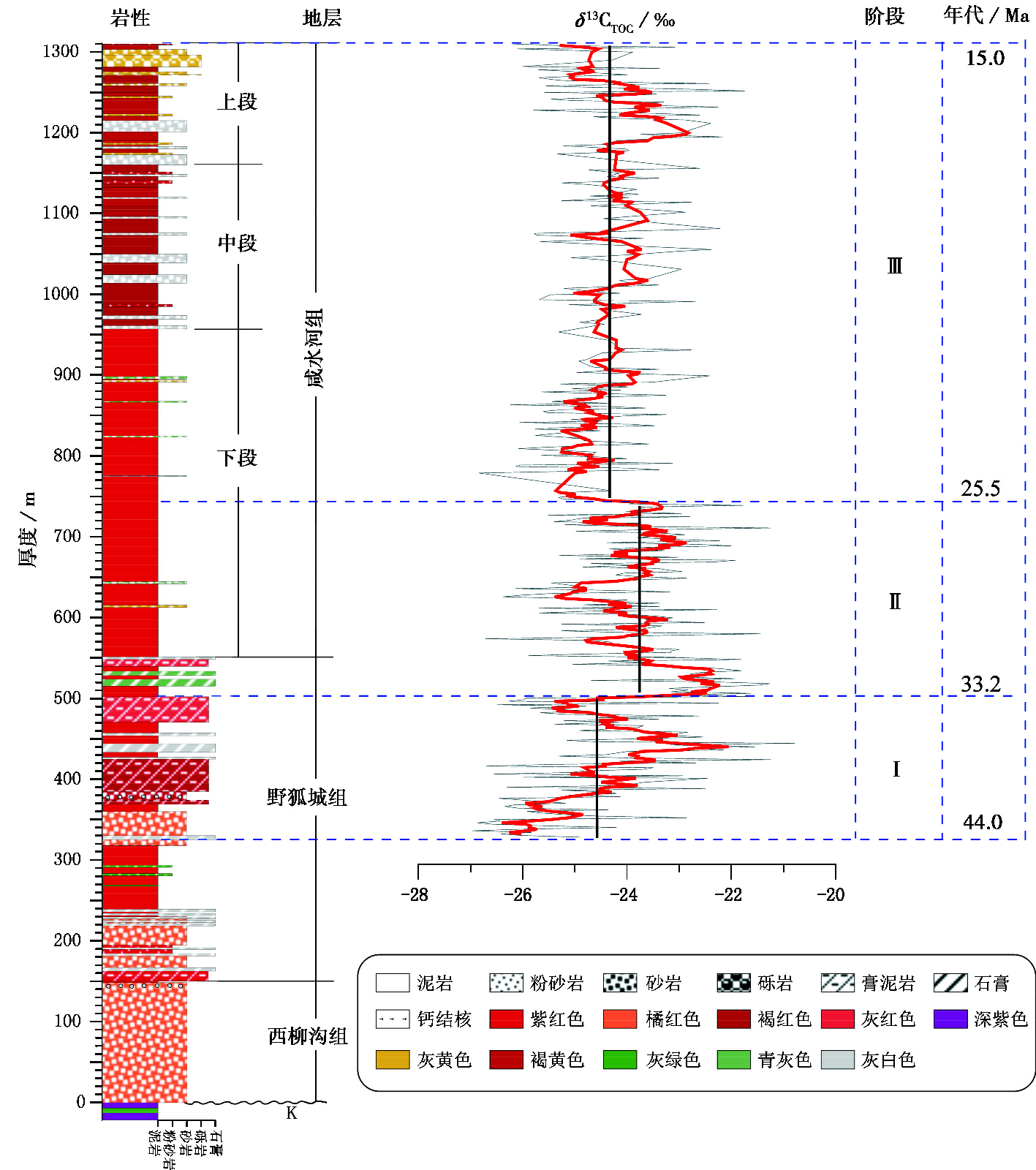
岳乐平等[33]曾对甘肃永登剖面(见 图1)进行了详细的磁性地层研究,揭示出西柳沟组顶界年龄约为51Ma,野狐城组沉积于51.0~31.5Ma,咸水河组(未见顶)顶部年龄约为15Ma。2014年9月笔者对该剖面(剖面起点A,深度0m:36°20′58 . 86″N,103°28′42 . 84″E; 终点B,深度1310m:36°22′5 . 46″N,103°29′52 . 86″E) 进行了地层的核查与有机碳同位素样品的采集,野外实测整个剖面厚1310m( 图2),依据上述各组岩性特征及主要标志层位,界定西柳沟组与野狐城组界限位于厚度150m处,野狐城组与咸水河组界限位于551.5m处。由于剖面底部地层沉积物以粗粒度的砂岩为主,本文主要对厚度为330~1310m部分地层的有机碳同位素结果进行分析讨论,根据上述磁性地层结果对采样地层进行了年代的重新分配,沉积时代介于44~15Ma之间。
|
图 2 兰州盆地永登剖面岩性与有机碳同位素记录 红色实线为5点平滑结果; 黑色实线为平均值 Fig.2 The lithology and results of δ 13 CTOC of Yongdeng section, Lanzhou basin. Red line shows the smooth results by five samples, black lines show average ones |
野外对研究剖面进行了有机碳同位素样品的采集,先去除表层风化物,在新鲜岩面上按2m间隔采集,尽可能选取细粒的泥岩和粉砂岩,在粒度较粗的层位则适当放大采样间隔,本文研究部分(厚度330~1310m)共采集样品376块。样品在室内低温40℃烘干后研磨成均匀粉末状(小于200目)。每样称取3g左右用过量盐酸(2mol/L)充分反应24小时,以确保完全去除无机碳,而后用蒸馏水洗至中性,在40℃烘箱内烘干,再度研磨后,称取约40mg样品,放入锡杯中包好待测[9, 12]。上机测试使用 Thermo公司生产的 Delta V型气体稳定同位素比质谱仪,通过CONFLO Ⅲ连接附件Flash EA 1112元素分析仪,采用EA-IRMS在线分析技术[37, 38, 39]对样品进行δ 13 CTOC值的测定。对于少数样品燃烧产生的CO2峰值与参考气体(CO2)峰差异较大的,酌情增减进样量进行重测。
样品的前处理在中国科学院青藏高原研究所(北京部)大陆碰撞与高原隆升重点实验室进行,上机测试在中国科学院青藏高原研究所(拉萨部)完成。测试时每批样品至少测试3个标准样品和2个平行样品,样品的重复分析误差 < 0.2 ‰ ,结果采用VPDB(Vienna Pee Dee Belemnite)标准。
4 实验结果永登剖面厚度330~1310m部分有机碳同位素结果如 图2所示,据其变化剖面自下而上大致可以划分为3个主要阶段:
阶段Ⅰ(厚度330~500m,44.0~33.2Ma):
此阶段有机碳同位素平均值为-24.6 ‰ ,为整个剖面最轻。变化幅度较大,初期偏负,最小值为-26.9 ‰ ,而后持续波动性变重,至约450m左右达到本阶段最大值-20.8 ‰ ,之后逐渐负偏。
阶段Ⅱ(厚度500~750m,33.2~25.5Ma):
厚度500m处δ 13 CTOC较之前快速正偏,维持至540m后略微变轻,后虽有波动,但整体较为稳定。此阶段δ 13 CTOC平均值为-23.7 ‰ ,较之上下两个阶段为最重,最大值为-21.2 ‰ ,最小值为-26.7 ‰ 。
阶段Ⅲ(厚度750~1310m,25.5~15.0Ma):
厚度750m后δ 13 CTOC较之阶段Ⅱ有所负偏,平均值为-24.4 ‰ 。整个阶段变化相对稳定,结果介于-21.7 ‰ 至-26.8 ‰ 之间。
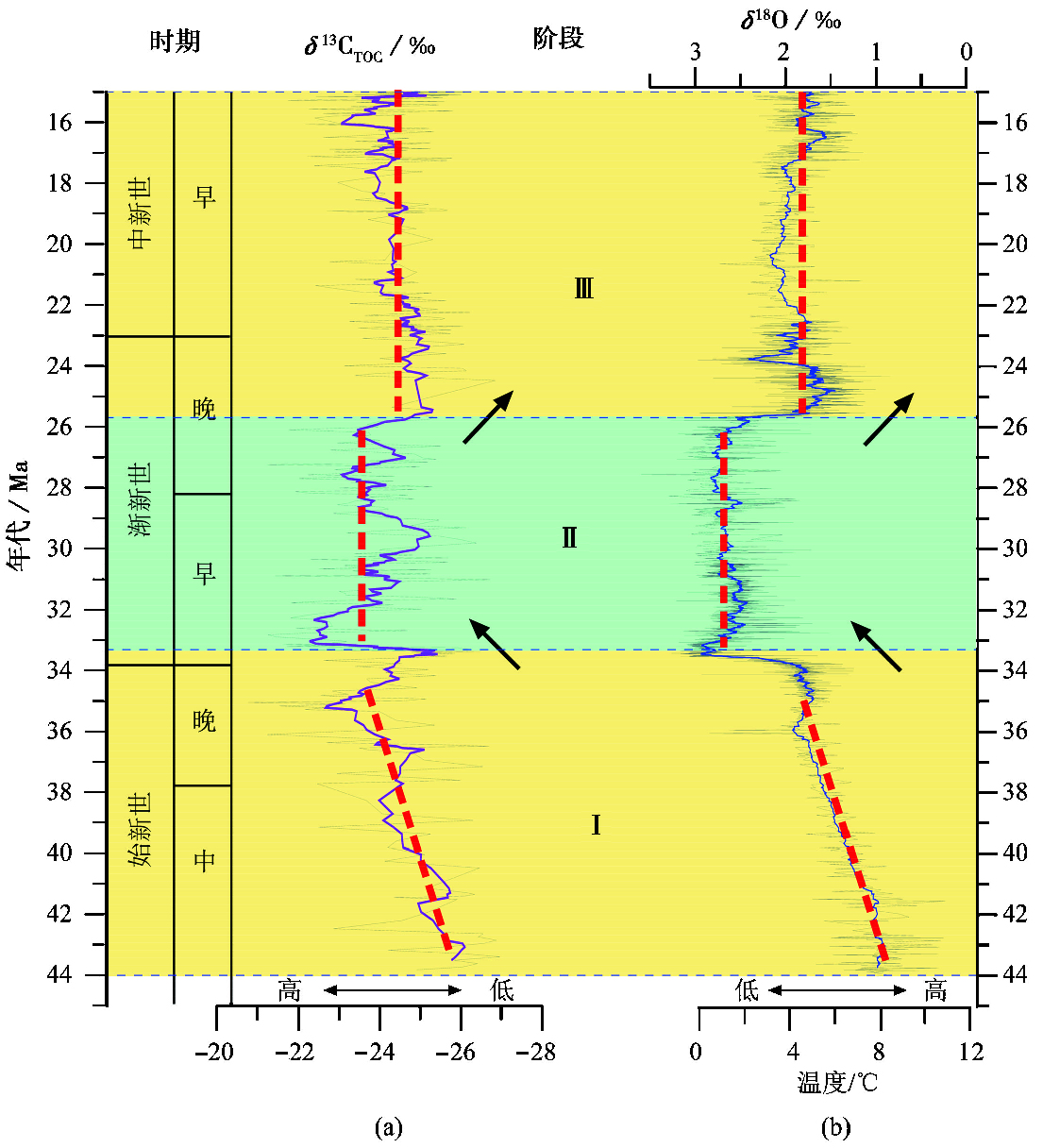
5 讨论 5.1 有机碳同位素变化与温度的关系将永登剖面有机碳同位素结果按年代标尺建立变化序列,如 图3a所示,与全球氧同位素( 图3b)[17]进行对比( 图3),可以发现两者呈现出较为一致的变化趋势。
|
图 3 兰州盆地永登剖面有机碳同位素(a)与全球氧同位素(b)[17]记录的对比 Fig.3 The comparation between δ 13 CTOC of Yongdeng section and marine δ 18 O[17] |
44~15Ma期间,全球深海 δ 18 O发生了两次明显的变化,永登剖面沉积物δ 13 CTOC对这两次事件均有明显响应。约33.5Ma时全球深海 δ 18 O突然增高,在很短的时间内增加1 ‰ ,温度出现快速的台阶式急剧下降,南极发育大规模冰川,南极冰盖进一步扩大,被称为著名的“Oi-l 变冷事件”[17],此时永登剖面δ 13 CTOC迅速偏正,由约-26 ‰ 快速变化为-22 ‰ 左右。另一次显著的变化发生在约25.5Ma,全球 δ 18 O突然降低,全球温度快速回升,为“晚渐新世增温事件”[17],该时期永登剖面δ 13 CTOC快速负偏,由-23 ‰ 变至-25 ‰ 左右。在重大事件对比上,永登剖面沉积物δ 13 CTOC与全球 δ 18 O之间存在较好的一致性。
长期演化方面,永登剖面δ 13 CTOC与全球 δ 18 O也呈现出一致的趋势。44.0~33.2Ma期间永登剖面δ 13 CTOC最轻,平均值为-24.6 ‰ ,并且初期值偏负,而后持续正偏变重,后期再度变轻( 图3a),全球氧同位素亦表现出持续增加后期突然降低同样的趋势变化( 图3b); 33.2Ma后δ 13 CTOC变重,平均值为-23.7 ‰ ,δ 18 O也从33.2Ma突然升高后维持整体偏高的水平; 25.5Ma后δ 13 CTOC再度负偏,δ 18 O亦有同样的表现( 图3)。
由上述可见永登剖面有机碳同位素与海洋沉积物氧同位素所反映的全球温度变化无论从事件上还是趋势变化上都呈现出较为一致的负相关关系。
5.2 永登剖面有机碳同位素变化可能机制探讨本文分析样品采自永登剖面野狐城组的上部和咸水河组(见 图2),这两个组在宏观上都表现为河流相-咸水或淡水湖相沉积[33, 34, 35, 40],以泥岩为主,包含有多层的砂砾岩。岩性的不同对有机质的保存可能存在一定的影响,但野外采样时尽可能地选取细粒的泥岩和泥质粉砂岩,并且分析结果可以看出有机碳同位素与岩性变化并非一一对应( 图2),因此,该研究中基本可以忽略岩性的不同对有机质保存的影响。
富含有机质的颗粒物质在经过成岩转变的过程中会进行不同程度的、 选择性的降解,从而对沉积物的同位素组成产生一定的影响。有研究发现富含13 C的有机化合物会优先降解使得沉积物中δ 13 CTOC变轻[41, 42, 43],如对百慕大Mangrove湖沉积物研究发现,选择性成岩作用造成δ 13 CTOC发生2 ‰ 的改变,但这种情况通常发生在有机碳含量超过20 % 的前提下,对于有机碳含量低于2 % ~3 % 的沉积物而言,这种改变微乎其微[44]。永登剖面的样品有机碳含量均不超过1 % ,对于成岩作用的影响基本可以忽略。
已有研究表明全球CO2浓度[45, 46]、 区域性的气候因素,包括气温、 降水等[8, 9, 10, 11, 12, 13, 14, 15, 47, 48, 49, 50, 51, 52, 53]是影响植被群落的组成,进而影响沉积物中有机碳同位素的主要因素。本文研究的永登剖面,其有机碳同位素的变化与全球温度变化具有较好地一致性( 图3),因此温度可能是主控该研究区有机碳同位素变化的决定性因素。温度可能通过两种途径对其产生影响,一是改变植物碳同位素的分馏,二是改变贡献有机质的植被碳同位素组成。
目前研究认为温度主要通过影响光合作用的酶的活性[54]、 影响呼吸作用等[55]来影响碳同位素的分馏。温度增高时,参加光合作用的酶的活性增强,光合速率增大,CO2同化加速,植物叶片内部的CO2浓度变低,碳同位素分馏降低,植物δ 13 C值增大[54]; 或者温度增高的时候植物呼吸速率增强,呼吸过程中12 C较13 C优先以CO2形式释放,植物相对富集13 C,从而导致植物δ 13 C值变大[55]。上述方式均表明温度与δ 13 C呈现正相关关系,与永登剖面所呈现的现象不符。
河湖相沉积物中有机碳的来源主要包括两个方面: 内生有机质和外生陆源有机质。内生湖沼有机质主要来源于沉水植物、 挺水植物、 浮游植物和湖中的低等菌藻类。沉水植物的δ 13 C值偏重,变化范围为-20 ‰ ~-12 ‰ [56]; 挺水植物的δ 13 C值偏轻,变化范围为-30 ‰ ~-24 ‰ [57]; 浮游植物与陆生C3植物接近,约-27 ‰ ; 低等菌藻类变化较大,但总体偏轻[58]。一般情况下湖沼中沉水和挺水植物占的比重大,是内源有机质的主要贡献者,浮游和低等菌藻类只在极其特殊的情况下才有可能产生大的贡献,并且在埋藏后的成岩过程中其有机质因富含蛋白质而最不易保存,因此内生有机质主要考虑沉水植物和挺水植物。外生陆源有机质主要源于C3植物和C4植物,前者的δ 13 C在-34 ‰ ~-22 ‰ (平均-27 ‰ ),后者为-19 ‰ ~-9 ‰ (平均-13 ‰ )[45,46,54,59~63]。在永登剖面沉积期间,即15Ma之前,有研究表明C4植物极少或可能还没有出现[45~47,64~67],因而外生陆源有机质主要源于C3植物。
温度的改变可能通过改变挺水植物、 沉水植物与C3植物的相对含量来影响有机质碳同位素的大小。温度高的时候,蒸发量大,湖水收缩,陆源和挺水植物对有机质贡献增多,而沉水植物对有机质贡献相对缩小,因而导致沉积物中有机质13 C值偏轻。这种关系在永登剖面岩相特征上也有体现,δ 13 CTOC值整体偏负的野狐城组中上部由含大量石膏、 芒硝夹层的紫红色泥岩、 砂岩组成,沉积相分析为咸水的盐湖[33, 34, 35, 36],是炎热干旱环境下的产物。相反,温度降低的时候,蒸发量相对减小,湖水面积相对增加,导致沉水植物贡献相对增加,沉积物中有机质13 C值相对正偏; 同时温度降低的时候湖水硬度增加导致水体中作为水生生物碳源HCO-3含量增加,也导致沉积物δ 13 CTOC值相对偏重[22]。如永登剖面δ 13 CTOC值相对偏正的33.2~25.5Ma期间,对应咸水河组的下部,为红色泥岩和砂岩互层,沉积相分析为淡水的湖盆[33, 34, 35, 36, 40],孢粉结果表明多为暖温带和亚热带的阔叶树种,耐旱的麻黄等分子少见[68],并且杨属植物化石[69]的发现都同样揭示出当时环境较为温和。
西宁盆地谢家剖面38~17Ma有机质碳同位素总体负偏并有几次显著低值对应深海氧同位素的高值,与全球温度变化呈正相关关系[20]。谢家剖面沉积主要为河漫滩相和洪泛平原相,可能较之永登剖面更靠近山前,沉积物中的有机质主要来源于陆生的C3植物,而温度主要通过改变C3植物中裸子植物和被子植物的相对构成来影响有机质碳同位素的大小[20],因而两者的关系呈现出与永登剖面不同的变化趋势。
综上所述,准确判断有机质的来源对于有机碳同位素结果的解译具有极其重要的意义。碳氮比(C/N)是第四纪尤其是全新世湖泊研究中常用的指标,但对于沉积年代较久的地层,由于有机质的分解常导致沉积物中C/N相对降低[70, 71, 72],因而结合其他指标诸如孢粉学、 生物标志化合物以及地球化学等指标的测试,可能将对有机碳同位素指标的指示意义及其机理提供更多参考。
6 结论通过对兰州盆地野狐城组上部与咸水河组地层的总有机碳同位素测定,发现44~15Ma之间有两次大的转变,分别在33.2Ma和25.5Ma时有机碳同位素平均值由-24.6 ‰ 变重至-23.7 ‰ ,而后变轻至-24.4 ‰ ,这与其间全球氧同位素变化呈现出较一致的对应关系,表明兰州盆地有机碳同位素变化可能受控于全球温度变化,温度高的时候,其值偏负,推测温度的变化改变了沉水、 挺水植物以及陆源输入的C3植物的组成进而影响了沉积物中有机碳同位素的轻重。
本文主要对永登剖面中始新世-中中新世期间有机碳同位素的结果给予展现,并发现其与温度之间存在一定的负相关关系,表明有机碳同位素在恢复气候环境变化方面是个很有潜力的指标,但对其机理的解释有待多指标研究的进一步开展,以提供更全面的环境信息。
致谢 张涛、 徐马强、 李兵参与了野外样品采集工作,朱志勇在上机测试过程中给予了细心的指导; 审稿人对本文提出了诸多建设性的意见和建议,杨美芳编辑及杨石岭研究员在成文及送审过程中给予热忱帮助,一并感谢。
| 1 | Nakai N. Carbon isotopic variation and the paleoclimate of sediments from Lake Biwa. Proceedings of the Japan Academy, 1972, 48 (7):516~521 |
| 2 | Pearson F J, Coplen T B. Stable isotope studies of lake. In:Lerman A ed. Lakes:Chemistry, Geology, Physics. New York:Springer, 1978. 235~236 |
| 3 | Stuiver M, Braziunas T F. Tree cellulose 13 C/12 C isotope ratios and climate change. Nature, 1987, 328 (6125):58~60 |
| 4 |
沈吉, 吴瑞金, 安芷生. 大布苏湖沉积剖面有机碳同位素特征与古环境. 湖泊科学, 1998, 10 (3):8~12 Shen Ji, Wu Ruijin, An Zhisheng. Characters of the organic δ 13 C and paleoenvironment in the section of Dabusu Lake. Journal of Lake Sciences, 1998, 10 (3):8~12 |
| 5 |
孙伟伟, 沈吉, 张恩楼等. 日本大沼湖沉积物碳氮比值、有机碳同位素特征及其近400年的古气候环境意义. 第四纪研究, 2014, 34 (6):1306~1313 Sun Weiwei, Shen Ji, Zhang Enlou et al. Characteristics of organic stable carbon isotope and C/N ration of sediments in Lake Onuma, Japna and their environmental implications for the last 400 years. Quaternary Sciences, 2014, 34 (6):1306~1313 |
| 6 |
孙博亚, 岳乐平, 赖忠平等. 14ka B.P.以来巴里坤湖区有机碳同位素记录及古气候变化研究. 第四纪研究, 2014, 34 (2):418~424 Sun Boya, Yue Leping, Lai Zhongping et al. Paleoclimate changes recorded by sediment organic carbon isotopes of Lake Barkol since 14ka B.P.Quaternary Sciences, 2014, 34 (2):418~424 |
| 7 | Fontugne M R, Calvert S E. Late Pleistocene variability of the carbon isotopic composition of organic matter in the eastern Mediterranean Sea:Monitor of changes in carbon sources and atmospheric CO2-concentrations. Paleoceanography, 1992, 7 (1):1~20 |
| 8 |
顾兆炎, 刘强, 许冰等. 气候变化对黄土高原末次盛冰期以来的C3/C4 植物相对丰度的控制. 科学通报, 2003, 48 (13):1458~1464 Gu Zhaoyan, Liu Qiang, Xu Bing et al. Climate as the dominant control on C3 and C4 plant abundance in the Loess Plateau:Organic carbon isotope evidence from the last glacial-interglacial loess-soil sequences. Chinese Science Bulletin, 2003, 48 (13):1458~1464 |
| 9 |
刘卫国, 宁有丰, 安芷生等. 黄土高原现代土壤和古土壤有机碳同位素对植被的响应. 中国科学(D辑), 2002, 32 (10):830~836 Liu Weiguo, Ning Youfeng, An Zhisheng et al. The response to vegetation of modern soil and paleosol organic carbon isotope in Loess Plateau. Science in China (Series D), 2002, 32 (10):830~836 |
| 10 | Chen Fahu, Rao Zhiguo, Zhang Jiawu et al. Variations of organic carbon isotopic composition and its environmental significance during the last glacial on western Chinese Loess Plateau. Chinese Science Bulletin, 2006, 51 (13):1593~1602 |
| 11 |
赵得爱, 吴海斌, 吴建育等. 过去典型增温期黄土高原东西部C3/C4植物组成变化特征. 第四纪研究, 2013, 33 (5):848~855 Zhao De'ai, Wu Haibin, Wu Jianyu et al. C3/C4 plants characteristics of the eastern and western parts of the Chinese Loess Plateau during Mid-Holocene and last interglacial. Quaternary Sciences, 2013, 33 (5):848~855 |
| 12 | Yang S L, Ding Z L. Winter-spring precipitation as the principal control on predominance of C3 plants in Central Asia over the past 1.77 Myr:Evidence from δ 13 C of loess organic matter in Tajikistan. Palaeogeography, Palaeoclimatology, Palaeoecology, 2006, 235 (4):330~339 |
| 13 |
张晓, 贾鑫, 饶志国等. 陇西黄土高原东南部地区末次冰期以来C3/C4植物相对丰度变化及其区域性剖面的对比研究. 第四纪研究, 2013, 33 (1):187~196 Zhang Xiao, Jia Xin, Rao Zhiguo et al. C3/C4 variation since the Last Glacial in the southeastern Longxi Loess Plateau and its comparison with other results. Quaternary Sciences, 2013, 33 (1):187~196 |
| 14 |
饶志国, 陈发虎, 曹洁等. 黄土高原西部地区末次冰期和全新世有机碳同位素变化与C3/C4植被类型转换研究. 第四纪研究, 2005, 25 (1):107~114 Rao Zhiguo, Chen Fuhu, Cao Jie et al. Variation of soil organic carbon isotope and C3/C4 vegetation type transition in the western loess plateau during the last glacial and Holocene periods. Quaternary Sciences, 2005, 25 (1):107~114 |
| 15 |
饶志国, 张晓, 薛骞等. 西峰红粘土/黄土剖面有机碳同位素研究的初步结果. 第四纪研究, 2012, 32 (4):825~827 Rao Zhiguo, Zhang Xiao, Xue Qian et al. Primary organic carbon isotopic study result of Xifeng loess/red clay profile. Quaternary Sciences, 2012, 32 (4):825~827 |
| 16 | Miller K G, Fairbanks R G, Mountain G S. Tertiary oxygen isotope synthesis, sea level history, and continental margin erosion. Paleoceanography, 1987, 2 (1):1~19 |
| 17 | Zachos J C, Pagani M, Sloan L et al. Trends, rhythms, and aberrations in global climate 65Ma to present. Science, 2001, 292 (5517):686~693 |
| 18 | Zachos J C, Gerald R D, Richard E Z. An Early Cenozoic perspective on greenhouse warming and carbon-cycle dynamics. Nature, 2008, 451 (7176):279~283 |
| 19 | Holdgate G R, McGowran B, Fromhold T et al. Eocene-Miocene carbon-isotope and floral record from brown coal seams in the Gippsland Basin of Southeast Australia. Global and Planetary Change, 2009, 65 (1):89~103 |
| 20 | Chi Y P, Fang X M, Song C H et al. Cenozoic organic carbon isotope and pollen records from the Xining Basin, NE Tibetan Plateau, and their palaeoenvironmental significance. Palaeogeography, Palaeoclimatology, Palaeoecology, 2013, 386 (18):436~444 |
| 21 | Degens E T, Guillard R R L, Sackett W M et al. Metabolic fractionation of carbon isotopes in marine plankton-Ⅰ. Temperature and respiration experiments. Deep Sea Research and Oceanographic Abstracts, 1968, 15 (1):1~9 |
| 22 |
谢远云, 何葵, 康春国等. 湖泊沉积物有机质碳同位素的气候意义: 以江汉平原江陵剖面为例. 哈尔滨师范大学自然科学学报, 2004, 20 (5):96~99 Xie Yuanyun, He Kui, Kang Chunguo et al. Climatic significance of organic matter carbon isotope in lacustrine sediments:A case study of Jiangling section, Jianghan Plain, China. Natural Sciences Journal of Harbin Normal University, 2004, 20 (5):96~99 |
| 23 |
马龙, 吴敬禄. 安固里淖湖积物中总有机碳含量及其碳同位素的环境意义. 自然资源学报, 2009, 24 (6):1099~1104 Ma Long, Wu Jinglu. Environmental significance of organic carbon and its isotope in Angulinao Lake sediment. Journal of Natural Resources, 2009, 24 (6):1099~1104 |
| 24 |
吴敬禄, 王苏民. 湖泊沉积物中有机质碳同位素特征及其古气候. 海洋地质与第四纪地质, 1996, 16 (2):103~109 Wu Jinglu, Wang Sumin. Climate versus changes in δ 13 C values of the organic matter in lake sediments. Marine Geology & Quaternary Geology, 1996, 16 (2):103~109 |
| 25 |
吴敬禄, Andreas Luecke, 李世杰等. 兴措湖沉积物有机碳及其同位素记录揭示的近代气候与环境. 海洋地质与第四纪地质, 2000, 20 (4):37~42 Wu Jinglu, Andreas Lucke, Li Shijie et al. Modern climatic signals from records of contents of TOC and δ 13 Corg in the Xingcuo Lake sediments in eastern Tibetan Plateau, China. Marine Geology & Quaternary Geology, 2000, 20 (4):37~42 |
| 26 | 吕厚远, 顾兆炎, 吴乃琴等. 海拔高度的变化对青藏高原表土δ 13 Corg的影响. 第四纪研究, 2001, 21 (5):830~836 Lü Houyuan, Gu Zhaoyan, Wu Naiqin et al. Effect of altitude on the organic carbon isotope composition of modern surface soils from Qinghai-Xizang Plateau. Quaternary Sciences, 2001, 21 (5):830~836 |
| 27 |
巨天珍, 陈学林, 赵传燕. 兰州地区草原植被的植物群落类型——干草原和荒漠草原. 草业学报, 1997, 6 (3):60~65 Ju Tianzhen, Chen Xuelin, Zhao Chuanyan. Grassland plant communities in Lanzhou region. Acta Pratacul Turae Sinica, 1997, 6 (3):60~65 |
| 28 |
杨钟健, 卞美年. 甘肃皋兰永登区新生代地质. 中国地质学会志, 1937, 13 (3/4):199~201 Yang Zhongjian, Bian Meinian. Cenozoic geology of Gansu Gaolan and Yongdeng district. Geological Society of China, 1937, 13 (3/4):199~201 |
| 29 |
邱占祥, 谷祖纲. 甘肃兰州—第三纪中期哺乳动物化石地点. 古脊椎动物学报, 1988, 26 (3):198~213 Qiu Zhanxiang, Gu Zugang. A new locality yielding Mid-Tertiary mammals near Lanzhou, Gansu. Vertebrata PalAsiatica, 1988, 26 (3):198~213 |
| 30 |
邱占祥, 王伴月, 邱铸鼎等. 甘肃兰州盆地咸水河组研究的新进展. 见: 童永生, 张银运, 吴文裕等. 演化的实证——纪念杨钟健教授百年诞辰论文集. 北京: 海洋出版社, 1997. 177~192 Qiu Zhanxiang, Wang Banyue, Qiu Zhuding et al. New progress in study on the Xianshuihe Formation of Lanzhou basin, Gansu. In:Tong Yongsheng, Zhang Yinyun, Wu Wenyu et al.eds. Evidence from Evolution——Essays in Honor of Prof. Chungchien Young on the Hundredth Anniversary of His Birth. Beijing:China Ocean Press, 1997. 177~192 |
| 31 |
邱占祥, 谢骏义, 阎德发. 甘肃东乡几种早中新世化石地点. 古脊椎动物学报, 1990, 28 (1):9~24 Qiu Zhanxiang, Xie Junyi, Yan Defa. Discovery of some Early Miocene mammalian fossils from Dongxiang, Gansu. Vertebrata PalAsiatica, 1990, 28 (1):9~24 |
| 32 | Qiu Z X, Wang B Y, Qiu Z D et al. Land mammal geochronology and magnetostratigraphy of Mid-Tertiary deposits in the Lanzhou Basin, Gansu Province, China. Eclogae Geologicae Helvetiae, 2001, 94 (3):373~385 |
| 33 |
岳乐平, Heller F, 邱占祥等. 兰州盆地第三系磁性地层年代与古环境记录. 科学通报, 2000, 45 (18):1998~2002 Yue Leping, Heller F, Qiu Zhanxiang et al. Magnetostratigraphy and paleoenvironmental record of Tertiary deposits of Lanzhou Basin. Chinese Science Bulletin, 2001, 46 (9):770~774 |
| 34 | 岳乐平, 邱占祥, 颉光普等. 兰州盆地永登剖面记录的第三纪沉积环境. 沉积学报, 2003, 21 (4):683~687, 694 Yue Leping, Qiu Zhanxiang, Xie Guangpu et al. Sedimentary environment of Tertiary recorded in the Yongdeng section of Lanzhou Basin. Acta Sedimentologica Sinica, 2003, 21 (4):683~687, 694 |
| 35 | 宋春晖. 青藏高原北缘新生代沉积演化与高原构造隆升. 兰州: 兰州大学博士论文, 2006. 341 Song Chunhui. Tectonic Uplift and Cenozoic Sedimentary Evolution in the Northern Margin of the Tibetan Plateau. Lanzhou:The Ph .D Thesis of Lanzhou University, 2006. 341 |
| 36 |
宋春晖, 孟庆泉, 夏维民等. 青藏高原北缘古近纪石英砂表面特征及其古环境意义. 沉积学报, 2009, 27 (1):94~103 Song Chunhui, Meng Qingquan, Xia Weimin et al. The Eogene surface texture of quartz sand and paleoclimatic change in northern margin of Tibetan Plateau. Acta Sedimentologica Sinica, 2009, 27 (1):94~103 |
| 37 |
储雪蕾. 一种新的、快速的碳、氮、硫同位素测定手段——EA-IRMS连线分析技术. 矿物岩石地球化学通报, 1996, 15 (4):259~262 Chu Xuelei. A new method of rapid measurements for C, N and S isotope ratios——On-line analytical method of EA-IRMS. Bulletin of Mineralogy, Petrology and Geochemistry, 1996, 15 (4):259~262 |
| 38 | 郑永飞, 陈江峰. 稳定同位素地球化学. 北京: 科学出版社, 2000. 316 Zheng Yongfei, Chen Jiangfeng. Stable Isotopic Geochemistry. Beijing:Science Press, 2000. 316 |
| 39 |
郑永飞, 龚冰, 王峥嵘等. 岩石中碳同位素比值的EA-MS测定及其地球化学应用. 地质评论, 1999, 45 (5):529~538 Zheng Yongfei, Gong Bing, Wang Zhengrong et al. EA-MS online analysis of both carbon concentration and isotopic ratio of silicate rocks and its geological applications. Geological Review, 1999, 45 (5):529~538 |
| 40 |
顾延生, 李长安, 黄长生等. 兰州-民和盆地第三纪沉积特征及环境. 地质通报, 2000, 19 (4):337~343 Gu Yansheng, Li Chang'an, Huang Changsheng et al. Tertiary sedimentary features and environment of the Lanzhou-Minhe Basin. Regional Geology of China, 2000, 19 (4):373~343 |
| 41 | McArthur J M, Tyson R V, Thomson J et al. Early diagenesis of marine organic matter:Alteration of the carbon isotopic composition. Marine Geology, 1992, 105 (1):51~61 |
| 42 | Prahl F G, De Lange G T, Scholten S et al. A case of post-depositional aerobic degradation of terrestrial organic matter in turbidite deposits from the Madeira Abyssal Plain. Organic Geochemistry, 1997, 27 (3~4):141~152 |
| 43 | Bötteher M E, Oelsehla ĝer B, Höpner T et al. Sulfate reduction related to the early diagenetic degradation of organic matter and "black spot" formation in tidal sandflats of the German Wadden Sea(Southern North Sea):Stable isotope(13 C, 34 S, 18 O)and other geochemical results. Organic Geochemistry, 1998, 29 (5):1517~1530 |
| 44 | Talbot M R, Livingstone D A. Hydrogen index and carbon isotopes of lacustrine organic matter as lake level indicator. Palaeogeography, Palaeoclimatology, Palaeoecology, 1989, 70 (1):121~137 |
| 45 | Cerling T E, Harris J M, MacFadden B J et al. Global vegetation change through the Miocence/Pliocene boundary. Nature, 1997, 389 (11):153~158 |
| 46 | Cerling T E, Wang Y, Quade J. Expansion of C4 ecosystem as an indicator of global ecological change in the Late Miocene. Nature, 1993, 361 (28):344~345 |
| 47 |
韩家懋, 王国安, 刘东生. C4植物的出现与全球环境变化. 地学前缘, 2002, 9 (1):233~243 Han Jiamao, Wang Guo'an, Liu Tungsheng. Appearance of C4 plants and global changes. Earth Science Frontiers, 2002, 9 (1):233~243 |
| 48 |
唐国军, 陈衍景. 有机碳同位素示踪古环境变化研究. 矿物岩石, 2004, 24 (3):110~115 Tang Guojun, Chen Yanjing. Comment on tracing environmental change with organic carbon isotopes. Journal of Mineralogy and Petrology, 2004, 24 (3):110~115 |
| 49 |
王国安, 韩家懋, 刘东生. 中国北方黄土区C-3草本植物碳同位素组成研究. 中国科学(D辑), 2003, 33 (6):550~556 Wang Guo'an, Han Jiamao, Liu Tungsheng. The study of C-3 herbs carbon isotopic composition in loess area of Northern China. Science in China(Series D), 2003, 33 (6):550~556 |
| 50 |
王国安, 韩家懋. C3植物碳同位素在旱季和雨季中的变化. 海洋地质与第四纪地质, 2001, 21 (4):43~46 Wang Guo'an, Han Jiamao. δ 13 C variations of C3 plants in dry and rainy seasons. Marine Geology & Quaternary Geology, 2001, 21 (4):43~46 |
| 51 |
王国安. 稳定碳同位素在第四纪古环境研究中的应用. 第四纪研究, 2003, 23 (5):471~481 Wang Guo'an. Application of stable carbon isotope for paleoenvironmental research. Quaternary Sciences, 2003, 23 (5):471~481 |
| 52 |
刘恋, 周鑫, 于严严等. 黄土高原自然植被的土壤有机碳同位素证据. 第四纪研究, 2011, 31 (3):506~513 Liu Lian, Zhou Xin, Yu Yanyan et al. The nature vegetations on the Chinese Plateau:The evidence of soil organic carbon isotope. Quaternary Sciences, 2011, 31 (3):506~513 |
| 53 |
陈英勇, 鹿化煜, 张恩楼等. 浑善达克沙地地表沉积物有机碳同位素组成与植被-气候的关系. 第四纪研究, 2013, 33 (2):351~359 Chen Yingyong, Lu Huayu, Zhang Enlou et al. The relationship between organic carbon isotopic composition of surface sediment and vegetation-climate in Otindag dune field. Quaternary Sciences, 2013, 33 (2):351~359 |
| 54 | Farquhar G, Ehleringer J, Hubick K. Carbon isotope discrimination and photosynthesis. Annual Review Plant Physilecular Biology, 1989, 40 (1):503~537 |
| 55 | 王国安. 环境稳定同位素原理. 北京: 地质出版社, 2011. 178 Wang Guo'an. The Theory of Environmental Stable Isotope. Beijing:Geological Publishing House, 2011. 178 |
| 56 | Dana S, Deevey E S. Carbon-13 in lake waters, and its possible bearing on paleolimnology. American Journal of Science, 1960, 258 :253~272 |
| 57 | Aravena R, Warner B G, MacDonald G M et al. Carbon isotope composition of lake sediments in relation to lake productivity and radiocarbon dating. Quaternary Research, 1992, 37 (3):333~345 |
| 58 |
张成君, 陈发虎, 尚华明等. 中国西北干旱区湖泊沉积物中有机质碳同位素组成的环境意义——以民勤盆地三角城古湖泊为例. 第四纪研究, 2004, 24 (1):88~94 Zhang Chengjun, Chen Fuhu, Shang Huaming et al. The paleoenvironmental signigicance of organic carbon isotope in lacustrine sediments in the arid China:An example from Sanjiaocheng palaeolake in Minqin. Quaternary Sciences, 2004, 24 (1):88~94 |
| 59 | Bender M M. Variations in the 13 C/12 C ratios of plants in relation to the pathway of photosynthetic carbon dioxide fixation. Phytochemistry, 1971, 10 (6):1239~1244 |
| 60 | Deines P. The isotopic composition of reduced organic carbon. In:Fritz P, Tontes J C eds. Handbook of Environmental Isotope Geochemistry, Vol.1. The Terrestrial Environment. Dordrecht:Elsevier, 1980. 329~406 |
| 61 | O'Leary M H. Carbon isotope fractionation in plants. Phytochemistry, 1981, 20 (4):553~567 |
| 62 | O'Leary M H. Carbon isotope in photosynthesis. BioScience, 1988, 38 :328~336 |
| 63 | Smith B N, Epstein S. Two categories of 13 C/12 C ratio for higher plants. Plant Physiology, 1971, 47 (3):380~384 |
| 64 | Quade J, Cerling T E, Bowman J R. Development of Asian monsoon revealed by marked ecological shift during the Latest Miocene in Northern Pakistan. Nature, 1989, 342 (9):163~166 |
| 65 | Edwards E J, Osborne C P, Strömberg C A E et al. The origin of C4 grasslands:Integrating evolutionary and ecosystem science. Science, 2010, 328 (5978):587~592 |
| 66 | Wang Y, Deng T. A 25 m.y. isotopic record of paleodiet and environmental change from fossil mammals and paleosols from the NE margin of the Tibetan Plateau. Earth and Planetary Science Letters, 2005, 236 (1):322~338 |
| 67 |
张瑜, 熊尚发, 丁仲礼等. 中新世以来六盘山邻区黄土-红粘土成土碳酸盐碳氧同位素记录及其对C4植物早期扩张的指示. 第四纪研究, 2011, 31 (5):800~811 Zhang Yu, Xiong Shangfa, Ding Zhongli et al. Carbon-oxygen isotope records of pedogenic carbonate from the Early Miocene-Pleistocene loess-red clay in the vicinity of the Liupanshan region and its implications for the early origin of C4 plants in the Chinese Loess Plateau. Quaternary Sciences, 2011, 31 (5):800~811 |
| 68 | Miao Y F, Wu F L, Herrmann M et al. Late Early Oligocene East Asian summer monsoon in the NE Tibetan Plateau:Evidence from a palynological record from the Lanzhou Basin, China. Journal of Asian Earth Sciences, 2013, 75 :46~57 |
| 69 | Sun Bainian, Yan Defei, Xie Sanping et al. Palaeogene fossil Populus leaves from Lanzhou Basin and their palaeoclimatic significance. Chinese Science Bulletin, 2004, 49 (14):1494~1501 |
| 70 | Meyers P A. Application of organic geochemistry to paleolimnological reconstructions:A summary of examples from the Laurentian Great Lakes. Organic Geochemistry, 2003, 34 (2):261~289 |
| 71 | Meyers P A. Organic geochemical proxies of paleoceanographic, paleolimnologic and paleoclimatic processes. Organic Geochemistry, 1997, 27 (5):216~250 |
| 72 | Fan M J, Dettman D L, Song C H et al. Climate variation in the Linxia Basin, NE Tibetan Plateau, from 13.1 to 4.3Ma:The stable isotope record. Palaeogeography, Palaeoclimatology, Palaeoecology, 2007, 247 (3):313~328 |
Abstract
The relative abundance of organic carbon isotope(δ 13 CTOC)in sediment is an effective proxy for paleo-environment reconstruction. The researches about the Cenozoic long-term δ 13 CTOC and paleo-environmental evolution on the continent are rare probably due to lack of continuous sediment records. The Lanzhou Basin in the northeastern Tibetan Plateau is filled with continuous fluvial-lacustrine sediments from the Eocene to the Middle Miocene. Yongdeng section lies at the northwestern of the Lanzhou Basin, and the thickness of the whole section is 1310m(0m:36°20'58.86"N, 103°28'42.84"E, 1310m:36°22'5.46"N, 103°29'52.86"E). We collected 376 fine mudstone or siltstone samples for δ 13 CTOC analysis from 330m to top 1310m in thickness(age between ca .44Ma and 15Ma)with an interval 2m or so(enlarged appropriately at coarse grained lithology)from the Yongdeng section. The results show the relatively lightest δ 13 CTOC from 44Ma(the average is -24.6 ‰), then a sudden increase in its value occurred at 33.2Ma, and the heaviest δ 13 CTOC remains stable till 25.5Ma(the average is -23.7 ‰), after which lighter δ 13 CTOC is observed(the average is -24.4 ‰). Moreover, the heavy/light δ 13 CTOC correlates well with the low/high global temperature both in long term trend and fluctuating phase or event, which indicates that the change of the δ 13 CTOC in Lanzhou basin could be controlled by the global temperature. We assume the reason is that the change in temperature could potentially influence the relative contribution of organic matter from terrestrial C3 plant and emerged plant(both have lighter δ 13 CTOC)and submerged plant(relatively heavier δ 13 CTOC)in the lake. More detailed and accurate understanding of this mechanism will be strengthened by integration of other proxies into the research.