 2015, Vol.35


1 引言
中国西北内陆地区堆积的大面积风成黄土,是第四纪气候变化研究的关键材料[1]。先前开展的大量中国黄土研究工作,已取得了众多优秀的成果[1, 2, 3, 4, 5, 6, 7],奠定了我国相关研究领域在国际学术界的地位。而中国黄土高原西部地区(本文指六盘山以西的陇西黄土高原地区)的黄土/古土壤序列,由于更靠近粉尘源区,具有更高的沉积速率,其蕴含的古气候信息具有更高的时间分辨率,成为古气候研究的热点区域[2, 3, 4, 5, 6, 7, 8, 9]。已有的研究工作已经证明该区域的黄土/古土壤序列是能够用来重建高分辨率(亚轨道及以下时间尺度)古气候变化的[3, 4, 5, 6, 7]。
然而,由于黄土高原西部地区更靠近粉尘源区,且气候条件相对更为冷干,环境条件相对更加恶劣,所以部分古气候代用指标受粉尘母质影响的几率也增加,尤其是生物地球化学指标。陆地生态系统对过去全球变化的响应很敏感,利用陆相沉积物的有机碳同位素(δ13 Corg.)重建局地植被过去C3/C4相对丰度变化是古气候研究的一个重要方面。先前已经有一些研究者在黄土高原西部地区运用黄土δ13 Corg. 开展了一些相关的研究工作[10, 11, 12, 13, 14, 15, 16, 17, 18, 19]。
由于黄土的风成特性,黄土/古土壤序列当中的有机质不可避免有一部分可能来源于粉尘母质,而非全部来自当地植被的输入。由于黄土高原东部地区陆地植被更加丰茂,所以粉尘母质对黄土地层有机质的相对贡献量在黄土高原西部地区应当更大,造成的影响更严重。对黄土高原西部地区塬堡剖面(YB)末次间冰期以来地层开展的分子生物地球化学研究,通过特征分子化合物的分子分布特征的分析,其结果暗示了较强的生物改造作用,Xie等[20]认为该剖面黄土δ13 Corg. 反映了古植被、 微生物活动和粉尘母质所携带有机质的相对输入,从而明确提出在一些中国黄土剖面当中,在利用总有机质碳同位素重建古植被之前,必须对微生物活动和黄土母质来源的有机质的影响进行评估。而兰州沙金坪和西宁土巷道两个剖面末次冰期以来的黄土δ13 Corg. 相对集中在偏正的范围(兰州为-21.4 ‰ 至-20.0 ‰ ; 西宁为-21.5 ‰ 至-19.7 ‰ ),与粉尘源区一些母岩的δ13 Corg. 落入大致相同的数值范围[21]; 作者据此认为,该区域黄土/古土壤序列当中的有机质主要来自粉尘母质,仅有少量来自当地植被的输入; 同样提出了,在对干旱区黄土沉积物有机碳同位素进行解译时,应当考虑来自黄土母质的碳同位素信号的影响[21]。
尽管黄土高原西部地区黄土地层有机质有一部分来自粉尘母质是可能的,但是如果该地区黄土/古土壤序列的有机质主要或者绝大部分来自粉尘源区的母岩,那么该地区,无论是表土还是地层中的黄土、 古土壤样品,其TOC含量和δ13 Corg. 都应该和母岩基本一致,不会有明显的随地层的变化规律。然而,已报道的数据显然并非如此[10, 11, 12, 13, 14, 15, 16, 17, 22, 23, 24],这说明该地区黄土有机质主要来自粉尘母质的结论值得进一步商榷。无论如何,正如已有研究所指出的那样,在该地区运用黄土δ13 Corg. 进行古植被、 古环境重建之前,有必要对粉尘母质的影响进行评估[20, 21],问题的关键在于随粉尘母质携带而来的有机质所占的比例及其对黄土δ13 Corg. 潜在的影响幅度。为了进一步评估来源于粉尘母质的有机质对黄土高原西部地区黄土/古土壤有机质含量及其δ13 Corg. 的影响,我们对该地区的一些表土样品和黄土/古土壤样品进行TOC含量和δ13 Corg. 的分析测试,并结合先前发表的数据(数据来源地点如 图1所示),来对该问题进行综合分析。

|
图 1
主要的黄土分布和研究地点示意图
(a)我国主要的黄土分布图, 其中以六盘山为界分为黄土高原东部地区(ECLP)和黄土高原西部地区(WCLP);(b)黄土高原西部地区, 用于本项研究的表土(YD—永登、 GL—皋兰、 YJ—永靖和DX—东乡)和表土中植物残体(XN—西宁、 LD—乐都和DZZ—大寨子)研究地点(■)以及剖面研究地点(▲:YB—塬堡、 JZT—九州台、 CX—曹岘和DDW—大 地湾)分布图;(c)粉尘源区母岩采样点分布图(▲, 转绘自文献[21]) Fig.1 Distribution of loess in China and locations of surface soil samples and plant litter samples.(a)Distribution of loess in China, with the Liupan Mounts. as the boundary, the Chinese Loess Plateau can be divided into the western Chinese Loess Plateau(WCLP)and eastern Chinese Loess Plateau(ECLP);(b)Locations of surface soil(YD—Yongdeng, GL—Gaolan, YJ—Yongjin, and DX—Dongxiang)and plant litter(XN—Xining, LD—Ledu, and DZZ—Dazhaizi)samples(■)and typical loess/paleosol sequences(▲:YB—Yuanbao, JZT—Jiuzhoutai, CX—Caoxian, and DDW—Dadiwan)in western Chinese Loess Plateau;(c)Locations of rock samples in dust source regions(▲, modified from reference[21]) |
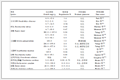
我们从黄土高原西部地区的永登、 永靖、 皋兰、 东乡4个地点采集了13个表土样品,用于分析其TOC含量和δ13 Corg.。具体的采样点分布( 图1)、 经纬度、 海拔高度和所获得的数据,均列于 表1。表土样品的TOC含量(Flash EA 112,元素分析仪)和δ13 Corg. 的分析测试(Finnigan Delta Plus,气体稳定同位素质谱仪),参考了之前的方法[25],分析结果以VPDB为标准; 所有分析测试都在兰州大学西部环境教育部重点实验室完成。
|
表 1 黄土高原西部地区13个表土样品的TOC含量和δ13Corg. 数据* Table 1 TOC and δ13 Corg. data of 13 surface soil samples on the western Chinese Loess Plateau |
与此同时,我们对黄土高原西部地区塬堡、 九州台、 曹岘和大地湾4个典型剖面( 图1b)的一些低分辨率黄土/古土壤样品进行TOC含量和δ13 Corg. 的分析测试。由于仅仅是需要考察TOC含量和δ13 Corg. 在不同地层当中的变化特征,因此,在参照前人已发表研究结果的基础上,选取了这些研究剖面的一些典型的地层样品进行分析测试,包括: 临夏塬堡剖面[3](9个样品,YB); 秦安大地湾剖面[26](10个样品,DDW); 靖远曹岘剖面[26](10个样品,CX); 兰州九州台剖面[3, 27, 28](19个样品,JZT)。这4个剖面相应的样品信息和数据,均列于 表2。黄土、 古土壤样品的TOC含量(Flash EA 112,元素分析仪)和δ13 Corg. 的分析测试(Finnigan Delta Plus,气体稳定同位素质谱仪),参考了之前的方法[25]; 所有分析测试都在兰州大学西部环境教育部重点实验室完成。
|
|
表 2 黄土高原西部地区4个典型剖面黄土/古土壤样品的TOC含量和δ13Corg.数据 Table 2 TOC and δ13 Corg. data of loess/paleosol samples from 4 typical profiles in the western Chinese Loess Plateau |
为了更好的对比和说明问题,我们还收集了已发表的西北内陆粉尘源区11个母岩样品的TOC含量和δ13 Corg. 数据( 表3),采样点主要分布在新疆和青海境内[21],如 图1c所示;同时,我们还收集了已发表的,位于黄土高原西部地区范围内的一些表土样品当中的植物残体δ13 Corg. 数据( 表3),包括已报道的来自西峰大寨子、 西宁和乐都表层土壤和5cm深度上的6个植物残体δ13 Corg. 数据[29],以及已报道的来自西宁地区的4个表土样品当中植物残体δ13 Corg. 数据[21],其位置如 图1b所示。
|
|
表 3 粉尘源区11个母岩样品的TOC含量和δ13 Corg. 数据以及来自黄土高原西部地区10个表土中植物残体δ13 Corg. 数据 Table 3 TOC and δ13 Corg. data of 11 rock samples from mountain area near the Chinese Loess Plateau, and 10 δ13 Corg.data of plant litter samples in surface soils on the western Chinese Loess Plateau |
来自粉尘源区的11个母岩样品,其TOC含量分布在0.03 % 至0.25 % 之间,均值为0.11 % ,相应的δ13 Corg. 数据分布在-23.5 ‰ 至-19.4 ‰ 之间,均值为-21.2 ‰ ; 来自黄土高原西部地区13个表土样品的TOC含量分布在0.10 % 至3.29 % 之间,均值为1.43 % ,相应的δ13 Corg. 数据分布在-29.0 ‰ 至-22.7 ‰ 之间,均值为-24.6 ‰ ; 来自黄土高原西部地区10个表层土壤当中植物残体δ13 Corg. 数据则分布在-26.5 ‰ 至-23.6 ‰ 之间,均值为-24.9 ‰ ( 图2)。可见,该地区表土当中植物残体δ13 Corg. 数据分布范围完全落入表土δ13 Corg. 数据分布范围之内,两者的均值也非常接近。总体而言,植物残体的δ13 Corg. 均值稍微偏负于表土总有机质。而表土TOC含量远大于粉尘源区的母岩,平均而言,高了一个数量级; 并且表土有机质δ13 Corg. 相对于粉尘源区的母岩,明显要偏负得多,整体平均而言,要偏负3.4 ‰ 。这意味着粉尘母质在沉降之后,又接收了大量的δ13 Corg. 较为偏负的有机质输入。

|
图 2 TOC含量(a)和δ13 Corg.(b)数据在粉尘源区母岩、 黄土高原西部地区表层土壤、 黄土高原西部地区黄土/古土壤当中的总体变化特征 竖直虚线标示分布范围, 实心方块标示均值; 为便于对比, 黄土高原西部地区表层土壤当中植物残体碳同位素也显示在图中 Fig.2 The variations of TOC (a) and δ13 Corg. (b)data in different sample types from rock samples in dust source regions to surface soil samples in western Chinese Loess Plateau, and then to loess/paleosol samples in western Chinese Loess Plateau. Vertical dashed line represent the data range with horizontal solid black bar represent the average value; for comparison, δ13 Corg. data of plat litter samples in surface soils in western Chinese Loess Plateau also shown |
相应的来自塬堡(YB)剖面的9个黄土/古土壤样品,其TOC含量分布在0.10 % 至1.09 % 之间,均值为0.35 % ; 来自大地湾(DDW)剖面的10个黄土/古土壤样品,其TOC含量分布在0.05 % 至0.31 % 之间,均值为0.19 % ; 来自曹岘(CX)剖面的10个黄土/古土壤样品,其TOC含量分布在0.07 % 至0.16 % 之间,均值为0.11 % ; 来自九州台(JZT)剖面的19个黄土/古土壤样品,其TOC含量分布在0.05 % 至0.94 % 之间,均值为0.24 % ( 图2a)。整体而言,这些黄土/古土壤地层样品的TOC含量要远低于黄土高原西部地区表层土壤,从数值来看,比较接近于粉尘源区的母岩样品,其TOC含量仅比粉尘源区母岩样品稍微高一些。我们认为这可能表明了原始沉积时的有机质(类似于现代表土),在漫长的地质过程当中发生了强烈的分解降解作用,导致了显著的质量损失。其中塬堡剖面和九州台剖面黄土/古土壤样品的TOC含量均值明显要比曹岘剖面和大地湾剖面的相应数值更高(平均高约2~3倍),这显然与塬堡剖面和九州台剖面样品中有较多古土壤样品(全新世古土壤S0和末次间冰期古土壤S1),而曹岘和大地湾剖面的样品主要来自末次冰期的马兰黄土L1有关( 表2)。综合上述分析来看,粉尘母质在黄土高原西部地区沉降之后,首先接收了大量的δ13 Corg. 较为偏负的有机质的输入,然后在埋藏之后的过程当中,这些有机质发生了强烈的降解作用,导致了明显的质量损失。
来自塬堡剖面的9个黄土/古土壤样品,其δ13 Corg. 数据分布在-20.5 ‰ 至-23.6 ‰ 之间,均值为-22.2 ‰ ; 来自大地湾剖面的10个黄土/古土壤样品,其δ13 Corg. 数据分布在-22.2 ‰ 至-24.2 ‰ 之间,均值为-23.1 ‰ ; 来自曹岘剖面的10个黄土/古土壤样品,其δ13 Corg. 数据分布在-21.3 ‰ 至-24.7 ‰ 之间,均值为-23.1 ‰ ; 来自九州台剖面的19个黄土/古土壤样品,其δ13 Corg. 数据在-21.8 ‰ 至-25.4 ‰ 之间,均值为-23.9 ‰ ( 图2b)。明显地,整体而言,这些黄土/古土壤样品的δ13 Corg. 比粉尘源区的母岩样品要更为偏负,平均而言,偏负幅度为1.0 ‰ 至1.8 ‰ ; 而相对于黄土高原地区表层土壤以及其中的植物残体而言,这些黄土/古土壤样品的δ13 Corg. 数据则要更加偏正,平均而言,偏正幅度为1.0 ‰ 至2.7 ‰ ( 图2)。假定以现代表土以及表土当中植物残体δ13 Corg. 数据代替黄土/古土壤样品初始沉积时的平均状态(所有13个表土和10个表土当中植物残体的δ13 Corg. 均值为-24.8 ‰ ),而以黄土/古土壤样品的均值代表地层当中经过强烈降解后的平均状态(所有48个黄土/古土壤样品的δ13 Corg. 均值为-23.3 ‰ ),地层样品相对于表层样品要偏正1.5 ‰ 。这意味着粉尘母质在黄土高原西部地区沉降之后,首先接收了大量δ13 Corg. 较为偏负的有机质的输入,这些有机质在埋藏之后,发生了较为明显的降解作用,在此过程中,δ13 Corg. 发生了一定程度的偏正变化,其变化的平均幅度约在1.5 ‰ 左右。
国际上早期报道的研究结果表明[30],土壤有机质的δ13 Corg. 变化主要发生在有机质降解的早期阶段,为一种偏正的变化,变化幅度也与我们获得平均结果较为接近。最近对中国北方3个研究地点(分别位于青藏高原东北部和北京附近的东灵山)的14个土壤剖面以及之上的植物进行了详细的研究,发现表层土壤相对于植物的δ13 Corg. 偏正约为1.8 ‰ ,而剖面底部的样品相对于植物的δ13 Corg. 偏正则约为2.8 ‰ [31]。由于这些剖面的深度范围比较小(最大不超过1.4m),若其中的有机质的确主要来自其上的陆生植物,可见随着深度的增加,其有机质δ13 Corg. 具有较为明显的偏正趋势,偏正的幅度(剖面底部样品相对于表层样品,偏正约1 ‰ )也与我们分析的结果较为接近。
我们进一步从TOC含量和δ13 Corg. 两个方面尝试进行定量的估算。假定黄土高原西部地区表层土壤当中的有机质仅仅来源于粉尘母质和局地植被两个方面,我们以0.11 % 代表粉尘母质的平均TOC含量(见 表2和3),而该区域现代表土的平均TOC含量为1.43 % ( 图2a中母岩和表土样品的TOC含量平均值,见 表1),假设来自植物残体的有机质质量可以忽略不计,则以0.11 % 除以1.43 % ,获得来自粉尘母质的相对有机质输入占整个有机质输入的比例约为7.69 % ,不超过8 % 。如果考虑来自植物残体的有机质输入的质量,则可以假设每100个单位质量的粉尘母质当中,来自植物残体的有机质输入质量为a,其TOC含量为100 % ,则可以获得相应的方程:
(0.11+a)/(100+a)=1.43 %
求解上述方程,获得的a约为1.33915单位,则来自粉尘母质的相对有机质输入比值应当约为7.59 % (0.11/(0.11+a))。
借鉴前人研究当中的两端元法[24],我们还从δ13 Corg. 的角度进行定量的估算,以平均值-21.2 ‰ 代表来自粉尘母质的有机质平均δ13 Corg. 值( 图1),来自粉尘母质的有机质质量为a; 以平均值-24.9 ‰ 代表表土样品当中植物残体的平均δ13 Corg. 值( 图1),来自植物残体的有机质质量为b, 而获得的表土平均有机质δ13 Corg. 值为-24.6 ‰ (见 表1),则可获得相应的方程:
a(-21.2)+b(-24.9)=(a+b)(-24.6)
求解上述方程,可得b=(3.4/0.3)a, 进一步可以计算得到来自粉尘母质的相对有机质输入量约为8 % 。可见上述两种估算方法得到的定量估算结果是比较一致的,总体而言,来自粉尘母质的有机质的相对贡献量应当不超过8 % ,而其造成的同位素影响应当在1.7 ‰ 左右(-21.2 ‰ ×0.08; 亦即: 粉尘母质平均δ13 Corg. 值×其相对贡献量)。
除了从粉尘源区母岩到黄土高原西部地区表土的变化,黄土高原西部地区TOC含量和δ13 Corg. 随地层序列的变化也能部分的说明其主要的有机质来源。这是由于如果该地区黄土地层的有机质主要来自粉尘源区的母岩,而来自局地植被的有机质输入是极少量的,那么这种来源于粉尘母质的TOC含量和δ13 Corg. 就应当随着地层序列没有显著的规律性特征。然而,事实恰恰与此相反。来自塬堡、 大地湾和曹岘剖面的TOC含量数据表明( 图3),相对而言,全新世古土壤S0的TOC含量要比末次冰期沉积的马兰黄土L1高很多(YB,见 图3)。

|
图 3 塬堡(YB)、 大地湾(DDW)、 曹岘(CX)剖面TOC含量和δ13 Corg. 数据随地层的变化特征 Fig.3 Variations of TOC and δ13 Corg. data along loess/paleosol sequences of Yuanbao (YB), Dadiwan (DDW) and Caoxian (CX) profiles |
对于末次冰期沉积的马兰黄土内部而言,TOC含量在末次间冰段(深海氧同位素3阶段(MIS 3)对应的地层为L1S1)弱发育古土壤当中,相对于早、 晚冰段(对应于深海氧同位素4和2阶段(MIS 4和MIS 2),对应的地层为L1L2和L1L1)要更高一些,这一特征在塬堡剖面、 曹岘剖面和大地湾剖面当中都是如此(见 图3)。而对于δ13 Corg. 而言,全新世古土壤S0的δ13 Corg. 相对于末次冰期期间沉积的马兰黄土L1而言,整体要更加偏正(YB,见 图3)。而在末次冰期沉积的马兰黄土内部,L1S1的δ13 Corg. 相对于L1L2和L1L1则要更为偏负一些(见 图3,尽管曹岘剖面L1L1当中存在个别较为偏负的数据,但是整体平均而言,其仍然要比L1S1的δ13 Corg. 值更偏正)。全新世古土壤的δ13 Corg. 值相对于末次冰期黄土更加偏正,这与先前报道的黄土高原东部地区多个剖面的研究结果是一致的[23,24,32~34],但是MIS 3阶段弱发育古土壤的δ13 Corg. 值相对于MIS 2和MIS 4阶段的黄土更加偏负,则似乎是黄土高原西部地区的特色,这与黄土高原东部地区的研究结果[34]恰恰是相反的。在我们先前的研究工作当中,我们讨论过这种现象的原因,这是因为黄土高原西部地区末次冰期期间的植被主要以C3植物占绝对优势地位或者可以视为纯C3植物,之所以在MIS 3阶段L1S1当中δ13 Corg. 值更为偏负,这是由于它记录的不是C3/C4植物相对丰度的变化,而是纯C3植物碳同位素对降水量变化的响应[7, 10, 11]。
4 结论对黄土高原西部地区新获得的一些表土和低分辨率黄土/古土壤地层样品进行了TOC含量和δ13 Corg. 的分析测试,结合之前已经报道的一些相关数据,我们对黄土高原西部地区黄土地层当中有机质的主要来源进行了综合的分析。首先,无论TOC含量还是δ13 Corg. 数据,在黄土高原西部地区的多个黄土/古土壤剖面当中表现出了一致的随地层的变化特征,这一特征说明该地区黄土地层当中的有机质应当不是主要来源于粉尘源区的母岩,而应当是当地植被的输入; 其次,从不同类型样品(主要是母岩样品,表土样品和表土当中的植物残体样品)的TOC含量和δ13 Corg. 数据两个方面入手,我们尝试进行的定量估算结果表明,现有条件下,对黄土高原西部地区而言,来源于粉尘母质的有机质相对输入量应当不超过8 % ,其所造成的同位素偏正变化幅度应当不超过1.7 ‰ 。所有这些结果说明,黄土高原西部地区,黄土地层的有机质主要来源于当地的植被,而非粉尘源区的母岩。所以,在该地区利用黄土有机质δ13 Corg. 重建过去C3/C4相对丰度及相应的古气候变化是可行的。
尽管我们的工作,能初步的说明黄土高原西部地区的黄土地层的有机质主要不是来源于粉尘母质,在以后的工作当中,有两个方面的影响仍然值得关注和进一步加以研究。其一,如已有研究[20]所指出的那样,微生物活动的影响,包括微生物活动对来源于当地植被的有机质的改造以及微生物本身向土壤输入的有机质的影响,这是我们暂时没有涉及和考虑的问题,以后值得加以关注; 其二,我们用来进行对比的是粉尘源区的母岩样品的δ13 Corg. 数据,实际上母岩风化,变成可搬运的粉尘母质,以及粉尘在搬运的过程当中,还可能经历一些与有机质输入输出相关的过程。后续的工作当中,可以加强粉尘样品的收集。在收集足够量的样品之后,测量其TOC含量和δ13 Corg. 数据,最终获得从粉尘源区母岩-粉尘-表土-到地层样品的完整对比序列,从而更精确的评估粉尘母质有机质输入对黄土高原西部地区黄土地层有机质δ13 Corg. 的影响。
致谢 野外工作得到了马剑英、 钟艳霞和孙惠玲的协助; 张平宇在样品前处理和仪器测试过程中给予了大力协助,特此致谢。
| 1 | 刘东生等. 黄土与环境. 北京: 科学出版社, 1985.1~412 Liu Tungsheng et al. Loess and Environmental. Beijing:Science Press, 1985. 1~412 |
| 2 | 陈发虎, 张维信. 甘青地区的黄土地层学与第四纪冰川问题. 北京: 科学出版社, 1993. 1~50 Chen Fahu, Zhang Weixin. Loess Stratigraphy and Quaternary Glaciation in Gansu-Qinghai Region. Beijing:Science Press, 1993. 1~50 |
| 3 | Chen F H, Bloemendal J M, Wand J M et al. High resolution multi-proxy climate records from Chinese Loess Plateau:Evidence for rapid climatic changes over the last 75 kyr. Paleogeography, Paleoclimatology, Paleoecology, 1997, 130 (1):323~335 |
| 4 | Ding Z L, Ren J Z, Yang S L et al. Climate instability during the penultimate glaciations:Evidence from two high-resolution loess records, China. Journal of Geophysical Research, 1999, 104 (B9):20123~20132 |
| 5 | Sun Y B, Clemens S C, Morrill C et al. Influence of Atlantic meridional overturning circulation on the East Asian winter monsoon. Nature Geoscience, 2012, 5 (1):46~49 |
| 6 | Sun Y B, Wang X L, Liu Q S et al. Impacts of post-depositional processes on rapid monsoon signals recorded by the last glacial loess deposits of Northern China. Earth and Planetary Science Letters, 2010, 289 (1):171~179 |
| 7 | Rao Z G, Chen F H, Cheng H et al. High-resolution summer precipitation variations in the western Chinese Loess Plateau during the last glacial. Scientific Reports, 2013, 3 :doi:10.1038/srep02785 |
| 8 | 刘现彬, 夏敦胜, 贾佳等.兰州九州台黄土磁性特征及其古气候意义研究. 第四纪研究, 2012, 32 (4): 761~770 Liu Xianbin, Xia Dunsheng, Jia Jia et al. Magnetic properties of Jiuzhoutai loess in Lanzhou and its significance of palaeoclimate. Quaternary Sciences, 2012, 32 (4): 761~770 |
| 9 | 梁莲姬,孙有斌,ChristiaanJB等.黄土中的碳酸盐矿物特征与化学风化.第四纪研究,2014,34(3):345-653 LiangLianji,SunYoubin,ChristiaanJBetal.Characteristicsof carbonate minerals in loess and its implication for chemical weathering.QuaternarySciences,2014,34(3):345-653 |
| 10 | 饶志国,陈发虎,曹 洁等.黄土高原西部地区末次冰期和全新世有机碳同位素变化与C3/C4植被类型转换研究.第四纪研究,2005,25(1):107-114 Rao Zhiguo,Chen Fahu,Cao Jieetal.Variation of soil organic carbonisotopeandC3/C4 vegetation type transition in the western LoessPlateau during the Last Glacialand Holocene periods.Quaternary Sciences,2005,25(1):107-114 |
| 11 | 梁莲姬, 孙有斌, Christiaan J B等. 黄土中的碳酸盐矿物特征与化学风化. 第四纪研究, 2014, 34 (3): 345~653 Liang Lianji, Sun Youbin, Christiaan J B et al. Characteristics of carbonate minerals in loess and its implication for chemical weathering. Quaternary Sciences, 2014, 34 (3): 345~653 |
| 12 |
饶志国, 陈发虎, 曹洁等. 黄土高原西部地区末次冰期和全新世有机碳同位素变化与C3/C4 植被类型转换研究. 第四纪研究, 2005, 25 (1):107~114 Rao Zhiguo, Chen Fahu, Cao Jie et al. Variation of soil organic carbon isotope and C3/C4 vegetation type transition in the western Loess Plateau during the Last Glacial and Holocene periods. Quaternary Sciences, 2005, 25 (1):107~114 |
| 13 | Chen Fahu, Rao Zhiguo, Zhang Jiawu et al. Variations of organic carbon isotopic composition and its environmental significance during the Last Glacial on western Chinese Loess Plateau. Chinese Science Bulletin, 2006, 51 (13):1593~1602 |
| 14 |
何勇, 秦大河, 任贾文等. 临夏塬堡全新世黄土剖面古土壤有机质碳同位素的气候记录. 冰川冻土, 2002, 24 (5):512~516 He Yong, Qin Dahe, Ren Jiawen et al. The climatic record of organic matter in the paleosol from the Yuanbao Holocene profile. Journal of Glaciology and Geocryology, 2002, 24 (5):512~516 |
| 15 |
何 勇, 秦大河, 任贾文等. 塬堡黄土剖面末次间冰期古土壤有机质碳同位素记录的夏季风演化历史. 科学通报, 2002, 47 (12):943~945 He Yong, Qin Dahe, Ren Jiawen et al. The summer monsoon evolution recorded by carbon isotope of organic matter from the Yuanbao loess section during the Last Interglaciation. Chinese Science Bulletin, 2002, 47 (15):1289~1291 |
| 16 |
杨桂芳, 彭红霞, 黄长生等. 黄土高原西缘末次盛冰期以来古气候演化的有机碳同位素记录. 华中师范大学学报(自然科学版), 2005, 39 (1):126~130 Yang Guifang, Peng Hongxia, Huang Changsheng et al. Paleoclimatic evolution deduced from organic carbon isotope of western Loess Plateau sediments since Last Glacial Maximum. Journal of Central China Normal University(Natural Science Edition), 2005, 39 (1):126~130 |
| 17 | An Z S, Stephen C P, Zhou W J et al. Episode of strengthened summer monsoon climate of Younger Dryas age on the Loess Plateau of Central China. Quaternary Research, 1993, 39 (1):45~54 |
| 18 | Liu W G, Yang H, Sun Y B et al.δ 13 C values of loess total carbonate:A sensitive proxy for Asian summer monsoon in arid northwestern margin of the Chinese Loess Plateau. Chemical Geology, 2011, 284 (3):317~322 |
| 19 |
张晓, 贾鑫, 饶志国等. 陇西黄土高原东南部地区末次冰期以来C3/C4植物相对丰度变化及其区域性剖面的对比研究. 第四纪研究, 2013, 33 (1):187~196 Zhang Xiao, Jia Xin, Rao Zhiguo et al. C3/C4 variation since the last glacial in the southeastern Longxi Loess Plateau and its comparison with other results. Quaternary Sciences, 2013, 33 (1):187~196 |
| 20 |
饶志国, 张晓, 薛骞等. 西峰红粘土/黄土剖面有机碳同位素研究的初步结果. 第四纪研究, 2012, 32 (4):825~827 Rao Zhiguo, Zhang Xiao, Xue Qian et al. Primary organic carbon isotopic study result of Xifeng loess/red clay profile. Quaternary Sciences, 2012, 32 (4):825~827 |
| 21 |
赵得爱, 吴海斌, 吴建育等. 过去典型增温期黄土高原东西部C3/C4植物组成变化特征. 第四纪研究, 2013, 33 (5):848~855 Zhao De'ai, Wu Haibin, Wu Jianyu et al. C3/C4 plants characteristics of the eastern and western parts of the Chinese Loess Plateau during Mid-Holocene and last interglacial. Quaternary Sciences, 2013, 33 (5):848~855 |
| 22 | Xie S C, Guo J Q, Huang J H et al. Restricted utility of δ 13 C of bulk organic matter as a record of paleovegetation in some loess-paleosol sequences in the Chinese Loess Plateau. Quaternary Research, 2004, 62 (1):86~93 |
| 23 | Liu W G, Yang H, Ning Y F et al. Contribution of inherent organic carbon to the bulk δ 13 C signal in loess deposits from the arid western Chinese Loess Plateau. Organic Geochemistry, 2007, 38 (9):1571~1579 |
| 24 | Rao Z G, Zhu Z Y, Chen F H et al. Does δ 13 Ccarb of the Chinese loess indicate past C3/C4 abundance?A review of research on stable carbon isotopes of the Chinese loess. Quaternary Science Reviews, 2006, 25 (17):2251~2257 |
| 25 | Liu W G, Huang Y S, An Z S et al. Summer monsoon intensity controls C4/C3 plants abundance during the last 35ka in the Chinese Loess Plateau:Carbon isotope evidence from bulk organic matter and individual leaf waxes. Palaeogeography, Palaeoclimatology, Palaeoecology, 2005, 220 (3):243~254 |
| 26 |
顾兆炎, 刘强, 许冰等. 气候变化对黄土高原末次盛冰期以来的C4/C3植物相对丰度的控制. 科学通报, 2003, 48 (13):1458~1464 Gu Zhaoyan, Liu Qiang, Xu Bing et al. Climate as the dominant control on C3 and C4 plant abundance in the Loess Plateau:Organic carbon isotope evidence from the last glacial-interglacial loess-soil sequences. Chinese Science Bulletin, 2003, 48 (12):1271~1276 |
| 27 |
饶志国, 贾国东, 朱照宇等. 中国东部表土总有机质碳同位素和长链正构烷烃碳同位素对比研究及其意义. 科学通报, 2008, 53 (17):2077~2084 Rao Zhiguo, Jia Guodong, Zhu Zhaoyu et al. Comparison of the carbon isotope composition of total organic carbon and long-chain n-alkanes from surface soils in Eastern China and their significance. Chinese Science Bulletin, 2008, 53 (24):3921~3927 |
| 28 | 钟艳霞. 末次冰期以来黄土高原西部地区环境变化的黄土有机地球化学记录研究. 兰州: 兰州大学博士学位论文, 2008. 25~33 Zhong Yanxia. A Study on Palaeoenvironmental Changes Recorded by Organic Geochemistry Proxies of Loess in the Western Loess Plateau since the Last-glacial. Lanzhou:The Dissertation for the Doctoral Degree of Lanzhou University, 2008.25~33 |
| 29 | Chen F H, Li J J, Zhang W X. Loess stratigraphy of the Lanzhou profile and its comparison with deep-sea sediment and ice core record. GeoJournal, 1991, 24 (2):201~209 |
| 30 |
陈发虎, 张宇田, 张维信等. 兰州九洲台黄土沉积年代的综合研究. 沉积学报, 1989, 7 (3):105~112 Chen Fahu, Zhang Yutian, Zhang Weixin et al. The comprehensive study on depositional age of Jiuzhoutai loess, Lanzhou. Acta Sedimentologica Sinica, 1989, 7 (3):105~112 |
| 31 |
魏明建, 董军社, 张静等. 黄土高原现代表层黄土植物残体稳定同位素组成特征. 现代地质, 1998, 12 (14):582~585 Wei Mingjian, Dong Junshe, Zhang Jing et al. Isotope composition characteristics of vegetation residues in modern loess deposition on the Loess Plateau in China. Geoscience, 1998, 12 (14):582~585 |
| 32 | Melillo J M, Aber J D, Linkins A E. Carbon and nitrogen dynamics along the decay continuum:Plant litter to soil organic matter. Plant and Soil, 1989, 115 :189~198 |
| 33 | Wang G, Feng X, Han J et al. Paleovegetation reconstruction using δ 13 C of soil organic matter. Biogeosciences, 2008, 5 (2):1325~1337 |
| 34 | Zhang Z H, Zhao M X, Lu H Y et al. Lower temperature as the main cause of C4 plant declines during the glacial periods on the Chinese Loess Plateau. Earth and Planetary Science Letters, 2003, 214 (3):467~481 |
| 35 | Vidic N J, Montañez I P. Climatically driven glacial-interglacial variations in C3 and C4 plant proportions on the Chinese Loess Plateau. Geology, 2004, 32 (4):337~340 |
| 36 |
刘卫国, 宁有丰, 安芷生等. 黄土高原现代土壤和古土壤有机碳同位素对植被的响应. 中国科学(D辑), 2002, 32 (10):830~836 Liu Weiguo, Ning Youfeng, An Zhisheng et al. Modern soil and paleosol organic carbon isotope response to vegetation of Chinese Loess Plateau. Science in China(Series D), 2005, 48 (1):93~99 |

Abstract
Stable isotopic compositions of total organic carbon(δ 13 Corg.), as a paleovegetation and paleoclimate indicator, have shown great potential in Chinese loess/paleosol sequences, especially in the western Chinese Loess Plateau(WCLP, west to Liupan Mounts.), due to the high resolution signal resulted from high accumulation rate of loess in this area. Until now, δ 13 Corg. has been applied in several loess/paleosol sequences in WCLP for paleoclimate reconstructions. At the same time, the primary provenance of the organic matter in the loess/paleosol sequences in WCLP has been concerned, because of the wind-borne nature of the Chinese loess which may result in the input of allothogenic organic matter to the loess/paleosol sequences in WCLP. If the organic matter in the loess/paleosol sequences in WCLP was mainly derived from the bedrocks in dust source areas of loess, then the loess δ 13 Corg. in WCLP is not a good indicator of paleovegetation and paleoclimate apparently.
In this paper, TOC concentrations and δ 13 Corg. data of 13 surface soil samples distributed in WCLP and 48 low resolution loess/paleosol samples from 4 typical loess profiles in WCLP have been measured, combining with previously reported TOC concentrations and δ 13 Corg. data from 11 bedrock samples from dust source regions and δ 13 Corg. data of 10 plant litter samples in surface soils from the WCLP, for the assessment on the primary provenance of organic matter in loess/paleosol sequences in WCLP. Our results indicate that, in WCLP, average TOC concentration of surface soils is much higher than that of the rock samples in dust source regions, and average δ 13 Corg. of surface soils is close to that of the plant litters in the surface soils in WCLP, and both of them are much more negative than average δ 13 Corg. of rock samples in dust source regions. That means, after the deposition, the dust in WCLP received a significant amount of organic matter with negative carbon isotopes. Relatively and averagely, the TOC concentration of loess/paleosol samples in WCLP is much lower than that of surface soils in WCLP, and the δ 13 Corg. of loess/paleosol samples in WCLP is much more positive than that of surface soils in WCLP. That means, during the burial process, the organic matter in loess of WCLP undergone significant decomposition accompany with the δ 13 Corg. became more positive. Our quantitative estimation indicated that the contribution of organic matter from rock samples in dust source regions to the surface soils in WCLP is less than 8 % (or 7 .69 %). At the same time, both TOC concentrations and δ 13 Corg. data from the low resolution loess/paleosol samples of the typical loess profiles in WCLP showed consistently regular variations along loess/paleosol layers. Concretely speaking, the TOC concentrations were relatively higher in paleosol layers developed during the Holocene(S0)and the last glacial interstadial(L1S1). The δ 13 Corg. were more positive in the Holocene paleosol layer relative to the last glacial loess layer. During the last glacial, the δ 13 Corg. were more negative in the paleosol layer developed during the last glacial interstadial relative to loess layers accumulated during the early and later last glacial(L1L2 and L1L1). Altogether, our results demonstrate that organic matter in loess/paleosol sequences in WCLP was derived from local vegetation mainly, rather than bedrocks in dust source regions. Therefore, our results provided fundamental evidence for the validity of stable carbon isotopic composition of organic matter in loess/paleosol sequences in WCLP as proxy for paleovegetation and paleoclimate reconstruction.