 2015, Vol.35


1 引言
由于C3和C4植物光合作用路径不同,所以这两种植物的碳同位素组成有比较大的差异,C3植物为-32 ‰ 至-20 ‰ ,以-27 ‰ 附近出现的频率最高,C4植物为-15 ‰ 至-9 ‰ ,以-13 ‰ 附近出现的频率最高[1, 2, 3]。由于土壤的有机质主要来自陆地植物,这样利用土壤的稳定碳同位素组成(13 C/12 C比值)可以估算出其上生长的C4/C3植物的比例。为了理解不同地区C4/C3植物的比例与相应影响因素间的关系,许多学者对全球不同地区现代C4与C3植物分布进行了探究[4, 5, 6, 7, 8, 9, 10],这些关于现代植物分布的研究表明,C4、 C3植物的分布受气候、 环境等多种因素的影响。例如,早期的研究发现,在北美地区,禾本科植物在高温度区域有较高的增长、 双子叶植物在高干旱度区域有较高增长、 莎草科植物在7月日均温值较低区域有较高增长[4]。对纳米比亚的草本植物的研究结果表明,NADP-ME型C4植物生长于降水较多区域,而NAD-ME型C4植物则在最干旱的区域比较丰富[5]。在美国德克萨斯州进行的实验发现温度和大气CO2浓度主导了C4/C3植物比值,且C4植物的总量和年均温及年平均降水呈正相关[6, 7]。在气候较温和的东亚草原(蒙古高原),C4/C3植物比值与7月风速正相关,与6月降水负相关[8],与纬度负相关[9]。对贡嘎山东坡C4植物分布的初步调查结果显示,C4植物主要分布在2100m以下的低海拔地区,并认为过低的夏季温度是限制C4植物在高海拔地区分布的主要原因[10]。
黄土高原位于中国西北地区,气候方面受东亚季风控制[11, 12]。黄土高原上的黄土-古土壤序列提供了最近22Ma来完整的陆地环境古气候与古植被的记录[13, 14]。在以往对黄土高原的研究中,学者提出了多种古环境指标,包括磁化率和石英颗粒的粒径变化等[12,15~20]。我们特别感兴趣的是黄土高原地区C4/C3植物丰度比值和东亚季风控制的气候间的关系[21, 22, 23, 24, 25, 26]。调查现代黄土高原上C4/C3植物丰度比值所代表的物种组成和分布,能让我们更好解释黄土高原地区植被与气候之间相互作用的方式。
本研究的内容有两方面,一是根据野外实地考察得到的黄土高原植被状况,来研究黄土高原上主要的C4和C3植物种类及其分布特点; 二是讨论C4植物所占比例和相应气候参数间的关系,如年平均降水、 季节性降水和年平均温度。
2 区域概况、 数据收集与研究方法 2.1 研究区域概况研究区域位于干旱的黄土高原地区,主要受到东亚季风控制,年平均降水量在200~700mm,降水主要集中在夏季7月和8月,冬季干冷少雨。年平均气温在6.9~13.2℃,最高温出现在7月,约为22~28℃。
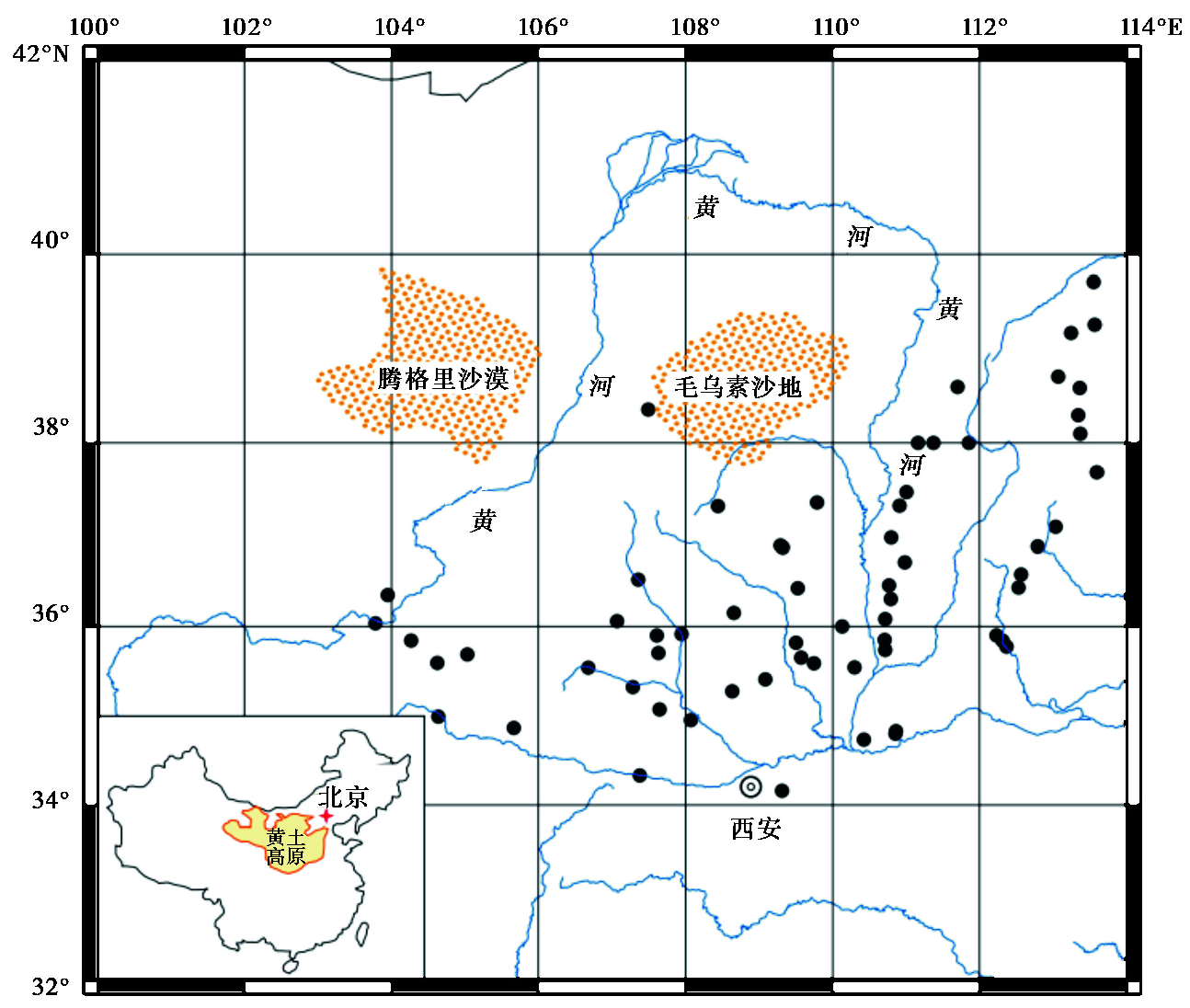
2.2 野外考察和样品采集植物与土壤样品是在黄土高原上大体沿着降水梯度线(700~300mm)采集到的,分别位于陕西省、 甘肃省和山西省境内,其中植物样品104份,土壤样品30份(图1)。黄土高原的植被现状很大程度上受到了人类的影响,但依然有一部分自然草原存在,这些自然草原多数分布在黄土台塬边的沟壑坡顶上。我们的采样点主要集中于黄土高原上的自然生态环境,以期尽量减小人类活动的干扰。
|
图 1 采样点位置图 Fig.1 The sampling sites |
本研究所采集的植物样品包括了这一区域内所生长的主要植物种类。为了对C4/C3植物比值变化进行初步估计,我们在每一采样点选定1~2个4~8m2的样方。收集样方中的所有植物、 分类并称量植物,获取每一采样点C4植物/(C3植物+C4植物)的湿重比(通过测量植物体的碳同位素组成来确定是C3植物还是C4植物),对有两个样方的研究点,我们取两样方比值的平均值。本文的研究总共包含67处采样点。各采样点数据见 表1。
|
表 1 采样点位置及C4植物比例 Table 1 Locations of sampling sites and C4 biomass |
为了研究现代土壤记录的C4/C3植物比值,我们在这里引用了一部分An等[26]2005年发表的表土碳同位素数据,并利用Ning等[27]提出的方法对土壤有机碳同位素值进行处理以减少降水的影响来获得更准确的C4/C3植物比。降水和温度数据从陕西省、 甘肃省和山西省气象局得到。
2.3 实验室碳同位素分析对采集的表层土壤,用粒径大于200μm的土壤样品(多来自表层植被)来测定碳同位素组成,因为这一部分受到老土壤有机质的影响很小[28]。1g筛过的土壤样品在室温下用2mol/L 盐酸浸泡24小时以去除其中的无机碳酸盐物质的干扰。再用蒸馏水清洗样品至中性后,在40℃条件下烘干,再在玛瑙研钵中研磨均匀。植物样品用剪刀剪碎,放入研钵中研磨。处理后的样品和银箔与氧化铜一起放入密封的石英管中,在800~850℃温度下加热至少4小时,通过液氮将CO2分离纯化后进行碳同位素分析。
利用有双进气系统的MAT-251气相质谱进行分析,当离子源部分的真空达到6×10⁻⁷ mbar时开始同位素分析。同位素比值表示为相对于PDB标准的千分偏差,精度为0.2 ‰ ,δ 13 C值通过下式计算得到:
δ 13 C=[(13 C/12 C)样品/(13 C/12 C)PDB-1]×1000 ‰
3 结果与讨论 3.1 黄土高原C4和C3植物的组成及同位素特征黄土高原上的自然草原由C4和C3植物组成,丰度随着时间和空间发生改变[29, 30, 31]。研究区域内的C4植物主要属于禾本科,例如白羊草(Bothriochloa ischaemum)等; 很少一部分C4植物来自藜科,例如我们在研究区域发现的猪毛菜(Salsola collina)和虫实(Corispermum hyssopifolium)等。研究区域内主要的C3植物是长芒草(Stipa bungeana)(禾本科)、 胡枝子(Lespedeza davurica)(豆科)、 禾叶嵩草(Kobresia graminifolia)(莎草科)、 百里香(Thymus quinquecostatus)(唇形科)、 金翼黄芪(Astragalus chrysopterus)(豆科)、 狗娃花(Heteropappus less)(菊科)。
对黄土高原上的植被来说,我们所采集的86株C3植物样品的δ 13 C值在-31 . 3 ‰ 到-23 . 5 ‰ 间变化(幅度为7 . 8 ‰ ),而18株C4植物样品的δ 13 C值在-14 . 4 ‰ 到-11 . 6 ‰ 间变化(幅度为2 . 8 ‰ ),C3、 C4植物样品的δ 13 C均值分别为-27 . 04 ‰ 和-12 . 99 ‰ 。 总体上,黄土高原上C3、 C4植物的平均δ 13 C值与全球C3、 C4植物碳同位素组成是一致的[1]。
3.2 黄土高原主要C4和C3植被分布情况白羊草是一种暖季型多年生丛生禾草,已有研究表明它是黄土高原上最主要的C4植物[32]。尽管C4植物具有耐旱性,但白羊草生长需要较多的暖季降水(年降水量在375~1000mm)。实地观察黄土高原的地上生物量表明,沿着降水和温度的变化梯度,白羊草的丰度和年平均降水呈正相关关系。研究区域内随着年平均降水从380mm变化到673mm,白羊草的丰度逐渐由10 % 增长到65 % 。研究区域内其他种类的C4植物较少,已有研究表明[8, 9],藜科植物(例如黄土高原上的C4植物猪毛菜和虫实)在降水量为150~200mm的东亚温带草原分布较多。
黄土高原上的C3植物包括草类、 灌木和树。与C4草类相反,C3植物主要分布在阴处(例如坡地和谷地)或干旱地区。随着研究区域的干旱程度由东南向西北加强,生态系统中C3灌木的丰度也逐渐增加。
3.3 利用土壤总有机碳同位素值(δ13 CTOC)反演植被状况气候变化除了引起陆地生态系统C4、 C3植物的相对丰度变化以外,降水量的变化还会改变植物体自身的δ 13 C值[33, 34, 35]。如果直接利用测得的土壤δ 13 CTOC值来反演植被和气候变化过程,则会存在一定的偏差。考虑到这一影响,我们利用Ning等[27]提出的方法,对测得的土壤δ 13 CTOC值进行校正,来计算得出土壤总有机碳同位素所反映的C4植物所占的比例,方法如下:
黄土高原土壤总有机碳的δ 13 C值是由C4、 C3植被决定的,可以表达为:

其中,公式(1)中F是C4植物所占相对比例。
根据前人所做的研究,同种植物的碳同位素组成并不是一成不变的,而是随着降水量的变化而线性变化[34],C4、 C3植物的δ 13 C值随降水变化的关系分别为:


同时,生态系统中C4植物所占相对比例F与年降水量R之间的关系也可以表达为:

将公式(2)、 (3)和(4)代入公式(1),我们可以得出黄土高原土壤总有机碳同位素值(δ 13 CTOC)与年降水量R之间的关系可以表达为:

由公式(5)可得,降水量为:

由于C4植物的相对比例F与年降水量R之间的关系为:
F=1.35×10⁻³×R-0.261,且F的理论取值范围在0~1之间(0≤F≤100 % ),可得,当-24.4 ‰ ≤δ 13 CTOC≤-14.4 ‰ 时可以利用公式(5)和(6)来进行计算,即当δ 13 CTOC≤-24.4 ‰ 时,可以认为生态系统中为纯C3植被; 当δ 13 CTOC≥-14.4 ‰ 时,可以认为生态系统中为纯C4植被[27]。
通过上述关系,我们就可以根据黄土高原土壤总有机碳的δ 13 C值计算相应的年降水量,同时,也可以获得扣除降水变化影响的C4植物的相对比例,而不是简单的用二元模式来估算C4/C3植物相对比例。我们选取了土壤δ 13 CTOC值在上述公式适用范围内的采样点数据来讨论这一指标在反映生态环境方面的意义。
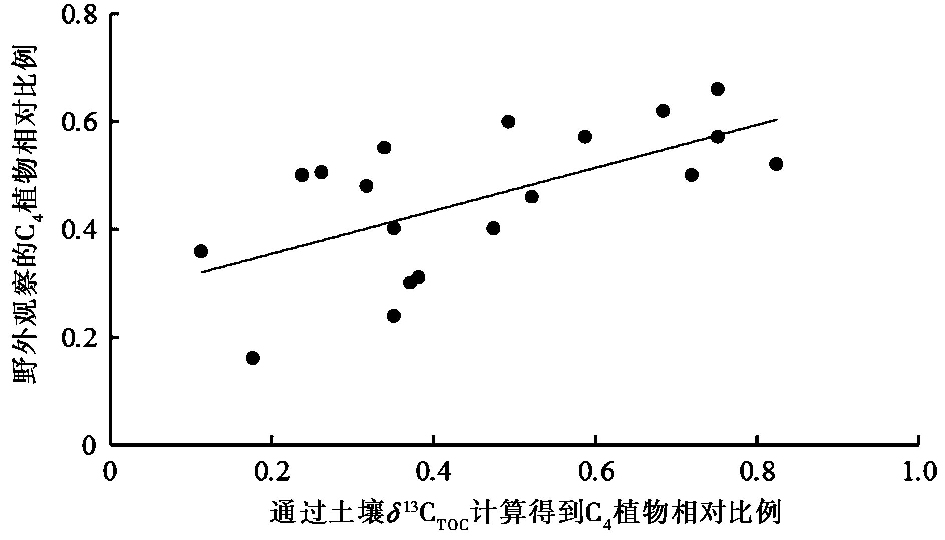
表层土壤的碳同位素组成与C4/C3植物丰度比值变化趋势相似,δ 13 CTOC值偏正时,生态系统中C4植物所占比例大。利用上文提到的方法所估算到的C4植物量与我们从野外样方调查得到的C4植物量结果大体上是一致的( 图2),这证实了土壤δ 13 CTOC在反映C4/C3植被生长情况方面的可靠性。
|
图 2 C4植物相对比例的计算值与观察值的关系(r2=0.39, p < 0.005) Fig.2 Correlation between calculated C4 biomass and observed C4 biomass |
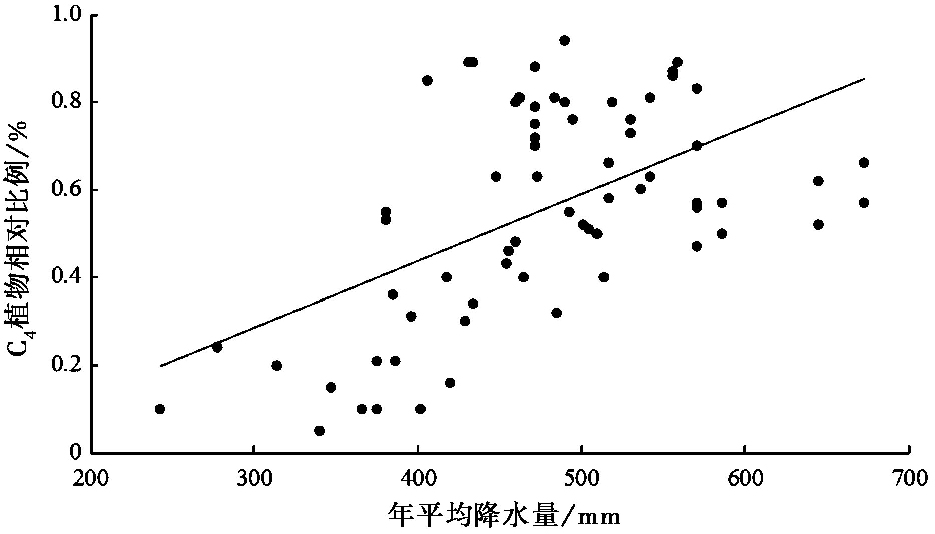
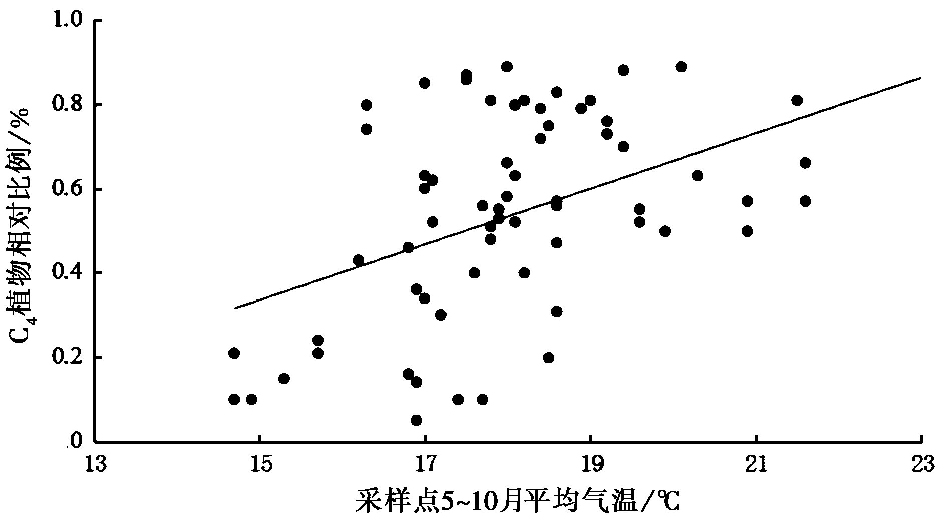
为研究C4植物相对比例与年平均降水量和生长季节温度间的关系,我们将数据进行统计分析,如 图3所示,C4植物相对比例与年平均降水量呈正相关关系; 从 图4可以看出,C4植物相对比例与夏季的月平均气温同样呈正相关关系。这与前人研究的关于增强的东亚夏季风(温度和暖季降水)是黄土高原地区C4植物增加的主要因素这一结果[25, 26, 36, 37]一致。
|
图 3 采样点降水量与C4植物所占比例的关系(共67处点, r2=0.30, p< 0.005) Fig.3 Correlation between annual precipitation and C4 biomass |
|
图 4 采样点5~10月温度与C4植物相对比例的关系(共67处点, r2=0.24, p< 0.005) Fig.4 Correlation between growing season temperature and C4 biomass |
有学者在北美大平原上发现了C4植物生物量与温度和降水有相似的相关关系[38, 39, 40]。夏季的高温更有利于C4植物的生长,且充足的水分可以提高草原上的C4植物生物量[40, 41],因此,夏季降水量的增加会导致C4草类比C3草类有更高的产量。
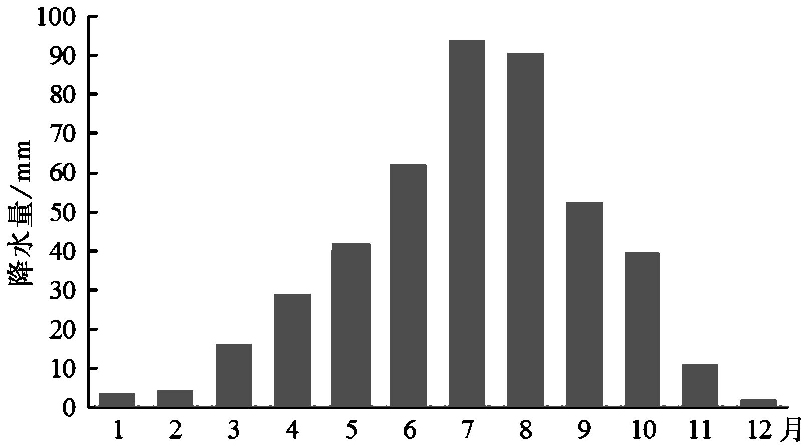
对黄土高原地区来说,冬季时大陆高气压团从西伯利亚产生,带来北方干冷的空气。而夏季时,东亚季风产生自西太平洋,带来更多的降水[42]。黄土高原年平均降水量在200~700mm之间变化,主要集中在7月和8月份( 图5)。C4植物较高的水利用效率使得它们在高温有暖季降水的环境下比C3植物更易生存,因此C4植物生物量从西北向东南逐渐增加。
|
图 5 所有采样点平均每月降水量 Fig.5 Mean monthly precipitation of all sampling sites |
值得注意的是,在不同地区对C4/C3植物生物量与生长环境间关系的研究上,研究人员得出了不尽相同的结论。如在对浑善达克沙地地区研究中发现,C4植物生物量与降水量呈负相关[43],与我们在黄土高原地区得到的结果相反,这表明了黄土高原C4植物的地带性。也说明鉴于生态系统与环境因子间的复杂关系,有关不同地区C4、 C3植物生物量对生长环境的响应还需要更多地区的研究和数据的支持。
在采样过程中我们发现,黄土的土壤质地可能是影响黄土高原C4植物分布的又一因素。细粒、 大孔隙度黄土土壤的积累,使得水很容易通过而难以贮存[44]。因为在黄土高原地区蒸发量很大,且这些地区远高于地下水面,所以总体来说,黄土高原的土壤湿度很低,即便是在年平均降水量在600mm左右的地区情况也是这样。所以我们认为黄土高原C4植物丰度与土壤特性也可能有关系。黄土的质地造成它有较低的可保留水,导致黄土沉积物的土壤湿度较低,由于C4植物在耐旱性和耐热性方面比C3植物有优势,所以在这种环境下C4植物比C3植物更容易生长。北美大平原土壤质地和C4/C3植物类型之间的关系显示,C4草本植物与含砂量正相关,与粘土含量负相关[40]。可见土壤质地和保持土壤水分的能力会影响正在生长的C4和C3植物。
4 结论我们对黄土高原上自然生长的C4和C3植物进行了调查。在我们的研究区域内最主要的C4植物是白羊草(Bothriochloa ischaemum),它适应于暖季降水型的气候,其余的C4植物占的比例较小。通过对比利用土壤总有机碳同位素值计算出来的C4植物生物量和实地观察得到的C4植物生物量,证实了土壤总有机碳同位素组成这一指标在古植被重建中的可靠性。
从我们的结果来看,C4植物相对比例与年平均降水量和5~10月平均气温均呈正相关关系。东亚夏季风在夏季给黄土高原带来了更多的降水,对黄土高原C4植物的时间和空间分布造成了影响,C4/C3植物的分布情况响应这一特点。夏季风在黄土高原东南部比在西北部影响更大,因此C4植物从西北向东南呈现递增的趋势。
致谢 感谢审稿专家和杨美芳编辑对本文提出的建议和修改意见。
| 1 | Deines P. The isotopic composition of reduced organic carbon. In:Fritz P, Fontes J C eds. Handbook of Environmental Isotope Geochemistry(Volume 1). Amsterdam:Elsevier, 1980.329~406 |
| 2 | Ehleringer J R. Implications of quantum yield differences on the distributions of C3 and C4 grasses. Oecologia, 1978, 31 (3):255~267 |
| 3 | Ehleringe J R, Pearcy R W. Variation in quantum yields for CO2 uptake among C3 and C4 plants. Plant Physiology, 1983, 73 (3):555~559 |
| 4 | Teeri J A, Stowe L G, Livingstone D A. The distribution of C4 species of the Cyperaceae in North America in relation to climate. Oecologia, 1980, 47 (3):307~310 |
| 5 | Schulze E D, Ellis R, Schulze W. Diversity, metabolic types and δ 13 C carbon isotope ratios in the grass flora of Namibia in relation to growth form, precipitation and habitat conditions. Oecologia, 1996, 106 (3):352~369 |
| 6 | Ehleringer J R, Cerling T E, Helliker B R. C4 photosynthesis, atmospheric CO2 and climate. Oecologia, 1997, 112 (3):255~299 |
| 7 | Maherali H, Reid C D, Polley H W et al. Stomatal acclimation over a subambient to elevated CO2 gradient in a C3/C4 grassland. Plant, Cell & Environment, 2002, 25 (4),557~566 |
| 8 | Chuluun T, Tieszen L L, Ojima D. Land use impact on C4 plant cover of temperate East Asian grasslands. In:Otsubo K, Tsuboi K, Hiromoto M eds. Proceedings of 1999 NIES Workshop on Information Bases and Modeling for Land-use and Land-cover Changes in East Asia, Tsukuba, 1999.103~109 |
| 9 | Vladimir I Pyonkov, Peter D Gunin, Shagadar Tsoog. C4 plants in the vegetation of Mongolia:Their natural occurrence and geographical distribution in relation to climate. Oecologia, 2000, 123 (1),15~31 |
| 10 |
李嘉竹, 王国安, 刘贤赵等. 贡嘎山东坡C3植物碳同位素组成及C4植物分布沿海拔高度的变化. 中国科学(D辑), 2009, 39 (10):1387~1396 LiJiazhu, Wang Guo'an, Liu Xianzhao et al. Variations in carbon isotope ratios of C3 plants and distribution of C4 plants along an altitudinal transect on the eastern slope of Mount Gongga. Science in China(Series D), 2009, 39 (10):1387~1396 |
| 11 | 刘东生等. 黄土与环境. 北京: 科学出版社, 1985.44~106 Liu Tungsheng et al. Loess and Environment. Beijing:Science Press, 1985.44~106 |
| 12 | An Z S, Kukla G J, Porter S C et al. Magnetic susceptibility evidence of monsoon variation on the Loess Plateau of Central China during the last 130000 years. Quaternary Research, 1991, 36 (1):9~36 |
| 13 | An Z S, Kutzbach J E, Prell W L et al. Evolution of Asian monsoons and phased uplift of the Himalaya-Tibetan Plateau since Late Miocene times. Nature, 2001, 411 (6833):62~66 |
| 14 | Guo Z T, Ruddiman W F, Hao Q Z et al. Onset of Asian desertification by 22 Myr ago inferred from loess deposits in China. Nature, 2002, 416 (6877):159~163 |
| 15 | Heller F, Liu T S. Palaeoclimatic and sedimentary history from magnetic susceptibility of loess in China. Geophysical Research Letters, 1986, 13 (11):1169~1172 |
| 16 |
赵得爱, 吴海斌, 吴建育等. 过去典型增温期黄土高原东西部C3/C4植物组成变化特征. 第四纪研究, 2013, 33 (5):848~855 ZhaoDe'ai, Wu Haibin, Wu Jianyu et al. C3/C4 plants characteristics of the eastern and western parts of the Chinese Loess Plateau during Mid-Holocene and last interglacial. Quaternary Sciences, 2013, 33 (5):848~855 |
| 17 |
谢巧勤, 陈天虎, 徐晓春等. 西峰黄土-红粘土序列有机质记录及其对磁化率古气候意义启示. 第四纪研究, 2012, 32 (4):709~718 XieQiaoqin, Chen Tianhu, Xu Xiaochun et al. Organic matter record of Xifeng eolian deposits and its decipherment for the paleoclimatic proxy of magnetic susceptibility of the loess-red clay sequences in Chinese Loess Plateau. Quaternary Sciences, 2012, 32 (4):709~718 |
| 18 |
赵辉, 强小科, 敖红等. 黄土高原西部红粘土岩石磁学性质及其指示的亚洲内陆中中新世气候变化特征. 第四纪研究, 2012, 32 (4):690~699 ZhaoHui, Qiang Xiaoke, Ao Hong et al. Mid-Miocene climate in the Asian interior, based on the mineral-magnetic record of the red clay sequence on the western Chinese Loess Plateau. Quaternary Sciences, 2012, 32 (4):690~699 |
| 19 |
赵国永, 刘秀铭, 吕镔等. 全新世黄土记录的古气候演化及磁化率和粒度参数灵敏性探讨. 第四纪研究, 2012, 32 (4):777~784 ZhaoGuoyong, Liu Xiuming, Lü Bin et al. The paleoclimatic evolution recorded by Holocene loess and discussing on the parameter sensitivity of magnetic susceptibility and medium particle diameter. Quaternary Sciences, 2012, 32 (4):777~784 |
| 20 |
李冠华, 夏敦胜, 温仰磊等. 天山北麓典型黄土沉积序列的磁学特征及主控因子初探. 第四纪研究, 2013, 33 (5):900~910 LiGuanhua, Xia Dunsheng, Wen Yanglei et al. Rock magnetism of the loess/paleosol sequences in north of the Tianshan Mountains, Northwest China. Quaternary Sciences, 2013, 33 (5):900~910 |
| 21 | Lin Benhai, Liu Rongmo, An Zhengsheng. Preliminary research on stable isotopic compositions of Chinese loess, In:Liu Tungsheng, Ding Zhongli, Guo Zhengtang eds. Loess, Environment and Global Change. Beijing:Science Press, 1991.124~131 |
| 22 | Frakes L A, Sun J Z. A carbon isotope record of the upper Chinese loess sequence:Estimates of plant types during stadials and interstadials. Palaeogeography, Palaeoclimatology, Palaeoecology, 1994, 108 (1):183~189 |
| 23 | Yang Shiling, Ding Zhongli, Gu Zhaoyan et al. Pedogenic carbonate isotope record of vegetational evolution since Late Miocene in Loess Plateau. Chinese Science Bulletin, 1999, 44 (11):1034~1038 |
| 24 | Jiang Wenying, Peng Shuzhen, Hao Qingzhen et al. Carbon isotopic records in paleosols over the Pliocene in Northern China:Implication on vegetation development and Tibetan uplift. Chinese Science Bulletin, 2002, 47 (8):687-690 |
| 25 | Liu W G, Huang Y S, An Z S et al. Summer monsoon intensity controls C4/C3 plant abundance during the last 35ka in the Chinese Loess Plateau:Carbon isotope evidence from bulk organic matter and individual leaf waxes. Palaeogeography, Palaeoclimatology, Palaeoecology, 2005, 220 (3):243~254 |
| 26 | An Z S, Huang Y S, Liu W G et al. Multiple expansions of C4 plant biomass in East Asia since 7Ma coupled with strengthened monsoon circulation. Geology, 2005, 33 (9):705~708 |
| 27 | Ning Y F, Liu W G, An Z S. A 130-ka reconstruction of precipitation on the Chinese Loess Plateau from organic carbon isotopes. Palaeogeography, Palaeoclimatology, Palaeoecology, 2008, 270 (1):59~63 |
| 28 | Cayet C, Lichtfouse E. δ 13 C of plant-derived n-alkanes in soil particle-size fractions. Organic Geochemistry, 2001, 32 (2):253~258 |
| 29 |
张瑜, 熊尚发, 丁仲礼等. 中新世以来六盘山邻区黄土-红粘土成土碳酸盐碳氧同位素记录及其对C4植物早期扩张的指示. 第四纪研究, 2011, 31 (5):800~811 ZhangYu, Xiong Shangfa, Ding Zhongli et al. Carbon-oxygen isotope records of pedogenic carbonate from the Early Miocene-Pleistocene loess-red clay in the vicinity of the Liupanshan region and its implications for the early origin of C4 plants in the Chinese Loess Plateau. Quaternary Sciences, 2011, 31 (5):800~811 |
| 30 |
饶志国, 张晓, 薛骞等. 西峰红粘土/黄土剖面有机碳同位素研究的初步结果. 第四纪研究, 2012, 32 (4):825~827 RaoZhiguo, Zhang Xiao, Xue Qian et al. Primary organic carbon isotopic study result of Xifeng loess/red clay profile. Quaternary Sciences, 2012, 32 (4):825~827 |
| 31 |
张晓, 贾鑫, 饶志国等. 陇西黄土高原东南部地区末次冰期以来C3/C4植物相对丰度变化及其区域性剖面的对比研究. 第四纪研究, 2013, 33 (1):187~196 ZhangXiao, Jia Xin, Rao Zhiguo et al. C3/C4 variation since the Last Glacial in the southeastern Longxi Loess Plateau and its comparison with other results. Quaternary Sciences, 2013, 33 (1):187~196 |
| 32 |
刘卫国, 宁有丰, 安芷生等. 黄土高原现代土壤和古土壤有机碳同位素对植被的响应. 中国科学(D辑), 2002, 32 (10):830~836 LiuWeiguo, Ning Youfeng, An Zhisheng et al. Carbon isotopic composition of modern soil and paleosol as a response to vegetation change on the Chinese Loess Plateau. Science in China (Series D), 2002, 32 (10):830~836 |
| 33 |
王国安, 韩家懋, 刘东生. 中国北方黄土区C-3草本植物碳同位素组成研究. 中国科学(D辑), 2003, 33 (6):550~556 WangGuo'an, Han Jiamao, Liu Tungsheng. Research on isotopic composition of C-3 herb plants in North China loess area. Science in China (Series D), 2003, 33 (6):550~556 |
| 34 | Liu W G, Feng X H, Ning Y F et al.δ 13 C variation of C3 and C4 plants across an Asian monsoon rainfall gradient in arid Northwestern China. Global Change Biology, 2005, 11 (7):1094~1100 |
| 35 |
饶志国, 陈发虎, 曹洁等. 黄土高原西部地区末次冰期和全新世有机碳同位素变化与C3/C4植被类型转换研究. 第四纪研究, 2005, 25 (1):107~114 RaoZhiguo, Chen Fahu, Cao Jie et al. Variation of soil organic carbon isotope and C3/C4 vegetation type transition in the western Loess Plateau during the last glacial and Holocene periods. Quaternary Sciences, 2005, 25 (1):107~114 |
| 36 |
刘恋, 周鑫, 于严严等. 黄土高原自然植被的土壤有机碳同位素证据. 第四纪研究, 2011, 31 (3):506~513 LiuLian, Zhou Xin, Yu Yanyan et al. The natural vegetations on the Chinese Loess Plateau:The evidence of soil organic carbon isotope. Quaternary Sciences, 2011, 31 (3):506~513 |
| 37 |
张普, 刘卫国, 鹿化煜等. 洛南黄土有机碳同位素组成及其与洛川、 西峰黄土对比. 第四纪研究, 2009, 29 (1):34~42 ZhangPu, Liu Weiguo, Lu Huayu et al. Organic carbon isotope composition of Luonan loess compared with that of Luochuan and Xifeng loess. Quaternary Sciences, 2009, 29 (1):34~42 |
| 38 | Paruelo J M, Lauenroth W K. Relative abundance of plant functional types in grasslands and shrub lands of North America. Ecological Applications, 1996, 6 (4):1212~1224 |
| 39 | Tieszen L L, Reed B C, Bliss N B et al. NDVI, C3 and C4 production, and distribution in Great Plains grassland land cover classes. Ecological Applications, 1997, 7 (1):59~78 |
| 40 | Epstein H E, Lauenroth W K, Burke I C et al. Productivity patterns of C3 and C4 functional types in the US Great Plains. Ecology, 1997, 78 (3):722~731 |
| 41 | Phillips S B, Raun W R, Johnson G V. Plant and soil responses to source, rate, and timing of applied N for plains bluestem production. Journal of Production Agriculture, 1999, 12 (2):254~257 |
| 42 | Tietze W Dr, Domrös M. The climate of China. GeoJournal, 1987, 14 (2):265~266 |
| 43 | 陈英勇, 鹿化煜, 张恩楼等. 浑善达克沙地地表沉积物有机碳同位素组成与植被-气候的关系. 第四纪研究, 2013, 33 (2):351-359 Chen Yingyong, Lu Huayu, Zhang Enlou et al. The relationship between organic carbon isotopic composition of surface sediment and vegetation-climate in Otindag dune field, North China. Quaternary Sciences, 2013, 33 (2):351~359 |
| 44 | 张信宝, 安芷生, 陈玉德. 半干旱区植被恢复与岩土性质. 地理学报, 1998, 53 (6):134-139 Zhang Xinbao, An Zhisheng, Chen Yude. Revegetation and lithological composition in semiarid regions. Acta Geographica Sinica, 1998, 53 (6):134~139 |
③ School of Human Settlement and Civil Engineering, Xi'an Jiaotong University, Xi'an 710049)
Abstract
Stable carbon isotope of soil organic matters is used as indicator of changing vegetation and environment. This paper analyzed the relationship between C4/C3 biomass and their growing environment in the Chinese Loess Plateau Table, the mean geographic unit on the Chinese Loess Plateau, in order that we could get a better understanding on factors influencing C4/C3 biomass. We calculated C4 biomass of 67 sampling sites, mainly in Shaanxi, Shanxi and Gansu provinces along the rainfall gradient from 700mm to 300mm. We estimated the ratio of C4 plants in each investigated site by choosing 1~2 quadrats covering 4~8m2. Our investigations show that the Bothriochloa ischaemum, which is favorable in warm season and more rainfall, takes up the most abundance of C4 plant on the loess table. Other C4 plant, Salsola collina and Corispermum hyssopifolium, etc, are less abundant. Natural C3 plants are composed of grasses and shrubs such as Stipa bungeana(Gramineae), Lespedeza davurica(Leguminosae)and Kobresia graminifolia(Labiatae), etc., and they are widely distributed in the shady slope and valley in the research area. The mean stable carbon isotope values of C3 and C4 plants are -27.04 ‰ and -12.99 ‰, respectively. Our results confirmed that stable carbon isotope of surface soil organic matters is reliable in reconstructing palaeovegetation. Our results also show that growing season precipitation(from May to October)results in C4 biomass increase and C4 biomass is responding to changes of seasonal precipitation of the Chinese Loess Plateau today. This paper helps us understand how C4/C3 biomass changes under the control of Asian monsoon climate.