 2015, Vol.35


1 引言
晚新生代内陆干旱化的起源、形成和演化与青藏高原的构造隆升、全球气候变冷和冰盖扩张之间的相互联系,一直存在着不同的观点[1, 2, 3, 4, 5, 6, 7, 8]。亚洲内陆干旱区,特别是中国西北和北方的沙漠,以及蒙古戈壁,地表气候干旱,风蚀作用强烈,产生了大量的粉尘,通过大气环流搬运出这些沙漠盆地,并且堆积在下风向的黄土高原[9],甚至更远的北太平洋地区[10]。这些连续沉积的风成堆积物为重建亚洲内陆干旱化过程提供了重要地质记录[1, 6]。红粘土地层动物群化石证据显示哺乳动物群化石仅集中分布在7.4Ma、6.1Ma和5.3Ma局部层位,其余层位化石丰富程度不够,难以获得连续的干旱化过程的信息[11]。孢粉组合特征显示8.1Ma和4.5Ma附近,喜干冷植被比例显著增高,指示了干旱环境,可能与青藏高原隆升过程有关[12]。通过对不同时代陆生蜗牛的鉴定和分类[13],发现适宜在干旱环境下生长的蜗牛种属在7.0~5.5Ma富集,表现出10万年的偏心率周期,揭示了全球冰量变化对黄土高原区域气候的控制[14]。
植被类型的更替对区域气候变化的指示更为直接[15, 16, 17]。已有的研究表明:C4植被在陆地生态系统中的比例很可能与区域干旱化的加强具有一致性[18]。黄土高原C4植被比例的增加受到区域干旱化和降雨的季节性加强所控制[19, 20, 21]。因此对C4植被演化过程的研究可以为恢复过去区域气候的变化提供重要参考。中国红粘土/黄土地层埋藏的有机质对过去生态系统植被构成的记录完整,是中新世以来C4植被扩张、演化的直接记录[22, 23, 24]。但由于红粘土地层能够保留下来的有机质含量很低(<0.5%),难以进行稳定碳同位素测试[25, 26]。前人曾利用红粘土土壤碳酸盐[27, 28, 29]的碳同位素变化来恢复C4植被演化。然而,土壤碳酸盐的成分十分复杂,包括次生碳酸盐[30, 31]和海相碎屑碳酸盐[32]两种成分,其碳同位素可能包含了植被演化和物源变化两个方面的信息,难以直接表征C4植被的扩张和演化。
本文选取佳县红粘土剖面,采用漫反射红外光谱(FTIR)方法[33],对608个层位的样本进行了测试。通过对碳酸盐种类的鉴定、矿物定量分析,选择出190个不含碎屑碳酸盐的层位,进行了稳定碳同位素测试,据此获得了晚中新世-上新世末黄土高原北部C4植被演化的记录。为探讨C4植被扩张的控制因素,我们将其演化趋势与深海氧同位素曲线进行比较,分析与全球冰量变化的耦合性;进而阐明C4植被演化的阶段性特征,探讨其与青藏高原隆升之间的内在联系;通过碳同位素显著正漂移事件与磁化率、Zr/Rb比值进行对比,揭示出这些事件可能和轨道周期有关。
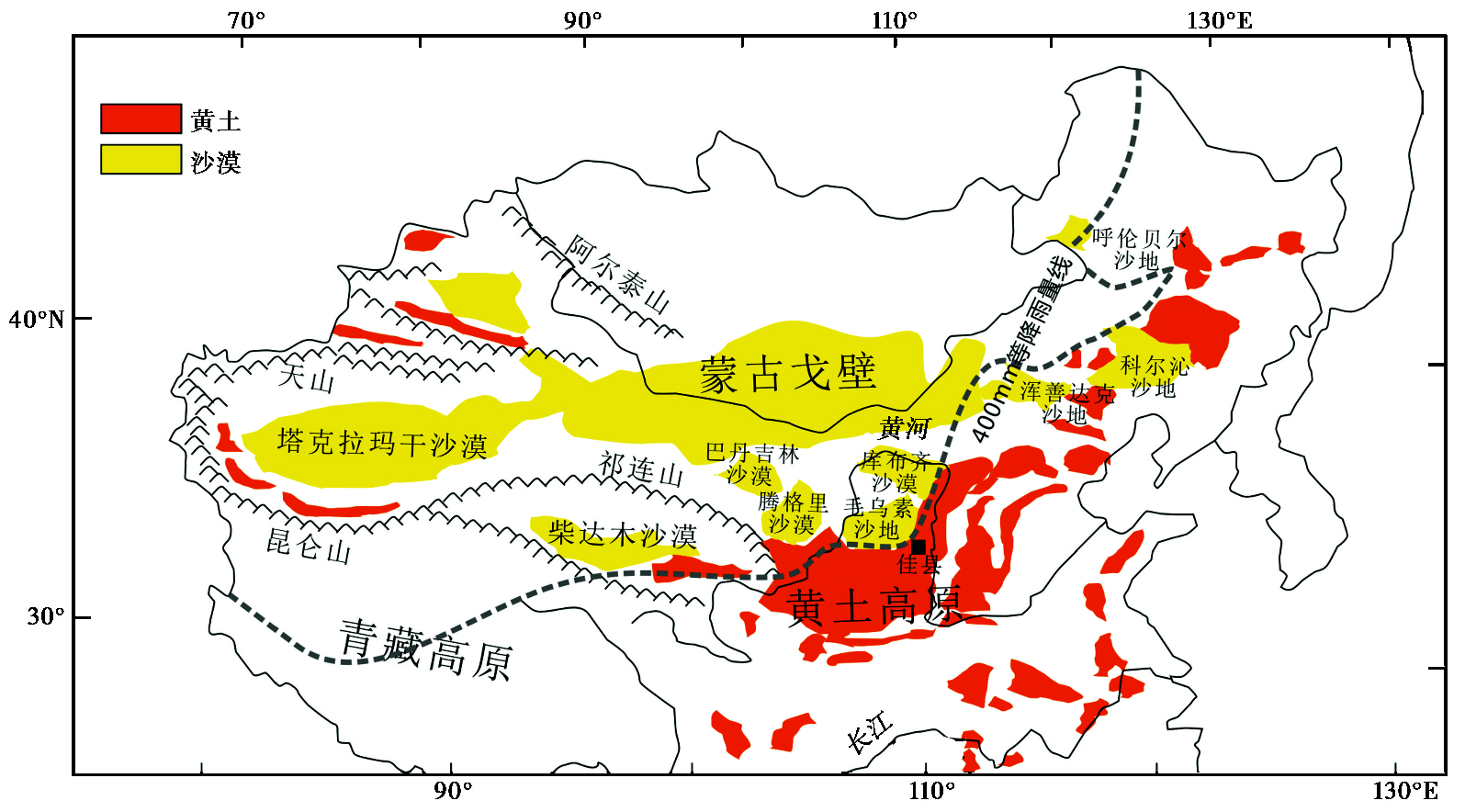
2 材料与方法黄土高原主体部分(六盘山以东)位于中国季风区和亚洲内陆干旱区的接合处,自南向北地理跨度约为1000km,年均降雨量梯度差大,大致从1000mm/a 至300mm/a,是研究亚洲内陆干旱化事件及其过程的最佳场所。佳县红粘土剖面(38°16′N,110°05′E)位于现代夏季风影响范围的北部边界( 图1),与毛乌素沙漠相邻,气候干旱,年均降雨量380mm/a。剖面地层厚64m,下伏三叠纪灰色砂岩,上覆早更新世午城黄土[34]。整套地层由众多的古土壤层和钙质淀积层构成,一共记录了86个高/低方解石含量波动的旋回[35],每个淋滤-淀积单元组合厚度在30~50cm之间。剖面地层年代控制依据已发表的古地磁年龄[34],年代跨度介于8.2~2.7Ma之间,每一个样本所对应的地层年龄通过古地磁年代对应的地层深度进行内插得到。
|
图 1 佳县剖面位置图 Fig.1 Location for Jiaxian Red Clay section |
对佳县剖面608个层位的样本各取约10g,使用英制Bartington MS2型磁化率仪测量磁化率值。取5g样本在玛瑙碾钵中压碎、 研磨,在105℃的烘箱中烘干4小时以上,使用ARL9800 XP型X射线荧光光谱仪分析Zr和Rb元素的含量。再准确称取0.2g烘干后的粉末样本,对碳酸盐矿物进行鉴定、 定量分析。采用Nicolet 6700型红外光谱仪(FTIR),采集全岩粉末样的漫反射红外光谱,再通过Omnic 8.2版光谱分析软件对碳酸盐矿物的谱峰进行标定。其中727cm-1和713cm-1吸收峰的位置分别对应于白云石和方解石矿物[36]。本文依据吸收峰深度与白云石、 方解石矿物含量已经建立的回归方程[31],将测得的727cm-1和713cm-1吸收峰深度代入该公式,计算出白云石、 方解石矿物的质量百分含量。
通过上述方法,确立了190个层位的样本适合进行无机碳同位素测试。这些层位不含白云石,而方解石矿物含量>5 % 。通过磷酸法可提取出足量的CO2气体,进行稳定同位素质谱分析。测试工作在中国科学院南京地理与湖泊研究所完成,使用Thermo公司生产的Finnigan Deltaplus质谱仪,分析结果以PDB为标准,测量误差在±0.04 ‰ 以内。
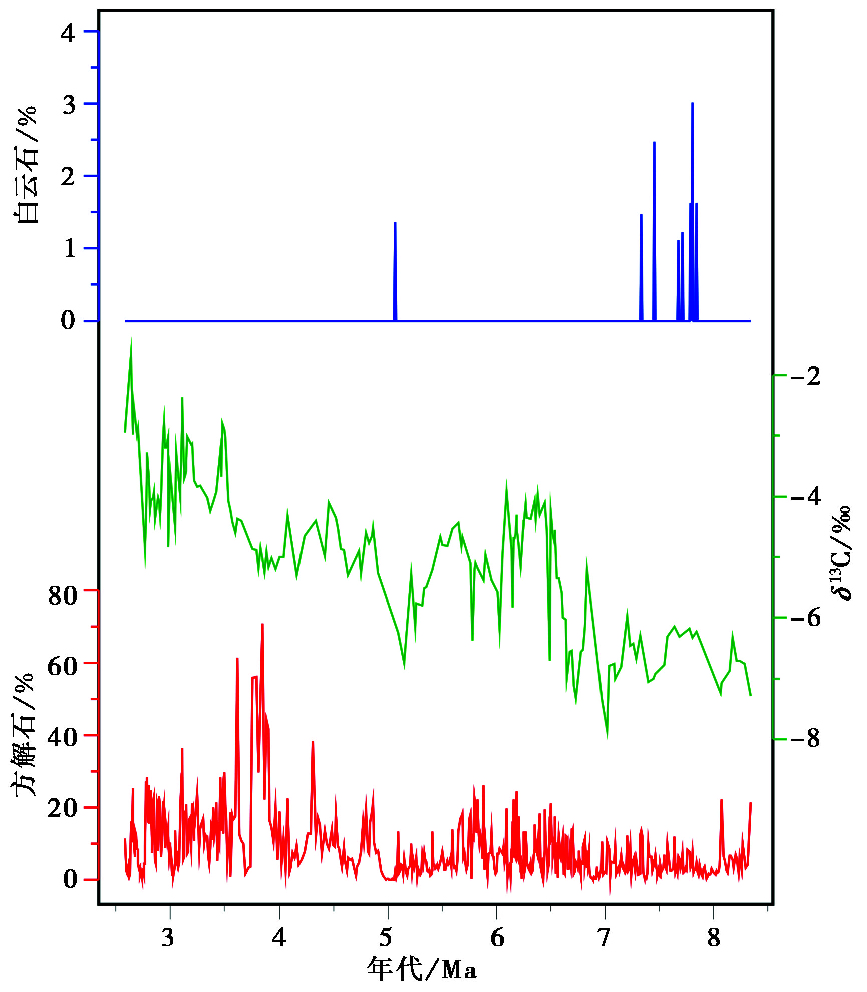
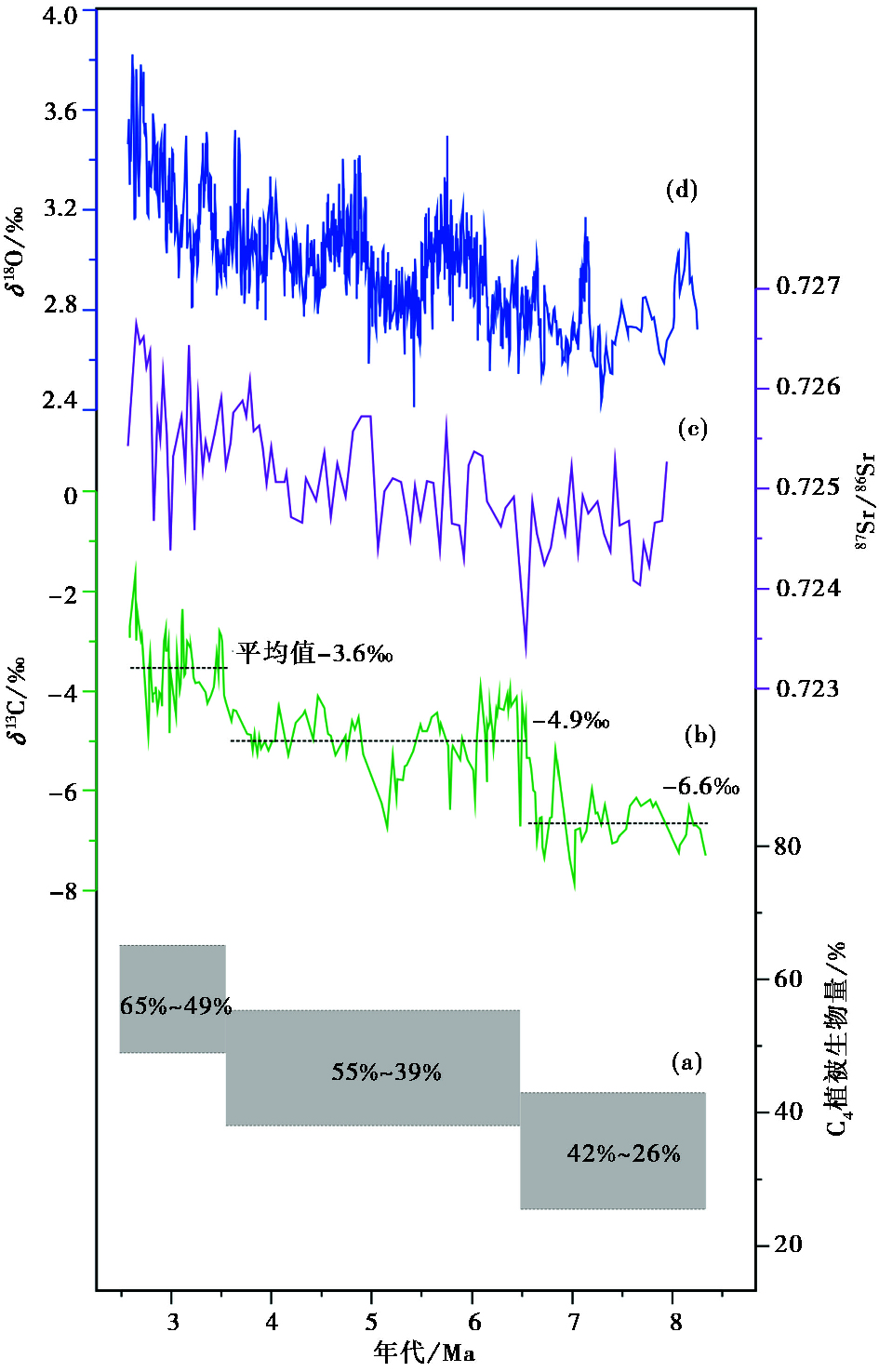
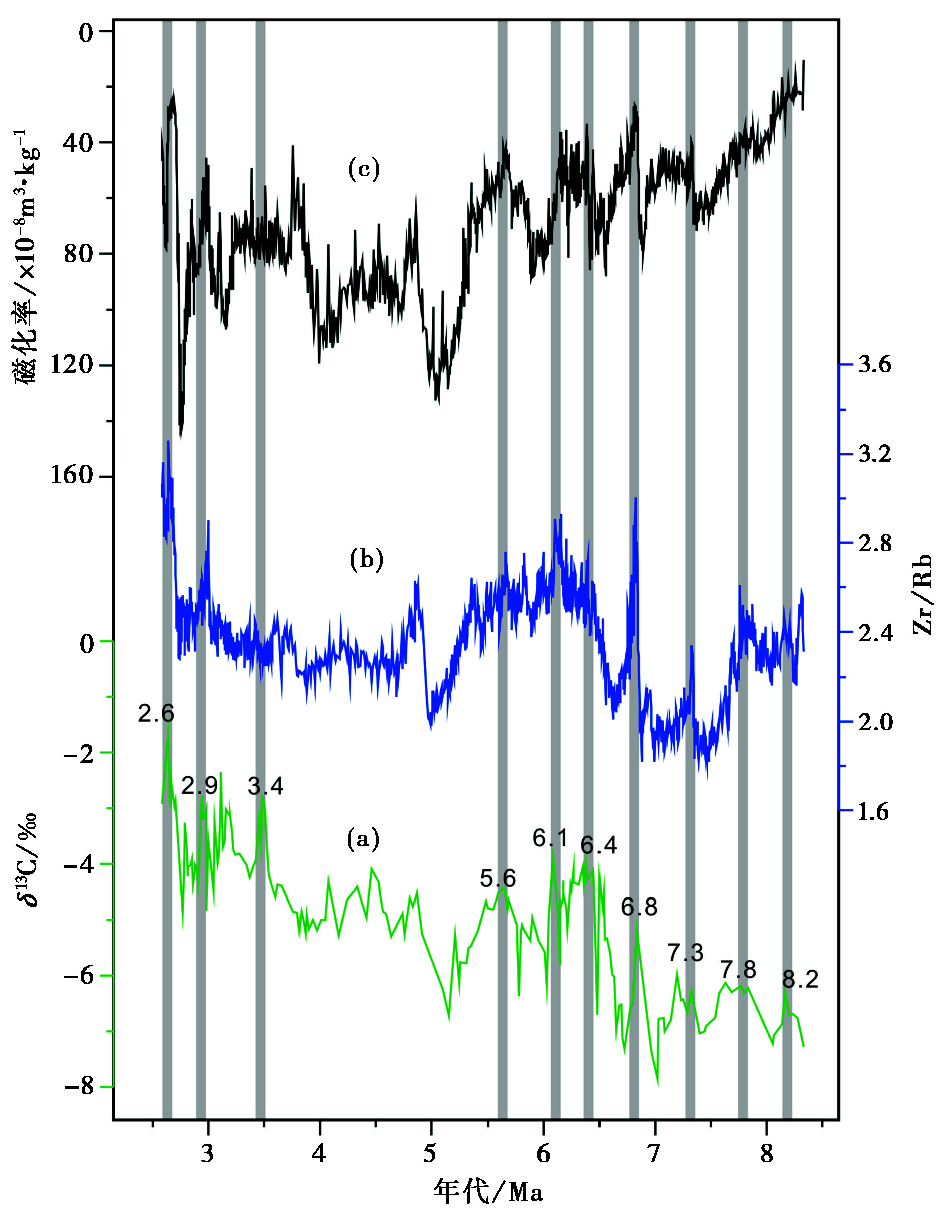
3 结果佳县红粘土剖面碳酸盐矿物定量结果显示: 白云石矿物仅在8个土壤层位出现,集中分布在约5Ma和约7~8Ma,矿物含量介于1 % ~3 % 之间( 图2)。 其余层位没有检测到白云石,但普遍含有方解石,含量在0~51 % 范围,呈高频率振荡。方解石含量>5 % 的层位共计190个,占到全部层位数目的55 % 。190个层位δ 13 C波动范围在-1.67 ‰ 到-7.85 ‰ 之间,平均值-4.86 ‰ 。随着地层由老到新(8.2~2.7Ma),δ 13 C逐渐偏高,且以6.6Ma和3.6Ma为界限,呈现出3个阶段的演化( 图3)。对碳同位素曲线作进一步观察,发现存在10个持续时间为10~20万年的波动旋回,波动幅度达1 ‰ ~2 ‰ ,叠加在整体增高的趋势上( 图4)。
|
图 2 佳县剖面红粘土序列的方解石、 白云石矿物含量与碳同位素记录 Fig.2 Records of carbon isotope, calcite and dolomite mineral contents from the Jiaxian Red Clay section |
|
图 3 佳县红粘土剖面C4植被生物量(a)、 碳同位素记录(b)与泾川红粘土Sr同位素记录(c)[37]和深海氧同位素曲线(d)[38]对比 Fig.3 Records of calculated C4-plants abundances (a) and carbon isotope (b) in the Jiaxian Red Clay sequence in comparison with 87 Sr/86 Sr ratios (c) in Jingchuan Red Clay sequence and marine benthic δ 18 O curve (d) |
|
图 4 佳县红粘土剖面碳同位素记录(a)与全岩Zr/Rb比值(b)、 磁化率(c)对比 Fig.4 Comparison of carbon isotope records (a) with bulk sample Zr/Rb ratios (b) and MS values (c) |
风成堆积物同时含有次生成因、 碎屑成因这两种类型的碳酸盐[39, 40, 41],分别记录了C4植被比例变化、 粉尘源区碎屑物质输送这两个方面的信号。因此需要建立一种简便、 快速的鉴定方法来区分出仅含次生碳酸盐的样本,从而提供较为可靠C4植被比例变化信息。已报道的研究结果显示风成堆积物中的碳酸盐矿物以白云石、 方解石矿物形态出现[41]。由风力搬运的碎屑碳酸盐中最容易被溶解的矿物是方解石[42],白云石矿物难以在地表环境下溶解。红粘土序列经历了较强的化学风化[43],不含白云石矿物的层位说明原生方解石矿物通过淋滤-沉淀作用,已经转化成次生方解石。其次,挑选方解石含量>5 % 的层位。在黄土高原主体部分(六盘山以东),碎屑方解石至多占到方解石总量的1/10[39],通常小于全岩质量的2 % 。因而方解石含量>5 % 的层位,远大于碎屑成因方解石的含量,可以最大可能排除碎屑碳酸盐对碳同位素测定结果的贡献。次生方解石形成的速率,要比土壤呼吸作用释放出的碳的速率低1~2个数量级[44],因此方解石在重结晶过程中吸收的CO2主要由土壤呼吸作用提供,其δ 13 C值主要取决于呼吸作用分解的植被有机体的碳同位素值。
C4植被有机体的δ 13 C值在-10 ‰ 到-14 ‰ 之间,平均值-13 ‰ [45],经过土壤呼吸作用分馏形成的土壤CO2的δ 13 C值要富集14 ‰ ~16 ‰ [44],由次生方解石记录到的δ 13 C理论值在1 ‰ ~3 ‰ 之间。C3植被有机体的δ 13 C值-23 ‰ 到-35 ‰ 之间,平均值-26 ‰ [45, 46],形成的土壤CO2理论值在-12 ‰ 到-10 ‰ 之间,与C4植被相比差异显著。借助地层中次生方解石的δ 13 C实测值,可以估算出C4植被比例的上限/下限范围。若以-12 ‰ 和1 ‰ 分别为100 % 的C3和C4植被环境下形成的无机碳同位素端元组成,那么运用两端元法计算得到的C4植被比例要高于以-10 ‰ 和3 ‰ 作为两端元的计算结果。这两种取值方法可以对C4植被的上限/下限做出估计。对佳县红粘土发育时期C4植被生物量的估算结果显示,6.6Ma和3.6Ma存在两次显著的C4植被增长,每一次增长量约10 % ,最终增加至49 % ~65 % (3.6~2.6Ma,δ 13 C平均值为-3.6 ‰ )。
最近对灵台红粘土黑炭的研究[47]发现在约3.6Ma时 C4植被生物量对黑炭的贡献量约30 % ,这与朝那剖面孢粉记录到大量木本植被存在[12]的结论一致。上述指标恢复得到的C4植被生物量,与碳酸盐和动物牙齿化石碳同位素得到的结果存在差异:灵台剖面碳酸盐的碳同位素记录了3.6Ma以后C4植被的生物量可能已经达到了50 % [48];西峰剖面的碳同位素值[18]要比灵台剖面整体高2 ‰ ,按照同样方法计算出的C4植被生物量也应高于50 % ;山西榆社同时期地层动物牙齿珐琅质的δ 13 C值也显示出显著的C4植被生物量( >50 % )[49]。 本文采用次生方解石碳同位素值的方法估算出佳县地区C4植被生物量的下限值至少49 % ,与已有的研究结论[18, 48, 49]一致,表明当地植被开始朝着偏向草原的类型发展。但65 % 的上限值的估计仍然偏高,很可能与计算过程中假定土壤有机质与次生方解石之间存在14 ‰ ~16 ‰ 的分馏有关。应用土壤无机碳的δ 13 C值作为C4植被生物量的指标,仍然存在方法上的不足[50, 51]。今后的研究中还需要结合有机碳与长链正构烷烃单体化合物的δ 13 C值的测定[24, 25, 26, 52, 53, 54],为恢复过去历史时期C4植被的比例提供新证据。
4.2 植被扩张与全球冰量增加过程耦合过去关于C4植被出现扩张的原因,一直存在争议[55, 56]。全球不同地点进行了较多晚中新世以来的陆地C4植被演化历史的研究。越来越多的研究结果显示世界上不同地区,C4植被的扩张并不同步,与大气CO2浓度的变化过程不耦合,与水文气候变化关系更为密切[57],C4植被的扩张表现出显著的区域性气候要素控制的特点[58, 59, 60]。在黄土高原,C4植被的扩张由区域干旱化与降雨的季节性增强所控制[19, 20, 21]。根据碳同位素曲线的增长趋势和正漂移事件,可以为恢复区域干旱化与降雨季节性加强过程提供重要的参考依据。
8.0~2.7Ma亚洲内陆环境演化的动力学机制包括两个方面:1)青藏高原的隆升阻隔了来自印度洋的水汽向亚洲内陆输送[2, 61]; 2)气候变冷造成全球冰量增长,延长了冬季的持续时间,降低了冬季地表温度[62],进而影响了亚洲内陆环境[63, 64]。这两种机制都会对黄土高原的区域气候起到控制作用[65, 66]。目前构造隆升事件发生的年代存在3.6Ma[67]、 8Ma[68]等不同认识,使得构造隆升和区域气候变化(降雨的季节性增强和干旱化加剧)在时间上的对应关系难以确定。而另一种机制: 气候变冷的驱动作用,目前的研究工作主要集中在北极冰盖大规模发育(约2.6Ma)之后[62, 63],对晚中新世-上新世的研究仍然不足。
为此,本文将佳县红粘土碳同位素记录与泾川红粘土 87 Sr/86 Sr 比值[37]、 深海氧同位素曲线[38]进行了对比( 图3)。结果显示碳同位素记录的峰值与深海氧同位素曲线的冰期阶段呈现一一对应的耦合关系( 图3),这一特征与2.6Ma以来黄土-古土壤旋回和全球冰量变化相吻合的关系[63]十分相近。很有可能早在晚中新世-上新世,高纬地区冰量的增长驱动了黄土高原的干旱化和降雨的季节性增强。这一认识得到了红粘土Sr同位素记录的验证[37]。87 Sr/86 Sr 比值[37]自约8Ma以来不断升高( 图3),显示了强烈的低海拔物质侵蚀的特征。低海拔的物理侵蚀主要由风蚀作用完成,地表风力的持续加强,与高纬度全球冰量的增长相联系。
4.3 C4植被的阶段性演化与事件佳县红粘土碳同位素值整体呈持续增长趋势,但是在6.6Ma和3.6Ma发生了两次突变,标志着C4植被发生过两次扩张( 图3)。在这两个时间节点,最显著的构造事件是地中海直布罗陀海峡的关闭(墨西拿事件)[69, 70]与青藏高原的隆升[1, 71]。在晚中新世末(6.6Ma)的这次构造事件,全球深海沉积物的碳同位素记录一致表现为负漂移,这一现象被归结为南极冰盖的扩张与海平面的下降[72]。然而关于南极冰盖扩张与黄土高原区域气候相联系的机理仍然有待研究。早上新世(3.6Ma)青藏高原的构造隆升与黄土高原区域干旱化、 降雨季节性的加强之间的联系更加直观。构造隆升一方面阻隔了来自印度洋的水汽向亚洲内陆的输送[2],加强了区域干旱化; 另一方面加强了季风环流,降雨的季节性分配更显著。这两次重要的构造事件是C4植被出现两次扩张( 图3)的重要原因。
除了这两次主要的C4植被扩张事件,尚有10次C4植被波动的旋回( 图4)。将这10次C4植被比例出现高值的阶段与磁化率、 Zr/Rb比值等气候指标进行对比。结果显示C4植被的每一次增长,都与磁化率的谷值、 Zr/Rb比值的峰值相对应。在机理上,磁化率是土壤有效湿度的指标[73~79],其低值指示了土壤有效湿度低; 而较高的Zr/Rb比值表明地表风力的增强[80]。尽管C4植被比例升高、 磁化率值降低和Zr/Rb比值增加,这三者的物理机制完全不同,但原理上相互独立的3种指标在这些阶段表现为系统性一致的变化,表明存在共同的控制因素。这10次事件集中分布在8.2~5.6Ma与3.4~2.6Ma这两个时段内,而在早上新世暖期(约5.0~3.4Ma)则表现不清晰( 图4),这可能是因为暖期过程中全球冰量小[81],对黄土高原区域气候的影响较弱。每次事件的持续时间在10~20万年之间,平均每40万年发生一次,显示出40万年的周期信号。这两个时间段内,南海ODP1148钻的沉积记录[82]也记录了很强的40万年冰量周期。来自黄土高原与南海沉积记录的这些共同的特征,暗示了上述两个时间段内,40万年周期的轨道参数是显著的,很可能通过对全球冰量的周期性变化影响到黄土高原的区域气候。
5 结论本研究使用漫反射红外光谱法(FTIR)鉴定、 定量测量了佳县红粘土剖面的碳酸盐矿物含量。选择出190个不含碎屑碳酸盐的层位进行稳定碳同位素分析。结果显示8.0~2.7Ma以来碳同位素值逐渐增高,与深海氧同位素记录的全球变冷趋势吻合,表明C4植被持续增长与全球冰盖的扩张基本一致,气候变冷很可能驱动了黄土高原区域气候的干旱化与降雨季节性的加强。C4植被的扩张存在明显的3个阶段,分别以6.6Ma和3.6Ma为界限,与“墨西拿”事件和青藏高原隆升这两次重大事件相关联,暗示了全球性构造事件对黄土高原植被演化的控制。除此之外,研究发现了10次持续时间在10~20万年的碳同位素正漂移事件,平均每40万年发生一次,说明40万年的周期也控制着黄土高原C4植被的演化。
致谢 稳定同位素质谱的测定工作由中国科学院南京湖泊研究所张恩楼研究员完成,谨此致谢; 感谢杨美芳副主编和审稿人对论文提出的修改意见。
| 1 | An Zhisheng, Kutzbach J E, Prell W L et al. Evolution of Asian monsoons and phased uplift of the Himalayan Tibetan Plateau since Late Miocene times. Nature, 2001, 411 (6833):62~66 |
| 2 | 刘晓东, Dong Buwen. 青藏高原隆升对亚洲季风-干旱环境演化的影响. 科学通报, 2013, 58 (28~29):2906~2919 |
| 3 |
李吉均. 青藏高原隆升与晚新生代环境变化. 兰州大学学报(自然科学版), 2013, 49 (2):154~159 Li Jijun. Tectonic uplift of Tibetan Plateau and Late Cenozoic climate change. Journal of Lanzhou University (Nantural Sciences), 2013, 49 (2):154~159 |
| 4 | Jiang Hanchao, Ding Zhongli. 20Ma pollen record of East-Asian summer monsoon evolution from Guyuan, Ningxia, China. Palaeogeography, Palaeoclimatology, Palaeoecology, 2008, 265 (1~2):30~38 |
| 5 |
鹿化煜, 胡挺, 王先彦. 1100万年以来中国北方风尘堆积与古气候变化的周期及驱动因素分析. 高校地质学报, 2009, 15 (2):149~158 Lu Huayu, Hu Ting, Wang Xianyan. Cycles and forcing mechanism of wet-dry variations in North China during the past 11.0 million years revealed by wind-blown silt deposits. Geological Journal of China Universities, 2009, 15 (2):149~158 |
| 6 | Guo Zhengtang, Ruddiman W F, Hao Qingzhen et al. Onset of Asian desertification by 22 Myr ago inferred from loess deposits in China. Nature, 2002, 416 (6877):159~163 |
| 7 |
方小敏, 徐先海, 宋春晖等. 临夏盆地新生代沉积物高分辨率岩石磁学记录与亚洲内陆干旱化过程及原因. 第四纪研究, 2007, 27 (6):989~1000 Fang Xiaomin, Xu Xianhai, Song Chunhui et al. High resolution rock magnetic records of Cenozoic sediments in the Linxia Basin and their implications on drying of Asian inland. Quaternary Sciences, 2007, 27 (6):989~1000 |
| 8 |
方小敏, 吴福莉, 韩文霞等. 上新世-第四纪亚洲内陆干旱化过程——柴达木中部鸭湖剖面孢粉和盐类化学指标证据. 第四纪研究, 2008, 28 (5):874~882 Fang Xiaomin, Wu Fuli, Han Wenxia et al. Plio-Pleistocene drying process of Asian inland——Sporopollen and salinity records from Yahu section in the central Qaidam Basin. Quaternary Sciences, 2008, 28 (5):874~882 |
| 9 | Maher B A, Mutch T J, Cunningham D. Magnetic and geochemical characteristics of Gobi Desert surface sediments:Implications for provenance of the Chinese Loess Plateau. Geology, 2009, 37 (3):279~282 |
| 10 | Rea D K. The paleoclimatic record provided by eolian deposition in the deep sea:The geologic history of wind. Review of Geophysics, 1994, 32 (2):159~195 |
| 11 |
薛祥煦, 张云翔, 岳乐平. 陕西府谷老高川三趾马动物群的发现及时代分期. 科学通报, 1995, 40 (5):447~449 Xue Xiangxu, Zhang Yunxiang, Yue Leping. The discovery of Hipparion fauna in Laogaochuan, Fugu, Shan'xi. Chinese Science Bulletin, 1995, 40 (5):447~449 |
| 12 | 马玉贞, 吴福莉, 方小敏等. 黄土高原陇东盆地朝那红粘土8.1-2.6Ma的孢粉记录. 科学通报, 2005, 50 (15):1627-1635 Ma Yuzhen, Wu Fuli, Fang Xiaomin et al.8.1-2.6Ma Pollen assemblages of Chaona Red Clay section in the eastern Gansu Province. Chinese Science Bulletin, 2005, 50 (15):1627~1635 |
| 13 | Li Fengjiang, Wu Naiqin, Pei Yunpeng et al. Wind-blown origin of Dongwan Late Miocene-Pliocene dust sequence documented by land snail record in western Chinese Loess Plateau. Geology, 2006, 34 (5):405~408 |
| 14 | Li Fengjiang, Rousseau D D, Wu Naiqin et al. Late Neogene evolution of the East Asian monsoon revealed by terrestrial mollusk record in western Chinese Loess Plateau:From winter to summer dominated sub-regime. Earth and Planetary Science Letters, 2008, 274 (3~4):439~447 |
| 15 |
吕厚远, 刘东生, 吴乃琴等. 末次间冰期以来黄土高原南部植被演替的植物硅酸体记录. 第四纪研究, 1999, (4):336~349 Lü Houyuan, Liu Tungsheng, Wu Naiqin et al. Phytolith record of vegetation succession in the southern Loess Plateau since Late Pleistocene. Quaternary Sciences, 1999, (4):336~349 |
| 16 |
饶志国, 陈发虎, 曹洁等. 黄土高原西部地区末次冰期和全新世有机碳同位素变化与C3/C4植被类型转换研究. 第四纪研究, 2005, 25 (1):107~114 Rao Zhiguo, Chen Fahu, Cao Jie et al. Variation of soil organic carbon isotope and C3/C4 vegetation type transition in the western Loess Plateau during the last glacial and Holocene periods. Quaternary Sciences, 2005, 25 (1):107~114 |
| 17 |
陈英勇, 鹿化煜, 张恩楼等. 浑善达克沙地地表沉积物有机碳同位素组成与植被-气候的关系. 第四纪研究, 2013, 33 (2):351~359 Chen Yingyong, Lu Huayu, Zhang Enlou et al. The relationship between organic carbon isotopic composition of surface sediment and vegetation-climate in Otindag dune field, Northern China. Quaternary Sciences, 2013, 33 (2):351~359 |
| 18 |
姜文英, 韩家懋, 刘东生等. 干旱化对成土碳酸盐碳同位素组成的影响. 第四纪研究, 2001, 21 (5):427~435 Jiang Wenying, Han Jiamao, Liu Tungsheng et al. Aridification and its influence on carbon isotope composition of pedogenic carbonate. Quaternary Sciences, 2001, 21 (5):427~435 |
| 19 | Sun Jimin, Lü Tongyan, Zhang Zhenqing et al. Stepwise expansions of C4 biomass and enhanced seasonal precipitation and regional aridity during the Quaternary on the southern Chinese Loess Plateau. Quaternary Science Reviews, 2012, 34 :57~65 |
| 20 |
张普, 刘卫国, 鹿化煜等. 洛南黄土有机碳同位素组成及其与洛川、西峰黄土对比. 第四纪研究, 2009, 29 (1):34~42 Zhang Pu, Liu Weiguo, Lu Huayu et al. Organic carbon isotope composition of Luonan loess compared with that of Luochuan and Xifeng loess. Quaternary Sciences, 2009, 29 (1):34~42 |
| 21 |
赵得爱, 吴海斌, 吴建育等. 过去典型增温期黄土高原东西部C3/C4植物组成变化特征. 第四纪研究, 2013, 33 (5):848~855 Zhao De'ai, Wu Haibin, Wu Jianyu et al. C3/C4 plants characteristics of the eastern and western parts of the Chinese Loess Plateau during Mid-Holocene and last interglacial. Quaternary Sciences, 2013, 33 (5):848~855 |
| 22 | Sun Jimin, Lü Tongyan, Gong Yingzeng et al. Effect of aridification on carbon isotopic variation and ecologic evolution at 5.3Ma in the Asian interior. Earth and Planetary Science Letters, 2013, 380 :d~d1 |
| 23 |
张瑜, 熊尚发, 丁仲礼等. 中新世以来六盘山邻区黄土-红粘土成土碳酸盐碳氧同位素记录及其对C4植物早期扩张的指示. 第四纪研究, 2011, 31 (5):800~811 Zhang Yu, Xiong Shangfa, Ding Zhongli et al. Carbon-oxygen isotope records of pedogenic carbonate from the Early Miocene-Pleistocene loess-red clay in the vicinity of the Liupanshan region and its implications for the early origin of C4 plants in the Chinese Loess Plateau. Quaternary Sciences, 2011, 31 (5):800~811 |
| 24 | 饶志国, 张晓, 薛骞等. 西峰红粘土/黄土剖面有机碳同位素研究的初步结果. 第四纪研究, 2012, 32 (4):825-827 Rao Zhiguo, Zhang Xiao, Xue Qian et al. Primary organic carbon isotopic study result of Xifeng loess/red clay profile. Quaternary Sciences, 2012, 32 (4):825~827 |
| 25 |
饶志国, 贾国东, 朱照宇等. 中国东部表土总有机质碳同位素和长链正构烷烃碳同位素对比研究及其意义. 科学通报, 2008, 53 (24):2077~2084 Rao Zhiguo, Jia Guodong, Zhu Zhaoyu et al. Comparison of the carbon isotope composition of total organic carbon and long-chain n-alkanes from surface soils in Eastern China and their significance. Chinese Science Bulletin, 2008, 53 (24):2077~2084 |
| 26 |
刘卫国, 张普, 孙有斌等. 黄土高原中部7-2Ma期间古植被变化的分子化石证据——以赵家川剖面为例. 第四纪研究, 2008, 28 (5):806~811 Liu Weiguo, Zhang Pu, Sun Youbin et al. Molecule fossil evidence for paleovegation changes in the central of Chinese Loess Plateau during7~2Ma:Zhaojiachuan profile as an example. Quaternary Sciences, 2008, 28 (5):806~811 |
| 27 | Kaakinen A, Sonninen E, Lunkka J P et al. Stable isotope record in paleosol carbonates from the Chinese Loess Plateau:Implications for Late Neogene paleoclimate and paleovegetation. Palaeogeography, Palaeoclimatology, Palaeoecology, 2006, 237 (2~3):359~369 |
| 28 | An Zhisheng, Huang Yongsong, Liu Weiguo et al. Multiple expansions of C4 plant biomass in East Asia since 7Ma coupled with strengthened monsoon circulation. Geology, 2005, 33 (9):705~708 |
| 29 | Ding Zhongli, Yang Shiling. C3/C4 vegetation evolution over the last 7.0 Myr in the Chinese Loess Plateau:Evidence from pedogenic carbonate δ 13 C. Palaeogeography, Palaeoclimatology, Palaeoecology, 2000, 160 (3):291~299 |
| 30 |
张普, 刘卫国. 西峰、洛川黄土碳酸盐根茎体碳同位素分布特征及古环境意义探讨. 第四纪研究, 2013, 33 (1):179~186 Zhang Pu, Liu Weiguo. Carbon isotope composition and paleoenvironment information of rhizolith in Xifeng and Luochuan loess. Quaternary Sciences, 2013, 33 (1):179~186 |
| 31 | He Tong, Chen Yang, Balsam W et al. Distribution and origin of protodolomite from the Late Miocene-Pliocene Red Clay formation, Chinese Loess Plateau. Geochemistry, Geophysics, Geosystem, 2012, 13 (6):gc004039 |
| 32 | Li Gaojun, Chen Yang, Chen Jun et al. Dolomite as a tracer for the source regions of Asian dust. Journal of Geophysics Research:Atmosphere, 2007, 112 (D17):d~d |
| 33 | Ji Junfeng, Ge Yun, Balsam W et al. Rapid identification of dolomite using a Fourier Transform Infrared Spectrophotometer(FTIR):A fast method for identifying Heinrich events in IODP Site U1308. Marine Geology, 2009, 258 (1-4):60~68 |
| 34 |
强小科, 安芷生, 李华梅等. 佳县红粘土堆积的磁学性质及其古气候意义. 中国科学(D辑), 2004, 34 (7):658~667 Qiang Xiaoke, An Zhisheng, Li Huamei et al. Magnetic properties of Jiaxian red clay deposits and its climatic significance. Science in China (Series D), 2004, 34 (7):658~667 |
| 35 | He Tong, Chen Yang, Balsam W et al. Carbonate leaching processes in the Red Clay Formation, Chinese Loess Plateau:Fingerprinting East Asian summer monsoon variability during the Late Miocene and Pliocene. Geophysics Research Letters, 2013, 40 (1):194~198 |
| 36 | Smith B C. Infrared Spectral Interpretation:A Systematic Approach. Washington DC:CRC Press, 1998. 288 |
| 37 | Sun Jimin. Nd and Sr isotopic variations in Chinese eolian deposits during the past 8Ma:Implications for provenance change. Earth and Planetary Science Letters, 2005, 240 (2):454~466 |
| 38 | Zachos J, Pagani M, Sloan L et al. Trends, rhythms, and aberrations in global climate 65Ma to present. Science, 2001, 292 (5517):686~693 |
| 39 | 刘东生等. 黄土与环境. 北京: 科学出版社, 1985.1~481 Liu Tungsheng et al. Loess and Environment. Beijing:Science Press, 1985.1~481 |
| 40 |
曾蒙秀, 宋友桂. 西风区昭苏黄土剖面中碳酸盐矿物组成及其古环境意义辨识. 第四纪研究, 2013, 33 (3):424~436 Zeng Mengxiu, Song Yougui. Carbonate minerals of Zhaosu loess section in westerly area and their paleoenvironmental significance. Quaternary Sciences, 2013, 33 (3):424~436 |
| 41 |
梁连姬, 孙有斌, Christiaan J R等. 黄土中的碳酸盐矿物特征与化学风化. 第四纪研究, 2014, 34 (3):645~653 Liang Lianji, Sun Youbin, Christiaan J R et al. Characteristics of carbonate minerals in loess and its implications for chemical weathering. Quaternary Sciences, 2014, 34 (3):645~653 |
| 42 | Lasaga A C, Soler J M, Ganor J et al. Chemical weathering rate laws and global geochemical cycles. Geochimica et Cosmochimica Acta, 1994, 58 (10):2361~2386 |
| 43 | Xiong Shangfa, Ding Zhongli, Zhu Yuanjian et al. A similar to 6Ma chemical weathering history, the grain size dependence of chemical weathering intensity, and its implications for provenance change of the Chinese loess-red clay deposit. Quaternary Science Reviews, 2010, 29 (15~16):1911~1922 |
| 44 | Cerling T E. The stable isotopic composition of modern soil carbonate and its relationship to climate. Earth and Planetary Science Letters, 1984, 71 (2):229~240 |
| 45 | Cerling T E, Wang Yang, Quade J. Expansion of C4 ecosystem as an indicator of global ecological change in the Late Miocene. Nature, 1993, 361 (6410):344~345 |
| 46 |
刘恋, 周鑫, 于严严等. 黄土高原自然植被的土壤有机碳同位素证据. 第四纪研究, 2011, 31 (3):506~513 Liu Lian, Zhou Xin, Yu Yanyan et al. The natural vegetations on the Chinese Loess Plateau:The evidence of soil organic carbon isotope. Quaternary Sciences, 2011, 31 (3):506~513 |
| 47 | Zhou Bin, Shen Chengde, Sun Weidong et al. Late Pliocene-Pleistocene expansion of C4 vegetation in semiarid East Asia linked to increased burning. Geology, 2014, 42 (12):1067~1070 |
| 48 |
杨石岭, 丁仲礼, 顾兆炎等. 灵台红粘土-黄土剖面晚中新世以来钙质结核的碳同位素记录及其古植被指示意义. 科学通报, 1998, 43 (21):2323~2326 Yang Shiling, Ding Zhongli, Gu Zhaoyan et al. Carbon isotope composition of pedogenic nodules in Lingtai red clay-loess sequence and the implications for paleoecological changes. Chinese Science Bulletin, 1998, 43 (21):2323~2326 |
| 49 | Passey B H, Ayliffe L K, Kaakinen A et al. Strengthened East Asian summer monsoons during a period of high-latitude warmth?Isotopic evidence from Miocene-Pliocene fossil mammals and soil carbonates from Northern China. Earth and Planetary Science Letters, 2009, 277 (3-4):443~452 |
| 50 | Rao Zhiguo, Zhu Zhaoyu, Chen Fahu et al. Does δ 13 Ccarb of the Chinese Loess indicate past C3/C4 abundances?A review of research on stable carbon isotopes of the Chinese loess. Quaternary Science Reviews, 2006, 25 (17~18):2251~2257 |
| 51 |
李朝柱, 张晓, 许元斌等. 黄土高原地区晚中新世以来陆地植被C3/C4植物相对丰度演化研究进展. 地球科学进展, 2012, 27 (3):284~291 Li Chaozhu, Zhang Xiao, Xu Yuanbin et al. Reviews on the reconstructed C3/C4 variations since the Late Miocene in the Chinese Loess Plateau. Advances in Earth Science, 2012, 27 (3):284~291 |
| 52 |
孙博亚, 岳乐平, 赖忠平等. 14ka B.P. 以来巴里坤湖区有机碳同位素记录及古气候变化研究. 第四纪研究, 2014, 34 (2):418~424 Sun Boya, Yue Leping, Lai Zhongping et al. Paleoclimate changes recorded by sediment organic carbon isotopes of Lake Barkol since 14kaB.P. Quaternary Sciences, 2014, 34 (2):418~424 |
| 53 |
匡欢传, 周浩达, 胡建芳等. 末次盛冰期和全新世大暖期湖光岩玛珥湖沉积记录的正构烷烃和单体稳定碳同位素分布特征及其古植被意义. 第四纪研究, 2013, 33 (6):1222~1233 Kuang Huanchuan, Zhou Haoda, Hu Jianfang et al. Variations of n-alkanes and compound-specific carbon isotopes in sediments from Huguang Maar Lake during the last glacial maximum and Holocene optimum:Implications for paleovegetation. Quaternary Sciences, 2013, 33 (6):1222~1233 |
| 54 |
任雅琴, 王彩红, 李瑞博等. 有机质饱和烃和δ 13 Corg. 记录的博斯腾湖早全新世晚期以来生态环境演变. 第四纪研究, 2014, 34 (2):425~433 Ren Yaqin, Wang Caihong, Li Ruibo et al. Ecological environment change recorded by sediment n-alkane and δ 13 Corg. of Lake Bosten since late of Early Holocene. Quaternary Sciences, 2014, 34 (2):425~433 |
| 55 | Cerling T E, Harris J M, MacFadden B J et al. Global vegetation change through the Miocene/Pliocene boundary. Nature, 1997, 389 (6647):153~158 |
| 56 | Pagani M, Freeman K H, Arthur M A. Late Miocene atmospheric CO2 concentrations and the expansion of C4 grasses. Science, 1999, 285 (5429):876~879 |
| 57 |
饶志国, 陈发虎, 张晓等. 末次冰期以来全球陆地植被中C3/C4植被相对丰度时空变化基本特征及其可能的驱动机制. 科学通报, 2012, 57 (18):1633~1645 Rao Zhiguo, Chen Fahu, Zhang Xiao et al. Spatial and temporal variations of C3/C4 relative abundance in global terrestrial ecosystem since the Last Glacial and its possible driving mechanism. Chinese Science Bulletine, 2012, 57 (18):1633~1645 |
| 58 | Xue Jibin, Zhong Wei, Cao Jiayuan. Changes in C3 and C4 plant abundances reflect climate changes from 41000 to 10000 years ago in northern Leizhou Peninsula, South China. Palaeogeography, Palaeoclimatology, Palaeoecology, 2014, 396 :173~182 |
| 59 | Feranec R S, Pagnac D. Stable carbon isotope evidence for the abundance of C4 plants in the Middle Miocene of southern California. Palaeogeography, Palaeoclimatology, Palaeoecology, 2013, 388 (19):42~47 |
| 60 | Lim J, Nahm W H, Kim J K et al. Regional climate-driven C3 and C4 plant variation in the Cheollipo area, Korea, during the Late Pleistocene. Palaeogeography, Palaeoclimatology, Palaeoecology, 2010, 298 (3~4):370~377 |
| 61 |
施雅风, 李吉均, 李炳元等. 晚新生代青藏高原的隆升与东亚环境变化. 地理学报, 1999, 54 (1):10~21 Shi Yafeng, Li Jijun, Li Bingyuan et al. Uplift of the Qinghai-Xizang(Tibetan)Plateau and East Asia environmental change during Late Cenozoic. Acta Geographica Sinica, 1999, 54 (1):10~21 |
| 62 | Hao Qingzhen, Wang Luo, Oldfield F et al. Delayed build-up of Arctic ice sheets during 400000-year minima in insolation variability. Nature, 2012, 490 (7420):393~396 |
| 63 | Ding Zhongli, Derbyshire E, Yang Shiling et al. Stacked 2.6-Ma grain size record from the Chinese loess based on five sections and correlation with the deep-sea δ 18 O record. Paleoceanography, 2002, 17 (3):1033~1053 |
| 64 | Liu Tungsheng, Ding Zhongli. Stepwise coupling of monsoon circulations to global ice volume variations during the Late Cenozoic. Global Planet Change, 1993, 7 (1-3):119~130 |
| 65 |
郭正堂, 彭淑贞, 郝青振等. 晚第三纪中国西北干旱化的发展及其与北极冰盖形成演化和青藏高原隆升的关系. 第四纪研究, 1999, (6):556~567 Guo Zhengtang, Peng Shuzhen, Hao Qingzhen et al. Late Tertiary development of aridification in Northwestern China:Link with the Arctic ice-sheet formation and Tibetan uplifts. Quaternary Sciences, 1999, (6):556~567 |
| 66 |
安芷生, 张培震, 王二七等. 中新世以来我国季风-干旱环境演化与青藏高原生长. 第四纪研究, 2006, 26 (5):678~693 An Zhisheng, Zhang Peizhen, Wang Erchie et al. Changes of the monsoon-arid environment in China and the growth of the Tibetan Plateau since the Miocene. Quaternary Sciences, 2006, 26 (5):678~693 |
| 67 |
李吉均, 方小敏. 青藏高原隆起与环境变化研究. 科学通报, 1998, 43 (15):1569~1574 Li Jijun, Fang Xiaomin. Studies on the tectonic uplift of Titetan Plateau and climatic changes. Chinese Science Bulletin, 1998, 43 (15):1569~1574 |
| 68 | Molnar P, England P, Martinod J. Mantle dynamics, uplift of the Tibetan Plateau, and the Indian monsoon. Reviews of Geophysics, 1993, 31 (4):357~396 |
| 69 | Hodell D A, Benson R H, Kent D V et al. Magnetostratigraphic, biostratigraphic, and stable isotope stratigraphy of an Upper Miocene drill core from the Salé Briqueterie(northwestern Morocco): A high-resolution chronology for the Messinian stage. Paleoceanography, 1994, 9 (6):835~855 |
| 70 | Keigwin L D, Shackleton N J. Uppermost Miocene carbon isotope stratigraphy of a piston core in the equatorial Pacific. Nature, 1980, 284 (5757):613~614 |
| 71 |
李吉均, 方小敏, 潘保田等. 新生代晚期青藏高原强烈隆起及其对周边环境的影响. 第四纪研究, 2001, 21 (5):381~391 Li Jijun, Fang Xiaomin, Pan Baotian et al. Late Cenozoic intensive uplift of Qinghai-Xizang Plateau and its implications on environments in surrounding area. Quaternary Sciences, 2001, 21 (5):381~391 |
| 72 | Zhao Quanhong, Wang Pinxian, Cheng Xinrong et al. A record of Miocene carbon excursions in the South China Sea. Science in China (Series D), 2001, 44 (10):943~951 |
| 73 | An Zhisheng, Kukla G J, Porter S C et al. Magnetic-susceptibility evidence of monsoon variation on the Loess Plateau of Central China during the Last 130000 Years. Quaternary Research, 1991, 36 (1):29~36 |
| 74 |
季峻峰, 陈骏, Balsam W等. 黄土剖面中赤铁矿和针铁矿的定量分析与气候干湿变化研究. 第四纪研究, 2007, 27 (2):221~229 Ji Junfeng, Chen Jun, Balsam W et al. Quantitative analysis of hematite and goethite in the Chinese Loess Plateau sequences and its implication for dry and humid variability. Quaternary Sciences, 2007, 27 (2):221~229 |
| 75 |
姜兆霞, 刘青松. 影响赤铁矿中铝替代量的因素及其环境意义探讨. 第四纪研究, 2012, 32 (4):608~614 Jiang Zhaoxia, Liu Qingsong. Factors controlling the Al content in Al-substituted hematite and its environmental significances. Quaternary Sciences, 2012, 32 (4):608~614 |
| 76 |
胡鹏翔, 刘青松. 磁性矿物在成土过程中的生成转化机制及其气候意义. 第四纪研究, 2014, 34 (3):443~458 Hu Pengxiang, Liu Qingsong. The production and transformation of magnetic minerals during pedogenesis and its paleoclimate significance. Quaternary Sciences, 2014, 34 (3):443~458 |
| 77 |
刘秀铭, 吕镔, 毛学刚等. 风积地层中铁矿物随环境变化及其启示. 第四纪研究, 2014, 34 (3):459~470 Liu Xiuming, Lü Bin, Mao Xuegang et al. Iron minerals of aeolian deposits vary with environment and its significances. Quaternary Sciences, 2014, 34 (3):459~470 |
| 78 |
张俊辉, 夏敦胜, 张英等. 阿勒泰地区表土磁学特性及变化机制研究. 第四纪研究, 2013, 33 (5):889~899 Zhang Junhui, Xia Dunsheng, Zhang Ying et al. Study on the magnetic characteristics and variable mechanism of surface soils in Altay area, Xinjiang China. Quaternary Sciences, 2013, 33 (5):889~899 |
| 79 |
李冠华, 夏敦胜, 温仰磊等. 天山北麓典型黄土沉积序列的磁学特征及主控因子初探. 第四纪研究, 2013, 33 (5):900~910 Li Guanhua, Xia Dunsheng, Wen Yanglei et al. Rock magnetism of the loess/paleosol sequences in north of the Tianshan Mountains, Northwest China. Quaternary Sciences, 2013, 33 (5):900~910 |
| 80 | Chen Jun, Li Gaojun, Yang Jiedong et al.Zr/Rb ratio in the Chinese loess sequences and its implication for changes in the East Asian winter monsoon strength. Geochimimica et Cosmochimica Acta, 2006, 70 (6):1471~1482 |
| 81 | Ballantyne A P, Greenwood D R, Damste J S et al. Significantly warmer Arctic surface temperatures during the Pliocene indicated by multiple independent proxies. Geology, 2010, 38 (7):603~606 |
| 82 | Wang Pinxian, Zhao Quanhong, Jian Zhimin et al. Thirty million year deep-sea records in the South China Sea. Chinese Science Bulletin, 2003, 48 (23):2524~2535 |
Abstract
The timing for expansion of global C4-plants is a key issue in understanding relationship between past climate changes and Earth's boundary conditions. However, the possible causes that have motivated the expansion remained disputed. Previous studies on carbon isotopic composition of mammal teeth fossil, soil organic matter and pedogenic carbonate have suggested that the decrease in atmospheric CO2 concentration may partly contribute to this expansion. Recent studies suggested that the C4-plants expansion is not globally synchronous, thus regional climate exerted a strong control on the relative abundance of C4-plants.
Jiaxian Red Clay section(38°16'N, 110°05'E)locates in the northern Chinese Loess Plateau near the northern limit of East Asian summer monsoon, an ideal site to study relation between regional vegetation cover and climatic changes. The Red Clay section is 64m thick, dated from 8.2Ma to 2.6Ma. Episodic changes in species and contents of carbonate minerals in the section allow us to study C4-plants evolution using the stable isotope techniques. Here we develop a simple and fast approach to obtain δ 13 C changes of secondary calcite minerals totally reflecting paleo-ecological changes. This new approach overcomes the problem of carbonate minerals of detrital origin that complicate an interpretation of δ 13 C changes in bulk sample of carbonate minerals related with paleo-ecological changes.
We identified species of carbonate minerals for 608 bulk soil samples using Fourier Transform Infrared Spectrometry(FTIR)and established dataset with 190 samples that are composed of abundant secondary calcite(>5 %)without any of dolomite minerals. We avoided dolomite minerals in measurement of δ 13 C for following reasons. Dolomite initially eroded from bedrock in dust provenance, having no paleo-ecological significance. The calcite minerals were easily weathered after the Red Clay deposition, thus mostly of secondary origin. Due to two order of magnitude larger rate than calcite formation, the source of carbon in the calcite of secondary origin mostly inherited from soil respiration. Hence, the carbon isotope values for our selected calcites are strongly related to paleo-ecological evolution in site. We analyzed the δ 13 C values in calcite for 190 samples with equal space interval, so as to obtain a long-term C3-plants record. The δ 13 C values varied from -1.67 ‰ to -7.85 ‰ with a mean value of -4.86 ‰.The δ 13 C values of calcite formed in 100 % C3-plants conditions ranged from -12 ‰ to -10 ‰.In contrast, 100 % C4-plants condition should theoretically with calcite δ 13 C values from 1 ‰ to 3 ‰.Using the two end-members of δ 13 C, we could infer C3/C4 abundances considering very different δ 13 C values for calcite formed in 100 % C3 or C4-plants conditions, respectively. This method for the estimation of C4-plants abundance is based on the assumption that soil organic matter and pedogenic carbonate share the same carbon source. The difference of δ 13 C between the two phases is assumed to be limited to 14 ‰ ~16 ‰.However, worldwide reported differences have largely exceeded this range for many instances. Therefore, future work should be involved on the study of carbon isotopic composition of soil organic matter.
The δ 13 C record displays a gradual increase from 8.2Ma to 2.6Ma. This evolution bears a resemblance to the marine oxygen isotope records, suggesting a coupled mechanism of C4-plants and high-latitude ice-volume changes. Considering an idea that changes in C4-plants are fully controlled by regional aridity and seasonality in precipitation, our evidence suggests that global climate cooling associated with increase in the northern hemisphere ice-sheets had motivated the expansion of C4-plants. Our data also indicate three stages bounded at 6.6Ma and 3.6Ma. The C4-plants abundance increased by 10 % for each expansion, revealing that tectonic event as "Messinian Event" and the uplift of Tibetan Plateau may initiate expansion of C4-plants abundance. The two tectonic events may have enhanced monsoon circulation, thus enhancing aridity and seasonality in precipitation. Further comparison of δ 13 C record with magnetic susceptibility values and Zr/Rb elemental ratios indicate that 10 events of δ 13 C major shifts occurred at two intervals of 8.2~5.6Ma and 3.4~2.6Ma. Each of the 10 events lasted 100~200ka in time, with an occurrence for each 400ka. This quasi-period is consistent with the orbital parameter, supported by evidence from a δ 13 C record in marine core of site ODP1148, South China Sea. We suggest that 400-ka cycle could have also modulated on terrestrial C4-plants evolution.