 2015, Vol.35


1 前言
新生代以来,地球气候系统经历了由古近纪的温室气候向第四纪的冰室气候的转变,尤其在中中新世以后,全球气候逐渐变冷[1]。新近纪(约23.0~2.6Ma,包括中新世和上新世)则代表了这个转变过程中的一个关键的过渡阶段。对这个时段的研究倍受各国地质学家、古气候学家和古生物学家的极大关注,因为许多全球性的重大气候事件、构造事件和生物事件都发生在这个时段,例如:南极冰盖形成、亚洲季风增强、青藏高原加速抬升以及C4草原扩张等[1, 2, 3, 4, 5, 6]。因此,新近纪对于理解欧亚大陆乃至全球长时间尺度的气候演化至关重要[7]。
新疆(34°10′00″~49°30′00″N,73°30′00″~96°30′00″E)地处我国西北内陆干旱区,地貌格局以“三山两盆”为特征,由南向北依次为昆仑山山脉、塔里木盆地、天山山脉、准噶尔盆地和阿尔泰山脉。气候类型上属于典型的大陆性气候,以干旱少雨、冬季严寒、昼夜温差大为特点。年均降水量150mm,年均温8.0~14.5℃。伴随着新生代以来印度次大陆向欧亚大陆的挤压碰撞,新疆地质发展经历了一系列显著变化。例如:喜马拉雅早期运动使特提斯海域封闭,喀喇昆仑和塔里木海湾的海水退却;晚期运动使青藏高原大幅度整体抬升,由于印度次大陆对欧亚大陆的强烈挤压,新疆境内各大山脉和盆地之间发生强烈的差异性升降运动[8]。青藏高原的抬升对远离碰撞带的新疆地区的环境变迁也产生了直接的影响。
本文收集整理了新疆地区新近纪孢粉资料,通过时空对比,有助于理解和认识新疆地区干旱化的形成和发展、植被和气候环境格局的演化、草原和荒漠草原以及荒漠生态系统的形成等科学问题。
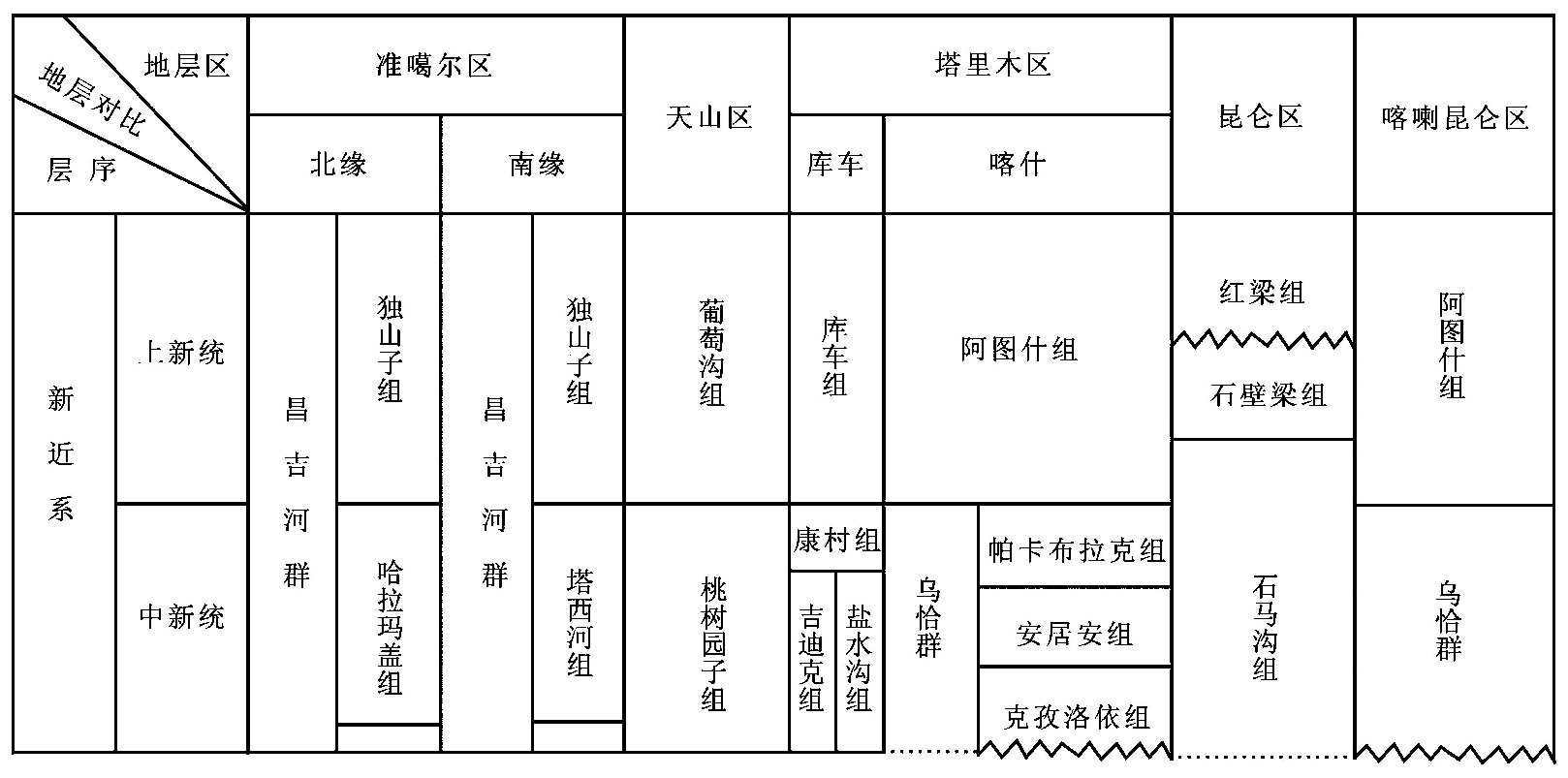
2 新近系概况新疆地区新近系分布广泛,以盆地和山前地区发育最好,从北往南可以划分为准噶尔区、天山区、塔里木区、昆仑区和喀喇昆仑区[8],各区地层划分对比见 图1。
|
图 1 新疆地区新近纪地层划分对比[8] Fig.1 Neogene strata of Xinjiang region[8] |
准噶尔区(Ⅰ)新近系为河湖相沉积,天山北坡山前地带为陆相磨拉石堆积; 天山区(Ⅱ)新近系为河流相沉积,分布于吐鲁番、博格达山南麓和觉洛塔格山北麓等地;塔里木区(Ⅲ)新近系为磨拉石建造,包括中新统乌恰群、上新统阿图什组,主要分布于昆仑山前地带;昆仑区(Ⅳ)中新-上新统石马沟组为一套杂色河湖相碎屑岩,上新统红梁组不整合接触于中上新统石壁梁组之上;喀喇昆仑区(Ⅴ)中新统乌恰群为陆相砾岩、砂砾岩夹砂岩及泥岩,上新统阿图什组为浅黄色河湖相沉积[8]。
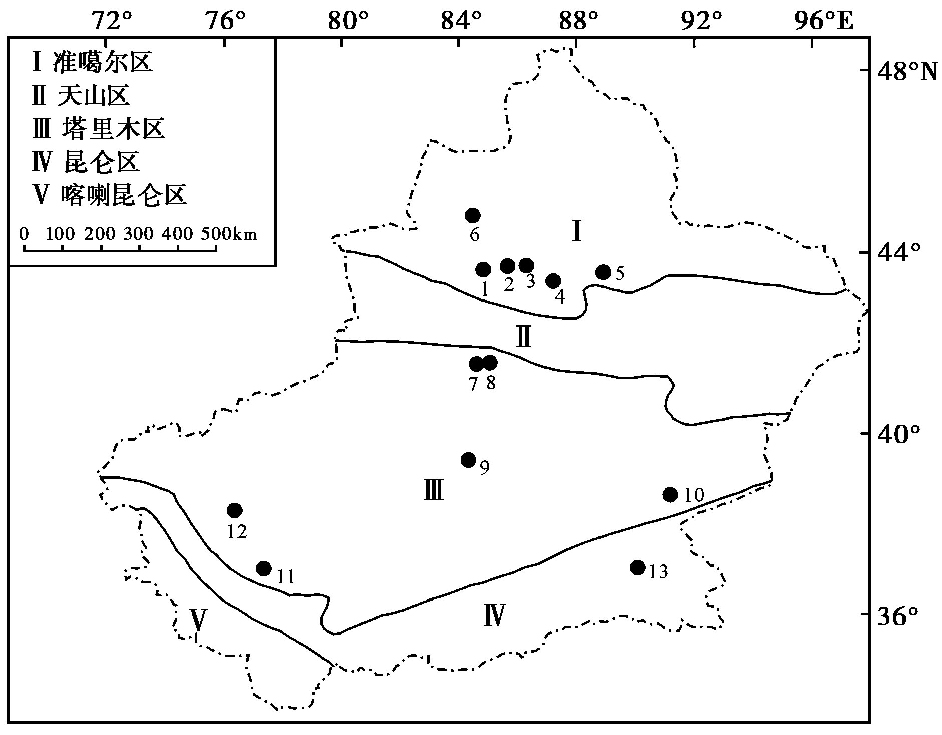
3 新近纪孢粉组合与气候环境20世纪80年代以来,前人对新疆地区新近纪地层剖面和钻孔的研究重点在天山北坡的准噶尔区,其次是天山南坡的塔里木区(图2)。天山北坡山前盆地的新生代沉积是我国西北地区标准的新近纪沉积地层[9],前人在该地区开展了哺乳动物、介形类、构造变形和磁性地层等方面的研究[9, 10, 11, 12, 13, 14]。由于亚洲高纬度地区晚新生代植被的主要变化与构造事件具有一定的关联[15],因此,开展孢粉地层学方面的研究有助于揭示造山运动与气候变化之间的相互作用。
|
图 2 新疆地区新近纪孢粉研究地点分布图 1.天山北坡独山子(剖面):晚中新世-上新世;2.金沟河(剖面):晚渐新世-上新世;3.天山北坡塔西河(剖面):晚渐新世-上新世;4.玛纳斯地区(剖面):上新世;5.昌吉(钻孔):上新世-更新世;6.艾比湖东南缘(钻孔):上新世;7.库车盆地(剖面):中新世;8.库车塔乌(剖面):中中新世-上新世;9.塔克拉玛干沙漠(钻孔):上新世-第四纪;10.罗布泊(钻孔):晚中新世;11.塔里木盆地桑株地区(剖面):晚中新世-早更新世;12.塔西南地区其木干(剖面):中新世-上新世;13.库木库里盆地(剖面):中新世-上新世 Fig.2 Location map showing the Neogene palynological sites in Xinjiang region.1.Dushanzi (section):Late Miocene-Pliocene,2.Jingouhe (section):Late Oligocene-Pliocene,3.Taxihe (section):Late Oligocene-Pliocene,4:Manasi region (section):Pliocene,5:Changji (borehole):Pliocene-Pleistocene,6.Southeastern margin of Ebinur Lake (borehole):Pliocene,7:Kuche Basin (section):Miocene,8.Kuchetawu (section):Middle Miocene-Pliocene,9.Takelamagan Desert (borehole):Pliocene-Quaternary,10.Lop Nur (borehole):Late Miocene,11.Sanzhu region,Tarim Basin (section):Late Miocene-Early Pleistocene,12.Qimugan,Taxinan region (section):Miocene-Pliocene,13.Kumukuli Basin (section):Miocene-Pliocene |
由于天山区和喀喇昆仑区的孢粉资料相对缺乏,因此本文按准噶尔区、塔里木区和昆仑区3个区对新疆地区新近纪孢粉组合及其指示的气候环境加以叙述。
3.1 准噶尔区前人对该区新近纪孢粉的研究主要集中在天山北坡的独山子、金沟河、塔西河、玛纳斯地区、昌吉以及艾比湖地区(图2)。
天山北坡山前盆地晚中新世-上新世(8 . 70~2 . 58Ma)独山子沉积剖面孢粉组合(图3上)反映了沉积时期的植被主要是以蒿属(Artemisia)和藜科(Chenopodiaceae)为主的草原植被,说明我国西北内陆盆地至少在8.7Ma以前的气候以干旱为主,而在5.8~3.9Ma时,暖温带成分栎属(Quercus)和胡桃属(Juglans)花粉丰度的增加,以及亚热带成份山核桃属(Carya)和水生植物类群香蒲属(Typha)和莎草科(Cyperaceae)花粉的出现,指示了此时段的气候温暖湿润,这个气候适宜期可以与黄土高原红粘土中喜温湿的蜗牛种类在5.4~3.4Ma丰度的大幅增加,以及全球海平面在5.8~4.0Ma期间维持较高的水平进行对比[16](图3下)。

|
图 3 天山北坡独山子剖面花粉谱(上)和花粉记录的温暖湿润期与其他记录的对比(下)(引自Sun等[16]) (a)独山子剖面,(b)喜温湿的蜗牛丰度,(c)全球海平面变化,(d)深海氧同位素变化 Fig.3 Pollen diagram of Dushanzi section,northern slope of Tianshan Mountain (above) and comparison of warm-humid period documented by pollen and other records (below)(a) Dushanzi section,(b) Relative abundance of the thermo-humidiphious snails,(c) global sea level change,(d)δ18O change at site 1088(cited from Sun et al.[16]) |
天山北坡晚渐新世-上新世(28.0~4.2Ma)金沟河剖面孢粉记录表明(图4上)在28.0~23.8Ma期间天山北坡以森林-草原植被为主,当时气候湿润;23.8~23.3Ma以旱生草本植物藜科和蒿属占优势的草原植被逐渐取代了森林-草原植被,并且一直持续到17.3Ma,反映了相对干旱的气候环境;17.3~16.2Ma花粉多样性增加,草原植被仍然在局部区域占据优势,指示了相对湿润的气候条件;16.2~13.5Ma木本类群丰度减少,旱生草本类群丰度增加,表明气候条件再度变干;13.5~4.2Ma藜科和蒿属花粉丰度不断增加,说明在13.5Ma左右天山北坡荒漠植被开始出现,此后一直占据优势,反映了气候条件持续干旱。该研究揭示了长时间尺度上植被的变化与新生代全球温度变化有很好的一致性(图4下),认为晚新生代全球气候变冷是中亚地区干旱化形成的主要驱动因素,而发生在23.8~23.3Ma 和16.2~13.5Ma的两次干旱事件更可能是区域造山运动的结果[17]。

|
图 4 天山北坡金沟河剖面花粉谱(上)和主要花粉类群通量(a~l)与第1主成分分值(m)、Simpson多样性指数(n)以及底栖有孔虫氧同位素记录(o)对比(下)(引自Tang等[17]) Fig.4 Pollen diagram of Jingouhe section,northern slope of Tianshan Mountain (above) and comparison (below) of representative palynomorph flux for log 10-tranformed data (a~l),PC1 scores from the Jingouhe section palynomorph percentage (m),Simpson's diversity index of the palynological record (n),and benthic foraminiferal oxygen isotope records (o)(cited from Tang et al.[17]) |
天山北坡山前盆地晚渐新世-上新世(26.5~2.6Ma)塔西河沉积剖面孢粉分析结果表明沉积时期的植被是以松属(Pinus)和桦木属(Betula)为主的森林植被(图5左)。在18 ~ 15Ma时,松属花粉的丰度降低以及落叶阔叶树种桦木属、胡桃属和栎属花粉的丰度增加,指示了当时气候更加温暖,此时段对应中中新世气候适宜期。6Ma以后,高海拔分布的冷杉属(Abies)和云杉属(Picea)花粉的丰度没有明显的增加,暗示了构造抬升并不是导致孢粉组合变化的主导因子。相反地,耐旱的草本植物蒿属和藜科花粉显著增加,指示气候向干旱方向发展,这可能是对北半球高纬度地区晚新生代气候恶化的响应。进一步对花粉数据进行主成分分析的结果与上述结果和解释基本吻合[18](图5右)。

|
图 5 天山北坡塔西河剖面花粉谱(左)和花粉数据主成分分析结果(右)(引自Sun等[18]) Fig.5 Pollen diagram of Taxihe section, northern slope of Tianshan Mountain (left) and the factor scores of PCA axes 1 and 2 based on pollen data (right)(citedfromSunetal.[18]) |
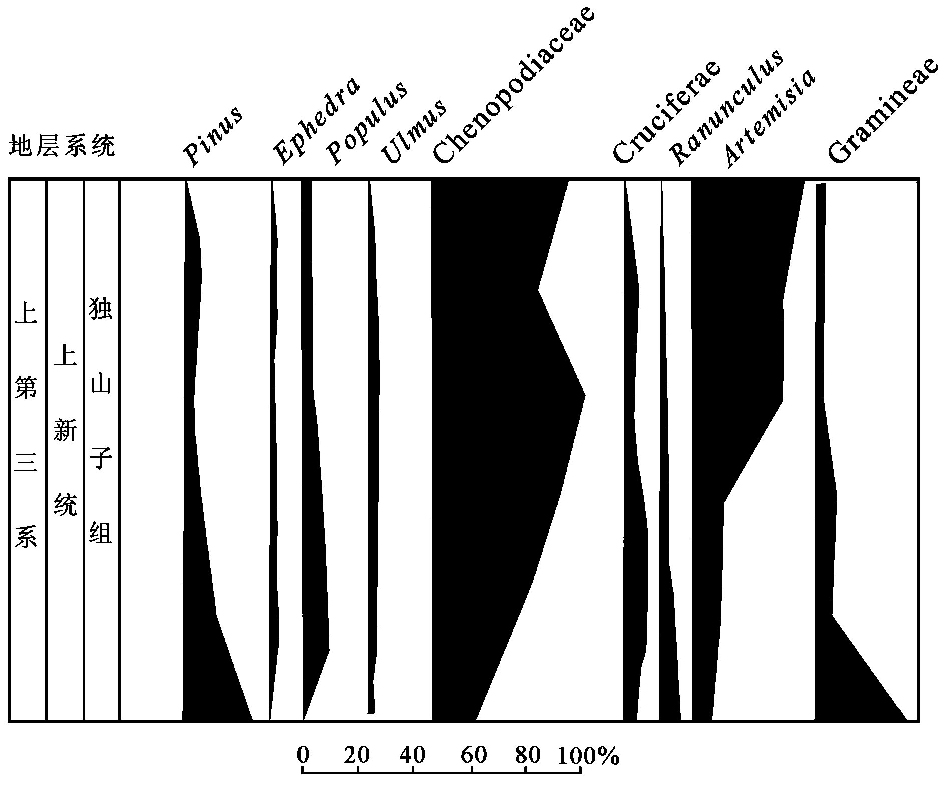
玛纳斯地区中新世塔西河组孢粉组合以榆属(Ulmus)、榉属(Zelkova)、朴属(Celtis)、胡桃属、桦木属、桤木属(Alnus)、栎属和槭属(Acer)等落叶阔叶树种占优势,云杉属、松属、冷杉属次之,组成暖温带针叶-阔叶落叶林,气候温暖湿润,组合中还出现罗汉松属(Podocarpus)、雪松属(Cedrus)、山核桃属和枫香属(Liquidambar)等亚热带科属成分。上新世独山子组孢粉组合则以藜科、蒿属、禾本科(Gramineae)、麻黄属(Ephedra)和白刺属(Nitraria)等草本及灌木植物为主,乔木植物主要包括松属、云杉属、冷杉属、榆属、桦木属、杨属(Populus)和胡桃属等,反映了上新世时期本地区的植被由温带针阔叶林-草原类型向温带稀树落叶林-荒漠草原发展,气候干旱,但比现今略湿润。由此可见,本地区上新世孢粉组合与中新世面貌截然不同,反映了玛纳斯地区中新世到上新世时期,植被和气候均发生了明显的变化,阔叶落叶林大大衰退,荒漠草原得到很大发展[19](图6)。
|
图 6 玛纳斯地区上新世花粉谱(改自阎顺[19]) Fig.6 Pliocene pollen diagram of Manasi region (modified from Yan[19]) |
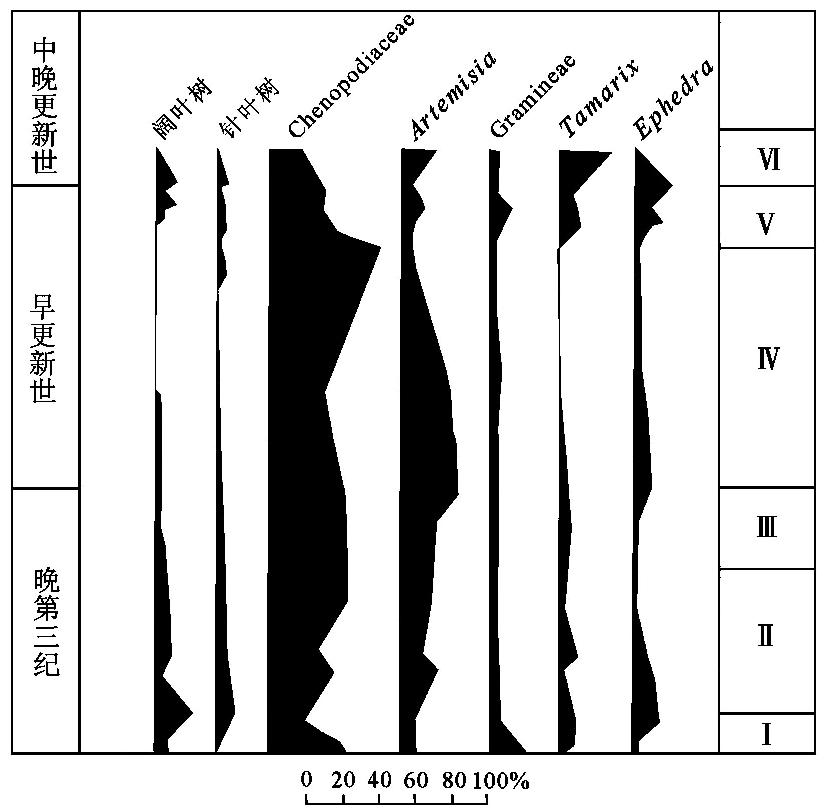
天山北麓平原区的昌吉D1孔Ⅰ和Ⅱ孢粉组合带主要以藜科、蒿属、禾本科、柽柳属(Tamarix)和麻黄属等草本和灌木花粉,以及榆属、栎属、白蜡树属(Fraxinus)和胡颓子属(Elaeagnus)等落叶阔叶树花粉为主,反映了上新世时期该地区的植被为温带稀树落叶林-荒漠草原,指示了当时较干旱的气候;更新世以后,植被不断向荒漠草原和荒漠发展[20](图7)。
|
图 7 昌吉D1孔花粉谱(改自阎顺和许英勤[20]) Fig.7 Pollen diagram of Changji D1 borehole (modified from Yan and Xu[20]) |
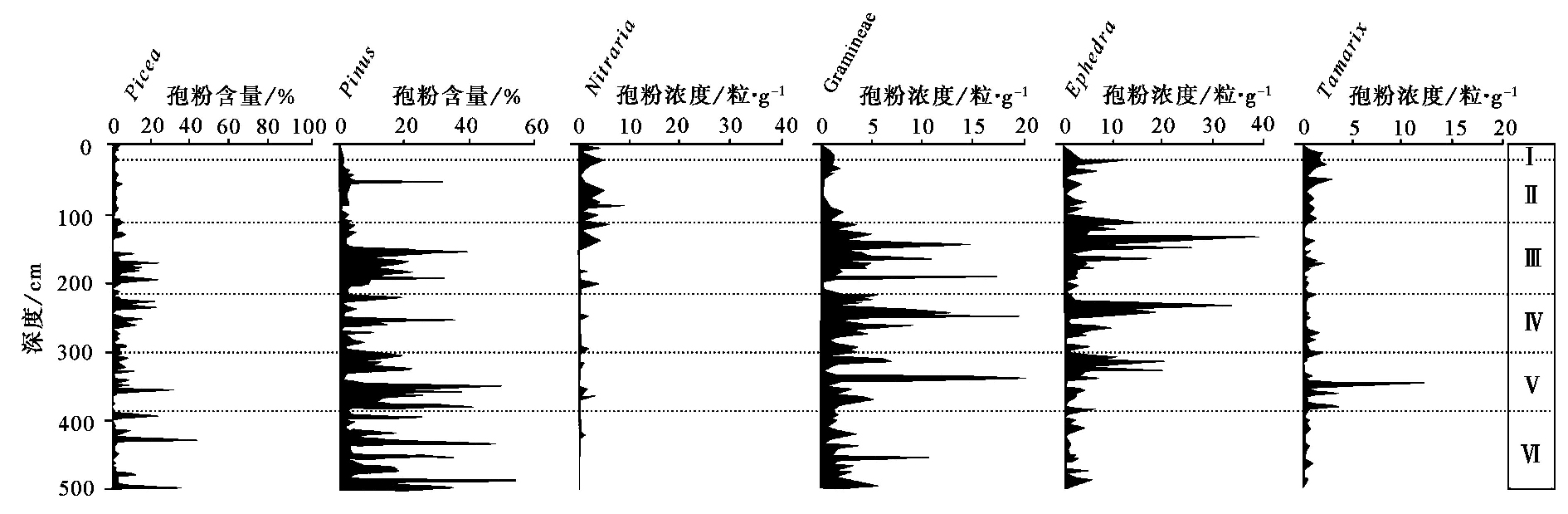
准噶尔盆地艾比湖东南缘K3孔深500.8~300.0m(4.2~2.6Ma)孢粉组合主要以旱生植物藜科、蒿属和麻黄属花粉为主,反映了上新世时期温暖、干旱/半干旱的气候背景,表明3.6Ma以来,随着青藏高原抬升加快,该地区干旱化程度不断加剧[21](图8)。
|
图 8 艾比湖东南缘K3孔花粉谱(改自张金起等[21]) Fig.8 Pollen diagram of K3 borehole at southeastern margin of Ebinur Lake (modified from Zhang et al.[21]) |
该区新近纪孢粉研究地点主要包括库车盆地、库车塔乌、塔克拉玛干沙漠、罗布泊、桑株地区和塔西南地区(图2)。
库车盆地早-中中新世盐水沟组孢粉组合以葇荑花序植物桦木科(Betulaceae)、胡桃科(Juglandaceae)、山毛榉科(Fagaceae)和榆科(Ulmaceae)花粉为主,松科(Pinaceae)各属十分繁盛,双子叶草本植物藜科、菊科(Compositae)、水生植物黑三棱科(Sparganiaceae)和眼子菜科(Potamogetonaceae)比较发育。孢粉组合反映了该时期植被为针叶-落叶阔叶混交林,气候为暖温带型[22]。库车盆地中新世中晚期康村组库尔哈剖面第66层被子植物花粉占绝对优势,以藜科、石竹科(Caryophyllaceae)、禾本科、蒿属和菊科等草本植物花粉为主,反映了以草原和灌丛为主的植被类型,第90层以葇荑花序植物为主的被子植物花粉占优势,山地丘陵(如:松属、雪松属和油杉属(Keteleeria))和中高山生长(如:云杉属和冷杉属)的裸子植物花粉繁茂,反映了盆地周缘广泛分布有以松科为主的高山针叶林带;同时推测该区域植被和环境的变化受喜马拉雅期构造运动和中亚特提斯海进退的影响[23]。
天山南坡中中新世-上新世(13.3~2.6Ma)库车塔乌剖面孢粉组合以木本植物花粉占优势,其中松属和桦木属花粉居多,冷杉属、云杉属、栎属和榆属花粉常见,草本植物花粉以蒿属和藜科为主[24](图9)。 13.3~7.0Ma期间,高海拔生长的冷杉花粉丰度达到全剖面最低值,喜暖类型榛属(Corylus)、鹅耳枥属(Carpinus)、胡桃属和栎属含量较高,指示了相对温暖湿润的气候环境;7Ma之后冷杉花粉丰度急剧上升,5.23Ma之后蒿属花粉含量显著增加。该研究揭示了13.3~7.0Ma期间研究区域的植被和气候变化是对全球气候变化的响应,而7Ma之后天山南部的抬升也局部影响了该区域的植被和气候变化,全球变冷和高大山体抬升造成的雨影效应共同驱动了5.23Ma之后干旱化的加剧[24]。

|
图 9 天山南坡库车塔乌剖面花粉谱(左)和花粉数据主成分分析结果(右)(引自Zhang和Sun[24]) Fig.9 Pollen diagram of Kuchetawu section, southern Tianshan range (left) and the factor scores of PCA axes 1 and 2 based on pollen data (right)(cited from Zhang and Sun[24]) |
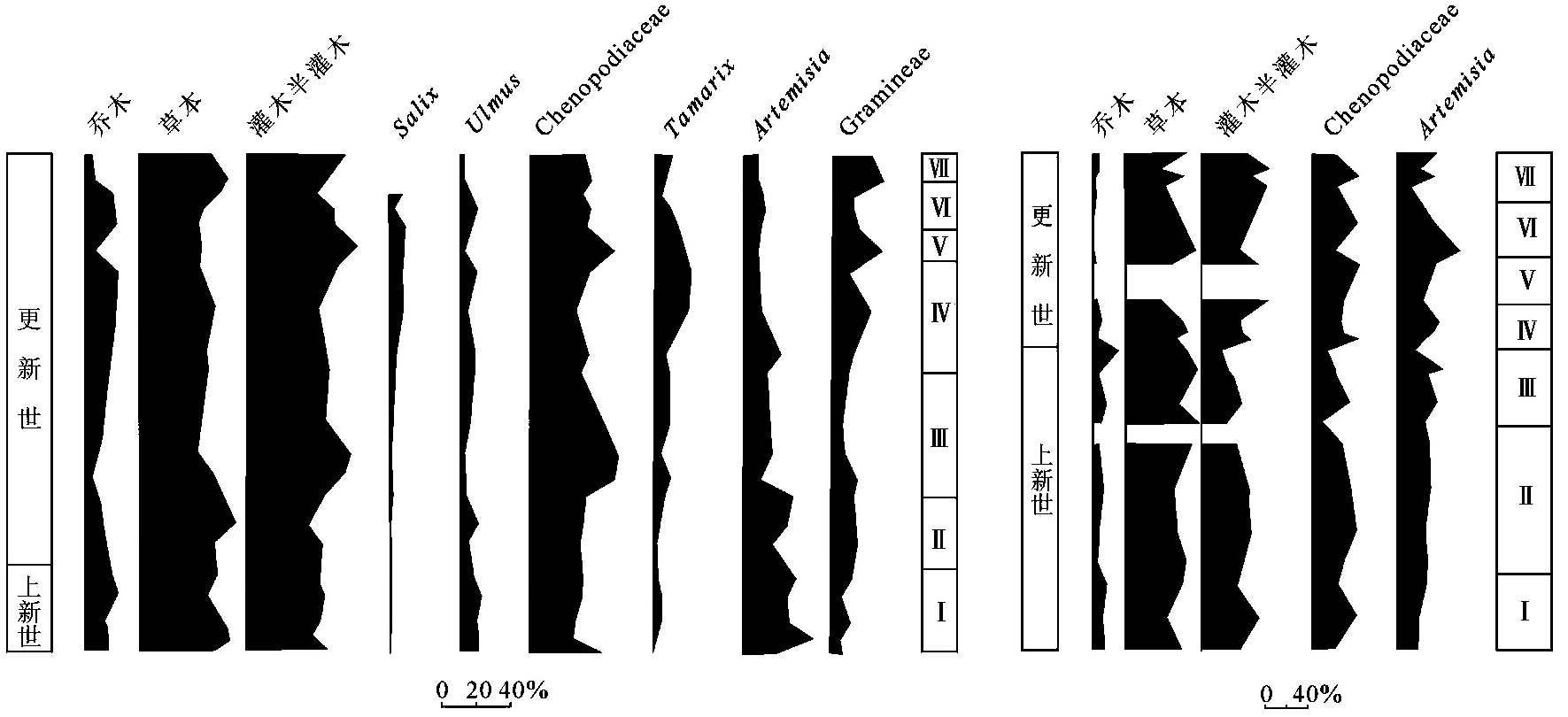
塔里木盆地中部塔克拉玛干沙漠两个钻孔(塔中1井和满西1井)孢粉组合(图10)揭示了上新世晚期塔克拉玛干沙漠广大地区为草原和荒漠平原,河流沿岸生长着以榆属为主的落叶阔叶林,当时有面积不大的沙漠出现;第四纪以来气候干旱,北部以荒漠为主,南部以荒漠草原为主,平原河谷地区广泛分布着以杨属、柳属和榆属为主的落叶阔叶林,北部沙漠发育,南部具阶段性发育。然而,由于缺乏精确的测年数据,因此只能根据孢粉组合特征以及地层对比来推测植被的发育和环境变化[25]。
|
图 10 塔克拉玛干沙漠塔中1井(左)和满西1井(右)花粉谱(改自阎顺和许英勤[25]) Fig.10 Pollen diagrams of Tazhong1 borehole (left) and Manxi1 borehole (right), Takelamagan Desert (modified from Yan and Xu[25]) |
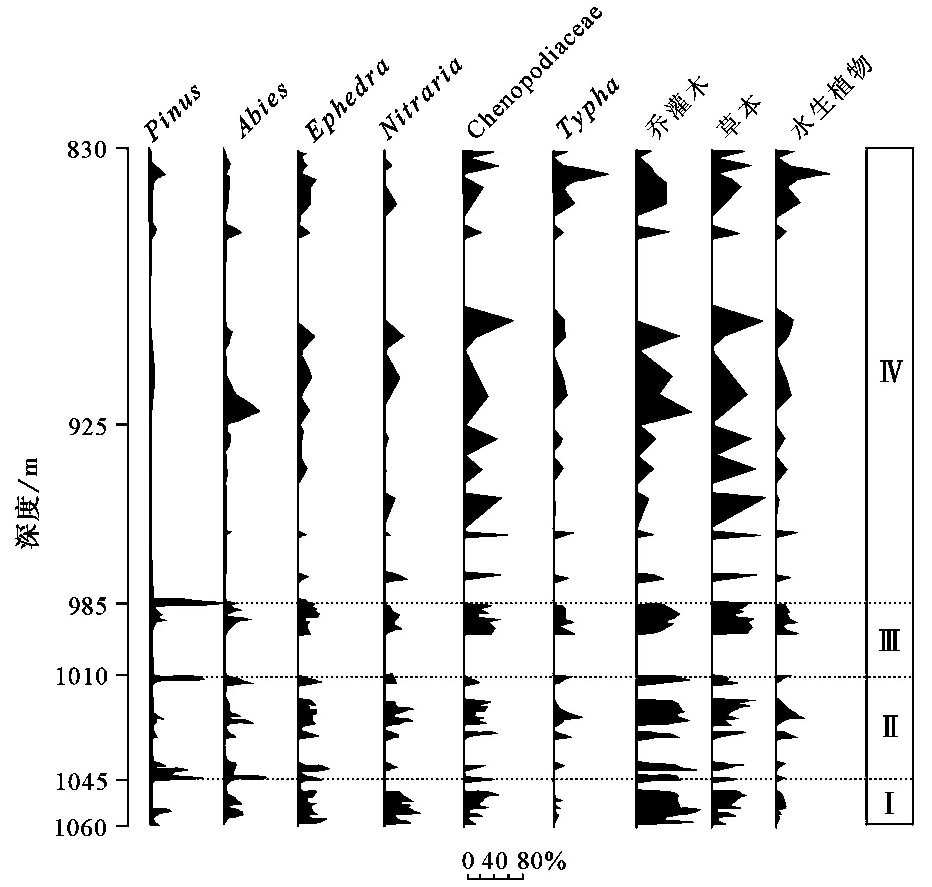
罗布泊地区晚中新世(7.1~5.3Ma)孢粉组合以中-旱生的藜科、蒿属、白刺属和麻黄属等草本和灌木植物花粉为主(图11),当时植被为草原类型,周围山坡上生长着冷杉属、松属和桦木属等木本植物。蒿藜比值的变化反映了晚中新世时期干湿波动的气候条件[26]。
|
图 11 罗布泊钻孔晚中新世花粉谱(改自Hao等[26]) Fig.11 Late Miocene pollen diagram of Lop Nur borehole (modified from Hao et al.[26]) |
塔里木盆地桑株地区晚新生代地层(晚中新世-早更新世)孢粉组合主要以蒿属、藜科、禾本科和毛茛科(Ranunculaceae)等草本植物花粉为主(图12),结合磁化率、粒度和有机碳等其他指标的研究结果,揭示了5.3Ma以来塔里木盆地干旱化加剧,其可能原因是昆仑山脉在5.3Ma的构造抬升有效地阻挡了印度季风携带的暖湿气流进入盆地,从而增强了雨影效应[27]。

|
图 12 塔里木盆地晚新生代地层磁化率、粒度、有机碳和孢粉浓度变化(引自Sun等[27]) Fig.12 Magnetic susceptibility,particle size,organic carbon and pollen concentration of Cenozoic strata of Tarim Basin (cited from Sun et al.[27]) |
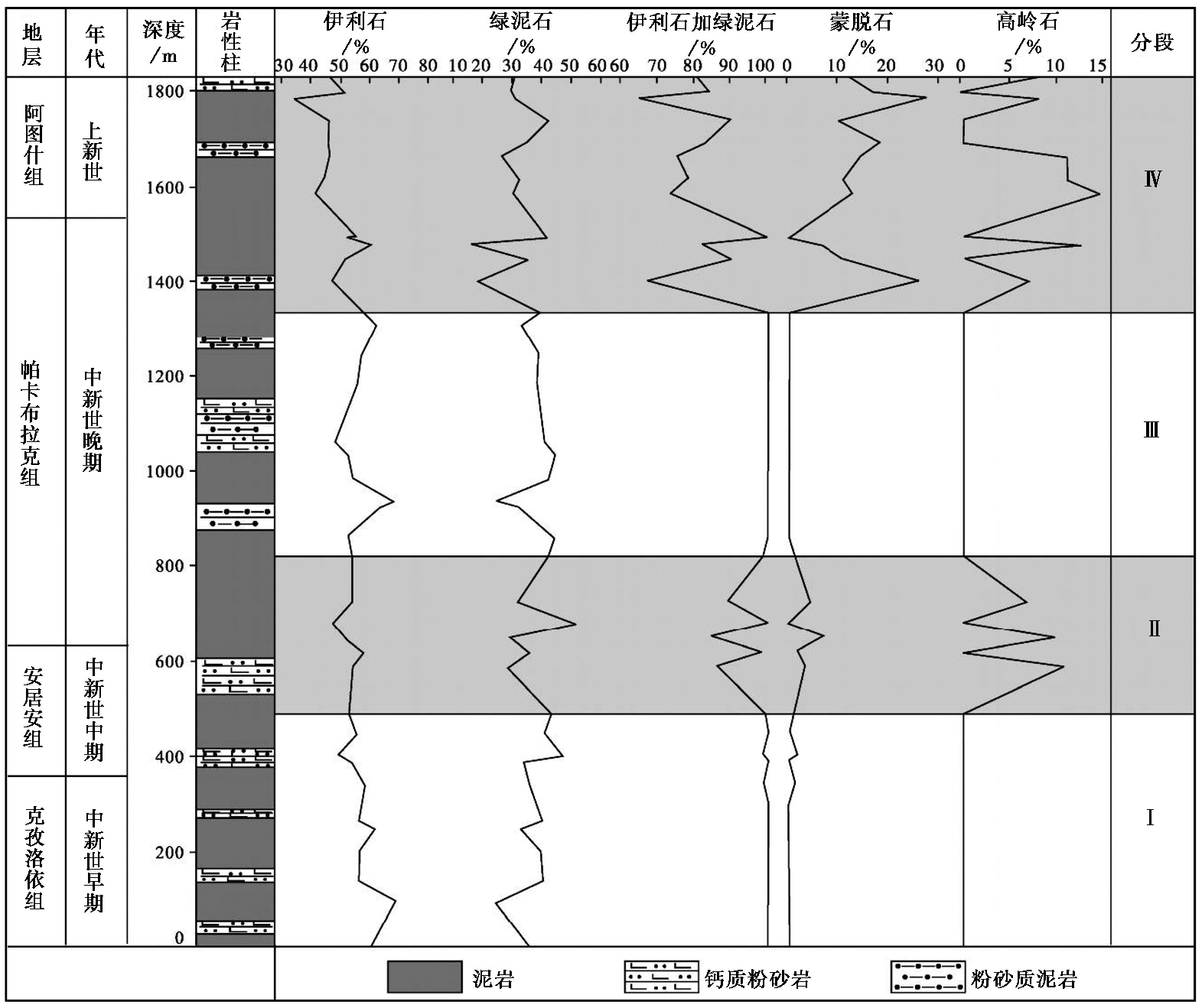
塔西南地区其木干剖面粘土矿物特征揭示了该地区中新世-上新世古气候总体以干旱为主,经历了干旱(Ⅰ段)→相对湿润(Ⅱ段)→干旱(Ⅲ段)→相对湿润(Ⅳ段)的演化过程[28](图13)。其中Ⅰ段与克孜洛依组的孢粉组合特征相吻合,主要以喜干旱的麻黄属花粉占优势,反映了干旱气候;Ⅱ段与安居安组的孢粉组合反映的古气候相一致,以松科植物占优势,其次是喜湿的温带落叶阔叶植物,指示以温带半干旱半湿润为主的气候特征[29]。总的来说,在整体干旱的气候背景下,塔西南地区出现了相对的湿润期,但是中新世比上新世更为干旱[28]。
|
图 13 塔西南地区其木干剖面粘土矿物特征变化曲线(引自杜鹃等[28]) Fig.13 Curves showing change in characteristics of clay mineral of Qimugan section, Taxinan region (cited from Du et al.[28]) |
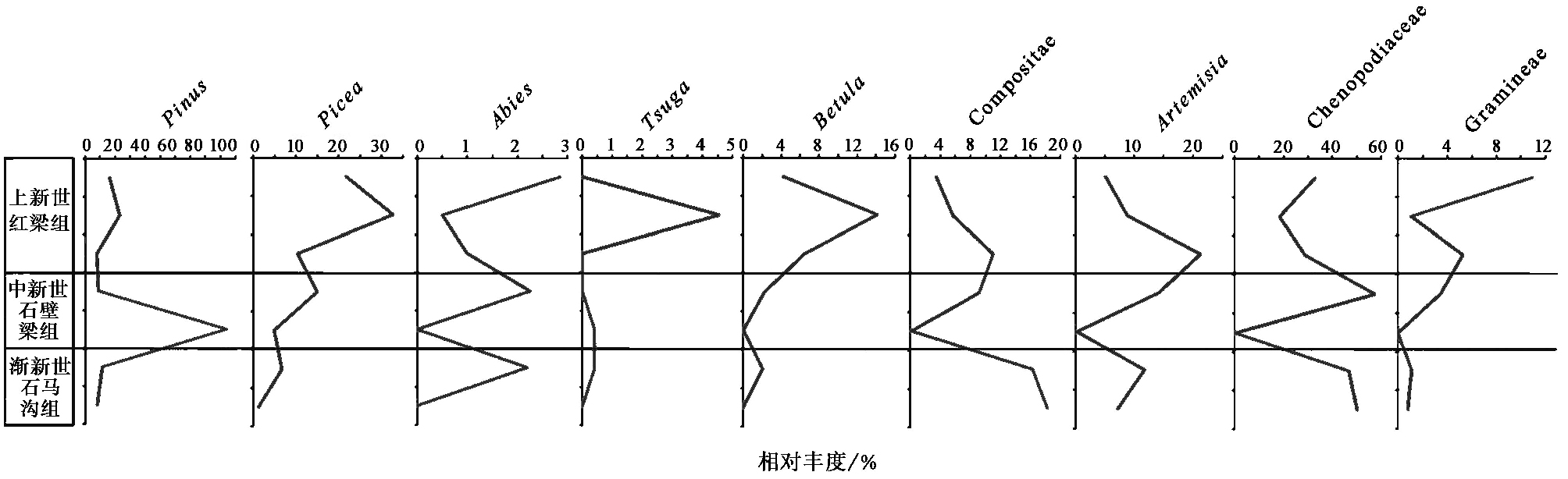
东昆仑库木库里盆地中新世石壁梁组下段孢粉组合以松属和云杉属花粉为主,上段以藜科、蒿属和云杉属花粉占优势;上新世红梁组下段以藜科、蒿属、菊科和麻黄属花粉为代表,上段以藜科、蒿属、禾本科、云杉属、松属和桦木属为特征(图14)。孢粉组合反映了中新世至上新世当地植被经历了森林→森林草原→荒漠草原→森林草原的转变,气候相应地经历了温暖潮湿→寒冷干燥→炎热干燥→寒冷干燥的变化过程;同时利用云杉、铁杉等山地针叶树花粉含量的变化作为海拔高度变化的标志,揭示了至上新世末期昆仑山海拔已达到3000 m左右的高度[30]。
|
图 14 库木库里盆地主要花粉类型含量变化(改自肖爱芳等[30]) Fig.14 Pollen diagram of major taxa recovered from Kumukuli Basin (modified from Xiao et al.[30]) |
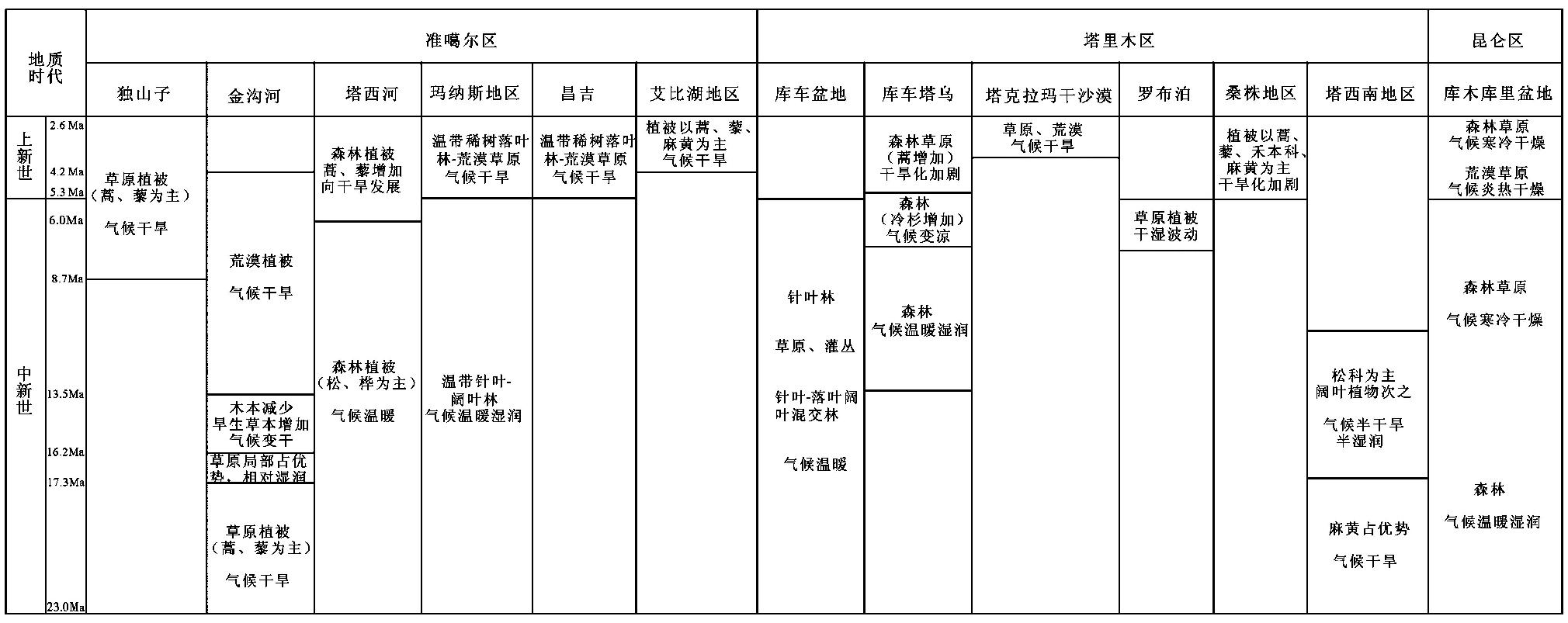
中新世早期,准噶尔区、塔里木区和昆仑区基本是以森林植被为主,当时气候温暖湿润,局部地区出现以蒿、藜为主的草原植被(例如:金沟河地区),指示局部地区气候干旱。中新世晚期准噶尔区独山子出现了以蒿、藜为主的草原植被,金沟河地区出现了荒漠植被,其他地区仍以森林植被为主,但旱生的草本植物明显增加,反映气候开始变得温暖干旱;晚期塔里木区的罗布泊出现草原植被,库车塔乌地区仍以森林植被为主,而库车盆地也出现了草原、灌丛及针叶林植被,说明气候总体上以干旱偏凉为主,存在干湿的波动;晚期昆仑区的库木库里盆地分布着森林草原植被,反映了气候由早期的温暖湿润过渡到晚期的寒冷干燥(图15)。
|
图 15 新疆地区新近纪植被格局与气候环境演化 Fig.15 Neogene vegetation pattern, climate and environment evolution in Xinjiang region |
上新世时期,整个新疆地区的气候显著干旱化。在准噶尔区的玛纳斯地区和昌吉地区出现稀树落叶林-荒漠草原,金沟河地区在中中新世出现的荒漠植被一直延续到上新世,独山子和艾比湖地区是以蒿、藜为主的草原植被,塔西河地区森林植被中的旱生成分也明显增加;在塔里木区的塔克拉玛干沙漠出现草原和荒漠,桑株地区也是以旱生草本为主,库车塔乌地区旱生草本蒿属植物大量增加;在昆仑区的库木库里盆地也出现荒漠草原(图15)。
青藏高原、昆仑山山脉和天山山脉的抬升是导致新疆地区新近纪植被变化和环境演变的主要因素之一。晚渐新世与早中新世之交,亚洲季风形成[31, 32, 33, 34],此时青藏高原、昆仑山脉和天山山脉尚未抬升到足够的高度,还不足以成为气候的天然屏障,阻挡从印度洋携带的暖湿气流进入新疆地区,因此中新世早期气候相对温暖湿润,有利的气候条件孕育了森林植被。该时期新疆地区的气候环境与我国南方大部分地区的温暖湿润气候基本一致[35]。早中新世以后,造山运动在全球范围内加剧,尤其是喜马拉雅山和青藏高原自晚中新世以后加速抬升,影响了季风气候系统的格局[4, 36, 37]。而现代天山山脉的形成也主要始于新近纪,中新世以后天山快速抬升以及两侧盆地强烈下沉[38, 39]。此时青藏高原、昆仑山山脉和天山山脉已经达到相当的高度,阻挡了部分暖湿气流进入新疆地区,因此晚期气候开始变得温暖干旱。到了上新世,青藏高原、昆仑山山脉和天山山脉已经抬升很高,有效地阻挡了暖湿气流的进入,导致气候干旱化加剧,开始出现草原和荒漠草原。
晚新生代全球变冷是导致新疆地区新近纪植被和环境变化的另一个主要因素。例如:天山北坡金沟河剖面晚渐新世-上新世(28.0~4.2Ma)孢粉记录的植被和气候变化与底栖有孔虫氧同位素记录的全球温度变化有较好的一致性,揭示了中亚地区干旱化的形成受到晚新生代全球变冷和区域造山运动的影响[17]。全球变冷同时也是欧亚大陆干旱化的主导因素,因为气候变冷会减少大气中的水蒸汽,减弱水循环的强度,从而导致陆地逐渐变干[40, 41, 42, 43]。
此外,研究地点的地形地貌、雨影效应、迎风和背风等因素以及古特提斯海退却也可能会对新疆地区新近纪植被格局和气候环境产生一定的影响。例如:天山北坡塔西河剖面[18]和南坡库车塔乌剖面[24]的孢粉组合都记录了发生在晚中新世的干旱事件(北坡发生在6Ma,南坡5.23Ma),两个孢粉组合不同之处在于天山南坡在7Ma时冷杉花粉突然增加,其原因可能与准噶尔盆地和塔里木盆地的地形地貌和水汽来源有一定关联。准噶尔盆地位于天山的迎风面,南面是天山,东北面是阿尔泰山,北极和大西洋来的暖湿气流能够从西面和西北面进入盆地,因此天山北部的抬升对准噶尔盆地的气候和植被不起关键作用。塔里木盆地位于天山的背风面,北面是天山,西面是帕米尔高原,南面是昆仑山,印度洋和北极来的水汽分别被喜马拉雅山和天山山脉阻挡,水汽很难进入盆地内部。所以天山的雨影效应对塔里木盆地的气候至关重要[24]。同位素证据表明中亚地区中中新世干旱化加剧与古特提斯海退却、喜马拉雅山、青藏高原、天山和帕米尔高原的抬升都有关联[44],其中古特提斯海从塔里木盆地退却导致盆地附近的水源缺乏,从而向着更加干旱的大陆性气候发展[45]。
5 存在问题与展望通过综合分析新疆地区新近纪孢粉资料,我们发现部分地层剖面和钻孔仅仅根据《新疆维吾尔自治区区域地质志》上描述的地层层序来进行孢粉样品的采集和分析,缺乏精确的年代数据。由于地层年龄没有得到很好地控制,因此往往只能根据孢粉组合特征和地层对比来推测区域植被的演替和环境的变迁,为对比研究整个新疆地区新近纪植被格局和气候环境变化带来一定的不确定性。所以,今后在新疆地区开展新近纪孢粉地层学工作的同时,应当加强年代地层学方面的研究。此外,该地区新近纪古气候定量方面的工作也有必要加强。
| 1 | Zachos J, Pagani M, Sloan L et al. Trends, rhythms, and aberrations in global climate: 65Ma to present. Science, 2001, 292 (5517): 686~693 |
| 2 | Cerling T E, Wang Y, Quade J. Expansion of C4 ecosystems as indicator of global ecological change in the Late Miocene. Nature, 1993, 361 (6410): 344~345 |
| 3 | Cerling T E, Harris J M, MacFadden B J et al. Global vegetation change through the Miocene~Pliocene boundary. Nature, 1997, 389 (6647): 153~158 |
| 4 | An Z S, Kutzbach J E, Prell W L et al. Evolution of Asian monsoons and phased uplift of the Himalaya~Tibetan Plateau since Late Miocene times. Nature, 2001, 411 (6833): 62~66 |
| 5 | Zheng H B, Powell C McA, Read D K et al. Late Miocene and Mid~Pliocene enhancement of the East Asian monsoon as viewed from the land and sea. Global and Planetary Change, 2004, 41 (3): 147~155 |
| 6 | Ségalen L, Lee~Thorp J A, Cerling T. Timing of C4 grass expansion across sub~Saharan Africa. Journal of Human Evolution, 2007, 53 (5): 549~559 |
| 7 | Mosbrugger V, Utescher T, Dilcher D L. Cenozoic continental climatic evolution of Central Europe. Proceedings of the National Academy of Sciences, 2005, 102 (42): 14964~14969 |
| 8 |
新疆维吾尔自治区地质矿产局. 新疆维吾尔自治区区域地质志. 北京: 地质出版社, 1993.1~50 Bureau of Geology and Mineral Resources of Xinjiang Uygur Autonomous Region. Regional Geology of Xinjiang Uygur Autonomous Region. Beijing: Geological Publishing House, 1993. 1~50 |
| 9 | 中国地层编辑委员会. 中国地层典(第三系). 北京: 地质出版社, 1999. 163 China Stratigraphical Editorial Committee. Stratigraphy of China (Tertiary).Beijing: Geological Publishing House, 1999. 163 |
| 10 | Peng X L. Positions and stratigraphical control of the Cenozoic mammalian fossils in the Junggar Basin of Xinjiang. Vertebrate PalAsiatica, 1975, 13 : 185~189 |
| 11 | Fu B H, Lin A M, Kano K et al. Quaternary folding of the eastern Tianshan, Northwest China. Tectonophysics, 2003, 369 (1): 79~101 |
| 12 | Sun J M, Zhu R X, Bowler J. Timing of the Tianshan Mountains uplift constrained by magnetostratigraphic analysis of molasse deposits. Earth and Planetary Science Letters, 2004, 219 (3~4): 239~253 |
| 13 |
孙继敏, 朱日祥. 天山北麓晚新生代沉积及其新构造与古环境指示意义. 第四纪研究, 2006, 26 (1): 14~19 Sun Jimin, Zhu Rixiang. Cenozoic deposits in the northern Tianshan Mountains and its implications for neotectonics and environmental changes. Quaternary Sciences, 2006, 26 (1): 14~19 |
| 14 | 吕红华, 王 玮, 常 远等. 新疆天山造山带新生代多期次剥露作用过程. 第四纪研究, 2013, 33 (4): 812~822 Lü Honghua, Wang Wei, Chang Yuan et al. Cenozoic episodic exhumation of the Tian Shan range, NW China. Quaternary Sciences, 2013, 33 (4): 812~822 |
| 15 | Molnar P, England P. Late Cenozoic uplift of mountain range sand global climate change: Chicken or egg? Nature, 1990, 346 (6279): 29~34 |
| 16 | Sun J M, Xu Q H, Huang B C. Late Cenozoic magnetochronology and paleoenvironmental changes in the northern foreland basin of the Tianshan Mountains. Journal of Geophysical Research, 2007, 112 : B04107, doi: 10.1029/2006JB004653 |
| 17 | Tang Z H, Ding Z L, White P D et al. Late Cenozoic Central Asian drying inferred from a palynological record from the northern Tianshan. Earth and Planetary Science Letters, 2011, 302 (3): 439~447 |
| 18 | Sun J M, Zhang Z Q. Palynological evidence for the Mid~Miocene climatic optimum recorded in Cenozoic sediments of the Tianshan Range, Northwestern China. Global and Planetary Change, 2008, 64 (1): 53~68 |
| 19 |
阎 顺. 新疆玛纳斯地区上新世孢粉组合及其意义. 干旱区地理, 1985, 8 (2): 29~34 Yan Shun. Palynological composition and its significant of Pliocene in Manasi, Xinjiang.Arid Land Geography, 1985, 8 (2): 29~34 |
| 20 |
阎 顺, 许英勤. 天山北麓平原区晚第三纪晚期~更新世的孢粉组合及环境变迁. 新疆地质, 1988, 6 (2): 59~65 Yan Shun, Xu Yingqin. Spore~pollen association and environmental evolution in northern piedment plain of Tianshan Mountain from Late Neogene to Pleistocene. Xinjiang Geology, 1988, 6 (2): 59~65 |
| 21 |
张金起, 刘 斌, 陈旭光等. 新疆艾比湖东南缘K3孔晚新生代环境演化. 现代地质, 2009, 23 (6): 1012~1021 Zhang Jinqi, Liu Bin, Chen Xuguang et al. Environmental evolution at the drilling hole K3 in the southeast margin of Ebinur Lake, Xinjiang in Late Cenozoic. Geoscience, 2009, 23 (6): 1012~1021 |
| 22 |
阎 顺. 新疆库车盆地第三纪孢粉化石及其所反映的自然环境. 新疆地理, 1983, 4 : 18~26 Yan Shun. Tertiary spore~pollen fossil and natural environment in Kuche Basin, Xinjiang. Xinjiang Geography, 1983, 4 : 18~26 |
| 23 |
金小赤, 王大宁, 柳永清等. 新疆库车库尔哈剖面两个新生代孢粉组合的时代和环境意义. 地质通报, 2002, 21 (12): 823~833 Jin Xiaochi, Wang Daning, Liu Yongqing et al. Two Cenozoic palynological assemblages of the Kurha section, Kuqa, Xinjiang and their age and environmental significance. Geological Bulletin of China, 2002, 21 (12): 823~833 |
| 24 | Zhang Z Q, Sun J M. Palynological evidence for Neogene environmental change in the foreland basin of the southern Tianshan Range, Northwestern China. Global and Planetary Change, 2011, 75 (1): 56~66 |
| 25 |
阎 顺, 许英勤. 新疆塔克拉玛干沙漠中两个钻孔的孢粉分析及其意义. 新疆地质, 1990, 8 (4): 342~350 Yan Shun, Xu Yingqin. Analysis of pollen from two drill holes in Taklimakan Desert of Xinjiang and its significance.Xinjiang Geology, 1990, 8 (4): 342~350 |
| 26 | Hao H, Ferguson D K, Chang H et al. Vegetation and climate of the Lop Nur area, China, during the past 7 million years. Climatic Change, 2012, 113 (2): 323~338 |
| 27 | Sun J M, Zhang L Y, Deng C L et al. Evidence for enhanced aridity in the Tarim Basin of China since 5.3Ma. Quaternary Science Reviews, 2008, 27 (9): 1012~1023 |
| 28 |
杜 鹃, 洪汉烈, 张克信等. 新疆其木干剖面中新世~上新世沉积物粘土矿物特征及其古气候指示意义. 生态学杂志, 2010, 29 (5): 923~932 Du Juan, Hong Hanlie, Zhang Kexin et al. Clay mineralogy and its palaeoclimatic indicative significance of Miocene-Pliocene sediments in Qimugan of Xinjiang. Chinese Journal of Ecology, 2010, 29 (5): 923~932 |
| 29 | Wang D N, Sun X Y, Zhao Y N. Palynoflora from Late Cretaceous to Tertiary in some regions of Qinghai and Xinjiang. Review of Palaeobotany and Palynology, 1990, 65 (1): 95~104 |
| 30 |
肖爱芳, 黎敦朋, 张汉军等. 新疆库木库里盆地渐新-上新统孢粉组合特征与古气候演变. 陕西地质, 2003, 21 (1): 36~44 Xiao Aifang, Li Dunpeng, Zhang Hanjun et al. Climate evolution and compositional features of sporopollen in the Oligocene-Pliocene series of the Kumukuli Basin in Xinjiang. Geology of Shaanxi, 2003, 21 (1): 36~44 |
| 31 | Guo Z T, Ruddiman W F, Hao Q Z. Onset of Asian desertification by 22 Myr ago inferred from loess deposits in China. Nature, 2002, 416 (6877): 159~163 |
| 32 | Sun X J, Wang P X. How old is the Asian monsoon system? —Palaeobotanical records from China. Palaeogeography, Palaeoclimatology, Palaeoecology, 2005, 222 (3): 181~222 |
| 33 | Wang P, Clemens S, Beaufort I. Evolution and variability of the Asian monsoon system: State of the art and outstanding issues. Quaternary Science Reviews, 2005, 24 (5): 595~629 |
| 34 | Li F J, Rousseau D D, Wu N Q et al. Late Neogene evolution of the East Asian monsoon revealed by terrestrial mollusk record in western Chinese Loess Plateau: From winter to summer dominated sub~regime. Earth and Planetary Science Letters, 2008, 274 (3): 439~447 |
| 35 | Yao Y F, Bruch A, Mosbrugger V et al. Quantitative reconstruction of Miocene climate patterns and evolution in Southern China based on plant fossils. Palaeogeography, Palaeoclimatology, Palaeoecology, 2011, 304 (3): 291~307 |
| 36 |
郭正堂, 彭淑贞, 郝青振等. 晚第三纪中国西北干旱化的发展及其与北极冰盖形成演化和青藏高原隆升的关系. 第四纪研究, 1999, (6):556~567 Guo Zhengtang, Peng Shuzhen, Hao Qingzhen et al. Late Tertiary development of aridification in Northwestern China: Link with the Arctic ice~sheet formation and Tibetan uplifts. Quaternary Sciences, 1999, (6):556~567 |
| 37 |
安芷生, 张培震, 王二七等. 中新世以来我国季风-干旱环境演化与青藏高原的生长. 第四纪研究, 2006, 26 (5) : 678~693 An Zhisheng, Zhang Peizhen, Wang Erchie et al. Changes of the monsoon-arid environment in China and growth of the Tibetan Plateau since the Miocene. Quaternary Sciences, 2006, 26 (5) : 678~693 |
| 38 |
卢德源, 李秋生, 高 锐等. 横跨天山的人工爆炸地震剖面. 科学通报, 2000, 45 (9): 982~987 Lu Deyuan, Li Qiusheng, Gao Rui et al. A deep seismic sounding profile across the Tianshan Mountains. Chinese Science Bulletin, 2000, 45 (22): 2100~2106 |
| 39 |
张培震. 天山及其前陆盆地的晚新生代构造变形. 科学通报, 2003, 48 (24): 2249~2250 Zhang Peizhen.Late Cenozoic tectonic deformation in the Tianshan Mountain and its foreland basins. Chinese Science Bulletin, 2004, 49 (4):311~313 |
| 40 | Miao Y F, Herrmann M, Wu F L et al. What controlled Mid-Late Miocene long-term aridification in Central Asia—Global cooling or Tibetan Plateau uplift: A review. Earth-Science Reviews, 2012, 112 (3): 155~172 |
| 41 |
方小敏, 吴福莉, 韩文霞等. 上新世~第四纪亚洲内陆干旱化过程——柴达木中部鸭湖剖面孢粉和盐类化学指标证据. 第四纪研究, 2008, 28 (5):874~882 Fang Xiaomin, Wu Fuli, Han Wenxia et al.Plio-Pleistocene drying process of Asian inland——Sporopollen and salinity records from Yahu section in the central Qaidam Basin. Quaternary Sciences, 2008, 28 (5):874~882 |
| 42 |
脱世博, 方小敏, 宋春晖等. 青藏高原东北部西宁盆地晚渐新世-早中新世沉积物岩石磁学特征及其古环境意义. 第四纪研究, 2013, 33 (5): 829~838 Tuo Shibo, Fang Xiaomin, Song Chunhui et al. Rock magnetic characteristics of the Late Oligocene to Early Miocene sediments in the Xining Basin, northeastern Tibetan Plateau. Quaternary Sciences, 2013, 33 (5): 829~838 |
| 43 |
常秋芳, 常 宏. 罗布泊Ls2孔近7.1Ma以来沉积物的环境磁学研究. 第四纪研究, 2013, 33 (5): 876~888 Chang Qiufang, Chang Hong. The environmental magnetism study of core Ls2 in Lop Nur, Tarim since 7.1Ma. Quaternary Sciences, 2013, 33 (5): 876~888 |
| 44 | Zhuang G S, Hourigan J K, Koch P L et al. Isotopic constraints on intensified aridity in Central Asia around 12Ma. Earth and Planetary Science Letters, 2011, 312 (1): 152~163 |
| 45 | Zhang Z, Wang H, Guo Z et al. What triggers the transition of palaeoenvironmental patterns in China, the Tibetan Plateau or the Paratethys Sea retreat? Palaeogeography, Palaeoclimatology, Palaeoecology, 2007, 245 (3): 317~331 |
Abstract
Neogene(23.0~2.6Ma, including Miocene and Pliocene) is an important transitional stage from the greenhouse climate of the Palaeogene to the icehouse climate of the Quaternary.During this period, numerous climatic, tectonic and biotic key events occurred on earth, such as the formation of the Antarctic ice sheet, enhancement of the Asian monsoon, acceleration of Tibetan Plateau uplift and expansion of C4 grasses.The study on vegetation, climate and environment in this time interval is crucial and useful for understanding the formation of their present pattern.
Xinjiang Uygur Autonomous Region is located in the internal arid area of Northwestern China, with a typical continental climate.The Neogene strata of Xinjiang distribute widely and can be divided into five regions from north to south, viz.Junggar, Tianshan, Tarim, Kunlun and Kalakunlun.Since the eighties of twenty century, more emphasis was concentrated on the northern and southern slopes of Tianshan Mountain such as Junggar and Tarim regions, especially the Cenozoic deposits from the foreland basin of the northern slope of Tianshan Mountain where a large number of researches have been done, including mammals, ostracoda, tectonic deformation and magnetostratigraphy.The Late Cenozoic vegetation is related to tectonic event in the Asian high latitude region, so palynological study is helpful in deciphering the interrelationship between orogeny and climate change.
This paper reviews the Neogene palynological literature published during the last three decades in Xinjiang region, and the vegetation pattern, climate and environment evolution in the Neogene were recognized by means of temporal and spatial comparison.In the Early Miocene, forest vegetation (mainly needle- and broad-leaved mixed forest) flourished in most areas of Xinjiang due to the warm and humid climatic conditions, with the exception of steppe vegetation growing in partial area.During the Late Miocene, the climate became warm and dry.Steppe vegetation (mainly Artemisia and Chenopodiaceae) occurred in Dushanzi of Junggar region, Lop Nur area and Kuche Basin of Tarim region.Desert vegetation emerged in Jingouhe of Junggar region.Forest or forest-steppe vegetation was distributed in the other regions.However, the aridification of climate was speeded up in the Pliocene, steppe and desert-steppe occurred in Junggar region, Tarim region and Kunlun region.The gobal cooling and the acceleration of uplift of Tibetan Plateau, Kunlun Mountains and Tianshan Mountains in the Late Cenozoic might be two crucial forcing factors on the development of Neogene vegetation, climate and environment pattern in Xinjiang and the intensified aridity in Central Asia.In addition, other secondary factors should be considered, including the topography, rainfall shadow, windward and leeward of the study area and the retreat of Paratethys.
Owing to the uncertainty of age control of some palynological studies, vegetation succession and environment change were inferred based on pollen assemblages and stratigraphical comparison.In the future, more studies on chronostratigraphy and quantitative reconstruction of Neogene climate in Xinjiang are necessary.Neogene(23.0~2.6Ma, including Miocene and Pliocene) is an important transitional stage from the greenhouse climate of the Palaeogene to the icehouse climate of the Quaternary.During this period, numerous climatic, tectonic and biotic key events occurred on earth, such as the formation of the Antarctic ice sheet, enhancement of the Asian monsoon, acceleration of Tibetan Plateau uplift and expansion of C4 grasses.The study on vegetation, climate and environment in this time interval is crucial and useful for understanding the formation of their present pattern.
Xinjiang Uygur Autonomous Region is located in the internal arid area of Northwestern China, with a typical continental climate.The Neogene strata of Xinjiang distribute widely and can be divided into five regions from north to south, viz.Junggar, Tianshan, Tarim, Kunlun and Kalakunlun.Since the eighties of twenty century, more emphasis was concentrated on the northern and southern slopes of Tianshan Mountain such as Junggar and Tarim regions, especially the Cenozoic deposits from the foreland basin of the northern slope of Tianshan Mountain where a large number of researches have been done, including mammals, ostracoda, tectonic deformation and magnetostratigraphy.The Late Cenozoic vegetation is related to tectonic event in the Asian high latitude region, so palynological study is helpful in deciphering the interrelationship between orogeny and climate change.
This paper reviews the Neogene palynological literature published during the last three decades in Xinjiang region, and the vegetation pattern, climate and environment evolution in the Neogene were recognized by means of temporal and spatial comparison.In the Early Miocene, forest vegetation (mainly needle- and broad-leaved mixed forest) flourished in most areas of Xinjiang due to the warm and humid climatic conditions, with the exception of steppe vegetation growing in partial area.During the Late Miocene, the climate became warm and dry.Steppe vegetation (mainly Artemisia and Chenopodiaceae) occurred in Dushanzi of Junggar region, Lop Nur area and Kuche Basin of Tarim region.Desert vegetation emerged in Jingouhe of Junggar region.Forest or forest-steppe vegetation was distributed in the other regions.However, the aridification of climate was speeded up in the Pliocene, steppe and desert-steppe occurred in Junggar region, Tarim region and Kunlun region.The gobal cooling and the acceleration of uplift of Tibetan Plateau, Kunlun Mountains and Tianshan Mountains in the Late Cenozoic might be two crucial forcing factors on the development of Neogene vegetation, climate and environment pattern in Xinjiang and the intensified aridity in Central Asia.In addition, other secondary factors should be considered, including the topography, rainfall shadow, windward and leeward of the study area and the retreat of Paratethys.
Owing to the uncertainty of age control of some palynological studies, vegetation succession and environment change were inferred based on pollen assemblages and stratigraphical comparison.In the future, more studies on chronostratigraphy and quantitative reconstruction of Neogene climate in Xinjiang are necessary.