 2015, Vol.35


关于末次冰期的气候环境特征和演变规律,前人从深海沉积物、黄土古土壤序列等及冰芯、石笋、孢粉、年代学等方面进行了大量研究,取得了许多成果[1, 2, 3, 4, 5, 6, 7, 8, 9, 10, 11, 12, 13, 14, 15, 16, 17]。然而,从哺乳动物的角度进行相关系统研究相对较少[18, 19, 20, 21, 22]。前人曾以东北地区第四纪大型食草类动物群的体型大小、种群密度及地理分布等角度,探讨了其与气候变迁的关系[23]。本文在前人工作的基础上,参考绝对年龄资料,以距今40~10ka动物群中食草类动物组成特征,探讨化石分布区末次冰期的环境演变历程,同时与渭河流域关中地区的3个动物群进行比较,讨论末次冰盛期在不同地区的不同反映。
1 距今40~10ka前东北及相邻地区的化石记录大型食草类动物对所食植物依赖性较强[24, 25, 26, 27],他们的兴衰演替可能反映了他们生活时期植物类型的变化发展,而植物对气候的变化比较敏感,其分布受气候控制[25, 28]。大型食草类动物的地史分布可以作为指标展示古气候演化历程[23, 29, 30, 31, 32]。
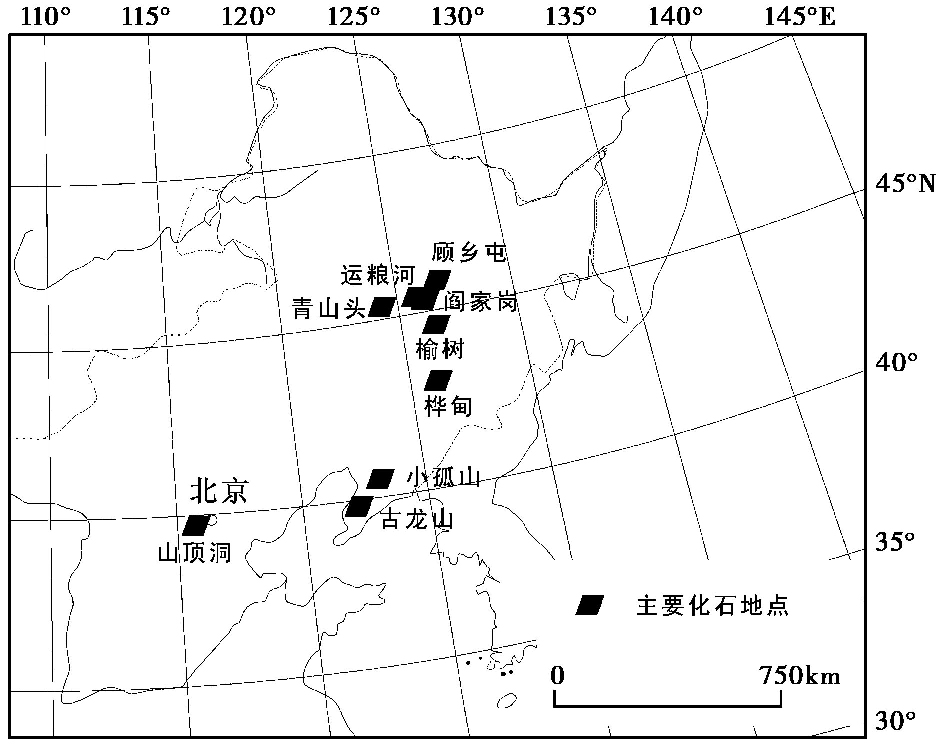
据研究资料[23, 33, 34, 35, 36, 37, 38, 39, 40, 41, 42, 43, 44, 45],距今40~10ka前,东北及相邻地区主要化石点从早到晚依次有顾乡屯 (40ka B.P.)[23, 33]、桦甸仙人洞(34.3 ka B.P.)[34]、榆树(30 ka B.P.)[23, 44]、小孤山(30 ka B.P.)[23, 37]、阎家岗(22ka B.P.)[23, 38]、山顶洞(18 ka B.P.)[23, 45]、古龙山(17 ka B.P.)[23, 39]、运粮河(14 ka B.P.)[23, 38]、青山头(11ka B.P.)[23, 40]等地点(图1)。
|
图 1 东北及邻区距今40~10ka主要化石地点 根据董为等[23]修改顾乡屯(Guxiangtun)40ka B.P.,桦甸仙人洞(Huadian)34ka B.P.,榆树(Yushu)30ka B.P.,小孤山(Xiaogushan)30ka B.P.,阎家岗(Yanjiagang)22ka B.P.,山顶洞(Shandingdong)18ka B.P.,古龙山(Gulongshan)17ka B.P.,运粮河(Yunlianghe)14ka B.P.,青山头(Qingshantou)11ka B.P. Fig.1 Distribution of large herbivores from major fossil sites in Northeast China and adjacent areas from 40~10ka B.P.Modified from Dong et al.,1996[23] |
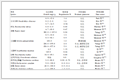
参照前人资料[23],我们对上述地点动物群中的大型食草类化石动物(包括长鼻目、 奇蹄目和偶蹄目以及杂食的猪类等)的组成及其分布进行统计( 表1),表1中所采用的参考绝对年龄为上下限之间的平均值[33, 34, 36, 37, 38, 39, 40, 41, 42, 44, 45]。
根据现代动物生态、 动物地理学研究[24, 46],不同的自然环境区域,具有不同的动物生活条件。所以在各个自然气候环境带中,动物的组成和生态基本上各不相同。虽然有些动物,适应能力较强,分布区较广,可以生活于几个气候-植被带,然而每个带中都各有一群基本成分,对该带环境有较高的适应性,是该带生存竞争的优胜者,在数量上形成优势种或常见种。据此,现代动物地理学家将中国基本的生态地理动物群分为以下7个[24, 46]:1)寒温带针叶林动物群; 2)温带森林-森林草原、 农田动物群; 3)温带草原动物群; 4)温带荒漠、 半荒漠动物群; 5)高地森林草原-草甸草原、 寒漠动物群; 6)亚热带林灌、 草地-农田动物群; 7)热带森林、 林灌、 草地-农田动物群。不同的动物群中各具不同的优势或常见种。如寒温带针叶林动物群中,有蹄类以驼鹿、 马鹿、 麝、 麅和野猪最为普通,麅是林缘动物,在热带林地大、 中型有蹄类如水鹿、 毛冠鹿、 鬣羚,温带草原上的有蹄类以黄羊最具代表性,温带荒漠有蹄类中最普遍的是鹅喉羚和野驴,寒漠的代表是藏羚和野牦牛,等等。
依据上述动物生态、 动物地理学研究,东北及相邻地区大型食草类化石动物被分为寒冷型(A)、 温暖型(B)、 苔原型(C)、 森林型(D)、 疏林型(E)、 草原型(F)、 沼泽型(G)等不同类型(见 表1)。
|
表 1 东北及邻区40~10ka B.P.时期主要化石地点的大型食草类动物分布及其生态类型* Table 1 Distribution and their ecological types of large herbivores from major fossil sites in Northeast China and adjacent areas from 40~10ka B.P. |
总体上看,动物群主要由冻土苔原、 草原及森林型动物组成,几乎都含有猛犸象和披毛犀动物,是典型的中国北方晚更新世猛犸象-披毛犀动物群(Mammuthus-Coelodonta fauna),但其森林型动物的分布却明显起伏变化。
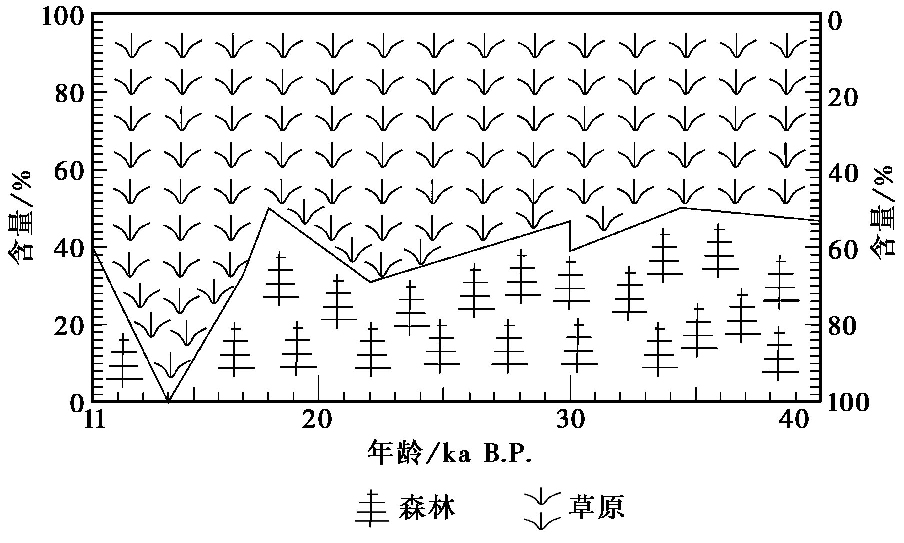
在40ka B.P. 、 30ka B.P. 和18ka B.P. 时,森林型动物较多,如Stephanorhinus kirchbergensis、 Sus scrofa、 Moschus moschiferus、 Moschus sp.、 Cervus hortulorum、 Cervus elaphus xanthopygus、 Cervus(Sika)grayi、 Megaloceros ordosianus、 Alces alces、 Capreolus manchuricus和Rangifer tarandus等组成,并伴有一定的沼泽型动物; 在34.3ka B.P. 、 22ka B.P. 、 17ka B.P. 和11ka B.P. 变为疏林型草原为主,如Bison(Parabison)exiguus、 Bos primigenius、 Bos taurus、 Bos sp.、 Procapra przewalskii、 Pachygazella sp.、 Spirocerus kiakhtensis、 Naemorhedus goral、 Ovis ammon、 Equus hemionus、 Equus dalianensis、 Equus przewalskii和Equus sp. 等; 在14ka B.P. 森林和疏林型草原全部消失,只有苔原和草原型动物,如Mammuthus primigenius、 Coelodonta antiguitatis、 Equus dalianensis、 Bison(Parabison)exiguus和Equus przewalskii等。到大约11ka B.P. 的青山头动物群,虽然也仅有5种动物,与前边的运粮河动物群(大约14ka B.P. )却截然不同: 不但少了苔原动物,同时还增加了森林类型,应该是气候环境发生明显变化的结果。当然这个动物群的属种数确实太少,我们也期待着更多的化石发现来进一步验证或补充我们目前所做的分析。大型食草类动物组成(见表1)的上述变化似乎表明东北及相邻地区晚更新世晚期距今40~10ka前,即末次冰期极盛期前后在冻土苔原大背景下可能经历了40ka B.P. 森林草原、 34.3ka B.P. 疏林草原、 30ka B.P. 森林草原、 22ka B.P. 疏林草原、 18ka B.P. 森林草原、 17ka B.P. 疏林草原、 14ka B.P. 无树干草原及11ka B.P. 疏林草原的变化过程。统计森林型、 草原型动物所占比例( 表2)并作图( 图2),可以看到更为清晰的环境变化过程。
|
|
表 2 森林与草原型动物所占比例统计* Table 2 Percentage of herbivores on forest and grassland through time |
|
图 2 东北地区大型食草动物所反映的环境变化 Fig.2 Environmental changes reflected by large herbivorous faunas in Northeast China |
从上述记录的东北及其邻近地区大约40~10ka B.P. 时的哺乳动物资料[23, 33, 34, 35, 36, 37, 38, 39, 40, 41, 42, 43, 44, 45]来看,该区在40-17ka B.P. 这一时间段,森林和草原动物比例波动起伏,草原型动物总体上比例略高,一般大于50 % ,相应的森林性动物比例较小,多在50 % 以下,应该是一个以草原为主的森林草原环境;但是到了大约14ka B.P. 前后,森林和疏林型动物全部消失,只有苔原和草原型动物(见图2)。运粮河动物群采自顾乡屯组之上的黄土层中部[23, 38],种类很少,只有5种大型食草类动物,其成分如猛犸象(Mammuthus primigenius)、 披毛犀(Coelodonta antiguitatis)、 东北野牛(Bison(parabison)exiguus)、 马(Equus dalianensis)和普氏原羚 (Procapra przewalskii)等,几乎全是在苔原或草原上生活的种类[23, 38]。
一般认为,末次盛冰期(Last Glacial Maximum,简称LGM)在时间上约为26 . 5~19 . 0ka B.P.[6]。但在不同的区域、 不同资料可有不同的时间段,如19 . 5~15 . 1ka B.P.[3]、 23-19ka B.P.[9]、 15~12ka B.P.[11]和18-15ka B.P.[15]等。唐领余等[47]报道了黄土高原西部的孢粉记录,研究显示该区4万多年以来古植被曾经历过草原、 森林草原(或疏林草原)、 针叶林以及荒漠草原或荒漠几种植被的多次快速变化。在44.2-11.0ka B.P. 期间,静宁地区植被主要表现为森林和草原成分的相互消长,其中44-29ka B.P. 期间(MIS 3)气候以湿润为主,发育针叶林,温度低于现在; 23ka B.P. 之后,气候冷干,以稀疏草原为主,在末次盛冰期植被甚至演化为荒漠草原。其中18.2-17.0ka B.P. 正是末次盛冰期鼎盛时期,气候条件十分恶劣,很低的花粉浓度反映出植被十分贫乏。
在关中地区的渭南北庄村剖面的花粉图上[14, 15],在距今约20.8ka前后,木本植物花粉占总花粉量比例较高; 在距今约20.4ka,这个比例已经降到比较低的水平了; 到距今18ka以后,草本植物的花粉占总花粉量比例的几近100 % ,偶见的木本植物的花粉只有松属的,反映了极端干冷,无森林存在的环境。
在北京西山黄土剖面[48],末次冰期晚期(末次盛冰期,距今约24.0-13.4ka B.P. )孢粉序列与末次冰期早期的序列相似,黄土中孢粉含量极少,平均总浓度仅为4.12粒/g,并且以耐旱的蒿属、 菊科、 藜科等草本花粉占绝对优势,木本植物花粉缺乏,且种类比较单调,主要为耐寒的松、 桦等,其中部分样品中木本花粉为零,广泛发育荒漠草原植被,说明当时气候异常干冷。
从本文上述哺乳动物资料分析来看( 表1和 表2),东北及其相邻地区末次冰盛期环境最恶劣的时间似乎更晚一些,大约在14ka B.P. 前后。
据施雅凤、 王靖泰和汪品先等[49, 50]的研究,在距今 14780±700a年前后,中国东部海岸线后退到东海大陆架前缘现代水深,即155m的位置上,是东海至今发现的最低海岸线,也是末次冰期海退的最后海岸线,其位置在今长江口以东600km。
据杨子庚[51]研究,今日北黄海区域在距今 14400±150a年前后海水退去,出水成陆,并且为疏林草原环境。
从安芷生等[15]花粉变化图上看,14ka B.P. 前后华北依然位于末次盛冰期的疏林草原环境,这种状况一直持续到接近13ka B.P. 前后才有所变化,乔木花粉开始增加。
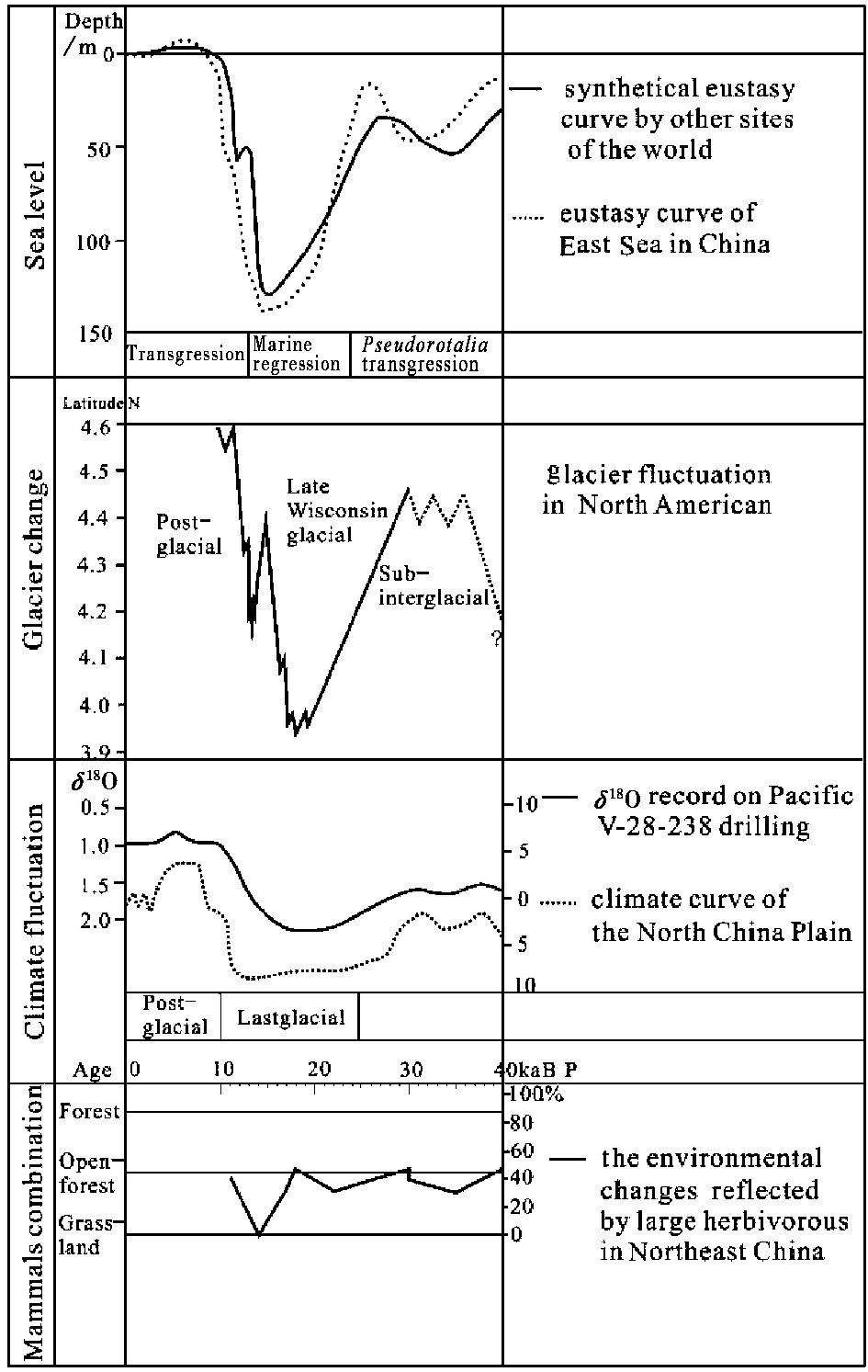
王靖泰和汪品先等[50]比较详细地研究讨论了中国东部晚更新世以来的气候变化,并拟出气候变化曲线。研究认为,如果海侵海退与气候变化相关的话,那么气候曲线与海面变化曲线之间应该出现某种对应关系。对比的结果表明,它们之间的对应关系十分鲜明,即温暖时期与高海面相对应,寒冷时期与低海面相对应,两种曲线符合得很好,而且这种对应关系在世界范围内普遍存在[50]。将前人研究的气候变化、 冰川波动和海平面升降曲线,与本文东北地区大型食草动物类型及其时代分布所反映的森林进退曲线进行比较( 图3),结果相当一致,显示出良好的拟合关系,这表明哺乳动物对环境变化同样具有良好的反映。
|
图 3 哺乳动物组合与气候变化、冰川波动及海面升降之比较气候变化、冰川波动及海面升降资料(据文献[50]) Fig.3 Comparison of the curves of the mammals combined with climate fluctuation,glacier change and eustasy in others (the curves of climate,glacier and eustasy are after Wang Jingtai and Wang Pinxian[50],1982) |
与上述研究相比较,新近的关于末次冰期中国东海陆架与全球海平面变化的研究资料似乎有不同的年代数值[9],为23-19ka B.P. ,与Clark等[6]给出的数值几乎完全一致。但如前所述,更多的研究资料[3, 4, 9, 10, 11, 52, 53, 54, 55, 56, 57, 58]仍然显示出在中国大陆不同区域末次冰期具有不同的时间进程。如与研究区邻近的科尔沁沙地,根据新获得的85个光释光测年数据以及古气候替代性指标和前人的研究结果[1],末次盛冰期以来该区的古气候变化经历被分为4个阶段,其中最干冷的时段大约是在26-12ka B.P. ,这一时期沙地气候干冷,普遍发育风沙层,出现沙化过程,东部的巴彦芒哈剖面(43.27407°N,123.37680°E) 风沙层年龄约为13.45ka[1]。
另外,东北及相邻地区距今40~10ka前后主要化石点的大型食草类动物群演替所反映的环境变化过程,也与陕西关中渭河流域的3个哺乳动物群(咸阳动物群20.796ka B.P. ,蒲城动物群 20.400±0.5ka B.P.和大荔动物群 17.330±0.5ka B.P. )[59]所反映的末次盛冰期的演化进程十分相似,都有一个从凉湿的森林草原环境向干冷方向发展的疏林草原环境,再到极端干冷的缺树荒草原或冻土苔原环境的演变过程[59]。 东北的运粮河动物群[38]和陕西的大荔动物群[59]的组成特点几乎完全一致,均由猛犸象、 马和羚羊为主的5种动物组成[38, 59],所不同的只是在时间上有早晚的差异,在关中17ka B.P. 就开始进入最干冷的时期,而在东北则推迟到14ka B.P. 前后。
根据上述资料,结合前人研究成果,可以这么认为: 末次盛冰期在时间上可能一直延续到14ka B.P. 前后,在进程上不同的地区可能由于地理位置的不同受东亚季风影响的强度不同而有不同的反映。
按现在中国自然地理区划[60],东北地区是温带冷湿性的森林、 森林草原景观,距海岸线相对较近,受夏季风影响较大; 陕西关中作为暖温带半湿润半干旱夏绿林、 森林草原景观,距海岸线相对较远,位于中国大陆的中部,大陆性较强,受东亚夏季风影响较小,处于夏季风的边缘地带,对于气候变化十分敏感。中国大陆的重要降水来源是东亚夏季风所携带的太平洋暖湿气流[15, 61],并且,海洋对于气温的变化相对于大陆也有较大的缓冲作用[62],这是影响内陆地区与近海地区气候差异的重要因素。末次盛冰期时的海陆分布格局与今日相近[9, 51, 63],据此,可以认为陕西关中地区因为处于内陆,受冬季风影响较大,容易随着末次盛冰期气温的下降导致环境迅速恶化,故在东部海平面还未下降到最低点,即17ka B.P. 前后就进入干冷的冻土苔原、 干草原环境。 比较而言,东北地区由于距海洋较近,受东亚夏季风影响较大,末次盛冰期的进程相对滞后,直到海岸线东移到最远处的14ka B.P. 前后,才出现运粮河动物群及其所反映的与陕西关中17ka B.P. 前后大荔动物群极其相似的极端干冷的冻土苔原、 干草原环境。
致谢 衷心感谢审稿专家和编辑部杨美芳老师提出的宝贵意见,感谢徐建博士修改英文摘要。
| 1 |
弋双文, 鹿化煜, 曾 琳等. 末次盛冰期以来科尔沁沙地古气候变化及其边界重建. 第四纪研究, 2013, 33 (2):206~217 Yi Shuangwen, Lu Huayu, Zeng Lin et al. Paleoclimate changes and reconstruction of the border of Horqin dune field(Northeastern China)since the Last Glacial Maximum. Quaternary Sciences, 2013, 33 (2):206~217 |
| 2 |
翦知湣, 王博士, 乔培军. 南海南部晚第四纪表层海水温度的变化及其与极地冰芯古气候记录的比较. 第四纪研究, 2008, 28 (3):391~398 Jian Zhimin, Wang Boshi, Qiao Peijun. Late Quaternary changes of sea surface temperature in the southern South China Sea and their comparison with the paleoclimatic records of polar ice cores. Quaternary Sciences, 2008, 28 (3):391~398 |
| 3 |
陈皎杰, 刘焱光, 葛淑兰等. 末次盛冰期以来兴凯湖的古环境演变化——基于地磁场长期变化的年龄框架. 第四纪研究, 2014, 34 (3):528~539 Chen Jiaojie, Liu Yanguang, Ge Shulan et al. Paleoenvironment evolution of the lake Khanka since the Last Glacial Maximum:Age model reconstructed by secular variation of geomagnetic field. Quaternary Sciences, 2014, 34 (3):528~539 |
| 4 |
汪永进, 孔兴功, 邵晓华等. 末次盛冰期百年尺度气候变化的南京石笋记录. 第四纪研究, 2002, 22 (3):243~251 Wang Yongjin, Kong Xinggong, Shao Xiaohua et al. Century~scale climatic oscillations during the Last Glacial Maximum recorded in a stalagmite from Nanjing. Quaternary Sciences, 2002, 22 (3):243~25l |
| 5 | Porter S C, An Zhisheng. Correlation between climate events in the North Atlantic and China during the last glaciation. Nature, 1995, 375 (6529):305~308 |
| 6 | Clark P U, Dyke A S, Shakun J D et al. The Last Glacial Maximum. Science, 2009, 325 (5941):710~714 |
| 7 |
王绍武, 闻新宇. 末次冰期冰盛期. 气候变化研究进展, 2011, 7 (5):381~382 Wang Shaowu, Wen Xinyu. Last Glacial Maximum. Advances in Climate Change Research, 2011, 7 (5):381~382 |
| 8 | Mix Alan C, Bard Edouard, Schneider Ralph. Environmental processes of the ice age:Land, oceans, glaciers(EPILOG). Quaternary Science Reviews, 2001, 20 (4 ):627~657 |
| 9 | Li Guangxue, Li Pin, Liu Yong et al. Sedimentary system response to the global sea level change in the East China Seas since the Last Glacial Maximum. Earth~Science Reviews, 2014, 139 :390~405 |
| 10 |
董国成, 易朝路, Caffee M. 念青唐古拉山西段冰碛垄漂砾 10 Be 暴露测年及末次冰期序列. 中国科学: 地球科学, 2014, 44 (5 ):945~956 Dong Guocheng, Yi Chaolou, Caffee M.10 Be dating of boulders on moraines from the last glacial period in the Nyainqentanglha Mountains, Tibet. Science China: Earth Science, 2014, 57 (2 ):221~231 |
| 11 |
朱日祥, 顾兆炎, 黄宝春等. 北京地区15000年以来地球磁场长期变化与气候变迁. 中国科学(D辑), 1995, 23 (12):1316~1321 Zhu Rixiang, Gu Zhaoyan, Huang Baochun et al. Geomagnetic field secular variation and climate change since 15000a B.P. Beijing region. Science in China(Series D), 1995, 23 (12):1316~132l |
| 12 | Heinrich H. Origin and consequences of cyclic ice rafting in the Northeast Atlantic Ocean during the past 130 000 years. Quaternary Research, 1988, 29 (2 ):142~152 |
| 13 |
孙湘君. 陕西渭南北庄村晚更新世晚期古植被的再研究. 第四纪研究, 1989,(2):177~187 Sun Xiangjun. A restudy of the Latest Pleistocene paleovegetation at Beizhuangcun, Shaanxi Province, Northern China. Quaternary Sciences, 1989,(2):177~187 |
| 14 |
周卫健, 周明富, Head J M. 距今三万年来北庄村沉积序列的 14C 年代学. 科学通报, 1989, 34 (14):1096~1099 Zhou Weijian, Zhou Mingfu, Head J M. The chronology of sedimentary sequences since 30ka BP in Beizhuang Village. Chinese Science Bulletin, 1989, 34 (14):1096~1099 |
| 15 |
安芷生, 吴锡浩, 卢演俦等. 最近2万年中国古环境变迁的初步研究. 见: 刘东生主编. 黄土 ·第四纪地质 ·全球变化(第二集). 北京: 科学出版社, 1990. 1~26 An Zhisheng, Wu Xihao, Lu Yanchou et al. The preliminary study of paleoenvironment change in China since the last 20ka. In:Liu Tungsheng ed. Loess, Quaternary Research, and Global Change(Part Ⅱ). Beijing:Science Press, 1990. 1~26 |
| 16 |
姚檀栋. 末次冰期青藏高原的气候突变——古里雅冰芯与格陵兰GRIP冰芯对比研究. 中国科学(D辑), 1999, 29 (4):175~184 Yao Tandong. Abrupt climatic changes on the Tibetan Plateau during the last ice age——Comparative study of the Guliya ice core with the Greenland GRIP ice core. Science in China(Series D), 1999, 42 (4):358~368 |
| 17 |
陈仕涛, 汪永进, 吴江滢等. 东亚季风气候对Heinrich 2事件的响应: 来自石笋的高分辨率记录. 地球化学, 2006, 35 (6):586~892 Chen Shitao, Wang Yongjin, Wu Jiangying et al. An event of the East Asian monsoon responding to Heinrich Event 2:Evidence from high~resolution stalagmite record. Geochimica, 2006, 35 (6):586~592 |
| 18 |
薛祥煦, 周卫健, 周 杰等. 末次冰期极盛期陕西关中地区古气候古环境演变的生物记录. 科学通报, 1999, 44 (22):2444~2448 Xue Xiangxu, Zhou Weijian, Zhou Jie et al. Biological records of paleoclimate and paleoenvironment changes from Guanzhong area, Shaanxi Province during the Last Glacial Maximum. Chinese Science Bulletin, 2000, 45 (9):853~857 |
| 19 | Prado J L,Alberdi M T. The mammalian record and climatic change over the last 30 000 years in the Pampean region, Argentina. Quaternary International, 1999, 57/58 :165~174 |
| 20 | Blois Jessica L, McGuire Jenny L, Hadly Elizabeth A. Small mammal diversity loss in response to Late~Pleistocene climatic change. Nature, 2010, 465 (7299):771~774 |
| 21 | Cuenca~Bescós Gloria, Straus Lawrence G,González Morales R Manuel et al. The reconstruction of past environments through small mammals:From the Mousterian to the Bronze Age in El Mirón Cave(Cantabria, Spain). Journal of Archaeological Science, 2009, 36 (4 ):947~955 |
| 22 | Tammone Mauro N, Hajduk Adan,Arias Pablo et al. Last Glacial Maximum environments in northwestern Patagonia revealed by fossil small mammals. Quaternary Research, 2014, 82 (1):198~208 |
| 23 |
董 为, 徐钦奇, 金昌柱等. 东北地区第四纪大型食草类动物群的演替及其与古气候的关系. 脊椎动物学报, 1996, 34 (1):58~70 Dong Wei, Xu Qinqi, Jin Changzhu et al. The evolution of Quaternary large herbivores from North~east China and its relationship with paleoclimatical variation. Vertebrata PalAsiatica, 1996, 34 (1):58~70 |
| 24 |
陈 鹏. 动物地理学. 北京: 高等教育出版社, 1986. 1~178 Chen Peng. Zoogeography. Beijing:Higher Education Press, 1986. 1~178 |
| 25 |
张金泉. 植物地理学. 北京: 科学出版社, 1989. 144~328 Zhang Jinquan. Plant Geography. Beijing:Science Press, 1989. 144~328 |
| 26 | Gong Bin, Zhang Guangfu. Interactions between plants and herbivores:A review of plant defense. Acta Ecologica Sinica, 2014, 34 (6):325~336 |
| 27 | Schippers Peter, van Teeffelen Astrid J A,Verboom Jana et al. The impact of large herbivores on woodland~grassland dynamics in fragmented landscapes:The role of spatial configuration and disturbance. Ecological Complexity, 2014, 17 :20~31 |
| 28 |
孙湘君, 汪品先. 从中国古植被记录看东亚季风的年龄. 同济大学学报(自然科学版), 2005, 33 (9):1137~1143 Sun Xiangjun, Wang Pinxian. How old is the Asian monsoon system?Palaeobotanical constraints from China. Journal of Tongji University (Natural Science), 33 (9):1137~1143 |
| 29 | Deng Tao, Wang Xiaoming, Fortelius Mikael et al. Out of Tibet:Pliocene woolly rhino suggests high~plateau origin of ice age megaherbivores. Science, 2011, 333 :1285~1288 |
| 30 |
邓 涛. 普氏野马的历史分布与气候控制. 兽类学报, 1999, 19 (1):10~16 Deng Tao. Historical distribution of Equus przewalskii and its control by climate fluctuation. Acta Theriologica Sinica, 1999, 19 (1):10~16 |
| 31 |
周本雄. 披毛犀和猛犸象的地理分布、古生态与有关的气候问题. 古脊椎动物与古人类, 1978, 16 (l):47~59 Zhou Benxiong. The distribution of the woolly rhinoceros and woolly mammoth. Vertebrata PalAsiatica, 1978, 16 (1):56~67 |
| 32 |
金昌柱, 徐钦琦, 郑家坚. 中国晚更新世猛犸象扩散事件的探讨. 古脊椎动物学报, 1998, 36 (1):47~53 Jin Changzhu, Xu Qinqi, Zheng Jiajian. On the dispersal events of Mammuthus during the Late Pleistocene. Vertebrata PalAsiatica, 1998, 36 (1):47~53 |
| 33 |
黎兴国, 刘光联, 李凤朝等. 中国猛犸象~披毛犀动物群与顾乡屯组. 见:《第一次全国 14C 学术会议论文集》编辑小组. 第一次全国 14C 学术会议论文集. 北京: 科学出版社, 1984. 121~127 Li Xingguo, Liu Guanglian, Li Fengchao et al. Mammuthus~Coelodonta Fauna in China and the Guoxiangtun Formation. In:Editorial Committee "The Proceedings of the First National 14C Conference" ed. The Proceedings of the First National 14C Conference. Beijing:Science Press, 1984. 121~127 |
| 34 |
陈全家, 赵海龙, 王法岗等. 桦甸仙人洞遗址出土的动物化石与孢粉. 人类学学报, 2013, 32 (2):1~11 Chen Quanjia, Zhao Hailong, Wang Fagang et al. A preliminary report on animal fossils and pollen of the Xianrendong paleolithic site in Huadian City, Jilin Province. Acta Anthropologica Sinica, 2013, 32 (2):1~11 |
| 35 |
中国科学院古脊椎动物研究所高等脊椎动物组. 东北第四纪哺乳动物化石志. 见: 中国科学院古脊椎动物与古人类研究所甲种专刊第三号. 北京: 科学出版社, 1959. 1~82 Mammal Research Team of Institute of Vertebrate Paleontology, Chinese Academy of Sciences. Pleistocene mammalian fossils from the Northeastern Provinces. In:Memoirs of the Institute of Vertebrate Paleontology and Paleoanthropolgy, Chinese Academy of Sciences (3). Beijing:Science Press, 1959. 1~82 |
| 36 |
张镇洪, 傅仁义, 陈宝峰等. 辽宁海城小孤山遗址发掘简报. 人类学学报, 1985, 4 (1):70~79 vZhang Zhenhong, Fu Renyi, Chen Baofeng et al. A preliminary report on the excavation of paleolithic site at Xiaogushan of Haicheng, Liaoning Province. Acta Anthropologica Sinica, 1985, 4 (1):70~79 |
| 37 |
张家富. 年代测定. 见: 黄慰文, 傅仁义编. 小孤山: 辽宁海城史前洞穴遗址综合研究. 北京: 科学出版社, 2009. 21~28 Zhang Jiafu. Datings. In:Huang Weiwen, Fu Renyi eds. Xiaogushan:Comprehensive Study on Prehistoric Cave Haicheng, Liaoning. Beijing:Science Press, 2009. 21~28 |
| 38 |
黑龙江文物管理委员会, 哈尔滨市文化局, 中国科学院古脊椎动物与古人类研究所东北考察队. 阎家岗——旧石器时代晚期古营地遗址. 北京: 文物出版社, 1987. 1~133 Heilongjiang Relics Administration Committee, Harbin Municipal Bureau of Culture, Northeast Team of Institute of Vertebrate Palaeontology and Palaeoanthropology, Acdemia Sinica. Yanjiagang——A Late Paleolithic Campsite in Harbin, Heilongjiang. Beijing:Cultural Relics Publishing House, 1987. 1~133 |
| 39 |
周信学, 孙玉峰, 王家茂. 古龙山动物群的时代及其对比. 古脊椎动物学报, 1984, 22 (2):151~156 Zhou Xinxue, Sun Yufeng, Wang Jiamao. A new mammalian fauna found Gulongshan, Dalian. Vertebrata PalAsiatica, 1984, 22 (2):151~156 |
| 40 |
金昌柱, 徐钦琦, 李春田. 吉林青头山遗址哺乳动物群及其地质时代. 古脊椎动物学报, 1984, 22 (4):314~323 Jin Changzhu, Xu Qinqi, Li Chuntian. The Quaternary mammalian faunas from Qingshantou site, Jilin Province. Vertebrata PalAsiatica, 1984, 22 (4):314~323 |
| 41 |
姜 鹏. 吉林晚更新世哺乳动物化石分布. 古脊椎动物与古人类, 1977, 15 (4):313~316 Jiang Peng. Distribution of mammalian fossils of Late Pleistocene in Jilin. Vertebrata PalAsiatica, 1977, 15 (4):313~316 |
| 42 |
黄万波. 中国晚更新世哺乳动物群. 见: 中国科学院古脊椎动物与古人类研究所编. 参加第十三届国际第四纪大会论文选. 北京: 科学技术出版社, 1991. 44~54 Huang Wanpo. The Late Pleistocene mammalian faunas in China. In:Institute of Vertebrate Paleontology and Paleoanthropology, Chinese Academy of Sciences ed. Papers Anthology of Attend the 13th Quaternary International Conference. Beijing:Science and Technology Publishing House, 1991. 44~54 |
| 43 |
徐钦琦, 金昌柱, 李春田. 东北地区一万年前的气候变迁与哺乳动物的绝灭事件. 吉林地质, 1985,(1):39~42 Xu Qinqi, Jin Changzhu, Li Chuntian. The incident extinction of mammals and the climate change in Northeast China 10000 year ago. Jilin Geology, 1985,(1):39~42 |
| 44 |
黎兴国, 许国英, 王福林等. 一批地质与考古标本的 C14年代测定(二). 古脊椎动物与古人类, 1980, 18 (4):344~347 Li Xingguo, Xu Guoying, Wang Fulin et al. Radiocarbon dating of some geological and archaeological samples(Ⅱ). Vertebrata PalAsiatica, 18 (4):344~347 |
| 45 |
陈铁梅, 原思训, 高世君. 铀子系法测定骨化石年龄的可靠性研究及华北地区主要旧石器地点的铀子系年代序列. 人类学学报, 1984, 3 (3):259~269 Chen Tiemei, Yuan Sixun, Gao Shijun. The study on uranium-series dating of fossil bones and an absolute age sequence for the main paleolithic sites of North China. Acta Anthropologica Sinica, 1984, 3 (3):259~269 |
| 46 |
张荣祖. 中国动物地理. 北京: 科学出版社, 2011. 45~54 Zhang Rongzu. Zoogeography of China. Beijing:Science Press, 2011. 45~54 |
| 47 |
唐领余, 李春海, 安成邦等. 黄土高原西部4万多年以来植被与环境变化的孢粉记录. 古生物学报, 2007, 46 (1):45~61 Tang Lingyu, Li Chunhai, An Chengbang et al. Vegetation history of the western Loess Plateau of China during the last 40ka based on pollen record. Acta Palaeontologica Sinica, 2007, 46 (1):45~61 |
| 48 |
于 涛. 末次冰期北京西山黄土中高分辨率的植被演化过程研究. 北京: 首都师范大学硕士论文, 2004. 1~65 Yu Tao. Study on the High~resolution Sequence of Vegetation Change during the Last Glacial Recorded in the Loess of Xishan Mountain of Beijing Area. Beijing:The Master Thesis of Capital Normal University, 2004. 1~65 |
| 49 |
施雅风, 王靖泰. 中国晚第四纪的气候、冰川和海平面的变化. 见: 中国第四纪研究委员会编. 第三届全国第四纪学术会议论文集. 北京: 科学出版社, 1982. 111~121 Shi Yafeng, Wang Jingtai. The climate, glacier and sea levels change of Late Quaternary in China. In:Chinese Quaternary Research Committee ed. The Conference Proceedings of Third Quaternary National Conference. Beijing:Science Press, 1982. 111~121 |
| 50 |
王靖泰, 汪品先. 中国东部晚更新世以来海面升降与气候变化的关系. 见: 中国第四纪研究委员会编. 第三届全国第四纪学术会议论文集. 北京: 科学出版社, 1982. 284~285 Wang Jingtai, Wang Pinxian. The relationship of the climate change with the sea~level fluctuation since the Late Pleistocene in East China. In:Chinese Quaternary Research Committee ed. The Conference Proceedings of Third Quaternary National Conference. Beijing:Science Press, 1982. 284~285 |
| 51 |
杨子庚. 中国东部陆架第四纪时期的演变及其环境效应. 见: 梁名胜, 张吉林主编. 中国海陆第四纪对比研究. 北京: 科学出版社, 1991. 1~22 Yang Zigeng. Evolution of eastern shelf of Quaternary and its environmental consequences. In:Liang Mingsheng, Zhang Jilin eds. Correlation of on Shore and off Shore Quaternary in China. Beijing:Science Press, 1991. 1~22 |
| 52 |
王世朋, 李永祥, 付少英等. 南海北部陆坡GHE24L柱样沉积物磁性特征及其环境意义. 第四纪研究, 2014, 34 (3):516~527 Wang Shipeng, Li Yongxiang, Fu Shaoying et al. Environmental changes as recorded by mineral magnetic properties of sediments from the core GHE24L, South China Sea. Quaternary Sciences, 2014, 34 (3):516~527 |
| 53 |
边叶萍, 李家彪, 翦知湣等. 低纬西太平洋末次冰期以来海洋孢粉记录对海平面变化的不同响应. 第四纪研究, 2012, 32 (6):1078~1086 Bian Yeping, Li Jiabiao, Jian Zhimin et al. The different response of marine pollen records to the sea level change in the low latitude west Pacific since the last glacial period. Quaternary Sciences, 2012, 32 (6):1078~1086 |
| 54 |
胡小猛, 王杜涛, 陈美君等. 山西临汾盆地末次冰期时段湖相沉积中的H、D/O 事件记录. 第四纪研究, 2014, 34 (2):354~363 Hu Xiaomeng, Wang Dutao, Chen Meijun et al. The study on the records of H and D/O paleoclimatic events during the last glacial period from the lacustrine sediment in Linfen Basin, Shanxi Graben. Quaternary Sciences, 2014, 34 (2):354~363 |
| 55 |
匡欢传, 周浩达, 胡建芳等. 末次盛冰期和全新世大暖期湖光岩玛珥湖沉积记录的正构烷烃和单体稳定碳同位素分布特征及其古植被意义. 第四纪研究, 2013, 33 (6):1222~1233 Kuang Huanchuan, Zhou Haoda, Hu Jianfang et al. Variations of n~alkanes and compound~specific carbon isotopes in sediments from Huguang Maar Lake during the Last Glacial Maximum and Holocene Optimum:Implications for paleovegetation. Quaternary Sciences, 2013, 33 (6):1222~1233 |
| 56 |
曾蒙秀, 宋友桂. 西风区昭苏黄土剖面中碳酸盐矿物组成及其古环境意义辨识. 第四纪研究, 2013, 33 (3):424~436 Zeng Mengxiu, Song Yougui. Carbonate minerals of Zhaosu Loess section in westerly area and their paleoenvironmental significance. Quaternary Sciences, 2013, 33 (3):424~436 |
| 57 |
张 晓, 贾 鑫, 饶志国等. 陇西黄土高原东南部地区末次冰期以来C3/C4植物相对丰度变化及其区域性剖面的对比研究. 第四纪研究, 2013, 33 (1):187~196 Zhang Xiao, Jia Xin, Rao Zhiguo et al. C3/C4 variation since the Last Glacial in the southeastern Longxi Loess Plateau and its comparison with other results. Quaternary Sciences, 2013, 33 (1):187~196 |
| 58 |
周亚利, 鹿化煜, 张小艳等. 末次盛冰期和全新世大暖期浑善达克沙地边界的变化. 第四纪研究, 2013, 33 (2):228~242 Zhou Yali, Lu Huayu, Zhang Xiaoyan et al. Changes of the border of Otindag sand field(Northern China)during the Last Glacial Maximum and Holocene Optimum. Quaternary Sciences, 2013, 33 (2):228~242 |
| 59 | Li Yongxiang, Zhang Yunxiang, Xue Xiangxu. The composition of three mammal faunas and environmental evolution in the Last Glacial Maximum, Guanzhong area, Shaanxi Province, China. Quaternary International, 2012, 248 :86~91 |
| 60 |
赵 济. 中国自然地理. 北京: 高等教育出版社, 1995. 188~195 Zhao Ji. Chinese Physical Geography. Beijing:Higher Education Press, 1995. 188~195 |
| 61 |
刘奕频, 张继书. 西北的气候. 西安: 陕西人民出版社, 1988.1~218 Liu Yipin, Zhang Jishu. Climate in Northwest of China. Xi'an: Shaanxi People's Press, 1988. 1~218 |
| 62 |
袁 熹, 石正国, 周卫健. 中全新世和末次盛冰期北大西洋涛动变化及其与亚洲降水的联系: 基于MPI~ESM模拟实验. 第四纪研究, 2014, 34 (6):1156~1165 Yuan Xi, Shi Zhengguo, Zhou Weijian. North Atlantic Oscillation changes and its relationship with Asian precipitation in Mid~Holocene and Last Glacial Maximum: Results from MPI~ESM simulations. Quaternary Sciences, 2014, 34 (6):1156~1165 |
| 63 |
安芷生. 特征时期中国古环境图说明书. 北京: 中国地图出版社, 2006. 1~35 An Zhisheng. Explanatory Memorandum of Ancient Environmental Map Characteristic Period in China. Beijing:China Cartographic Publishing House, 2006. 1~35 |
Abstract
Sites of large herbivores fossils in Northeast China and adjacent areas for the period of 40~10ka B.P.mainly include sites of Guxiangtun (40ka B.P.), Huadian (34.3ka B.P.), Yushu(30ka B.P.), Xiaogushan(30ka B.P.), Yanjiagang(22ka B.P.), Shandingdong(18ka B.P.), Gulongshan(17ka B.P.), Yunlianghe(14ka B.P.)and Qingshantou(11ka B.P.).We analyzed percentages of forest or grassland and recovered climate evolution process of the last glacial(40~10ka B.P.)based on large herbivorous animals.Our record of mammal assemblages is in good comparison with the record of climate change in the North China Plain, with records of global sea level change and glacier fluctuation in North America, and as well as with δ18 O record of Core V-28-238 from the Pacific Ocean(see figure 3).Records of large herbivores from Northeast China for the past 40ka show that this area probably had a frozen tundra background and experienced the subsequent environmental changes: forest grassland at 40ka B.P., open forest grassland at 34.3ka B.P., forests grassland at 30ka B.P., open forest grassland at 22ka B.P., forest grassland at 18ka B.P., open forest grassland at 17ka B.P., tree less prairie at 14ka B.P., open forest grassland at 11ka B.P., and the worst environment in the dry and cold period at about 14ka B.P.This series of changes are comparable to the environmental evolution reflected by three mammalian faunas from the Guanzhong Basin of Shaanxi Province.The only difference between the two regions is that a dry, cold climate and a frozen tundra environment occurred in the Guanzhong Basin(inland)at 17ka B.P., earlier than that in Northeast China(coastal)at about 14ka B.P.It thus indicates that onset of the Last Glacial Maximum environment may have happened with a geographical difference, possibly due to geographically different intensity of the East Asia monsoon.