 2015, Vol.35


1 引言
西太平洋暖池(以下简称西太暖池)作为暖水大量聚集的区域,是向两极输送热量和水汽的主要来源[1],通过厄尔尼诺-南方涛动(ENSO)和东亚季风活动影响全球气候变化[2]。在厄尔尼诺时期,暖水向东移动,热带太平洋温度分布的变化可以在数月内传递到北部高纬地区,从而影响北部高纬地区的气候变化[3]。已有研究表明,西太暖池在过去发生了显著的变化,并且这些变化影响了全球气候[4, 5, 6, 7],因此对西太暖池古海洋变化特征以及暖池变动的研究尤为重要。近年来对于过去热带太平洋变化的研究逐渐增多,然而多数研究的时间跨度较短,多集中在最后一个冰期-间冰期旋回[8, 9, 10, 11]。并且,对于类ENSO式变化过程的研究仍存在争议: 一些研究认为在冰消期时为类厄尔尼诺状态,而另一些研究则认为冰消期时为类拉尼娜状态[6, 8, 9, 12]。此外,对长时间尺度上热带太平洋古海洋变化的研究主要集中在热带东太平洋、 西太暖池翁通爪哇海台以及南海海区[13, 14, 15, 16, 17, 18, 19, 20, 21, 22],而对西太暖池北部边缘西菲律宾海的研究相对较少[23, 24, 25],主要原因在于西太暖池沿岸较窄的大陆架和较强的边界流限制了沉积物的连续厚层堆积,使得很难在西太暖池北部边缘取得高分辨率的连续沉积记录。
本次研究材料取自菲律宾海本哈姆高原,时间跨度约70万年,是研究西太暖池北部边缘古海洋变化的良好材料,本文利用有孔虫氧碳同位素记录来研究西菲律宾海古海洋变化,并与西太暖池核心区、 热带东太平洋的气候记录进行对比,从而探讨过去70万年来热带太平洋暖池的变化。
2 菲律宾海现代气候特征及水文条件菲律宾海位于西太平洋北部边缘,介于东海、 南海和西太平洋之间,是西太平洋最大的边缘海盆[26]。菲律宾海处于东亚季风区内,受东亚季风影响,在吕宋岛以东海区冬季盛行东北风; 夏季盛行西南风,并且冬季风要强于夏季风[27]。菲律宾海的表层水温沿纬线平行分布,季节变化明显[28]。菲律宾海的主要海流为黑潮和北赤道流,由东北信风引起的、 受地转偏向力影响而形成的北赤道流,在到达菲律宾群岛沿岸时,由于受到地形的阻挡,分成两支,一支向南,形成棉兰老流,一支北上,为其主流,沿菲律宾东岸,经巴士海峡东口,沿台湾岛东海岸进入东海,这支高温、 高盐和高透明度的流系即为黑潮[28]。菲律宾海的温跃层变化呈纬向带状分布,南部温跃层深度季节性变化较小,而北部海区的温跃层深度有着明显的季节变化,冬季较深,夏季较浅[29]。
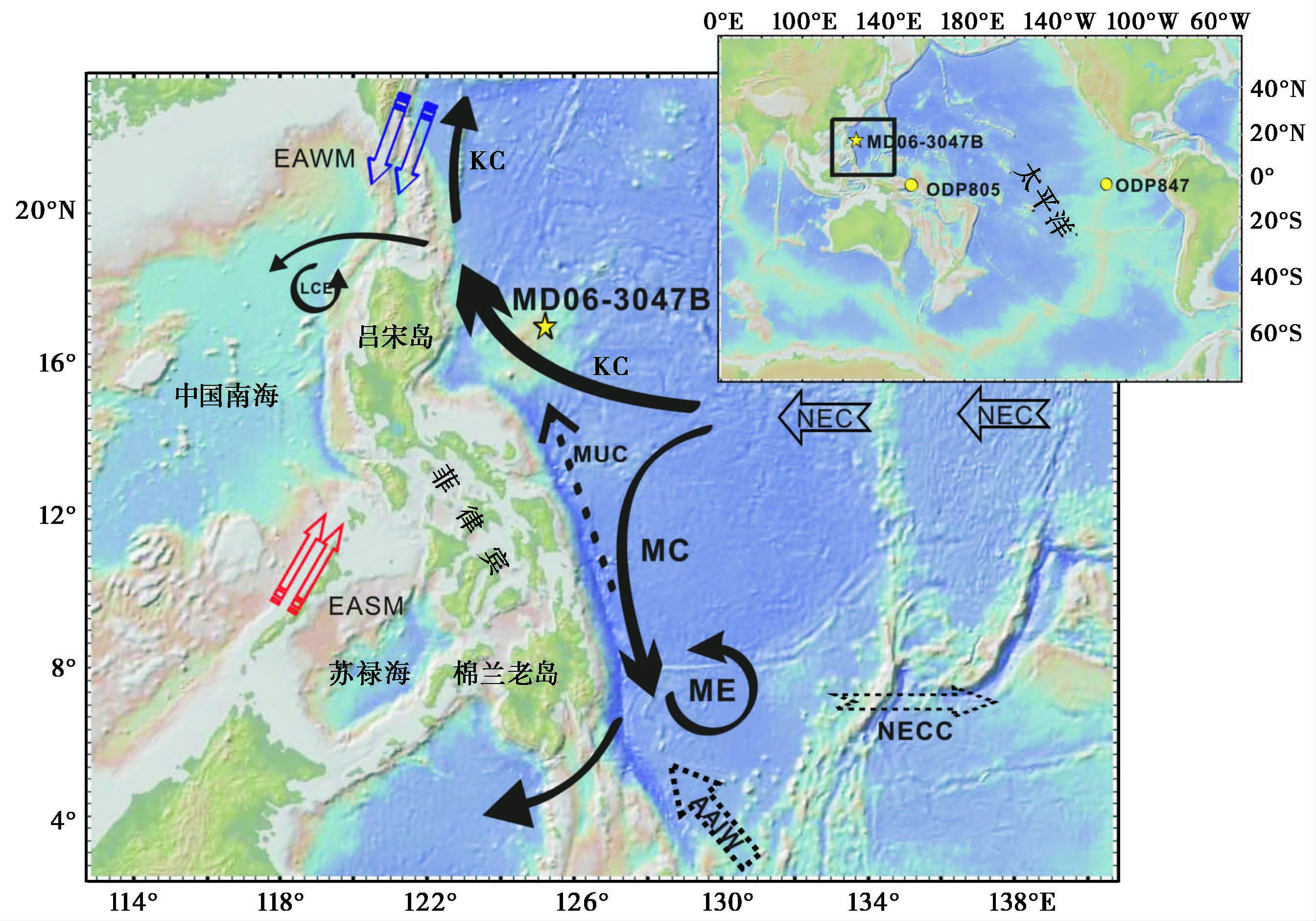
3 材料与方法本次研究选取由法国极地研究所Marco Poloz IMAGES XIV航次取自西菲律宾海本哈姆高原的MD06-3047B孔(17°00.44′N,124°47.93′E)( 图1)沉积物柱状样,水深2510m,柱长8.9m。该孔沉积连续,没有明显的沉积间断和浊流沉积层出现,主要由黄色粉砂质泥组成,柱状样中有孔虫壳体保存完好。在本次工作中,我们按2cm间隔取样,对445个样品的底栖有孔虫Cibicidoides wuellerstorfi进行氧碳同位素测试; 按4cm间隔取样,分别对222个样品浮游有孔虫表层种Globigerinoides ruber和次表层种Pulleniatina obliquiloculata进行氧碳同位素测试。G. ruber是生活在现代海洋约30-60m上部混合层的浮游有孔虫属种,而P. obliquiloculata作为次表层种,在西太平洋海区主要生活在温跃层顶部到混合层底部[12, 33]。因此,在本次研究中依据G. ruber和P.obliquiloculata作为表层水和次表层水变化的替代性指标。
|
图1
西太暖池北部边缘区 MD06-3047B孔位置、 洋流及东亚季风 右上附图展示了本文中讨论的岩芯站位,图中黑色方框示意区放大为主图; 主图中洋流系统:NEC为北赤道流,NECC为北赤道逆流,KC为黑潮,MC为棉兰老流,AAIW为南极中层水,MUC为棉兰老潜流,ME为棉兰老冷涡,LCE为吕宋冷涡;季风系统: EASM为东亚夏季风,EAWM为东亚冬季风; 洋流信息据文献[30, 31],季风信息据文献[32] Fig.1 Location of Core MD06-3047B,regional circulation and East Asian monsoon in the north margin of the Western Pacific Warm Pool(WPWP) |
样品的前处理和测试均在中国科学院海洋地质与环境重点实验室进行。将湿样放入已洗净烘干的烧杯中,并置于烘箱中在50℃条件下烘干12小时,然后加入蒸馏水浸泡48小时后过63μm筛冲洗,将剩余粗组分重新置于烧杯中,在50℃条件下烘干后收集于样品瓶中。分别过筛分选出所需粒径的有孔虫样品,用于氧碳同位素分析的有孔虫分别为保存完好的直径为300-350μm的C. wuellerstorfi 2-6枚,直径为250-300μm的G. ruber (白色)15-20枚和直径为300-400μm的P. obliquiloculata 7-10枚。将挑选出的样品进行测试前处理,首先用解剖针将有孔虫壳体分别压碎成2-3瓣,用浓度为3 % -5 % 的双氧水浸泡30分钟,然后加入丙酮溶液超声清洗,用超纯水清洗3遍,在60℃ 的烘箱中干燥5小时之后转移到稳定同位素质谱仪上进行测试。δ 18 O分析精度优于±0.06 ‰ ,δ13 C分析精度优于±0.03 ‰ ,结果校正为PDB 标准数据。
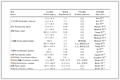
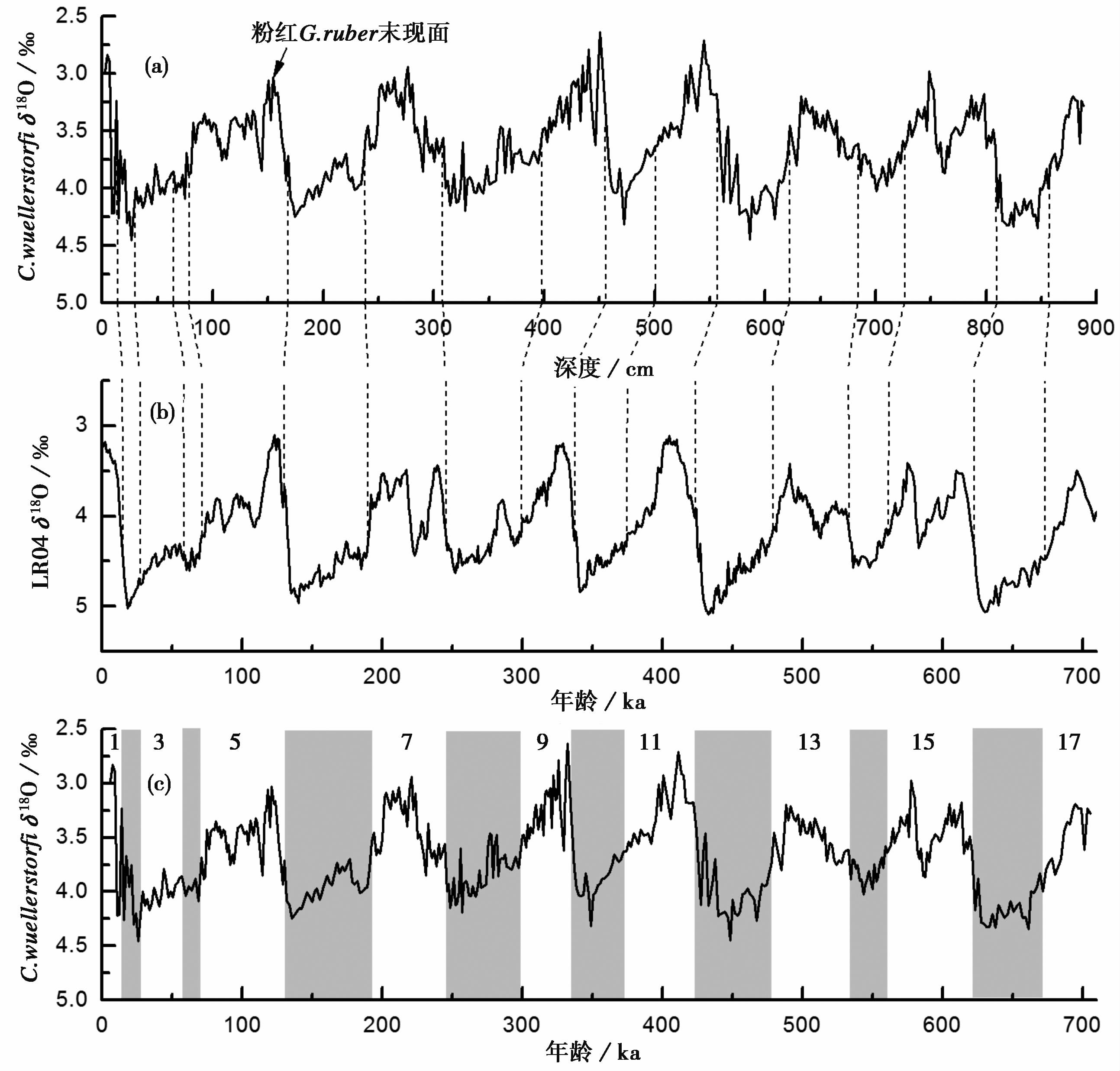
4 氧同位素年代地层由于本次研究记录的时间跨度已远远超出\{AMS 14 C\} 测年的测量范围,因此年代框架的建立主要借助底栖有孔虫氧同位素曲线与全球大洋底栖有孔虫氧同位素合成曲线[34]进行对比,以粉红色G. ruber末现面(约为12万年)作为控制点[35],来建立MD06-3047B孔的年代框架。MD06-3047B孔的G. ruber末现面位于约 160-162cm 层位处,选择氧同位素期次的分界点作为时间控制点( 表1),然后线性插值所有的氧同位素数据,计算沉积速率和各个层位的年龄,最后得到该孔的年代地层剖面( 图2)。将该孔8.9m长的沉积记录划分为17个氧同位素期次(MIS),时间跨度约70.5万年。
|
表1 西太暖池北部边缘区MD06-3047B孔的年龄控制点 Table 1 Age controlling points of Core MD06-3047B in the north margin of the WPWP |
|
图2
西太暖池北部边缘区MD06-3047B孔底栖有孔虫氧同位素年代地层 (a)MD06-3047B孔C. wuellerstorfi的 δ 18 O-深度曲线;(b)全球大洋底栖有孔虫 δ 18 O合成曲线[34]; (c)MD06-3047B孔C. wuellerstorfi的 δ 18 O-年龄曲线 虚线代表年龄控制点的选取 Fig.2 Age model based on benthic foraminifera C. wuellerstorfi δ 18 O from Core MD06-3047B in the north margin of the WPWP |
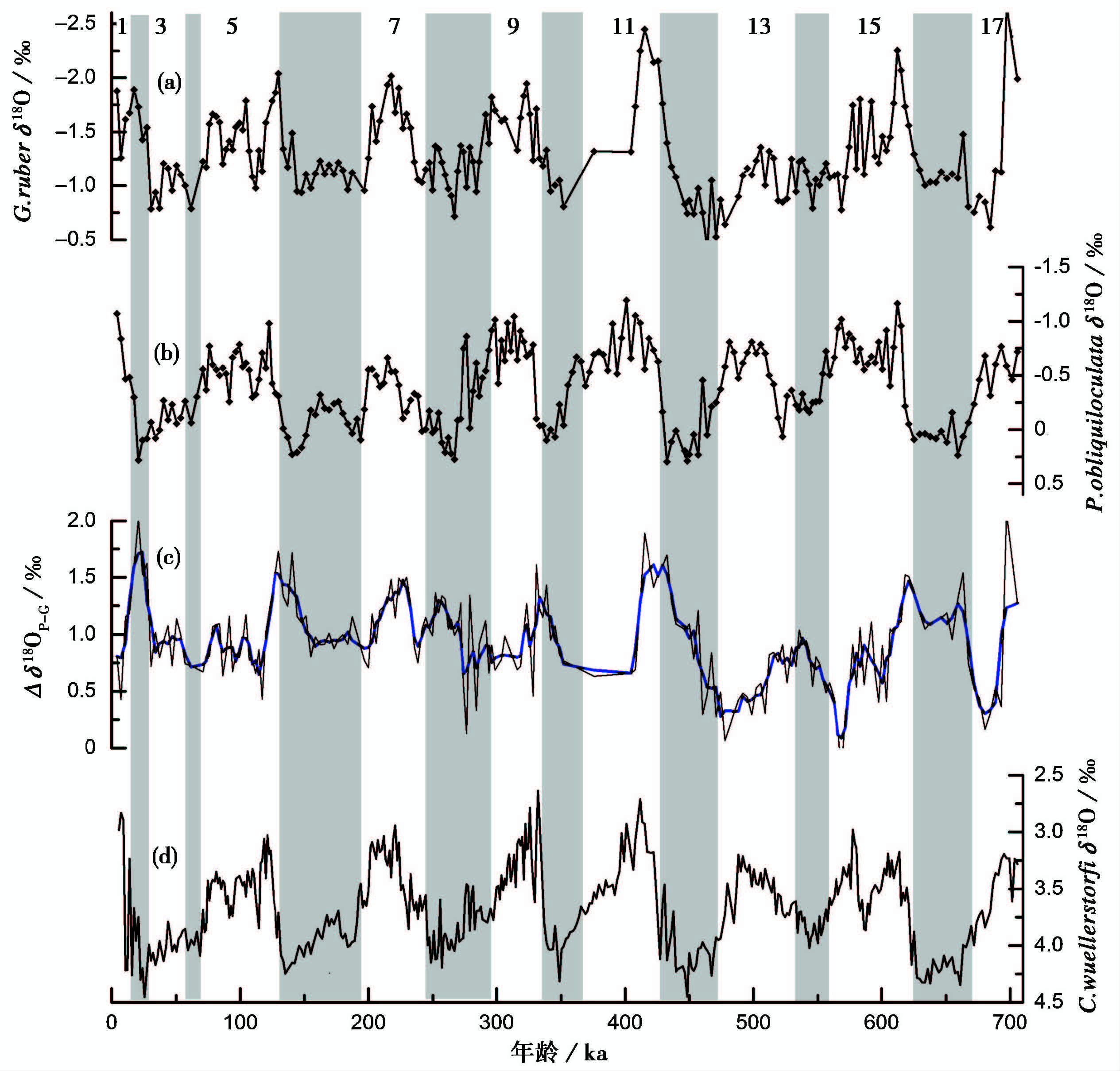
图3a、图3b和图3d分别为MD06-3047B孔G.ruber、 P.obliquiloculata和C.wuellerstorfi的δ18O记录在过 去70万年间,C.wuellerstorfi的δ18O介于2.64‰ 至 4.45‰之间,平均值为3.67‰;G.ruber的δ18O变化 范围从-0.42‰ 到-2.65‰,平均值约为-1.29‰; P.obliquiloculata的δ18O在0.30‰至-1.20‰之间变 化,平均值为-0.38‰。除MIS14~13期外,C. wuellerstorfi的δ18O与G.ruber和P.obliquiloculata的 δ18O记录具有相似的冰期-间冰期旋回变化特征。 从变化幅度来看,轨道时间尺度上,MIS17~15期, C.wuellerstorfi和P.obliquiloculata与G.ruber的δ18O又 具有相似的波动幅度; MIS14 ~ 13 期, P.obliquiloculata和C.wuellerstorfi的δ18O仍然具有 显著的冰期时偏重,间冰期时偏轻的特征,而 G.ruber的δ18O变化幅度很小,因此,该时间段 P.obliquiloculata和底栖种C.wuellerstorfi的δ18O变 化幅度大于G.ruber; MIS12期以来G.ruber、 P.obliquiloculata和C.wuellerstorfi的δ18O变化幅度 相差不大。
|
图3 西太暖池北部边缘区MD06-3047B孔有孔虫氧同位素记录 图3c中深灰色实线为原始数据曲线,黑色粗线为三点平滑曲线 Fig.3 Foraminiferal oxygen isotopic records of Core MD06-3047B in the north margin of the WPWP |
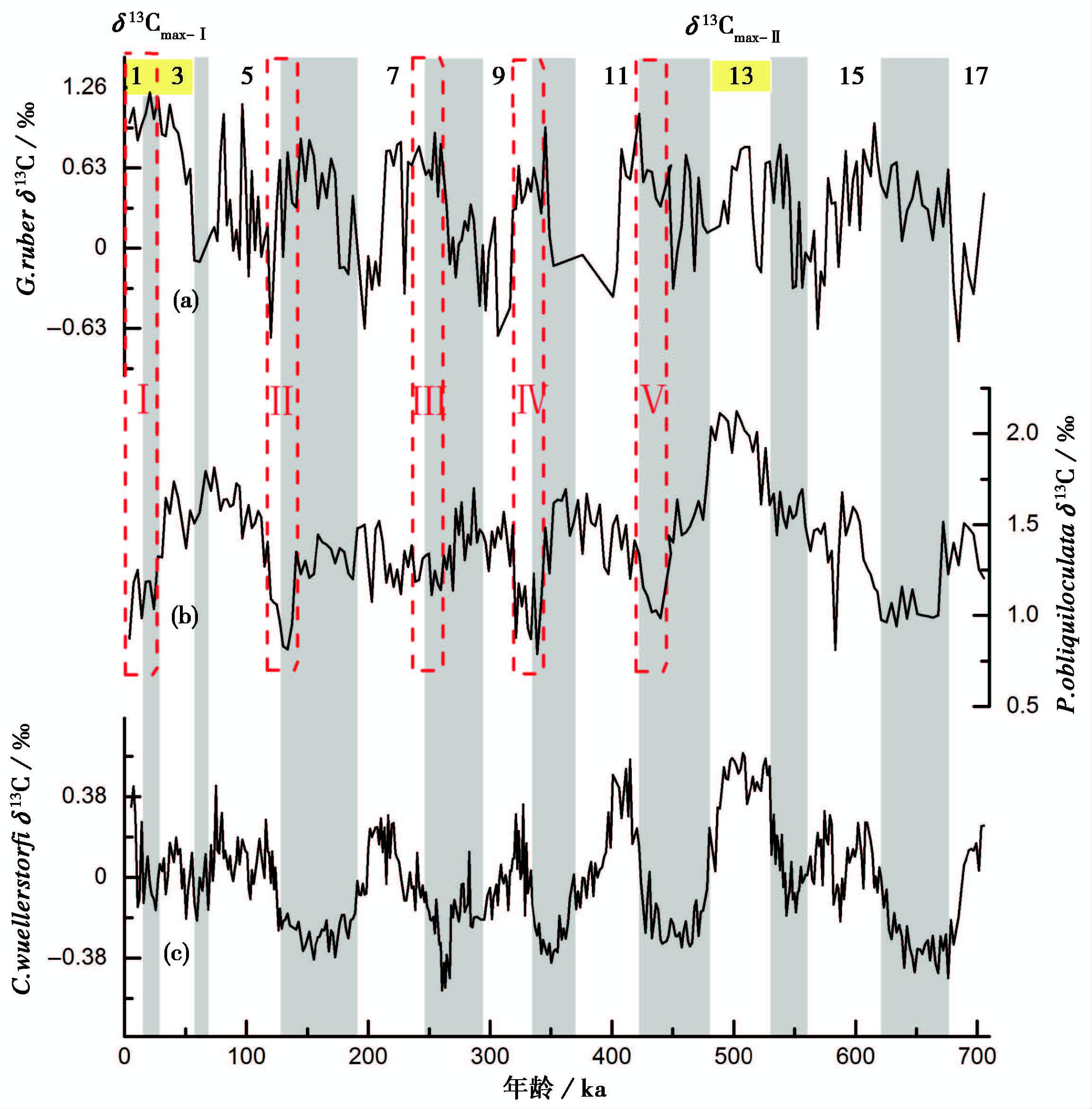
图4a、图4b和图4c分别为MD06-3047B孔G.ruber、 P.obliquiloculata和C.wuellerstorfi的δ13C记录。底栖 有孔虫C.wuellerstorfi的δ13C记录具有明显的冰期- 间冰期变化特征,具体表现为冰期时负偏、间冰期 时正偏(图4c)与C.wuellerstorfi不同,G.ruber和 P.obliquiloculata的δ13C记录并没有明显的冰期-间 冰期旋回变化,且G.ruber较P.obliquiloculata的δ13C 记录具有更明显的波动性(图4a和图4b)G.ruber 的δ13C记录在MIS3~1期明显偏重,次表层 P.obliquiloculata的δ13C记录在冰期终止期Ⅰ、Ⅱ、Ⅳ 和Ⅴ期分界处出现异常偏负的现象,在MIS13期 偏正。
|
图4 西太暖池北部边缘区MD06-3047B孔有孔虫碳同位素记录 Fig.4 Foraminiferal carbon isotopic records of Core MD06-3047B in the north margin of the WPWP |
在MIS 14-13期,P. obliquiloculata与G. ruber的 δ 18 O变化幅度差别较大,G. ruberδ 18 O冰期-间冰期波动特征不明显,尤其是在MIS 13期,表层种G. ruberδ 18 O值明显偏重( 图3a和图3b)。在南海北部、 暖池核心区以及东赤道太平洋没有发现类似现象[13, 36, 37],相反,在南海南部ODP1143站和南海北部ODP1144站在该阶段内G. ruber δ 18 O值持续偏轻[15, 38]。在该时间段内中国黄土高原宝鸡、 蒲县和灵台等剖面的中值粒径持续较低状态,对应黄土S5古土壤层[39],特别是S5-1古土壤层是与MIS 13期对应的具有全球性的夏季风强盛的极端暖湿环境时期[40, 41]。在海洋记录中,南海北部ODP1146站的蒙脱石/伊利石加绿泥石比值维持较高值[42]说明该时间段内夏季风持续较强。而在此阶段,MD06-3047B孔的表层种G. ruber的 δ 18 O值持续较重,由于此阶段为夏季风较强的暖湿环境,因此我们排除由于降雨量骤减蒸发量增大导致海水盐度偏高或表层海水温度降低而造成G. ruber δ 18 O值偏重[43]的可能; 此外,G. ruberδ 13 C记录在该时间段内没有表现出δ13 Cmax-Ⅱ事件,因此我们推断在该时间段内强盛的西南夏季风可能导致菲律宾群岛以东沿岸地区形成上升流,从而使得下部低温高盐的高 δ 18 O值的海水上涌到表层。但次表层种P.obliquiloculataδ 18 O和δ13 C记录并没有明显的上升流活动特征,推测研究区可能不是上升流活动的主要区域,而是受到吕宋岛沿岸形成的上升流扩散影响的边缘地区。对于吕宋岛沿岸可能形成上升流的机理推测与吕宋冷涡以及棉兰老冷涡的形成机理相似,是受到风应力和水团共同作用的结果,研究表明吕宋冷涡位于吕宋岛西北沿岸,主要是由进入南海的黑潮支流与东亚冬季风共同作用而形成的涡旋[30],研究也显示棉兰老冷涡在冬季风强盛时期加强,说明了冬季风对其形成的重要驱动作用[31]; 同理我们推断,在夏季风异常强盛的时期,在吕宋岛东北沿岸有可能形成类似的涡旋结构,从而导致吕宋岛东北沿岸形成上升流区。由于目前还没有研究结果提到该区存在上升流活动,因此对于这一推断需要寻找更多证据进行验证。
汪品先等[44]提出在全球大洋范围内,无论底栖还是浮游有孔虫的δ13 C每隔40-50万年会出现一次不同程度的δ13 C重值期,即长周期碳同位素重值事件,最后两次重值事件分别发生在MIS 3-1期(δ13 Cmax-Ⅰ)和MIS 13期(δ13 Cmax-Ⅱ)。MD06-3047B孔C. wuellerstorfi的δ13 C记录表现出较为明显的δ13 Cmax-Ⅰ和δ13 Cmax-Ⅱ( 图4c)。但该孔G. ruber的δ13 C记录仅出现δ13 Cmax-Ⅰ( 图4a),P. obliquiloculata的δ13 C记录仅表现出δ13 Cmax-Ⅱ( 图4b)。在冰期终止期普遍存在于印度-太平洋、 亚南极地区和大西洋的浮游有孔虫δ13 C极小值事件,被认为是环南极深层水的上涌,导致低δ13 C的海水从高纬输送到低纬海区[45, 46, 47, 48]所致。MD06-3047B孔P. obliquiloculata的δ13 C记录显示,在终止期Ⅰ、 Ⅱ、 Ⅳ 和Ⅴ期出现δ13 C极小值事件( 图4b),说明在这几个冰期终止期来自南极的低δ13 C海水到达了西太平洋暖池北部边缘地区。同时,我们也推测次表层种P. obliquiloculata的δ13 C记录没有出现δ13 Cmax-Ⅰ,可能是由于来自南极的低δ13 C南极中层水的涌入减弱了δ13 C重值事件对次表层水的影响。而G. ruber的δ13 C记录在上述终止期不存在δ13 C极小值事件,表层种与次表层种δ13 C的差异可能是由于伴随南大洋中层水上涌而导致的营养跃层上涌,使得表层生产力升高,使得12 C大量被表层浮游植物吸收,从而导致浮游有孔虫表层种δ13 C偏重[49]( 图4a)。另一有趣现象是,终止期Ⅲ期时,赤道东太平洋ODP1240站的浮游有孔虫δ 13 C记录存在明显的δ13 C极小值事件,并推测该事件是由受到南极中层水/南极模态水影响的西热带太平洋次表层水通过赤道潜流传输到东太平洋所致[48],但MD06-3047B孔在终止期Ⅲ期没有发现明显的δ13 C极小值事件,因此我们的结果表明冰期终止期时赤道东太平洋δ13 C极小值事件可能不是来自于热带西太平洋,很可能是南极中层水或亚南极模态水对赤道东太平洋的直接影响。
5.3 西太暖池北部边缘区温跃层变化特征已有研究表明,浮游有孔虫次表层种(如P. obliquiloculata或Neogloboquadrina dutertrei)与表层种(如G. ruber或Globigerinoides sacculifer)的 δ 18 O差值可以用来指示热带大洋的温跃层相对深度的变化[50],该方法已广泛应用于热带太平洋及其边缘海[5, 13, 15]。其中,次表层种与表层种的 δ 18 O差值越大说明温跃层越浅; δ 18 O的差值越小,代表温跃层越深[50]。本次研究利用此方法来反演研究区的温跃层相对变化。MD06-3047B孔浮游有孔虫P.obliquiloculata与G. ruber的 δ 18 O差值(Δδ 18 OP-G)( 图3c)所反映的西太平洋暖池北缘西菲律宾海的温跃层变化表现为冰期时逐渐变浅,间冰期时逐渐变深,在冰消期时温跃层较浅。
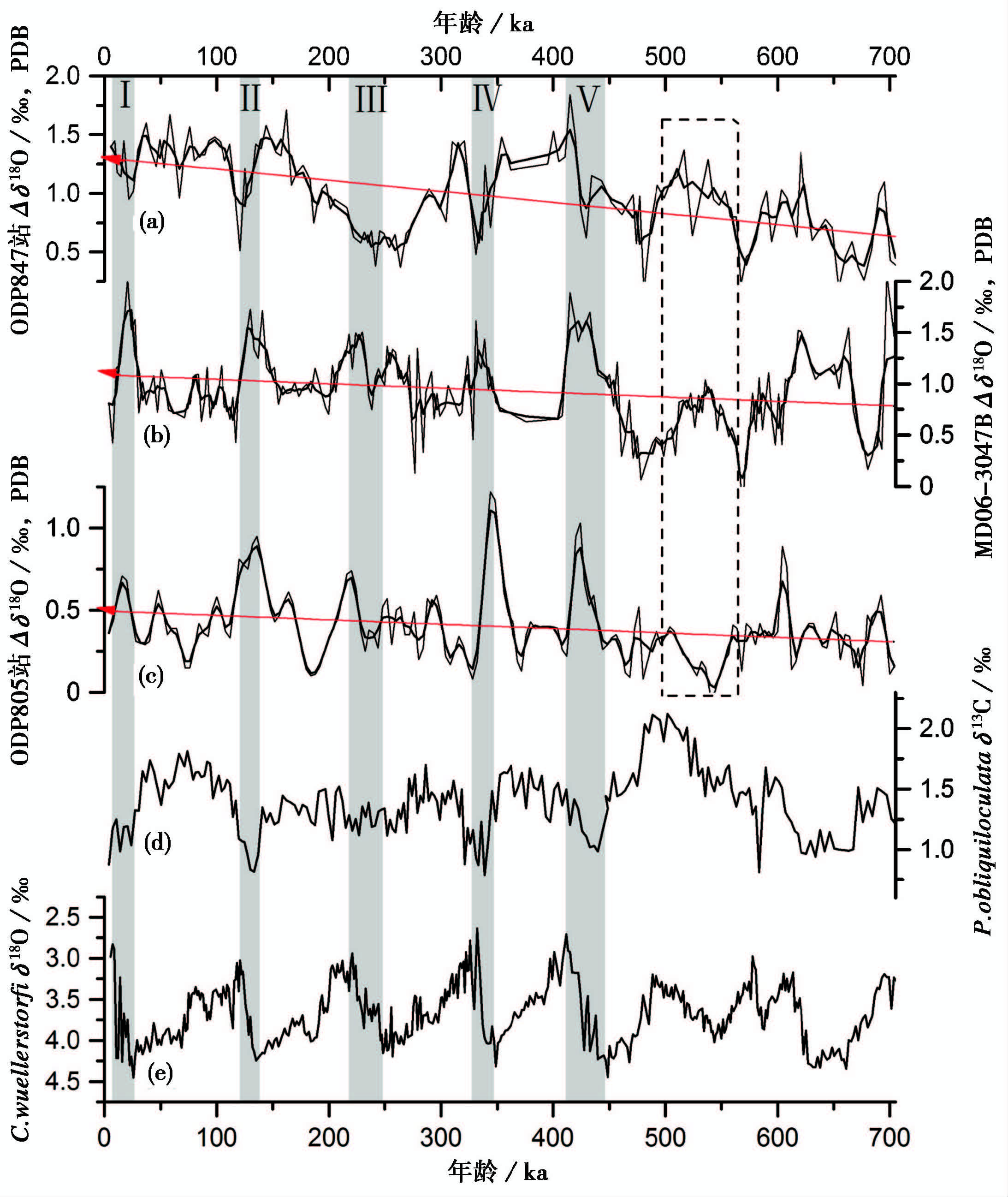
为了将西太平洋暖池北部边缘的温跃层变化与热带东太平洋和暖池核心区进行对比( 图5),我们搜集整理了热带东太平洋ODP847站的G. sacculifer和 N. dutertrei的 δ 18 O记录[36],以及西太平洋暖池核心区ODP805站G. sacculifer和Pulleniatina的 δ 18 O记录[37],并分别计算次表层种与表层种的 δ 18 O差值(Δδ 18 ON-S和Δδ 18 OP-S)。由于这两个站位分别是热带东太平洋冷舌区和西太平洋暖池核心区的典型站位,选择这两个站位是想将代表西太平洋暖池北部边缘的结果与这两个区域进行比较,分析研究其中的关系。 因此,对这3个站位的Δδ 18 O记录进行三点平滑,以消除个别尖锐点对曲线趋势的影响,结果如 图5a、 5b和5c所示。在MIS 12期以来,MD06-3047B孔和暖池核心区ODP805站的Δδ 18 O所反映的温跃层具有较为一致的变化趋势,而且与ODP847站的结果存在相反的变化关系,特别是在冰期终止期时,西太平洋暖池区的温跃层处于较浅状态,而赤道东太平洋的温跃层较深,热带西太平洋温跃层的变浅对应着热带东太平洋温跃层的变深。现代观测到的ENSO变化显示 厄尔尼诺时期热带太平洋西浅东深,拉尼娜时期热带太平洋温跃层西深东浅[51],因此,我们推断,在MIS 12期以来,热带太平洋地区在轨道时间尺度上发生了类ENSO式的变化,在冰消期时表现为类厄尔尼诺状态。在冰期终止期Ⅰ、 Ⅲ、 Ⅳ 和Ⅴ期温跃层的变化与次表层种P. obliquiloculataδ 13 C记录的极小值事件具有很好的对应关系( 图5),两者之间可能存在正反馈关系: 上涌的南大洋深层水强化了热带太平洋的类ENSO式变化,而热带太平洋类ENSO变化促进了南大洋深层水的上涌。
|
图5
西太暖池北部边缘区MD06-3047B孔与西太暖池核心区ODP805站[37]
和东赤道太平洋ODP847站[36]的浮游有孔虫Δδ 18 O记录的对比 (a)ODP847站Δδ 18 ON-S;(b)MD06-3047B孔Δδ 18 OP-G;(c)ODP805站Δδ 18 OP-S;(d)MD06-3047B孔次表层种δ13 C; (e)全球大洋底栖有孔虫氧同位素合成曲线[34] Fig.5 Comparisons of Δδ18 O records among Core MD06-3047B in the north margin of the WPWP,Site ODP805 in the center of WPWP and Site ODP847 in the eastern tropical Pacific |
在MIS 17-13期,热带东西太平洋温跃层变化在整体上似乎不存在明显相关性,ODP805站在该阶段内反映的温跃层变化较小,可能说明此阶段内暖池相对较为稳定。但在MIS 14-13期,ODP847站反映较浅的温跃层,而ODP805站表现为较深的温跃层,说明此时可能存在类拉尼娜现象。考虑到热带辐合带位置随季节而南北移动,在西太平洋至南亚区域的热带辐合带,其位置与季风的变化密切相关,夏季风时北移,冬季风时南移[52]。而我们前面提到已有研究结果表明在该阶段内夏季风持续偏强,因此说明此阶段内热带辐合带北偏,并且现代观测结果显示拉尼娜年对应着热带辐合带的北偏[52],而我们推测的该时间段内热带辐合带北偏与根据前面温跃层变化得到的类拉尼娜现象相匹配,说明在MIS 14-13期热带太平洋存在类拉尼娜现象,但在该阶段,MD06-3047B孔却表现出与西太暖池核心区情况相反的较浅的温跃层变化,这可能与我们前面提到的此时西菲律宾海存在上升流活动而导致温跃层变浅有关,这也从另一方面印证了此时西菲律宾海可能受到上升流活动的影响。 从整体上来分析70万年来热带太平洋温跃层的变化特征,我们发现无论是西太平洋暖池还是赤道东太平洋,在过去70万年间,温跃层深度都发生了不同程度的变浅,变浅幅度依次为: 赤道东太平洋>西太平洋暖池北部边缘>西太平洋暖池核心区( 图5)。而这一结果与金海燕等[53]利用氧同位素差值和表层海水温度得到的结果相一致。由于赤道东太平洋的温跃层变浅幅度大于西太平洋暖池,因此我们推断距今70万年来东西太平洋的温度梯度加大,可能表明在此期间西太平洋暖池效应逐渐加强,在以后的工作中,我们会通过重建古温度指标,对这一结果进行进一步验证。
6 结论(1)将MD06-3047B孔沉积记录划分为17个氧同位素期次,时间跨度约70.5万年。除MIS 14-13期,该孔的底栖种、 次表层种与表层种 δ 18 O记录具有相似的冰期间冰期变化特征。MIS 14-13期,由于受东亚夏季风影响增强,研究区附近可能受到上升流活动的影响。
(2)MD06-3047B孔次表层种P. obliquiloculata在冰期终止期Ⅰ、 Ⅱ、 Ⅳ 和Ⅴ期存在δ13 C极小值事件,表明在这几个冰期终止期来自南极的低δ 13 C海水到达了西太平洋暖池北部边缘地区。 (3)70万年来MD06-3047B孔次表层种与表层种氧同位素差值反映的温跃层变化表现为冰期逐渐变浅,间冰期逐渐变深,在冰消期时温跃层较浅。将所得结果与赤道东太平洋、 暖池核心区次表层种与表层种氧同位素差值结果对比发现,热带太平洋存在长时间尺度的类ENSO式变化,MIS 12期以来,冰消期时为明显的类厄尔尼诺状态,并且冰期终止期时的类ENSO变化可能与南纬深层水的上涌存在正反馈关系。
| 1 | Yan Xiaohai, Ho Chungru, Zheng Quanan et al. Temperature and size variabilities of the Western Pacific Warm Pool. Science, 1992, 258:1643~1645 |
| 2 | Webster P J. The role of hydrological processes in ocean-atmosphere interactions. Reviews of Geophysics,1994, 32 (4):427~476 |
| 3 | Cane M A. A role for the tropical Pacific. Science, 1998, 282:59~61 |
| 4 | Zhang Yige, Ji Junfeng, Balsam W L et al. High resolution hematite and goethite records from ODP 1143, South China Sea:Co-evolution of monsoonal precipitation and El Niño over the past 600,000 years. Earth and Planetary Science Letters, 2007, 264 (1):136~150 |
| 5 | Billups K, Ravelo A C, Zachos J C et al. Link between oceanic heat transport, thermohaline circulation, and the Intertropical Convergence Zone in the Early Pliocene Atlantic. Geology, 1999, 27 (4):319~322 |
| 6 | Beaufort L, Thoron T G, Mix A C et al. ENSO-like forcing on oceanic primary production during the Late Pleistocene. Science, 2001, 293:2440~2444 |
| 7 | Andreasen D J, Ravelo A C. Tropical Pacific Ocean thermocline depth reconstructions for the Last Glacial Maximum. Paleoceanography, 1997, 12 (3):395~413 |
| 8 | Stott L, Poulsen C, Lund S et al. Super ENSO and global climate oscillations at millennial time scales. Sciences, 2002, 297:222~226 |
| 9 | Koutavas A, Stieglitz J L, Marchitto T M et al. El Niño -like pattern in ice age tropical Pacific sea surface temperature. Science, 2002, 297:226~230 |
| 10 | Clement A C, Seager R, Cane M A. Suppression of El Niño during the Mid-Holocene by changes in the Earth's orbit. Paleoceanography, 2000, 15 (6):731~737 |
| 11 | Andreasen D H, Ravelo A C, Broccoli A J. Remote forcing at the Last Glacial Maximum in the Tropical Pacific Ocean. Journal of Geophysical Research, 2001, 106 (C1):879~897 |
| 12 | Sagawa T, Yokoyama Y, Ikehara M et al. Shoaling of the western equatorial Pacific thermocline during the Last Glacial Maximum inferred from multispecies temperature reconstruction of planktonic foraminifera. Palaeogeography, Palaeoclimatology, Palaeoecology, 2012, 346 (4):120~129 |
| 13 | 金海燕, 翦知湣. 中更新世气候转型期南海北部和南部的气候变化差异. 第四纪研究, 2008, 28 (3):381~390 Jin Haiyan, Jian Zhimin. Comparison of climate changes between northern and southern South China Sea during the Mid-Pleistocene climate transition period. Quaternary Sciences, 2008, 28 (3):381~390 |
| 14 | Wang Pinxian, Tian Jun, Cheng Xinrong et al. Major Pleistocene stages in a carbon perspective:The South China Sea record and its global comparison. Paleoceanography, 2004, 19 (4):PA4005, doi:10.1029/2003PA000991 |
| 15 | Tian Jun, Wang Pinxian, Chen Ronghua et al. Quaternary upper ocean thermal gradient variations in the South China Sea:Implications for East Asian monsoon climate. Paleoceanography, 2005, 20 (4):PA4007, doi:10.1029/2004PA001115 |
| 16 | Saikku R, Stott L, Thunell R. A bi-polar signal recorded in the western tropical Pacific:Northern and Southern Hemisphere climate records from the Pacific Warm Pool during the last Ice Age. Quaternary Science Reviews, 2009, 28 (23-24):2374~2385 |
| 17 | Medina-Elizalde M, Lea D W. The Mid-Pleistocene transition in the tropical Pacific. Science, 2005, 310:1009~1012 |
| 18 | Lea D W, Pak D K, Spero H J. Climate impact of Late Quaternary Equatorial Pacific sea surface temperature variations. Science, 2000, 289:1719~1724 |
| 19 | Dyez K A, Ravel A C, Late Pleistocene tropical Pacific temperature sensitivity to radiative greenhouse gas forcing. Geology, 2012, 41 (1):23~26 |
| 20 | 周 超, 金海燕, 翦知湣. 赤道西太平洋晚第四纪古生产力变化: 来自元素比值的证据. 第四纪研究, 2011, 31 (2):276~283 Zhou Chao, Jin Haiyan, Jian Zhimin. Variations of the Late Quaternary paleo-productivity in the western equatorial Pacific:Evidences from the elemental ratios. Quaternary Sciences, 2011, 31 (2):276~283 |
| 21 | 翦知湣, 李保华, 王吉良. 从微体化石看西太平洋暖池的形成与演化. 第四纪研究, 2003, 23 (2):185~192 Jian Zhimin, Li Baohua, Wang Jiliang. Formation and evolution of the Western Pacific Warm Pool recorded by microfossils. Quaternary Sciences, 2003, 23 (2):185~192 |
| 22 | 李铁刚, 赵京涛, 孙荣涛等. 250ka B.P. 以来西太平洋暖池中心区——Ontong Java海台古生产力演化. 第四纪研究, 2008, 28 (3):447~457 Li Tiegang, Zhao Jingtao, Sun Rongtao et al. Paleoproductivity evolution in the Ontong Java Plateau——Center of the Western Pacific Warm Pool during the last 250ka. Quaternary Sciences, 2008, 28 (3):447~457 |
| 23 | 葛淑兰, 石学法, 杨 刚等. 西菲律宾海780ka以来气候变化的岩石磁学记录: 基于地磁场相对强度指示的年龄框架. 第四纪研究, 2007, 27 (6):1040~1052 Ge Shulan, Shi Xuefa, Yang Gang et al. Rock magnetic response to climatic changes in west Philippine Sea for the last 780ka: Based on relative paleointensity assisted chronology. Quaternary Sciences, 2007, 27 (6):1040~1052 |
| 24 | 党皓文, 翦知湣, Franck Bassinot. 西菲律宾海末次冰期以来的浊流沉积及其古环境意义. 第四纪研究, 2009, 29 (6):1078~1085 Dang Haowen, Jian Zhimin, Franck Bassinot. Turbidite deposition of the last glacial stage in the western Philippine Sea and its paleoenvironmental implications. Quaternary Sciences, 2009, 29 (6):1078~1085 |
| 25 | 孙晗杰, 李铁刚, 苏 翔等. 中更新世以来西菲律宾海上层水体结构演化特征——来自钙质超微化石Florisphaera profunda的证据. 第四纪研究, 2011, 31 (2):216~226 Sun Hanjie, Li Tiegang, Su Xiang et al. Upper water mass structure evolution in the western Philippine Sea since Mid-Pleistocene—Evidence from the abundance of coccolith species Florisphaera profunda. Quaternary Sciences, 2011, 31 (2):216~226 |
| 26 | 李常珍, 李乃胜, 林美华. 菲律宾海的地势特征. 海洋科学, 2000, 24 (6):47~51 Li Changzhen, Li Naisheng, Lin Meihua. Terrain features of the Philippine Sea. Marine Sciences, 2000, 24 (6):47~51 |
| 27 | 孙守勋, 滕 军. 菲律宾海的气候特征. 海洋预报, 2003, 20 (3):31~39 Sun Shouxun, Teng Jun. Climate character of the Philippine Sea. Marine Forecasts, 2003, 20 (3):31~39 |
| 28 | 张 弦, 俞幕耕, 江 伟等. 菲律宾海及其邻近海区的水文特征. 海洋通报, 2004, 23 (1):8~14 Zhang Xian, Yu Mugeng, Jiang Wei et al. Hydrologic characteristic of the Philippine Sea and its nearby areas. Marine Science Bulletin, 2004, 23 (1):8~14 |
| 29 | 张 旭, 张永刚, 张胜军等. 菲律宾海温跃层的区域性特征及其季节性变化. 海洋通报, 2009, 28 (4):17~26 Zhang Xu, Zhang Yonggang, Zhang Shengjun et al. The distribution characteristics and seasonal variabilities of thermocline in the Philippine Sea. Marine Science Bulletin, 2009, 28 (4):17~26 |
| 30 | 孙成学, 刘秦玉. 卫星高度计资料揭示的冬季南海吕宋冷涡的双涡结构. 热带海洋学报, 2011, 30 (3):9~15 Sun Chengxue, Liu Qinyu. Double eddy structure of the winter Luzon Cold Eddy based on satellite altimeter data. Journal of Tropical Oceanography, 2011, 30 (3):9~15 |
| 31 | Bolliet T, Holbournet A, Kuhnt W et al. Mindanao Dome variability over the last 160 kyr:Episodic glacial cooling of the West Pacific Warm Pool. Paleoceanography, 2011, 26 (1):PA1208, doi:10.1029/2010PA001966 |
| 32 | Wan Shiming, Yu Zhaojie, Clift P D et al. History of Asian eolian input to the West Philippine Sea over the last one million years. Palaeogeography, Palaeoclimatology, Palaeoecology, 2012, 326-328:152~159 |
| 33 | Pflaumann U, Jian Zhimin. Modern distribution patterns of planktonic foraminifera in the south China Sea and western Pacific:A new transfer technique to estimate regional sea-surface temperatures. Marine Geology, 1999, 156 (1-4):41~83 |
| 34 | Lisiecki L E, Raymo M E. A Pliocene-Pleistocene stack of 57 globally distributed benthic δ18O records. Paleoceanography, 2005, 20 (1):PA1003, doi:10.1029/2004PA001071 |
| 35 | Thompson P R, Be A W H, Duplessy J C et al. Disappearance of pink-pigmented Globigerinoides ruber at 120,000 yr BP in the Indian and Pacific Oceans. Nature, 1979, 280:554~558 |
| 36 | Farrell J W, Murray D W, Mckenna V S et al. Upper ocean temperature and nutrient contrasts inferred from Pleistocene planktonic foraminifer δ18O and δ13C in the eastern equatorial Pacific. Proceedings of the Ocean Drilling Program, Scientific results, 1995, 138:289~319 |
| 37 | Berger W H, Bicker T, Schmidt H et al. Quaternary oxygen isotope record of pelagic foraminifers:Site 805, Ontong Java Plateau. Proceedings of the Ocean Drilling Program, Scientific Results, 1993, 130:363~379 |
| 38 | Bühring C, Sarnthein M, Erlenkeuser H. Toward a high-resolution stable isotope stratigraphy of the last 1.1 million years:Site 1144, South China Sea. Proceedings of the Ocean Drilling Program, Scientific Results, 2004, 184:1~29 |
| 39 | Ding Z L, Derbyshire E, Yang S L et al. Stacked 2.6-Ma grain size record from the Chinese loess based on five sections and correlation with the deep-sea δ18O record. Paleoceanography, 2002, 17 (3):5~1-5-21 |
| 40 | Qiao Yansong, Guo Zhengtang, Hao Qingzhen et al. Loess-soil sequences in Southern Anhui Province:Magnetostratigraphy and paleoclimatic significance. Chinese Science Bulletin, 2003, 48 (19):2088~2093 |
| 41 | 伍 斌, 吴乃琴. 黄土高原S5古土壤形成期的气候环境——陆生蜗牛化石的证据. 第四纪研究, 2008, 28 (5):902~908 Wu Bin, Wu Naiqin. Paleoenvironmental study of S5 paleosol formation: Based on mollusk fossil evidence. Quaternary Sciences, 2008, 28 (5):902~908 |
| 42 | Wang Pinxian, Jian Zhimin, Zhao Quanhong et al. Evolution of the South China Sea and monsoon history revealed in deep-sea records. Chinese Science Bulletin, 2003, 48 (23):2549~2561 |
| 43 | Ravelo A C, Hillaire-Marcel C. The use of oxygen and carbon isotopes of foraminifera in paleoceanography. Developments in Marine Geology, 2007, 1:735~764 |
| 44 | Wang Pinxian, Tian Jun, Cheng Xinrogn et al. Exploring cyclic changes of the ocean carbon reservoir. Chinese Science Bulletin, 2003, 48 (23):2536~2548 |
| 45 | Shackleton N J, Hall M A, Line J et al. Carbon isotope data in Core V19-30 confirm reduced carbon-dioxide concentration in the ice-age atmosphere. Nature, 1983, 306:319~322 |
| 46 | Ninnemann U S, Charle C D. Regional differences in Quaternary subantarctic nutrient cycling:Link to intermediate and deep water ventilation. Palaeoceanography, 1997, 12 (4):560~567 |
| 47 | Spero H J, Lea D W. The cause of carbon isotope minimum events on glacial terminations. Science, 2002, 296:522~525 |
| 48 | Pena L D, Cacho I, Ferretti P et al. El Niño -Southern Oscillation-like variability during glacial terminations and interlatitudinal teleconnections. Palaeoceanography, 2008, 23 (3):PA3101, doi:10.1029/2008PA001620 |
| 49 | Kroom D, Ganssen G. Northern Indian Ocean upwelling cells and the stable isotope composition of living planktonic foraminifera. Deep-Sea Research, 1989, 36 (8):1219~1236 |
| 50 | Ravelo A C, Shackleton N J. Evidence for surface-water circulation changes at Site 851 in the eastern Tropical Pacific Ocean. Proceedings of the Ocean Drilling Program, Scientific Results, 1995, 138:503~514 |
| 51 | 赵永平, 陈永利, 王 凡等. 热带太平洋海洋混合层水体振荡与ENSO 循环. 中国科学(D辑), 2007, 37 (8):1120~1133 Zhao Yongping, Chen Yongli, Wang Fan et al. Oscillations of mixed layer waters and ENSO cycles in the tropical Pacific. Science in China(Series D), 2007, 37 (8):1120~1133 |
| 52 | 冯士筰, 李凤岐, 李少菁. 海洋科学导论. 北京: 高等教育出版社, 1999. 260~270 Feng Shizuo, Li Fengqi, Li Shaojing. Introduction to Ocean Sciences. Beijing:Higher Education Press, 1999. 260-270 |
| 53 | 金海燕, 翦知湣, 成鑫荣. 赤道西太平洋暖池中更新世过渡期的古海洋变化. 海洋地质与第四纪地质, 2006, 26 (6):71~80 Jin Haiyan, Jian Zhimin, Cheng Xinrong. Paleoceanographic variations of the Western Pacific Warm Pool during the middle Pleistocene climate transition. Marine Geology & Quaternary Geology, 2006, 26 (6):71~80 |
2. University of Chinese Academy of Sciences, Beijing 100049)
Abstract
Core MD06-3047B(17°00.44'N, 124° 47.93'E, length 8.90m, water depth 2510m)was retrieved during Marco Polo 2 IMAGES XIV Cruise from the Benham Rise, east off Luzon Island in the Western Philippine Sea, was used to investigate paleoceanographic variations at the north margin of the Western Pacific Warm Pool (WPWP) over the past 700,000 years. The core mainly consists of yellow silty mud without obvious hiatus and turbidite layers, and the foraminifer fossils were well preserved.
In this study, stable carbon and oxygen isotope measurements were carried on 445 samples of benthic foraminifera Cibicidoides wuellerstorfi(300~350μm)sampled at 2-cm intervals and 222 samples of two planktonic foraminifera Globigerinoides ruber(250~300μm)and Pulleniatina obliquiloculata(300~400μm)sampled at 4-cm intervals respectively. Stable isotope ratios of foraminiferal tests were measured on the GV IsoPrime mass spectrometer at the Key Laboratory of Marine Geology and Environment, Institute of Oceanography, Chinese Academy of Sciences. The analytical precision is better than ±0.06‰ for δ18O and ±0.03 ‰ for δ13C. The age model of Core MD06-3047B was established by comparing benthic foraminifera C. wuellerstorfi δ18 O curve with the LR04 stack combining the last appearance datum of G. ruber(pink)which indicates a numerical age of 120ka, and the results showed that the age of bottom of the core was about 700ka B.P. (MIS 17). The results of the stable oxygen isotope records of C. wuellerstorfi, G. ruber and P. obliquiloculata show obvious changes over glacial-interglacial cycle except of the stable oxygen isotope records of G. ruber during MIS 14~13. Unlike G. ruber and P. obliquiloculata,the stable carbon isotope records of C. wuellerstorfi also show glacial-interglacial changes. And the stable carbon isotope records of P. obliquiloculata occur intense negative excursions during termination Ⅰ, Ⅱ, Ⅳ and Ⅴ and obvious positive excursion during MIS 13. Based on these records, obvious upwelling activities occurred in this study area during MIS 14~13. The intense negative δ13C excursions at thermocline during termination Ⅰ, Ⅱ, Ⅳ and Ⅴ indicates that the low δ13C waters from Southern Ocean had arrived at the north margin of the WPWP. The δ18O difference between the subsurface dwelling P. obliquiloculata and the surface dwelling G. ruber in the Core MD06-3047B suggests shallower thermocline during most glacial episodes and deeper thermocline during interglacial intervals. By comparing the δ18O differences of Core MD06-3047B in the north margin of WPWP, Site ODP805 in the center of WPWP and Site ODP847 in the eastern tropical Pacific, the WPWP is suggested to have been intensified over the past 700,000 years; and there were "El Niño-like" state of climate during the deglacial periods.