 2015, Vol.35


1 前言
现代大洋海水温度和盐度是全球气候系统最重要的两个变量。温度和盐度决定了大洋水体的密度,驱动着大洋水团和环流,是影响区域蒸发与降水,进而控制水汽循环和分配的基本边界条件。其中,盐度对环境的变化尤其敏感,是区域蒸发、 降水及淡水输入等的良好指标[1]。大洋表层海水盐度(Sea Surface Salinity,简称SSS)主要受蒸发-降水平衡及上升流因素的影响[2],同时河流冲淡水的输入也能使边缘海盆的海水盐度显著降低。冰期-间冰期旋回中,全球大洋SSS不仅受冰体积变化的影响,边缘海盆的SSS更是与大陆降水的变化密切相关。SSS不仅是古海洋环境重建的一个关键参数,更是恢复区域气候变化过程的一个重要指标[3]。
然而,与海水古温度相比,直接且定量的古盐度替代指标相当匮乏。Cullen[4]在1981年提出的依据微体古生物组合提取的SSS定性信息可信度和适用性有限。目前大部分研究采用Duplessy等[5]1991年、 Rostek等[6]1993年和Wang等[7]1995年提出的,从浮游有孔虫 δ18O中剔除表层海水温度(Sea Surface Temperature,简称SST)和冰体积(海平面)变化信号后的剩余 δ18O来半定量指示SSS。但浮游有孔虫 δ18O受诸多因素控制,准确定量与冰体积相关的 δ18O变化基本是不可能的,SST与 δ18O的准确关系存在很大不确定性,且SST本身的定量估计也有很多问题[8, 9, 10]。因此,尽管被广泛地应用,但这一方法存在着明显的局限性。
河流输入是全球大洋中溶解Ba的主要来源,而浮游有孔虫壳体钙化时吸收的Ba与海水中的Ba/Ca呈线性关系[11, 12, 13],所以在一些特定海区可以依据浮游有孔虫壳体的Ba/Ca定量重建古海水盐度。据此,Weldeab等[14, 15]2007年首次在西非几内亚湾实现了SSS的定量重建。然而这一方法的应用不仅受区域海洋环境、 有孔虫属种的限制,同时对样品的沉积后保存条件有苛刻要求。本文利用ODP155航次942站的13个样品检验了该指标在亚马逊冲积扇海域的适用性,以期为进一步依据SSS研究末次冰期以来亚马逊河流域降水及大西洋温盐环流的变化过程提供依据。
2 材料和方法ODP155航次942站于1994年钻探于赤道大西洋巴西东北岸、 亚马逊冲积扇西部的废弃堤坝顶部(5°45′N,49°6′W),水深3346m( 图1)。亚马逊深海冲积扇的形成源于大量来自安第斯山脉、 亚马逊盆地低地平原及热带雨林的沉积物输入[16, 17]。陆源沉积物的供应与亚马逊河流域的降水密切相关,后者受诸如南美季风、 热带辐合带(Inter-tropical Convergence,简称ITCZ)和ENSO等多种热带过程的影响和控制,在全球水汽循环以及潜热向高纬地区输送中起着关键作用[18]。亚马逊冲积扇海域处于西热带大西洋水团影响之下,该水团对大洋动力和洋内热量转移相当重要,亚马逊流域淡水输入的变化不仅对该水团的特征有重要影响,更控制着大西洋跨赤道环流——北巴西沿岸流(NBCC)的变异,从而调节着全球温盐环流[18, 19, 20]( 图1)。ODP942站毗邻亚马逊河口,得益于亚马逊盆地大量沉积物的输入,是区域气候和海洋环境高分辨率重建的良好材料。研究材料为分别取自ODP942B和942C孔41.03cm以上部分的13个沉积物样品,依据Maslin 等[18]确定的ODP942站位年龄模式,获得这13个样品的日历年龄,其中底部41.03cm处为4099a B.P. 。

|
图1 ODP155 Site 942站位与现代海洋环流图 黑线表示ITCZ在2月和8月的位置迁移; NBCC—北巴西沿岸流, NECC—北赤道逆流, SEC—南赤道流, BC—巴西流, NBCC翻转—北巴西沿岸流翻转; 底图源自GeoMapAppTM(http:∥www.geomapapp.org); 洋流和ITCZ位置信息分别源自文献[21]和[22] Fig.1 The location of the ODP Leg 155 Site 942 and modern ocean circulation. Black lines depict the migration of the mean position of ITCZ between February and August; NBCC=North Brazil Coastal Current; NECC=North Equatorial Counter Current; SEC=South Equatorial Current; BC=Brazil Current; retroflection of NBCC). The base map was generated from GeoMapAppTM(http:∥www.geomapapp.org), ocean current information from reference[21], and the information of ITCZ position derived from reference[22] |
用于Ba/Ca分析的沉积物原样,经50℃条件下烘干、 超纯水充分浸泡和63μm筛冲洗后,从粒径250~300μm的组分中挑选浮游有孔虫Globigerinoides ruber (White)和 Globigerinoides sacculifer壳体各30~40枚。对挑出的有孔虫壳体进行测试前的处理工作,首先用解剖针轻轻将每枚壳体分别压碎,保证每个房室均被打开,然后按照美国加州大学圣巴巴拉分校(UCSB)的标准程序[23, 24, 25]进行清洗。依次经过超声、 氧化和还原清洗等步骤后,淋洗溶解的样品通过同位素稀释/内标法[23]分析有孔虫壳体微量元素。测试工作在加州大学圣巴巴拉分校利用Thermo Finnigan Element 2 sector field ICP-MS质谱仪进行,其中Ba/Ca分析精度优于1.8 % ,Mg/Ca 优于0.6 % 。为了监测样品的清洗效果同时给出了Al/Ca、 Fe/Ca、 Mn/Ca 以及La/Ca、 Ce/Ca、 Nd/Ca、 U/Ca等的测试值。
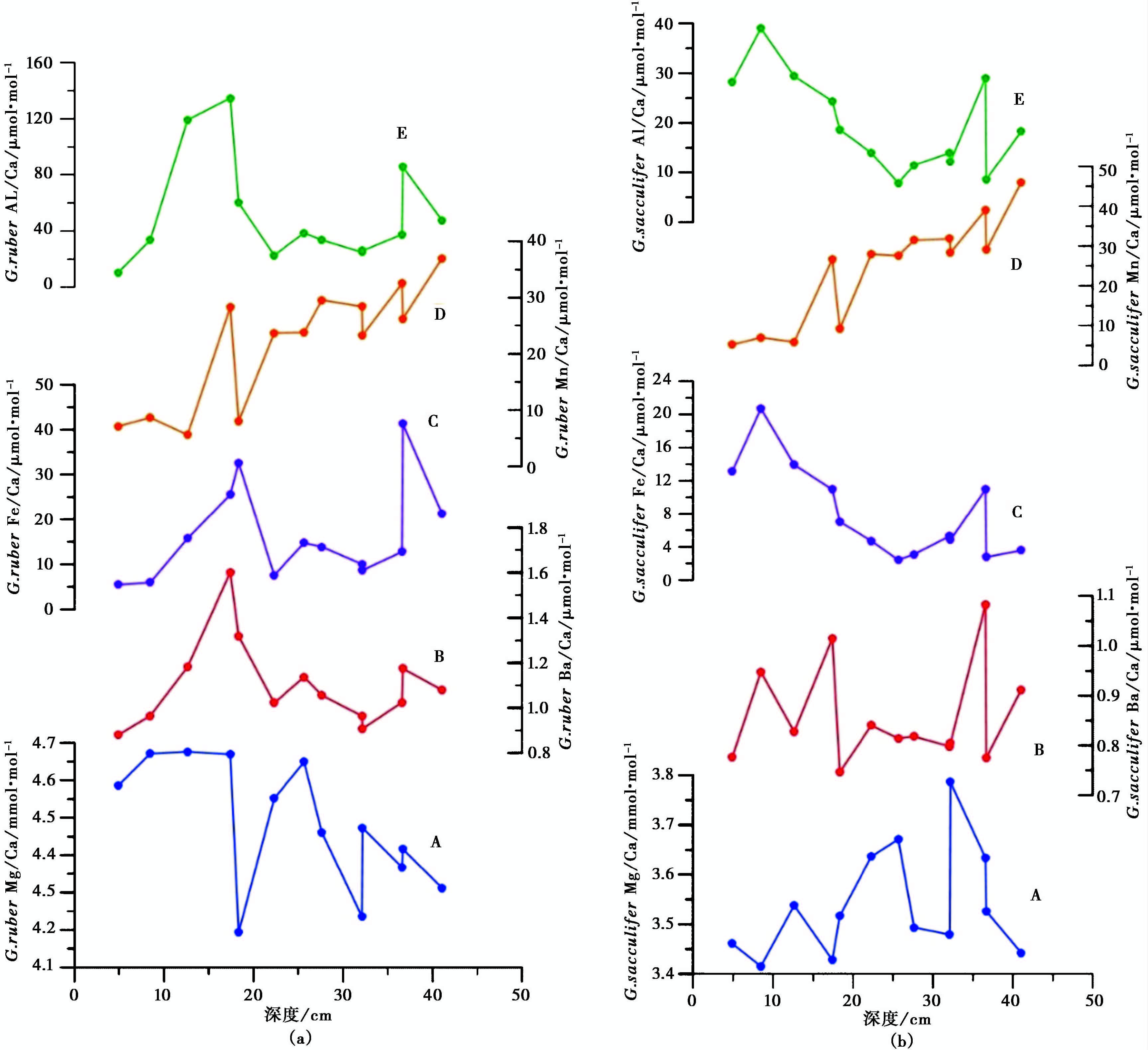
3 结果与讨论 3.1 清洗效果检测与Mg/Ca测试一样,有孔虫壳体的严格清洗是Ba/Ca分析数据准确可靠的保证。有孔虫完成生命周期以后,在向海底沉降及之后的埋藏过程中都会受到不同程度的污染; 由于有孔虫壳体中Ba含量极低,其测量值极易受到附着于其外表或充填于其房室中的粘土矿物、 有机物及自生铁锰氧化物的影响,其次沉积后的埋藏和成岩作用也可能改变其壳体的元素组成[26, 27]。粘土矿物、 自生铁锰氧化物及硅酸盐矿物对有孔虫壳体的污染可通过测量有孔虫壳体的Fe/Ca、 Mn/Ca或Al/Ca比值监测。ODP942站位13个样品的分析结果中G. ruber (White)和G. sacculifer的Ba/Ca范围分别为0.88~1.60μmol/mol和0.75~1.08μmol/mol,均未出现任何异常值( 图2)。G. ruber(White)和G. sacculifer的Fe/Ca及Mn/Ca比值绝大部分不足0.04mmol/mol,远低于典型的污染上限0.1mmol/mol[26]; 而且Ba/Ca与Fe/Ca显示了极差的相关性(G. ruber:R2=0.14; G. sacculifer:R2=0.25),Al/Ca比值与Ba/Ca值基本不相关(G. ruber:R2=0.0021; G. sacculifer:R2=0.12)。尽管有两个样品的G. ruber(White)Al/Ca达到了0.119mmol/mol和0.135mmol/mol,但其对应的Ba/Ca却没有明显的异常。说明前处理有效地去除了粘土矿物以及自生或吸附的铁锰氧化物外衣,沉积后作用的影响基本可以排除,实验测得的有孔虫壳体Ba/Ca真实可靠。
|
图2 ODP155 Site 942金属元素/Ca深度变化图 (a)G.ruber(White)Mg/Ca、 Ba/Ca、 Fe/Ca、 Mn/Ca和Al/Ca;(b)G.sacculiferMg/Ca、 Ba/Ca、 Fe/Ca、 Mn/Ca和Al/Ca Fig.2 ODP155 Site 942 metal element/Ca depth profile |
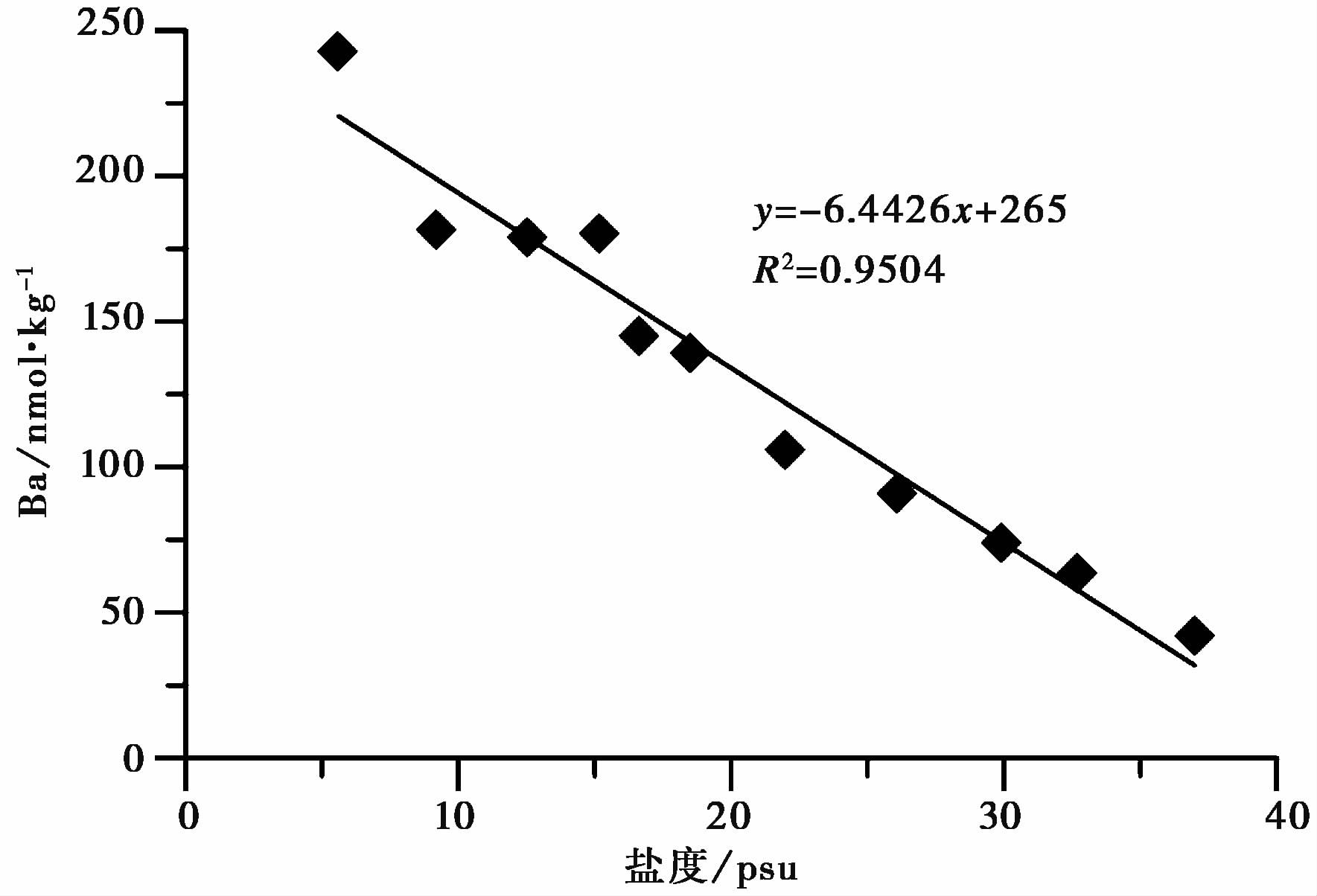
河流输入是海水中可溶性Ba的主要来源,淡水中Ba从悬浮粘土中的释放,使得河水中富集Ba2+。在河口处,当河流淡水与海水混合时,悬浮粘土发生凝聚作用,使得近河口区海水以高Ba2+、 低盐为特征,与开阔大洋低Ba2+、 高盐的特点形成鲜明对比。因此,在受河流输入影响显著的区域,可以依据水体中的溶解Ba2+浓度来估算表层海水盐度(SSS)[11]。浮游有孔虫的实验培养结果表明,其钙化过程中吸收进壳体的Ba与海水的中的Ba/Ca成线性关系,具有相对恒定的分配系数[12, 13, 28]; 同时,其他一些参数,如壳体钙化温度、 周围海水的碱度和pH值不影响这种关系[13, 29, 30, 31]。因此,可以利用海洋沉积物中的有孔虫壳体的Ba/Ca比值来重建古盐度[11]。目前,研究表明在亚马逊河、 刚果河、 密西西比河以及雅鲁藏布江-恒河河口湾海区,海水中Ba2+离子浓度受河流径流控制,与盐度呈明显高的负相关关系[14, 31]。本文收集了11个亚马逊河口区的现代Ba-SSS配对测量数据[31, 32],对其分析表明海水中的溶解Ba浓度与SSS呈明显的负相关,相关系数可以达到R2=0.95( 图3)。
|
图3 亚马逊河口Ba-SSS关系(数据源于文献[31, 32]) Fig.3 The relationship between Ba concentrations and SSS at the mouth of Amazon(data from references[31, 32]) |
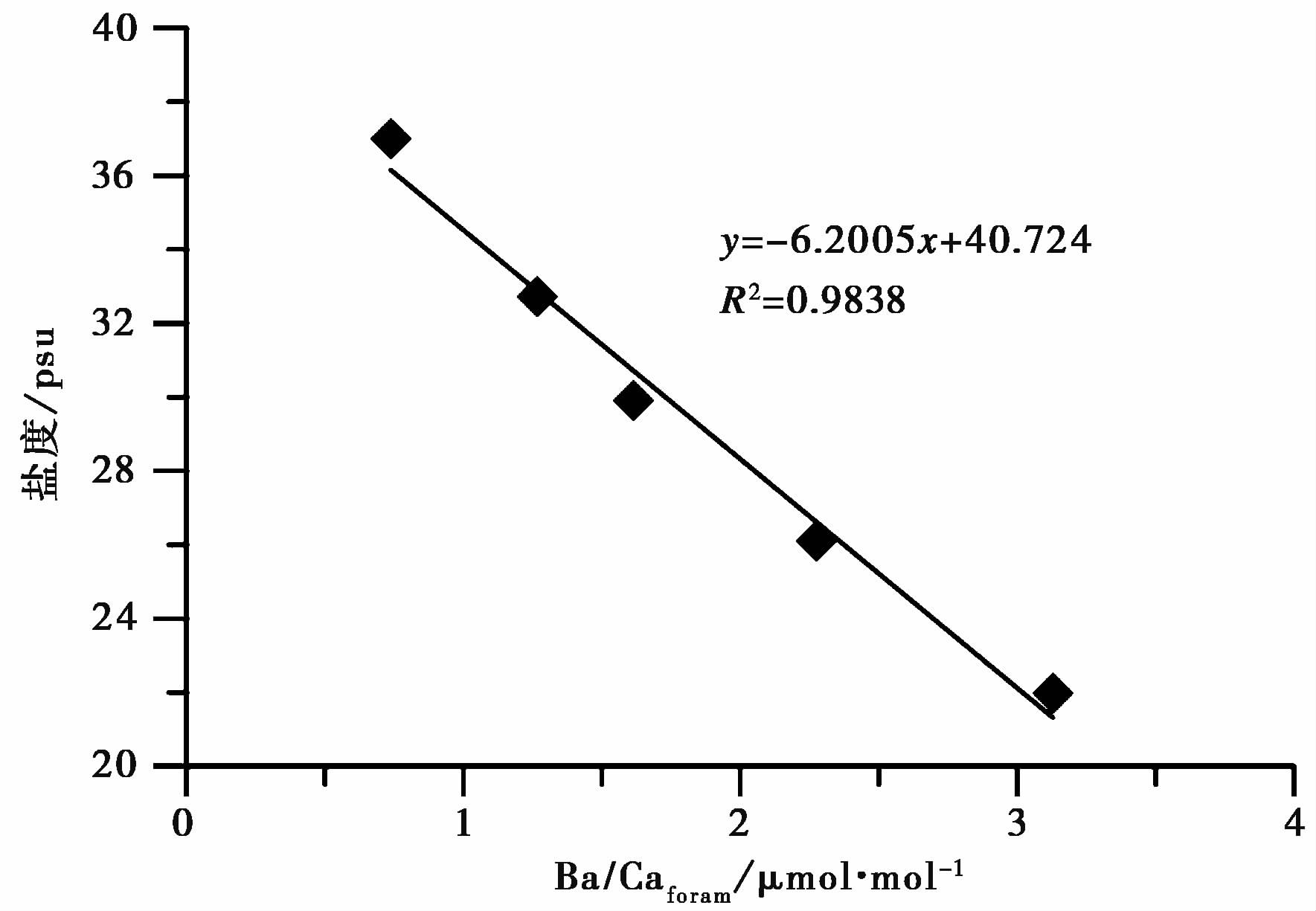
因此依据海水Ba浓度估计盐度在该区域是可行的。根据该海域盐度范围,选取合适的5个数据值,再结合大西洋海域Ba在浮游有孔虫壳体与海水中的分配系数(DBa=0.19±0.05[29]),从而获得亚马逊河口地区浮游有孔虫壳体Ba/Caforam与SSS关系为( 图4):

相关系数R2=0.98,SSS估计误差(1σ)为±1.80psu。
|
图4 亚马逊河口Ba/Caforam-SSS关系 Fig.4 The relationship between Ba/Caforam ratios and SSS at the mouth of Amazon |
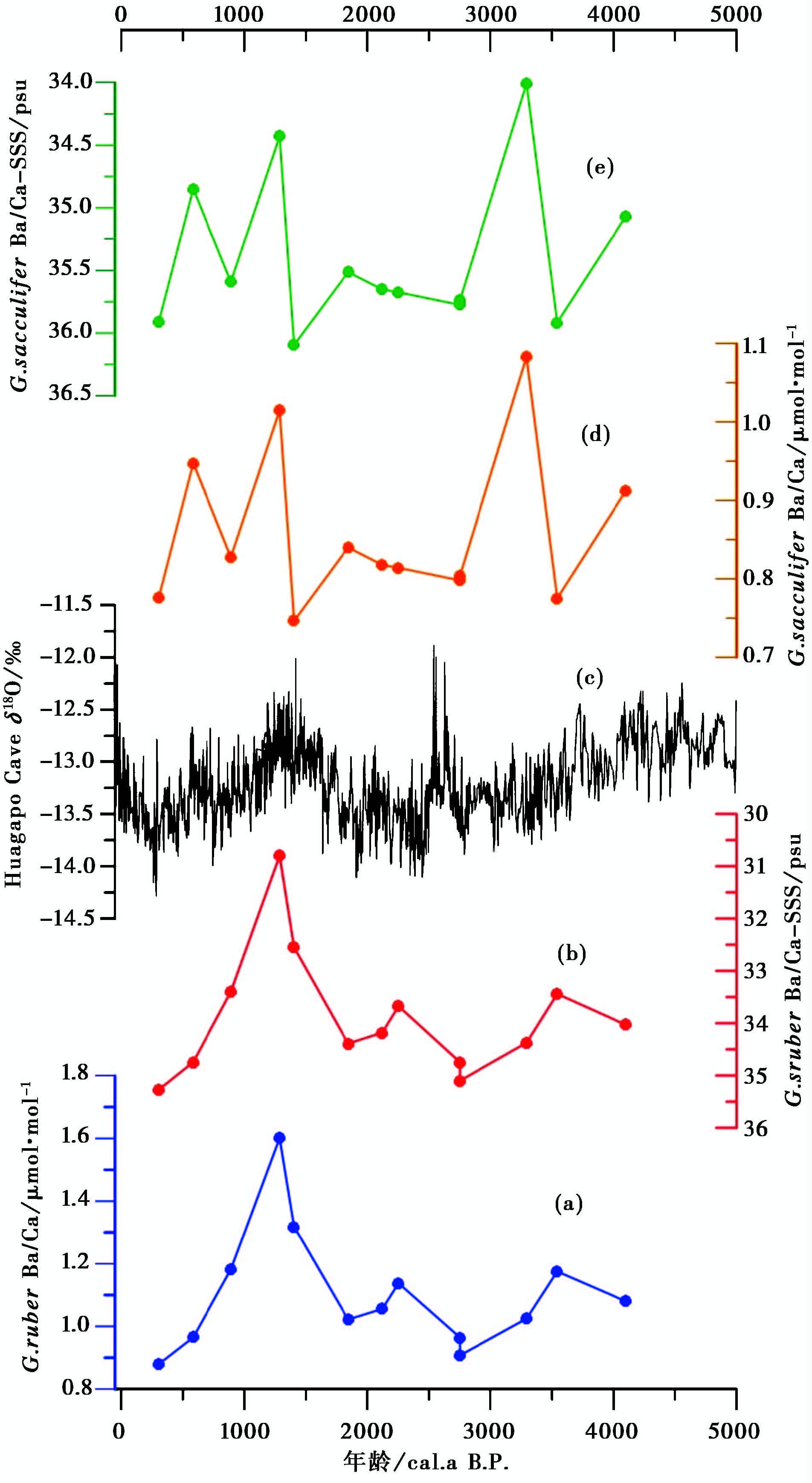
利用上述回归公式分别计算了ODP942站位13个样品G. ruber (White)和G. sacculifer壳体的 Ba/Ca估计SSS( 图5)。近4099a B.P. 年来,G.ruber (White)Ba/Ca估计的SSS(Ba/Caruber-SSS)变化范围为30.8~35.3psu; G. sacculifer Ba/Ca估计的SSS(Ba/Casacculifer-SSS)在34.0~36.1psu之间。其中,Ba/Caruber-SSS在305.8a B.P. 处值为35.3psu,接近于现代亚马逊冲积扇海域的表层海水盐度值35.0psu[33]; 而Ba/Casacculifer-SSS在305.8a B.P. 处值为35.9psu,接近该海域其现代生活深度的盐度值36.1psu[33]。过去4099a B.P. ,G. ruber(White)壳体Ba/Ca值在4099~1844a B.P. 期间较低,Ba/Caruber-SSS较高。在1287a B.P.左右,G.ruber(White)Ba/Ca值从1.02μmol/mol增大到1.60μmol/mol,SSS从34.4psu 降低到30.8psu。此后,G. ruber (White)Ba/Ca值持续下降,Ba/Caruber-SSS连续增大。过去4099a B.P. 期间G.sacculifer壳体 Ba/Ca值分别在3293a B.P. 、1287a B.P. 和584a B.P. 左右出现3次高峰值,相应地Ba/Casacculifer-SSS分别呈现了34.0psu、 34.4psu和34.9psu的3次低值,而在2751~1404a B.P. 则表现为明显持续的高盐度值( 图5)。
|
图5 ODP155 Site 942有孔虫壳体Ba/Ca值、 Ba/Ca-SSS与Huagapo洞 δ 18 O对比图 (a)ODP155 Site 942 G.ruber(White)壳体Ba/Ca;(b)G.ruber (White)壳体Ba/Ca-SSS;(c)Huagapo Cave δ 18 O(数据源于文献[34]); (d)G.sacculifer壳体Ba/Ca;(e)G.sacculifer壳体Ba/Ca-SSS Fig.5 Planktonic foraminifer Ba/Ca(μmol/mol),Ba/Ca-SSS estimates from ODP155 Site 942 and compared with the δ 18 O in stalagmite of Huagapo cave |
现代研究表明,亚马逊流域的降水主要受南美夏季风(South American Summer Monsoon,简称SASM)和ITCZ的南北迁移控制[34]。随着ITCZ位置的纬向转变,热带南美降雨强度也发生变化,当ITCZ北移时,SASM增强,亚马逊流域降雨增多; 反之则夏季风减弱,降雨减少。降雨量的变化与亚马逊河的流量密切相关,继而影响输送到亚马逊冲积扇海域的河流淡水,导致该海域SSS出现变化[17, 18, 19]。依据安第斯山脉秘鲁中部Huagapo洞(11.27°S,75.79°W) 两个石笋的 δ 18 O的记录,Kanner等[34]恢复了7150a B.P. 南美南部与夏季风相关的降水变化过程。ODP942站位的13个样品浮游有孔虫G. ruber(White)和G. sacculifer壳体Ba/Ca值估计的亚马逊冲积扇海域SSS变化与该记录对比发现,Ba/Caruber-SSS变化趋势与Huagapo洞石笋 δ 18 O指示的南美南部大陆降水过程呈很好的反向关系( 图5c)。当亚马逊冲积扇海域Ba/Caruber-SSS降低时,Huagapo洞石笋 δ 18 O值偏重[34],指示此时该地区季风减弱,降雨减少。这与ITCZ北移,南美南部SASM减弱,大陆降雨减少; 而热带南美北部大陆降水增强,亚马逊河流量增加,淡水输入增多,亚马逊冲积扇海域Ba/Caruber-SSS下降的事实相当一致。反之,当ITCZ南移时,增强的东向风向大陆输送更多水汽,南美南部SASM加强,Huagapo洞地区降雨增多[34],而位于北半球的亚马逊冲积扇区域降水减弱,淡水输入减少,河口处Ba/Caruber-SSS增大。可见利用G. ruber(White)壳体Ba/Ca值估算的SSS变化特征能够很好地反映亚马逊降水变化。与此相比,G. sacculiferBa/Ca估计的SSS与Huagapo洞石笋 δ 18 O则没有良好的可对比性。这是由于海水中的溶解Ba浓度与SSS的这种负相关关系只存在于表层海水中,并不适用于其他海水深度。而G.sacculifer生活的水深较大,其壳体中的地球化学特性受到表层和温跃层共同影响[35],所以它反映的不只是表层海水信息。
4 结论亚马逊冲积扇海域表层海水溶解Ba浓度与SSS之间存在明显的负相关关系,相关系数可以达到R2=0.95。依据现代海水Ba/Ca与SSS的相关关系以及Ba/Ca在海水和有孔虫壳体之间的分配系数,建立了一个浮游有孔虫壳体Ba/Ca比值与SSS的回归关系式:SSS=-6.2005*Ba/Caforam+40.724,相关系数R2=0.98,SSS估计误差±1.80psu。与G. sacculifer壳体Ba/Ca相比,G. ruber(White)壳体Ba/Ca估算的近4099a B.P. 年来SSS变化与南美石笋的降水记录[34]有更好的可对比性,G. ruber(White)Ba/Ca是亚马逊冲积扇海域SSS良好的替代指标,为进一步通过G. ruber(White)Ba/Ca恢复区域淡水输入及降水变化奠定了基础。
| 1 | 范维佳, 陈荣华. 南海北部5万年来的表层海水盐度及东亚季风降水. 第四纪研究, 2011, 31 (2):227~235 Fan Weijia, Chen Ronghua. Sea surface salinity and East Asian monsoon precipitation since last 50000 years in the northern South China Sea..shtml Quaternary Sciences, 2011, 31 (2):227~235 |
| 2 | 向 荣, 阎 军. 表层海水古盐度重建. 海洋科学, 2002, 26 (4):17~20 Xiang Rong, Yan Jun. Reconstruction of sea surface paleosalinity. Marine Science, 2002, 26 (4):17~20 |
| 3 | 李 丽, 王 慧, 李建如等. 南海西部晚更新世以来表层海水剩余氧同位素及盐度变化. 第四纪研究, 2008, 28 (3):399~406 Li Li, Wang Hui, Li Jianru. Variability of sea surface residual oxygen isotopic and salinity in western South China Sea over Late Pleistocene. Quaternary Sciences, 2008, 28 (3):399~406 |
| 4 | Cullen J L. Microfossil evidence for changing salinity patterns in the Bay of Bengal over the last 20000 years. Palaeogeography, Palaeoclimatology, Palaeoecology, 1981, 35:315~356 |
| 5 | Duplessy J C, Labeyrie L, Juillet-Leclerc A et al. Surface salinity reconstruction of the North Atlantic Ocean during the Last Glacial Maximum. Oceanologica Acta, 1991, 14 (4):311~324 |
| 6 | Rostek F, Ruhland G, Bassinot F C et al.Reconstructing sea surface temperature and salinity using δ18O and alkenone records. Nature, 1993, 364:319~321 |
| 7 | Wang L, Sarnthein M, Duplessy J C et al. Paleo sea surface salinities in the low-latitude Atlantic:The δ18O record of Globigerinoides ruber(white). Paleoceanography, 1995, 10 (4):749~761 |
| 8 | 王晓燕, 李保华. 浅谈浮游有孔虫群落海水古温度估算. 微体古生物学报, 2006, 23 (2):182~190 Wang Xiaoyan, Li Baohua. Review of planktonic foraminiferal assemblages for sea surface temperature estimate. Acta Micropalaeontologica Sinica, 2006, 23 (2):182~190 |
| 9 | 赵美训, 李大伟, 邢 磊. 古菌生物标志物古海水温度指标TEX86研究进展. 海洋地质与第四纪地质, 2009, 29 (3):75~84 Zhao Meixun, Li Dawei, Xing Lei. Using archaea biomarker index TEX 86 as a paleo-sea surface temperature proxy. Marine Geology & Quaternary Geology, 2009, 29 (3):75~84 |
| 10 | 徐 建, 李建如, 乔培军. 有孔虫Mg/Ca温度计研究进展—盐度影响及校正. 地球科学进展, 2011, 26 (9):997~1005 Xu Jian, Li Jianru, Qiao Peijun. Progresses in study of foraminiferal Mg/Ca thermometer: Salinity effect and its correction. Advances in Earth Science, 2011, 26 (9):997~1005 |
| 11 | Hertzberg J E, Schmidt M W. Quantifying the [Ba2+]︰δ18Oseawater: Surface salinity relationship in the Eastern Equatorial Pacific. Mineralogical Magazine, 2011, 75 (3):1017 |
| 12 | Hall J M, Chan L H. Ba/Ca in Neogloboquadrina pachyderma as an indicator of deglacial meltwater discharge into the western Arctic Ocean. Paleoceanography, 2004, 19 (1):PA1017, doi:10.1029/2003PA000910 |
| 13 | Hönisch B, Allen K A, Russell A D et al. Planktic foraminifers as recorders of seawater Ba/Ca. Marine Micropaleontology, 2011, 79 (1~2):52~57 |
| 14 | Weldeab S, Lea D W, Schneider R R et al.155,000 years of West African monsoon and Ocean Thermal evolution. Science, 2007, 316:1303~1307 |
| 15 | Weldeab S, Schneider R R, Muller P. Comparison of Mg/Ca- and alkenone-based sea surface temperature estimates in the fresh water-influenced Gulf of Guinea, eastern equatorial Atlantic. Geochemistry, Geophysics, Geosystems, 2007, 8 (5):Q05P22, doi:10.1029/2006GC001360 |
| 16 | Hoorn C. Palynology of the Pleistocene glacial/interglacial cycles of the Amazon fan(Holes 940A, 944A, and 946A). Proceedings of the Ocean Drilling Program, Scientific Results, 1997, 155:397~409 |
| 17 | Maslin M, Knutz P C, Ramsay T. Millennial-scale sea-level control on avulsion events on the Amazon Fan. Quaternary Science Reviews, 2006, 25 (23~24):3338~3345 |
| 18 | Maslin M A, Ettwein V J, Wilson K E et al. Dynamic boundary-monsoon intensity hypothesis: Evidence from the deglacial Amazon River discharge record. Quaternary Science Reviews, 2011, 30 (27~28):3823~3833 |
| 19 | Maslin M A, Durham E, Burns S J et al. Palaeoreconstruction of the Amazon River freshwater and sediment discharge using sediments recovered at Site 942 on the Amazon Fan. Journal of Quaternary Science, 2000, 15 (4):419~434 |
| 20 | Flood R D, Piper D J W. Amazon fan sedimentation: The relationship to equatorial climate change, continental denudation, and sea-level fluctuations. Proceedings of the Ocean Drilling Program, Scientific Results, 1997, 155:653~675 |
| 21 | Wilson K E, Maslin M A, Burns S J. Evidence for a prolonged retroflection of the North Brazil Current during glacial stages. Palaeogeography, palaeoclimatology, Palaeoecology, 2011, 301 (1~4):86~96 |
| 22 | Maslin M A, Ettwein V J, Boot C S et al. Amazon Fan biomarker evidence against the Pleistocene rainforest refuge hypothesis?Journal of Quaternary Science, 2012, 27 (5):451~460 |
| 23 | Martin P A, Lea D W. A simple evaluation of cleaning procedures on fossil benithic foraminiferal Mg/Ca. Geochemistry, Geophysics, Geosystems, 2002, 3 (10):8401 |
| 24 | Weldeab S. Bipolar modulation of millennial-scale West African monsoon variability during the last glacial(75,000~25,000 years ago). Quaternary Science Reviews, 2012, 40:21~29 |
| 25 | Lea D W, Boyle E A. Determination of carbonatebound barium in corals and foraminifera by isotope dilution plasma mass spectrometry. Chemical Geology, 1993, 103 (1~4):73~84 |
| 26 | Barker S, Greaves M, Elderfield H. A study of cleaning procedures used for foraminiferal Mg/Ca paleothermometry. Geochemistry, Geophysics, Geosystems, 2003, 4 (9):8407 |
| 27 | Weldeab S, Schneider R R, Kölling M. Comparison of foraminiferal cleaning procedures for Mg/Ca paleothermometry on core material deposited under varying terrigenous-input and bottom water conditions. Geochemistry,Geophysics, Geosystems, 2006, 7 (4):Q04P12,doi:10.1029/2005GC000990 |
| 28 | Lea D W, Spero H J. Assessing the reliability of paleochemical tracers:Barium uptake in the shells of planktonic foraminifera. Paleoceanography, 2010, 9 (3):445~452 |
| 29 | Lea D W, Boyle E A. Barium in planktonic foraminifera. Geochimica et Cosmochimica Acta, 1991, 55 (11):3321~3331 |
| 30 | Lea D W, Spero H J. Experimental determination of barium uptake in shells of the planktonic foraminifera Orbulina universa at 22℃. Geochimica et Cosmochimica Acta, 1992, 56 (7):2673~2680 |
| 31 | Edmond J M, Boyle E D, Drummond D. Desorption of Barium in the plume of the Zaire(Congo)River. Netherlands Journal of Sea Research, 1978, 12 (3/4):324~328 |
| 32 | Boyle E A. The Marine Geochemistry of Trace Metals. Massachusetts:The Ph.D. Thesis of Massachusetts Institute of Technology and Woods Hole Oceanographic Institution, 1976. 136~138 |
| 33 | http://www. nodc.noaa. gov/OC5/WOA09/woa09data.html. |
| 34 | Kanner L C, Burns S J, Cheng Hai. High-resolution variability of the South American summer monsoon over the last seven millennia:Insights from a speleothem record from the central Peruvian Andes. Quaternary Science Reviews, 2013, 75:1~10 |
| 35 | Spero H J, Mielke K M, Kalve E M et al. Multispecies approach to reconstructing eastern equatorial Pacific thermocline hydrography during the past 360 kyr. Paleoceanography, 2003, 18 (1):1002 |
Abstract
Salinity is a crucial variable in paleoceanographic study. No independent geochemical proxy for salinity has been discovered, impairing the reliabilities of past climate and environmental reconstruction. The Amazon Fan is located in the Brazilian continental margin of the equatorial Atlantic Ocean, which is a large mud-rich deep-sea fan. The fan stores sediments from the Andean region, the lowland savannahs, and the Amazon rainforest. The supply of terrigenous sediments is closely related with the precipitation of the Amazon basin, which is controlled by a variety of tropical processes, such as the South American Summer Monsoon(SASM), the Inter-tropical Convergence Zone(ITCZ), and ENSO. The precipitation plays a major role in the supply of latent heat to the high latitudes and influences the output of fresh water from the Atlantic to the Pacific, which is thought to regulate global thermohaline circulation. ODP Leg 155 Site 942(5°45'N, 49°6'W at a water depth of 3346m)is drilled to the west of the Amazon Fan. The location of Site 942 is important for understanding the meeting and mixing of the Amazon River freshwater with the North Brazil Coastal Current(NBCC). According to the result that the people had been studied, we collect 11 modern Ba-SSS matching measurement data from Amazon estuary and the analysis indicates that the dissolved barium concentrations in this region show an obvious negative correlation to the SSS(R2=0.95). A lineal equation(SSS=-6.2005*Ba/Caforam+40.724, R2=0.98)is established based on the relationship between modern sea surface Ba/Ca and salinity, and a distribution coefficient of Ba reported for planktonic foraminifera. Planktonic foraminiferal Ba/Ca ratios are determined on thirteen samples from Site 942B and 942C to investigate the usability of Ba/Ca in G. ruber (White)and G. sacculifer as an indicator of past sea surface salinity(SSS). The bottom of the samples is 41.03cm, which is estimated to 4099a B.P. The result shows that for the last 4099a B.P., the Ba/Caruber-SSS is from 30.8psu to 35.3psu, and the Ba/Casacculifer-SSS is from 34.0psu to 36.1psu. At 305.8a B.P. the Ba/Caruber-SSS(35.3psu)is close to the modern Amazon Fan SSS(35.0psu), while the Ba/Casacculifer-SSS(35.9psu)is close to the salinity of modernG. sacculifer dwelling oceanic depth (36.1psu). During the period of 4099a B.P. to 1844a B.P., the Ba/Caruber-SSS is high. There is a step to lower Ba/Caruber-SSS at about 1287a B.P., which is 30.8psu. Since then, the Ba/Caruber-SSS increases continuously. There are three low values of the Ba/Casacculifer-SSS, respectively at 3293a B.P., 1287a B.P. and 584a B.P., while during 2751~1404a B.P. the Ba/Casacculifer-SSS sustains high values. Application of this equation to the thirteen ODP942 samples suggests that for the last 4099 a B.P., SSS estimates based on G. ruber(White)-Ba/Ca show fairly comparable results to the precipitation records indicated by the stalagmite δ18O from South American continent. Ba/Ca in G. ruber (White)is a useful proxy of SSS over the Amazon Fan.