 2015, Vol.35


冲绳海槽广泛发育着第四纪以来的连续沉积物,海平面变化、 季风变化、 构造活动以及火山活动等都影响着海槽的沉积物分布和组成[1, 2, 3, 4, 5, 6, 7],晚第四纪以来的古海洋事件几乎都在冲绳海槽有记录[6, 7, 8, 9, 10, 11, 12, 13]。因而,冲绳海槽成为研究晚第四纪以来陆海相互作用、 陆源入海物质“源—汇”过程以及古环境的理想区域[8, 14, 15]。此外,冲绳海槽由于陆源物质供应充足往往具有较高的沉积速率,其对海平面变化的记录相比于开阔海区更加灵敏[9, 10],是进行高分辨率古环境重建的理想场所。
前人对东海陆架泥质沉积的研究很多,如刘振夏等[11]恢复了冲绳海槽5万年来的古气候事件,陈金霞等[12]用孢粉对末次冰期以来的古气候变化进行了重建,常凤鸣[13]恢复了冲绳海槽晚更新世—全新世的古环境演化,褚智慧等[16]对末次盛冰期以来海水对气候变化的响应进行了研究。 但由于取样位置和取样深度的原因,以上的古气候恢复均基于较长的时间序列,导致分辨率不高,不能准确代表海洋的环境。
本文利用冲绳海槽北部的柱状沉积记录,基于高精度的14C年代地层,提取全新世以来的粒度组成在千年及百年尺度上的变化特征,重建全新世高分辨率古环境记录。在区域对比的基础上,探讨沉积物粒度记录对区域海平面及气候变化的响应。
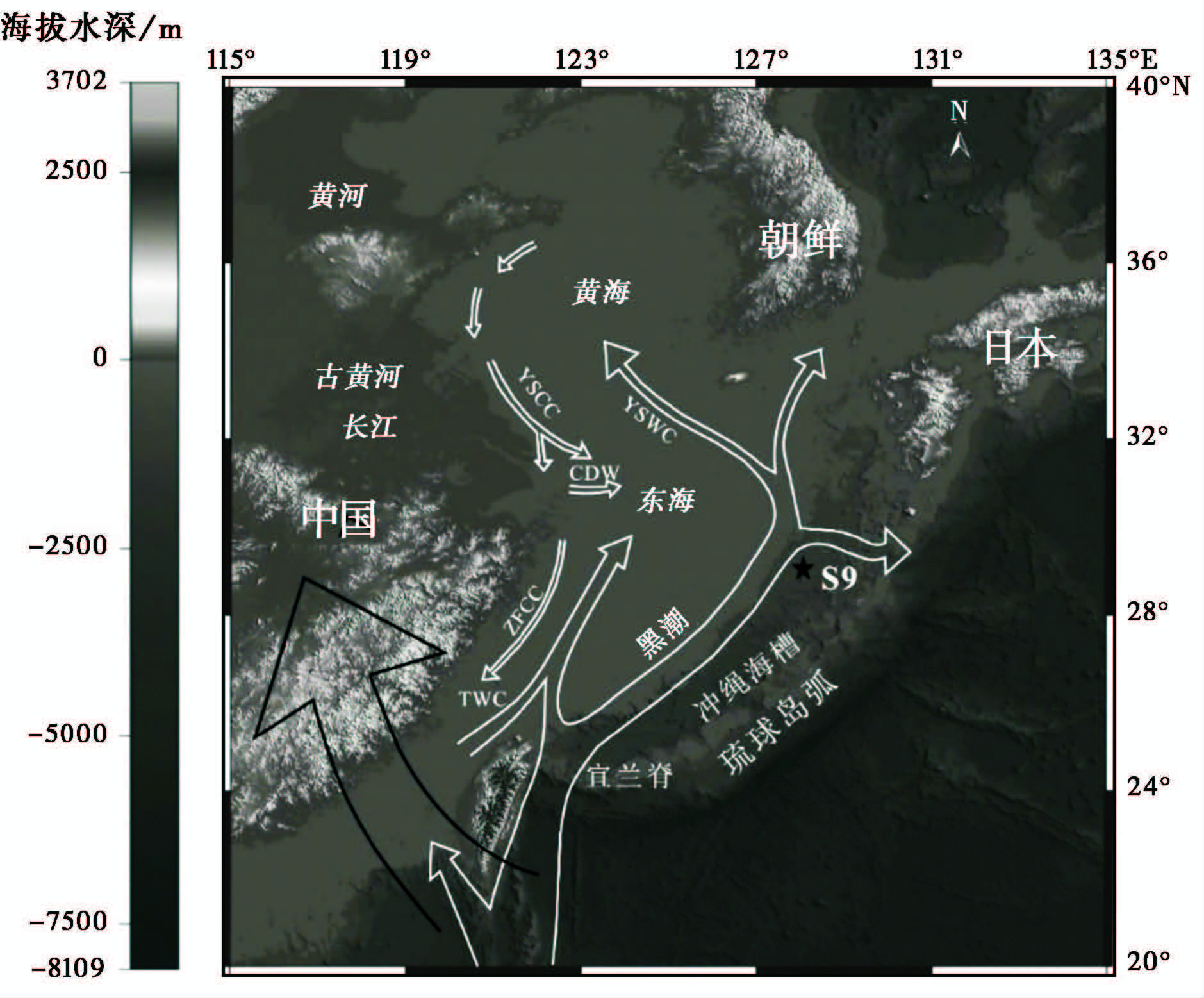
1 材料与方法沉积物重力柱状样S9(29°23.4989′N,128°15.8230′E)采自2013年夏冲绳航次(图1),取样水深1062m,柱样全长251cm。岩芯记录未显示明显的沉积间断。岩芯整体为灰绿色,没有明显的颜色变化。自顶部向底部含水量逐渐减少,流动性逐渐减弱,粒度逐渐变大,至底部呈现明显的大颗粒散碎沉积物。S9采样间隔为1cm,共获得样品251个。因为S9柱底部的样品结块严重,从226cm到237cm无法测试粒度数据,因此只对柱样上部0-226cm进行了粒度分析。
|
图1 冲绳海槽位置、 海流及研究站位 其中TWC是台湾暖流,YSCC是黄海沿岸流,YSWC是黄海暖流,CDW是长江淡水,ZFCC是浙江-福建沿岸流,海流数据来自文献[17, 18],黑色箭头代表东亚季风 Fig.1 Schematic map showing locations of Okinawa Trough and the Core S9,and the regional circulation system. TWC=Taiwan Warm Current; YSCC=Yellow Sea Coastal Current; CDW=Changjiang Diluted Water; ZFCC=Zhejiang-Fujian Coastal Current. The regional circulation pattern are sourced from references[17, 18]. The black arrow is East Asian monsoon |
在粒度测试之前,进行了前处理,去除了CaCO3和有机质等的影响[19, 20, 21],用5 % -7 % 的稀盐酸1-2ml,反应24小时后加10 % 的双氧水2ml,反应8小时。然后加水至容器2/3-3/4,静置一夜,倒去上层清液,如此反复3次。在上机测试之前,进行5分钟的超声处理,使样品分散开来。对处理后的样品利用Cilas940L激光粒度仪进行测试,仪器测量的范围是0.5-2000μm,重复测量相对误差小于2 % 。本文使用McManus矩法公式[22]计算得到平均粒径(μ)、 分选系数(σ)、 偏态(Sk)和峰态(Ku)等粒度参数。
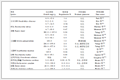
挑选5个层位的粒径>150μm的浮游有孔虫( >10mg) 混合种(Globigerinoides ruber、 Globigerinoides sacculife、 Pulleriatina obliquilocalata、 Neogloboquadrina dutertrei和Globigerina bulloides)在美国Beta Analytic实验室进行14C 年代测试,对14C 年代测试数据采用CALIB7.02程序[23, 24]进行日历年龄校正[25],碳储库采用区域平均值ΔR=-85±6[25]。
数据点之间的年代序列采用逐次线性内插法求得,数据点之外采用线性外推法求得( 表1)。本文所指的年龄均为日历年龄(1σ)。
|
表1 冲绳海槽北部S9孔14C 年龄和日历年龄 Table 1 14C age,calibrated calendar age of the Core S9 from the northern Okinawa Trough |
如 表1所示,5个层位的14C 测试数据结果显示S9柱代表1.0-13.390ka B.P. 的沉积,柱状样的年代没有倒转,此外,镜下观察显示,159-169cm层位存在着明显的火山玻璃层(李安春研究员鉴定),这很可能是该区域普遍存在的由于日本西南火山Kikai-Akahoya活动造成的火山灰堆积层,该K-Ah火山灰层的年代为7.324ka B.P.[26, 27, 28]。而S9柱与之接近的年代测试层165-166cm,有孔虫14C 年代数据为6.495-7.293ka B.P. (1σ),说明此沉积物柱状样的年龄是可靠的。
样品的平均时间分辨率为49.36a,本文只讨论全新世以来的粒度变化情况( 图2)。

|
图2 S9沉积物柱状样年代模式及沉积速率 图上所示的三角点为14C 测年点及其年代,箭头所示的年代为K-Ah火山灰层年代,照片为镜下火山灰 Fig.2 Age pattern and sedimentation rate of the Core S9 |
S9柱的沉积速率从古到今逐渐增加,早全新世的沉积速率最低,为8cm/ka,中全新世的沉积速率从17cm/ka增加到27cm/ka,晚全新世沉积速率较高,达到32cm/ka。
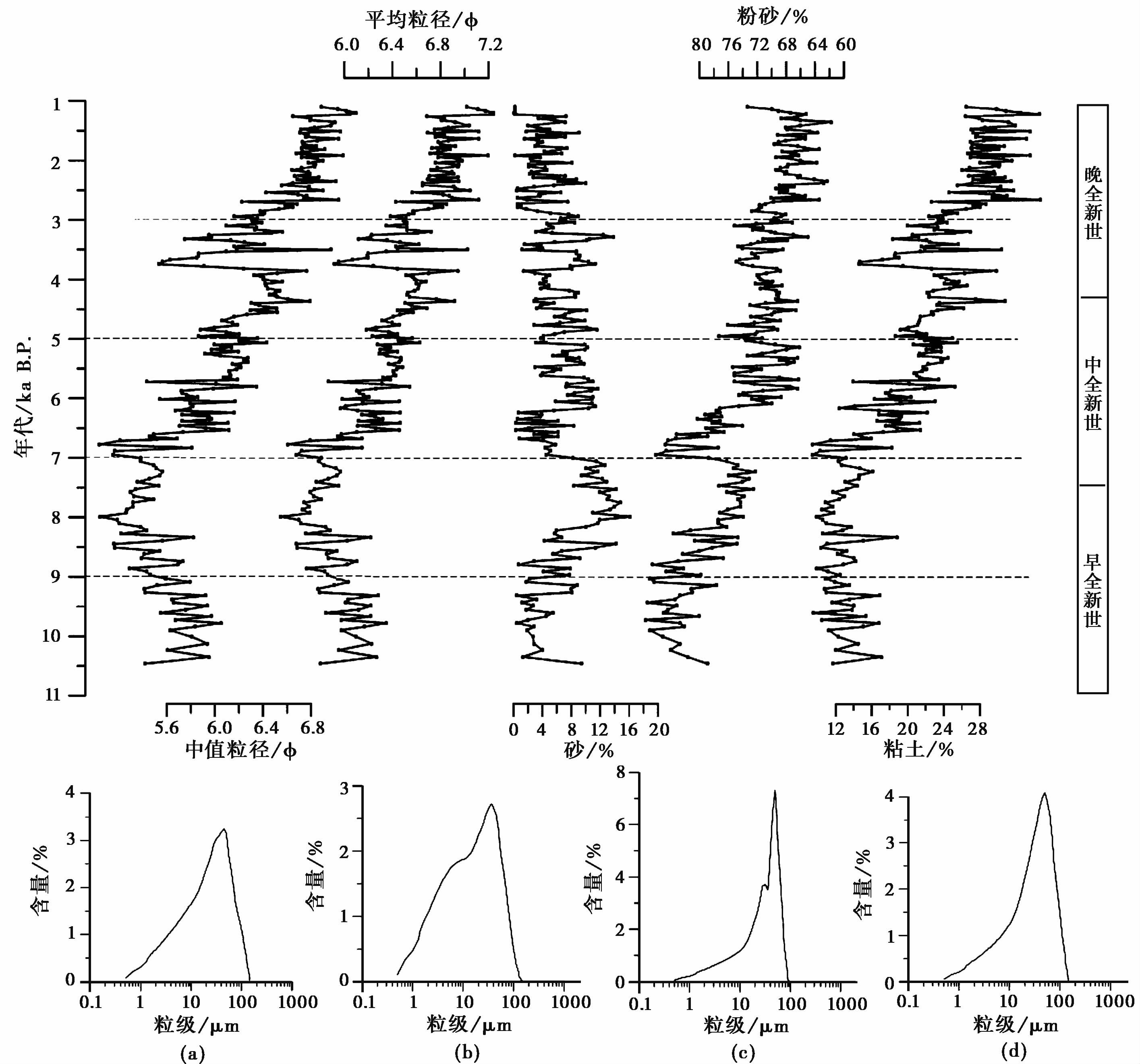
2.2 粒度特征S9柱的粒度及粒度各参数如 图3。从 图3中可见,平均粒径随着深度增加由小变大。中值粒径变化范围为5.2-7.2φ,平均粒径变化范围5.6-7.2φ。根据岩芯沉积物粒度变化,将沉积物分为3层: 第一层(11.8-8.0ka B.P. ),中值粒径变化范围为5.2-6.0φ,平均粒径有轻微减小趋势,相对平稳; 第二层(8.0-3.7ka B.P. ),中值粒径变化范围为5.2-6.8φ,中值粒径变化较大且变化不稳定,呈现明显增加趋势,8.0ka B.P. 时,达到平均粒径最大值; 第三层(3.7-1.1ka B.P. ),中值粒径变化范围为6.0-7.2φ,变化相对较缓,略有增加趋势,3.567-3.708ka B.P. 有较大平均粒径,达6.0φ,3.7-3.3ka B.P. 变化略显突兀,3.3-1.1ka B.P. 平均粒径波动性稳定增加。
|
图3 S9孔沉积物全新世以来粒度组成特征及部分层位粒级-频率分布图 (a)S9孔84cm层位粒级-频率分布图;(b)S9孔132cm层位粒级-频率分布图;(c)S9孔166cm层位粒级-频率分布图;(d)S9孔187cm层位粒级-频率分布图。图中虚线为2ka分割线 Fig.3 Characteristics of grain size and grain size-frequency of part of the horizon of the Core S9 since the Holocene |
其中,砂含量为0-20 % ,粉砂含量为60 % -90 % ,粘土含量为0-40 % 。砂含量较不稳定,8.450-7.062ka B.P. 波动幅度较小,7.062-6.165ka B.P. 有较大增加,接着突变为较低,然后逐渐增加,6.165-1.1ka B.P. 增加趋势稳定。粉砂的含量整体呈现由古到今逐渐减小趋势。粘土含量整体呈现由古到今逐渐增加趋势,变化较为稳定,只有较小的波动。粒度参数值都在8.0ka B.P. 处有转折性的变化。粒度数据的5个指标趋势一致(见 图3),反映相同的粒度变化,本文采用平均粒径进行对比说明。
3 讨论 3.1 粒度特征对海平面的响应冲绳海槽地形复杂,受到的物源影响因素较多,外生的沉积物来源比较复杂,冲绳海槽外生物质多来源于长江和黄河[29, 30, 31, 32],以及台湾物质[33, 34]。冲绳海槽的沉积物还有其他的来源,比如,不定期发生的日本西部火山区的火山塌陷[35, 36]、 海底热液活动[37]、 风的输送[38]、 海底地震[39]以及黑潮的流入[40, 41]等等,均为海槽提供了硅质碎屑沉积[42]。冲绳海槽不同区域的物质来源不尽相同,冲绳海槽中南部的沉积物主要来源于长江和台湾物质[43, 44, 45, 46, 47, 48, 49, 50, 51, 52],而冲绳海槽北部的沉积物因为距离台湾较远,其沉积物源主要来自于长江和黄河,有无台湾物质尚有争议[53, 54, 55]。
S9柱底层的沉积物,距今约1万年,其时海平面比现在约低40m[56],并且气候比较干冷[57],东海大陆架出露面积大于现在[58, 59],长江的古河口直对冲绳海槽[60, 61],输入较多的碎屑矿物进入冲绳海槽北部[62],而当时的古黄河河口也更靠近冲绳海槽北部[63],黑潮活动弱于现在[64, 65],并且,因为海平面较低,所以冲绳海槽几乎与太平洋和黑潮隔离开来,黑潮沿着琉球群岛流向东北,没有进入冲绳海槽[66, 67],因此,推断S9柱底部的沉积物多来自于长江和黄河的物质,台湾物质和黑潮带入的其他物质偏少。随着海平面的升高,长江和黄河河口距离冲绳海槽越来越远,到距今7.5-7.0ka B.P. 的时候,海平面逐渐升高至现今的高度[56],大陆输入的物质逐渐减少。
晚更新世时,海平面较低,冲绳海槽完全从太平洋隔离出来,黑潮流向开阔的太平洋[67, 68],1万年来,海平面升高,虽然黑潮重新进入冲绳海槽的时间尚有争议,但一般都认为在16.3-7.6ka B.P.之间[9, 55, 69, 70, 71, 72, 73, 74, 75, 76],根据S9的定年数据,黑潮重新进入冲绳海槽可能会对该沉积物柱状样有所影响。S9柱沉积速率( 图2)显示,冲绳海槽北部约7.0ka B.P.时沉积速率较冰消期有所增加,这可能与区域海平面的快速上升密切相关; 约7.0ka B.P. 之后沉积速率进一步增大,可能与黑潮进入进而影响冲绳海槽北部水体相关[77, 78]。受黑潮水体顶托以及海槽坡折地形的双重影响,来自中国大陆的陆源物质向外海扩散的规模减小,进而沉积于冲绳海槽,造成了沉积速率较早全新世的大幅度升高。
全新世以来,海平面逐渐升高,东海陆架裸露的面积逐渐减小[58, 59],全新世初期,长江黄河的河口更靠近冲绳海槽[60, 61, 62, 63],大量的悬浮物质并未经过长距离搬运而进入冲绳海槽,其时沉积物粒度相对较粗,随着海平面升高,裸露的东海陆架逐渐被淹没,冰期时在东海陆架上的粗颗粒物质经过再搬运进入冲绳海槽,而随着海平面逐渐升高、 黄河改道,河流的河口逐渐后移,河流搬运的物质经过较长距离的搬运进入冲绳海槽,沉积物粒度相对变细,7.5-7.0ka B.P. 时,海平面升至现在的高度[50],7.5-7.0ka B.P. 以来,长江河口和冲绳海槽的距离变化不大,其沉积物粒度受到搬运距离的影响变小。
早全新世,海平面持续上升,冰期暴露在东海陆架上的粗颗粒物质进入冲绳海槽北部,S9柱的平均粒径也随之上升,直至其平均粒径达到S9粒径的最高值。
早全新世晚期到中全新世早期,海平面快速上升,东海陆架快速被海水淹没,长江和黄河河口后退迅速,陆源物质输入距离迅速增加,导致此时S9柱的平均粒径大幅度减小,表明S9柱的平均粒径对海平面上升有很好的响应。
中全新世和晚全新世时期,海平面趋于稳定,其变化范围在0-1m之间[79, 80],S9柱的粒度受海平面变化影响很小。
3.2 粒度特征与季风降雨量的关系冲绳海槽北部沉积物主要来源于大陆河流的输入,当大陆河流地区的降雨量增加时,大陆河流的流量增加,河流携带更多的沉积物进入冲绳海槽,研究区沉积物粒度较粗; 当大陆河流地区的降雨量减少时,大陆河流的流量随之减少,河流搬运较少的沉积物进入冲绳海槽,研究区沉积物粒度较细[81]。
古季风较弱时,在长江中下游有大量的降雨[82, 83, 84, 85],导致长江流量增加,注入冲绳海槽的沉积物粒度较粗,而古季风较强时,大量的降雨迁移到欧亚大陆北部,长江中下游降雨量变少,河流的流量随之变少,注入冲绳海槽的沉积物粒度较细。
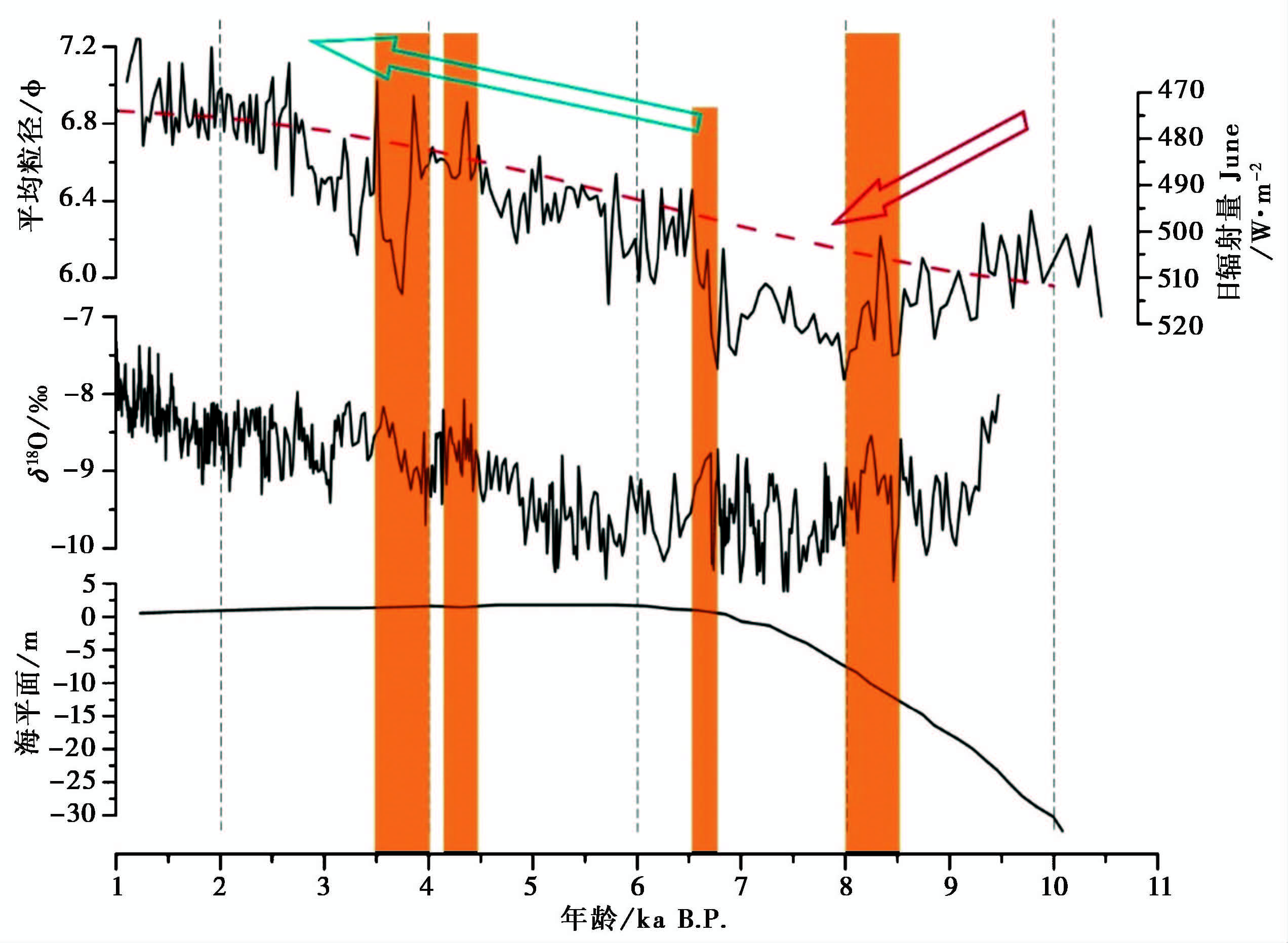
陆源碎屑粒度可以反映东亚季风的演化[86],全新世适宜期时,长江中下游的季风降雨量比现在高8 % ,比早全新世高3 % [87, 88],具有全新世最高的季风降雨量,导致冲绳海槽陆源输入大量增加,其沉积物平均粒径有大幅度提升,早全新世时期,其季风降雨量也高于现在,其时冲绳海槽陆源输入也大于现在的量,沉积物平均粒径大于现在的平均粒径,从 图4可以看出,在该期,S9柱沉积物在全新世适宜期的时候具有最高的平均粒径,较早全新世高,早全新世又高于现在的粒径,与全新世时期季风降雨量相合。
|
图4 S9孔全新世以来平均粒径与区域季风降雨[87, 88]及海平面变化[79, 80, 89]响应特征红色虚线为日辐射量[90] Fig.4 The response characteristics of the mean of the Core S9 to regional monsoon rain and sea level changes since the Holocene |
石笋中的 δ 18 O为季风演化提供了很好的研究指标,其受控于很多环境因素,如温度、 年平均降雨量[91, 92],但在亚洲季风区,它随降雨量变化敏锐[93, 94],中国大陆已经有很多高分辨率的 δ 18 O记录[95, 96],反映着季风降雨量的变化,这些变化可能是因为控制季风强度的太阳辐射量的变化所导致的[95, 97],其中和尚洞的石笋中 δ 18 O的变化代表着长江中下游的季风降雨量变化[87]。
S9的分辨率高达49a,为研究季风演化提供了良好的指标。如 图4所示,将样品的平均粒径与和尚洞高分辨率的石笋 δ 18 O[87, 88]进行对比: 10.91-8.0ka B.P. ,δ 18 O逐渐下降,S9的平均粒径也有相应地减少,8.0ka B.P. ,δ 18 O和S9柱的平均粒径均达到极值,8.0-3.7ka B.P. ,δ 18 O明显上升,对应的S9柱的平均粒径也明显增加,3.7-1.1ka B.P. ,δ 18 O相对较平缓,但有所增加,S9柱的平均粒径也平缓增加,二者演化曲线的幅度具有良好的对应关系。
全新世有几次变冷事件,这几次变冷事件在S9柱上也有很好的表现,8.2ka B.P. 是全新世适宜期中气候突然变冷的时期,该事件在格陵兰的冰芯[98, 99]、 挪威的湖泊和陆地沉积物[100, 101, 102, 103, 104]、 美洲的碳酸盐沉积物[105]和湖泊沉积物[106, 107, 108, 109]以及石笋[110]、 非洲的湖泊沉积物[111, 112, 113, 114, 115]、 黄土高原洞穴石笋[116]、 湖北神农架石笋[117]中均有记录[118]。来自中国的湖泊沉积物[119]以及其他的研究[120, 121, 122]表明,湖泊沉积物中总有机碳、 碳酸盐以及植物孢粉量明显减少[119],气候变得干冷[120, 121, 122],气候干冷导致河流流量减少,输入进冲绳海槽的陆源物质减少,粒度变细,图4显示,该期 δ 18 O值有小范围上的负极值,显示该期的干冷事件,而同时,S9柱的平均粒径也有大幅度的减小,表明其对该事件的灵敏响应。8.5-8.0ka B.P. 时期,δ 18 O值和S9柱的平均粒径有良好的对应关系。意大利山洞的流石[123]和安第斯山脉的冰川[124]都证明4.2ka B.P. 是全新世另一个非常严重的干旱事件,S9柱的平均粒径在该期较为平缓,小范围内相对较大,可以反映出对该干旱事件响应。
从 图4中可以看出,6.5ka B.P. 时 δ 18 O值显示,该期降雨减少,流入冲绳海槽的陆源物质随之减少,粒度有所减低,S9柱的平均粒径曲线上可以看出,该期的粒度也有大幅度的减小。3.5ka B.P. 时,δ 18 O值有小范围的最大值,显示该时期的降雨量在小范围内最大,S9柱在3.5ka B.P. 处有小范围内的最小值,指示其对于输入冲绳海槽的陆源物质增加的响应。4.0-3.5ka B.P. 处,δ 18 O值向小范围负极值变化,说明此时的降雨量逐渐增加,而此时的S9柱平均粒径逐渐趋近最大值,最后在3.8ka B.P. 处,δ 18 O值显示降雨量变大,此时的S9柱有小范围最小粒径,表示该时期对降雨量的响应。
S9柱平均粒径与和尚洞石笋 δ 18 O的值的数据趋势有很好的对应性,这表示粒度对东亚季风的演化同样有指示作用,与 δ 18 O一样都可以反映季风降雨量的变化。S9的平均粒径以与石笋中 δ 18 O同样的灵敏度揭示出中全新世和晚全新世东亚季风的演化。
此外,S9孔粒度显著降低事件对应于全新世几期干冷事件,显示出季风降雨的减弱与全新世全球变冷事件具有相关性: 全球冷事件对应着减弱的东亚夏季风降雨。根据 图4中的日射量数据[90]与S9柱的平均粒径关系可以看出,全新世以来,日射量逐渐减小,S9柱的平均粒径在8.0ka B.P. 以来随之波动性减小,其变化趋势与太阳辐射量变化趋势相一致,显示了千年尺度上S9柱记录的平均粒径及其所反映的源区季风降雨量的变化与太阳活动的密切关系[95, 97]。
4 结论通过以上分析与讨论的情况,主要形成几点认识:
(1)冲绳海槽北部S9孔的沉积物粒度的变化反映了全新世以来研究区的海平面、 物源区的季风降雨量等的变化特征。
(2)全新世初期,海平面较低,源区河口距离研究区较近,沉积物粒级相对较大,随着海平面的逐渐升高,大陆的两大河流的河口逐渐远离研究区,粘土含量增加,而粉砂含量减少,沉积物的粒级随之逐渐减小。而中全新世早期以来,海平面趋于稳定,区域季风降雨量成为S9柱粒度变化的主导因素。
(3)S9沉积物柱状样的粒度与长江中下游和尚洞石笋的 δ 18 O数据良好的对应关系表示其可以作为反映季风降雨量变化的良好指标,百年尺度上S9粒度的变化对应于石笋 δ 18 O降雨量减少的记录,同时这些记录与全球气候变冷记录之间存在着良好的对应关系,表示减弱的东亚季风降雨与全新世全球变冷事件具有密切的相关性。
致谢 感谢参加HOBAB-1航次所有队员为采集样品、 数据和资料所做出的贡献; 感谢李安春研究员、 张凯棣、 沈兴艳、 张晋、 赵德博、 俞宙菲在火山物质鉴定上的大力帮助; 感谢马文涛博士在日辐射量数据计算上的帮助; 感谢王倩、 贾奇、 郭景腾、 尹孟山在数据处理上给予的帮助; 感谢粒度实验室王红莉老师关于粒度实验操作的指导; 感谢舒云超、 张丹丹、 江书龙在样品前处理中的帮忙; 最后真诚地感谢审稿专家具有建设性的修改意见和编辑老师细致的指导。
| 1 | 潘志良, 石斯器. 冲绳海槽沉积物及其沉积作用的研究. 海洋地质与第四纪地质, 1986, 6 (1):17~28 Pan Zhiliang, Shi Siqi. Study on sediments and sedimentation in Okinawa Trough. Marine Geology & Quaternary Geology, 1986, 6 (1):17~28 |
| 2 | 张明书. 冲绳海槽沉积物分类和层序划分的初步意见. 海洋地质与第四纪地质, 1986, 6 (2):31~40 Zhang Mingshu. On preliminary classification of sediments and sedimentary sequence in Okinawa Trough. Marine Geology & Quaternary Geology, 1986, 6 (2):31~40 |
| 3 | 陈丽蓉, 徐文强, 申顺喜等. 冲绳海槽的矿物组合、物质来源及原始岩浆性质的初步探讨. 海洋与湖沼, 1986, 17 (1):3~12 Chen Lirong, Xu Wenqiang, Shen Shunxi et al. A study on marine sediment mineral assemblages, their sources and the property of proto magma of Okinawa Trough. Oeanologia et Limnologia Sinica, 1986, 17 (1):3~12 |
| 4 | 孟宪伟, 王永吉, 吕成功. 冲绳海槽中段沉积地球化学分区及其物源指示意义. 海洋地质与第四纪地质, 1997, 17 (3):37~43 Meng Xianwei, Wang Yongji, Lü Chenggong. Precincts of sediments with different element associations and the sources indications in the central Okinawa Trough. Marine Geology & Quaternary Geology, 1997, 17 (3):37~43 |
| 5 | 阎 军, Thompson P R. 冲绳海槽晚更新世以来古海洋学的研究. 海洋与湖沼, 1991, 22 (3):264~271 Yan Jun, Thompson P R. Paleoceanographic evolution in the Okinawa Trough during the Late Pleistocene. Oeanologia et Limnologia Sinica, 1991, 22 (3):264~271 |
| 6 | 李铁刚, 阎 军, 苍树溪. 冲绳海槽北部 Rd-82和 Rd-86孔氧同位素记录及其古环境分析. 海洋地质与第四纪地质, 1996, 16 (2):57~64 Li Tiegang, Yan Jun, Cang Shuxi. Oxygen isotope records and paleoenvironment analysis in core Rd-82 and core Rd-86 in the north of the Okinawa Trough. Marine Geology & Quaternary Geology, 1996, 16 (2):57~64 |
| 7 | 秦蕴珊, 赵一阳, 陈丽蓉等. 东海地质. 北京: 科学出版社, 1987. 1~287 Qin Yunshan, Zhao Yiyang, Chen Lirong et al. Geology of East China Sea. Beijing:Science Press, 1987. 1~287 |
| 8 | Wei Kuo-Yen. Leg 195 synthesis:Site 1202——Late Quaternary sedimentation and paleoceanography in the southern Okinawa Trough. Proceedings of the Ocean Drilling Program, Scientific Results, 2006, 195:1~31 |
| 9 | Li Tiegang, Xiang Rong, Sun Rongtao et al. Benthic foraminifera and bottom water evolution in the middle-southern Okinawa Trough during the last 18ka. Science in China(Series D), 2005, 48 (6):805~814 |
| 10 | Meng Xianwei, Liu Yanguang, Du Dewen et al. Terrestrial flux in sediments from the Okinawa Trough estimated using geochemical compositional data and its response to climate changes over the past 35000a. Acta Oceanologica Sinica, 2009, 28 (1):47~54 |
| 11 | 刘振夏, 李培英, 李铁刚等. 冲绳海槽5万年以来的古气候事件. 科学通报, 2000, 45 (16):1776~1781 Liu Zhenxia, Li Peiying, Li Tiegang et al. Paleoclimatic events since 50ka in the Okinawa Trough. Chinese Science Bulletin, 2000, 45 (16):1776~1781 |
| 12 | 陈金霞, 张德玉, 张文卿等. 末次冰期以来冲绳海槽北部古气候变化的孢粉记录. 海洋学报, 2006, 28 (1):85~91 Chen Jinxia, Zhang Deyu, Zhang Wenqing et al. The paleoclimatic change since the last glaciation in the north of Okinawa Trough based on the spore pollen records. Acta Oceanologica Sinica, 2006, 28 (1):85~91 |
| 13 | 常凤鸣. 冲绳海槽晚更新世-全新世的古环境演化. 北京: 中国科学院研究生院博士论文, 2004. 1~160 Chang Fengming. Paleoenvironment Evolution in the Okinawa Trough during the Late Pleistocene and Holocene. Beijing:The Thesis of Doctor's Degree of Graduate School of Chinese Academy of Sciences, 2004. 1~160 |
| 14 | 郑旭峰, 李安春, 万世明等. 冲绳海槽中全新世的浊流沉积及其控制因素. 第四纪研究, 2014, 34 (3):579~589 Zheng Xufeng, Li Anchun, Wan Shiming et al. The turbidity events in Okinawa Trough during Middle Holocene and its potential dominating mechanisms. Quaternary Sciences, 2014, 34 (3):579~589 |
| 15 | 郑铁民, 徐善民, 徐志明. 冲绳海槽表层沉积物沉积特征的初步研究. 海洋与湖沼, 1989, 20 (2):113~121 Zheng Tiemin, Xu Shanmin, Xu Zhiming. Characteristics of the surface sediments in Okinawa Trough. Oeanologia et Limnologia Sinica, 1989, 20 (2):113~121 |
| 16 | 褚智慧, 翦知湣, 乔培军等. 末次盛冰期以来苏拉威西海区上层海水对快速气候变化的响应. 第四纪研究, 2011, 31 (2):256~264 Chu Zhihui, Jian Zhimin, Qiao Peijun et al. Responses of the Sulawesi Sea upper ocean water to the rapid climate changes since the Last Glacial Maximum. Quaternary Sciences, 2011, 31 (2):256~264 |
| 17 | Huh Chih-An, Su Chih-Chieh. Sedimentation dynamics in the East China Sea elucidated from 210Pb, 137Cs and 239,240Pu. Marine Geology, 1999, 160 (1):183~196 |
| 18 | Yu Hua, Xiong Yingqian, Liu Zhenxia et al. Evidence for the 8200 a BP cooling event in the middle Okinawa Trough. Geo-Marine Letters, 2008, 28 (3):131~136 |
| 19 | Rea D K, Janecek T R. Mass accumulation rates of the non-authigenic inorganic crystalline(eolian)components from the western Mid-Pacific Mountains. In:Deep Sea Drilling Project Site 463, Initial Report of Deep Sea Drill Project, 1981, 62:653~659 |
| 20 | 孙友斌, 高 抒, 鹿化煜. 前处理方法对北黄海沉积物粒度的影响. 海洋与湖沼, 2001, 32 (6):665~671 Sun Youbin, Gao Shu, Lu Huayu. Influence of different pretreatment procedures on the particle-size distribution of surficial sediments in the Northern Yellow Sea. Oceanologica et Limnologica Sinica, 2001, 32 (6):665~671 |
| 21 | 鹿化煜, 苗晓东, 孙友斌. 前处理步骤与方法对风成红粘土粒度测量的影响. 海洋地质与第四纪地质, 2002, 22 (3):129~135 Lu Huayu, Miao Xiaodong, Sun Youbin. Pretreatment methods and their influences on grain-size measurement of aeolian "Red Clay" in North China. Marine Geology & Quaternary Geology, 2002, 22 (3):129~135 |
| 22 | McManus J. Grain size determination and interpretation. In:Tucker M. Techniques in Sedimentology, Oxford:Blackwell, 1988. 408 |
| 23 | Hughen Konrad A, Baillie Mike G L, Bard Edouard et al. Marine04 marine radiocarbon age calibration, 0~26cal kyr BP. Radiocarbon, 2004, 46 (3):1059~1086 |
| 24 | Reimer Palula J, Baillie Mike G L, Bard Edouard et al. IntCal04 terrestrial radiocarbon age calibration, 0~26cal kyr BP. Radiocarbon, 2004, 46 (3):1029~1058 |
| 25 | Stuiver M, Reimer P J, Reimer R. CALIB Radiocarbon Calibration, Version 4.4., 2003, University of Washington Quaternary Isotope Lab(QIL, Available: www.calib.org/) |
| 26 | Kitagawa H, Fukuzawa H, Nakamura T et al. AMS 14C dating of varved sediments from Lake Suigetsu, Central Japan and atmospheric 14C change during the Late Pleistocene. Radiocarbon, 1995, 37 (2):371~378 |
| 27 | Yoji Arakawa, Mie Kurosawa, Kaori Takahashi et al. Sr-Nd isotopic and chemical characteristics of the silicic magma reservoir of the Aira pyroclastic eruption, southern Kyushu, Japan. Journal of Volcanology and Geothermal Research, 1998, 80 (3):179~194 |
| 28 | Hamasaki S. Volcanic-related alteration and geochemistry of Iwodake volcano, Satsuma Iwojima, Kyushu, SW Japan. Earth Planets and Space, 2002, 54 (3):217~230 |
| 29 | Sibuet Jean-Claude Jean, Letouzey Florence, Barbier Jacques et al. Back Arc extension in the Okinawa Trough. Journal of Geophysical Research:Solid Earth(1978~2012), 1987, 92 (B13):14041~14063 |
| 30 | Kazuo Iseki, Kazumaro Okamura, Yoko Kiyomoto. Seasonality and composition of downward particulate fluxes at the continental shelf and Okinawa Trough in the East China Sea. Deep Sea ResearchPartⅡ:Tropical Studies in Oceanography, 2003, 50 (2):457~473 |
| 31 | Hajime Katayama, Yoshio Watanabe. The Huanghe and Changjiang contribution to seasonal variability in terrigenous particulate load to the Okinawa Trough. Deep Sea ResearchPartⅡ:Tropical Studies in Oceanography, 2003, 50 (2):475~485 |
| 32 | Liu Jian, Zhu Rixiang, Li Tiegang et al. Sediment-magnetic signature of the Mid-Holocene paleoenvironmental change in the central Okinawa Trough. Marine Geology, 2007, 239 (1):19~31 |
| 33 | Milliman John D, Syvitski James P M. Geomorphic/tectonic control of sediment discharge to the ocean:The importance of small mountainous rivers. The Journal of Geology, 1992, 100 (5):525~544 |
| 34 | Liu J P, Liu C S, Xu K H et al. Flux and fate of small mountainous rivers derived sediments into the Taiwan Strait. Marine Geology, 2008, 256 (1):65~76 |
| 35 | Machida Hiroshi. The stratigraphy, chronology and distribution of distal marker-tephras in and around Japan. Global and Planetary Change, 1999, 21 (1):71~94 |
| 36 | Miyairi Y, Yoshida K, Miyazaki Y et al. Improved 14C dating of a tephra layer(AT tephra, Japan)using AMS on selected organic fractions. Nuclear Instruments and Methods in Physics Research Section B:Beam Interactions with Materials and Atoms, 2004, 223:555~559 |
| 37 | Zhai Shikui, Xu Shumei, Yu Zenghui et al. Two possible hydrothermal vents in the northern Okinawa Trough. Chinese Science Bulletin, 2001, 46 (11):943~945 |
| 38 | Tsunogai Shizuo, Suzuki Toshitaka, Kurata Takayoshi et al. Seasonal and areal variation of continental aerosol in the surface air over the western North Pacific region. Journal of the Oceanographical Society of Japan, 1985, 41 (6):427~434 |
| 39 | Huh Chih-An, Su Chih-Chieh, Liang Wen-Tzong et al. Linkages between turbidites in the southern Okinawa Trough and submarine earthquakes. Geophysical Research Letters, 2004, 31 (12):1~4 |
| 40 | Jian Zhimin, Wang Pinxian, Saito Yoshiki et al. Holocene variability of the Kuroshio current in the Okinawa Trough, northwestern Pacific Ocean. Earth and Planetary Science Letters, 2000, 184 (1):305~319 |
| 41 | Lee Shih-Yu, Huh Chih-An, Su Chih-Chieh et al. Sedimentation in the Southern Okinawa Trough:Enhanced particle scavenging and teleconnection between the Equatorial Pacific and western Pacific margins. Deep Sea Research Part Ⅰ:Oceanographic Research Papers, 2004, 51 (11):1769~1780 |
| 42 | Dou Yanguang, Yang Shouye, Liu Zhenxia et al. Provenance discrimination of siliciclastic sediments in the middle Okinawa Trough since 30ka:Constraints from rare earth element compositions. Marine Geology, 2010, 275 (1):212~220 |
| 43 | Kao Shuh-Ji, Liu Kon-Kee. Estimating the suspended sediment load by using the historical hydrometric record from the Lanyang-Hsi watershed. Terrestrial, Atmospheric and Oceanic Sciences, 2001, 12 (2):401~414 |
| 44 | Jeng Woei-Lih, Lin Saulwood, Kao Shuh-Ji. Distribution of terrigenous lipids in marine sediments off northeastern Taiwan. Deep Sea ResearchPart Ⅱ:Topical Studies in Oceanography, 2003, 50 (6):1179~1201 |
| 45 | Liu Kon-Kee, Peng Tsung-Hung, Shaw Ping-Tung et al. Circulation and biogeochemical processes in the East China Sea and the vicinity of Taiwan:An overview and a brief synthesis. Deep Sea ResearchPartⅡ:Topical Studies in Oceanography, 2003, 50 (6):1055~1064 |
| 46 | Hsu Shih-Chieh, Lin Fei-Jan, Jeng Woei-Lih et al. Observed sediment fluxes in the southwesternmost Okinawa Trough enhanced by episodic events:Flood runoff from Taiwan rivers and large earthquakes. Deep Sea ResearchPart Ⅰ:Oceanographic Research Papers, 2004, 51 (7):979~997 |
| 47 | Sheu D D, Jou W C, Chung Y C et al. Geochemical and carbon isotopic characterization of particles collected in sediment traps from the East China Sea continental slope and the Okinawa Trough northeast of Taiwan. Continental Shelf Research, 1999, 19 (2):183~203 |
| 48 | Jeng Woei-Lih. Aliphatic hydrocarbon concentrations in short sediment cores from the southern Okinawa Trough:Implications for lipid deposition in a complex environment. Continental Shelf Research, 2007, 27 (15):2066~2078 |
| 49 | Kao S J, Lin F J, Liu K K. Organic carbon and nitrogen contents and their isotopic compositions in surficial sediments from the East China Sea shelf and the southern Okinawa Trough. Deep Sea ResearchPart Ⅱ:Topical Studies in Oceanography, 2003, 50 (6):1203~1217 |
| 50 | Chuan Y, Chang W C. 210 Pb fluxes and sedimentation on rates on the lower continental slope between Taiwan and the South Okinawa Trough. Continental Shelf Research, 1995, 15 (2):149~164 |
| 51 | Huh Chih-An, Su Chih-Chieh, Wang Chung-Ho et al. Sedimentation in the southern Okinawa Trough——Rates, turbidities and a sediment budget. Marine Geology, 2006, 231 (1):129~139 |
| 52 | Hsu Shih-Chieh, Lin Fei-Jan, Jeng Woei-Lih et al. The effect of a cyclonic eddy on the distribution of lithogenic particles in the southern East China Sea. Journal of Marine Research, 1998, 56 (4):813~832 |
| 53 | Jiang Fuqing, Li Anchun, Li Tiegang. Sediment pathway of the East China Sea inferred from an R-mode factor analysis of surface sediments in the Okinawa Trough. Quaternary International, 2011, 230 (1):13~20 |
| 54 | Youn Jeungsu, Kim Tae-Joung. Geochemical composition and provenance of muddy shelf deposits in the East China Sea. Quaternary International, 2011, 230 (1):3~12 |
| 55 | Xu Xuedong, Oda Motoyoshi. Surface-water evolution of the eastern East China Sea during the last 36,000 years. Marine Geology, 1999, 156 (1):285~304 |
| 56 | Liu J Paul, Milliman John D, Gao Shu et al. Holocene development of the Yellow River's subaqueous delta, North Yellow Sea. Marine Geology, 2004, 209 (1):45~67 |
| 57 | Lambeck K, Yokoyama Y, Purcell T. Into and out of the Last Glacial Maximum:Sea-level change during Oxygen Isotope Stages 3 and 2. Quaternary Science Reviews, 2002, 21 (1):343~360 |
| 58 | Saito Y, Katayama H, Ikehara K et al. Transgressive and highstand systems tracts and post-glacial transgression, the East China Sea. Sedimentary Geology, 1998, 122 (1~4):217~232 |
| 59 | Li Congxian, Chen Qingqiang, Zhang Jiaqiang et al. Stratigraphy and paleoenvironmental changes in the Yangtze delta during the Late Quaternary. Journal of Asian Earth Sciences, 2000, 18 (4):453~469 |
| 60 | Ujii Hiroshi, Hatakeyama Yasuhide, Gu Xuexin et al. Upward decrease of organic C/N ratios in the Okinawa Trough cores: Proxy for tracing the post-glacial retreat of the continental shore line. Palaeogeography, Palaeoclimatology, Palaeocology, 2001, 165 (1):129~140 |
| 61 | Li Guangxue, Liu Yong, Yang Zigeng et al. Ancient Changjiang channel system in the East China Sea continental shelf during the last glaciation. Science in China(Series D), 2005, 48 (11):1972~1978 |
| 62 | 徐兆凯, 常凤鸣, 李铁刚等. 24ka来冲绳海槽北部沉积物来源的高分辨率常量元素记录. 海洋地质与第四纪地质, 2012, 32 (4):73~82 Xu Zhaokai, Chang Fengming, Li Tiegang et al. Provenance of sediments in the northern Okinawa Trough over the last 24ka:High resolution record from major elements. Marine Geology & Quaternary Geology, 2012, 32 (4):73~82 |
| 63 | Zhou Liangyong, Liu Jian, Saito Yoshiki et al. Fluvial system development and subsequent marine transgression in Yellow River(Huanghe)delta and its adjacent sea regions during Last Glacial Maximum to Early Holocene. Continental Shelf Research, 2014, 90 (1):117~132 |
| 64 | Chinzei Kiyotaka, Fujioka Kantaro, Kitazato Hiroshi et al. Post glacial environmental change of the Pacific Ocean off the coasts of Central Japan. Marine Micropaleontology, 1987, 11 (4):273~291 |
| 65 | Sawada Ken, Handa Nobuhiko. Variability of the path of the Kuroshio Ocean Current over the past 25,000 years. Nature, 1998, 392 (6676):592~595 |
| 66 | Ujiié Hiroshi, Ujiié Yurika. Late Quaternary course changes of the Kuroshio Current in the Ryukyu Arc region, northwestern Pacific Ocean. Marine Micropaleontology, 1999, 37 (1):23~40 |
| 67 | Ahagon Naokazu, Tanaka Yuichiro, Ujiié Hiroshi. Florisphaera profunda,a possible nannoplankton indicator of Late Quaternary changes in sea-water turbidity at the northwestern margin of the Pacific. Marine Micropaleontology, 1993, 22 (3):255~273 |
| 68 | Ujiié Hiroshi, Tanaka Yuichiro, Ono Tomonori. Late Quaternary paleoceanographic record from the middle Ryukyu Trench slope, northwest Pacific. Marine Micropaleontology, 1991, 18 (1):115~128 |
| 69 | Li Baohua, Jian Zhimin, Wang Pinxian. Pulleniatina obliquiloculata as a paleoceanographic indicator in the southern Okinawa Trough during the last 20,000 years. Marine Micropaleontology, 1997, 32 (1~2):59~69 |
| 70 | Jian Zhimin, Wang Pinxian, Saito Yoshiki et al. Holocene variability of the Kuroshio Current in the Okinawa Trough, northwestern Pacific Ocean. Earth and Planetary Science Letters, 2000, 184 (1):305~319 |
| 71 | Li Tiegang, Liu Zhenxia, Hall Michael A et al. Heinrich event imprints in the Okinawa Trough:Evidence from oxygen isotope and planktonic foraminifera. Palaeogeography, Palaeoclimatology, Palaeoecology, 2001, 176 (1):133~146 |
| 72 | Ujiié Yurika, Ujiié Hiroshi, Taira Asahiko et al. Spatial and temporal variability of surface water in the Kuroshio source region, Pacific Ocean, over the past 21,000 years:Evidence from planktonic foraminfera. Marine Micropaleontology, 2003, 49 (4):335~364 |
| 73 | Kao S J, Horng C S, Hsu S C et al. Enhanced deepwater circulation and shift of sedimentary organic matter oxidation pathway in the Okinawa Trough since the Holocene. Geophysical Research Letters, 2005, 32 (15):L15609, 1~4 |
| 74 | Kao S J, Dai M H, Wei K Y et al. Enhanced supply of fossil organic carbon to the Okinawa Trough since the last deglaciation. Paleoceanography, 2008, 23 (2):PA2207, 1~10 |
| 75 | Sun Youbin, Oppo Delia W, Xiang Rong et al. Last deglaciation in the Okinawa Trough:Subtropical northwest Pacific link to Northern Hemisphere and tropical climate. Paleoceanography, 2005, 20 (4):PA4005, 1~9 |
| 76 | Xiang Rong, Sun Youbin, Li Tiegang et al. Paleoenvironmental change in the middle Okinawa Trough since the last deglaciation:Evidence from the sedimentation rate and planktonic foraminiferal record. Palaeogeography, Palaeoclimatology, Palaeoecology, 2007, 243 (3):378~393 |
| 77 | 郭志刚, 杨作升, 雷 坤等. 冲绳海槽中南部及其邻近陆架悬浮提的分布、组成和影响因子分析. 海洋学报, 2001, 23 (1):66~72 Guo Zhigang, Yang Zuosheng, Lei Kun et al. The distribution and composition of suspended matters and their influencing factors in the central-southern area of Okinawa Trough and its adjacent shelf sea. Acta Oceanologica Sinica, 2001, 23 (1):66~72 |
| 78 | 雷 坤, 杨作升, 郭志刚. 东海不同底质类型海域春季悬浮体通量及影响因素. 海洋与湖沼, 2001, 32 (1):50~57 Lei Kun, Yang Zuosheng, Guo Zhigang et al. Suspended sediment flux in spring on the East China sea shelf with different surface sediment types. Oceanologica et Limnologica Sinica, 2001, 32 (1):50~57 |
| 79 | 金翔龙. 东海海洋地质. 北京: 海洋出版社, 1992. 1~524 Jin Xianglong. Marine Geology of East China Sea. Beijing:China Ocean Press, 1992. 1~524 |
| 80 | 辛立国, 李广雪, 李西双等. 中国东海2万年来海平面变化分析. 中国海洋大学学报, 2006, 36 (5):699~704 Xin Liguo, Li Guangxue, Li Xishuang et al. Analysis of sea-level variation in the East China Sea since the Last Glacial Maximum. Periodical of Ocean University of China, 2006, 36 (5):699~704 |
| 81 | Folk Robert L, Ward William C. Brazos River bar:A study in the significance of grain size parameters. Journal of Sedimentary Research, 1957, 27 (1):3~26 |
| 82 | 王有芝, 徐淑爱. 东南季风过程在华南的建立与稳定及其对降雨的影响. 中山大学学报, 1985,(2):97~103 Wang Youzhi, Xu Shu'ai. The influence of establishment and stability of the SE monsoon process of the South China on rainfall. Acta Scientiarum Naturalium Universitatis Sunyatseni, 1985,(2):97~103 |
| 83 | 竺可桢. 东南季风与中国之雨量. 地理学报, 1934,(1):1~27 Chu Coching. The enigma of southeast monsoon in China. Acta Geographica Sinica, 1934,(1):1~27 |
| 84 | 许淑英, 高由禧. 我国季风进退及其日期的确定. 地理学报, 1962, 28 (1):1~18 Xu Shuying, Gao Youxi. The monsoon changes and the determine of the date of China. Acta Geographica Sinica, 1962, 28 (1):1~18 |
| 85 | 丁一汇, 村上胜人. 亚洲季风. 北京: 气象出版社, 1994. 76~83 Ding Yihui, Murakami Masato. Asian Monsoon. Beijing:China Meteorology Press, 1994. 76~83 |
| 86 | 郑洪波, 陈国成, 谢 昕等. 南海晚第四纪陆源沉积: 粒度组成、动力控制及反应的东亚季风演化. 第四纪研究, 2008, 28 (3):414~423 Zheng Hongbo, Chen Guocheng, Xie Xin et al. Grain size distribution and dynamic control of Late Quaternary terrigenous sediments in the South China Sea and their implication for East Asian monsoon evolution. Quaternary Sciences, 2008, 28 (3):414~423 |
| 87 | Hu Chaoyong, Henderson Gideon M, Huang Junhua et al. Quantification of Holocene Asian monsoon rainfall from spatially separated cave records. Earth and Planetary Science Letters, 2008, 266 (3):221~232 |
| 88 | Hu Chaoyong, Henderson Gideon M, Huang Junhua et al. Report of a three-year monitoring programme at Heshang cave, Central China. International Journal of Speleology, 2008, 37 (3):143~151 |
| 89 | 冯应俊. 东海四万年来海平面变化与最低海平面. 东海海洋, 1983, 2:36~42 Feng Yingjun. Sea-level changes since 40ka and the lowest sea-level of the East Sea. Donghai Marine Science, 1983, 2:36~42 |
| 90 | Laskar J, Robutel P, Joutel F et al. A long-term numerical solution for the insolation quantities of the Earth.Astronomy & Astrophysics, 2004, 428 (1):261~285 |
| 91 | Bar-Matthews Miryam, Ayalon Avner, Kaufman Aaron et al. The eastern Mediterranean paleoclimate as a reflection of regional events:Soreq cave, Israel. Earth and Planetary Science Letters, 1999, 166 (1):85~95 |
| 92 | McDermott Frank. Palaeo-climate reconstruction from stable isotope variations in speleothems:A review. Quaternary Science Reviews, 2004, 23 (7):901~918 |
| 93 | Dansgaard W. Stable isotopes in precipitation. Tellus, 1964, 16 (4):436~468 |
| 94 | Johnson Kathleen R, Ingram B Lynn. Spatial and temporal variability in the stable isotope systematics of modern precipitation in China:Implications for paleoclimate reconstructions. Earth and Planetary Science Letters, 2004, 220 (3):365~377 |
| 95 | Wang Yongjin, Cheng Hai, Edwards R Lawrence et al. The Holocene Asian monsoon:Links to solar changes and North Atlantic climate. Science, 2005, 308 (5723):854~857 |
| 96 | Dykoski Carolyn A, Edwards R Lawrence, Cheng Hai et al. A high-resolution, absolute-dated Holocene and deglacial Asian monsoon record from Dongge cave, China. Earth and Planetary Science Letters, 2005, 233 (1~2):71~86 |
| 97 | Wang Yongjin, Cheng Hai, Edwards R L et al. A high-resolution absolute-dated Late Pleistocene monsoon record from Hulu cave, China. Science, 2001, 294 (5550):2345~2348 |
| 98 | Alley R B, Mayewski P A, Sowers T et al. Holocene climatic instability:A prominent, widespread event 8200 yr ago. Geology, 1997, 25 (6):483~486 |
| 99 | Johnsen S J, Clausen H B, Dansgaard W et al. Irregular glacial interstadials recorded in a new Greenland ice core. Nature, 1992, 359 (6393):311~313 |
| 100 | Dahl Svein Olaf, Nesje Atle. Holocene glacier fluctuations at Hardangerj∅kulen, central-Southern Norway:A high-resolution composite chronology from lacustrine and terrestrial deposits. The Holocene, 1994, 4 (3):269~277 |
| 101 | Seierstad Jorun, Nesje Atle, Dahl Svein Olaf et al. Holocene glacier fluctuations of Grovabreen and Holocene snow-avalanche activity reconstructed from lake sediments in Grningstlsvatnet, Western Norway. The Holocene, 2002, 12 (2):211~222 |
| 102 | Nesje Atle, Dahl Svein Olaf. The Greenland 8200cal. yr BP event detected in loss-on-ignition profiles in Norwegian lacustrine sediment sequences. Journal of Quaternary Science, 2001, 16 (2):155~166 |
| 103 | Nesje Atle, Bjune Anne E, Bakke Jostein et al. Holocene palaeoclimate reconstructions at Vanndalsvatnet, Western Norway, with particular reference to the 8200cal. yr BP event. The Holocene, 2006, 16 (5):717~729 |
| 104 | Hald Morten, Korsun Sergei. The 8200cal. yr BP event reflected in the Arctic Fjord, Van Mijenfjorden, Svalbard. The Holocene, 2008, 18 (6):981~990 |
| 105 | Yu Zicheng, Eicher Ulrich. Abrupt climate oscillations during the last deglaciation in central North America. Science, 1998, 282 (5397):2235~2238 |
| 106 | Kurek Joshua, Cwynar Les C, Spear Ray W. The 8200cal yr BP cooling event in eastern North America and the utility of midge analysis for Holocene temperature reconstructions. Quaternary Science Reviews, 2004, 23 (5):627~639 |
| 107 | Shuman Bryan, Bartlein Patrick, Logar Nathaniel et al. Parallel climate and vegetation responses to the Early Holocene collapse of the Laurentide Ice Sheet. Quaternary Science Reviews, 2002, 21 (16):1793~1805 |
| 108 | Kneller Margaret, Peteet Dorothy. Late-glacial to Early Holocene climate changes from a central Appalachian pollen and macrofossil record. Quaternary Research, 1999, 51 (2):133~147 |
| 109 | Dean Walter E, Schwalb Antje. Holocene environmental and climatic change in the Northern Great Plains as recorded in the geochemistry of sediments in Pickerel Lake, South Dakota. Quaternary International, 2000, 67 (1):5~20 |
| 110 | Lachniet Matthew S, Asmerom Yemane, Burns Stephen J et al. Tropical response to the 8200 yr BP cold event?Speleothem isotopes indicate a weakened Early Holocene monsoon in Costa Rica. Geology, 2004, 32 (11):957~960 |
| 111 | Gasse Francoise, Campo Elise Van. Abrupt post-glacial climate events in West Asia and North Africa monsoon domains. Earth and Planetary Science Letters, 1994, 126 (4):435~456 |
| 112 | Gasse Francoise. Hydrological changes in the African tropics since the Last Glacial Maximum. Quaternary Science Reviews, 2000, 19 (1):189~211 |
| 113 | Stager J C, Mayewski P A. Abrupt Early to Mid-Holocene climatic transition registered at the equator and the poles. Science, 1997, 276 (5320):1834~1836 |
| 114 | Lamb Henry F, van der Kaars Sander. Vegetational response to Holocene climatic change:Pollen and palaeolimnological data from the Middle Atlas, Morocco. The Holocene, 1995, 5 (4):400~408 |
| 115 | Gasse Francoise, Tehet Regis, Durand A et al. The arid humid transition in the Sahara and the Sahel during the last deglaciation. Nature, 1990, 346 (6280):141~146 |
| 116 | 董进国, 吉云松, 钱 鹏. 黄土高原洞穴石笋记录的8.2ka B.P. 气候突变事件. 第四纪研究, 2013, 33 (5):1034~1036 Dong Jinguo, Ji Yunsong, Qian Peng."8.2ka B .P . event" of Asian monsoon in a stalagmite record from Chinese Loess Plateau. Quaternary Sciences, 2013, 33 (5):1034~1036 |
| 117 | 邓 朝, 汪永进, 刘殿兵等."8.2ka"事件的湖北神农架高分辨率年纹层石笋记录. 第四纪研究, 2013, 33 (5):945~953 Deng Chao, Wang Yongjin, Liu Dianbing et al. The Asian monsoon variability around 8.2ka B.P. recorded by an annually-laminated stalagmite from Mt. Shennongjia, Central China. Quaternary Sciences, 2013, 33 (5):945~953 |
| 118 | 刘浴辉. 东亚季风区8.2ka BP气候突变记录及其精细解剖. 北京: 中国地质大学博士论文, 2012. 1~158 Liu Yuhui. The Abrupt Climate Change Record of 8.2ka BP Event from East Asian Monsoon Area with Its Characteristics Analysis. Beijing:The Thesis of Doctor's Degree of China University of Geosciences, 2012. 1~158 |
| 119 | Liu Chenglin, Wang Mili, Jiao Pengcheng et al. Holocene yellow silt layers and the paleoclimate event of 8200a BP in Lop Nur, Xinjiang, NW China. Acta Geologica Sinica(English Edition), 2003, 77 (4):514~518 |
| 120 | 郑 茜, 张虎才, 明庆忠等. 泸沽湖记录的西南季风区15000a B.P. 年以来植被与气候变化. 第四纪研究, 2014, 34 (6):1314~1326 Zhen Qian, Zhang Hucai, Ming Qingzhong et al. Vegetational and environmental changes since 15ka B.P. recorded by Lake Lugu in the southwest monsoon domain. Quaternary Sciences, 2014, 34 (6):1314~1326 |
| 121 | 董明星, 张艳红, 张建国等. 石家庄地区早全新世冷湿气候的牙齿微磨痕和同位素证据. 第四纪研究, 2014, 34 (1):8~15 Dong Mingxing, Zhang Yanhong, Zhang Jianguo et al. Cold and/or wet Early Holocene in Shijiazhuang district:Evidences from tooth microwear and stable isotope analyses. Quaternary Sciences, 2014, 34 (1):8~15 |
| 122 | 谭亮成, 蔡演军, 安芷生等. 石笋氧同位素和微量元素记录的陕南地区4200~2000a B.P. 高分辨率季风降雨变化. 第四纪研究, 2014, 34 (6):1238~1245 Tan Liangcheng, Cai Yanjun, An Zhisheng et al. High-resolution monsoon precipitation variations in southern Shaanxi, Central China during 4200~2000a B.P. as revealed by speleothem δ18O and Sr/Ca records. Quaternary Sciences, 2014, 34 (6):1238~1245 |
| 123 | Drysdale Russell, Zanchetta Glovanni, Hellstrom John et al. Late Holocene drought responsible for the collapse of Old World civilizations is recorded in an Italian cave flowstone. Geology, 2006, 34 (2):101~104 |
| 124 | Davis Mary E, Thompson Lonnie G. An Andean ice-core record of a Middle Holocene mega-drought in North Africa and Asia. Annals of Glaciology, 2006, 43 (1):34~41 |
Abstract
High resolution paleoenvironmental records since Holocene have been acquired by the AMS 14C age-testing and grain size analyzing of the Core S9 sediments (29°23.4989'N, 128°15.8230'E), which was taken from the northern Okinawa Trough with 251cm length and 1062m water depth during the Okinawa Trough Cruise in the summer of 2013. A total of 251 samples were collected from the Core S9 at 1cm intervals. Because of the agglomeration in the bottom of the sediments, 226 samples were used for particle size measurement by Cilas 940L Laser particle size instrument in the Key Laboratory of Marine Geology and Environment, Institute of Oceanology, Chinese Academy of Sciences. A high-resolution age model of the core was established on five samples (30cm, 80cm, 165cm, 220cm and 243cm) on the basis of accelerator mass spectrometry (AMS) radiocarbon dating of planktonic foraminifera (Globigerinoides ruber, Globigerinoides sacculife, Pulleriatina obliquilocalata, Neogloboquadrina dutertrei, and Globigerina bulloides) which were measured at Woods Hole Oceanographic Institution. The depositional age is estimated to be 13.39ka at the bottom of the core and 1.1ka at the top of the core. The sedimentation rate of the core is 8cm/ka during the Early Holocene and increases from 17cm/ka to 27cm/ka during the Middle Holocene and increase to 32cm/ka during the Late Holocene. Sediments from the Core S9 are primarily composed of silt (60% ~90%), with a mean grain size of 5.6~7.2 and a median grain size of 5.2~7.2φ. A tephra layer in the Core S9(159~169cm) correlates well with the volcanic eruptions at 7.3ka in Southern Japan.
The results reveal that the grain size composition of the Core S9 present two-stage obvious variation in millennial scales: the mean and silt increase and reach the maximum in 10.5~8.0ka B.P., and the mean and clay decrease in 8.0~1.0ka B.P. The changes of grain size of Core S9 are related with the relative sea-level changes, implying the control of the relative sea-level on regional material transport. The relative sea-level has been stable since 7.5a B.P. and the grain size varies in century scales and is controlled by regional monsoon rainfall in the source region.
The grain size parameters of the Core S9 are well correlated with the stalagmite records of δ18O in the source region. The mean has been decreased since 7.5ka B.P., showing well consistency with the regional summer monsoon rainfall. Moreover, the Core S9 records reveal several climate events in century scales, such as ca.8.2ka B.P., 6.5ka B.P., 4.2ka B.P. and 3.8ka B.P., which the grain size decreases obviously, and they are corresponding to the periods when regional monsoon decrease. The grain size composition of the Core S9 implies the influence of the relative sea-level changes and regional monsoon rainfall in the source region to the sediments composition in the Okinawa Trough, and provides a powerful tool to use marine sediments features to rebuild regional monsoon rainfall.