 2015, Vol.35


近年来,随着全球变暖的趋势逐渐显现,对其所可能引起的海平面变化以及相应的海岸环境变化的讨论日益增加。冰川融化引起了全球性的水动型海平面变化。但是,不同地区水动型海平面的上升幅度和过程有所不同。原因有3种: 第一,冰川与海洋容量的变化带来的相应的地壳形变与地幔物质流动,导致了不同地区相对的隆升与下沉[1, 2, 3, 4]; 第二,地球重力场的不均匀分布以及离心力作用而导致大地表面物质(海水)的流动和再平衡; 第三,长期的区域性地壳和新构造运动。过去的20年里,地球-冰川模型的建立为研究第一和第二种变化过程提供了大量的数据。这些结果对研究过去几千年来的地区性地壳运动的细节有很大的帮助。对后者的了解则能为准确地预测在21世纪的地区性相对海平面变化的方向和速度提供参考。本文对广东海岸全新世海平面变化最新的一些研究方法和成果进行总结,从而分析区域性构造运动等影响因素对本地区海平面重建工作的影响。
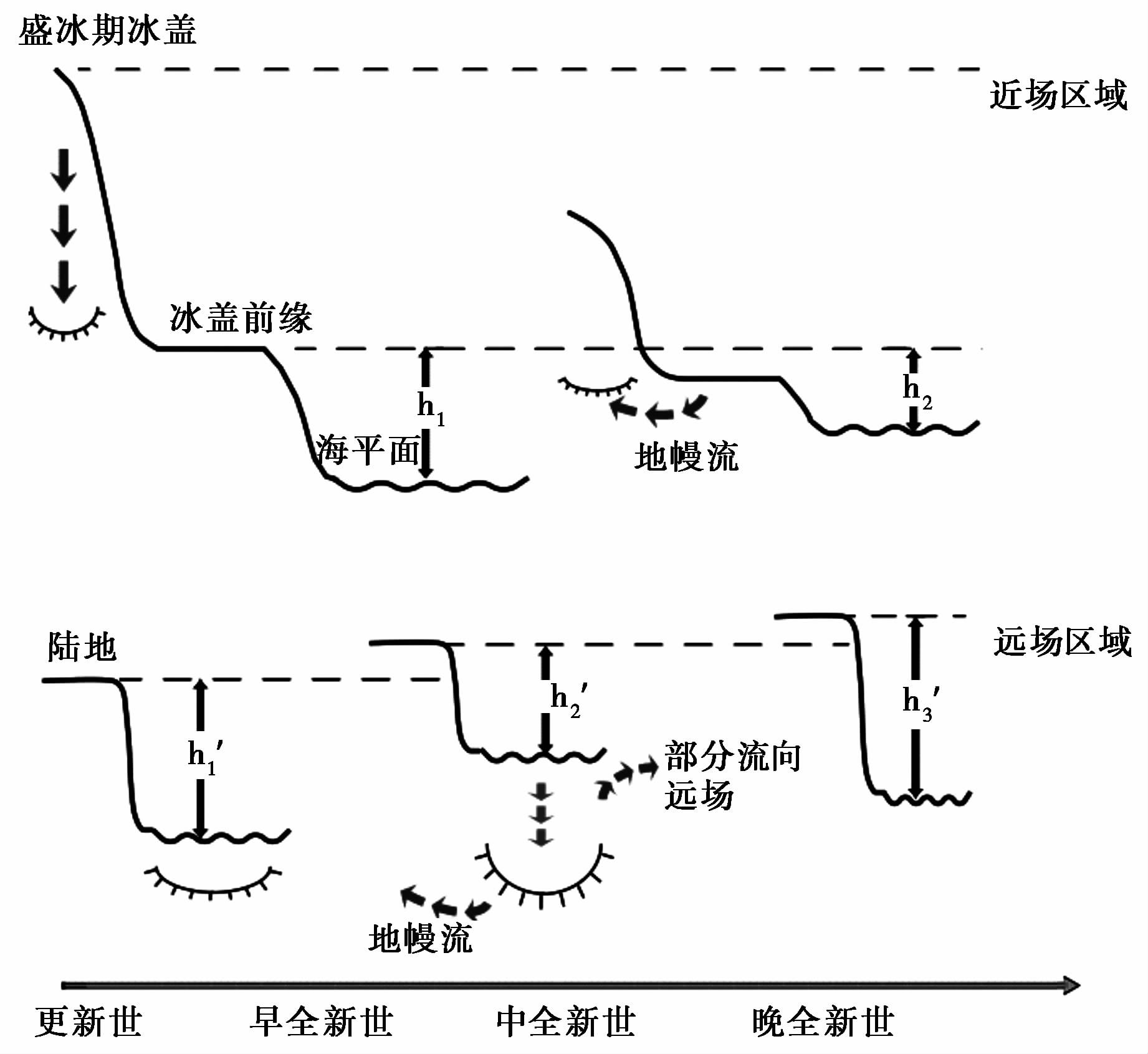
1 冰川均衡调整与海平面变化自最后一次盛冰期以来,全球进入了冰退阶段,海平面总体呈上升趋势[1, 2, 5]。自全新世中早期,冰川融化速度逐渐减慢直至停滞。首先,对于大冰盖覆盖地区,由于冰川消融,表面质量负荷减少,引起地壳回弹隆升,地幔物质从原冰盖前缘地区向原冰盖中心地区流入,导致原冰盖前缘地区地表的沉降与海平面的上升,而原冰盖中心地区地表的显著上升与海平面下降,即所谓冰川均衡调整(Glacial Isostatic Adjustment,简称GIA)效应[1]。靠近大冰盖受这种均衡效应影响显著的地区亦称之为近场区域; 与之相对应的远离大冰盖的区域称之为远场区域。在这些远场区域,部分海水向近场区域迁移,以补充原冰盖前缘地区地壳沉降造成的空间和物质缺失。同时海洋水量变化导致的地表压力不均匀分布也带来了相应的海洋-陆地微小地壳垂直运动与地幔流流动,表现为海平面上升时因海水容量增加而导致大陆架近岸地区的微小的相对上升以及海底的相对下沉。这种因全球海洋水容量的重新分布以及随之而来的地球重力场重新分布产生的变化被称为水均衡效应[6, 7, 8, 9]。由于地幔流的重新分布具有一定的滞后性[3],全新世中期冰盖融化减缓后,水均衡效应依然继续显现,表现为远场区域海平面的相对下降。如 图1所示,h2-h1为近场区域的海平面变化,h3′-h1′为远场区域的海平面变化,而h2′为中全新世远场区域的海平面高度,即所谓中全新世高海平面。由于近场区域和远场区域均为相对概念,水均衡与冰川均衡作用在空间分布上均为渐变过程,因此在近场区域与远场区域中间还存在着一个受到这两种均衡作用共同影响的过渡区域。由于因水均衡效应引起的相对海平面变化幅度比较小,在过去7000年里只有2~3m[10],海面的这种微小变化往往需要高精确度的海平面重建方法才能测出来。还有,这种微小的海面变化也很容易被区域性的新构造运动和海岸变化遮盖。
|
图1 均衡效应对海平面的影响 Fig.1 Glacio-isostatic and hydro-isostatic effects on sea level |
随着冰川均衡调整理论的不断发展,同时古冰盖模型与地球模型的逐步完善,实现了利用GIA模型重建与预测海平面变化。基于对地壳和地幔物质的粘度、 弹性参数、 密度等一系列参数的假设,以及对最近一次冰期以来冰盖的范围、 厚度和消融历史数据的运用,这些模型提供了非常有价值的对在全球每一个区域相对海平面变化的预测,可供海岸变化研究作参考[11]。为了保证这些模型的准确性,很多研究者利用海岸带海平面标志物的高程和年龄对这些模型进行调整。在美国、 欧洲与澳大利亚[12, 13, 14, 15],利用实测数据对模型的校正已经取得了显著的成效。其中,远场区域的海平面数据有助于校正模型对水动型海平面变化过程的模拟,而近场区域的海平面数据则可用于重建古冰盖范围、 厚度分布以及消融过程。过渡区域的数据可帮助确定冰盖均衡作用的影响范围。被校正后的模型就可以用来模拟末次冰期以来GIA过程,特别是其中远场水动型海平面变化(Eustasy)过程,从而分析对全球各地海岸的影响。近年来的研究表明,GIA不仅对全球海平面变化以及地壳运动产生影响,同时也在逐步影响着地球重力场、 应力场与地球旋转运动[11],而上述因素也会间接影响到全球海平面分布变化。虽然,这些模型还不能够模拟新构造运动的影响,但能够为研究新构造运动提供很好的参考。
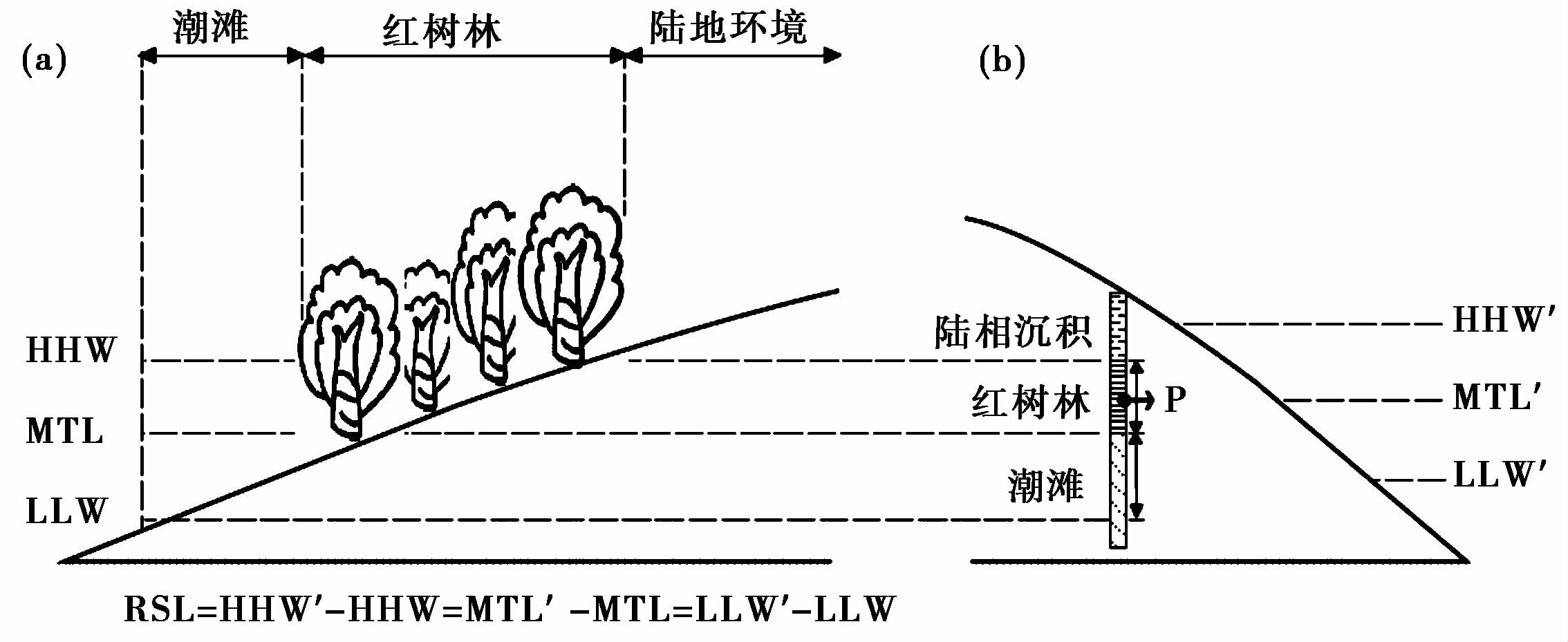
海平面标志物已被广泛地运用在海平面历史重建[16]。除了这些标志物的高程和定年,这些海面标志物与当时的平均海面的高度方面的关系,称海面标志物的指示关系(indicative meaning),要首先被确定。不同海面标志物的指示关系有一定的差异。而且,在校正的时候还要把当地的潮汐差考虑进去。具体方法举例如 图2a所示,现代海岸带红树林生长于平均潮位(MTL)与高高潮位(HHW)之间,低低潮位(LLW)与平均潮位(MTL)之间为潮滩。在红树林带以上,通常是陆相沉积。因此,来自红树林标志物的海面指示关系就可以被确定为:
Isl=0.5×(HHW-MTL)+MTL
|
图2 古沉积环境: 潮滩-红树林 (a)海岸带环境分布(coastal environment distribution); (b)沉积物相对位置(sedimentation relative position) Fig.2 Palaeosedimentary environment: tidal flat and mangrove |
首先根据当地的潮差监测结果得出当地HHW相对于黄海基准面(YSD)的高程,从而计算Isl数值。如没有其他方法帮助,Isl误差就比较大,约为当地潮差的50 % 。以珠江三角洲为例,当地HHW为1.9m,MTL为0.4m[17],计算得出Isl值为1.15m,误差范围为±0.75m。在一个海退沉积物层序里,往往可以看到陆相沉积之下有红树林与潮滩沉积。假设通过钻探和测量,红树林沉积物被发现在深度(D)0.5m 处,而地面高程(A)为3.0m( 图2b),古海面的高度(pSL)就可以确定为:
pSL=A-D-Isl=3.0-0.5-1.15±0.75=1.35±0.75m
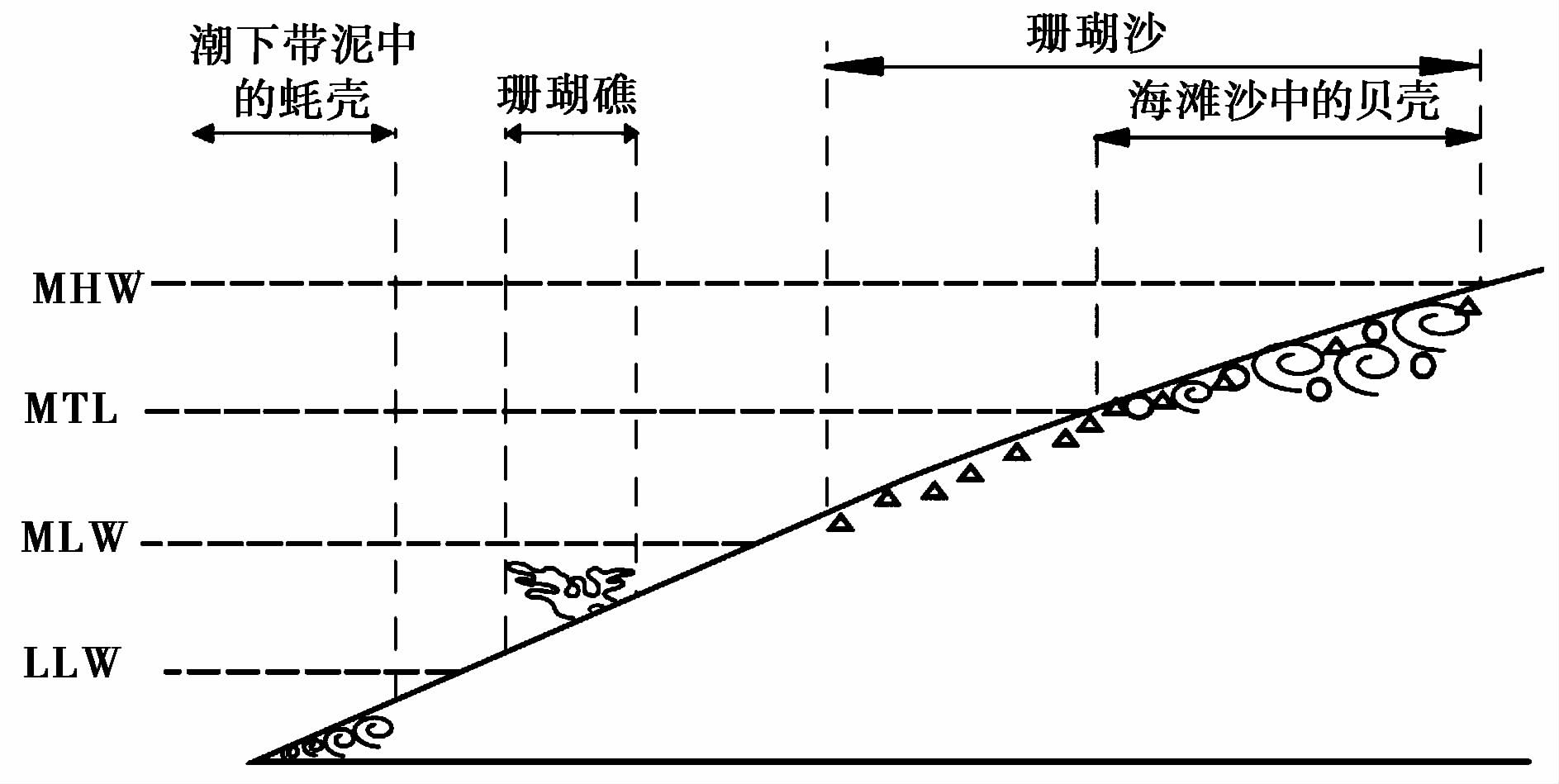
在实际操作中,经常需要微体古生物分析帮助从钻孔沉积物中确认红树林沉积和决定沉积层序。然后根据当地的潮汐记录,沉积深度和钻孔地面高程等对所得的海面数据点所反映的古海面高度进行推算。还有,应用微体古生物往往可以把古海面重建的精确度大大提高,把误差减少到当地潮差的20 % ~30 % [16],甚至更小。海平面标志物的种类很多,范围十分广泛,图3列举了部分珊瑚、 贝壳的指示意义,表1是根据Zong[18]总结的中国区沿海常见的15种海平面标志物类型,其中MHW和MLW分别为平均高潮与平均低潮。
|
图3 古沉积环境: 贝壳、 珊瑚 Fig.3 Palaeosedimentary environment: shells and coral |
|
表1 海平面标志物指示意义 Table 1 ndicative meanings of sea-level indicators |
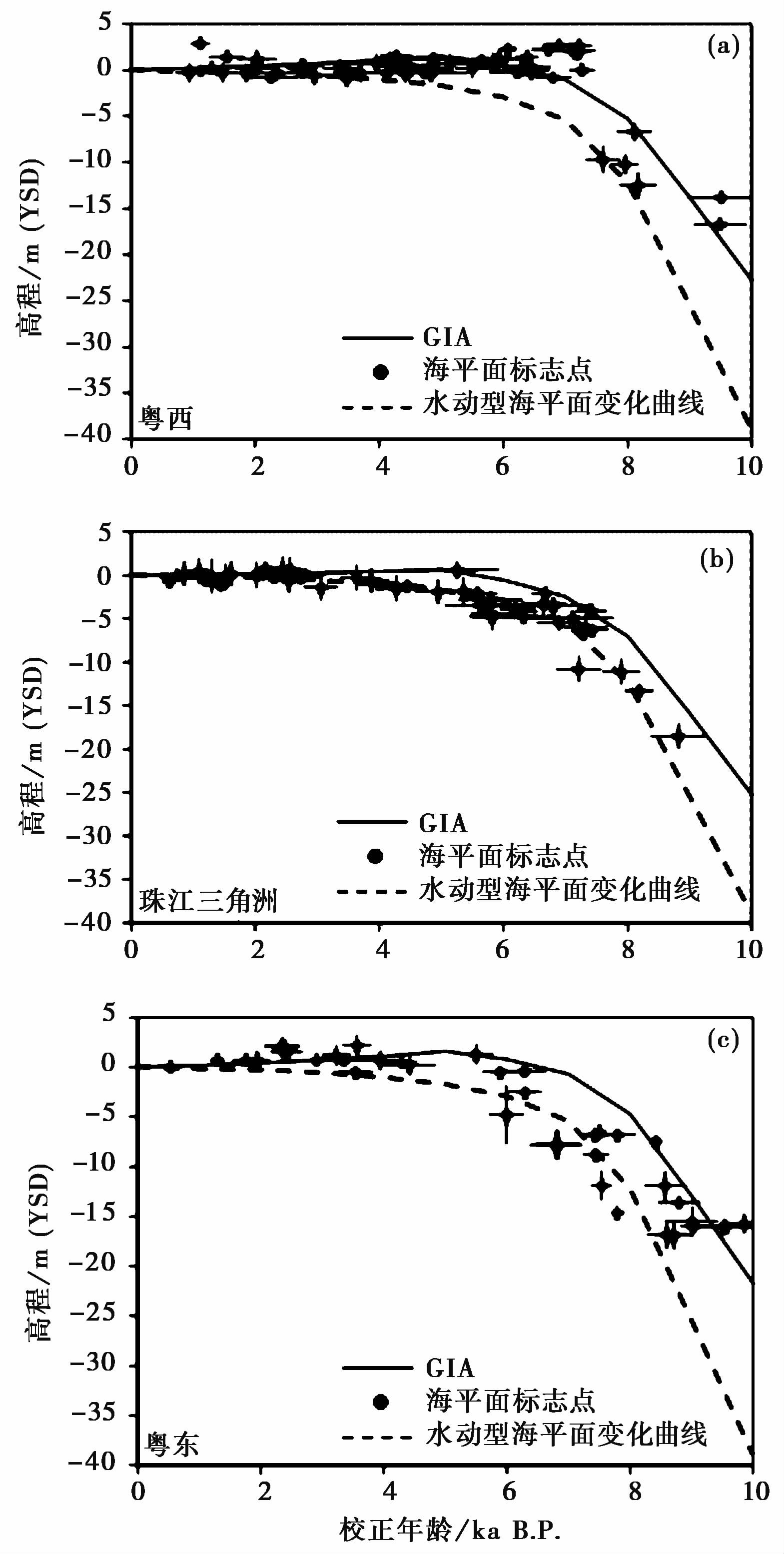
本文采用的水动型海平面变化曲线取自Lambeck 等[19]的结果。这个曲线采用了大量远场海平面数据进行了修正,描述了冰后期冰川融化水量变化引起的水动型海平面变化(Eustasy)。本文采用的GIA预测模型参考汪汉胜等[11]成果。此模型采用横向非匀质地球介质参数RF3L15,即考虑地幔粘滞度不仅沿地球径向而且沿横向的变化。末次盛冰期以来冰盖消融模型采用ICE-5G[7]。模型结果既包括了海动型海平面增长部分,也包含了GIA引起的海水和地幔流重新分布带来的海平面变化[20]。把这些曲线与实地的历史海平面数据进行比较,例如广东海岸,可以引出一些有意义的讨论。本文假设GIA模型的预测是准确的,因此中国海岸的历史海平面数据应该与其预测相吻合。广东沿岸作为构造运动活跃地区,在全新世期间经历了很多小尺度的相对运动,其海平面重建数据[21, 22, 23, 24, 25, 26, 27, 28, 29, 30]见 表2,海平面重建与GIA模型结果的比较见 图4,可以看出,在粤西、 珠江三角洲地区以及粤东海平面全新世以来(10000年来)基本上均低于GIA预测。以下重点根据GIA预测值与海平面实测值之差(ΔRSL)随时间的变化,分别判断区域性地壳的运动状态,例如,以上3个地区ΔRSL 随沉积物年龄增加总体上在上升,意味着地壳不断下沉。
|
|
表2 广东地区全新世海平面重建及数据来源 Table 2 Holocene sea-level reconstruction and data sources |
|
图4 广东地区海平面重建与模拟 Fig.4 Sea-level reconstructions and modeling results for Guangdong |
粤西大部分过去10000年以来的海平面标志物来源于潟湖、 河口和海滩沉积物,较新的部分为珊瑚。根据原始文献中沉积物来源记载,这些海平面数据( 图4a)大致可以分为三组来讨论。第一组来自潟湖和河口湾沉积物,定年为约7700年以前[21, 25],数据点比较少,有两个数据在年代上有很大的误差,总体反映早全新世海面上升。第二组来自雷州半岛的珊瑚数据,主要在6070年至7220年以前[23, 25]。这是一组精确度很高的数据,显示在中全新世时期出现了近2m的高海平面。第三组数据主要来自海滩沉积物,年龄为6000年和1000年之间[21, 24, 25]。这组数据反映6000年以来海平面总体平稳,或有轻微下降。与模型比较发现,第二组数据明显比模型(GIA)预测结果高,而第三组数据与模型的结果在误差范围以内大致吻合,但有微小低于GIA结果。根据ΔRSL随时间的变化情况,可以看出,粤西海岸大致稳定,但在雷州半岛附近地区结果显示在6070~7220年间,ΔRSL随沉积物年龄增加而呈现负值,很可能为新构造运动导致的局部构造隆升的结果。
珠江三角洲的海平面数据( 图4b)大部分来自三角洲/河口湾沉积物。早全新世和中全新世的数据大都低于GIA模型的预测结果,大致落在水动型海平面变化(Eustasy)曲线上。只有晚全新世的数据与GIA和Eustasy模型的预测结果吻合。可以看出,全新世以来,珠江三角洲整体上呈现微弱的地壳沉降趋势,但也不能排除沉积物压实作用而导致海平面数据点普遍低于GIA曲线。从7000年到3000年间海平面数据普遍分布在水动型曲线上,比GIA曲线要地3m,地壳下沉明显。晚全新世期间地壳相对比较稳定。
粤东(不包括韩江三角洲)海平面数据( 图4c)来自两种沉积环境。5000年以前的数据[26, 27, 28, 29, 30]多来源于河口湾沉积物,高程重建的误差较大。这些数据点也比较分散,但多数在GIA曲线甚至Eustasy曲线以下。5000年以来的数据[26, 27]大多来源于海滩岩和贝壳堤,在误差范围内,这些数据点大部分沿GIA曲线分布,所以,粤东海岸5000年以来大致稳定。但是5000年以前的数据具有很大不确定性,难以判断构造引起的地壳运动状态。
4 海平面历史影响因素分析以上的例子说明,全新世以来水动型海面变化在本区的表现是一种连续上升的形态。正如 图4的Eustasy曲线所显示,海平面由早全新世的快速上升变为中全新世早期上升速度减慢,再变为中-晚全新世的缓慢上升。但这样的简单的海平面历史,在冰川均衡效应、 水均衡效应、 当地的地壳运动以及河口湾沉积物的压实作用等的共同作用下,变得十分复杂[31]。不过,借助GIA模型的应用,海岸变化的一些细节还是能够被找出来。下面分析影响广东海岸海平面的因素。
第一,除了一些地点,广东海岸的区域构造是否十分稳定?根据广东沿岸的海平面数据,区域性的微小而长期的地壳沉降看来是可能的。这要追溯到新生代板块运动和南海的演变。自从南海的形成和印度板块与欧亚板块的碰撞,中国东南地块受应力场的影响逐渐由北向南蠕动或扩张。由于南海洋盆的沉陷,南海北部大陆架在向南蠕动和扩张同时也有随之下沉[32, 33]。这种下沉也就带动了整个广东沿海总体的缓慢沉降[34, 35]。同时,GIA模拟结果[18]也显示为地壳运动在中国东部及东南部内陆地区表现为长期抬升。抬升幅度最大的区域为江西,而抬升幅度向沿海方向逐渐减弱,在广东沿岸趋近于0或有微小沉降。
第二,自新生代以来南海应力场逐渐由挤压转为松弛,不均匀的区域应力场也导致了广东沿海大量西北-东南正断层的活动。这些断裂在晚第四纪较为活跃,其中一部分在全新世期间依然有较为明显的活动[36]。这些断层的活动导致广东中部和东部沿海非常多的局部的相对抬升和沉降。发生沉降的地方形成了很多河口湾和珠江三角洲盆地。比邻河口湾的地方则发育了许多海蚀阶地[37]。这种差异性的地壳活动也反映在珠江三角洲的11个不同断块构造区之间不同时空的抬升与沉降历史[38]。由于在抬升地区很少有沉积物得到保存,本文收集的海平面数据大多来自沉降地区。对于研究未来海面上升的影响而言,来自沉降地区的海平面历史还是有参考价值的。
第三,此外,雷州半岛作为一个新构造活跃地带[39],第四纪晚期还有多次火山活动,使这里局部地区呈抬升趋势[40]。结果造成中全新世早期的海平面点明显高出GIA预测的高度( 图4a)。
第四,珠江流域位于东亚湿润亚热带。河流上游带来的大量细颗粒泥沙淤积在三角洲盆地内,本区域的泥沙年径流量在8000×104吨以上。当这些以粉沙粘土为主的沉积物被压实而脱水,可造成地表的下沉。同时,不断增加的地表负荷也会造成区域性的沉降。随着过去近百年逐渐增加的人类活动包括城市化和抽取地下水,地表沉降愈加明显[41]。这些因素的综合作用也在一定程度上降低了珠江三角洲海平面数据点的高度,使得对当地构造沉降的研究变得困难。
5 结论本文利用广东海平面重建结果与冰川均衡预测模型的差异,研究和分析了构造运动和沉降等因素。结果表明,海平面标志物可被广泛用于古海平面重建中,但有些数据受构造运动、 沉积物压实作用与人类活动影响,较为明显的偏离了它们原来的位置; 整体而言,全新世以来,广东沿岸可能有因南海海盆沉降和大陆地块向南延伸而引起的微弱地壳沉降; 但是新构造运动也使一些地区发生较明显的沉降,例如珠江三角洲,和局部地区的隆升,例如雷州半岛; 精确的古海面重建和准确的GIA模拟可以帮助我们分析区域构造动和海岸变化的历史。
致谢 感谢审稿专家建设性的修改意见,使文章得以完善。
| 1 | Clark J A, Farrell W E, Peltier W R. Global changes in postglacial sea level:A numerical calculation. Quaternary Research, 1978, 9 (3):265~287 |
| 2 | Farrell W E, Clark J A. On postglacial sea level. Geophysical Journal International, 1976, 46 (3):647~667 |
| 3 | Peltier W R, Wu P, Yuen D A. The viscosities of the Earth's mantle. In:Stacey F D, Paterson M S, Nicholas A eds. Anelasticity in the Earth. Washington, D. C:American Geophysical Union, 1981. 59~77 |
| 4 | 赵希涛. 全球海面变化的近期模式. 地球科学进展, 1989, 3:67~77 Zhao Xitao. Recent global sea-level changes. Advance in Earth Sciences, 1989, 3:67~77 |
| 5 | Gehrels Roland. Sea level changes since the Last Glacial Maximum: An appraisal of the IPCC fourth assessment report. Journal of Quaternary Science, 2010, 25 (1):26~38 |
| 6 | Chappell J. Late Quaternary Glacio- and Hydro-isostasy, on a layered earth. Quaternary Research, 1974, 4 (4):405~428 |
| 7 | Peltier W R. Global glacial isostasy and the surface of the ice-age Earth:The ICE-5G(VM2)model and GRACE. Annual Review of Earth and Planetary Sciences, 2004, 32:111~149 |
| 8 | 汪汉胜, Wu Patrick, 许厚泽. 冰川均衡调整(GIA)的研究. 地球物理学进展, 2009, 24 (6):1958~1967 Wang Hansheng, Wu Patrick, Xu Houze. A review of reseach in glacial isostatic adjustment. Progress in Geophysics, 2009, 24 (6):1958~1967 |
| 9 | 杨学祥. 地壳均衡与海平面变化. 地球科学进展, 1992, 7 (5):22~30 Yang Xuexiang. Isostasy and sea-level change. Advance in Earth Sciences, 1992, 7 (5):22~30 |
| 10 | Lambeck K. Sea level change from Mid Holocene to recent time:An Australian example with global implications. Geodynamics Series, 2002, 29:33~50 |
| 11 | 汪汉胜, 贾路路, Wu Patrick等. 末次冰期冰盖消融对东亚历史相对海平面的影响及意义. 地球物理学报, 2012, 55 (4):1144~1153 Wang Hansheng, Jia Lulu, Wu Patrick et al. Effects of last-deglaciation on the historical relative sea levels of East Asia seas and the implications. Chinese Journal of Geophysics, 2012, 55 (4):1144~1153 |
| 12 | Horton Benjamin P, Zong Yongqiang, Hillier Caroline et al. Diatoms from Indonesian mangroves and their suitability as sea-level indicators for tropical environments. Marine Micropaleontology, 2007, 63 (3):155~168 |
| 13 | Lambeck Kurt, Chappell John. Sea level change through the last glacial cycle. Science, 2001, 292 (5517):679~696 |
| 14 | Milne G A, Long A J, Bassett S E. Modelling Holocene relative sea-level observations from the Caribbean and South America.Quaternary Science Reviews, 2005, 24 (10):1183~1202 |
| 15 | Peltier W R, Shennan I, Drummond R et al. On the postglacial isostatic adjustment of the British Isles and the shallow viscoelastic structure of the Earth. Geophysical Journal International, 2002, 148 (3):443~475 |
| 16 | Zong Yongqiang. Late Quaternary relative sea-level changes in the tropics. In:Elias S A, Mock C J eds. Encyclopedia of Quaternary Science(2nd ed). Amsterdam:Elsevier, 2013. 495~502 |
| 17 | Hydrographic Department. Admiralty Tide Tables, Vol. 3, Pacific Ocean and Adjacent Seas, Including Tidal Stream Tables. Great Britain:Hydrographer of the Navy, 1984. 28~29 |
| 18 | Zong Yongqiang. Mid-Holocene sea-level highstand along the southeast coast of China. Quaternary International, 2004, 117 (1):55~67 |
| 19 | Lambeck K, Rouby H, Purcell A et al. Sea level and global ice volumes from the Last Glacial Maximum to the Holocene. Proceedings of the National Academy of Sciences, 2014, 111 (43):15296~15303 |
| 20 | Wang Hansheng, Wu Patrick, Jia Lulu et al. The role of glacial isostatic adjustment in the present-day crustal motion and sea levels of East Asia. Earth, Planets and Space, 2011, 63 (8):915~928 |
| 21 | 黄镇国, 李平日, 张仲英等. 华南晚更新世以来的海平面变化. 见: 国际地质对比计划第200 号项目中国工作组编. 中国海平面变化. 北京: 海洋出版社, 1986. 178~194 Huang Zhenguo, Li Pingri, Zhang Zhongying et al. Changes of sea level in South China coast since the Late Pleistocene. In:The IGCP 200 China Working Group ed. China Sea-Level Changes. Beijing:China Ocean Press, 1986. 178~194 |
| 22 | 李平日. 珠江三角洲一万年来环境演变. 北京: 海洋出版社, 1991. 154 Li Pingri. Environmental Evolution of Zhujiang Delta in the Past 10000 Years. Beijing:China Ocean Press, 1991. 154 |
| 23 | Zhao Jianxin, Yu Kefu. Timing of Holocene sea-level highstands by mass spectro-metric U-series ages of a coral reef from Leizhou Peninsula, South China Sea. Chinese Science Bulletin, 2002, 47 (4):348~352 |
| 24 | 赵希涛. 中国海平面变化. 济南: 山东科学技术出版社, 1996. 464 Zhao Xitao. China Sea-level Change. Jinan:Shandong Scientific and Technological Press, 1996. 464 |
| 25 | 张仲英, 刘瑞华. 海南岛沿海的全新世. 地理科学, 1987, 7 (2):129~138 Zhang Zhongying, Liu Ruihua. Holocene stratigraphy in Hainan coasts. Geographic Science, 1987, 7 (2):129~138 |
| 26 | Yim W W S. Radiocarbon dates from Hong Kong and their geological implication. Journal of the Hong Kong Archaeological Society, 1986, 11:50~63 |
| 27 | Zong Yongqiang. Postglacial stratigraphy and sea-level changes in the Han River delta, China. Journal of Coastal Research, 1992, 8 (1), 1~28 |
| 28 | Zong Yongqiang, Huang Kangyou, Yu Fengling et al. The role of sea-level rise, monsoonal discharge and the palaeo-landscape in the Early Holocene evolution of the Pearl River delta, Southern China. Quaternary Science Reviews, 2012, 54: 77~88 |
| 29 | Zong Y Q, Huang G Q, Switzer A D et al. An evolutionary model for the Holocene formation of the Pearl River delta, China. The Holocene, 2009, 19 (1), 129~142 |
| 30 | Zong Y Q, Yim W W S, Yu F L et al. Late Quaternary environmental changes in the Pearl River mouth region, China. Quaternary International, 2009, 206:35~45 |
| 31 | 谢志仁, 袁林旺. 略论全新世海面变化的波动性及其环境意义. 第四纪研究, 2012, 32 (6):1065~1077 Xie Zhiren, Yuan Linwang. Fluctuation characteristics of Holocene sea-level change and its environmental implications. Quaternary Sciences, 2012, 32 (6):1065~1077 |
| 32 | 张 健, 石耀霖. 东亚陆缘带构造扩张的深部热力学机制. 大地构造与成矿学, 2003, 27 (3):222~227 Zhang Jian, Shi Yaolin. Thermodynamics mechanism of the marginal extensional belt of East Asia. Geotectonica et Metallogenia, 2003, 27 (3):222~227 |
| 33 | 符启基, 蔡周荣, 马 驰. 南海形成演化综合模式的初步探讨. 海洋地质动态, 2007, 23 (9):1~7 Fu Qiji, Cai Zhourong, Ma Chi. The formation and evolution integration of the South China Sea. Marine Geology Letters, 2007, 23 (9):1~7 |
| 34 | 邵 磊, 赵 梦, 乔培军等. 南海北部沉积物特征及其对珠江演变的响应. 第四纪研究, 2013, 33 (4):760~770 Shao Lei, Zhao Meng, Qiao Peijun et al. The characteristics of the sediment in northern South China Sea and its response to the evolution of the Pearl River. Quaternary Sciences, 2013, 33 (4):760~770 |
| 35 | 董艺辛, 刘春莲, 陈木宏等. 珠江三角洲中部大鳌平原晚第四纪古生物记录及环境演化. 第四纪研究, 2012, 32 (6):1183~1198 Dong Yinxin, Liu Chunlian, Chen Muhong et al. Late Quaternary paleontology and environmental changes in Da'ao Plain, middle Pearl River delta, Southern China. Quaternary Sciences, 2012, 32 (6):1183~1198 |
| 36 | Tang Yukun, Chen Guoneng, Peng Zuolun et al. Late Quaternary tectonics of the Pearl River delta, SE China:Evidence from Xilingang. Geodinamica Acta, 2011, 24 (3):133~139 |
| 37 | Pedoja Kerin, Shen Jianwei, Kershaw Steve et al. Coastal Quaternary morphologies on the northern coast of the South China Sea, China, and their implications for current tectonic models:A review and preliminary study. Marine Geology, 2008, 255 (3):103~117 |
| 38 | 陈伟光, 赵红梅, 常 郁 等. 珠江三角洲晚第四纪垂直构造运动速率. 地震地质, 2001, 23 (4):527~536 Chen Weiguang, Zhao Hongmei, Chang Yu et al. The rate of Late Quaternary vertical motion of the Zhujiang delta. Seismology and Geology, 2001, 23 (4):527~536 |
| 39 | Xu Jiawei, Tong Weixing. Major characteristics of the epi-continental arcs of East Asia and their tectonic significance. Journal of Southeast Asian Earth Sciences, 1988, 2 (1):23~33 |
| 40 | 詹文欢, 朱照宇, 姚衍桃等. 南海西北部珊瑚礁记录所反映的新构造运动. 第四纪研究, 2006, 26 (1):77~84 Zhan Wenhuan, Zhu Zhaoyu, Yao Yantao et al. Neotectonic movement recorded in coral reefs in the northwestern South China Sea. Quaternary Sciences, 2006, 26 (1):77~84 |
| 41 | Wang Ying. Sea-level changes, human impacts and coastal responses in China. Journal of Coastal Research, 1998, 14 (1):31~36 |
Abstract
This study aims to investigate the influence of tectonic activity in the Holocene sea-level records. The coast of Guangdong was selected because of its active tectonics during the Late Quaternary. Due to the fact that the tectonic movement during the Holocene has been very small in magnitude, a careful sea-level reconstruction is needed. With the high precision reconstruction, this study is able to reveal some important features of tectonic movement and evaluate its impacts on the sea-level history.
Most important in sea-level reconstructions is the ability to precisely determine the vertical relationship(also called indicative meaning)of a sea-level index point to its associated reference water levels. This study employed a scheme to help quantify this relationship for 15 types of sea-level indicators, which are commonly obtained from this coast. Once the palaeo-sea-level height was established by the above method, a sea-level curve for a small area was developed. To identify tectonic component within the sea-level records, the newly developed global eustatic history and a laterally heterogeneous earth model coupled with a deglacial model were used to generate predictions for the Holocene eustatic sea-level history and the effects of glacial-isostatic adjustments(GIA)for the study area. A comparison between the reconstructed sea-level history and the GIA history shows valuable information about the influence of tectonic movement.
Results show that along the west coast of Guangdong there are few good quality sea-level data for the period before 7700 year. A group of high quality data from coral samples of Leizhou Peninsula suggests a small magnitude of uplift, whilst data from estuarine environments of this coastal area show the coast was tectonically stable and the GIA was the main process that determines the mid-late Holocene sea-level history. Within the Pearl River deltaic basin, sea-level data suggest subsidence and possible sedimentary compaction. Further study is needed to quantify the tectonic component in the sea-level history. In the case of East Guangdong, the sea-level data scatter around the eustatic sea-level curve, with some data points(in Mid-Holocene)appearing below the eustatic curve and some others(in Late Holocene), above the GIA curve, implying a complex history of tectonic movement.
This study concludes:(1)The Guangdong coastal area in general has experienced a slight subsidence during the Holocene, possibly a result of the long-term continental extension that has caused the subsidence of northern continental shelf of the South China Sea;(2)Due to a change of the stress field in Late Quaternary, many NW-SE faults became active in this coast, resulted in differential, local subsidence and uplift, with estuaries and deltaic basins being mainly subsiding;(3)Leizhou Peninsula, an tectonically active area with the Hainan Island, shows evidence of uplift during the Holocene, reflecting the fact that this area has a long history of volcanic activity and earthquake throughout the Quaternary;(4)The data from the Pearl River Delta may show a combination of tectonic subsidence and sedimentary compaction due to dewatering of the sedimentary sequence.