 2015, Vol.35


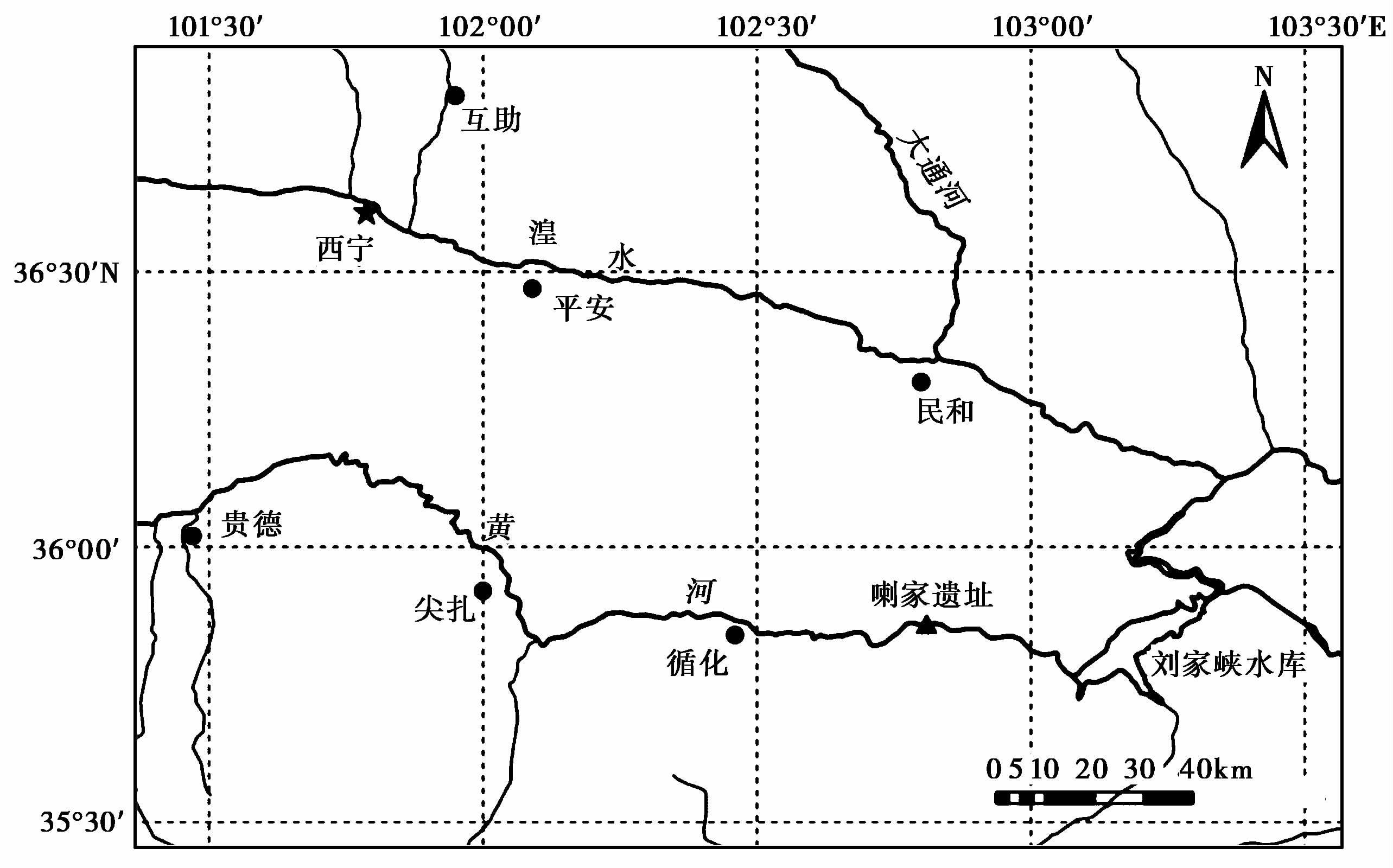
喇家遗址(35°51′15″N,102°49′40″E) 位于青海省民和县官亭镇下喇家村( 图1),地处黄河上游河谷的二级阶地上,海拔高度约为1800m。喇家遗址探明面积达50×104m2,自1999年至2007年经过中国社会科学院考古研究所甘青队和青海省文物考古研究所连续多年的联合发掘,首次发现并经科学研究确认了中国史前古地震和古洪水灾难遗存,出土了壕沟、 广场、 祭坛、 窑洞式房屋、 干栏式建筑以及成组玉器等重要遗迹遗物,经14 C测年,其绝对年代在距今约4300-3900年之间,是一处具有中心聚落性质的齐家文化遗址[1, 2, 3, 4]。喇家遗址的发现为研究齐家文化社会性质和经济形态,探索黄河上游古代文明与环境变迁的关系提供了丰富资料,具有积极的学术价值。
|
图1 喇家遗址位置图 Fig.1 Location of the Lajia site |
除了考古学的重要发现之外,学者们也对喇家遗址在多学科研究方面做了许多尝试,这包括史前灾难遗迹的确认及形成原因的讨论[5, 6, 7, 8],人骨鉴定和DNA分析[9, 10],以及聚落、 社会形态和文明化进程的研究[1, 4, 11]。喇家先民的经济生活状况也是学术界关心的问题。结合植物大遗存[12]、 人骨碳氮稳定同位素分析[13]以及面条遗存的淀粉粒和植硅体分析[14]结果,一般认为喇家遗址齐家文化时期的经济形态属于典型的北方旱作农业经济,种植粟(Setaria italica)和黍(Panicum miliaceum)两种农作物,并且以种植粟为主[15, 16],这与官亭盆地其他齐家文化遗址的植物考古结果一致[17]。然而,上述研究的样品采集还不够系统,样品量较少而且仅限于少数遗迹单位,喇家遗址的农业生产特点如何?齐家文化时期黍、 粟种植结构是怎样的,是否还有其他农作物?还需要通过系统的植物考古学方法进行研究验证。
本文利用植硅体分析方法,对喇家遗址2004-2007年发掘过程中系统采集的土样标本进行了分析,并进一步探讨喇家遗址的农作物种植种类与结构,为深入认识喇家遗址乃至齐家文化的农业生产状况提供直接的植物遗存证据。
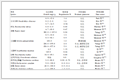
1 分析材料和方法2011年,我们获得了由叶茂林先生提供的110份喇家遗址土样( 表1)。这些样品的出土单位均与人类生产生活活动关系密切,包括7座房址、 10个灰坑、 3个灰堆、 10个柱洞和7个地层。对于一些房址和灰坑内部,还按不同的位置、 深度、 背景和器物分别采取土样。根据层位关系与出土器物分析[1, 2],大部分采样单位属于齐家文化遗存,但10个柱洞以及T1101⑤层是辛店文化遗存。经过仔细核查,我们将重复的样品进行合并,最后共有87份样品进行植硅体分析。
植硅体实验室分析采用湿式灰化法,具体步骤如下:1)样品描述与称重。分析样品重量在1.5-3g之间; 2)将样品放入试管,加30 % 的双氧水,使其充分反应以去除有机质; 3)加蒸馏水离心清洗3次,再加入石松孢子片(27637粒/片)及10 % 的盐酸,放入沸水中加热15分钟以去除钙质; 4)加蒸馏水离心清洗3次,然后加比重为2.35的溴化锌重液进行浮选; 5)将浮选出的样品用蒸馏水洗净,然后用中性树胶制成固定玻片待用。
植硅体的统计和鉴定是在400倍徕卡DM750光学显微镜下进行的。大部分样品统计400粒以上,对于植硅体含量少的样品则统计100-200粒,并同时计数石松孢子。植硅体鉴定参照王永吉和吕厚远[18]的分类标准,粟、 黍植硅体鉴定依据Lu等[19]的区分标准。棒型、 刺棒型植硅体单体长度大于10μm,黍、 粟稃壳植硅体单片内包含的特殊纹饰多于2个的植硅体个体记入统计数量。然后计算每个植硅体类型的百分含量(单个类型数与总统计数的比值×100 % )。每个样品植硅体浓度通过公式: 植硅体浓度(粒/克)=(鉴定的植硅体数量×外加石松孢子数)/(鉴定的石松孢子数×样品取样重量)计算得出。对于所有发现农作物的齐家文化样品,我们将统计到的谷物植硅体数量相加求取总数,然后计算每个农作物植硅体的相对百分含量(单个农作物植硅体数与谷物植硅体总数的比值×100 % )。植物遗存的出土概率根据发现有某种植物种类的样品在总样品数中所占的比例计算。
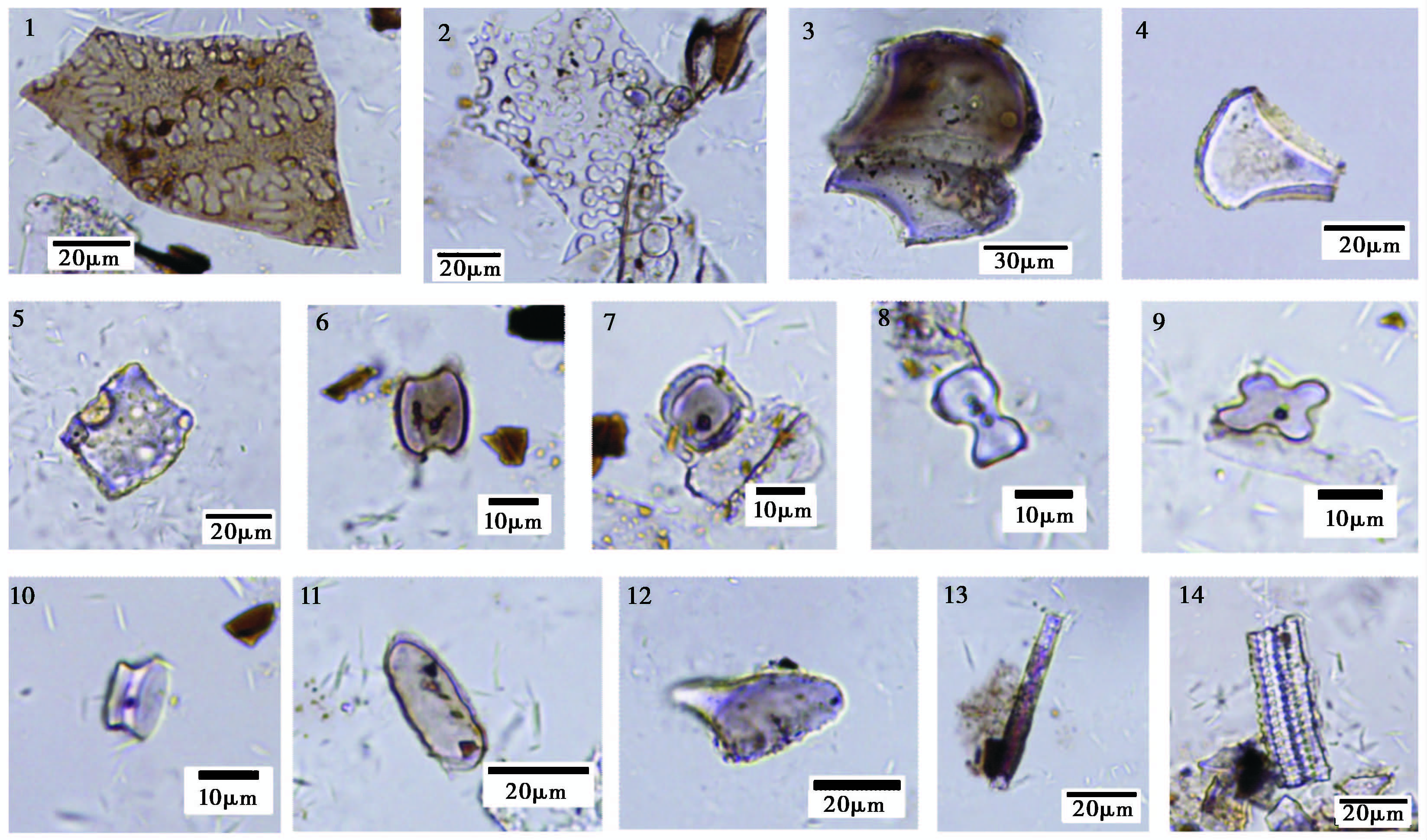
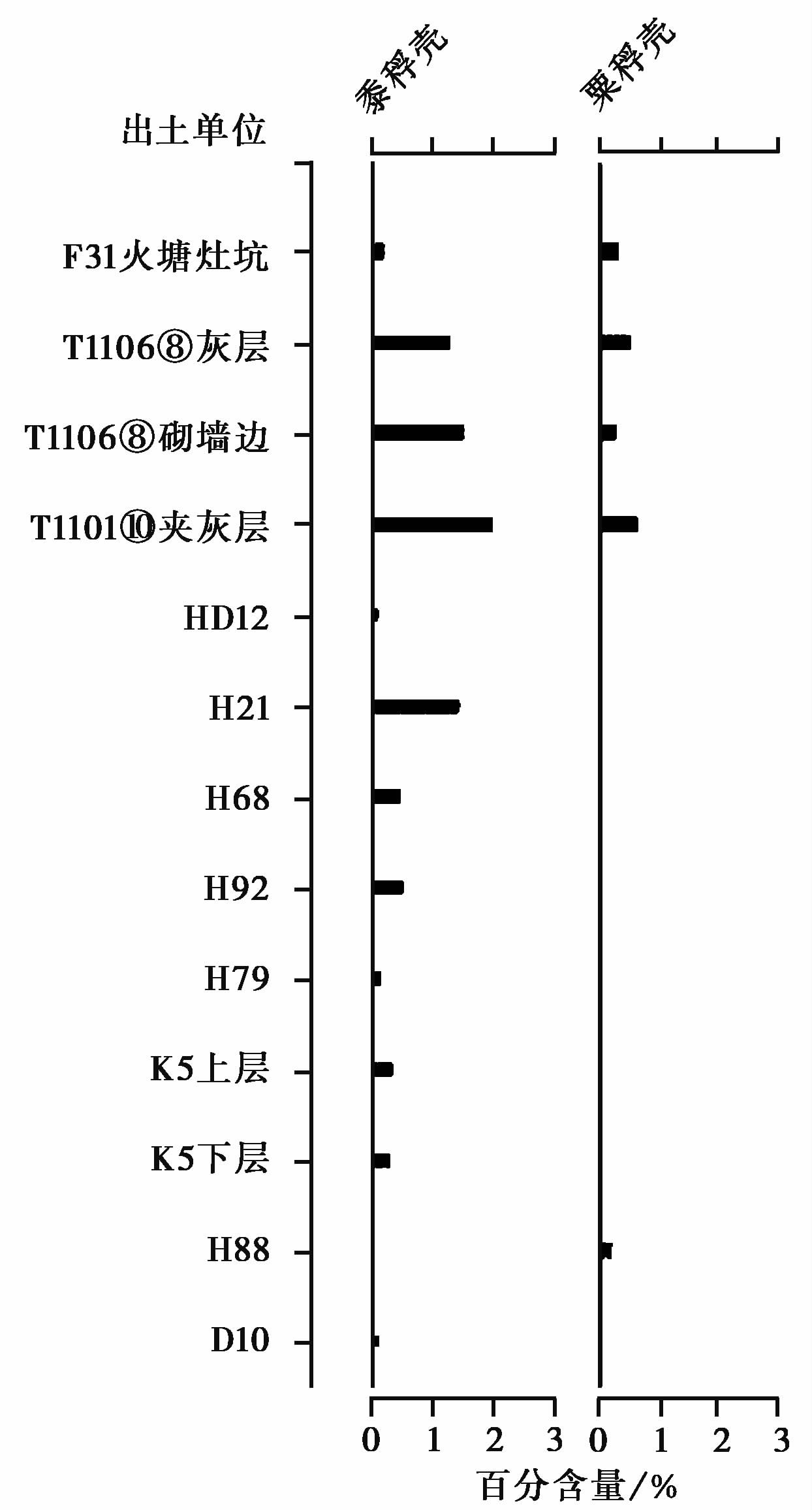
2 植硅体分析结果喇家遗址土样的植硅体含量不一,但总体上较为丰富,平均浓度可达100×104粒/g。87个样品中共鉴定出24个植硅体类型,统计41678粒个体。在13个样品中发现了农作物植硅体,但含量较少,最高在2 % 左右,可鉴定的种类有粟和黍种子稃壳植硅体(黍η型: 图2-1; 粟Ω型: 图2-2)。在数量上黍植硅体要多于粟植硅体( 表2),而在百分含量上黍植硅体(0-2 % )所占的比例也要大于粟植硅体(0-0.6 % )( 图3)。其他常见植硅体形态有芦苇盾型、 扇型、 方型、 鞍型、 哑铃型、 尖型以及帽型等(见 图2)。
|
图2 喇家遗址常见植硅体形态 1—黍稃壳η型(η type from husks of common millet); 2—粟稃壳Ω型(Ω type from husks of foxtail millet); 3—芦苇盾型(scutiform-bullifrom from reed); 4—扇型(bulliform); 5—方型(square); 6—短鞍型(short saddle); 7—中鞍型(middle saddle); 8—哑铃型(bilobate); 9—十字型(cross); 10—帽型(rondel); 11—齿型(trapeziform sinuate); 12—尖型(pointed); 13—棒型(smooth elongate); 14—导管型(vessel) Fig.2 Shapes of common phytoliths from Lajia site |
|
表1 喇家遗址植硅体样品采集统计表 Table 1 Summary of the phytolith samples from Lajia site |
喇家遗址齐家文化时期黍植硅体的相对百分含量为80 % ,是粟植硅体含量的4倍。而对于辛店文化期样品,仅在柱洞D10发现了1粒黍稃壳植硅体。另外,喇家遗址黍植硅体的出土概率为13.8 % ,而粟植硅体的出土概率仅为5.8 % 。
喇家遗址样品的植硅体组合可大体分为两类,即大部分没有出现农作物的遗迹和器物中植硅体组合以尖型、 帽型和齿型等冷型植硅体为主,而发现有农作物的灰坑和灰层植硅体组合则出现较高比例的哑铃型(最高达52 % )和短鞍型(最高达20 % )等暖型植硅体。综合所有样品,我们还发现芦苇盾型植硅体普遍存在,出土概率为97 % ,主要分布在房址、 灰坑和灰堆等遗迹,尤其是在F31内,从遗迹土样、 器物内积土到火塘、 壁炉和器座坑土样均有发现,百分含量可达12 % -24 % 。
另外值得注意的现象是,在T1102⑨ 硬面灰烬层中导管型植硅体( 图2-14)含量十分丰富,高达79 % ,而且包含有许多无法鉴定的植硅体碎片。灰坑K5上层和下层的植硅体组合相近,均发现有黍植硅体( 图3)。该灰坑植硅体浓度高(平均约985万粒/g)而纯净,并且较少发现炭屑,这种现象在其他灰坑中没有发现。
|
图3 喇家遗址出土黍、 粟植硅体百分含量对比 Fig.3 Percentage contents of common millet and foxtail millet phytoliths from Lajia site |
因为此次分析只有一份辛店时期的样品发现了农作物植硅体,而且含量极少( 表2),证据不够充分,所以本文不探讨喇家遗址辛店时期的农业生产状况,而将重点放在齐家文化农业遗存的讨论上。 在过去的研究中,齐家文化的植物遗存发现很少,仅在永靖大何庄[20]和广河齐家坪[21]两处遗址偶然发现埋藏在陶罐中的炭化粟粒,从而被简单认识为一个种植粟的农业文化[22]。最近,齐家坪、 堡子坪、 下海石和堡子山等遗址人骨同位素的分析结果也表明齐家文化先民以小米为主食[23, 24],但具体以哪种小米为主仍然不清楚,而互助金禅口遗址,官亭盆地鄂家、 辛家和清泉旱台遗址的浮选结果则显示齐家文化的农作物种植以粟为主[17, 25]。 喇家遗址的发现为进一步探讨齐家文化的农业生产状况提供了机会。尝试性浮选结果显示喇家遗址种植粟和黍两种农作物,而粟占绝对优势[12]; 对面条遗存的淀粉粒和植硅体分析确认其成分为粟和黍,以粟为大量[14]; 人骨食性分析的结果揭示出喇家先民的主食为C4类植物,是小米类的可能性较大[13]。综合以上证据,喇家遗址齐家文化时期的农业生产被认为属于典型的粟黍旱作农业体系,并以粟为主要农作物[16]。本文植硅体分析结果也显示喇家遗址齐家文化时期的农作物种植有粟和黍两种,但黍可能更为重要。黍植硅体在数量、 百分含量、 相对含量以及出土概率上均高于粟植硅体,再结合黍植硅体在各种遗迹单位中广泛分布的现象( 表2),可以反映出黍与喇家先民的关系更为密切。
|
|
表2 喇家遗址农作物植硅体数量统计 Table 2 Quantitative statistics of crops phytoliths from Lajia site |
中国北方旱作农业体系起源于新石器时代早期[26, 27, 28],来自磁山[26]、 唐户[29]、 月庄[30, 31]、 兴隆沟[32]、 大地湾[33]、 陇东[34]和甘肃中部地区[35]遗址的植物考古证据表明,这一时期很可能是以黍为主的种植格局。仰韶文化晚期之后,粟才开始逐渐取代黍而成为中国北方聚落中最重要的粮食作物,在绝大多数粟黍共存的遗址中,粟在数量和出土概率上均占有优势[36]。但是,关中盆地泉护、 杨官寨、 浒西庄、 案板、 王家嘴以及水沟等6处遗址[37]和豫西南沟湾遗址[38]的植物考古证据揭示出,仰韶晚期之后中国北方仍有一些地区延续了早期以黍为主的旱作农业。而有学者发现仰韶时代以后黍遗存多分布在西北[36, 39],暗示着相对于东部地区,西北地区对黍的利用依然普遍。尤其是在农业出现较晚的新疆地区,黍从4000年前的小河文化到汉代一直是除小麦外的最重要的粮食作物[40],除了煮粥还被用来制作面条和点心这两种主食[41]。
对于甘青文化区,特别是陇东和甘肃中部地区,虽然黍的比重在仰韶文化晚期以后呈下降趋势,到齐家文化时期被粟取代[34, 35],但在喇家遗址,黍依然超过粟,显示了与东部邻区不同的种植结构。喇家遗址位于青海省东部,属于青藏高寒气候区,年平均温度较低,农业生态环境脆弱,加之4.5ka B.P. 之后该区气候趋于干冷[42],从而使农业生产条件更为不利。在这种情况下,喇家先民很可能优先选择种植更加耐寒耐旱且耐贫瘠的黍而不是粟。
此次植硅体分析显示黍多于粟,而喇家及其周边齐家文化遗址的浮选结果则均显示粟多于黍,二者恰恰相反。鉴于黍粟植硅体和炭化种子鉴定特征都很明确,鉴定误差应该不是导致这一分歧的原因。前人研究发现[37],经相同方法处理的等重量的黍、 粟种子稃片的植硅体产量基本相等,意味着相同条件下黍、 粟植硅体的保存状况相似,而植硅体含量反映的是黍、 粟的相对重量(产量)变化,这与浮选结果反映的种子颗粒数量意义不同。两种方法结果的指示含义不同可能是导致解释上出现差异的原因。1g粟的颗粒数平均是黍的2.26倍,最高达10倍[37],这意味着浮选结果中粟的颗粒数至少除以2.3才可以与黍进行相对产量的对比。但根据喇家遗址浮选结果,粟颗粒数(n=589)即便除去2.3倍,其相对产量(n=256)依然远高于黍(n=5),这还是与植硅体结果相异。因此这种差异的形成是否还有其他原因,与炭化和埋藏过程有无关系?
植物种子能否被炭化进而保存到遗址中,除取决于是否经过高温烘烤,还取决于其在不同炭化条件下的质地和坚固性。现代粟、 黍种子炭化模拟实验表明[43],以加热时间和升温速率一致为前提,在氧化条件下,粟的炭化温度区间为220-500℃,黍为225-400℃; 在还原条件下,粟的炭化温度区间为220-550℃,黍为245-325℃。这说明无论在什么环境下,黍的炭化区间均小于粟,也就是说在相同温度、 时间和氧气条件下,黍比粟更难炭化,这或许是导致遗址中黍炭化颗粒少于粟的原因。当然,这一模拟结果还需要更多材料和实验验证,黍、 粟种子在不同条件下的炭化比例也需要具体计算,而且考古遗址中种子的炭化过程要远比实验室模拟复杂,其野外埋藏方式(集中或散布)和位置的不同也会影响到炭化的程度[44],以上问题都有待于进一步的工作来解决。此外,在实际工作中,还有一些因素可能会造成两种方法结果的差异,如古人对粟、 黍加工利用方式的不同(粒食或面食),样品采集量和采集位置的代表性。因此,在黍粟对比上,要最终找到两种方法分歧的原因还需要更为细致的研究。
喇家遗址目前缺乏麦类作物的证据[12, 14, 15],但依然有学者推测有麦作农业的存在[45],其主要依据不仅是早在龙山时代麦类遗存在黄河流域考古遗址的普遍存在[46],而且在于与其同时期甚至更早的周围区域,以及相继文化遗址中发现了麦类遗存,如天水西山坪遗址发现了距今4600年的炭化大麦和小麦[47],齐家文化的长宁[48]、 柳湾[49]和磨沟[50]等遗址发现了小麦族的淀粉粒,堡子坪遗址发现了炭化大麦[51],卡约文化的丰台遗址出现了炭化大麦和小麦[52]以及小麦族淀粉粒[53],官亭盆地4处辛店文化遗址也发现了炭化大麦和小麦[17],而最近对喇家遗址齐家文化石刀的残留物分析也发现了麦类淀粉粒[54]。最新的研究认为中国小麦起源于公元前2100-1800年的河西走廊地区,之后向外传播[55],而互助金禅口遗址发现的公元前2030-1770年的炭化小麦和大麦便是这两种谷物传入河湟谷地的重要证据[25]。有鉴于此,虽然此次没有发现麦类植硅体,但我们不否认喇家遗址麦类种植的可能性,这需要未来植物考古工作加以印证。
在喇家遗址,一些发现有农作物的灰坑和灰层样品中,哑铃型和短鞍型植硅体的比例相对较高。这两种植硅体类型分别来自黍亚科和画眉草亚科植物[18],而这两类植物性喜暖,很少分布在青藏高原[56],所以这两种植硅体的主要来源应该不是自然植被。粟黍是黍亚科作物,而画眉草亚科植物又是混生于粟黍田地的杂草,人类很可能将粟黍连带杂草共同收割,脱壳后将稃皮、 茎叶废弃或作为燃料集中堆放,从而造成了相应沉积中具有较高含量的哑铃型和鞍型植硅体,因此这种现象应是人类选择和利用植物的结果。
芦苇植硅体的普遍存在,说明芦苇可能是生活在河流阶地上的喇家先民经常利用的植物。芦苇用途广泛,不仅可用于铺建房屋和编织物品,也可以入药或作为牧草喂饲牲畜,而喇家遗址的火塘、 灰堆、 壁炉和灰坑等遗迹也发现了较多芦苇植硅体,说明喇家先民也可能较多地使用芦苇作为燃料。
K5中的植硅体浓度高而纯净,炭屑较少,说明该坑曾经堆放了大量植物而且未经过火烧和自然炭化,不像是作为垃圾坑的一般灰坑,而可能是用于专门用途。关于这一遗迹现象的堆积成因与具体用途,还需要结合考古学背景做进一步分析。T1102⑨ 硬面灰烬层中大量导管型植硅体的出现是一种特殊现象,现在只能确定这些属于棒状导管植硅体,很可能来自草本植物。但是,导管植硅体为何在这一样品中密集出现,是否源于某种特殊的保存条件?而它们是否来自某种特殊植物,该硬面灰烬层又作何用途?还需要在做其他成分分析的基础上加以探究。
综上所述,此次植硅体分析结果表明喇家遗址齐家文化时期的农业生产属于典型的黍粟旱作农业,种植的主要是黍,没有发现麦类遗存。在未来的研究中,要全面认识喇家遗址的生业经济状况,还需要更多的考古发掘成果和多种方法的综合应用。
致谢 感谢审稿专家和编辑部老师对本文提出的建设性修改意见和帮助。
| 1 | 中国社会科学院考古研究所, 青海省文物考古研究所. 青海民和喇家史前遗址的发掘. 考古, 2002, (7):3~5 Institute of Archaeology, Chinese Academy of Social Sciences, Qinghai Provincial Institute of Cultural Relics and Archaeology. The excavation of the prehistorical Lajia site in Minhe County, Qinghai Province. Archaeology, 2002, (7):3~5 |
| 2 | 中国社会科学院考古研究所甘青工作队, 青海省文物考古研究所. 青海民和县喇家遗址2000年发掘简报. 考古, 2002, (12):12~25 The Gansu-Qinghai Archaeological Team, Institute of Archaeology, Chinese Academy of Social Sciences, Qinghai Provincial Institute of Cultural Relics and Archaeology. A brief report on the 2000 excavation of the Lajia site, Minhe County, Qinghai Province. Archaeology, 2002, (12):12~25 |
| 3 | 叶茂林, 何克洲. 青海民和县喇家遗址出土齐家文化玉器. 考古, 2002, (12):89~90 Ye Maolin, He Kezhou. The jade ware of Qijia Culture from the Lajia site, Minhe County, Qinghai Province. Archaeology, 2002, (12):89~90 |
| 4 | 中国社会科学院考古研究所甘青工作队, 青海省文物考古研究所. 青海民和喇家遗址发现齐家文化祭坛和干栏式建筑. 考古, 2004, (6):3~6 The Gansu-Qinghai Archaeological Team, Institute of Archaeology, Chinese Academy of Social Sciences, Qinghai Provincial Institute of Cultural Relics and Archaeology. The altar and pile-dwelling of Qijia Culture in the Lajia site, Minhe County, Qinghai Province. Archaeology, 2004, (6):3~6 |
| 5 | 夏正楷, 杨晓燕, 叶茂林. 青海喇家遗址史前灾难事件. 科学通报, 2003, 48 (11):1200~1204 Xia Zhengkai, Yang Xiaoyan, Ye Maolin. Prehistoric disasters at Lajia site, Qinghai, China. Chinese Science Bulletin, 2003, 48 (17):1877~1881 |
| 6 | 佟 派, 王 睦. 古代中国的环境研究——关于解释和年代对应方面的问题. 见: 山东大学东方考古研究中心编. 东方考古(第2集). 北京: 科学出版社, 2005. 263~271 Tarasov Pavel, Wagner Mayke. Environmental aspects of Chinese antiquity:Problems of interpretation and chronological correlation. In:Oriental Archaeology Center of Shandong University ed. Oriental Archaeology(Vol. 2). Beijing:Science Press, 2005. 263-271 |
| 7 | 张小虎, 夏正楷, 杨晓燕. 青海喇家遗址废弃原因再探讨——与《古代中国的环境研究》一文作者商榷. 考古与文物, 2009, (1):100~103 Zhang Xiaohu, Xia Zhengkai, Yang Xiaoyan. Reconsideration of the reason for the disuse of Lajia site, Qinghai Province:Discussing with the authors of "Environmental aspects of Chinese antiquity". Archaeology and Cultural Relics, 2009, (1):100~103 |
| 8 | 吴庆龙, 张培震, 张会平等. 黄河上游积石峡古地震堰塞溃决事件与喇家遗址异常古洪水灾害. 中国科学(D辑), 2009, 39 (8):1148~1159 Wu Qinglong, Zhang Peizhen, Zhang Huiping et al. A palaeoearthquake induced damming and bursting of Yellow River and the abnormal flood that destroyed Lajia relic. Science in China(Series D), 2009, 39 (8):1148~1159 |
| 9 | 王明辉. 青海民和县喇家遗址人骨及其相关问题. 考古, 2002, (12):25~28 Wang Minghui. The human bone remains and their relevant issues at Lajia site, Minhe County, Qinghai Province. Archaeology, 2002, (12):25~28 |
| 10 | Gao Shizhu, Yang Yidai, Xu Yue et al. Tracing the genetic history of the Chinese people: Mitochondrial DNA analysis of a neolithic population from the Lajia site. American Journal of Physical Anthropology, 2007, 133 (4):1128~1136 |
| 11 | 钱耀鹏. 关于喇家聚落的灾难遗迹与广场建筑. 考古, 2007, (5):57~68 Qian Yaopeng. On the traces of disasters and square buildings in the Lajia settlement. Archaeology, 2007, (5):57~68 |
| 12 | 赵志军. 青海喇家遗址尝试性浮选的结果. 中国文物报, 2003年9月19日第7版 Zhao Zhijun. The preliminary floatation results of the Lajia site, Qinghai Province. China Cultural Relics News, 19th September, 2003, 7th Page |
| 13 | 张雪莲. 碳十三和氮十五分析与古代人类食物结构研究及其新进展. 考古, 2006, (7):50~56 Zhang Xuelian. δ 13 C and 15 N analysis on ancient human diet structure and new development. Archaeology, 2006, (7):50~56 |
| 14 | Lu Houyuan, Yang Xiaoyan, Ye Maolin et al. Millet noodles in late Neolithic China. Nature, 2005, 437 :967~968 |
| 15 | 张小虎, 夏正楷, 杨晓燕等. 黄河流域史前经济形态对4ka B.P. 气候事件的响应. 第四纪研究, 2008, 28 (6):1061~1069 Zhang Xiaohu, Xia Zhengkai, Yang Xiaoyan et al. Different response models of prehistoric economy to 4ka B.P. climate event in the reaches of Huanghe River. Quaternary Sciences, 2008, 28 (6):1061~1069 |
| 16 | 赵志军. 中华文明形成时期的农业经济特点. 见: 中国社会科学院考古研究所科技考古中心编. 科技考古(第3辑). 北京: 科学出版社, 2011. 1~35 Zhao Zhijun. The characteristics of agriculture during the formation of Chinese civilization. In:The Center for Scientific Archaeology, Institute of Archaeology, Chinese Academy of Social Sciences ed. Science for Archaeology(Vol. 3). Beijing:Science Press, 2011. 1~35 |
| 17 | 张小虎. 青海官亭盆地植物考古调查收获及相关问题. 考古与文物, 2012, (3):26~33 Zhang Xiaohu. The results and relevant issues of the archaeobotanical investigation of the Guanting basin, Qinghai Province. Archaeology and Cultural Relics, 2012, (3):26~33 |
| 18 | 王永吉, 吕厚远著. 植物硅酸体研究及应用. 北京: 海洋出版社, 1993. 1~228 Wang Yongji, Lü Houyuan. The Study of Phytolith and Its Application. Beijing:China Ocean Press, 1993. 1~228 |
| 19 | Lu Houyuan, Zhang Jianping, Wu Naiqin et al. Phytoliths analysis for the discrimination of foxtail millet(Setaria italica)and common millet(Panicum miliaceum). Plos One, 2009, 4 (2):e4448 |
| 20 | 黄河水库考古队甘肃分队. 临夏大何庄、秦魏家两处齐家文化遗址发掘简报. 考古, 1960, (3):9~12 The Gansu Squad, Yellow River Reservoirs Archaeological Team. Excavations of the Qijia Culture sites at Dahezhuang and Qinweijia, Linxia County, Gansu Province. Archaeology, 1960, (3):9~12 |
| 21 | 何双全. 甘肃先秦农业考古概述. 农业考古, 1987, (1):55~61 He Shuangquan. A summary of the Pre-Qin agricultural archaeology in Gansu Province. Agricultural Archaeology, 1987, (1):55~61 |
| 22 | 王吉怀. 齐家文化农业概述. 农业考古, 1987, (1):71~77 Wang Jihuai. A summary on the agriculture of Qijia Culture. Agricultural Archaeology, 1987, (1):71~77 |
| 23 | Ma Minmin, Dong Guanghui, Lightfoot Emma et al. Stable isotope analysis of human and faunal remains in the western Loess Plateau, approximately 2000 Cal BC. Archaeometry, 2014, 56 (Supplement S1):237~255 |
| 24 | Ma Minmin, Dong Guanghui, Liu Xinyi et al. Stable isotope analysis of human and animal remains at the Qijiaping site in middle Gansu, China. International Journal of Osteoarchaeology, 2013, published online, doi:10.1002/oa.2379 |
| 25 | 董广辉, 杨 颖, 任晓燕等. 金禅口齐家文化遗址发现青海省早期大麦、小麦遗存. 中国文物报, 2014年7月4日第7版 Dong Guanghui, Yang Ying, Ren Xiaoyan et al. Early barley and wheat remains in Qinghai Province were unearthed from the Jinchankou Qijia Culture site. China Cultural Relics News, 4th July, 2014, 7th Page |
| 26 | Lu Houyuan, Zhang Jianping, Liu Kam-biu et al. Earliest domestication of common millet(Panicum miliaceum)in East Asia extended to 10,000 years ago. Proceedings of the National Academy of Sciences USA, 2009, 106 (18):7367~7372 |
| 27 | Yang Xiaoyan, Wan Zhiwei, Linda Perry et al. Early millet use in Northern China. Proceedings of the National Academy of Sciences USA, 2012, 109 (10):3726~3730 |
| 28 | 赵志军. 中国古代农业的形成过程——浮选出土植物遗存证据. 第四纪研究, 2014, 34 (1):73~84 Zhao Zhijun. The process of origin of agriculture in China:Archaeological evidence from flotation results. Quaternary Sciences, 2014, 34 (1):73~84 |
| 29 | Zhang Jianping, Lu Houyuan, Gu Wanfa et al. Early mixed farming of millet and rice 7800 years ago in the Middle Yellow River region, China. Plos One, 2012, 7 (12):e52146 |
| 30 | Crawford Gary, 陈雪香, 王建华. 山东济南长清区月庄遗址发现后李文化时期的炭化稻. 见: 山东大学东方考古研究中心编. 东方考古(第3集). 北京: 科学出版社, 2006. 247~251 Crawford Gary, Chen Xuexiang, Wang Jianhua. Houli Culture rice from the Yuezhuang site, Jinan, Shandong. In:Oriental Archaeology Center of Shandong University ed. Oriental Archaeology(Vol. 3). Beijing:Science Press, 2006. 247~251 |
| 31 | Crawford Gary, 陈雪香, 栾丰实等. 山东济南长清月庄遗址植物遗存的初步分析. 江汉考古, 2013, (2):107~116 Crawford Gary, Chen Xuexiang, Luan Fengshi et al. A preliminary analysis on plant remains of the Yuezhuang site in Changqing district, Jinan City, Shandong Province. Jianghan Archaeology, 2013, (2):107~116 |
| 32 | 赵志军. 从兴隆沟遗址浮选结果谈中国北方旱作农业起源问题. 见: 南京师范大学文博系编. 东亚古物(A卷). 北京: 文物出版社, 2004. 188~199 Zhao Zhijun. Floatation results from the Xinglonggou site and the origin of the dry-land agriculture in North China. In:Department of Cultural Relics and Museology of Nanjing Normal University ed. Antiquities of East Asia(A). Beijing:Cultural Relics Publishing House, 2004. 188~199 |
| 33 | 刘长江, 孔昭宸, 郎树德. 大地湾遗址农业植物遗存与人类生存的环境探讨. 中原文物, 2004, (4):26~30 Liu Changjiang, Kong Zhaochen, Lang Shude. Plant remains at the Dadiwan site and a discussion of human adaptation to the environment. Zhongyuan Cultural Relics, 2004, (4):26~30 |
| 34 | 周新郢, 李小强, 赵克良等. 陇东地区新石器时代的早期农业及环境效应. 科学通报, 2011, 56 (4-5):318~326 Zhou Xinying, Li Xiaoqiang, Zhao Keliang et al. Early agricultural development and environmental effects in the Neolithic Longdong basin(East Gansu). Chinese Science Bulletin, 2011, 56 (4-5):318~326 |
| 35 | 安成邦, 吉笃学, 陈发虎等. 甘肃中部史前农业发展的源流: 以甘肃秦安和礼县为例. 科学通报, 2010, 55 (14):1381~1386 An Chengbang, Ji Duxue, Chen Fahu et al. Evolution of prehistoric agriculture in central Gansu Province, China:A case study in Qin'an and Li County. Chinese Science Bulletin, 2010, 55 (14):1381~1386 |
| 36 | 刘长江, 靳桂云, 孔昭宸编著. 植物考古——种子和果实研究. 北京: 科学出版社, 2008. 1~273 Liu Changjiang, Jin Guiyun, Kong Zhaochen. Archaeobotany——Research on Seeds and Fruits. Beijing:Science Press, 2008. 1~273 |
| 37 | 张健平, 吕厚远, 吴乃琴等. 关中盆地6000-2100cal.a B.P. 期间黍、粟农业的植硅体证据. 第四纪研究, 2010, 30 (2):287~297 Zhang Jianping, Lü Houyuan, Wu Naiqin et al. Phytolith evidence of millet agriculture during about 6000-2100a B.P. in the Guanzhong basin, China. Quaternary Sciences, 2010, 30 (2):287~297 |
| 38 | 王育茜, 张 萍, 靳桂云等. 河南淅川沟湾遗址2007年度植物浮选结果与分析. 四川文物, 2011, (2):80~92 Wang Yuqian, Zhang Ping, Jin Guiyun et al. Floatation results of 2007 excavation season from the Gouwan site in Xichuan County, Henan Province. Sichuan Cultural Relics, 2011, (2):80~92 |
| 39 | Lee Gyoung-Ah, Crawford Gary, Liu Li et al. Plants and people from the Early Neolithic to Shang periods in North China. Proceedings of the National Academy of Sciences USA, 2007, 104 (3):1087~1092 |
| 40 | 赵克良, 李小强, 周新郢等. 新疆新塔拉遗址农业活动特征及其影响的植物指标记录. 第四纪研究, 2012, 32 (2):219~225 Zhao Keliang, Li Xiaoqiang, Zhou Xinying et al. Characteristics of agricultural activities and its impact on the environment at Xintala site, Xinjiang, reconstructed from archaeological plant remains. Quaternary Sciences, 2012, 32 (2):219~225 |
| 41 | Gong Yiwen, Yang Yimin, Ferguson David K et al. Investigation of ancient noodles, cakes, and millet at the Subeixi site, Xinjiang, China. Journal of Archaeological Science, 2011, 38 (2):470~479 |
| 42 | Shen Ji, Liu Xingqi, Wang Sumin et al. Palaeoclimatic changes in the Qinghai Lake area during the last 18,000 years. Quaternary International, 2005, 136 (1):131~140 |
| 43 | Tanja Märkle, Manfred Rösch. Experiments on the effects of carbonization on some cultivated plant seeds. Vegetation History and Archaeobotany, 2008, 17 (Suppl.1):S257~S263 |
| 44 | 杨 青, 李小强, 周新郢等. 炭化过程中粟、黍种子亚显微结构特征及其在植物考古中的应用. 科学通报, 2011, 56 (9):700~707 Yang Qing, Li Xiaoqiang, Zhou Xinying et al. Investigation of the ultrastructural characteristics of foxtail and broomcorn millet during carbonization and its application in archaeobotany. Chinese Science Bulletin, 2011, 56 (9):700~707 |
| 45 | 叶茂林, 吕厚远, 杨晓燕等. 喇家遗址四千年前的面条及其意义. 中国文物报, 2005年12月23日第7版 Ye Maolin, Lü Houyuan, Yang Xiaoyan et al. 4000-year old noodles from the Lajia site and their implications. China Cultural Relics News, 23th December, 2005, 7th Page |
| 46 | 靳桂云. 中国早期小麦的考古发现与研究. 农业考古, 2007, (4):11~20 Jin Guiyun. The archaeological findings and study on the early wheat in China. Agricultural Archaeology, 2007, (4):11~20 |
| 47 | 李小强, 周新郢, 周 杰等. 甘肃西山坪遗址生物指标记录的中国最早的农业多样化. 中国科学(D辑), 2007, 37 (7):934~940 Li Xiaoqiang, Zhou Xinying, Zhou Jie et al. The earliest archaeobiological evidence of the broadening agriculture in China recorded at Xishanping site in Gansu Province. Science in China(Series D), 2007, 50 (11):1707~1714 |
| 48 | Li Mingqi, Yang Xiaoyan, Ge Quansheng et al. Starch grains analysis of stone knives from Changning site, Qinghai Province, Northwest China. Journal of Archaeological Science, 2013, 40 (4):1667~1672 |
| 49 | 李明启. 5-2ka BP甘青地区人类生计模式的演化及其对4ka BP气候事件的响应. 北京: 中国科学院地理科学与资源研究所博士论文, 2010. 55~68 Li Mingqi. Human Subsistence Stratigies Changes during 5-2ka BP and Its Response to the Climate Event at about 4ka BP in Gansu-Qinghai Area. Beijing:The Doctor's Thesis of Institute of Geographic Sciences and Natural Resources Research, Chinese Academy of Sciences, 2010. 55~68 |
| 50 | 李明启, 杨晓燕, 王 辉等. 甘肃临潭陈旗磨沟遗址人牙结石中淀粉粒反映的古人类植物性食物. 中国科学(D辑), 2010, 40 (4):486~492 Li Mingqi, Yang Xiaoyan, Wang Hui et al. Starch grains from dental calculus reveal ancient plant food stuffs at Chenqimogou site, Gansu Province. Science in China(Series D), 2010, 40 (4):486~492 |
| 51 | Jia Xin, Dong Guanghui, Li Hu et al. The development of agriculture and its impact on cultural expansion during the Late Neolithic in the western Loess Plateau, China. The Holocene, 2013, 23 (1):85~92 |
| 52 | 赵志军. 青海互助丰台卡约文化遗址浮选结果分析报告. 考古与文物, 2004, (2):85~91 Zhao Zhijun. Analysis of the floatation result from the Fengtai site, an Early Bronze site at Qinghai Province. Archaeology and Cultural Relics, 2004, (2):85~91 |
| 53 | 李明启, 葛全胜, 王 强等. 青海卡约文化丰台遗址灰坑古代淀粉粒揭示的植物利用情况. 第四纪研究, 2010, 30 (2):372~376 Li Mingqi, Ge Quansheng, Wang Qiang et al. Ancient starch grains from ash pits of Fengtai site, Qinghai Province and their application in archaeology. Quaternary Sciences, 2010, 30 (2):372~376 |
| 54 | 马志坤, 李 泉, 郇秀佳等. 青海民和喇家遗址石刀功能分析: 来自石刀表层残留物的植物微体遗存证据. 科学通报, 2014, 59 (13):1242~1248 Ma Zhikun, Li Quan, Huan Xiujia et al. Plant microremains provide direct evidence for the functions of stone knives from the Lajia site, Northwestern China. Chinese Science Bulletin, 2014, 59 (11):1151~1158 |
| 55 | Dodson John R, Li Xiaoqiang, Zhou Xinying et al. Origin and spread of wheat in China. Quaternary Science Reviews, 2013, 72 :108~111 |
| 56 | 陈守良主编. 中国植物志(第10卷第1分册). 北京: 科学出版社, 1990. 1~445 Chen Shouliang ed. Flora of China(Vol .10-1). Beijing:Science Press, 1990. 1~445 |
Abstract
The agricultural pattern of Qijia Culture is of interest to scholars for long time. Previous studies suggested that the agriculture of Qijia Culture belonged to millet agriculture that was based majorly on foxtail millet(Setaria italica), however, it should be tested by systematic archaeobotanical research. The Lajia site(35°51'15"N, 102°49'40"E) in Minhe County, Qinghai Province, is located on a terrace on the upper reaches of the Yellow River in Northwestern China, and has been excavated since 1999. The site covers an area of 0.5 square kilometers and dates to 4300~3900cal.a B.P. The site is considered as a central settlement of the Qijia Culture, providing valuable materials for archaeobotanical study.
A total of 87 samples were collected for phytolith analysis during excavation between 2004 to 2007. These samples were from 7 house foundations, 10 trash pits, 3 ash piles, 10 pillar holes and 7 occupation layers. Most sample proveniences were remains of Qijia Culture, but 10 pillar holes and an occupation layer(T1101⑤) were remains of Xindian Culture. We then extracted phytoliths from these samples by wet oxidation method, and phytolith counting and identification were performed using Leica DM750 optical microscope at 400 magnification. In most samples, more than 400 phytoliths were counted.
24 phytolith types were identified from all 87 samples, including η type from husks of common millet and Ω type from husks of foxtail millet. Other common phytolith types in Lajia site were scutiform-bullifrom from reed, bulliform, square, short saddle, bilobate, pointed and rondel. The percentage of common millet was always higher(0~2%)than that of foxtail millet(0~0.6%). The relative percentage content of common millet phytoliths was 80%, which was much higher than that of foxtail millet(20%)during Qijia Culture period. Moreover, the ubiquity of common millet phytoliths was also higher(13.8%)than that of foxtail millet(5.8%). Other crops phytoliths, such as phytoliths from husks of wheat and barley, were not found in Lajia site.
These phytolith evidences supported the previous opinion that the agriculture of Qijia Culture was millet agriculture, but the primary crop was common millet(Panicum miliaceum). This pattern might have been attributed to the change toward cool-dry climate since 4.5ka B.P. in the region. Moreover, the reason for difference in the results of relative proportion of the two millets which were respectively from phytolith analysis and floatation work was discussed. These results provides a new reference for evaluating the agricultural pattern in Lajia site and even in Qijia Culture.