 2015, Vol.35

晚更新世以来的干旱、 半干旱地区湖泊形成演化问题成为国际第四纪研究的热点,如北美西部Lake Bonneville[1, 2, 3]、 澳大利亚中部Lake Frome和Lake Eyre[4]以及中亚Aral Sea[5]等。在中国,湖泊地貌和剖面、 钻孔记录的大量研究表明,包括新疆[6, 7]、 青藏高原[8, 9, 10, 11, 12, 13]、 腾格里沙漠[14, 15, 16]和巴丹吉林沙漠[17, 18]在内的内陆干旱区,在晚更新世均出现高湖面,指示当时的气候非常湿润。
早期的古大湖研究多使用14 C测年,普遍认为中国内陆干旱区在深海氧同位素第3阶段(Marine Isotope Stage 3,简写为MIS 3)发育古大湖[7, 8, 9, 11, 14, 15, 17, 18, 19, 20],但随着研究的深入以及光释光(Optically Stimulated Luminescence,简写为OSL)测年的广泛应用,关于古大湖形成演化的时间出现了MIS 3阶段与MIS 5阶段,甚至更老年代的争论[12, 13, 16, 21, 22, 23, 24]。以腾格里沙漠地区的古大湖研究为例,Pachur等[14]和Zhang等[15, 20]调查了白碱湖六道湖岸堤及断头梁等多个剖面,并进行了湖滨贝壳或浅剖面碳酸盐14 C测年,认为次级湖岸堤年代在35000a B.P.与22000a B.P. 之间,腾格里古大湖高湖面出现在MIS 3阶段; Long等[16]报道了白碱湖岸堤OSL测年结果,认为腾格里古大湖最高湖面出现于MIS 5阶段(100-70ka)而非MIS 3阶段; Long等[23]对腾格里沙漠南部的秦王川盆地黄土-沙丘序列进行了OSL测年,发现35-25ka期间堆积沙丘,说明MIS 3阶段该地为干旱气候,从而推断邻近的腾格里地区也应为干旱气候,而非暖湿气候,发育古大湖的可能性较小。
综上可知,晚更新世期间中国内陆干旱区古大湖形成以及高湖面持续时间存在MIS 3阶段和MIS 5阶段两种主要观点。王乃昂等[24]报道的阿拉善高原岸堤14 C测年结果在MIS 3阶段,并认为14 C和OSL测年两种结果的差异不足以否定MIS 3阶段存在古大湖的认识,而很有可能在MIS 3和MIS 5阶段均存在高湖面。我国内陆干旱区在MIS 3阶段是否存在古大湖,古大湖形成和高湖面存在年代的差异本质是地区差异还是测年问题,各地区古大湖形成机制是否相同,这些问题都有待深入研究。
额济纳盆地北部和东部有居延海和居延泽两大湖盆,其中居延海盆地又分为嘎顺淖尔和苏泊淖尔两个子盆地,它们均为黑河尾闾湖泊。前人依据古湖岸堤地貌学和沉积学证据,利用生物壳体或湖相碳酸盐进行14 C测年,指出MIS 3阶段存在覆盖居延海和居延泽两个盆地的统一古大湖[17, 18, 25],这与邻近的腾格里古大湖年代一致[14, 15, 20],并作为我国内陆干旱区在MIS 3阶段为暖湿气候的证据之一[7, 19]。但Wünnemann等[26]依据额济纳盆地中部230m的D100钻孔记录,认为MIS 3阶段该区域呈现暖湿与冷干剧烈交替的气候特征,并且在38ka、 32ka和26ka发生湖泊收缩事件,这应不足以支持MIS 3阶段古大湖的持续存在。因此,MIS 3阶段的额济纳地区是否存在覆盖居延海和居延泽的统一古大湖尚需更多探讨。
额济纳尤其是居延泽盆地的全新世地层记录已有较多报道[27, 28, 29, 30, 31, 32, 33],但它们均使用14 C测年,而中国西部干旱区普遍缺少可靠的14 C测年材料且碳库效应明显[34]。不同湖泊的碳库效应差异很大,从几百年到几千年[35, 36],甚至可达上万年[37],即使同一湖泊的同一剖面的碳库效应也可能随沉积时间发生变化[38]。居延泽的地层记录也可能存在几百年以上的碳库效应[33]。为克服14 C测年出现的诸多问题,OSL测年近年来被广泛用来测定湖泊沉积物年代[39, 40, 41, 42, 43, 44],干旱区湖泊周边往往植被裸露甚至为沙丘环绕,这些含大量粗颗粒石英的风成砂往往侵入湖泊水体参与到湖泊沉积物之中,成为良好的OSL测年材料[34],因而采用OSL测年有望获得更可靠的年代地层序列。
本文通过研究额济纳盆地居延泽湖盆中部JYZ11A孔上部27m的岩芯记录,采用OSL测年建立年代框架并对比邻近地层记录,重点开展粒度特征分析,旨在回答以下3个问题:1)居延泽盆地末次冰期以来的沉积环境; 2)MIS 3阶段额济纳盆地北部是否存在覆盖居延海和居延泽的统一古大湖; 3)全新世期间的居延泽湖泊演化特征及指示意义。
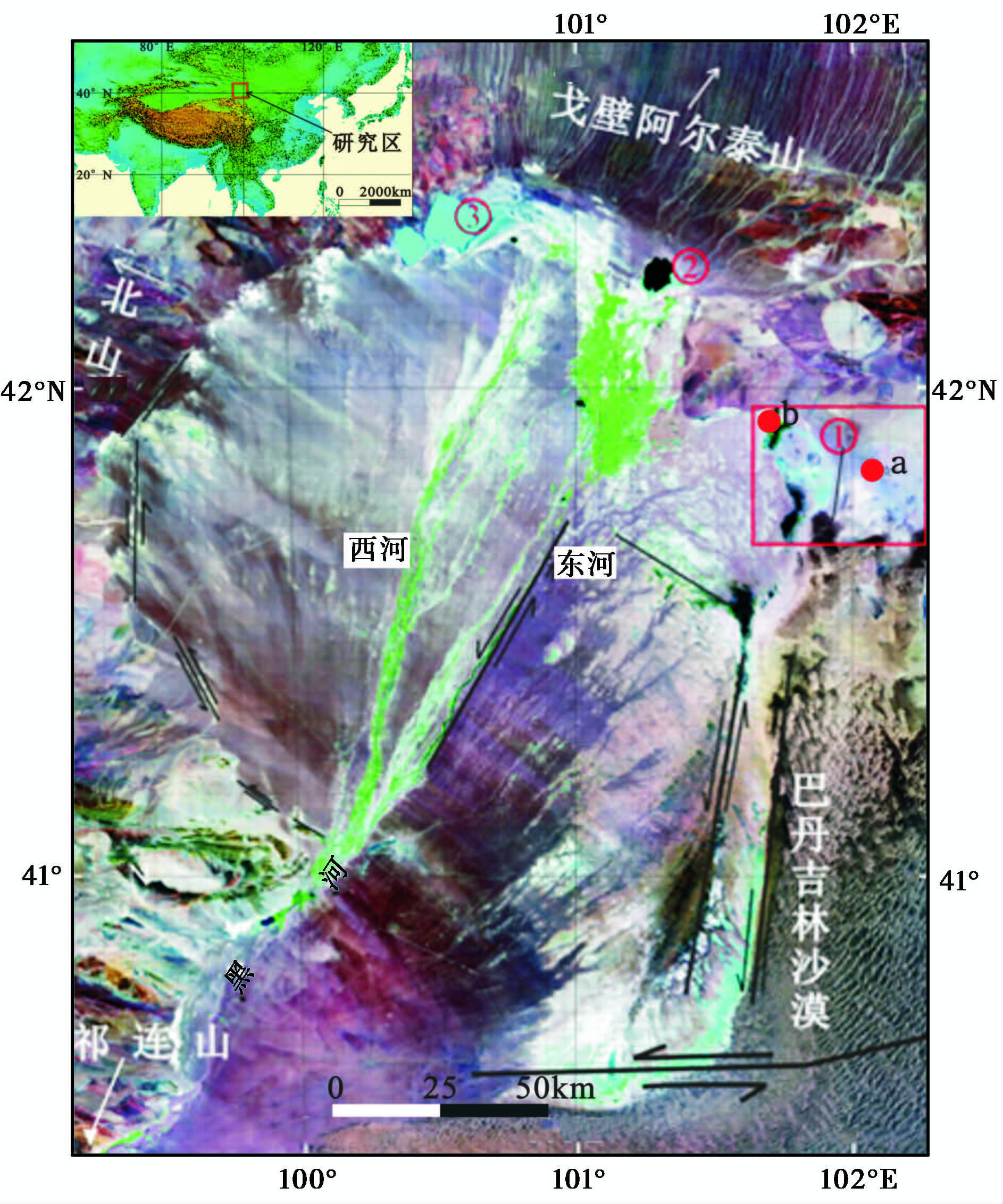
1 研究区概况额济纳盆地位于内蒙古西部,是阿拉善高原的一部分。它北临戈壁阿尔泰山,西临北山,东侧、 东南侧与巴丹吉林沙漠相接,西南隔河西走廊与青藏高原相望。发源于祁连山脉的我国第二大内陆河——黑河绕过狼心山后分为东西两条支流,沿西南-东北方向流入盆地,形成巨大的内陆冲积扇,并在盆地北部汇成3个尾闾湖,即西部的嘎顺淖尔、 中间的苏泊淖尔(两者合称居延海)以及东部的居延泽( 图1)。居延泽盆地位于额济纳盆地东部,由中部南北向高脊分为东居延泽和西居延泽,因黑河下游改道,东居延泽现已全部干涸,西居延泽也只残留很小的湖沼,称为天鹅湖[45, 46]。
|
图1 研究区位置和额济纳盆地遥感影像图 ①,②和③分别表示居延泽、 苏泊淖尔和嘎顺淖尔盆地; a为钻孔JYZ11A和G36位置,b为剖面THV位置; 黑色实线为断层线; 据文献[49, 50, 51, 52]修改 Fig.1 Remote sensing image of Ejina basin and its surrounding area,modified from references[49, 50, 51, 52] |
第四纪以来,受青藏高原隆升影响[47, 48],盆地四周为断裂控制( 图1),多为走滑张性断裂[49, 50, 51, 52]。居延泽位于内陆干旱区,气候极端干旱,降水稀少且年际变化大。据额济纳旗气象资料,该地区年均降水量39mm; 年均潜在蒸发量3500mm,接近降水量的100倍; 风沙活动强烈,沙尘暴天气发生的次数为2-56次/年,平均14次/年[53]。额济纳盆地本身,包括北部蒙古高原对居延泽的水源补给非常有限,在自然条件下居延泽几乎全部由黑河形成的地表径流或地下水补给。
2 材料和方法JYZ11A孔位于东居延泽湖盆最低点处(41°53′41.4″N, 101°51′05.4″E; 约895m a .s .l.),使用大型机械钻探,总取芯率85 % ,共获得61.13m长的岩芯,岩芯密封于塑料套管内运回实验室,保存在冷藏室内,后上部10m以2cm间距、 下部51.13m以5cm间距分样。本文研究只涉及上部27m。
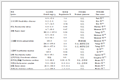
本研究使用OSL测年获得3个可靠年代控制点( 表1)。前处理过程在有微弱红光的暗室中进行,去除表面曝光部分后取少量样品用于测定含水率和剂量率,未曝光的样品用于提取纯净石英。用10 % 的稀盐酸和20 % 的双氧水分别除去样品中的碳酸盐和有机质,然后用湿筛法得到90-125μm粒级的颗粒,采用重液分离法、 氢氟酸溶蚀法最终得到纯净的石英颗粒。采用改进后的单片再生剂量法(post IR-SAR)测量等效剂量[54],测量在装有 90 Sr/90 Y β源的Ris TL/OSL-DA-20释光测年仪上进行。 β源剂量率为0.104Gy/s,测量时,激发光源为蓝光发光二极管(Light-Emitting Diodes,简称LED),探测滤光系统为2片3.5mm Hoya U-340滤光片。为验证石英SAR法的可靠性,本研究做了剂量恢复实验,实验结果证明石英SAR法对本研究是可靠的。
|
表1 JYZ11A孔岩芯样品OSL测年结果 Table 1 OSL dating results of the JYZ11A drill core |
环境剂量率通过测定沉积物本身及周边环境放射性元素的含量算出,U、 Th、 K含量通过中子活化分析得到,并按照Aitken[55]将其转换为β和γ剂量率。宇宙射线的剂量率通过样品埋藏深度和钻孔海拔高度得到[56]。石英颗粒的内剂量率贡献不大,可忽略不计。含水率均按 10±5 % 计算。
本研究对JYZ11A孔按10cm间距挑选样品508个进行粒度测量,本文只分析上部10m结果。测量前处理步骤参考Peng等[57]进行,称取0.2-1.0g样品放入150ml烧杯中,先加入10 % 的双氧水置于加热板上加热至无气泡冒出,以去除有机质; 后加入10 % 的盐酸反应至沸腾或出现上层清液,以完全去除碳酸盐。然后在烧杯中加满去离子水,静置12小时以上,抽去上层清液,加入10ml 10 % 的六偏磷酸钠(NaPO3)6,在80Hz的超声波振荡器中振荡约5分钟,即可上机测量。测量使用英国马尔文公司生产的Mastersizer 2000激光粒度仪,测量范围0.02-2000μm,可自动生成中值粒径、 频率曲线等粒度数据,重复测量误差小于2 % 。
本研究对JYZ11A孔上部16.7m按照2cm间距挑选463个样品作了低频磁化率测试,本文只分析上部10m结果。样品称重后用塑料膜包紧,装入2cm×2cm×2cm的样品盒中,用Bartington MS2磁化率仪测量样品的低频(470Hz)磁化率(χlf),并进行了本底矫正。以上实验均在兰州大学西部环境教育部重点实验室进行。
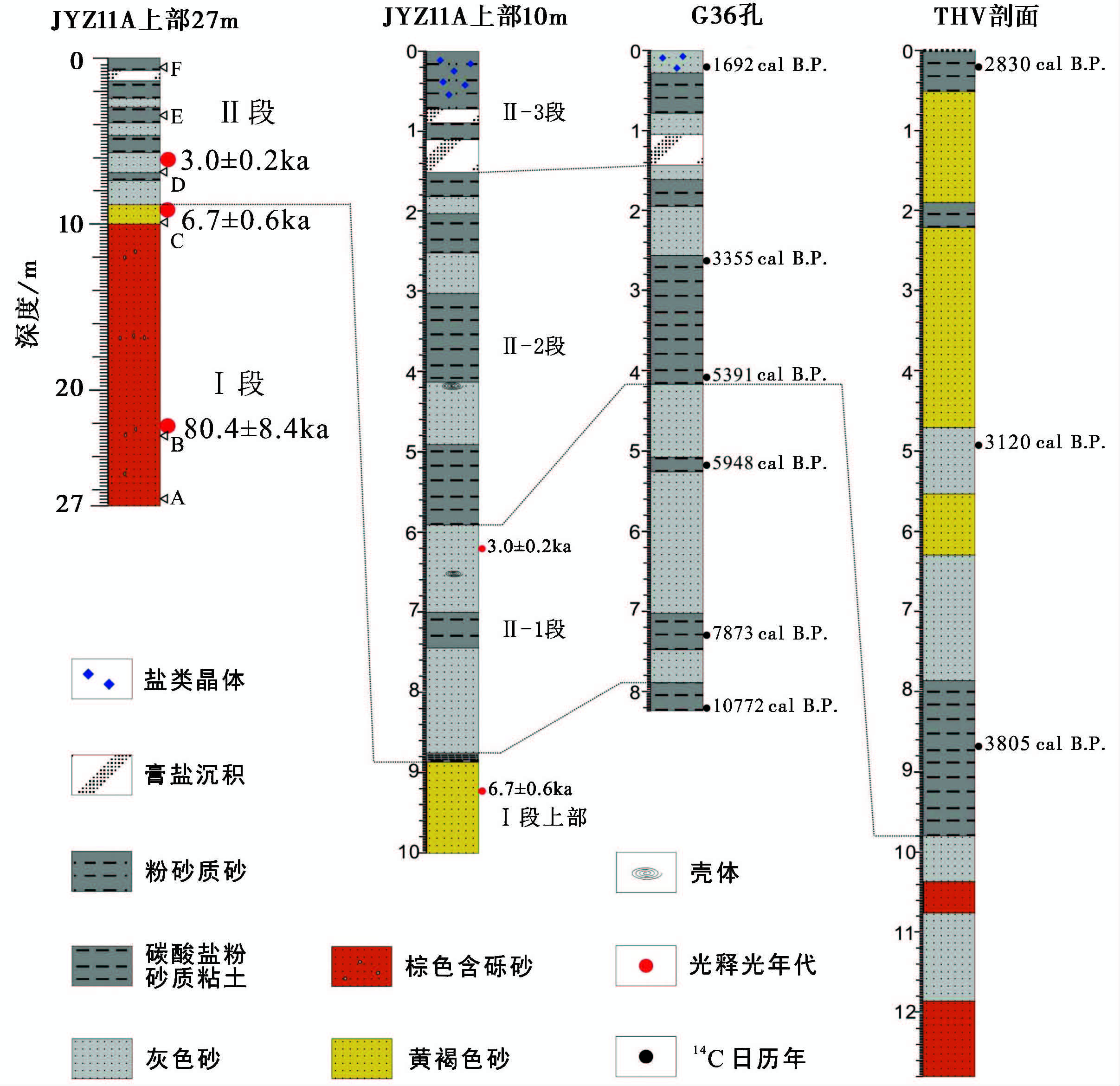
3 结果 3.1 年代与地层 3.1.1 JYZ11A地层序列依据沉积物颜色、 粒径等特征,JYZ11A孔上部27m岩芯从底到顶总体可分为两段( 图2)。
Ⅰ段(27.00-8.88m)整体为棕红色到黄褐色砂,含少量粗砂和砾石,沉积物颗粒整体较大,颜色偏棕红色,又可分为两段: 下部(27-10m)为棕红色砂砾质,以中-粗砂为主,个别砾石直径可达5mm,这一沉积类型一直延续到钻孔底部(即61.13m); 上部(10.00-8.88m)为黄褐色细-中砂,几乎不含砾石。
Ⅱ段(8.88-0m)整体为灰黑色-灰绿色粉砂质粘土或细砂,沉积物颗粒较小,颜色偏灰色,可分为3个亚段:
Ⅱ -1段(8.88-5.93m),下部为棕褐色细砂与灰黑色细砂交替沉积,上部为灰黑色粘土质粉砂与青灰色砂质交替沉积,青灰色砂层中含腹足类壳体。8.88-8.76m和7.78-7.92m两段为黑色淤泥质,具水平韵律层理。
Ⅱ -2段(5.93-1.53m),以碳酸盐粉砂质粘土沉积为主,中间间断沉积青灰色细砂(4.90-4.13m)和灰绿色粉砂质砂(3.00-2.54m和2.02-1.82m),青灰色细砂层中见贝壳残体。
Ⅱ -3段(1.53-0m),以纯膏盐层的出现为标志,含两段膏盐沉积,粉砂质粘土层中析出大量盐类晶体。
|
图2 JYZ11A钻孔、 G36钻孔和THV剖面地层对比 14 C年代为日历年代,G36孔和THV剖面地层据Hartmann和Wünnemann[33]以及Mischke等[29]修改; A-F表示 图3a-3f在地层中的位置 Fig.2 Stratigraphic sequences of core JYZ11A and core G36 and section THV.14 C ages are calender years,G36 and THV sections are modified from Hartmann and Wünnemann[33],and Mischke et al.[29]. A,B,C,D,E,and F are the positions of samples that used for grain size distribution analysis |
JYZ11A孔岩芯上部6.18-6.25m处的青灰色砂层OSL年龄为 3.0±0.2ka,9.24-9.30m处的黄褐色砂层OSL年龄为 6.7±0.6ka,岩芯下部22.18-22.24m处的棕色砂层OSL年龄为 80.4±8.4ka( 表1)。
3.1.3 JYZ11A与G36孔和THV剖面对比G36孔(41.891°N,101.851°E) 位于居延泽盆地中部,与JYZ11A孔相距约百米( 图1),全长8.25m,其14 C年代局限于全新世[18, 33, 58],为使其与JYZ11A孔地层对比方便,本文自下而上将其分为4段:8.25-7.90m为黑色碳酸盐泥,8.20m处的14 C日历年龄为10772cal.a B.P. ,对应JYZ11A孔8.88-8.76m处的黑色泥质(具韵律层理); 7.9-4.1m为灰黑色泥质与砂质交替沉积,7.24m和5.1m处的14 C日历年龄分别为7873cal.a B.P. 和5948cal.a B.P. ,对应JYZ11A孔8.76-5.93m段; 4.1-1.4m为碳酸盐泥与灰色砂质交替沉积,4.04m和2.63m处14 C日历年龄分别为5391cal.a B.P. 和3355cal.a B.P. ; 1.4-0m为盐类、 粘土质和砂质交替沉积,近地表处14 C日历年龄为1692cal.a B.P. ,对应JYZ11A孔1.53-0m段。
THV剖面(41°59′59″N, 101°31′48″E) 位于居延泽盆地北部的河口附近( 图1),全长12.73m,14 C年代限于中晚全新世[29],以距剖面顶部9.8m处为界将其分为两大段:9.8m以下为灰色砂质和褐色砂质交替沉积,对应JYZ11A孔5.93m以下部分; 9.8m以上为泥质、 灰色砂质和褐色砂质交替沉积,8.7m、 4.9m 和0.2m 处的14 C日历年龄分别为3805cal.a B.P. 、 3120cal.a B.P. 和 2830cal.a B.P. ,顶部缺失[29]。THV整个剖面对应JYZ11A孔5.93m以上部分。
本文将JYZ11A孔与G36孔和THV剖面进行了地层对比( 图2),发现JYZ11A孔上部地层记录与G36孔和THV剖面具有较好的可对比性,但Hartmann和Wünnemann[33]推测G36孔可能存在千百年的碳库效应,本文根据G36孔和THV剖面顶部14 C日历年龄认为这两剖面均至少存在千年的碳库效应,因而相比14 C年龄,JYZ11A孔的OSL年龄应更接近真实年龄。JYZ11A孔沉积序列长且变化多,因岩芯22m到27m堆积冲洪积物,故27m处年龄应老于22m处年龄,即老于约80ka,年代覆盖了末次冰期和全新世。 且OSL测年避免了碳库效应,总体年代框架清晰,是研究更长时间尺度湖泊演化的理想载体[59, 60, 61]。
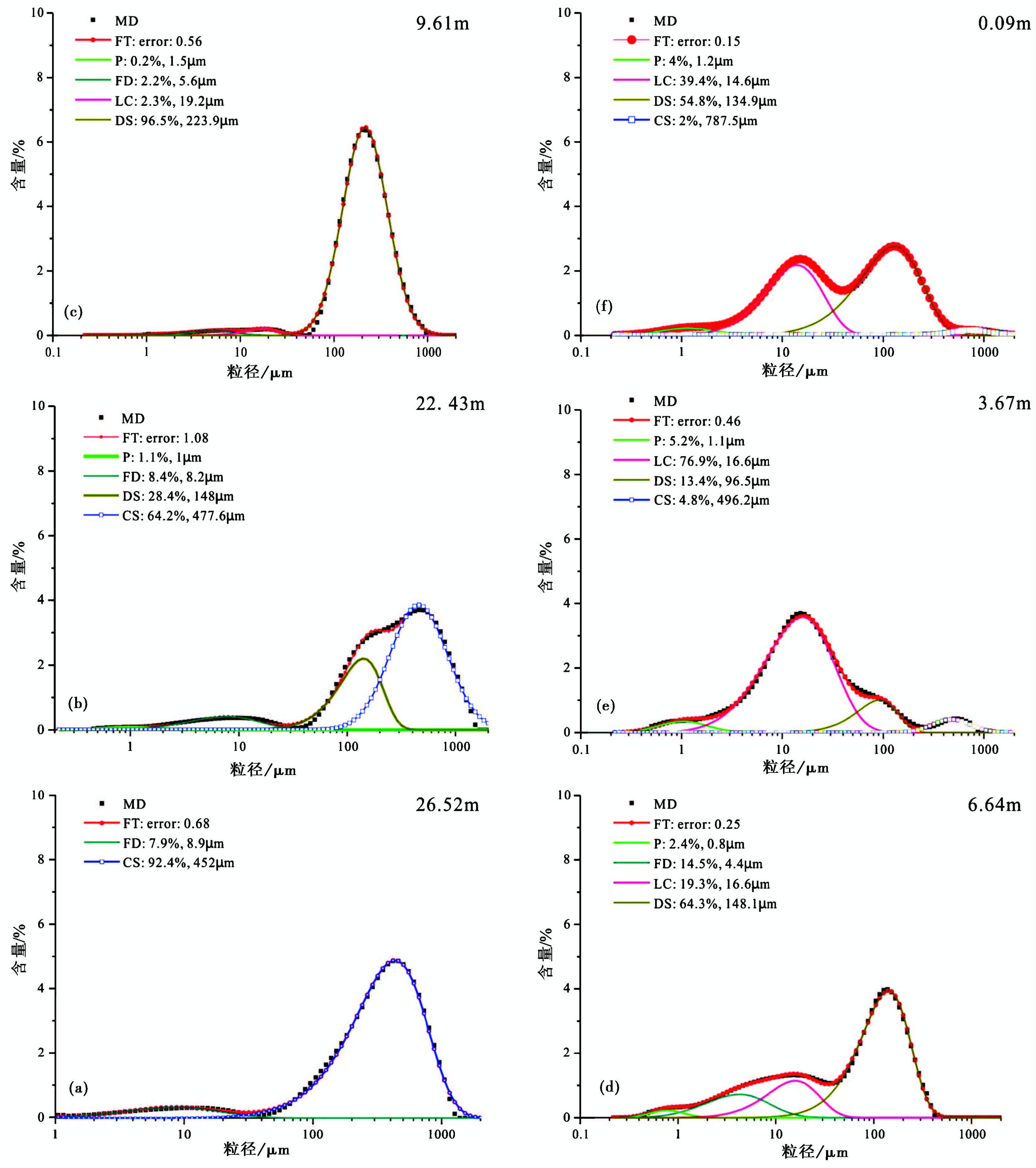
3.2 粒度分布特征与沉积环境野外考察与取样是了解地层沉积相与区域沉积环境最直接的手段,通过沉积物颜色、 颗粒性状等特征可以获得初步认识。但我国内陆干旱区风力强度大且风沙活动十分频繁,湖泊和冲洪积沉积物中经常性的接受风成沉积[62],获取的沉积物往往成分复杂多变,难以直接判定成因,而通过粒度组分分析结合沉积物岩性特征能够较好的区分各沉积相而讨论沉积环境的变化[63]。本研究参考Li等[64]的步骤,采用Weibull函数和正态分布函数拟合方法对JYZ11A孔粒度数据进行了组分分离,在钻孔距顶部26.52m、 22.43m、 9.61m、 6.64m、 3.67m和0.09m处挑选的6个代表性粒度频率曲线如 图3所示。
|
图3 JYZ11A孔典型样品的粒度分布特征 (a)和(b)冲洪积物(alluvial and fluvial deposit); (c)风成砂(eolian sand); (d)、 (e)和(f)湖相-风成砂(lacustro-eolian sand) MD—实测数据; FT—error: 函数拟合值及残差(百分比); P—超细粒组分; FD—细粒组分; LC—湖相组分; DS—细砂组分; CS—粗砂组分(各组分图例后面的百分比数值表示该组分百分含量,粒径值表示该组分众数粒径大小) Fig.3 Grain size distribution curves for typical samples from JYZ11A core. Abbreviations in the legend: Error-residual error per sent;MD—measured data; FT—fitting function; P—ultra-fine grained component; FD—fine grained component; LC—lacustrine component;DS—fine sand; CS—coarse sand. Each component legend is followed by the percentage composition and the mode size |
26.52m处沉积物( 图3a)粗砂组分占90 % 以上,峰值大于400μm,其分选较一般冲洪积物( 图3b)好,但不如风成砂( 图3c),颜色为棕红色,综合判断为近地面风力改造过的冲洪积砂,少量细粉砂可能附着在粗粒砂上被搬运而来,但据Tsoar和Pye[65]认为其为高空长距离悬移的风尘组分; 22.43m处沉积物( 图3b)分选差,粗粒成分(可分为峰值大于400μm的粗砂组分和峰值100-200μm的细砂组分)占90 % 以上,细粉砂含量为8.4 % ,含量极少的超细粒组分成因复杂,可能为成壤组分或后沉积作用组分[66],综上判断其为较典型的冲洪积物,但风的作用对粒度分布仍有影响; 9.61m处沉积物( 图3c)为黄褐色细砂,粒度组分中风成砂组分含量占95 % 以上且分选良好,其余组分(如峰值10-30μm的湖相组分)含量均很低,因此判断其为较纯净的近地面搬运的风成砂。以上这3个样品取自JYZ11A孔地层Ⅰ段(见图2中A,B和C点),风力作用下的冲洪积砂甚至纯风成砂的含量占绝对主导,且均明显缺失湖相组分。
另3个样品取自JYZ11A孔地层Ⅱ段,6.64m处沉积物( 图3d)粒度分布形态与 图3b相似,但缺少粗砂组分,粒径明显较细,且湖相组分含量(约20 % )明显比地层Ⅰ段样品高,颜色为青灰色,综合判断其为近地面风成砂与细粉砂进入水下环境而受到水作用的改造所致; 3.67m处沉积物( 图3e)湖相组分含量接近80 % ,明显多于风成砂(包括细砂和粗砂)组分,判断其为典型的湖相沉积环境; 0.09m处沉积物( 图3f)分选很差,风成砂组分略高于湖相组分,为浅水环境和风沙环境。它们均取自地层Ⅱ段(见图2中D、 E和F点),细粉砂组分和风成砂组分明显较Ⅰ段含量少,而湖相组分含量显著增加,成为最主要的组分之一。本段超细粒组分含量比Ⅰ段该组分含量稍高,可能为水下环境沉积物经生物化学风化作用形成。
对于物质来源以陆源碎屑物质供给为主的湖泊,按照理想的沉积作用模式,从湖岸到湖心,随着水深不断增大,水动力条件由强变弱,依次沉积粗砂—细砂—粉砂—粘土[67],因而位于湖心的沉积物粒径大小能够反映水动力条件的强弱,进而指示水位高低,粒径增大反映岩芯点距湖岸较近,湖泊水位较低,指示气候干旱,反之则指示高水位和湿润气候[68]。但Qiang等[62]由湖边—湖心—湖边取苏干湖沉积物表样,发现常年盛行的西北风将临近的砂质不断吹入湖中,而呈现粒径自西向东逐渐降低的特征。居延泽盆地位于极端干旱区,频繁而剧烈的风沙活动也会导致粉砂质、 砂质甚至砾质的物质以高空悬移或者近地面搬运等形式进入湖中甚至湖心,从而使得湖泊沉积物组成复杂化。
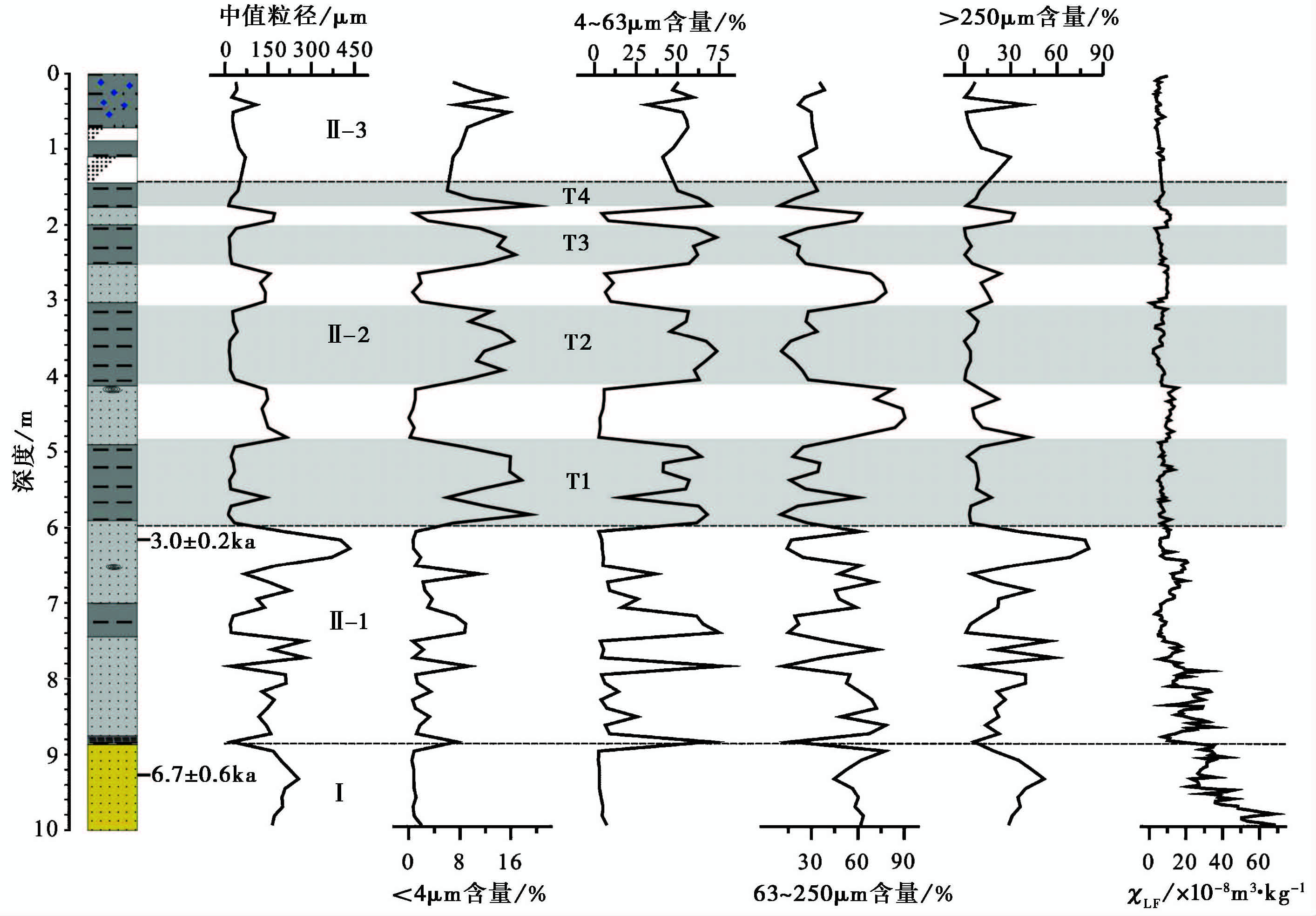
JYZ11A孔Ⅰ段上部和Ⅱ段(10-0m)沉积物的粒度参数变化明显,可分为Ⅰ、 Ⅱ-1、 Ⅱ-2和Ⅱ-3共4段( 图4)。中值粒径表征全样粒径的平均水平,粘土级(小于4μm)含量与粉砂级(4-63μm)含量变化趋势可表示细粒组分变化情况; 细砂级(63-250μm)含量与粗砂级(大于250μm)含量的变化可代表粗粒组分含量变化。Ⅰ段的细粒组分含量在四段中最低,而粗粒组分含量很高,结合典型样品粒度分布特征( 图3c),认为该段以近源风成沉积为主; Ⅱ-1段的粒度参数波动剧烈,6.2m左右的粗粒组分含量甚至高于Ⅰ段的平均值,但细粒组分含量出现几个峰值,结合沉积物颜色等特征和 图3d所示的粒度分布特征,可知本段开始出现断续的湖相沉积,但风沙活动仍为主导作用; Ⅱ-2段内部出现T1、 T2、 T3和T4细粒组分含量最高的4个亚段,它们之间被突变性的3个粗粒组分高含量段隔开,表明该段以湖相沉积为主,但风沙活动仍很剧烈; Ⅱ-3段以盐类沉积为主,为湖泊干涸过程的产物。
|
图4 JYZ11A孔上部10m岩芯粒度和磁化率记录随深度的变化图 Fig.4 The grain size and magnetic susceptibility records of the top 10m of JYZ11A drill core |
磁化率是磁性矿物种类、 含量和大小的函数,而磁性矿物有原生碎屑、 后沉积作用等多种来源[69],能反映不同的沉积环境[69, 70, 71, 72, 73, 74, 75, 76]。JYZ11A孔10-0m段的低频磁化率值(lf)变化明显( 图4),总体可分为3段:Ⅰ段上部(10.00-8.88m)风成砂层的磁化率值在20×10-8-70×10-8m3/kg之间,为各段中最高; Ⅱ -1段(8.88-5.93m)磁化率整体较低,但明显高于Ⅱ -2段和Ⅱ -3段(5.93-0m)。这3段分别指示风沙环境、 风沙与水体边界环境和水下环境,磁化率值的逐段降低可能存在以下两种解释:1)随着水体的出现,沉积环境逐渐由氧化环境过渡到偏还原状态,磁性矿物发生相变而使其磁性变弱,磁化率值明显降低; 2)随着水体出现以及区域气候环境的改善,风沙活动减弱,沉积的碳酸盐等相对含量增加,从而使得磁化率值降低。总之,磁化率值能够敏感地响应区域环境的变化,但内部机制还需更多磁学参数以及多指标证据的支持。
4 讨论 4.1 末次冰期时的居延泽盆地古环境不同于居延泽盆地其他地点的全新世地层记录[29, 33],JYZ11A孔27m的沉积序列提供了末次冰期以来的古环境记录,该孔并不在居延泽湖盆中心位置,但考虑到整个居延泽盆地内部地形非常平坦,并且钻孔点地面高程与湖盆中心高程一致,因而该孔的沉积序列能够代表该区域晚更新世以来的古环境变化。岩芯Ⅰ段下部(27-10m)为棕红色砂砾质,粒度分布特征( 图3a和 图3b)和稳定的磁化率低值(约20×10-8m3/kg)表明其为冲洪积物,后经风力作用改造搬运使其分选性变好,明显缺失湖相组分; Ⅰ段上部(10.00-8.88m)为黄褐色细砂,分选良好,为典型的近源风成砂( 图3c),磁化率值与现代沙漠沙一致。综上判断,Ⅰ段(27.00-8.88m)为冲洪积物堆积和风沙沉积环境。
JYZ11A孔距顶部约22.2m处的OSL年代为 80.4±8.4ka,表明Ⅰ段主要在晚更新世期间沉积,考虑到OSL年龄的误差范围,Ⅰ段地层基本覆盖了末次冰期,其中包括了MIS 3阶段晚期(即MIS 3a阶段,约40-30ka); 另外,钻孔沉积相分析结果表明,居延泽盆地主要为冲洪积堆积和风沙沉积环境,没有稳定湖泊等大型水体发育。
JYZ11A孔位于居延泽盆地最低处,其地层序列能够代表居延泽盆地演化过程,作为额济纳盆地北部也即黑河下游的两大沉积中心之一(另一处为居延海盆地),居延泽盆地在MIS 3a阶段并未出现湖相地层,至少说明MIS 3a阶段并不存在覆盖两大盆地的统一古大湖。
Wünnemann等[17]报道了嘎顺淖尔北部和苏泊淖尔西部的最高级岸堤海拔可达920m左右,高出湖底约35m,湖滨砂中生物壳体的14 C年龄为37-29ka。本研究实地考察这些露头后发现,由于北面山麓冲洪积作用的推进,最高或者较高级的岸堤只残留零星的极少数出露点,不存在类似较低高程的近封闭的湖岸线,因此认为单纯的地貌学证据过于单薄。需要说明的是,居延泽盆地与北部的嘎顺淖尔和苏泊淖尔盆地同为黑河的尾闾湖,黑河下游水系的变迁可能也是导致居延泽与北部两湖泊演化过程不一致的原因之一。
中国西部干旱区过去曾被认为是MIS 3a阶段(40-30ka)发育的古大湖[7, 8, 9, 11, 14, 15, 17, 18, 19, 20],越来越多的研究表明其应在MIS 5阶段(100-70ka)甚至更老[10, 12, 13, 16, 23],这是因为14 C测年尤其是使用贝壳碳酸盐的14 C年龄存在低估,可能是由于贝壳被埋藏之后,在成岩过程中发生蚀变作用而混入较年轻的文石所致[77],大气碳的混入也会造成样品污染,而且这种影响会随着样品年龄的变老而加剧,对于2 % 的现代碳污染,年龄为15ka的样品可能只有很小的误差而一个60ka年龄的样品却只能测得大约30ka的14 C年龄[78]。Lai等[79]认为老于25ka B.P. 的14 C年代尤其是干旱区的均需要重新研究。 我们的钻孔结果说明,在距今8万年到全新世的末次冰期内,居延泽地区不曾存在覆盖居延泽与居延海的古大湖环境,因此有理由推论嘎顺淖尔北部和苏泊淖尔西部的最高级岸堤也应当是末次冰期以前形成的,具体形成于何时,需要今后更可靠的年代测定。
4.2 全新世以来居延泽湖泊演化特征及可能的指示意义JYZ11A孔Ⅰ段上部(10.00-8.88m)黄褐色细砂层和整个Ⅱ段地层在全新世沉积( 图2)。早全新世居延泽盆地主要为风沙沉积环境; 中全新世(约6.7ka左右)开始出现间断、 局地的水体; 大约3ka前后的中晚全新世,居延泽盆地才开始发育稳定的湖泊,也就是现今所说的古居延泽。岩性和粒度参数变化表明居延泽湖面发生多次剧烈波动,并可能在细粒组分含量最高的T1-T4段( 图4)形成4次高湖面。
居延泽早全新世干涸、 中晚全新世较稳定发育的成湖模式显然与中国季风区湖泊早中全新世发育良好、 晚全新世逐渐萎缩的演化模式不同[80, 81, 82, 83],而与内陆干旱区许多湖泊记录相似[84],比如位于新疆的博斯腾湖心钻孔记录[85, 86]表明,16-8cal.ka B.P. 之间沉积了1m厚的风成砂,8-6cal.ka B.P. 之间湖泊水体很小,6.0-1.5cal.ka B.P. 时期湖泊稳定发育。Long等[87]报道了新疆天山中段巴音布鲁克1个剖面的年代地层结果,发现早全新世(11-8ka)沙丘堆积,气候干旱,中晚全新世(5.0-1.6ka)古土壤发育,气候湿润。居延泽湖泊水体主要由区域降水及其形成的浅部地下水补给,因此有理由推测居延泽全新世的演化模式表征了当地的湿度变化情况,结合西风环流主控的内陆干旱区(可称为西风带)的诸多古气候记录[88],本文认为它们共同指示了全新世期间一种有别于中国季风区湿度变化的区域湿度变化模式。
现今居延泽湖盆北部和东部的多级湖岸堤[25]清晰而完整,应为湖泊自高湖面不断波动退缩的产物,湖泊沉积记录与湖岸堤均能够指示水位变化情况,两者应具有极好的相关性[31],JYZ11A孔沉积记录的变化应与保存良好的多级湖岸堤的分布联系密切,具体的对应关系需要更多准确可靠的年代证据才能探讨。岩芯顶部Ⅱ -3段膏盐层和盐类晶体的大量析出表明此时的居延泽已开始走向干涸。据历史记载,元末明初战争破坏了黑河下游的水利建设,河床淤塞,上游来水无法进入居延泽盆地而沿现今东河干流( 图1)注入苏泊淖尔,居延泽随之干涸[45, 46],这与JYZ11A钻孔结果相符,因此推测历史时期的居延泽水位变化及走向干涸与人类活动密切相关。
JYZ11A孔10-0m段的粒度分布特征( 图3d-3f)表明,在整个全新世期间近源风成砂不断进入湖泊水体,并直接决定了沉积物粒度平均水平的变化( 图4),因此即使是在稳定的湖泊出现之后,当地的风沙活动依旧盛行,气候条件仍然较差,而一旦黑河上游来水减少或者人类不合理的开发利用导致居延泽水体缩小甚至干涸,风力输送的砂质会快速入侵湖盆内部,造成严重的荒漠化。现今包括居延泽盆地在内的整个黑河中下游地区正在发生的荒漠化过程[89],应引起我们的足够重视。
5 结论JYZ11A孔岩芯记录表明,末次冰期时期,包括MIS 3阶段晚期,居延泽盆地并没有稳定湖泊等水体发育,而在冲洪积和风沙沉积环境下堆积有很厚的棕红色砂砾质并混有较多的风沙沉积物。MIS 3阶段的额济纳地区不存在覆盖居延泽和居延海两大盆地的统一大湖。
中晚全新世居延泽湖泊才开始出现,其水位历经多次波动。约6.7ka后出现间断、 局地的水体; 约3ka前后才形成较稳定的湖泊环境,并有多次相对高湖面与低湖面的交替,全新世期间居延泽的湖泊演化模式可能具有指示区域湿度变化的气候意义; 至近代,湖泊趋于干涸,盐类大量析出,湖盆已发生严重的荒漠化。
致谢 兰州大学孙东怀教授给予粒度分析方面的指导,颉耀文教授提供部分遥感资料,夏敦胜教授协助选定钻探点,刘宇航参与野外钻探工作,陈晓龙、 张复协助进行岩芯室内分样和测试,刘建宝、 陈雪梅、 王飞和李再军对本文提出有益建议; 审稿人隆浩研究员、 另一位匿名审稿专家和编辑部杨美芳老师认真审阅稿件并提出宝贵意见,在此一并表示感谢!
| 1 | Oviatt C G. Lake Bonneville fluctuations and global climate change. Geology, 1997, 25 (2):155~158 |
| 2 | Benson L, Lund S, Smoot J et al. The rise and fall of Lake Bonneville between 45 and 10.5ka. Quaternary International, 2011, 235 (1):57~69 |
| 3 | Nishizawa S, Currey D R, Brunelle A et al. Bonneville basin shoreline records of large lake intervals during Marine Isotope Stage 3 and the Last Glacial Maximum. Palaeogeography, Palaeoclimatology, Palaeoecology, 2013, 386 :374~391 |
| 4 | Cohen T J, Nanson G C, Jansen J D et al. Late Quaternary mega-lakes fed by the northern and southern river systems of Central Australia:Varying moisture sources and increased continental aridity. Palaeogeography, Palaeoclimatology, Palaeoecology, 2012, 356-357 :89~108 |
| 5 | Boomer I, Aladin N, Plotnikov I et al. The palaeolimnology of the Aral Sea:A review. Quaternary Science Reviews, 2000, 19 (13):1259~1278 |
| 6 | Rhodes T E, Gasse F, Lin R et al. A Late Pleistocene-Holocene lacustrine record from Lake Manas, Zunggar(northern Xinjiang, Western China). Palaeogeography, Palaeoclimatology, Palaeoecology, 1996, 120 (1):105~121 |
| 7 | 杨小平, 刘东生. 距今30ka前后我国西北沙漠地区古环境. 第四纪研究, 2003, 23 (1):25~30 Yang Xiaoping, Liu Tungsheng. Paleoenvironments in desert regions of Northwest China around 30ka B.P. Quaternary Sciences, 2003, 23 (1):25~30 |
| 8 | 李炳元. 青藏高原大湖期. 地理学报, 2000, 55 (2):174~182 Li Bingyuan. The last greatest lakes on the Xizang(Tibetan)Plateau. Acta Geographica Sinica, 2000, 55 (2):174~182 |
| 9 | Shi Yafeng, Yu Ge, Liu Xiaodong et al. Reconstruction of the 30-40ka BP enhanced Indian monsoon climate based on geological records from the Tibetan Plateau. Palaeogeography, Palaeoclimatology, Palaeoecology, 2001, 169 (1):69~83 |
| 10 | 赵希涛, 朱大岗, 严富华等. 西藏纳木错末次间冰期以来的气候变迁与湖面变化. 第四纪研究, 2003, 23 (1):41~52 Zhao Xitao, Zhu Dagang, Yan Fuhua et al. Climatic change and lake-level variation of Nam Co, Xizang since the last interglacial stage. Quaternary Sciences, 2003, 23 (1):41~52 |
| 11 | 李世杰, 张宏亮, 施雅风等. 青藏高原甜水海盆地MIS 3阶段湖泊沉积与环境变化. 第四纪研究, 2008, 28 (1):122~131 Li Shijie, Zhang Hongliang, Shi Yafeng et al. A high resolution MIS 3 environmental change record derived from lacustrine deposit of Tianshuihai Lake, Qinghai-Tibet Plateau. Quaternary Sciences, 2008, 28 (1):122~131 |
| 12 | Madsen D B, Ma H, Rhode D et al. Age constraints on the Late Quaternary evolution of Qinghai Lake, Tibetan Plateau. Quaternary Research, 2008, 69 (2):316~325 |
| 13 | Rhode D, Ma H, Madsen D B et al. Paleoenvironmental and archaeological investigations at Qinghai Lake, Western China:Geomorphic and chronometric evidence of lake level history. Quaternary International, 2009, 218 (1):29~44 |
| 14 | Pachur H J, Wünnemann B, Zhang Hucai et al. Lake evolution in the Tengger desert, Northwestern China, during the last 40000 years. Quaternary Research, 1995, 44 (2):171~180 |
| 15 | Zhang H C, Peng J L, Ma Y Z et al. Late Quaternary palaeolake levels in Tengger desert, NW China, Palaeogeography, Palaeoclimatology, Palaeoecology, 2004, 211 (1):45~58 |
| 16 | Long Hao, Lai Zhongping, Fuchs Markus et al. Timing of Late Quaternary palaeolake evolution in Tengger desert of Northern China and its possible forcing mechanisms. Global and Planetary Change, 2012, 92-93 :119~129 |
| 17 | Wünnemann B, Pachur H, Li J et al. Chronologie der Pleistozänen und Holozänen Seespiegelschwankungen des Gaxun Nur/Sogo Nur und Baijian Hu, Innere Mongolei, Nordwestchina. Petermanns Geographische Mitteilungen, 1998, 142 (3):191~206 |
| 18 | Hartmann K. Spätpleistozäne und Holozäne morphodynamik im nördlichen Gaxun Nur Becken, Innere Mongolei, NW China. Berlin:The Ph.D Dissertation of Freien Universität Berlin, 2003. 1-123 |
| 19 | Yang B, Shi Y, Braeuning A et al. Evidence for a warm-humid climate in arid Northwestern China during 40-30ka BP. Quaternary Science Reviews, 2004, 23 (23):2537~2548 |
| 20 | Zhang H, Wünnemann B, Ma Yuzhen et al. Lake level and climate changes between 42000 and 1800014C yr B.P. in the Tengger desert, Northwestern China. Quaternary Research, 2002, 58 (1):62~72 |
| 21 | 陈发虎, 范育新, Madsen D B等. 河套地区新生代湖泊演化与"吉兰泰-河套"古大湖形成机制的初步研究. 第四纪研究, 2008, 28 (5):866~873 Chen Fahu, Fan Yuxin, Madsen D B et al. Preliminary study on the formation mechanism of the Jilantai-Hetao Megalake and the lake evolutionary history in Hetao region. Quaternary Sciences, 2008, 28 (5):866~873 |
| 22 | 陈发虎, 张家武, 程 波等. 青海共和盆地达连海晚第四纪高湖面与末次冰消期以来的环境变化. 第四纪研究, 2012, 32 (1):122~131 Chen Fahu, Zhang Jiawu, Cheng Bo et al. Late Quaternary high lake levels and environmental changes since last deglacial in Dalianhai, Gonghe basin in Qinghai Province. Quaternary Sciences, 2012, 32 (1):122~131 |
| 23 | Long H, Lai Z, Fuchs M et al. Palaeodunes intercalated in loess strata from the western Chinese Loess Plateau:Timing and palaeoclimatic implications. Quaternary International, 2012, 263 :37~45, doi:10.1016/j.quaint.2010.12.030 |
| 24 | 王乃昂, 李卓仑, 程弘毅等. 阿拉善高原晚第四纪高湖面与大湖期的再探讨. 科学通报, 2011, 56 (17):1367~1377 Wang Nai'ang, Li Zhuolun, Cheng Hongyi et al. High lake levels on Alashan Plateau during the Late Quaternary. Chinese Science Bulletin, 2011, 56 (17):1367~1377 |
| 25 | Wünnemann B, Hartmann K. Morphodynamics and paleohydrography of the Gaxun Nur basin, Inner Mongolia, China. Zeitschrift fuer Geomorphologie N. F., 2002, 126 (Suppl.-Bd):147~168 |
| 26 | Wünnemann B, Hartmann K, Altmann N et al. Interglacial and glacial fingerprints from lake deposits in the Gobi desert, NW China. Developments in Quaternary Sciences, 2007, 7 :323~347 |
| 27 | Mischke S, Fuchs D, Riedel F et al. Mid to Late Holocene palaeoenvironment of Lake Eastern Juyanze(North-Western China)based on ostracods and stable isotopes. Geobios, 2002, 35 (1):99~110 |
| 28 | Mischke S, Demske D, Schudack M E. Hydrologic and climatic implications of a multidisciplinary study of the mid to Late Holocene Lake Eastern Juyanze. Chinese Science Bulletin, 2003, 48 (14):1411~1417 |
| 29 | Mischke S, Demske D, Wünnenann B et al. Groundwater discharge to a Gobi desert lake during Mid and Late Holocene dry periods. Palaeogeography, Palaeoclimatology, Palaeoecology, 2005, 225 (1-4):157~172 |
| 30 | Demske D, Mischke S. Palynological investigation of a Holocene profile section from the Palaeo-Gaxun-Nur-Basin. Chinese Science Bulletin, 2003, 48 (14):1418~1422 |
| 31 | Chen Fahu, Wu Wei, Holmes J A et al. A mid-Holocene drought interval as evidenced by lake desiccation in the Alashan Plateau, Inner Mongolia China. Chinese Science Bulletin, 2003, 48 (14):1401~1410 |
| 32 | Herzschuh U, Tarasov P, Wünnemann B et al. Holocene vegetation and climate of the Alashan Plateau, NW China, reconstructed from pollen data. Palaeogeography, Palaeoclimatology, Palaeoecology, 2004, 211 (1-2):1~17 |
| 33 | Hartmann K, Wünnemann B. Hydrological changes and Holocene climate variations in NW China, inferred from lake sediments of Juyanze palaeolake by factor analyses. Quaternary International, 2009, 194 (1):28~44 |
| 34 | Long H, Lai Z P, Wang N A et al. A combined luminescence and radiocarbon dating study of Holocene lacustrine sediments from arid Northern China. Quaternary Geochronology, 2011, 6 (1):1~9 |
| 35 | Hou J, D'Andrea W J, Liu Z. The influence of14C reservoir age on interpretation of paleolimnological records from the Tibetan Plateau. Quaternary Science Reviews, 2012, 48 :67~79 |
| 36 | 侯居峙, D'Andrea William J, 柳中晖. 湖泊碳库效应对青藏高原气候变化解释的影响探讨. 第四纪研究, 2012, 32 (3):441~453 Hou Juzhi, D'Andrea William J, Liu Zhonghui. Geochronological limitations for interpreting the paleoclimatic history of the Tibetan Plateau. Quaternary Sciences, 2012, 32 (3):441~453 |
| 37 | Mischke S, Weynell M, Zhang C et al. Spatial variability of14C reservoir effects in Tibetan Plateau lakes. Quaternary International, 2013, 313-314 :147~155 |
| 38 | Long H, Lai Z, Frenzel P et al. Holocene moist period recorded by the chronostratigraphy of a lake sedimentary sequence from Lake Tangra Yumco on the south Tibetan Plateau. Quaternary Geochronology, 2012, 10 :136~142 |
| 39 | Lang A. Infra-red simulated luminescence dating of Holocene reworked silty sediments. Quaternary Science Reviews, 1994, 13 (5-7):525~528 |
| 40 | Lang A, Zolitschka B. Optical dating of annually laminated lake sediments:A test case from Holzmaar, Germany. Quaternary Science Reviews, 2001, 20 (5):737~742 |
| 41 | Cupper M L. Luminescence and radiocarbon chronologies of playa sedimentation in the Murray basin, Southeastern Australia. Quaternary Science Reviews, 2006, 25 (19):2594~2607 |
| 42 | Lee J, Li S H, Aitchison J. OSL dating of paleoshorelines at Lagkor Tso, western Tibet. Quaternary Geochronology, 2009, 4 (4):335~343 |
| 43 | Thomas D S, Bailey R, Shaw P A et al. Late Quaternary highstands at Lake Chilwa, Malawi:Frequency, timing and possible forcing mechanisms in the last 44ka. Quaternary Science Reviews, 2009, 28 (5):526~539 |
| 44 | Liu X, Lai Z, Yu L et al. Luminescence chronology of aeolian deposits from the Qinghai Lake area in the northeastern Qinghai-Tibetan Plateau and its palaeoenvironmental implications. Quaternary Geochronology, 2012, 10 :37~43 |
| 45 | 朱震达, 刘 恕, 高前兆等. 内蒙西部古居延—黑城地区历史时期环境的变化与沙漠化过程. 中国沙漠, 1983, 3 (2):1~8 Zhu Zhenda, Liu Shu, Gao Qianzhao et al. The environmental changes and desertification processes in historical period in the areas of ancient Juyan-Heicheng region in western Inner Mongolia. Journal of Desert Research, 1983, 3 (2):1~8 |
| 46 | 龚家栋, 程国栋, 张小由等. 黑河下游额济纳地区的环境演变. 地球科学进展, 2002, 17 (4):491~496 Gong Jiadong, Cheng Guodong, Zhang Xiaoyou et al. Environmental changes of Ejina region in the lower reaches of Heihe River. Advance in Earth Sciences, 2002, 17 (4):491~496 |
| 47 | Molnar P, Tapponnier P. Cenozoic tectonics of Asia:Effects of a continental collision. Science, 1975, 189 (4201):419~426 |
| 48 | Hetzel R, Niedermann S, Tao M et al. Low slip rates and long-term preservation of geomorphic features in Central Asia. Nature, 2002, 417 (6887):428~432 |
| 49 | Zhang H, Ming Q, Lei G et al. Dilemma of dating on lacustrine deposits in an hyperarid inland basin of NW China. Radiocarbon, 2006, 48 (2):219~226 |
| 50 | Becken M, Hölz S, Fiedler-Volmer R et al. Electrical resistivity image of the Jingsutu graben at the NE margin of the Ejina basin(NW China)and implications for the basin development. Geophysical Research Letters, 2007, 34 (9):L09315 |
| 51 | Hölz S, Polag D, Becken M et al. Electromagnetic and geoelectric investigation of the Gurinai structure, Inner Mongolia, NW China. Tectonophysics, 2007, 445 (1):26~48 |
| 52 | Hartmann K, Wünnemann B, Hölz S et al. Neotectonic constraints on the Gaxun Nur inland basin in north-central China, derived from remote sensing, geomorphology and geophysical analyses. Geological Society, London, Special Publications, 2011, 353 (1):221~233 |
| 53 | 迟振卿, 王 永, 姚培毅等. 内蒙古额济纳旗地貌特征及其构造、 气候事件. 地质论评, 2006, 52 (3):370~378 Chi Zhenqing, Wang Yong, Yao Peiyi et al. Tectonic and climatic events recorded by morphologic units in Ejin Qi, Inner Mongolia. Geological Review, 2006, 52 (3):370~378 |
| 54 | Wintle A G, Murray A S. A review of quartz optically stimulated luminescence characteristics and their relevance in single-aliquot regeneration dating protocols. Radiation Measurements, 2006, 41 (4):369~391 |
| 55 | Aitken M J. An Introduction to Optical Dating. Oxford, UK:Oxford University Press, 1998. 1-267 |
| 56 | Prescott J R, Hutton J T. Cosmic ray contributions to dose rates for luminescence and ESR dating:Large depths and long-term time variations. Radiation Measurements, 1994, 23 (2):497~500 |
| 57 | Peng Y J, Xiao J, Nakamura T et al. Holocene East Asian monsoonal precipitation pattern revealed by grain-size distribution of core sediments of Daihai Lake in Inner Mongolia of north-central China. Earth and Planetary Science Letters, 2005, 233 (3-4):467~479 |
| 58 | 金 明. 居延泽湖泊演化与全新世环境变化研究. 兰州: 兰州大学博士学位论文, 2005. 1-133 Jin Ming. Studies on the Lake Evolution of Juyanze and Holocene Environmental Changes. Lanzhou:The Ph.D. Thesis of Lanzhou University, 2005. 1-133 |
| 59 | 范育新, 赵 晖, 陈发虎等. 博斯腾湖湖泊沉积物光释光年代测量. 第四纪研究, 2007, 27 (4):568~575 Fan Yuxin, Zhao Hui, Chen Fahu et al. OSL dating of lacustrine sediments from Lake Bosten. Quaternary Sciences, 2007, 27 (4):568~575 |
| 60 | 年小美, 周力平, 袁宝印. 泥河湾陆相沉积物光释光年代学研究及其对古湖泊演化的指示意义. 第四纪研究, 2013, 33 (3):403~414 Nian Xiaomei, Zhou Liping, Yuan Baoyin. Optically stimulated luminescence dating of terrestrial sediments in the Nihewan basin and its implication for the evolution of ancient Nihewan lake. Quaternary Sciences, 2013, 33 (3):403~414 |
| 61 | 孙博亚, 岳乐平, 赖忠平等. 14ka B.P. 以来巴里坤湖区有机碳同位素记录及古气候变化研究. 第四纪研究, 2014, 34 (2):418~424 Sun Boya, Yue Leping, Lai Zhongping et al. Paleoclimate changes recorded by sediment organic carbon isotopes of Lake Barkol since 14ka B.P. Quaternary Sciences, 2014, 34 (2):418~424 |
| 62 | Qiang M, Chen F, Zhang J et al. Grain size in sediments from Lake Sugan:A possible linkage to dust storm events at the northern margin of the Qinghai-Tibetan Plateau. Environmental Geology, 2007, 51 (7):1229~1238 |
| 63 | Sun D, Bloemendal J, Rea D et al. Grain-size distribution function of polymodal sediments in hydraulic and aeolian environments, and numerical partitioning of the sedimentary components. Sedimentary Geology, 2002, 152 (3):263~277 |
| 64 | Li Z, Sun D, Chen F et al. Chronology and paleoenvironmental records of a drill core in the central Tengger desert of China. Quaternary Science Reviews, 2014, 85 :85~98 |
| 65 | Tsoar H, Pye K. Dust transport and the question of desert loess formation, Sedimentology, 1987, 34 (1):139~153 |
| 66 | Sun D, Zhang Y, Han F et al. Magnetostratigraphy and palaeoenvironmental records for a Late Cenozoic sedimentary sequence from Lanzhou, northeastern margin of the Tibetan Plateau. Global and Planetary Change, 2011, 76 (3-4):106~116 |
| 67 | 霍坎松 L, 杨松 M. 郑光膺翻译. 湖泊沉积学原理. 北京: 科学出版社, 1992. 1-254 Hakanson L, Jansson M. Translated by Zheng Guangying. The Principles of Lake Sediments. Beijing:Science Press, 1992. 1-254 |
| 68 | 陈敬安, 万国江, 张 峰等. 不同时间尺度下的湖泊沉积物环境记录——以沉积物粒度为例. 中国科学(D 辑), 2003, 33 (6):563~568 Chen Jing'an, Wan Guojiang, Zhang Feng et al. Environmental records of lacustrine sediments in different time scales:Sediment grain size as an example. Science in China (Series D), 2004, 47 (10):954~960 |
| 69 | Liu Q S, Roberts A P, Larrasoana J C et al. Environmental magnetism:Principles and applications. Reviews of Geophysics, 2012, 50 (4):RG4002, 1-50 |
| 70 | 刘青松, 邓成龙, 潘永信. 磁铁矿和磁赤铁矿磁化率的温度和频率特性及其环境磁学意义. 第四纪研究, 2007, 27 (6):954~962 Liu Qingsong, Deng Chenglong, Pan Yongxin. Temperature-dependency and frequency-dependency of magnetic susceptibility of magnetite and maghemite and their significance for environmental magnetism. Quaternary Sciences, 2007, 27 (6):954~962 |
| 71 | 刘秀铭, 刘东生, Shaw John. 中国黄土磁性矿物特征及其古气候意义. 第四纪研究, 1993, (3):281~287 Liu Xiuming, Liu Tungsheng, Shaw John. Magnetic mineral characteristics of Chinese loess and its palaeoclimatic significance. Quaternary Sciences, 1993, (3):281~287 |
| 72 | 刘秀铭, 马明明, Hesse Paul等. 澳大利亚黄土磁学性质及环境意义. 第四纪研究, 2011, 31 (5):837~848 Liu Xiuming, Ma Mingming, Hesse Paul et al. Magnetic properties of loess deposits in Australia and its environmental significances. Quaternary Sciences, 2011, 31 (5):837~848 |
| 73 | 聂军胜, 昝金波, 宋友桂. 中国黄土高原红粘土环境磁学研究进展. 第四纪研究, 2012, 32 (4):576~587 Nie Junsheng, Zan Jinbo, Song Yougui. Recent advances in red clay environmental magnetism on the Chinese Loess Plateau. Quaternary Sciences, 2012, 32 (4):576~587 |
| 74 | 李冠华, 夏敦胜, 温仰磊等. 天山北麓典型黄土沉积序列的磁学特征及主控因子初探. 第四纪研究, 2013, 33 (5):890~910 Li Guanhua, Xia Dunsheng, Wen Yanglei et al. Rock magnetism of the loess/paleosol sequences in north of the Tianshan Mountains, Northwest China. Quaternary Sciences, 2013, 33 (5):889~899 |
| 75 | 常秋芳, 常 宏. 罗布泊Ls2孔近7.1Ma以来沉积物的环境磁学研究. 第四纪研究, 2013, 33 (5):876~888 Chang Qiufang, Chang Hong. The environmental magnetism study of core Ls2 in Lop Nur, Tarim since 7.1Ma. Quaternary Sciences, 2013, 33 (5):876~888 |
| 76 | 脱世博, 方小敏, 宋春晖等. 青藏高原东北部西宁盆地晚渐新世-早中新世沉积物岩石磁学特征及其古环境意义. 第四纪研究, 2013, 33 (5):829~838 Tuo Shibo, Fang Xiaomin, Song Chunhui et al. Rock magnetic characteristics of the Late Oligocene to Early Miocene sediments in the Xining basin, northeastern Tibetan Plateau. Quaternary Sciences, 2013, 33 (5):829~838 |
| 77 | Webb G E, Price G J, Nothdurft L D et al. Cryptic meteoric diagenesis in freshwater bivalves:Implications for radiocarbon dating. Geology, 2007, 35 (9):803~806 |
| 78 | Pigati J S, Quade J, Wilson J et al. Development of low-background vacuum extraction and graphitization systems for14C dating of old(40-60ka)samples. Quaternary International, 2007, 166 (1):4~14 |
| 79 | Lai Z P, Mischke S, Madsen D. Paleoenvironmental implications of new OSL dates on the formation of the "Shell Bar" in the Qaidam basin, northeastern Qinghai-Tibetan Plateau. Journal of Paleolimnology, 2013, 51 (2):197~210 |
| 80 | Herzschuh U. Palaeo-moisture evolution in monsoonal Central Asia during the last 50000 years. Quaternary Science Reviews, 2006, 25 (1):163~178 |
| 81 | Zhao Y, Yu Z, Chen F et al. Vegetation response to Holocene climate change in monsoon-influenced region of China. Earth-Science Reviews, 2009, 97 (1):242~256 |
| 82 | Zhang J, Chen F, Holmes J A et al. Holocene monsoon climate documented by oxygen and carbon isotopes from lake sediments and peat bogs in China:A review and synthesis. Quaternary Science Reviews, 2011, 30 (15):1973~1987 |
| 83 | Ran M, Feng Z. Holocene moisture variations across China and driving mechanisms:A synthesis of climatic records. Quaternary International, 2013, 313-314 :179~193 |
| 84 | Chen F, Yu Z, Yang M et al. Holocene moisture evolution in arid Central Asia and its out-of-phase relationship with Asian monsoon history. Quaternary Science Reviews, 2008, 27 (3):351~364 |
| 85 | 陈发虎, 黄小忠, 杨美临等. 亚洲中部干旱区全新世气候变化的西风模式——以新疆博斯腾湖记录为例. 第四纪研究, 2006, 26 (6):881~887 Chen Fahu, Huang Xiaozhong, Yang Meilin et al. Westerly dominated Holocene climate model in arid Central Asia: Case study on Bosten Lake, Xinjiang, China. Quaternary Sciences, 2006, 26 (6):881~887 |
| 86 | Huang X Z, Chen F H, Fan Y X et al. Dry late-glacial and Early Holocene climate in arid Central Asia indicated by lithological and palynological evidence from Bosten Lake, China. Quaternary International, 2009, 194 (1):19~27 |
| 87 | Long H, Shen J, Tsukamoto S et al. Dry Early Holocene revealed by sand dune accumulation chronology in Bayanbulak basin(Xinjiang, NW China). The Holocene, 2014, 24 (5):614~626 |
| 88 | 张家武, 王君兰, 郭小燕等. 博斯腾湖全新世岩芯沉积物碳酸盐氧同位素气候意义. 第四纪研究, 2010, 30 (6):1078~1087 Zhang Jiawu, Wang Junlan, Guo Xiaoyan et al. Paleoclimatic significance of oxygen isotope composition of carbonates from a sediment core at Bosten Lake, Xinjiang, China. Quaternary Sciences, 2010, 30 (6):1078~1087 |
| 89 | Feng Q, Cheng G, Endo K. Towards sustainable development of the environmentally degraded River Heihe basin, China. Hydrological Sciences Journal, 2001, 46 (5):647~658 |
 ,
Wei Haitao
,
Wei Haitao , Fan Yuxin, Jin Ming, Wen Lijuan, Fan Tianlai, Li Guoqiang, Xie Haichao, Chen Fah
 Abstract
Whether palaeolakes were widely distributed in Northwestern China during Marine Isotope Stage 3(MIS 3) is still under debate. Radiocarbon dating data suggested that the paleolakes developed during MIS 3. However, the Optically Stimulated Luminescence(OSL)dating data have indicated that the ages of paleolakes 14C dating dated to MIS 3 are mostly fall in MIS 5.
Ejina Basin is a terminal lake basin of the Heihe River, consisting of three sub-basins of Gaxun Nur, Sogo Nur and Juyanze from east to west. The basin is surrounded by Gobi Altay Mountains in the north, Badain Jaran desert in the southeast, and alluvial fans of Heihe River in the south. The 14C dating of palaeoshorelines at the Ejina Basin have suggested that megalake appeared during some time of MIS 3, however, this is still lack of lacustrine records studies from central of the basin as nearly all lacustrine records are just focused on Holocene paleoenvironmental/climatic changes. In this study, we drilled and retrieved a 61.13m deep core JYZ11A(41°53'41.4"N, 101°51'05.4"E; 895m a.s.l.) at the central of Juyanze Basin. Environmental proxy index samples were collected at 2cm interval in the upper 10m and 5cm intervals from 10.00~61.13m of the drill core and only upper 27m of the drill core are presented in this study. According to lithology and sedimentary, the upper 27m of the drill core sequence can be divided into two stratigraphical units from bottom to top. Unit Ⅰ(27.00~8.88m)is reddish brown coarse sand or yellowish brown sand, and Unit Ⅱ(8.88m~0)is grey silty clay alternating with fine-to-medium sand. Three OSL samples were collected at the sand layer of the drill core at the depth of ca.6.2m, 9.3m and 22.2m in the darkroom, and the ages of these three samples are 3.0±0.2ka, 6.7±0.6ka and 80.4±8.4ka, respectively. A total of 508 samples at 10cm interval of JYZ11A core were collected for grain size analysis including different grain size fractions and frequency distribution for typical samples, and a total of 463 samples at 2cm interval of upper 16.7m of JYZ11A core were collected for low frequency magnetic susceptibility(χlf)analysis.
Combining lithology, grain size frequency distribution for typical samples from upper 27m of JYZ11A core and previously published proxy indexes results of JYZ11A core, it is suggested that an aridity environment characterized by prevailing alluvium sands and eolian sands appeared in Juyanze Basin during the Last Glaciation and Early Holocene. Shallow lake environment with frequent wind-sand activities appeared only after ca.6.7ka and the stable lake environment occurred in the region after ca.3ka. We suggest that no permanent paleolake appeared in Juyanze area during the MIS 3 and even Last Glaciation. The evolutionary pattern of lake in Juyanze Basin during Holocene presents a difference comparing to the lake evolution in monsoonal China.