 2015, Vol.35


1 引言
湖泊是陆地水圈的重要组成部分,与大气圈、 生物圈和岩石圈有着密切联系[1]。干旱区湖泊是气候环境变化的敏感指示器。湖泊沉积物连续性好,分辨率高,是重建古气候变化历史的重要信息载体之一[2, 3]。湖泊沉积中的造岩元素主要来源于流域汇水区域,其含量的变化既与元素的赋存状态、 地球化学行为有关,同时又受到气候、 植被和地貌等地理要素的影响[4]。因此,湖泊沉积元素含量变化可以用来指示流域环境变化,成为古气候研究中重要的代用指标之一。
湖泊碎屑物质的输入过程主要受流域水蚀及风蚀等作用的控制。流域降水量、 风力强度以及植被覆盖度等环境要素的变化均会影响到流域侵蚀作用的强度,进而影响湖泊陆源碎屑物质的输入过程[5, 6]。因此,湖泊碎屑物质输入过程对流域气候变化敏感,对该过程的认识有助于理解区域气候变化历史及其可能的驱动机制。近年来,国内外学者利用沉积物地球化学特征、 粒度组成等指标针对湖泊碎屑物质输入过程开展了一定程度的研究[7, 8, 9, 10, 11, 12, 13, 14, 15, 16, 17]。然而,就干旱区或半干旱区风沙活动与流水作用均显著的区域而言,较为详细的研究案例尚不多见,尤其是区别过去不同时期碎屑物质输入的主要过程与强度等变化的研究尚无报道。这些地区的湖泊碎屑物质的输入不但受到流域流水作用的影响,而且频繁的风沙活动对碎屑物质的输入也产生重要的影响。本文选择青藏高原东北部更尕海湖泊沉积为研究对象,通过分析沉积岩芯元素含量,结合其粒度组成变化,重建了湖泊碎屑物质输入过程的变化,进而探讨晚冰期以来亚洲季风边缘区气候变化历史及其可能的驱动机制。
2 材料与方法共和盆地位于青藏高原东北部,盆地大体上呈NW-SE方向展布,西窄东宽,总面积约13800km2,平均海拔高度约为3000m(图1a)。共和县气象站记录显示,1953~2000年盆地年均降水量为314mm,主要集中在5~9月份; 年平均气温为3.67℃; 潜在蒸发量高达1528~1937mm。更尕海(36°11′N,100°06′E) 是共和盆地中部的一个半封闭湖泊,由上更尕海和下更尕海组成,下更尕海基本干涸,仅残余部分水域(图1b); 上更尕海(本文称更尕海)最大水深约1.8m,水域面积约2km2,矿化度为1.2g/L,pH为9.1,为微咸水湖泊。地下水是湖泊的主要补给水源。研究区人类活动较少,仅有少数藏族牧民在湖泊周边草地放牧。更尕海中龙须眼子菜(Potamogeton pectinatus)、 穗状狐尾藻(Myriophyllum spicatum)及轮藻(Chara spp.)等沉水植物生长茂盛,且伴生有腹足类软体动物。

|
图1 研究区概况 (a)共和盆地自然地理,区域大气环流格局见插图,实线和虚线分别代表现代印度夏季风和东亚夏季风的边界[18]; (b)更尕海流域 Fig.1 Map of the study area. (a)Map showing the geographical overview of Gonghe basin and its physical environments. In inset,dashed and solid lines indicate modern extent of the East Asian Summer Monsoon(EASM) and Indian Ocean summer monsoon(ISM) respectively[18]. (b)Close overview of the Genggahai basin |
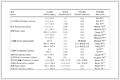
2008年1月与2013年1月,利用活塞钻(Piston corer)在更尕海不同位置钻取沉积岩芯(图1b)。通过测定12个沉水植物茎叶或种子 AMS14C 的年龄建立了岩芯GGH-A(36°11.42′N,100°06.23′E) 的年代序列[19, 20]。将现代湖泊表层样品中植物残体的14C年龄 1010±35a B.P. 视为湖泊“碳库效应”,所选14C年龄减去1010a,然后校正成日历年龄(Calib 5.0.1)[21]。通过相邻年龄的线性插值获得岩芯GGH-A的年代序列。本文通过与岩芯GGH-A指标与岩性等的对比,获得了8个特征年龄(表1),从而建立了岩芯GGH-C(36°11.46′N,100°06.27′E) 的年代序列。
|
表1 岩芯GGH-A与GGH-C年龄特征点 Table 1 The corresponding age controls of cores GGH-A and GGH-C |
利用X射线荧光光谱扫描仪(XRF)对岩芯GGH-C进行扫描分析,获得了岩芯中元素含量随深度的变化。X射线荧光光谱分析的原理是利用原级X射线光子激发待测物质中的原子,使之产生次级的特征X射线(X光荧光),依据X射线的波长可以定性分析元素的种类,而X射线的强度与相对应的元素浓度有着一定的关系,以此为基础进行元素的定量分析[22]。X射线荧光光谱分析具有谱线简单、 分析速度快、 测量元素多、 能进行多元素同时分析等优点[23, 24, 25]。以5mm为间隔,分别在两种不同扫描工作条件下(40s、 30kV、 2000μA和20s、 10kV、 1000μA)对岩芯GGH-C进行扫描分析,获得了Si、 Al、 K、 Ti、 Rb、 Fe、 Ca、 Sr、 Mn、 Zr、 S和Cl共12种元素含量随深度的变化,测量元素的单位以计数率(count per second,cps)表示。
利用英国Malven公司生产的Mastersizer 2000型激光粒度仪,测定了岩芯GGH-C 以10cm为间隔样品的粒度组成。取约1g样品置于烧杯中,分别用10ml浓度为20 % 的双氧水和10 % 的盐酸去除样品中的有机质和碳酸盐。静置24小时,抽取上层清夜,加入10ml 0.5mol/L的(NaPO3)6溶液,超声波震荡5分钟,使颗粒充分分散。
X射线荧光光谱扫描与粒度测试实验均在兰州大学西部环境教育部重点实验室完成。
3 结果与分析 3.1 年代序列岩芯GGH-A与GGH-C取自更尕海湖泊中心位置(图1b),钻孔地点水深约为170cm,进深分别为782cm和774cm,钻取时间相间5a。实验室观察,两支岩芯性状变化具有良好的一致性(图2a)。岩芯GGH-A与GGH-C底部同为风成砂,将风成砂沉积结束的年龄视为同一年龄,参考GGH-A的年龄[19, 20],从而确定了岩芯GGH-C底部风成砂结束年龄约为15.3cal .ka B .P.(表1)。

|
图2 沉积岩芯对比与GGH-C年龄模型 (a)沉积岩芯岩性变化; (b)沉积岩芯指标对比,箭头指示的是两个岩芯对应的年龄特征点; (c)沉积岩芯年代模型; (d)中值粒径对比 Fig.2 Lithostratigraphical comparisons between cores GGH-A and GGH-C and the age models of the cores. (a)The lithostratigraphical units of cores. (b)The index comparison between the two cores,and arrows point the corresponding age controls. (c)The age models of cores GGH-A and GGH-C. (d)The median grain size comparison between cores GGH-A and GGH-C |
元素Ca在湖泊沉积物中主要以碳酸盐的形式赋存。此外,研究显示,同一钻孔的元素Ca含量与碳酸盐含量有良好的一致性[26, 27]。可见,XRF扫描分析获得的岩芯GGH-C元素Ca含量可以用来指示该岩芯碳酸盐含量。岩芯GGH-C元素Ca的变化与岩芯GGH-A碳酸盐含量的总体变化趋势相似(图2b),因此,选取两支岩芯深度相仿且出现元素Ca与碳酸盐含量高值或低值的深度作为年代对比的特征点(表1),从而建立了岩芯GGH-C的年代模型(图2c)。岩芯GGH-C其余样品的年龄利用相邻两点的年龄线性内插或外推获得。岩芯GGH-C底部(约774cm)年龄为15.6cal .ka B.P.,沉积速率变化范围为0.02~0.80cm/a。
由于两支岩芯的钻探地点非常接近,为了进一步验证岩芯GGH-C年龄序列的可靠性,我们比较了两支岩芯粒度组成的变化,尽管岩芯GGH-C粒度数据分辨率较低。采用上述独立的年代模型,分别建立了岩芯GGH-A与GGH-C中值粒径随年代的变化(图2d)。结果显示,晚冰期以来岩芯GGH-A与GGH-C的中值粒径变化较为一致,15.6~10.3cal.ka B.P. 中值粒径较大,10.3~6.3cal.ka B.P. 中值粒径较小,6.3cal.ka B.P. 之后中值粒径呈现快速波动变化,且在6.0~1.0cal.ka B.P. 期间存在3个显著的峰值段。两支岩芯粒度数据随年代相似的变化趋势表明,由元素Ca与岩芯GGH-A碳酸盐含量对比而获得岩芯GGH-C的年代序列具有一定的可靠性。
3.2 元素组成如 图3所示,元素Si、 Al、 K、 Ti、 Fe和Rb含量变化较为一致,15.6~10.3cal.ka B.P. 含量整体较低,10.3~6.3cal.ka B.P. 含量较高,且在10.3~9.7cal.ka B.P. 出现峰值段; 6.3cal.ka B.P. 之后元素含量快速波动,且在6.3~6.1cal.ka B.P.、 5.6~5.2cal.ka B.P.、 4.8~3.9cal.ka B.P.、 3.7~2.8cal.ka B.P.、 2.3~1.8cal.ka B.P.、 1.2~0.8cal.ka B.P. 和0.3~0cal.ka B.P. 等时段出现元素高值段。

|
图3 GGH-C沉积岩芯元素含量变化 Fig.3 The elemental variations of core GGH-C |
利用SPSS 16.0对岩芯GGH-C中元素进行相关性分析(表2)。结果显示,元素Si、 Al、 K、 Ti、 Rb和Fe之间具有较好的相关性,除元素Si和Rb之间的相关性为0.59外,其他元素之间相关性均在0.6之上(见表2中黑体数据),且双尾检验显著性概率均小于0.01。
|
|
表2 GGH-C岩芯不同元素间的相关关系 Table 2 Correlation analyses of elements in core GGH-C |
在自然条件下,湖泊沉积物一般包括两部分来源: 一是流域侵蚀带来的碎屑组分,二是湖泊水体中各种化学或生物过程所产生的内生沉积[4]。沉积剖面中不同化学元素含量变化的相关性越高,这些元素来自同一输入过程的可能性越大。共和盆地广泛分布着古河湖相沉积物[28],这些细小的碎屑沉积物易被流水或风力搬运入湖。更尕海沉积岩芯中元素Si、 Al、 K、 Ti、 Fe和Rb之间相关性较好。这些元素也被认为是活动性较差的惰性元素,主要分布于碎屑物质(如石英、 云母等矿物)或不容残积物(粘土、 氧化铁等)等风化产物中,部分K元素会以游离态的形式进入湖泊[29]。因此,更尕海沉积岩芯中元素Si、 Al、 K、 Ti、 Fe和Rb为外源输入,这些元素含量的变化共同指示了更尕海湖泊陆源碎屑物质输入过程的差异或强度的变化。沉积岩芯中元素Si、 Al、 K、 Ti、 Fe和Rb等的高含量指示了强烈的湖泊碎屑物质输入过程。
更尕海流域风沙活动强烈,风力是更尕海碎屑物质输入的主要动力之一。更尕海表层沉积、 流域大气降尘、 湖泊水体沉积以及岩芯沉积等粒度组成的综合分析表明,沉积岩芯中>63μm组分主要由风力输入[30],因此其可用来反映碎屑物质的风力输入过程。研究表明,沉积物中不同粒级组分的元素组成存在显著的差异。Yang等[31]对黄土高原风成剖面研究发现,沉积物粗颗粒组分中SiO2较高,而细颗粒组分中Al2O3、 K2O、 Fe2O3和Rb含量较高,TiO2在不同粒级沉积物中含量变化并不显著。Qiang等[32]的研究显示,沙丘砂中的SiO2含量高达84.37 % 。外源输入碎屑物质中风成粗颗粒组分的增加,将使得更多富含元素Si的矿物(如石英)被输入至湖泊沉积物中。然而,更尕海沉积岩芯中粗颗粒组分与元素Si含量的变化并不完全一致。早中全新世更尕海沉积岩芯中元素Si含量较高,特别在10.3~9.7cal.ka B.P. 期间达到峰值(图4a),湖泊碎屑物质输入过程强烈。同时段岩芯中粗颗粒组分含量较低(图4b),表明风力携带的碎屑物质输入过程较弱。这种不一致性表明,风力输入并不能完全解释更尕海碎屑物质输入过程的变化。更尕海表层沉积物粒度分析结果显示,粒度组成主要包含两个敏感粒度组分,标准偏差峰值处的粒径分别为6.3μm和63.3μm,意味着湖泊表层沉积中存在两个不同的组分,反映了不同的沉积动力[16]。流域季节性降水形成的坡面漫流或暂时性径流、 泉水形成的径流以及岸边波浪作用等过程可能将流域中细颗粒碎屑物质输送入湖。

|
图4 更尕海岩芯元素含量、 粗颗粒含量、 湖泊水位等变化与其他气候记录的对比 (a)GGH-C沉积岩芯Si元素含量,平均值以上用黑色阴影部分表示,灰色阴影部分指示了岩芯中Si元素含量显著增加; (b)GGH-A沉积岩芯>63μm组分含量,平均值以上用黑色阴影部分表示,灰色阴影部分指示了岩芯中>63μm组分含量显著增加; (c)更尕海湖泊水位[20]; (d)青海湖岩芯孢粉浓度[33]; (e)董哥洞石笋氧同位素值[34]; (f)30°N夏季太阳辐射强度[35] Fig.4 Comparisons of climate changes recorded by sediments from Genggahai Lake sediments and other climate records. (a) and (b) Si content of core GGH-C and >63μm fraction of core GGH-A,respectively. Values above the average are shadowed,and significant increases in Si content and >63μm fraction are highlighted by gray bars. (c)Lake-level fluctuations of Genggahai Lake[20]. (d)Pollen concentrations from Qinghai Lake[33]. (e)δ 18 O of stalagmite from Dongge Cave[34]. (f)Summer solar radiation intensity at 30°N[35] |
晚冰期(15.6~10.3cal.ka B.P.)沉积岩芯中>63μm组分含量较高,指示了流域风沙活动强烈,风力携带的碎屑物质输入过程较强。然而沉积岩芯中元素Si等的含量较低,表明湖泊碎屑物质输入过程整体较弱。研究表明,流域的化学风化作用对湖泊碎屑物质输入过程具有重要的影响[15]。化学风化强度影响沉积岩芯元素获得的可能性,强烈的化学风化作用将为湖泊提供大量的碎屑物质来源。由于元素地球化学性质的差异,湖泊沉积岩芯中不同元素含量的比值,常被用来指示流域的化学 风化强度[36, 37, 38]。Zhang和Mischke[39]以及Herzschuh等[40]通过分析青藏高原东北部希门错湖沉积岩芯认为,岩芯Y/Al值可以指示流域风化强度。14.5~10.4cal.ka B.P. 期间,岩芯Y/Al值较低,介于2.2~4.6之间,指示了流域风化程度较弱[39, 40]。晚冰期更尕海流域较弱的风化程度限制了更尕海湖泊碎屑物质的输入,从而使得沉积岩芯中元素Si等含量整体偏低。
早中全新世(10.3~6.3cal.ka B.P.)沉积岩芯元素Si等的含量较高,指示了更尕海湖泊碎屑物质输入过程显著增强。然而该时段沉积岩芯中>63μm颗粒含量显著降低,反映了碎屑物质风力输入过程的减弱。早中全新世更尕海湖泊沉积物为粉砂质粘土与粘土质粉砂,且沉积岩芯中K等易迁移元素含量较高。因此,早中全新世更尕海湖泊碎屑物质输入过程主要以流水作用为主。在10.4~5.5cal.ka B.P. 期间,希门错湖岩芯Y/Al值[39, 40]显著增加,指示了流域化学风化作用的增强。更尕海流域强烈的化学风化可能进一步加剧了这一时期的湖泊碎屑物质的输入过程。
晚全新世(6.3cal.ka B.P. 以来)湖泊碎屑物质输入过程存在较大的波动。在6.3~6.1cal.ka B.P.、 5.6~5.2cal.ka B.P.、 4.8~3.9cal.ka B.P.、 3.7~2.8cal.ka B.P.、 2.3~1.8cal.ka B.P.、 1.2~0.8cal.ka B.P. 和0.3~0cal.ka B.P. 时段内,岩芯GGH-C中元素Si等的含量较高,反映了湖泊碎屑物质输入过程较为强烈; 而岩芯GGH-A>63μm组分的高含量值出现在6.3~6.1cal.ka B.P.、 5.9~5.3cal.ka B.P.、 4.7~3.7cal.ka B.P.、 3.5~3.0cal.ka B.P.、 2.6~1.5cal.ka B.P. 和0.2~0.1cal.ka B.P. 等时段。考虑到年龄模式的不确定性,除1.2~0.8cal.ka B.P. 时段外,元素Si等含量高值段与>63μm组分含量高值段具有良好的对应关系,反映了晚全新世流域强烈的风沙活动是湖泊碎屑物质输入过程增强的主要原因。Liu等[41]通过青海都兰地区祁连圆柏树轮宽度的研究认为,850~1013A .D . 和1063~1107A .D . 时期青藏高原东北部降水量偏多,并认为是区域尺度的气候特征。该气候特征或许可以解释1.2-0.8cal.ka B.P. 期间更尕海湖泊碎屑物质输入过程的增强,即其可能与降水量增加所导致的流水输入过程有关。
4.2 晚冰期以来气候变化重建沉积岩芯元素含量与粒度数据表明,更尕海湖泊陆源碎屑物质输入过程受流水与风力等动力条件,以及流域化学风化作用的共同影响。化学风化是一个复杂的表生过程,它不但与不同气候区的气温、 降水有关,而且还受植被覆盖、 地形、 海拔和土壤类型等环境要素的制约[42, 43, 44, 45, 46]。陆生植被可以通过控制土壤水再循环、 分泌并提供酸性溶液以及增加土壤CO2分压等过程调节区域化学风化作用[47]。对于更尕海流域来说,气候条件与植被覆盖可能是化学风化强度的主要控制因素。
前期工作利用岩芯GGH-A中植物大化石遗存进行了更尕海湖泊水位重建[20]。更尕海主要由地下水补给,湖泊面积较小。更尕海流域北部及西北部大范围的地下水出渗表明,更尕海可能与北部沙珠玉河存在水文联系,湖泊水源补给面积可能超过100km2,远大于湖泊面积。因此,湖泊蒸发量对湖泊水位平衡影响相对较小,湖泊水位波动主要反映了区域降水量的变化[20]。本文通过对比更尕海湖泊碎屑物质输入过程与湖泊水位变化,结合邻区青海湖孢粉浓度[33],重建了研究区晚冰期以来气候变化历史(图4)。
晚冰期(15.6~10.3cal.ka B.P.)沉积岩芯中粗颗粒组分含量较高,沉积物主要为粉砂与粘土质粉砂,湖泊碎屑物质输入过程较弱且以风力输入为主。湖泊水位整体较低(图4c),反映了研究区气候干冷,降水量较低,且风沙活动较为强烈。Qiang等[48]研究认为更尕海沉积岩芯底部风成砂沉积可能与末次盛冰期共和盆地强烈的风沙活动有关,并将风成砂地层结束年龄(15.3cal.ka B.P.)视为更尕海湖泊形成的年龄(图4b)。元素结果显示,15.2cal.ka B.P. 前后更尕海湖泊碎屑物质输入过程存在一个短暂的增强阶段; 此时更尕海正处于湖泊充盈阶段,使得沉积岩芯中元素Si等的丰度有所增加(图3和 图4a)。青藏高原东北部其他湖泊记录显示,有效湿度开始增加的时间与更尕海形成的时间基本一致,如青海湖(约16cal.ka B.P.)、 寇察湖 (约14.6cal.ka B.P.)、 达连海(约14.8cal.ka B.P.) 等[49, 50, 51]。晚冰期青海湖流域植被状况较差等事实也反映了青藏高原东北部总体冷干的气候特点[33, 49, 50, 51, 52]。
早中全新世(10.3~6.3cal.ka B.P.)湖泊碎屑物质输入过程增强,特别是流水输入过程显著增强。更尕海湖泊水位整体较高(图4c),反映了流域降水量增加,气候较为湿润。青藏高原东北部其他湖泊也记录了该时期暖湿的气候,尽管在时间上存在一定的差异[52, 53, 54, 55, 56, 57]。青海湖介形虫氧同位素值在10~6cal.ka B.P. 期间偏负,反映了早全新世季风降水的增强[49]。寇察湖与冬给措纳湖氧同位素记录的早全新世季风的增强时间分别为10.3~7.3cal.ka B.P. 与11.9~6.8cal.ka B.P.[50, 53]。此外,石笋记录显示,由于轨道参数调节的夏季太阳辐射量的变化,早全新世亚洲季风迅速增强[34, 35](图4e和4f)。早中全新世更尕海流域暖湿的气候条件以及碎屑物质的流水输入过程的显著增强,应当响应于这一时期区域季风环流的增强。
全新世初期(10.3~9.7cal.ka B.P.),元素Si等丰度达到最高值,反映了急剧增强的碎屑物质流水输入过程。然而,应当指出的是,增强的流水输入过程可能并不代表区域降水量的急剧增加。该时段,更尕海流域处于由晚冰期向全新世的过渡阶段,湖泊周围植被状况可能尚未得以显著改善,流水机械侵蚀,可携带大量的碎屑物质入湖。
晚全新世(6.3cal.ka B.P. 以来)湖泊碎屑物质风力输入过程增强,反映了晚全新世总体冷干的气候状况。研究表明[58, 59],晚全新世青藏高原东北部季风环流减弱,有效湿度降低。6.3cal.ka B.P. 以来,青海湖孢粉浓度显著下降,反映了区域植被的退化[33](图4d)。气候变冷以及植被的退化导致区域化学风化过程减弱。与早中全新世相比,青藏高原东北部和东部晚全新世近地面风力强度相对增强[48, 60],也可能是湖泊碎屑物质风力输入过程总体增强的原因。
晚全新世更尕海湖泊碎屑物质输入过程的最显著特点是频繁的风沙输入的出现,表明研究区存在强烈、 频繁的风沙活动事件。近年来,大量的研究表明全新世气候变化存在不稳定性[61, 62, 63, 64, 65, 66, 67, 68, 69, 70, 71, 72, 73, 74]。An等[54]指出,青海湖流域全新世夏季风的减弱伴随着西风环流的增强与频繁侵入,反映了亚洲季风与西风环流的相互作用。Qiang等[30]的研究显示,晚全新世更尕海流域百年至千年尺度的风沙活动事件与北大西洋冰漂碎屑事件具有较好的对应关系,可能与高纬度地区的冷事件有关。高纬度地区气候变冷可增强西伯利亚高压势力,从而影响研究区近地面风场的强度,导致更尕海沉积岩芯中粗颗粒组分增加。由此可见,亚洲季风与高纬冷气团(西风环流)的相互作用通过影响研究区植被、 降水、 风化强度以及近地面风场等的变化,从而影响了更尕海湖泊碎屑物质的输入过程。
5 结论(1)研究区晚冰期以来湖泊碎屑物质输入过程可以分为3个阶段。晚冰期碎屑物质输入过程较弱且以风力输入为主,流水输入过程较弱; 早中全新世碎屑物质流水输入过程显著增强,风力输入过程减弱; 晚全新世湖泊碎屑物质输入过程阶段性增强,风力输入是碎屑物质入湖的主要过程。
(2)更尕海湖泊沉积物记录了晚冰期以来的气候变化历史。更尕海流域晚冰期气候冷干,降水量较少,风化程度低,风沙活动较强; 早中全新世流域降水量显著增加,有效湿度较高,植被覆盖度增加,风化程度较高; 晚全新世流域降水量减少,植被有所退化,风沙活动阶段性增强。
(3)更尕海碎屑物质输入过程的变化响应于区域大气环流格局的变化。早中全新世湖泊碎屑物质风力输入过程的减弱或流水输入过程的增强响应了亚洲季风的增强。晚全新世更尕海湖泊碎屑物质风力输入过程的阶段性增强可能与高纬度地区的气候变冷事件有关。亚洲夏季风与高纬冷气团的相互作用可能是我国季风边缘区环境变化的主要驱动因素。
致谢 兰州大学西部环境教育部重点实验室周爱锋副教授、 潘艳辉博士、 徐军强、 吴铎等参与了野外工作和实验室分析,在此表示感谢。
| 1 | 沈 吉. 湖泊沉积研究的历史进展与展望. 湖泊科学, 2009, 21 (3):307~313 Shen Ji. Progress and prospect of palaeolimnology research in China. Lake Sciences, 2009, 21 (3):307~313 |
| 2 | 霍坎松 L, 杨松 M. 郑光鹰翻译. 湖泊沉积学原理. 北京: 科学出版社, 1992. 1~254 Hakanson L, Jansson M. Translated by Zheng Guangying. The Principle of Lake Sedimentology. Beijing:Science Press, 1992. 1~254 |
| 3 | 王苏民, 窦鸿身, 陈克造等. 中国湖泊志. 北京: 科学出版社, 1998. 22~27 Wang Sumin, Dou Hongshen, Chen Kezao et al. eds. Chinese Lakes. Beijing:Science Press, 1998. 22~27 |
| 4 | 陈敬安, 万国江, 陈振楼等. 洱海沉积物化学元素与古气候演化. 地球化学, 1999, 28 (6):562~570 Chen Jing'an, Wan Guojiang, Chen Zhenlou et al. Chemical elements in sediments of Lake Erhai and palaeoclimate evolution. Geochimica, 1999, 28 (6):562~570 |
| 5 | Morellón M, Valero-Garcés B, Vegas-Vilarrúbia T et al. Lateglacial and Holocene palaeohydrology in the western Mediterranean region:The Lake Estanya record(NE Spain). Quaternary Science Reviews, 2009, 28 (25):2582~2599 |
| 6 | Metcalfe S E, Jones M D, Davies S J et al. Climate variability over the last two millennia in the North American Monsoon region, recorded in laminated lake sediments from Laguna de Juanacatlán, Mexico. The Holocene, 2010, 20 (8):1195~1206 |
| 7 | 孙千里, 肖举乐. 岱海沉积记录的季风/干旱过渡区全新世适宜期特征. 第四纪研究, 2006, 26 (5):781~790 Sun Qianli, Xiao Jule. Characteristics of the Holocene Optimum in the monsoon/arid transition belt recorded by core sediments of Daihai Lake, North China. Quaternary Sciences, 2006, 26 (5):781~790 |
| 8 | 孙千里, 肖举乐, 刘 韬. 岱海沉积物元素地球化学特征反映的末次冰期以来季风/干旱过渡区的水热条件变迁. 第四纪研究, 2010, 30 (6):1121~1130 Sun Qianli, Xiao Jule, Liu Tao. Hydrothermal status in the monsoon/arid transition belt of China since the last glaciation inferred from geochemical characteristics of the sediment cores at Daihai Lake. Quaternary Sciences, 2010, 30 (6):1121~1130 |
| 9 | 任雅琴, 王彩红, 李瑞博等. 有机质饱和烃和δ13 Corg. 记录的博斯腾湖早全新世晚期以来生态环境演变. 第四纪研究, 2014, 34 (2):425~433 Ren Yaqin, Wang Caihong, Li Ruibo et al. Ecological environment change recorded by sediment n-alkane and δ13 Corg. of Lake Bosten since late of Early Holocene. Quaternary Sciences, 2014, 34 (2):425~433 |
| 10 | 孙博亚, 岳乐平, 赖忠平等. 14ka B.P. 以来巴里坤湖区有机碳同位素记录及古气候变化研究. 第四纪研究, 2014, 34 (2):418~424 Sun Boya, Yue Leping, Lai Zhongping et al. Paleoclimate changes recorded by sediment organic carbon isotopes of Lake Barkol since 14ka B.P. Quaternary Sciences, 2014, 34 (2):418~424 |
| 11 | 郑 茜, 张虎才, 明庆忠等. 泸沽湖记录的西南季风区15000a B.P. 年以来植被与气候变化. 第四纪研究, 2014, 34 (6):1314~1326 Zheng Qian, Zhang Hucai, Ming Qingzhong et al. Vegetational and environmental changes since 15ka B.P. recorded by Lake Lugu in the southwest monsoon domain. Quaternary Sciences, 2014, 34 (6):1314~1326 |
| 12 | 朱 芸, 雷国良, 姜修洋等. 晚全新世以来福建仙山泥炭钻孔的正构烷烃记录. 第四纪研究, 2013, 33 (6):1211~1221 Zhu Yun, Lei Guoliang, Jiang Xiuyang et al. Late Holocene organism records from peat n-alkanes of Xianshan in Fujian Province, Southeast China. Quaternary Sciences, 2013, 33 (6):1211~1221 |
| 13 | Murakami T, Katsuta N, Yamamoto K et al. A 27-kyr record of environmental change in Central Asia inferred from the sediment record of Lake Hovsgol, Northwest Mongolia. Journal of Paleolimnology, 2010, 43 (2):369~383 |
| 14 | 陈永福, 顾兆炎, 储国强等. 浑善达克沙地近50年来风沙活动的湖泊记录. 第四纪研究, 2009, 29 (4):774~780 Chen Yongfu, Gu Zhaoyan, Chu Guoqiang et al. Lacustrine sediment record for activities of wind and dust in the Hunshandake desert during the last 50 years from Xiarinao Lake. Quaternary Sciences, 2009, 29 (4):774~780 |
| 15 | 李明慧, 康世昌, 朱立平等. 西藏纳木错沉积物单水方解石出现前后的环境变化. 第四纪研究, 2008, 28 (4):601~609 Li Minghui, Kang Shichang, Zhu Liping et al. Late Holocene lake environment reflected by the occurrence of monohydrocalcite in Nam Co, Central Tibet. Quaternary Sciences, 2008, 28 (4):601~609 |
| 16 | 宋 磊, 强明瑞. 更尕海现代碎屑物质粒度组成空间分异及其输入过程. 第四纪研究, 2010, 30 (6):1199~1208 Song Lei, Qiang Mingrui. Grain-size spatial differentiation of surface detrital sediments in Lake Genggahai and their input processes, Gonghe basin. Quaternary Sciences, 2010, 30 (6):1199~1208 |
| 17 | 刘 斌, 徐 海, 蓝江湖等. 青海湖沉积物生物硅的环境意义初步研究. 第四纪研究, 2010, 30 (6):1169~1176 Liu Bin, Xu Hai, Lan Jianghu et al. A preliminary study on the environmental significance of biogenic silica in Qinghai Lake. Quaternary Sciences, 2010, 30 (6):1169~1176 |
| 18 | Winkler M G, Wang P K. The Late Quaternary vegetation and climate of China. In:Wright H E ed. Global Climates since the Last Glacial Maximum. Minneapolis:University of Minnesota Press, 1993. 221~261 |
| 19 | Song Lei, Qiang Mingrui, Lang Lili et al. Changes in palaeoproductivity of Genggahai Lake over the past 16ka in the Gonghe basin, northeastern Qinghai-Tibetan Plateau. Chinese Science Bulletin, 2012, 57 (20):2595~2605 |
| 20 | Qiang Mingrui, Song Lei, Chen Fahu et al. A 16-ka lake-level record inferred from macrofossils in a sediment core from Genggahai Lake, northeastern Qinghai-Tibetan Plateau(China). Journal of Paleolimnology, 2013, 49 (4):575~590 |
| 21 | Reimer P J, Baillie M G L, Bard E et al. IntCal04 terrestrial radiocarbon age calibration, 26~0ka B.P. Radiocarbon, 2004, 46 (3):1029~1058 |
| 22 | Richter T O, Van der Gaast S, Koster B et al. The Avaatech XRF core scanner:Technical description and applications to NE Atlantic sediments. Geological Society, London, Special Publications, 2006, 267 (1):39~50 |
| 23 | 周 锐, 李 珍, 宋 兵等. 长江三角洲平原湖沼沉积物XRF岩芯扫描结果的可靠性分析. 第四纪研究, 2013, 33 (4):697~704 Zhou Rui, Li Zhen, Song Bing et al. Reliability analysis of X-ray fluorescenc core-scanning in the Yangtze Delta limnetic sediments. Quaternary Sciences, 33 (4):697~704 |
| 24 | 谢曼曼, 孙 青, 凌 媛等. 同步辐射技术在高分辨率古气候、古环境变化中的应用. 第四纪研究, 2010, 30 (6):1218~1224 Xie Manman, Sun Qing, Ling Yuan et al. Application of synchrotron radiation technology in high-resolution paleoclimatic and paleoenvironmental research. Quaternary Sciences, 2010, 30 (6):1218~1224 |
| 25 | 凌 媛, 孙 青, 朱庆增等. 同步辐射X射线荧光光谱测定沉积物中元素含量的归一方法研究——以四海龙湾纹层沉积物为例. 第四纪研究, 2014, 34 (6):1327~1335 Ling Yuan, Sun Qing, Zhu Qingzeng et al. Research on normalization method for element analysis of sediment with synchrotron radiation X-ray fluorescence(SRXRF)——An example of varved sediment in Lake Sihailongwan, Northeast China. Quaternary Sciences, 2014, 34 (6):1327~1335 |
| 26 | Wünnemann B, Wagner J, Zhang Yongzhan et al. Implications of diverse sedimentation patterns in Hala Lake, Qinghai Province, China for reconstructing Late Quaternary climate. Journal of Paleolimnology, 2012, 48 (4):725~749 |
| 27 | Yan Dada, Wünnemann B. Late Quaternary water depth changes in Hala Lake, northeastern Tibetan Plateau, derived from ostracod assemblages and sediment properties in multiple sediment records. Quaternary Science Reviews, 2014, 95 :95~114 |
| 28 | Perrineau A, Van Der Woerd J, Gaudemer Y et al. Incision rate of the Yellow River in northeastern Tibet constrained by 10Be and 26Al cosmogenic isotope dating of fluvial terraces:Implications for catchment evolution and plateau building. Geological Society, London, Special Publications, 2011, 353 (1):189~219 |
| 29 | 张虎才. 元素表生地球化学特征及理论基础. 兰州: 兰州大学出版社, 1997. 1~15 Zhang Hucai ed. Geochemical Characteristics of Elements in Earth Surface and the Geochemical Principle. Lanzhou:Lanzhou University Press, 1997. 1~15 |
| 30 | Qiang Mingrui, Liu Yingying, Jin Yanxiang et al. Holocene record of eolian activity from Genggahai Lake, northeastern Qinghai-Tibetan Plateau, China. Geophysical Research Letters, 2014, 41 (2):589~595 |
| 31 | Yang Shiling, Ding Feng, Ding Zhongli. Pleistocene chemical weathering history of Asian arid and semi-arid regions recorded in loess deposits of China and Tajikistan. Geochimica et Cosmochimica Acta, 2006, 70 (7):1695~1709 |
| 32 | Qiang Mingrui, Chen Fahu, Wang Zhenting et al. Aeolian deposits at the southeastern margin of the Tengger desert(China):Implications for surface wind strength in the Asian dust source area over the past 20,000 years. Palaeogeography, Palaeoclimatology, Palaeoecology, 2010, 286 (1):66~80 |
| 33 | Shen Ji, Liu Xingqi, Wang Sunmin et al. Palaeoclimatic changes in the Qinghai Lake area during the last 18,000 years. Quaternary International, 2005, 136 (1):131~140 |
| 34 | Dykoski C A, Edwards R L, Cheng Hai et al. A high-resolution, absolute-dated Holocene and deglacial Asian monsoon record from Dongge Cave, China. Earth and Planetary Science Letters, 2005, 233 (1):71~86 |
| 35 | Berger A, Loutre M F. Insolation values for the climate of the last 10 million years. Quaternary Science Reviews, 1991, 10 (4):297~317 |
| 36 | Shen Ji, Lü Houyuan, Wang Sumin et al. Environmental evolution and its response to tectonic events revealed by Cuoe core at the center of Tibetan Plateau since 2.8Ma B.P. Science in China (Series D), 2004, 34 (4):359~366 |
| 37 | Dypvik H, Harris N B. Geochemical facies analysis of fine-grained siliciclastics using Th/U, Zr/Rb and(Zr+Rb)/Sr ratios. Chemical Geology, 2001, 181 :131~146 |
| 38 | Jin Zhangdong, Wang Sumin, Shen Ji et al. Weak chemical weathering during the Little Ice Age recorded by lake sediments. Science in China(Series D), 2001, 44 (7):652~658 |
| 39 | Zhang Chengjun, Mischke S. A Lateglacial and Holocene lake record from the Nianbaoyeze Mountains and inferences of lake, glacier and climate evolution on the eastern Tibetan Plateau. Quaternary Science Reviews, 2009, 28 (19):1970~1983 |
| 40 | Herzschuh U, Borkowski J, Schewe J et al. Moisture-advection feedback supports strong Early-to-Mid Holocene monsoon climate on the eastern Tibetan Plateau as inferred from a pollen-based reconstruction. Palaeogeography, Palaeoclimatology, Palaeoecology, 2014, 402 :44~54 |
| 41 | Liu Yu, An Zhisheng, Ma Haizhou et al. Precipitation variation in the northeastern Tibetan Plateau recorded by the tree rings since 850A.D. and its relevance to the Northern Hemisphere temperature. Science in China (Series D), 2006, 49 (4):408~420 |
| 42 | Gislason S R, Arnorsson S, Armannsson H. Chemical weathering of basalt in Southwest Iceland; Effects of runoff, age of rocks and vegetative/glacial cover. American Journal of Science, 1996, 296 (8):837~907 |
| 43 | 梁莲姬, 孙有斌, Christiaan J Beets等. 黄土中的碳酸盐矿物特征与化学风化. 第四纪研究, 2014, 34 (3):645~653 Liang Lianji, Sun Youbin, Christiaan J Beets et al. Characteristics of carbonate minerals in loess and its implication for chemical weathering. Quaternary Sciences, 2014, 34 (3):645~653 |
| 44 | 韦刚健, 谢露华, 卢伟健等. 珠江水系桂平、高要和清远站河水化学组成的季节变化及对化学风化研究的意义. 第四纪研究, 2011, 31 (3):417~425 Wei Gangjian, Xie Luhua, Lu Weijian et al. Seasonal variations of the river water chemical compositions at Guiping, Gaoyao and Qingyuan stations of the Pearl River system. Quaternary Sciences, 2011, 31 (3):417~425 |
| 45 | 陶 贞, 高全洲, 刘 昆. 流域化学风化过程的碳汇能力. 第四纪研究, 2011, 31 (3):408~416 Tao Zhen, Gao Quanzhou, Liu Kun. Carbon sequestration capacity of the chemical weathering processes within drainage basins. Quaternary Sciences, 2011, 31 (3):408~416 |
| 46 | 吴卫华, 郑洪波, 杨杰东等. 中国河流流域化学风化和全球碳循环. 第四纪研究, 2011, 31 (3):397~407 Wu Weihua, Zheng Hongbo, Yang Jiedong et al. Chemical weathering of large river catchments in China and the global carbon cycle. Quaternary Sciences, 2011, 31 (3):397~407 |
| 47 | Sehwartzman D W, Volk T. Biotic enhancement of weathering and hability of Earth. Nature, 1989, 340 :457~460 |
| 48 | Qiang Mingrui, Chen Fahu, Song Lei et al. Late Quaternary aeolian activity in Gonghe basin, northeastern Qinghai-Tibetan Plateau, China. Quaternary Research, 2013, 79 (3):403~412 |
| 49 | Liu Xingqi, Shen Ji, Wang Suming et al. Southwest monsoon changes indicated by oxygen isotope of ostracode shells from sediments in Qinghai Lake since the Late Glacial. Chinese Science Bulletin, 2007, 52 (4):539~544 |
| 50 | Mischke S, Kramer M, Zhang Chengjun et al. Reduced Early Holocene moisture availability in the Bayan Har Mountains, northeastern Tibetan Plateau, inferred from a multi-proxy lake record. Palaeogeography, Palaeoclimatology, Palaeoecology, 2008, 267 (1~2):59~76 |
| 51 | 陈发虎, 张家武, 程 波等. 青海共和盆地达连海晚第四纪高湖面与末次冰消期以来的环境变化. 第四纪研究, 2012, 32 (1):122~131 Chen Fahu, Zhang Jiawu, Cheng Bo et al. Late Quaternary high lake levels and environmental changes since last deglacial in Dalianhai, Gonghe basin in Qinghai Province. Quaternary Sciences, 2012, 32 (1):122~131 |
| 52 | Mischke S, Zhang Chengjun. Holocene cold events on the Tibetan Plateau. Global and Planetary Change, 2010, 72 (3):155~163 |
| 53 | Opitz S, Wünnemann B, Aichner B et al. Late Glacial and Holocene development of Lake Donggi Cona, north-eastern Tibetan Plateau, inferred from sedimentological analysis. Palaeogeography, Palaeoclimatology, Palaeoecology, 2012, 337 :159~176 |
| 54 | An Zhisheng, Colman S M, Zhou Weijian et al. Interplay between the Westerlies and Asian monsoon recorded in Lake Qinghai sediments since 32ka. Scientific Reports, 2012, 2 :619~625 |
| 55 | Liu Xingqi, Dong Hailiang, Rech J A et al. Evolution of Chaka Salt Lake in NW China in response to climatic change during the Latest Pleistocene-Holocene. Quaternary Science Reviews, 2008, 27 (7):867~879 |
| 56 | 王素萍, 贾国东, 赵 艳等. 柴达木盆地克鲁克湖全新世气候变化的正构烷烃分子记录. 第四纪研究, 2010, 30 (6):1097~1104 Wang Suping, Jia Guodong, Zhao Yan et al. Plant wax n-alkanes record of the Holocene paleoclimatic changes from a core sediment of Hurleg Lake in the Qaidam Basin. Quaternary Sciences, 2010, 30 (6):1097~1104 |
| 57 | 张彭熹, 张保珍, 钱桂敏等. 青海湖全新世以来古环境参数的研究. 第四纪研究, 1994, (3):225~238 Zhang Pengxi, Zhang Baozhen, Qian Guimin et al. The study of paleoclimatic parameter of Qinghai Lake since Holocene. Quaternary Sciences, 1994, (3):225~238 |
| 58 | Zhao Yan, Yu Zicheng. Vegetation response to Holocene climate change in East Asian monsoon-margin region. Earth-Science Reviews, 2012, 113 (1):1~10 |
| 59 | Yu Lupeng, Lai Zhongping. Holocene climate change inferred from stratigraphy and OSL chronology of aeolian sediments in the Qaidam Basin, northeastern Qinghai-Tibetan Plateau. Quaternary Research, 2014, 81 (3):488~499 |
| 60 | Ferrat M, Weiss D J, Spiro B et al. The inorganic geochemistry of a peat deposit on the eastern Qinghai-Tibetan Plateau and insights into changing atmospheric circulation in Central Asia during the Holocene. Geochimica et Cosmochimica Acta, 2012, 91 :7~31 |
| 61 | Denton G H, Karlén W. Holocene climatic variations——Their pattern and possible cause. Quaternary Research, 1973, 3 (2):175~205 |
| 62 | Alley R B, Mayewski P A, Sowers T et al. Holocene climatic instability:A prominent, widespread event 8200 yr ago. Geology, 1997, 25 (6):483~486 |
| 63 | Fronval T, Jansen E. Eemian and Early Weichselian(140~60ka)paleoceanography and paleoclimate in the Nordic Seas with comparisons to Holocene conditions. Paleoceanography, 1997, 12 (3):443~462 |
| 64 | Mayewski P A, Rohling E E, Curt Stager J et al. Holocene climate variability. Quaternary Research, 2004, 62 (3):243~255 |
| 65 | Bond G, Showers W, Cheseby M et al. A pervasive millennial-scale cycle in North Atlantic Holocene and glacial climates. Science, 1997, 278 (5341):1257~1266 |
| 66 | Bond G, Kromer B, Beer J et al. Persistent solar influence on North Atlantic climate during the Holocene. Science, 2001, 294 (5549):2130~2136 |
| 67 | 张振球, 刘殿兵, 汪永进等. 中全新世东亚季风年至10年际气候变率: 湖北青天洞5.56~4.84ka B.P. 石笋年层厚度与地球化学证据. 第四纪研究, 2014, 34 (6):1246~1255 Zhang Zhenqiu, Liu Dianbing, Wang Yongjin et al. Annual-to decadal-scale variability of Asian monsoon climates during Mid-Holocene:Evidence from proxies of annual bands and geochemical behaviors of a speleothem from 5.56ka B.P. to 4.84ka B.P. in Qingtian cave, Central China. Quaternary Sciences, 2014, 34 (6):1246~1255 |
| 68 | 谭亮成, 蔡演军, 安芷生等. 石笋氧同位素和微量元素记录的陕南地区4200~2000a B.P. 高分辨率季风降雨变化. 第四纪研究, 2014, 34 (6):1238~1245 Tan Liangcheng, Cai Yanjun, An Zhisheng et al. High-resolution monsoon precipitation variations in southern Shaanxi, Central China during 4200~2000a B.P. as revealed by speleothem δ 18 O and Sr/Ca records. Quaternary Sciences, 2014, 34 (6):1238~1245 |
| 69 | 吴江滢, 汪永进, 董进国. 全新世东亚夏季风演化的辽宁暖和洞石笋 δ 18 O记录. 第四纪研究, 2011, 31 (6):990~998 Wu Jiangying, Wang Yongjin, Dong Jinguo. Changes in East Asian summer monsoon during the Holocene recorded by stalagmite δ18 O records from Liaoning Province. Quaternary Sciences, 2011, 31 (6):990~998 |
| 70 | 董进国, 吉云松, 钱 鹏. 黄土高原洞穴石笋记录的8.2ka B.P. 气候突变事件. 第四纪研究, 2013, 33 (5):1034~1036 Dong Jinguo, Ji Yunsong, Qian Peng. "8.2ka B.P. event" of Asian monsoon in a stalagmite record from Chinese Loess Plateau. Quaternary Sciences, 2013, 33 (5):1034~1036 |
| 71 | 陈发虎, 黄小忠, 杨美临等. 亚洲中部干旱区全新世气候变化的西风模式——以新疆博斯腾湖记录为例. 第四纪研究, 2006, 26 (6):881~887 Chen Fahu, Huang Xiaozhong, Yang Meilin et al. Westerly dominated Holocene climate model in arid Central Asia: Case study on Bosten Lake, Xinjiang, China. Quaternary Sciences, 2006, 26 (6):881~887 |
| 72 | 张家武, 王君兰, 郭小燕等. 博斯腾湖全新世岩芯沉积物碳酸盐氧同位素气候意义. 第四纪研究, 2010, 30 (6):1078~1087 Zhang Jiawu, Wang Junlan, Guo Xiaoyan et al. Paleoclimatic significance of oxygen isotope composition of carbonates from a sediment core at Bosten Lake, Xinjiang, China. Quaternary Sciences, 2010, 30 (6):1078~1087 |
| 73 | 姜雅娟, 王 维, 马玉贞等. 内蒙古鄂尔多斯高原泊江海子全新世气候变化初步研究. 第四纪研究, 2014, 34 (3):654~665 Jiang Yajuan, Wang Wei, Ma Yuzhen et al. A preliminary study on Holocene climate change of Ordos Plateau, as inferred by sedimentary record from Bojianghaizi Lake of Inner Mongolia, China. Quaternary Sciences, 2014, 34 (3):654~665 |
| 74 | 宋 木, 刘卫国, 郑 卓等. 西北干旱区湖泊沉积物中长链烯酮的古环境意义. 第四纪研究, 2013, 33 (6):1199~1210 Song Mu, Liu Weiguo, Zheng Zhuo et al. Paleoenvironmental implications of long chain alkenones in arid regions, Northwestern China. Quaternary Sciences, 2013, 33 (6):1199~1210 |
Abstract
Understanding of the processes of detrital input to a lake is of great importance to investigate climatic and environmental changes in a region. The Gonghe Basin is located in the northeastern Qinghai-Tibetan Plateau, which is influenced climatically by both the Asian monsoon and the Westerlies. This area is crucial for understanding the climatic linkages between high latitudes and low latitudes in the Northern Hemisphere. Genggahai Lake (36°11'N, 100°06'E), a small, shallow lake, is situated in the central of Gonghe Basin. Its water surface area is about 2km2, and the maximum water depth is about 1.8m. The simple hydrologic pattern and abundant biodiversity make it sensitive to the changing global climate system, and hence an ideal site to study environmental changes.
Cores GGH-A(782cm in length; 36°11.42'N, 100°06.23'E) and GGH-C(774cm in length; 36°11.46'N, 100°06.27'E) were recovered at the water depth of 170cm in central Genggahai Lake. 12 samples of aquatic macrophyte remains were selected from core GGH-A for accelerator mass spectrometer(AMS) 14C dating. By comparing the varations of lithostratigraphical units and carbonate (Ca) content between cores GGH-A and GGH-C, we created an age-depth model of GGH-C. The age at the base of core GGH-C was 15.6cal.ka B.P. Chemical elements of core GGH-C were measured using high-resolution X-Ray Fluorescence(XRF)scanning. The abundances of Si, Al, K, Ti, Fe and Rb in sediments can be used as proxies for inputs of detrital material to the lake. Combined with the variability of sand fraction (>63μm) in core GGH-A, we reconstructed changes in input processes of detrital material to Genggahai Lake and climatic changes in the study area since the Late Glacial. During the Late Glacial, the sediments was characterized by coarse median size and low content of Si, which indicated that a cold and arid climate prevailed. The input process of detritus was generally weak, and detrital material may have been transported mainly by winds. During the Early to Middle Holocene, the content of Si increased sharply, while the content of sand fraction decreased. The warmer and wetter climate was prevalent and may had been characterized by a remarkable increase in weathering process. The input of detritus to the lake increased abruptly, as a result of enhanced regional precipitation. During the Late Holocene, the content of Si increased sharply at 6.3~6.1cal.ka B.P., 5.6~5.2cal.ka B.P., 4.8~3.9cal.ka B.P., 3.7~2.8cal.ka B.P., 2.3~1.8cal.ka B.P. and 0.3~0cal.ka B.P., which was in accord with the sand fraction generally, reflecting that detrital materials were episodically transported to the lake by winds and episodic aeolian activity occurred on centennial to millennial timescales.
The input processes of detrital materials to Genggahai Lake appear to change in response to the changing atmospheric circulation patterns over the northeastern Qinghai-Tibetan Plateau. The increasing weathering and detrital input to the lake, owing to warmer and wetter climatic conditions during the Early to Middle Holocene, may be a response to the strengthened Asian summer monsoon at that time. In contrast, the abrupt, intense sand deposition events are likely to be associated with strong wind regimes, in response to the cold events in the North Atlantic Ocean. Our results suggest that the interaction of Asian monsoon and cold air masses from high latitudes(or the Westerlies)perhaps plays an important role in climatic changes in the marginal zones of regions dominated by the Asian summer monsoon.