 2015, Vol.35


多环芳烃(Polycyclic Aromatic Hydrocarbons,简称PAHs)是指由两个及两个以上苯环稠合而成的一类持久性有机污染物(Persistent Organic Pollutants,简称POPs)[1]。PAHs具有难降解性和生物累积性,由于其毒性和致癌性,它们早已成为国际社会研究的热点[2]。美国环保部(US Environmental Protection Agency,简称USEPA)列出的优先控制污染物名单中包括16种多环芳烃。PAHs主要来源于矿物燃料和生物不完全燃烧以及有机质合成过程等,自然过程中产生的不完全燃烧(森林火灾等)及生物合成过程虽然也可以产生一部分PAHs,但目前环境中存在的PAHs大部分来自于人类活动,如化石、 生物燃料的不完全燃烧,石油泄漏,垃圾焚烧等[3, 4, 5]。工业革命以来,随着人类活动的日益加剧,能源使用的不断增加,目前世界各地各种环境介质(空气、 水体、 沉积物、 土壤等)都已不同程度的受到了PAHs的污染[6, 7, 8, 9]。从全球范围来看,发达国家和地区,如美国、 欧洲和日本[10, 11, 12] PAHs的排放在20世纪50-80年代已达到峰值,随后基本呈下降的趋势。然而,格陵兰冰芯的研究发现[13],自工业革命直至20世纪90年代,PAHs一直呈上升趋势,这可能与发展中国家尤其是中国和印度等近年来PAHs排放持续增长有关[14]。最近的评估显示2004年全球PAHs排放量为520Gg/a,而中国和印度的同年排放量分别为114Gg/a和90Gg/a,分别位于世界第一位和第二位[14]。近年来,中国能源消耗急剧增加,特别是化石燃料等使用导致了大量PAHs进入各种环境介质,据统计[15],2003年中国排放的16种优先控制PAHs总量已经达到25300 吨,接近美国历年来排放量的最大值(26500 吨)。考虑到中国PAHs的高排放量及PAHs的远距离迁移特征,调查中国环境介质中PAHs含量及分布特征非常必要。
近年来,国内外学者已对中国土壤、 河流、 泥炭及近海沉积物等环境介质中的PAHs展开了大量的研究工作[16, 17, 18, 19, 20, 21]。Wang等[16]报道了中国北方(北京、 天津及其周边)部分地区的表土PAHs污染状况。 通过城乡之间土壤PAHs含量对比表明,偏远地区-农村-城市土壤PAHs不同的污染程度主要与人口密度、 GDP及土地利用类型有关。Tao等[9]报道了中国青藏高原地区土壤PAHs污染水平、 空间分布特征及来源,指出青藏高原土壤PAHs污染水平远低于中国东部地区,可以代表东亚地区的PAHs背景值。 Liu等[17]报道了中国黄海、 东海及南海表层沉积物PAHs污染状况,指出黄海沉积物PAHs污染程度要高于南海。这些研究记录了中国各环境介质中PAHs含量的空间分布特征,并且通过不同的手段分析了PAHs的可能来源。除了上述对PAHs污染现状的研究,关于PAHs污染历史的研究也有很多,多集中于中国近海海域及河流入海口[18, 19, 20]。Guo等[18, 19]和Liu等[20]分别利用东海、 黄海及南海沉积物重建了中国近海海域近200年来的PAHs排放历史,指出PAHs的变化反映了中国经济发展水平及能源使用结构的转变。很多研究表明[5, 22],沉积物中PAHs含量与当地人口密度、 GDP(Gross Domestic Product)等都有较好的相关性。PAHs沉积通量的变化特征也可以反映PAHs排放历史,进而反映经济发展水平及能源消费结构的历史变化[22]。因此,PAHs不仅仅是环境污染物,还是反映人类活动以及社会经济发展历史的重要地球化学指标[12]。
湖泊沉积物作为内陆地区重要的污染物“贮存库”,忠实的记录了流域乃至区域PAHs污染信息,不但可以反映PAHs排放现状,还可以用来重建我国不同地区PAHs排放历史,了解不同地区、 不同时期PAHs排放差异,有效地弥补其他环境载体的局限性。目前已有大量关于中国湖泊沉积物多环芳烃的含量、 组成及来源分析的报道[22, 23, 24, 25, 26, 27, 28, 29],但其中大部分研究都是针对中国某个湖泊或者某几个湖泊沉积物,鲜有关于中国湖泊PAHs总体分布情况的报道。我国湖泊沉积物PAHs的总体污染状况如何?在污染历史方面,沉积记录表明20世纪50-80年代发达国家和地区PAHs排放已出现峰值[10, 11, 12],那么在工业革命起步较晚的中国,湖泊沉积物记录的PAHs又会呈现怎样的排放特征?这些都是值得深入研究的问题。本文基于大量已发表的文献,分析了中国湖泊表层沉积物PAHs的空间分布情况及湖泊沉积物记录的PAHs排放历史,并与发达国家和地区的研究结果进行比较,尝试分析我国湖泊沉积物中PAHs的分布特点与主要来源。
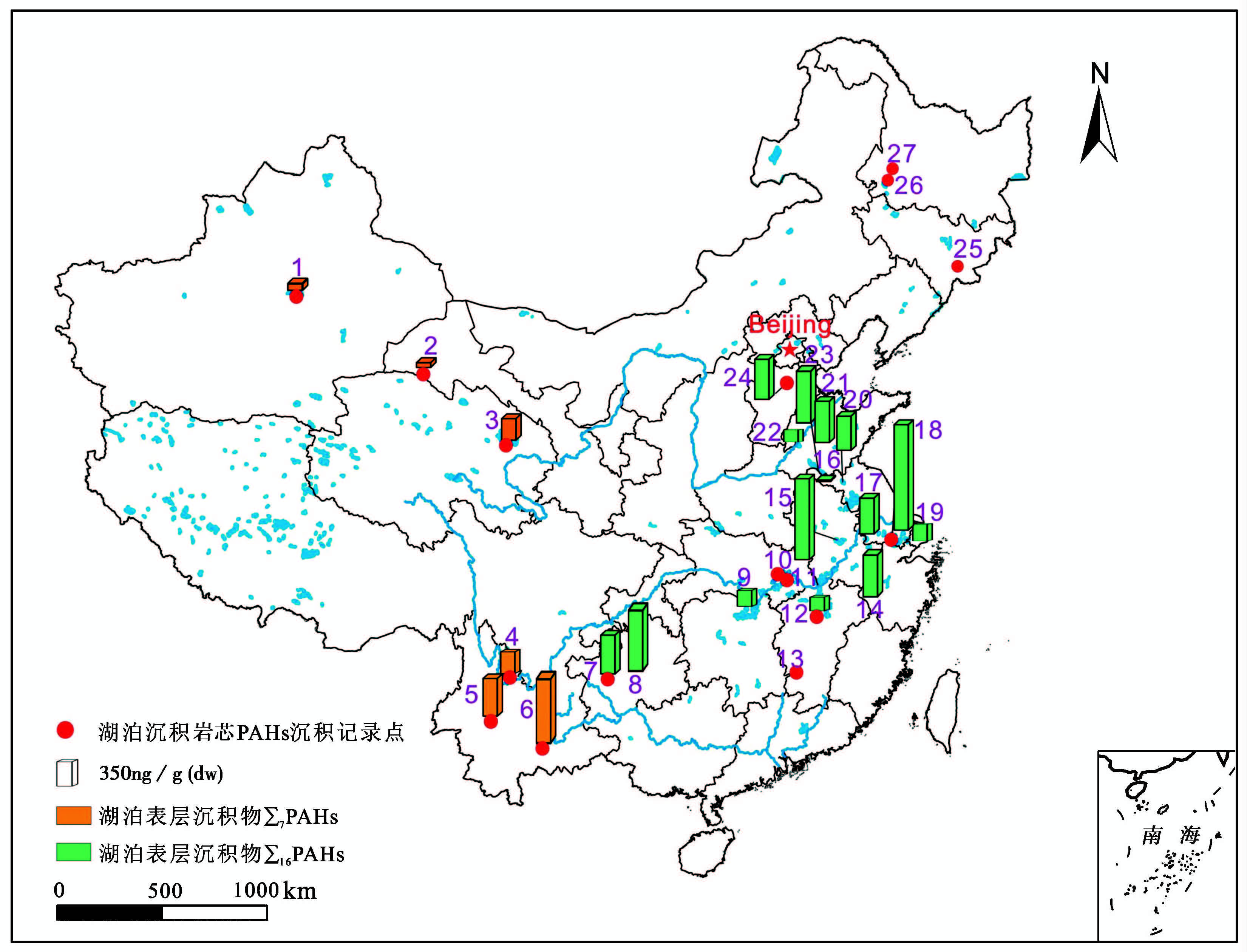
1 研究区域与数据来源考虑到数据的有效性,本研究收集的有关中国湖泊沉积物PAHs污染的调查数据,主要来自于中国知网及SCI等较权威数据库,且数据发表时间仅限于过去10年的数据(2004年至今)。数据涵盖16个省,27个湖泊(图1),其中湖泊表层PAHs数据涉及21个湖,柱状样数据涉及16个湖。为了与国外湖泊沉积物PAHs进行比较,本研究还收集了其他国家和地区部分湖泊表层沉积物及沉积记录PAHs数据,其中PAHs单体化合物主要收集16种优先控制污染物,分别为萘(Nap)、 苊稀(Acy)、 苊(Ace)、 芴(Flu)、 菲(Phe)、 蒽(Ant)、 荧蒽(Fla)、 芘(Pyr)、 屈(Chr)、 苯并[a]蒽(BaA)、 苯并[b]荧蒽(BbF)、 苯并[k]荧蒽(BkF)、 苯并[a]芘(BaP)、 茚并[1,2,3-cd]芘(InP)、 二苯并[a,h]蒽(DahA)和苯并[g,h,i]苝(BghiP)。同时还收集了本研究中涉及到的13个城市2008年GDP数据及人口密度数据、 中国1950年以来的GDP数据、 煤炭消费量数据以及欧洲、 美国1950年以来的煤炭消费量数据。
|
图1 本研究综述文献中各湖泊的分布位置及其表层沉积物PAHs平均浓度 1. 博斯腾湖[23, 24]; 2. 苏干湖[23, 24]; 3. 青海湖[23, 24, 25, 26]; 4. 程海[23, 24]; 5. 洱海[23, 24, 27]; 6. 滇池[28, 29, 30]; 7. 红枫湖[31, 32, 33]; 8. 百花湖[34]; 9. 大通湖[35]; 10. 东湖[36]; 11. 梁子湖[37]; 12. 鄱阳湖[38, 39]; 13. 陡水湖[40]; 14. 千岛湖[41]; 15. 巢湖[42, 43]; 16. 云龙湖[44]; 17. 天目湖[45]; 18. 太湖[46, 47, 48, 49, 50, 51, 52, 53, 54, 55, 56, 57, 58, 59, 60]; 19. 滴水湖[61]; 20. 骆马湖[62]; 21. 南四湖[63, 64, 65, 66, 67]; 22. 东平湖[68]; 23. 微山湖[69]; 24. 白洋淀[70, 71, 72, 73, 74]; 25. 四海龙湾玛珥湖[22]; 26. 克钦湖[75]; 27. 连环湖[75, 76] Fig.1 The average PAHs concentration of different surface lake sediments and the sampling location in this study |
本研究共选择21个湖泊表层沉积物 PAHs污染数据(图1),分别统计了各个湖泊 PAHs的最大值、 最小值和平均值。我国湖泊表层沉积物中 PAHs 含量为3.2-5260ng/g(dw)(n=495),平均值753.1ng/g(dw)。其中,太湖PAHs含量最高,浓度为240-3499ng/g(dw),平均值为1252.8ng/g(dw)(n=224); 最低值出现在云龙湖,浓度为5.4-19.1ng/g(dw),平均值为13ng/g(dw)(n=6)。青海湖等6个湖泊只包括7种PAHs,浓度为55.1-886ng/g(dw),平均值335.5ng/g(dw)(n=6)。
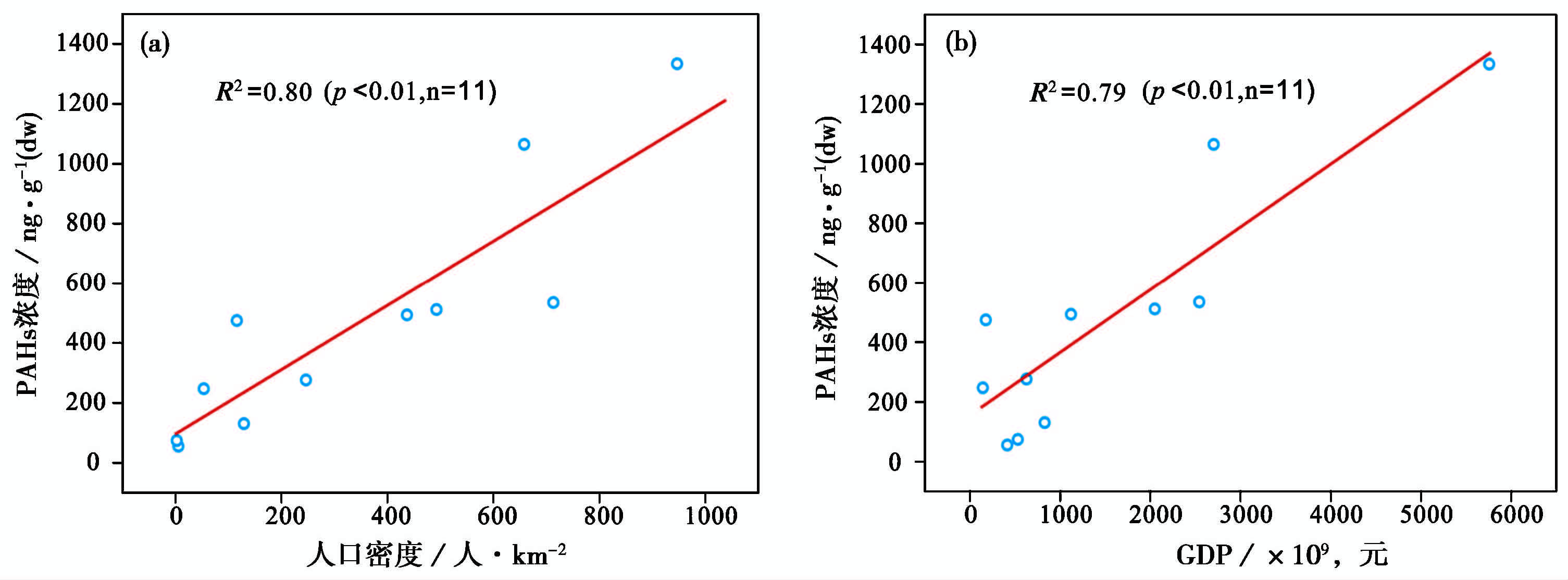
已有研究表明[23, 24, 25, 26, 27],人为排放是当今湖泊沉积物PAHs的主要来源。因此,人口密度、 国内生产总值(Gross Domestic Product,简称GDP)等因素都直接影响着湖泊沉积物PAHs浓度。由于收集到的数据的采样时间多集中在2007-2008年间,因此本研究收集了各湖泊所在地区2008年的GDP数据及人口密度数据,西部6个湖泊(青海湖、 博斯腾湖、 苏干湖、 程海、 洱海和滇池)数据只包含7种PAHs的含量,在此不进行分析比较。将收集到的各个湖泊沉积物PAHs平均浓度同当地人口密度、 GDP分别做相关性分析发现(图2),PAHs含量与当地GDP(R2=0.79,p<0.01)及人口密度(R2=0.80,p<0.01)具有显著的相关性。此结果表明,经济发展水平和人口密度是影响中国湖泊表层沉积物PAHs浓度的重要因素,人口密度直接关系到化石燃料消费量、 垃圾排放量及当地污水的排放等,从而影响环境中PAHs的排放量[5]。
|
图2 湖泊表层沉积物平均含量同当地人口密度(a)和GDP的相关性(b) Fig.2 Relationship between local population density (a) /GDP (b) and PAHs average concentration in different lakes of surface sediments |
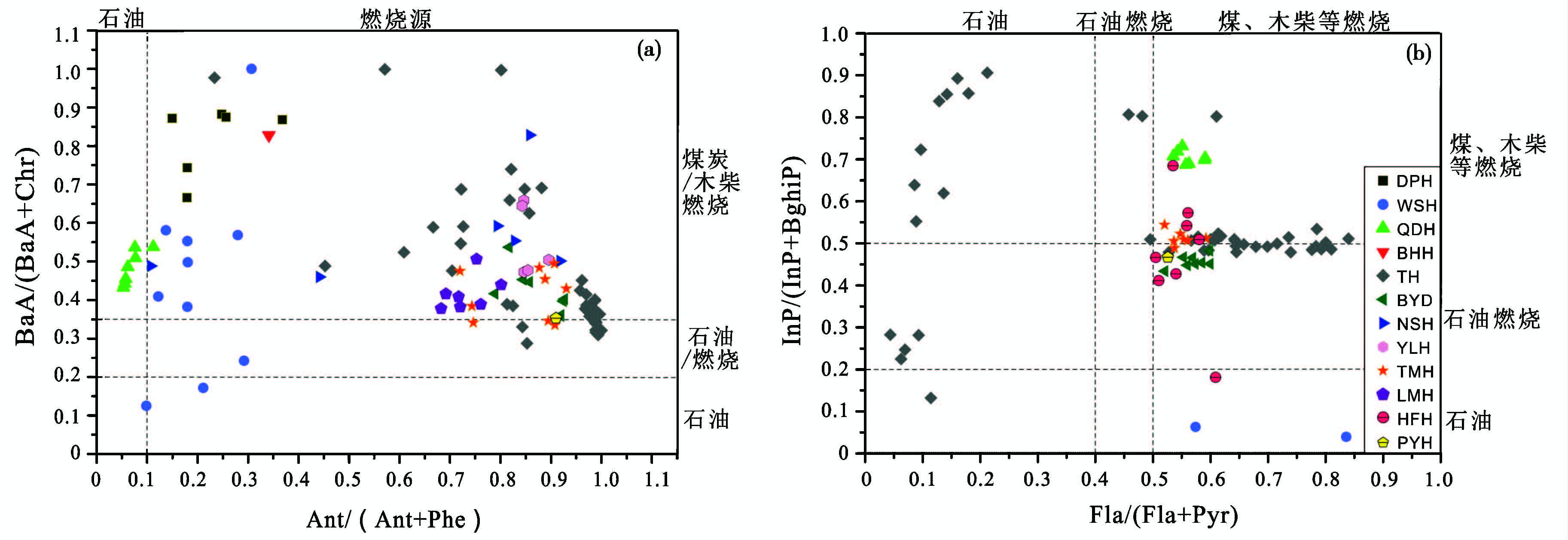
目前用于甄别环境中污染源的方法主要有比值法、 特征化合物法、 轮廓图法和多元统计法等,其中比值法可以定性的判断其来源[30, 31, 32, 33, 34, 35]。根据研究归纳,Ant/(Ant+Phe)比值小于0.1时表明是石油来源,大于0.1为燃烧来源; BaA/(BaA+Chr)小于0.2为石油来源,在0.20-0.35之间为石油和燃烧的混合来源,大于0.35为燃烧来源[77]。由 图3a可知,我国湖泊表层沉积物Ant/(Ant+Phe)的变化范围为0.05-0.98,平均值为0.69,表明PAHs来源以燃烧来源为主; BaA/(BaA+Chr)的变化范围为0.13-0.96,平均值为0.48,大部分比值在0.35-0.90的范围内,表明PAHs以石油、 木材及煤等燃烧为主要来源。通常,InP/(InP+BghiP)比值大于0.5表示PAHs来自煤、 木材等的燃烧,0.2-0.5指示为石油类物质燃烧,小于0.2则主要来自石油污染。Fla/(Fla+Pyr)大于0.5表示PAHs主要来自煤及木材的燃烧,0.4-0.5之间则是石油类物质燃烧,小于0.4则显示为石油污染[77]。 图3b表明,我国湖泊表层沉积物InP/(InP+BghiP)的变化范围为0.05-0.91,平均值为0.52; Fla/(Fla+Pyr)的变化范围为0.04-0.88,平均值为0.55,表明PAHs主要来自煤炭、 石油燃烧,但是石油源也是一些湖泊PAHs的主要来源之一,尤其是太湖、 千岛湖等湖泊石油源也是其污染来源之一。由此可见,3种主要的污染源在中国湖泊表层沉积物中均有体现,其中煤炭、 石油燃烧是我国表层湖泊沉积物PAHs的主要来源,但是根据比值法无法定量解析各种污染源排放比重。因此,利用主成分分析/多元线性回归(PCA/MLR)分析方法对我国湖泊表层沉积物PAHs污染源进行进一步分析。
|
图3 湖泊表层沉积物PAHs特征比值 Fig.3 Diagnostic ratios of PAHs in lake surface sediments |
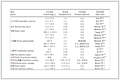
本研究利用SPSS19.0软件,对已收集到的我国湖泊表层沉积物16种PAHs数据进行主成分分析(PCA),根据特征值大于1的提取原则,提取出3个主因子,解释了总变量的80.94 % ,并利用方差最大正交因子旋转法进行了因子旋转,其中在各因子中载荷因子较高(>0.7)[78]的化合物在 表1中用黑体标出,结果如 表1所示。
|
表1 中国湖泊表层沉积物多环芳烃PCA因子载荷系数及累积变量* Table 1 Component loading and cumulative variance of principal component for PAHs in surface lake sediments of China |
的44.80 % ,此因子在变量BaA、 Chr、 BbF、 BkF、 BaP、 BghiP和InP等化合物上有很高的载荷系数,其中BaA、 BkF等被认为是机动车尾气排放的特征指示物[79, 80],而BghiP和InP分别是汽油车和柴油车排放物的特征化合物[79, 80]。由此可见,因子1代表了机动车的尾气排放来源。因子2解释了总变量的22.63 % 。在该因子上,Pry和Phe的载荷系数很高,除此之外,因子2在Flu和DahA的载荷系数也较高。相关研究认为,Pyr及Phe是煤炭燃烧的特征化合物[81, 82, 83, 84],而Flu是煤制焦过程中的特征化合物之一[85, 86]。因此,因子2代表了煤炭燃烧源。因子3解释了总变量的13.51 % 。其中,Nap和Ace的载荷系数最高,而高环物质载荷较低,结合PAHs特征比值显示的污染源类型,由此推测因子3最有可能代表石油源。本文所收集到的湖泊数据大多位于经济较发达的东部及华北地区,该区人口密度较大,湖区养殖强度大,渔民船只活动频繁,加上一些湖泊的旅游产业,石油泄漏也必然是湖泊PAHs的主要来源之一。
根据Tao等[53]、 Larsen和Baker[80]的研究成果,利用线性回归方法模型,对上述因子分析结果进行回归分析,得到回归方程如下:

其中,PC1-PC3分别代表机动车尾气排放、 煤炭燃烧和石油源。
根据平均贡献率i=Ai/∑Ai×100 % (Ai为多元回归各项回归系数),计算出不同污染源的贡献量分别为: 机动车尾气排放占42.7 % 、 煤炭燃烧占30.1 % 以及石油泄漏占27.2 % 。
与国内外其他表层水体沉积物相比(表2),我国湖泊表层沉积物PAHs污染处于中等偏上水平,低于污染较为严重的美国Erie湖[87]和Michigan湖[89]。但与俄罗斯Baikal湖[90]、 北极圈以内的偏远地区湖泊[92]等污染较轻的湖泊相比,我国湖泊表层沉积物PAHs总体污染水平较高。
|
|
表2 中国和其他国家湖泊表层沉积物∑PAHs浓度的比较 Table 2 Comparison of ∑PAHs concentration in China lake surface sediments and that in other countries |
目前收集到的湖泊钻孔沉积物PAHs的历史变化记录共包括16个湖泊(图1)、 24个沉积记录,由于沉积通量能够更准确的反映历史时期的湖泊污染信息,本研究仅讨论具有沉积通量的数据。据本研究统计结果,我国湖泊钻孔沉积记录PAHs时间变化序列涵盖1730-2012年,各湖泊最大沉积通量变化范围为11.9-3128.7ng/cm2 ·a(n=8),各湖泊沉积通量平均值269.1ng/cm2 ·a(n=230)。其中鄱阳湖[39]、 连环湖[76]、 克钦湖[75]、 陡水湖[40]和梁子湖[37] PAHs缺乏沉积通量数据,西部地区博斯腾湖、 洱海、 苏干湖及程海[23]只包含7种PAHs,在此只讨论其PAHs变化趋势,沉积通量不做比较。
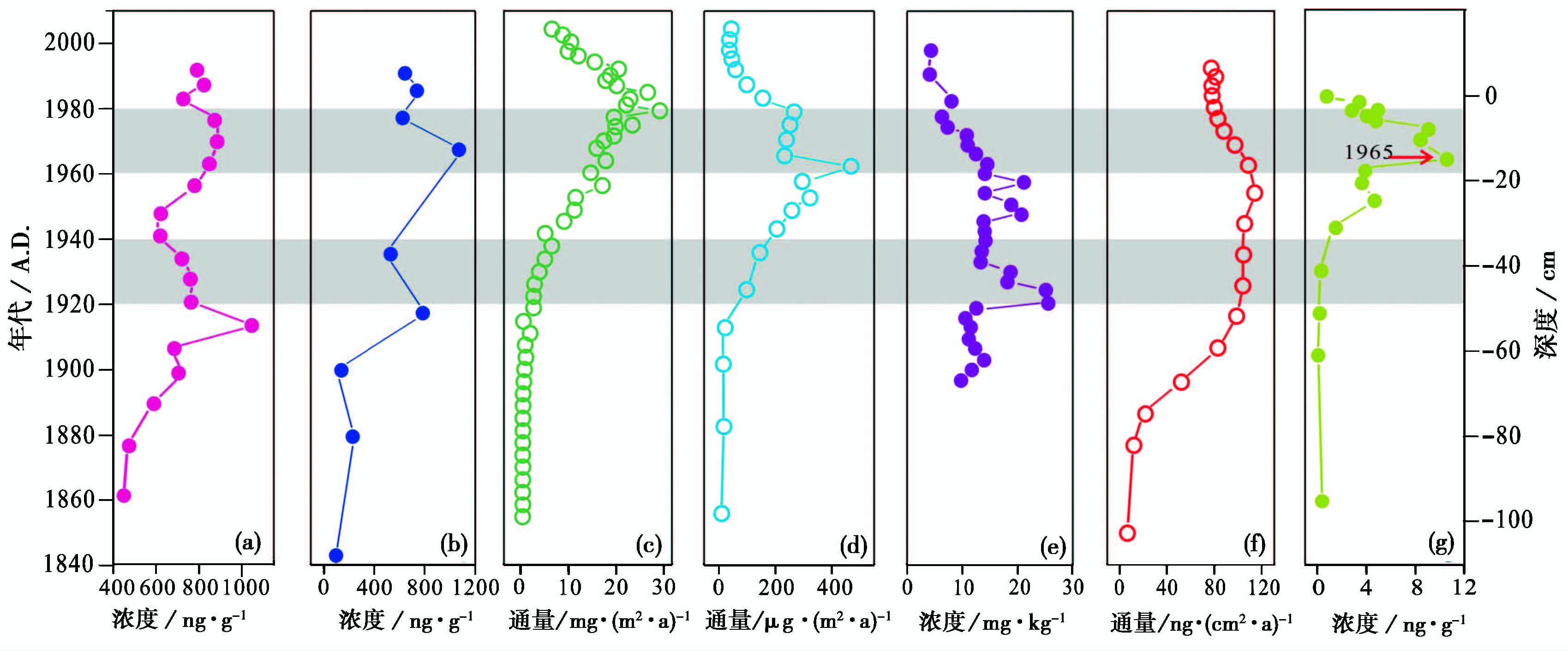
本研究统计了1900年至2010年我国各湖泊PAHs变化序列,从 图4可以看出,我国各湖泊沉积记录 PAHs从下向上总体都表现为由低到高的变化特征,基本对应了区域社会经济的发展。新中国成立之前,我国经济发展水平非常落后; 在沉积通量上,各湖泊沉积物PAHs通量在1900-1949年之间基本没有变化,相当于本底值。从新中国成立到1978年,虽然经历了短暂的经济复苏及产业结构调整,但文化大革命10年动乱导致我国经济发展缓慢,因此,此阶段我国湖泊沉积记录中只有部分湖泊PAHs沉积通量表现出微弱的增加趋势。改革开放之后,我国经济迅速发展,各个湖泊PAHs沉积通量均在1980年以后出现迅速升高的趋势,随着能源消费的急剧增加,相继出现峰值,峰值均出现在1990s以后,但是白洋淀在1990-2009年PAHs沉积通量出现下降趋势,虽然此时段该区经济仍为快速发展的趋势,但是据资料记载该湖区周边实施了一系列环境保护措施,如新建污水处理厂、 关闭重污染工厂(造纸厂、 化工厂)等,这些措施减少了白洋淀PAHs的点源污染,这可能是1990年以来,白洋淀PAHs呈现下降趋势的原因[70]。总体上东部湖泊(太湖、 白洋淀和东湖)峰值出现时间要略早于西部湖泊及较偏远区湖泊(博斯腾湖、 苏干湖、 程海及四海龙湾玛珥湖),这可能是由于中国改革开放优先发展东部及沿海地区经济的政策所致。而欧、 美及日本等发达国家和地区,湖泊沉积物PAHs的变化特征表现为(图5):20世纪早期PAHs沉积通量开始出现增加的趋势,20世纪50年代以后达到峰值,即使在欧洲一些较偏远地区及高山湖泊也在20世纪70到80年代出现峰值,随后PAHs沉积通量逐渐下降[95, 96, 97, 98, 99, 100, 101]。

|
图4 中国不同湖泊沉积物中PAHs浓度和沉积通量的垂直变化 实心代表浓度,空心代表沉积通量; 此图分别修改相关考文献[22, 23, 29, 32, 36, 56, 70] Fig.4 Vertical profiles of PAHs in different lakes from China. Solid circle: concentration; open circle: flux |
|
图5 不同国家湖泊沉积物中PAHs浓度和沉积通量的垂直变化 (a)欧洲高山湖泊Escura湖[95, 96]; (b)欧洲高山湖泊Redo湖[95, 96]; (c)英国坎布里亚郡偏远地区湖泊[97]; (d)瑞典Stora Frillingerl湖[98]; (e)日本Osaka湖[99]; (f)美国Michigan湖[100]; (g)美国Washingto湖[101] 实心代表浓度,空心代表沉积通量; 此图修改自相关文献[95, 96, 97, 98, 99, 100, 101] Fig.5 Vertical profiles of PAHs in different lakes from different countries. Solid circle: concentration; open circle: flux |
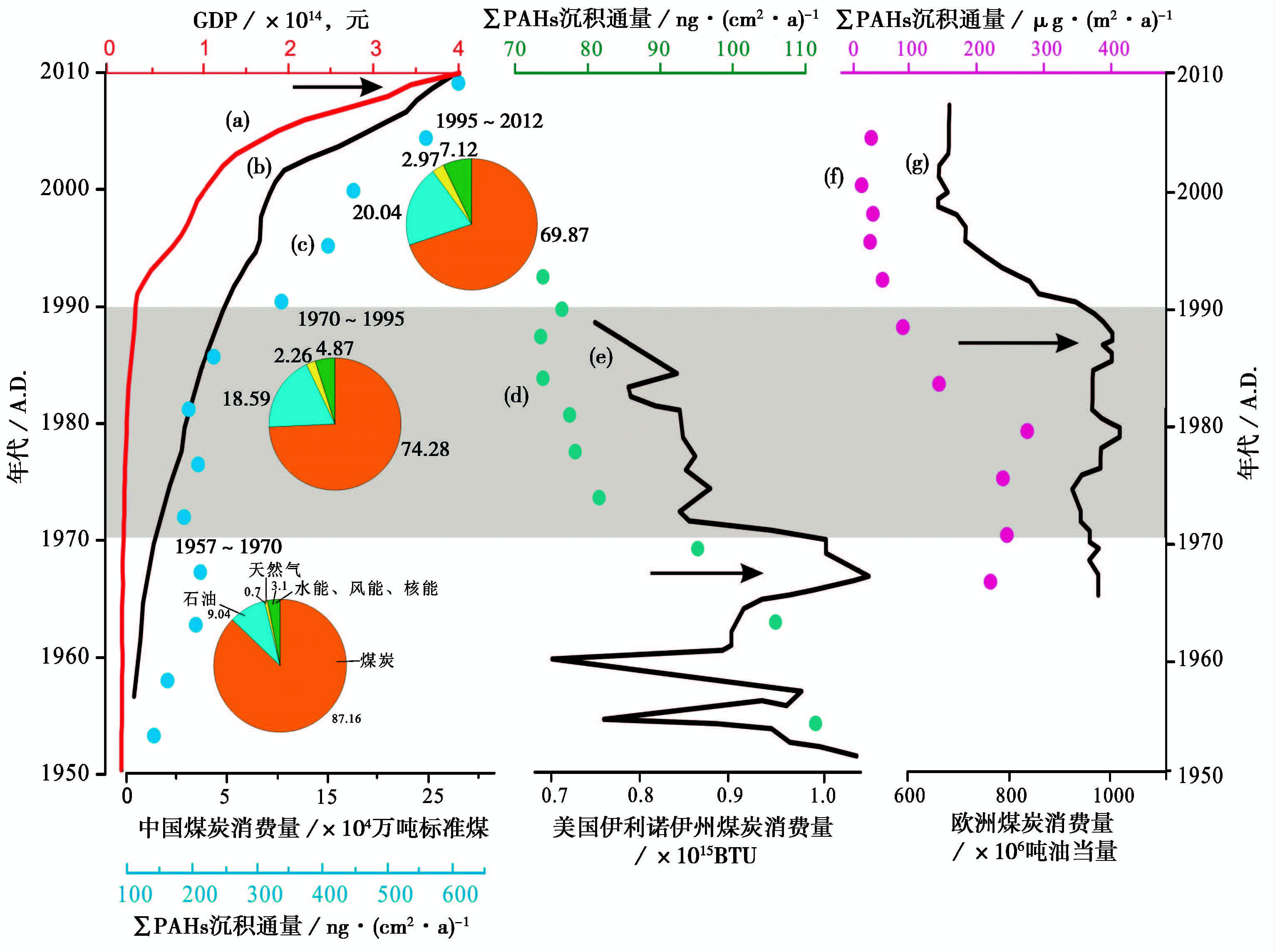
有很多研究指出煤炭消费是美国及英国环境PAHs的重要来源[98, 99, 100, 101, 102],本研究收集了中国、 欧洲及美国伊利诺伊州1950年以来的煤炭消费量,并分别与四海龙湾玛珥湖、 瑞典Stora Frillingen 湖及美国Michigan湖(图6)进行对比分析,发现各地区湖泊PAHs 沉积通量变化曲线与各地煤炭消费趋势极为相似,表明煤炭消费量对这些湖泊沉积物PAHs的变化有较大的影响。发达国家及地区湖泊沉积物PAHs沉积通量在20世纪50年代出现峰值,可能由工业革命以来能源消费总量及煤炭、 石油等化石燃料不断增加导致[97, 100]。自20世纪70-80年代以来出现的降低趋势则可能与近20年来发达国家和地区经历的能源结构的调整有关[97]。从1965 年至2009 年,世界能源结构从以煤炭和石油为主,过渡到了煤、 石油、 天然气及新能源等多种能源并存的阶段。在此期间,煤炭和石油所占比重下降了15 % ,而天然气和核电所占比重分别上升了8 % 和5 % [103]。同时环保意识的增强,如英国1956年和1968年发起的空气清洁行动,1980年的欧共体指令(European Community Directive,简称EEC)等相关政策都有助于PAHs排放量的减少[97]。
|
图6 不同国家和地区PAHs沉积通量与GDP发展水平、 煤炭消费量的历史记录 (a)中国GDPa; (b)中国历年煤炭消费量a; (c)中国四海龙湾玛珥湖PAHs沉积通量[22]; (d)美国Michigan湖PAHs沉积通量[100]; (e)美国伊利诺伊州历年煤炭消费量[100]; (f)瑞典Stora Frillingen湖[98]; (g)欧洲历年煤炭消费量b a http://data.stats.gov. cn/workspace/index?m=hgnd. b http://bp. com/statisticalreview Fig.6 Historical records of coal consumption,GDP and PAHs accumulation in different Lakes from different countries |
与发达国家相比,我国湖泊沉积物PAHs沉积通量的峰值出现时间较晚,表层沉积物PAHs浓度仍然较高,并没有出现下降的趋势。这可能与我国工业化和城市化进程晚于发达国家有关。我国湖泊沉积记录 PAH通量自1980s以来迅速增加反映了改革开放以来,我国社会经济发展水平及能源消费总量的快速增长。据统计(图6),自1957年至2012年,我国能源消费总量由最初的9644万吨标准煤增长到361732万吨标准煤(http://www.stats.gov.cn/)。能源消费的急剧增长导致PAHs排放量的持续增长。因此,我国湖泊钻孔记录的PAHs排放量在现阶段仍表现为增长的趋势。然而根据对各介质的研究,目前机动车尾气排放[16, 17, 18, 19]也已成为我国环境PAHs的主要来源之一,这也与本研究计算出的不同污染源贡献量结果一致,这种现象可能与以下原因有关: 一方面,建国之初我国煤炭消费量较高,20世纪50-70年代,中国煤炭消费占能源消费总量的87.2 % (http://www.stats.gov.cn/)。为了控制环境污染,中国政府从1990年就已经开始控制大城市煤炭消费总量。由于政策控制以及新能源的替代作用,1950s至今中国煤炭消费比重下降了20 % (http://www.stats.gov.cn/)。另一方面,改革开放以来,随着我国经济的高速发展,我国民用汽车保有量从1978年的135.8万辆上升到2012年的10933.1万辆(http://data.stats.gov.cn/workspace/index? m=hgnd),机动车数量的快速增加必然带来PAHs排放量的增加。这一点也从我国湖泊沉积记录中得到验证,本研究统计的大多数湖泊中(滇池、 四海龙湾玛珥湖、 东湖、 青海湖、 博斯腾湖、 洱海、 苏干湖等[22, 23, 26, 27, 28, 36]),PAHs组成结构发生变化,表现为低环物质的比重不断减少、 高环物质比重不断增加的趋势。 研究表明[26, 27, 28, 29],2-3环物质主要来源于低温燃烧过程(薪柴燃烧、 家庭用煤等),5-6环物质主要来源于高温燃烧过程(机动车尾气排放、 工业烧煤等)。PAHs组成结构的变化表明PAHs来源由以低温燃烧过程为主向以高温燃烧过程转变。据Guo等[23]的研究,我国西部湖泊沉积物记录的PAHs来源有明显变化,机动车尾气排放源,如BbF、 InP及BghiP等代表机动车尾气排放的特征化合物含量增长,而由家庭煤炭燃烧及薪柴燃烧产生的PAHs比重下降。
因此,我国湖泊沉积钻孔很好的记录了PAHs来源的变化,在我国工业化和城市化进程的初期及发展过程中使用的煤炭资源是我国部分湖泊沉积历史中PAHs的主要来源。随着社会经济发展、 机动车数量的增加,机动车尾气排放的PAHs在我国多数湖泊沉积记录中所占比重有所增长,表明随着社会经济发展PAHs来源有所变化,机动车尾气排放产生的PAHs也成为目前我国湖泊沉积物PAHs的主要来源之一。然而,目前我国的煤炭消费量较其他国家仍然属较高水平,据BP(British Petroleum)世界能源统计(http://www.bp.com/zh_cn/China/reports-and-publications/bp_2012.html),2012年中国煤炭消费总量占全球消费总量的50.2 % ,煤炭燃烧带来的PAHs排放量仍然不可忽视,加上机动车数量的持续增长,因此我国PAHs排放量需要进一步控制。
3 结论我国湖泊表层沉积物中 PAHs含量在3.2-5260ng/g(dw),平均值为753.1ng/g(dw)(n=495)。人口密度及经济发展水平等因素决定了中国表层沉积物空间分布特征。利用PCA/MLR计算出我国湖泊表层沉积物PAHs主要来源于机动车尾气排放、 煤炭燃烧及石油泄漏,其贡献量分别为42.7 % 、 30.1 % 和27.2 % 。与国外研究相比,我国湖泊表层沉积物PAHs污染处于中等偏上水平。
我国湖泊沉积物PAHs最大沉积通量为11.9-3128.7ng/cm2 ·a(n=8),平均值269.1ng/cm2 ·a(n=230)。各湖泊钻孔沉积记录 PAHs总体都表现为由低到高的变化特征,基本反映了我国社会经济发展历史。湖泊PAHs的历史沉积记录反映出我国PAHs排放历史与发达国家有着明显不同,PAHs排放峰值一般出现在20世纪90年代以后,明显晚于发达国家的50-80年代。同时,我国湖泊沉积物记录了PAHs来源发生变化,工业化和城市化进程中使用的煤炭资源是我国部分湖泊沉积历史中PAHs的主要来源。然而,随着机动车数量的增加,机动车尾气排放已成为目前我国湖泊沉积物PAHs主要污染源之一。
致谢 真诚地感谢审稿专家和编辑部老师提出的建设性修改意见; 感谢江苏省气候变化协同创新中心资助!
| 1 | Simcik M F, Offenberg J H. Persistent Organic Pollutants in the Great Lakes. Germany:Springer, 2006. 307~353 |
| 2 | Maliszewska-Kordybach B. Sources, concentrations, fate and effects of polycyclic aromatic hydrocarbons(PAHs)in the environment. Part A:PAHs in air. Polish Journal of Environmental Studies, 1999, 8 (3):131~136 |
| 3 | Punning J M, Terasmaa J, Vaasma T et al. Historical changes in the concentrations of polycyclic aromatic hydrocarbons(PAHs)in Lake Peipsi sediments. Environmental Monitoring and Assessment, 2008, 144 (1~3):131~141 |
| 4 | Perra G, Renzi M, Guerranti C et al. Polycyclic aromatic hydrocarbons pollution in sediments:Distribution and sources in a lagoon system(Orbetello, Central Italy). Transitional Waters Bulletin, 2010, 3 (1):45~58 |
| 5 | Kannan K, Johnson-Restrepo B, Yohn S S et al. Spatial and temporal distribution of polycyclic aromatic hydrocarbons in sediments from Michigan inland lakes. Environmental Science & Technology, 2005, 39 (13):4700~4706 |
| 6 | Liu S, Tao S, Liu W et al. Atmospheric polycyclic aromatic hydrocarbons in North China:A winter-time study. Environmental Science & Technology, 2007, 41 (24):8256~8261 |
| 7 | Vilanova R M, Fernández P, Mart'nez C et al. Polycyclic aromatic hydrocarbons in remote mountain lake waters. Water Research, 2001, 35 (16):3916~3926 |
| 8 | Zhang X, Christensen E R, Gin M F. Polycyclic aromatic hydrocarbons in dated sediments from Green Bay and Lake Michigan. Estuaries, 1993, 16 (3):638~652 |
| 9 | Tao S, Wang W, Liu W et al. Polycyclic aromatic hydrocarbons and organochlorine pesticides in surface soils from the Qinghai-Tibetan Plateau. Journal of Environmental Monitoring, 2011, 13 (1):175~181 |
| 10 | Li K, Christensen E R, Van Camp R P et al. PAHs in dated sediments of Ashtabula River, Ohio, USA. Environmental Science & Technology, 2001, 35 (14):2896~2902 |
| 11 | Rose N L, Rippey B. The historical record of PAH, PCB, trace metal and fly-ash particle deposition at a remote lake in north-west Scotland. Environmental Pollution, 2002, 117 (1):121~132 |
| 12 | Itoh N, Tamamura S, Kumagai M. Distributions of polycyclic aromatic hydrocarbons in a sediment core from the north basin of Lake Biwa, Japan. Organic Geochemistry, 2010, 41 (8):845~852 |
| 13 | Masclet P, Hoyau V, Jaffrezo J et al. Evidence for the presence of polycyclic aromatic hydrocarbons in the polar atmosphere and in the polar ice of Greenland. Analusis, 1995, 23 (6):250~252 |
| 14 | Zhang Y X, Tao S. Global atmospheric emission inventory of polycyclic aromatic hydrocarbons(PAHs)for 2004. Atmospheric Environment, 2009, 43 (4):812~819 |
| 15 | Xu S S, Liu W, Tao S. Emission of polycyclic aromatic hydrocarbons in China. Environmental Science & Technology, 2006, 40 (3):702~708 |
| 16 | Wang W, Massey Simonich S L, Xue M et al. Concentrations, sources and spatial distribution of polycyclic aromatic hydrocarbons in soils from Beijing, Tianjin and surrounding areas, North China. Environmental Pollution, 2010, 158 (5):1245~1251 |
| 17 | Liu L Y, Wang J Z, Wei G L et al. Polycyclic aromatic hydrocarbons(PAHs)in continental shelf sediment of China:Implications for anthropogenic influences on coastal marine environment. Environmental Pollution, 2012, 167 :155~162 |
| 18 | Guo Z G, Lin T, Zhang G et al. High-resolution depositional records of polycyclic aromatic hydrocarbons in the central continental shelf mud of the East China Sea. Environmental Science & Technology, 2006, 40 (17):5304~5311 |
| 19 | Guo Z G, Lin T, Zhang G et al. The sedimentary fluxes of polycyclic aromatic hydrocarbons in the Yangtze River Estuary coastal sea for the past century. Science of the Total Environment, 2007, 386 (1):33~41 |
| 20 | Liu L Y, Wang J Z, Wei G L et al. Sediment records of polycyclic aromatic hydrocarbons(PAHs)in the continental shelf of China: Implications for evolving anthropogenic impacts. Environmental Science & Technology, 2012, 46 (12):6497~6504 |
| 21 | 明荔莉, 李 军, 刘 向等. 若尔盖草原泥炭柱中多环芳烃的沉积记录. 第四纪研究, 2010, 30 (6):1145~1150 Ming Lili, Li Jun, Liu Xiang et al. Sedimentary record of polycyclic aromatic hydrocarbons in a peat core form the Zoigê peat bog. Quaternary Science, 2010, 30 (6):1145~1150 |
| 22 | Guan Y F, Sun J L, Ni H G et al. Sedimentary record of polycyclic aromatic hydrocarbons in a sediment core from a maar lake, Northeast China:Evidence in historical atmospheric deposition. Journal of Environmental Monitoring, 2012, 14 (9):2475~2481 |
| 23 | Guo J Y, Wu F C, Luo X J et al. Anthropogenic input of polycyclic aromatic hydrocarbons into five lakes in Western China. Environmental Pollution, 2010, 158 (6):2175~2180 |
| 24 | Xu J, Guo J Y, Liu G R et al. Historical trends of concentrations, source contributions and toxicities for PAHs in dated sediment cores from five lakes in Western China. Science of the Total Environment, 2014, 470 :519~526 |
| 25 | 郭建阳, 廖海清, 张 亮等. 青海湖沉积物中多环芳烃的沉积记录. 生态学杂, 2011, 30 (7):1467~1472 Guo Jianyang, Liao Haiqing, Zhang Liang et al. Historical records of sediment polycyclic aromatic hydrocarbons in Qinghai Lake, Northwest China. Chinese Journal of Ecology, 2011, 30 (7):1467~1472 |
| 26 | Wang X P, Yang H D, Gong P et al. One century sedimentary records of polycyclic aromatic hydrocarbons, mercury and trace elements in the Qinghai Lake, Tibetan Plateau. Environmental Pollution, 2010, 158 (10):3065~3070 |
| 27 | Guo J Y, Liang Z, Liao H Q et al. Sedimentary record of polycyclic aromatic hydrocarbons in Lake Erhai, Southwest China. Journal of Environmental Sciences, 2011, 23 (8):1308~1315 |
| 28 | 郭建阳, 王 静, 朱元荣等. 滇池沉积物中多环芳烃赋存状态及其再分配的初步研究. 地球与环境, 2014, 42 (001):11~16 Guo Jianyang, Wang Jing, Zhu Yuanrong et al. A primary investigation on the occurrence and redistribution of polycyclic aromatic hydrocarbons in sediments from Dianchi Lake, Southwest China. Earth and Environment, 2014, 42 (001):11~16 |
| 29 | Guo J Y, Wu F C, Liao H Q et al. Sedimentary record of polycyclic aromatic hydrocarbons and DDTs in Dianchi Lake, an urban lake in Southwest China. Environmental Science and Pollution Research, 2013, 20 (8):5471~5480 |
| 30 | 李秋华, 郭建阳, 朱元荣等. 滇池PAHs的沉积记录、来源及其生态风险评估. 环境科学学报, 2013, 33 (9):2565~2572 Li Qiuhua, Guo Jianyang, Zhu Yuanrong et al. Sedimentary record sources and risk assessment of polycyclic aromatic hydrocarbons in Dianchi Lake Southwest China. Acta Scientiae Circumstantiae, 2013, 33 (9):2565~2572 |
| 31 | 罗世霞, 朱淮武, 张笑一等. 红枫湖表层沉积物中多环芳烃的分布及来源分析. 江西师范大学学报: 自然科学版, 2009, 33 (1):119~123 Luo Shixia, Zhu Huaiwu, Zhang Xiaoyi et al. Distribution and sources of polycyclic aromatic hydrocarbons in surface sediments from Hongfeng Lake. Journal of Jiangxi Normal University (Natural Science), 2009, 33 (1):119~123 |
| 32 | Guo J Y, Wu F C, Zhang L et al. Screening level of PAHs in sediment core from Lake Hongfeng, Southwest China. Archives of Environmental Contamination and Toxicology, 2011, 60 (4):590~596 |
| 33 | 李秋华, 郭建阳, 朱元荣等. 红枫湖多环芳烃的高分辨沉积记录. 生态学杂志, 2013, 32 (9):2424~2432 Li Qiuhua, Guo Jianyang, Zhu Yuanrong et al. High-resolution sedimentary records of polycyclic aromatic hydrocarbons in Hongfeng Lake of Southwest China. Chinese Journal of Ecology, 2013, 32 (9):2424~2432 |
| 34 | 李 勇, 董 娴, 张颂富等. 百花湖水库表层沉积物中PAHs生态风险. 湖北农业科学, 2013, 52 (6):1280~1283 Li Yong, Dong Xian, Zhang Songfu et al. Ecological risk assessment of PAHs in surface sediments from Baihua reservoir, Guizhou Province. Hubei Agricultural Science, 2013, 52 (6):1280~1283 |
| 35 | 张光贵. 大通湖表层沉积物中多环芳烃的含量、来源与生态风险评估. 水生态学杂志, 2014, 35 (1):46~49 Zhang Guanggui. Concentrations, sources and ecological risk assessment of polycyclic aromatic hydrocarbons in surface sediments from Datong Lake. Journal of Hydroecology, 2014, 35 (1):46~49 |
| 36 | Yang Z F, Tang Z W, Shen Z Y et al. One-hundred-year sedimentary record of polycyclic aromatic hydrocarbons in urban lake sediments from Wuhan, Central China. Water, Air, & Soil Pollution, 2011, 217 (1~4):577~578 |
| 37 | 刘建华, 祁士华, 张 干等. 湖北梁子湖沉积物正构烷烃与多环芳烃对环境变迁的记录. 地球化学, 2005, 33 (5):501~506 Liu Jianhua, Qi Shihua, Zhang Gan et al. Response of the n-alkanes and polycyclic aromatic hydrocarbons records in sediments from Lake Liangzi to the environmental change. Geochimica, 2005, 33 (5):501~506 |
| 38 | Lu M, Zeng D C, Liao Y et al. Distribution and characterization of organochlorine pesticides and polycyclic aromatic hydrocarbons in surface sediment from Poyang Lake, China. Science of the Total Environment, 2012, 433 :491~497 |
| 39 | Wu F, Xu L, Sun Y et al. Exploring the relationship between polycyclic aromatic hydrocarbons and sedimentary organic carbon in three Chinese lakes. Journal of Soils and Sediments, 2012, 12 (5):774~783 |
| 40 | 刘国卿, 彭先芝, 张 干等. 南岭山地湖泊多环芳烃的大气沉降历史记录. 地球化学, 2007, 36 (4):357~362 Liu Guoqing, Peng Xianzhi, Zhang Gan et al. Sedimentary records of atmospheric deposition of polycyclic aromatic hydrocarbons in a reservoir in Nanling Mountains, South China. Geochimica, 2007, 36 (4):357~362 |
| 41 | 张 明, 唐访良, 吴志旭等. 千岛湖表层沉积物中多环芳烃污染特征及生态风险评价. 中国环境科学, 2014, 34 (1):253~258 Zhang Ming, Tang Fangliang, Wu Zhixu et al. Pollution characteristics and ecological risk assessment of polycyclic aromatic hydrocarbons(PAHs)in surface sediments from Xin'anjiang Reservoir. China Environmental Science, 2014, 34 (1):253~258 |
| 42 | Wang J Z, Zhang K, Liang B et al. Occurrence, source apportionment and toxicity assessment of polycyclic aromatic hydrocarbons in surface sediments of Chaohu, one of the most polluted lakes in China. Journal of Environmental Monitoring, 2011, 13 (12):3336~3342 |
| 43 | 宁 怡, 柯用春, 邓建才等. 巢湖表层沉积物中多环芳烃分布特征及来源. 湖泊科学, 2012, 24 (6):891~898 Ning Yi, Ke Yongchun, Deng Jiancai et al. Distribution and source of polycyclic aromatic hydrocarbons(PAHs)in surface sediment in Lake Chaohu. Journal of Lake Sciences, 2012, 24 (6):891~898 |
| 44 | 丁文文, 韦 萍. 徐州市云龙湖沉积物中多环芳烃的污染研究. 安徽农业科学, 2008, 35 (34):11197~11198 Ding Wenwen, Wei Ping. Study on the pollution of polycyclic aromatic hydrocarbons in the sediment of Yunlong Lake in Xuzhou City. Journal of Anhui Agricultual Science, 2008, 35 (34):11197~11198 |
| 45 | 舒卫先, 李世杰. 江苏天目湖表层沉积物中多环芳烃污染特征与来源. 长江流域资源与环境, 2009, 18 (1):27~32 Shu Weixian, Li Shijie. Characteristics and sources of polycyclic aromatic hydrocarbons(PAHs)in sediment Tianmu Lake, Jiangsu Province. Resources and Environment in the Yangtze Basin, 2009, 18 (1):27~32 |
| 46 | Qiao M, Wang C X, Huang S B et al. Composition, sources, and potential toxicological significance of PAHs in the surface sediments of the Meiliang Bay, Taihu Lake, China. Environment International, 2006, 32 (1):28~33 |
| 47 | 舒卫先, 李世杰. 太湖流域典型湖泊表层沉积物中多环芳烃污染特征. 农业环境科学学报, 2008, 27 (4):1409~1414 Shu Weixian, Li Shijie. Pollution characteristics of polycyclic aromatic hydrocarbons(PAHs)in the surface sediment from two typical lakes in the Taihu basin. Journal of Agro-Environment Science, 2008, 27 (4):1409~1414 |
| 48 | 陈燕燕, 尹 颖, 王晓蓉等. 太湖表层沉积物中 PAHs 和 PCBs 的分布及风险评价. 中国环境科学, 2009, 29 (2):118~124 Chen Yanyan, Yi Ying, Wang Xiaorong et al. Polycyclic aromatic hydrocarbons and polychlorinated biphenyl in surface sediments of Taihu Lake:The distribution, sources and risk assessment. China Environmental Science, 2009, 29 (2):118~124 |
| 49 | 武江越, 刘征涛, 冯 流等. 太湖表层沉积物中PAHs的空间分布及风险评价. 环境科学研究, 2012, 25 (4):391~396 Wu Jianyue, Liu Zhengtao, Feng Liu et al. Spatial distribution and risk assessment of polycyclic aromatic hydrocarbons in partical surface sediment of Taihu Lake. Research of Environmental Science, 2012, 25 (4):391~396 |
| 50 | 袁旭音, 李阿梅, 王 禹等. 太湖表层沉积物中的多环芳烃及其毒性评估. 河海大学学报: 自然科学版, 2005, 32 (6):607~610 Yuan Xuyin, Li Amei, Wang Yu et al. Polycyclic aromatic hydrocarbons in sediments from Taihu Lake and their toxicity evaluation. Journal of Hohai University(Natural Sciences), 2005, 32 (6):607~610 |
| 51 | Zhang Y, Lu Y, Xu J et al. Spatial distribution of polycyclic aromatic hydrocarbons from Lake Taihu, China. Bulletin of Environmental Contamination and Toxicology, 2011, 87 (1):80~85 |
| 52 | Zhang Y, Shi G L, Guo C S et al. Seasonal variations of concentrations, profiles and possible sources of polycyclic aromatic hydrocarbons in sediments from Taihu Lake, China. Journal of Soils and Sediments, 2012, 12 (6):933~941 |
| 53 | Tao Y Q, Yao S C, Xue B et al. Polycyclic aromatic hydrocarbons in surface sediments from drinking water sources of Taihu Lake, China:Sources, partitioning and toxicological risk. Journal of Environmental Monitoring, 2010, 12 (12):2282~2289 |
| 54 | 李玉斌, 刘征涛, 冯 流等. 太湖部分沉积物中多环芳烃生态风险评估. 环境化学, 2011, 30 (10):1769~1774 Li Yubin, Liu Zhengtao, Feng Liu et al. Ecological risk assessment of PAHs in the sediments from Taihu Lake. Environmental Chemistry, 2011, 30 (10):1769~1774 |
| 55 | 林海涛. 太湖沉积物中多环芳烃(PAHs)的沉积记录及环境安全性研究. 中国水运, 2010, 10 (10):163~164 Lin Haitao. The sediment record of polycyclic aromatic hydrocarbons(PAHs)and risk assessment in Taihu Lake. China Water Transport, 2010, 10 (10):163~164 |
| 56 | 刘国卿, 张 干, 金章东等. 太湖多环芳烃的历史沉积记录. 环境科学学报, 2006, 26 (6):981~986 Liu Guoqing, Zhang Gan, Jin Zhangdong et al. Sedimentary record of polycyclic aromatic hydrocarbons in the Taihu Lake. Acta Scientiae Circumstantiae, 2006, 26 (6):981~986 |
| 57 | 刘楠楠, 陈 鹏, 朱淑贞等. 辽河和太湖沉积物中 PAHs 和 OCPs 的分布特征及风险评估. 中国环境科学, 2011, 31 (2):293~300 Liu Nannan, Chen Peng, Zhu Shuzhen. Distribution characteristics of PAHs and OCPs in sediments of Liaohe River and Taihu Lake and their risk evaluation based on sediment quality criteria. China Environmental Science, 2011, 31 (2):293~300 |
| 58 | Liu G Q, Zhang G, Jin Z D et al. Sedimentary record of hydrophobic organic compounds in relation to regional economic development:A study of Taihu Lake, East China. Environmental Pollution, 2009, 157 (11):2994~3000 |
| 59 | Peng X Z, Zhang G, Zheng L P et al. The vertical variations of hydrocarbon pollutants and organochlorine pesticide residues in a sediment core in Lake Taihu, East China. Geochemistry:Exploration, Environment, Analysis, 2005, 5 (1):99~104 |
| 60 | Zhang Y, Guo C S, Xu J et al. Potential source contributions and risk assessment of PAHs in sediments from Taihu Lake, China:Comparison of three receptor models. Water Research, 2012, 46 (9):3065~3073 |
| 61 | 梅卫平, 阮慧慧, 吴 昊等. 滴水湖水系沉积物中多环芳烃的分布及风险评价. 中国环境科学, 2013, 33 (11):2069~2074 Mei Weiping, Ruan Huihui, Wu Hao et al. Distribution and ecological risk assessment of polycyclic aromatic hydrocarbons in sediments from Dishui Lake water system. China Environmental Science, 2013, 33 (11):2069~2074 |
| 62 | 郑 曦, 姚俊华, 蒋 欢等. 骆马湖表层沉积物中多环芳烃的分布及风险评价. 安徽农业科学, 2010, 38 (20):10858~10861 Zheng Xi, Yao Junhua, Jiang Huan et al. Distribution and risk assessment of polycyclic aromatic hydrocarbons in surface sediments from Luoma Lake. Journal of Anhui Agricultual Science, 2010, 38 (20):10858~10861 |
| 63 | 刘 哲, 张玉山, 苏治中等. 南四湖表层沉积物中 PAHs 的分布、来源及变化分析. 中国人口资源与环境, 2010, 20 (6):136~140 Liu Zhe, Zhang Yushan, Su Zhizhong et al. Distributions, sources and trends of polycyclic aromatic hydrocarbons in surface sediment in Nansihu Lake. China Population, Resources and Environment, 2010, 20 (6):136~140 |
| 64 | 史双昕, 杨永亮, 石 磊. 南四湖表层沉积物中多环芳烃的分布及其来源. 青岛大学学报: 工程技术版, 2006, 20 (4):95~99 Shi Shuangxin, Yang Yongliang, Shi Lei. The distributions and sources of polycyclic aromatic hydrocarbons in surface sediments of the Nansi Lake. Journal of Qingdao University (E & T), 2006, 20 (4):95~99 |
| 65 | 孙媛媛, 张祖陆, 李 爽. 南四湖表层底泥中多环芳烃有机污染及其生态风险研究. 水土保持研究, 2012, 19 (4):142~146 Sun Yuanyuan, Zhang Zulu, Li Shuang. Organic pollution and ecological risk of PAHs in the surface sediment of Nansihu Lake, Shandong Province of China. Research of Soil and Water Conservation, 2012, 19 (4):142~146 |
| 66 | 朱 晨, 李红莉, 高 虹等. 南四湖上级湖表层沉积物中多环芳烃的含量及分布特征. 中国环境监测, 2009, 25 (2):75~78 Zhu Chen, Li Hongli, Gao Hong et al. Concentrations and distribution characteristic of PAHs in surface sediments of Nansi Lake. Environmental Monitoring in China, 2009, 25 (2):75~78 |
| 67 | Li H L, Gao H, Zhu C et al. Spatial and temporal distribution of polycyclic aromatic hydrocarbons(PAHs)in sediments of the Nansi Lake, China. Environmental Monitoring and Assessment, 2009, 154 (1~4):469~478 |
| 68 | 刘海珍, 刘道辰, 陈诗越. 东平湖表层沉积物中PAHs来源分析及生态风险评价. 环境工程, 2014, doi:10.13205/j.higc. 201401030 :126~127 Liu Haizhen, Liu Daochen, Chen Shiyue. The source and ecological risk assessment of PAHs in surface sediments of Dongping Lake. Environmental Engineering, 2014, doi:10.13205/j.higc.201401030 :126~127 |
| 69 | 郑 曦, 韩宝平. 微山湖表层沉积物中多环芳烃的分布及风险评价. 农业环境科学学报, 2010, 29 (11):2185~2191 Zheng Xi, Han Baoping. Content analysis and assessment of polycyclic aromatic hydrocarbons in surface sediments from Weishan Lake, China. Journal of Agro-Environment Science, 2010, 29 (11):2185~2191 |
| 70 | Guo W, Pei Y S, Yang Z F et al. Historical changes in polycyclic aromatic hydrocarbons(PAHs)input in Lake Baiyangdian related to regional socio-economic development. Journal of Hazardous Materials, 2011, 187 (1):441~449 |
| 71 | Hu G C, Luo X J, Li F C et al. Organochlorine compounds and polycyclic aromatic hydrocarbons in surface sediment from Baiyangdian Lake, North China:Concentrations, sources profiles and potential risk. Journal of Environmental Sciences, 2010, 22 (2):176~183 |
| 72 | 胡国成, 郭建阳, 罗孝俊等. 白洋淀表层沉积物中多环芳烃的含量、分布、来源及生态风险评价. 环境科学研究, 2009, 22 (3):321~326 Hu Guocheng, Guo Jianyang, Luo Xiaojun et al. Distribution, sources and risk assessment of polycyclic aromatic hydrocarbons(PAHs)in surface sediments from Baiyangdian Lake. Research of Environmental Sciences, 2009, 22 (3):321~326 |
| 73 | 周怀东, 赵 健, 陆 瑾等. 白洋淀湿地表层沉积物多环芳烃的分布、来源及生态风险评价. 生态毒理学报, 2008, 3 (3):291~299 Zhou Huaidong, Zhao Jian, Lu Jin et al. Distribution, sources and ecological risk assessment of polycyclic aromatic hydrocarbons in sediments from Baiyangdian wetland. Asian Journal of Ecotoxicology, 2008, 3 (3):291~299 |
| 74 | 朱 樱, 吴文婧, 王军军等. 小白洋淀水-沉积物系统多环芳烃的分布、来源与生态风险. 湖泊科学, 2009, 21 (5):637~646 Zhu Ying, Wu Wenjing, Wang Junjun et al. Distribution, sources and ecological risks of polycyclic aromatic hydrocarbons in water-sediment system in Lake Small Baiyangdian. Journal of Lake Sciences, 2009, 21 (5):637~646 |
| 75 | Sun L, Zang S Y, Sun H J. Sources and history of PAHs in lake sediments from oil-producing and industrial areas, Northeast China. International Journal of Environmental Science and Technology, 2014, 11 (7):2051~2060 |
| 76 | Sun L, Zang S. Relationship between polycyclic aromatic hydrocarbons(PAHs)and particle size in dated core sediments in Lake Lianhuan, Northeast China. Science of the Total Environment, 2013, 461 :180~187 |
| 77 | Tobiszewski M, Namiesnik J. PAH diagnostic ratios for the identification of pollution emission sources. Environmental Pollution, 2012, 162 :110~119 |
| 78 | Golobo anin D D, krbi Ac'1 B D, Miljevi Ac'1 N R. Principal component analysis for soil contamination with PAHs. Chemometrics and Intelligent Laboratory Systems, 2004, 75 (13):1533~1536 |
| 79 | 朱利中, 王 静, 杜 烨等. 汽车尾气中多环芳烃(PAHs)成分谱图研究. 环境科学, 2003, 3 (24):26~29 Zhu Lizhong, Wang Jing, Du Ye et al. Research on PAHs fingerprints of vehicle discharges. Environment Science, 2003, 3 (24):26~29 |
| 80 | Larsen R K, Baker J E. Source apportionment of polycyclic aromatic hydrocarbons in the urban atmosphere:A comparison of three methods. Environmental Science & Technology, 2003, 37 (9):1873~1881 |
| 81 | 朱先磊, 刘维立. 燃煤烟尘多环芳烃成分谱特征的研究. 环境科学研究, 2001, 14 (5):4~8 Zhu Xianlei, Liu Weili. Study on the characteristics of PAHs source profile of coal combustion. Research of Environmental Sciences, 2001, 14 (5):4~8 |
| 82 | 于国光, 王铁冠, 吴大鹏. 薪柴燃烧源和燃煤源中多环芳烃的成分谱研究. 生态环境, 2007, 16 (2):285~289 Yu Guoguang, Wang Tieguan, Wu Dapeng. Study on fingerprints of PAHs from the combustion of bavin and coal. Ecology and Environment, 2007, 16 (2):285~289 |
| 83 | 朱先磊, 刘维立, 卢妍妍等. 民用燃煤、焦化厂和石油沥青工业多环芳烃源成分谱的比较研究. 环境科学学报, 2002, 22 (2):199~203 Zhu Xianlei, Liu Weili, Lu Yanyan et al. A comparison of PAHs source profiles of domestic coal combustion, coke plant and petroleum asphalt industry. Acta Scientiae Circumstantiae, 2002, 22 (2):199~203 |
| 84 | 朱先磊, 王玉秋. 焦化厂多环芳烃成分谱特征的研究. 中国环境科学, 2001, 21 (3):266~269 Zhu Xianlei, Wang Yuqiu. Study on the characteristics of PAHs source profile of coke plant. China Environmental Science, 2001, 21 (3):266~269 |
| 85 | Mastral A M, Callen M, Murillo R. Assessment of PAH emissions as a function of coal combustion variables. Fuel, 1996, 75 (13):1533~1536 |
| 86 | Khalili N R, Scheff P A, Holsen T M. PAH source fingerprints for coke ovens, diesel and, gasoline engines, highway tunnels, and wood combustion emissions. Atmospheric Environment, 1995, 29 (4):533~542 |
| 87 | Smirnov A, Abrajano Jr T A, Smirnov A et al. Distribution and sources of polycyclic aromatic hydrocarbons in the sediments of Lake Erie, Part 1. Spatial distribution, transport, and deposition. Organic Geochemistry, 1998, 29 (5):1813~1828 |
| 88 | Furlong E T, Cessar L R, Hites R A. Accumulation of polycyclic aromatic hydrocarbons in acid sensitive lakes. Geochimicaet Cosmochimica Acta, 1987, 51 (11):2965~2975 |
| 89 | Helfrich J, Armstrong D E. Polycyclic aromatic hydrocarbons in sediments of the southern basin of Lake Michigan. Journal of Great Lakes Research, 1986, 12 (3):192~199 |
| 90 | Ok G, Shirapova G, Matafonova G et al. Characteristics of PAHs, PCDD/Fs, PCBs and PBDEs in the sediment of Lake Baikal, Russia. Polycyclic Aromatic Compounds, 2013, 33 (2):173~192 |
| 91 | Barra R, Popp P, Quiroz R et al. Polycyclic aromatic hydrocarbons fluxes during the past 50 years observed in dated sediment cores from Andean Mountain lakes in central south Chile. Ecotoxicology and Environmental Safety, 2006, 63 (1):52~60 |
| 92 | Jiao L, Zheng G J, Minh T B et al. Persistent toxic substances in remote lake and coastal sediments from Svalbard, Norwegian Arctic:Levels, sources and fluxes. Environmental Pollution, 2009, 157 (4):1342~1351 |
| 93 | Barakat A O, Mostafa A, El-Sayed N B et al. Polycyclic aromatic hydrocarbons(PAHs)in surface sediments of Lake Manzala, Egypt. Soil and Sediment Contamination:An International Journal, 2013, 22 (3):315~331 |
| 94 | Tundo P, Raccanelli S, Reda L A et al. Distribution of polychlorinated dibenzo-p-dioxins, polychlorinated dibenzofurans, dioxin-like polychlorinated biphenyl and polycyclic aromatic hydrocarbons in the sediment of Temsah Lake, Suez Canal, Egypt. Chemistry and Ecology, 2004, 20 (4):257~265 |
| 95 | Fernandez P, Vilanova R M, Grimalt J O. Sediment fluxes of polycyclic aromatic hydrocarbons in European high altitude mountain lakes. Environmental Science & Technology, 1999, 33 (21):3716~3722 |
| 96 | Fernández P, Vilanova R M, Martínez C et al. The historical record of atmospheric pyrolytic pollution over Europe registered in the sedimentary PAH from remote mountain lakes. Environmental Science & Technology, 2000, 34 (10):1906~1913 |
| 97 | Gevao B, Jones K C, Hamilton-Taylor J. Polycyclic aromatic hydrocarbon(PAH)deposition to and processing in a small rural lake, Cumbria UK. Science of the Total Environment, 1998, 215 (3):231~242 |
| 98 | Elmquist M, Zencak Z, Gustafsson Ö. A 700 year sediment record of black carbon and polycyclic aromatic hydrocarbons near the EMEP air monitoring station in Aspvreten, Sweden. Environmental Science & Technology, 2007, 41 (20):6926~6932 |
| 99 | Ishitake M, Moriwaki H, Katahira K et al. Vertical profile of polycyclic aromatic hydrocarbons in a sediment core from a reservoir in Osaka City. Environmental Geology, 2007, 52 (1):123~129 |
| 100 | Simcik M F, Eisenreich S J, Golden K A et al. Atmospheric loading of polycyclic aromatic hydrocarbons to Lake Michigan as recorded in the sediments. Environmental Science & Technology, 1996, 30 (10):3039~3046 |
| 101 | Wakeham S G, Forrest J, Masiello C A et al. Hydrocarbons in Lake Washington sediments:A 25-year retrospective in an urban lake. Environmental Science & Technology, 2004, 38 (2):431~439 |
| 102 | Harrison R M, Smith D J T, Luhanal L. Source apportionment of atmospheric polycyclic aromaric hydrocarbons collected from urban location in Birmingham U. K. Environmental Science & Technology, 1996, 30 (3):825~832 |
| 103 | 廖春良. "十二五" 时期中国能源结构的演变. 上海经济, 2010, 12 (12):40~43 Liao Chunliang. The evolution of Chinas energy structure during the "Twelve-Five-Year Plan". Shanghai Economy, 2010, 12 (12):40~43 |
Abstract
Lake surface sediments can reflect spatial distribution of Polycyclic aromatic hydrocarbons (PAHs) in regional scale, and deep lake sediments are very useful in unraveling historical environmental contamination. Therefore, it is essential to comprehensive understanding the PAHs pollution in lake sediments.
In this study, the characteristic of pollution status and components of PAHs in lake sediments of China were reviewed. Data from the developed countries were also selected for comparison. Statistical analysis on the collected data showed that the total PAHs concentrations (sum of 16 PAH compounds) in Chinese lake surface sediments varied greatly depending on the sampling location and ranged from 3.2ng/g to 5260ng/g (n=495) dry weigh with a mean concentration of 753.1ng/g (dw). In general, the concentration of total PAHs correlated significantly with local population density (R2=0.80, p<0.01) and GDP (R2=0.79, p<0.01) for each lake. To estimate the source of the PAHs in the lake sediments of China, four specific PAH ratios were calculated for the studied samples: Ant/(Ant+Phe), BaA/(Chr+BaA),(Fla+Pyr) and InP/(InP+BghiP). Vehicles emission, coal combustion and spillage of petroleum were apportioned to be the main sources of PAHs in lake surface sediments of China by principal component analysis, which contributed 42.7%、30.1% and 27.2% to the sources estimated by further multiple linear regression. Compared with foreign researches, the pollution level of surface sediments in China is above the average.
The maximum sediment flux from different lakes ranged from 11.9ng/cm2 ·a to 3128.7ng/cm2 ·a(n=8), and the mean flux of different lakes is 269.1ng/cm2 ·a(n=230). The characteristics of changes in lake sediment cores from China roughly find a change from low to high, which basically reflected the regional economic development history. The temporal trends of PAHs in the sediment cores from China were different from those reported in developed countries, such as Europe, the United State and Japan. The flux of PAHs generally reached the maximum in the 1990s in China, and the period (1950s~1980s) in which PAHs started to decrease in developed countries is the very period that PAHs started to increase sharply in China. This may due to that the process of industrialization in China were later than that in developed countries. Historical coal consumption correlated well with the historical PAHs accumulation rates over the same time period in most China lake sediments, indicating coal consumption during the industrialization and urbanization in China was the major source for PAHs in Chinese lake sediments. But with fast increase in the number of motor vehicles, vehicle emission of PAHs has become one of the main sources of lake sediments in our country at present.