 2015, Vol.35


气候变化与构造运动是山前砾石层形成与进积的主要控制因素[1],砾石层堆积所反映的地表快速侵蚀过程可以为研究地貌演化、 构造运动和气候变化提供重要证据[2]。在青藏高原北缘地区塔里木盆地周缘、 天山和昆仑山山前盆地中,广泛发育和出露了一套晚新生代砾石沉积,即西域砾岩,其作为晚新生代地层的重要部分,主要由巨厚层、 冲-洪积相砂砾石层组成[3, 4]。大量研究表明,其形成与进积反映了青藏高原北缘构造抬升导致的地表剥蚀,以及由气候剧变引起的源区侵蚀作用二者加速的共同作用[5, 6, 7, 8, 9, 10, 11, 12, 13, 14, 15, 16, 17, 18, 19, 20, 21, 22]。因此对这套晚新生代地层的研究可以为青藏高原北麓晚第三纪到更新世隆升提供重要的构造和气候信息。
西域砾岩作为一个地层单位最早见于20世纪40年代黄汲清等对塔里木盆地北缘、 天山南麓库车地区新生代地质调查[23]。对于其成因和时代的研究一直是学术界的热点,其成因目前主要有两种观点:Zhang等[13]认为西域砾岩堆积是发育于第三纪红层之上一套上新世晚期至第四纪的磨拉石建造,是晚新生代全球气候变冷和气候从稳定状态变至大幅度、 高频率动荡状态的产物; Sun等[16]研究认为天山山前早更新世的西域砾岩是第四纪冰川作用(气候变冷)与新构造运动共同作用下的产物。对西域砾岩形成时代的研究主要是通过古生物化石和磁性地层学方法: 早在20世纪70年代在安集海剖面的西域砾岩层底部曾发现早更新世的三门马化石[24],之后不同学者对多个西域砾岩地点开展了磁性地层学研究[5, 8, 11, 14, 16, 17, 19, 20, 21, 25]。陈华慧等[25]对北天山独山子剖面的磁性地层学研究认为西域砾岩的底界年龄为2.9Ma,Sun 等[16, 17]对同一地区西域砾岩剖面的研究显示其底界正好位于松山和高斯极性期的界线位置,由此得出其底界年龄约为2.58Ma; Charreau等[26]对该地区奎屯剖面的磁性地层学研究则认为西域砾岩的底界年龄约为4.8Ma。腾志宏等[5]对南天山山前库车河剖面西域砾岩的研究认为其堆积时间跨度为3.4-1.5Ma。Zheng等[11]对帕米尔-西昆仑山前的叶城剖面的研究显示西域砾岩的起止时代约为3.5-1.8Ma。陈杰等[7, 8, 14]对塔里木盆地西北缘西南天山山前的多个剖面的西域砾岩进行了磁性地层学研究,其中博古孜河剖面,底界磁性地层学年龄约为1.9Ma,明尧勒和喀什西两个剖面西域砾岩的起始沉积时间约为1.6Ma; Charreau 等[21] 和 Huang等[20]对塔里木盆地库车坳陷内亚哈剖面的磁性地层学研究均认为该地区西域砾岩开始堆积的时间约为1.7Ma。另外,近年来国外还有学者通过对有磁性地层学年龄控制的西域砾岩剖面沉积物的10 Be浓度分析来研究古侵蚀速率[22]。尽管不同学者对不同地区的西域砾岩开展了大量的磁性地层年代测定工作,但对于西域砾岩这套标志性地层堆积的底界年龄和时间跨度尚不十分明确。
目前对晚新生代砾石层的测年主要采用地层对比、 古生物化石或磁性地层学的方法。其中,古生物地层学方法是研究地层中古生物化石动物群组成,其可以作为判断化石出土层位地层时代的标志[27],但化石在砾石层中往往不易保存,所以在野外通过寻找动物化石来判断砾石层年代带有很大的偶然性; 磁性地层学方法是通过将地层剖面整个沉积过程内所记录的地磁场反转序列即磁性地层与标准地磁极性年表做对比来获得地层剖面的年代框架[28, 29, 30, 31, 32]。由于磁性地层学测年的对象主要为细粒沉积物,在对砾石剖面进行测年时只能对砾石层中夹杂的细粉砂做采样分析,或采用地层追踪的方法在周边区域寻找与砾石地层相当的细粒地层开展磁性地层研究,因此在缺乏细粒沉积夹层的剖面中年代学工作难以展开。同时,对于可能存在沉积间断或缺失的砾石地层,磁性地层学年代结果可能难以令人信服。另有一些沉积物测年方法如电子自旋共振法(Electron Spin Resonance,简称ESR)主要是针对经过日光暴晒的风成或水成砂质沉积物进行测年[33, 34],但样品测年信号是否归零难以准确评估[35]。因此,直接对西域砾岩中快速堆积的砾石样品开展年代学研究就需要寻找一种更可靠的测年手段。而宇宙成因核素埋藏测年方法能够直接对砾石样品进行年代测定,是一种颇具潜力的地质同位素测年方法。本文即是对宇宙成因核素 26Al/10Be埋藏测年应用于西域砾岩堆积年代学研究的一次探索与尝试。
1 研究方法宇宙成因核素 26Al/10Be埋藏测年方法是近年来发展和完善起来的一种同位素测年方法[36, 37, 38, 39, 40, 41, 42]。地表矿物在暴露期间形成的 26 Al和 10 Be在地表岩石被后期沉积物埋藏后开始衰变,由于 26 Al的半衰期约为 10 Be 的一半[43, 44],所以二者核素含量比值会随埋藏时间增加呈指数规律下降。由于样品中 26 Al和 10 Be初始核素含量比与地表产率之比(约为6.75)基本一致[45, 46, 47, 48],所以通过测定被埋藏石英矿物中 26 Al和 10 Be的含量比就可以计算出样品的埋藏时间[39, 49]。根据目前加速器质谱(AMS)的测量极限,26Al/10Be埋藏测年方法最老可测到大约5Ma[45],由于 26Al/10Be埋藏测年的理想材料是地层中广泛分布的石英矿物,这就为研究上新世以来沉积物埋藏事件的年代提供了可能。目前将 26Al/10Be埋藏测年方法应用于地貌演化和早期人类遗址年代研究已多有成果报道[38, 50, 51, 52, 53, 54]。Kong等[51] 用该方法测定金沙江流域昔格达组湖相沉积地层的沉积时间为1.34Ma; Shen等[53] 对周口店第1地点下部地层的 26Al/10Be埋藏研究将“北京人”的生存时代提早了30万年; Erlanger等[55] 利用埋藏测年得到南非德班Greenwood公园附近海成阶地上采集的砾石样品的等时线年龄约为4.26Ma。以上这些国内外的研究表明 26Al/10Be埋藏测年方法可以应用于第四纪早期及上新世沉积物样品的定年。
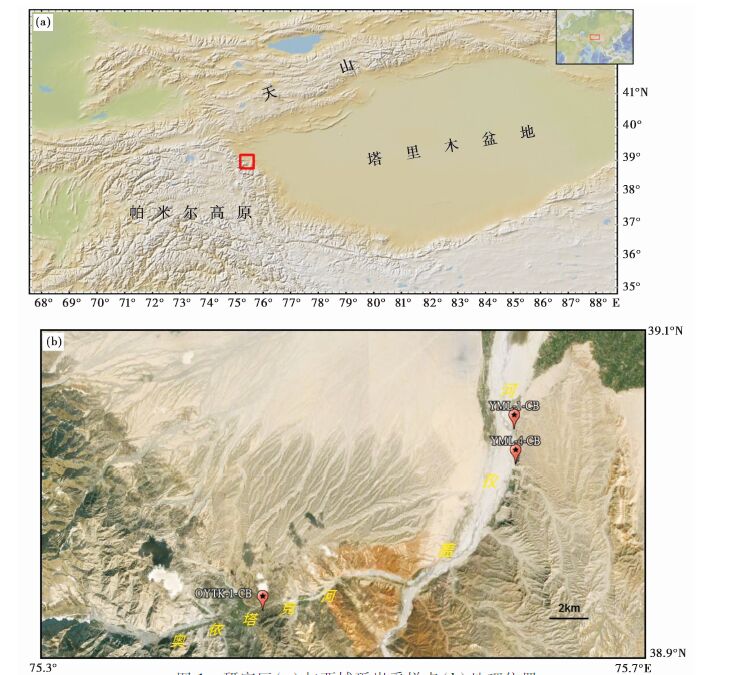
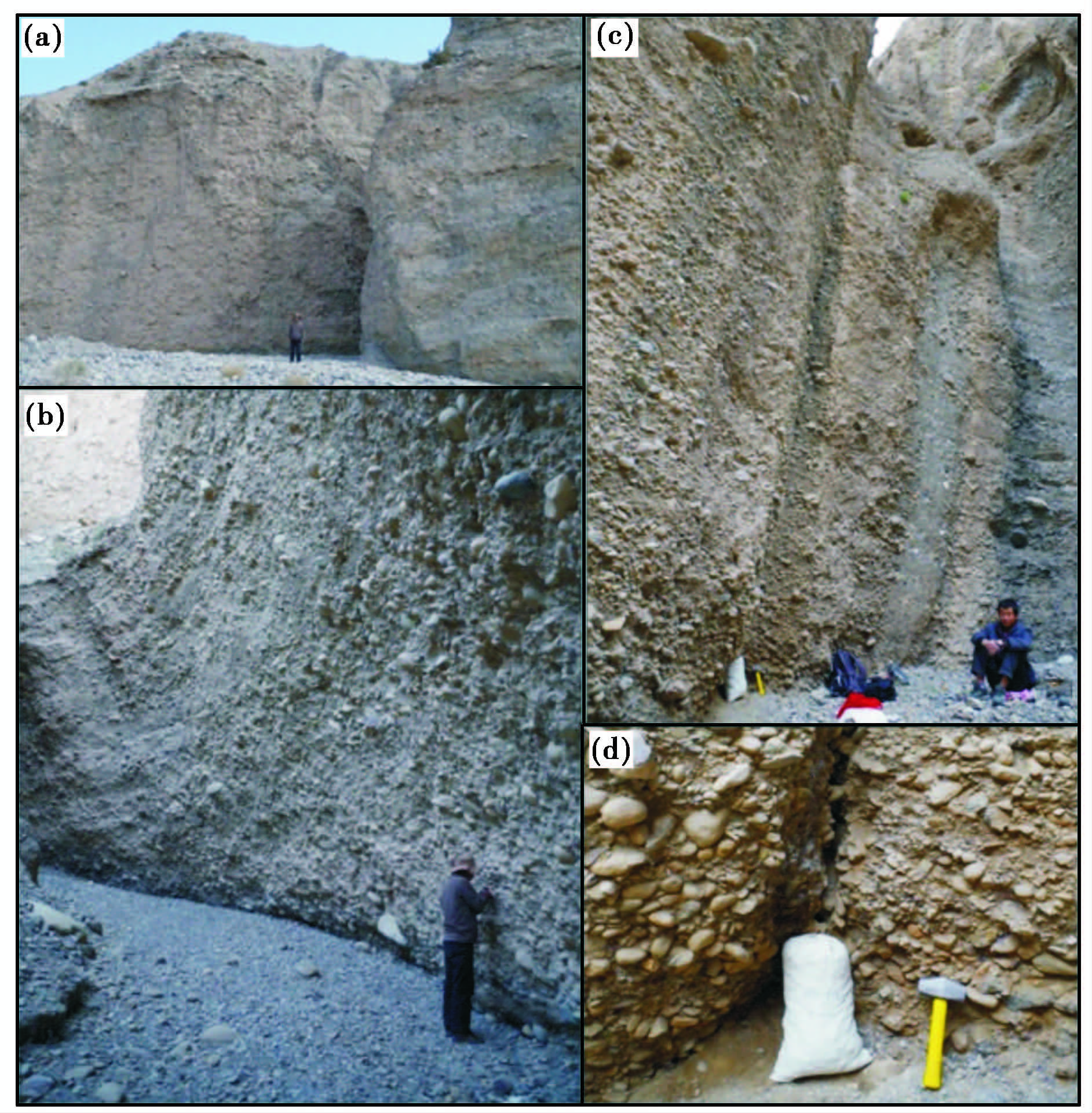
2 研究区概况研究区位于我国塔里木盆地西缘帕米尔高原-西昆仑山北麓的前陆盆地边缘,区内发育有巨厚的晚新生代磨拉石建造,其构造变形记录了青藏高原隆升和陆内造山运动形成与演化的全过程[56, 57, 58, 59, 60, 61, 62, 63, 64, 65, 66]。本研究的埋藏测年样品分别采自流经该区的盖孜河右岸山前的亚勒马剖面(39°03′N,75°35′E) 与奥依塔克河右岸的西域砾岩剖面(38°58′N,75°26′E) ( 图1,图2)。其中,亚马勒剖面采集的两个样品YML-1-CB和YML-4-CB位于西域组砾岩上部,两采样点之间相距约2km,地层倾角<10°。剖面沿盖孜河整体大致呈南北走向。采样位置均位于剖面被切割出的深谷底部,实测埋深分别为48m和106m。奥依塔克河畔的1个西域砾岩混合砾石样品(OYTK-1-CB)采集自帕米尔主断裂(MPT)附近的生长地层底部。每个样品均采集了5-6kg含石英矿物的小砾石,其中在亚马勒剖面采集样品YML-1-CB的同一层位还分别采集了4块石英含量较高的单个石英大砾石样品(YML1-C,YML1-D,YML-F和YML1-G)。
|
图1 研究区(a)与西域砾岩采样点(b)地理位置 Fig.1 Location of studied area (a) and sampling sites (b) of Xiyu conglomerate |
|
图2 亚马勒剖面西域砾岩剖面采样点照片(a,b)和奥依塔克西域砾岩采样点照片(c,d) Fig.2 Photos of Xiyu conglomerate sections from Yamale site (a,b) and Oytake site (c,d) |
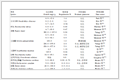
样品的初步石英提纯工作在中国地震局地质研究所新构造年代学实验室进行。砾石样品首先进行粉碎并筛选出砾径为0.25-0.50mm的颗粒。首先用盐酸去除其中的碳酸盐类矿物,再用5 % 的硝酸和氢氟酸混合酸去除石英矿物表面的大气成因 10 Be和大部分长石矿物。最后采用偏钨酸锂重液分离出石英中混杂的重矿物和轻矿物以及暗色石英矿物(27 Al含量较高)。提纯后石英矿物的Al含量在美国普度大学进行了ICP-OES测试,对Al含量达到150 ppm以下的样品进行了Be-Al化学分离: 首先用5 ︰ 1的浓氢氟酸和硝酸混合酸溶解加入 10 Be载体后的石英样品,取2ml溶解后的样品溶液用于ICP-OES Al含量精确测量; 溶解后的样品溶液先后加入浓硫酸和浓盐酸并蒸干使Be和Al转化为可溶性盐类,加入浓NaOH溶液调节pH=14使样品溶液中的Fe和Ti沉淀,再调节溶液pH=8沉淀Be和Al的氢氧化物,用草酸溶解沉淀并过阴阳离子柱以分离Be和Al,过柱后的溶液再分别调pH=9和pH=8沉淀Be和Al的氢氧化物,高温灼烧使其转化为Be和Al的氧化物。在氧化物粉末中分别混入铌(Ni)粉和银(Ag)粉制备成靶样用于加速器质谱(AMS)测量。AMS测量在美国普度大学物理系PRIME Lab实验室完成。具体测试结果见 表1。
|
表1 亚马勒和奥依塔克西域砾岩样品 26Al/10Be测试分析数据和年龄结果* Table 1 The 10 Be and 26 Al concentration and simple burial ages of Xiyu conglomerate samples from Yamale and Oytake sites |
根据Granger和Muzikar[39]提出的 26Al/10Be埋藏测年简单埋藏模型,样品在埋藏时间t过程中积累的 26 Al和 10 Be核素浓度NAl(t)和NBe(t)可以分别表示为:


公式(1)和(2)中,NAl(0)和NBe(0)表示样品在埋藏前的初始核素浓度,λAl和λBe分别为 26 Al和 10 Be的衰变常数,如果将样品在埋藏时间t的 26 Al和 10 Be的核素浓度比NAl(t)/NBe(t)与初始核素浓度比NAl(0)/NBe(0)分别用Rt和R0表示,则通过联立公式(1)和(2)得到样品的埋藏年龄(t)可以表示为:

如果样品在埋藏过程中由于埋深不足以屏蔽宇宙射线的作用而继续有核素生成,那么公式(3)给出的只是样品的最小埋藏年龄。样品在埋藏后期生成的核素可能由两种情况产生: 一种是由于样品上覆堆积物沉积速率较慢所致,另一种是由于剥蚀作用所导致的样品埋深变浅。本研究中所分析样品的埋深均大于30m( 表1),在这样的埋深条件下即便是穿透能力很强的μ介子的作用也几近停止,故可以忽略后期剥蚀作用对测年结果的影响。另一方面,前人研究显示,喀什盆地一带的上新世-早更新世西域砾岩的堆积速率大约在400-1000m/Ma 之间[14, 67, 68, 69]。如果我们以这一地区的最高沉积速率1000m/Ma 进行计算,埋深达到30m仅需大约30ka,而如果采用最低400m/Ma 的沉积速率,则需要约75ka达到30m埋深,此时埋藏后期生成核素对年龄计算的影响也小于5 % ,所以对于沉积速率较高的本研究区,采用公式(3)计算出的最小埋藏年龄接近样品的实际年龄。
需要指出的是,尽管本研究中单个样品的测量数据误差较大,尤其是 26 Al测量误差均大于40 % ,给出的埋藏年龄误差较大,但对于年龄较老的样品,在一定的置信程度上,可以获得年龄可能分布的范围。其中,亚马勒剖面西域砾岩下部样品YML-4-CB的 26Al/10Be比值误差>100 % ,其年龄>3.5Ma,置信程度可达84 % ; 另一处奥依塔克剖面西域砾岩样品(OYTK-1-CB)的埋藏年龄在0.46-7.12Ma(置信区间68 % )。对于来自同一地层层位的样品,由于单个样品年龄误差较大,进行等时线年龄计算是不可靠的,但通过多个样品方差加权平均理论上可以提高测年精度。亚马勒剖面西域砾岩上部5个同层样品的加权平均年龄为2.11+0.60/-0.46Ma。
目前西域砾岩形成时代的磁性地层学研究主要集中在西南天山与天山北麓一带[5, 6, 7, 8, 9, 10, 11, 12],对西昆仑山北麓分布的晚新生代西域砾岩堆积尚缺少详细的磁性地层学研究。但根据多数学者对天山地区的研究,西域砾岩堆积的形成时代大致在上新世至早更新世,确定这一时段内砾石堆积形成的绝对年代,目前除 26Al/10Be埋藏测年方法外几乎没有其他的同位素测年方法,但针对某些特定地区,可以采用K-Ar或Ar-Ar方法对西域砾石层上部和下部的火山岩层定年(赵志军,个人交流); 如果同一地层沉积中含有碳酸盐矿物还可以利用U-Pb方法进行定年。 另外,对于一些灰岩含量较高的西域砾岩分布地区,在开展石英 26Al/10Be测年的同时还可以对灰岩中的另一种宇宙成因核素 36 Cl进行分析,通过 10 Be-36 Cl核素对对灰岩定年[70]。这些方法在今后的研究中可以用来检验西域砾岩中石英矿物 26Al/10Be埋藏测年结果的可靠性。
通过对新疆喀什地区周边分布的西域砾岩的采样和分析,我们发现将 26Al/10Be埋藏测年方法应用于该套砾石堆积地层的年代学研究中存在一些难点和问题:
(1)由于研究区的西域砾岩属于快速剥蚀堆积的产物,所以样品在最后一次埋藏前累积的 10 Be和 26 Al的核素含量相对较低,加之目前 26 Al的加速器质谱(AMS)测量精度与 10 Be相比较低,导致本文样品的测量误差较大(约50 % ->100 % ),并严重影响测年结果的精度。
(2)由于西域砾岩堆积具有穿时性,在一些地区西域砾岩底界砾石样品的埋藏时间可能已接近或超出 26Al/10Be埋藏测年的测年时限(约5Ma)(例如本研究中的样品YML-4-CB),所以在一定程度上限制了 26Al/10Be埋藏测年方法对不同地区西域砾岩堆积年代学研究的适用性。Balco和Shuster[71]提出可以通过引入第三种核素 21 Ne来扩展 26Al/10Be埋藏测年的测年范围,其中 21 Ne与 10 Be核素对的埋藏测年时限可扩展至15Ma。
(3)砾石样品中含较高的稳定同位素27 Al含量,降低了 26 Al/27 Al的测量精度。同时由于一些地区西域砾岩的母岩成分比较复杂,样品中Ti、 Mg、 Ca、 Mn等元素的含量较高,对Al和Be的化学分离及AMS测量产生干扰,进而影响了测年精度。
(4)本研究中我们在计算样品年代时采用了简单埋藏模式,即假设样品剥露于地表后被快速深度埋藏。但实际情况中样品可能会经历多次暴露和埋藏,Balco 和 Rovey[47]提出的等时线方法是在同一层位采集分析多个样品,通过将它们的核素浓度拟合成等时线,从其斜率解得样品的埋藏年龄。虽然等时线法可以剔出暴露埋藏史不同的砾石样品,并规避埋藏后生成核素的影响,从而获得比采用简单埋藏模式更为可信的年龄,但在同层采集的多块砾石的核素浓度测量误差需较小且要有一定差异才能保证等时线的拟合精度,由于本研究中亚马勒剖面样品 26 Al的测量误差较大,加之部分样品的核素浓度比较接近,故无法采用等时线方法。
目前对于西域砾岩的 26Al/10Be埋藏测年在很大程度上受到AMS测量精度的制约。随着AMS测试技术的发展及制样技术的改进,例如通过引入充气磁铁可以在消除同重核素26 Mg对 26 Al测量干扰的同时获得更佳的离子束流强度,这将会极大地改善 26 Al的测年精度[72]。另外,通过对第三种核素的分析,也可以使我们对西域砾岩这类砾石样品的搬运和堆积历史有更清楚地认识。
5 结论本文尝试通过 26Al/10Be埋藏测年方法获得了帕米尔高原-西昆仑山北麓前陆盆地边缘两处西域砾岩剖面的时代,其中亚马勒剖面西域砾岩上部砾石样品的加权平均年龄为2.11+0.60/-0.46Ma,下部埋藏年龄>3.5Ma; 奥依塔克剖面生长地层底部西域砾岩的埋藏年龄约为0.46-7.12Ma,表明西域砾岩堆积具有穿时性。本文工作是对西域砾岩年代学研究的一次尝试和探索。样品宇宙成因核素浓度低、 测量误差大,可能是源区剥蚀较快、 砾岩样品在埋藏前积累的核素浓度较低造成。但对于同一层位的多个样品,采用加权平均的方式可以减小误差,获得具有地质意义的年龄。尽管本文工作尚不能为西域砾岩提供精确的年代学框架,但随着宇宙成因核素测试技术的发展和其他核素的引入,宇宙成因核素埋藏测年对确定我国西北地区普遍分布的山前砾石堆积年代仍具有广泛的前景。
致谢 顾兆炎研究员对本文工作进行了指导并给予较大的帮助,Darryl Granger教授协助测量了本文的样品并讨论了数据结果,沈冠军教授和其他审稿专家对本文工作提出了宝贵意见和修改建议,李涛和刘浪涛在野外和室内工作上给予了帮助,在此一并感谢。
| 1 | Burbank D W, Anderson R S. Tectonic Geomorphology. Oxford:Wiley-Blackwell, 2012. 195~242 |
| 2 | Liu T S, Menglin D, Derbyshire E. Gravel deposits on the margins of the Qinghai-Xizang Plateau, and their environmental significance. Palaeogeography, Palaeoclimatology, Palaeoecology, 1996, 120 (1~2):159~170 |
| 3 | 周慕林. 中国的第四系, 中国地层(14). 北京: 地质出版社, 1988. 276 Zhou Mulin. China Quaternary System, Stratigraphy of China(14). Beijing:Geological Publishing House, 1988. 276 |
| 4 | 叶春辉, 黄金仁. 第三系, 塔里木生物地层和地质演化. 北京: 科学出版社, 1990. 308~338 Ye Chunhui, Huang Jinren. Tertiary System, Biostratigraphy and Geological Evolution of Tarim. Beijing:Science Press, 1990. 308~338 |
| 5 | 滕志宏, 岳乐平, 蒲仁海等, 用磁性地层学方法讨论西域组的时代. 地质论评, 1996, 42 (6):481~489 Teng Zhihong, Yue Leping, Pu Renhai et al. The magnetostratigraphic age of the Xiyu Formation. Geological Review, 1996, 42 (6):481~489 |
| 6 | 邓秀芹, 岳乐平, 滕志宏等. 塔里木盆地周缘库车组、西域组磁性地层学初步划分:沉积学报, 1998, 16 (2):82~86 Deng Xiuqin, Yue Leping, Teng Zhihong et al. A primary magnetostratigraphy study on Kuche and Xiyu Formations on the edge of Tarim Basin. Acta Sedimentologica Sinica, 1998, 16 (2):82~86 |
| 7 | 陈 杰, 尹金辉, 曲国胜等. 塔里木盆地西缘西域组的底界、时代、成因与变形过程的初步研究. 地震地质, 2000, 22 (增刊):104~116 Chen Jie, Yin Jinhui, Qu Guosheng et al. Timing, lower boundary, genesis, and deformation of Xiyu Formation around the western margins of the Tarim Basin. Seismology and Geology, 2000, 22 (Suppl.):104~116 |
| 8 | 陈 杰, Heermance R V, Burbank D W等. 中国西南天山西域砾岩的磁性地层年代与地质意义. 第四纪研究, 2007, 27 (4):576~587 Chen Jie, Heermance R V, Burbank D W et al. Magnetochronology and its implications of the Xiyu conglomerate in the southwestern Chinese Tianshan foreland. Quaternary Sciences, 2007, 27 (4):576~587 |
| 9 | 郑洪波, 陈惠忠, 靳鹤龄等. 上新世—早更新世青藏高原北缘隆升的磁性地层学证据. 海洋地质与第四纪地质, 2002, 22 (2):57~62 Zheng Hongbo, Chen Huizhong, Jin Heling et al. Magnetostratigraphic evidence for the Pliocene-Early Pleistocene uplift of the northern Tibetan Plateau. Marine Geology & Quaternary Geology, 2002, 22 (2):57~62 |
| 10 | 孙继敏, 朱日祥. 天山北麓晚新生代沉积及其新构造与古环境指示意义. 第四纪研究, 2006, 26 (1):14~19 Sun Jimin, Zhu Rixiang. Cenozoic deposits in the northern Tianshan Mountains and its implications for neotectonics and environmental changes. Quaternary Sciences, 2006, 26 (1):14~19 |
| 11 | Zheng H, Powell C M A, An Z et al. Pliocene uplift of the northern Tibetan Plateau. Geology, 2000, 28 (8):715~718 |
| 12 | Zheng H, Huang X, Butcher K. Lithostratigraphy, petrography and facies analysis of the Late Cenozoic sediments in the foreland basin of the west Kunlun. Palaeogeography, Palaeoclimatology, Palaeoecology, 2006, 241 (1):61~78 |
| 13 | Zhang P Z, Molnar P, Downs W R. Increased sedimentation rates and grain sizes 2~4 Myr ago due to the influence of climate change on erosion rates. Nature, 2001, 410 :891~897 |
| 14 | Chen J, Burbank D, Scharer K et al. Magnetochronology of the Upper Cenozoic strata in the southwestern Chinese Tian Shan:Rates of Pleistocene folding and thrusting. Earth and Planetary Science Letters, 2002, 195 (1~2):113~130 |
| 15 | Molnar P. Late Cenozoic increase in accumulation rates of terrestrial sediment:How might climate change have affected erosion rates?Annual Review of Earth Planetary Sciences, 2004, 32 :67~89 |
| 16 | Sun J, Zhu R, Bowler J. Timing of the Tianshan Mountains uplift constrained by magnetostratigraphic analysis of molasse deposits. Earth and Planetary Science Letters, 2004, 219 (3~4):239~253 |
| 17 | Sun J, Xu Q, Huang B. Late Cenozoic magnetochronology and paleoenvironmental changes in the northern foreland basin of the Tian Shan Mountains. Journal of Geophysical Research, 2007, 112 (B04):107 |
| 18 | Sun J, Zhang Z. Syntectonic growth strata and implications for Late Cenozoic tectonic uplift in the northern Tian Shan, China. Tectonophysics, 2009, 463 (1):60~68 |
| 19 | Huang B, Piper J D A, Peng S et al. Magnetostratigraphic study of the Kuche depression, Tarim Basin, and Cenozoic uplift of the Tian Shan Range, Western China. Earth and Planetary Science Letters, 2006, 251 (3):346~364 |
| 20 | Huang B, Piper J D, Qiao Q. Magnetostratigraphic and rock magnetic study of the Neogene upper Yaha section, Kuche depression(Tarim Basin):Implications to formation of the Xiyu conglomerate formation, NW China. Journal of Geophysical Research, 2010, 115 (B01):101 |
| 21 | Charreau J, Gumiaux C, Avouac J-P et al. The Neogene Xiyu Formation, a diachronous prograding gravel wedge at front of the Tianshan:Climatic and tectonic implications. Earth and Planetary Science Letters, 2009, 287 (3):298~310 |
| 22 | Charreau J, Blard P H, Puchol N et al. Paleo-erosion rates in Central Asia since 9Ma:A transient increase at the onset of Quaternary glaciations? Earth and Planetary Science Letters, 2011, 304 (1):85~92 |
| 23 | 黄汲清, 杨钟健, 程裕淇. 新疆油田地质调查报告: 中央地质调查所地质专报甲种第21号, 1947,(21):31~66 Huang T K, Young C C, Cheng Yuqi. Report on geological investigations of some oil fields in Sinkiang. Geological Memoris (Series A), 1947,(21):31~66 |
| 24 | 彭希龄. 新疆准噶尔盆地新生界脊椎动物化石地点与层位. 古脊椎动物与古人类学报, 1975, 13 (3):185~189 Peng Xiling. Cenozoic vertebrate localities and horizon of Dzungaria Basin, Sinkiang. Vertebrata PalAsiatica, 1975, 13 (3):185~189 |
| 25 | 陈华慧, 林秀伦, 关康年. 新疆天山地区早更新世沉积及其下限. 第四纪研究, 1994,(1):38~47 Chen Huahui, Lin Xiulun, Guan Kangnian. Early Pleistocene deposits and its lower Boundary(Q/N)in Tianshan Mt, Xinjiang region. Quaternary Sciences, 1994,(1):38~47 |
| 26 | Charreau J, Chen Y, Gilder S et al. Magnetostratigraphy and rock magnetism of the Neogene Kuitun He section(Northwest China): Implications for Late Cenozoic uplift of the Tianshan Mountains. Earth and Planetary Science Letters, 2005, 230 (1):177~192 |
| 27 | Lister A. Mammalian fossils and Quaternary biostratigraphy. Quaternary Science Reviews, 1992, 11 (3):329~344 |
| 28 | 朱日祥, 邓成龙, 潘永信. 泥河湾盆地磁性地层定年与早期人类演化. 第四纪研究, 2007, 27 (6):922~944 Zhu Rixiang, Deng Chenglong, Pan Yongxin. Magnetochronology of the fluvio-lacustrine sequences in the Nihewan basin and its implications for early human colonization of Northeast Asia. Quaternary Sciences, 2007, 27 (6):922~944 |
| 29 | 刘 平, 张 崧, 韩家懋等. 甘肃龙担早第四纪黄土堆积古地磁年代研究. 第四纪研究, 2008, 28 (5):796~805 Liu Ping, Zhang Song, Han Jiamao et al. Paleomagnetic chronology of Quaternary stratigraphy of the Longdan section in Gansu Province of China. Quaternary Sciences, 2008, 28 (5):796~805 |
| 30 | 胥勤勉, 袁桂邦, 秦雅飞等. 滦河三角洲南部MT04孔磁性地层研究及其构造与气候耦合关系的探讨. 第四纪研究, 2014, 34 (3):540~552 Xu Qinmian, Yuan Guibang, Qin Yafei et al. Magnetostratigraphy and discussion of coupling relationship between tectonic movement and climate change of MT04 borehole in southern Luanhe River delta. Quaternary Sciences, 2014, 34 (3):540~552 |
| 31 | 程 瑜, 乔彦松, 刘宗秀等. 甘肃灵台邵寨红粘土的磁性地层及其色度记录. 第四纪研究, 2014, 34 (2):391~398 Cheng Yu, Qiao Yansong, Liu Zongxiu et al. Magnetostratigraphy and chorma records of a red clay formation near Lingtai County of Gansu Province. Quaternary Sciences, 2014, 34 (2):391~398 |
| 32 | 张 磊, 白凌燕, 蔡向民等. 北京平原南口—孙河断裂南段第四纪活动性的磁性地层学研究. 第四纪研究, 2014, 34 (2):381~390 Zhang Lei, Bai Lingyan, Cai Xiangmin et al. Magnetostratigraphy study on the south segment of Nankou-Sunhe fault at Beijing plain and its implications for the fault activity during Quaternary. Quaternary Sciences, 34 (2):381~390 |
| 33 | Voinchet P, Bahain J J, Falguères C et al. ESR dating of quartz extracted from Quaternary sediments application to fluvial terraces system of Northern France. Quaternaire, 2004, 15 :135~141 |
| 34 | Tissoux H, Falguères C, Voinchet P et al. Potential use of Ti-center in ESR dating of fluvial sediment. Quaternary Geochronology, 2007, 2 (1):367~372 |
| 35 | Rink W, Bartoll J, Schwarcz H et al. Testing the reliability of ESR dating of optically exposed buried quartz sediments. Radiation Measurements, 2007, 42 (10):1618~1626 |
| 36 | Lal D. Cosmic ray labeling of erosion surfaces: In situ nuclide production rates and erosion models. Earth and Planetary Science Letters, 1991, 104 (2):424~439 |
| 37 | 顾兆炎, 刘东生, Lal D.10 Be和 26 Al在地表形成和演化研究中的应用: 第四纪研究, 1997,(3):211~221 Gu Zhaoyan, Liu Tungsheng, Lal D. Application of the in situ cosmogenic nuclides 10 Be and 26 Al for studies of formation and evolutionary histories of the Earth surface. Quaternary Sciences, 1997,(3):211~221 |
| 38 | Granger D E, Kirchner J W, Finkel R C. Quaternary downcutting rate of the New River, Virginia, measured from differential decay of cosmogenic 26 Al and 10 Be in cave-deposited alluvium. Geology, 1997, 25 (2):107~110 |
| 39 | Granger D E, Muzikar P F. Dating sediment burial with in situ-produced cosmogenic nuclides:Theory, techniques, and limitations. Earth and Planetary Science Letters, 2001, 188 (1):269~281 |
| 40 | 沈冠军. 原地宇生核素埋藏测年法: 最新进展及其在中国早期人类遗址年代研究中的应用前景. 第四纪研究, 2012, 32 (3):382~387 Shen Guanjun. In situ cosmogenic nuclides burial dating:Recent progresses and prospects in chronological studies of early hominin sites in China. Quaternary Sciences, 2012, 32 (3):382~387 |
| 41 | 孔 屏. 宇宙成因核素埋藏年龄法: 原理及应用. 第四纪研究, 2012, 32 (3):388~393 Kong Ping. Cosmogenic nuclide burial dating:Theory and application. Quaternary Sciences, 2012, 32 (3):388~393 |
| 42 | 刘 彧, 王世杰, 刘秀明等. 贵州荔波黑洞碎屑沉积物宇宙成因核素 26 Al/10 Be埋藏年龄. 第四纪研究, 2013, 33 (3):437~444 Liu Yu, Wang Shijie, Liu Xiuming et al. Cosmogenic nuclides 26 Al and 10 Be burial age of Black Cave sediments, Libo of Guizhou, China. Quaternary Sciences, 2013, 33 (3):437~444 |
| 43 | Nishiizumi K. Preparation of 26 Al AMS standards. Nuclear Instruments and Methods in Physics Research Section B: Beam Interactions with Materials and Atoms, 2004, 223~224 :388~392 |
| 44 | Chmeleff J, von Blanckenburg F, Kossert K et al. Determination of the 10 Be half-life by multicollector ICP-MS and liquid scintillation counting. Nuclear Instruments and Methods in Physics Research Section B: Beam Interactions with Materials and Atoms, 2010, 268 (2):192~199 |
| 45 | Granger D E. A review of burial dating methods using 26 Al and 10 Be. Special Papers-Geological Society of America, 2006, 415 :1~16 |
| 46 | Nishiizumi K, Imamura M, Caffee M W et al. Absolute calibration of 10 Be AMS standards. Nuclear Instruments and Methods in Physics Research Section B: Beam Interactions with Materials and Atoms, 2007, 258 (2):403~413 |
| 47 | Balco G, Rovey C W. An isochron method for cosmogenic-nuclide dating of buried soils and sediments. American Journal of Science, 2008, 308 (10):1083~1114 |
| 48 | Balco G, Stone J O, Lifton N A et al. A complete and easily accessible means of calculating surface exposure ages or erosion rates from 10 Be and 26 Al measurements. Quaternary Geochronology, 2008, 3 (3):174~195 |
| 49 | Dunai T J. Cosmogenic Nuclides:Principles, Concepts and Applications in the Earth Surface Sciences. Cambridge:Cambridge University Press, 2010. 109~118 |
| 50 | Carbonell E, de Castro J M B, Parés J M et al. The first hominin of Europe. Nature, 2008, 452 :465~469 |
| 51 | Kong P, Granger D E, Wu F Y et al. Cosmogenic nuclide burial ages and provenance of the Xigeda paleo-lake:Implications for evolution of the middle Yangtze River. Earth and Planetary Science Letters, 2009, 278 (1):131~141 |
| 52 | Kong P, Zheng Y, Fu B et al. Cosmogenic nuclide burial ages and provenance of Late Cenozoic deposits in the Sichuan basin:Implications for Early Quaternary glaciations in east Tibet. Quaternary Geochronology, 2011, 6 (3):304~312 |
| 53 | Shen G, Gao X, Gao B et al. Age of Zhoukoudian Homo erectus determined with 26 Al/10 Be burial dating. Nature, 2009, 458 :198~200 |
| 54 | Shen G, Michel V, Despriée J et al.26 Al/10 Be burial dating and its preliminary application to Lower Paleolithic sites in China and in France. L’Anthropologie, 2012, 116 :1~11 |
| 55 | Erlanger E D, Granger D E, Gibbon R J. Rock uplift rates in South Africa from isochron burial dating of fluvial and marine terraces. Geology, 2012, 40 (11):1019~1022 |
| 56 | Bershaw J, Garzione C N, Schoenbohm L et al. Cenozoic evolution of the Pamir Plateau based on stratigraphy, zircon provenance, and stable isotopes of foreland basin sediments at Oytag(Wuyitake)in the Tarim Basin(West China). Journal of Asian Earth Sciences, 2012, 44 :136~148 |
| 57 | Burtman V. Cenozoic crustal shortening between the Pamir and Tien Shan and a reconstruction of the Pamir-Tien Shan transition zone for the Cretaceous and Palaeogene. Tectonophysics, 2000, 319 (2):69~92 |
| 58 | Burtman V S, Molnar P. Geological and geophysical evidence for deep subduction of continental crust beneath the Pamir. Geological Society of America Special Papers, 1993, 281 :1~76 |
| 59 | Sun J, Jiang M. Eocene seawater retreat from the southwest Tarim Basin and implications for Early Cenozoic tectonic evolution in the Pamir Plateau. Tectonophysics, 2013, 588 :27~38 |
| 60 | 陈 杰, 李 涛, 李文巧等. 帕米尔构造结及邻区的晚新生代构造与现今变形. 地震地质, 2011, 33 (2):241~259 Chen Jie, Li Tao, Li Wenqiao et al. Late Cenozoic and present tectonic deformation in the Pamir Salitent, Northwestern China. Seismology and Geology, 2011, 33 (2):241~259 |
| 61 | 陈 杰, 卢演俦, 丁国瑜. 塔里木西缘晚新生代造山过程的记录——磨拉石建造及生长地层和生长不整合. 第四纪研究, 2001, 21 (6):528~539 Chen Jie, Lu Yanchou, Ding Guoyu. Records of Late Cenozoic mountain building in western Tarim basin:Molasses, growth strata and growth unconformity. Quaternary Sciences, 2001, 21 (6):528~539 |
| 62 | 肖伟鹏, 陈 杰, 李 涛等. 帕米尔北缘木什背斜第四纪滑脱褶皱作用与北翼逆断裂的生长. 地震地质, 2011, 33 (2):289~307 Xiao Weipeng, Chen Jie, Li Tao et al. Quaternary detachment folding and propagation of north limb fault of Mushi anticline, northern margin of the Pamir. Seismology and Geology. 2011, 33 (2):289~307 |
| 63 | 陈汉林, 张芬芬, 程晓敢等. 帕米尔东北缘地区构造变形特征与盆山结构. 地质科学, 2010, 45 (1):102~112 Chen Hanlin, Zhang Fenfen, Cheng Xiaogan et al. The deformation features and basin-range coupling structure in the northeastern Pamir tectonic belt. Chinese Journal of Geology, 2010, 45 (1):102~112 |
| 64 | 潘家伟, 李海兵, Van der Woerd J等. 青藏高原西北部帕米尔东北缘构造地貌与活动构造研究. 第四纪研究, 2009, 29 (3):586~598 Pan Jiawei, Li Haibing, Van der Woerd J et al. Tectonic geomorphology and active tectonics in north eastern Pamir, northwest margin of Qinghai-Tibet Plateau. Quaternary Sciences, 2009, 29 (3):586~598 |
| 65 | 吕红华, 李有利. 天山北麓活动背斜带的变形特征. 第四纪研究, 2010, 30 (5):1003~1011 Lü Honghua, Li Youli. Tectonic deformation of active fault-related fold belts in the north piedmont of the central Tianshan Mountains, NW China. Quaternary Sciences, 2010, 30 (5):1003~1011 |
| 66 | 吕红华, 王 玮, 常 远等. 新疆天山造山带新生代多期次剥露作用过程. 第四纪研究, 2013, 33 (4):812~822 Lü Honghua, Wang Wei, Chang Yuan et al. Cenozoic episodic exhumation of the Tian Shan range, NW China. Quaternary Sciences, 2013, 33 (4):812~822 |
| 67 | Heermance R V, Chen J, Burbank D W et al. Temporal constraints and pulsed Late Cenozoic deformation during the structural disruption of the active Kashi foreland, Northwest China. Tectonics, 2008, 27 (6):12 |
| 68 | Heermance R V, Chen J, Burbank D W et al. Chronology and tectonic controls of Late Tertiary deposition in the southwestern Tian Shan foreland, NW China. Basin Research, 2007, 19 (4):599~632 |
| 69 | Li T, Chen J, Thompson J A et al. Equivalency of geologic and geodetic rates in contractional orogens:New insights from the Pamir Frontal Thrust. Geophysical Research Letters, 2012, 39 (15):305 |
| 70 | Braucher R, Benedetti L, Bourlès D et al. Use of in situ-produced 10 Be in carbonate-rich environments:A first attempt. Geochimica et Cosmochimica Acta, 2005, 69 (6):1473~1478 |
| 71 | Balco G, Shuster D L. 26 Al- 10 Be- 21 Ne burial dating. Earth and Planetary Science Letters, 2009, 286 (3):570~575 |
| 72 | Granger D E, Caffee M W, Woodruff T E. A tenfold increase in 26 Al currents at PRIME Lab:Revisiting old ideas and exploring new possibilities with a gas-filled-magnet. In:GSA Annual Meeting in Vancouver, British Columbia, 2014 |
Abstract
Distributed along the periphery of Tianshan and Kunlun Mountains in the northern margin of Tibetan Plateau, Xiyu conglomerate formation is a unit of Late Cenozoic gravel deposit which provides significant information of tectonic activities of the Northern Tibetan Plateau and global climate changes. It is crucial for attaining its depositional age in order to better understand the growth of Tibetan Plateau and related landscape evolution process. Cosmogenic nuclides 26Al/10Be burial dating is an emerging radioisotopic dating technique which could be used in dating gravel samples containing quartz mineral up to 5Ma. This study intends to explore the possibility of using 26Al/10Be burial dating method to determine the age range of the Xiyu conglomerates of two sections-Yamale(39°03'N, 75°35'E) and Oytake (38°58'N, 75°26'E) in the foreland of western Kunlun Mountain on Pamir Plateau, which has intact and well-preserved stratigraphy in great depth. Calculating with simple burial model, the burial age of lower layer sample of Yamale section is older than 3.5Ma. Weighted mean age of five samples from upper layer is 2.11±0.60/0.46Ma. The simple burial age of another amalgamated sample from the bottom of growth strata of Xiyu conglomerate section in Oytake at 0.46~7.12Ma. In this study, we find several difficulties and problems of 26Al/10Be burial dating of Xiyu conglomerate: (1)High erosion rates in the source area results in a low initial concentration of nuclides and large analytical uncertainty because of approaching lower limit of AMS measurement; (2)The ages of certain samples reach the limit of maximum age of 26Al/10Be burial dating; (3)High concentration of stable 27 Al and other nuclides in the samples interfere the chemical separation and the precision of AMS measurement;(4)Multiple periods of erosion and deposition will change the apparent age of the sample, and isochron analysis may not always work in some cases. Weighted mean of isolevel multiple samples could give meaningful geological ages. This study is an exploration work of applying 26Al/10Be burial dating method on Xiyu conglomerate. Although this work does not give a precise chronological framework of this deposition, it shows the potential for the future study of burial dating of Late Cenozoic gravel deposits in the Northwestern China.