 2015, Vol.35


1 引言
对第四纪冰川波动及其气候响应机制的研究,有助于我们了解过去气候与环境变化,也有助于我们了解现代冰川的活动规律和预测未来趋势。在全球变暖、 冰川加速消融的今天,这个问题显得更为重要和紧迫。青藏高原及其周边山地在第四纪期间冰川范围多次扩张与退缩,留下了大量的冰川地貌遗迹,为了解过去冰川波动历史和活动规律提供了理想的材料。不过,该区域冰川发育的时代和气候响应机制仍然存在一些争议[1, 2, 3, 4, 5, 6, 7, 8, 9, 10, 11, 12, 13, 14, 15, 16, 17, 18, 19, 20]。
十余年来,Owen等学者[1, 2, 3, 4, 5, 6, 7, 8, 9, 10, 11, 12, 13]运用陆地生成宇宙核素(Terrestrial Cosmogenic Nuclide,简称TCN)10Be和光释光(Optically Stimulated Luminescence,简称OSL)等测年技术在喜马拉雅-青藏高原地区对冰川漂砾和沉积物做了大量测年,发现末次冰期间冰段(Marine Oxygen Isotope Stage 3,简称MIS 3)比末次盛冰期(Last Glacial Maximum,简称LGM)冰川规模更大。他们据此认为这些地区末次冰期最大规模冰川前进对应于印度(南亚)季风强盛期,而不是传统上认为的冷期[21, 22]。同时,在季风影响的喜马拉雅和青藏高原地区,全新世早期也发现有不少冰川前进,也被认为受同样的因素驱动[5, 9, 10, 11, 12, 13]。这种现象引起了中外学者的广泛关注和讨论,并提出了不同的解释[14, 15, 16, 17, 18, 19, 20]。最近几年来,青藏高原及周边山地冰川作用的年代数据又有了大量的扩充。Murari等[23]、 Dortch 等[24]以及Owen和Dortch[25]对已有的TCN 10Be年代数据做了总结,将主要的冰期时代定在氧同位素奇数阶段(即冰期-间冰期循环中的间冰期,或间冰阶),并且强调了南亚季风对青藏高原冰期的主导作用。如果说MIS 3和早全新世冰期的发现已大大改变我们对青藏高原冰期的认识,这种将冰川作用与间冰期/间冰阶对应的冰期划分则完全颠覆了传统观点。
青藏高原及周边山地冰川作用究竟对应于冷期还是暖期?究竟是传统上认为的低温还是印度季风带来的水汽导致了冰川的前进?简单地说,是气温还是降水对冰川的控制作用更明显?基于青藏高原冰川波动与气候记录的对比,结合前人的研究,本文将对上述问题进行讨论。需指出的是,影响冰川发育的因素很多,本文在此只讨论最主要的气温和降水两个因素。
2 青藏高原第四纪冰期年代序列第四纪冰川研究经历了与经典的阿尔卑斯冰期模式对比阶段、 与深海氧同位素曲线对比以及技术测年3个阶段[26]。代表大陆冰量的深海氧同位素曲线为冰期研究树立了标尺,人们自然在这个标尺中为历次冰期寻找对应的位置,将冰川作用对应于氧同位素偶数阶段(冰期-间冰期旋回中的冰期,或冰阶)[26, 27]。中国(以青藏高原为主体的)第四纪冰期划分方案主要是建立在此基础之上的。随着测年技术发展和数值年代的涌现,冰期的划分不断得到改进[14, 15, 28, 29],已形成了较为统一的认识。中国第四纪以来大体上经历了6个主要的冰期/冰进阶段15个主要特征时段(表1),分别是: 希夏邦马冰期、 昆仑冰期、 中梁赣冰期、 古乡冰期、 大理冰期和全新世冰进。希夏邦马冰期可能是青藏高原地区最早的冰期,但目前还没有具体的年代数据。Zheng等[30]推断其形成于1.17~0.80Ma,对应于MIS22阶段。昆仑冰期为目前所知的青藏高原最大冰川作用期,可能发生在“昆仑-黄河运动”之后[31],电子自旋共振(Electron Spin Resonance,简称ESR)年代为700~500ka,起始于MIS20,于MIS16达到鼎盛[14]。中梁赣冰期发生于MIS12阶段,ESR年代在530~420ka之间[15, 32]。古乡冰期即倒数第二次冰期,发生在MIS10、 MIS8和MIS6阶段,以MIS6阶段的年代数据(包括TCN和ESR)最为多见。大理冰期即末次冰期可以分为4个阶段: 早阶段(MIS4)、 MIS3b阶段、 末次冰期最盛期和晚冰期(Younger Dryas,简称YD)。全新世冰进可分为早中期、 新冰期和小冰期等阶段。但早中全新世冰进规模较小,且可能不具普遍性[14]。
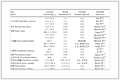
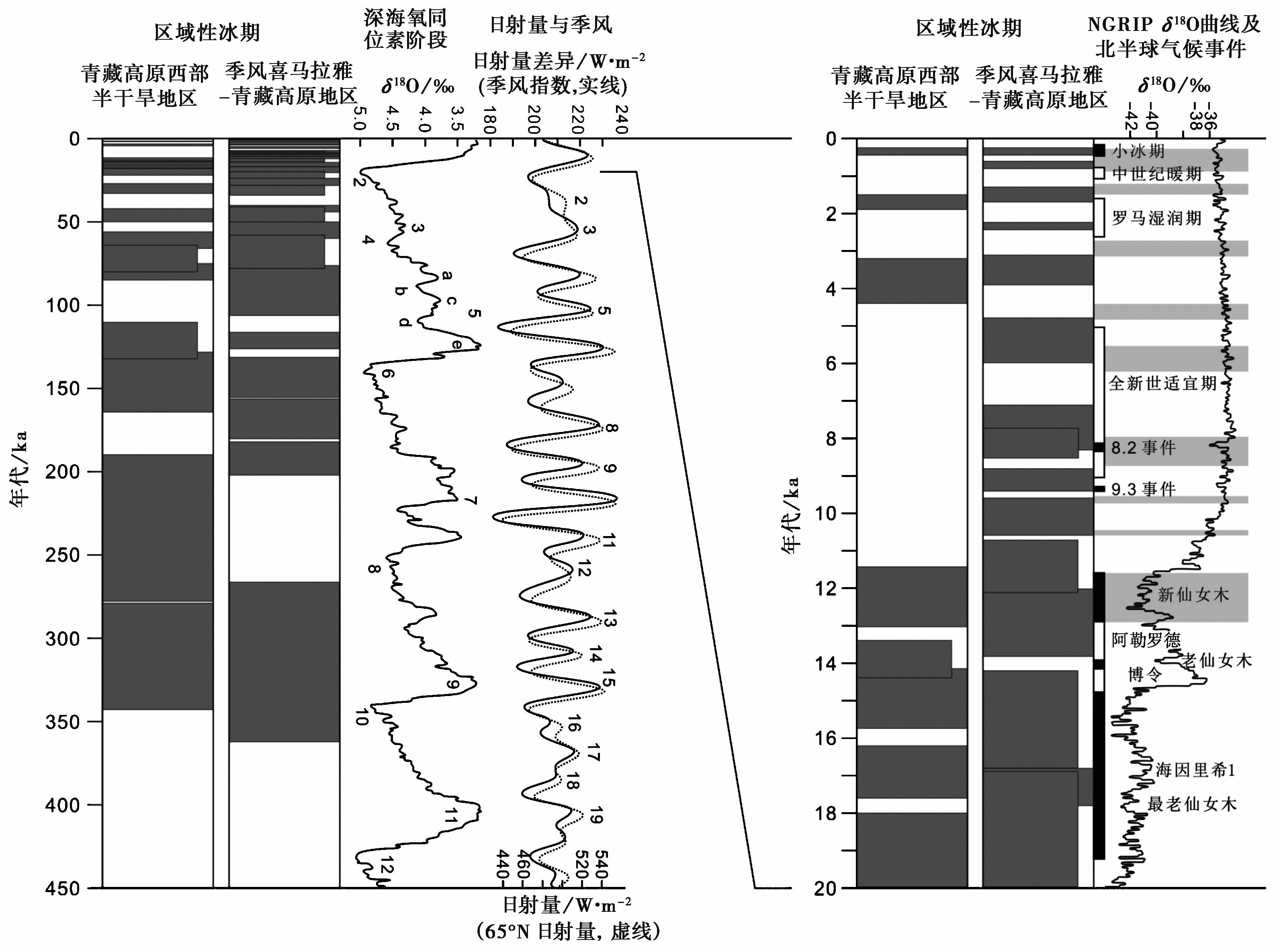
Murari等[23]、 Dortch 等[24]以及Owen和Dortch[25]总结并重新计算了喜马拉雅-青藏高原地区过去十余年来发表的1700多个TCN 10Be年代,并运用“累计概率密度函数中提取正态分布”和“学生t检验”的方法区分区域性冰期年代。他们将喜马拉雅-青藏高原分为西部半干旱区和季风影响区。第四纪期间,西部半干旱区可划分为19个冰期阶段,季风影响区可划分为27个阶段[23, 24, 25, 33, 34, 35, 36](表2和图1)。与前述中国学者的划分[14, 15, 26, 27, 28, 29]相比,这种划分有几个明显特征: 一是完全基于TCN年代,用统计的方法去除测年的不确定性,提取“有效”的代表冰期的年代; 二是冰期划分较细; 三是老冰期发生在MIS13、 MIS9、 MIS7、 MIS6和MIS5阶段,主要为氧同位素奇数阶段(间冰期)。
|
表2 季风喜马拉雅-青藏高原地区和喜马拉雅-青藏高原西部半干旱地区区域性第四纪冰期年代及相应气候关联 [23, 24] Table 2 Chronologies of regional Quaternary glaciations in the monsoonal-influenced and the semi-arid Himalayan-Tibetan orogen and their climate correlations[23, 24] |
|
图1 青藏高原西部半干旱地区和季风喜马拉雅-青藏高原地区第四纪冰期年代与古气候记录对比[25] 4条曲线分别为深海δ18O曲线[33]、 模拟印度季风指数和 65°N日射量曲线[34]、 北格陵兰NGRIP冰芯δ18O曲线[35];最右侧黑白条指示气候事件的持续时间,灰色横条纹指示快速气候变化事件的时间[36] Fig.1 Comparison of ages of regional glacial stages in the semi-arid western Himalayan-Tibetan orogen and the monsoon-influences Himalayan-Tibetan orogen with paleoclimatic records[25]. Stacked marineδ18O curves[33],simulated monsoon index and 65°N insolation[34] and the NGRIPδ18O curve[35] are provided for comparison. The duration of specific climatic events are marked by black and white bars in the far right column. Light gray horizontal bands in the far right column indicate times of rapid climate change[36] |
年代久远的冰碛物不易保存,青藏高原上保留的老冰川作用证据和研究程度比较有限。中国第四纪冰期划分中(表1)的老冰期确定,主要是基于青藏高原若干研究地点保留的冰碛物及其年代(ESR和TCN为主),比较典型的是MIS16、 MIS12和MIS6等氧同位素偶数阶段。而Murari等[23]和Dortch 等[24]则主要根据若干地点的TCN年代将老冰期划分在MIS13、 MIS9、 MIS7、 MIS6和MIS5等,以氧同位素奇数阶段为主(表2)。
由于当前测年技术仍有其局限性,测年结果受技术本身、 地质地貌过程和环境等多种因素影响。不管是TCN和OSL,还是ESR技术,对冰川地貌定年的不确定性还很大,尤其是老冰川地貌。即便技术本身是没有问题的,地质地貌过程的复杂影响仍是当前无法消除的。TCN是目前应用于第四纪冰川测年最受认可的技术。不过,从青藏高原的数据来看,老冰川作用TCN年代的误差范围很大。有的冰碛垄的年代覆盖整个冰期/间冰期甚至跨越几个冰期-间冰期[5, 9, 18, 37, 38, 39, 40, 41, 42],这与冰川作用的实际年代可能是不相符的。Owen和Dortch[25]总结了TCN测年在喜马拉雅-青藏高原地区第四纪冰川应用上的问题。首先,在年代的校正和计算上,同一测试结果,运用不同的计算模型,年代差别可高达30 % [43],甚至40 % [25]。在喜马拉雅-青藏高原这种低纬度高海拔地区,这种差别特别明显。其次,高海拔地区宇生核素的生成速率估算可能有较大的偏差,至今仍没有公认的准确值。再次,对冰川地貌TCN暴露测年来说,影响最大的是地质地貌因素,包括冰碛垄上漂砾的稳定性、 后继出露、 地貌剥蚀、 风化、 沉积前暴露、 积雪或沉积物遮蔽……,除了沉积前暴露可导致年代高估之外,其他因素都可导致年代低估。受这些因素影响,同一道冰碛垄上的不同漂砾年代可能相差很大。在同一个冰碛垄上采多个样品可把风险降低,但也可能会产生更宽泛的年代范围,具体的冰川作用时期仍不容易确定。Heyman[44]最近也对青藏高原及周边山地1855个 10Be年代作了总结,发现该地区年代老于LGM的冰碛垄的 10Be年代非常分散,难以精确界定冰期年代。运用累计概率密度函数从跨度较大的 10Be年代中提取正态分布和学生t检验的方法所提取的年代能否代表冰期的真实年代,也有待更多检验。鉴于老冰川作用年代的不确定性太大,目前仍难以确定其气候响应机制。因此,下文主要讨论末次冰期以来的冰川作用及其气候响应。
3.2 MIS 3冰进对于青藏高原冰川驱动机制的分歧大致源于喜马拉雅-青藏高原地区MIS 3冰进的发现[1, 2, 3, 4, 5, 6, 7, 8]。在这些地区获得的TCN和OSL年代与相关的气候记录对比结果显示,末次冰期早期(主要在MIS 3阶段),强大的季风环流带来的大量降水促使冰川大规模前进。相反,在末次冰期晚期的盛冰期,虽然温度比早期低,但由于此时夏季风极弱,降水极少,抑制了冰川发育,冰川规模反而不及早期。
Ono等[19]则认为西喜马拉雅和喀喇昆仑地区现代降雪的主要水汽来源为西风从地中海和里海等地带来。该地区MIS 3冰进其实是西风加强携带更多的地中海和里海等的水汽的结果。Schaefer等[18]也对Owen等[1, 2, 3, 4, 5, 6, 7, 8]的观点提出了质疑,他们对喜马拉雅山脉希夏邦马峰(聂拉木县)地区冰碛垄上的漂砾进行了TCN测年,其中MIS 2和晚冰期漂砾的暴露年代对应于相对冷干时期。他们认为西藏及其他地区的冰川大规模扩张是在夏季低温削弱了消融的时段。而另一部分漂砾的暴露年代结果大部分集中在50~40ka(MIS 3),一小部分在190~100ka(MIS 6)之间。这部分漂砾年代有违于地貌地层学观察,没有体现出应有的新老对应关系,甚至相反。他们的解释是:MIS 3阶段的高温和丰沛降水导致高剥蚀率,冰碛垄被剥蚀降低,致使埋藏漂砾不断出露,因此漂砾的暴露年龄跨度很大,从沉积时代一直到剥蚀出露的年代都有[18]。冰碛垄的形成年代很可能在MIS 6甚至更早。而暴露年代最集中的MIS 3阶段,可能仅代表剥蚀速率加大的时段,并非冰碛垄形成的时代。据此他们推而广之地认为[18],Owen等[5, 6, 8]此前在青藏高原及周边地区测试的大量MIS 3阶段的漂砾暴露年龄代表的也可能仅是MIS 3的剥蚀加强事件,而不是漂砾沉积暴露的年代。通过对青藏高原地区过去发表的1855个10Be年代的总结,Heyman[44]也认为该地区末次盛冰期和冰消期的年代比较可靠,可以确定是与北半球高纬冰盖同步的。该区域的末次冰期冰川规模最大确实不在MIS 2,而是更早。不过,这些更老的冰碛垄的10Be年代跨度很大,难以确定其确切时间。
在水汽相对充足的MIS 3阶段,低温和降水的结合使冰川大幅前进甚至超出末次盛冰期的冰川范围,这也应属正常。施雅风和姚檀栋[17]根据古里雅冰芯的气候记录,将MIS 3细分为a、 b和c共3个阶段; MIS 3b为冷期,气温比现代温度低5℃,而MIS 3c和MIS 3a为暖期,气温比现代分别高3℃和4℃; 并通过查阅已有的测年资料,发现对应于MIS 3b(54~44ka)冷阶段的山地冰川前进在亚洲、 欧洲、 北美洲、 南美洲和大洋洲等地区多个地点都存在,并且冰川范围比末次盛冰期更大。结合这些测年数据和古里雅冰芯的气候记录,他们[17]认为MIS 3b阶段降水较多与冷期降温抑制消融相结合,导致冰川伸展范围超过气候严寒而干燥的盛冰期。赵井东等[20]也发现我国季风区与西风环流区冰川在MIS 3b阶段都有前进。其原因是该阶段较丰富的降水配合低温所致。王杰[16]进一步认为季风环流区MIS 3冰进可能是中期的冷期(或者古里雅冰芯记录中47~43ka两次冷事件的直接作用)结合较丰富的季风降水所致。而在西风区,可能是MIS 3中期低温结合西风环流带来的相对较多的降水所致。
众所周知,末次冰期(包括MIS 3)有很多快速降温事件,这些降温事件也都有可能促发冰川前进。很多谷地保留有末次冰期多道冰碛垄[25],说明冰川发育存在多次波动。这点也被众多的TCN年代所证明(图1)。这种冰川多次波动现象用气温(而不是降水)波动来解释似乎更合理。最近,Dong等[45]在念青唐古拉山的TCN测年结果也证明念青唐古拉山MIS 3冰川比末次盛冰期规模更大; MIS 3阶段的几次冰进可能与该时期的千年尺度冷事件(H事件和D-O循环)以及印度季风增强都有关系。
此外,还有研究表明青藏高原冰川发育与构造抬升也有密切关系[14, 26, 46, 47]。第四纪青藏高原的隆升与全球冰期的耦合是冰川发育的主要促发因素。其中发生在晚第四纪的“共和运动”,对末次冰期冰川发育影响深远[14]。这点在青藏高原东缘地带表现较为明显[48, 49, 50]。该区域一些山地仅在末次冰期发育冰川作用,说明构造运动导致的山地抬升对冰川发育起着决定性作用。MIS 3冰进刚好发生在共和运动之后。共和运动导致山地抬升,积累区面积增加,与增强的夏季风带来的大量降水耦合,可能是促发MIS 3较大规模冰进的原因[14]。在气候上,高原隆升可能起加剧降温的作用。降水相对较多、 冷期或冷事件降温,加上构造抬升加剧了降温,可能是MIS 3阶段规模冰川规模较大的原因。
3.3 早全新世冰进同样基于TCN和OSL年代,Owen等[5, 9, 10, 11, 12, 13]在喜马拉雅-青藏高原地区还发现了不少早全新世(11.5~8.0ka)冰进的证据,并推断该时段的冰进是低纬地区日射量增加促使南亚季风增强导致的结果。他们认为季风水汽增加在高山地区表现为降雪量的增加,冰川物质正平衡从而导致规模扩张。
其实,早全新世冰进在青藏高原地区很早就有报道[51, 52, 53]。当然,更多的地点未见有该时期冰进的证据。很多山系只发现有晚全新世冰碛垄,没有早全新世冰碛垄[21]。崔之久等[14]也认为该区域早中全新世冰进规模小,不具普遍性,因此没有将其划为一个冰川作用阶段。此外,有些冰碛垄的早全新世年代也有一些争议。例如,Owen等[9]利用TCN技术测定贡嘎山地区的冰川地貌,将海螺沟原认为属于末次冰期的冰碛垄的年代定为早全新世。但Wang等[54]通过在这一地区的OSL和ESR测年,结合中国学者的多年调查研究结果,认为这套冰碛垄应属末次盛冰期。他们认为TCN暴露年代指示的是冰川开始退缩的时代,更重要的是这些年代未经表面侵蚀的校正。而海洋型冰川区丰沛的降水可导致漂砾的严重剥蚀,从而使TCN暴露年代比实际年龄年轻得多[54]。横断山地区其他地点的研究,如千湖山[50]、 点苍山[49]、 拱王山[48]、 稻城[55, 56, 57]、 理塘[58]、 折多山[59, 60, 61]和雀儿山[62, 63, 64]等,也都没有早全新世冰进的报道。这样看来,贡嘎山地区的海螺沟早全新世冰进仍有待进一步证实。
与MIS 3一样,早全新世日射量高、 季风强盛[65],但气候也是不稳定的,存在若干千年尺度的快速气候变化,即降温事件[36, 66]。已有研究[51],包括Owen课题组的研究[12, 23, 42]也表明青藏高原地区早全新世冰进与这些降温事件相关,下文将有详细的阐述。Rupper等[67]模拟的结果则表明,云量增加导致阳光入射减少从而导致的夏季气温下降才是早全新世冰进的主因; 夏季降温对平衡线降低的贡献大于季风降水增加。正如Owen和Dorch[25]所说,这些早全新世冰进到底是季风信号,还是冷事件? 还是都有?大多数年代的分辨率尚达不到将它们区分开的程度。也许季风水汽和降温都有影响。从现已报道的季风区早全新世多次冰进的情况来看,也许与MIS 3相似,即在降水较多的背景下,气温多次快速变动导致了冰川多次波动。
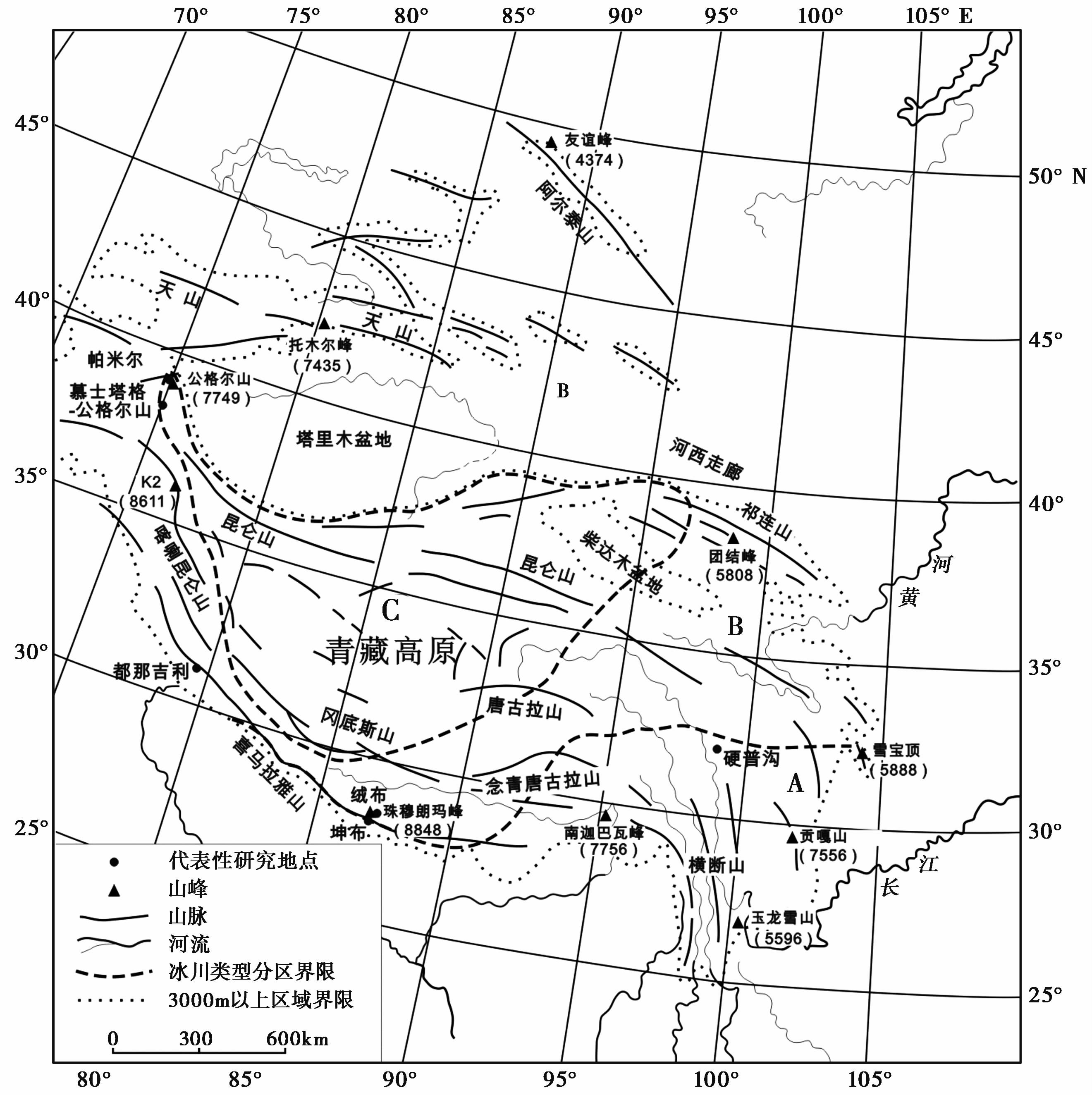
4 末次冰期以来冰川波动与气候记录中亚地区冰川可划分为海洋型(A)、 亚大陆型(B)和极大陆型(C)3个类型[68],大致分别位于喜马拉雅和藏东南地区、 青藏高原东北部和天山地区、 青藏高原中部和西部地区(图2)。 在降水量相对较多的海洋型冰川区,冰川对降水量的变化相对迟钝,对气温的反应较为敏感,而降水量相对较少的亚大陆型冰川和极大陆型冰川区,情况则相反[21, 22, 69]。不同类型冰川对气候变化的敏感性差别很大[70]。近年不同区域已有不少关于冰川波动历史与古气候记录对比的尝试[5, 23, 24, 25, 42, 45, 51, 54, 57, 62, 71, 72, 73, 74, 75, 76, 77],下文将分区域进行阐述。
|
图2 青藏高原及周边山地3种不同的冰川类型[68] A、 B和C分别代表海洋型、 亚大陆型和极大陆型冰川区; 圆点指示不同冰川类型区冰川波动与古气候对比研究若干代表地点 Fig.2 Three types of glacier on the Tibetan Plateau and the bordering mountains[68]. A,B and C are zones of maritime (temperate) glaciers,sub-continental (sub-polar) glaciers and extreme continental (polar) glaciers,respectively. Black dots indicate representative study sites of comparison of glacier fluctuations and palaeoclimate in different zones of glacier type |
从 表1、 表2和 图1中可以看出,MIS 3和早全新世冰进只不过是青藏高原第四纪冰川波动历史中的2幕。要研究冰川活动的气候响应机制,当然也不能仅关注这2幕。将第四纪以来冰川活动历史与气候(包括气温和降水等)记录进行对比,看看冰川发育究竟对应冷期/暖期,还是湿润期/干燥期,应该有助于进一步了解冰川对气候的响应机制。如前所述,由于老冰期的年代不确定性较大,末次冰期以来的冰川地貌年代的可信度相对较高,本文仅讨论末次冰期以来的情况。
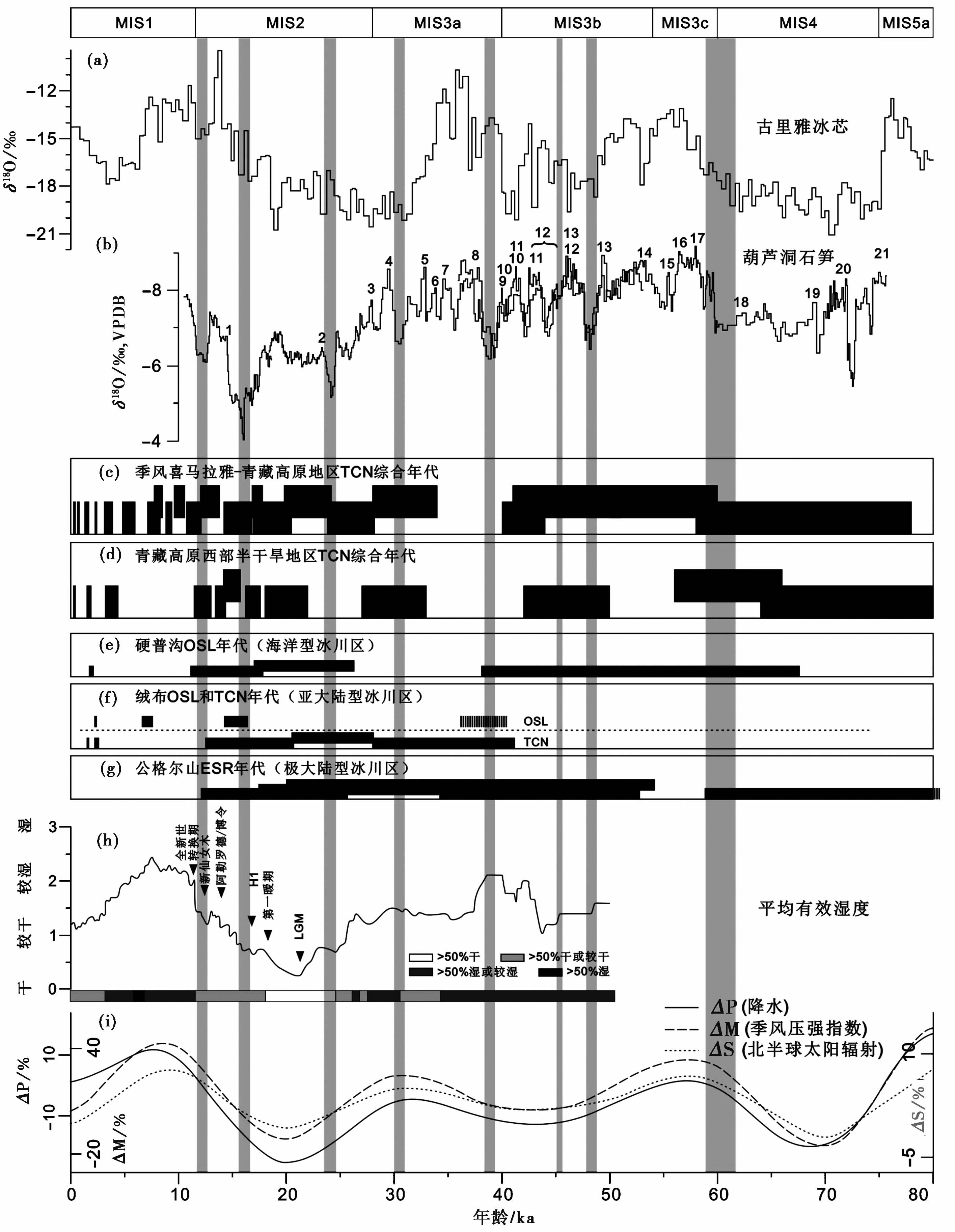
目前为止,对末次冰期以来的气候变化的了解还是相对较深入的。极地冰芯[78]、 深海钻孔[33, 79]和石笋[80, 81, 82, 83],以及青藏高原冰芯[84, 85, 86, 87, 88]、 高原东部黄土[89, 90, 91, 92, 93, 94]和湖泊沉积[95, 96, 97, 98, 99, 100, 101, 102]等众多载体给我们展现了该时期高分辨率的气候变化历史(图3)。各地点的气候在全球变化背景下有区域性差异,但与全球,至少是半球的气候变化大体相似。青藏高原也不例外,末次冰期以来的气候环境与北半球其他地区大致是同步的[21, 87, 88]: MIS 4阶段,气候寒冷,半湿润或半干旱。MIS 3阶段气候变化较为频繁,气候波动幅度较大,在暖(温)湿为主的气候条件下存在多次冷波动。此阶段大致可以分为MIS 3a(40~28ka)、 MIS 3b(54~40ka)和MIS 3c(60~54ka)3个亚阶段,气候状况分别为暖湿、 冷湿和暖湿。末次盛冰期是晚更新世以来最为寒冷干燥的时段。晚冰期气温和降水条件稍转好,但存在两次明显的干冷事件(H1和YD)。全新世早中期暖湿,晚期相对干冷。Herzschuh[103]根据已有的古气候资料总结了季风中亚地区5万年来的湿度变化(图3h)。大体上MIS 3中期和晚期比较湿润,末次盛冰期最干燥,此后湿度条件逐步改善。全新世早中期湿度非常高,其中印度季风影响区的湿度高峰在早全新世,而东南季风和西风影响区的湿度高峰出现在中全新世。晚全新世湿度逐渐降低。
|
图3 末次冰期以来冰川作用年代与古气候记录对比 (a) 古里雅冰芯[87]; (b)葫芦洞石笋[80]; (h)季风中亚区湿度变化综合曲线[103]; (i)南亚地区模拟降水变化、 印度洋地区模拟季风压强指数和北半球太阳辐射变化曲线[65]; 冰川作用年代分别来自季风喜马拉雅-青藏高原地区(c)[23]和青藏高原西部半干旱地区(d)[24]的TCN综合年代, 以及3种类型冰川区的3个代表地点: 硬普沟(e)[62]、 绒布(f)[104]和公格尔山(g)[71]的冰期序列年代 浅灰色竖条纹指示H事件[105] Fig.3 Comparison of glaciations with paleoclimatic records since the last glacial. (a)Guliya ice core[87],(b)Hulu Cave stalagmite[80],(h)mean effective moisture of monsoonal Central Asia[103],(i)simulated monsoon pressure index for the Indian Ocean,simulated changes in precipitation in Southern Asia,and variations in Northern Hemisphere solar radiation[65]. The chronologies of glaciations are: the synthetic chronologies of glaciations of the monsoon-influences Himalayan-Tibetan orogen(c)[23]and the semi-arid western Himalayan-Tibetan orogen(d)[24],and three representative sites from three zones of glacier types:Yingpu Valley(e)[62], Rongbuk Valley(f)[104]and Kongur Mountain(g)[71]. Light gray bands indicate H events[105] |
Murari等[23]总结并重新计算了季风喜马拉雅-青藏高原地区(包括青藏高原东部和喜马拉雅山地区,大部分处于海洋型冰川区,一小部分位于亚大陆型冰川区)1081个冰川地貌 10Be年代,划分了第四纪以来27次区域性冰期(MOHITS),并将冰期年代与气候记录对比(见 表2和 图1),认为16次冰期与南亚季风增强水汽增加有关,11次与中纬西风即北半球气候(冷)事件相关,还有2次由于年代不确定性太大,因此冰期原因不明。他们把多数老冰期定在传统认为的间冰期(MIS 5、 MIS 7、 MIS 9和MIS 11阶段),因此这几个冰期的成因也就归于南亚季风增强所致; 此外,还把新冰期2次(MOHITS 1D和1E)、 末次冰期8次(MOHITS 2A、 2C、 2D、 2F和2G,以及MOHITS 3A、 3B和3C)和MIS 6阶段冰期(MOHITS 6A和6B)也对应于季风[23]。具有争议的是,新冰期、 末次冰期和MIS 6阶段,在我们的传统认识上都是冷期; 其中末次冰期里的MOHITS 2A、 2G和3B阶段,他们认为分别对应于H0、 H3和H5事件,也应属降温事件[105]。将这些冰川作用仅归因于南亚季风水汽增加,让人费解。如果将他们归纳的末次冰期以来的冰川作用与古气候曲线做一对比(图3c),可以发现冰川作用的出现很频繁,且低温和降水丰富的时段都有对应的冰进事件,很难区分冰川活动究竟受何种气候因素控制。
笔者等[62]最近在处于海洋型冰川区的青藏高原东部横断山脉雀儿山做了冰川波动与古气候对比工作,所得结论与Murari等[23]不同。雀儿山北麓竹庆盆地南侧的U形谷中保留了多次冰川波动的证据,硬普沟是其中最典型的一条U形谷,保留了数套末次冰期以来冰碛垄序列。3组末次冰期冰碛垄分布在U形谷口,由外而内分别被命名为外冰碛垄、 主冰碛垄和内冰碛垄。各组又分别由数道冰碛垄组成,反映了冰川的频繁波动特征。全新世以来的2组冰碛垄分布在U形谷内、 现代冰川前方1.4km范围之内。外冰碛垄和主冰碛垄序列的众多道冰碛垄的OSL年代分别在 41.2±3.1~51.3±3.9ka和 19.7±1.4~22.2±1.7ka之间,分属MIS 3b和末次盛冰期。内冰碛垄序列的2道冰碛垄的OSL年代分别为 12.2±1.1ka和 16.2±1.4ka,可能是YD和H1事件的产物。全新世两组冰碛垄,较老的一组的OSL年代为 1.92±0.2ka,属新冰期; 较年轻一组没有OSL年代,推测形成于小冰期。与各种代表性的古气候记录做一对比(图3e)可以发现,除MIS 3b相对冷湿,受气温和降水共同作用的特征比较明显之外,其余冰川作用时段为气候冷干阶段,主要与低温相关[62]。
同样处于横断山地区的沙鲁里山[57]和贡嘎山[54]也有类似的对比工作。ESR和OSL年代显示贡嘎山东坡第四纪冰川作用的时代为MIS 6、 MIS 3b、 MIS 2、 新冰期和小冰期。将冰期时代与古里雅冰芯[87, 88]、 若尔盖盆地RM 钻孔[99]、 LR04深海氧同位素曲线[33]和CLIMBER II模拟的6月、 7月和8月南亚季风降水[106]等古气候记录作对比,结果显示冰期基本上也都在冷期和印度季风降水相对较少的时期[54]。Fu等[57]在沙鲁里山地区运用TCN测年,分辨出MIS 6和MIS 2两个主要的冰川作用阶段。这个结果与沙鲁里山以西400km的藏东南波堆藏布的TCN年代[107]非常一致。两个地点的TCN年代结果均证明了青藏高原东部季风影响的海洋型冰川发育与北半球冰期大致同步。此外,另外一些数据[58, 59, 60]也证明了青藏高原东部冰川对LGM、 H1和YD等冷事件的反应。
而在喜马拉雅-青藏高原西部半干旱地区(处于极大陆型和亚大陆型冰川区),Dortch等[24]总结并重新计算了645个冰川地貌 10Be年代,提出了19次区域性冰期(SWHTS),并也做了冰期年代与气候记录对比(见 表2和 图1),提出了冰期的气候驱动机制。结果表明老于21ka的冰期大致与南亚季风(水汽)相关,而21ka以后的冰期大致与西风,即全球冰量和北半球冷事件相关。属于间冰期的MIS 5、 MIS 7和MIS 9阶段被划为冰期,归因于南亚季风增强所致。同样极具争议的是,属于冷期的末次冰期的SWHTS 2F和SWHTS 3阶段(分别对应于H3和H5冷事件),以及MIS 6的SWHTS 6阶段冰期,都归因于南亚季风水汽增加。而如果我们细看末次冰期以来的情况(图3d)[24],则多数冰川作用可以与低温对应。
青藏高原西部的东帕米尔公格尔山处于极大陆型冰川区。Wang等[71]根据ESR测年结果,认为该地经历了至少6次规模较大的冰川作用,可分别对应于MIS 6、 MIS 4、 MIS 3b、 MIS 2、 新冰期和小冰期。冰川作用时代与各气候曲线的对比(图3g)可以看出,第四纪冰川作用主要在低温时段。
在亚大陆型冰川区的珠峰北坡的绒布河谷,Owen等[104]区分了6套主要的冰碛垄序列。结合OSL和TCN 10Be测年,最老的一套冰碛>330ka,其他5套年轻冰碛垄的形成时代分别为>41ka、 24~27ka、 14~17ka、 8~2ka(可进一步细分为7.7~6.8ka和约2.4ka两次)以及大约1.6ka,冰川规模依次逐渐变小。除缺少早全新世之外,冰川作用与南坡坤布地区[5, 11]可以对比。北坡缺少早全新世的原因被认为是喜马拉雅山阻挡了印度季风的深入,水汽不足从而影响了冰川发育。ELA(equilibriumline altitude,平衡线高度)的重建的结果表明[104],由于水汽的减少,冰川对气候变化的反应反而更灵敏(图3f)。同处亚大陆型冰川区其他山系,例如天山[77, 108, 109, 110]、 祁连山[111, 112]及念青唐古拉山[45, 113]等,所报道的冰川作用时代主要也在冷期。
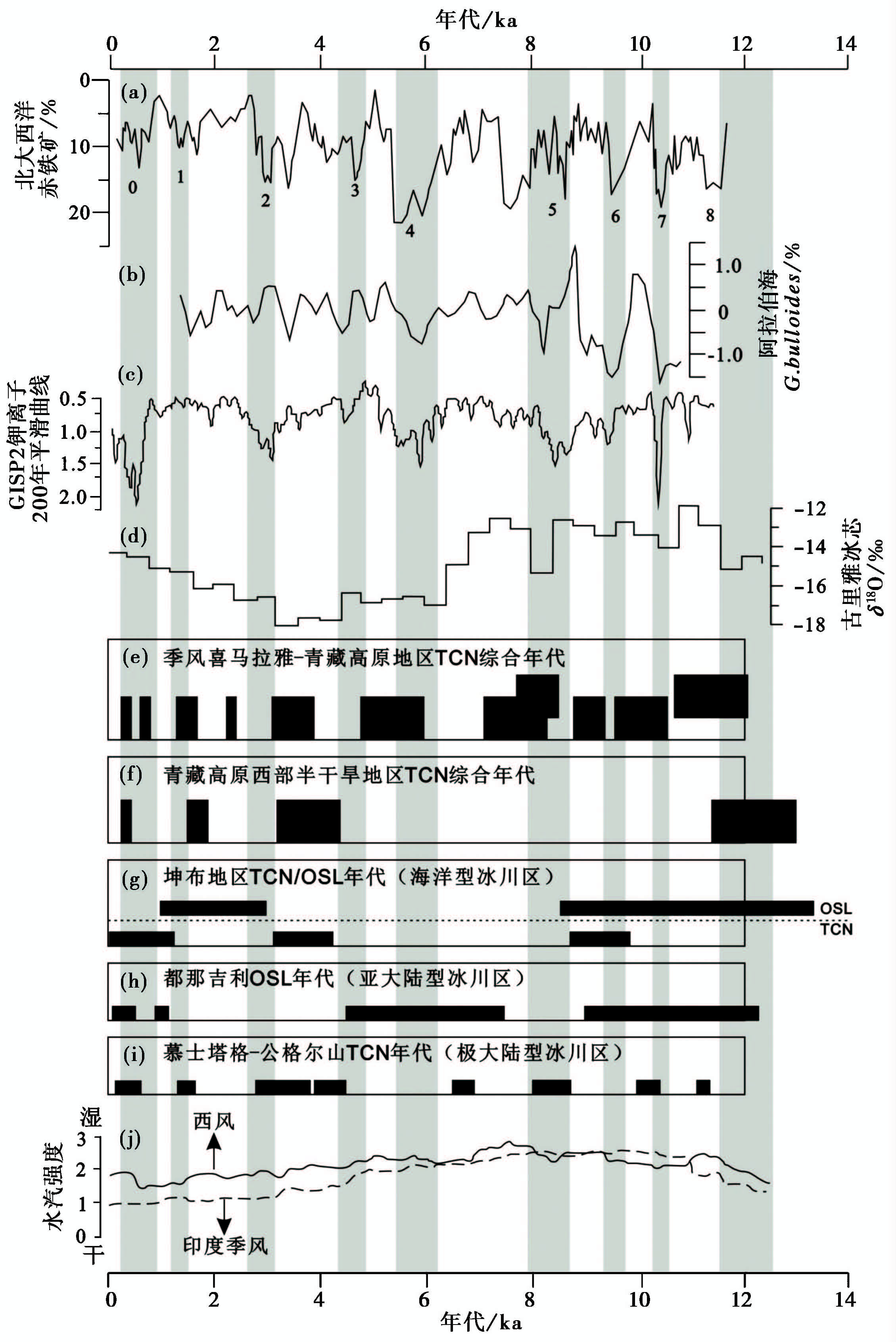
为了更清晰展现短尺度冰进事件的气候响应情况,本文将Owen和Dortch[25]、 Dortch等[24]以及Murari等[23]的TCN综合年代、 三大类型冰川区具有代表性的全新世冰进年代与气候曲线做了进一步对比(图4)。他们根据TCN年代总结了全新世冰川作用发生的时代,并强调了季风对全新世尤其是早中全新世冰川发育的影响[5, 11, 23, 66, 103, 114, 115]。不过,从 图4来看,根据TCN综合年代,全新世存在多次冰进事件,似乎和全新世快速气候变化事件关系密切(图4e和4f)。但降水没有显示出类似的波动(图4j)[103],冰进事件似乎用气温的波动来解释更合理。在深受印度季风影响的珠峰南坡坤布地区[5, 11](海洋型冰川区)(图4g),全新世以来保留了几套冰碛。OSL测年表明在1~2ka和10ka左右存在冰进[11]; TCN的冰进年代则为9.2ka、 3.5ka、 1ka以及小冰期[5]。两种测年结果都证实了该地区早全新世和晚全新世的冰进。早全新世的冰进可能显示了印度季风水汽和降温事件的共同影响。喜马拉雅山西段的都那吉利河谷位于亚大陆型冰川区。自12ka以来,该地经历了3次主要的冰川作用,OSL年代分别在12~9ka、 7.5~4.5ka和约1ka,另外还发现有小冰期冰进的证据(图4h)[73],并认为该地冰川波动是气温与降水共同作用的结果,不过,降温可能是全新世冰川作用的主要驱动因素。Seong等[42]运用TCN测年技术测定了极大陆型冰川区的慕士塔格和公格尔山地区末次盛冰期至今千年尺度冰川波动的年代,并把这些年代结果与气候曲线进行对比(图4i)。该地区冰进年代为 17.1±0.3ka、 13.7±0.5ka、 11.2±0.1ka、 10.2±0.3ka、 8.4±0.4ka、 6.7±0.2ka、 4.2±0.3ka、 3.3±0.6ka、 1.4±0.1ka 以及距今几百年前。自末次盛冰期以来,青藏高原西部冰川主要是对北半球气候波动(快速降温事件)的响应,南亚季风的影响很小。青藏高原冰芯研究也支持该区域气候变化通过中纬西风与大西洋气候变化相关联,即存在多次千年-百年尺度的快速气候波动[87, 88]。可见,即使是在冰川对降水相对敏感的极大陆型冰川区,冰川发育也主要受控于气温变化。Owen[12]也认为晚冰期以来,喜马拉雅-青藏高原地区冰川波动与格陵兰冰芯和北大西洋深海沉积记录的频率具有可比性,即大致1470年的准周期[66]; 世界其他地区全新世冰川波动也都具有相似的准周期[36]。
|
图4 全新世以来冰川作用年代与古气候记录对比 (a)北大西洋MC52-VM29-191孔赤铁矿百分比变化,数字1~8代表气候变化事件[66]; (b)阿拉伯海723-A孔Globigenina bulloides百分比变化[114]; (c)高斯平滑后的格陵兰冰盖计划2(GISP2)冰芯钾离子指示的西伯利亚高压系统变化[115]; (d)古里雅冰芯δ18O曲线[87]; (j)多种古气候指标恢复的青藏高原全新世有效湿度变化曲线[103] (实线和虚线分别指示西风和印度季风); 冰川作用年代分别来自季风喜马拉雅-青藏高原地区[23](e)和青藏高原西部半干旱地区[24](f)的TCN综合年代,以及3种类型冰川区的3个代表地点:(g)坤布地区[5, 11]、 (h)都那 吉利[73]和(i)墓士塔格-公格尔山地区[42]的冰期序列年代。浅灰色竖条纹指示快速气候变化事件[36] Fig.4 Comparison of glaciations with paleoclimatic records during the Holocene. (a)Hematite percentage change in core MC52-VM29-191 from the North Atlantic,and events labeled (1through 8)[66]. (b)Percentage change in Globigenina bulloides in Bore Hole 723-A from the Arabian Sea[114]. (c)Gaussian smoothed (200yr) Greenland Ice Sheet Project 2(GISP2) potassium(K+:ppb) ion proxy for the Siberian high-pressure system[115]. (d)δ18O record from Guliya ice core[87]. (j) Effective moisture variability reconstructed from the paleoclimate proxies records of the Tibetan Plateau during the Holocene[103]. Solid and dotted curves refer to the westerlies and Indian monsoon,respectively. The chronologies of glaciations are: the synthetic chronologies of glaciations of the monsoon-influences Himalayan-Tibetan orogen (e)[23] and the semi-arid western Himalayan-Tibetan orogen (f)[24],and three representative sites from three zones of glacier types: Khumbu(g)[5, 11],Dunagiri (h)[73],and Muztag Ata-Kongur Shan (i)[42]. Lightgray bands indicate rapid climate change[36] |
Yi等[51]综述了整个青藏高原及周边山地不同地点全新世冰碛垄上的14C年代。结合OSL和TCN年代,他们划分了全新世的几个冰进时段: 小冰期(1.0~0.13cal.ka)、 新冰期(3.5~1.4cal.ka)和早全新世(9.4~8.8cal.ka)。小冰期存在3个亚阶段,高原南部和东部边缘的小冰期冰进比北部边缘山地发生较早,可能是由于水汽较丰沛导致; 新冰期冰进几乎在每个山系都能找到证据; 而早全新世冰进在高原内部和周边山地也都有记录。冰碛垄年代与敦德冰芯氧同位素对比表明[51],全新世冰进对应于冰芯氧同位素记录的冷期。而在冰芯记录的暖期,没有冰进的报道。
冰芯研究对青藏高原冰川作用也具有指示作用。除古里雅冰芯外,青藏高原几个冰芯的底部年代都落在了早全新世,敦德和普若冈日冰芯的底部 14C 年代都为6000多年[84, 116]。对于这种寒冷的末次盛冰期没有冰川发育,以及早全新世南亚季风高峰之后冰川开始形成的现象,Thompson等[84]解释为冰川主要受控于岁差驱动的日射量变化所影响的降水量变化。但也不排除另一种可能,即此前(如末次冰期最盛期)累积的冰川经历早全新世的高温之后消融殆尽,到6000年左右复又开始积累。
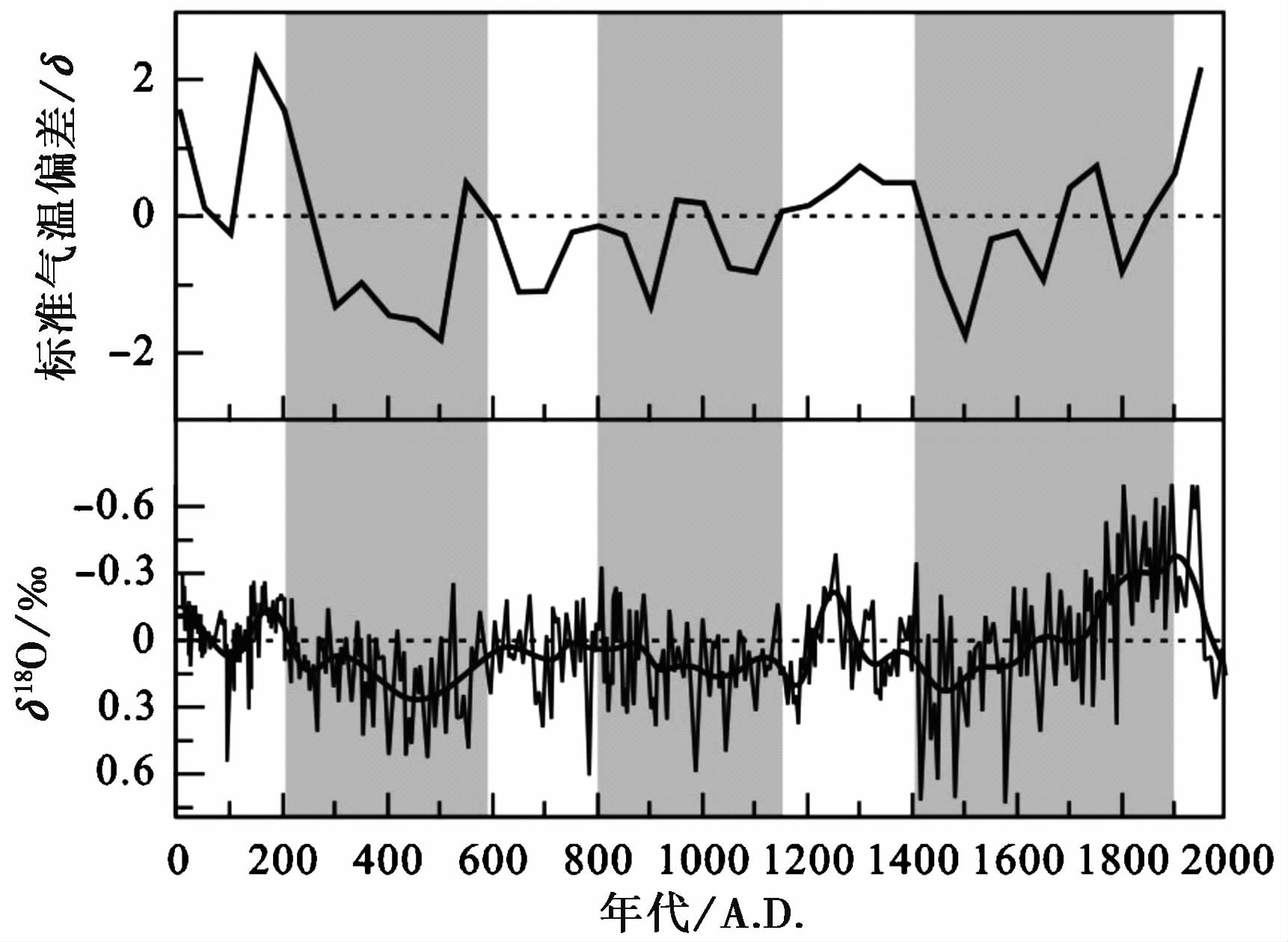
5 历史时期及现代冰川波动与气候变化青藏高原2000年来冰川波动与古里雅冰芯指示的气温变化对比表明,大多数时候冰进与冰芯氧同位素曲线是一致的,即冷期冰进,暖期退缩[117]。2000年来青藏高原海洋型冰川波动与代表气温和南亚季风降水变化的曲线对比(图5)结果也显示,冰川前进的时段与冷期非常吻合[118]。除19世纪之外,南亚季风增强和减弱分别对应于冰川的退缩和前进。表明在百年尺度上,冰川波动的主要控制因素是气温变化而不是南亚季风带来的降水量变化。对冰川波动而言,降水的作用是附加在气温变化起主要影响的基础之上的。
|
图5 2000年来青藏高原冰川波动与气温和南亚季风强度变化的对比[118] 上为综合冰芯、 树轮和湖泊沉积恢复的气温变化曲线[117]; 下为董歌洞石笋指示的南亚季风强度变化曲线[119],代表降水量变化;阴影柱表示冰进时段 Fig.5 Comparison of the glacier fluctuations on the Tibetan Plateau with proxy climate records[118]for temperature change (upper curve)[117] and south Asian summer monsoon strength (lower curve)[119]. The glacial advance record is shown by the shaded bars |
自17世纪的小冰期之后,中国季风温冰川(海洋型冰川)区的气温上升0.8°C,冰川面积缩减约3900km2,大致相当于现代冰川面积的30 % [69]。预测到2100年,中国季风温冰川区的气温将上升2.1°C,冰川面积将减少75 % ,约9900km2。如果降水减少,冰川退缩将更快,但减少的面积也不会超过80 % [69]。对中国季风温冰川区东部最近400年来冰川波动的研究和观测显示[120],自17~19世纪小冰期的两个寒冷阶段以后,气温呈上升趋势,降水量也表现为上升的趋势,但冰川总体是持续退缩的。
根据现代冰川变化监测,由于气温上升,全球绝大部分冰川在过去一个多世纪以来都在退缩[121]。总体来说冰川对气温变化的敏感性较高,而降水对于冰川变化来说重要性相对较低[121, 122, 123]。研究表明高亚洲地区的冰川也正在加速退缩[124]。纵使部分地区降水有所增加,也阻止不了这种趋势[125]。湿润地区比干旱地区的冰川对变暖的反应更加敏感[126, 127]。在青藏高原地区,冰川(因为变暖导致的)退缩由内部向边缘递增[124, 128]。大部分地区降水都有增加,但仍弥补不了由于增温导致的消融[124, 125, 129, 130, 131]。
6 总结与展望青藏高原老冰川作用(末次冰期之前)的定年一直以来就是个难题。ESR测试冰川沉积在国际上的认可度仍不高[132]; OSL在老冰川沉积物上的应用仍极少有尝试[133, 134]; TCN技术是当前国际上冰川地貌和河流阶地定年最认可的方法[135, 136, 137, 138],近年来在青藏高原的应用为这个问题的解决提供了机会。基于现有的TCN年代,青藏高原及周边地区的老冰期大多定在氧同位素奇数阶段,这对中国第四纪冰期划分以及我们的传统认识提出了新挑战,值得引起同行重视。不过,山地冰川区复杂的地质地貌过程以及冰川沉积的特殊性阻碍了测年技术的应用,冰川地貌年代的分辨率还不够高,年代数据的不确定性比较大。不同的研究者、 不同的研究地点以及不同的测年技术,所得结果之间的横向对比仍然困难。尤其越老的冰期其年代不确定性越大。有鉴于此,本文暂时不过多讨论老冰期及其气候响应。期待未来测年技术有新突破之后可以尝试对此问题再讨论。
青藏高原冰川地貌的测年数据主要以年轻冰期(末次冰期以来)为主。其中又以TCN 10Be年代最多,还有一部分OSL、 ESR及 14C等年代。相对老冰期,年轻冰期年代较为精确,但仍然有很大的不确定性。在冰川作用的时代及其气候响应上的分歧依然存在。本文综述了关于该地区冰川作用的气候响应的两种主要观点,即印度季风(降水)控制说和气温控制说。可以看出,不同的观点各具证据。众所周知,气温和降水都是冰川发育的最主要因素之一。因此,毫无疑问两者都会对青藏高原冰川发育产生重要影响。青藏高原及周边山地冰川波动的气候响应机制的争议最初由Owen等学者[1, 2, 3, 4, 5, 6, 7, 8, 9, 10, 11, 12, 13]发现MIS 3较大规模冰进和早全新世冰进开始。MIS 3和早全新世对应于印度季风强盛期,体现了印度季风对青藏高原冰川发育的影响,但其间多次冰川波动的事实用气温的快速变化来解释似乎更为合理。这两个时段的冰进可能是降水较多结合冷期(或冷事件)降温所致。基于数值定年的末次冰期以来冰川波动历史与古气候记录的对比研究表明,在不同的时间尺度下、 不同类型冰川区,冰川波动对气候的响应存在差异。但总体来说,冰川前进和退缩都分别主要与冷期和暖期对应。青藏高原波动对气温的响应似乎更为敏感,其中的机制仍有待探索。就已有的众多测年数据来看,实际上并没有改变“冰期发生在氧同位素偶数阶段”这种传统认识。
测年技术的发展及应用大大提升了我们对青藏高原第四纪冰川历史的了解,也有利于我们检视过去的冰期划分和对冰期成因的认识。中国第四纪冰期的划分也是根据新的年代数据不断更新改进的。但也应该看到,当前测年技术在青藏高原第四纪冰川应用上仍有其局限性,不确定性还很大。在冰川作用的时代及其气候响应上出现分歧的原因也可能主要是测年的问题。更多、 更准确的冰川地貌年代是进一步了解青藏高原第四纪冰川作用及其气候响应机制的关键。如何避免复杂的地质地貌过程对测年的不利影响,提高冰川沉积测年的精确度,是当前亟待解决的问题。
致谢 审稿专家及编辑部杨美芳老师给了中肯而又富有建设性的意见,特此致谢。
| 1 | Owen L A, Bailey R M, Rhodes E J et al. Style and timing of glaciation in the Lahul Himalaya, Northern India:A framework for reconstructing Late Quaternary palaeoclimatic change in the western Himalayas. Journal of Quaternary Science, 1997, 12 (2):83~109 |
| 2 | Richards B W M, Owen L A, Rhodes E J. Timing of Late Quaternary glaciations in the Himalayas of Northern Pakistan. Journal of Quaternary Science, 2000, 15 (3):283~297 |
| 3 | Owen L A, Finkel R C, Caffee M W. A note on the extent of glaciation throughout the Himalaya during the global Last Glacial Maximum. Quaternary Science Reviews, 2002, 21 (1-3):147~157 |
| 4 | Owen L A, Kamp U, Spencer J Q et al. Timing and style of Late Quaternary glaciation in the eastern Hindu Kush, Chitral, Northern Pakistan:A review and revision of the glacial chronology based on new optically stimulated luminescence dating. Quaternary International, 2002, 97-98 :41~55 |
| 5 | Finkel R C, Owen L A, Barnard P L et al. Beryllium-10 dating of Mount Everest moraines indicates a strong monsoon influence and glacial synchroneity throughout the Himalaya. Geology, 2003, 31 (6):561~564 |
| 6 | Owen L A, Finkel R C, Ma Haizhou et al. Timing and style of Late Quaternary glaciation in northeastern Tibet. Geological Society of America Bulletin, 2003, 115 (11):1356~1364 |
| 7 | Benn D I, Owen L A. The role of the Indian summer monsoon and the mid-latitude westerlies in Himalayan glaciation:Review and speculative discussion. Journal of the Geological Society, 1998, 155 (2):353~363 |
| 8 | Phillips W M, Sloan V F, Shroder J F et al. Asynchronous glaciation at Nanga Parbat, northwestern Himalaya Mountains, Pakistan. Geology, 2000, 28 (5):431~434 |
| 9 | Owen L A, Finkel R C, Barnard P L et al. Climatic and topographic controls on the style and timing of Late Quaternary glaciation throughout Tibet and the Himalaya defined by 10Be cosmogenic radionuclide surface exposure dating. Quaternary Science Reviews, 2005, 24 (12-13):1391~1411 |
| 10 | Owen L A, Gualtieri L, Finkel R C et al. Cosmogenic radionuclide dating of glacial landforms in the Lahul Himalaya, Northern India:Defining the timing of Late Quaternary glaciation. Journal of Quaternary Science, 2001, 16 (6):555~563 |
| 11 | Richards B W M, Benn D I, Owen L A et al. Timing of Late Quaternary glaciations south of Mount Everest in the Khumbu Himal, Nepal. Geological Society of America Bulletin, 2000, 112 (10):1621~1632 |
| 12 | Owen L A. Latest Pleistocene and Holocene glacier fluctuations in the Himalaya and Tibet. Quaternary Science Reviews, 2009, 28 (21-22):2150~2164 |
| 13 | Owen L A, Finkel R C, Caffee M W et al. Timing of multiple Late Quaternary glaciations in the Hunza Valley, Karakoram Mountains, Northern Pakistan:Defined by cosmogenic radionuclide dating of moraines. Geological Society of America Bulletin, 2002, 114 (5):593~604 |
| 14 | 崔之久, 陈艺鑫, 张 威等. 中国第四纪冰期历史、特征及成因探讨. 第四纪研究, 2011, 31 (5):749~764 Cui Zhijiu, Chen Yixin, Zhang Wei et al. Research history, glacial chronology and origins of Quaternary glaciations in China. Quaternary Sciences, 2011, 31 (5):749~764 |
| 15 | 赵井东, 施雅风, 王 杰. 中国第四纪冰川演化序列与MIS对比研究的新进展. 地理学报, 2011, 66 (7):867~884 Zhao Jingdong, Shi Yafeng, Wang Jie. Comparison between Quaternary glaciations in China and the Marine Oxygen Isotope Stage(MIS): An improved schema. Acta Geographica Sinica, 2011, 66 (7):867~884 |
| 16 | 王 杰. 青藏高原及周边地区MIS 3中期冰进探讨. 第四纪研究, 2010, 30 (5):1055~1065 Wang Jie. Glacial advance in the Qinghai-Tibet Plateau and peripheral mountains during the mid-MIS 3. Quaternary Sciences, 2010, 30 (5):1055~1065 |
| 17 | 施雅风, 姚檀栋. 中低纬度MIS 3b(54-44ka BP)冷期与冰川前进. 冰川冻土, 2002, 24 (1):1~9 Shi Yafeng, Yao Tandong. MIS 3b(54-44ka BP)cold period and glacial advance in middle and low latitudes. Journal of Glaciology and Geocryology, 2002, 24 (1):1~9 |
| 18 | Schaefer J M,Oberholzer P,Zhao Z et al. Cosmogenic beryllium-10 and neon-21 dating of Late Pleistocene glaciations in Nyalam, monsoonal Himalayas.Quaternary Science Reviews, 2008, 27 (3-4):295~311 |
| 19 | Ono Y, Shulmeister J, Lehmkuhl F et al. Timings and causes of glacial advances across the PEP-II transect(East-Asia to Antarctica)during the last glaciation cycle. Quaternary International, 2004, 118 :55~68 |
| 20 | 赵井东, 周尚哲, 刘时银等. 中国西部山岳冰川MIS 3b冰进的初步探讨. 冰川冻土, 2007, 29 (2):233~241 Zhao Jingdong, Zhou Shangzhe, Liu Shiyin et al. A preliminary study of the glacier advance in MIS 3b in the western regions of China. Journal of Glaciology and Geocryology, 2007, 29 (2):233~241 |
| 21 | 施雅风, 崔之久, 苏 珍. 中国第四纪冰川与环境变化. 石家庄: 河北科学技术出版社, 2006. 65~115 Shi Yangfeng, Cui Zhijiu, Su Zhen. The Quaternary Glaciations and Environmental Variations in China. Shijiazhang:Hebei Science and Technology Press, 2006. 65~115 |
| 22 | 施雅风. 中国冰川与环境——现在、过去和未来. 北京: 科学出版社, 2000. 320~355 Shi Yafeng. Glaciers and Their Environments in China:The Present, Past and Future. Beijing:Science Press, 2000. 320~355 |
| 23 | Murari M K, Owen L A, Dortch J M et al. Timing and climatic drivers for glaciation across monsoon-influenced regions of the Himalayan-Tibetan orogen. Quaternary Science Reviews, 2014, 88 :159~182 |
| 24 | Dortch J M, Owen L A, Caffee M W. Timing and climatic drivers for glaciation across semi-arid western Himalayan-Tibetan orogen. Quaternary Science Reviews, 2013, 78 :188~208 |
| 25 | Owen L A, Dortch J M. Nature and timing of Quaternary glaciation in the Himalayan-Tibetan orogen. Quaternary Science Reviews, 2014, 88 :14~54 |
| 26 | 周尚哲, 李吉均. 第四纪冰川测年研究新进展. 冰川冻土, 2003, 25 (6):660~666 Zhou Shangzhe, Li Jijun. New dating results of Quaternary glaciations in China. Journal of Glaciology and Geocryology, 2003, 25 (6):660~666 |
| 27 | 张 威, 刘蓓蓓, 崔之久等. 中国第四纪冰川作用与深海氧同位素阶段的对比和厘定. 地理研究, 2013, 32 (4):628~637 Zhang Wei, Liu Beibei, Cui Zhijiu et al. Division of glaciation and correlation between the Quaternary glaciation in China and the marine isotope stage. Geographical Research, 2013, 32 (4):628~637 |
| 28 | 施雅风. 中国第四纪冰期划分改进建议. 冰川冻土, 2002, 24 (6):687~692 Shi Yafeng. A suggestion to improve the chronology of Quaternary glaciations in China. Journal of Glaciology and Geocryology, 2002, 24 (6):687~692 |
| 29 | 易朝路, 崔之久, 熊黑钢. 中国第四纪冰期数值年表初步划分. 第四纪研究, 2005, 25 (5):609~619 Yi Chaolu, Cui Zhijiu, Xiong Heigang. Numerical periods of Quaternary glaciations in China. Quaternary Sciences, 2005, 25 (5):609~619 |
| 30 | Zheng B X, Xu Q Q, Shen Y P. The relationship between climate change and Quaternary glacial cycles on the Qinghai-Tibetan Plateau:Review and speculation. Quaternary International, 2002, 97-98 :93~101 |
| 31 | Cui Zhijiu, Wu Yongqiu, Liu Gengnian et al. On Kunlun-Yellow River tectonic movement. Science in China (Series D), 1998, 41 (6):592~600 |
| 32 | Zhou S Z, Wang X L, Wang J et al. A preliminary study on timing of the oldest Pleistocene glaciation in Qinghai-Tibetan Plateau. Quaternary International, 2006, 154-155 :44~51 |
| 33 | Lisiecki L E, Raymo M E. A Pliocene-Pleistocene stack of 57 globally distributed benthic δ18 O records. Paleoceanography, 2005, 20 (1):PA103 |
| 34 | Leuschner D C, Sirocko F. Orbital insolation forcing of the Indian Monsoon——A motor for global climate changes?Palaeogeography, Palaeoclimatology, Palaeoecology, 2003, 197 (1):83~95 |
| 35 | Members N. High-resolution record of Northern Hemisphere climate extending into the last interglacial period. Nature, 2004, 431 (7005):147~151 |
| 36 | Mayewski P A, Rohling E E, Curt Stager J et al. Holocene climate variability. Quaternary Research, 2004, 62 (3):243~255 |
| 37 | Chevalier M-L, Hilley G, Tapponnier P et al. Constraints on the Late Quaternary glaciations in Tibet from cosmogenic exposure ages of moraine surfaces. Quaternary Science Reviews, 2011, 30 (5):528~554 |
| 38 | Hedrick K A, Seong Y B, Owen L A et al. Towards defining the transition in style and timing of Quaternary glaciation between the monsoon-influenced Greater Himalaya and the semi-arid Transhimalaya of Northern India. Quaternary International, 2011, 236 (1):21~33 |
| 39 | Owen L A, Caffee M W, Bovard K R et al. Terrestrial cosmogenic nuclide surface exposure dating of the oldest glacial successions in the Himalayan orogen:Ladakh Range, Northern India. Geological Society of America Bulletin, 2006, 118 (3-4):383~392 |
| 40 | Owen L A, Yi C, Finkel R C et al. Quaternary glaciation of Gurla Mandhata(Naimon'anyi). Quaternary Science Reviews, 2010, 29 (15):1817~1830 |
| 41 | Owen L A, Chen J, Hedrick K A et al. Quaternary glaciation of the Tashkurgan Valley, Southeast Pamir. Quaternary Science Reviews, 2012, 47 :56~72 |
| 42 | Seong Y B, Owen L A, Yi C L et al. Quaternary glaciation of Muztag Ata and Kongur Shan:Evidence for glacier response to rapid climate changes throughout the Late Glacial and Holocene in westernmost Tibet. Geological Society of America Bulletin, 2009, 121 (3-4):348~365 |
| 43 | Owen L A, Caffee M W, Finkel R C et al. Quaternary glaciation of the Himalayan-Tibetan orogen. Journal of Quaternary Science, 2008, 23 (6-7):513~531 |
| 44 | Heyman J. Paleoglaciation of the Tibetan Plateau and surrounding mountains based on exposure ages and ELA depression estimates. Quaternary Science Reviews, 2014, 91 :30~41 |
| 45 | Dong Guocheng, Yi Chaolu, Caffee M. 10Be dating of boulders on moraines from the last glacial period in the Nyainqentanglha Mountains, Tibet. Science China:Earth Sciences, 2014, 57 (2):221~231 |
| 46 | 施雅风, 赵井东, 王 杰. 中国第四纪冰川新论. 上海: 上海科学普及出版社, 2011. 40~44 Shi Yafeng, Zhao Jingdong, Wang Jie. New Understanding of Quaternary Glaciations in China. Shanghai:Shanghai Popular Science Press, 2011. 40~44 |
| 47 | 张 威, 刘蓓蓓. 滇西北山地末次冰期冰川发育及其基本特征. 冰川冻土, 2014, 36 (1):30~37 Zhang Wei, Liu Beibei. Features of glaciation during the Last Glaciation cycle in northwestern Yunnan Province. Journal of Glaciolgy and Geocryology, 2014, 36 (1):30~37 |
| 48 | Zhang W, Cui Z J, Feng J L et al. Late Pleistocene glaciation of the Hulifang Massif of Gongwang Mountains in Yunnan Province. Journal of Geographical Sciences, 2005, 15 (4):448~458 |
| 49 | Yang J Q, Zhang W, Cui Z J et al. Late Pleistocene glaciation of the Diancang and Gongwang Mountains, southeast margin of the Tibetan Plateau. Quaternary International, 2006, 154-155 :52~62 |
| 50 | Zhang W, Liu B, Li Y et al. Late Pleistocene glaciations on Qianhu Mountain, northwest Yunnan Province, China. Geografiska Annaler:Series A, Physical Geography, 2014, 96 (3):417~429 |
| 51 | Yi C L, Chen H L, Yang J Q et al. Review of Holocene glacial chronologies based on radiocarbon dating in Tibet and its surrounding mountains. Journal of Quaternary Science, 2008, 23 (6-7):533~543 |
| 52 | Rthlisberger F, Geyh M. Glacier variations in Himalayas and Karakorum. Z.Gletscherkunde Glazialgeologie, 1985, 21 :237~249 |
| 53 | Zhou S Z, Chen F H, Pan B T et al. Environmental change during the Holocene in Western China on a millennial timescale. The Holocene, 1991, 1 (2):151~156 |
| 54 | Wang Jie, Pan Baotian, Zhang Guoliang et al. Late Quaternary glacial chronology on the eastern slope of Gongga Mountain, eastern Tibetan Plateau, China. Science China:Earth Sciences, 2013, 56 (3):354~365 |
| 55 | Xu L B, Zhou S Z. Quaternary glaciations recorded by glacial and fluvial landforms in the Shaluli Mountains, southeastern Tibetan Plateau. Geomorphology, 2009, 103 (2):268~275 |
| 56 | Wang Jian, Grand R, Xu Xiaobin et al. In situ cosmogenic 10Be dating of the Quaternary glaciations in the southern Shaluli Mountain on the southeastern Tibetan Plateau. Science in China(Series D), 2006, 49 (12):1291~1298 |
| 57 | Fu P, Stroeven A P, Harbor J M et al. Paleoglaciation of Shaluli Shan, southeastern Tibetan Plateau. Quaternary Science Reviews, 2013, 64 :121~135 |
| 58 | Schafer J M, Tschudi S, Zhao Z Z et al. The limited influence of glaciations in Tibet on global climate over the past 170 000 yr. Earth and Planetary Science Letters, 2002, 194 (3-4):287~297 |
| 59 | Tschudi S, Schafer J M, Zhao Z et al. Glacial advances in Tibet during the Younger Dryas?Evidence from cosmogenic 10Be, 26 Al, and 21 Ne. Journal of Asian Earth Sciences, 2003, 22 (4):301~306 |
| 60 | Strasky S, Graf A A, Zhao Z Z et al. Late Glacial ice advances in southeast Tibet. Journal of Asian Earth Sciences, 2009, 34 (3):458~465 |
| 61 | 许刘兵, 周尚哲, 王 杰. 沙鲁里山更新世冰川作用及西南季风波动对末次冰期冰川作用的影响. 第四纪研究, 2005, 25 (5):620~629 Xu Liubing, Zhou Shangzhe, Wang Jie. Pleistocene glaciations in the Shaluli Shan and the influences of southwest monsoon on the glaciations during the last glacial period. Quaternary Sciences, 2005, 25 (5):620~629 |
| 62 | Ou X J, Lai Z P, Zhou S Z et al. Timing of glacier fluctuations and trigger mechanisms in eastern Qinghai-Tibetan Plateau during the Late Quaternary. Quaternary Research, 2014, 81 (3):464~475 |
| 63 | 许刘兵, 周尚哲, 李昌爱等. 甘孜绒坝岔古冰川演化与黄土古土壤对比研究. 冰川冻土, 2003, 25 (5):504~509 Xu Liubing, Zhou Shangzhe, Li Chang'ai et al. The Quaternary glaciation in Rongbacha and correlation with the loess-paleosol in Garzê. Journal of Glaciology and Geocryology, 2003, 25 (5):504~509 |
| 64 | Zhang B, Ou X J, Lai Z P. OSL ages revealing the glacier retreat in the Dangzi valley in the eastern Tibetan Plateau during the Last Glacial Maximum. Quaternary Geochronology, 2012, 10 :244~249 |
| 65 | Prell W L, Kutzbach J E. Monsoon variability over the past 150,000 years. Journal of Geophysical Research, 1987, 92 (D7):8411~8425 |
| 66 | Bond G, Kromer B, Beer J et al. Persistent solar influence on North Atlantic climate during the Holocene. Science, 2001, 294 (5549):2130~2136 |
| 67 | Rupper S, Roe G, Gillespie A. Spatial patterns of Holocene glacier advance and retreat in Central Asia. Quaternary Research, 2009, 72 (3):337~346 |
| 68 | Shi Yafeng, Liu Shiyin. Estimation on the response of glaciers in China to the global warming in the 21st century. Chinese Science Bulletin, 2000, 45 (7):668~672 |
| 69 | Su Z, Shi Y. Response of monsoonal temperate glaciers to global warming since the Little Ice Age. Quaternary International, 2002, 97 :123~131 |
| 70 | Zhang Y, Fujita K, Ageta Y et al. The response of glacier ELA to climate fluctuations on High-Asia. Bulletin of Glacier Research, 1998, 16 :1~11 |
| 71 | Wang Jie, Zhou Shangzhe, Zhao Jingdong et al. Quaternary glacial geomorphology and glaciations of Kongur Mountain, eastern Pamir, China. Science China:Earth Sciences, 2011, 54 (4):591~602 |
| 72 | Zech R, Abramowski U, Glaser B et al. Late Quaternary glacial and climate history of the Pamir Mountains derived from cosmogenic 10Be exposure ages. Quaternary Research, 2005, 64 (2):212~220 |
| 73 | Sati S P, Ali S N, Rana N et al. Timing and extent of Holocene glaciations in the monsoon dominated Dunagiri valley(Bangni glacier), central Himalaya, India. Journal of Asian Earth Sciences, 2014, 91 :125~136 |
| 74 | Nawaz Ali S, Biswas R, Shukla A et al. Chronology and climatic implications of Late Quaternary glaciations in the Goriganga valley, central Himalaya, India. Quaternary Science Reviews, 2013, 73 :59~76 |
| 75 | Amidon W H, Bookhagen B, Avouac J-P et al. Late Pleistocene glacial advances in the western Tibet interior. Earth and Planetary Science Letters, 2013, 381 :210~221 |
| 76 | Rhringer I, Zech R, Abramowski U et al. The Late Pleistocene glaciation in the Bogchigir Valleys(Pamir, Tajikistan)based on 10Be surface exposure dating. Quaternary Research, 2012, 78 (3):590~597 |
| 77 | Zech R, Röhringer I, Sosin P et al. Late Pleistocene glaciations in the Gissar Range, Tajikistan, based on 10Be surface exposure dating. Palaeogeography, Palaeoclimatology, Palaeoecology, 2013, 369 :253~261 |
| 78 | Grootes P M, Stuiver M, White J W C et al. Comparison of oxygen isotope records from the GISP 2 and GRIP Greenland ice cores. Nature, 1993, 366 (6455):552~554 |
| 79 | Martinson D G, Pisias N G, Hays J D et al. Age dating and the orbital theory of the ice ages:Development of a high-resolution 0 to 300,000-year chronostratigraphy. Quaternary Research, 1987, 27 (1):1~29 |
| 80 | Wang Y J, Cheng H, Edwards R L et al. A high-resolution absolute-dated Late Pleistocene monsoon record from Hulu Cave, China. Science, 2001, 294 (5550):2345~2348 |
| 81 | 彭子成, 张兆峰, 蔡演军等. 贵州七星洞晚更新世晚期石笋的古气候环境记录. 第四纪研究, 2002, 22 (3):273~282 Peng Zicheng, Zhang Zhaofeng, Cai Yanjun et al. The paleoclimatic records from the Late Pleistocene stalagmite in Guizhou Qixing Cave. Quaternary Sciences, 2002, 22 (3):273~282 |
| 82 | 覃嘉铭, 袁道先, 程 海等. 贵州都匀七星洞石笋剖面晚更新世高分辨率的气候地层学. 第四纪研究, 2004, 24 (3):318~324 Qin Jiaming, Yuan Daoxian, Cheng Hai et al. A high resolution Late Pleistocene climato-stratigraphy of 4 stalagmites from Qixing Cave, Duyun, Guizhou. Quaternary Sciences, 2004, 24 (3):318~324 |
| 83 | 姜修洋, 孔兴功, 汪永进等. 神农架三宝洞倒数第二次冰期高分辨率石笋δ13 C记录. 第四纪研究, 2011, 31 (1):1~7 Jiang Xiuyang, Kong Xinggong, Wang Yongjin et al. A high-resolution stalagmite δ13 C record from Sanbao Cave over the penultimate glaciation. Quaternary Sciences, 2011, 31 (1):1~7 |
| 84 | Thompson L G, Davis M E, Mosley-Thompson E et al. Tropical ice core records: Evidence for asynchronous glaciation on Milankovitch timescales. Journal of Quaternary Science, 2005, 20 (7-8):723~733 |
| 85 | Thompson L G. Ice core evidence for climate change in the Tropics:Implications for our future. Quaternary Science Reviews, 2000, 19 (1-5):19~35 |
| 86 | Thompson L, Mosley-Thompson E, Davis M et al. Holocene-Late Pleistocene climatic ice core records from Qinghai-Tibetan Plateau. Science, 1989, 246 (4929):474~477 |
| 87 | Thompson L G, Yao T D, Davis M E et al. Tropical climate instability:The last glacial cycle from a Qinghai-Tibetan ice core. Science, 1997, 276 (5320):1821~1825 |
| 88 | Yao Tandong, Thompson L G, Shi Yafeng et al. Climate variation since the last interglaciation recorded in the Guliya ice core. Science in China (Series D), 1997, 40 (6):662~668 |
| 89 | 潘保田, 王建民. 末次间冰期以来青藏高原东部季风演化的黄土沉积记录. 第四纪研究, 1999, (4):330~335 Pan Baotian, Wang Jianmin. Loess record of Qinghai-Xizang Plateau monsoon variations in the eastern part of the Plateau since the last interglacial. Quaternary Sciences, 1999, (4):330~335 |
| 90 | Fang X, Lü L, Mason J A et al. Pedogenic response to millennial summer monsoon enhancements on the Tibetan Plateau. Quaternary International, 2003, 106-107 :79~88 |
| 91 | 鹿化煜, 马海州, 谭红兵等. 西宁黄土堆积记录的最近13 万年高原季风气候变化. 第四纪研究, 2001, 21 (5):416~426 Lu Huayu, Ma Haizhou, Tan Hongbing et al. Plateau monsoon variations during the past 0.13Ma indicated by loess deposit at Xining, northeast Qinghai, China. Quaternary Sciences, 2001, 21 (5):416~426 |
| 92 | 曾蒙秀, 宋友桂. 西风区昭苏黄土剖面中碳酸盐矿物组成及其古环境意义辨识. 第四纪研究, 2013, 33 (3):424~436 Zeng Mengxiu, Song Yougui. Carbonate minerals of Zhaosu Loess section in westerly area and their paleoenvironmental significance. Quaternary Sciences, 2013, 33 (3):424~436 |
| 93 | 张 晓, 贾 鑫, 饶志国等. 陇西黄土高原东南部地区末次冰期以来C3/C4植物相对丰度变化及其区域性剖面的对比研究. 第四纪研究, 2013, 33 (1):187~196 Zhang Xiao, Jia Xin, Rao Zhiguo et al. C3/C4 variation since the Last Glacial in the southeastern Longxi Loess Plateau and its comparison with other results. Quaternary Sciences, 2013, 33 (1):187~196 |
| 94 | 饶志国, 陈发虎, 曹 洁等. 黄土高原西部地区末次冰期和全新世有机碳同位素变化与C3/C4植被类型转换研究. 第四纪研究, 2005, 25 (1):107~114 Rao Zhiguo, Chen Fahu, Cao Jie et al. Variation of soil organic carbon isotope and C3/C4 vegetation type transition in the western Loess Plateau during the last glacial and Holocene periods. Quaternary Sciences, 2005, 25 (1):107~114 |
| 95 | 孙千里, 肖举乐, 刘 韬. 岱海沉积物元素地球化学特征反映的末次冰期以来季风/干旱过渡区的水热条件变迁. 第四纪研究, 2010, 30 (6):1121~1130 Sun Qianli, Xiao Jule, Liu Tao. Hydrothermal status in the monsoon/arid transition belt of China since the last glaciation inferred from geochemical characteristics of the sediment cores at Daihai Lake. Quaternary Sciences, 2010, 30 (6):1121~1130 |
| 96 | 匡欢传, 周浩达, 胡建芳等. 末次盛冰期和全新世大暖期湖光岩玛珥湖沉积记录的正构烷烃和单体稳定碳同位素分布特征及其古植被意义. 第四纪研究, 2013, 33 (6):1222~1233 Kuang Huanchuan, Zhou Haoda, Hu Jianfang et al. Variations of n-alkanes and compound-specific carbon isotopes in sediments from Huguang Maar Lake during the Last Glacial Maximum and Holocene optimum:Implications for paleovegetation. Quaternary Sciences, 2013, 33 (6):1222~1233 |
| 97 | 胡小猛, 王杜涛, 陈美君等. 山西临汾盆地末次冰期时段湖相沉积中的H、D/O 事件记录. 第四纪研究, 2014, 34 (2):354~363 Hu Xiaomeng, Wang Dutao, Chen Meijun et al. The study on the records of H and D/O paleoclimatic events during the last glacial period from the lacustrine sediment in Linfen basin, Shanxi Graben. Quaternary Sciences, 2014, 34 (2):354~363 |
| 98 | Zhou H Y, Zhu Z Y. Oxygen isotopic composition of lacustrine carbonates since 130ka BP from a Tianshuihai Lake core, Tibet:An overall increasing δ18 O trend and its implications. Journal of Asian Earth Sciences, 2002, 20 (3):225~229 |
| 99 | Wu Jinglu, Wang Sumin, Shi Yafeng et al. Temperature estimation by oxygen-stable record over the past 200ka in Zoigê basin. Science in China (Series D), 2000, 43 (6):577~586 |
| 100 | Shen Caiming, Tang Lingyu, Wang Sumin et al. Pollen records and time scale for the RM core of the Zoigê Basin, northeastern Qinghai-Tibetan Plateau. Chinese Science Bulletin, 2005, 50 (6):553~562 |
| 101 | 朱立平, 鞠建廷, 王君波等. 湖芯沉积物揭示的末次冰消开始时期普莫雍错湖区环境变化. 第四纪研究, 2006, 26 (5):772~780 Zhu Liping, Ju Jianting, Wang Junbo et al. Environmental changes recorded in core sediments from the Pumoyum Co Lake of the Tibetan Plateau during the initial stage of the last deglacial period. Quaternary Sciences, 2006, 26 (5):772~780 |
| 102 | 李世杰, 张宏亮, 施雅风等. 青藏高原甜水海盆地MIS 3阶段湖泊沉积与环境变化. 第四纪研究, 2008, 28 (1):122~131 Li Shijie, Zhang Hongliang, Shi Yafeng et al. A high resolution MIS 3 environmental change record derived from lacustrine deposit of Tianshuihai Lake, Qinghai-Tibet Plateau. Quaternary Sciences, 2008, 28 (1):122~131 |
| 103 | Herzschuh U. Palaeo-moisture evolution in monsoonal Central Asia during the last 50,000 years. Quaternary Science Reviews, 2006, 25 (1-2):163~178 |
| 104 | Owen L A, Robinson R, Benn D I et al. Quaternary glaciation of Mount Everest. Quaternary Science Reviews, 2009, 28 (15-16):1412~1433 |
| 105 | Bond G, Broecker W, Johnsen S et al. Correlations between climate records from North Atlantic sediments and Greenland ice. Nature, 1993, 365 (6442):143~147 |
| 106 | Ziegler M. Orbital forcing of the Late Pleistocene Boreal Summer Monsoon: Links to North Atlantic Cold Events and El Niño -Southern Oscillation. Utrecht:The PhD Dissertation of Utrecht University, 2009. 38-39 |
| 107 | Zhou Shangzhe, Xu Liubing, Colgan P M et al. Cosmogenic 10 Be dating of Guxiang and Baiyu glaciations. Chinese Science Bulletin, 2007, 52 (10):1387~1393 |
| 108 | Yi C L, Jiao K Q, Liu K X et al. ESR dating of the sediments of the Last Glaciation at the source area of the Ürümqi River, Tian Shan Mountains, China. Quaternary International, 2002, 97-98 :141~146 |
| 109 | Zhao J D, Liu S Y, He Y Q et al. Quaternary glacial chronology of the Ateaoyinake River Valley, Tianshan Mountains, China. Geomorphology, 2009, 103 (2):276~284 |
| 110 | Zhao J D, Song Y G, King J W et al. Glacial geomorphology and glacial history of the Muzart River valley, Tianshan Range, China. Quaternary Science Reviews, 2010, 29 (11-12):1453~1463 |
| 111 | Zhou S Z, Li J J, Zhang S Q. Quaternary glaciation of the Bailang River Valley, Qilian Shan. Quaternary International, 2002, 97-98 :103~110 |
| 112 | Hu G, Yi C L, Zhang J F et al. Optically stimulated luminescence dating of a moraine and a terrace in Laohugou valley, western Qilian Shan, northeastern Tibet. Quaternary International, 2014, 321 :37~49 |
| 113 | 赵希涛, 吴中海, 朱大岗等. 念青唐古拉山脉西段第四纪冰川作用. 第四纪研究, 2002, 22 (5):424~433 Zhao Xitao, Wu Zhonghai, Zhu Dagang et al. Quaternary Glaciations in the west Nyaiqentanglha Mountains. Quaternary Sciences, 2002, 22 (5):424~433 |
| 114 | Gupta A K, Anderson D M, Overpeck J T. Abrupt changes in the Asian southwest monsoon during the Holocene and their links to the North Atlantic Ocean. Nature, 2003, 421 (6921):354~357 |
| 115 | Meeker L D, Mayewski P A. A 1400-year high-resolution record of atmospheric circulation over the North Atlantic and Asia. The Holocene, 2002, 12 (3):257~266 |
| 116 | Thompson L G, Mosley-Thompson E, Davis M E et al. Ice core evidence for asynchronous glaciation on the Tibetan Plateau. Quaternary International, 2006, 154 :3~10 |
| 117 | Yang B, Bräuning A, Shi Y F. Late Holocene temperature fluctuations on the Tibetan Plateau. Quaternary Science Reviews, 2003, 22 (21):2335~2344 |
| 118 | Yang B, Brauning A, Dong Z B et al. Late Holocene monsoonal temperate glacier fluctuations on the Tibetan Plateau. Global and Planetary Change, 2008, 60 (1-2):126~140 |
| 119 | Wang Y, Cheng H, Edwards R L et al. The Holocene Asian monsoon:Links to solar changes and North Atlantic climate. Science, 2005, 308 (5273):854~857 |
| 120 | He Y, Zhang Z, Theakstone W H et al. Changing features of the climate and glaciers in China's monsoonal temperate glacier region. Journal of Geophysical Research, 2003, 108 (D17):4530~4536 |
| 121 | Oerlemans J. Extracting a climate signal from 169 glacier records. Science, 2005, 308 (5722):675~677 |
| 122 | Braithwaite R J, Zhang Y. Sensitivity of mass balance of five Swiss glaciers to temperature changes assessed by tuning a degree-day model. Journal of Glaciology, 2000, 46 (152):7~14 |
| 123 | Anderson B, Mackintosh A. Temperature change is the major driver of late-glacial and Holocene glacier fluctuations in New Zealand. Geology, 2006, 34 (2):121~124 |
| 124 | Yao Tandong, Wang Youqing, Liu Shiyin et al. Recent glacial retreat in High Asia in China and its impact on water resource in Northwest China. Science in China (Series D), 2004, 47 (12):1065~1075 |
| 125 | Wang Y, Hou S, Liu Y. Glacier changes in the Karlik Shan, eastern Tien Shan, during 1971/71-2001/02. Annals of Glaciology, 2009, 50 (53):39~45 |
| 126 | Fujita K, Nuimura T. Spatially heterogeneous wastage of Himalayan glaciers. Proceedings of the National Academy of Sciences, 2011, 108 (34):14011~14014 |
| 127 | Oerlemans J, Fortuin J. Sensitivity of glaciers and small ice caps to greenhouse warming. Science, 1992, 258 (5079):115~117 |
| 128 | Ding Y, Liu S, Li J et al. The retreat of glaciers in response to recent climate warming in Western China. Annals of Glaciology, 2006, 43 (1):97~105 |
| 129 | Li Z, He Y, An W et al. Climate and glacier change in Southwestern China during the past several decades. Environmental Research Letters, 2011, 6 (4):045404 |
| 130 | Ye B, Yang D, Jiao K et al. The Ürümqi River source glacier No.1, Tianshan, China:Changes over the past 45 years. Geophysical Research Letters, 2005, 32 (21):L21504 |
| 131 | Liu S, Ding Y, Shangguan D et al. Glacier retreat as a result of climate warming and increased precipitation in the Tarim River basin, Northwest China. Annals of Glaciology, 2006, 43 (1):91~96 |
| 132 | 赵希涛, 张永双, 曲永新等. 玉龙山西麓更新世冰川作用及其与金沙江河谷发育的关系. 第四纪研究, 2007, 27 (1):35~44 Zhao Xitao, Zhang Yongshuang, Qu Yongxin et al. Pleistocene glaciations along the western foot of the Yulong Mountains and their relationship with the formation and development of the Jinsha River. Quaternary Sciences, 2007, 27 (1):35~44 |
| 133 | 陈艺鑫, 李英奎, 张 跃等. 末次冰期以来格尔木河填充-切割及驱动机制初探. 第四纪研究, 2011, 31 (2):347~359 Chen Yixin, Li Yingkui, Zhang Yue et al. Late Quaternary deposition and incision sequences of the Golmud River and their environmental implication. Quaternary Sciences, 2011, 31 (2):347~359 |
| 134 | 类延斌, 张虎才, 尚华明等. 青藏高原年保玉则山末次冰期中期以来的湖泊演化与古冰川发育. 第四纪研究, 2008, 28 (1):132~139 Lei Yanbin, Zhang Hucai, Shang Huaming et al. Lake evolution and glaciation of the Nianbaoyuze Mountain in the Tibetan Plateau since the middle of the last glacial. Quaternary Sciences, 2008, 28 (1):132~139 |
| 135 | 王 建, 张志刚, 徐孝彬等. 青藏高原东南部稻城古冰帽南缘第四纪冰川活动的宇生核素年代研究. 第四纪研究, 2012, 32 (3):394~402 Wang Jian, Zhang Zhigang, Xu Xiaobin et al. Cosmogenic isotopes dating of Quaternary glacial activity of the Paleao-Daocheng Ice Cape, On the southeastern part of the Qinghai-Xizang Plateau. Quaternary Sciences, 2012, 32 (3):394~402 |
| 136 | 王 建, 徐晓彬, 张志刚等. 海螺沟现代冰碛物中的宇生核素 10Be浓度分析. 第四纪研究, 2010, 30 (5):956~961 Wang Jian, Xu Xiaobin, Zhang Zhigang et al. Inherited cosmogenic nuclide 10Be in modern moraine of Hailuogou Glacier in the Gongga Mountains, Sichuan Province, China. Quaternary Sciences, 2010, 30 (5):956~961 |
| 137 | 赵志中, 钱 方, 刘宗秀等. 青藏高原若干地点的第四纪冰川年代学——深切怀念孙殿卿院士. 第四纪研究, 2007, 27 (5):669~673 Zhao Zhizhong, Qian Fang, Liu Zongxiu et al. Quaternary glacial chronology in Qinghai-Xizang Plateau. Quaternary Sciences, 2007, 27 (5):669~673 |
| 138 | 吕延武, 顾兆炎, 许 冰等. 云南怒江丙中洛河段第三级阶地 10Be暴露年龄. 第四纪研究, 2012, 32 (3):403~408 Lü Yanwu, Gu Zhaoyan, Xu Bing et al.10Be dated boulders from the third terrace of Nujiang River at Bingzhongluo, Yunnan Province, China. Quaternary Sciences, 2012, 32 (3):403~408 |
Abstract
The Qinghai-Tibetan Plateau and the surrounding mountains is the most glaciated region outside the polar realm. Understanding the time of Quaternary glaciations and their climatic response is thus very important. However, different views occur on these issues.
In this paper, two major different views were introduced and discussed. In the past more than ten years, based on the numerous chronological works including terrestrial cosmogenic nuclide (TCN) beryllium-10 and optically stimulated luminescence (OSL) dating, some scientists suggested that, (1) The glaciations were mostly occurred in the odd marine oxygen isotope stages(MIS). (2) The maximum glacial advance in the last glacial occurred during the MIS 3; and significant glacier advances occurred during the early Holocene. (3) Glacial advances in this region were mainly driven by increased precipitation brought by the intensive Indian summer monsoon.
Other scientists considered that glacier advances in this region were corresponding to cold stages (even MIS stages) or events. Some scientists supposed that glaciations in this high altitude region probably a result of both glacial climate and tectonic uplift.
To discuss these issues, the history of glacial fluctuations mainly based on the existing chronologies (including TCN and OSL ages) was compared with climatic records since the last glacial. Comparisons of glacier and climatic change at a variety of temporal scales(since the last glacial, Holocene, historical period and modern) were carried out. Glaciers in different zones of glacier types (maritime, sub-continental and extreme continental glaciers) were investigated. The results show that glacier advances occurred at both humid and cold periods. But they mainly responded to low temperature. It seems that glaciers in this region were more sensitive to temperature rather than precipitation. For the old glaciations that prior to the last glacial, the larger uncertainties of chronologies do not allow further discussion of the time and climatic response of glacier advance.
It is worth to note that during the MIS 3 and the Early Holocene, glacier advances did occurred, and indicates that the Indian summer monsoon has a profound influence on the glaciers in this region. However, there were many rapid climatic change events during these two periods. And there are evidences that these glacier advances were also corresponding to the cold events. It seems that glacier fluctuations during these two periods were influenced by both monsoonal precipitation and temperature changes.
According to the existing chronological data, especially the data since the last glacial, the traditional view ‘glaciations occurred in the even MIS stages’ haven't been overturned by far. More and more accuracy numerical chronologies are required to update our understanding of glaciations and their climatic response in the Qinghai-Tibetan Plateau.