 2014, Vol. 2
The article information
- Anders Eriksen, Dominik Osinski, Dag Roar Hjelme
- Evaluation of thermal imaging system and thermal radiation detector for real-time condition monitoring of high power frequency converters
- Advances in Manufacturing, 2014, 2(1): 88-94
- http://dx.doi.org/10.1007/s40436-014-0066-1
-
Article history
- Received: 2014-01-19
- Accepted: 2014-02-14
- Published online: 2014-03-11


2. Department of Electrical and Computer Engineering, Faculty of Technology, Sør-Trøndelag University College, Trondheim, Norway;
3. Department of Electrical and Computer Engineering, Faculty of Technology, Sør-Trøndelag University College, Trondheim, Norway
Cost effective operation and management of offshore wind turbine systems demand advanced condition monitoring systems. To reduce failure rates and decrease down time, we need high quality data as input to algorithms for fault diagnosis and prognosis.
Recent studies of failures in wind turbines have demonstrated that failures in the electrical systems contribute significantly to generator downtime [1]. Electrical systems account for 13%–18% of the failures [2]. Condition monitoring of transformers and rotating electrical machinery has already been proven cost effective in the power generation industry, and condition monitoring methods used in the power generation industry have been adapted for commercial use in wind turbines. However, the operation and maintenance cost remains too high, and there is a need for better condition monitoring methods of the electrical systems.
Insulated gate bipolar transistors (IGBTs) account for 15% of the failures in a power converter [3]. A major reason for the failure of IGBTs is bond wire lift-off [4], which results from the thermal cycles that the device is subjected to in operation. Recent studies have demonstrated that reliable lifetime estimation can be predicted from historic junction temperature variations [5]. Thus online monitoring of IGBT temperature will be very useful for enhancing the reliability, cost effectiveness and performance of the power electronic system [6]. However, it is difficult to obtain the actual junction temperature since it cannot be measured directly with conventional sensors [7]. It is common to use measured heat sink temperatures to compute dynamic junction temperature. However, unless very advanced thermal models are used, the uncertainty in the predicted junction temperature may be too large for good lifetime prediction. Additional temperature measurements on the IGBT modules can possibly be used to reduce the uncertainty in the junction temperature prediction.
Monitoring a high power frequency converter is challenging both in terms of electromagnetic interference and high voltages. In this paper we present preliminary result from an evaluation of two non-contact temperature measurement systems, an infrared camera and a single-pixel thermopile sensor, for online thermal monitoring of IGBT load terminals and heat sink of frequency converters in wind turbines. 2 Measurement systems 2.1 High resolution thermal imaging system
The thermal imaging system was based on a commercial
high resolution camera from Xenics interfaced to a custom
written LabVIEW application [8]. The Gobi 640GigE
camera (see Fig. 1a) is a 0.3 megapixel (640 × 480) camera
based on uncooled micro-bolometer technology operating in
the 8–14 μm spectral band. It is the smallest thermal imaging
camera using GigE vision interface standard, allowing fast
data transfer to the PC (<50 Hz). The measurement range is
from -25 to 125, and the resolution is specified to
50 mK [8]. The camera has some valuable features regarding use in wind turbine converter diagnostics like operating
temperature range (from -40 to70), shock (70 G)
and vibration conditions (4.5 G for frequency 5–500 Hz).
The camera is equipped with an 18 mm lens and has pixel
pitch of 25μm. During testing we operate the camera with an
object distance of 52 cm, resulting in a spatial resolution of
0.7 mm (limited by the pixel).
to 125, and the resolution is specified to
50 mK [8]. The camera has some valuable features regarding use in wind turbine converter diagnostics like operating
temperature range (from -40 to70), shock (70 G)
and vibration conditions (4.5 G for frequency 5–500 Hz).
The camera is equipped with an 18 mm lens and has pixel
pitch of 25μm. During testing we operate the camera with an
object distance of 52 cm, resulting in a spatial resolution of
0.7 mm (limited by the pixel).
 |
| Fig. 1 a Gobi 640GigE infrared camera (the camera measures 49 mm × 49 mm × 77 mm and weights about 500 g (without lens) and b The TI TMP006 single pixel thermopile sensor kit (the thermopile chip package measures 1.6 mm × 1.6 mm (lower image)) |
The Gobi 640GigE camera can be easily integrated with LabVIEW programming environment. For integration purposes we used LabVIEW vision package, which supports connection by using GigE vision protocol. After connecting to the camera the program loads the calibration file provided by the manufacturer and creates the calibration table where the relationship between the digital pixel values and the temperature is stored. In order to store the number of frames, the points or areas of interest may be set by the user. Figure. 2 shows the LabVIEW application user interface.
 |
| Fig. 2 Thermal camera LabVIEW application interface |
The part of the program that is responsible for point and area temperature data analysis uses LabVIEW MathScript add-on module, which enables use of Matlab functions during the data analysis. Currently, the program calculates the mean temperature value over the selected area of interest. The data presentation phase is realized by temperature graph plotting. 2.2 Single pixel infrared thermopile sensor
The single pixel sensor is a model TMP006EVM from Texas
instruments. It is an infrared thermopile sensor with digital
output realized by integrated circuit. The measurement frequency can be adjusted and varied from 0.25 Hz to 4 Hz [9].
The sensor has a wide operating temperature range from
-55 to 125 and measurement range from -40to
125. The sensors temperature error is specified to
(±1). The temperature resolution depends on the number
of averages, varying from 500 mK to 125 mK, for 1 and 16
averages respectively. The TMP006EVM has a very large
field of view of 90°[10]. The sensor output is influenced by
all the objects within the field of view of the sensor. This fact
influences the practical application areas of the sensor. The
sensor is the best fitted for the relatively big surfaces and for
little distances between the object and the sensor. The recommended operating distance is equal or less than half the
object radius. The field of view may be reduced using pinhole in a low emissivity shield around the sensor.
We perform the evaluation using the default software provided by Texas instruments. The software is written in LabVIEW, and TI gives access to the source files. Therefore, future developments are possible on basis of original virtual instrument files. 2.3 Other installed temperature sensors
The frequency converter was also instrumented with a
SENTRY temperature monitoring system from Kongsberg
[11]. This is a wireless sensor system suitable for highvoltage applications. The mounted sensors are individually
scanned by a multiplexing central unit using low energy
radar pulses. The sensors respond to the pulses with a temperature dependent pattern. The system has a measuring
range from 0 to 200. The thermal resolution of the
sensor system at the test facility is configured to 1 K, with an
accuracy of 2 K. The central unit (signal processing unit)
operating temperatures are between 40 and 85, and
the antennas operating temperatures are from 0 to
110.
3 High power frequency converter
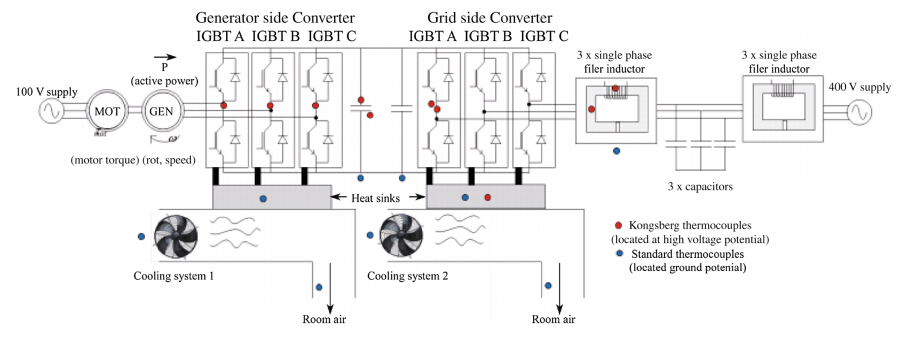
The high power frequency converter used for testing is a prototype 25 kW converter at the NTNU-SINTEF Renewable Energy Systems Laboratory [12]. The heart of the converter contains four IGBTs (400 A, 1,200 V) Semikron modules. The converter modules, capacitors, inductors, and control module are mounted in a standard 48.26 cm rack, as shown in Fig. 3. The frequency converter is fed from a generator driven by an electrical motor, as illustrated in Fig. 4. Generator speed and motor torque are controlled by software.
Location of reference temperature sensors, wireless SENTRY sensors on high voltage points, and thermocouples at ground potential (heat sink) is illustrated in Fig. 4. The thermal camera is used to monitor the generator side of the converter, whereas the single pixel thermopile senor is used to monitor the heat sink.
 |
| Fig. 3 High power frequency converter at NTNU-SINTEF Renewable Energy Systems Laboratory used for testing (the image on the right shows the IGBT module mounted on the heat sink) |
 |
| Fig. 4 Location of reference temperature sensors |
The thermal camera is positioned on the outside of the transformer rack imaging area around the emitter/collector terminals of the IGBT modules on the generator side. The distance from the camera objective to the IGBT terminal is 52 cm (see phase A). This allows us to monitor the surface temperature of the terminal of all three phases, as well the surface temperature of the IGBT module casing. The singe pixel sensor is placed 4 cm above the heat sink on the generator side.
Temperature measurements based on the thermal radiation are strongly dependent on emissivity of the measured object. To circumvent the emissivity issue, we coat the surfaces of interest with electrical non-conducting tape with emissivity ε around 0.97. For more advanced tests the high thermal emissivity spray coating should be used. The plastic casing has emissivity close to 1 and there is no need for additional coatings. 4.1 IGBT load terminal temperature monitoring
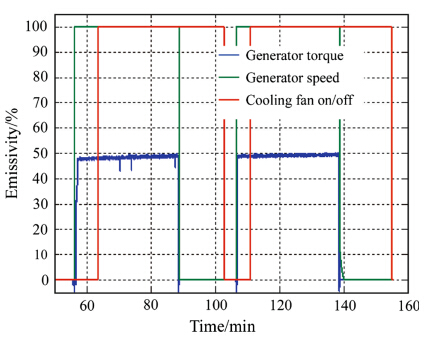
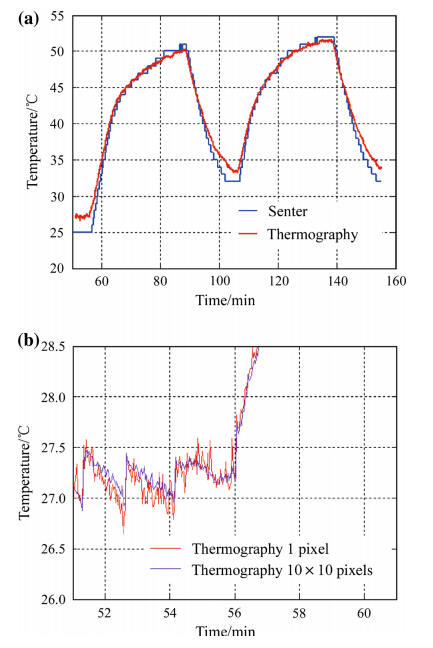
For the first test we monitor the temperature of phases A and B while running the generator and converter for approximately 2 h, as illustrated in Fig. 5. Figure. 6 shows the IGBT load terminal temperature developments as measured using thermal camera and the point-contact sensors (Sentry). Temperature data for both a single camera pixel and an area of 10 × 10 pixels were logged. This corresponds to terminal areas of 0.7 mm × 0.7 mm and 7mm × 7 mm respectively. As expected the temperature response is dominated by a "fast" (10 min) and a "slow" (h) time constant. The agreement between the different sensors is as expected. The small deviations of around 0.5° can be attributed to the physical configuration and mounting of the point-contact sensor, and the emissivity error of the thermal camera system.
 |
| Fig. 5 Generator input sequence for test 1 |
 |
| Fig. 6 a Temperature development on IGBT terminal phase B as measured by the SENTRY-sensor and the thermography system and b detailed temperature signal from the thermography system for 1 pixel and for area of 10 × 10 pixels |
From Fig. 6b it is clear that there are two different noise mechanisms involved in the thermography system including a white noise from the radiation detector and electronics and a low frequency technical noise. The low frequency noise is due to periodic compensation of the cameras internal temperature. The technical noise due to camera internal adjustment has peak-to-peak amplitude of 500 mK, dominating the white noise.
The white noise contribution is reduced by spatial averaging over several pixels. The root mean square noise in the one pixel measurement in the time interval between the two first camera adjustments (51.3–52.6 min) is 90 mK, while the corresponding root mean square noise for the 10 × 10 pixels measurement is 45 mK. Noise reduction of only factor two indicates that noise from neighbouring pixels is correlated.
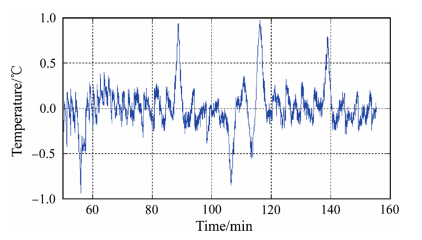
The low frequency technical noise can in principle be reduced by proper filtering at the expense of time resolution. However, the time interval between internal corrections generally increases with time interval since the camera system is powered, and with room temperature variations. In Fig. 7 we have plotted the deviation between the camera signal (10 × 10 pixels) and the same signal smoothed using a moving average filter over 120 data points (4 min). This plot clearly illustrates how the time interval between the internal camera adjustments increases with time, starting at around 1.3 min at the beginning (@ 50 min) and increasing to 4.4 min towards the end (@ 150 min).
 |
| Fig. 7 Deviation between the camera signal (10 × 10 pixels) and the same signal smoothed using a moving average filter over 120 data points (4 min) |
The temperature of the IGBT module casing may also be of interest for condition monitoring, e.g., to monitor material degradation. Fig. 8 shows the measured case temperature compared to the terminal temperature for phase A. The quality (S/N) of the casing temperature data is identical to the quality of the terminal data. As expected the case temperature is significantly lower than the terminal temperature. The terminal temperature is close to the junction temperature and the thermal gradient from the junction to the case increases with temperature due to the low thermal conductivity of the case material.
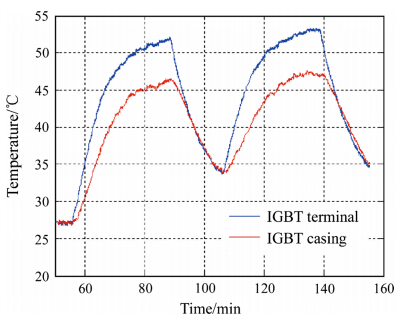 |
| Fig. 8 Temperature measurement on the IGBT module casing compared to the terminals for phase A |
For the first evaluation of the infrared thermopile sensor we monitor the heat sink temperature. Figure9 shows the generator input (from wind profile data) and the resulting temperature measurements. The thermopile sensor signal is noisy, but gives an accurate representation of the heat sink temperature dynamics. For these low temperatures, the higher noise in the thermopile compared to the camera is expected, since the thermopile operates at shorter wavelengths.
We note that before cooling fan 1 is turned on the measured temperature is essentially identical to the temperature form thermocouple 1 mounted in the heat sink wall. With cooling fan 1 the measured temperature is essentially identical to the temperature from thermocouple 2 mounted in the airflow.
For comparison we have also included the IGBT load terminal temperature. As expected this temperature is close, but not identical, to the heat sink temperature (thermocouple 1) throughout the measurement cycle. The small temperature difference for the highest temperature may be used for accurate junction temperature estimation.
We estimate the root mean square noise of the thermopile sensor to 490 mK, however signal averaging will
reduce this. The sampling time in the data in Fig. 9 is 1 s,
filtering the signal using a moving average filter over 30
points and reducing the root mean square noise to 94 mK.
This reduction is close to the expected factor
 , assuming uncorrelated noise. The root mean square noise is
reduced to 68 mK by reducing the bandwidth even further
by averaging over 60 points. This is comparable to the
noise in the thermal camera system (no averaging).
, assuming uncorrelated noise. The root mean square noise is
reduced to 68 mK by reducing the bandwidth even further
by averaging over 60 points. This is comparable to the
noise in the thermal camera system (no averaging).
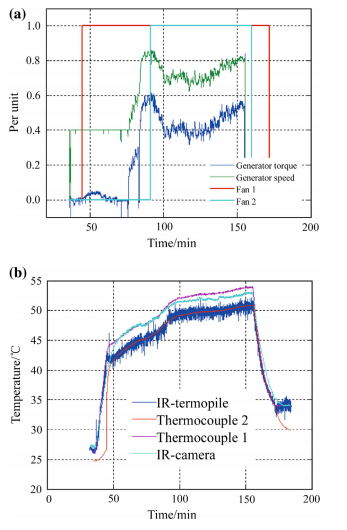 |
| Fig. 9 a Generator input sequence for test 1 and b heat sink temperature measurements using the IR-thermopile sensor and two thermocouples |
We are currently building a multipoint temperature system using multiple thermopile sensors in order to monitor all load terminals and possibly additional point on casing and heat sink.
Acknowledgement The authors wish to thank Atle Årdal and Kjell Ljøkelsøy at Sintef Energy for facilitating the experiments at the NTNU-SINTEF Renewable Energy Systems Laboratory. The work was funded by the Norwegian Research Council (Grant No. 217607/E20).
| 1. | Daneshi-Far Z, Capolino GA, Henao H (2010) Review of failures and condition monitoring in wind turbine generators. In: International conference on electrical machines, proceedings of ICEM conference, Rome, 6–10 Sept 2010 |
| 2. | Lu B et al (2009) A review of recent advances in wind turbine condition monitoring and fault diagnosis. In: Power electronics and machines in wind applications, 2009. pp 1–7 |
| 3. | Department of Defense (1995) The military handbook for reliability prediction of electronic equipment. Defense Printing Service, Mechanicsburg |
| 4. | Ciappa M, Fichtner W (2000) Lifetime prediction of IGBT modules for traction applications. In: Proceedings of IEEE 38th annual international reliability physics symposium, IEEE, pp 210–216 |
| 5. | James PA (2012) Health monitoring of IGBTs in automotive power converter systems. PhD, The University of Manchester |
| 6. | Kuhn H, Mertens A (2009) On-line junction temperature measurement of IGBTs based on temperature sensitive electrical parameters. In: Proceedings of the 13th European conference on power electronics and applications 2009, pp 1–10 |
| 7. | Bazzo JP, Lukasievicz T, Vogat M (2012) Thermal characteristics analysis of an IGBT using a fiber Bragg grating. Opt Lasers Eng 50:99–103 |
| 8. | Gobi-640-GigE—Scientific brochure. http://www.xenics.com/en/infrared_camera/lwir_-_infrared_thermography_camera/gobi-640-gige__thermal_imaging_camera_with_gige_vision_interface.asp. Accessed 25 Feb 2014. |
| 9. | TMP006EVM user guide and software tutorial. http://www.ti.com/lit/ug/sbou109a/sbou109a.pdf. Accessed 25 Feb 2014 |
| 10. | Infrared thermopile sensor in chip-scale package. http://www.ti.com/lit/ds/sbos518c/sbos518c.pdf. Accessed 25 Feb 2014 |
| 11. | SENTRY GB-200 wireless temperature monitoring. http://www.km.kongsberg.com/ks/web/nokbg0240.nsf/AllWeb/6B5FEFE64164D3FBC12577CB003EFDDA?OpenDocument. Accessed 25Feb 2014 |
| 12. | Kolstad H, Ljøkelsøy K (2002) 20 kW IGBT omformer. Beskrivelse, 3rd Utgave, SINTEF Energiforskning AS |