 2013, Vol. 1
The article information
- Muralidharan Ramachandran • Ramana G. Reddy
- Making aviation green
- Advances in Manufacturing, 2013, 1(1): 42-49
- http://dx.doi.org/10.1007/s40436-013-0008-3
-
Article history
- Received: 2012-07-14
- Accepted: 2012-10-08
- Published online: 2013-03-13


The aviation industry,belonging to the manufacturing industry,provides products for air transportation that is a major consumer of natural resources and energy. Development of green technology in aviation manufacturing will have significant impacts on air transportation. Under the guidance of related policy-making,green aviation is leading the future of aviation industry. To challenge the future, aviation industry must become low-carbon and green oriented.
Green aviation comprehensively considers energy consuming and pollution emission in the entire product lifecycle. The fundamental goal is to achieve low energy consumption,low emission and low pollution throughout the whole process including design,testing and manufacturing. These are essential for the balance of economic benefits, social benefits and environmental benefits. The basic principle is to improve energy/resource efficiency of aviation manufacturing and air transportation,and to create a clean energy system. The core for achieving the goal is the technological innovation and change of the development patterns. 2 Current status of global green aviation
The global aviation manufacturing community is making every effort to reduce emission and develop green aviation, which involves research and development in various technologies including aerodynamics,noise reduction, more electricity,propulsion/combustion,green fuel,green materials,and green manufacturing. 2.1 Active aerodynamics research
Aerodynamics is important not only in improving aircraft performances and economy,but also in satisfying environmental requirements and promoting aircraft upgrade [1]. Fuel consumption could be reduced for aircraft in service by adopting state-of-the-art aerodynamic techniques to improve lift and reduce drag,thus decreasing fuel cost,pollutants emission and noise.
Aerodynamic drag-reduction techniques being developed and/or applied are characterized by laminar flow control,which is focused on new spoilers to reduce negative effects caused by vortex,large-size of wing tips, self-adaptable flaps,new approach of wings laminar flow control and active flow control. The target is to decrease aerodynamic drag by 5 %-7 %,fuel consumption by 2 %, and noise level by 2 dB [2] in near future.
Potential future aerodynamic configuration is well represented by blended wing body (BWB) aircraft developed by NASA and Boeing,which can increase lift/drag ratio by 20 %,decrease fuel consumption by 27 %,and reduce noise. 2.2 Noise reduction to meet environmental
requirements Regarding noise pollution,the civil aviation authorities and environmental organizations worldwide all adopt more strict standards and requirements for air vehicles,especially civil airplanes. Noise control requirements are found in the airworthiness regulations of many countries,e.g., FAR-36 of the United States and CCAR-36 of China. Therefore,to apply for airworthiness certificates,all aircraft manufacturers must meet noise airworthiness standards. According to the EU roadmap,the airworthy noise level of commercial airplanes has to be 10 dB with regard to effective perceived noise lower than the stipulations in 2000 by 2020. This is to be achieved in three major areas: noise reduction of engine and nacelle,and airframe noise control. 2.3 Green propulsion/combustion technology for emission reduction
Emissions from the aircraft are directly generated by the engine. Improving engine performance and combustion efficiency will have an immediate effect on reducing fuel consumption and greenhouse emissions [3]. For conventional engine structure,specific fuel consumption can be reduced through cycle parameter optimization,aerodynamic improvement and design improvement of combustors. The United States and European countries initiated various programs for developing efficient and environment-friendly engine technologies [4]. They are working on GTF engines, open rotor engines,more-electricity engines,pulse detonation engines and other new engine architectures. The basic goal is to reduce fuel consumption by 8 %-20 %,noise by 6 dB-20 dB,NOx pollutants by 40 %-80 %,and operational cost by 15 %-30 %.
Green fuel technology focuses on finding new alternative fuel to replace aviation fuel and achieve low energy consumption and low emission. It is expected that up to 25 % of aviation fuel will be bio-fuel by 2025. That number will reach 35 % in 2030,and 50 % in 2040 respectively. 2.4 More electricity technology for energy consumption reduction
More electricity technology can enable overall management of power utilization for airborne systems and integration of equipment and thus reduces fuel consumption. This technology is critical both in improving aircraft performance and reducing environmental footprint [5]. Several projects in the US,the EU and other countries have achieved energy optimization through integration of electromechanical systems. Electrical network is adopted to replace traditional centralized hydraulic,pneumatic and mechanical energy systems. Electricity becomes the major source for secondary energy so as to reduce secondary energy types,improve efficiency and reliability,reduce fuel consumption,system weight,and cost in manufacturing,maintenance and operation. 2.5 New generation flight management system for greener operation
As an important technology that can reduce fuel consumption and flight intervals,increase operational capability of air space,ensure flight safety and quality as well as ease pilots’ workload,the flight management system has experienced five phases such as local navigation system,performance management system,3D & 4D flight management system to a new generation flight management system since the 1960s. With the development of computer technology,GPS,data link communication and requirements change of CNS/ATM operational environment,the real time dynamic management based on 4D track control which is evolved from flight plan has become the core characteristics of new generation flight management system. The performance-based navigation,space-sky-ground integrated network data link and 4D leading technology based on optimized flight path have become the key trend. 2.6 Green materials and manufacturing technology become main research topics
Apart from optimization of propulsion system and overall aerodynamic efficiency,advanced materials such as composite and Al-Li alloys are introduced to reduce aircraft weight,thus reducing fuel consumption and engine emission to certain extent. New green aviation coating products currently in use,e.g.,metal pretreatment coating and epoxy primer,are quite effective in corrosion prevention and do not contain chromate [6]. Since they contains little volatile organic compound,greenhouse gas emission can be effectively reduced.
With improved environmental standards for energy saving,fuel consumption and emission reduction,green manufacturing technologies become a major area for research and development. Rapid shaping,precision forging and casting,and other near-net shaping techniques to save raw materials are evolving rapidly. Research on composite materials has been extended from design and manufacturing to waste treatment. Airbus replaces chemical milling with skin mirror milling,a green transformation of traditional ECM technology and perfect solution for the recycling and disposing of electrolyte. Efficient NC machining is widely applied in parts processing. With improved awareness and intensive research that has been done,green manufacturing has been applied to a wider range of areas which involve the whole product lifecycle and multiple lifecycles. 2.7 Information technology as a foundation for green manufacturing
Various IT tools are adopted to promote green manufacturing such as PLM,ERP,SCM,and MRO. The application of these tools in operation and process management helps the information management between suppliers, manufacturers,retailers and customers,and supports information sharing and decision-making. IT technologies provide virtual environment in which all aspects of green manufacturing could be simulated,shared and tracked and therefore compatible to all stakeholders.
IT technologies not only function in aviation manufacturing,but also play significant role in smart cockpit and paperless operation to reduce carbon footprint. 3 Green aviation manufacturing in China
Aviation Industry Corporation of China (AVIC) is a stateowned industrial group. It is involved in the design,testing and manufacturing of civil airplanes,transporters,fighters, trainers,helicopters,and general aircraft. A large number of environmental issues are involved in the design,testing and manufacturing of aircraft structures and systems. As a major aviation manufacturer in China,AVIC pays high attention to energy conservation and environmental protection. Great efforts have been made to improve the energy saving,reduce energy consumption and pollution as well as actively develop an environment-friendly industry by using high technology in aviation. 3.1 Status quo on green aviation development of AVIC AVIC sticks to its strategy in developing green aviation technology. Comprehensive research has been conducted on aerodynamics,noise reduction,more electricity,green power,green materials and green manufacturing [5]. Productive results have been obtained in energy saving and emission reduction. IT technologies are widely applied to create digitalized development system and support new mode of production,so as to realize fly before manufacturing. 3.1.1 Research on advanced aerodynamics AVIC has signed the Greener Aeronautics International Networking (GRAIN) with the EU. GRAIN is a SinoEuropean cooperative project in identifying and evaluating new approaches to reduce pollution and noise,enhance lift and decrease drag,developing new materials,and large-scale simulation methods and tools supporting these technologies. The program aims at meeting the strategic targets for environmental protection in the long-term development of aviation industry in China. Under this framework,Key Green Technology Package II is focused on the lift enhancement and drag reduction technologies,mainly airframe anti-drag design and optimized aerodynamics. Specific technical subjects include: laminar flow wings and boundary layer control of laminar flow,optimization design of lift enhancement and drag reduction,theory and application of turbulent flow drag reduction,basic research on stability of cross flow stationary wave in 3D boundary layer,engineering application of laminar flow wing design (see Fig. 1).
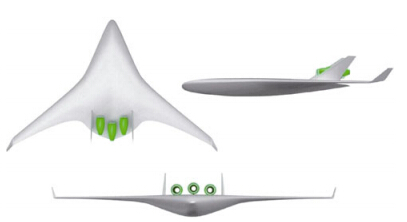 |
| Fig. 1 BWB configuration proposed by AVIC |
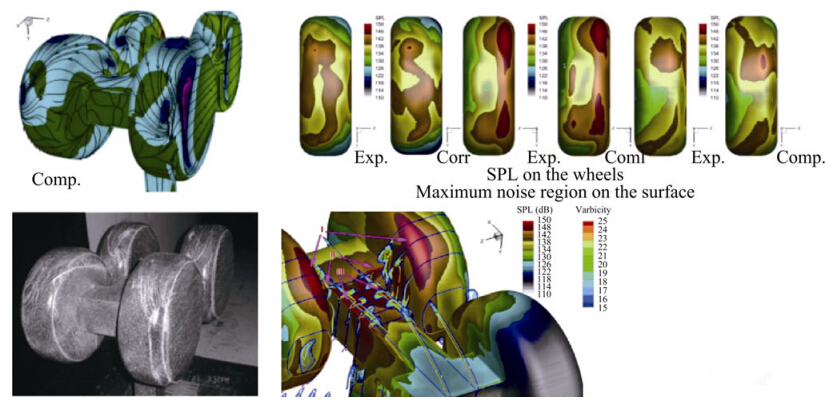 |
| Fig. 2 China’s numerical simulation of landing gear noise |
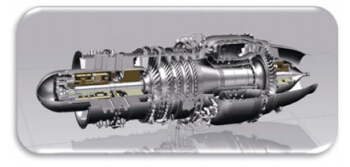 |
| Fig. 3 More-electricity engine |
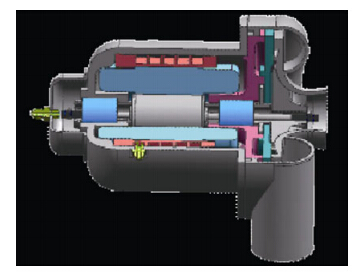 |
| Fig. 4 Centrifugal compressor driven by high speed DC motor |
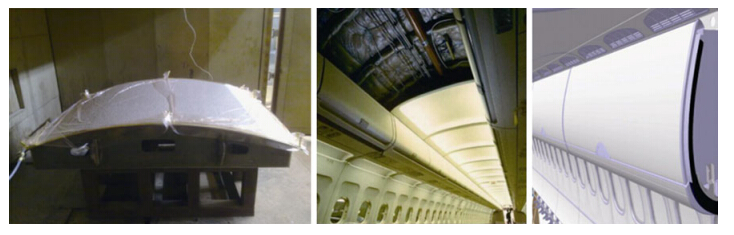 |
| Fig. 5 Application of plant fiber composite on aircraft |
Energy saving and emission reduction are key elements in promoting green development of aviation manufacturing. In the past years,strategic actions have been taken by AVIC to promote energy conservation and emission reduction,an implementation of the national plan. Old equipments with high energy consumption and high emission have been replaced or upgraded. Environmental evaluation report mechanism is in place for any fix asset investment. The design,construction and investment of environment facilities are started in parallel with the project. Strict requirements are applied to major subsidiaries to prevent big environment events. Through continuous efforts,AVIC has accomplished the energy saving and emission reduction targets set by government 2 years in advance (see Fig. 6).
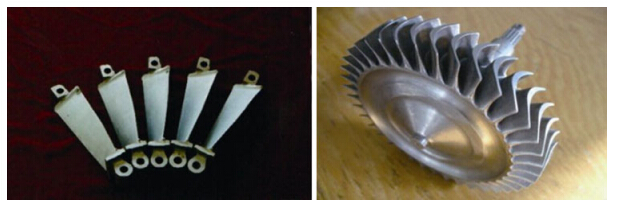 |
| Fig. 6 Numerical controlled electrochemical machining of engine blades and integral impeller |
Apart from the energy saving methods of traditional manufacturing,AVIC has put into huge investments and manpower to develop advanced green manufacturing technology. From the point of view of saving raw material consumption,the advanced joining technology and additive manufacturing level of friction stir welding,linear friction welding and laser welding have been rapidly increased. Those techniques are being widely utilized in the aircraft structure manufacturing,thus greatly increasing the buy to fly ratio of those expensive materials such as titanium alloy and superalloy. To meet the requirements on reducing pollutants emission,phosphoric anodizing is used to replace sulfuric acid anodizing,the highly polluted chemical milling replaced by mechanical processing. Moreover,the pollutant processing technology of electrochemical machining has made significant breakthroughs. Since energy consumption reduction is one of the important goals of green technology,AVIC has developed resin transfer molding (RTM) and resin film infusion (RFI) which can replace traditional autoclave processing,thus reducing electricity greatly. These new technologies are changing Chinese aviation industry fundamentally. With more investments in advanced manufacturing from AVIC,advanced technologies will make the aviation products affordable and the manufacturing process environmentally friendly.
Advanced information technology is widely used in modern aviation industry to increase resources utilization during the product design,manufacturing and application. The development and manufacturing systems of aviation products in AVIC are turning digitalized,network-oriented and intelligent. Information technologies are adopted to create digitalized development system to support new mode of production and achieving fly-before-manufacturing. Through ERP system,the allocation and operation of resources,logistics and capital could be supervised and controlled in real time. AVIC is stepping towards a green aviation company,using green concepts to guide its activities throughout the product lifecycle. Virtual concept design is replacing traditional physical prototyping. The manufacturability of the product can be evaluated during development phase so that economic and feasible manufacturing processes could be designed in advance. Simulation of assembly could identify coordination and processing defects and thus achieve green manufacturing through resources utilization improvement and energy saving. Numerical technology can simulate product operation and maintenance environment so that the overall environmental impact could be evaluated for the whole product lifecycle. Mitigation measures can then be prepared,resources utilization improved (see Fig. 7).
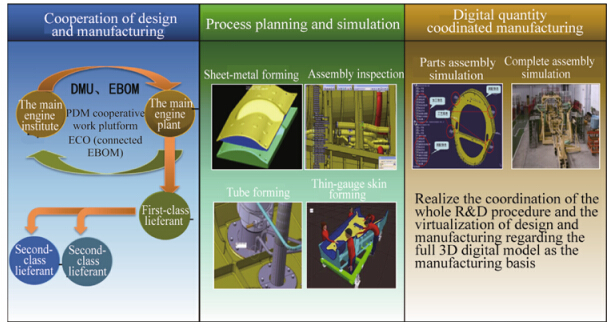 |
| Fig. 7 Coordinated development system of different locations to support green manufacturing |
Turboprops consume less fuel compared to turbofan and turbojet aircraft. They also produce less emissions of CO2 , CO,SO2,as compared to turbofan aircraft of the same category. By using turboprops,significant economic advantages can be achieved in energy saving,emission reduction. In an air route of 500-600 km,the operating cost per seat of turboprop aircraft is 35 % lower than that of a turbojet. For less than 500 km routes,the number is more than 40 %. Therefore turboprop aircraft is an ideal choice for green aviation.
In 1990s,AVIC developed MA60 turboprop aircraft for regional operation,an upgrade on China’s Y-7. Due to excellent performance in economy,safety and comfort, MA60 has won market recognition. With substantial improvements and system upgrades according to high international standards,the newly developed MA600 has been certified by CACC and ready to be delivered. Targeting the international market,AVIC launched the brand new MA700 program. With a family products strategy,MA60, MA600 and MA700,AVIC is going to become one of the major suppliers for turboprop aircraft in the global market. 4 AVIC’s prospects for green aviation
Since the new century,the problems of global resources, environment and climate have become more and more severe, environment-friendly,energy-saving,low-carbon and environment protection,as well as green development have become the inevitable choice of human development. To realize green development,AVIC will increase energy and resources efficiency,reduce pollutants emissions,and improve resource structure. It is AVIC’s internal requirements of scientific development and social responsibility to develop low-carbon economy and serve for national economy. 4.1 Promote green concept and speed up change of development patterns
Green aviation will be regarded as one of the most important concepts of AVIC at the strategic level,which is penetrated into every element of our business including operation,product design,manufacturing,and marketing. Important actions are being taken to promote strategic planning and structural optimization. To greatly promote the capability of using intangible competitiveness to create values as well as reduce resources consumption and environment pollution,AVIC will actively foster core competitiveness of brand values,commercial modes and integrated network. This will encourage effective growth, avoid resource and capital occupancy and energy consumption,and reduce environmental impacts. 4.2 Develop advanced commercial aircraft and green aviation
AVIC is committed to developing advanced economical civil aviation products of low carbon impact for domestic and global markets,focusing on serial development of turboprop aircraft,civil helicopters and general aircraft. The MA turboprop family has become an established brand in the regional market. MA700—new turboprop commuter—is under development. AVIC is trying to be a world-class turboprop commuter manufacturer. Low emission engine—which will equip C-919—will make AVIC among the most advanced engine manufacturers. 4.3 Scientific and technological innovation lays solid foundation for green development
Technology is the key for industrial upgrade and the foundation for green development. Green aviation development must be based on innovation and mastery of core technologies. AVIC is committed to developing leadingedge technologies to support green development. To strengthen innovative capabilities,break through core and key technologies,AVIC is committed to a large investment in research. Focused research areas include new materials, new structure,new dynamic configuration,new design technology,new manufacturing technology,new engine technology,green more-electricity technology,and information technology. The goal is to continuously reduce emission,noise,weight and fuel consumption. 4.4 Energy saving,emission reduction and green manufacturing
In accordance with the state requirements,AVIC sticks to its energy conservation and emission reduction targets. It will continually promote resource recycling and regeneration,maintaining as an energy saving and environment friendly corporation. Actions will be taken as follows:
(i) Set up mechanism for energy conservation and emission reduction; implement statistics,testing and evaluation systems; strengthen the supervision management of statistic reporting; build monitoring networks; implement target assessment and make environment performance evaluation part of business performance evaluation; set up benchmarking and evaluation standards for major energy consuming subsidiaries
(ii) Upgrade facility. AVIC will invest more in the replacement and upgrade of old facilities with high energy consumption and emission,remove redundant capacity
(iii) Evaluate environmental impacts of construction projects and promote energy saving evaluation and investigation systems; ensure a parallel launch of environment project with the main project 5 Conclusions
In the era of low-carbon economy,AVIC faces both challenges and opportunities. It is AVIC’s missions to pursue green aviation,speed up change,enhance technology innovation,and strengthen the foundation for green development; it is AVIC’s opportunities to develop new energy and integrate into the supply chain. AVIC is also committed to developing green and strong aviation industry and contributing to the establishment of resource-saving and environmentally friendly society in China.
| 1. | Kare K, Wim D, Michael O et al (2012) Methodology forsystematic analysis and improvement of manufacturing unitprocess lifecycle inventory (UPLCI)CO2PE initiative (cooperativeeffort on process emissions in manufacturing). Int J Cycle Assess17:69–78 |
| 2. | Tridech S, Cheng K (2008) Low carbon manufacturing: characterization, theoretical models and implementation. In: The 6thInternational Conference on Manufacturing Research, BrunelUniversity, 9–11 September 2008 |
| 3. | Tridech S, Cheng K (2010) An investigation of the ERFE-basedlow carbon manufacturing on CNC machine. In: Proceeding of the36th International MATADOR Conference, Manchester, 14 –16July 2010 |
| 4. | Ball PD, Evans S, Levers A et al (2009) Zero carbon manufacturing facility-towards integrating material, energy, and wasteprocess flows. J Eng Manuf 223(9):1085–1096 |
| 5. | Ameta G, Mani M, Rachuri S et al (2009) Carbon weight analysisfor machining operation and allocation for redesign. Int J SustainEng 2(4):241–251 |
| 6. | Song JS, Lee KM (2010) Development of a low-carbon productdesign system based on embedded GHG emissions. ResourConserv Recycl 54(9):547–556 |