 2017, Vol. 5
The article information
- Tian-Yu Liu,Jie Sun,Cheng Sheng,Qi-Xin Wang,Yun-Hu Zhang,Li-Juan Li,Hong-Gang Zhong,Qi-Jie Zhai
- Influence of pulse magneto-oscillation on the efficiency of grain refiner
- Advances in Manufacturing, 2017, 5(2): 143-148.
- http://dx.doi.org/10.1007/s40436-017-0175-8
-
Article history
- Received: 2 November, 2016
- Accepted: 21 April, 2017
- Published online: 19 May, 2017


2 College of Science, Shanghai University, Shanghai 200444, People's Republic of China
Almost all metal alloys experience at least one solidification procedure during their production. The solidified structure of fine equiaxed grains can significantly enhance the mechanical properties of castings, ingots, and strips. Hence, grain refinement methods have been rigorously investigated and developed, such as the applications of a grain refiner [1-3], ultrasonic vibration [4-7], mechanical stirring [8-10], and electromagnetic fields [11-15].
In particular, grain refiners have been widely employed in the aluminum industry. Many kinds of grain refiners have been previously developed, including halide salts (K2TiF6 and KBF4)[16, 17] and Al-Ti intermetallics (Al-B, Al-Ti-B, Al-Ti-B-Re, Al-Ti-B-C and Al-Ti-C) [18]. Among these, the Al-Ti-B grain refiner is more frequently used in the aluminum industry [19].
However, the degradation of grain refiners limits their applications, especially for the production of large aluminum casting or ingots. It was presented that the degradation caused the sedimentation and aggregation of grain refiner particles in the melt with a long holding time in Refs. [19-23]. Kearns et al. [21] proposed that the sedimentation of the Al-Ti-B grain refiner was due to TiAl3 and TiB2 particles having a higher density than the mother melt. Limmaneevichitr and Eidhed [22] confirmed this mechanism by performing related experiments and also found that the degradation of the grain refiner could be reduced by applying mechanical stirring in the melt.
It has been recognized that the application of electromagnetic fields can influence the degradation of the grain refiner. For example, Chen et al. [23] investigated the effect of a rotating magnetic field on the degradation of the Al5Ti1B grain refiner in pure aluminum. It was found that a magnetic field intensity of 6-12 mT could significantly reduce sedimentation in the grain refiner due to the long holding time. However, the degradation of the grain refiner was enhanced when the intensity was increased to 18 mT because the aggregation of TiB2 particles was triggered. Recently, Liang et al. [24, 25] presented that the application of pulsed magneto-oscillation (PMO) could generate a finer grain size in pure aluminum with the addition of the Al3Ti1B grain refiner.
In the present paper, the influence of PMO on the degradation of the grain refiner was investigated by performing solidification experiments under different superheat degrees. This is due to the fact that a higher superheat degree allows a longer sedimentation time and the increased possibility of aggregation of the grain refiner particle [20]. In addition, superheat is an important parameter in the production of alloys. Our investigation can provide a reference for the practical production of aluminum alloys with a grain refiner.
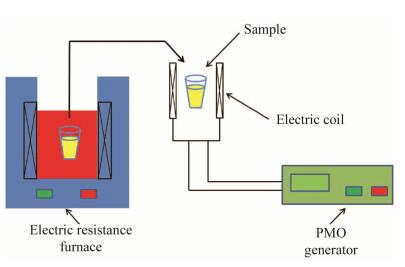
2 Experimental methodsAl-Cu (w(Cu) = 5%) alloy having liquidus temperature of 648 ℃ was prepared by melting pure aluminum and pure copper. The prepared aluminum alloy samples with a weight of 550 g were located in a stainless steel crucible (Φ 70 mm × Φ 45 mm × 80 mm, its thickness is 2 mm), and remelted in an electric resistance furnace to temperatures of 668 ℃, 688 ℃, and 708 ℃. After holding the temperature for 10 min, the Al3Ti1B intermediate alloy (Ti: 3.1%, B: 0.9%, Fe: 0.3%) with a commercial level of 10-3 Ti was added to the Al-Cu (w(Cu) = 5%) melt through the free surface. Subsequently, mechanical stirring was performed to promote the dissolution of the grain refiner and homogenize the distribution of particles. Finally, the stainless steel crucible with the melt was placed within a PMO magnetic coil and treated with a parameter of 250hi A (current intensity), 2ki Hz (frequency), and 200fi ms (pulse length), where hi, ki and fi are constant coefficients of the power supply. The schematic view of the solidification experimental setup is shown in Fig. 1. To avoid the reaction between the Al-Cu (w(Cu) = 5%) alloy and the steel crucible, the inner wall of the steel crucible was coated with boron nitride. Al3Ti1B was preheated to 300 ℃ in another electric resistance furnace before addition into the Al-Cu (w(Cu) = 5%) alloy melt.
|
|
|
Small units of 15 mm × 15 mm × 20 mm were sectioned from the center of the specimens, ground and polished from 6 μm to 1lm. The prepared units were anodized by electrolytic polishing in φ(HBF4 = 4%) solution with a direct current of 0.3-0.4 A/cm2 for 20 s. The microstructures were photographed using a Zeiss microscope (Imager A2m) with polarized light. The average grain size was evaluated by the mean linear intercept method.
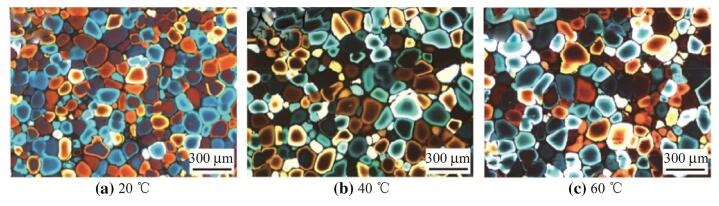
3 Results3.1 Solidified structureFigure 2 shows the structures of the Al-Cu (w(Cu) = 5%) alloy with the refining agent Al3Ti1B (10-3 Ti) solidified at the superheats of 20 ℃, 40 ℃, and 60 ℃. The solidified structures present significant grain refinement in the grain refiner treated Al-Cu (w(Cu) = 5%) samples. In addition, it can be found that the transition from dendrite to sphere is remarkably promoted under the influence of the grain refiner regardless of the employed superheat. However, it is evident that the grain in the Al-Cu (w(Cu) = 5%) sample becomes coarse with increasing degree of superheat. It indicates that the efficiency of the grain refiner is significantly influenced by the superheat.
|
|
|
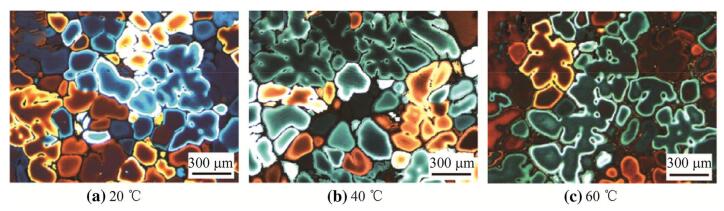
The Al-Cu (w(Cu) = 5%) alloy treated by PMO was also solidified at different superheats of 20 ℃, 40 ℃, and 60 ℃. The corresponding solidified structures are shown in Fig. 3. In comparison with the structure of AlCu (w(Cu) = 5%) alloy treated by grain refiner (see Fig. 2), the grain size is not reduced as much as the sample with grain refiner. The transition from dendrite to sphere in a sample influenced by PMO is also not so significant (see Fig. 3). The coarse dendritic morphology is even observed in samples with PMO. However, it is fortunate that grain size variation under different superheat degrees is not observed. It means that the grain size of sample driven by PMO is not sensitive to the varied superheat.
|
|
|
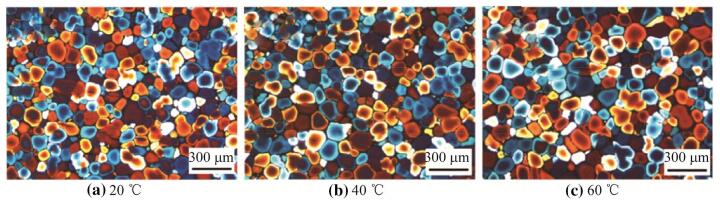
Based on the achieved results, it is possible to improve the efficiency of the grain refiner at high superheat by applying PMO. Hence, the related solidification experiments of Al-Cu (w(Cu) = 5%) alloy treated by both PMO and the grain refiner and solidified at different superheats were performed. As the corresponding solidified structure shown (see Fig. 4), when the PMO and the refining agent are applied together, the grains are much finer and more uniform than the samples only treated with the Al3Ti1B refining agent. It suggests that PMO can promote the efficiency of the grain refiner even at high superheat.
|
|
|
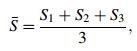
The measured grain size of the Al-Cu (w(Cu) = 5%) alloy is shown in Table 1. It can be seen that the grain sizes of all samples solidified at different conditions gradually rise with increasing superheat. To characterize the trend of grain size coarsening with the increasing superheat degree, parameter K is defined as

|
(1) |
|
(2) |

|
where S1, S2 and S3 are the grain sizes corresponding to the samples cooled at the superheat of 20 ℃, 40 ℃ and 60 ℃, respectively.
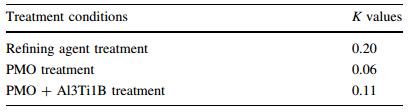
The value of K reflects the variation amplitude of grain size controlled by the difference of superheat. As shown in Table 2, the grain refiner treated Al-Cu alloy with the highest value of K means that the grain size is significantly influenced by the variation of superheat. It indicates that the efficiency of the grain refiner is reduced at high superheat. A lower value of K is achieved when PMO was applied in the grain refiner treated sample (see Table 2). It suggests the efficiency of the grain refiner is improved by the application of PMO. The result obtained is consistent with the evolution of the solidified structure shown in Fig. 4.
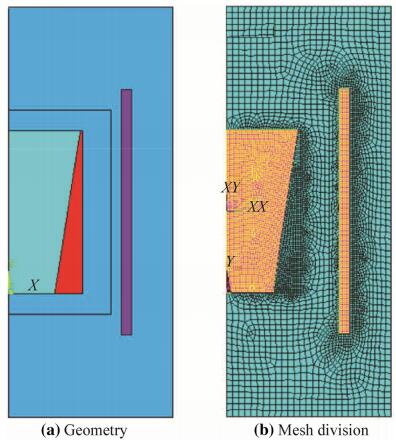
To better understand the influence of PMO on the efficiency of the grain refiner, numerical simulation was performed to present the distribution of the electromagnetic force and flow field inside the melt. ANSYS finite element software was employed to develop the simulated domains and mesh (see Fig. 5). The electromagnetic parameters of the material are shown in Table 3.
|
|
|

To simplify the mathematical model, the model was based on the following assumptions: (ⅰ) ignore the changes of melt density effected by temperature; (ⅱ) the melt with a small amount of grain refiner particles is considered to be an incompressible Newtonian fluid; (ⅲ) the current-carrying coil is a conductor with uniform current density; and (ⅳ) since the geometry has axial symmetry, a two-dimensional model is employed.
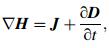
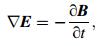
The induced magnetic field and electric current are calculated according to Maxwell's laws, which can be expressed as
|
(3) |
|
(4) |

|
(5) |

|
(6) |
where H is the magnetic field intensity vector, J the current density vector, D the electric flux density vector, E the electric field intensity vector, B the magnetic flux density vector, and ρ0 the electric charge density.
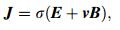
The electromagnetic force of the melt f can be expressed by the following formulae

|
(7) |
|
(8) |

|
(9) |
where μ0 is the magnetic permeability, σ the conductivity, and v the velocity vector.
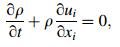
The numerical calculation of the flow field is based on the continuity equation and the momentum conservation equation, given by
|
(10) |

|
(11) |
where ρ is the density of the melt, ui the velocity vector components in the radial direction and axial direction, P the external pressure, and μ the effective coefficient of viscosity.
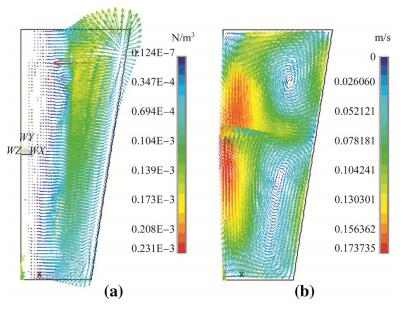
4.2 Simulated resultsFigure 6 presents the distribution of the electromagnetic force and flow field in the melt under the impact of PMO. As shown in Fig. 6a, the direction of the induced electromagnetic force is from the wall to the core of the melt. In addition, the strongest electromagnetic force is at the center of the coil. As a result, a stable vortex is generated inside the melt, as shown in Fig. 6b. In the upper part of the ingot, a counterclockwise flow circle is formed whereas a clockwise flow circle is observed in the lower part. This indicates that the applied PMO can cause global forced flow throughout the bulk melt. When PMO is combined with Al3Ti1B refining agent treatment, the forced flow inside the melt of Al-Cu (w(Cu) = 5%) alloy has the ability to stir the grain refiner particles in the melt and result in homogeneous distribution.
|
|
|
The element Ti in the Al3Ti1B refinement agent has two states. 2.2%Ti appears in the form of TiB2 as the heterogeneous substrate of the melt. The remaining 0.8%Ti appears in the form of solute [26], which promotes the formation of a constitutional undercooling region to cause nucleation. In addition, the solute Ti in the refining agent easily forms intermetallic TiAl3 with Al in the melt as another nucleation site. However, the TiAl3 formed is unstable and has a strong potential to aggregate [27], especially in melts with high superheat. Hence, when high superheat is employed, more TiAl3 particles aggregated inside the melts. In addition, the higher superheat allows the TiB2 particles exposed in the melt for a longer time to sedimentate. Eventually, the number of effective nucleation particles is significantly reduced. This is the reason that the efficiency of the grain refiner is significantly influenced by superheat, as presented in Sect. 3.
It has been shown in the experimental results that PMO can reduce the influence of superheat on the efficiency of the grain refiner. This is because PMO induces forced convection in the melt. According to the numerically simulated results, since PMO has a high discharge frequency and narrow pulse width; the generated strong electromagnetic force causes a strong and global forced convection inside the melt. The flow intensity is much greater than that of the melt in natural convection. The forced flow generated can significantly reduce grain refiner particle aggregation and sedimentation, as well as suppress the decay of refiner in the melt with high superheat. This means that the application of PMO can promote the pour temperature of a melt with grain refiner to ensure the grain refinement and the fluidity of the melt.
6 ConclusionsThis paper investigated the effects of PMO on the efficiency of the Al3Ti1B refining agent at different superheat temperatures. Results show that the solidified structures present significant grain refinement in the grain refinertreated Al-Cu (w(Cu) = 5%) samples, but the efficiency of the grain refiner is significantly influenced by superheat. However, the grain size of samples treated by PMO is not sensitive to the degree of superheat. When the PMO and the refining agent are applied together, the finer grains generated with little variation in grain size at different superheat temperatures suggest that the application of PMO can significantly improve the efficiency of the refiner and delay refiner recession at high superheat. The simulated result shows that the forced flow generated by PMO inside the melt has the ability to stir the grain refiner particles in the melt and result in homogeneous distribution to reduce the degeneration of the grain refiner at high superheat.
Acknowledgements The authors gratefully acknowledge the financial support from the National Natural Science Foundation of China (Grant No. 51320105003), Shanghai Government (Grant No. 14DZ2261200), and the Science and Technology Commission of Shanghai Municipality (Granted No. 15520710800).| 1. | Tronche A, Vandyoussefi M, Greer AL(2002)Instability of TiC particles in aluminium melts inoculated with an Al-Ti-C grain refiner.Mater Sci Technol 18, 1072-1078 doi:10.1179/026708302225006034 |
| 2. | Lu L, Dahle AK(2006)Effects of combined additions of Sr and AlTiB grain refiners in hypoeutectic Al-Si foundry alloys.Mater Sci Eng A, 435-436-288-296 |
| 3. | Wang F, Liu Z, Qiu D, et al(2013)Revisiting the role of peritectics in grain refinement of Al alloys.Acta Mater 61(1), 360-370 doi:10.1016/j.actamat.2012.09.075 |
| 4. | Qian M, Ramirez A, Das A, et al(2010)The effect of solute on ultrasonic grain refinement of magnesium alloys.J Cryst Growth 312(15), 2267-2272 doi:10.1016/j.jcrysgro.2010.04.035 |
| 5. | Stjohn DH, Easton MA, Qian M, et al(2013)Grain refinement of magnesium alloys: a review of recent research,theoretical developments,and their application.Metall Mater Trans A 44(7), 2935-2949 doi:10.1007/s11661-012-1513-x |
| 6. | Han QY(2015)Ultrasonic processing of materials.Metall Mater Trans B 46(4), 1603-1614 doi:10.1007/s11663-014-0266-x |
| 7. | Eskin D, Albabaena N, Pabel T, et al(2015)Ultrasonic degassing of aluminium alloys: basic studies and practical implementation.Mater Sci Technol 31(1), 79-84 doi:10.1179/1743284714Y.0000000587 |
| 8. | Sukumaran K, Pai BC, Chakraborty M(2004)The effect of isothermal mechanical stirring on an Al-Si alloy in the semisolid condition.Mater Sci Eng A 369(1-2), 275-283 doi:10.1016/j.msea.2003.11.036 |
| 9. | Guo HM, Zhang AS, Yang XJ, et al(2014)Grain refinement of Al-5% Cu aluminum alloy under mechanical vibration using meltable vibrating probe.Trans Nonferrous Met Soc China 24(8), 2489-2496 doi:10.1016/S1003-6326(14)63375-6 |
| 10. | Jiang WM, Fan ZT, Chen X, et al(2015)Effects of mechanical vibration and wall thickness on microstructure and mechanical properties of AZ91D magnesium alloy processed by expendable pattern shell casting.Metall Mater Trans A 46(4), 1776-1788 doi:10.1007/s11661-015-2746-2 |
| 11. | Liao XL, Zhai QJ, Luo J, et al(2007)Refining mechanism of the electric current pulse on the solidification structure of pure aluminum.Acta Mater 55(9), 3103-3109 doi:10.1016/j.actamat.2007.01.014 |
| 12. | Gong YY, Luo J, Jing JX, et al(2008)Structure refinement of pure aluminum by pulse magneto-oscillation.Mater Sci Eng A 497(1), 147-152 |
| 13. | Zhao ZL, Wang JL, Liu L(2011)Grain refinement by pulse electric discharging and undercooling mechanism.Mater Manuf Process 26(2), 249-254 doi:10.1080/10426914.2010.512649 |
| 14. | Räbiger D, Zhang YH, Galindo V, et al(2014)The relevance of melt convection to grain refinement in Al-Si alloys solidified under the impact of electric currents.Acta Mater 79, 327-338 doi:10.1016/j.actamat.2014.07.037 |
| 15. | Edry I, Mordechai T, Frage N, et al(2016)Effects of treatment duration and cooling rate on pure aluminum solidification upon pulse magneto-oscillation treatment.Metall Mater Trans A 47(3), 1261-1267 doi:10.1007/s11661-015-3306-5 |
| 16. | Fjellstedt J, Jarfors A(2005)On the precipitation of TiB2 in aluminum melts from the reaction with KBF4 and K2TiF6.Mater Sci Eng A 413(6), 527-532 |
| 17. | Birol Y(2008)Production of Al-Ti-B grain refining master alloys from Na2B4O7 and K2TiF6.J Alloys Compd 458(1), 271-276 |
| 18. | Birol Y(2012)Performance of AlTi5B1,AlTi3B3 and AlB3 master alloys in refining grain structure of aluminium foundry alloys.Mater Sci Technol 28(4), 481-486 doi:10.1179/1743284711Y.0000000058 |
| 19. | Murty BS, Kori SA, Chakraborty M(2013)Grain refinement of aluminium and its alloys by heterogeneous nucleation and alloying.Int Mater Rev 47(1), 3-29 |
| 20. | Mccartney DG(1989)Grain refining of aluminium and its alloys using inoculants.Int Mater Rev 34(1), 247-260 doi:10.1179/imr.1989.34.1.247 |
| 21. | Kearns MA, Thistlethwaite SR, Cooper PS (1996) Recent advances in understanding the mechanism of aluminum grain refinement by TiBAl master alloys. Minerals, Metals and Materials Society, Warrendale |
| 22. | Limmaneevichitr C, Eidhed W(2003)Fading mechanism of grain refinement of aluminum-silicon alloy with Al-Ti-B grain refiners.Mater Sci Eng A 349(1), 197-206 |
| 23. | Chen H, Jie JC, Svynarenko K, et al(2014)Effect of rotating magnetic field on the fading effect of Al-5Ti-1B in commercial pure Al.J Mater Res 29(15), 1656-1663 doi:10.1557/jmr.2014.198 |
| 24. | Liang D, Liang ZY, Zhai QJ, et al(2014)Nucleation and grain formation of pure Al under pulsed magneto-oscillation treatment.Mater Lett 130, 48-50 doi:10.1016/j.matlet.2014.05.058 |
| 25. | Liang D, Sun J, Liu TY, et al(2015)Enhanced heterogeneous nucleation by pulsed magneto-oscillation treatment of liquid aluminum containing Al3Ti1B additions.Adv Eng Mater 17(10), 1465-1469 doi:10.1002/adem.201400488 |
| 26. | Easton MA, Stjohn DH, Prasad A (2014) Grain refinement of aluminium alloys: recent developments in predicting the as-cast grain size of alloys refined by Al-Ti-B master alloys. In: Grandfield J (ed) Light metals 2014. Wiley, Hoboken, pp 939-944 |
| 27. | Iqbal N, Van-Dijk NH, Hansen T, et al(2004)The role of solute titanium and TiB2 particles in the liquid-solid phase transformation of aluminum alloys.Mater Sci Eng A 386(1-2), 20-26 doi:10.1016/S0921-5093(04)00921-9 |