 2014, Vol. 2
The article information
- Jin-Ke Yu, Hong-Wei Li, Qi-Jie Zhai, Jian-Xun Fu, Zhi-Ping Luo, Hong-Xing Zheng
- Crystal structure and formation mechanism of the secondary phase in Heusler Ni-Mn-Sn-Co materials
- Advances in Manufacturing, 2014, 2(4): 353-357
- http://dx.doi.org/10.1007/s40436-014-0091-0
-
Article history
- Received: 2014-04-17
- Accepted: 2014-11-05
- Published online: 2014-11-27


2. Shanghai Key Laboratory of Modern Metallurgy and Materials Processing, Shanghai University, Shanghai 200072, People’s Republic of China
3. Department of Chemistry and Physics, Fayetteville State University, Fayetteville, NC 28301, USA
In the past decades, alternative solid-state refrigeration methods have increasingly received attentions which provide high efficiencies, and thus they can contribute to a more efficient use of resources and lower greenhouse gas emissions [1]. Heusler Ni-Mn-(Ga, In, Sn, Sb) with magnetocaloric effect represents a promising class of candidate materials based on two solid-state transitions including the first-order martensitic transformation and the second-order magnetic transition of austenite [2, 3, 4, 5]. Nowadays a lot of efforts have been made on the doping of the fourth element since it has been considered as an effective way to improve the magnetic properties [6, 7, 8, 9, 10]. Meanwhile, it was found that the secondary phase would form with these additions and produce strong effects on the martensitic transformation and magnetic properties as well. Feng et al. observed that face-centered cubic (ƒcc) particles appeared both along the grain boundaries and inside the grains after doping 5 % Fe to Ni-Mn-In alloys, and enhanced mechanical properties were obtained with the precipitation of the secondary phase particles [8]. A Dy(Ni, Mn)4Ga phase with a hexagonal CaCu5-type structure was identified by Gao et al. in Ni50Mn29Ga21-xDyx alloys. They found that the crystal structure of martensite evolved from five-layered to orthorhombic, and then to non-modulated structures. The martensitic transition temperatures also notably increased with increasing Dy content due to the presence of the Dy(Ni, Mn)4Ga precipitates [9]. Very recently, a ƒcc γ phase in Ni43Co12Mn41Sn9 alloy was identified based on conventional X-ray diffraction technique, which could be fully suppressed under melt-spun condition, and thus the martensitic transformation shifted to higher temperature with positive effects on magnetic properties in the Ni43Co12Mn41Sn9 ribbon [10]. Additionally, melt-spinning technique could generate highly textured homogeneous polycrystalline ribbons [11, 12] with substantially improved magnetic properties [13], and it is being widely used for the fabrication of high-performance magnetocaloric materials [14, 15, 16, 17]. Considering that Ni-Mn-Sn is highly potential for large-scale engineering applications among the Heusler Ni-Mn based family, and Co doping is effective to enhance the magnetocaloric effect through intensifying the magnetization discrepancy between the austenite and the martensite [18, 19], it is necessary to better understand the crystal structure and formation mechanism of the secondary phase in the Heusler Ni-Mn- Sn-Co materials. However, fewer reports on the secondary phase could be found in the literature. The main objective of the present work is to provide more information on this point based on Ni44.1Mn35.1Sn10.8Co10 alloy. 2 Experimental
As-cast Ni44.1Mn35.1Sn10.8Co10 ingot with mass about 80 g was arc melted from Ni, Mn, Sn, Co with purities of 99.99 % (mass fraction) in argon gas atmosphere. Additional w (Mn) = 5 % was added to compensate for its evaporation loss. The ribbons were fabricated using melt spinning technique at a linear speed of 10 m/s and the resultant meltspun ribbons were about 20 mm long, 4-6 mm wide and 30-35 lm thick.
X-ray diffraction (XRD, DLMAX-2200) was employed to detect the phases and crystal structures. Microstructural observations were conducted using a field-emission scanning electron microscopy (SEM, JSM-6700F). Transmission electron microscopy (TEM) analyses were performed in a JEOL JEM-2010F microscope equipped with an energy dispersive spectrometer (EDS), operated at 200 kV using a double-tilt stage. High-temperature differential scanning calorimetric measurement (NETZSCH DSC 404C) was carried out at heating/cooling rates of 10 K/min. 3 Results and discussion
Figure 1 shows the XRD patterns of Ni44.1Mn35.1Sn10.8Co10 as-cast bulk alloy and melt-spun ribbon at room temperature. In case of the as-cast bulk alloy, besides the diffraction peaks from cubic LZ1 austenite (β phase), all the other peaks can be well indexed in reference to Ni17Sn3 phase, which is denoted as γ phase in Ref. [10]. For the melt-spun ribbon, LZ1 phase can be clearly distinguished, whereas the peaks of γ phase are rather weak. Based on the XRD data, the lattice parameters of LZ1 phase are calculated to be a = 0.5998 nm for the bulk alloy and 0.5946 nm for the ribbon, respectively. The unit cell shrinks slightly, which can also be evidenced from the fact that the peaks from LZ1 phase of the melt-spun ribbon shift slightly towards higher angles in contrast to these peaks in the ascast bulk alloy. The lattice parameter of the γ phase in the bulk alloy is about 0.3644 nm.
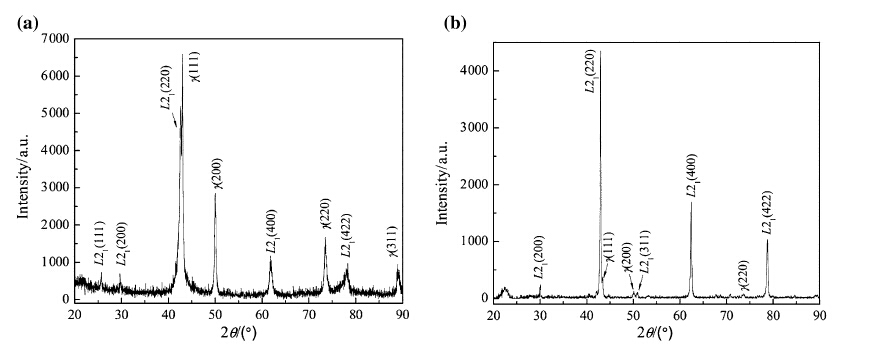 |
| Fig. 1 XRD patterns of Ni44.1Mn35.1Sn10.8Co10 as-cast bulk alloy a and melt-spun ribbon b at room temperature |
The microstructure of the as-cast bulk alloy was studied using SEM and TEM, as shown in Fig. 2. It can be observed that the sample consists of coarse dendritic β phase and lamellar (β + γ) eutectic microstructure, as shown in Fig. 2a. The eutectic microstructure is enlarged in Fig. 2b. The β phase would undergo an ordering transition from B2 structure to LZ1 structure upon subsequent cooling at around 1000 K [20]. Figure 2c is the TEM image of the ascast bulk alloy. The selected-area electron diffraction pattern (SAEDP) inserted in Fig. 2c indicates that the γ phase has ƒcc structure. Furthermore, the EDS chemical compositions of spot 1 (matrix) and spot 2 (γ phase) are listed in Table 1. It is evident that the γ phase has much higher Co but much lower Sn contents than the matrix.
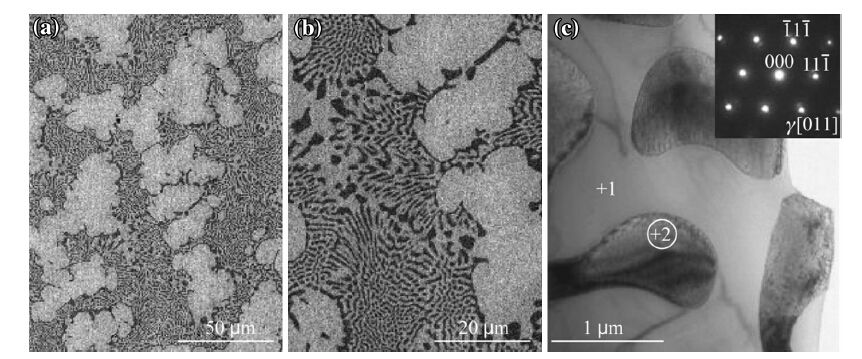 |
| Fig. 2 a SEM backscattered electron micrograph of Ni44.1Mn35.1Sn10.8Co10 as-cast bulk alloy; b enlarged from a; c TEM image and the SAEDP taken from the area 2 highlighted with a white circle (The EDS chemical compositions from spots 1 and 2 are given in Table 1.) |
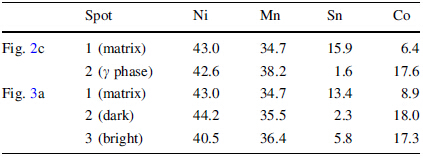 |
TEM observations were performed to characterize the crystal structure of the secondary phase in the ribbon. Figure 3a presents a TEM bright-field image where novel precipitates, with an average width less than 100 nm, appear along grain boundaries. It can be noticed that the grain boundaries indeed consist of two distinct phases with high contrast. The SAEDP taken from the area 1 confirms the LZ1 austenitic matrix (see Fig. 3b). However, the SAEDPs taken from the area 2 after tilting to three different zone axes [001], [011] and [112], as shown in Figs. 3c, d and e, respectively, reveal the dark phase as the Ni17Sn3-type ƒcc structure with the lattice parameter a = 0.351 nm and the space group of Fm3m. Therefore it is concluded that the dark phase along the boundaries is the same γ phase in the as-cast bulk alloy. The EDS results in Table 1 show that the composition of the dark phase is about Ni44.2Mn35.5Sn2.3Co18.0. It is interesting that the SAEDP taken from the area 3 (the bright phase) shows typical amorphous ring (see Fig. 3f) and the corresponding HRTEM image demonstrates a highly disorder feature (see Fig. 3g). As compared with the dark γ phase, the bright phase contains slightly higher Sn content (see Table 1). Since a significant part of the γ phase with high Co and low Sn contents is dissolved in the ribbon, the matrix composition of the ribbon shows higher Co (atom radius, r = 0.126 nm) and lower Sn (r = 0.163 nm) in contrast to the as-cast bulk alloy [21]. This explains well why the lattice constant slightly decreased. It should be mentioned that the black/white contrast of the precipitates originates from the diffraction contrast. The central beam selected for bright-field imaging has lower intensity since the crystalline γ phase diffracts electron beams, and thus it appears as darker. In fact, thickness fringes are visible, which also indicate their crystalline nature. However, the bright amorphous phase does not diffract electron beams and its contrast does not change even during tilting.
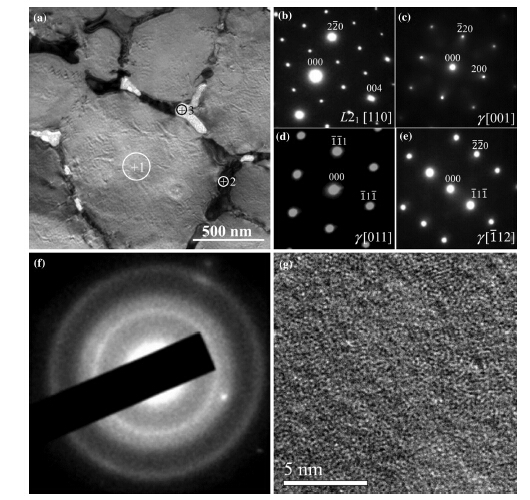 |
| Fig. 3 a TEM image of Ni44.1Mn35.1Sn10.8Co10 melt-spun ribbon; b SAEDP taken from area 1 in a; c-e SAEDPs from area 2 in a with different zone axes by tilting; f SAEDP from area 3 in a; g HRTEM image taken from area 3 in a showing amorphous feature (The EDS chemical compositions from spots 1,2 and 3 are given in Table 1.) |
DSC result of the as-cast bulk alloy presents two exothermic peaks at 1 296 K and at 1 288 K upon cooling, corresponding to the formation of the primary β phase and (β + γ) eutectic microstructure, respectively (see Fig. 4). That is, the as-cast bulk alloy firstly forms dendritic b matrix (L→b), and then a eutectic reaction (L→β + γ) happens. In case of melt-spun ribbon, no lamellar eutectic microstructure is observed in Fig. 3. It seems to be reasonable to attribute that the dark γ phase originates from a divorced eutectic reaction in limited residual liquid phase after the formation of a large amount of primary β phase. While for the bright amorphous phase, it might form due to high local cooling rate. Such an explanation is in agreement with the EDS compositional results.
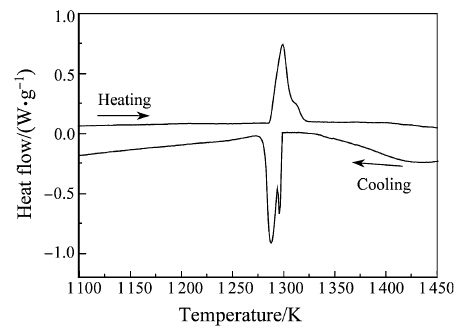 |
| Fig. 4 DSC curve of Ni44.1Mn35.1Sn10.8Co10 as-cast bulk alloy at the heating/cooling rate of 10 K/min |
In summary, X-ray diffraction, SEM/TEM and SAEDP were employed to investigate the secondary phase in Heusler Ni-Mn-Sn-Co materials. The following conclusions were obtained.
(i) The secondary phase is identified as ƒcc Ni17Sn3-type structure. The as-cast bulk alloy firstly forms dendritic β matrix, and then undergoes a eutectic reaction during cooling. While in case of melt-spun rapid solidification, the secondary phase is resulted from a divorced eutectic reaction in limited residual liquid phase after the formation of a large amount of primary β phase.
(ii) The secondary phase formed in melt-spun ribbons was largely suppressed as nano-precipitates, which distributed along the grain boundaries compared with the as-cast bulk alloy and meanwhile the secondary phase exhibited partial amorphous state due to high local cooling rate.
Acknowledgements The authors gratefully acknowledge the supports from the National Natural Science Foundation of China (Grant Nos. 51201096 and 51474144), the Specialized Research Fund for the Doctoral Program of Higher Education of China (Grant No. 20123108120019), and the Scientific Research Foundation for the Returned Overseas Chinese Scholars, State Education Ministry.| 1. | FäLhler S, Rösler UK, Kastner O, Eckert J, Eggeler G, Emmerich H, Entel P, Müller S, Quandt E, Albe K (2012) Caloric effects in ferroic materials: new concepts for cooling. Adv Eng Mater 14:10-19 |
| 2. | Liu J, Woodcock TG, Scheerbaum N, Gutfleisch O (2009) Influence of annealing on magnetic field-induced structural transformation and magnetocaloric effect in Ni-Mn-In-Co ribbons. Acta Mater 57:4911-4920 |
| 3. | Zheng HX, Wu DZ, Xue SC, Frenzel J, Eggeler G, Zhai QJ (2011) Martensitic transformation in rapidly solidified Heusler Ni49Mn39Sn12 ribbons. Acta Mater 59:5692-5699 |
| 4. | Zheng HX, Wang W, Xue SC, Zhai QJ, Frenzel J, Luo ZP (2013) Composition-dependent crystal structure and martensitic transformation in Heusler Ni-Mn-Sn alloy. Acta Mater 61:4648-4656 |
| 5. | Feng WJ, Zhang Q, Zhang LQ, Li B, Du J, Deng YF, Zhang ZD (2010) Large reversible high-temperature magnetocaloric effect in Ni50-xMn38+xSb12 alloys. Solid State Commun 150:949-952 |
| 6. | Koho K, Söderberg O, Lanska N, Ge Y, Liu X, Straka L, Vimpari J, Heczko O, Lindroos VK (2004) Effect of the chemical composition to martensitic transformation in Ni-Mn-Ga-Fe alloys. Mater Sci Eng A378:384-388 |
| 7. | Cong DY, Roth S, Schultz L (2012) Magnetic properties and structural transformations in Ni-Co-Mn-Sn multifunctional alloys. Acta Mater 60:5335-5351 |
| 8. | Feng Y, Sui JH, Gao ZY, Zhang J, Cai W (2009) Investigation on martensitic transformation behavior, microstructures and mechanical properties of Fe-doped Ni-Mn-In alloys. Mater Sci Eng A507:174-178 |
| 9. | Gao L, Sui JH, Cai W, Gao ZY (2009) Study of the precipitate phases and martensitic transformation in quaternary Heusler alloys of NiMnGaDy. Solid State Commun 149:257-260 |
| 10. | Chen F, Tong YX, Huang YJ, Tian B, Li L, Zheng YF (2013) Suppression of γ phase in Ni38Co12Mn41Sn9 alloy by melt spinning and its effect on martensitic transformation and magnetic properties. Intermetallics 36:81-85 |
| 11. | Llamazares JLS, Sanchez T, Santos JD, Pérez MJ, Sanchez ML, Hernando B, Escoda L, Suño JJ, Varga R (2008) Martensitic phase transformation in rapidly solidified Mn50Ni40In10 alloy ribbons. Appl Phys Lett 92:012513 |
| 12. | Xuan HC, Xie KX, Wang DH, Han ZD, Zhang CL, Gu BX, Du YW (2008) Effect of annealing on the martensitic transformation and magnetocaloric effect in Ni44.1Mn44.2Sn11.7 ribbons. Appl Phys Lett 92:242506 |
| 13. | Hernando B, Llamazares JLS, Santos JD, Escoda L, Suñol JJ, Varga R, Baldomir D, Serantes D (2008) Thermal and magnetic field-induced martensite-austenite transition in Ni50.3Mn35.3Sn14.4 ribbons. Appl Phys Lett 92:042504 |
| 14. | Ma SC, Cao QQ, Xuan HC, Zhang CL, Shen LJ, Wang DH, Du YW (2011) Magnetic and magnetocaloric properties in melt-spun and annealed Ni42.7Mn40.8Co5.2Sn11.3 ribbons. J Alloys Compd 509:1111-1115 |
| 15. | Wu DZ, Xue SC, Frenzel J, Eggeler G, Zhai QJ, Zheng HX (2012) Atomic ordering effect in Ni50Mn37/Sn13 magnetocaloric ribbons. Mater Sci Eng A534:568-572 |
| 16. | Das R, Saravanan P, Babu DA, Perumal A, Srinivasan A (2013) Influence of solidification rate and heat treatment on magnetic refrigerant properties of melt spun Ni51Mn34In14Si1 ribbons. J Magn Magn Mater 344:152-157 |
| 17. | Zheng HX, Wang W, Yu JK, Zhai QJ, Luo ZP (2014) Martensitic transformation in melt-spun Heusler Ni-Mn-Sn-Co ribbons. J Mater Res 29(7):880-886 |
| 18. | Krenke T, Duman E, Acet M, Wassermann EF, Moya X, Manosa L, Planes A (2005) Inverse magnetocaloric effect in ferromagnetic Ni-Mn-Sn alloys. Nat Mater 4:450-454 |
| 19. | Wang W, Yu JK, Zhai QJ, Luo ZP, Zheng HX (2013) Co-doping effect on the martensitic transformation and magnetic properties of Ni49Mn39Sn12 alloy. J Magn Magn Mater 346:103-106 |
| 20. | Schlagel DL, McCallum RW, Lograsso TA (2008) Influence of solidification microstructure on the magnetic properties of Ni- Mn-Sn alloys. J Alloys Compd 463:38-46 |
| 21. | Chen XQ, Yang FJ, Lu X, Qin ZX (2007) The way composition affects martensitic transformation temperatures of Ni-Mn-Ga Heusler alloys. Phys Stat Solidi (b) 244(3):1047-1053 |