 2026, Vol. 37


b Department of Chemistry, School of Science, China Pharmaceutical University, Nanjing 211198, China;
c School of Chemistry and Chemical Engineering, Zhejiang Sci-Tech University, Hangzhou 310018, China
Spiro carbocycles are privileged structures for developing novel functional materials due to their unique orthogonally rigid structure and good thermal stability [1–4], and they are also frequently found in natural products and bioactive compounds [5–7]. Therefore, development of novel spirocarbocycles and their asymmetric synthesis have attracted much attention [8–12]. A particularly useful chiral spirostructure is the C2-symmetric one, which has found wide applications in chiral catalyst/ligand development [13–16]. It is noteworthy that the combination of different fused rings will dramatically affect the structural conformation, thus leading to diverse spirostructures that are suitable for different applications, as exemplified by the spirobiindane, spirobitetralin, and spirobi[dihydrophenalene] structures [17–21]. However, this type of spirostructures is mainly constructed based on the six-membered arene-fused rings, and the spirostructures featuring the five-membered heteroarene-fused rings remain underdeveloped (Scheme 1a).

|
Download:
|
| Scheme 1. C2-symmetric spirostructures and asymmetric synthesis. | |
Preparation of enantiopure C2-symmetric spirostructures represents a challenging task in organic synthesis [8–12], and classical approach relies on optical resolution of racemic products or using chiral starting materials [17–19,22–27]. With the great advances of asymmetric catalysis, catalytic asymmetric synthesis of the axially chiral C2-symmetric spirostructures becomes feasible. In this regard, Tan group achieved the catalytic asymmetric synthesis of spirobiindanes via chiral phosphoric acid (CPA)-catalyzed intramolecular spirocyclization [28]. Ding group reported the synthesis of cyclohexyl-fused spirobiindanes by employing Ir-catalyzed asymmetric hydrogenation as the key step [29]. Wang group developed the spirosilabiindanes by Rh-catalyzed asymmetric intramolecular hydrosilation [30]. Sun group designed and synthesized a novel SPHENOL structure through CPA-catalyzed asymmetric intramolecular spirocyclization [21]. Taking advantage of the 'central chirality-controlled construction of axial chirality' strategy, we successfully realized the asymmetric synthesis of 3,3′-Ar-SPINOLs and 3,3′-Ar-SPHENOLs (Scheme 1b) [31,32]. We surmised that spirostructures featuring the five-membered heteroarene-fused rings might be efficiently constructed by a similar strategy. Considering the importance of chiral indole in organic synthesis as well as the inherent high reactivity of indole for Friedel–Crafts-type spirocyclization [33–35], we chose indole as the incorporating heteroarene to construct the desired spirostructure. Herein, we report that the C2-symmetric chiral spirobiindole structure could be efficiently constructed via Rh-catalyzed asymmetric arylation/intramolecular spirocyclization sequence with excellent diastereoselectivities and enantioselectivities (Scheme 1c). During the preparation of this manuscript, two elegant works on development of chiral spirobiindoles were independently reported by Tan group and Sun group [36,37].
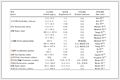
As required by the 'central chirality-controlled construction of axial chirality' strategy [31,32], it would be ideal to obtain the enantiopure centrally chiral precursor. We then started the investigation from asymmetric synthesis of the centrally chiral precursor 3a by rhodium-catalyzed asymmetric conjugate phenylation of indolyl dienone 1a with phenylboronic acid. As summarized in Table 1, chiral bisphosphine-ligated catalysts were able to promote the reaction, but only low yield and moderate stereoselectivity were attainable (entries 1 and 2). Chiral diene ligand [38] proved to be superior to bisphosphine ligand in terms of both reactivity and selectivity in this reaction system (entries 3 and 4), and excellent diastereoselectivity and enantioselectivity were obtained with L1 as the chiral ligand [39]. In addition to ethanol, other solvents such as dioxane and DCE were also suitable for this reaction (entries 4–6). The stereoselectivity was further increased (>20:1 dr, >99% ee) when the reaction was conducted at lower temperature, and the reaction worked equally well with only 1 mol% catalyst loading (entries 7 and 8).
|
Table 1 Investigation on the rhodium-catalyzed asymmetric conjugate arylation of indolyl dienone 1a with phenylboronic acid 2a.a |

With enantiopure 3a in hand, construction of the spirostructure via intramolecular spirocyclization was subsequently studied. As shown in Table 2, the choice of solvent was crucial for the spirocyclization. A single diastereomer was obtained in 37% yield with EtOH as the solvent and BF3·OEt2 as the acid while other solvents either led to trace amount of the spirocyclization product or poor diastereoselectivity (entries 1–6), indicating that the solvent not only affect the reactivity but also the diastereoselectivity. Gratifyingly, the yield was improved to 95% by elevating the reaction temperature without compensating the stereoselectivity (entry 7, 95% yield, >20:1 dr, >99% ee). Other Lewis acids like SiMe3Cl and TiCl4 were also effective for the diastereoselective spirocyclization albeit somewhat lower yields were obtained (entries 8 and 9). Control experiments were conducted considering that BF3 will decompose in EtOH to generate HBF4 and B(OEt)3, and HBF4 was found to promote the reaction, indicating that it is the possible active catalyst for the spirocyclization step. The spirostructure and absolute configuration of 4a was unambiguously confirmed by single-crystal X-ray diffraction analysis.
|
|
Table 2 Investigation on the spirocyclization condition.a |


With the optimal conditions for asymmetric synthesis of spirobiindole structure, the substrate scope was next explored (Scheme 2). The conditions were found to be quite general for different substrates. Arylboronic acids bearing electron-donating groups, electron-withdrawing groups, and halides at different positions were all well tolerated (products 4b-4i). The sterically bulky 3,5-disubstituted or 2-substituted phenylboronic acids were also suitable (products 4j-4l). In addition, the N-protected indolyl substrates could be employed to construct the corresponding spirobiindoles (products 4m-4o). It is worth highlighting that >20:1 dr and >99% ee were obtained in all the examples.

|
Download:
|
| Scheme 2. Substrate scope of spirobiindoles. a The arylation step was performed at 80 ℃. b The arylation step was performed in toluene/H2O at 25 ℃, and the spirocyclization step was performed in toluene at 25 ℃. | |

As shown in Scheme 3, the reaction also proceeded well with commercially available dibenzalacetone and indolylboronic acid pinacol ester under the established standard conditions, thus providing a practical synthesis route to the other enantiomer without changing the catalyst (ent–4a). The substituted indolylboronic acid pinacol esters, including the 2-substituted one, could be employed to produce the corresponding substituted spirobiindoles (4p-4r). The structure and absolute configuration of ent–4a was also confirmed by single-crystal X-ray diffraction analysis.

|
Download:
|
| Scheme 3. Alternative synthesis route. | |

To showcase the practicality of the method, 1 mmol scale synthesis was performed (Scheme 4a), and the reaction still proceeded well to produce the spirobiindole 4a in high yield with excellent stereo control (>20:1 dr, >99% ee). Functionalization of the spirobiindole product was also demonstrated (Scheme 4b). For example, monoformylation product 6 was produced under the Vilsmeier–Haack reaction conditions. Treatment of 4m with NBS selectively delivered bromine to the 2-position of the indole ring. Application of the chiral structure in development of chiral ligand was also explored. As shown in Scheme 4c, bisphosphine 7 can be readily synthesized from spirobiindole 4a. Its catalytic performance as a chiral ligand was demonstrated by application in palladium-catalyzed enantioselective allylic amination and alkylation reaction, and high enantioselectivities were observed with N-methylbenzylamine (91% ee) and dimethyl malonate (88% ee) as the nucleophiles.

|
Download:
|
| Scheme 4. Scale up synthesis, derivatization, and application of the spirobiindole product. | |

In conclusion, we have developed a new type of C2-symmetric spirobiindole structure. By employing the 'central chirality-controlled construction of axial chirality' strategy, the spirostructure could be easily synthesized in high yields with excellent diastereoselectivities and enantioselectivities. In addition, the reaction features tunable enantiomer synthesis by switching the substrate combination under the same conditions. Further studies on the applications of the spirobiindole structures are ongoing in our laboratory
Declaration of competing interestThe authors declare that they have no known competing financial interests or personal relationships that could have appeared to influence the work reported in this paper.
CRediT authorship contribution statementLong Yin: Writing – original draft, Visualization, Validation, Supervision, Software, Resources, Project administration, Methodology, Investigation, Funding acquisition, Formal analysis, Data curation, Conceptualization. Yuxin Shi: Software, Resources, Project administration, Methodology, Investigation, Funding acquisition, Formal analysis. Rong Meng: Software, Resources, Project administration. Jiapei Shan: Project administration, Methodology, Formal analysis. Weiwei Sun: Project administration, Methodology, Formal analysis, Data curation. Weijun Yao: Resources, Methodology. Xiaowei Dou: Writing – review & editing, Funding acquisition, Formal analysis, Data curation. Dong Guo: Writing – review & editing, Investigation, Funding acquisition, Data curation.
AcknowledgmentsLong Yin is grateful for the financial support from the National Natural Science Foundation of China (No. 22207094). Xiaowei Dou is grateful for the financial support from the Fundamental Research Funds for the Central Universities (No. 2632024ZD03) and the National Natural Science Foundation of China (No. 22471290). Dong Guo is grateful for the financial support from the National Natural Science Foundation of China (Nos. 22077110, 22377103) and the Jiangsu Outstanding Youth Fund (No. BK20240051).
Supplementary materialsSupplementary material associated with this article can be found, in the online version, at doi:10.1016/j.cclet.2025.111258.
| [1] |
T.P.I. Saragi, T. Spehr, A. Siebert, T. Fuhrmann-Lieker, J. Salbeck, Chem. Rev. 107 (2007) 1011-1065. DOI:10.1021/cr0501341 |
| [2] |
Y.K. Qu, Q. Zheng, J. Fan, L.S. Liao, Z.Q. Jiang, Acc. Mater. Res. 2 (2021) 1261-1271. DOI:10.1021/accountsmr.1c00208 |
| [3] |
S.Y. Yang, J. Wang, Z. Deng, et al., Matter 7 (2024) 3390-3421. DOI:10.1016/j.matt.2024.07.017 |
| [4] |
K. Zhang, S. Zuo, P. You, T. Ru, F.E. Chen, Chin. Chem. Lett. 35 (2024) 109157. DOI:10.1016/j.cclet.2023.109157 |
| [5] |
L. Yu, A. Dai, W. Zhang, et al., J. Agric. Food Chem. 70 (2022) 10693-10707. DOI:10.1021/acs.jafc.2c02301 |
| [6] |
V. Molteni, D. Rhodes, K. Rubins, et al., J. Med. Chem. 43 (2000) 2031-2039. DOI:10.1021/jm990600c |
| [7] |
X. Long, M. Zhang, X. Yang, J. Deng, Org. Lett. 24 (2022) 1303-1307. DOI:10.1021/acs.orglett.1c04282 |
| [8] |
P.W. Xu, J.S. Yu, C. Chen, et al., ACS Catal. 9 (2019) 1820-1882. DOI:10.1021/acscatal.8b03694 |
| [9] |
A. Ding, M. Meazza, H. Guo, J.W. Yang, R. Rios, Chem. Soc. Rev. 47 (2018) 5946-5996. DOI:10.1039/c6cs00825a |
| [10] |
R. Rios, Chem. Soc. Rev. 41 (2012) 1060-1074. DOI:10.1039/C1CS15156H |
| [11] |
X. Xie, W. Huang, C. Peng, B. Han, Adv. Synth. Catal. 360 (2018) 194-228. DOI:10.1002/adsc.201700927 |
| [12] |
Z. Wang, C. Hui, H. Wang, Tetrahedron Chem. 12 (2024) 100095. DOI:10.1016/j.tchem.2024.100095 |
| [13] |
J.H. Xie, Q.L. Zhou, Acc. Chem. Res. 41 (2008) 581-593. DOI:10.1021/ar700137z |
| [14] |
K. Ding, Z. Han, Z. Wang, Chem. Asian J. 4 (2009) 32-41. DOI:10.1002/asia.200800192 |
| [15] |
Chiral spiro ligands S.F. Zhu, Q.L. Zhou, Privileged Chiral Ligands and Catalysts Wiley-VCH, Weiheim, 2011, pp. 137–170.
|
| [16] |
X. Wang, Z. Han, Z. Wang, K. Ding, Acc. Chem. Res. 54 (2021) 668-684. DOI:10.1021/acs.accounts.0c00697 |
| [17] |
V.B. Birman, A.L. Rheingold, K.C. Lam, Tetrahedron: Asymmetry 10 (1999) 125-131. DOI:10.1016/S0957-4166(98)00481-9 |
| [18] |
J.H. Zhang, J. Liao, X. Cui, et al., Tetrahedron: Asymmetry 13 (2002) 1363-1366. DOI:10.1016/S0957-4166(02)00360-9 |
| [19] |
J.H. Xie, A.G. Hu, H. Zhou, L.X. Wang, Q.L. Zhou, Chem. Commun. 5 (2002) 480-481. |
| [20] |
X.H. Huo, J.H. Xie, Q.S. Wang, Q.L. Zhou, Adv. Synth. Catal. 349 (2007) 2477-2484. DOI:10.1002/adsc.200700109 |
| [21] |
R. Zhang, S. Ge, J. Sun, J. Am. Chem. Soc. 143 (2021) 12445-12449. DOI:10.1021/jacs.1c05709 |
| [22] |
A.J. Argüelles, S. Sun, B.G. Budaitis, P. Nagorny, Angew. Chem. Int. Ed. 57 (2018) 5325-5329. DOI:10.1002/anie.201713304 |
| [23] |
J. Huang, M. Hong, C.C. Wang, et al., J. Org. Chem. 83 (2018) 12838-12846. DOI:10.1021/acs.joc.8b01693 |
| [24] |
G.Q. Chen, B.J. Liu, J.M. Huang, et al., J. Am. Chem. Soc. 140 (2018) 8064-8068. DOI:10.1021/jacs.8b03642 |
| [25] |
Q. Zhou, R. Pan, H. Shan, X. Lin, Synthesis 51 (2019) 557-563. DOI:10.1055/s-0037-1610831 |
| [26] |
W. Guo, Q. Liu, J. Jiang, J. Wang, Org. Lett. 22 (2020) 3110-3113. DOI:10.1021/acs.orglett.0c00858 |
| [27] |
G. Sun, Z. Wang, Z. Luo, et al., J. Org. Chem. 85 (2020) 10584-10592. DOI:10.1021/acs.joc.0c01155 |
| [28] |
S. Li, J.W. Zhang, X.L. Li, D.J. Cheng, B. Tan, J. Am. Chem. Soc. 138 (2016) 16561-16566. DOI:10.1021/jacs.6b11435 |
| [29] |
Z. Zheng, Y. Cao, Q. Chong, et al., J. Am. Chem. Soc. 140 (2018) 10374-10381. DOI:10.1021/jacs.8b07125 |
| [30] |
X. Chang, P.L. Ma, H.C. Chen, C.Y. Li, P. Wang, Angew. Chem. Int. Ed. 59 (2020) 8937-8940. DOI:10.1002/anie.202002289 |
| [31] |
L. Yin, J. Xing, Y. Wang, et al., Angew. Chem. Int. Ed. 58 (2019) 2474-2478. DOI:10.1002/anie.201812266 |
| [32] |
C. Peng, C. Wang, C. Wu, et al., Org. Lett. 27 (2025) 869-873. DOI:10.1021/acs.orglett.4c04612 |
| [33] |
R. Dalpozzo, Chem. Soc. Rev. 44 (2015) 742-778. DOI:10.1039/C4CS00209A |
| [34] |
Y.C. Zhang, F. Jiang, F. Shi, Acc. Chem. Res. 53 (2019) 425-446. DOI:10.3390/ma12030425 |
| [35] |
M.S. Tu, K.W. Chen, P. Wu, et al., Org. Chem. Front. 8 (2021) 2643-2672. DOI:10.1039/d0qo01643h |
| [36] |
H.W. Zhao, F. Jiang, S. Chen, et al., Angew. Chem. Int. Ed. 137 (2025) e202422951. DOI:10.1002/ange.202422951 |
| [37] |
J.Y. Wang, J. Sun, Angew. Chem. Int. Ed. 137 (2025) e202424773. DOI:10.1002/ange.202424773 |
| [38] |
Y. Huang, T. Hayashi, Chem. Rev. 122 (2022) 14346-14404. DOI:10.1021/acs.chemrev.2c00218 |
| [39] |
K. Okamoto, T. Hayashi, V.H. Rawal, Chem. Commun. 32 (2009) 4815-4817. DOI:10.1039/b904624k |