 2026, Vol. 37


b Fujian Yongjing Technology Co., Ltd., Shaowu 354003, China;
c College of Chemistry and Environmental Engineering, Pingdingshan University, Pingdingshan 467000, China
The C-F bond, recognised as the strongest single bond, has received considerable attention in the selective activation of the C-F bond, as it enhances the synthetic versatility of fluorinated compounds [1–5]. Significant progress has been achieved via different strategies, including Lewis acid activation [6], transition-metal catalysis [7–9], photocatalysis [10,11], and radical-mediated processes [12,13]. Despite these advances, the defluorinative functionalization of C(sp3)-F bonds remains a formidable challenge, which is primarily attributed to the higher bond dissociation energy of C(sp3)-F compared to that of C(sp2)-F bonds [14–18]. gem-Difluorocyclopropanes (gem-F2CPs) are recognized as valuable fluorinated synthons [19–21], playing a pivotal role in the synthesis of a range of valuable products via transition-metal-catalysed C-F bond activation [22–25]. Pioneering work in this field was performed by Fu and coworkers in 2015, in which β-F elimination was used as a critical step to facilitate C-F bond cleavage and subsequent cross-coupling reactions [26]. Inspired by this seminal work, a plethora of significant advancements have been made in this emerging field (Scheme 1a) [27–49]. Also noteworthy is the work of Li, Lv and coworkers, who achieved high branched regioselectivity by using ambident nucleophiles and bulky N-heterocyclic carbene (NHC) ligands [50–53].

|
Download:
|
| Scheme 1. Ring-opening defluorinative cross-coupling reactions of gem-F2CPs with nucleophiles. | |
It is well-known that carbonyls represent one of the most pivotal and versatile functional groups in organic synthesis. In 2021, our group demonstrated that simple ketones can function as ambident nucleophiles to react with gem-F2CPs under the Pd/IHept catalytic system [54]. This transformation has been shown to be highly efficient and selective in the formation of branched products (Scheme 1b). Based on this result, our group has recently investigated the Pd/IHept-catalyzed ring-opening reactions of gem-F2CPs with malonates and their derivatives, which has delivered a variety of linear 2-fluorinated products in good to excellent yields (Scheme 1c) [55].
The incorporation of a fluorine atom at the α-position of malonates could significantly enhance its acidity, which is also accompanied by an obvious decrease in nucleophilicity [56]. Our previously developed palladium/IHept catalytic system, which has been effective for the catalytic transformations of gem-F2CPs with malonates, is not capable of facilitating the analogous transformations with fluoromalonates [54]. The development of alternative catalytic strategies to address this issue is necessary. We hypothesize that this problem may be addressed by utilizing phosphine as the auxiliary ligand on the assumption that the phosphine ligand's enhanced π-acceptor capacity could reduce the electron density at the palladium center compared to observed with NHC ligand. Consequently, this reduction of electron richness at the palladium centre is expected to facilitate the ligand exchange process with the less nucleophilic fluoromalonates [57–65]. Herein, we report the Pd/XPhos-catalyzed defluorinative ring-opening cross-coupling of gem-F2CPs with fluoromalonates (Scheme 1d). A range of difluorinated alkenes were obtained in moderate to good yields. Besides, 2,4-difluorobutadienyl sulfones were efficiently synthesized when 1-fluorobis(phenylsulfonyl)methane (FBSM) was used as the nucleophile. The utility of this protocol for the late-stage modification of complex molecules has also been demonstrated.
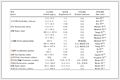
We began our study by investigating the coupling of gem-F2CP 1a with fluoromalonate 2a using Pd(OAc)2 as the catalyst and K2CO3 as the base in THF at 50 ℃ for 12 h (Table 1). As can be seen, the nature of ligands significantly influences the efficiency of this transformation. No desired product could be detected in the combination of Pd(OAc)2 with N-heterocyclic carbene (NHC) ligand, leaving almost all the starting materials remaining unreacted (entries 1 and 2). Gratifyingly, the coupling product 3a was obtained in 32% yield when RuPhos was used as the ligand (entry 3). To improve the yield, a series of sterically-bulky phosphine ligands were evaluated for this reaction (entries 4–7), and XPhos behaved the best, delivering the desired product 3a in 90% yield (entry 6). A further evaluation of solvents such as toluene, EtOAc, 1, 4-dioxane and MeCN were performed (entries 8–11), and MeCN turned out to be the optimal solvent, affording 3a in 94% yield (entry 11). Optimization of the base revealed that K3PO4 displayed the similar performance of K2CO3 (entry 12), while other bases including Cs2CO3, KHCO3 or Na2CO3 were inferior (entries 13–15). Control experiments revealed that no target 3a was detected in the absence of the palladium catalyst, ligand or base (entries 16–18).
|
Table 1 Optimization of the reaction conditions.a |


With the optimal conditions established, we evaluated the scope of gem-F2CPs using dimethyl 2-fluoromalonate 2a as the nucleophile (Scheme 2a). Generally, a variety of gem-F2CPs with phenyl rings bearing substituents at different positions (para, ortho, or meta) exhibited good reaction efficiency. For example, the desired products 3b-3e were obtained in 86%, 95% and 92% yields, respectively, when para-, ortho- and meta-methyl-substituted gem-F2CPs were tested under the standard conditions. gem-F2CPs with electron-donating substituents (-tBu, -Ph, -OMe, -OBn) afforded products 3f-3i in 71%−92% yields, and those with electron-withdrawing substituents (-OTs, -F, -CF3, -CO2Me, -amide) also proved effective, affording the corresponding products 3j-3n in 63%–90% yields. Further attempts were made to expand the substrate scope. Reactions of gem-F2CPs containing ferrocene, 1-naphthalene and pyridine moieties were also tolerated, resulting in the formation of the desired products 3o-3q in 89%−91% yields. A carbazole group in the gem-F2CP was feasible but resulted in a slightly lower yield (3r, 36%). Alkyl-substituted gem-F2CP (3s) was incompatible in this transformation, likely due to the thermodynamic unfavourability of the corresponding allyl metal intermediates compared to the aryl substitution. Fortunately, 1, 2-disubstituted gem-F2CP was suitable, as evidenced by the formation of product 3t in 89% yield.

|
Download:
|
| Scheme 2. Scope of substrates. Reaction conditions: 1 (0.1 mmol), 2 (0.2 mmol), Pd(OAc)2 (5.0 mol%), XPhos (6.0 mol%), K2CO3 (0.2 mmol), CH3CN (1.0 mL), under Ar at 50 ℃ for 12 h. Isolated yields based on 1. | |

We next explored the scope of fluorinated nucleophiles (Scheme 2b). Fluorinated diethyl malonate and phenylsulfonyl-acetate reacted efficiently with gem-F2CP 1a, giving the corresponding products 3u and 3v in 94% and 83% yields, respectively. Diethoxy-phosphoryl-fluoroacetate also proved to be a competent reaction partner under the optimal conditions, affording the desired product 3w in 53% yield. However, fluorinated 1,3-diketones and keto-esters were not suitable for this transformation, resulting in almost the complete recovery of the starting materials. Notably, gem-F2CPs derived from estradiol, δ-tocopherol, menthol, diacetone glucose and estrone all reacted smoothly with fluorinated dimethyl malonate 2a, delivering the corresponding products 3z-3ad in 82%−90% yields, as shown in Scheme 2c. These results highlight the potential of this protocol for the late-stage modification of bioactive and complex molecules.
During the study of fluoro nucleophiles, an intriguing result was observed when fluorobis(phenylsulfonyl)methane was applied as the nucleophile [66–72]. The desired fluorobis(phenylsulfonyl)methylated product 6 was detected in only trace amount, while an unexpected product 2,4-difluorobutadienyl sulfone 7 was obtained in 29% yield (Scheme 3a). When the reaction temperature was elevated to 100 ℃, compound 6 was completely disappeared while 2,4-difluorobutadienyl sulfone 7 could be obtained in 80% yield in a highly stereoselective manner. This result indicated that 7 should be derived from 6 via further desulfonation [73]. To elucidate the origin of the stereoselectivity of the desulfonation process, a possible configuration analysis is proposed. It is apparent that configuration Ⅰ was disfavoured due to the more steric hinderance, whereas configuration Ⅱ would undergo desulfonation with trans-configuration of the sulfone group and fluoroalkene moiety [74].

|
Download:
|
| Scheme 3. Reaction of gem-F2CPs with FBSM. Reaction conditions: 1 (0.1 mmol), 5 (0.2 mmol), Pd(OAc)2 (5.0 mol%), XPhos (6.0 mol%), K2CO3 (0.2 mmol), CH3CN (1.0 mL), under Ar at 100 ℃ for 5 h. Isolated yields based on 1. | |

We then investigated the substrate scope for the synthesis of 2,4-difluorodienyl sulfones (Scheme 3b). gem-F2CPs bearing either the electron-donating (-Me, -tBu, -Ph, -OMe) or electron-withdrawing (-F, -CF3) substituents on the phenyl ring reacted smoothly with FBSM to afford the corresponding products 7a-7h in 66%−82% yields. A ferrocene-substituted gem-F2CP also reacted successfully under standard conditions. Besides, we were able to efficiently introduce the 2,4-difluorodienyl sulfone moiety onto δ-tocopherol and estradiol, and the desired products 7j and 7k were obtained in 81% and 72% yields, respectively.
We also conducted a 1.0 mmol-scale experiment with the model substrates under the optimal reaction conditions, providing 3a in 85% yield (Scheme 4). Subsequent synthetic transformations of the product were performed. For example, Krapcho decarboxylation [75] of 3a using 0.5 equiv. of LiCl for 30 min afforded the difluorinated monoester 8 in 79% yield, while treatment of 3a with 2.0 equiv. of LiCl and extending the reaction time to 5 h resulted in the difluorinated carboxylic acid 9 in 91% yield.

|
Download:
|
| Scheme 4. Scale-up preparation of 3a and synthetic transformations. | |

In summary, we have developed a divergent Pd/XPhos-catalyzed ring-opening defluorinative cross-coupling methodology involving gem-difluorocyclopropanes and fluorinated malonates or fluorobis(phenylsulfonyl)methane. A variety of difluoromalonates and 2,4-difluorobutadienyl sulfones were synthesized with excellent stereoselectivity and in good to excellent yields. Furthermore, the versatility of this protocol is exemplified by its successful application to the modification of structurally diverse bioactive molecules.
Declaration of competing interestThe authors declare that they have no known competing financial interests or personal relationships that could have appeared to influence the work reported in this paper
CRediT authorship contribution statementJunqi Su: Investigation, Data curation. Wenhao Liu: Investigation. Jianjun Wang: Writing – review & editing. Weifen Luo: Writing – review & editing. Yangyang Ma: Writing – review & editing. Leiyang Lv: Writing – review & editing, Writing – original draft, Project administration, Funding acquisition, Conceptualization. Zhiping Li: Writing – review & editing.
AcknowledgmentsThis work was supported by the National Natural Science Foundation of China (Nos. 22571319 and 22201300), the Beijing Natural Science Foundation (No. 2252010), the Fundamental Research Funds for the Central Universities, and the Research Funds of Renmin University of China (No. 24XNKJ27), Natural Science Foundation of Henan Province of China (No. 242300420568) and Nanping School (College) Cooperation in Science and Technology Plan Project (No. HNPNP2024XD1020012).
Supplementary materialsSupplementary material associated with this article can be found, in the online version, at doi:10.1016/j.cclet.2025.111288.
| [1] |
D. O'Hagan, Chem. Soc. Rev. 37 (2008) 308-319. DOI:10.1039/B711844A |
| [2] |
E.P. Gillis, K.J. Eastman, M.D. Hill, D.J. Donnelly, N.A. Meanwell, J. Med. Chem. 58 (2015) 8315-8359. DOI:10.1021/acs.jmedchem.5b00258 |
| [3] |
Q. Wang, H. Song, Q. Wang, Chin. Chem. Lett. 33 (2022) 626-642. DOI:10.1016/j.cclet.2021.07.064 |
| [4] |
D. Ge, X.Q. Chu, Org. Chem. Front. 9 (2022) 2013-2055. DOI:10.1039/d1qo01749g |
| [5] |
J.D. Hamel, J.F. Paquin, Chem. Commun. 54 (2018) 10224-10239. DOI:10.1039/c8cc05108a |
| [6] |
T. Stahl, H.F.T. Klare, M. Oestreich, ACS Catal. 3 (2013) 1578-1587. DOI:10.1021/cs4003244 |
| [7] |
J.L. Kiplinger, T.G. Richmond, C.E. Osterberg, Chem. Rev. 94 (1994) 373-431. DOI:10.1021/cr00026a005 |
| [8] |
T. Ahrens, J. Kohlmann, M. Ahrens, T. Braun, Chem. Rev. 115 (2015) 931-972. DOI:10.1021/cr500257c |
| [9] |
T. Fujita, K. Fuchibe, J. Ichikawa, Angew. Chem. Int. Ed. 58 (2019) 390-402. DOI:10.1002/anie.201805292 |
| [10] |
K. Chen, N. Berg, R. Gschwind, B. König, J. Am. Chem. Soc. 139 (2017) 18444-18447. DOI:10.1021/jacs.7b10755 |
| [11] |
Y.C. Luo, F.F. Tong, Y. Zhang, C.Y. He, X. Zhang, J. Am. Chem. Soc. 143 (2021) 13971-13979. DOI:10.1021/jacs.1c07459 |
| [12] |
Y.J. Yu, F.L. Zhang, T.Y. Peng, et al., Science 371 (2021) 1232-1240. DOI:10.1126/science.abg0781 |
| [13] |
K. Lye, R.D. Young, Chem. Sci. 15 (2024) 2712-2724. DOI:10.1039/d3sc06485a |
| [14] |
H. Amii, K. Uneyama, Chem. Rev. 109 (2009) 2119-2183. DOI:10.1021/cr800388c |
| [15] |
D.B. Vogt, C.P. Seath, H. Wang, N.T. Jui, J. Am. Chem. Soc. 141 (2019) 13203-13211. DOI:10.1021/jacs.9b06004 |
| [16] |
G. Landelle, M. Bergeron, M.O. Turcotte-Savard, J.F. Paquin, Chem. Soc. Rev. 40 (2011) 2867-2908. DOI:10.1039/c0cs00201a |
| [17] |
G. Yan, K. Qiu, M. Guo, Org. Chem. Front. 8 (2021) 3915-3942. DOI:10.1039/d1qo00037c |
| [18] |
T.W. Butcher, J.L. Yang, W.M. Amberg, et al., Nature 583 (2020) 548-553. DOI:10.1038/s41586-020-2399-1 |
| [19] |
W.R. Dolbier, M.A. Battiste, Chem. Rev. 103 (2003) 1071-1098. DOI:10.1021/cr010023b |
| [20] |
M. Fedoryński, Chem. Rev. 103 (2003) 1099-1132. DOI:10.1021/cr0100087 |
| [21] |
K.S. Adekenova, P.B. Wyatt, S.M. Adekenov, Beilstein J. Org. Chem. 17 (2021) 245-272. DOI:10.3762/bjoc.17.25 |
| [22] |
L. Lv, J. Su, Z. Li, Org. Chem. Front. 11 (2024) 6518-6533. DOI:10.1039/d4qo01583e |
| [23] |
L. Lv, H. Qian, Z. Li, ChemCatChem 14 (2022) e202200890. DOI:10.1002/cctc.202200890 |
| [24] |
Y. Zhu, Y. Zeng, Z.T. Jiang, Y. Xia, Synlett 34 (2023) 1-13. |
| [25] |
Y. Zeng, Z.T. Jiang, Y. Xia, Chem. Commun. 60 (2024) 3764-3773. DOI:10.1039/d4cc00793j |
| [26] |
J. Xu, E.A. Ahmed, B. Xiao, et al., Angew. Chem. Int. Ed. 54 (2015) 8231-8235. DOI:10.1002/anie.201502308 |
| [27] |
E.A.M.A. Ahmed, A.M.Y. Suliman, T.J. Gong, Y. Fu, Org. Lett. 22 (2020) 1414-1419. DOI:10.1021/acs.orglett.0c00022 |
| [28] |
Z. Fu, J. Zhu, S. Guo, A. Lin, Chem. Commun. 57 (2021) 1262-1265. DOI:10.1039/d0cc07529a |
| [29] |
W. Yuan, X. Li, Z. Qi, X. Li, Org. Lett. 24 (2022) 2093-2098. DOI:10.1021/acs.orglett.2c00246 |
| [30] |
L. Wu, M. Wang, Y. Liang, Z. Shi, Chin. J. Chem. 40 (2022) 2345-2355. DOI:10.1002/cjoc.202200307 |
| [31] |
Z.T. Jiang, J. Huang, Y. Zeng, F. Hu, Y. Xia, Angew. Chem. Int. Ed. 60 (2021) 10626-10631. DOI:10.1002/anie.202016258 |
| [32] |
Y. Xia, J. Jia, Chin. J. Org. Chem. 43 (2023) 4017-4018. DOI:10.6023/cjoc202300065 |
| [33] |
Y. Zeng, H. Gao, Z.T. Jiang, et al., Nat. Commun. 15 (2024) 4317. DOI:10.1038/s41467-024-48541-5 |
| [34] |
Y. Zeng, Y. Xia, Chin. J. Org. Chem. 43 (2023) 3331-3333. DOI:10.6023/cjoc202300052 |
| [35] |
Z. Su, B. Tan, H. He, et al., Angew. Chem. Int. Ed. 63 (2024) e202402038. DOI:10.1002/anie.202402038 |
| [36] |
Z. Wang, C. Liu, J. Huang, L. Huang, H. Feng, Org. Lett. 26 (2024) 6905-6909. DOI:10.1021/acs.orglett.4c02554 |
| [37] |
Y. Yan, W. Lu, H. Qian, L. Lv, Z. Li, Chin. J. Org. Chem. 44 (2024) 1630-1640. DOI:10.6023/cjoc202312003 |
| [38] |
X. Zhang, H. Lin, B. Tan, et al., Org. Lett. 26 (2024) 8956-8960. DOI:10.1021/acs.orglett.4c03477 |
| [39] |
J. Ni, B. Nishonov, A. Pardaev, A. Zhang, J. Org. Chem. 84 (2019) 13646-13654. DOI:10.1021/acs.joc.9b01897 |
| [40] |
D. Li, C. Shen, Z. Si, L. Liu, Angew. Chem. Int. Ed. 62 (2023) e202310283. DOI:10.1002/anie.202310283 |
| [41] |
Y. Zhu, J. Jia, X. Song, C. Gong, Y. Xia, Chem. Sci. 15 (2024) 13800-13806. DOI:10.1039/d4sc03624g |
| [42] |
Z. Liang, H. Ye, H. Zhang, G. Jiang, X. Wu, Chin. J. Org. Chem. 43 (2023) 1483-1491. DOI:10.6023/cjoc202208031 |
| [43] |
B. Xiong, X. Chen, J. Liu, et al., ACS Catal. 11 (2021) 11960-11965. DOI:10.1021/acscatal.1c02952 |
| [44] |
X. Qi, F. Yuan, X. Yan, Y. Xia, Org. Lett. 26 (2024) 10317-10321. DOI:10.1021/acs.orglett.4c03920 |
| [45] |
H. Yang, Y. Zeng, X. Song, et al., Angew. Chem. Int. Ed. 63 (2024) e202403602. DOI:10.1002/anie.202403602 |
| [46] |
Y. Zeng, Y. Xia, Angew. Chem. Int. Ed. 62 (2023) e202307129. DOI:10.1002/anie.202307129 |
| [47] |
B. Zhao, Z. Pan, J. Pan, et al., Green Chem. 25 (2023) 3095-3102. DOI:10.1039/d2gc04636a |
| [48] |
T.S. Wu, Y.J. Hao, Z.J. Cai, S.J. Ji, Org. Chem. Front. 11 (2024) 1057-1061. DOI:10.1039/d3qo01879b |
| [49] |
Z. Su, B. Tan, Z. Li, H. Huang, Y. Zhang, Org. Lett. 26 (2024) 5375-5379. DOI:10.1021/acs.orglett.4c01882 |
| [50] |
L. Lv, C.J. Li, Angew. Chem. Int. Ed. 60 (2021) 13098-13104. DOI:10.1002/anie.202102240 |
| [51] |
L. Lv, H. Qian, A.B. Crowell, S. Chen, Z. Li, ACS Catal. 12 (2022) 6495-6505. DOI:10.1021/acscatal.2c01391 |
| [52] |
H. Qian, H.D. Nguyen, L. Lv, S. Chen, Z. Li, Angew. Chem. Int. Ed. 62 (2023) e202303271. DOI:10.1002/anie.202303271 |
| [53] |
H. Qian, Z.P. Cheng, Y. Luo, et al., J. Am. Chem. Soc. 146 (2024) 24-32. DOI:10.1021/jacs.3c07992 |
| [54] |
L. Lv, H. Qian, Y. Ma, et al., Chem. Sci. 12 (2021) 15511-15518. DOI:10.1039/d1sc05451a |
| [55] |
Y. Yan, H. Qian, L. Lv, Z. Li, J. Org. Chem. 89 (2024) 16253-16261. DOI:10.1021/acs.joc.3c00744 |
| [56] |
J. Saadi, H. Wennemers, Nat. Chem. 8 (2016) 276-280. DOI:10.1038/nchem.2437 |
| [57] |
Y. Lv, W. Pu, X. Zhu, C. Chen, S. Wang, J. Org. Chem. 86 (2021) 10043-10054. DOI:10.1021/acs.joc.1c00789 |
| [58] |
B. Huang, C. Li, H. Wang, et al., Org. Lett. 19 (2017) 5102-5105. DOI:10.1021/acs.orglett.7b02365 |
| [59] |
Z.W. Hou, T. Jiang, T.X. Wu, L. Wang, Org. Lett. 23 (2021) 8585-8589. DOI:10.1021/acs.orglett.1c03284 |
| [60] |
H. Jiang, W.W. Zhao, X. Wang, et al., Chem. Eur. J. 30 (2024) e202402875. DOI:10.1002/chem.202402875 |
| [61] |
M. Chen, Z.J. Wu, J. Song, H.C. Xu, Angew. Chem. Int. Ed. 61 (2022) e202115954. DOI:10.1002/anie.202115954 |
| [62] |
Q.Y. Liao, C. Ma, Y.C. Wang, et al., Chin. Chem. Lett. 34 (2023) 108371. DOI:10.1016/j.cclet.2023.108371 |
| [63] |
X. Wang, H.Z. Miao, G.Q. Lin, Z.T. He, Angew. Chem. Int. Ed. 62 (2023) e202301556. DOI:10.1002/anie.202301556 |
| [64] |
Z.W. Hou, T. Jiang, T.X. Wu, L. Wang, Org. Lett. 23 (2021) 8585-8589. DOI:10.1021/acs.orglett.1c03284 |
| [65] |
A. Harsanyi, G. Sandford, Org. Process Res. Dev. 18 (2014) 981-992. DOI:10.1021/op500141c |
| [66] |
T. Furukawa, N. Shibata, S. Mizuta, et al., Angew. Chem. Int. Ed. 47 (2008) 8051-8054. DOI:10.1002/anie.200802904 |
| [67] |
S. Mizuta, N. Shibata, Y. Goto, et al., J. Am. Chem. Soc. 129 (2007) 6394-6395. DOI:10.1021/ja071509y |
| [68] |
G.K.S. Prakash, S. Chacko, S. Alconcel, et al., Angew. Chem. Int. Ed. 46 (2007) 4933-4936. DOI:10.1002/anie.200700834 |
| [69] |
T. Fukuzumi, N. Shibata, M. Sugiura, et al., Angew. Chem. Int. Ed. 45 (2006) 4973-4977. DOI:10.1002/anie.200600625 |
| [70] |
X. Shen, L. Zhang, Y. Zhao, et al., Angew. Chem. Int. Ed. 50 (2011) 2588-2592. DOI:10.1002/anie.201006931 |
| [71] |
S.L. Zhang, H.X. Xie, J. Zhu, et al., Nat. Commun. 2 (2011) 211. DOI:10.1038/ncomms1214 |
| [72] |
G.K.S. Prakash, S. Chacko, H. Vaghoo, et al., Org. Lett. 11 (2009) 1127-1130. DOI:10.1021/ol8029627 |
| [73] |
X.Q. Chu, D. Ge, Y.Y. Cui, Z.L. Shen, C.J. Li, Chem. Rev. 121 (2021) 12548-12680. DOI:10.1021/acs.chemrev.1c00084 |
| [74] |
Y. Li, X. Li, X. Li, D. Shi, J. Org. Chem. 86 (2021) 6983-6993. DOI:10.1021/acs.joc.1c00490 |
| [75] |
F. Zhu, P.W. Xu, F. Zhou, C.H. Wang, J. Zhou, Org. Lett. 17 (2015) 972-975. DOI:10.1021/acs.orglett.5b00072 |