 2026, Vol. 37


b University of Chinese Academy of Sciences, Beijing 100049, China
Birefringent crystals are important optical functional components in commercial, agricultural, industrial, and military fields [1-4]. Some crystals have been commercialized, such as CaCO3 [5], YVO4 [6], MgF2 [7], TiO2 [8], and LiNbO3 [9]. In recent years, the requirements for miniaturization of devices have also increased, with the rapid development of photoelectric technology. The miniaturization of devices requires that crystals must have sufficiently large birefringence [10-12]. Therefore, it is very important to explore the optical materials with large birefringence for the development of science and technology.
Based on the structure-property relationship in birefringent crystals, scientists generally believe that introducing functional units with high polarization anisotropy is conducive to the development of materials with large birefringence [13,14]. Stereo-chemically active lone pair cations, such as Sn2+, I5+, Te4+, and Se4+, as well as d0 transition metal (TM) cations like V5+, Mo6+, W6+, often exhibit significant polarization anisotropy, which favors enhanced birefringence [15,16]. As a result, a series of compounds with large birefringence, including, Sn9O4Br9Cl (0.273@1064 nm) [17], CaYF(SeO3)2 (0.127@1064 nm) [18], ZrF2(IO3)2 (0.329@1064 nm) [19] and LiGa(IO3)4 (0.23@1064 nm) [20], have been synthesized. Moreover, d10-TM like Zn2+, Cd2+, and Hg2+, with their highly polarizable and deformable 18-electron configurations, can also significantly enhance birefringence [21,22]. For instance, compounds such as HgTeO2F(OH) (0.09@1064 nm) [23], H11C4N2CdI3 (0.090@546 nm) [24] and LiZn(OH)CO3 (0.147@1064 nm) [25] display notable birefringence. Among them, Hg has garnered considerable attention due to its versatile coordination geometries and oxidation states. For example, HgⅠ exhibits a linear O—Hg-Hg-O coordination [26,27], while HgⅡ can adopt trigonal HgO3, tetrahedral HgO4, square-planar HgO4, octahedral HgO6 and polyhedral HgOn coordination environments [28-33]. This diversity and flexibility in structure enable the discovery of a broad range of birefringent crystals.
Our group has conducted systematic research on the Hg-based tellurite system and successfully synthesized a series of compounds with excellent properties, such as Hg2(TeO3)(SO4) (0.146@546 nm), Hg3(Te3O8)(SO4) (0.182@546 nm), Hg2ⅠHgⅡ(Te2O4)2(HPO4)2 (0.444@546 nm) [26], and Hg4(Te2O5)(SO4) (0.542@546 nm) [27]. Notably, Hg4(Te2O5)(SO4) represents the largest birefringence reported among inorganic oxysalts. Se4+, which is stereo-chemically similar to Te4+ in the same main group, also possesses active lone pairs. Combining Se4+ with Hg often results in compounds with large birefringence. However, within this system, only three compounds have been reported with birefringence exceeding 0.1: Hg3(SeO3)2(SO4) [28], Hg2(SeO3)(SO4) [32], and MgHg(SeO3)2(H2O)2 [34]. Therefore, systematic research in this area is essential. Based on this, we initially explored the Hg-Se-O system and successfully synthesized a NCS compound, HgGa2(SeO3)4. This compound exhibits 60% of the SHG efficiency of commercial KDP; however, its birefringence is only 0.032@546 nm. Structural analysis revealed that the highly symmetric HgO4 square-planar and GaO6 octahedral coordination environments contribute minimally to birefringence. To overcome this limitation, we proposed introducing linear groups and fluoride ions to optimize the structure, thereby achieving enhanced birefringence [35]. The intended purpose of introducing fluoride ions is to reduce the coordination between the GaO6 and SeO3 groups, thereby enhancing the synergistic effect of the SeO3 group. Meanwhile, the introduction of the linear Hg2O2 group aims to maximize the birefringence of the compound (Fig. 1). Guided by the above ideas, we successfully synthesized Hg2Ga(SeO3)2F. Notably, Hg2Ga(SeO3)2F is the first reported HgⅠ-based selenite birefringent material and exhibits excellent transparency in the MIR region. Herein, we provide a detailed description of the synthesis, crystal structure, thermal stability, and optical properties of these compounds.

|
Download:
|
| Fig. 1. Design roadmap for Hg2Ga(SeO3)2F. | |

HgGa2(SeO3)4 and Hg2Ga(SeO3)2F have been synthesized through hydrothermal reactions at 200 ℃. Detailed synthetic methods can be found in Synthesis section in Supporting information. The purities of the obtained products were confirmed using powder X-ray diffraction (PXRD), as shown in Fig. S1 (Supporting information).
The HgGa2(SeO3)4 crystallizes in the NCS space group I-42d. The asymmetric unit of the crystal is composed of one selenium atom, one gallium atom, one mercury atom, and three oxygen atoms. Mercury and gallium atoms occupy special positions with occupancies of 0.25 and 0.5, respectively. The selenium atom is connected to three oxygen atoms to form a SeO3 trigonal pyramid structure, while the gallium atom is coordinated with six oxygen atoms in an octahedral configuration. The Se-O bond lengths range from 1.682 Å to 1.715 Å, and the Ga-O bond lengths vary between 1.955 Å and 1.999 Å. The mercury atom, in a divalent state, is connected to four oxygen atoms, forming a planar square structure with each Hg-O bond length being 2.269 Å. According to the bond valence calculation results presented in Table S2 (Supporting information), the oxidation states of selenium, gallium, and mercury are + 4, + 3, and + 2, respectively.
HgGa2(SeO3)4 exhibits a complex three-dimensional (3D) structure composed of a 3D gallium selenite framework and HgO4 planar square units (Fig. 2). In this structure, isolated GaO6 octahedra are aligned along the a, b, and c axes of the crystal, with each GaO6 octahedron connected to six SeO3 groups (Fig. S2 in Supporting information). The SeO3 groups act as linkers in this structure, bridging the isolated GaO6 octahedra to form a continuous 3D gallium selenite framework (Fig. 2a). Meanwhile, the HgO4 planar square units are nestled within the voids of this framework, providing stability to the entire structure (Fig. 2b).

|
Download:
|
| Fig. 2. (a) The 3D mercury selenate structure, (b) 3D structure of HgGa2(SeO3)4. (c) The 2D gallium selenite layered structure and (d) 3D structure of Hg2Ga(SeO3)2F. | |

Upon substituting HgⅡ with HgⅠ in HgGa2(SeO3)4, along with partial fluorination of the GaO6 octahedra, a new fluorinated selenite Hg2Ga(SeO3)2F is synthesized. This novel Hg2Ga(SeO3)2F compound crystallizes in the CS I2/a space group. Its asymmetric unit comprises one mercury atom, one selenium atom, one gallium atom, one fluorine atom, and three oxygen atoms, totaling seven atoms. In this structure, gallium and fluorine atoms occupy special positions, each with an occupancy rate of 0.5. The SeO3 groups maintain their trigonal pyramidal configuration with Se-O bond lengths ranging from 1.706 Å to 1.713 Å. The gallium atom is coordinated with four oxygen atoms and two fluorine atoms, forming an octahedral configuration with Ga-O/F bond lengths between 1.931 Å and 1.967 Å. The mercury atom exists in the form of Hg+, manifesting as Hg2+, and forms a dumbbell-shaped configuration. Disregarding the longer Hg-O bonds, Hg(1)-Hg(1) is bridged by two oxygen atoms, forming a linear O(1)-Hg(1)-Hg(1)-O(1) group. The bond valences of selenium, mercury, and gallium are calculated to be 3.956, > 0.569, and 2.948, respectively, indicating their oxidation states are + 4, + 1, and + 3.
Hg2Ga(SeO3)2F exhibits a 3D structure composed of 2D gallium selenite layers and linear Hg2O2 units (Fig. 2). In this structure, multiple GaO4F2 octahedra share F atoms to form straight chains of gallium octahedra (Fig. S3 in Supporting information). This type of structure has also been observed in our previously reported compound, Pb2Ga3F3(Te6F2O16) [36]. The SeO3 groups bridge these straight chains of gallium octahedra, creating 2D gallium selenite layers (Fig. 2c). The linear Hg2O2 units further connect these layers, forming the overall 3D structure of the compound (Fig. 2d).
Within the temperature range of 20–800 ℃, thermal gravimetric analysis (TGA) was conducted on HgGa2(SeO3)4 and Hg2Ga(SeO3)2F. HgGa2(SeO3)4 demonstrated good thermal stability up to 300 ℃. Upon reaching 800 ℃, the observed weight loss corresponded to the theoretical loss of 4 molecules of SeO2 and 1 molecule of HgO. The experimental weight loss was measured at 76.1%, which is very close to the theoretically calculated value of 77.8% (Fig. S4a in Supporting information). As for Hg2Ga(SeO3)2F, it remained stable below 200 ℃. At 800 ℃, the weight loss was primarily attributed to the evaporation of 1 molecule of F, 2 molecules of SeO2, and 1 molecule of Hg2O. The experimental weight loss was 88.4%, which matches the theoretical weight loss of 88.5% (Fig. S4b in Supporting information). The thermal stability of Hg2Ga(SeO3)2F is slightly lower than that of HgGa2(SeO3)4, mainly due to the presence of fluorine atoms.
The infrared (IR) spectra of HgGa2(SeO3)4 and Hg2Ga(SeO3)2F were measured at room temperature, covering the wavelength range of 4000–400 cm-1 (Fig. S5 in Supporting information). No absorption peaks were detected for either compound between 4000 cm-1 and 900 cm-1. The absorption peaks observed between 405 cm-1 and 470 cm-1, as well as 650 and 850 cm-1 for both compounds, can be attributed to the characteristic vibrations of the (SeO3)2- group. The vibrational peaks corresponding to the Ga-O group are found in the range of 410–530 cm-1, consistent with values reported in the literature [37-39].
UV/Vis-NIR absorption spectroscopy analysis shows that the UV cutoff edges of HgGa2(SeO3)4 and Hg2Ga(SeO3)2F are approximately 273 nm and 383 nm, respectively, corresponding to band gaps of 4.0 eV and 2.8 eV (Fig. S6 in Supporting information). For HgGa2(SeO3)4, its band gap is larger than those of previously reported mercury-based selenites, such as Ag4Hg(SeO3)2(SeO4) (3.11 eV) [30], Hg3Se(SeO3)(SO4) (3.58 eV) [39], K2Hg2(SeO3)3 (3.64 eV) [31], and Hg2(SeO3)(SO4) (3.58 eV) [32]. Meanwhile, the band gap of Hg2Ga(SeO3)2F is comparable to that of previously reported HgⅠ-based compounds, such as Hg4(Te2O5)(SO4) (2.85 eV) [27]. The powdered crystals of HgGa2(SeO3)4 and Hg2Ga(SeO3)2F exhibit wide transparency ranges, spanning from 0.27 µm to 11.5 µm and 0.38–12.3 µm, respectively. To account for the discrepancies in the IR cutoff edge observed between powder and crystal measurements, which are largely attributed to multiphonon absorption, a 50% correction has been applied [40,41]. With this adjustment, the transparency ranges for HgGa2(SeO3)4 and Hg2Ga(SeO3)2F are refined to 0.27–5.8 µm and 0.38–6.2 µm, respectively. These ranges cover crucial atmospheric transparency windows in the MIR region, indicating that these materials are promising candidates MIR birefringent materials.
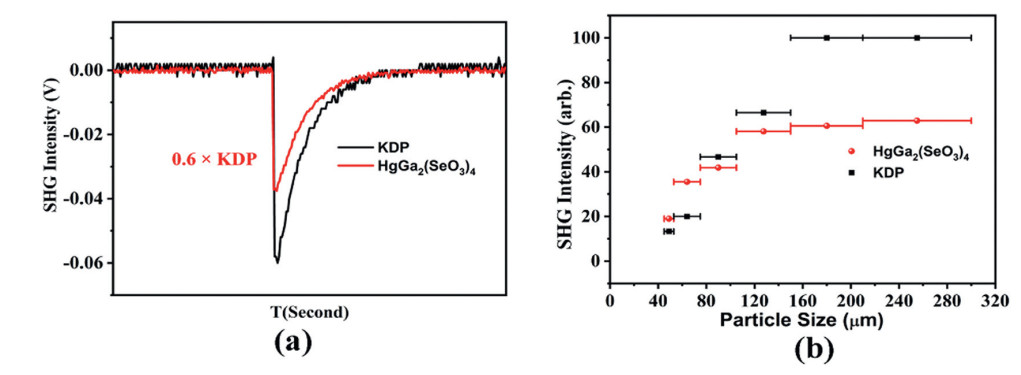
Second-harmonic generation (SHG) measurements reveal that HgGa2(SeO3)4 particles with ranging from 150 µm to 210 µm can exhibit SHG signals under 1064 nm laser irradiation, which are approximately 60% of that of commercially available KDP (Fig. 3a). Tests with particles of varying sizes demonstrate that the SHG intensity increases with particle size, indicating phase matching (Fig. 3b). Notably, HgGa2(SeO3)4 is the first example of a Hg-based simple selenite exhibiting SHG intensity. Structural analysis indicates that the SHG effect primarily stems from the contribution of the SeO3 groups. It is noteworthy that the SHG effect of HgGa2(SeO3)4 is greater than that of the Ag4Hg(SeO3)2(SeO4) we previously reported (0.35 × KDP) [30], and comparable to that of Cd3(SeO3)2(SeO4) (0.6 × KDP) and Hg3(SeO3)2(SeO4) (0.8 × KDP) [42].

|
Download:
|
| Fig. 3. (a) The oscilloscope traces of the SHG signal, and (b) the measured SHG signals with different particle sizes for HgGa2(SeO3)4. | |
To gain deeper insights into the electronic properties of HgGa2(SeO3)4 and Hg2Ga(SeO3)2F, theoretical calculations were performed using the DFT method for both compounds. As shown in Fig. S7 (Supporting information), both compounds are direct bandgap materials, with calculated bandgaps of 3.022 eV and 2.614 eV, respectively. Due to the limitations of theoretical calculations, the calculated bandgaps are generally smaller than the experimental values [43,44]. Therefore, in the subsequent analysis, scissor corrections of 0.978 eV and 0.186 eV were applied to the two compounds, respectively.
The total and partial density of states (DOS) for HgGa2(SeO3)4 and Hg2Ga(SeO3)2F are shown in Fig. S8 (Supporting information), and both compounds exhibit similar DOS characteristics. The top of the valence bands (VBs) is mainly dominated by O-2p and Se-4p orbitals, while the conduction bands (CBs) close to the Fermi level are primarily composed of Se-4p and Hg-6s states. Therefore, the bandgaps of these compounds are mainly determined by the contributions from Hg, Se, and O atoms.
The birefringence of these two compounds was calculated based on the formula ε(ω) = ε1(ω) + iε2(ω) and n2(ω) = ε(ω). HgGa2(SeO3)4 is a uniaxial crystal, where the extraordinary refractive index ne is greater than the ordinary refractive index no. The birefringence (Δn) values for the material are 0.032@546 nm, 0.028@1064 nm and 0.027@2000 nm (Fig. 4a). These values are similar to those observed in Y3F(SeO3)4, which has a birefringence of 0.038@532 nm [18], and in NaGa3(HSeO3)6(SeO3)2, with a birefringence of 0.033@532 nm [45]. Additionally, Hg2Ga(SeO3)2F, identified as a biaxial crystal, demonstrates birefringence values of 0.111@546 nm, 0.095@1064 nm and 0.091@2000 nm (Fig. 4b). Fig. 4c and Table S4 (Supporting information) summarized the birefringence data of Hg-based selenites reported in the literature. Notably, Hg2Ga(SeO3)2F shows a large birefringence and is the first example of HgⅠ-based selenite birefringent material. It is worth mentioning that Hg2Ga(SeO3)2F has a wide transmission window, indicating its potential as a MIR birefringent material.

|
Download:
|
| Fig. 4. The calculated refractive indices and birefringence values of (a) HgGa2(SeO3)4 and (b) Hg2Ga(SeO3)2F. (c) The birefringence of the reported Hg-based selenite crystals. | |

Compared to HgGa2(SeO3)4, the birefringence of Hg2Ga(SeO3)2F has been enhanced by 3.5 times. Therefore, it is necessary to analyze the reasons behind the differences in birefringence between these two compounds. For HgGa2(SeO3)4, its smaller birefringence is mainly due to the following factors: As shown in Figs. 5a and b and Table S2 (Supporting information), the highly symmetrical configurations of the GaO6 octahedron and HgO4 square contribute almost nothing to the birefringence. Although the lone pair electrons in the SeO3 group have a positive effect on birefringence, the SeO3 group is connected to six oxygen atoms in the highly symmetrical GaO6 octahedron (Fig. 5a). This causes the lone pair electrons to be arranged in different directions, resulting in the birefringence canceling out, thus leading to a smaller overall birefringence in this compound. For Hg2Ga(SeO3)2F, its large birefringence is mainly attributed to the introduction of the linear Hg2O2 group. Compared to the planar HgO4 square, the Hg2O2 group exhibits more large anisotropy, and in this structure, the linear Hg2O2 groups are arranged in an orderly manner along the same direction. Additionally, due to the "chemical scissor" effect of fluorine atoms [46], partial fluorination of the GaO6 octahedra prevents the anisotropy of the SeO3 groups from canceling each other out. According to literature, for linear groups, the direction of maximum refractive index is parallel to the linear structure of the molecule, while for lone-pair electron groups, the direction of maximum refractive index is perpendicular to the orientation of the lone pair, which usually points toward the direction of minimum refractive index [47]. As shown in Figs. 5c and d, the synergistic effect between the linear Hg2O2 group and the lone-pair SeO3 group results in the large birefringence observed in this compound.

|
Download:
|
| Fig. 5. (a, b) The schematic diagram illustrating the cancellation of effects in HgGa2(SeO3)4. (c, d) The Schematic diagram of the synergistic effect in Hg2Ga(SeO3)2F. | |

In summary, two new selenite compounds, HgGa2(SeO3)4 and Hg2Ga(SeO3)2F, were successfully synthesized in the Hg-based selenite system using a mild hydrothermal method. HgGa2(SeO3)4 crystallizes in a NCS space group and represents the first example of a Hg-based simple selenite with SHG intensity. It exhibits 60% of the SHG intensity of commercial KDP, along with good stability, a large bandgap (4.0 eV), and a broad transmission window (0.27–5.8 µm). Hg2Ga(SeO3)2F represents the first HgⅠ-based selenite birefringent material, showing a large birefringence (0.111@546 nm) and wide transmission window (0.38–6.2 µm), making it a promising candidate for birefringent applications. Structural analysis reveals that the large birefringence of Hg2Ga(SeO3)2F arises from the synergistic effect of the linear Hg2O2 and SeO3 groups. Our work presents a novel approach for designing new birefringent materials. Next, we will conduct a more systematic investigation of the HgⅠ-based selenite system.
Declaration of competing interestThe authors declare that they have no known competing financial interests or personal relationships that could have appeared to influence the work reported in this paper.
CRediT authorship contribution statementPeng-Fei Li: Writing – original draft, Methodology, Investigation, Formal analysis, Data curation. Chun-Li Hu: Software, Methodology. Bo Zhang: Data curation. Jiang-Gao Mao: Supervision, Resources, Funding acquisition. Fang Kong: Writing – review & editing, Supervision, Resources, Funding acquisition.
AcknowledgmentsThis work was supported by the National Natural Science Foundation of China (Nos. 22475215, 22031009 and 21921001), the NSF of Fujian Province (Nos. 2023J01216, 2024J010039) and the Self-deployment Project Research Program of Haixi Institutes, Chinese Academy of Sciences (No. CXZX-2022-GH06).
Supplementary materialsSupplementary material associated with this article can be found, in the online version, at doi:10.1016/j.cclet.2024.110588.
| [1] |
H.Y. Sha, Y.R. Shang, Z.J. Wang, et al., Small 20 (2023) e2309776. |
| [2] |
J. Chen, M.B. Xu, H.Y. Wu, et al., Angew. Chem. Int. Ed. 63 (2024) e202411503. DOI:10.1002/anie.202411503 |
| [3] |
H. Sha, D. Yang, Y. Shang, et al., Chin. Chem. Lett. 36 (2025) 109730. DOI:10.1016/j.cclet.2024.109730 |
| [4] |
M. Ma, J. Dang, Y. Wu, et al., Inorg. Chem. 62 (2023) 6549-6553. DOI:10.1021/acs.inorgchem.3c00683 |
| [5] |
G. Ghosh, Opt. Commun. 163 (1999) 95-102. DOI:10.1016/S0030-4018(99)00091-7 |
| [6] |
H.T. Luo, T. Tkaczyk, E.L. Dereniak, et al., Opt. Lett. 31 (2006) 616-618. DOI:10.1364/OL.31.000616 |
| [7] |
M.J. Dodge, Appl. Opt. 23 (1984) 1980-1985. DOI:10.1364/AO.23.001980 |
| [8] |
J.R. DeVore, J. Opt. Soc. Am. 41 (1951) 416-419. DOI:10.1364/JOSA.41.000416 |
| [9] |
D.E. Zelmon, D.L. Small, D. Jundt, J. Opt. Soc. Am. 14 (1997) 3319-3322. DOI:10.1364/JOSAB.14.003319 |
| [10] |
S.J. Han, A. Tudi, W.B. Zhang, et al., Angew. Chem. Int. Ed. 62 (2023) e202302025. DOI:10.1002/anie.202302025 |
| [11] |
Y. Lan, J. Ren, P. Zhang, et al., Chin. Chem. Lett. 35 (2024) 108652. DOI:10.1016/j.cclet.2023.108652 |
| [12] |
D. Yan, M.M. Ren, Q. Liu, et al., Inorg. Chem. 62 (2023) 4757-4761. DOI:10.1021/acs.inorgchem.3c00556 |
| [13] |
Z. Hu, L. Liu, R. Zhang, et al., J. Mater. Chem. C 11 (2023) 3325-3333. DOI:10.1039/d2tc05374h |
| [14] |
B. Zhang, M.Y. Ran, X.T. Wu, et al., Coord. Chem. Rev. 517 (2024) 216053. DOI:10.1016/j.ccr.2024.216053 |
| [15] |
X.H. Dong, H.B. Huang, L. Huang, et al., Angew. Chem. Int. Ed. 63 (2024) e202318976. DOI:10.1002/anie.202318976 |
| [16] |
M.B. Xu, Q.Q. Chen, B.X. Li, et al., Chin. Chem. Lett. 36 (2025) 110513. DOI:10.1016/j.cclet.2024.110513 |
| [17] |
M. Hu, C. Tu, Z. Yang, et al., Scripta Mater 231 (2023) 115437. DOI:10.1016/j.scriptamat.2023.115437 |
| [18] |
P.F. Li, C.L. Hu, F. Kong, et al., Angew. Chem. Int. Ed. 62 (2023) e202301420. DOI:10.1002/anie.202301420 |
| [19] |
J. Chen, K.Z. Du, Inorg. Chem. 61 (2022) 17893-17901. DOI:10.1021/acs.inorgchem.2c03267 |
| [20] |
S. Yang, H. Wu, Z. Hu, et al., Small 20 (2023) 2306459. |
| [21] |
Y. Li, K.M. Ok, Angew. Chem. Int. Ed. 63 (2024) e202409336. DOI:10.1002/anie.202409336 |
| [22] |
J. Zhou, Z. Fan, K. Zhang, et al., Mater. Horiz. 10 (2023) 619-624. DOI:10.1039/d2mh01200f |
| [23] |
R.L. Tang, M. Yan, W.D. Yao, et al., Inorg. Chem. 61 (2022) 2333-2339. DOI:10.1021/acs.inorgchem.1c03737 |
| [24] |
H.Y. Wu, C.L. Hu, M.B. Xu, et al., Chem. Sci. 14 (2023) 9533-9542. DOI:10.1039/d3sc03052k |
| [25] |
X. Liu, L. Kang, P. Gong, et al., Angew. Chem. Int. Ed. 60 (2021) 13574-13578. DOI:10.1002/anie.202101308 |
| [26] |
P.F. Li, C.L. Hu, J.G. Mao, et al., Laser Photonics Rev. 19 (2025) 2401488. DOI:10.1002/lpor.202401488 |
| [27] |
P.F. Li, C.L. Hu, Y.F. Li, et al., J. Am. Chem. Soc. 146 (2024) 7868-7874. DOI:10.1021/jacs.4c01740 |
| [28] |
J. Ren, Y. Chen, L. Ren, et al., Inorg. Chem. 62 (2023) 9130-9138. DOI:10.1021/acs.inorgchem.3c00986 |
| [29] |
M.Y. Ran, S.H. Zhou, W.B. Wei, et al., Small 20 (2024) 2304563. DOI:10.1002/smll.202304563 |
| [30] |
X.X. Wang, X.B. Li, C.L. Hu, et al., Sci. China Mater. 62 (2019) 1821-1830. DOI:10.1007/s40843-019-1193-x |
| [31] |
J. Ren, H. Cui, L. Cheng, et al., Inorg. Chem. 62 (2023) 21173-21180. DOI:10.1021/acs.inorgchem.3c03136 |
| [32] |
P.F. Li, C.L. Hu, F. Kong, et al., Mater. Chem. Front. 6 (2022) 3567-3576. DOI:10.1039/d2qm00773h |
| [33] |
J. Chen, C. Lin, X. Jiang, et al., Mater. Horiz. 10 (2023) 2876-2882. DOI:10.1039/d3mh00257h |
| [34] |
Y.L. Sun, L. Huai, A.H. Gong, J. Solid State Chem. 336 (2024) 124772. DOI:10.1016/j.jssc.2024.124772 |
| [35] |
Z. Yan, J. Fan, S. Pan, et al., Chem. Soc. Rev. 53 (2024) 6568-6599. DOI:10.1039/d3cs01136d |
| [36] |
P.F. Li, J.G. Mao, F. Kong, Mater. Today Phys. 37 (2023) 101197. DOI:10.1016/j.mtphys.2023.101197 |
| [37] |
J. Zhang, H. Yu, Z. Hu, et al., Mater. Today Phys. 35 (2023) 101145. DOI:10.1016/j.mtphys.2023.101145 |
| [38] |
G. Park, K.M. Ok, Inorg. Chem. Front. 7 (2020) 4469-4476. DOI:10.1039/d0qi01056a |
| [39] |
P.F. Li, C.L. Hu, B.X. Li, et al., Inorg. Chem. 63 (2024) 4011-4016. DOI:10.1021/acs.inorgchem.4c00033 |
| [40] |
P.F. Li, C.L. Hu, B.X. Li, et al., Inorg. Chem. Front. 10 (2023) 7343-7350. DOI:10.1039/d3qi01937c |
| [41] |
Z. Yang, C. Hu, M. Mutailipu, et al., J. Mater. Chem. C 6 (2018) 2435-2442. DOI:10.1039/c7tc04857b |
| [42] |
M. Shang, P.S. Halasyamani, J. Solid State Chem. 286 (2020) 121292. DOI:10.1016/j.jssc.2020.121292 |
| [43] |
M. Yan, R.L. Tang, W.D. Yao, et al., Chem. Sci. 15 (2024) 2883-2888. DOI:10.1039/d3sc06683e |
| [44] |
M.Y. Ran, S.H. Zhou, X.T. Wu, et al., Mater. Today Phys. 44 (2024) 101442. DOI:10.1016/j.mtphys.2024.101442 |
| [45] |
P.F. Li, C.L. Hu, J.G. Mao, et al., Coord. Chem. Rev. 517 (2024) 216000. DOI:10.1016/j.ccr.2024.216000 |
| [46] |
P.F. Li, C.L. Hu, J.G. Mao, et al., Chem. Sci. 15 (2024) 7104-7110. DOI:10.1039/d4sc01376j |
| [47] |
J.Y. Guo, A. Tudi, S.J. Han, et al., Angew. Chem. Int. Ed. 60 (2021) 3540-3544. DOI:10.1002/anie.202014279 |