 2025, Vol. 36


b Leibniz-Institut für Katalyse e.V., Albert-Einstein-Straβe 29a, 18059 Rostock, Germany
Quaternary carbon in a complex molecule has been identified as one of the most vital structural moieties since they are widely represented in natural products and pharmaceuticals [1–7], but their synthesis usually requires multi-synthetic steps and relatively harsh conditions [8]. The construction of all-carbon quaternary centers via tert-C(sp3)-C cross-coupling reactions by transition-metal catalysis is also a challenging project. The challenges can mainly be categorized according to two aspects: (ⅰ) The severe steric effects encountered around the metal center; (ⅱ) the competing isomerization routes of alkylmetal intermediates always have low barriers [9–12]. On the other hand, the precursors of the construction of quaternary carbon can be classified into tertiary electrophilic reagents (alkyl halides, pseudohalides) [13–21], tertiary nucleophilic reagents (boronic acid derivatives [22], Grignard reagents [23–26], alkylzinc [27]), and 1,1,2-trisubstituted alkenes [28,29]. But unfortunately, tertiary halides, pseudohalides, borates, and Grignard reagents are not easy to obtain (Scheme 1A) [8].

|
Download:
|
| Scheme 1. Strategies towards amides or esters derivatives with α quaternary carbon center. | |
Aliphatic amides, esters, and acids bearing α-quaternary carbon are a promising and valuable class of chemicals for potential bioactive molecules, such as Caramiphen, Dalcetrapib, Loperamide, Fenhexamid [30–33]. Traditional synthetic methods toward these compounds were the condensation reaction of carboxylic acid or nucleophilic attack of acyl halide [34,35]. Recently, for the synthesis of aforementioned valuable chemicals, visible-light photoredox-catalyzed carboxylation of tertiary C(sp3)-H [36,37], iron-catalyzed C(sp3)-C(sp3) coupling [38] and carbonylation of tertiary halides by iron catalysis [39,40] provide novel and elegant disconnection approaches from the perspective of retrosynthesis analysis (Scheme 1B). However, the raw materials of most of these methods were not readily available. As a result, the development of novel C—C bond-forming methodologies to amides and esters with α-quaternary carbon from abundant reagents remained in high demand.
Among the reported methodologies, in 2023, Yu and co-workers reported an efficient C—H-activated protocol to increase the complexity of acid with a quaternary carbon rapidly [41]. Complicated amides and acids with α-quaternary carbon were prepared effectively from readily available raw materials (Scheme 1C). On the other hand, carbon monoxide is an abundant chemical that can be produced from biomass gasification, steel manufacturing, reduction of carbon dioxide, etc. [42]. The synthetic transformation based on CO, carbonylation, has been accepted as a powerful toolbox in organic chemistry. Among the achievements, Guan and co-workers developed a Markovnikov hydroaminocarbonylation of 1,1,2-trisubstituted olefins in 2021, which is an efficient and seminal protocol for the construction of amides with α-quaternary carbon (Scheme 1D) [43]. Inspired by this methodology and our previous work of carbonylation for the synthesis of bioactive 2-cyanoacetate derivatives [44], we wish to explore a new method for the modular synthesis of amides and esters bearing α-quaternary carbon from more primitive raw material like acrylonitrile. Moreover, complex nitrile-containing molecules are attractive in synthetic chemistry due to their versatility as synthetic intermediates for the generation of ketones, amines, carboxylic acids, and so on [45,46].
Acrylonitrile is an existing cheap cyanide source which can polymerize easily to synthesize acrylic fiber and nitrile rubber in industry [47]. Herein, we hypothesized a carbonylative five-component synthesis of amides and esters with α-quaternary carbon using available acrylonitrile and carbon monoxide as the readily available substrates. In this designed procedure, the corresponding products with α-quaternary carbon which contain difluoromethyl or perfluoroalkyl moiety were prepared effectively with good functional group tolerance and excellent chemoselectivity. (Scheme 1E).
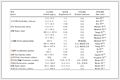
For establish this five-component carbonylative reaction, we started to investigate different phosphine ligands in the model reaction of aniline (1a), acrylonitrile (2a), and perfluorobutyl iodide (3a) under 10 bar CO gas at 80 ℃ for 24 h. As shown in Table 1, utilizing monodentate and bidentate phosphine ligands such as DPPF, DPEphos, DPPP, PPh3, PCy3, and Brettphos, the desired product 4a was obtained in 45% yield when using Brettphos as the ligand (Table 1, entries 1–6). Then, further palladium catalyst screening showed Pd(MeCN)2Cl2 is the best choice, and 61% yield of the target product was obtained (Table 1, entry 9). Considering the catalyst loading, we reduced the catalyst dosage to 5% and we can still get a 59% yield of 4a (Table 1, entry 10). Subsequently, we studied the effect of different solvents, but unfortunately, reduced yields were obtained when 1,4-dioxane, and MeCN were tested (Table 1, entries 11 and 12). To our delight, further temperature screening showed that 50 ℃ is the best choice here (Table 1, entry 13). Finally, different bases were investigated to improve this five-component carbonylative transformation, and we obtained a good yield of the target product when using K2CO3 as the base (Table 1, entry 17). Notably, by-products of three or four components carbonylation and the reaction between aniline and perfluorobutyl iodide could be detected during the optimization process.
|
Table 1 Optimization of reaction conditions.a |


With the optimized conditions in hand, we started to explore the scope with various aromatic amines under our best conditions (Scheme 2). We obtained a 76% isolated yield of 4a and the structure of 4a was confirmed by X-ray crystallography (CCDC: 2414127). It should be mentioned that ortho-substituted aniline gave the corresponding product in lower yield compared with para-substituted aniline and mete-substituted aniline because of the steric hindrance (4d vs. 4b, 4c). Aromatic amines with electron-donating groups, such as tert-butyl, thiomethyl, methoxy, benzeneoxy, and trifluoromethoxy were compatible well to give the corresponding compounds in good to excellent yields (4e-4i). For those substrates with halogen groups like fluoro, chloro, and bromo substituents, the aimed products were isolated in 65%−82% yields (4j-4l). Aromatic amines with electron-withdrawing groups like acetyl group, trifluoromethyl, and cyano group, afforded the corresponding products in medium to good yields (4m-4o). Some substrates with heterocycles can also be tolerated with our reaction conditions (4p-4q). Subsequently, we turned our attention to investigating the universality of various alcohols (Scheme 2). We can get an 81% yield of 5a when utilizing benzyl alcohol as a reaction partner. Benzyl alcohol substituted with an electron-donating group like methoxy was compatible and got the desired compounds. Benzyl alcohols substituted with halogen groups like fluoro, chloro, and bromo group, could also gave the corresponding products in 70%−78% yields (5c-5e). We obtained 5f-5l in 57%−85% when using long-chain alkyl alcohols, cyclic alcohols, and phenol as our substrates. Then, several activated alkyl halides with diverse fluoroalkyl groups and aromatic amines were investigated in this multi-component carbonylative transformation. Compared difluoroalkyl group with perfluoroalkyl group in alkyl halides, yields of the former were decreased relatively, and aniline with electron-donating group was better than aniline with electron-withdrawing group in the comparison of the activity in the reaction (6a-6h). However, no desired product was detected when 1-iodobutane was tested here.

|
Download:
|
| Scheme 2. Scope of the amides, alcohols and fluoroalkyl halides. a Amines (0.3 mmol), 2a (2.5 equiv.), 3a (1.2 equiv.), Pd(MeCN)2Cl2 (5 mol%), Brettphos (5 mol%), K2CO3 (3 equiv.), CO (10 bar), PhCF3 (1.5 mL) stirred at 50 ℃ for 24 h, isolated yield. b Alcohols or phenols (0.3 mmol), 2a (2.5 equiv.), Pd(PPh3)4 (5 mol%), Xantphos (5 mol%), K2CO3 (3 equiv.), CO (10 bar), PhCF3 (1.5 mL) stirred at 50 ℃ for 24 h, isolated yield. c Amines (0.2 mmol), 2a (3 equiv.), ethyl iododifluoroacetate (1.5 equiv.), Pd(MeCN)2Cl2 (10 mol%), tri-p-anisylphosphine (20 mol%), K2CO3 (3 equiv.), CO (10 bar), PhCF3 (2 mL) stirred at 50 ℃ for 48 h, isolated yield. | |

To test the practicality of this five-component carbonylative procedure, diverse drug molecules and natural products modified anilines were also investigated (Scheme 3). To our delight, anilines bearing pregnenolone, dehydroepiandrosterone, estradiol benzoate, DL-menthol, DL-isoborneol, vitamin E, diacetonefructose, procaine, epiandrosterone, and amino acid derivatives were all converted to the target compounds smoothly and give the desired products 7a-7l in 50%−92% yields.

|
Download:
|
| Scheme 3. Late-stage modification of pharmaceutical agents and natural products. a Amines (0.3 mmol), 2a (2.5 equiv.), 3a (1.2 equiv.), Pd(MeCN)2Cl2 (5 mol%), Brettphos (5 mol%), K2CO3 (3 equiv.), CO (10 bar), PhCF3 (1.5 mL) stirred at 50 ℃ for 24 h, isolated yield. b Alcohols or phenols (0.3 mmol), 2a (2.5 equiv.), Pd(PPh3)4 (5 mol%), Xantphos (5 mol%), K2CO3 (3 equiv.), CO (10 bar), PhCF3 (1.5 mL) stirred at 50 ℃ for 24 h, isolated yield. | |

In order to manifest the usefulness and scalability of this methodology, we manipulated a scale-up reaction which increased to 1 mmol and got a good yield of the target compound (Scheme 4A). Two other activated alkenes (ethyl acrylate and methyl acrylate) were also tested in place of acrylonitrile, but no desired product could be detected under our standard conditions. However, as shown in Schemes 4H and I, other types of activated alkenes can be applied successfully in a two-step manner. Subsequently, a carbonylative six-component transformation was conducted in our laboratory due to the interest that we wonder reaction sequence of the ethylene or acrylonitrile. Then we obtained a 22% yield of 10a which was confirmed by distortionless enhancement by polarization transfer (Scheme 4B and Supporting information). Compounds from the reaction between aniline and ethylene can be detected as well.

|
Download:
|
| Scheme 4. Scale-up experiment, mechanistic investigations, scope of intermediates and synthetic utility. | |

Subsequently, several control experiments were conducted to understand this reaction mechanism. First, only a trace amount of the target product 4a was detected when radical inhibitor TEMPO (2,2,6,6-tetramethyl-1-piperinedinyloxy, 2 equiv.) was added to our reaction under the standard conditions (Scheme 4C). The fluoroalkyl radical was captured by 1,1-diphenylethylene when 1,1-diphenylethylene was added to the model reaction as an additive (Scheme 4D). Then we conducted a ring-opening radical clock reaction and 36% of the corresponding product 9a was given under standard conditions (Scheme 4E). These experiments indicated that this transformation involves radical intermediates. Soon afterwards, we hypothesized a Michael addition process in this five-component carbonylation considering acrylonitrile is a good Michael acceptor (Scheme 4F). Next, we conducted 8a and acrylonitrile into our reaction condition without catalyst and ligand, and 31% yield of the aimed product 4a was isolated which verified our hypothesis (Scheme 4G). Considering the excellent metabolic stability of the difluoromethyl group and its wide existence in numerous drug molecules [47], we started to find a feasible reaction environment and explore its substrate scope. Subsequently, various carbonyl difluoro-containing compounds were performed (Scheme 4H). Anilines with diverse groups like methyl, tert-butyl, methoxy, benzeneoxy, thiomethyl, halogen groups like fluoro, chloro, bromo substituents, were converted into the corresponding compounds in 40%−90% yields. However, very low yield of the desired product was detected when the aniline was substituted with a CF3 group.
Considering cyano group and carbonyl group both have versatile transformability that can enable facile increasing of the molecular complexity, the resulting product 8a was utilized for various transformations. Firstly, considering the reaction cost, we chose a cheaper bromo-difluoro precursor to conduct a scale-up experiment and got a medium yield of 8a. Secondly, we tested a Michael addition reaction of α,β-unsaturated ketone and gave a good yield of 9b As we all know, fluorinated heterocycle plays an important role in pharmaceutical and agrochemical industries [48,49]. Subsequently, we prepared a carbonyl difluoro-containing heterocycle 9c in good yield under a reductive environment. Likewise, we manipulated other Michael addition transformations toward 9d, 6e, and 9f. Cyclic carboxylic derivatives containing α-quaternary carbon centers are often challenging to synthesize but have high bioactive activity [36,41]. Finally, we prepared an interesting difluoro-containing heterocycle 9e with α-quaternary carbon in good yield via Michael addition and reduction (Scheme 4I).
Based on the above reaction results and literature studies [50–70], we proposed a reasonable reaction mechanism (Scheme 4J). Initially, active catalyst Pd0Ln species A was produced from the Pd(MeCN)2Cl2 pre-catalyst. Then, the Pd0Ln complex induced a SET (single-electron transfer) process of fluoroalkyl halides to yield the corresponding radical B and a PdILnX species, followed by the addition of the radical B to acrylonitrile to afford a secondary radical C. Next, the PdILnX species was reincorporated with the C to get the intermediate D. After the insertion of carbon monoxide, complex D can be transformed into intermediate E. Later on, intermediate E reacts with nucleophiles to give the desired intermediate F and it also can be a good partner to react with Michael acceptor to prepare diverse products G with α-quaternary carbon. Meanwhile, palladium-hydride complex H can be yielded and converted to Pd0Ln species A in the presence of base for the next catalytic transformation.
In summary, we have achieved a five-component carbonylative transformation with good functional group tolerance and excellent chemoselectivity, which converts abundant acrylonitrile, carbon monoxide, fluoroalkyl halides, and nucleophiles to value-added carboxylic acid derivatives with α-quaternary carbon center. The synthetic utilities were demonstrated by the various transformations of the products into medicinal interest fluorine-containing compounds with α-quaternary carbon center. We believe that this interesting protocol can find potential applications in drug development.
Declaration of competing interestThe authors declare that they have no known competing financial interests or personal relationships that could have appeared to influence the work reported in this paper.
CRediT authorship contribution statementZhi-Peng Bao: Writing – original draft, Methodology, Formal analysis, Data curation. Hefei Yang: Formal analysis. Ru-Han A: Formal analysis. Yuanrui Wang: Formal analysis. Xiao-Feng Wu: Writing – review & editing, Writing – original draft, Validation, Supervision, Resources, Project administration, Methodology, Investigation, Funding acquisition, Conceptualization.
AcknowledgmentWe thank the financial support from National Key R&D Program of China (No. 2023YFA1507500) and DICP.
Supplementary materialsSupplementary material associated with this article can be found, in the online version, at doi:10.1016/j.cclet.2025.111150.
| [1] |
X.C. Gan, B. Zhang, N. Dao, et al., Science 384 (2024) 113-118. DOI:10.1126/science.adn5619 |
| [2] |
Z. Wang, H. Yin, G.C. Fu, Nature 563 (2018) 379-383. DOI:10.1038/s41586-018-0669-y |
| [3] |
W. Xue, X. Jia, X. Wang, et al., Chem. Soc. Rev. 50 (2021) 4162-4184. DOI:10.1039/d0cs01107j |
| [4] |
J.J. Murphy, D. Bastida, S. Paria, M. Fagnoni, P. Melchiorre, Nature 532 (2016) 218-222. DOI:10.1038/nature17438 |
| [5] |
W. Liu, M.N. Lavagnino, C.A. Gould, J. Alcázar, D.W.C. MacMillan, Science 374 (2021) 1258-1263. DOI:10.1126/science.abl4322 |
| [6] |
P. Xu, F. Zhou, L. Zhu, J. Zhou, Nature Synth. 2 (2023) 1020-1036. DOI:10.1038/s44160-023-00406-3 |
| [7] |
M. Shimizu, Angew. Chem. Int. Ed. 50 (2011) 5998-6000. DOI:10.1002/anie.201101720 |
| [8] |
T.G. Chen, H. Zhang, P.K. Mykhailiuk, et al., Angew. Chem. Int. Ed. 58 (2019) 2454-2458. DOI:10.1002/anie.201814524 |
| [9] |
R. Jana, T.P. Pathak, M.S. Sigman, Chem. Rev. 111 (2011) 1417-1492. DOI:10.1021/cr100327p |
| [10] |
J. Choi, G.C. Fu, Science 356 (2017) eaaf7230. DOI:10.1126/science.aaf7230 |
| [11] |
E.L. Lucas, E.R. Jarvo, Nat. Rev. Chem. 1 (2017) 0065. DOI:10.1038/s41570-017-0065 |
| [12] |
G.C. Fu, ACS Cent. Sci. 3 (2017) 692-700. DOI:10.1021/acscentsci.7b00212 |
| [13] |
S.L. Zultanski, G.C. Fu, J. Am. Chem. Soc. 135 (2013) 624-627. DOI:10.1021/ja311669p |
| [14] |
X. Wang, G. Ma, Y. Peng, et al., J. Am. Chem. Soc. 140 (2018) 14490-14497. DOI:10.1021/jacs.8b09473 |
| [15] |
X. Wang, S. Wang, W. Xue, H. Gong, J. Am. Chem. Soc. 137 (2015) 11562-11565. DOI:10.1021/jacs.5b06255 |
| [16] |
Y. Ye, H. Chen, J.L. Sessler, H. Gong, J. Am. Chem. Soc. 141 (2019) 820-824. DOI:10.1021/jacs.8b12801 |
| [17] |
H. Chen, X. Jia, Y. Yu, Q. Qian, H. Gong, Angew. Chem. Int. Ed. 56 (2017) 13103-13106. DOI:10.1002/anie.201705521 |
| [18] |
X. Lu, Y. Wang, B. Zhang, et al., J. Am. Chem. Soc. 139 (2017) 12632-12637. DOI:10.1021/jacs.7b06469 |
| [19] |
L.J. Cheng, S.M. Islam, N.P. Mankad, J. Am. Chem. Soc. 140 (2018) 1159-1164. DOI:10.1021/jacs.7b12582 |
| [20] |
Z.T. Ariki, Y. Maekawa, M. Nambo, C.M. Crudden, J. Am. Chem. Soc. 140 (2018) 78-81. DOI:10.1021/jacs.7b10855 |
| [21] |
A.L. Pace, F. Xu, W. Liu, M.N. Lavagnino, D.W.C. MacMillan, J. Am. Chem. Soc. 146 (2024) 32925-32932. DOI:10.1021/jacs.4c14942 |
| [22] |
D.N. Primer, G.A. Molander, J. Am. Chem. Soc. 139 (2017) 9847-9850. DOI:10.1021/jacs.7b06288 |
| [23] |
C. Lohre, T. Dröge, C. Wang, F. Glorius, Chem. Eur. J. 17 (2011) 6052-6055. DOI:10.1002/chem.201100909 |
| [24] |
A. Joshi-Pangu, C.Y. Wang, M.R. Biscoe, J. Am. Chem. Soc. 133 (2011) 8478-8481. DOI:10.1021/ja202769t |
| [25] |
P. Ren, L.A. Stern, X. Hu, Angew. Chem. Int. Ed. 51 (2012) 9110-9113. DOI:10.1002/anie.201204275 |
| [26] |
T. Iwasaki, H. Takagawa, S.P. Singh, H. Kuniyasu, N. Kambe, J. Am. Chem. Soc. 135 (2013) 9604-9607. DOI:10.1021/ja404285b |
| [27] |
B. Breit, P. Demel, D. Grauer, C. Studte, Chem. Asian J. 1 (2006) 586-597. DOI:10.1002/asia.200600100 |
| [28] |
S.A. Green, S. Vásquez-Céspedes, R.A. Shenvi, J. Am. Chem. Soc. 140 (2018) 11317-11324. DOI:10.1021/jacs.8b05868 |
| [29] |
S.A. Green, S.W.M. Crossley, J.L.M. Matos, et al., Acc. Chem. Res. 51 (2018) 2628-2640. DOI:10.1021/acs.accounts.8b00337 |
| [30] |
T.H. Figueiredo, V. Aroniadou-Anderjaska, F. Qashu, et al., Br. J. Pharmacol. 164 (2011) 1495-1505. DOI:10.1111/j.1476-5381.2011.01427.x |
| [31] |
D.M. Black, D. Bentley, S. Chapel, et al., Clin. Pharmacokinet. 57 (2018) 1359-1367. DOI:10.1007/s40262-018-0656-3 |
| [32] |
L. Hillebrands, M. Lamshoeft, A. Lagojda, A. Stork, O. Kayser, J. Agric. Food Chem. 68 (2020) 14123-14134. DOI:10.1021/acs.jafc.0c05277 |
| [33] |
R.J. Vaz, J. Kang, Y. Luo, D. Rampe, Bioorg. Med. Chem. Lett. 28 (2018) 446-451. DOI:10.1016/j.bmcl.2017.12.020 |
| [34] |
L. Viejo, M. Rubio-Alarcón, R.L. Arribas, et al., Molecules 16 (2022) 4473. |
| [35] |
S.M. Wang, C. Zhao, X. Zhang, H.L. Qin, Org. Biomol. Chem. 17 (2019) 4087-4101. DOI:10.1039/c9ob00699k |
| [36] |
Y. Liu, G.H. Xue, Z. He, et al., J. Am. Chem. Soc. 146 (2024) 28350-28359. |
| [37] |
J.L. Li, S.S. Zhang, L.L. Jiang, et al., Angew. Chem. Int. Ed. 63 (2024) e202420852. |
| [38] |
Q. Zhang, X.Y. Liu, Y.D. Zhang, et al., J. Am. Chem. Soc. 146 (2024) 5051-5055. DOI:10.1021/jacs.3c14032 |
| [39] |
H.J. Ai, B.N. Leidecker, P. Dam, et al., Angew. Chem. Int. Ed. 61 (2022) e202211939. DOI:10.1002/anie.202211939 |
| [40] |
H.J. Ai, F. Zhao, X.F. Wu, Chin. J. Catal. 47 (2023) 121-128. DOI:10.1016/S1872-2067(22)64208-6 |
| [41] |
G. Meng, L. Hu, M. Tomanik, J.Q. Yu, Angew. Chem. Int. Ed. 62 (2023) e202214459. DOI:10.1002/anie.202214459 |
| [42] |
X. Ma, J. Albertsma, D. Gabriels, et al., Chem. Soc. Rev. 52 (2023) 3741-3777. DOI:10.1039/d3cs00147d |
| [43] |
H.Y. Yang, Y.H. Yao, M. Chen, Z.H. Ren, Z.H. Guan, J. Am. Chem. Soc. 143 (2021) 7298-7305. DOI:10.1021/jacs.1c03454 |
| [44] |
Z.P. Bao, X.F. Wu, Angew. Chem. Int. Ed. 62 (2023) e202301671. DOI:10.1002/anie.202301671 |
| [45] |
S. Alazet, M.S. West, P. Patel, S.A.L. Rousseaux, Angew. Chem. Int. Ed. 58 (2019) 10300-10304. DOI:10.1002/anie.201903215 |
| [46] |
J. Long, R. Yu, J. Gao, X. Fang, Angew. Chem. Int. Ed. 59 (2020) 6785-6789. DOI:10.1002/anie.202000704 |
| [47] |
E.M. Karp, T.R. Eaton, V.S. Nogué, et al., Science 358 (2017) 1307-1310. DOI:10.1126/science.aan1059 |
| [48] |
N. Rao, Y.Z. Li, Y.C. Luo, Y. Zhang, X. Zhang, ACS Catal. 13 (2023) 4111-4119. DOI:10.1021/acscatal.2c06149 |
| [49] |
Z.P. Bao, Y. Zhang, L.C. Wang, X.F. Wu, Sci. China Chem. 66 (2023) 139-146. DOI:10.1007/s11426-022-1439-1 |
| [50] |
Ding Y., Huang H., Chem. Catal. 2 (2022) 1467-1479. |
| [51] |
J.X. Xu, C.S. Kuai, B. Chen, X.F. Wu, Chem. Catal. 2 (2022) 477-498. |
| [52] |
Z.P. Bao, Y. Zhang, X.F. Wu, Chem. Sci. 13 (2022) 9387-9391. DOI:10.1039/d2sc02665a |
| [53] |
M. Chen, X. Wang, P. Yang, et al., Angew. Chem. Int. Ed. 59 (2020) 12199-12205. DOI:10.1002/anie.202003288 |
| [54] |
S. Cai, Z. Zhao, G. Yang, H. Huang, Nat. Chem. 16 (2024) 1972-1981. DOI:10.1038/s41557-024-01673-z |
| [55] |
Y. Ding, J. Wu, H. Huang, J. Am. Chem. Soc. 145 (2023) 4982-4988. DOI:10.1021/jacs.3c00004 |
| [56] |
Y. Ding, J. Wu, T. Zhang, H. Liu, H. Huang, J. Am. Chem. Soc. 146 (2024) 19635-19642. DOI:10.1021/jacs.4c05360 |
| [57] |
J. Han, B. Xiao, T.Y. Sun, et al., J. Am. Chem. Soc. 144 (2022) 21800-21807. DOI:10.1021/jacs.2c10559 |
| [58] |
H. Hu, F. Teng, J. Liu, et al., Angew. Chem. Int. Ed. 58 (2019) 9225-9229. DOI:10.1002/anie.201904838 |
| [59] |
Z. Nie, K. Wu, X. Zhan, et al., Nat. Commun. 15 (2024) 8510. DOI:10.1038/s41467-024-52392-5 |
| [60] |
S. Chen, Y.N. Wang, J. Xie, et al., Nat. Commun. 15 (2024) 5479. DOI:10.1038/s41467-024-49870-1 |
| [61] |
X. Zhao, X. Feng, F. Chen, et al., Angew. Chem. In. Ed. 60 (2021) 26511-26517. DOI:10.1002/anie.202111061 |
| [62] |
X. Zhao, H.Y. Tu, L. Guo, et al., Nat. Commun. 9 (2018) 3488. DOI:10.1038/s41467-018-05951-6 |
| [63] |
Y. Zhang, H.Q. Geng, X.F. Wu, Angew. Chem. Int. Ed. 60 (2021) 24292-24298. DOI:10.1002/anie.202111206 |
| [64] |
F.P. Wu, Y. Yuan, X.F. Wu, Angew. Chem. Int. Ed. 60 (2021) 25787-25792. DOI:10.1002/anie.202112609 |
| [65] |
C.S. Kuai, B.H. Teng, X.F. Wu, Angew. Chem. Int. Ed. 63 (2024) e202318257. DOI:10.1002/anie.202318257 |
| [66] |
Y. Wang, H. Yang, Y. Zheng, et al., Nat. Catal. 7 (2024) 1065-1075. DOI:10.1038/s41929-024-01204-6 |
| [67] |
B. Lu, F.S. Bao, Z.W. He, W.J. Xiao, J.R. Chen, Chin. J. Chem. 42 (2024) 990-996. DOI:10.1002/cjoc.202300733 |
| [68] |
Z.P. Bao, Y. Zhang, X.F. Wu, J. Catal. 413 (2022) 163-167. DOI:10.1016/j.jcat.2022.06.032 |
| [69] |
M. Yang, Y. Liu, X. Qi, Y. Zhao, X.F. Wu, Green Synth. Catal. 5 (2024) 211-269. |
| [70] |
Y. Ning, T. Ohwada, F.E. Chen, Green Synth. Catal. 2 (2021) 247-266. |