 2025, Vol. 36


Helicenes, with their inherent chiral π-electron conjugation, display fascinating optical and electronic properties [1,2], positioning them as promising candidates for applications in chiral optoelectronic devices [3–5], asymmetric catalysis [6], and molecular recognition [7,8]. Among their structural variations, the incorporation of non-hexagonal rings, particularly heptagons, plays a crucial role in modulating the rigidity, chiroptical properties, and electronic behavior of helicenes [9–12]. Heptagon-embedded helicenes could exhibit narrow emissions, high photoluminescence quantum yields [10], and long-lived delayed fluorescence [13].
Several synthetic approaches have been developed to incorporate heptagons into helicenes, including ring-skeleton arrangement [14–20], extension of cycloheptanones [21–25] and intramolecular cyclization [26–30]. Among these, intramolecular cyclization offers a rational strategy for constructing heptagons within helicenes. For example, Itami and colleagues reported a π-extended dithia[6]helicene featuring a heptagon [31], as well as a propeller-shaped triple [4]helicene containing three heptagons [26]. The Miao group synthesized aromatic saddles with two heptagons [32] and a heptabenzo[7]circulene [33], while Campaña et al. produced a π-extended [7]helicene with heptagons embedded in HBC-like units [23]. In other cases, heptagons form part of the helicene backbone [34–38]. Yashima et al. synthesized a heptagon-embedding enantiopure [6]helicene via acid-promoted stepwise alkyne annulations, which exhibited greater dissymmetry factors than both fully aromatic [6]helicenes and the present [7]helicene [27]. Incorporating nitrogen and boron atoms has also proven effective for embedding heptagons in helicenes [39–41]. More recently, pristine or heteroatom-doped [6]helicenes have been shown to undergo dehydrocyclization, enabling their controlled transformation into heptagons [9,42–44]. This process offers a straightforward synthetic route to heptagon-embedded aromatic hydrocarbons, with several such helicenes synthesized via this approach.
Here, we report the synthesis of two oxa-helicenes, 5 and 6, containing one and two embedded heptagons, respectively, achieved through the dehydrocyclization of a triple [6]helicene (4). The structures of 5 and 6 were confirmed through single-crystal X-ray diffraction. Following the incorporation of heptagons, both compounds exhibited red-shifted absorption spectra and an increased Stokes shift. Additionally, the fluorescence quantum yields of 5 and 6 were 2–3 times higher than those of 4. The enantiomers of 5 and 6 were successfully resolved, and their thermal stability was investigated, revealing a significant decrease in enantiomeric stability compared to 4. This reduction was attributed to the planarization effects caused by the incorporation of the heptagons. Finally, the chiroptical properties of the enantiomers of 4–6 were studied, revealing the decreased absorption and emission dissymmetry factors of 5 and 6, compared with that of 4.
Scheme 1 outlines the synthetic route employed for the preparation of 4, 5 and 6 in a three-step procedure. Initially, 2 was synthesized from 1 on a gram scale, yielding 59%. Subsequently, a triple Suzuki-Miyaura coupling reaction involving the known 1, 3, 5-tri(2-bromophenyl)benzene (2) and commercially available benzofuran-2-boronic acid in the presence of 1, 4-dioxane/H2O afforded 1, 3, 5-tri(2-benzofuranylphenyl)benzene (3) in 56% yield [45]. The subsequent Scholl reaction of compound 3 with FeCl3 yielded 4 in 21% yield. 4 can also be generated with 2, 3-dichloro-5, 6-dicyano-1, 4-benzoquinone (DDQ) by Scholl reaction [46]. 5 and 6 were obtained by treatment of 3 with DDQ in dichloromethane/triflic acid (TfOH). The reaction proceeded for 0.5 h to synthesize 5 in 14% yield, while extending the reaction time to 1 h resulted in the formation of 6 in 6% yield. The structures of 4, 5 and 6 were fully characterized by matrix-assisted laser desorption ionization time-of-flight mass spectrometry (MALDI-TOF MS) and nuclear magnetic resonance (NMR) spectroscopy (Figs. S1-S14 in Supporting information). Detected by MALDI-TOF MS, the low yields of 5 and 6 was due to the formation of chlorinated byproducts, which is usual in Scholl reactions [47].

|
Download:
|
| Scheme 1. Synthetic route to helicenes 4, 5 and 6. (i) TfOH, 130 ℃, 14 h, yield 59%; (ii) 1, 4-dioxane/H2O, 80 ℃, 12 h, yield 56%; (iii) FeCl3/CH3NO2, DCM, r.t., 0.5 h, yield 21%; (iv) DDQ/TfOH, DCM, 0 ℃, 0.5 h, yield 14%; (v) DDQ/TfOH, DCM, 0 ℃, 1 h, yield 6%. | |

Single crystals suitable for X-ray diffraction analysis were obtained by slow evaporation of hexane vapor into its carbon disulfide solution to confirm the structures of 4, 5 and 6. Three, two and one [6]helicene units are demonstrated in 4, 5 and 6 (Figs. 1a-c). The torsion angles of 4 (28.0°), 5 (34.7°) and 6 (34.9°) increase with the addition of heptagons and the average distances between terminal benzene rings are 4.43 Å, 4.66 Å and 4.39 Å, respectively (Figs. 1d-f). Despite the larger torsion angles pushing the benzene rings apart on helical axis direction, the strain from planarization curves the uncyclized [6]helicene unit in the plane, bringing the benzene rings of 6 getting closer than that of 4 and 5. The average bond length of the heptagon of 5 is 1.50 Å, slightly longer than that of 6 (1.44 Å), indicating increased conjugation with the addition of heptagons. The results are verified by the calculation of the nucleus-independent chemical shift (NICS) (Fig. S15 in Supporting information) [48,49]. The positive NICS values of the heptagons decrease from 5 (26.2 ppm) to 6 (19.6 ppm, 23.3 ppm). And the less negative NICS values of the uncyclized [6]helicene units from 4 to 6 are consistent with the increasing curvature of the uncyclized [6]helicene units.

|
Download:
|
| Fig. 1. (a–c) Top view of 4–6. (d–f) The thermal ellipsoids are set at 50% probability level. Side view of 4–6. (g–i) Crystal packing structures of 4–6. Intermolecular π–π stacking distances are labelled on the side. Hydrogen atoms are omitted for clarity. | |

As shown in the packing structure of 4, the adjacent benzene rings of (P, P, P)- and (M, M, M)-4 present typical π–π stacking interactions with a distance of 3.31 Å (Fig. 1g). The molecules are aligned along the b-axis through C–H···π contacts [50] with a distance of 2.91 Å to form a one-dimensional column (Fig. S16 in Supporting information). 5 exhibits π–π stacking between enantiomeric (P, M) and (M, P) configurations along the c-axis direction with larger overlap and a distance of 3.63 Å (Fig. 1h). Along the c-axis, the homochiral molecules possess C–H···π interactions with distances of 2.69 Å and 2.86 Å (Fig. S17 in Supporting information). Besides, the heterochiral molecules in the direction of b-axis interact via C–H···π contacts of 2.93 Å. For 6, the enantiomers P-6 and M-6 are stacked along the b-axis direction alternatively and equally (Fig. 1i). The π–π distance between benzene rings of P-6 and M-6 is 3.28 Å. However, the interplanar spacing between the heterochiral molecules of the other side is 3.79 Å, indicating weaker interactions. The molecules of 6 interact with each other by C–H···π interactions with distances ranging from 2.64 Å to 2.89 Å (Fig. S18 in Supporting information).
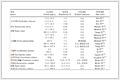
The UV–vis absorption and fluorescence spectra of 4–6 (Fig. 2 and Table 1) were recorded in dichloromethane (DCM) solution (4 × 10⁻⁵ mol/L) at room temperature. The absorption spectrum of 4 exhibits a major band from 325 to 430 nm peaking at 366 nm (ε = 6.95 × 10⁴ L mol-1 cm-1) and a weak absorption tail at around 443 nm. 5 and 6 showed the highest absorption at 348 nm (ε = 6.85×10⁴ L mol-1 cm-1) and 340 nm (ε = 4.73×10⁴ L mol-1 cm-1), respectively. In comparison to 4 (443 nm), the absorption tail wavelength (λtailabs) of 5 and 6 were red-shifted to 460 and 465 nm, respectively, owing to the extension of the π-system. Density functional theory (DFT) calculations revealed narrower HOMO-LUMO gap of 5 (3.36 eV) and 6 (3.38 eV) than 4 (3.51 eV), shown in Table 1 and Fig. S19 (Supporting information). Cyclic voltammetry (CV) measurement of 4–6 exhibited one reversible oxidation wave at 0.72, 0.69 and 0.70 V, respectively (Figs. S20-S22 in Supporting information). The maximum emission wavelengths (λmaxem) were 491 nm for 4, 477 nm for 5, and 483 nm for 6, showing a blue shift for 5 and 6 compared to 4. The Stokes shift increased slightly with the number of heptagons from 4 (125 nm), 5 (129 nm) to 6 (143 nm), indicating greater structural relaxation in the excited state due to the nonplanar heptagonal ring [36]. In Figs. 2b–d, the quantum yield (ΦL) of 5 (26.69%) and 6 (27.19%) were 2–3 times higher than 4 (9.39%), demonstrating the profound effect of forming an additional heptagonal ring. As the embedded heptagon increases, the aggregation-caused quenching (ACQ) effects intensify from 4 to 6 (Figs. S23 and S24 in Supporting information) upon the addition of a poor solvent.

|
Download:
|
| Fig. 2. (a) UV–vis absorption (solid line) and emission (dashed line) spectra (excited at 366 nm for 4, 348 nm for 5 and at 340 nm for 6) of 4–6 in DCM (concentration = 4×10⁻⁵ mol/L), insert: The amplified absorption tail of 4–6. (b–d) Time-resolved fluorescence decay of 4–6 measured in DCM. | |

|
Table 1 Summary of the photophysical, computational and chiroptical data for 4–6. |
The S1 states of 4, 5 and 6 were optimized by TD-DFT calculations and the f (oscillator strength) values of 4, 5 and 6 are calculated to be 0.0016, 0.0354 and 0.0418, respectively (Fig. S25 in Supporting information). It indicates that the S1→S0 transition of 4 is forbidden and the S1→S0 transitions of 5 and 6 are improved, which is consistent with higher quantum yields of 5 and 6. The major contribution of S1→S0 transition of 4 comes from two sets of degenerate frontier orbitals, LUMO→HOMO (30.4%) and LUMO+1→HOMO−1 (30.4%). The configuration interaction of these degenerate transitions leads to the forbidden S1→S0 transition [46,51]. The major contribution of S1→S0 transition is originated from LUMO→HOMO for 5 (58.9%) and 6 (63.5%). It appears a clear spilt of the frontier orbitals for 5 and 6, avoiding forbidden S1→S0 transition.
The enantiomers of 4–6 were successfully separated by chiral HPLC using a Daicel Chiralpak IF column (Figs. S26-S28 in Supporting information). The chiroptical properties of the pure enantiomers of 4–6 were investigated (Fig. 3). The CD spectra of the enantiomers of 4–6 showed a series of mirror-image Cotton effects. The maximum absorption dissymmetry factors (gabs) for 4–6 were found at 300, 424 and 425 nm according to the formula gabs = Δε/ε. The gabs values decreased from 13.98×10⁻³ to 2.35×10⁻³ for 4 to 5, and then increased to 3.73×10⁻³ for 6 as the number of heptagons increased (Table 1). Then their circularly polarized luminescence was investigated (Fig. S29 in Supporting information). The enantiomers of 4–6 express mirror images in the fluorescence regions. The corresponding maximum luminescence dissymmetry factors (glum) of 4–6 are 1.99 × 10⁻³, 4.72 × 10⁻⁴ and 8.48 × 10⁻⁴, respectively. Different from the case of enhanced dissymmetry factor observed in the nanographenes embedded heptagons [44], the glum of 5 and 6 were largely decreased. The luminescence dissymmetry factor can be calculated by glum = 4cosθ|m||μ|/(|m|2 + |μ|2) ≈ 4cosθ|m|/|μ|, in which m and μ are the magnetic and electric transition dipole moments and θ denotes their angle. The order of magnitude of |m|/|μ| for 4–6 is 10–3, leading to the low glum values (Table S1 in Supporting information). Compared with the angle for 4 (θ = 0.1°), the angles for 5 and 6 are 85.8° and 86.5°, resulting in lower glum values for 5 and 6. The CPL brightness values of 4–6 are 6.49, 4.30 and 5.47 L mol-1 cm-1 according to the formula BCPL = ε × ΦL × |glum|/2, which are comparable to each other.

|
Download:
|
| Fig. 3. CD spectra of 4 (a) and 6 (e) measured in DCM and 5 (c) measured in the mobile phase. The racemization kinetic study of 4 (b) and 6 (f) measured in 1, 1, 2, 2-tetrachloroethane and 5 (d) measured in the mobile phase. | |

The racemization process of the enantiomers of 4 was monitored by the CD spectra under heating (Fig. S30a in Supporting information). 4 racemized obviously until the temperature reaches 130 ℃ for 0.5 h. In contrast, the racemization of enantiomers of 5 and 6 was observable at room temperature. The racemization barriers of 4–6 were investigated both experimentally and theoretically. To quantify the stability of the enantiomers, their racemization behavior was monitored in 1, 1, 2, 2-tetrachloroethane at 130 ℃ for 4 and 50 ℃ for 6 and in the mobile phase of hexane and DCM at 25 ℃ for 5 (Figs. S30-S32 in Supporting information). The kinetics were studied by plotting ln(A/A0) versus time, where A represents the concentration at time t, and A0 is the initial concentration (Figs. 3b, d and f). The experimental racemization barrier ΔG≠ of 4 was experimentally determined to be 31.1 kcal/mol, with a half-life (t1/2) of 128 min. The racemization barriers ΔG≠ and half-lives of 5 and 6 were found to be 22.3 kcal/mol (42 min) and 24.2 kcal/mol (34 min), respectively. Then, the chiral stability and isomerization processes of 4–6 were simulated using DFT calculations at the M062X-D3/def2-TZVP//M062X-D3/def2-SVP level (Fig. 4). 4 exhibited two primary stable configurations, (P, P, P) and (M, M, M), with theoretical racemization barriers of 34.4 kcal/mol for transition states (4-TS1 and 4-TS3). 5 presented two transition states (5-TS1 and 5-TS2) with theoretical racemization barriers of 23.0 kcal/mol and 24.2 kcal/mol for TS1 and TS2. 6 underwent isomerization from (P, Pbay, Mbay) to (M, Mbay, Pbay) configuration with three observable transition states (6-TS1, 6-TS2 and 6-TS3), having a theoretical racemization barrier of 25.3 kcal/mol. The agreement between computational predictions and experimental observations validated the computational approach. Both experimental and computational racemization barrier manifested the largely decreased enantiomeric stability of 5 and 6 compared with heptagon-free 4.

|
Download:
|
| Fig. 4. Racemization pathways with relative Gibbs free energy values (kcal/mol) of 4–6. | |

In conclusion, two heptagon-embedding helicenes (5 and 6) were synthesized by stepwise oxidative cyclization of a triple helicene 4. Their structures were clearly characterized including single-crystal crystallographic analysis. The analysis of crystal structures reveals that planarization strain, induced by the cyclization of helicene, brings the curvature of [6]helicene unit. Compared with 4, 5 and 6 exhibited red-shifted optical absorption, increased Stoke shifts and enhanced fluorescence quantum yields, while the faster racemization of 5 and 6 was observed at ambient temperature, revealing the decreased chirality stability, due to reduced racemization barriers. The chiroptical investigation of 5 and 6 showed the decreased optical dissymmetry factors, compared with 4.
Declaration of competing interestThe authors declare that they have no known competing financial interests or personal relationships that could have appeared to influence the work reported in this paper.
CRediT authorship contribution statementJiang-Feng Xing: Writing – original draft, Software, Investigation. Kang Li: Investigation. Wan Xiang: Writing – original draft, Investigation. Yang-Yang Ju: Investigation. Xin-Jing Zhao: Investigation. Xiao-Hui Ma: Investigation. Mei-Lin Zhang: Writing – review & editing, Writing – original draft, Supervision, Formal analysis. Yuan-Zhi Tan: Writing – review & editing, Supervision, Conceptualization.
AcknowledgmentsThis work was financially supported by the Ministry of Science and Technology of China (No. 2017YFA0204902), the National Natural Science Foundation of China (Nos. 21901217, 22101241).
Supplementary materialsSupplementary material associated with this article can be found, in the online version, at doi:10.1016/j.cclet.2025.110982.
| [1] |
W. Cui, Z. Jin, W. Fu, C. Shen, Chin. Chem. Lett. 35 (2024) 109667. |
| [2] |
W.B. Lin, M. Li, L. Fang, C.F. Chen, Chin. Chem. Lett. 29 (2018) 40-46. DOI:10.1117/12.2289207 |
| [3] |
Y.F. Wu, S.W. Ying, L.Y. Su, et al., J. Am. Chem. Soc. 144 (2022) 10736-10742. DOI:10.1021/jacs.2c00794 |
| [4] |
J.K. Li, X.Y. Chen, Y.L. Guo, et al., J. Am. Chem. Soc. 143 (2021) 17958-17963. DOI:10.1021/jacs.1c09058 |
| [5] |
L. Shi, Z. Liu, G. Dong, et al., Chem. Eur. J. 18 (2012) 8092-8099. DOI:10.1002/chem.201200068 |
| [6] |
C.F. Chen, Y. Shen, Helicenes in catalysis, in: C.F. Chen, Y. Shen (Eds.), Helicene Chemistry: From Synthesis to Applications, Springer, Berlin Heidelberg, Berlin, Heidelberg, 2017, pp. 187–199.
|
| [7] |
E. Anger, H. Iida, T. Yamaguchi, et al., Poly. Chem. 5 (2014) 4909-4914. |
| [8] |
M. Gingras, Chem. Soc. Rev. 42 (2013) 1051-1095. |
| [9] |
Y.Y. Ju, H. Luo, Z.J. Li, et al., Angew. Chem. Int. Ed. 63 (2024) e202402621. |
| [10] |
D. Tan, J. Dong, T. Ma, et al., Angew. Chem. Int. Ed. 62 (2023) e202304711. |
| [11] |
K. Wang, Y. Rao, L. Xu, et al., Chem. Eur. J. 29 (2023) e202301955. |
| [12] |
M.A. Medel, C.M. Cruz, D. Miguel, et al., Angew. Chem. Int. Ed. 60 (2021) 22051-22056. DOI:10.1002/anie.202109310 |
| [13] |
M. Reale, A. Sciortino, C.M. Cruz, et al., Carbon 206 (2023) 45-52. |
| [14] |
Y. Han, Z. Xue, G. Li, et al., Angew. Chem. Int. Ed. 59 (2020) 9026-9031. DOI:10.1002/anie.201915327 |
| [15] |
M. Grzybowski, K. Skonieczny, H. Butenschön, D.T. Gryko, Angew. Chem. Int. Ed. 52 (2013) 9900-9930. DOI:10.1002/anie.201210238 |
| [16] |
Z.J. Qiu, S. Asako, Y.B. Hu, et al., J. Am. Chem. Soc. 142 (2020) 14814-14819. DOI:10.1021/jacs.0c05504 |
| [17] |
J. Ma, Y. Fu, E. Dmitrieva, et al., Angew. Chem. Int. Ed. 59 (2020) 5637-5642. DOI:10.1002/anie.201914716 |
| [18] |
I.A.Stepek Chaolumen, K.E. Yamada, H. Ito, K. Itami, Angew. Chem. Int. Ed. 60 (2021) 23508-23532. DOI:10.1002/anie.202100260 |
| [19] |
Y.Y. Fei, J.Z. Liu, Adv. Sci. 9 (2022) 2201000. |
| [20] |
A. Pradhan, P. Dechambenoit, H. Bock, F. Durola, J. Org. Chem. 78 (2013) 2266-2274. DOI:10.1021/jo3027752 |
| [21] |
C.M. Cruz, I.R. Márquez, I.F.A. Mariz, et al., Chem. Sci. 9 (2018) 3917-3924. DOI:10.1039/c8sc00427g |
| [22] |
I.R. Márquez, N. Fuentes, C.M. Cruz, et al., Chem. Sci. 8 (2017) 1068-1074. |
| [23] |
C.M. Cruz, S. Castro-Fernández, E. Maçôas, J.M. Cuerva, A.G. Campaña, Angew. Chem. Int. Ed. 57 (2018) 14782-14786. DOI:10.1002/anie.201808178 |
| [24] |
C.M. Cruz, I.R. Márquez, S. Castro-Fernández, et al., Angew. Chem. Int. Ed. 58 (2019) 8068-8072. DOI:10.1002/anie.201902529 |
| [25] |
S. Castro-Fernández, C.M. Cruz, I.F.A. Mariz, et al., Angew. Chem. Int. Ed. 59 (2020) 7139-7145. DOI:10.1002/anie.202000105 |
| [26] |
K. Kawai, K. Kato, L. Peng, et al., Org. Lett. 20 (2018) 1932-1935. DOI:10.1021/acs.orglett.8b00477 |
| [27] |
T. Ikai, K. Oki, S. Yamakawa, E. Yashima, Angew. Chem. Int. Ed. 62 (2023) e202301836. |
| [28] |
K.M. Cheung, Y. Xiong, S.H. Pun, et al., Chem 9 (2023) 2855-2868. |
| [29] |
K.E. Yamada, I.A. Stepek, W. Matsuoka, H. Ito, K. Itami, Angew. Chem. Int. Ed. 62 (2023) e202311770. |
| [30] |
S.M. Elbert, O.T.A. Paine, T. Kirschbaum, et al., J. Am. Chem. Soc. 146 (2024) 27324-27334. DOI:10.1021/jacs.4c09185 |
| [31] |
T. Fujikawa, Y. Segawa, K. Itami, J. Org. Chem. 82 (2017) 7745-7749. DOI:10.1021/acs.joc.7b01540 |
| [32] |
K.Y. Cheung, X. Xu, Q. Miao, J. Am. Chem. Soc. 137 (2015) 3910-3914. DOI:10.1021/jacs.5b00403 |
| [33] |
S.H. Pun, Y. Wang, M. Chu, et al., J. Am. Chem. Soc. 141 (2019) 9680-9686. DOI:10.1021/jacs.9b03910 |
| [34] |
Z.W. Qi, H.L. Shang, B.L. Ji, et al., J. Org. Chem. 88 (2023) 14550-14558. DOI:10.1021/acs.joc.3c01563 |
| [35] |
N. Ogawa, Y. Yamaoka, H. Takikawa, K.I. Yamada, K. Takasu, J. Am. Chem. Soc. 142 (2020) 13322-13327. DOI:10.1021/jacs.0c06156 |
| [36] |
A.K. Swain, K. Radacki, H. Braunschweig, P. Ravat, J. Org. Chem. 87 (2022) 993-1000. DOI:10.1021/acs.joc.1c02281 |
| [37] |
A. Swain, P. Ravat, Org. Chem. Fronti. 10 (2023) 3714-3725. DOI:10.1039/d3qo00386h |
| [38] |
L. Yang, Y.Y. Ju, M.A. Medel, et al., Angew. Chem. Int. Ed. 62 (2023) e202216193. |
| [39] |
F. Gan, G. Zhang, J. Liang, C. Shen, H. Qiu, Angew. Chem. Int. Ed. 63 (2024) e202320076. |
| [40] |
S. Qiu, A.C. Valdivia, W. Zhuang, et al., J. Am. Chem. Soc. 146 (2024) 16161-16172. DOI:10.1021/jacs.4c03815 |
| [41] |
H. Luo, J. Liu, Angew. Chem. Int. Ed. 63 (2024) e202410759. |
| [42] |
B. Borrisov, G.M. Beneventi, Y.B. Fu, et al., J. Am. Chem. Soc. 146 (2024) 27335-27344. DOI:10.1021/jacs.4c09224 |
| [43] |
W. Zhuang, F.F. Hung, C.M. Che, J. Liu, Angew. Chem. Int. Ed. 63 (2024) e202406497. |
| [44] |
Y.Y. Ju, L.E. Xie, J.F. Xing, et al., Angew. Chem. Int. Ed. 64 (2025) e202414383. |
| [45] |
J. Hong, X. Xiao, H. Liu, et al., Chem. Eur. J. 28 (2022) e202202243. |
| [46] |
J. Liu, L.H. Jiang, H. Chang, et al., Chem. Commun. 58 (2022) 13087-13090. DOI:10.1039/d2cc04475g |
| [47] |
Y. Zhang, S.H. Pun, Q. Miao, Chem. Rev. 122 (2022) 14554-14593. DOI:10.1021/acs.chemrev.2c00186 |
| [48] |
P.V. Schleyer, C. Maerker, A. Dransfeld, H.J. Jiao, N.J.R.V. Hommes, J. Am. Chem. Soc. 118 (1996) 6317-6318. |
| [49] |
Z.F. Chen, C.S. Wannere, C. Corminboeuf, et al., Chem. Rev. 105 (2005) 3842-3888. DOI:10.1021/cr030088+ |
| [50] |
M. Nishio, Phys. Chem. Chem. Phys. 13 (2011) 13873-13900. DOI:10.1039/c1cp20404a |
| [51] |
R. Yamaguchi, S. Ito, B.S. Lee, et al., Chem. Asian J. 8 (2013) 178-190. DOI:10.1002/asia.201200723 |