 2025, Vol. 36


b Drilling and Production Technology Research Institute, Chuanqing Drilling Engineering Company Limited, China National Petroleum Corporation, Xi'an 710018, China
Metal-organic frameworks (MOFs) showing photoresponsive structures and functions have attracted much attention for their potential applications in gas storage and separation [1-4], chemical sensors [5-8], and molecular devices [9-14]. Among them, MOFs containing photoactive anthracene and its derivatives are particularly attractive because they not only possess abundant photophysical properties [15-17], but also can undergo photo-induced reversible [4 + 4] photocycloaddition reaction [18-20]. One of the prerequisites for the photocycloaddition to occur is that the anthracene rings must be stacked face-to-face by π-π interactions [21-23], which is often difficult to achieve in self-assembled anthracene-based MOFs as π-π interactions are non-covalent weak interactions [24,25]. A more feasible approach would be to construct MOFs using pre-photodimerized dianthracene ligands [26-30], followed by dissociation of the dianthracene ligands by heating or light irradiation to form π-π interacting anthracene pairs. However, this route is also difficult to realize in practice. Previous studies have shown that the dissociation of dianthracene ligands can easily result in sliding of the anthracene pairs causing them to deviate from face-to-face stacking, as well as causing fragmentation of the crystals to form powders [26-28]. As a result, the de-dimerized products could not undergo photocycloaddition reaction of the anthracene rings. To date, only a two-dimensional metal-dianthracene compound has been able to undergo reversible single crystal-to-single crystal (SC-SC) structural transformation concerning with the de-dimerization of part of the dianthracene ligands in the structure and re-photodimerization of the dissociated anthracene rings, and this property has been further used for the construction of MOF-based heterostructures for photonic applications [18].
In this work, we propose a more general approach to achieve photoresponsive dianthracene-based MOF materials by increasing the synthesis temperature to partially de-dimerize the dianthracene ligand in the framework. The compound chosen for this study is Dy2(amp2H2)3(H2O)6·4H2O (Dy), where amp2H4 represents a pre-photodimerized 9-anthracenemethylphosphonic acid (ampH2) [29]. By controlling the synthesis temperature at 70, 80, and 90 ℃, we obtained three isostructural compounds containing partially dissociated dianthracene ligands, i.e., Dy2(ampH)2x(amp2H2)3-x(H2O)6·4H2O (x = 0.01, Dy-70; x = 0.02, Dy-80; x = 0.037, Dy-90). Interestingly, the partial dissociation of amp2H22− linkers led to the presence of a small amount of face-to-face stacked anthracene pairs which showed excimer emission and, further, underwent reversible photo-induced dimerization reaction (Scheme 1). By utilizing this switchable photoluminescence property, we explored the potential applications of Dy-90 for anti-counterfeiting. This work may shed light on the development of photoresponsive dianthracene-based MOFs for practical applications.

|
Download:
|
| Scheme 1. Proposed method for introducing photoactive anthracene pairs in lanthanide dianthracene frameworks by controlling the synthesis temperature. | |

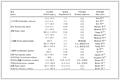
The reaction of a mixture of DyCl3 and amp2H4 in water (pH 2.5) at different temperatures (70, 80, 90 ℃) for 2 days led to single crystals of the targeted compounds Dy-70, Dy-80, and Dy-90 with identical PXRD patterns (Fig. 1a, Figs. S1 and S2 in Supporting information) and IR spectra (Fig. 1b and Fig. S3 in Supporting information). The same reaction at lower (60 ℃) or higher (100, 110 ℃) temperature resulted in the formation of either pale-yellow or brown-yellow powders, with PXRD patterns distinct from Dy-70 (Fig. S2). To determine the degree of de-dimerization of the ligand amp2H22− in these products, we measured the 1H NMR spectra of the samples digested in D2O solution of NaOD (1 mol/L). As shown in Fig. 1c and Figs. S4–S8 (Supporting information), in addition to the signals corresponding to the amp2H22− ligand, other weak signals can be seen in the chemical shift range of 7.5–8.6 ppm, attributed to the de-dimerized anthracene unit. Based on the integrated areas of the two sets of signals, the de-dimerization ratios are estimated to be 1.0% for Dy-70, 2.0% for Dy-80, and 3.7% for Dy-90, respectively (Table 1). Apparently, the dissociation degrees were small even when the reaction temperature was raised to 90 ℃. This may explain why the C—H vibrations of anthracene rings at 1281 and 881 cm−1 cannot be observed in the IR spectra of Dy-70, Dy-80, and Dy-90 (Fig. S3). Thermogravimetric (TG) analysis revealed a two-step weight loss below 170 ℃ for Dy-70, Dy-80, and Dy-90 (Fig. S9 in Supporting information), corresponding to the removal of six water molecules at 30–130 ℃ (obs. 4.9%, calcd. 5.1%) and four water molecules at 150–170 ℃ (obs. 3.4%, calcd. 3.4%).

|
Download:
|
| Fig. 1. (a) The PXRD patterns of Dy-70, Dy-80 and Dy-90. The pattern simulated from the single crystal data of Dy-70 is given for comparison. (b) The IR spectra of Dy-70, Dy-80 and Dy-90 in the range of 400 – 4000 cm−1. (c) The 1H NMR spectra of ampH2, amp2H4, Dy-70, Dy-80 and Dy-90 digested in D2O solution of NaOD (1 mol/L). The inset is an enlarged view of peaks a-f. | |

|
Table 1 The structural and luminescent differences of different samples. |
Single-crystal structural analysis can help provide insight into structural changes. Noting that the structure of Dy-70 was already reported [29], we first determined the single-crystal structures of Dy-90. The structure of Dy-90 is identical to that of Dy-70, except for minor changes in bond lengths and angles (Table S2 in Supporting information). It crystallizes in the triclinic space group P-1 (Table S1 in Supporting information). The asymmetric unit contains one DyⅢ ion, three types of amp2H22− ligands (each sits on a crystallographic inversion center), three coordinated water and two lattice water molecules (Fig. 2a and Fig. S10 in Supporting information). Each DyⅢ is seven-coordinated by four phosphonate oxygen atoms [Dy-O(P): 2.232(3)−2.371(3) Å] and three water molecules [Dy-O(W): 2.364(3)−2.444(3) Å]. The amp2H22− ligands (P1, P2, and P3) serve as either tetradentate (P3) or bidentate (P1, P2) ligands, and each phosphonate group is singly protonated at O3, O6 or O9. The two equivalent DyⅢ ions are bridged by the two O7-P3-O8 units of the P3 ligand to form the {Dy2(O-P-O)2} dimer [Dy···Dy: 5.716 Å] (Table S3 in Supporting information), which is connected to each other in three directions by different amp2H22− ligands to form a 3D framework (Fig. 2c). The shortest Dy···Dy distance between Dy2 dimers is 16.124 Å through the P1 ligand, 14.623 Å through the P2 ligand, and 13.325 Å through the P3 ligand (Table S3). The most significant structural difference is found for the P3 ligand in Dy-90, which is disordered owing to the partial de-dimerization (Fig. 2a). The refined occupancy of the dimerized part P3 and de-dimerized part P3’ is 0.90 and 0.10 (Table 1), respectively. While the P1 and P2 ligands remain the same as that in Dy-70. Apparently, about 3.3% of amp2H22− is de-dimerized in Dy-90, which agrees well with the NMR result (3.7%). The separated anthracene groups of P3’ are engaged in face-to-face π-π interactions, with the plane-to-plane distance between the anthracene rings being 3.35 Å and a center-to-center distance of 3.49 Å (Fig. 2b and Table 1). These distances adhere to Schmidt's rule [31,32] for enabling the [4 + 4] photocycloaddition reaction. In addition, due to the opposite orientations of P3-O9 and P3’-O9’, O9 forms a hydrogen bond with O1 [O9-H…O1, 2.632(4) Å], and O9’ does not (Table S4 in Supporting information).

|
Download:
|
| Fig. 2. The coordination environment of Dy1 in structure Dy-90 (a), Dy-90-UV (d), and Dy-90-re (e). (b) The coordination environment of Dy1 in Dy-90 showing only the dissociated part of the dianthracene ligand P3. (c) The framework structure of Dy-90 viewed along the a-axis. (f) The hydrogen bonding interaction between ligands P1 and P2 in the structure of Dy-90. Symmetry codes: A:x + 1, -y + 1, -z + 1; B:x + 1, -y, -z + 2; C:x + 2, -y + 1, -z; D:x + 1, -y, -z + 1; E: x, y + 1, z; F:x + 2, -y + 1, -z + 1. | |

The structural analyses not only confirmed the partial de-dimerization of amp2H22− in Dy-90 but also raised a question: Why is it the P3 ligand, but not the P1 or P2 ligand, that undergoes partial de-dimerization? In a previous report, we demonstrated by theoretical calculations that the selective dissociation of the dianthracene ligand in a two-dimensional layered compound [Dy(NO3)3(depma2)1.5]·(depma2)0.5 (depma2 = pre-photodimerized 9-diethylphosphonomethylanthracene) is caused by steric hindrance [18]. In the present case, we notice that the ∠C—C-P3 bond angle of the P3 ligand in Dy-90 remains nearly unchanged before and after dissociation (∠C32-C31-P3 = 120.7°, ∠C32’-C31’-P3’ = 120.9°). It means that the phosphonate groups need to adjust their coordination to the Dy atoms by rotating around the C-P bond, as observed by the change in orientation of the P-OH group on the P3 ligand (Fig. 2a). Meanwhile, the P1 and P2 ligands contribute to a more constrained environment by forming intermolecular double hydrogen bonds (O3i-H…O5, 2.571(4) Å; O6-H…O2i, 2.613(4) Å; symmetric code: i, -x + 2, -y + 1, -z + 1) (Fig. 2f and Table S4 in Supporting information), significantly limiting the rotational freedom of the phosphonate groups when de-dimerization of the ligands might occur. These structural features may explain why the P3 ligand is selectively dissociated in Dy-90.
It is noteworthy that we did not observe P3 ligand disorder in the crystal structure of Dy-70 (Fig. S10 in Supporting information), although 1H NMR measurement confirmed that about 1.0% dianthracene in Dy-70 was dissociated. This result suggests that the single-crystal structural analysis is not sensitive to the presence of very small amounts of dissociated dianthracene. Therefore, we also did not perform a single-crystal structure determination of Dy-80.
To examine the effect of partial dissociation of dianthracene ligand on the optical properties of Dy-70, Dy-80, and Dy-90, we measured their solid-state UV–vis diffuse reflectance spectra and photoluminescence (PL) spectra. All show similar UV–vis spectra, as shown in Fig. S11 (Supporting information), with spectral bands at ca. 230–260 nm, 260–300 nm and 300–450 nm attributed to the n → π* and/or π → π* transitions of the amp2H22− ligand, while the weak peaks at 756 and 807 nm are ascribed to the f-f transitions of the DyⅢ ion from 5H15/2 to 6F3/2 and 6F5/2 states [33]. Apparently, there are no significant differences between the UV–vis diffuse reflectance spectra of the three compounds, except for a slight decrease in the intensity of compound Dy-90 in the sub-300 nm bands.
Upon excitation at 372 nm, all three compounds show photoluminescence in the visible region. As shown in Fig. 3a and Fig. S12 (Supporting information), Dy-70 displays three peaks at 423, 445 and 475 nm, which are due to the vibrational manifold of the π* → π transition of dianthracene. Dy-70 also shows a weak shoulder at ca. 550 nm belonging to the excimer of the anthracene pair, although only 1.0% of the dianthracene ligand in this compound is dissociated. Obviously, PL spectrum is very sensitive in detecting the dissociation of small amounts of dianthracene ligands in MOF structures. The emission profiles of Dy-80 and Dy-90 are very similar, showing a strong broad peak at 555 nm, attributed to the excimer emission of the dissociated π-π stacking anthracene rings. The intensities of the three peaks at about 423, 446, and 485 nm are significantly weaker for Dy-80 compared to Dy-70, and nearly invisible for Dy-90. The results indicate that the PL spectrum of the dianthracene-MOF exhibits predominantly excimer emission of anthracene pairs when the dianthracene ligand is only ca. 3.7% dissociated. We also measured the lifetimes of the three samples (Figs. S13–S15 and Table S5 in Supporting information). For the three emission peaks attributed to dianthracene, the lifetimes (τ) are 3.09–5.66 ns, 2.33–8.55 ns and 2.01–6.63 ns for Dy-70, Dy-80 and Dy-90 respectively. For the excimer emission, the lifetimes are 131.67 ns, 111.43 ns, and 83.96 ns for the three compounds, respectively. The quantum yields (QY) are 5.53% for Dy-70, 4.19% for Dy-80 and 4.12% for Dy-90. Based on the τ and QY values, the radiative transition rates (kr) and non-radiative transition rates (knr) can be estimated with the lowest value of kr (ca. 105 s−1) found for the excimer emission peak in all three cases (Table S5).

|
Download:
|
| Fig. 3. (a) The steady state emission spectra for Dy-70, Dy-80, Dy-90, Dy-90-UV and Dy-90-re excited at 372 nm. (b) The change in the PL peak intensities at 446 nm of solid Dy-90 after five cycles of UV irradiation at room temperature, with each cycle lasting for 5 min under UV light at 365 nm and 280 nm, respectively. (c, d) Photoluminescence spectra for Dy-90 as a function of irradiation time upon 365 nm and 280 nm UV light irradiation. Inset: Photographs of Dy-90 crystals irradiated with 365 nm and 280 nm UV light taken under 365 nm UV light. | |

Since single-crystal structural analysis confirmed the presence of a small number of face-to-face π-π interacting anthracene pairs in Dy-90, we envision that they may undergo reversible [4 + 4] photocycloaddition reactions. To test this hypothesis, we have studied the PL spectra of Dy-90 after illumination at 365 nm for different times. When excited by 372 nm UV light, compound Dy-90 exhibits emission peaks at 422, 446, 485 and 555 nm, accompanied by bright yellow fluorescence (Fig. 3a). After 10 s of irradiation under 365 nm UV light, it shows distinct emission peaks at 422, 446, and 485 nm, which are attributed to the dianthracene ligand (Fig. 3c). The intensity of these peaks increases with exposure time, accompanied by the intensity decreasing of the excimer emission peaking at 555 nm (Fig. S16 in Supporting information). After 5 min of illumination, the PL profile no longer changes, indicating that the photocycloaddition of the anthracene pair in Dy-90 may be completed with the formation of Dy-90-UV, which emits blue fluorescence. This process is reversible. If we irradiate Dy-90-UV under 280 nm UV light for 5 min, it regains yellow fluorescence (Fig. 3d). However, the peak intensity at 555 nm is much lower than that of Dy-90, suggesting that exposing Dy-90-UV to 280 nm UV light resulted in a lower amount of dianthracene ligand for de-dimerization. The CIE coordinates were employed to monitor the transition of the emission color change throughout the photoreaction, which changed from (0.366, 0.456) for Dy-90 to (0.167, 0.120) for Dy-90-UV under 365 nm UV light, and then to (0.375, 0.485) for Dy-90-re under 280 nm UV light (Fig. S17 in Supporting information). To further verify the reversibility of the photodimerization/de-dimerization process, we performed five cycles of photoresponse testing on Dy-90. As shown in Fig. 3b and Fig. S18 (Supporting information), the luminescence intensity remained consistent over the five cycles without significant decay.
To ensure the completeness of the photocycloaddition and de-dimerization products, we irradiated Dy-90 with 365 nm UV light for 4 h and obtained the product denoted as Dy-90-UV. We further irradiate the compound Dy-90-UV with 280 nm UV light for 4 h and obtained the product denoted as Dy-90-re. Single-crystal structural analysis revealed that the P3 ligand in Dy-90-UV was ordered without partial de-dimerization (Table 1, Fig. 2d and Fig. S19 in Supporting information). While in Dy-90-re, the P3 ligand was disordered and ca. 1.7% of the total dianthracene ligand was dissociated (Table 1, Fig. 2e and Fig. S19). The 1H NMR spectra confirmed that the proportion of the de-dimerized dianthracene ligands in compounds Dy-90-UV and Dy-90-re was 0 and 2.0%, respectively (Figs. S20 and S21 in Supporting information).
Stimuli-responsive luminescent materials are good candidates for applications in confidential information protection [34-40]. Inspired by the excellent photoresponsive properties of Dy-90, we further explored the potential application of this materials for anti-counterfeiting. We designed a small logo that mimics the new-fashioned anticounterfeiting pattern. Because of its softness and high optical transparency, poly(methyl methacrylate) (PMMA) was chosen as the matrix. The security membrane was prepared via mixing certain amount of Dy-90 in a solution of PMMA and acetone. Typically, 90 mg of PMMA was dissolved in 2 mL of acetone and stirred for 2 h. Then, 10 mg of Dy-90 was added into the above solution and stirred for another 30 min to obtain the Dy-90@PMMA membrane, which is flexible, transparent and shows photoresponsible PL spectra similar to the pristine Dy-90 (Fig. 4a and Fig. S22 in Supporting information). The membrane can be used as a simple encryption device, and then the confidential information can be written into the film by irradiating it with 365 nm UV light through a solid mask (Fig. 4b). The confidential information can be stably stored in the device for at least two months (Fig. S22), and nothing can be observed on the device with the naked eye under natural light. If we want to read the information, it is necessary to irradiate the device with an ultraviolet lamp once again. The yellow sun pattern with a blue background can be observed under 365 nm UV light irradiation. Significantly, the yellow PL of the sun pattern quickly turns blue after seconds and then leaves only the blue background. As a consequence, Dy-90@PMMA membrane could conceal a great number of encrypted messages in the anticounterfeiting field, as they are difficult to detect by the naked eye under visible light and have complex fluorescent properties under different wavelengths of UV irradiation.

|
Download:
|
| Fig. 4. (a) Schematic diagram of photo-responsive Dy-90 as a security membrane anticounterfeiting material and photos to show the flexibility of the membrane. (b) Photos of the PL images applied in encryption. The Al foil was used to make the solid mask required for the experiment. | |

In summary, we report the structural and optical properties of compounds Dy2(ampH)2x(amp2H2)3-x(H2O)6·4H2O, where the degree of dissociation of amp2H22− can be controlled by synthesis temperature. The product obtained at 90 ℃ (Dy-90) was further used to study in detail the photoresponsive changes in its structure and PL properties. The remarkable and reversible photoresponsive PL properties of this material can be further utilized for anti-counterfeiting applications. This work not only elucidates the possible influence of the synthesis temperature on the PL spectra of dianthracene-based compounds, but more importantly provides a generalized method for constructing dianthracene-based photoresponsive materials, which in turn provides a basis for their practical application.
Declaration of interest statementThe authors declare that they have no known competing financial interests or personal relationships that could have appeared to influence the work reported in this paper.
CRediT authorship contribution statementRan Gao: Writing – original draft, Methodology, Investigation, Formal analysis, Data curation. Qian Zou: Investigation, Data curation. Qian-Qian Su: Data curation. Xiu-Fang Ma: Data curation. Ye-Hui Qin: Data curation. Rui Liao: Data curation. Song-Song Bao: Methodology, Formal analysis, Data curation. Li-Min Zheng: Writing – review & editing, Supervision, Project administration, Funding acquisition, Conceptualization.
AcknowledgmentThis work was supported by grants from the National Natural Science Foundation of China (Nos. 22273037, 21731003).
Supplementary materialsSupplementary material associated with this article can be found, in the online version, at doi:10.1016/j.cclet.2024.110404.
| [1] |
X. Zhang, T. Yu, V.K.M. Au, ChemNanoMat 8 (2022) e202100486. DOI:10.1002/cnma.202100486 |
| [2] |
S. Krause, J.D. Evans, V. Bon, et al., Nat. Commun. 13 (2022) 1951. DOI:10.1038/s41467-022-29149-z |
| [3] |
Y.X. Wang, S.R. Yang, G.P. Li, et al., ACS Mater. Lett. 5 (2023) 3074-3079. DOI:10.1021/acsmaterialslett.3c00934 |
| [4] |
A. Hazra, S. Bonakala, S.A. Adalikwu, et al., Inorg. Chem. 60 (2021) 3823-3833. DOI:10.1021/acs.inorgchem.0c03575 |
| [5] |
S. Zhang, Z. Ba, T. Li, et al., Chin. J. Lumin. 44 (2023) 227-239. DOI:10.37188/cjl.20220289 |
| [6] |
Z. Li, F. Jiang, M. Yu, et al., Nat. Commun. 13 (2022) 2142. DOI:10.1007/s11664-022-09441-w |
| [7] |
Z.W. Huang, X.B. Li, L. Mei, et al., Adv. Funct. Mater. 34 (2024) 2404126. DOI:10.1002/adfm.202404126 |
| [8] |
C.X. Guo, X.J. Ma, B. Wang, Acta Chim. Sinica 79 (2021) 967-985. DOI:10.6023/a21040173 |
| [9] |
X.R. Xue, C. Cao, Y. Ge, et al., Inorg. Chem. Front. 10 (2023) 4102-4108. DOI:10.1039/d3qi00748k |
| [10] |
S.S. Adrian, Int. J. Mol. Sci. 23 (2022) 7121. DOI:10.3390/ijms23137121 |
| [11] |
B. Yuan, G. Gou, T. Fan, et al., Angew. Chem. Int. Ed. 61 (2022) e202204568. DOI:10.1002/anie.202204568 |
| [12] |
T. Qian, C. Zhao, R. Wang, et al., Nanoscale 13 (2021) 17396-17403. DOI:10.1039/d1nr04595d |
| [13] |
H.Q. Zheng, Y. Yang, Z. Wang, et al., Adv. Mater. 35 (2023) 2300177. DOI:10.1002/adma.202300177 |
| [14] |
Z.X. You, C. Wang, Y. Xiao, et al., Chem. Eur. J. 27 (2021) 9605-9619. DOI:10.1002/chem.202100588 |
| [15] |
J.R. Zhang, H.Y. Zhang, J.H. Guo, et al., Dalton Trans. 51 (2022) 1769-1774. DOI:10.1039/d1dt04077d |
| [16] |
T.L. Ren, X.N. Zhang, J.J. Hu, et al., Dalton Trans. 51 (2022) 14858-14864. DOI:10.1039/d2dt02632e |
| [17] |
Y.J. Zhao, W.Q. Tang, X.W. Wang, et al., Chem. Sci. 13 (2022) 11896-11903. DOI:10.1039/d2sc03923k |
| [18] |
X.D. Huang, B.K. Hong, G.H. Wen, et al., Chem. Sci. 14 (2023) 1852-1860. DOI:10.1039/d2sc06732c |
| [19] |
M. Tu, H. Reinsch, S. Rodríguez–Hermida, et al., Angew. Chem. Int. Ed. 58 (2019) 2423-2427. DOI:10.1002/anie.201813996 |
| [20] |
Y.J. Ma, G. Xiao, X. Fang, et al., Angew. Chem. Int. Ed. 62 (2023) e202217054. DOI:10.1002/anie.202217054 |
| [21] |
X.D. Huang, X.F. Ma, L.M. Zheng, Angew. Chem. Int. Ed. 62 (2023) e202300088. DOI:10.1002/anie.202300088 |
| [22] |
X.D. Huang, Y. Xu, K. Fan, et al., Angew. Chem. Int. Ed. 57 (2018) 8577-8581. DOI:10.1002/anie.201804102 |
| [23] |
X.F. Ma, X.D. Huang, L.M. Zheng, Cryst. Grow Des. 23 (2023) 1095-1103. DOI:10.1021/acs.cgd.2c01249 |
| [24] |
X.F. Ma, Y. Guo, X.D. Huang, et al., Dalton Trans. 51 (2022) 12026-12030. DOI:10.1039/d2dt01710e |
| [25] |
X.D. Huang, X.F. Ma, T. Shang, et al., Inorg. Chem. 62 (2023) 1864-1874. DOI:10.1021/acs.inorgchem.2c01210 |
| [26] |
G. Collet, T. Lathion, C. Besnard, et al., J. Am. Chem. Soc. 140 (2018) 10820-10828. DOI:10.1021/jacs.8b05047 |
| [27] |
Q. Zou, T. Shang, X.D. Huang, et al., J. Mater. Chem. C 9 (2021) 10749-10758. DOI:10.1039/d1tc01027a |
| [28] |
Q. Zou, S.S. Bao, X.D. Huang, et al., Chem. Asian J. 16 (2021) 1456-1465. DOI:10.1002/asia.202100283 |
| [29] |
Q. Zou, G.L. Wang, Y.Q. Chen, et al., Chem. Eur. J. 29 (2023) e202203454. DOI:10.1002/chem.202203454 |
| [30] |
Y.P. Qu, Q. Zou, S.S. Bao, et al., Chin. Chem. Lett. 35 (2024) 108320. DOI:10.1016/j.cclet.2023.108320 |
| [31] |
E. Heller, G.M.J. Schmidt, Isr. J. Chem. 9 (1971) 449-462. DOI:10.1002/ijch.197100061 |
| [32] |
I. Zouev, D.K. Cao, T.V. Sreevidya, et al., CrystEngComm 13 (2011) 4376-4381. DOI:10.1039/c0ce00739k |
| [33] |
K.B. Yatsimirskii, N.K. Davidenko, Coord. Chem. Rev. 27 (1979) 223-273. DOI:10.1016/S0010-8545(00)82068-8 |
| [34] |
H. Zhou, J. Han, J. Cuan, et al., Chem. Eng. J. 431 (2022) 134170. DOI:10.1016/j.cej.2021.134170 |
| [35] |
Y. Wang, H. Li, X. He, et al., Inorg. Chem. 60 (2021) 15001-15009. DOI:10.1021/acs.inorgchem.1c02455 |
| [36] |
X.F. Jiang, S.D. Han, A.N. Wang, et al., Chem. Eur. J. 27 (2020) 1410-1415. DOI:10.1145/3368089.3417054 |
| [37] |
Z. Li, G. Wang, Y. Ye, et al., Angew. Chem. Int. Ed. 58 (2019) 18025-18031. DOI:10.1002/anie.201910467 |
| [38] |
C. Xing, Z. Qi, B. Zhou, et al., Angew. Chem. Int. Ed. 63 (2024) e202402634. DOI:10.1002/anie.202402634 |
| [39] |
C. Xing, B. Zhou, D. Yan, et al., CCS Chem. 5 (2023) 2866-2876. DOI:10.31635/ccschem.023.202202605 |
| [40] |
C. Xing, B. Zhou, D. Yan, et al., Adv. Sci. 11 (2024) 2310262. DOI:10.1002/advs.202310262 |