 2025, Vol. 36


b Jiangxi Key Laboratory for Mass Spectrometry and Instrumentation, East China University of Technology, Nanchang 330013, China;
c State Key Laboratory of Inorganic Synthesis and Preparative Chemistry, College of Chemistry, Jilin University, Changchun 130012, China;
d Jilin Ginseng Academy, Changchun University of Chinese Medicine, Changchun 130017, China
Copper wire is a kind of metal wire made of pure copper or copper alloy, widely used in electronics, electrical, construction, transportation, chemical, textile and other fields. Copper wire has the characteristics of good conductivity, excellent thermal conductivity, strong ductility, corrosion resistance, and easy processing. With the development of the microelectronics industry, there is an increasing demand for various materials with wire diameters in the micro and nano scales. Due to the excellent optoelectronic properties and relatively low price, micro/nano level copper wires are widely used in modern industrial production and daily life products [1-4].
In addition to product purity, the performance and price of copper based micro linear products often depend on the length of the product (the longer the better, generally ≥ 10 km), wire diameter, and wire diameter uniformity (the more uniform the better). For example, for products with wire diameters ranging from 0.05 mm to 0.1 mm, the allowable deviation is ±0.003 mm (high precision level) to ±0.004 mm (ordinary level) [5]. In the actual copper wire production process of enterprises, various reasons such as unstable tension on the storage wire wheel, vibration of copper wire on the annealing wheel, and wear caused by long-term use of the main motor gearbox may cause uneven diameter of the same copper wire.
At present, the main method for measuring the diameter of metal wires was optical microscopy (OM) [6-8]. However, the OM method only measures along the size of the cross-section. If the cross-section of the copper wire is uneven and this unevenness is not reflected by changes in the maximum diameter, then OM methods cannot accurately measure the variations in the copper wire. Scanning electron microscopy (SEM) [9-11], transmission electron microscopy (TEM) [12,13], low-temperature nitrogen adsorption (BET) [14,15], were also used to measure the diameter of the copper wire. However, these detection techniques often require complex and tedious operations, and often demand the cutting of copper wires, resulting in the loss of trading attributes of products. Therefore, it is necessary to develop a new method that can accurately detect the wire diameter of long-length copper based micro linear products without wire cutting or damage.
Herein a novel strategy was proposed for online detection of the average diameter at any segment of given length using a homemade Z-type device coupled to extractive electrospray ionization mass spectrometry (EESI-MS) [16-19]. Molecular ligands with moderate affinity for copper have been utilized as adsorbents to facilitate rapid adsorption/desorption processes, while also exhibiting high proton affinity (e.g., arginine, PA=1051.0 kJ/mol) to ensure enhanced mass detection sensitivity. After reaching adsorption equilibrium, the amount of adsorbent on the surface of the copper wire can be detected by EESI-MS after elution with an appropriate eluent (e.g., ammonia), which can be further used to calculated the area of this segment copper wire due to they are linearly dependent. Subsequently, the average line diameter within a specified length can be obtained based on the calculated area of the copper wire [20-23]. This method has the following advantages: (1) Nondestructive. This method necessitates neither the severance of the copper wire nor any compromise to the inherent characteristics of the product. (2) Universality. This method is applicable to a wide range of metal wire, featuring straightforward operation, high efficiency, and cost-effectiveness [24,25]. (3) High sensitivity. The detectable average diameter ranged from micrometers to millimeters, with a limit of detection (LOD) of 2.5 µm and a relative standard deviation ranging from 1.10% to 2.81%.
A home-made Z-type device was first prepared (Figs. 1a-c), which consisted of four parts: (1) Silicone pad; (2) Supporting base. A airtight sample chamber was formed between silicone pad and supporting base. During the analysis, the copper wire was placed within the sample chamber and sealed by the silicone pad; (3) Connector. This part was used to introduce and expel the adsorbents and eluents; (4) Locker. The function of this component is to secure the device and enclose the copper wire within the sample chamber once it has been loaded. The detailed parameter of the device was displayed in Fig. 1c. The silicon pad can be adjusted based on the approximate diameter of the copper wire in order to establish a tight seal between the silicon and copper wire. As shown in Fig. 1d, the analytical device for non-destructive detection of the average diameter of copper wire was constructed by equipped the Z-type device on the EESI-MS.

|
Download:
|
| Fig. 1. Schematic illustration of the device for non-destructive detection of the average diameter of micro copper wires. (a) Overview of the Z-type device. (b) Explosive view of the Z-type device. (c) Sectional view of the overview. (d) The Z-type device coupled on EESI-MS for analysis of the average diameter of a segment randomly selected along a long-length copper wire. | |

The mathematical principle for analysis of the average diameter of copper wire by mass spectrometry was deduce as follows:
(1) As we can see from the analytical device in Fig. 1d, the area (S) contact with the adsorbent and eluent is:
| $ \mathrm{S}=\pi d l $ | (1) |
where “d” is the diameter of the copper wire, “l” is the given length of the copper wire for analysis (Fig. 2a). As shown in Fig. 1c, l = 4 cm.

|
Download:
|
| Fig. 2. Mathematical principle and typical spectrum obtained by using the Z-type device coupled for online EESI-MS detection of the average diameter of a copper wire. (a) A segment of thin copper wire with ideal cylindrical shape. (b) EESI-MS spectrum and tandem mass spectrum of arginine. (c) EIC of the fragment peak of arginine (m/z 130) during the elution process. R. A. is the abbreviation of relative abundance. | |

(2) According to the manual, arginine can adsorb on the copper wire using the amino end, and the adsorption amount (A) is positive correlation to the area after reach a adsorption equilibrium.
| $ A=k S=k \pi d l $ | (2) |
This formula indicates that the amount of arginine adsorbed on the copper wire is positively related to the average diameter of the copper wire.
(3) The amount of arginine adsorbed on the copper wire can be determined by liberating the arginine from the copper wire using an appropriate eluent for online EESI-MS detection.
Thus, after established a calibration curve between the "A" and "d" by using a serials of copper wire with known diameter, the diameter of a random copper can be obtained based on this calibration curve and the corresponding MS results of adsorbed arginine.
After established the analytical principle, a typical analytical procedure for measuring the diameter was carried out using a copper wire with known diameter of 0.4 mm. Copper wire was initially loaded into the Z-type device and then equipped onto the EESI-MS system. Subsequently, arginine solution was introduced into the Z-type device until it reached full capacity, and then allowed to remain stationary for a period of time to achieve adsorption equilibrium on the copper wire. Following this step, arginine was removed from the Z-type device, and H2O was used for thorough washing of the device to eliminate any physical residual arginine. Finally, ammonia solution was utilized to elute the arginine that had been adsorbed on the copper wire. Note that, to eliminate the oxidation caused by the ionization voltage, EESI was employed instead of ESI for online detection of the eluates herein, which segregated the ionization voltage from the copper wire [26]. The EESI-MS spectrum was depicted in Fig. 2b, demonstrating the sensitive detection of protonated arginine molecules (m/z 175) due to its high proton affinity (PA = 1051.0 kJ/mol). Tandem mass spectrometry was used to confirm the protonated arginine (m/z 175). In the MS/MS spectrum (inset of Fig. 2b), protonated molecular ions (m/z 175) lose fragments with M = 17 (NH3) and M = 18 (H2O), producing peaks at m/z 158 and m/z 157, respectively. Competitively, [M + H]+ can also lose M = 45 (NH3 + CO) and M = 59 (NH═C(NH2)), yielding the fragments of m/z 130 and m/z 116; and the fragment ion peak of m/z 116 further lost M = 46 (H2O + CO) fragments to produce the peak of m/z 70. These data confirm that the arginine was successfully detected.
Condition optimization experiments were conducted to enhance the analytical performance. As depicted in Fig. S1 (Supporting information), it was observed that a sustained adsorption process of arginine on the copper surface occurred during the incubation process when the concentration of arginine was low (e.g., 100 mg/L). The low concentration of arginine required >30 min to complete the adsorption. Therefore, to shorten the adsorption equilibrium time, saturated arginine was used and the incubation time was about 10 min (Fig. S2a in Supporting information). In order to improve the sensitivity of EESI-MS, the experimental parameters such as concentration and flow rate of eluent ammonia, electrospray voltage, distance between the sprayer tip and mass spectrometer inlet, and temperature of ion transfer tube were systematically optimized. Figs. S2b-f (Supporting information) showed the optimal condition for detection of the arginine adsorbed on copper wire. The concentration of ammonia was 15% and the flow rate was 10 µL/min; the electrospray voltage was 4.0 kV. Distance between the sprayer tip and mass spectrometer inlet was 2.0 mm. The temperature of the ion transfer tube was 350 ℃. Fig. 2c displayed the extractive ion chromatogram (EIC) of the fragment peak of arginine (m/z 130) during the elution process, which demonstrated that the arginine was eluted quickly and thoroughly.
Under the optimized conditions, 6 standard solutions of arginine with mass concentration gradients of 1, 2, 5, 10, 25, and 50 µg/L were experimentally tested to make the calibration curve, for which the characteristic fragment ion of m/z 130 derived from the protonated arginine (m/z 175) was selected as the signal for quantitative analysis. The horizontal axis represents the mass concentration of arginine standard solution, and the vertical axis represents the MS signal intensity of the target ion (m/z 130). The quantitative curve was plotted as shown in Fig. 3a, and the regression equation was y = 50.4379x + 63.9661. The results demonstrated that arginine showed linear responses in the range of 1–50 µg/L, with a linear correlation coefficient R2 of 0.9968. When the signal-to-noise ratio (S/N) was 3, according to LOD = 3σ/k [27-28], the detection limit was calculated to be 0.17 µg/L, where “σ” was the standard deviation, “k” represents the slope of the standard curve. When the S/N was 10, according to limit of quantification detection (LQD) = 10σ/k [14], the calculated limit of quantification was 0.58 µg/L.

|
Download:
|
| Fig. 3. Calibration curves obtained by the present method. (a) Intensity of arginine vs. the concentration of arginine. (b) Intensity of the adsorbed arginine vs. the diameter of the copper wires (n = 5). | |

Micro copper wires with various diameters (0.020, 0.030, 0.06, 0.25, 0.40 mm) were subjected to EESI-MS analysis with a given length of 4 cm to establish calibration curves correlating the wire diameter with the amount of adsorbed arginine. The secondary characteristic fragment ion m/z 130 derived from arginine (m/z 175) was used as the signal for quantitative analysis. The horizontal axis represents the diameter of the copper wire, and the vertical axis represents the absolute signal strength of the target ion. The curve was plotted as shown in Fig. 3b. The regression equation was y = 3274.7349x + 328.8561. The results showed that there was a good linear relationship between the diameter of copper wires and the amount of arginine adsorbed on their surface, with a linear correlation coefficient R2 of 0.9945. When the S/N was 3, according to LOD = 3σ/k, the detection limit of the average diameter was calculated to be 0.0025 mm. Note that, according to the format of A = kS = kπdl, if the LOD of arginine is defined, the LOD of diameter will decrease with the increase of the given length. For example, if the given length increased from 4 cm to 8 cm, the LOD of the diameter will decrease from 0.0025 mm to 0.00125 mm. When the S/N was 10, according to LQD = 10σ/k, the quantification limit was calculated to be 0.0083 mm.
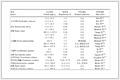
SEM has been regarded as the gold standard method for measuring the diameter of copper wire due to its unparalleled accuracy [29,30]. Therefore, SEM was employed to validate the performance of the present method. Three actual copper wire samples, coded as samples-1, sample-2, sample-3, were measured by SEM and the present method parallelly. The experimental results were listed in Table 1, confirming that this method was able to accurately measure the average diameter of micro copper wires. It is worth noting that the relative standard deviation (RSD) values for SEM are generally higher than those of the present method (Table 1). This can be attributed to the nonuniform diameter of the copper wire, where the present method provides an averaged measurement while SEM only captures point measurements. For example, if there is a slight protrusion in the Z-axis direction, it can significantly increase its surface area, but the projection of its xy plane would not change much. For such situations, traditional microimaging methods (e.g., OM, SEM) may not be competent, while our method can detect surface changes in any direction with high sensitivity. Moreover, the present method calculates the average diameter of metal wires based on the linear relationship between the surface area of the metal wire and the saturation adsorption capacity of the adsorbent on its surface, which has wide applicability. As long as a suitable adsorbent is selected, this method can be used to analyze various metal wires.
|
Table 1 Analytical results of three actual copper wire samples obtained by EESI-MS and SEM. |
According to the standard of GB/T 1652–2017, the allowable deviation for copper wires with diameters ranging from 0.05 mm to 0.1 mm is ±0.003 mm for high-precision level or ±0.004 mm for ordinary level in the industry. In this method, the deviation of the measurement of copper wire diameter can be calculated according to the detection limit (LOD = 0.17 µg/L) and the RSD (1.10%−2.81%) of arginine, and the results were shown in Table S1 (Supporting information), which indicated that the accuracy of this method in detecting copper wire diameter is significantly higher than the accuracy requirements of the Chinese national standard [5].
Besides, the properties of copper wire were systematically characterized after analysis, including surface oxidation resistance, corrosion resistance, mechanical properties, electrical properties, and internal microstructure. Electrochemistry [31] was employed to characterize the oxidation resistance and corrosion resistance. The cyclic voltammogram of copper wire before and after analysis were shown in Fig. S3 (Supporting information). It can be observed that the intensity of oxidation current and oxidation potential in the copper wire remained almost unchanged before and after EESI-MS analysis, indicating that the oxidation resistance and corrosion resistance were not affected by the analysis. SEM was used to examine the structure of copper (Fig. S4 in Supporting information), which revealed that there was no discernible alteration on the surface structure of copper wire after EESI-MS analysis. The results from electrochemical tests and SEM indicated that both chemical and physical properties remained unaltered following EESI-MS analysis, which further suggest that neither mechanical nor electrical properties were affected.
In conclusion, this paper presents a novel method for measuring the average diameter of long copper wires using a self-developed Z-type device to elute arginine from the wire surface. The arginine-containing eluent is then analyzed on-line using EESI-MS. This technique allows for accurate measurement of the copper wire diameter based on the arginine signal. Experimental results demonstrate that the sample analysis can be completed within 15 min, with a strong linear correlation between the copper wire diameters and arginine adsorption capacity. The accuracy of this method for detecting copper wire diameters significantly exceeds the requirements of the Chinese national standard. Additionally, it is capable of measuring the average diameter of various metal wires, providing a practical solution for manufacturers to accurately measure the diameter of long metal wire products.
Declaration of competing interestThe authors declare that they have no known competing financial interests or personal relationships that could have appeared to influence the work reported in this paper.
CRediT authorship contribution statementRui Su: Writing – original draft. Xiaowei Fang: Methodology. Peng Zeng: Methodology. Yong Qian: Writing – review & editing. Xuanzhu Li: Writing – original draft. Huiyu Xing: Methodology. Jiamei Lin: Writing – original draft. Jiaquan Xu: Supervision.
AcknowledgmentsThis work was supported by the National Natural Science Foundation of China (No. 22422402), National Key Research and Development Program of China (No. 2022YFF0705300), Key Research and Development Program of Jiangxi Province (No. 20232BBG70004).
Supplementary materialsSupplementary material associated with this article can be found, in the online version, at doi:10.1016/j.cclet.2024.110748.
| [1] |
K. Osipovich, A. Vorontsov, A. Chumaevskii, et al., Materials 15 (2022) 814. DOI:10.3390/ma15030814 |
| [2] |
Z. Li, Q. Lin, Y. Li, et al., Polymers 14 (2022) 4766. DOI:10.3390/polym14214766 |
| [3] |
J. Mostaghimi, L. Pershin, H. Salimijazi, M. Nejad, M. Ringuette, J. Therm. Spray. Tech. 30 (2021) 25-39. DOI:10.1007/s11666-021-01161-7 |
| [4] |
D. Tomotoshi, H. Kawasaki, Nanomaterials 10 (2020) 1689. DOI:10.3390/nano10091689 |
| [5] |
GB/T 21652-2017Copper and Copper Alloy Wire, Standards Press of China, Beijing, 2017.
|
| [6] |
A. Alexandrov, T. Asada, L.G. De, et al., Sci. Rep. 10 (2020) 18773. DOI:10.1038/s41598-020-75883-z |
| [7] |
J.F. Berret, Nat. Commun. 7 (2016) 10134. DOI:10.1038/ncomms10134 |
| [8] |
S.A. Khodier, Optics. Laser. Tech. 36 (2004) 63-67. DOI:10.1016/S0030-3992(03)00134-8 |
| [9] |
J. Ma, Y. Sun, R. Zan, J. Ni, X. Zhang, Mater. Sci. Eng. C Mater. Biol. Appl. 109 (2020) 110520. DOI:10.1016/j.msec.2019.110520 |
| [10] |
N. Aguiló-Aguayo, R. Amade, S. Hussain, E. Bertran, T. Bechtold, Nanomaterials 7 (2017) 438. DOI:10.3390/nano7120438 |
| [11] |
N.A. Hotaling, K. Bharti, H. Kriel, C.G.J. Simon, Biomaterials 61 (2015) 327-338. DOI:10.1016/j.biomaterials.2015.05.015 |
| [12] |
K. Morita, M. Takenaka, K. Tomita, et al., Cellulose 30 (2023) 11357-11367. DOI:10.1007/s10570-023-05514-z |
| [13] |
H. Muramatsu, T. Kambe, T. Tsukamoto, T. Imaoka, K. Yamamoto, Molecule 27 (2022) 3398. DOI:10.3390/molecules27113398 |
| [14] |
R. Vasiliev, D. Kurtina, N. Udalova, et al., Materials 15 (2022) 8213. DOI:10.3390/ma15228213 |
| [15] |
S. Pradhan, J. Hedberg, J. Rosenqvist, et al., PLoS One 13 (2018) e0192553. DOI:10.1371/journal.pone.0192553 |
| [16] |
J. Xu, Z. Yu, T. Li, et al., J. Am. Soc. Mass Spectrom. 34 (2023) 1342-1348. DOI:10.1021/jasms.3c00043 |
| [17] |
H. Lu, H. Zhang, W. Zhou, H. Chen, Analyst 146 (2021) 5675-5681. DOI:10.1039/d1an00871d |
| [18] |
M. Qin, Y. Qian, L. Huang, et al., Front. Pharmacol. 14 (2023) 1110900. DOI:10.3389/fphar.2023.1110900 |
| [19] |
H. Zhang, H.Y. Lu, K.K. Huang, et al., Analyst 145 (2020) 7330-7339. DOI:10.1039/d0an01204a |
| [20] |
A. Liu, W. Kou, H. Zhang, et al., Anal. Chem. 92 (2020) 4137-4145. DOI:10.1021/acs.analchem.0c00304 |
| [21] |
S. Wang, F. Li, Y. Liu, H. Zhao, H. Chen, Anal. Bioanal. Chem. 411 (2019) 4049-4054. DOI:10.1007/s00216-018-1520-x |
| [22] |
K.D. Swanson, S.E. Spencer, G.L. Glish, J. Am. Soc. Mass Spectrom. 28 (2017) 1030-1035. DOI:10.1007/s13361-016-1546-2 |
| [23] |
S. Pan, Y. Tian, M. Li, et al., Sci. Rep. 5 (2015) 8725. DOI:10.1038/srep08725 |
| [24] |
H. Gu, N. Xu, H. Chen, Anal. Bioanal. Chem. 403 (2012) 2145-2153. DOI:10.1007/s00216-012-5874-1 |
| [25] |
W.S. Law, R. Wang, B. Hu, et al., Anal. Chem. 82 (2010) 4494-4500. DOI:10.1021/ac100390t |
| [26] |
H. Chen, R. Zenobi, Nat. Protoc. 3 (2008) 1467-1475. DOI:10.1038/nprot.2008.109 |
| [27] |
J.Q. Xu, T. Li, Z.D. Yu, et al., Chin. Chem. Lett. 35 (2024) 108578. DOI:10.1016/j.cclet.2023.108578 |
| [28] |
J.Q. Xu, F.L. Li, F. Xia, et al., Sci. China Chem. 64 (2021) 642-649. DOI:10.1007/s11426-020-9928-6 |
| [29] |
S. Henning, R. Adhikari, Scanning electron microscopy, ESEM, and X-ray microanalysis, in: S. Thomas, R. Thomas, A.K. Zachari-ah, R.K. Mishra (Eds.), Microscopy Methods in Nanomaterials Characterization, Elsevier, 2017, pp. 1–30.
|
| [30] |
D.K. Bowen, C.R. Hall, Scanning electron microscopy, in: D.K. Bowen, C.R. Hall (Eds.), Microscopy of Materials, Red Globe Press, London, 1975, pp. 13–67.
|
| [31] |
L. Song, J. Xu, D. Zhong, et al., Analyst 144 (2019) 3505-3510. DOI:10.1039/c8an02472c |