 2025, Vol. 36


Amines constitute an important and vast class of organic compounds, which range from bioactive compounds to organic functional materials [1-3]. The literature data reveals that 82% of the top 200 small molecule prescription medicines by 2022 global sales contain at least an amine moiety or a nitrogen-containing heterocycle [4]. Recently, the transition-metal-catalyzed C–H functionalization of amines using transient directing groups (TDGs) has offered a direct and facile avenue to afford various amine derivatives, which has attracted great attention due to circumventing the additional steps needed for the installation and removal of covalent directing groups [5-7]. During the past decade, most attention has been paid to developing TDG-directed C–H functionalization of free amines using precious 4d and 5d transition metal-based catalysts like palladium [8-15] and iridium [16]. The precious 4d and 5d transition metals are effective as catalytic systems and often furnish good results, but their expense, toxicity, and low natural abundance prevent them from achieving ideality. Nickel, as a 3d transition metal, is showing great potential for C–H bond functionalization because of its comparatively low cost, low toxicity, and easy availability in the earth's crust. Great progress has been made in developing nickel-catalyzed C−H functionalization of carboxylic acid derivatives using amide-bound directing groups [17-21]. However, to date, only a few examples of nickel-catalyzed C–H functionalization of amines using covalent directing groups have been reported, and the substrates are limited to anilines (Scheme 1a). Ackermann's group reported the nickel-catalyzed C–H alkyne annulation, alkylation, alkynylation, and chalcogenation of anilines using 2-pyrimidyl (2-pym) or purinyl as directing groups [22-26]. The combination of a TDG and a nickel catalyst for C–H functionalization of free amines is highly desirable but has not been reported to the best of our knowledge.

|
Download:
|
| Scheme 1. Strategies for Ni-catalyzed C–H functionalization of amines. | |
The prevalence of alkynes in natural products, medicinal targets, and functional materials has motivated tremendous efforts directed toward the synthesis of these fundamental building blocks. Hence, the direct alkynylation of unactivated C–H bonds with alkynyl halides or pseudohalides has attracted much attention [16, 27-29]. Meanwhile, the development of efficient methods for directed C(sp2)–H functionalization of benzylic compounds is also highly desirable due to the ubiquitous C(sp2)–H moiety in pharmaceutical scaffolds [30-34]. Herein, we describe a novel method for TDG-directed ortho-selective nickel-catalyzed C(sp2)–H alkynylation of free benzylamines, which is enabled by the use of 2, 4, 6-trimethylpyridine ligand to achieve good yields of the alkynylated products (Scheme 1b).
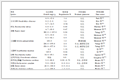
We commenced our investigation of nickel-catalyzed C(sp2)–H alkynylation of 2-phenylpropan-2-amine 1a with TIPS-protected bromoalkyne 2a with an initial focus on TDG screening. The reactions could not afford any products with glyoxylic acid (TDG1) and phenylglyoxylic acid (TDG2) respectively (Table 1, entries 1 and 2). We found that trace amounts of alkynylated product 3a were detected using quinoline-8-carbaldehyde as a TDG (Table 1, entry 3). Changing to 2-hydroxynicotinaldehyde (TDG4), the yield increased to 18% (Table 1, entry 4). Compared with TDG4, the yield dramatically increased to 35% using 2-hydroxybenzaldehyde (TDG5) (Table 1, entry 5). Attempting to use 2-hydroxybenzaldehyde with different substituents failed to yield better than TDG5 (Table 1, entries 6–9). In the reported literature on nickel-catalyzed C–H functionalizations, a catalyst-stabilizing ligand is crucial to achieving good yields of products [22-26, 35]. Therefore, we next examined the effect of ligands. Unfortunately, L1 (DtBEDA) and L2 (dppf) previously employed for nickel-catalyzed C–H functionalization of amines directed by covalent DGs proved less effective in our reaction, indicating that the bidentate ligand is not suitable when using TDG5 (Table 1, entries 11 and 12). In contrast, the use of monodentate ligands, such as triphenylphosphane (L3) and diethylamine (L4), gave increased yields (Table 1, entries 13 and 14). Pyridine-based ligands were then investigated. The results showed that the yields were decreased using pyridine with electron-withdrawing groups (Table 1, entries 16–18), but using pyridine with electron-donating groups gave dramatically increased yields (Table 1, entries 19–21). Among a variety of ligands, monodentate L10 proved to be optimal (Table 1, entry 20). Using several other representative ligands (L12–L18) did not further enhance the reaction efficiency (Table 1, entries 22–28). Attempting to use other NiⅡ precursors gave a poor yield of 3a (Table 1, entries 29–31). Screening of solvents revealed that toluene was the best choice (Table 1, entries 32–36). Lowering the temperature to 120 ℃ decreased the yield to 43% (Table 1, entry 37).
|
Table 1 Optimization of the reaction conditions.a |


With the optimized conditions in hand, the substrate scope was subsequently examined Scheme 2. Reactions of α, α-dimethylbenzylamines bearing halides including fluoride, chloride, and bromide on the ortho, meta, and para-position of the benzene ring with TIPS-protected bromoalkyne went quite well, giving the corresponding products 3b–3i in moderate to good yields. Functional groups including methyl, ethyl, and phenyl groups are well tolerated, affording the desired products 3j–3n in good yields. Electron-rich (R1= OCH3) and electron-poor (R1 = OCF3) groups were also compatible and furnished the desired products in good yields (3o–3q). Besides, 2-(naphthalen-2-yl)propan-2-amine proceeded smoothly to generate the β-alkynylated product 3r in a good yield. Notably, excellent regioselectivity in favor of the less hindered ortho-C–H bonds was observed with meta-substituted substrates (3c, 3f, 3i, 3j, 3m, 3o, 3r). Pleasingly, the substrates containing heterocycles such as pyridine, furan, thiophene, benzo-1, 4-dioxane also afforded the corresponding products 3s–3v in moderate to good yields.

|
Download:
|
| Scheme 2. Substrate scope. The reactions were performed by using 1 (0.3 mmol), 2 (0.6 mmol), NiCl2 (10 mol%), TDG5 (50 mol%), L10 (20 mol%), Na2CO3 (0.6 mmol) in toluene (2 mL) at 140 ℃ under Ar atmosphere for 24 h. Isolated yield. a TIPS-protected ethynyl iodide was used as the coupling partner. | |

Next, the scope of benzylamines with different substituents at the α-position was examined. The benzylamine without any substituent at the α-position was unreactive. The reaction of benzylamines bearing one or two substituents at the α-position yielded the desired products 3x–3ab in 32%–77% yields. These results indicate that the substituents at α-carbon were essential for the reactivity of benzylamines, which may facilitate the formation of five-membered-ring cyclonickelated intermediates [36]. Arylcycloalkylamines are the core structure of numerous biologically and pharmacologically active molecules. For example, arylcyclohexylamine compounds such as ketamine, phencyclidine, and eticyclidine derivatives are well-known psychoactive substances [37]. Therefore, the alkynylation of arylcycloalkylamines was tested. To our delight, the alkynylation of arylcyclobutylamines, arylcyclopentylamines, and arylcyclohexylamines worked well under the standard conditions, providing the corresponding products 3ac–3aj in moderate to good yields (36%–70%). The reaction also proceeded smoothly when using tetrahydropyranyl compound 1ak, affording the desired product 3ak in 68% yield. We found that no dialkynylated products were formed in all reactions. The presence of α-substituents may provide sufficient steric hindrance to induce monoselectivity.
We then further investigated the scope of alkynyl halides. The amine 1a coupled with TIPS-protected ethynyl iodide to afford the desired alkynylated product 3a in 63% yield. The TIPS group replaced by the less sterically demanding TES group could still give a moderate yield (3al, 42%). Other groups (R4 = TPS, Ph, and tBu) were also compatible but resulted in lower yields.
To gain insight into the mechanism of our reaction, a series of mechanistic experiments were performed (Scheme 3). First, radical inhibition experiments were implemented. We found that radical scavengers such as 2, 2, 6, 6-tetramethyl-1-piperidinyloxy (TEMPO), butylated hydroxytoluene (BHT), and 1, 1-diphenylethylene (DPE) did not affect the reaction efficiency under optimized conditions (Scheme 3a). These results suggested that the reaction may not involve a radical process. Further, to obtain more insight into the C–H activation step, the initial rates of the reaction for substrates 1a and [D]−1a were determined, and a kinetic isotope effect of kH/kD = 2.4 was calculated (Scheme 3b), which indicates that C–H nickelation is kinetically relevant. To demonstrate the role of TDG5, the aldimine (Ⅰ) was synthesized and then coupled with 2a under standard conditions without TDG5 (Scheme 3c). The ortho-alkynylation of Ⅰ took place to produce 3a in a 70% isolated yield after hydrolysis. In the case of 1a, however, no ortho-alkynylated product was obtained under the same reaction conditions.

|
Download:
|
| Scheme 3. Mechanistic experiments. | |

Based on the mechanistic investigations and previous reports [38-40], a plausible Ni(Ⅱ)/Ni(Ⅳ) catalytic cycle is proposed for this reaction (Scheme 4). The TDG5 first condenses with the amine 1a and forms the imine intermediate Ⅰ. Coordination and deprotonation of the amine Ⅰ by Ni(Ⅱ) give the intermediate Ⅱ, which undergoes C(sp2)–H activation delivering the nickelacycle species Ⅲ. Subsequent oxidative addition of TIPS-protected bromoalkyne yields the Ni(Ⅳ) species Ⅳ, which undergoes reductive elimination to give intermediate Ⅴ. A protonation step releases the alkynylated imine Ⅵ and regenerates the Ni(Ⅱ) catalyst.

|
Download:
|
| Scheme 4. Possible mechanism. | |

In summary, we have developed a nickel-catalyzed ortho-C(sp2)–H alkynylation of free α-substituted benzylamines enabled by a transient directing group and promoted by a pyridine ligand. The combination of a TDG with a nickel catalyst improves the reaction step and atom economy. This catalytic system works well with benzylamines bearing different substituents. This method provides an efficient and selective route for synthesizing the alkynylated unprotected benzylamines. Further development of TDG-directed nickel-catalyzed C–H functionalization of free amines is under investigation in our laboratory and will be reported in due course.
Declaration of competing interestThe authors declare that they have no known competing financial interests or personal relationships that could have appeared to influence the work reported in this paper.
CRediT authorship contribution statementXinghao Cai: Writing – review & editing, Writing – original draft, Software, Methodology, Investigation. Chen Ma: Software. Ying Kang: Funding acquisition. Yuqiang Ren: Validation. Xue Meng: Methodology. Wei Lu: Validation. Shiming Fan: Writing – review & editing, Writing – original draft, Software, Resources, Methodology, Investigation, Funding acquisition, Data curation, Conceptualization. Shouxin Liu: Writing – review & editing, Supervision, Resources, Project administration, Funding acquisition, Data curation, Conceptualization.
AcknowledgmentsThis work was supported financially by the Excellent Going Abroad Expert's Training Program in Hebei Province (No. 201940), the Hebei Natural Science Foundation of China (No. H2020208030) and the S & T Program of Hebei (No. 22567607H) for financial support.
Supplementary materialsSupplementary material associated with this article can be found, in the online version, at doi:10.1016/j.cclet.2025.110901.
| [1] |
C. Kim, Y. Ha, M. Choi, Acc. Chem. Res. 56 (2023) 2887-2897. DOI:10.1021/acs.accounts.3c00326 |
| [2] |
H. Jeon, J.H. Kim, S. Kim, Nat. Prod. Rep. 41 (2024) 228-250. DOI:10.1039/d3np00032j |
| [3] |
Z. Sharifzadeh, A. Morsali, Coordin[J]. Chem. Rev. 459 (2022) 214445. |
| [4] |
J. Chen, C. Tan, J. Rodrigalvarez, S. Zhang, R. Martin, Angew. Chem. Int. Ed. 63 (2024) e202406485. DOI:10.1002/anie.202406485 |
| [5] |
M. Kapoor, A. Singh, K. Sharma, M.H. Hsu, Adv. Synth. Catal. 362 (2020) 4513-4542. DOI:10.1002/adsc.202000689 |
| [6] |
B. Li, M. Elsaid, H. Ge, Chem 8 (2022) 1254-1360. DOI:10.1016/j.chempr.2022.04.018 |
| [7] |
J.I. Higham, J.A. Bull, Org. Biomol. Chem. 18 (2020) 7291-7315. DOI:10.1039/d0ob01587c |
| [8] |
Y. Wu, Y.Q. Chen, T. Liu, M.D. Eastgate, J.Q. Yu, J. Am. Chem. Soc. 138 (2016) 14554-14557. DOI:10.1021/jacs.6b09653 |
| [9] |
Y. Xu, M.C. Young, C. Wang, D.M. Magness, G. Dong, Angew. Chem. Int. Ed. 55 (2016) 9084-9087. DOI:10.1002/anie.201604268 |
| [10] |
Y. Liu, H. Ge, Nat. Chem. 9 (2017) 26-32. DOI:10.1038/nchem.2606 |
| [11] |
A. Yada, W. Liao, Y. Sato, M. Murakami, Angew. Chem. Int. Ed. 56 (2017) 1073-1076. DOI:10.1002/anie.201610666 |
| [12] |
Y.Q. Chen, Z. Wang, Y. Wu, et al., J. Am. Chem. Soc. 140 (2018) 17884-17894. DOI:10.1021/jacs.8b07109 |
| [13] |
Y.Q. Chen, Y. Wu, Z. Wang, J.X. Qiao, J.Q. Yu, ACS Catal. 10 (2020) 5657-5662. DOI:10.1021/acscatal.0c01310 |
| [14] |
Y.Q. Chen, S. Singh, Y. Wu, et al., J. Am. Chem. Soc. 142 (2020) 9966-9974. DOI:10.1021/jacs.9b13537 |
| [15] |
S. Dong, X. Cai, C. Ma, et al., Org. Lett. 26 (2024) 6153-6158. DOI:10.1021/acs.orglett.4c01968 |
| [16] |
J. Zhou, T. Jiao, Q. Fu, et al., Chem. Commun. 59 (2023) 6355-6358. DOI:10.1039/d3cc01414b |
| [17] |
N.A. Harry, S. Saranya, S.M. Ujwaldev, G. Anilkumar, Catal. Sci. Technol. 9 (2019) 1726-1743. DOI:10.1039/c9cy00009g |
| [18] |
Y.H. Liu, Y.N. Xia, B.F. Shi, Chin. J. Chem. 38 (2020) 635-662. DOI:10.1002/cjoc.201900468 |
| [19] |
K. Yang, Z. Li, Q. Hu, et al., Catalysts 12 (2022) 1163. DOI:10.3390/catal12101163 |
| [20] |
N. Chatani, Acc. Chem. Res. 56 (2023) 3053-3064. DOI:10.1021/acs.accounts.3c00493 |
| [21] |
F. Požgan, U. Grošelj, J. Svete, B. Štefane, H.H. Al Mamari, Molecules 29 (2024) 1917. DOI:10.3390/molecules29091917 |
| [22] |
W. Song, L. Ackermann, Chem. Commun. 49 (2013) 6638-6640. DOI:10.1039/c3cc43915a |
| [23] |
Z. Ruan, S. Lackner, L. Ackermann, Angew. Chem. Int. Ed. 55 (2016) 3153-3157. DOI:10.1002/anie.201510743 |
| [24] |
Z. Ruan, S. Lackner, L. Ackermann, ACS Catal. 6 (2016) 4690-4693. DOI:10.1021/acscatal.6b01120 |
| [25] |
T. Müller, L. Ackermann, Chem. Eur. J. 22 (2016) 14151-14154. DOI:10.1002/chem.201603092 |
| [26] |
Z. Ruan, D. Ghorai, G. Zanoni, L. Ackermann, Chem. Commun. 53 (2017) 9113-9116. DOI:10.1039/C7CC05011A |
| [27] |
L.D. Caspers, B.J. Nachtsheim, Chem. Asian J. 13 (2018) 1231-1247. DOI:10.1002/asia.201800102 |
| [28] |
A. Suseelan Sarala, S. Bhowmick, R.L. de Carvalho, et al., Adv. Synth. Catal. 363 (2021) 4994-5027. DOI:10.1002/adsc.202100992 |
| [29] |
P. Zhou, X. Liang, Z. Xu, et al., Chem. Commun. 60 (2024) 6679-6682. DOI:10.1039/d4cc02254h |
| [30] |
Y. Lu, D.H. Wang, K.M. Engle, J.Q. Yu, J. Am. Chem. Soc. 132 (2010) 5916-5921. DOI:10.1021/ja101909t |
| [31] |
Y. Lu, D. Leow, X. Wang, K.M. Engle, J.Q. Yu, Chem. Sci. 2 (2011) 967-971. DOI:10.1039/c0sc00633e |
| [32] |
W. Shang, H. Sun, W. Chen, J. Liu, Green Synth. Catal. 4 (2023) 104-123. |
| [33] |
Q. Li, Y. Zhu, Y. Wang, et al., Chin. Chem. Lett. 35 (2024) 109494. DOI:10.1016/j.cclet.2024.109494 |
| [34] |
W.B. Li, X.C. Huang, P. Liu, J. Kong, G.P. Yang, Chin. Chem. Lett. 36 (2025) 110543. DOI:10.1016/j.cclet.2024.110543 |
| [35] |
S.Y. Yan, Z.Z. Zhang, B.F. Shi, Chem. Commun. 53 (2017) 10287-10290. DOI:10.1039/C7CC05532C |
| [36] |
Y. Aihara, N. Chatani, J. Am. Chem. Soc. 136 (2014) 898-901. DOI:10.1021/ja411715v |
| [37] |
L. Xu, H. Yan, Y. Tang, et al., J. Anal. Toxicol. 48 (2024) 217-225. DOI:10.1093/jat/bkae020 |
| [38] |
H.M. Omer, P. Liu, J. Am. Chem. Soc. 139 (2017) 9909-9920. DOI:10.1021/jacs.7b03548 |
| [39] |
Y. Li, L. Zou, R. Bai, Y. Lan, Org. Chem. Front. 5 (2018) 615-622. DOI:10.1039/c7qo00850c |
| [40] |
N.M. Camasso, M.S. Sanford, Science 347 (2015) 1218-1220. DOI:10.1126/science.aaa4526 |