 2025, Vol. 36


b Hubei Key Laboratory of Genetic Regulation & Integrative Biology, School of Life Sciences, Central China Normal University, Wuhan 430079, China;
c Key Laboratory of Functional Molecular Solids, Ministry of Education, Anhui Normal University, Wuhu 241002, China
Sultines, which are sulfur-containing bioisosteres/analogues of lactones and sultones, serve as important motifs/intermediates in the synthesis of natural compounds and drugs. They are also utilized in medical research related to various physiological processes, making them of great interest to biochemistry and the pharmaceutical industry [1-10]. Biologically active compounds α, β-unsaturated γ-sultines (oxathiolene oxides) frameworks are bioisosteric with unsaturated 2(5H)-furanones and 1, 3-propene sultones, and so are often used in the areas of pharmaceuticals and agrochemicals, in particular, to enhance physical and chemical properties, as the replacement of a bioisostere would result in structural change with different biological activity by tuning molecular size, shape, electronic distribution, lipophilicity and so on (Fig. 1a) [11-14]. For example, oxathiolene oxides are effective in displacing a zinc ion from retroviral zinc finger nucleocapsid proteins, which is effective in inhibiting HIV replication [14]. Given the selective usefulness of oxathiolene oxides, new forms of these compounds and reliable methods for their preparation is continually desirable, a few methods for synthesizing unsaturated γ-sultines have been documented; however, none of the reported syntheses to date are widely applicable [11-18]. Carbometalation of propargyl alcohols and Grignard reagents, then thionyl chloride or sulfur dioxide insertion is the typical method to the synthesis of oxathiolene oxides reported by Fallis [11], Duboudin [15-18], and co-workers. However, very harsh conditions, limited scope and poor to moderate yields hindered their potential for further exploration. Consequently, the development of reliably method for synthesizing such molecules and their analogues in various forms is still of significant importance and urgency, particularly within the pharmaceutical industry.

|
Download:
|
| Fig. 1. (a) Selected application examples of oxathiolene oxides derivatives. (b) Dichalcogenation of unsaturated compounds. (c) This work: Thiosulfinylation of alkynes to oxathiolene oxides (α, β-unsaturated γ-sultines). | |
Dichalcogenated organic compounds are often found in various bioactive molecules with anti-HIV and anti-cancer activities and optoelectronic materials. Bifunctionalization of unsaturated compounds has become a highly valuable strategy for transforming simple precursors into structurally complex products due to its high atom- and step economy in modern synthetic chemistry, and a lot of dichalcogenation reactions have been discovered based on this design, such as well-developed disulfenylation, thiosulfonylation, disulfonylation, sulfinylsulfonylation, diselenation (Fig. 1b) [19-26]. Although important advance has been achieved in this field, the thiosulfinylation and disulfinylation is still far less developed because of uncontrolled sulfur oxidation state and unavailable strategies, in particular from readily accessible starting materials, using abundant and inexpensive metal-free catalysis. The same element varied in different oxidation states from one molecule is necessary to fully realize their potential in advancing pharmaceutical research.
Inspired by above elegant studies and our ongoing interests in radical chemistry [27-31], we envisioned that the addition of catalytically-generated sulfur radical species from disulfide to alkynol derivative followed by in situ intramolecular homolytic substitution at the sulfur atom would yield desired sulfurized cycles, which would represent an unprecedented avenue to the synthesis of oxathiolene oxide, but also a significant advancement in the field of unsaturated bond dichalcogenation, i.e. thiosulfinylation of alkynes (Fig. 1c). The key to the success of this idea are (1) complicated chemo- and regio-stereoselective control; (2) intermolecular radical substitution, and (3) the stability of products [32-36].
Herein, we display the successful development of a photoinduced thiosulfinylation of alkynols for the straightforward synthesis of oxathiolene oxides derivatives, the bioisosteres/analogues of 2(5H)-furanones and 1, 3-propene sultones with broad substrate scope and excellent functional group tolerance under very mild metal-free conditions. A diverse variety of disulfides and alkynol derivatives were found to react smoothly to generate structurally diversified α, β-unsaturated γ-sultines, which are highly valuable moieties in drug exploration but typically challenging-to-access with known methods, and now accessible from safe, simple, and readily available building blocks. Significantly, preliminary cytotoxicity assay against 4T1 cancer cells indicated that the obtained products exhibit biological activities.
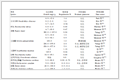
At the outset, 1.0 equiv. of diphenyl disulfide 1a was exposed to alkynol 2a under nitrogen and visible light irradiation in ethyl acetate, to our delight, the expected sultine 3a was obtained in 60% yield (Table 1, entry 1). Encouraged by this preliminary observation, we then conducted a comprehensive examination of the reaction parameters in order to acquire optimal conditions. The influence of different photo catalysts was then evaluated. It was found that 96% yield was obtained when using 2.0 mol% cheap thioxanthone (TXO) as photo catalyst (Table 1, entry 3). And, the loading of photo catalyst could reduce to 0.1 mol%, the yield of 3a still remains high lever for 70%, highlighting the high efficiency of this thiosulfinylation reaction (Table 1, entry 2). Then, other organic solvents such as MeCN, THF, Acetone, toluene and DMF were investigated and only moderate yields were observed (Table 1, entries 4–8). Other metal free- and metal-based photosensitizers (Ruthenium and Iridium) were screened as well and only diminished yields were observed (See Supporting information for more details). Additional assessment of the loading of 1a resulted in the formation of the desired product in a slightly diminished yield (Table 1, entry 9).
|
Table 1 Optimization of the reaction conditions.a |


Having identified the optimal reaction conditions, we first aimed to investigate the comprehensive substrate scope of reactions with different disulfide derivatives and assessed the compatibility with various functional groups.
As summarized in Scheme 1, a wide range of diaryl, dihetro-aryl and dialkyl disulfides with different electronic and steric properties were all compatible to deliver the expected oxathiolene oxides products effciently (3b-3u) in generally moderate to excellent yields. Electron-rich or -withdrawing substituents on the ortho, meta, or para position of diaryl disulfides, such as methyl, methoxy, halogens (F, Cl, Br), ester, cyano and nitro substituents proceeded smoothly in the system, without a distinct electronic or steric effect on the reactivity being observed, and the corresponding products were obtained in 75%−99% yields. Of note, terminal double bond substituted diaryl disulfide 1l was tolerated well to deliver the double bond remained product 3l in 93% yield, highlighting the robustness and selectivity of the current protocol. 3m and 3n both with two electron-deficient groups were isolated in 70% and 53% yields, respectively. Significantly, heteroaromatic disulfides, such as pyridinyl (1o and 1p), furyl (1q), thienyl (1r), benzothiazolyl (1s) and tetrazol (1t) disulfides, were also successfully incorporated in the reaction, furnishing the corresponding thiolated products in moderate to excellent yields, implying the potential application in durg discovery. Moreover, compared previous negative results with alkyl disulfides in radical reactions owing to the lesser stability of alkyl radicals and stronger bond energy of S-S bond in alkyl disulfide, to this reaction, dialkyl sulfide, such as dimethyl disulfide underwent smoothly to form the oxathiolene oxides 3u in 50% yield [37-44].

|
Download:
|
| Scheme 1. Reaction scope of disulfide ethers. Reaction conditions: 1 (1.0 equiv.), 2 (1.0 equiv.), TXO (2.0 mol%), EA (0.05 M), r.t., 12 h, 30 W 450 nm blue LED, N2, in vials; yields are those for the isolated products. a Values of parentheses are isolated yields without TXO. b With [Ir(dF(CF3)ppy2(dtbby))]PF6 as PC. c Asymmetric disulfide was used; see Supporting information for details. | |

Next, we turned our attention to evaluate the generality involving in the alkynol derivatives as radical adduct receptors. As demonstrated in Scheme 2, this protocol tolerated a wide range of functional groups with diverse substitution patterns in alkynols. Electron-rich aromatic substituted alkynols performed well to afford the desired oxathiolene oxides products 4b−4g in 50%−99% yields. Naphthyl substituted alkynol 2h gave the sultine 4h in 99% yield, even 90% yield was achieved when the reaction was conducted without photocatalyst. Electron-withdrawing groups on aromatic ring of alkynols, such as fluorine 2i, chlorine 2j and 2k, bromine 2l and cyano 2m, were compatible in the reaction as well, and leading to the corresponding products in high yields. In addition, sensitive formyl group (2n) and heterocyclic thienyl (2o) containing alkynols were also smoothly incorporated in this photo reaction to form the expected products in 79% and 78% yields, respectively. Notably, we were delighted to find that 2, 3, 4-trisubstituted oxathiolene oxide (4p) was also produced in 82% yield from alkynol (2p), again demonstrating the broad compatibility of the current procedure.

|
Download:
|
| Scheme 2. The scope of alkynols and complex disulfides. Reaction conditions: 1 (1.0 equiv.), 2 (1.0 equiv.), TXO (2.0 mol%), EA (0.05 mol/L), r.t., 30 W 450 nm blue LED, N2, in vials; yields are those for the isolated products. a Values of parentheses are isolated yields without TXO, see Supporting information for details. | |

Of note, one of the critical targets to a synthetic strategy is the usability and performance of late-stage functionalization of complicated scaffolds based on biologically active natural products, pharmaceutical drugs, and functional materials. Expectedly, l-menthol derivative delivered site-selective thiosulfinylation product (5a) in 85% yield. Likewise, complex α, β-unsaturated γ-sultines were obtained in yields ranging from 73% to 93% from substituted disulfides containing biologically active motifs and drug molecules, such as Indometacin (5b), Ciprofibrate (5c), and Oxaprozin (5d), demonstrating the potential of this protocol for pharmaceutical development.
To showcase the potential applications of the developed methodology and the obtained products under various conditions, several product derivatizations were performed (Scheme 3). First, two scale-up experiments were displayed with diphenyl disulfide, which afforded oxathiolene oxides (4l and 4n) in 83% and 82% yields, respectively (Scheme 3a). Then, sulfinyl sultine (6a) and sulfonyl sultone (6b) were obtained in excellent yields through selective oxidation, resulting in the creation of two new types of dichalcogenated molecules (Scheme 3bi). The oxathiolene oxides skeleton could either be retained or cleaved by the addition of Grignard reagent, leading to the formation of a diphenylmethanol derivative (7a) or a tetrasubstituted alkene (7b). Then, aldehyde group of 4n underwent smoothly Wittig olefination, to afford alkene product (7c) in 89% yield. Moreover, sodium borohydride reduction of the obtained 4n provided benzyl alcohol 7d, which was further transformed into complex molecules 8a and 8b by reaction with drug Epalrestat and agricultural chemical Fluralaner N-1 intermediate [45, 46].

|
Download:
|
| Scheme 3. Scale-up reaction and follow-up chemistry. See Supporting information for details. | |

It is known that the structurally-related oxathiolene oxides are promising chemopreventive agents, due to their ability in inducing phase 2 enzymes that involve in the metabolism of xenobiotic procarcinogens. We next explored the preliminary live-cell cytotoxicity of several representative compounds synthesized with variations on R1, R2, or R3. The MTT assay was performed on the breast cancer cell line 4T1 for the evaluation of cytotoxicity. To our delight, as shown in Fig. 2, the compound 3q with a 2-methylfuryl group demonstrated a clear dose-dependent cytotoxicity against the growth of 4T1 cells. 60 µg/mL of 3q inhibited cell growth by more than 70% compared with the control, and the IC50 was calculated to be 52.53 µg/mL [11-14].

|
Download:
|
| Fig. 2. Preliminary evaluation of live-cell cytotoxicity of oxathiolene oxides toward the 4T1 cancer cells. (a) Cell viability at different concentrations of 3q in 4T1 cells. (b) Calculation of IC50. | |

To gain insight into the mechanism of this reaction, a series of mechanistic studies were performed (Scheme 4). First, radical inhibition experiments with 2, 2, 6, 6-tetramethylpiperidin-1-yl)oxyl (TEMPO) or butylated hydroxytoluene (BHT), led to trace amount of the cyclization product 3a and notable amounts of the TEMPO/BHT-trapping adduct 3aa and 3ab from HRMS (Scheme 4a). A cross-coupling product, 1-(4-thienyl)−2-phenyldisulfane, was detected by GC–MS when the reaction between disulfide 1a and 1r was irradiated with blue LED under nitrogen, whereas no reaction occurred in the absence of light (Scheme 4b). Oxathiolene oxide 3a was observed at 50% yield under direct ultraviolet-light irradiation (λmax = 365 nm) and the reaction was completely suppressed by treating with triplet quenchers, which implied that a triple energy excitation process might be involved (Schemes 4c and d). Of note, a possible radical chain should be involved in current reaction supported by both a short-term photo irradiation experiment (Scheme 4e) and the calculated quantum yield (Ф = 9.5). More mechanism studies are deposited in Supporting information.

|
Download:
|
| Scheme 4. Control experiments and proposed mechanism. See Supporting information for details. | |

On the basis of the above observations and literatures, a plausible mechanism is proposed for this photoinduced thiosulfinylation of alkynols (Scheme 4f). Firstly, homolytic cleavage of photo excited disulfide 1a to generate sulfur radical A. Meanwhile, visible light irradiation of TXO to the excited state catalyst TXO*, then the EnT event between the TXO* and (PhS)2 to give excited (PhS)2*, which undergoes homolytic S–S bond fragmentation to form a radical A. The facile addition of sulfur radical A to alkynol leads to the formation of the alkenyl carbon centre radical intermediate B. Subsequently, an intramolecular homolytic substitution at the sulfur atom yields the desired product 3a, along with the formation of the tertiary butyl radical C. This radical propagates the radical chain process through a homolytic substitution with substrate 1a.
In summary, we have demonstrated a practical and modular approach through photoinduced site-selective thiosulfinylation of alkynols for the construction of bioactive oxathiolene oxides derivatives by using commercially available disulfides as radical precursors. It showcases a broad substrate scope and functional group compatibility under metal-free and easy-to-handle conditions. Additionally, the potential applications of the reaction protocol were highlighted through scale-up preparations, late-stage functionalization of complex scaffolds, and various products transformations. Preliminary biological activity testing was evaluated by live-cell cytotoxicity. It is anticipated that this operationally simple method, along with the products obtained and their potential for synthetic diversification, will attract the interest of the synthetic and medicinal chemistry communities. Further investigations with this chemistry and biological activity research are ongoing in our laboratory.
Declaration of competing interestThe authors declare that they have no known competing financial interests or personal relationships that could have appeared to influence the work reported in this paper.
CRediT authorship contribution statementYuanyuan Zhao: Writing – original draft, Methodology. Zhiming Zhu: Writing – original draft, Methodology, Investigation. Liang Li: Methodology, Investigation. Bingyao Shi: Methodology. Ziyang Li: Methodology, Investigation. Yuyang Huang: Methodology. Lijun Jiang: Writing – original draft, Supervision. Chao Shu: Writing – review & editing, Writing – original draft, Supervision, Methodology, Investigation.
AcknowledgmentsWe are grateful for financial support from the National Key R&D Program of China (No. 2023YFD1700500), National Natural Science Foundation of China (No. 22301093), the Fundamental Research Funds for the Central Universities, the Central China Normal University (CCNU) and Knowledge Innovation Program of Wuhan-Shuguang Project.
Supplementary materialsSupplementary material associated with this article can be found, in the online version, at doi:10.1016/j.cclet.2025.110900.
| [1] |
D.C. Dittmer, M.D. Hoey, The Chemistry of Sulfinic Acids, Esters, and Their Derivatives. New York: Wiley, 1990: 239.
|
| [2] |
P. Vogel, M. Turks, L. Bouchez, et al., Acc. Chem. Res. 40 (2007) 931-942. DOI:10.1021/ar700096h |
| [3] |
O.B. Bondarenko, L.G. Saginova, N.V. ZyK, Russ. Chem. Rev. 65 (1996) 147-166. DOI:10.1070/RC1996v065n02ABEH000204 |
| [4] |
L. Yang, Y. Li, C. Shu, Acta Chim. Sin. 82 (2024) 171-183. DOI:10.6023/A23100435 |
| [5] |
Y. Zhang, H. Li, X. Yang, P. Zhou, C. Shu, Chem. Commun. 59 (2023) 6272-6285. DOI:10.1039/d3cc01238g |
| [6] |
J. Yu, X. Jiang, Ad. Agrochem. 2 (2023) 3-14. DOI:10.1016/j.aac.2022.12.003 |
| [7] |
S. Yolka, E. Dunach, M. Loiseau, et al., Flavour Fragr. J. 17 (2002) 425-431. DOI:10.1002/ffj.1120 |
| [8] |
D.W. Roberts, D.L. Williams, Tetrahedron 43 (1987) 1027-1062. DOI:10.1016/S0040-4020(01)90041-9 |
| [9] |
T.W. Kensler, J.D. Groopman, T.R. Sutter, T.J. Curphey, B.D. Roebuck, Chem. Res. Toxicol. 12 (1999) 113-126. DOI:10.1021/tx980185b |
| [10] |
J. Zhang, X. Wang, P. Wang, et al., Sci. China Chem. 67 (2024) 908-913. DOI:10.1007/s11426-023-1814-2 |
| [11] |
D.V. Smil, F.E.S. Souza, A.G. Fallis, Bioorg. Med. Chem. Lett. 15 (2005) 2057-2062. DOI:10.1016/j.bmcl.2005.02.056 |
| [12] |
M.A. Franks, E.A. Schrader, M.E. Welker, Med. Chem. 13 (2005) 2221-2233. |
| [13] |
S. Kumari, A.V. Carmona, A.K. Tiwari, P.C. Trippier, J. Med. Chem. 63 (2020) 12290-12358. DOI:10.1021/acs.jmedchem.0c00530 |
| [14] |
M.E. Welker, S.V. Torti, F.M. Torti, et al., US Patent 6242478, 2001.
|
| [15] |
E. Thoumazeau, B. Jousseaume, F. Tiffon, J.G. Duboudin, Heterocycles 19 (1982) 2247-2250. DOI:10.3987/R-1982-12-2247 |
| [16] |
S. Braverman, Y. Duar, J. Am. Chem. Soc. 105 (1983) 1061-1063. DOI:10.1021/ja00342a073 |
| [17] |
F.W. Von Rein, H.G. Richey Jr, Org. Chem. 20 (1969) 32-35. DOI:10.1016/S0022-328X(00)80078-9 |
| [18] |
J.G. Duboudin, B.J. Jousseaume, Org. Chem. 168 (1979) 233-240. DOI:10.1016/S0022-328X(00)83279-9 |
| [19] |
C.K. Prier, D.A. Rankic, D.W.C. MacMillan, Chem. Rev. 113 (2013) 5322-5363. DOI:10.1021/cr300503r |
| [20] |
A.R. Nathan, D.A. Nicewicz, Chem. Rev. 116 (2016) 10075-10166. DOI:10.1021/acs.chemrev.6b00057 |
| [21] |
G.E.M. Crisenza, P. Melchiorre, Nat. Commun. 11 (2020) 803-806. DOI:10.1038/s41467-019-13887-8 |
| [22] |
R. Cannalire, S. Pelliccia, L. Sancineto, et al., Chem. Soc. Rev. 50 (2021) 766-897. DOI:10.1039/d0cs00493f |
| [23] |
V. Srivastava, P.K. Singh, P.P. Singh, J. Photochem. Photobiol. 50 (2022) 100488. DOI:10.1016/j.jphotochemrev.2022.100488 |
| [24] |
M. Krumb, L.M. Kammer, R. Forster, C. Grundke, T. Opatz, ChemPhotoChem 4 (2020) 101-104. DOI:10.1002/cptc.201900231 |
| [25] |
J. Yang, D. Xie, H. Zhou, et al., Org. Chem. Front. 5 (2018) 1325-1329. DOI:10.1039/c8qo00056e |
| [26] |
C. Wang, Y. Xu, Y. Zhou, et al., Org. Chem. Front. 10 (2023) 4972-5027. DOI:10.1039/d3qo00933e |
| [27] |
C. Shu, A. Noble, V.K. Aggarwal, Nature 586 (2020) 714-719. DOI:10.1038/s41586-020-2831-6 |
| [28] |
C. Shu, R.S. Mega, B.J. Andreassen, A. Noble, V.K. Aggarwal, Angew. Chem. Int. Ed. 57 (2018) 15430-15434. DOI:10.1002/anie.201808598 |
| [29] |
H. Li, Y. Zhang, X. Yang, et al., Angew. Chem. Int. Ed. 62 (2023) e202300159. DOI:10.1002/anie.202300159 |
| [30] |
C. Shu, A. Noble, V.K. Aggarwal, Angew. Chem. Int. Ed. 58 (2019) 3870-3874. DOI:10.1002/anie.201813917 |
| [31] |
M. Liu, X. Ouyang, C. Xuan, C. Shu, Org. Chem. Front. 11 (2024) 895-915. DOI:10.1039/d3qo01929b |
| [32] |
F. Jung, M. Molin, R. Van Den Elzen, T. Durst, J. Am. Chem. Soc. 96 (1974) 935-936. DOI:10.1021/ja00810a059 |
| [33] |
J.L. Charlton, T. Durst, Tetrahedron Lett. 25 (1984) 5287-5290. DOI:10.1016/S0040-4039(01)81585-9 |
| [34] |
R.F. Heldeweg, H. Hogeveen, J. Am. Chem. Soc. 98 (1976) 2341-2342. DOI:10.1021/ja00424a060 |
| [35] |
F. Jung, J. Chem. Soc. Chem. Commun. (1976) 525-526. |
| [36] |
T. Durst, J.D. Finlay, D.J.H. Smith, Chem. Soc., Perkin Trans. 1 (1979) 950-952. |
| [37] |
Q. Shi, P. Li, Y. Zhang, L. Wang, Org. Chem. Front. 4 (2017) 1322-1330. DOI:10.1039/C7QO00152E |
| [38] |
G. Leonel, I. Klann, D.F. Back, et al., Chem. Eur. J. 29 (2023) e202202847. DOI:10.1002/chem.202202847 |
| [39] |
H.W. Du, M.S. Liu, W. Shu, Org. Lett. 24 (2022) 5519-5524. DOI:10.1021/acs.orglett.2c01915 |
| [40] |
Y. Luo, Handbook of Bond Dissociation Energies in Organic Compounds. Boca Raton, FL: CRC Press, 2003.
|
| [41] |
F. Dénès, M. Pichowicz, G. Povie, P. Renaud, Chem. Rev. 114 (2014) 2587-2693. DOI:10.1021/cr400441m |
| [42] |
Y. Shen, H. Zhu, L. Deng, et al., ACS Appl. Mater. Interfaces 16 (2024) 56073-56081. |
| [43] |
H. Zhang, Y. Zhong, L. Yang, et al., Mol. Catal. 564 (2024) 114255. |
| [44] |
H. Zhu, Y. Zhang, G. Ren, et al., Chem. Commun. 59 (2023) 1050-1053. DOI:10.1039/d2cc06107d |
| [45] |
N.J. Beeton, S. Carver, L.K. Forbes, J. Theor. Biol. 462 (2019) 466-474. DOI:10.1016/j.jtbi.2018.11.033 |
| [46] |
Y. Wang, C. Wang, Q. Tian, Y. Li, J. Agric. Food Chem. 72 (2024) 15077-15091. DOI:10.1021/acs.jafc.4c02096 |