 2025, Vol. 36


The photochemistry of electron donor-acceptor (EDA) complexes [1–3] has been recognized as a powerful strategy to generate radical intermediates under mild conditions, providing wider space for synthetic radical chemistry. This strategy is intrinsically different from photoredox catalysis since it does not rely on the use of exogenous photoredox catalysts, thus attracting growing interest. Over the last decade, a wide range of novel synthetic transformations enabled by photoinduced EDA complexes have been developed [4–7]. However, in vast majority of the examples, the EDA complex-mediated synthetic platforms comprises the need for coupling of two stoichiometric electron-donor and acceptor substrates, where both components end up in the core of the products, thus limiting their structural diversity [8–19]. Otherwise, one of the two components serves as sacrificial reagent, which lowers the atom economy [20–26]. Thus, implementing catalytic EDA complex strategy would significantly expand the reaction efficiency and synthetic applicability, yet remain challenging.
Within the catalytic regime, Melchiorre explored an or-ganocatalytic EDA strategy by in situ generation of transient catalytic intermediates acting as electron donors, examples include transiently generated catalytic chiral enamines and enolates as donors for asymmetric photochemical EDA processes [27–29]. Gilmour developed a complementary strategy by exploiting in situ-formed iminium ions, another classical organocatalytic intermediates, as electron acceptors [30]. Nonetheless, these catalytic scenarios require judiciously chosen of catalysts and substrates because the catalytic EDA complex formation (radical generation) is associated with the bond formation event (radical trapping). A more general catalytic regime is to explore external donors or acceptors themselves as catalysts that associate with redox-active substrates to form catalytic EDA complexes, allowing for decoupling of the SET event from the bond-forming event. In 2019, Shang and Fu [31–34] reported a novel catalytic EDA system that explored a combination of triphenylphosphine with sodium iodide as a catalytic donor to facilitate radical alkylation of silyl enol ethers and heteroarenes, thus offering a versatile and robust EDA catalytic platform. Since then, a number of catalytic donors including 3-acetoxyquinuclidine, 2-methoxynaphthalene, dithiocarboxylate anions, and triarylamines have been discovered by Bosque and Bach [35], Stephenson [36], Melchiorre [37], Procter [38] and Li [39,40], among others [41–45]. Alternatively, a complementary approach for catalytic EDA complex photosynthesis is the identification of acceptors to trigger the EDA complex formation [46–49]. This decoupled strategy provides fresh opportunities to expand the synthetic diversity of catalytic EDA complex photochemistry. While recent advance showcase the expansion of the catalytic donor or acceptor toolbox, there still exist challenges in catalytic EDA design as the key step for catalyst turnover heavily relies on an efficient SET with the reaction intermediates, which causes the difficulties in broadening the substrate and reaction generality (Scheme 1a).

|
Download:
|
| Scheme 1. (a) Classical catalytic EDA complexes. (b) The concept of incorporated catalytic EDA with transition metal catalysis. (c) Previous work on photoreodox/Cu dual-catalyzed carbocyanation of alkenes. (d) This study: developing dual EDA/Cu catalytic platform for asymmetric carbocyanation. | |

Recently, the incorporation of transition metal catalysis into photoredox catalysis offers fresh opportunities to develop various previously inaccessible radical-based cross-coupling reactions [50]. According to this concept of synergistic catalysis, one can imagine if combining EDA catalysis with metal catalysis will emerge a new catalytic EDA paradigm, in which the D/A catalyst turnover can be realized through SET reduction of the donor radical cation or SET oxidation of the acceptor radical anion by transition metal intermediates. The radicals generated from the progenitor EDA complex will fall into the metal-catalyzed radical coupling processes. This dual catalytic protocol renders the catalyst turnover more flexible and effective as the critical SET step for catalyst turnover is decoupled from substrate functionalization. Recent studies have demonstrated the feasibility of this dual catalytic approach. Guan [51] and our group [52] developed the synergy of EDA donor catalysis and Cu catalysis for radical C‒O, C‒N, and C‒CN bond formation reactions, in which the catalytic amounts of iodide salts were used as donor catalysts (Scheme 1b). Meanwhile, Melchiorre demonstrated a successful combination of EDA acceptor catalyst with cobaloxime catalyst for Heck-type coupling [46].
Cu-catalyzed radical cyanation has emerged as a popular strategy to synthesize organic nitriles under mild conditions [53–55]. Inspired by seminal works from Liu's group in Cu-catalyzed cyanotrifluoromethylation [56–58], researchers have further implemented photoredox/Cu dual catalytic system for radical carbocyanation of alkenes with a wide range of easily accessible radical precursors including N-hydroxyphthalimide esters (NHPI esters), redox-active oximes, N-pyridinium salts and so on [59–72]. Among them, radical decarboxylative cyanation of NHPI esters derived from carboxylic acids evoked particularly interests due to the inexpensive and abundant nature of carboxylic acid feedstocks. For instance, Han reported an enantioselective radical cyanoalkylation of styrenes by merging photoredox and copper catalysis using NHPI esters as alkylation reagents [73]. Xiao reported a photoredox/Cu-catalyzed enantioselective radical carbocyanation of 1,3-dienes to afford chiral allylic nitriles [74]. Walsh and Yang developed a chemo- and regioselective carbocyanation of 2-azadienes for the synthesis of α-amino nitriles through dual photoredox/copper catalysis [75]. Despite significant advance, the necessity of precious polypyridyl iridium complexes or synthetically elaborate organic dyes impede the further synthetic application of the radical decarboxylative cyanation (Scheme 1c). Taking advantages of catalytic EDA complex chemistry, we aim to further generalize this synthetic protocol to intermolecular carbocyanation of alkenes with increased applicability of the reaction by removing photocatalysts. Herein, we report a highly chemo-, regio-, and stereoselective radical carbocyanation of styrenes by merging donor catalysis and chiral copper catalysis. The catalytic electron-donor iodide salts participate the EDA complex formation to trigger the decarboxylative radical generation process, meanwhile serving as an electron shuttle catalyst to transfer electrons from Cu to NHPI esters. This dual EDA/Cu catalytic system expands the synthetic potential of catalytic EDA complex chemistry and provides an alternative pathway for asymmetric radical cyanation (Scheme 1d)
We selected NHPI ester 1a, alkene 2a, and TMSCN as model substrates to test the feasibility, when adding 20 mol% of NaI/PCy3 as donor catalyst, 10 mol% of CuBr/L1 as chiral copper catalyst, the enantioselective three-component carbocyanation reaction proceeded smoothly under blue LED irradiation, affording desired chiral alkylnitrile 3 in 40% yield with 80% ee (Table 1, entry 1). Variation in chiral ligands resulted in substantially decreased reactivity and enantioselectivity (entries 2–4). As a consequence, we chose L1 as an optimal chiral ligand to examine other parameters. Of note, the metal/ligand ratio has an unneglectable influence on the enantiocontrol. Increasing the molar ratio of Cu/L to 20/12 could improve the ee up to 90% (entry 5). A variety of copper salts with different counter anions were then screened, most of them provided high enantioselectivities (> 90% ee) but with low yields (entries 6–8). Cu(MeCN)4BF4 led to a slightly enhanced yield with a comparable ee (entry 9). Further efforts were devoted to improve the yield. Adjusting the molar ratio of each component to 2:1:2 further improved the yield to 45% (entry 10). Solvents have no obvious effect on the reactivity and the mixed solvent system was eventually not necessary (entry 11). Finally, a series of monodentate and bidentate phosphines were screened and the dcype gave an increased yield to 72% (entry 13).
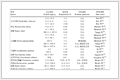
|
Table 1 Condition optimization.a |
Having established the optimal reaction conditions for this enantioselective radical relay process, we began to investigate the scope generality of the radical precursors (Scheme 2). A variety of bench-stable NHPI esters derived from readily available linear and cyclic alkylcarboxylic acids were all effective in this reaction, producing the corresponding chiral cyanide products in moderate to good yields and high enantioselectivities (3–17). A series of functional groups, such as halides, alkenes, alkynes, were well tolerated (14–17). In particular, alkyl NHPI ester bearing an alkyl bromide group reacted in exclusive site-selectivity with alkyl bromide untouched (15). The three-component radical transformation was not only compatible with tertiary and secondary alkyl radicals, but also tolerated more challenging primary alkyl radicals. It should be mentioned that this reaction showed broader scope of radical patterns and higher levels of enantiocontrols (> 90%). Next, the scope generality of alkenes was explored. Styrene reacted with high yield and high ee (18). Arenes bearing para substituents such as methyl (19), tert-butyl (22), and F (24), Cl (25), Br (26) functional groups proceeded smoothly with high enantioselectivity. Especially, the substrate bearing a para tert-butyl gave an excellent enantioselectivity (up to 98% ee). The enantiocontrol was sensitive to the steric hindrance as meta-methyl substituted styrene provided a comparable yield and a slightly higher ee (20), while steric hindered ortho-substituted variant gave a decreased ee (21). Besides, 2-vinylnaphthalene was also suitable substrate, which reacted smoothly with very high yield and good enantiomeric excess (23).

|
Download:
|
| Scheme 2. Scope of the asymmetric radical carbocyanation. All reactions were carried out with 1 (0.40 mmol), 2 (0.20 mmol) and TMSCN (0.40 mmol) based on the optimized reaction conditions shown in Table 1, entry 13. Isolated yields were provided. The ee values were determined by chiral HPLC analysis. a S-Phos instead of dcype. | |

To understand the mechanism, several control experiments were conducted (Scheme 3). First, radical probe experiments were performed. The reaction was completely inhibited when adding radical scavenger TEMPO and the TEMPO-trapped adducts were detected by HRMS (Scheme 3a). Moreover, when adding BHT as radical scavenger, we could also isolate BHT-trapped adduct 27 in 52% yield (Scheme 3b). Both results provided evidence of radical pathway and the alkyl radicals originated from NHPI esters triggers the carbocyanation process. The radical cyanation of substrate 1l did not afford the ring-closed products, indicating the radical-organometallic cross-over perhaps be faster than the ring-closing step (Scheme 3c). The nonlinear effect experiment showed a linear relationship of the ee value of the product with the ee value of the ligand, suggesting the involvement of one single chiral ligand and one copper species in the enantio-determining step (Fig. 1a). To provide evidence for the formation of EDA complex between NHPI ester and NaI/dcype, UV–vis absorption spectroscopy measurements were performed. When mixing NHPI eater 1a and NaI/dcype in DMAc, an obvious red shift of the mixed components was observed in UV–vis absorption spectrum (Fig. 1b). This indicated the formation of EDA complex by assembly of NaI/dcype and NHPI ester. Besides, when running the reaction of NHPI ester with 1,1-diphenylethylene in the presence of 1.0 equiv. of NaI/dcype while removing Cu/L catalyst, the radical Heck-type reaction proceeded smoothly to afford 28 in 69% yield (Scheme 3d). All these together indicated that the intramolecular SET of the resulting EDA complex occurs to generate alkyl radicals.

|
Download:
|
| Scheme 3. Control experiments. | |


|
Download:
|
| Fig. 1. Mechanistic studies. | |

Of note, without NaI/dcype, the reaction could still work but with very low efficiency (17% yield). While omitting NaI and chiral Box ligand, only Cu/phosphine cannot promote the reaction (entry 8, Table S8 in Supporting information for details). These results suggested that the Cu/Box combination might serve as a photoactive complex to reduce NHPI ester to generate radical species. According to Fu's [76] and our previous work [52], photoexcitation of Cu(I) salt, bipyridyl ligand, and Xantphos, could trigger an SET from the excited Cu(I) complex to the NHPI ester to get radical species, which means the excited state of Cu* complex can act as a photocatalyst to reduce NHPI ester.
To verify this possibility, the fluorescence quenching experiments were conducted and the results showed that the mixture of Cu and nitrogen ligand in DMAc exhibited an obvious absorption in the UV–vis region (400~500 nm), and the resulting emission of the photoexcited Cu(L1)* complex can be quenched by the addition of the NHPI ester, while no emission quenching observed when adding NHPI ester to the photoexcited Cu/S-Phos complex (Fig. 1c). This result indicated that the Cu/L1 complex might be a photoactive species, which absorbs visible light to reach its excited state and facilitates the electron transfer from the excited Cu(L1)* complex to the NHPI ester. Due to this reason, a little access amount of Cu is added to offset this partial consumption, thus ensuring the high reactivity and stereoselectivity.
Based on the above mechanistic studies and literature reports [31–34,52], a plausible catalytic cycle was depicted (Scheme 4): Photoexcitation of the EDA complex by assembly of NaI, R3P, and NHPI ester triggers an SET event to get an alkyl radical and R3P-I• intermediate. The alkyl radical undergoes radical addition to styrene to give a more stable benzyl radical, which falls into copper-catalysed radical coupling process. In the copper catalytic cycle, a facile SET between CuⅠ(CN)L* and R3P-I• affords CuⅡ(CN)L* and regenerates NaI-PR3. The resulting CuⅡ species undergoes ligand exchange and radical recombination affords CuⅢ complex, reductive elimination of the resulting CuⅢ produces the final product and regenerates CuⅠ to close the copper catalytic cycle.

|
Download:
|
| Scheme 4. Proposed mechanism. | |

In conclusion, we have developed a novel decarboxylative carbocyanation reaction of alkenes by merging catalytic electron donor-acceptor (EDA) complex with copper catalysis. The reaction shows a broad scope of alkyl radical precursors. A series of primary, secondary, and tertiary alkyl radicals were tolerated to engage the asymmetric decarboxylative cyanation with good regio- and stereoselectivity. This dual EDA/Cu catalytic platform enables to obviate the need of photocatalyst for decarboxylative radical cyanation, thus providing new space for broad synthetic application of catalytic EDA complex photochemistry.
Declaration of competing interestThe authors declare that they have no known competing financial interests or personal relationships that could have appeared to influence the work reported in this paper.
CRediT authorship contribution statementHongping Zhao: Data curation. Weiming Yuan: Writing – original draft, Conceptualization.
AcknowledgmentWe are grateful to the National Natural Science Foundation of China (No. 22201087) for the financial support.
Supplementary materialsSupplementary material associated with this article can be found, in the online version, at doi:10.1016/j.cclet.2025.110894.
| [1] |
R.S. Mulliken, J. Am. Chem. Soc. 72 (1950) 600-608. DOI:10.1021/ja01157a151 |
| [2] |
R. Foster, J. Phys. Chem. 84 (1980) 2135-2141. DOI:10.1021/j100454a006 |
| [3] |
S.V. Rosokha, J.K. Kochi, Acc. Chem. Res. 41 (2008) 641-653. DOI:10.1021/ar700256a |
| [4] |
C.G.S. Lima, T. de M. Lima, M. Duarte, I.D. Jurberg, M.W. Paixão, ACS Catal. 6 (2016) 1389-1407. DOI:10.1021/acscatal.5b02386 |
| [5] |
G.E.M. Crisenza, D. Mazzarella, P. Melchiorre, J. Am. Chem. Soc. 142 (2020) 5461-5476. DOI:10.1021/jacs.0c01416 |
| [6] |
L. Zheng, L. Cai, K. Tao, et al., Asian J. Org. Chem. 10 (2021) 711-748. DOI:10.1002/ajoc.202100009 |
| [7] |
A.K. Wortman, C.R.J. Stephenson, Chem 9 (2023) 2390-2415. DOI:10.1016/j.chempr.2023.06.013 |
| [8] |
M. Tobisu, T. Furukawa, N. Chatani, Chem. Lett. 42 (2013) 1203-1205. DOI:10.1246/cl.130547 |
| [9] |
S.R. Kandukuri, A. Bahamonde, I. Chatterjee, et al., Angew. Chem. Int. Ed. 54 (2015) 1485-1489. DOI:10.1002/anie.201409529 |
| [10] |
B. Liu, C.H. Lim, G.M. Miyake, J. Am. Chem. Soc. 139 (2017) 13616-13619. DOI:10.1021/jacs.7b07390 |
| [11] |
S. Xie, D. Li, H. Huang, F. Zhang, Y. Chen, J. Am. Chem. Soc. 141 (2019) 16237-16242. DOI:10.1021/jacs.9b09099 |
| [12] |
M. Lübbesmeyer, E.G. Mackay, M.A.R. Raycroft, et al., J. Am. Chem. Soc. 142 (2020) 2609-2616. DOI:10.1021/jacs.9b12343 |
| [13] |
J. Wu, L. He, A. Noble, V.K. Aggarwal, J. Am. Chem. Soc. 140 (2018) 10700-10704. DOI:10.1021/jacs.8b07103 |
| [14] |
I. Kim, S. Park, S. Hong, Org. Lett. 22 (2020) 8730-8734. DOI:10.1021/acs.orglett.0c03347 |
| [15] |
Q. Guo, M. Wang, H. Liu, R. Wang, Z. Xu, Angew. Chem. Int. Ed. 57 (2018) 4747-4751. DOI:10.1002/anie.201800767 |
| [16] |
Q. Xia, Y. Li, L. Cheng, et al., Org. Lett. 22 (2020) 9638-9643. DOI:10.1021/acs.orglett.0c03703 |
| [17] |
L. Marzo, S. Wang, B. König, Org. Lett. 19 (2017) 5976-5979. DOI:10.1021/acs.orglett.7b03001 |
| [18] |
H.H. Zhang, S. Yu, Org. Lett. 21 (2019) 3711-3715. DOI:10.1021/acs.orglett.9b01169 |
| [19] |
Z. Chen, S. Zheng, Z. Wang, Z. Liao, W. Yuan, ChemPhotoChem 5 (2021) 906-910. DOI:10.1002/cptc.202100133 |
| [20] |
J. Zhang, Y. Li, R. Xu, Y. Chen, Angew. Chem. Int. Ed. 56 (2017) 12619-12623. DOI:10.1002/anie.201707171 |
| [21] |
J. Sun, Y. He, X.D. An, et al., Org. Chem. Front. 5 (2018) 977-981. DOI:10.1039/c7qo00992e |
| [22] |
X. Sun, W. Wang, Y. Li, J. Ma, S. Yu, Org. Lett. 18 (2016) 4638-4641. DOI:10.1021/acs.orglett.6b02271 |
| [23] |
J. Davies, S.G. Booth, S. Essafi, R.A.W. Dryfe, D. Leonori, Angew. Chem. Int. Ed. 54 (2015) 14017-14021. DOI:10.1002/anie.201507641 |
| [24] |
Y. Liu, X.L. Chen, K. Sun, et al., Org. Lett. 21 (2019) 4019-4024. DOI:10.1021/acs.orglett.9b01175 |
| [25] |
Y. Cheng, S. Yu, Org. Lett. 18 (2016) 2962-2965. DOI:10.1021/acs.orglett.6b01301 |
| [26] |
J. Wu, P.S. Grant, X. Li, A. Noble, V.K. Aggarwal, Angew. Chem. Int. Ed. 58 (2019) 5697-5701. DOI:10.1002/anie.201814452 |
| [27] |
E. Arceo, I.D. Jurberg, A. Álvarez-Fernández, P. Melchiorre, Nat. Chem. 5 (2013) 750-756. DOI:10.1038/nchem.1727 |
| [28] |
Ł. Woźniak, J.J. Murphy, P. Melchiorre, J. Am. Chem. Soc. 137 (2015) 5678-5681. DOI:10.1021/jacs.5b03243 |
| [29] |
A. Bahamonde, P. Melchiorre, J. Am. Chem. Soc. 138 (2016) 8019-8030. DOI:10.1021/jacs.6b04871 |
| [30] |
T. Morack, C. Mück-Lichtenfeld, R. Gilmour, Angew. Chem. Int. Ed. 58 (2019) 1208-1212. DOI:10.1002/anie.201809601 |
| [31] |
M.C. Fu, R. Shang, B. Zhao, B. Wang, Y. Fu, Science 363 (2019) 1429-1434. DOI:10.1126/science.aav3200 |
| [32] |
Y.T. Wang, M.C. Fu, B. Zhao, R. Shang, Y. Fu, Chem. Commun. 56 (2020) 2495-2498. DOI:10.1039/c9cc09654j |
| [33] |
C. Liu, N. Shen, R. Shang, Org. Chem. Front. 8 (2021) 4166-4170. DOI:10.1039/d1qo00648g |
| [34] |
G.Z. Wang, M.C. Fu, B. Zhao, R. Shang, Sci. China Chem. 64 (2021) 439-444. DOI:10.1007/s11426-020-9905-1 |
| [35] |
I. Bosque, T. Bach, ACS Catal. 9 (2019) 9103-9109. DOI:10.1021/acscatal.9b01039 |
| [36] |
E.J. McClain, T.M. Monos, M. Mori, J.W. Beatty, C.R.J. Stephenson, ACS Catal. 10 (2020) 12636-12641. DOI:10.1021/acscatal.0c03837 |
| [37] |
E. de Pedro Beato, D. Spinnato, W. Zhou, P. Melchiorre, J. Am. Chem. Soc. 143 (2021) 12304-12314. DOI:10.1021/jacs.1c05607 |
| [38] |
A. Dewanji, L. van Dalsen, J.A. Rossi-Ashton, et al., Nat. Chem. 15 (2023) 43-52. DOI:10.1038/s41557-022-01092-y |
| [39] |
D.J. Castillo-Pazos, J.D. Lasso, E. Hamzehpoor, et al., Chem. Sci. 14 (2023) 3470-3481. DOI:10.1039/d2sc07078b |
| [40] |
J.D. Lasso, D.J. Castillo-Pazos, J.M. Salgado, et al., J. Am. Chem. Soc. 146 (2024) 2583-2592. DOI:10.1021/jacs.3c11225 |
| [41] |
T. Tasnim, C. Ryan, M.L. Christensen, C.J. Fennell, S.P. Pitre, Org. Lett. 24 (2022) 446-450. DOI:10.1021/acs.orglett.1c04139 |
| [42] |
H. Li, X. Tang, J.H. Pang, et al., J. Am. Chem. Soc. 143 (2021) 481-487. DOI:10.1021/jacs.0c11968 |
| [43] |
S. Wang, H. Wang, B. König, J. Am. Chem. Soc. 143 (2021) 15530-15537. DOI:10.1021/jacs.1c07785 |
| [44] |
E.Le Saux, M. Zanini, P. Melchiorre, J. Am. Chem. Soc. 144 (2022) 1113-1118. DOI:10.1021/jacs.1c11712 |
| [45] |
V. Quint, F. Morlet-Savary, J.F. Lohier, et al., J. Am. Chem. Soc. 138 (2016) 7436-7441. DOI:10.1021/jacs.6b04069 |
| [46] |
W. Zhou, S. Wu, P. Melchiorre, J. Am. Chem. Soc. 144 (2022) 8914-8919. DOI:10.1021/jacs.2c03546 |
| [47] |
Y. Aramaki, N. Imaizumi, M. Hotta, J. Kumagai, T. Ooi, Chem. Sci. 11 (2020) 4305-4311. DOI:10.1039/d0sc01159b |
| [48] |
W. Yuan, J. Huang, X. Xu, L. Wang, X.Y. Tang, Org. Lett. 23 (2021) 7139-7143. DOI:10.1021/acs.orglett.1c02553 |
| [49] |
A. Runemark, H. Sundén, J. Org. Chem. 87 (2022) 1457-1469. DOI:10.1021/acs.joc.1c02776 |
| [50] |
A.Y. Chan, I.B. Perry, N.B. Bissonnette, et al., Chem. Rev. 122 (2022) 1485-1542. DOI:10.1021/acs.chemrev.1c00383 |
| [51] |
R.H. Li, Y.L. Zhao, Q.K. Shang, et al., ACS Catal. 11 (2021) 6633-6642. DOI:10.1021/acscatal.1c01222 |
| [52] |
H. Zhao, X. Xi, T. Wu, et al., Sci. China Chem. 67 (2024) 3019-3028. DOI:10.1007/s11426-024-2123-0 |
| [53] |
F. Wang, P. Chen, G. Liu, Nat. Synth. 1 (2022) 107-116. DOI:10.1038/s44160-021-00016-x |
| [54] |
F. Wang, P. Chen, G. Liu, Acc. Chem. Res. 51 (2018) 2036-2046. DOI:10.1021/acs.accounts.8b00265 |
| [55] |
D. Liang, W. Xiao, S. Lakhdar, J. Chen, Green Synth. Catal. 3 (2022) 212-218. |
| [56] |
F. Wang, D. Wang, X. Wan, et al., J. Am. Chem. Soc. 138 (2016) 15547-15550. DOI:10.1021/jacs.6b10468 |
| [57] |
F. Wang, D. Wang, Y. Zhou, et al., Angew. Chem. Int. Ed. 57 (2018) 7140-7145. DOI:10.1002/anie.201803668 |
| [58] |
G. Zhang, S. Zhou, L. Fu, et al., Angew. Chem. Int. Ed. 59 (2020) 20439-20444. DOI:10.1002/anie.202008338 |
| [59] |
D. Wang, N. Zhu, P. Chen, Z. Lin, G. Liu, J. Am. Chem. Soc. 139 (2017) 15632-15635. DOI:10.1021/jacs.7b09802 |
| [60] |
P.Z. Wang, Y. Gao, J. Chen, et al., Nat. Commun. 12 (2021) 1815-1824. DOI:10.1038/s41467-021-22127-x |
| [61] |
F.D. Lu, D. Liu, L. Zhu, et al., J. Am. Chem. Soc. 141 (2019) 6167-6172. DOI:10.1021/jacs.9b02338 |
| [62] |
Y. Deng, R. Lu, P. Chen, G. Liu, Chem. Commun. 59 (2023) 4656-4659. DOI:10.1039/d3cc00410d |
| [63] |
J. Chen, P.Z. Wang, B. Lu, et al., Org. Lett. 21 (2019) 9763-9768. DOI:10.1021/acs.orglett.9b03970 |
| [64] |
H.W. Chen, F.D. Lu, Y. Cheng, et al., Chin. J. Chem. 38 (2020) 1671-1675. DOI:10.1002/cjoc.202000309 |
| [65] |
X. Bao, Q. Wang, J. Zhu, Angew. Chem. Int. Ed. 58 (2019) 2139-2143. DOI:10.1002/anie.201813356 |
| [66] |
H. Chen, W. Jin, S. Yu, Org. Lett. 22 (2020) 5910-5914. DOI:10.1021/acs.orglett.0c02008 |
| [67] |
T. Wang, Y.N. Wang, R. Wang, et al., Nat. Commun. 10 (2019) 5373-5381. DOI:10.1038/s41467-019-13369-x |
| [68] |
Z. Zhang, D.T. Ngo, D.A. Nagib, ACS Catal. 11 (2021) 3473-3477. DOI:10.1021/acscatal.1c00404 |
| [69] |
M. Zheng, K. Gao, H. Qin, G. Li, H. Lu, Angew. Chem. Int. Ed. 60 (2021) 22892-22899. DOI:10.1002/anie.202108617 |
| [70] |
D. Forster, W. Guo, Q. Wang, J. Zhu, ACS Catal. 13 (2023) 7523-7528. DOI:10.1021/acscatal.3c01782 |
| [71] |
S. Qian, T.M. Lazarus, D.A. Nicewicz, J. Am. Chem. Soc. 145 (2023) 18247-18252. DOI:10.1021/jacs.3c06936 |
| [72] |
B. Zhang, T.T. Li, Z.C. Mao, et al., J. Am. Chem. Soc. 146 (2024) 1410-1422. DOI:10.1021/jacs.3c10439 |
| [73] |
W. Shang, L. Deng, S. Ni, et al., ACS Catal. 8 (2018) 7489-7494. DOI:10.1021/acscatal.8b01863 |
| [74] |
F.D. Lu, L.Q. Lu, G.F. He, et al., J. Am. Chem. Soc. 143 (2021) 4168-4173. DOI:10.1021/jacs.1c01260 |
| [75] |
S. Duan, Y. Du, L. Wang, et al., Angew. Chem. Int. Ed. 62 (2023) e202300605. DOI:10.1002/anie.202300605 |
| [76] |
W. Zhao, R.P. Wurz, J.C. Peters, G.C. Fu, J. Am. Chem. Soc. 139 (2017) 12153-12156. DOI:10.1021/jacs.7b07546 |